






Abstract
Humans are commonly motivated towards cooperation and prosociality. In this study, we examined this motivational predisposition in autistic individuals. Using an adaptation of the Cyberball paradigm, we investigated subsequent pro-social behaviour after witnessing social exclusion. Participants witnessed and played a series of Cyberball games, rated their affective state and valued emotional faces with respect to their approachability. Results showed that participants from both groups were aware of the social exclusion. However, while neurotypically developing participants engaged in pro-social behaviour in reaction to the exclusion, autistic participants showed less alterations, in terms of either behaviour or affective state. The current findings suggest a distinct motivational drive and processing of social reward stimuli in autism, which may result in behavioural responses divergent from typical development when engaging in the social world.
Keywords
Human beings are commonly cooperative (Tomasello, 2014). Intrinsic motivation to cooperate is thought to be a key component of the social structure which enabled the development of various socio-cognitive competences (Burkart et al., 2014). These forms of cooperation find their roots in a motivational tendency for the welfare of others, that is, in a motivational tendency towards prosociality (Burkart, Hrdy, & Van Schaik, 2009), which humans find rewarding overall. Cooperative ways of living create bonds, and with it, a sense of belongingness (Baumeister & Leary, 1995). Although this implies the profound relevance of membership in social groups, this tendency towards sociality is inherently risky. Ostracism, or being ignored and excluded (Williams, 2001, 2009), involves the dissolution of social connections and threatens that sense of belongingness. Social cohesion and the need to belong are thought to be fundamental motivations underlying evolutionary pressures that favoured sociality and cooperation (Spoor & Williams, 2007), but that also shaped an alleged ostracism-detection system, which activates a pain signal to warn the threat of social segregation (Williams & Zadro, 2005). Within an evolutionary framework, social exclusion may serve as a twofold function: as form of social control legitimizing punitive actions against deviance and as a strategy fostering group cohesiveness (Williams, 2001). Thus, being skilled at detecting social exclusion cues clearly represents an adaptive advantage for maintaining the success of the individual and of the group (Spoor & Williams, 2007; Williams, 2007b).
Response to social exclusion has been operationalized in neurotypically developing (TD) individuals using the ‘Cyberball’ (Williams, Cheung, & Choi, 2000; see also Williams, 2007b, for a review), an ecological ball-tossing game where the participant plays with two (or more) other participants (virtual pre-programmed players), and in which one of them is going to be excluded. Although numerous studies have used Cyberball to investigate the effects of self-experienced ostracism, fewer have focused on how individuals respond when they witness someone else being socially excluded. Yet, vicarious ostracism is just as frequent as experiencing it, and both events can trigger similar levels of distress (Güroğlu, Will, & Klapwijk, 2013; Masten, Eisenberger, Pfeifer, & Dapretto, 2010; Masten, Morelli, & Eisenberger, 2011; Riem, Bakermans-Kranenburg, Huffmeijer, Van, & IJzendoorn, 2013; Wesselmann, Bagg, & Williams, 2009; Will, Crone, Van den Bos, & Güroğlu, 2013). Studies using the Cyberball have shown that after witnessing social exclusion, participants engage in pro-social behaviour by throwing more balls to the ostracized player (Howard, Landau, & Pryor, 2014; Masten et al., 2010; Riem et al., 2013), a response congruent with the perceived pain of another (Batson, Early, & Salvarani, 1997). Moreover, this response seems to be amplified when bystanders take the excluded person’s perspective (e.g. Wesselmann et al., 2009). In line with this, increased activation in brain regions involved in the processing of social pain while observing social exclusion has also been associated with increased pro-social concern towards the ostracized player, both in adults (Masten, Morelli, & Eisenberger, 2011) and in adolescents (Masten et al., 2010). However, an inhibition of pro-social behaviour and a tendency for displaying exclusive behaviours towards the excluder players have also been reported (Will et al., 2013). Thus, when individuals witness someone else being ostracized, distinct patterns of behavioural responses can be observed: individuals can be driven by inclusionary, pro-social motives regarding the excluded person (by throwing them the ball more often), they can be moved by exclusionary motives regarding the excluder player or they can act as passive bystanders and ultimately disregard the excluded person (e.g. Wesselmann, Ren, & Williams, 2015; Williams, 2007b). In either case, witnessing ostracism appears to attune individuals’ orienting towards social cues that may assist them in a social context in which they may be involved later on.
For autistic individuals, social situations of ostracism as those described above can be even more challenging than for TDs, as they are faced with complex social rules that develop within social interactions (e.g. Landa & Goldberg, 2005). Differences in social cognition (e.g. Callenmark, Kjellin, Rönnqvist, & Bölte, 2014), but also in reasoning style (e.g. Brosnan, Ashwin, & Lewton, 2017; Brosnan, Lewton, & Ashwin, 2016), have been reported in autism spectrum disorder (ASD; American Psychiatric Association (APA), 2013). These differences are thought to be primarily implicit in nature (e.g. Callenmark et al., 2014; Klin, Jones, Schultz, & Volkmar, 2003). Reasoning and decision making are essential skills while navigating in a social context. It has been suggested that the reasoning style of autistic people is more characterized by a reflexive or deductive reasoning, in contrast to an intuitive or automatic reasoning style (Brosnan et al., 2017). This is consistent with self-report difficulties in rapid decision making (Luke, Clare, Ring, Redley, & Watson, 2012), and in decision processes requiring a more intuitive type of reasoning and spontaneous adaptation, such as those involving a reciprocal interaction or a changing in routine (Klin & Volkmar, 1997; Luke et al., 2012). Social adaptive responses depend on the processing of the current value of stimuli, and studies have shown that autistic people do not exhibit the same processing bias towards those social stimuli, nor spontaneous pro-social behaviour more generally, compared to TD counterparts (e.g. Brosnan et al., 2016; Dawson, Bernier, & Ring, 2012; Silva, Da Fonseca, Esteves & Deruelle, 2015, 2017). People on the autism spectrum seem to find social situations less pleasing (Chevallier, Kohls, Troiani, Brodkin, & Schultz, 2012; Ruta et al., 2017) and to manifest less interest for collaborative activities (Liebal, Colombi, Rogers, Warneken, & Tomasello, 2008). Relatedly, it has been suggested that the process of acquisition of inherent social cognition skills is atypical in ASD, resulting in differences in the processing of rewarding stimuli, which may ultimately result in differences when responding to such stimuli (e.g. Chevallier et al., 2012; Grelotti et al., 2005; Klin et al., 2003; Supekar et al., 2018). That is, differences in the sensitivity to the reward value of a stimulus can impact the decision to act in a certain manner in a social context.
Interestingly, a recent imaging study showed significant differences in both structural and functional mesolimbic reward pathway in response to social stimuli in autistic children (as measured by parents’ reports on the Autism Diagnostic Interview–Revised (ADI-R); Rutter, Le Couteur, & Lord, 2003; Supekar et al., 2018). These findings, replicated across two independent cohorts, provide a neurobiological link with these motivational differences towards rewarding stimuli in ASD (Supekar et al., 2018). Consistent with this, a review and meta-analysis reported neural differences in the processing of both social and non-social rewards in autistic individuals (Clements et al., 2018). This review additionally suggests that this difference in reward processing may also underlie increased motivation towards restricted interests, leading to a broader view of more general motivation differences in ASD (Clements et al., 2018). Taken together, these findings suggest that differences in reward processing may be associated with a weakened drive towards social stimuli in autistic individuals (e.g. Clements et al., 2018; Kohls, Chevallier, Troiani, & Schultz, 2012; Supekar et al., 2018). Although desire for sociality exists in autism (e.g. Silva et al., 2015; Volkmar & Klin, 1995), interpreting complex social interactions and others’ intentions hamper motivation and generate insecurity (e.g. Baron-Cohen, Wheelwright, Hill, Raste & Plumb, 2001). Furthermore, autistic individuals are at risk of higher rates of victimization (e.g. Little, 2001), experiencing greater levels bullying from peers (Van Roekel, Scholte, & Didden, 2010) than their TD counterparts, suggesting that they may be more vulnerable to adverse effects of social exclusion.
Surprisingly, while some studies have explored how responses of autistic people to self-exclusion differ to those of TD peers, none has investigated their responses to vicarious ostracism. Studies using Cyberball have shown that autistic participants recognize the obstruction of another player and subsequently engage in pro-social behaviour towards (re-)inclusion (Sebastian, Blakemore, & Charman, 2009), as measured by comparable self-reported exclusion-related distress (McPartland et al., 2011). However, brain responses to exclusion differ, as revealed by imaging studies (Bolling et al., 2011; Masten, Colich, et al., 2011) reporting hypo-activations in brain regions associated with the pain of social exclusion in the autistic group, compared to the TD group. Bolling and colleagues (2011) additionally reported a hyper-activation on the brain network associated with social exclusion during a non-social condition (violation of a shape-matching rule), but not during the social exclusion condition in the autistic group. Consistent with this, electrophysiological findings show that, compared to their TD peers, autistic children show significant differences in the engagement of attentional resources to decipher social cues, suggesting difficulties discriminating a social exclusion context (McPartland et al., 2011). Interestingly, adapted social affect and behaviour following exclusion in Cyberball were found to be enhanced by oxytocin inhalation (i.e. increased preference and trust for socially cooperative players compared to exclusive players; Andari et al., 2010; Andari, Richard, Leboyer, & Sirigu, 2016). Together, these studies suggest that, despite possible distinct neurobiological underpinnings, autistic individuals are, at an explicit level, aware of the pain of being excluded. It remains however unknown, whether they will recognize the pain felt by an ostracized player and whether they will engage in pro-social or inclusive behaviours.
This study aimed at investigating motivational disposition towards prosociality following vicarious ostracism in ASD versus TD. To investigate how the experience of witnessing social exclusion affects the behavioural responses of autistic adolescents, we used an adapted version of the Cyberball. In this paradigm, participants witnessed two social exclusion episodes and then had the opportunity to act prosocially towards the excluded player (see Figure 1 for an overview of the procedure). Specifically, we assessed whether participants would engage in pro-social behaviour towards the ostracized player, and whether those actions reflected an index of a pro-social, altruistic behaviour, or whether they were instead followed by exclusive behaviours towards the excluder player. We thus focus on a two-level analysis: whether participants perceived the social situation (explicit level) and whether and how they reacted (implicit level). Explicit aspects of social cognition are assumed to be largely intact in ASD (Callenmark et al., 2014; C. D. Frith & Frith, 2008; U. Frith, 2004). However, when a task requires participants to act rather freely and spontaneously, differences may emerge (e.g. Silva et al., 2015). Differentiating between spontaneous (i.e. implicit) and elicited (i.e. explicit) social cognitive processes allowed investigating pro-social behaviour beyond subjective feeling and accessing a directly measurable behaviour response (i.e. the behaviour of the participant towards the excluded and the excluder players, as measured by the number of ball tosses thrown towards those players). To further examine whether pro-social behaviour had an impact on participants’ positive affect (e.g. Pfundmair, Aydin, Frey, & Echterhoff, 2014), we assessed affect by including the Positive Affect Subscale of Positive and Negative Affect Schedule (PANAS PA; Watson, Clark, & Tellegen, 1988). We additionally inquired whether pro-social proclivity could be extended, as indexed by approach behaviours, by using the Approachability Rating of Faces task (ARF; Adolphs, Tranel, & Damasio, 1998).
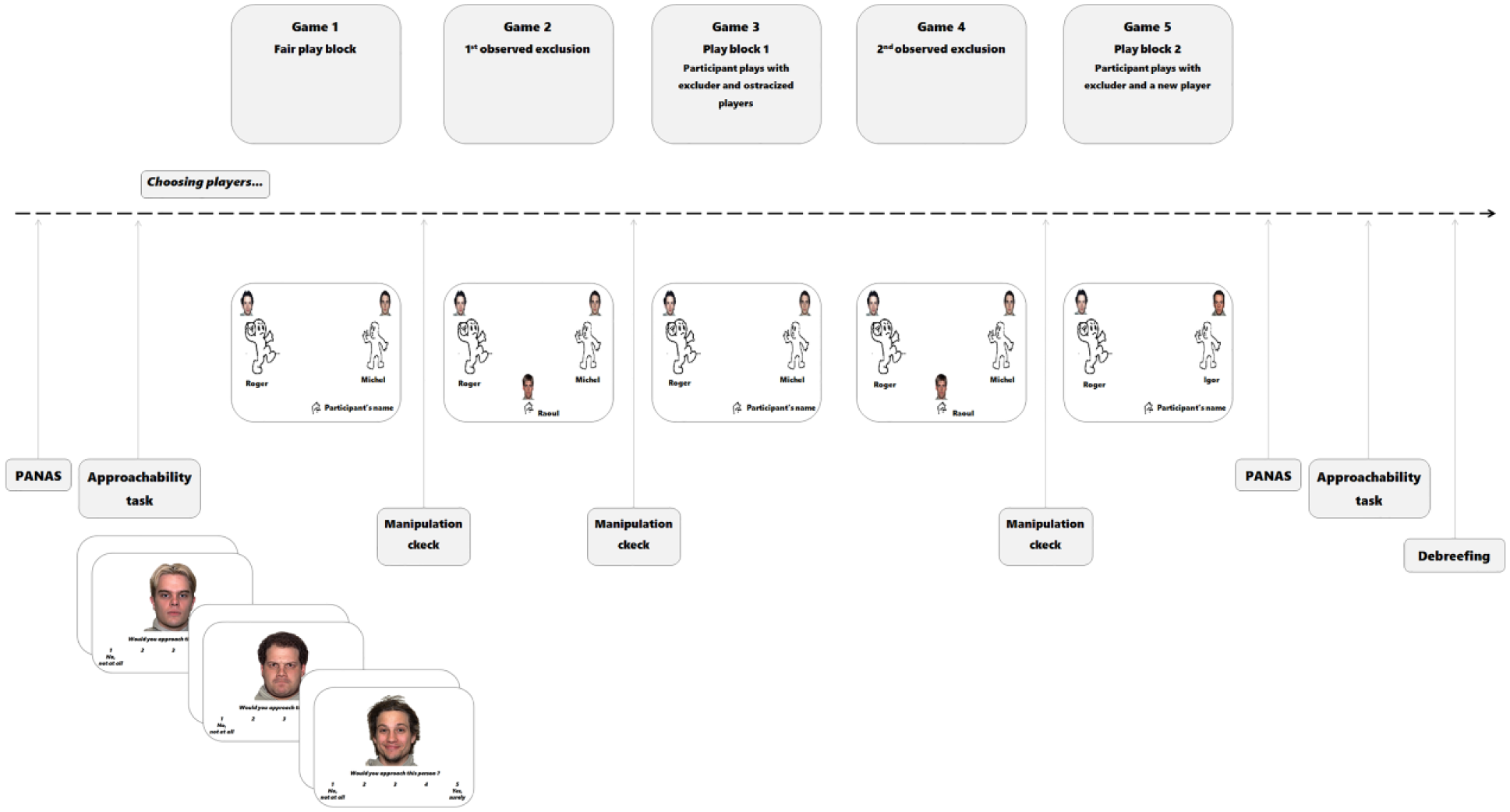
Illustration of the Cyberball paradigm.
Based on previous findings, we hypothesized that autistic adolescents would show a dissociation between the perception of the social exclusion episodes as elicited by the manipulation check (i.e. explicit) and the reaction to it as measured by their spontaneous (i.e. implicit) play behaviour (ball tosses). More precisely, we hypothesized that all participants would be aware of the social exclusion episodes. However, at a behavioural level, we expected that, relative to the autistic group, the TD group would spontaneously engage in pro-social behaviour towards the ostracized player after having witnessed the exclusion episodes in the Cyberball. We also predicted more pronounced changes in positive affect and a greater impact of the witnessed social exclusion in the subsequent approach behaviour in the TD, compared to the autistic participants.
Method
Participants
Two groups of individuals participated in this study. The first group consisted of 32 autistic individuals (26 boys and 6 girls) aged 11–19 years (M = 14.88; standard deviation (SD) = 2.25). Participants with ASD were recruited via the local Resource Centre of Autism (CRA, Adolescent Psychiatry Unit, Salvator Hospital, Marseille). All adolescents were cognitively able and had previously received a clinical diagnosis of ASD by a multidisciplinary team of experienced clinicians from the CRA (Salvator Hospital, Marseille). Diagnosis was based on the ASD criteria of the Diagnostic and Statistical Manual of Mental Disorders (5th ed.; DSM-5; APA, 2013), as well as on the Autism Diagnostic Observation Schedule–Generic (ADOS-G; Lord et al., 2000), and the ADI-R (Rutter et al., 2003) on which all autistic participants scored above the cut-offs for ASD. Exclusion criteria were the following: known neurological or physical disorders, schizophrenia or other psychotic disorders, major depressive disorder, major bipolar disorder and attention deficit hyperactivity disorder, and intellectual disability. Level of intellectual disability was determined by the criteria outlined in the DSM-5 (APA, 2013): a standardized measure of cognitive ability (e.g. Wechsler Intelligence Scale for Children (WISC-IV); Wechsler, 2003), a standardized measure of adaptive behaviour the (e.g. Vineland Adaptive Behaviour Scales-II (VABS-II); Sparrow, Cicchetti, & Balla, 2005) and behavioural observations. All autistic participants were free of medication at the time of testing. Performance IQ (PIQ; M = 105.34, SD = 17.75) was assessed using the WISC-IV (Wechsler, 2003) or Wechsler Adult Intelligence Scale (WAIS-R; Wechsler, 1997). Because the experimental paradigm used in the current study is a non-verbal one, we report only the relevant criteria in terms of cognitive ability that is required to fully understand and perform the task.
The second group of participants consisted of 36 TD adolescents (24 boys and 12 girls), aged 10–17 years (M = 14.56, SD = 1.63), matched to ASD participants for PIQ (M = 105.81, SD = 8.45), F(1, 66) = 0.02, p = 0.88. The two groups did not differ in terms of age, F(1, 66) = 0.46, p = 0.50, gender ratio, χ2(1, N = 68) = 1.85, p = 0.17, and handedness (as measured by the Edinburgh Handedness Inventory; Oldfield, 1971), χ2(1, N = 68) = 0.32, p = 0.57. All Adolescents included in this group were volunteers and free of psychiatric or neurological disorders at the time of testing. They were recruited via local schools. All were native French speakers and had normal or corrected-to-normal vision. The experiment adhered to the Declaration of Helsinki and experimental procedures were approved by the local ethics committee (Ref: 2016-05-25-003). Parental informed consent was obtained from all participants.
Materials and procedure
PANAS PA
The PA is a 10-item self-report sub-scale of the PANAS (Watson et al., 1988; French version, Caci & Baylé, 2007) and measures positive emotion experience and expression. The PA reflects the level of pleasant engagement and the extent to which a person feels enthusiastic, active, excited, alert and determined. Ten descriptors compose the PA sub-scale, and for each item, participants are required to respond using a 5-point scales (1 = very slightly or not at all to 5 = very much). A number of different time frames have been used. In the current study, the time frame adopted was at this moment. Reliability analyses on the PA sub-scale indicated a good Cronbach’s alpha coefficient (0.81).
ARF
The ARF was adapted from Adolphs and colleagues (1998). Face stimuli were 20 black and white photographs drawn from the NimStim Set of Facial Expressions (Tottenham et al., 2009). The stimuli represented male actors, depicting different emotional face expressions (happy, sad, anger and neutral). Participants were asked to imagine meeting the person on the street and to indicate how much they would want to walk up to that person and ask, for example, a direction to go somewhere, or another information. They were asked to rate or evaluate whether the individual depicted in the photograph was approachable or not, using a 5-point scale (1 = no, not at all to 5 = yes, surely). The photographs remained on the screen until a response was detected. Once the participant responded, the next photograph would appear on the screen. E-Prime software (Psychology Software Tools, Inc., Pittsburgh, PA) was used for stimuli presentation and data collection.
Procedures
Preceding the Cyberball task, participants were invited to complete the PANAS scales, followed by the ARF task. Once the Cyberball was finished, participants were once more invited to complete the PANAS scales, again followed by the ARF (see Figure 1). The procedures lasted approximately 75 min in total. At the end of the experiment, the participants were fully debriefed.
The Cyberball task
A link to ‘Cyberball’ was clicked by the experimenter, followed by a ‘loading’ screen. During the loading period, the participants were informed they would be playing an online ball-tossing game called Cyberball (Williams et al., 2000) with two other players located in different rooms. Instructions were delivered in visual and auditory format. Prior to the games, and to increase realism and personal investment, participants selected the players from four pictured choice photographs of players, who presented themselves (e.g. Hi! My name is Michel, would you like to play with me?). The photographs of the selected players, as well as their names, were then depicted in the screen during the games. The name of the participant, which would be given before the games started, also appeared in the screen, in the participant’s position (always the bottom centre). Instructions were displayed on screen. The Cyberball paradigm (see Figure 1) consisted of five blocks, with 60 trials (number of tosses) each. (1) A fair play game in which each player, including the participant, could throw the ball an equal amount of times to the other players in 20 trials (60 trials in total). Unbeknown to the participants, in this game they would play with the players that would be, later on, the excluder and the ostracized players. Next, participants observed a first round of social exclusion. (2) In this game, a new player was introduced and participants watched the game. In this game, one of the two players who had previously played in the fair play game with the participant (randomly assigned) was tossed only three times and never thrown to again during the game (thereby becoming the ostracized player). Thus, the other player who had previously played in the fair play game (as well as the new player) became the excluder player. (3) A play block followed (play block 1), in which the participant could play with both the ostracized and the excluder players. (4) A second observation of social exclusion followed (alike the first observation instance). (5) A final play block game (play block 2), in which the participant played with the excluder player and a new player who was introduced in this game (not the same player included in the previous observed social exclusion games). In the two witnessed social exclusion games, participants were given the instruction to simply watch the games. In the play block 1 and play block 2, the other two players always threw the ball to the participant. This ensured that the participant would have more opportunities to act in the game. Between each game, a pause followed, with the instructions for the next game, that participants could reinitiate at their pace. Participants played a total of three online Cyberball games.
A manipulation check was administered to ensure participants’ engagement in the Cyberball games and to access their awareness of the social exclusion of another. Immediately following the fair play game and the two witnessed social exclusion instances of the Cyberball, participants were asked, How well do you think the players get along during the game? Participants provided answers using a scale ranging from 1 = not well at all to 5 = very well. A higher score indicates that the players get along very well; on the contrary, a low score indicates perceived unfairness between the players.
Data analyses
Data analyses were based on the ratio of ball throws by the participant to each one of the players (the ostracized, the excluder and the new player). Only three games were considered for analyses: the fair play, the play block 1 and play block 2. Data were analysed by conducting generalized linear model (GLM) analyses of variance (ANOVAs) with repeated measures corrected by the Greenhouse-Geisser test (with Statistica, Version 7, StatSoft Inc.), including Group (ASD and TD) as between-subjects. The Game (fair play, play block 1 and play block 2) and the Players (ostracized, excluder and new player) were included as within-subjects factor, depending on the analyses. Same analyses were conducted for the manipulation check responses, including the participants’ responses on the three Games (fair play, play block 1 and play block 2) as within-subjects factor. A GLM ANOVAs with repeated measures was also conducted for the scores on the PA, before and after the Cyberball task, included as within-subjects factor. Likewise, for the ARF task, same analyses were conducted, including the Ratings (approach towards emotional and non-emotional, neutral faces) and Game (before and after), as within-subjects factor. Effects sizes (η2) are reported for all statistical results. Fisher’s least significant difference (LSD) tests were used for post hoc comparisons. Chi-square tests were used for some complementary analyses.
Results
Cyberball task
We first analysed the behavioural responses of the two Groups during the fair play block. This analysis intended to ensure that all participants understood the task and also aimed at controlling for left or right (Player) bias. Results showed an absence of an interaction with the Group, F(1, 66) = 1.09, p = 0.29, η2 = 0.004, showing that all participants played with both players evenly (M = 0.50, SD = 0.05).
Then, two main questions were addressed. The first question regarded to whether participants engaged in pro-social behaviour towards the ostracized player after observing the social exclusion episode. This was examined by comparing the ratio of ball throws towards the ostracized player in the games he was included, that is, during the fair play and the play block 1. The second concerned the behaviour towards the excluder player along the games, which was examined by comparing the ratio of ball throws towards the excluder player during the three games where this player was present (fair play, play block 1 and play block 2). This allowed investigating whether the playing behaviour reflected an altruistic behaviour, or rather, an exclusive behaviour towards the excluder protagonist.
Behaviour towards the ostracized player
This analysis compared the ratio of ball throws towards the ostracized player during the fair play and the play block 1. Results revealed a significant main effect of Group, F(1, 66) = 5.20, p = 0.02, η2 = 0.04, showing that, overall, the TD participants played significantly more with the ostracized player than the ASD participants (MTD = 0.52, SD = 0.08; MASD = 0.49, SD = 0.07). A significant two-way interaction between Group and Player (fair play vs play block 1) was also found (see Figure 2), F(1, 66) = 5.15, p = 0.02, η2 = 0.03, showing that the TD participants played significantly more with the ostracized player during the play block 1 (M = 0.54, SD = 0.09) relative to the ASD participants (M = 0.48, SD = 0.08, p = 0.004). Within-group comparisons further confirmed that while the TD group played significantly more with the ostracized player during the play block 1 relative to the fair play (M = 0.50, SD = 0.05, p = 0.01), that was not the case for the ASD group (p = 0.51). No other effects were found significant.
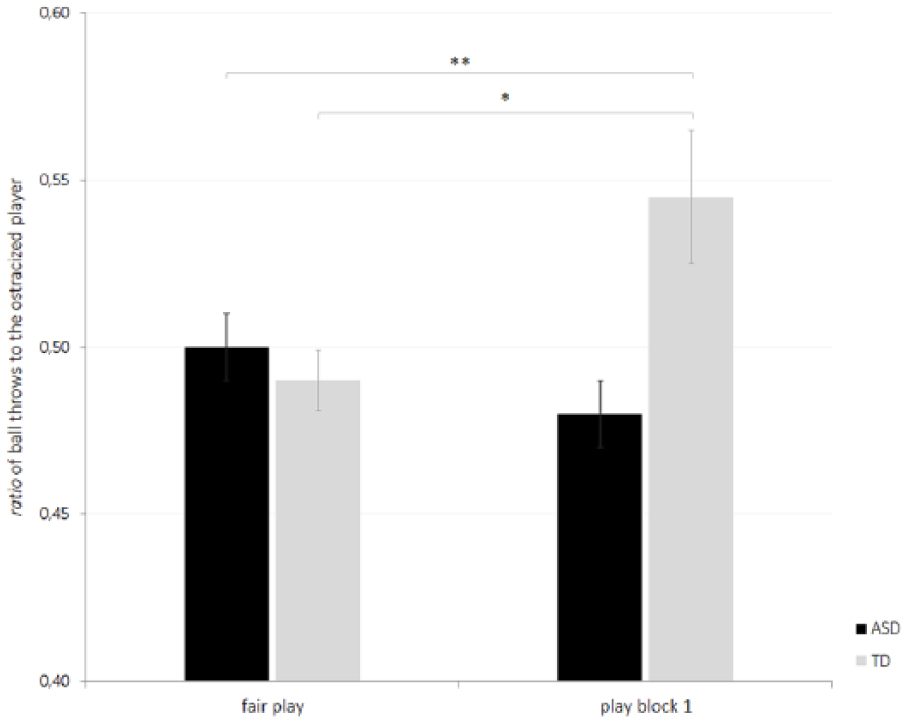
Two-way interaction between subsequent pro-social behaviour towards the ostracized player (ratio of ball throws) and Group (ASD vs TD). Error bars are within-subject standard errors.
Behaviour towards the excluder player
This analysis compared the ratio of ball throws towards the excluder player during the fair play and the play blocks 1 and 2. Results revealed a significant main effect of Group, F(1, 66) = 8.41, p = 0.01, η2 = 0.06, showing that overall, and during the three games (fair play, play block 1 and play block 2), the TD group played less with excluder player (M = 0.48, SD = 0.08) than the ASD group (M = 0.51, SD = 0.08, p = 0.005). A main effect of Player was also found significant, F(2, 132) = 3.36, p = 0.03, η2 = 0.02, indicating that the participants played more with the excluder player during the play block 2 (i.e. when a new player was included; M = 0.51, SD = 0.08) relative to the play block 1 (i.e. when the ostracized player was also playing; M = 0.48, SD = 0.09, p = 0.01). Analyses also revealed a two-way interaction between Group and Player (see Figure 3), F(2, 132) = 3.16, p = 0.04, η2 = 0.02, showing that compared to the ASD participants (Mplay block 1 = 0.51, SD = 0.08; Mplay block 2 = 0.54, SD = 0.11), the TD participants played significantly less with the excluder player during both the play block 1 (M = 0.46, SD = 0.09, p = 0.01) and the play block 2 (M = 0.49, SD = 0.05, p = 0.03). Within-group comparisons additionally confirmed that the TD group played less with the excluder player in the play block 1, compared to the fair play game (p = 0.007). On the other hand, they played more with the excluder player in the play block 2, compared to the play block 1 (p = 0.03). No differences in behaviour between the fair play and the play block 2 were found (p = 0.59). For the ASD group, no differences in behaviour were found between the fair play and play block 1 (p = 0.50), nor between the two play blocks (p = 0.12). The ASD participants however played significantly more with the excluder player in the play block 2, relative to the fair play game (p = 0.02). No other effects were found significant.
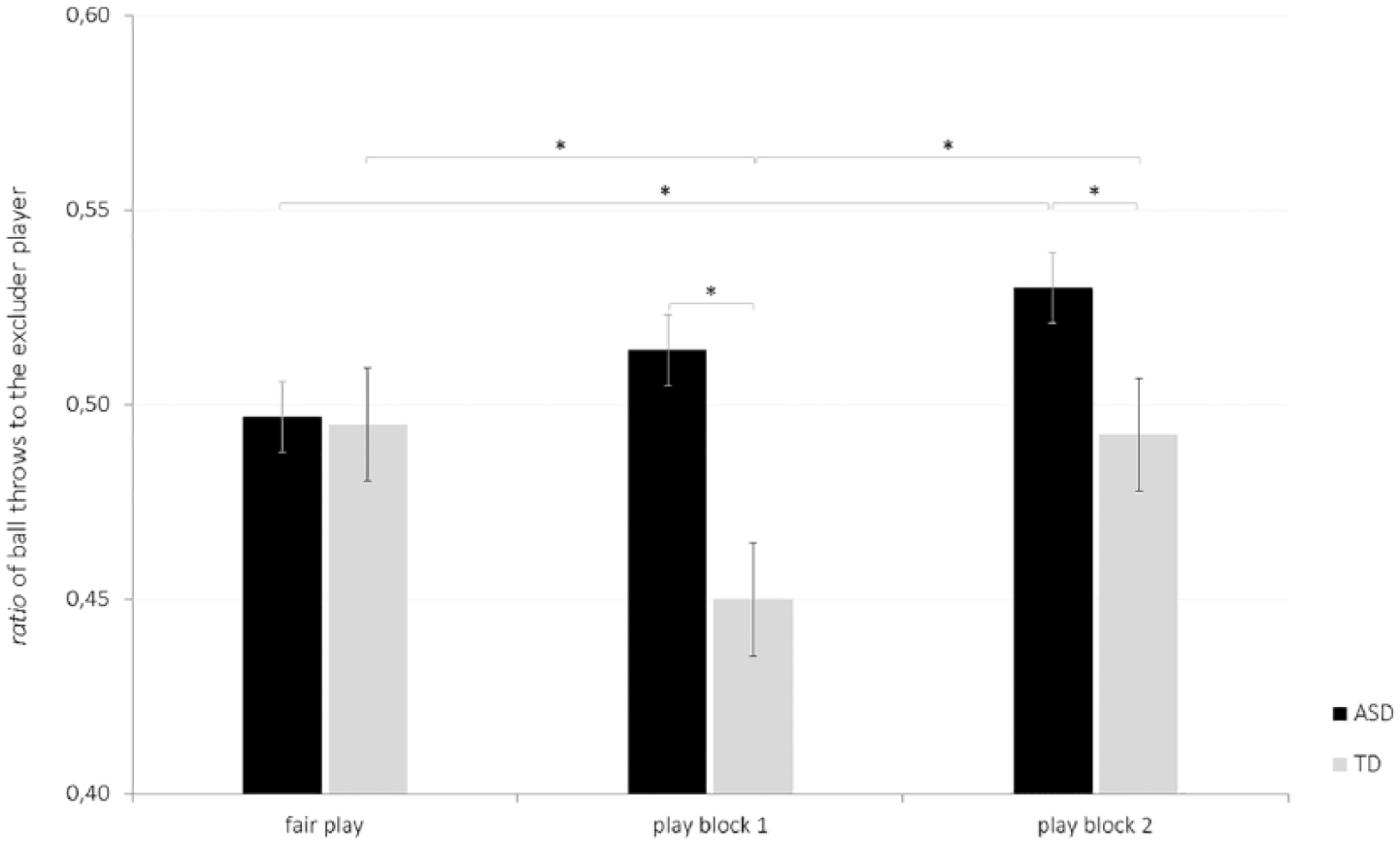
Two-way interaction between subsequent behaviour towards the excluder player (ratio of ball throws) and Group (ASD vs TD). Error bars are within-subject standard errors.
Manipulation check
Results showed a significant main effect of Game, F(2, 132) = 119.29, p = 0.00001, η2 = 0.53, showing that all participants were aware of the social exclusion occurring in the first (M = 1.81, SD = 1.15, p = 0.00001), and in the second witnessed social exclusion instances (M = 1.82, SD = 0.83, p = 0.00001), relative to the fair play game (M = 3.88, SD = 0.90). No differences were found for the manipulation check between the two exclusion games (p = 0.92). No other effects were found significant.
Positive affect (PANAS PA)
Results for the PA showed significant main effect of the Affect, F(1, 66) = 22.41, p = 0.0001, η2 = 0.05, showing a decrease in PA for all participants after the games (Mbefore = 27.55, SD = 6.66; Mafter = 24.04, SD = 8.17; p = 0.00001). A significant two-way interaction between Group and PA was also found, F(1, 66) = 4.40, p = 0.03, η2 = 0.01, indicating that the decrease in PA between the beginning and the end of the Cyberball was significant for the TD group (Mbefore = 28.83, SD = 5.64; Mafter = 23.97, SD = 7.73; p = 0.00001), but not for the autistic group (Mbefore = 25.72, SD = 7.46; Mafter = 23.84, SD = 8.54; p = 0.07), even though this difference within the ASD group shows a tendency for significance. No other effects were found significant.
To further explore potential effects of the Cyberball task on the positive affective state of participants, we examined responses to the three subscales identified by Egloff, Schmukle, Burns, Kohlmann, and Hock (2003): Joy (enthusiastic, excited, proud), Interest (interested, strong, determined) and Activation (active, attentive, inspired, alert), considered to better capture approach motivation and positive affect (e.g. Harmon-Jones, Harmon-Jones, Abramson, & Peterson, 2009). We thus analysed the potential changes in the affective state measured by these subscales before and after the Cyberball task. Analyses showed a significant main effect of Joy, F(1, 66) = 11.54, p = 0.001, η2 = 0.04, revealing that after the Cyberball, all participants felt less joyful (Mbefore = 2.68, SD = 0.91; Mafter = 2.31, SD = 0.93; p = 0.0007). A significant two-way interaction was found between joy and Group, F(1, 66) = 5.74, p = 0.01, η2 = 0.02. Post hoc comparisons showed that while the TD group reported a significant decrease on the joy felt before and after the Cyberball (p = 0.00001), that was not the case for the autistic group (p = 0.49). No between-group effects were found significant. Results also showed a main effect of Interest, F(1, 66) = 10.83, p = 0.001, η2 = 0.02, revealing that, generally all participants felt significantly less interested after the Cyberball (Mbefore = 2.89, SD = 0.86; Mafter = 2.65, SD = 0.92; p = 0.001). Finally, a main effect of the affective state Activation was also found to be significant, F(1, 66) = 24.32, p = 0.00001, η2 = 0.04, again showing a general decrease after the Cyberball for all participants (Mbefore = 2.67, SD = 0.68; Mafter = 2.35, SD = 0.80; p = 0.00001).
ARF
Statistical analyses yielded non-significant results (all ps > 0.10). Note that due to technical issues, data from the retest of the ARF task (after the Cyberball manipulation) were available only for a subset of participants (ASD: N = 24; TD: N = 27). Therefore, these results will not be discussed further.
Discussion
The main goal of this study was to investigate subsequent pro-social behaviour after witnessing social exclusion of another among autistic adolescents compared to TD. We further aimed at investigating whether the actions on behalf of the excluded person indeed reflected an index of pro-social behaviour or whether these were followed by exclusive behaviours towards the excluder player. Specifically, our findings suggest that autistic adolescents may be differentially motivated to process witnessed ostracism experiences, despite evidence of similar self-reported awareness.
The first main finding showed that TD participants do engage in pro-social behaviour towards the ostracized player after observing the social exclusion episode. This is consistent with our hypothesis and with previous studies reporting that in such cases, individuals commonly engage in pro-social behaviour by throwing more balls to the ostracized player compared to the fair play game (e.g. Howard et al., 2014; Masten et al., 2010; Riem et al., 2013), a response congruent with the perceived pain of another (Batson et al., 1997). The second main finding showed that, despite playing less with the excluder player during the play block 1 (relative to the fair play block) when benefitting the ostracized player, TD participants played fairly with the excluder player in the second encounter, when a new player entered into the game (play block 2). Proximate causes to altruism, a form of pro-social behaviour, refer to the immediate situation that triggers behaviour and the mechanisms that enables it (de Waal, 2008). Indeed, the pattern of behavioural response found for the TD group suggests a deliberate action generated on behalf of the excluded person, that was specifically triggered by the immediate exclusion situation and that was not extended to a subsequent context (play block 2). This thus suggests that their pro-social behaviour towards the ostracized player was intended and driven by inclusionary motives rather than exclusionary ones, since they did not use exclusive behaviours as regards to the excluder player. This is also consistent with prior studies showing that witnessing ostracism increases pro-social behaviour much like experiencing ostracism does (e.g. Williams, 2009). The research on pro-social behaviour has relied mostly on self-report measures (e.g. rating of emails participants wrote to the excluded player; Masten, Morelli, & Eisenberger, 2011). Here, by using a novel adaptation of the Cyberball paradigm, we objectively showed actual pro-social behavioural responses in TD individuals. Moreover, these findings are in agreement with current functional magnetic resonance imaging (fMRI) research indicating that witnessing someone else being excluded increases activation in the social pain brain network, which has been associated with increased pro-social concern towards the ostracized player, both in adults (Masten, Morelli, & Eisenberger, 2011) and in adolescents (Masten et al., 2010).
The pattern of affect changes after the games was, nevertheless, less clear. Results showed a decrease in positive affect after the games, for both groups, but particularly in the TD group. It has been suggested that after witnessing social exclusion, participants report negative feelings and distress, because the detection of social pain may elicit the same pain in the observer (Wesselmann et al., 2009). Perhaps the negative feeling elicited by this aversive situation is more arousing than the positive feeling that may have emerged after engaging in inclusive behaviours.
In contrast, the behaviour of the autistic group remained relatively constant. After witnessing the two social exclusion instances, autistic participants did not significantly change their playing behaviour, not towards the ostracized player, nor towards the excluder player. This pattern of behaviour cannot be explained by basic differences in the perception of the Cyberball games. As predicted, the explicit ratings of the games on the manipulation check measures showed that they recognized when someone else was being ignored or rejected. Autistic participants are therefore aware of the social exclusion of another, as they showed to be in the case of self-experienced social exclusion reported in prior studies (Masten, Colich, et al., 2011; Sebastian et al., 2009). To our knowledge, acting on observed social exclusion in autism has never been addressed before. The finding that autistic participants do not show any specific behaviour alterations after perceiving the social exclusion episodes is nonetheless analogous to that found in the studies on self-experienced exclusion, suggesting that autistic individuals seem to process rejection experiences differently than TD participants (Masten, Colich, et al., 2011). This finding is reminiscent with the idea that differences in reward processing in autistic individuals may be associated with a distinct motivation drive towards social stimuli (e.g. Clements et al., 2018; Kohls et al., 2012; Supekar et al., 2018). Perhaps that while in a context in which they are not directly or explicitly involved, they may simply prefer to not engage in the social situation.
If autistic individuals have distinct predispositions to sociality, that is, if they are less biased towards social stimuli than TD individuals are, social learning will most likely be affected, as well as their decisions to act (or not) in social instances. It has been suggested that difficulties in social cognitive processes in ASD are primarily implicit in nature (e.g. Callenmark et al., 2014; Klin et al., 2003). Imaging research on the neural mechanisms involved in social decisions affecting one-self and others in scenarios such as should I trust this person? Should I treat this person fairly? suggests that individuals typically show sharp behavioural and neural responses to socially rewarding stimuli and peer interactions (e.g. Rilling & Sanfey, 2011). On the other hand, autistic people seem to rely more on deductive reasoning than on social awareness and intuition (e.g. Brosnan et al., 2017; Brosnan et al., 2016). In addition, differences in decision making involving spontaneous adaptation such as a reciprocal interaction (Klin & Volkmar, 1997; Luke et al., 2012) could also affect their decisions to act. This raises the question of whether their behaviour reflects a response that follows a specific rule, such as to play evenly with both players. However, the finding that they play evenly with both players in the fair play game does not explain why they played more with the excluder player when a new player joined the game (play block 2).
Consistent with the view that autistic individuals may be more vulnerable to adverse effects of social exclusion (e.g. Little, 2001), this behaviour towards the excluder player could instead reflect a strategy to avoid being ostracized in the future. The literature on social exclusion has proposed several explanations for the behavioural responses found across studies when individuals are faced with ostracism. A related point is that these may vary according to the particular experiences and expectations individuals have from this specific situation (e.g. Masten, Morelli, & Eisenberger, 2011). While witnessing someone else being excluded, participants are confronted with a dilemma (by siding with the excluded person or with the excluder protagonist) that can be solved by adopting distinct strategies. Individuals can choose to actively compensate the excluded person by inclusion (throwing them the ball more often, as found for the TD group); they can choose to display exclusive behaviours towards the excluder player (throwing them the ball less often), or they can choose to avoid the situation for fear of retaliation from the excluder player. This last option, which reflects an avoidance response, can take two forms: either one chooses to go along with the crowd, meaning that he or she will also ostracize the stigmatized player (and by consequence, actively assist the excluder protagonist), or one can simply do nothing and keep acting as passive bystanders. Either way, this strategy will actively or passively assist the excluder player. Sociality is inherently risky, and this choice of ‘taking no position’ may in fact underline a protective response, because by acting prosocially towards an excluded person, the participant is facing the risk of being excluded himself (e.g. Salmivalli, 2010). It has been suggested that individual preference and motivation towards reciprocal social interactions may shape brain responses and thereby also shape the reward system’ activation (Kawamichi et al., 2016). In this context, the current findings suggest that while TD participants show a preference and motivation to actively engage in the situation and adopt inclusive behaviours towards the excluded person, autistic participants rather prefer to take a reserved and protective position. Taken together, these findings suggest that, compared to the TD group, the autistic group shows an atypical motivational drive towards social rewards (Chevallier et al., 2012; Clements et al., 2018; Supekar et al., 2018) which results, in this specific case, in a distinct response to a context of observed social exclusion.
Experiencing social rejection has an important impact on the ways people perceive the social world, their expectations and by consequence, in their motivation to act pro-socially, with some individuals eventually stop seeking others for support further withdrawing and ostracizing themselves (e.g. Williams & Nida, 2009). For individuals with different predispositions towards sociality as those on the autism spectrum, these experiences can be overwhelming, increasing the risk for social exclusion and rejection, but also the risk of social isolation (e.g. Twyman et al., 2010). Indeed, higher levels of social exclusion (e.g. Masten, Colich, et al., 2011; Twyman et al., 2010) and loneliness have been found to be more frequent among autistic individuals, perhaps signalling a longing for social contact (Bauminger, Shulman, & Agam, 2003). Although a desire to socially engage with others and make friends exists (e.g. Silva et al., 2015; Volkmar & Klin, 1995), they are distinctively motivated to spontaneously seek, initiate, maintain and enhance social interactions with others as TD individuals do (Chevallier et al., 2012), suggesting differences in the processing of social information that is essential to make social encounters successful (e.g. Bauminger et al., 2003). In fact, the reverse is more likely to happen, with loneliness as the outcome of a social avoidance built-in of social awkwardness (e.g. Bauminger & Kasari, 2000; Sigman & Capps, 1997). These are adverse consequences of social life that remind us that social reciprocity is a two-way avenue, underlying the critical relevance that a better understanding and acceptance of ASD by the community are needed (e.g. Milton, 2012).
People engage in pro-social behaviours because they enjoy its rewards (e.g. Kawamichi et al., 2016) and because such acts increase the feeling of belongingness (e.g. Williams, 2007a). They do it typically expecting to be included (Kerr & Levine, 2008; Wesselmann, Williams, & Hales, 2013; Wesselmann, Wirth, & Bernstein, 2017; Wesselmann, Wirth, Pryor, Reeder, & Williams, 2013). Autistic people, by contrast, given their particular social experience and expertise of the social environment, may be less predisposed towards sociality, compared to TD individuals (Milton, 2012). Everyday life takes place in highly complex social environments, and many important decisions are made in the context of social interactions. Social exclusion is an interactive phenomenon, and despite people’s efforts to be accepted, it is, however, a pervasive feature of social life.
Strengths and limitations
While shedding light on some aspects of prosociality, this study incurred several limitations. The integration of the play block 2 to fully understand the pro-social response was accomplished by including sequential blocks. Thus, it is possible that due to the nature of the paradigm used, there was a risk that order effects would influence the responses found. However, if present, such effects should in principle affect both groups equally, which was not the case. Also, instead of focusing on the positive affect related to prosociality, by using the PANAS PA, a measure focusing on the social pain resulting from an exclusion situation may have been more sensitive to capture the impact of witnessed social exclusion in the affect of participants. The technical issues impeding the availability of all data regarding the ARF constituted an obvious limitation, not allowing answering our research questions. Given the hypothesis of an alleged ostracism-detection system, it would be enriching to use this paradigm coupled with an eye-tracking to investigate potential biases in attentional processes involved in the detection of this aversive social context. This is reminiscent with the fact that although Cyberball has been valuable and extensively used to investigate social pain, a caveat regarding the generalization of findings to other exclusion situations is to be acknowledged. Research has indeed shown that even when participants are aware that the players in the game are fictional, the effects of ostracism do exist (Zadro, Williams, & Richardson, 2004). Nevertheless, as an artificial environment, the Cyberball will, by consequence, lack many of the real and dynamics aspects of social interactions. A related point is that we cannot fully explain the pattern of results found for the ASD group. Here, with Cyberball, autistic participants showed a more protective type of response, being less reactive to the witnessed social exclusion, in spite of being aware of it. However, we do not know whether in a real life situation, autistic and TD adolescents will, for instance, react as ‘excluder protagonists’ to the same extent. This leaves open the question of whether autistic individuals prefer neither to act nor to react to social exclusion. The answer to this question would disentangle the meaning of the behavioural responses found here but also improve our overall understanding of the strategies used when facing exclusion, but also to investigate the ostracism-detection system.
Conclusion
In sum, the findings of the present study revealed that TD participants do engage in pro-social, altruistic behaviour after witnessing the social exclusion of another. In contrast, autistic participants showed an atypical pattern of response, suggesting differences in the motivational drive towards social rewards (Chevallier et al., 2012; Clements et al., 2018; Supekar et al., 2018). To our knowledge, this is the first time the question of acting on observed social exclusion is studied in ASD. The current findings indicate that autistic individuals may not be completely shut off from social stimulation, but instead, that they may be distinctively motivated to perceive the reward value in a social context and thereby distinctively motivated to decide whether to act upon it. A better understanding of how individuals with ASD react to ostracism appears relevant in the conception and amelioration of intervention programmes aiming at developing social skills. These have proved to have beneficial outcomes assisting autistic individuals in their daily socio-emotional difficulties, as well as their families (e.g. Baker-Ericzén et al., 2018; Böckler, Tusche, Schmidt, & Singer, 2018; Stichter, O’Connor, Herzog, Lierheimer, & McGhee, 2012), but also in developing people’s altruistic motivation and behaviour, increasing thereby global cooperation (Böckler et al., 2018).
Supplemental Material
AUT857578_Lay_Abstract – Supplemental material for Acting on observed social exclusion and pro-social behaviour in autism spectrum disorder
Supplemental material, AUT857578_Lay_Abstract for Acting on observed social exclusion and pro-social behaviour in autism spectrum disorder by Catarina Silva, Chloé Jover, David Da Fonseca, Francisco Esteves and Christine Deruelle in Autism
Footnotes
Acknowledgements
We gratefully acknowledge all the volunteers who participated in this study and their families as well as Isabelle Charvin for her assistance with data collection.
Funding
The author(s) disclosed receipt of the following financial support for the research, authorship, and/or publication of this article: This research was partially supported by a grant from the Portuguese Ministry of Science and Technology, FCT-MCTES (SFRH/BPD/111598/2015) awarded to Catarina Silva.

References
Supplementary Material
Please find the following supplemental material available below.
For Open Access articles published under a Creative Commons License, all supplemental material carries the same license as the article it is associated with.
For non-Open Access articles published, all supplemental material carries a non-exclusive license, and permission requests for re-use of supplemental material or any part of supplemental material shall be sent directly to the copyright owner as specified in the copyright notice associated with the article.
