







Abstract
Center-based classroom community interventions create opportunities for young children with autism to connect with peers. Yet, there has been little examination of the peer interactions of toddlers with autism who experience core challenges in social communication and play skills that may create barriers to successful peer interactions. Classrooms of toddlers were randomized to an experimental social communication intervention including peers or to the standard individual (adult–child) social communication intervention. Both toddlers in peer and no peer conditions demonstrated significant gains in social communication and play. Toddlers with greater receptive language and combination and presymbolic play skills were most likely to demonstrate peer engagement.
Lay Abstract
Although young children may participate in education and intervention programs that take place in classrooms or groups, there is little information about how toddlers with special needs, and specifically toddlers with autism, are engaging with their peers. This study takes place in a public center-based early intervention program for toddlers with autism. Classrooms of toddlers were randomly assigned to an individual social communication intervention or the same intervention adapted to include a peer. Children in both groups made gains in social communication and play skills. Children who had the peer intervention were more engaged with peers when an adult was present, but not when the children were unsupported. This article adds information about early skills that may be important for children to master so that they have more success when trying to interact with their peers. These skills include understanding language (referred to as “receptive language” at 12 months or more) and play skills including building and stacking (referred to as “combination play”—for example, building with blocks or completing a puzzle) and extending familiar actions to themselves, others, and figures (referred to as “presymbolic play”—for example, putting a bottle to the doll or to themselves). Understanding which skills to target can help practitioners focus their instruction to build children’s skills toward connecting with peers through play.
Keywords
Early peer interactions can set the stage for interaction patterns that are consolidated over the course of childhood (Hay et al., 2004). Typically developing children show social interest in their peers early in the second year of life, including early cooperative behavior such as turn taking and joint attention (Blandon & Scrimgeour, 2015). Center-based classroom and group early intervention (EI) programs create opportunities for peer connections. Yet, little examination of peer interaction has focused on toddlers with developmental disorders and specifically, those with autism spectrum disorder (ASD) who experience core challenges in social communication and play skills that may create barriers to successful peer interactions.
Play is a natural context to explore young children’s peer interactions. In the first 3 years of life, children progress from parallel play (same activity but no peer acknowledgment) to complementary/reciprocal play (e.g. hide and seek) and then to social pretend play (enacting roles). This developmental sequence has been examined cross-sectionally in childcare settings where nearly all 19–23-month-old children showed complementary and reciprocal social play with peers, about half of whom demonstrated these skills as early as 13–15 months of age (Howes & Matheson, 1992). For children age 30–35 months, more than half engaged in cooperative social pretend play (Howes & Matheson, 1992).
However, not all children experience this rapid growth in social development. For children with ASD, engaging in reciprocal play may prove challenging both socially and cognitively due to a multitude of demands, including social participation, understanding symbolism/abstraction, and demonstrating the discrete play skills required to join the game. Therefore, children with ASD may require support to appropriately engage with toys (Stone et al., 1990), increase play diversity (Ungerer & Sigman, 1981), advance from functional to symbolic play (e.g. Charman et al., 1997), and imitate actions with objects (Stone et al., 1990). In addition to play skills, children with ASD can also benefit from support for early social communication skills that have been shown to contribute to successful peer interactions (Hay et al., 2004), including initiations of joint attention (Mundy et al., 1986) and the ability to coordinate social interactions with others (joint engagement: Adamson et al., 2009). Through targeted intervention with early childhood educators (e.g. Shire et al., 2017) and caregivers (e.g. Kasari et al., 2015), toddlers with ASD can make significant gains in these core skills. However, it is unclear what level of skill is necessary for successful peer engagement.
The peer interaction intervention literature has largely focused on preschoolers with ASD. Preschoolers with ASD are more often observed as unengaged and object focused than peers with other developmental disorders (Wong & Kasari, 2012) with only 20% having friends, defined as free play peer engagement, positive affect, and social initiations (Chang, Shih, & Kasari, 2016). One common strategy to increase successful peer interactions is to provide training for typically developing peers, including teaching peers to use prompts and/or provide reinforcement to a child with ASD (Watkins et al., 2015). We know less about children’s social interactions in dyads where both classmates have ASD. Center-based programs providing intervention to toddlers and preschoolers may include social exposure to peers, but studies have not reported on the peer interactions of children with ASD (e.g. Landa et al., 2011; Stahmer & Ingersoll, 2004). Not only are the benefits of peer engagement currently unknown, practitioners have little guidance regarding when and how to systematically target peer social interactions for toddlers with ASD.
Current study
This study evolved from an existing partnership between the research team and an EI center-based program serving toddlers with ASD. Together, the team has previously explored the implementation and effectiveness of a social communication intervention—Joint Attention, Symbolic Play, Engagement, and Regulation (JASPER: Kasari et al., 2006) when delivered by the center’s staff. This project demonstrated that first, children who received JASPER showed greater gains in engagement, social communication, and play skills than the children who received the center’s existing social skills intervention. Second, paraprofessional teaching assistants (TAs) could deliver JASPER with an average of 80% fidelity by study exit (Shire et al., 2017). Third, these effects were sustained without support from the research team during the following school year (Shire et al., 2019). Due to these results, the center established individual JASPER as their regular social program. After this study, the TAs expressed a desire to support the children’s peer interactions. They reported that some children were interested in each other and they wanted to support these budding interactions. At the center’s request, the current study introduced an adaptation of the existing JASPER model, referred to as “jasPEER” where the TA delivered the intervention with two children in partnership with another TA. The focus of jasPEER was to advance children’s individual social communication and play skills as well as support peer engagement. This model had been previously tested with preschool children (Chang, Shire, Shih et al., 2016), but had yet to be applied with toddlers.
Therefore, the following research questions were addressed. First, to what degree would TAs deliver the jasPEER intervention with fidelity? Second, would children in jasPEER demonstrate greater change in unsupported peer engagement then children in classrooms receiving JASPER? Finally, would children in JASPER classrooms show greater changes in social communication and play skills than children randomized to jasPEER classrooms? Based on our prior study, we hypothesized that the TAs would learn to deliver the intervention with an average of 80% fidelity. As this study compared two active versions of the JASPER intervention, we hypothesized that no significant differences would be found between the jasPEER and JASPER groups for children’s core skills (e.g. initiation of joint attention, play skills). However, we hypothesized that children in jasPEER classrooms would spend more time engaged with peers than children in JASPER classrooms, due to the focus on connecting with classmates in the jasPEER model.
Method
School program characteristics
The study took place in a public EI program for children aged 24–36 months who qualified for public EI services (see Shire et al., 2017). Toddlers were referred by the New York City Early Intervention (NYC EI) program. Multi-disciplinary teams of independent assessors determine whether a child meets the criteria for EI programming in applied behavior analysis. Toddlers are enrolled throughout the year as they become age eligible (24 months).
The program included two physical sites in low resource neighborhoods. Each site contained two classrooms staffed by a head teacher. A classroom housed four 2-h class sessions daily. Each 2-h class included 8–10 children who were each assigned a TA. The TA remained with the same child from study entry through follow-up. The 2-h class included 1.5 h of classroom programming based on the verbal behavior model (Sundberg, 2008) plus 30 min of JASPER. The JASPER sessions were supervised by a Group Leader (GL; see participants), while each child was supported by a TA.
Randomization and study design
JASPER was tested in this setting in a prior randomized controlled trial (RCT; see Shire et al., 2017) demonstrating both high TA strategy implementation and gains in children’s outcomes. Based on the results of that partnership, the center leadership decided to establish JASPER as their standard of care for 30 min per day. Therefore, JASPER serves as treatment as usual (TAU), constituting an active control in this study. To study the effect of jasPEER on children’s peer engagement, an independent statistician randomized the two classrooms within each site to either jasPEER or to the waitlist JASPER TAU.
All procedures were in accordance with the ethical standards of the institutional review committee at the University of California Los Angeles. Informed consent was obtained for all participants. All TA and GLs were invited to participate in the study. All nine GLs participated. Of the 52 TAs who consented, data for 47 were included. The additional 5 TAs began their employment after training had been conducted and thus, their data were excluded. Each child’s family was offered study participation as they enrolled across the school year. Of the 151 children whose families consented, data for 38 children were not included. One family declined to have the child video-recorded and 37 children were enrolled after intervention week 5 (half-way point; Figure 1). Due to the limited intervention dose, their data were not included in the analyses.
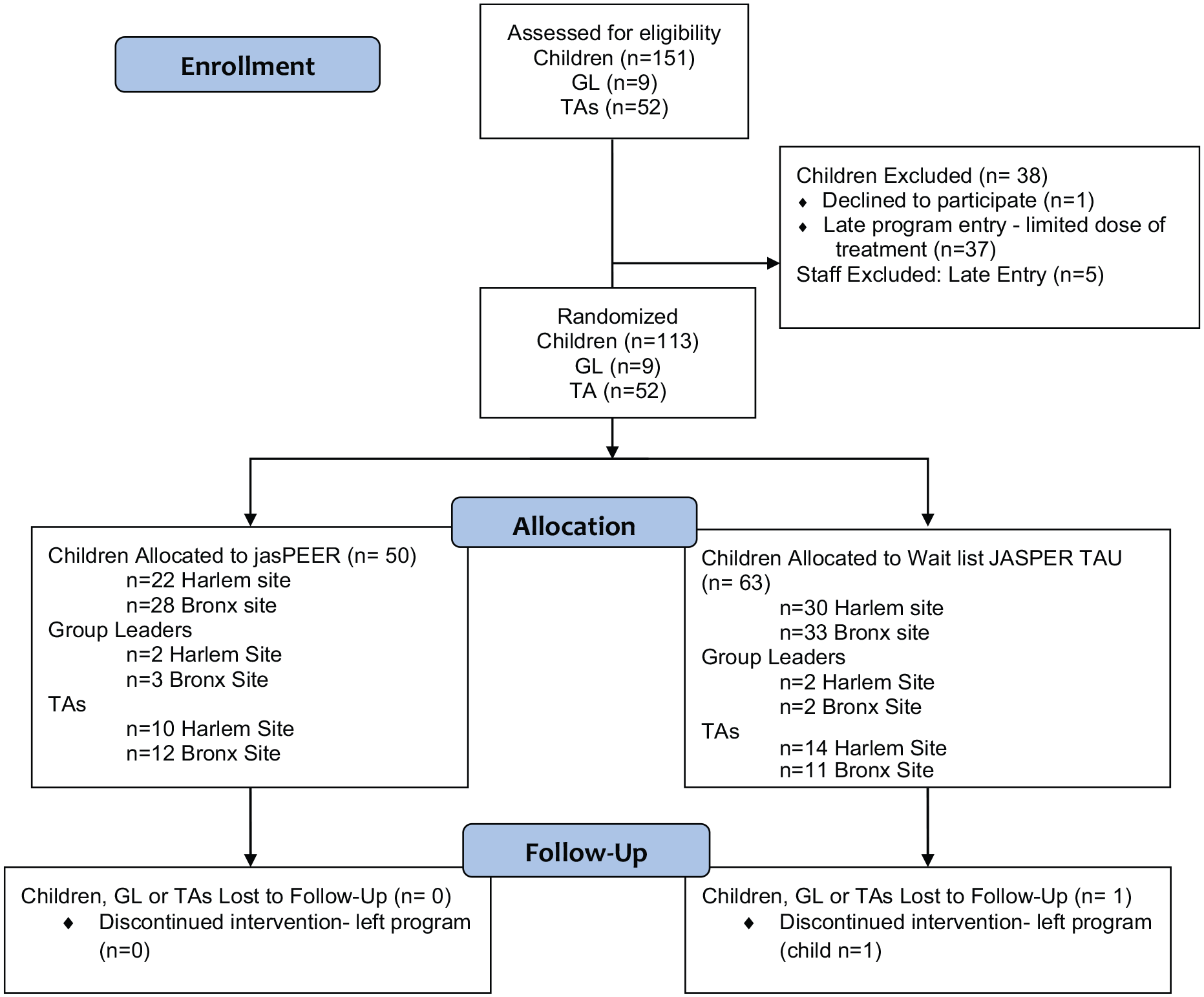
CONSORT flow diagram.
Participants
Children
A total of 113 toddlers (M age = 32.28 months, SD = 3.28) were included. Children had received a diagnosis of ASD (n = 1 with Down’s syndrome) by NYC EI approved providers, were primarily male (n = 89), and were of ethnically diverse backgrounds including African American (n = 26), Caucasian (n = 3), Hispanic (n = 71), and mixed race (n = 13). Toddlers entered with mean age equivalent Mullen Scales of Early Learning (MSEL) receptive language scores of 17.64 months (SD = 10.31 months) and expressive language scores of 18.41 months (SD = 9.53 months).
Staff
A total of 47 TAs participated with 22 from classrooms randomized to jasPEER and 25 in waitlist JASPER classrooms. TAs were primarily female (n = 43) and held their positions for an average of 2.93 years (SD = 2.30) after having completed high school (n = 3), some college (n = 13), vocational training (n = 8), or a college degree (n = 23). TAs reported their ethnicity as African American (n = 13), Asian (n = 1), Caucasian (n = 3), Hispanic (n = 28), and mixed race (n = 2).
The nine GLs included speech language pathologists, social workers, and occupational therapists. GLs were primarily female (n = 8), had obtained graduate degrees (n = 1 bachelors), and held their positions for an average of 1.78 years (SD = 1.15). GLs self-reported race/ethnicity as African American (n = 1), Asian (n = 1), Caucasian (n = 5), and Hispanic (n = 2).
The on-site JASPER Consultant, a Caucasian female with a graduate degree in school psychology, was the local supervision lead. The study occurred during her second year in this position. She provided live coaching across sites and both JASPER and jasPEER classrooms.
Intervention
The base program which all children received included 1.5 h of verbal behavior programming (Sundberg, 2008). Led by the head classroom teacher, individualized programs were developed and the child’s functional use of language was targeted through adult-led discrete trials and embedded within daily activities. In addition, the children received 30 min of social group instruction, including either TAU JASPER or jasPEER. Classrooms initially randomized to JASPER, received 11 weeks of intervention, followed by 4 weeks of follow-up, and then 11 weeks of jasPEER.
JASPER
Children in classrooms randomized to waitlist JASPER TAU received the comprehensive social communication intervention with their TA. JASPER sessions occurred in the context of toy play. This Naturalistic Developmental Behavioral Intervention (Schreibman et al., 2015) is a package of seven strategy subscales including supports for engagement and regulation, environmental arrangement, balancing imitation and modeling, establishing play routines, expanding play, language strategies, and programming for joint attention and requesting (see Table 1). Toys are selected to match the child’s developmental play level to build routines that scaffold the child’s play flexibly and complexity. Layered onto the play are language models matched to the child’s expressive language level and opportunities for the child to communicate to request and comment.
JASPER TAU and jasPEER components.
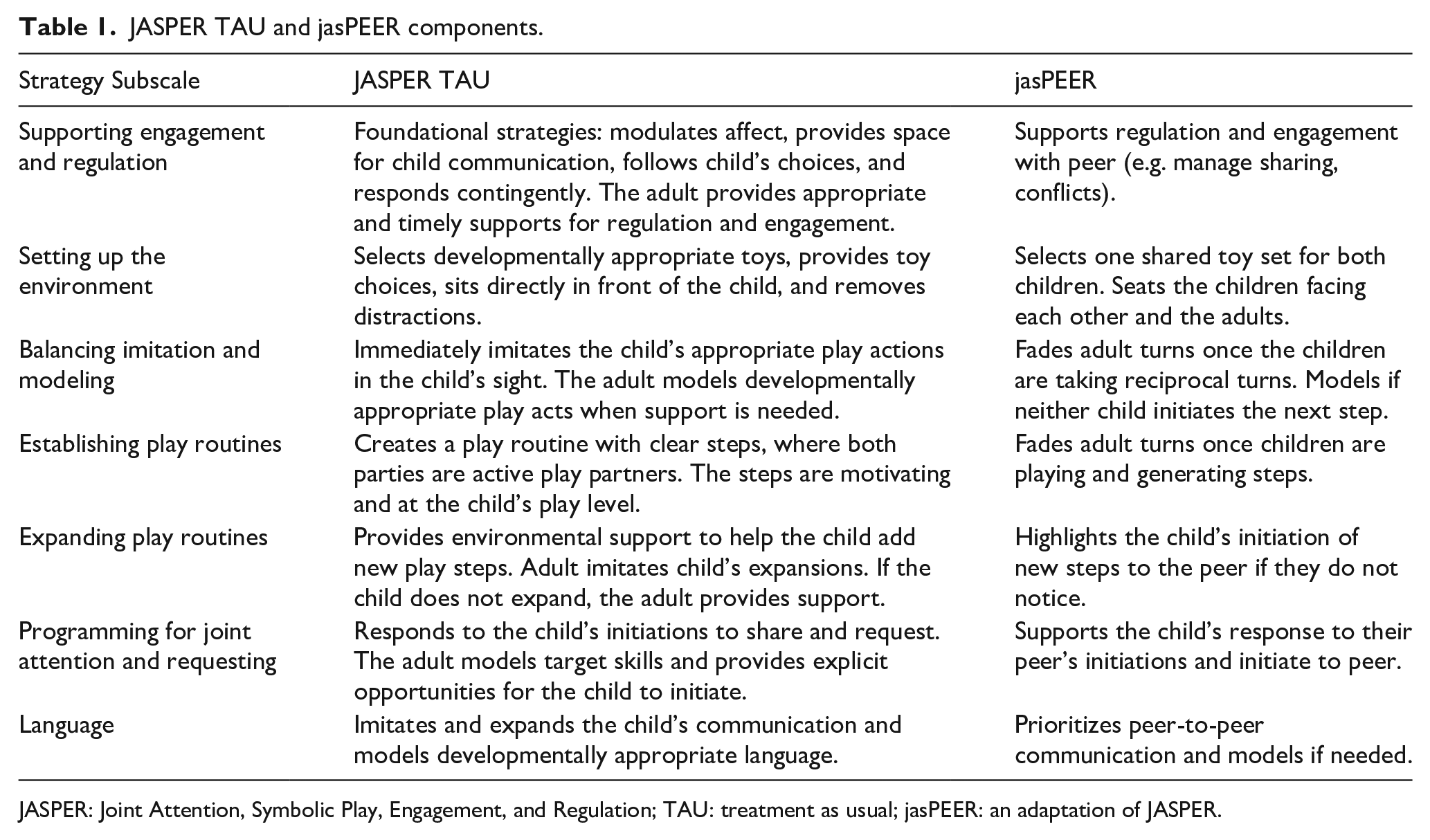
JASPER: Joint Attention, Symbolic Play, Engagement, and Regulation; TAU: treatment as usual; jasPEER: an adaptation of JASPER.
JasPEER
Children enrolled in the experimental jasPEER classrooms were provided with a modification of JASPER to include a peer. This small group modification has been previously tested in preschools with 1 adult and 2–5 children (Chang, Shire, Shih, et al., 2016). This study required further adaptations to fit the center’s standard of practice where during jasPEER, a team of two TAs worked together with two children to address the core skills including joint engagement, play, and social communication skills. The children were paired together based on the children’s mastered play level as determined by their entry Short Play and Communication Evaluation (SPACE) assessment (see measures). By pairing children at the same play level, the TAs could build routines that both children were developmentally capable of engaging in. For example, for two children building blocks, the TAs set up one block building activity with materials for both children. Children sat facing each other and at least one adult. TAs are active play partners until children are taking reciprocal turns at which point the adults can fade their turns. TAs may also support children’s responding to peer communication. For example, if a peer were to hand a block to the child and the child did not notice, the TA may point out the peer’s initiation and provide environmental, verbal, or physical support for the child to receive the block from their peer. See Table 1 for jasPEER adaptations.
Staff training
The research team provided support for the training of the TAs in jasPEER. TAs in classrooms randomized to jasPEER were provided with a 5-day introductory training, including daytime live coaching with students and evening didactic pupil free sessions. This was followed by individual weekly remote feedback on one 10-min portion of their intervention session sent to the research team for written feedback. Tips for implementation were discussed on a weekly conference call with the GLs and the onsite supervisor. A second 5-day live booster was provided after intervention week 5 (half-way). The on-site JASPER consultant provided coaching to TAs delivering jasPEER and JASPER. The same jasPEER training was provided to the waitlist staff once they began jasPEER.
Measures
Entry
At study entry all families, TAs, and GLs completed a demographic form to report characteristics such as birthdate, ethnicity, and educational/employment history. Children were also given the MSEL language subscales (Mullen, 1995) by volunteer psychology graduate students. Volunteers’ MSEL training and administration were led by the on-site JASPER supervisor.
Weekly measures
The staff tracked the children’s attendance and who the child was paired with during jasPEER. Peer pairings were kept consistent throughout the intervention with the exception of child absences where a different peer from the same session was substituted in. The TAs also completed a weekly diary measure consisting of five questions asking about their intervention implementation. Each question was answered using a 1–5 Likert-type scale from “not at all true” to “very true.”
Video-recorded measures and outcomes
Three measures were completed for both treatment groups at four time points, including study entry, midpoint, exit, and follow-up: (a) teacher–child interaction (TCX), (b) SPACE, and (c) non-adult-mediated Peer Interaction Observation (Peer Obs). Coding frameworks for TA implementation and children’s behavior are described below each measure. Research staff including graduate students and research assistants who were blind to study time point, site, and intervention allocation coded the videos for children’s engagement, social communication, and play skills.
TCX
The TCX consisted of a randomly selected 10-min segment of a 30-min intervention session (Chang, Shire, Shih, et al., 2016). The TCX was video-recorded by the GLs and on-site supervisor. It was the proximal measure of change that captured a snapshot of the JASPER or jasPEER intervention session with the child and TA. JasPEER session videos were coded twice, once for each child–TA pair in the session. The TCX videos were coded for TA’s strategy implementation and children’s joint engagement.
Primary TA outcome: TA jasPEER and JASPER strategy implementation
The strategy implementation rating system included 31 items capturing the seven intervention subscales (see Table 1). JasPEER was designed to systematically build on JASPER. Fidelity items were adapted for jasPEER implementation with two children. For example, TAs must select materials that are developmentally appropriate for both children in jasPEER, while in JASPER the selection is based on the individual child.
This rating system was developed for research clinicians and the same standards are applied to TAs’ implementation. Each item was rated from 0 to 5 where “0” reflected incorrect or lack of strategy implementation, a “3” described mixed implementation where up to 50% of opportunities to use a strategy are missed, and a “5” represented accurate and developmentally appropriate strategy implementation at least 80% of the time. Item scores were summed and divided by the total number of possible points to obtain a percentage score for implementation. Two reliable raters scored the TA implementation (intra-class coefficient: ICC = 0.96).
Primary child outcome: time jointly engaged
The TCX videos were examined in 1-min intervals for children’s engagement (unengaged, person, object, or joint engaged: See supplemental Appendix). Independent raters identified one mutually exclusive state representing the majority of the intervals (31+ s). Intervals scored as jointly engaged were also marked as adult-directed (e.g. redirects or recruits the child) or child-initiated using a dichotomous code (1 = adult directed, 0 = child-initiated). Finally, for joint engagement intervals, the child’s interaction partner(s) were noted: child, child and adult, or adult. A second child was only available during the jasPEER sessions. Kappa scores ranged from 0.82 to 1.0 (engagement state) and 0.83 to 0.88 (initiator of the joint engaged state).
SPACE
The SPACE is a brief tool designed to capture children’s spontaneous initiations of joint attention (IJA) and behavioral regulation (IBR), as well as children’s spontaneous play skills by type and level (see Shire, Shih, Chang, & Kasari, 2018 for details). The assessment took approximately 15 min using a standard set of items including (a) simple and combination toys (blocks, truck, puzzle), (b) presymbolic and symbolic toys (figures, structure, furniture, food, and plates/utensils), (c) ball, (d) bubbles, and (e) set of three distal points to assess the child’s response to joint attention. The assessor may not prompt communication or play skills, rather they were asked to create a warm social atmosphere by commenting and praising the child. The SPACE was administered by center staff, including TAs, teachers, and a behavioral program supervisor. Staff assessed children who they did not directly work with. Staff administered the SPACE with an average of 90.03% (SD = 8.10%) fidelity based on a random 25% of all videos across children, time, sites, and assessors.
Social communication and play skills
The SPACE was coded for (a) children’s spontaneous nonverbal and verbal IJA and IBR and (b) children’s spontaneous unique play types. IJA and IBR behaviors included eye gaze, gestures, and language (see supplemental Appendix). The coding system was consistent with those applied in prior publications (e.g. Shire et al., 2017). IJA and IBR behaviors were each summed to create counts of total IJA and total IBR. Individual play acts were assigned 1 of 15 play levels which were grouped into four categories: simple, combination, presymbolic, and symbolic types (see supplemental Appendix). ICCs across three raters included number of play types (ICC = 0.80–0.90), IJA (ICC = 0.90–0.95), and IBR (ICC = 0.87–0.97).
Unsupported Peer Obs
The Peer Obs measure was adapted from the Playground Observations of Peer Engagement (POPE: Kasari et al., 2005) to explore children’s engagement with a peer without adult support. TAs selected three toys that matched the children’s play level. These toys were different from those used during intervention. The toys were arranged on the table and children were sat facing each other. The adult introduced the children to each other, asked them to play, and left them to play as they would for 5 min. The adult provided no further instruction other than to guide the children back to the play space if needed.
Peer engagement
The Peers Obs was the non-adult-mediated distal measure of children’s peer engagement. The 5-min Peer Obs was split into 30-s intervals and coded for mutually exclusive engagement states (unengaged, parallel, parallel aware, jointly engaged) representing the majority of the interval (16+ s). Kappa scores ranged from 0.84 to 0.89 across three raters.
Statistical analyses
To assess the success of randomization, t-tests, Wilcoxon tests, chi-square tests, and Fisher’s exact tests were used to compare the characteristics between the groups at baseline depending on the distribution of the variables. The trajectories of primary and secondary outcomes over the intervention and follow-up were modeled using generalized linear mixed models (GLMM), including main effects of group allocation (JASPER and jasPEER), main effects of time, and group by time interactions with subject-level random intercepts. Time was modeled continuously in months controlling for children’s average age-equivalent MSEL receptive and expressive scores and site main effects. All models tested for site by intervention group by time interactions. Nonsignificant site by intervention group by time interactions were dropped and only site main effects were kept in the final models. Separate models were fit for each longitudinal outcome. All observations from each participant were included. Group difference is defined as a significant interaction effect between JASPER/jasPEER groups and time from baseline to exit. Effect sizes including Cohen’s f and φ are reported. Cohen’s f was selected to calculate effect sizes within a mixed regression framework and φ was applied to χ2 tests. Effect sizes of 0.10, 0.25, and 0.40 were regarded as small, moderate, and large.
Two variables required another approach. First, due to the high prevalence of zeros at all time points, symbolic play was examined as a binary process where “0” represented children with no symbolic play types and “1” represented those with at least one symbolic play type. Second, high-level IJA gestures (point, give, show) were examined separately from gaze and language. Due to an over-inflation of zeros for high-level IJA gestures and symbolic play, hurdle models with random effects (using SAS NLMIXED) were utilized to assess intervention group effects on high-level IJA gestures across time. A hurdle model is a modified count model where there are two processes, one generating the zeros and the other generating the positive counts. The binary process models whether the count outcome has a zero or a positive value. If the count is positive (i.e. crossing the hurdle), then the conditional distribution of the positive counts is assumed to be zero-truncated Poisson.
Results
Children’s baseline characteristics including gender, age, race/ethnicity, MSEL age equivalent receptive and expressive language were tested for between-group differences. No significant differences at entry were found (see Table 2).
Baseline child characteristics.
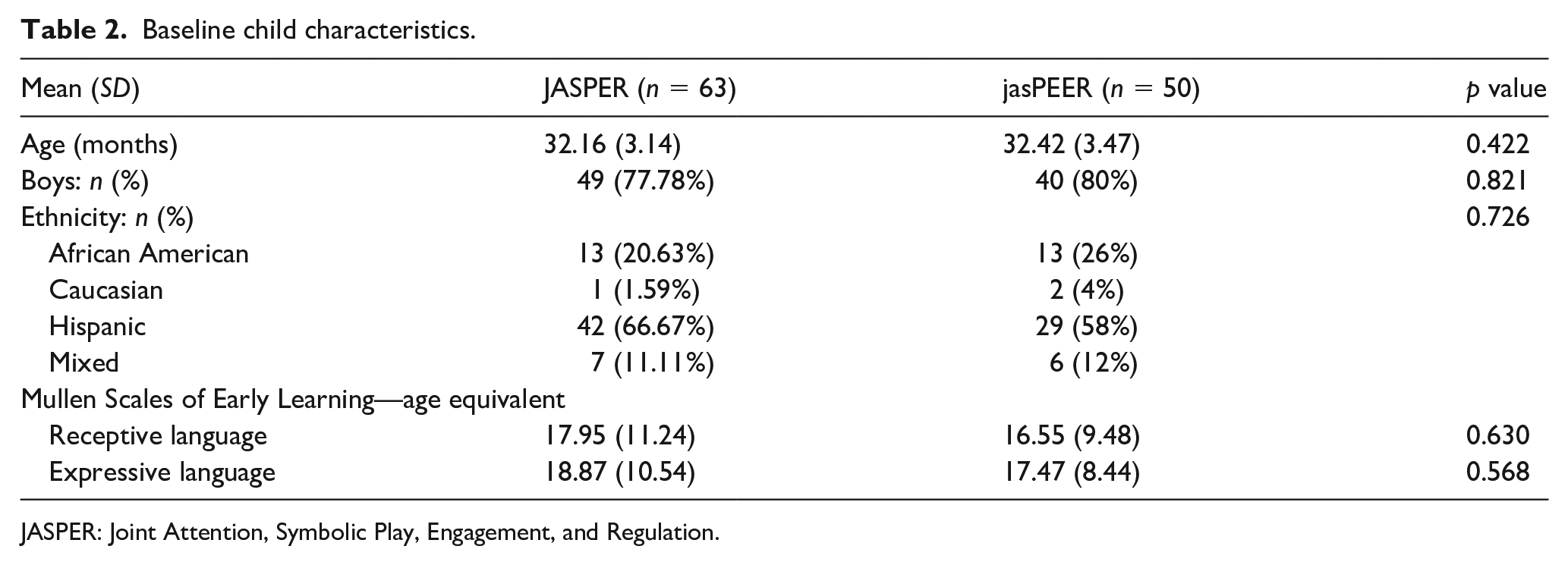
JASPER: Joint Attention, Symbolic Play, Engagement, and Regulation.
TA intervention implementation
TAs in classrooms randomized to the experimental jasPEER condition were required to learn the novel intervention adaptation. As hypothesized, with weekly support from the research team and the on-site supervisor, TAs demonstrated significant gains in implementation from entry to exit (f(1,74) = 10.23, p = 0.002). However, the average of 72% at exit (see Table 3) was slightly lower than our hypothesized 80% exit fidelity.
Primary and secondary outcomes.
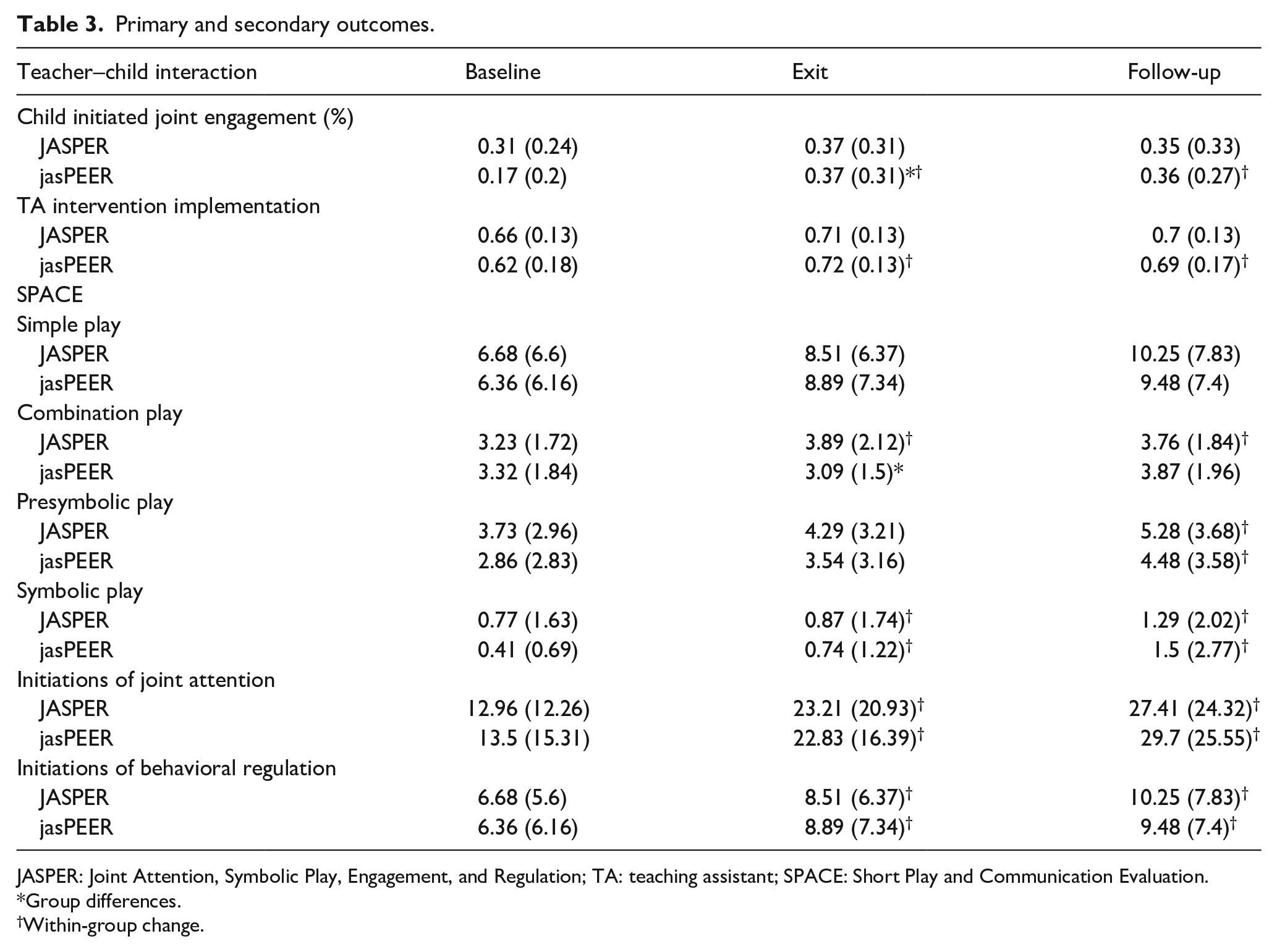
JASPER: Joint Attention, Symbolic Play, Engagement, and Regulation; TA: teaching assistant; SPACE: Short Play and Communication Evaluation.
Group differences.
Within-group change.
Children’s joint engagement
TCX
Children enrolled in classrooms randomized to JASPER demonstrated significantly greater time in child-initiated joint engagement at study entry than those in jasPEER classrooms (t(1, 244) = 3.14, p = 0.002). All TAs had JASPER experience; however, those delivering jasPEER were learning to add new strategies influencing their ability to engage the children in their early sessions. By exit, children in jasPEER classrooms showed significantly greater improvement in time jointly engaged than children in JASPER classrooms (t(1, 244) = 2.34, p = 0.02). The between-group effect remained at follow-up (t(1, 244) = 4.68, p < 0.001) where children in jasPEER classrooms showed significantly greater time jointly engaged than children in JASPER classrooms.
Within the jasPEER classrooms, the target child had the opportunity to engage with both a peer and an adult. From entry to exit, children in jasPEER classrooms made significant gains in time jointly engaged with both peer and adult (t(1, 113) = 4.60, p < 0.001). These gains were sustained at follow-up (t(1, 113) = 4.67, p < 0.001).
Peer Obs
At study entry, 23% of all toddlers showed at least one interval where they noticed their peer (parallel aware), while only 7% demonstrated at least one interval jointly engaged with their peer. No significant between group effect nor effect of time was found from study entry to exit in the number of 1-min intervals parallel aware or jointly engaged with a peer. Consistency of the peer partner was not associated with peer engagement.
Children’s IJA and IBR: SPACE
Children in both jasPEER and JASPER classrooms showed significant improvement in IJA (F(1,164) = 91.73, p < 0.001) and IBR (F(1,164) = 19.25, p < 0.001) from entry to exit. No significant between-group effect was found for either IJA (F(1,164) = 0.02; p = 0.879) or IBR (F(1,164) = 0.05, p = 0.815). However, significant site differences were found for IBR (see Figure 2 and Table 4).
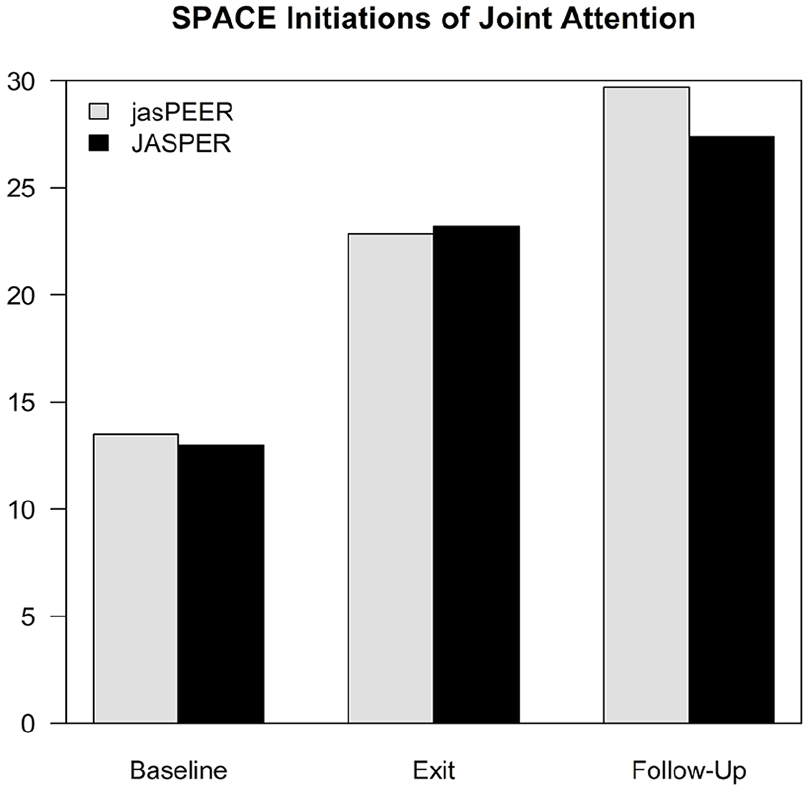
Initiations of joint attention.
Outcomes by site and intervention groups.
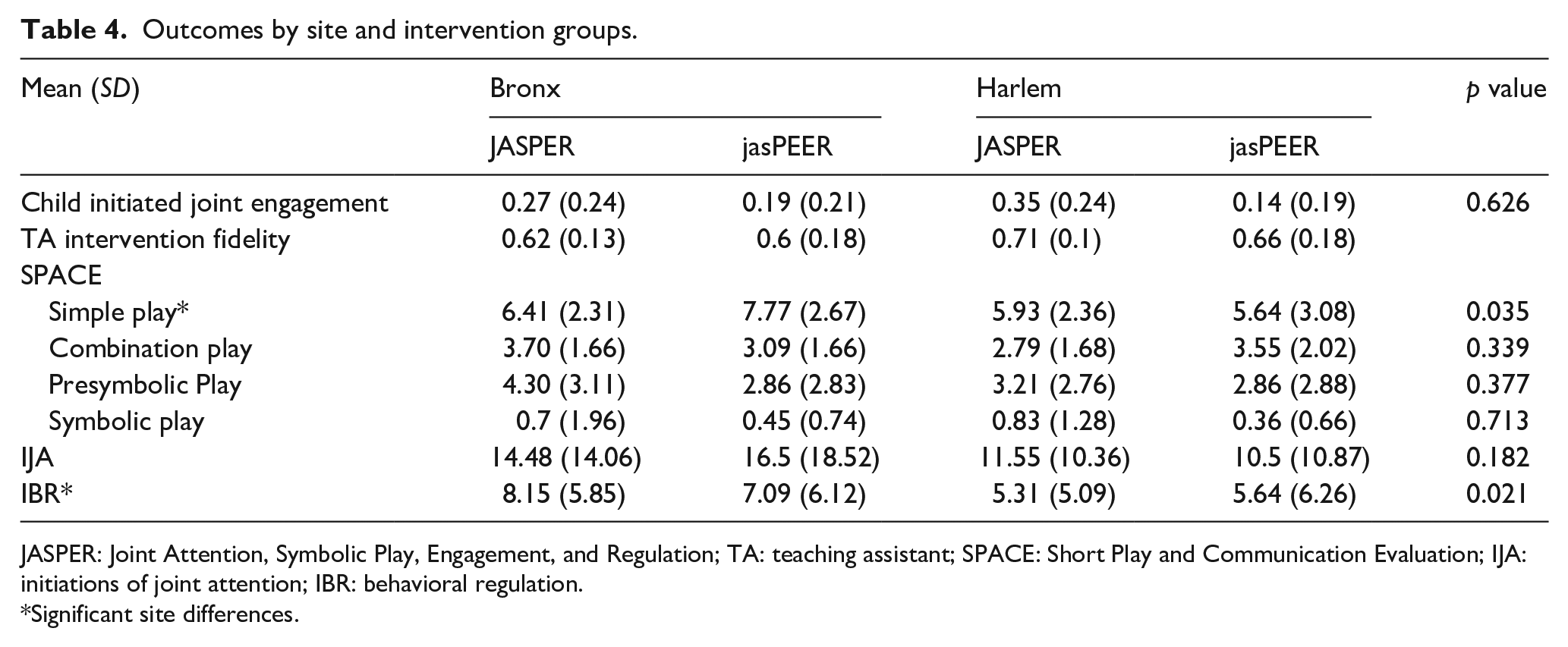
JASPER: Joint Attention, Symbolic Play, Engagement, and Regulation; TA: teaching assistant; SPACE: Short Play and Communication Evaluation; IJA: initiations of joint attention; IBR: behavioral regulation.
Significant site differences.
Children’s play skills: SPACE
Children’s types of simple play remained stable over time in both JASPER and jasPEER classrooms. For the combination level play, a significant between group difference (t(1, 160) = −2.05, p = 0.042) was found where children in jasPEER classrooms remained stable (p = 0.549) and children in JASPER classrooms demonstrated significant increases (t(1, 160) = 2.41, p = 0.017). The effect was maintained at follow-up (t(1, 160) = 2.04, p = 0.043).
Both children in jasPEER and JASPER classrooms showed significant gains in presymbolic play (F(1,162) = 23.23, p < 0.001) and symbolic play (F(1,162) = 28.91, p = 0.008). No significant between group effect was found for either presymbolic (F(1,160) = 0.09, p = 0.768) or symbolic play (F(1,160) = 0.78, p = 0.377).
Post hoc analyses: characteristics of toddlers who engaged with peers
Children were divided into two groups: (a) peer engaged (parallel aware or jointly engaged for 20%+ of the Peer Obs at any time point) and (b) not yet engaged (parallel or unengaged). A classification and regression tree (CART: Breiman et al., 1984) was applied to examine predictors of children’s time jointly engaged with peers during the unsupported Peer Obs. With 78% accuracy (p < 0.001), the CART indicated children with receptive language age equivalent score of 12 months or greater, SPACE combination play diversity of 3+ play types, and SPACE presymbolic play diversity of 2+ play types, had greater success in the Peer Obs.
Discussion
Children in both the jasPEER and JASPER classrooms made significant gains in play and social communication skills over time on the SPACE. The results indicate that children’s individual growth in these core skill domains was not disadvantaged by learning in a dyadic versus individual environment. In regard to peer engagement, toddlers with ASD demonstrated gains in time jointly engaged with their peer with adult support, where by exit, nearly all children were spending time jointly engaged with another child during the TCX. However, when the toddlers were observed with a peer and no adult support, they did not demonstrate significant gains in peer joint engagement. There are several facilitators and barriers to understanding how to measure and support toddlers’ peer engagement.
Observations of peer interactions of young children with ASD and thus, also interventions, have focused on preschool aged children. This study provided the opportunity to understand peer interactions among toddlers with ASD. Through the Peer Obs, we found that a small number of toddlers were engaged with a peer during this unsupported (non-adult-mediated) period. Post hoc analyses indicated that toddlers with greater receptive language (>12 months), combination play diversity (⩾3 play types), and presymbolic play diversity (⩾2 play types) were most likely to demonstrate peer joint engagement. Supporting children in individual JASPER to develop these skills may provide a foundation for successful jasPEER interactions. Therefore, for many toddlers, jasPEER may be an augmentation provided based on individual readiness rather than a frontline intervention for all. In JASPER, toddlers experience high cognitive demands during social play with an adult, including play flexibility, initiating to communicate their ideas and needs, and socially attending to both a partner and the shared activity. Considering this significant cognitive load, it is reasonable that mastery of some prerequisite skills may allow the cognitive space children need to engage a peer.
The emphasis on developing a range of spontaneous functional play is fitting with the demands of the jasPEER intervention. In jasPEER, children are paired based on their mastered play level. Considering that the children need to be able to comfortably play with a shared set of toys, it is critical that both children have the skills to act on the toys. For example, if both children have mastered general combination play, the staff would select toys with enough pieces for the children to build together. Since play is the context for the interaction and conversation, if a child does not yet have the skills necessary to comfortably play, then adding social engagement would be very challenging. These preliminary findings suggest a need for adaptive interventions to provide a sequence of interventions based on a child’s individual needs (Collins et al., 2004). For example, an adaptive intervention could be built that includes monitoring of children’s growth in requisite skills, where a level of child response triggers the introduction of systematic teaching with peers. Developing an adaptive intervention can provide a replicable guide for decision making in clinical practice (Almirall & Chronis-Tuscano, 2016). For children who do not yet demonstrate readiness for peer interaction, individual intervention to bolster early receptive language and play skills may maximize jasPEER gains.
Measuring peer engagement
The question of how best to measure toddlers’ social interactions is challenging. Several aspects of the Peer Obs measure were difficult for the toddlers. First, a peer play interaction with no adult support did not provide sufficient structure for many toddlers to engage with a peer. Children often looked toward the adults in the room but, who were not playing as they typically would be. Furthermore, the Peer Obs materials were selected to represent the range of play levels but be separate from the intervention materials. This required the children to generalize both their play and their social skills. Therefore, the use of familiar materials is one strategy that could reduce the demand during the Peer Obs. Another option may be to assess the children’s social skills in an environment with some adult support. For example, children also receive 90 min of classroom verbal behavior programming. A brief small group classroom activity (e.g. free play, small group activity) may provide an opportunity for peer engagement with some adult structure outside of the jasPEER intervention context.
Children’s engagement and TAs’ implementation fidelity
TAs in classrooms randomized to the jasPEER adaptation were required to adjust their strategies to systematically include a second child. Unlike in our prior small group JASPER classroom study (Chang, Shire, Shih, et al., 2016) where one adult worked with multiple children, in the current study two adults were present. The TAs learned to work together to support child-to-child interaction by adapting their JASPER strategies to fit a small group environment (e.g. ensure all four people are face to face and can access the materials, and make toy selections that match the level and interests of both children), supporting children’s initiations and responses to their peer, creating and expanding play routines where all parties have active roles (e.g. one adult manages environmental arrangement, while the second plays with the children), and fading adult support as the children become more independent. This adjustment period as the TAs find a balance with these new strategies is reflected in their implementation scores which increased to 72% on average by exit. This adjustment period may be one reason that children in jasPEER classrooms showed less time in joint engagement at entry but made significant gains to catch up to levels equal to classmates receiving JASPER by exit. Considering that the TAs required significant support to learn the jasPEER adaptation after having previously mastered the individual JASPER model, similarly to the children, TAs may benefit from first learning JASPER and then adding jasPEER.
Limitations
Specific adaptations were required to fit the center’s context. First, to conduct the study within the school year, follow-up assessment was limited to 1-month post-treatment. Second, given the service context in which each child is paired with a TA, jasPEER was adapted to include two adult–child dyads rather than one adult and 2–5 children as previously tested. The center’s TA–child ratio limits generalization of the findings to programs with high child to adult ratios. Finally, to keep measurement demands as low as possible for the center, no additional observations of children’s social interactions were conducted in other instructional settings. Therefore, examination of peer social engagement with adult support was only possible in the jasPEER sessions where another child was present.
Conclusion
TAs learned to implement a peer adaptation of JASPER over 11 weeks of live and remote supports. TAs’ strategy implementation and toddlers’ joint engagement in the jasPEER classrooms caught up to levels demonstrated by those in JASPER classrooms. The added demand to engage with a peer during intervention did not impede students’ skill gains; however, understanding factors that may prime children for growth in peer engagement may inform the timing of jasPEER augmentation.
Toddlers with ASD can make gains in peer engagement in a supported play setting but few demonstrated those skills independently without any adult support. Considering the toddlers’ age and developmental level, measuring peer social interactions in other supported settings may provide additional insights into their social growth. Furthermore, providing targeted individual intervention to bolster children’s communication and play skills may help more children prepare for peer engagement.
Supplemental Material
Appendix – Supplemental material for Peer engagement in toddlers with autism: Community implementation of dyadic and individual Joint Attention, Symbolic Play, Engagement, and Regulation intervention
Supplemental material, Appendix for Peer engagement in toddlers with autism: Community implementation of dyadic and individual Joint Attention, Symbolic Play, Engagement, and Regulation intervention by Stephanie Y Shire, Wendy Shih, Suzanne Bracaglia, Maria Kodjoe and Connie Kasari in Autism
Footnotes
Acknowledgements
The authors thank the students, staff, and leadership at the New York Center for Infants and Toddlers (NYCIT) including Michael Gordon and Evelyn Blanc for their dedication and support. In addition, they acknowledge the contributions of research assistants and graduate students who supported the organization and coding of the data, including Hayley Iwig, Kiana Krolick, Jonathan Panganiban, Alyssa Tan, Nicole Tu as well as Caitlin Elliot, who supported live and remote training at NYCIT.
Declaration of conflicting interests
The author(s) declared no potential conflicts of interest with respect to the research, authorship, and/or publication of this article.
Funding
The author(s) disclosed receipt of the following financial support for the research, authorship, and/or publication of this article: The data presented in this study were collected from participants as an extension of prior work supported by Autism Speaks (PI: Kasari; Grant # 5666)

Supplemental material
Supplemental material for this article is available online.
References
Supplementary Material
Please find the following supplemental material available below.
For Open Access articles published under a Creative Commons License, all supplemental material carries the same license as the article it is associated with.
For non-Open Access articles published, all supplemental material carries a non-exclusive license, and permission requests for re-use of supplemental material or any part of supplemental material shall be sent directly to the copyright owner as specified in the copyright notice associated with the article.
