







Abstract
Autistic individuals often experience challenges in social communication and interaction, and there is growing evidence that specific interests can help them regulate these difficulties. However, it is unclear what specific properties of these interests make them suitable for this role. In this qualitative study, we conducted semi-structured interviews with nine autistic individuals to explore the social functions of their specific interests. Data analysis followed Grounded Theory and Interpretative Phenomenological Analysis principles. Our analysis revealed that these interests have two important functions in social communication and interaction. On one hand, they provide a means of disconnecting from the often-distressing challenges in the social outside world. On the other hand, specific interests serve as a social compass: they provide structure and meaning to social reality, can foster a sense of connection with others, and provide an entryway for social participation. Based on these findings, we propose a conceptual model suggesting that specific interests enhance the experience of a psychological boundary between oneself and others, which contributes to a sense of safety during social interactions. Our study suggests that incorporating specific interests into therapeutic interventions can improve the social communication and interaction of autistic individuals, without losing sight of their personal well-being.
Lay abstract
Growing evidence shows that specific interests can help autistic individuals cope with difficulties in social communication and interaction. However, it is unclear which specific characteristics of these interests make them suitable for this coping role. Therefore, this study explored how specific interests can help autistic individuals navigate social communication and interaction. We conducted semi-structured interviews with nine autistic individuals to inquire about their perspectives on the meanings and functions of their specific interest in their (social) life. We found that specific interests served two important social functions. First, the interests provided a way to disconnect from the challenging outside world, through a shift in the attentional focus of participants. Second, the interests served as a “social compass,” providing structure and meaning to social situations and helping the participants feel more connected to others. Based on these findings, we propose a conceptual model suggesting that specific interests create the experience of a “protective boundary” between oneself and others, which helps autistic individuals feel safe during social interactions. Namely, engaging in specific interests not only creates a space where autistic individuals can retreat when they feel overwhelmed, but also provides a framework with delineations in time and space, as well as explicit rules for social interactions, which make them more predictable and regulated. The study suggests that incorporating specific interests into therapy can help improve social communication and interaction for autistic individuals while still prioritizing their personal well-being.
Keywords
Introduction
A large majority (75% to even 95%) of autistic people have a specific interest (Klin et al., 2007; Turner-Brown et al., 2011). This can be defined as a strong attachment to certain topics, objects, activities, or persons that capture their mind, heart, time, and attention (Rourke, 2019; Winter-Messiers, 2007). Examples of diverse specific interests include music, video games, toilet brushes, sculpting, Disney animated movies, trains, animal behavior, and Star Wars (Attwood, 1998; Grandin, 2006; Mercier et al., 2000; Perrin, 2015; Suskind, 2014; Winter-Messiers, 2007). The fifth edition of Diagnostic and Statistical Manual of Mental Disorder (DSM-V; American Psychiatric Association, 2013) categorizes these specific interests as limited and repetitive behavioral patterns in the diagnosis of autism spectrum disorder (ASD).
Traditional views in research literature suggest that specific interests lead to rigidity in social relationships, resulting in negative impacts on employment prospects, learning opportunities, and the quality of social interactions for autistic individuals (Klin et al., 2007; Turner-Brown et al., 2011). However, these views are challenged by the autobiographical accounts of several autistic persons and their close ones (Grandin, 2006; Suskind, 2014; Williams, 2009) and the results of the few existing qualitative studies on specific interests (Gass, 2013; Goldfarb et al., 2021; Mercier et al., 2000; Rourke, 2019; Winter-Messiers, 2007). These sources prioritize the subjective experience of autistic individuals and indicate that specific interests have an important social function, serving as a means of managing social communication and interaction. Several autistic autobiographers emphasize how they achieved social integration by focusing on their specific interests. For example, Temple Grandin (1992) writes that her successful career in livestock equipment originated with an early fixation on cattle chutes. Furthermore, previous qualitative studies by Goldfarb et al. (2021) and Winter-Messiers (2007) suggest that autistic individuals often feel confident and enjoy the recognition they receive for their expertise when discussing their interests. A specific interest can also provide a pathway into school or professional life (Goldfarb et al., 2021; Winter-Messiers, 2007). Autistic people have reported that they often relish speaking about their interests (Gass, 2013; Winter-Messiers, 2007). In addition, Winter-Messiers (2007) observed that participants spoke more animatedly about their specific interests during the interviews compared to other topics, and their speech was more sophisticated in terms of vocabulary, grammar, and word order. However, the same study suggests that autistic individuals often gauge their interlocutor’s interest before bringing up their topic of interest. If the interest is not mutual, they tend to change the subject. Participants in the study by Mercier et al. (2000) also reported how they changed their specific interests over time to reduce negative impacts on social relationships. Finally, the studies by Goldfarb et al. (2021), Rourke (2019) and Winter-Messiers (2007) indicate that autistic individuals use their specific interests to give direction and meaning to their lives, and to understand social situations and life events.
A recent study by Goldfarb et al. (2021) also contradicts a purely pathological view of other limited and repetitive behavioral patterns (e.g. body rocking, making repetitive sounds), by showing how these symptoms can have important subjective functions, such as regulating emotions, attention, and sensory experiences. Yet a social regulatory function was found only for specific interests. Given the social difficulties faced by autistic individuals, the discovery that an intrinsically motivated autistic behavioral pattern (Grove et al., 2016) possibly has an inherent social function, is of great clinical importance. However, existing research does not explore in detail why specific interests are so particularly appealing to autistic individuals and what exactly makes them suited to perform these social regulatory functions. To fully grasp this social potential, a deeper understanding of the subjective impact and functions of specific interests in the social domain, as viewed from the perspective of autistic individuals, is necessary. This study aims to address these questions. To obtain an in-depth understanding, it is important not only to focus on the role of specific interests in the social domain, but also to identify other potential functions (e.g. the impact on subjective experience of time and space, affect regulation and bodily self-experience) and to study how these different functions are interconnected. Furthermore, specific interests are not isolated phenomena, so it is crucial to examine how they are integrated into an individual’s broader life context and history. Qualitative research is well-suited to explore these dimensions. Thus, following research questions are studied with semi-structured interviews: (a) what functions and meanings do specific interests hold for autistic individuals, and (b) how do autistic individuals perceive the influence of their specific interests on their social lives?
Methods
Participants
Nine participants took part in the study. The goal of achieving a balance between depth and breadth of analysis informed our decision regarding sample size; the sample size needed to be small enough to analyze each individual account in full qualitative detail (Noon, 2018), but large enough to achieve theoretical saturation. We reached the point of data saturation at nine participants, when we gathered enough data to develop a comprehensive theoretical model that integrated the various themes identified and explained the relationships between them (Charmaz, 2014).
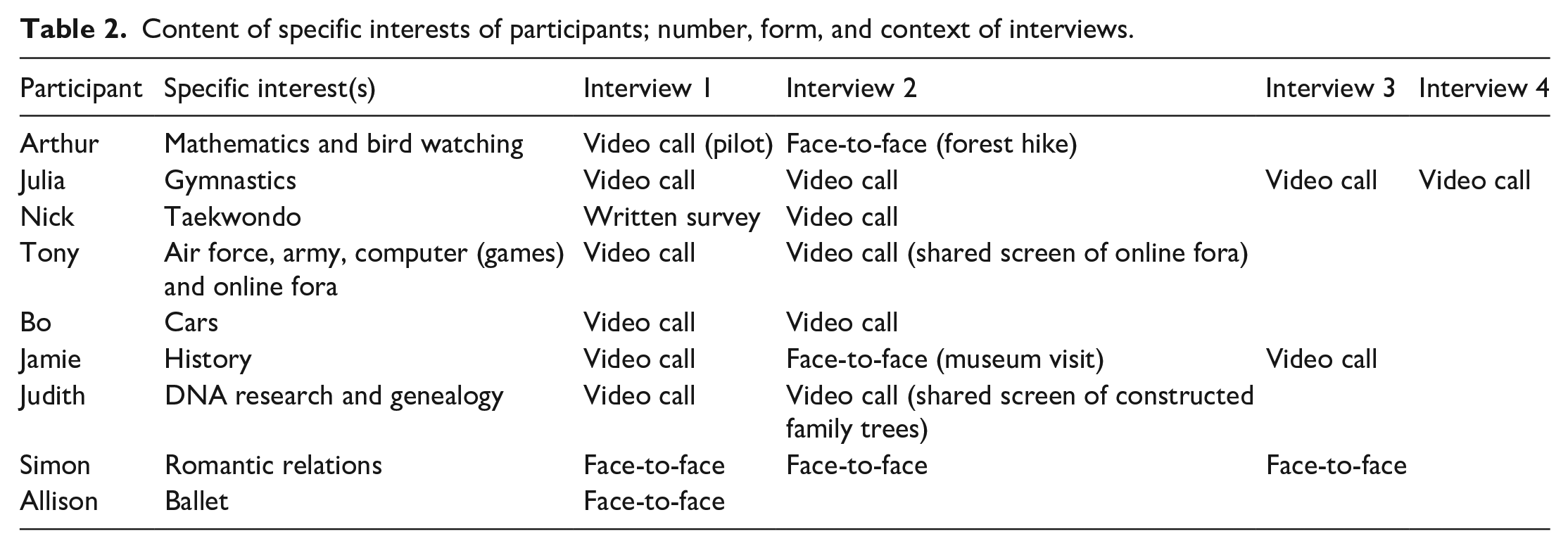
All participants were Flemish-speaking Belgian adults, and none were hospitalized at the time of the interview. To participate, individuals were required to have a self-reported diagnosis of autism according to the fourth edition of Diagnostic and Statistical Manual of Mental Disorder (DSM-IV) or DSM-V criteria, the capacity to provide informed consent, and a specific interest (defined as a “passion for a certain topic, object, activity, or person that captures time and attention”). Participants also needed to possess sufficient social and verbal skills for effectively conducting a fairly extensive interview. A total of 11 individuals were interviewed, but 2 of them were excluded from the data analysis because, after all, they did not meet the criterion of having a specific interest. These individuals expressed during the interviews that they did not have a specific interest but chose to participate in the research out of a desire to help. Participants were recruited through a call on the Facebook page of an official Flemish association for autistic people. Information about the participant characteristics can be found in Table 1, and the content of the participants’ specific interests can be found in Table 2.
Participant characteristics.
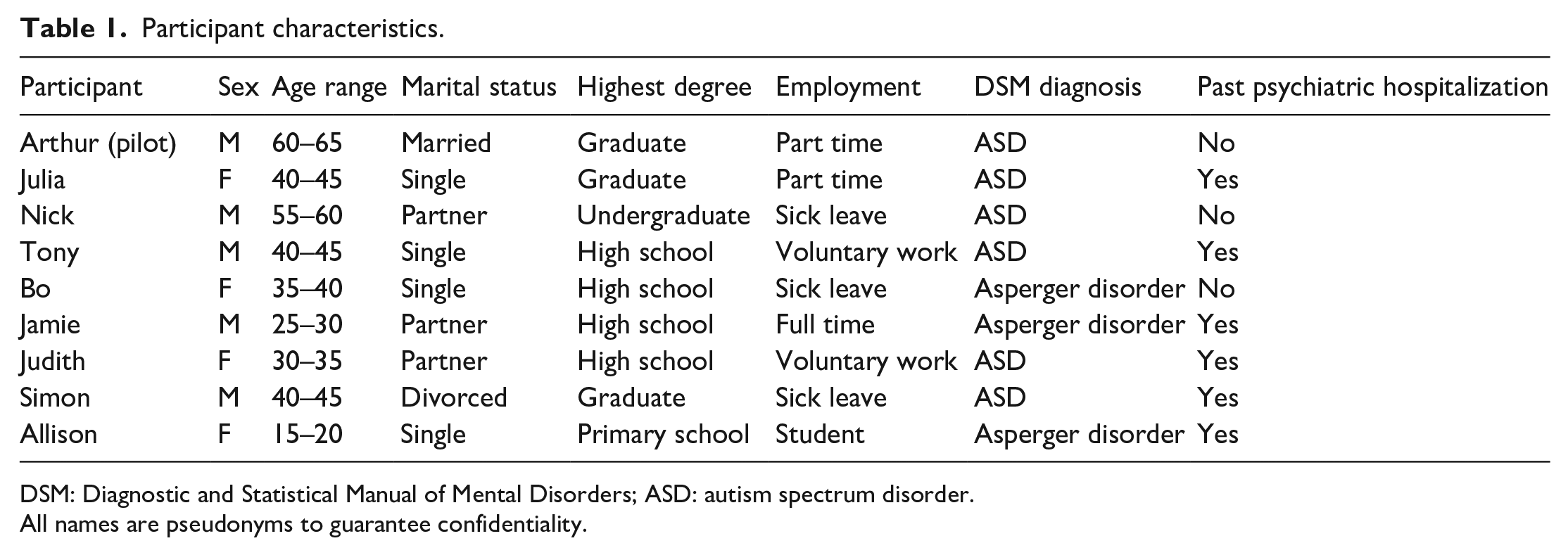
DSM: Diagnostic and Statistical Manual of Mental Disorders; ASD: autism spectrum disorder.
All names are pseudonyms to guarantee confidentiality.
Content of specific interests of participants; number, form, and context of interviews.
Data collection
Semi-structured interviews were conducted with the participants by the first author (ML), following the approval of the Ethics Committee of Ghent University Hospital (11I3422N) and with participants providing written informed consent. Table 2 provides an overview of the form, number, and context of the interviews per participant. The interviews lasted between 49 and 186 min, with an average duration of 100 min. The form of communication was adapted to participants’ preference, including face-to-face, video call, or completion of a written survey. The number of interviews varied per participant, primarily to accommodate the needs and preferences of the participants (e.g. difficulties in concentrating, fatigue during lengthy interviews). In addition, follow-up interviews were scheduled to gather additional information and/or delve into specific topics in greater depth, building upon the initial interview. Some follow-up interviews were conducted in the context of the specific interest. Typically, these interviews involved participants showing their engagement in their specific interest. For example, Tony showed the online fora in which he participated by sharing his screen during a video interview. In two cases, the interviewer actively participated in an activity related to the participant’s interest. This included visiting a historical museum with Jamie and accompanying Arthur for a bird-watching walk in the woods. These contextualized interviews served to examine the participants’ experiences with their specific interests from a different perspective, not merely relying on their verbal accounts, but also by observing their interactions with their interests or engaging in shared activities. However, the interview format remained central, with observations primarily serving as catalysts for supplementary questions. Furthermore, the interviewer sought to establish a trusting relationship with the participants by demonstrating a genuine interest in their individual passions.
The first author (ML) developed an interview guide in Dutch, and for reference, an English translation of the guide has been included in Appendix 1. During the first interview, general information was requested, regarding the diagnosis (age and context) and current life situation (studies, job, housing, family). The interviewer (ML) briefly defined specific interests and asked the participants whether they recognized this description as conforming to their own experiences, stimulating them to further elaborate and elicit a spontaneous account of their understandings. The interview guide provided a list of possible conversation topics (e.g. history of the specific interest, impact on different life domains). However, the course of the interview was tailored to the participants’ rhythm, with space to address broader life context and history, to explore how the specific interest is situated within it.
Before conducting a follow-up interview, the previous interview was re-listened to note questions and salient observations that could be further explored during the follow-up. All interviews were recorded and transcribed verbatim. The interviews and data analysis were conducted in Dutch and the excerpts used in the Results section were translated into English by ML.
Data analysis
The first author (ML) conducted the data analysis, inspired by the principles of Grounded Theory (GT; Charmaz, 2014) and Interpretative Phenomenological Analysis (IPA; Smith & Osborn, 2008). Consistent with the viewpoint of Timulak and Elliott (2018), we chose not to follow one method rigorously, but instead to adapt our approach to the research questions, giving a detailed account of the steps taken in analyzing the data. We employed GT to develop a theoretical model that addresses the research questions and IPA to perform a case-level analysis in the first phase to consider the individual life history and context. Both methods aim for a bottom-up analysis by generating codes and themes from the data and exploring the similarities and differences between individuals.
The first phase of the data analysis was focused on the individual level. For each participant, relevant interview fragments were selected based on the research questions and assigned codes. These codes were then grouped and categorized, leading to a case-conceptualization that analyzed the functions and effects of the specific interest in the life history and context of each individual participant. In the second phase, the interviews and case conceptualizations were analyzed across all participants. This phase emphasized finding recurring patterns while also considering information-rich individual differences that were theoretically relevant. The themes presented in the Results section reflect these identified patterns and were derived through a bottom-up approach. To avoid relying solely on the interpretation of a single researcher and to elevate the analysis from a purely descriptive level to a comprehensive theoretical framework, the co-authors served as auditors at various stages of the data analysis. They reviewed the analysis conducted by the first author and offered feedback on how to enhance it. This iterative process was repeated multiple times until a consensus was reached and a final draft of the results was achieved.
Following the principles of IPA and GT, we attempted to minimize the influence of our theoretical background on the initial phases of data-analysis and remained close to the participants’ own words. However, completely bracketing one’s background is never possible and can lead to superficial analyses that remain on a descriptive level (Moernaut, 2021). Our theoretical background in Lacanian psychoanalysis helped us to integrate the data in the later phases of the data analysis (i.e. the precise naming and structuring of the themes, as well as the development of the theoretical model presented in the Discussion).
The Yardley (2008) criteria for ensuring quality in qualitative research were utilized throughout the study. These criteria encompassed sensitivity to context, commitment and rigor, transparency and coherence, and impact and importance. Regular reviews of the study procedure were conducted to ensure these criteria were met at each stage of the research process.
Community involvement
Participant feedback was solicited during a pilot interview and was used to refine the interview guide, ensuring that questions were comprehensible and exhaustive. After several objections from participants, we decided to no longer refer to “special” interests, but rather to “specific” interests in the study. Following analysis, participants were invited to provide feedback on a video presentation of the results. Four participants watched the presentation, with three providing feedback. All indicated that the results were clear and identifiable, and suggested no substantive changes. One participant found the hypothesis of a fragile boundary between inside and outside an interesting way to understand autism. Another participant indicated that the suffering associated with social difficulties was underemphasized. This has been amended.
Results
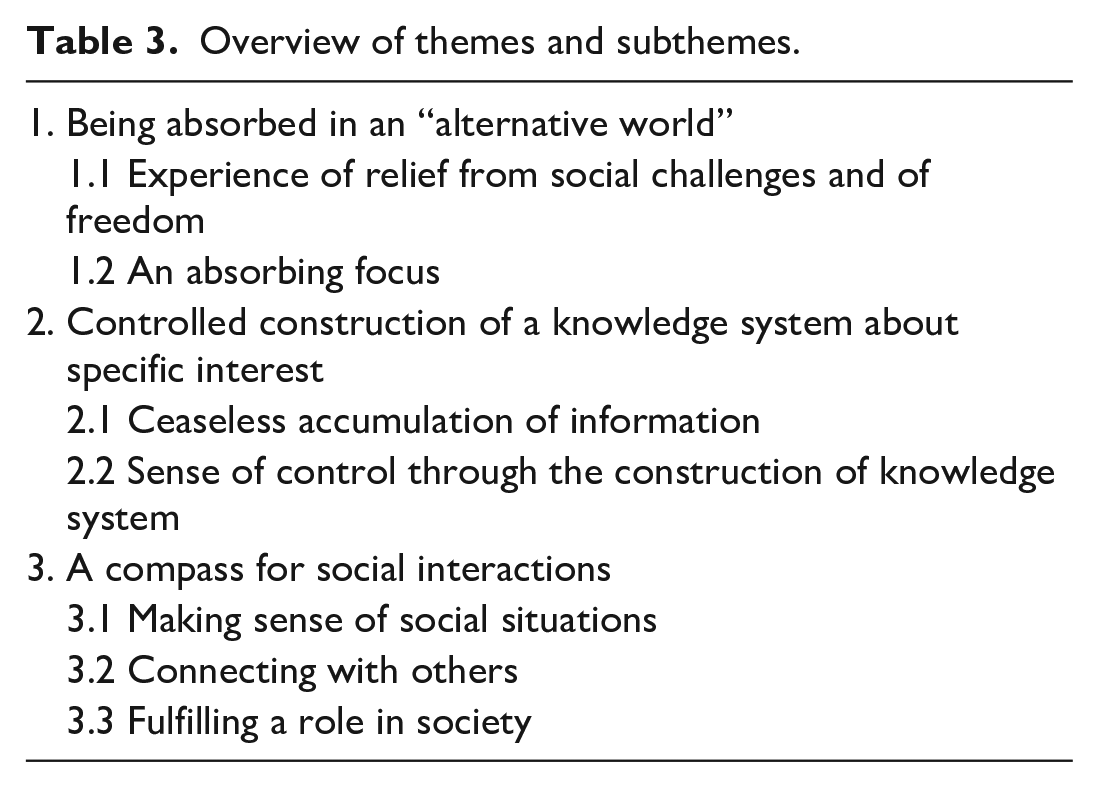
The analysis resulted in three main themes (see Table 3). First, participants reported that they deeply enjoy their specific interests, as they provide a sense of freedom. By focusing intensely on their interests, participants can ward off certain burdens of social reality, that they otherwise experience as intrusive (Theme 1). Second, by building an extensive knowledge system about their specific interest, participants appear to gain a sense of control. They use various strategies to regulate the influence of others over this knowledge system (Theme 2). Finally, the specific interest appears to not only serve as a means to withdraw from social relationships, but also as a compass, enabling participants to make sense of (social) experiences, interact with others, and participate in meaningful social activities (Theme 3). For an overview of theme frequency, see Appendix 2.
Overview of themes and subthemes.
Being absorbed in an “alternative world”
A number of participants described their specific interest as “another world,” that is, a safe space where they can recover from the challenges they face in the outside world. This provides a sense of freedom, perpetuated by the limitless nature of interest, which creates a world that can be explored endlessly. Participants described gaining access to this “other world” by shifting their focus and becoming completely absorbed in the topic of their interest. As a result, their specific interest appears to function as a shield, allowing them to retreat into a pleasurable attentional bubble and avoid the stressors of the outside world.
Experience of relief from social challenges and of freedom
All participants describe difficulties in navigating social reality (i.e. the context in which they live with others) and the profound suffering it causes. Many indicate that social interactions are mysterious to them, as if there are unwritten rules they are unaware of:
You start to feel like: “Something’s not in sync.” Like, “I want to participate in social situations, but I don’t get it or it’s not going well, or I have too many anxieties about it or something.” (Simon)
This causes perplexity in social situations. For instance, Julia mentions that her mind goes blank when someone asks her a simple question in a store. Several participants resort to rational thinking as a solution to this paralysis. They deliberately evaluate the best course of action in social situations. However, this mental exertion requires a lot of energy, and a lack of connection with others often persists. In addition, some participants find the smells and sounds of others to be irritating, as well as their need for physical affection or the expression of opinions. For our participants, therefore, social interaction is a delicate balancing act, that can quickly tip into loneliness or social exhaustion as extremes.
In contrast, participants experience enjoyment and a sense of freedom while engaging with their specific interests. Some participants literally describe these as “another world” (Jamie, Arthur). On one hand, focusing on a specific interest provides a feeling of relief by excluding the demands of social reality. They report feeling free from the ambiguity of social situations while engaging in their specific interest as they are not required to make decisions about how to handle the often-obscure expressions, needs, or expectations of others. For example, Arthur values the absence of reciprocity in mathematics:
When I talk to you and you begin asking questions or making statements, there is a dialogue. In mathematics it’s like, there’s a problem that I’m trying to solve, and the problem itself doesn’t respond, or ask questions back, so I can continue working until I find the solution. This is different from something that involves reciprocity.
Julia, in her turn, finds comfort in the clear expectations within her area of interest. She frequently experiences panic during leisure time, but when she engages in gymnastics, she finds solace in the coach’s instructions:
There was no choice. The instructions were clear: “Now we will do this gymnastic apparatus, and now you will do this.” This also determined what you did at home: if you’re at the gym from 5 to 8, your schoolwork must be squeezed in between, and all you can do afterwards is eat and sleep. So, you don’t have to make any decisions, like, “Now I’ll do this.”
On the other hand, the specific interest also seems to provide a more radical form of freedom, characterized by the limitless range of possibilities within their specific interest realm. Several participants describe it as an inexhaustible universe that they can explore endlessly:
What is an immeasurable source of fantasy? That must be history, certainly. It can be drawn endlessly, thought about endlessly, and dreamt about endlessly. You can never fully know everything about it. (Jamie)
In video games, Tony’s specific interest, this limitless quality manifests itself through entering a fantasy world of virtual characters unconstrained by physical limitations, such as mortality, frailty, or gravity.
An absorbing focus
While engaging in their specific interests, participants experience a shift in their attentional focus, withdrawing into an attentional bubble and shutting off from the outside world. Nick describes this process as being so focused on something that everything else disappears from sight and that you wake up from your bubble a few hours later and think: “Is it dark already, did I miss out on today?”
By becoming absorbed in specific interests, participants tend to lose their sense of time and space:
I was wandering in a forest in Estonia, and I completely lost my sense of orientation and time. It was a fantastic feeling, as if I were an animal, roaming its territory, just continuously walking. (Arthur)
Furthermore, attention for sensations originating from their body and the environment fades into the background. Julia recounts that she does not notice the need for food when she is taking pictures at a [gymnastics] competition.
This shift in attention seems to occur automatically, with participants feeling as though their specific interest attracts their attention. For example, Bo is drawn to looking at cars because you never know if you will miss a nice car. However, participants also actively seek this shift in attention to disengage from sensory stimuli or to seek distraction from worries and negative emotions:
If you focus on your movements, you can focus less on your thoughts. So, for the hours I was dancing, this created a kind of peace. [. . .] If I had schoolwork, I was stressed; when I went to ballet, I didn’t have to think about anything for two hours straight. I just immersed myself in dancing. (Allison)
Given the absence of social pressures and its inherent appeal, participants are tempted to become fully absorbed in their specific interests. However, most do not consider this to be desirable and seek ways to mitigate this risk and remain connected to the outside world, for example, by adhering to a strict schedule.
Controlled construction of a knowledge system about specific interest
By dedicating a significant amount of time to their specific interest and developing extensive knowledge about it, participants attain a sense of mastery. It is crucial for the participants to have control over the construction of the knowledge system, thus regulating the involvement of others.
Ceaseless accumulation of information
Engagement with a specific interest results in extensive knowledge about it:
There’s always this “desire to know.” It’s not enough just to register things and stick to observation. It’s not like poets who simply experience light and write about it. (Arthur)
However, participants consider it impossible to achieve full knowledge about their interest. As Judith describes, it’s a hobby that you could do 24 h a day, because it never stops. There is always more information that comes online, you can keep researching further and wider. For most participants, this impossibility is reassuring, as it turns their specific interest into a place they can go to anytime without an ending point.
In this context, knowledge should be understood broadly, encompassing different types of information, such as facts, theories, formulae, sensory information (e.g. sounds and body movements), stories, or philosophies. For example, Bo’s knowledge system about cars consists of engine sounds, images, license plates, and facts about cars.
Sense of control through the construction of knowledge system
Such construction of a knowledge system appears to lead to a sense of control in two ways: (a) the specific interest provides a framework with explicit rules that justifies the regulation of the involvement of others in acquiring knowledge, and (b) mastery in a knowledge domain helps participants establish an identity as experts.
First, the participants indicate that regulating others’ input regarding the information included in their knowledge system is important. More precisely, they want to avoid the arbitrariness of others’ opinions. As discussed, participants frequently encounter this challenge in everyday social situations due to implicit rules that govern appropriate responses, often feeling unfamiliar with them. However, in the specific interest domain, there appear to exist more well-defined rules that can be employed to regulate others’ input. Several participants emphasize the importance of objectivity within their specific interest domain, which enables the development of a personal set of indisputable facts. For example, Arthur is skeptical of orally and written transmitted knowledge about nature and relies more on his own observations:
In almost all books, it’s written that the middle-spotted woodpecker only occurs in oak forests [although it also occurs in beech forests]. It’s a typical issue with these magazines: they all copy each other, but they don’t investigate further to find out how it truly is.
Julia also emphasizes the importance of objectivity. She refuses to write competition reports for a certain organization because they once pressured her to embellish the performances of gymnasts:
In my opinion, it should simply be correct. You shouldn’t just say, “She did that beautifully!” If she falls afterwards, then she falls.
For Jamie, it is rather the lack of a clear objective criterion for determining the accuracy of information that makes history so attractive. He is particularly interested in ancient historical periods, as all individuals from that era have passed away. This allows him to fantasize freely, without the risk of being interrupted and told, “No, I’m one hundred percent sure that wasn’t the case.”
However, despite participants restricting the involvement of others, their constructed knowledge systems are not entirely private. After all, their specific interests are part of social reality: there are other people interested in the same topic, and participants build their knowledge system by adopting carefully selected information from others. Therefore, specific interests concern a defined domain of social reality, where rules can be determined that participants view as more straightforward. For example, Judith primarily relies on DNA research to construct her family tree:
DNA doesn’t lie; it represents your genes and cannot be manipulated. The information it provides is either true or false; there is no middle ground. You can’t say: “It’s a little bit true.” Either you are related, or you’re not.
As a result, participants report taking pleasure in gathering knowledge about their interests, and social interactions centered around these interests are perceived as comfortable. Thus, the role of a specific interest as a safe zone in broader social reality seems to lie in the regulation of input from and interaction with others, rather than in their radical exclusion.
Second, participants feel in control within their specific interests due to their expertise in their respective interest domains. Through continuous refinement of their knowledge, they gain a deep understanding of the intricacies of their field and how to effectively apply their expertise. The mastery of their interest provides participants with a feeling of self-worth and establishes their identity as experts. Arthur describes it as being someone in something:
The bar was continually set higher, requiring you to always have more knowledge, conduct more research, and solve more challenging mathematical problems. [. . .] It gave me a feeling like, in this I am something. In other areas I felt inferior, but in mathematics I was something.
A compass for social interactions
While the specific interests help to ward off distressing aspects of social reality, they also provide opportunities for participants to connect with others. These interests can act as a compass in navigating social relationships, as participants report often using their constructed knowledge systems to understand social situations and determine how to act on these. In addition, the shared practice of a specific interest seems to foster a sense of belonging with others. Finally, specific interests assist participants in participating in society.
Making sense of social situations
Some participants utilize the knowledge system constructed around their interest to interpret and organize social interactions. For instance, Bo has difficulty recognizing people by their faces, but is able to do so with the help of their cars:
Even in the dark, I can easily differentiate between my dad, my neighbor, or someone else based on the way their car lights shine [through the windows as they pull into the driveway].
Furthermore, this knowledge system provides some of the participants with concrete guidelines to determine how to act in the outside world. Simon, for instance, at some point forced himself to put his theoretical knowledge about interactions between men and women in practice. For example, during a dance night, he made a conscious effort to touch others when greeting them, following the premise that touch helps foster connection with others. Similarly, Nick utilizes the taekwondo philosophy to determine how to live his life:
In Eastern culture, it [i.e., underlying philosophical principles of taekwondo, e.g., the interplay between body and mind] is a way of life, and many of those teachings are also relevant in Western society. I try to integrate these into my life.
Connecting with others
In general, specific interests allow participants to feel connected with others. This was evident in the narratives shared by participants about their first encounter with their interest. For several, engaging with the interest sparked positive connections with others. For instance, Bo remembers having a great time with her uncle on the bumper cars at a fair, and Jamie recounts being fascinated by his grandfather’s historical tales as a child. For other participants, their interest was initiated by others noticing their aptitude for it:
It happened in the living room with my aunt. I don’t remember what I did, but it was something I wasn’t expected to be able to do on my own. My aunt then took me to the gymnastics club, and after one session, they asked, “Do you want to join the competition team?” (Julia)
Later in life, the specific interest also enables participants to feel connected with others who share the same interest. They enjoy talking about it and bringing it into practice with others:
When you accidently vibe with someone on the dance floor, it feels like, “Wow!” When you really click with another person on a physical level, it gives—phew—a huge rush, it can’t be forgotten, it’s as if a piece of you stays with your dance partner and vice versa. (Simon)
Participants indicate that social interactions facilitated by their specific interest proceed more smoothly. The interest provides a framework with delineations in time and space, as well as explicit rules for social interactions, which make them more predictable and regulated. For instance, Tony feels secure communicating in online fora because of the presence of moderators, established communication rules, and the division into chat rooms based on topic. In addition, many participants feel more comfortable discussing their specific interest than other subjects and could spend hours doing so (Nick).
However, some participants also report negative social experiences related to their specific interests. People can be dismissive of their interests, or by following their interest some ended up in unsafe environments (i.e. a hobby club with an insensitive coach), where little consideration was given to their needs. This leads some participants to avoid discussing their interest, if not quit it.
Fulfilling a role in society
For most participants their specific interest provides opportunities for social participation, such as joining hobby clubs, volunteering, or turning their interest into a profession. They utilize their expertise to help others. For instance, Judith assists others in constructing their family trees, and Bo advises people on purchasing a new car. Although social commitments through their specific interests can sometimes be challenging, due to social exhaustion or conflicts with others, participants generally feel fulfilled by the experience of being of value to others.
Discussion
Several qualitative studies (Gass, 2013; Goldfarb et al., 2021; Mercier et al., 2000; Rourke, 2019; Winter-Messiers, 2007) and autobiographical testimonies (Grandin, 2006; Suskind, 2014; Williams, 2009) suggest that specific interests have social potential for autistic individuals. However, to realize this potential, a more thorough understanding is needed of the functions that specific interests fulfill allowing autistic individuals to socially participate. This study addressed this knowledge gap.
The analysis revealed that specific interests play a dual role in the social sphere. On one hand, participants use their interests as a means of shielding themselves from the difficulties and stress of navigating social situations. By immersing themselves in their specific interest, they enter an attentional bubble in which they experience relief and freedom and build a comprehensive knowledge system, carefully regulating the input of others. On the other hand, the results also demonstrate that these interests function as a social bridge in various ways, enabling participants to engage with others and society. First, some participants apply the knowledge system constructed around their interests to better understand and navigate broader social interactions and situations. Furthermore, they report feeling a sense of safety in social interactions facilitated by shared interests, as these interests provide a greater level of regulation and predictability. The participants also describe that engaging in interests alongside others can foster a sense of belonging, which stands in contrast to the prevailing social malaise experienced by many of them. Finally, specific interests appear to contribute to the participation of participants in hobby clubs, volunteer work, and professional life.
In the existing research literature, the dual social function of specific interests is paradoxical. Some qualitative studies demonstrate that specific interests contribute to connectedness with others, civic engagement, and a better understanding of the (social) outside world (Gass, 2013; Goldfarb et al., 2021; Mercier et al., 2000; Rourke, 2019; Winter-Messiers, 2007). The study by Grove et al. (2018) also showed that intrinsically motivated specific interests positively predicted satisfaction with social contact. In contrast, other studies such as those by Klin et al. (2007) and Turner-Brown et al. (2011) confirm a more traditional view that specific interests lead to rigidity and obstruct social adaptation. The conflicting perspectives of these strength and deficit approaches might seem difficult to reconcile.
Based on our results, we propose a conceptual model (see Figure 1) to explain this seemingly contradictory dual social function. We argue that the experience of a boundary between self and other is crucial for safe and enjoyable interactions, as it “engenders an inner space in so far as it protects the subject from the outside world,” (Brenner, 2022, p. 8). This psychological boundary appears to be particularly vulnerable in autism (Brenner, 2022; Meltzer, 2018; Tordjman et al., 2019). A recent study conducted by Taels et al. (2023) clearly observed such vulnerability. Their results demonstrate how the experience of a fragile boundary between self and other/environment in autistic functioning significantly influences various experiential dimensions: “on a physical level, participants described an intrusion of their body’s boundaries; on a cognitive level, a lack of a filter was prominent; on a social level, the crossing of personal boundaries was especially experienced as problematic and, finally, on an affective level, fear, anger, exhaustion and withdrawal were mainly described as reactive to experiences of intrusion,” (Taels et al., 2023, p. 9).
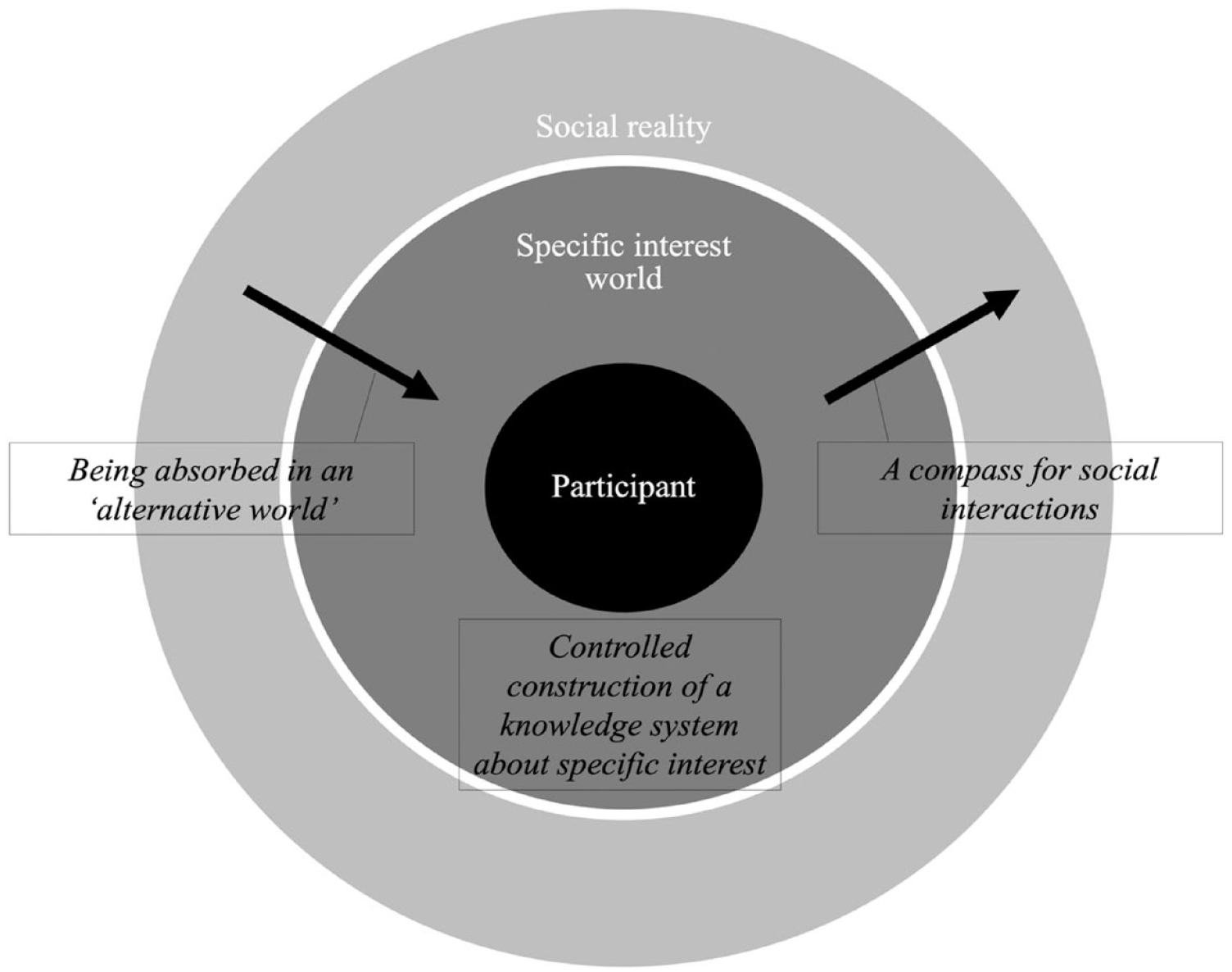
Model on the social functionality of specific interests.
The findings of this study show that specific interests reinforce the boundary between the individual and the external (social) world, depicted by the bold white line on Figure 1. This boundary can manifest itself in a solid way, where participants shut off from the disruptive outside world through the engagement with their specific interests in social isolation. This aligns with the function of insistence on sameness behaviors (e.g. insistence on eating the same foods every day) in autism, which serve as a self-regulatory mechanism, aiding autistic individuals in avoiding potentially distressing stimuli and environments and thus reducing anxiety (Uljarević et al., 2017). However, our study shows that the specific interest can also install a more permeable boundary, enabling participants to participate in safer social interactions within the delineated context of their interest. In both cases, the specific interest seems to provide a barrier against the unpredictability of the (social) world, either by shutting it out or partially regulating it.
Furthermore, this conceptual model and the results offer possible explanations for the findings by Goldfarb et al. (2021) that specific interests have greater potential for social participation than other limited and repetitive symptoms (e.g. sorting objects, body rocking) in autism. One possible explanation is that specific interests are part of social reality (as depicted in the concentric circles of the specific interest world and social reality in Figure 1) and are less idiosyncratic than other repetitive symptoms. Participants exchange information with others to construct their own knowledge system. In addition, hobby clubs and Internet fora gather individuals spontaneously around shared interests, making it easier to join a group. A second possible explanation is that knowledge about specific interests can serve as a sense-making framework for structuring and interpreting the chaotic outside world. This idea of specific interests providing meaning and direction to the world is also mentioned in the works of Winter-Messiers (2007) and Rourke (2019).
The presented model is partly consistent with existing theoretical frameworks. Occupational therapy states that specific interests can develop into “meaningful occupations,” which are everyday activities that “are central to a client’s health, identity, and sense of competence and have particular meaning and value to the client,” (Boop et al., 2020, p. 7). They help to mitigate anxiety and engage autistic individuals in occupational pursuits related to their preferred interests (Koenig & Williams, 2017). Furthermore, Winter-Messiers (2007) developed theoretical hypotheses in her qualitative study on specific interests. She posits that there is a fusion between the interest and the core self-image. More specifically, it is through their specific interest that autistic individuals define themselves and acquire a social approach, as well as a way of organizing and interpreting life.
However, since these two frameworks do not discuss the construction of a psychological boundary, they provide no explanation for the seemingly contradictory dual social function of specific interests. This is recognized by psychoanalytic theories that view the root cause of autism in terms of a lack of psychological boundary formation between the social and bodily self and the outside world (Burgoyne, 2000, cited in Brenner, 2020). For instance, Tustin (1981) locates the essence of autism in traumatic, intrusive experiences of the social world as an alien “not-me” environment that poses a threat to one’s subjective sense of bodily integrity. Recent Lacanian authors (Brenner, 2020; Laurent, 2012; Maleval, 2021) view repetitive motor movements, object or speech use, and specific interests as spontaneous attempts by autistic individuals to create a “protective border” in their psyche against intrusions from the social world.
The findings emphasize the significance of clinical interventions already promoted by occupational therapy (Koenig & Williams, 2017), affinity therapy (Suskind, 2014), and various psychoanalytic authors (Brenner, 2020; Laurent, 2012; Maleval, 2021). When counseling autistic individuals, it can be crucial to respect their individual pace and not impose social adaptation. Isolating behaviors may serve a significant purpose given the fragile boundary experience in autism. Hence, it is recommended to examine the individual functions of such behaviors and find ways for autistic persons to connect with the outside world in their own pace and unique manner. In addition, specific interests can provide a non-intrusive entry point to facilitate contact with extremely isolated autistic individuals. For example, Owen Suskind’s family utilized dialogues from his beloved Disney movies to communicate with their son, who became mute at the age of 3 (Suskind, 2014).
Finally, we mention some limitations of our study and suggestions for future research. First, our purposive sample consisted of autistic individuals with strong social and verbal skills, providing rich testimonies suitable for qualitative analysis. Future studies could use methods such as participant observation to study the experiences of less verbally and socially skilled individuals. Specifically, it would be interesting to examine if the dual social function is also present in this population. Second, none of the participants of this study had more unusual interests, such as a fascination for dates, collecting unusual items, or focusing on the visual aspects of objects. However, a study conducted by Spackman et al. (2023) discovered that young autistic individuals with unusual interests exhibited significantly greater impairments in social and communication skills compared to those with more typical interests, such as history, vehicles, or science. Therefore, further research is necessary to investigate the impact of specific interests on the social lives of autistic individuals with more unusual interests. Third, our sample consisted only of autistic adults. It is possible that the processes described in the results are a result of adult maturity. Thus, it would be interesting to examine whether specific interests serve the same functions in childhood and adolescence. In addition, the participants in this study also reflected retrospectively on the evolution of their specific interests throughout their life history, including childhood, adolescence, and specific life events. Although this information was analyzed in the case conceptualizations, it was not possible to include it in the results given the scope of this article. Case studies would be more appropriate to address this research question in depth and with respect for the individuality and complexity of the participants’ life stories. Finally, this study focused on the role of specific interests in social life. Some participants had a specific interest in physical activities and reported positive effects on their bodily experience (e.g. improved motor coordination and regulation of physical interactions with others). This dimension needs further examination.
Conclusion
The analysis of the social functionality of specific interests for autistic individuals has revealed their dual role as both a means of self-protection and a social bridge. They provide a safe, always available bubble in which autistic individuals can retreat from social challenges, but also an entrance to safely navigate the social outside world. To reconcile these seemingly opposite functions, we propose the hypothesis that specific interests promote the experience of a psychological boundary between oneself and others. This might foster a sense of safety by mitigating the unpredictability inherent in social interactions.
Supplemental Material
sj-docx-1-aut-10.1177_13623613231193532 – Supplemental material for Specific interests as a social boundary and bridge: A qualitative interview study with autistic individuals
Supplemental material, sj-docx-1-aut-10.1177_13623613231193532 for Specific interests as a social boundary and bridge: A qualitative interview study with autistic individuals by Marie Lizon, Liesbeth Taels and Stijn Vanheule in Autism
Supplemental Material
sj-docx-2-aut-10.1177_13623613231193532 – Supplemental material for Specific interests as a social boundary and bridge: A qualitative interview study with autistic individuals
Supplemental material, sj-docx-2-aut-10.1177_13623613231193532 for Specific interests as a social boundary and bridge: A qualitative interview study with autistic individuals by Marie Lizon, Liesbeth Taels and Stijn Vanheule in Autism
Footnotes
Declaration of conflicting interests
The author(s) declared no potential conflicts of interest with respect to the research, authorship, and/or publication of this article.
Funding
The author(s) disclosed receipt of the following financial support for the research, authorship, and/or publication of this article: This work was supported by the special research fund (BOF) of Ghent University under Grant BOF20/DOC/016.
Ethical approval
The project was approved by the Ethics Committee of Ghent University Hospital (11I3422N). Participants provided written informed consent.

Supplemental material
Supplemental material for this article is available online.
References
Supplementary Material
Please find the following supplemental material available below.
For Open Access articles published under a Creative Commons License, all supplemental material carries the same license as the article it is associated with.
For non-Open Access articles published, all supplemental material carries a non-exclusive license, and permission requests for re-use of supplemental material or any part of supplemental material shall be sent directly to the copyright owner as specified in the copyright notice associated with the article.
