






Abstract
Camouflaging of autistic traits has gained increasing attention as a psychological construct capturing strategies used to conceal or compensate for autistic characteristics in social contexts. Given the cultural specificity of social behavior, the adaptation and validation of measurement instruments across diverse populations are essential. The present study aimed to culturally adapt and validate the Persian version of the Camouflaging Autistic Traits Questionnaire (CAT-Q) and to examine its measurement invariance and group differences between adults with high and low autistic traits in Iran. Following a standardized forward–backward translation procedure and expert panel review, the Persian CAT-Q was administered to 1,100 individuals, of whom 948 (aged 15–50 years) met the inclusion criteria after data screening. Construct validity was examined using confirmatory factor analysis (CFA). Convergent validity was assessed through correlations with the social camouflage subscale of the Comprehensive Autistic Trait Inventory (CATI), and reliability was evaluated using Cronbach’s alpha and mean inter-item correlations. CFA supported the original three-factor structure of the CAT-Q (compensation, masking, and assimilation) with acceptable fit indices (Comparative Fit Index [CFI] = 0.91, Root Mean Square Error of Approximation [RMSEA] = 0.06). Measurement invariance testing supported configural, metric, and scalar invariance across high and low autistic traits groups, indicating comparable measurement properties. Convergent validity was confirmed through significant correlations with the social camouflage subscale of the CATI. Internal consistency was strong, with Cronbach’s alpha coefficients ranging from .66 to .89 across subscales and .89 for the total scale, although the assimilation subscale showed comparatively lower reliability. The Persian version of the CAT-Q demonstrates satisfactory psychometric properties and measurement equivalence across groups, supporting its use in research contexts within Iran. Findings should be interpreted with attention to cultural context and the relatively lower reliability of the assimilation subscale.
Lay Abstract
Many autistic people use “camouflaging” to cope in social situations. Camouflaging means trying to hide autistic traits or to compensate for social difficulties so that others will not notice differences. These efforts may help someone blend in, but they can also be tiring and may affect wellbeing. Because social rules and expectations differ across cultures, researchers and clinicians need tools that are carefully adapted for each language and society. This study adapted the Camouflaging Autistic Traits Questionnaire (CAT-Q) into Persian and examined whether it works well for adults in Iran. The questionnaire was translated using a standard forward–backward process, reviewed by specialists for clarity and cultural suitability, and then tested in a large Iranian sample recruited online. We examined whether the Persian CAT-Q keeps the same three parts found in earlier research: (1) compensation (actively managing social situations), (2) masking (hiding autistic traits), and (3) assimilation (trying to fit in by suppressing one’s natural style). We also tested whether the questionnaire measures camouflaging in the same way for people with higher versus lower levels of autistic traits, so that comparisons between these groups are fair. Overall, results showed that the Persian CAT-Q is a useful and consistent measure of camouflaging in Iranian adults. The “Assimilation” part was somewhat less consistent than the other parts, so it should be interpreted with extra care. This Persian version can support future research and may help improve understanding of hidden social effort and support needs in Iran.
Introduction
Autism spectrum disorder (ASD) is a neurodevelopmental condition characterized by persistent difficulties in social communication and interaction, alongside restricted and repetitive behaviors (American Psychiatric Association, 2013). Although ASD has been increasingly recognized worldwide, accurate identification remains challenging, particularly due to substantial heterogeneity in symptom presentation across individuals (Fombonne, 2020; Lai et al., 2017). This complexity is further compounded by social and cultural influences that shape the way autistic traits manifest and are perceived within different populations (Beck et al., 2020; Scheerer et al., 2020).
In recent years, growing attention has been directed toward the construct of camouflaging, which refers to the conscious or unconscious use of strategies aimed at concealing or compensating for autistic characteristics in order to navigate social situations (Hull et al., 2019; Livingston & Happé, 2017). Such strategies may include deliberately maintaining eye contact, practicing conversational exchanges in advance, or imitating the social behaviors of peers (Hull et al., 2019; Tierney et al., 2016). These adaptive responses can emerge either implicitly, as a result of prolonged efforts to align with social expectations, or more deliberately, for instance, by selecting subtle forms of self-stimulatory behavior (Miller et al., 2021). Although these practices may temporarily enhance social acceptance, research indicates they are frequently linked to adverse mental health consequences, such as elevated stress, anxiety, depression, and emotional exhaustion (Cage et al., 2017; Lai & Baron-Cohen, 2015; Milner et al., 2022).
A growing body of evidence indicates that camouflaging contributes to diagnostic disparities, especially among women and gender-diverse individuals (Bargiela et al., 2016; Parish-Morris et al., 2017). Considering the benefits of early and accurate autism detection, along with the tendency of autistic individuals to employ camouflaging strategies to mask their characteristics, there is a growing demand for refined assessment tools capable of identifying the distinctive ways in which they hide or compensate for their challenges (Hannon et al., 2023; van der Putten et al., 2024).
Several methods have been proposed to quantify camouflaging, ranging from discrepancy approaches (i.e., measuring the gap between internal autistic traits and external presentation) to self-report measures (Lai et al., 2017; Livingston et al., 2020). Among these, the Camouflaging Autistic Traits Questionnaire (CAT-Q), developed by Hull and colleagues (2019), has become the most widely used self-report instrument. The CAT-Q assesses three dimensions of camouflaging—masking, compensation, and assimilation—demonstrating robust psychometric properties across different populations (Cassidy et al., 2020; Hull et al., 2019). Its application has extended across both clinical and non-clinical groups, providing critical insights into the prevalence and correlates of camouflaging behaviors (Beck et al., 2020; Scheerer et al., 2020).
The CAT-Q was originally developed and validated by Hull et al. (2019), demonstrating a robust three-factor structure (masking, compensation, assimilation), high internal consistency, and expected associations with anxiety and depression, alongside higher mean scores in females. Subsequent validations across different cultural contexts have both replicated and extended these findings. For instance, studies in the United Kingdom and the United States consistently confirmed the three-factor structure and gender differences (Beck et al., 2020; Livingston et al., 2020), whereas German and Italian validations revealed acceptable fit indices but somewhat weaker reliability for the assimilation subscale (Fombonne, 2020; Scheerer et al., 2020). Similarly, research in East Asian populations indicated that cultural norms shape the extent and strategies of camouflaging, yielding variations in mean scores and correlational patterns (Hongo et al., 2024).
Iranian Culture
Iran represents a culturally diverse society comprising multiple ethnic and linguistic communities that, despite their diversity, are unified within a shared national identity. Within this cultural context, norms surrounding social self-presentation play a central role in regulating individual behavior. In particular, the cultural concepts of āberu (social face or honor) and shaxsiat (character or personality) emphasize self-control, social conformity, and the avoidance of behaviors perceived as socially inappropriate. Cultural research indicates that Iranian society places strong value on collectivism, emotional restraint, and the maintenance of social harmony, whereby individuals are encouraged to preserve their public image and avoid actions that may invite social judgment or disapproval (Hosseini, 2022).
These cultural patterns can be understood through Goffman’s (1967) theory of facework, which conceptualizes social interaction as a continuous process of managing one’s social “face” through avoidance and corrective strategies. Within this framework, camouflaging of autistic traits may be viewed as a culturally reinforced form of facework, employed not only to reduce individual distress but also to avoid stigma and maintain social harmony. In the Iranian context, such practices may be driven by deeply internalized expectations related to respectability, modesty, and emotional self-regulation.
Alongside this cultural perspective, Iranian empirical research has shown that autism as a diagnostic and social construct has undergone substantial conceptual expansion over recent decades. Studies by Samadi and colleagues demonstrate that changes in diagnostic frameworks, increased professional awareness, and the development of screening programs have contributed to a broader clinical and social understanding of autism in Iran (Samadi & McConkey, 2015; Samadi et al., 2020). Nevertheless, evidence suggests that social stigma, concerns related to āberu, and structural barriers to accessing services may still contribute to delayed diagnosis or the concealment of autistic characteristics (Shahrokhi et al., 2021).
Moreover, experiences from the cultural adaptation and validation of autism screening and diagnostic tools in Iran indicate that instruments developed in Western contexts may lack sufficient sensitivity when applied without cultural consideration. Iranian studies have highlighted that the psychometric structure and functional utility of such tools may differ across sociocultural settings (Samadi & McConkey, 2015; Samadi et al., 2020). Taken together, these findings underscore the growing need for assessment instruments that extend beyond core autistic symptoms to capture culturally shaped strategies of managing and concealing autistic traits. From this perspective, the cross-cultural adaptation and validation of the CAT-Q addresses a critical gap in Iranian autism research and provides a framework for empirically examining camouflaging within the sociocultural context of Iran.
Current Study
Despite its widespread use internationally, the CAT-Q has not yet been validated in Iran. Given that cultural norms strongly influence social expectations, communication styles, and perceptions of autistic traits, there is a pressing need to adapt and validate the CAT-Q for the Iranian context (Fombonne, 2020; Milner et al., 2022). Such validation would not only contribute to more accurate assessment and earlier identification of autism in Iran but also support cross-cultural comparisons that advance global autism research (Hull et al., 2019; van der Putten et al., 2024). Although initially described in autistic adults, camouflaging is observed across the general population, including neurotypical adults, and is generally correlated with levels of autistic traits (Lorenz & Hull, 2024). Similar factor structures of the CAT-Q have been identified in high autistic traits and low autistic traits samples in some cultures, but not in others, suggesting there may be culturally specific differences between high autistic traits and low autistic traits camouflaging (Hull et al., 2019; van der Putten et al., 2023).
Accordingly, the present study aimed to culturally adapt and validate the Persian version of the CAT-Q and to examine its factorial validity, reliability, and convergent validity among both high autistic traits and low autistic traits adults in Iran. In addition, measurement invariance across groups was examined to determine whether the CAT-Q demonstrated comparable factor structure and performance among high autistic traits and low autistic traits participants.
Method
Procedure
Participants were recruited through social media platforms, university networks, and autism-related associations across several urban regions of Iran. Before participation, individuals were informed about the study’s purpose, data confidentiality, and their right to withdraw at any time without penalty. Informed consent was obtained electronically, and participation was voluntary, anonymous, and confidential. For participants aged 15–17 years, informed consent was obtained from both the participants and their parents or legal guardians in accordance with ethical guidelines. Following the initial screening using the Comprehensive Autistic Trait Inventory (CATI) and Broad Autism Phenotype Questionnaire (BAPQ), participants who scored above the established cutoff for autistic traits were categorized as the high autistic traits group, while age- and gender-matched individuals were included in the low autistic traits comparison group. Participants were classified into high and low autistic traits groups based on self-report screening measures, and no clinical diagnostic assessments were conducted. Consistent with dimensional accounts of autism, group classification in the present study was based on validated self-report measures of autistic traits rather than categorical clinical diagnoses (Lai et al., 2017; Robinson et al., 2016). The online survey package, which required approximately 15–20 min to complete, included demographic questions and the Persian version of the CAT-Q. Prior to analysis, responses were screened for data quality. Suspicious response patterns were defined as indicators of low data quality, including excessive missing responses, invariant response patterns (e.g., selecting the same option across most items), and implausibly short completion times. All procedures were conducted in accordance with the ethical standards of the American Psychiatric Association (APA, 2017), and procedures were approved by an institutional ethics committee (Approval Code: IR.AZARUNIV.REC.1403.003).
Participants
In the present study, the CATI and BAPQ questionnaires were initially administered to 3,937 individuals from the general population. Based on the obtained scores, 500 participants were identified as having elevated levels of autistic traits, and 600 age- and gender-matched individuals were selected as the comparison group. Of these, 403 participants from the high autistic traits group and 545 from the low autistic traits group provided complete and valid responses, resulting in a total sample of 948 individuals included in the final analyses (overall response rate: 86%). Participants were recruited from multiple regions across Iran via online platforms, although the sample predominantly comprised urban residents with access to higher education and digital resources. Participants ranged in age from 15 to 50 years. Although the CAT-Q has been primarily used with adults, previous psychometric research has indicated validity concerns in children younger than 15 years, particularly regarding factor structure and construct validity. Therefore, the lower age limit of 15 years was selected to ensure more reliable and valid self-report of camouflaging behaviors (Lundin Remnélius & Bölte, 2024). Inclusion criteria required participants to be fluent in Persian, aged over 15 years, and capable of completing self-report questionnaires independently. Exclusion criteria included more than 10% missing responses, invariant or suspicious response patterns, and incomplete demographic information.
The mean age of the high autistic traits group was 30.14 years, whereas the mean age of the low autistic traits group was 25.74 years. Gender distribution was comparable across the two groups, with 61.2% women and 38.8% men in the high autistic traits group and 62.5% women and 37.5% men in the low autistic traits group. This pattern indicates that the two groups were properly matched in terms of gender. With respect to educational level, the majority of participants in both groups reported university-level education. In the high autistic traits group, approximately 41.7% had a moderate level of university education (bachelor’s degree), 32.5% reported lower levels of education, and approximately 8.4% had advanced postgraduate education. A similar pattern was observed in the low autistic traits group, with 49.2% reporting a moderate level of university education, 30.1% reporting lower levels of education, and approximately 13.2% reporting postgraduate education. Overall, the two groups did not show substantial differences in key demographic characteristics (age, gender, and education), supporting the comparability of the groups for subsequent analyses.
Translation and Cultural Adaptation
The original English version of the CAT-Q (Hull et al., 2019) was translated into Persian using Beaton’s cross-cultural adaptation guidelines. First, two bilingual experts (one with a PhD in psychology and the other with a PhD in English translation) independently translated the items into Persian. These translations were synthesized into a single version by an expert panel of psychologists. Backward translation was then performed by two independent translators unfamiliar with the original CAT-Q. A panel of 10 psychologists reviewed the reconciled version for clarity, conceptual equivalence, and cultural appropriateness. Content validity was quantified using the Content Validity Index (CVI) based on expert ratings, following the method of Waltz and Bausell (1981). Finally, the pre-final version was pilot-tested with 30 participants, who reported no difficulties in comprehension, confirming face validity.
Measures
CATI
The CATI is a 42-item self-report measure developed to assess autistic traits across multiple domains including social interaction, communication, sensory sensitivity, repetitive behaviors, cognitive rigidity, and imagination. Higher scores indicate a greater expression of autistic traits (English et al., 2021). In Iran, a Persian version of the CATI was culturally adapted and psychometrically evaluated (Abdolmohammadi et al., 2025), demonstrating favorable reliability and construct validity in Iranian adults. In the present study, this Persian version was used as the primary instrument for identifying individuals with elevated autistic traits for group formation. The CATI was selected for group classification due to its comprehensive multidimensional coverage of autistic traits and its recent psychometric validation in Iranian adults, which made it particularly suitable for trait-based grouping in a large, non-clinical sample. Shorter screening tools (e.g., Autism Spectrum Quotient-10) or clinical interviews were not employed, as the study aimed to capture dimensional variation in autistic traits within the general population rather than to establish categorical clinical diagnoses.
BAPQ
The BAPQ (Hurley et al., 2007) includes 36 items measuring three dimensions of the broader autism phenotype: aloof personality, pragmatic language, and rigid personality. Responses are provided on a six-point scale from “very rarely” to “very often,” with higher scores indicating stronger expression of autistic-like characteristics. In this study, the BAPQ was employed to conceptually complement the CATI and to verify group classification accuracy. The BAPQ was included as a complementary screening measure to capture subclinical expressions of autistic traits, particularly those associated with the broader autism phenotype. The use of both the CATI and BAPQ allowed for a more comprehensive trait-based characterization of participants, consistent with dimensional models of autism that emphasize continuous variation in autistic characteristics rather than categorical diagnostic boundaries.
CAT-Q
The CAT-Q is a 25-item self-report measure developed by Hull et al. (2019) to assess social camouflaging behaviors in high autistic traits and low autistic traits populations. It comprises three subscales: (1) compensation (eight items), reflecting strategies to actively compensate for social-cognitive difficulties (e.g., developing social scripts); (2) masking (eight items), capturing behaviors that involve hiding autistic traits and creating a socially acceptable façade (e.g., monitoring facial expressions); and (3) assimilation (nine items), assessing behaviors aimed at blending into social environments by suppressing individuality (e.g., avoiding social interactions or feeling like one is “performing”). Items are rated on a seven-point Likert-type scale ranging from 1 (strongly disagree) to 7 (strongly agree). Higher scores indicate greater levels of camouflaging. The CAT-Q has demonstrated good psychometric properties across diverse populations, with Cronbach’s alpha coefficients ranging from 0.76 to 0.94 for subscales in the original validation study.
Demographic Questionnaire
Sociodemographic variables, including age, gender, and education level, were collected to describe the sample and explore potential group differences.
Statistical Analyses
To ensure a comprehensive evaluation of the psychometric properties of the CAT-Q, statistical analyses were performed using Amos-24 and SPSS-25. The confirmatory factor analysis (CFA) was conducted using the Maximum Likelihood Estimation (MLE) method. Preliminary analyses included examination of descriptive statistics and tests of normality, specifically skewness and kurtosis, to confirm the suitability of the data for subsequent factor analyses. Data screening procedures were also implemented to address missing values and detect response patterns that could bias the results, thereby ensuring data integrity.
Following these preparatory steps, multiple forms of validity were systematically assessed. Face validity was first assessed through expert review and pilot testing, and content validity indices were then calculated to evaluate the clarity and relevance of the items. Construct validity was examined using CFA across the high autistic traits group and the low autistic traits group, while measurement invariance testing was conducted to verify structural equivalence across groups.
Convergent validity and discriminant validity were evaluated using Average Variance Extracted (AVE) and Maximum Shared Variance (MSV) following the criteria of Fornell and Larcker (1981). Convergent validity and discriminant validity were further investigated through correlation analyses with the CATI, another measure of camouflaging. To reduce potential measurement circularity, convergent validity analyses were restricted to the social camouflage subscale of the CATI rather than the total score.
In addition, reliability analyses were carried out to evaluate the internal consistency of the CAT-Q and its subscales using Cronbach’s alpha and mean inter-item correlations. Together, these analyses provide a robust foundation for establishing the CAT-Q as a psychometrically sound instrument suitable for use in populations with both high and low autistic traits.
Results
Descriptive statistics and group comparisons for the study variables are presented in Table 1. Specifically, the mean scores and differences between groups are summarized to provide an overview of the patterns observed in the data.
Mean Scores and Differences.
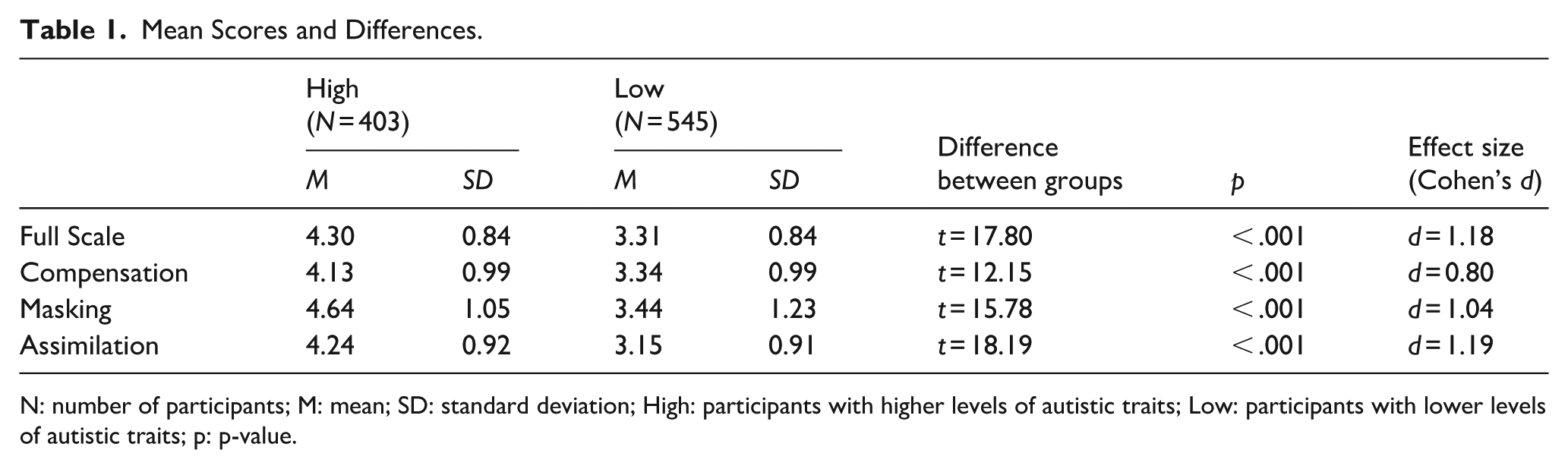
N: number of participants; M: mean; SD: standard deviation; High: participants with higher levels of autistic traits; Low: participants with lower levels of autistic traits; p: p-value.
As shown in Table 1, individuals in the high autistic traits group reported significantly higher scores on the CAT-Q compared with those in the low autistic traits group across the total scale and all subscales (compensation, masking, and assimilation). All group differences were statistically significant (p < .001) and associated with large effect sizes (Cohen’s d = 0.80–1.19), supporting the CAT-Q’s ability to distinguish between groups with high and low levels of autistic traits.
Content Validity
Following consultation with 10 experts, it was established that the item-level content validity index (I-CVI) was more than 0.75, while the scale-level content validity index (S-CVI) showed a value of 0.88. Following the presentation of these findings, the specialists affirmed that the CAT-Q is both pertinent and clear.
Construct Validity
The construct validity of the survey was evaluated through CFA (Table 2).
CFA of the Three-Factor.
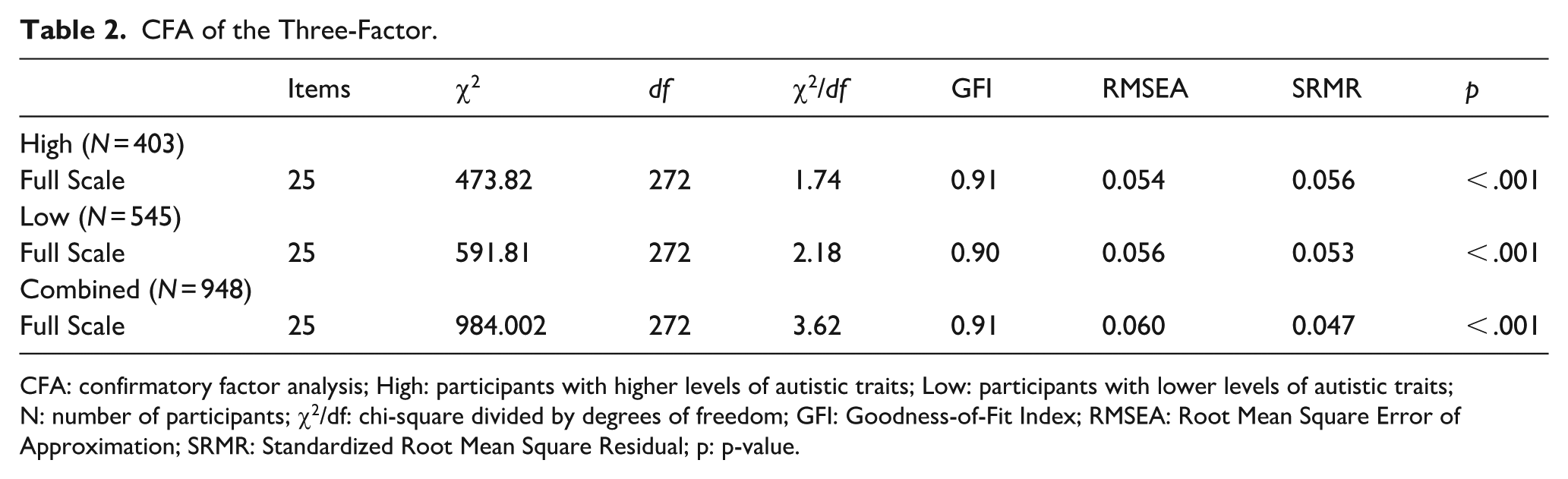
CFA: confirmatory factor analysis; High: participants with higher levels of autistic traits; Low: participants with lower levels of autistic traits; N: number of participants; χ2/df: chi-square divided by degrees of freedom; GFI: Goodness-of-Fit Index; RMSEA: Root Mean Square Error of Approximation; SRMR: Standardized Root Mean Square Residual; p: p-value.
The CFA was conducted separately in the high autistic traits group (n = 403), the low autistic traits group (n = 545), and the combined sample (n = 948) to evaluate the three-factor structure of the CAT-Q. Among high autistic traits participants, the model demonstrated acceptable fit (χ2= 473.82, p < .001; χ2/df = 1.74; Goodness-of-Fit Index [GFI] = 0.91; Root Mean Square Error of Approximation [RMSEA] = 0.054; Standardized Root Mean Square Residual [SRMR] = 0.056). The low autistic traits group showed comparable results (χ2 = 591.81, p < .001; χ2/df = 2.18; GFI = 0.90; RMSEA = 0.056; SRMR = 0.053). In the combined sample, model fit remained within acceptable thresholds (χ2 = 984.00, p < .001; χ2/df = 3.62; GFI = 0.91; RMSEA = 0.060; SRMR = 0.047). The multi-group measurement invariance analysis was conducted to ensure that the instrument measures the same construct equivalently across different groups (Table 3).
Multi-Group Measurement Invariance in CAT-Q.
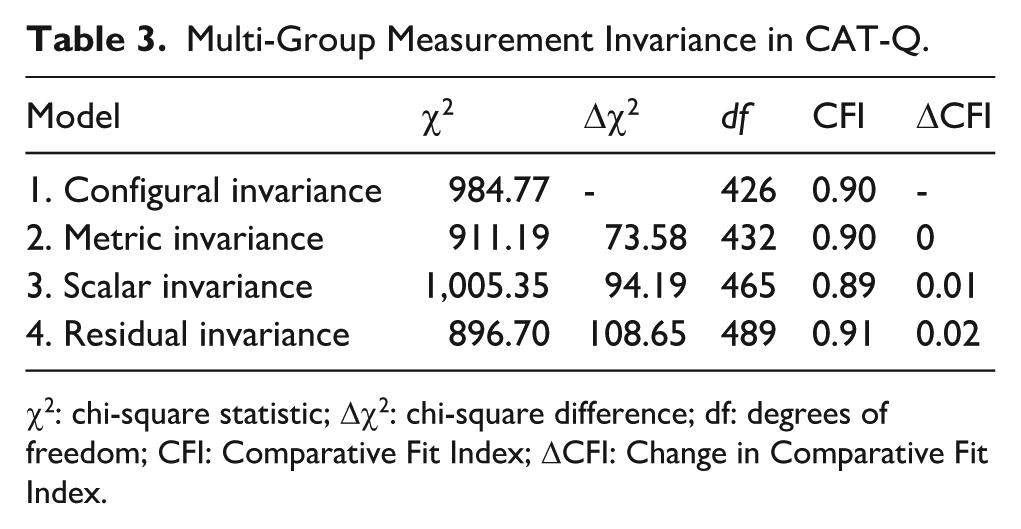
χ2: chi-square statistic; Δχ2: chi-square difference; df: degrees of freedom; CFI: Comparative Fit Index; ΔCFI: Change in Comparative Fit Index.
Measurement invariance testing across the high autistic traits group and the low autistic traits group supported configural, metric, and scalar invariance.
The configural model demonstrated adequate fit (Comparative Fit Index [CFI] = 0.90). Imposing metric constraints did not result in a reduction in model fit. The scalar invariance model showed a small change in fit (Change in Comparative Fit Index [ΔCFI] = 0.01), which remained within the accepted threshold for invariance. Residual invariance was also examined and demonstrated acceptable overall model fit (CFI = 0.91); however, changes in CFI at this level were larger than those observed for metric and scalar invariance and were therefore not considered central to subsequent interpretations.
Measurement invariance was evaluated using changes in comparative fit indices, with ΔCFI ⩽ .01 considered evidence of invariance (Cheung & Rensvold, 2002). In practical terms, configural invariance indicates that the same factor structure is present across groups, metric invariance supports comparisons of associations between constructs, and scalar invariance permits meaningful comparisons of latent mean levels between groups. Although residual invariance was also examined to provide a more stringent test, interpretations in the present study primarily rely on evidence for configural, metric, and scalar invariance.
This criterion was prioritized over Δχ2 due to its sensitivity to large sample sizes. Evidence for configural, metric, and scalar invariance indicates that the CAT-Q assesses the same latent constructs across groups, supporting meaningful comparisons of group differences. Accordingly, evidence for scalar invariance supports meaningful comparisons of latent mean levels of camouflaging between the high and low autistic traits groups. Standardized factor loadings for the three-factor CFA model are presented in Supplementary Table S1. All items loaded significantly on their intended factors, with standardized loadings ranging from 0.425 to 0.722.
Discriminant and Convergent Validity
To examine discriminant validity, an inter-correlation analysis was conducted to assess whether the variables measure distinct constructs in the high autistic traits and low autistic traits samples (Table 4).
Inter-Correlation Matrix.
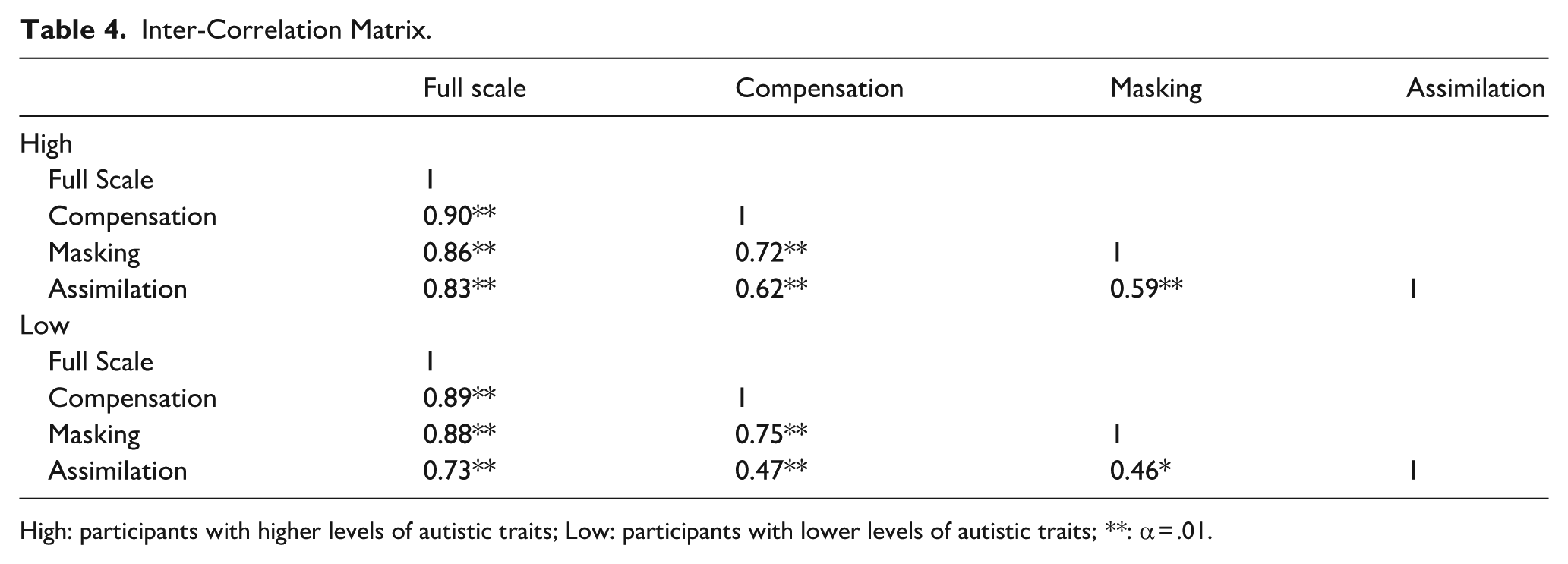
High: participants with higher levels of autistic traits; Low: participants with lower levels of autistic traits; **: α = .01.
To assess the convergent validity of the CAT-Q, Pearson’s correlation coefficients were calculated between each CAT-Q subscale and the social camouflage subcomponent of the CATI. As shown in Table 5, all correlations were positive and statistically significant (α = .01), providing support for the convergent validity of the Persian CAT-Q.
Correlations Between the CAT-Q Dimensions and Social Camouflage.
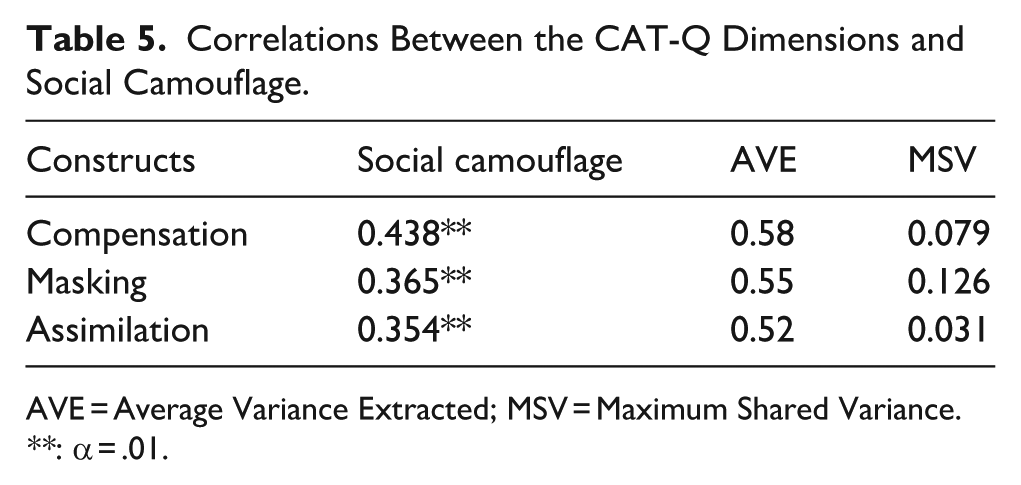
AVE = Average Variance Extracted; MSV = Maximum Shared Variance. **: α = .01.
All AVE values exceeded the recommended threshold of 0.50 (Fornell & Larcker, 1981), indicating adequate convergent validity. In addition, discriminant validity was supported, as AVE values were greater than the corresponding MSV values for each construct (Hair et al., 2019). Overall, these findings suggest that the CAT-Q and the CATI are related but empirically distinguishable constructs, supporting the construct validity of the Persian CAT-Q.
Reliability
Internal consistency coefficients (Cronbach’s α) of the CAT-Q across high and low autistic traits and the combined sample are presented in Table 6.
Internal Consistency Coefficients.

High: participants with higher levels of autistic traits; Low: participants with lower levels of autistic traits; N: number of participants.
As shown in Table 6, Cronbach’s alpha coefficients indicated satisfactory internal consistency across all groups. The total scale demonstrated high reliability in all samples (α = .86–.89). Subscale reliabilities were acceptable to good (α = .66–.78), with comparatively lower values observed for the assimilation subscale, suggesting that scores on this subscale should be interpreted with some caution.
Discussion
The present study aimed to validate the Persian version of the CAT-Q among individuals with high and low levels of autistic traits. The findings supported the original three-factor structure—masking, compensation, and assimilation—consistent with the initial validation reported by Hull et al. (2019) and subsequent replications across different cultural contexts (Bureau et al., 2023; Scheerer et al., 2020; van der Putten et al., 2023). However, this pattern of results differs from the findings of Lundin Remnélius and Bölte (2024), who reported that the original three-factor model did not demonstrate adequate fit for the Swedish version of the CAT-Q, suggesting that the factor structure of the questionnaire may vary across cultural contexts.
Internal consistency estimates were generally high, indicating that the Persian CAT-Q functions as a psychometrically coherent instrument within the present sample. Small positive correlations with the social camouflage subscale of the CATI further supported convergent validity, suggesting that both measures capture related, although not identical, aspects of camouflaging. It is important to emphasize, however, that the group characterized as having “high autistic traits” in this study was defined on the basis of self-report measures rather than clinically confirmed ASD diagnoses. Accordingly, the present findings should be interpreted as reflecting patterns of camouflaging among individuals with elevated autistic traits, rather than as definitive evidence of the CAT-Q’s validity for use in clinically diagnosed autistic populations in Iran. While the CAT-Q effectively differentiated between individuals with higher and lower levels of self-reported autistic traits, further validation in samples with gold-standard clinical diagnoses is necessary to establish its applicability in formal diagnostic or clinical decision-making contexts.
A notable finding was that mean camouflaging scores in the Iranian sample were higher than those reported in several European studies. One possible explanation for this pattern relates to sociocultural norms in Iran, where social conformity, impression management, and sensitivity to social evaluation are highly valued. Within such a context, individuals may experience increased pressure to regulate or conceal behaviors perceived as socially atypical, potentially leading to higher reported levels of camouflaging. This interpretation is broadly consistent with cross-cultural research indicating that the prevalence and expression of camouflaging behaviors vary as a function of societal expectations and cultural norms (Bureau et al., 2023). At the same time, it is important to acknowledge substantial within-culture variability in Iran. Social norms, expectations, and pressures related to self-presentation may differ across urban and rural settings, socioeconomic strata, gender roles, and educational contexts. Accordingly, the present findings should not be interpreted as uniformly representative of all Iranian populations.
At the same time, this cultural interpretation should be approached with caution. The present study relied on an online, self-selected sample, which may overrepresent individuals who are more educated, digitally literate, and self-aware of their social differences. Such characteristics may facilitate the development and reporting of more sophisticated compensatory or masking strategies, independent of broader cultural pressures. Consequently, elevated camouflaging scores may reflect, at least in part, methodological factors related to sampling and self-selection rather than cultural influences alone. Alternative explanations rooted in the study design therefore need to be considered alongside cultural accounts to avoid circular interpretations in which higher scores are taken as both evidence and explanation of cultural pressure.
The internal consistency of the assimilation subscale in the present study was relatively lower (α = .66) compared with other subscales and therefore should be interpreted with caution. One possible explanation may relate to cultural differences in how assimilation-related social behaviors are understood or expressed in the Iranian context. In addition, although the Persian version of the instrument was developed using a rigorous translation and back-translation procedure, it is possible that subtle differences in wording may have introduced slightly different nuances in the meaning of some items. These factors may have influenced how participants interpreted and responded to items within this subscale.
From a broader contextual perspective, the findings of the present study can be situated within existing Iranian research on autism, which has documented the role of social stigma, barriers to service access, and concerns about social judgment in shaping the experiences of autistic individuals and their families (Samadi et al., 2020; Samadi & McConkey, 2015; Shahrokhi et al., 2021). Within this literature, cultural constructs related to social reputation and respectability have been identified as important influences on help-seeking and disclosure. Interpreted in this light, higher levels of camouflaging may be understood as one strategy through which individuals with elevated autistic traits attempt to navigate social expectations and mitigate the risk of negative evaluation, rather than as a uniform or deterministic outcome of culture.
Several limitations should be acknowledged. The use of convenience sampling restricts the generalizability of the findings, particularly to less-educated, male, or rural populations in Iran. Reliance on self-report measures may also introduce response biases, including shared method variance and heightened self-awareness among participants. Although steps were taken to reduce measurement circularity by restricting convergent validity analyses to the Social Camouflage subscale of the CATI, some degree of conceptual overlap between self-report measures cannot be fully excluded. Accordingly, correlations between the CAT-Q and other self-report instruments should be interpreted cautiously.
Future research in Iran would benefit from recruiting clinically confirmed autistic samples, employing more diverse recruitment strategies to include underrepresented groups, and directly examining the relationship between camouflaging and theoretically linked outcomes such as anxiety, burnout, or mental health burden. In addition, qualitative approaches and culturally specific measures could be used to empirically investigate the role of constructs such as āberu and social conformity in shaping camouflaging behaviors. Such work would further clarify the cultural, developmental, and clinical significance of camouflaging within the Iranian context.
Conclusion
In conclusion, the Persian version of the CAT-Q demonstrates sound psychometric properties, replicates the established three-factor structure, and reveals culturally specific trends in camouflaging intensity. These results highlight both the universality and the cultural variability of camouflaging behaviors in autism.
Supplemental Material
sj-docx-1-aut-10.1177_13623613261452296 – Supplemental material for Pretending to Be Normal: Cross-Cultural Adaptation and Validation of the Camouflaging Autistic Traits Questionnaire in Iran
Supplemental material, sj-docx-1-aut-10.1177_13623613261452296 for Pretending to Be Normal: Cross-Cultural Adaptation and Validation of the Camouflaging Autistic Traits Questionnaire in Iran by Karim Abdolmohamadi, Asgar Alimohamadi and Laura Hull in Autism
Footnotes

Ethical Considerations
This study was approved by the Ethics Committee of Azarbaijan Shahid Madani University (Approval Code: IR.AZARUNIV.REC.1403.003).
Author Contributions
Funding
The authors received no financial support for the research, authorship, and/or publication of this article.
Declaration of Conflicting Interests
The authors declared no potential conflicts of interest with respect to the research, authorship, and/or publication of this article.
Data Availability Statement
De-identified data are available upon reasonable request (karim.abdolmohamadi@gmail.com).
Supplemental Material
Supplemental material for this article is available online.
References
Supplementary Material
Please find the following supplemental material available below.
For Open Access articles published under a Creative Commons License, all supplemental material carries the same license as the article it is associated with.
For non-Open Access articles published, all supplemental material carries a non-exclusive license, and permission requests for re-use of supplemental material or any part of supplemental material shall be sent directly to the copyright owner as specified in the copyright notice associated with the article.
