







Abstract
In line with the neurodiversity paradigm, the social difficulties experienced by autistic individuals are increasingly seen as the result of a mutual misunderstanding across different neurotypes, rather than deficits inherent to autistic individuals. This underscores the need to design inclusive spaces and educate people about autism, which remains a challenge. Previous qualitative evidence suggests that neurodiverse choir experiences may provide an opportunity to address this challenge. In this study, 12 adult choristers participated in a 6-month choir practice alongside eight autistic adolescents and three autism specialists. We assessed whether their representation of autism evolved, using a set of questionnaires before and after participation. The results indicate that participants’ representations of autism became richer, more accurate, and more aligned with a difference rather than a deficit model. Participants felt more able and inclined to interact with other neurodivergent individuals after sharing this experience. Although preliminary, these findings lend support to the neurodiversity paradigm and offer promising perspectives for addressing the double empathy problem. They highlight the importance of designing inclusive spaces within our societies and illustrate how choral singing may be a particular tool to foster inclusion.
Lay Abstract
A choir is a powerful metaphor for a successful neurodiverse society, in which achievement stems from blending together voices that are different, rather than from everyone singing the same line in the same way. This study explores a real-life example of this metaphor: a neurodiverse choir composed of 12 adult choristers, 8 autistic adolescents, and 3 professionals specialized in autism. The choir rehearsed for 6 months and then performed a few shows under the direction of a professional choir director. More specifically, we tracked the experience of the 12 adult choristers, using a set of questionnaires before and after their participation in the choir. Consistent with previous qualitative evidence, the results demonstrate a measurable shift in their representation of autism: they understood it better and perceived it more as a neutral difference (from typical development) than a deficit. After participating in this choir, the choristers also felt more able and more inclined to interact with other neurodivergent individuals. These findings lend support to the neurodiversity paradigm, which values autism as a set of natural variations in human neurocognitive functioning. In this view, the social difficulties encountered by autistic individuals can be considered the result of a mutual misunderstanding between autistic and non-autistic people, a problem known as the “double empathy problem.” Our results show that the choristers tended to naturally embrace this view. Thus, this preliminary study provides a promising perspective to address this problem, using choral singing as a natural “double empathy solution.” More generally, this exemplifies the importance of designing inclusive spaces within our societies.
Introduction
Autism is characterized by communication and interaction difficulties (American Psychiatric Association, 2022). However, these difficulties are increasingly seen as relational challenges, resulting from a mutual misunderstanding across different neurotypes (Marocchini & Baldin, 2024), rather than as individual characteristics of autistic individuals. This issue can be referred to as the double empathy problem (Milton, 2012). A choir is a powerful metaphor for a society that addresses this very challenge because its achievement stems from the harmonious blending of different voices, rather than requiring everyone to sing the same line in the same (neurotypical) way. This metaphor was previously introduced through the concrete example of a neurodiverse choir that brings together autistic adolescents, health professionals, and adult choristers (Petit & Jurek, 2025; see also Lord & Su, 2025 for further developments).
A preliminary qualitative study explored the experience of this neurodiverse choir and showed that it was highly satisfying for the autistic adolescents who participated, their families, and the adult choristers, leading to important perceived benefits for all parties (Petit, 2024). Among those, both autistic and non-autistic choristers perceived an especially important social connection with other participants. This is in line with previous research in other populations showing that choral singing promotes mental health by inducing strong social connection (e.g., Linnemann et al., 2017). Moreover, many adult choristers reported a clear perceived improvement in their comprehension of autism (Petit, 2024). This is important because while the neurodiversity paradigm stresses the need to design inclusive spaces (where neurodivergent individuals can fit in) and to educate people about autism, this remains a challenge. For instance, there is evidence that sharing an activity in a neurodiverse setting alone is not sufficient to facilitate cross-neurotype communication; instead, it may rather tend to reinforce preferences for same-neurotype interactions (Y.-L. Chen et al., 2021).
In this context, the current study focused on adult general-population choristers and sought to examine whether their participation in a neurodiverse choir alongside autistic adolescents can lead to objective and measurable changes. Following what choristers reported in previous qualitative research, we hypothesized that using pre- and post-participation questionnaires would reveal a quantitative improvement in participants’ representations of autism and in their personal socio-emotional lives.
Method
This study used a single group pre-post quantitative method.
Population
The project was open to any French-speaking adult with prior experience in choral singing. Thirteen participants were initially enrolled; one participant dropped out during the experience for personal reasons and was excluded from all subsequent analyses. The 12 remaining participants were diverse in gender (4 men, 7 women, 1 other) and age (age range in years = [26–86], M = 45, SD = 18) with a relatively high education level (12/12 had a Baccalauréat [A-levels] degree, 6/12 had a master’s degree). Within the group, one participant identified as autistic without a medical diagnosis, nine reported not being autistic, and two did not know. Most participants had previous experience or knowledge about autism through their personal (8/12) or professional lives (4/12). Some of them (4/12) had participated in an earlier neurodiverse choir. The study was conducted in accordance with the Declaration of Helsinki and local (French) laws, and each participant provided written informed consent to participate.
Shared Choral Practice
Participants formed a novel choir under the direction of a professional choir director, together with eight autistic adolescents (seven males and one female; age range in years = [12–15]), with associated conditions in most cases (including attention-deficit/hyperactivity disorder [ADHD], intellectual disorder, language disorder), and three health professionals specialized in autism. Participants attended approximately 16 choir sessions over a period of 6 months. Two months after the beginning of rehearsals, an information session on autism was proposed to the adult choristers by one of the autism specialists of the choir, including a 20-min presentation and a 20-min Q&A session. Details of the rehearsals and information session are provided in Supplementary Materials (Box S1).
Materials
Each participant completed an online questionnaire before and after their participation in the choir (details in Supplementary Materials, Box S2).
To measure autism representations, we first used Likert-type-scale questionnaires. This included an autism knowledge questionnaire (adapted to French from Gillespie-Lynch et al., 2022) and an attitude questionnaire that assessed openness/avoidance towards an adolescent character with typical autistic behaviours (adapted from Harnum et al., 2007). An additional question targeting self-efficacy in interacting with this character was added for the purpose of this study. The original questionnaires in English were translated into French by the first author, and then back-translated into English by an assistant, to ensure there were no translation issues (see the original questionnaire and the translations used in this study in the Supplementary Materials).
We also included some open-ended questions to better capture participants’ autism representations. First, we asked the participants to define autism. We derived from their definition an accuracy score (varying from 0 to 12, indexing how aligned with current consensual knowledge the definition is) and a grounding model score varying from −1 to 1, indexing whether the definition seems grounded in a deficit model (−1) to a difference model (1). In two other open questions, participants were asked to describe why it could be complicated/difficult (or interesting/beneficial) to include autistic participants in a choir. Each question led to two scores: the total number of challenges (or benefits) named, and the balance of the challenges (or benefits) varying from −1 (exclusively relating to autistic adolescents’ individual characteristics) to +1 (exclusively not relating to autistic adolescents’ individual characteristics). The open questions were scored blind to the time of measurement and to participants’ identity, based on a procedure detailed in the Supplementary Materials (Boxes S3 and S4). The reliability of this procedure was assessed by comparing human ratings to ratings provided by a generative artificial intelligence (AI) tool that was given the instructions of this article, and which demonstrated good to excellent reliability (r range = [.63, .95, all ps < .001; see details in the Supplementary Materials).
Finally, to measure personal socio-emotional benefits, we included two more Likert-type-scale questionnaires to assess social self-esteem (10 questions extracted from the French Social Self Esteem Inventory [SSEI, Gauthier et al., 1981]) and loneliness (the Campaign to End Loneliness Measurement Tool).
Analysis
Given the small sample size, pre-post differences in the metrics were assessed via a bootstrapping method (Dwivedi et al., 2017) with 10,000 resampling of the pre-post difference to determine 90% confidence intervals (as we held directional, i.e., improvement hypotheses), using the Hmisc package (Harrell, 2025) in R (R Core Team, 2024). We also provide Cohen’s ds as an indication of effect sizes, with the values of 0.2, 0.5, and 0.8 being conventionally considered as indicative of small, medium, and large effects, respectively (Cohen, 1988).
Results
Autism Representations
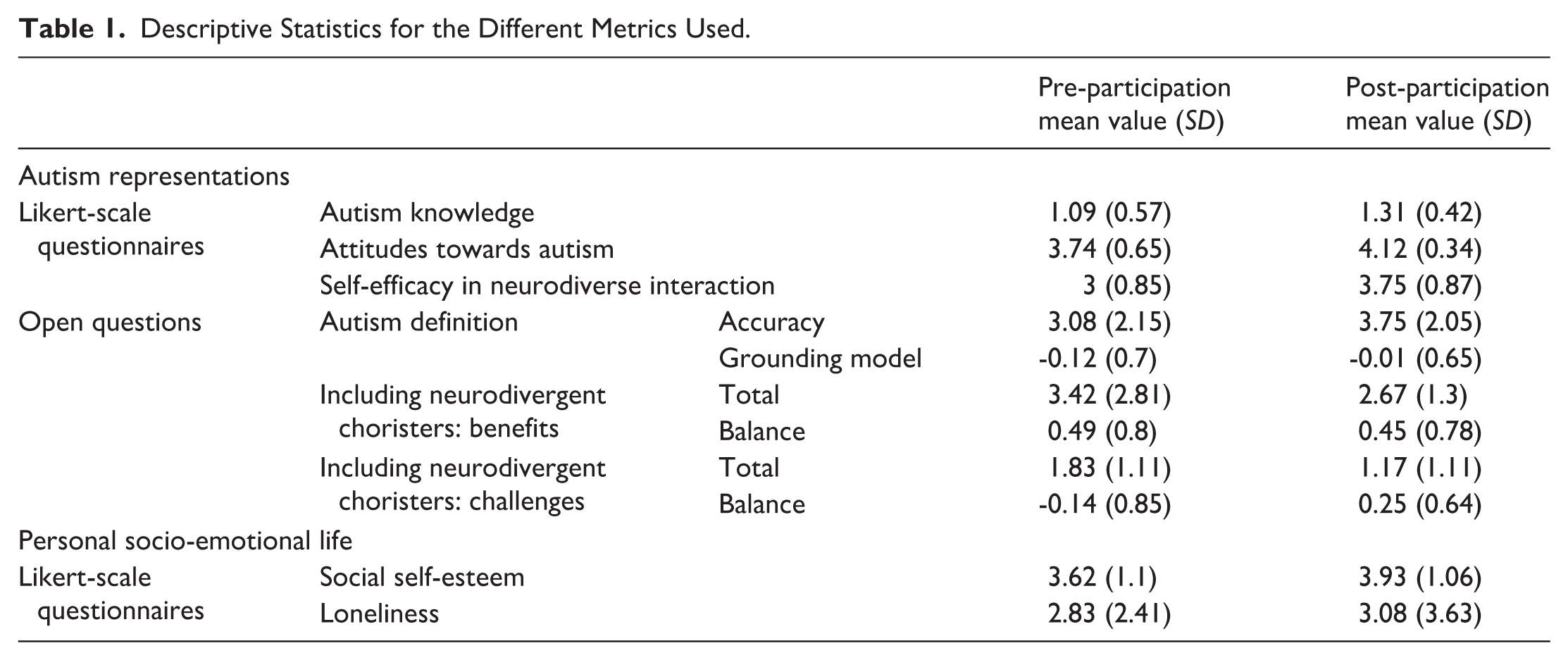
We report in Table 1 the descriptive statistics for all metrics used. As shown in Figure 1(A), the quantitative questionnaires showed that participants’ representations of autism significantly approached maximum knowledge and maximum openness after participation (mean difference = 0.43, 90% CI = [0.16, 0.73], d = 0.68). This was consistent with the analysis of the definition of autism participants provided, which also got closer to a definition that would be both exhaustive and completely aligned with a difference account of autism (mean difference = 0.61, 90% CI = [0.01, 1.21], d = 0.55, see Figure S3 in the Supplementary Materials). Moreover, participants’ self-efficacy in interacting with autistic individuals also increased after this experience (mean difference = 0.75, 90% CI = [0.17, 1.42], d = 0.55; see Figure 1(B)).
Descriptive Statistics for the Different Metrics Used.
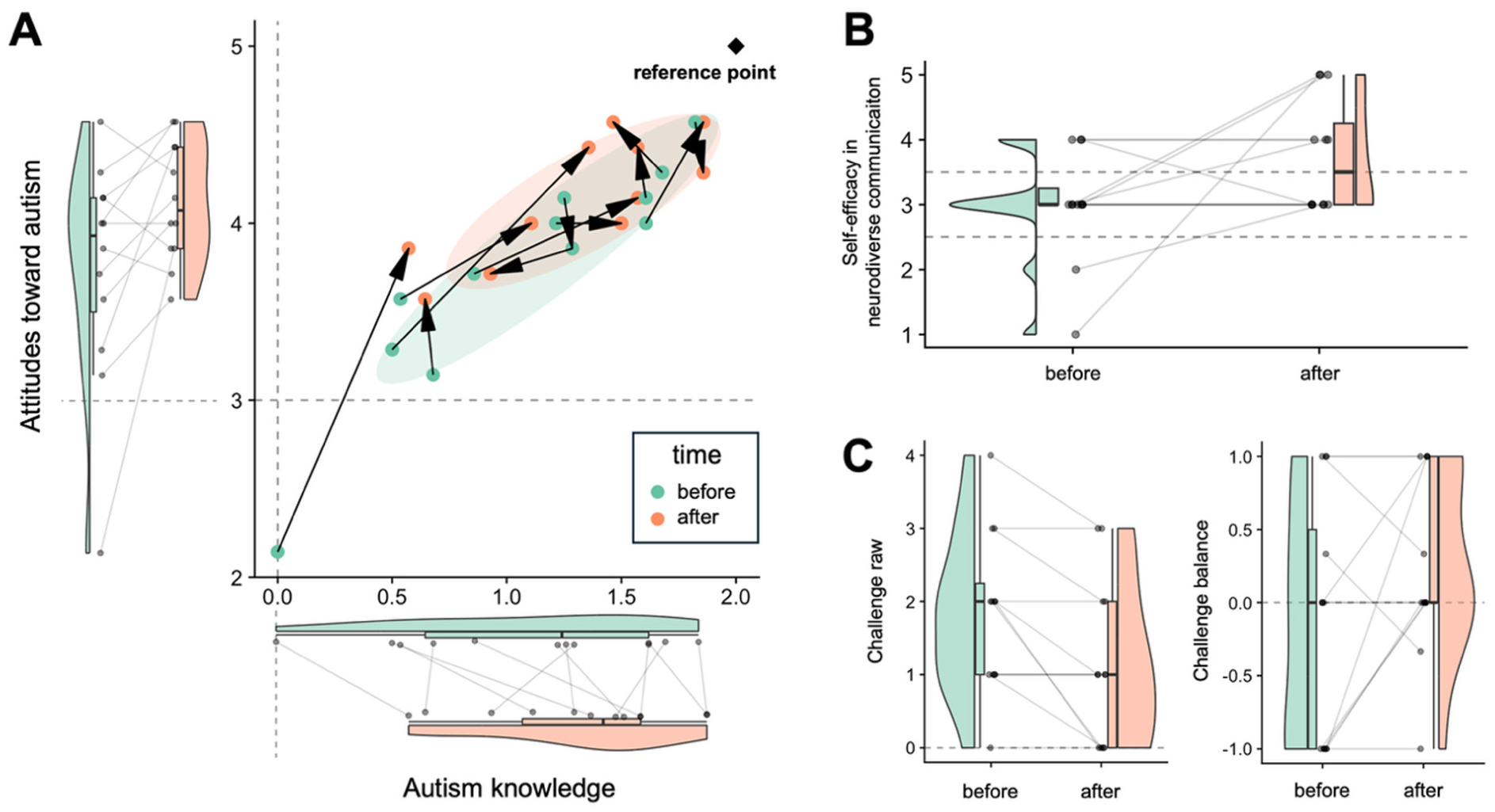
Main comparisons between participants’ pre- and post-experience autism representations (A), self-efficacy in neurodiverse communication (B), and challenges raised by neurodiversity (C).
Open questions revealed changes in how participants perceived the challenges induced by the inclusion of autistic individuals in a choir (Figure 1(C)). They perceived fewer challenges (mean difference = −0.67, 90% CI = [−1.00, −0.33]) and the expressed challenges were less linked to autistic individuals’ characteristics but more to group-level or relational factors (mean difference = 0.39, 90% CI = [0.03, 0.75]). No such change was observed in the analysis of the perceived benefits (see the Supplementary Materials, Figure S4).
Personal Socio-Emotional Life
We observed an increase in participants’ social self-esteem (mean difference = 0.30, 90% CI = [0.03, 0.58], d = 0.52, Supplementary Materials, Figure S5), but no significant change in loneliness (mean difference = 0.25, 90% CI = [−0.67, 1.17], d = .12).
Discussion
This study explored whether participation in a neurodiverse choir alongside autistic adolescents could lead to objective and measurable changes in 12 general-population adult choristers. Indeed, previous qualitative evidence has shown that choristers perceive benefits in terms of autism comprehension and personal socio-emotional life (Petit, 2024). As hypothesized, we observed that participants’ knowledge of autism became more accurate (both in questionnaires and in free definitions), and that their attitude towards autism improved. Participants also felt more capable of successfully interacting with autistic individuals after this shared experience. Moreover, they developed a perception of autism that is more aligned with the neurodiversity paradigm, that is, in which challenges are not absent (although they appeared less important than initially anticipated) but are considered more relational than individual. In other words, choristers took more responsibility, as individuals and as a group, in the challenges raised by inclusion.
Given the scarcity of explicit information delivered in this project, it can be interpreted that the choristers naturally adopted a perception of autism that was more aligned with the neurodiversity paradigm through this shared experience. This constitutes further evidence in support of this perspective, especially since their representations were reshaped with mostly moderate to large effects, that is, with a stronger magnitude than what is usually observed in interventions targeting mental health stigma (Crockett et al., 2025).
In our study, we also observed an increase in participants’ social self-esteem levels. Combined with previous qualitative evidence, our results are thus important, because they highlight that neurodiverse inclusive settings can be beneficial (1) to all individuals, including neurotypical and not only neurodivergent individuals and (2) to the group itself, supporting the core idea that neurodiversity is valuable (Chapman, 2021).
This also constitutes proof-of-concept for the use of choral singing (or shared music practice) as a relevant tool for addressing the double empathy problem, serving as a natural “double empathy solution.” Indeed, previous evidence has shown that merely sharing an activity in a neurodiverse setting is not sufficient to facilitate cross-neurotype communication (Y.-L. Chen et al., 2021). Choral singing or joint music-making, on the contrary, may have evolved specifically as a mechanism for social connection in humans (Kirschner & Tomasello, 2010), exploiting biological interindividual synchronization (Delius & Müller, 2023). Thus, it is unsurprising that participants in the neurodiverse choir reported this specific mediation to be very important in their experience (Petit, 2024). In addition, this activity taps into musical abilities that are likely to be unaffected or even superior in autism (Y. Chen et al., 2022; Masataka, 2017).
These remain preliminary results that should now be confirmed and extended using more robust methodologies, including larger samples and a control group (Kim et al., 2024). Moreover, the participants of this study are likely to have volunteered because of an a priori interest in autism; it would be important to determine whether our findings could generalize to other samples (such as less educated participants or a neurodiverse group of adolescents only) and to other situations. Furthermore, one of the participants of this study identified as autistic, and two were unsure of their neurotype, which may have affected their results, and their experience more generally. Future research should further explore how this or other factors may influence choristers’ experience. Future work should also study how shifts in individuals’ representations may translate to behaviours, for example, in actual communication.
Overall, this neurodiverse choir experience highlights the importance of designing inclusive spaces for the benefit of all and provides an interesting perspective for fostering inclusion.
Supplemental Material
sj-pdf-1-aut-10.1177_13623613261452693 – Supplemental material for Shared Musical Practice in a Neurodiverse Setting Can Reshape How People Think About Autism
Supplemental material, sj-pdf-1-aut-10.1177_13623613261452693 for Shared Musical Practice in a Neurodiverse Setting Can Reshape How People Think About Autism by Nicolas Petit, Marie-Maude Geoffray-Cassar, Paola Piccolo and Lucie Jurek in Autism
Footnotes
Acknowledgements
The authors thank the participants of this study and all the choristers of the Ha’Chœur choir, as well as the choir director, Maude Georges. The authors also thank the Lavéli organization (especially Pascale Maddalena and Apolline Reydellet), which implemented this project together with the hospital Le Vinatier (especially with Florence Chevigny, Jeannie Meyrand, and their team).

Ethical Considerations
The research was run in accordance with the Declaration of Helsinki, and each participant provided informed written consent to participate. According to local (French) laws, as a research in social science, this study did not require formal ethical approval.
Author Contributions
Funding
The authors disclosed receipt of the following financial support for the research, authorship, and/or publication of this article: This project received support from the hospital Le Vinatier Psychiatrie Universitaire Lyon Métropole and the cities of Lyon and Villeurbanne (France).
Declaration of Conflicting Interests
The authors declared no potential conflicts of interest with respect to the research, authorship, and/or publication of this article.
Data Availability Statement
The quantitative data are displayed in the figures. Additional data can be made available upon request to the authors.
Positionality Statement
All four authors are clinical practitioners who work in direct contact with autistic individuals and their families in a hospital department specialized in diagnosing and providing care to children and adolescents who present with autism or other neurodevelopmental conditions. There are three child and adolescent psychiatrists, and one is a speech-language therapist. Three of them are also researchers.
Identifying Information
NA.
Supplemental Material
Supplemental material for this article is available online.
References
Supplementary Material
Please find the following supplemental material available below.
For Open Access articles published under a Creative Commons License, all supplemental material carries the same license as the article it is associated with.
For non-Open Access articles published, all supplemental material carries a non-exclusive license, and permission requests for re-use of supplemental material or any part of supplemental material shall be sent directly to the copyright owner as specified in the copyright notice associated with the article.
