







Abstract
This article argues, in the form of demonstration, for the necessity of disciplinary openness in punishment and society scholarship. Theories about the political culture of punishment and sentimental accounts of the toll mass incarceration takes on the personal lives of millions are insufficient for developing a critical knowledge of the relationship between race, law and gender. Approaching the object of the letter unfettered by traditional disciplinary methods, the article traces the centrality of the prisoner’s letter in the lifeworld of punishment. The letter is analyzed as both itself a paper-trail, and the subject of various other forms of paper-trails, including prisoners’ First Amendment rights jurisprudence, official political rhetoric, and cinematic production.
Which words act as revenants, haunting the precincts of law?
Words from beyond the grave
In 2006, the US Federal Bureau of Prisons proposed a new regulation: Limited Communication for Terrorist Inmates. This regulation would impose the strictest limitations on prisoners’ First Amendment rights in history by providing prison wardens with unilateral decision-making power to label a prisoner as having ‘an identifiable link to terrorist-related activity’ (Bureau of Prisons, 2006). After such determination, a prisoner’s capacity to communicate with the outside world would be all but eliminated. S/he would only be allowed communication with immediate family, and those communications would be limited to one six-page letter a week, one 15-minute phone call a month, and one one-hour visit a month.
Against the outcry over this proposed regulation and its ultimate defeat, the Bureau of Prisons quietly proceeded in the aftermath to open two specialized prisons. One located in Marion, Illinois and the other in Terre Haute, Indiana, the Bureau of Prisons termed these new prisons, ‘communication management units’ (CMUs). Through these CMUs, prisoners’ communications are now completely monitored by virtue of their spatial containment in these specialized prisons. In a candid description summarizing the establishment of these CMUs, prison officials reasoned, ‘By concentrating resources in this fashion, it will greatly enhance the agency’s capabilities for language translation, content analysis and intelligence sharing’ (Eggen, 2007: A07).
The majority of the prisoners held in these CMUs are Muslim, and many are political prisoners or prisoners with a history of challenging civil rights violations in the federal prison system (www.ccrjustice.org). 1 CMU prisoners reflect the widened range of activities and associations captured under the legal definition of terrorism endorsed by the US Patriot Act. Daniel McGowan (2009), for example, is an environmental activist held at Marion who is serving a seven-year sentence reflecting ‘terrorism enhancements’ established by the Patriot Act. Interestingly, McGowan likened the political effect and process of the CMU to the Lexington High Security Unit (Kentucky) opened in 1986 to house women political prisoners. The Lexington prison was shut down as a result of international protest and a court order two years later because of all the gross human rights abuses and its complete lack of any reasonable ‘security’ function. 2
The CMU demonstrates the authoritarianism that the public has consistently endorsed through the wars on crime and terror, by granting the state virtually unchecked powers to make unilateral decisions about individual fates sacrificed in the name of the collective. It is not difficult to find critiques of this particular denigration of individual liberties in both liberal and radical defenses of democracy. It also demonstrates the dominant response the state has consistently fallen back on in the face of these defenses of democracy. This is a response the state has mastered over the course of the last 40 years through the rollback of any pretenses of rehabilitative criminal justice (Allen, 1981). The history of the CMU embodies the dialectical relation between panoptic discipline (the proposed regulation) and administered life (the CMU) theorized by ‘new penology’ scholarship (Feeley and Simon, 1992).
Along these lines, the tendency might be to explain the CMU as an exceptional form of punishment. Yet, once historically contextualized, the CMU seems prefigured by the general question forever debated in First Amendment prisoner rights jurisprudence: can and should the law protect expression, one of the most essential characteristics of what it means to be human, against the various innovations of modern punishment? In other words, the CMU understandably elicits feelings of alarm because of its resemblance to an Orwellian dystopia, but these feelings are predictable, almost scripted, because of the difficulty if not impossibility for the general public and the law to understand the penal lifeworld. 3
To clarify these issues, this article mobilizes theories from an eclectic collection of critical thinkers writing in diverse disciplines and interdisciplines. Probably the most unusual aspect of this article as a contribution to this special issue is the inclusion of legal cases and other cultural commentary on punishment as sources of critical thought on par with people like Pierre Bourdieu and Jacques Lacan, or Pat Carlen and Beth Richie. The First Amendment prisoner rights cases and the 2001 film, Stranger Inside, explored below are not examples, case studies, or various forms of evidence demonstrating a certain theoretical idea developed in a specialized field of academic research. They are instead drawn upon as articulations of theoretical concepts and questions that are as engaged with the same sorts of issues driving the formal study of punishment. Although this could be seen as a strange methodological choice or not a methodology at all, it is simply one way to describe what it means to ‘do’ critical theory. 4 These issues will be explored in more detail in the next section, ‘The matter of punishment’.
In this article I will try to demonstrate what such disciplinary openness might reveal by tracing the centrality of the prisoner’s letter—both itself a paper-trail, and the subject of various other forms of paper-trails. The issue of the letter is the focus of my reading of punishment, law, and human expression and it is the issue by which I stage a conversation between academics, prisoners, politicians, and artists—a conversation that is already staged whether or not we care to engage in it. I focus on it because theories about the political culture of punishment and sentimental accounts of the toll mass incarceration takes on the personal lives of millions only touch upon the letter, which has become a universal substrate of the lifeworld of punishment.
My analysis will move away from the two-dimensional prison building that largely remains untroubled as the dominant image of punishment today, and towards where the specters of the civilly dead appear. In The Law Is a White Dog, Colin Dayan (2011: 57) asks:
The convict, though actually a living being, is not only dead but buried by the law. The body is there, but restrained in prison. The external physical conditions are clear. The internal spiritual state is not. The physical person (solely body and appetite) has no personhood (the social and civic components of personal identity). What kind of spectral form remains? … What is more pressing, more spectacular than the realm of the flesh-and-bones ghost, the palpable specter watching over its own perpetual degradation?
‘[B]y the law’, prisoners’ physical bodies are buried in cages, but what remains of their spirits? Where do their spirits go? My sense is that they are buried, in prison yes, but also, in the law. Here, I approach law in the architectural sense of language, as explored by Claudia Brodsky’s (2009) In the Place of Language. Law is not an instrument of civil death, or the official speech act that calls civil death into existence. Rather, law becomes a graveyard where civil death takes place through the material activity of writing and reading. Another way to understand this idea of law is through Robert Cover’s (1986: 1601) argument that ‘Legal interpretation takes place in a field of pain and death’—not as a theory of how the state communicates through legal discourse but as a theory of space. Every writing and reading of law is a material act of burial and demarcation. We might say that to legalize civil death is to engrave it in law, to give words within the law a certain kind of spectral life by displacing people (see Brodsky, 2009). 5 By this engravement and displacement, ‘words act as revenants, haunting the precincts of law’, as Dayan (2001: 4) rightly suggests in the epigraph opening this article.
One of these words, on which this article focuses, is ‘letter’. In prisoners’ First Amendment rights jurisprudence (see the ‘Reading prisoners’ First Amendment rights’ section), the letter acts as a rather shifty, if not unverifiable fact, casting light on all of the various relations it organizes. Consequently, the law struggles with an implicit but basic question of who the prisoner’s letter is written to be read by. Later, the ‘The purloined prisoner’ section examines a seemingly inane case involving a letter considered to be ‘in poor taste’ to explore why the law avoids the basic question of who is to read prisoners’ letters. The final section, ‘Strange life’, analyzes the television movie, Stranger Inside, specifically for how it answers this complex question.
The matter of punishment
Caleb Smith (2009: 23) argued in The Prison and the American Imagination that ‘Prisoners are not beyond the embrace of law; they are mortified by it.’ This idea is supported by the historical trajectory of mass incarceration, whereby the battle over constitutional guarantees of civil rights and liberties in the evolving legal infrastructure of slavery and formal racial segregation establishes the prisoner’s precarious security in bodily and individual integrity (see Alexander, 2010; Dayan, 2004; Human Rights Watch, 1996). This in turn suggests our understanding of the racism inherent in US mass incarceration needs to move beyond the calculation of disproportionate rates of surveillance and imprisonment, or even the historicization of what these calculations are taken to mean. Instead, we need to focus on law’s portrayal of racial inequality, which forever marks and remarks the making of US democracy. The Constitution as slavery’s signature continues to write us into the world.
Within this context, we cannot say for sure that the US government’s series of international and domestic wars on crime depart from, deface, or dismantle constitutional principles of equality and liberty. We cannot disprove that the Constitution does not sanction US imperialism and the militarization of domestic policing. And we cannot shake the possibility that such repression might be fantasized about through ever-changing legal rules and doctrine. This is not because ‘anything can be made to mean anything’, but because the layers and layers of slavery that echo in the hollow universalist ideals of racial equality in constitutional law and civil rights have yet to be undone.
This brings up an issue more troubling than whether or not the deprivation of prisoners’ rights is constitutional: the enduring problem of state impunity as the effect of a legal structure of interpretation that has developed historically through a bond between the Constitution’s textual ambivalences and an image of the fugitive slave. The excessiveness of police force reflects the excesses of the American legal imagination, or what I have elsewhere called a type of ‘racial profiling’ (see Han, 2012). Given this racial core of constitutional law, to call out the extra-judiciality of certain administrative policies of punishment like the CMU, or legislative efforts to carve away hard-won civil rights and liberties, or popular acquiescence to these policies and laws simply is to call by another name the racial structure of the US Constitution that has always tied judicial rationality with racial fantasy.
This legal foundation requires us to revisit the question: What is the object of punishment and society studies? This question involves two senses of the word ‘object’: first, the goals, objectives, ideals, and normative investments of the field; second, the thing, the problem, the phenomenon, the fundamental issue the field is attempting to clarify. Here, I am more concerned with the latter (but this is not to say that the former is unimportant)—with the matter, the stuff, the lifeworld, which is only partially engaged by the field. This makes it more possible to break away from the instrumentalist drift of knowledge about punishment. This break may even act as a form of resistance against punishment, or at least that is the hope. Instrumentalism, whether consciously applied or inadvertently followed, assumes that there is a social use (for the punished individual or society in general) in punishment, whatever the form punishment takes at a particular historical moment. This assumption then facilitates a technocratic relationship between various (inter)disciplines, such as criminology, law, political science, social welfare, and so on, and criminal justice administration and reform. This consolidated expert knowledge of penality is, as noted by Michel Foucault (1995), generally immune from critique or legal challenge.
By eschewing instrumentalism, the social usefulness of punishment becomes a question rather than an unstated assumption. We are allowed to pursue a knowledge of punishment that does not (one hopes, at least) automatically become part of the prison industrial complex. We can instead ask questions about what the relationship between punishment and expression, for example, is in the first place, before moving on to argue what it should be. The materialities of punishment surface more readily in their complexities.
One way to approach this complexity is to conceptualize punishment as a phenomenological object, not already territorialized as knowable by one or another method, institution, or political position for a disciplinarily given purpose. Punishment is not only a system of signification whose purpose is to shape something outside of it. It is also a material reality constituted through writing, coding, organizing, filing, reading, publicizing, and so on. Punishment is paperwork. Similarly, punishment is not only an abstract term for specific historical and social policies of incapacitation, deterrence, or rehabilitation. It also becomes a material practice of social identification, political imagination, and both mundane and spectacular statecraft. This complex surface of punishment allows us to approach practices and relationships beyond the value structures of the Beccarian social contract (see Beccaria, 1995) around which the disciplines and legal study concerned with punishment are organized, and toward a method (for lack of a better word) captured by what philosopher Jacques Lacan (2002: 139) called ‘à la lettre’.
The literality of punishment includes all the ways the relations of mass incarceration appear to us in our experience of it: legal, fictional, personal, administrative, epistemological, physical, bureaucratic, poetic, dreamt, erased, read, touched, and more. It suggests a ‘mode of being’ (Heidegger, 2010: 33–35) through which the letter comes into contact with varying levels of truth-making: personal, empirical, archival, legal, institutional, emotional, existential, and so on. It facilitates a confrontation with the structural implications of the law’s writing by which prisoners’ expressive rights have been whittled down to the single option (which is to say, a non-option) of writing letters. From this perspective, mass incarceration is the legalization and distribution of the originary coercion of language. 6
The point here is that the long history of case law sanctioning censorship of prisoners’ expression has created a diffuse, transinstitutional space of non-communication, or more precisely, non-correspondence. The literality of punishment illuminates networked communities on both sides of the wall: not not communicating, not not corresponding, not not trying, not not writing, not not calling, not not wanting. 7 Rehabilitative punishment’s perception of self-expression as a privilege appears as a strangely literal geographic rendering of enduring problems of language. There are just so many letters (including all that are never sent, never arrive, are only partially read, etc.) marking so many prisoners’ lostness, sentences barely read, a chorus of drowning chatter, filed defilement. These are the emergent lineaments of the revenant letter in the law (Lacan, 1988), that purloins, the prisoner. This vast negative space of communication, both interpersonal and cultural, awaits a language through which to think about it. 8
Reading prisoners’ First Amendment rights
In 2004, then-California governor Arnold Schwarzenegger renamed the California Department of Corrections (CDC) as the California Department of Corrections and Rehabilitation. The illusory promise contained in the renaming against the backdrop of all the inefficiencies and failures a specially appointed review board found in California prisons comes off with a certain kind of earnestness (Corrections Independent Review Panel, 2004). Schwarzenegger was administrating a state that had perfected the biopolitical project of population management and criminal punishment through imprisonment; had conjoined by that time society-wide risk and individual redemption through an open secret of the state celebrating personal justice over any other kinds available or imaginable (see Gilmore, 2007; Simon, 2007).
So, while rehabilitative punishment as an effective policy might have been abandoned decades earlier, it emerged in the CDC’s renaming as an ‘imaginary penality’ (Carlen, 2008) par excellence. For it is a paradigmatic instance of a state acting ‘as if’—as if the curtailment of prisoners’ First Amendment rights can in fact reform their souls; as if calculating and controlling the various risks attending the shades of liberty administered by the criminal justice system can in fact increase national security; as if our actuarial interests can in fact rely on policy justifications to translate, analyze, and share intelligence better. In this administrative imaginary, human self-expression is not so much a type of raw material through which populations are rendered and managed, but becomes almost unnecessary to the legal definition of human personhood. Because of this near obsolescence, the right of self-expression protected by the First Amendment slips with such ease in constitutional law down to a privilege.
More insidious still is that much of the civil rights gains and aspirations of the women’s and black liberation movements have been refracted by this imaginary penality into what feminist criminologist Meda Chesney-Lind (2006) has called ‘vengeful equity’. Women in prison experience all kinds of harsh punishments, not because they are afforded less legal protection than men, but because they are subject to equal punishment to men. Mandatory arrest laws for police responding to calls of domestic violence have skyrocketed rates of women’s incarceration and given fodder to the argument that women are equally violent as men in disposition. It is a sad state of legal affairs that appears throughout the feminist criminological literature. Equality as a universal constitutional principle has been formalized as a matter of legal recognition of populations, and moralized as a matter of individual experiences of structural inequality. Equality shaped by the imaginary penality of rehabilitation has proliferated types and scales of state violence against minority communities as it convolutes our critiques of the state’s failures to protect women and communities of color from violence.
The prisoner of this imaginary is a strange culmination of a caring and pitiless state. S/he is the placeholder for the soul—the thoughts, desires, the interior life of the human—which in its infinite need for rehabilitation becomes, as Foucault (1995: 30) put it, ‘the prison of the body’.
The law experiments on this soul through the language it develops to test the limits and vicissitudes of civil death. Analyzing civil death through Eighth Amendment law, Dayan (2001: 27) made the devastating observation that: ‘If you happen to be a prisoner, without any status explicitly recognized in law, you possess rights only insofar as you have lost your skin or your mind.’ She is speaking here of the Eighth Amendment’s prohibition against the infliction of ‘cruel and unusual punishment’ in seeking criminal justice, and how this prohibition has actually created a perversely legitimated system of torture for those two-some million prisoners living in cages across the United States. By requiring either intentionally inflicted bodily harm or mental insanity as the only forms of constitutionally relevant evidence to apply the Eighth Amendment, prisoners suffer from all sorts of tortures falling just short of these evidentiary thresholds. These include any number of strange correctional policies that structure the everyday life of the average prisoner: from strip searches to highly specified contraband lists, from administrative segregation to the time-and-a-half work wage, and from group therapy sessions to mail regulations.
The prisoner in law is a convoluted form of human to whom only the barest of rights are attached at precisely the moment when she has lost or been stripped of any signs of being human. While Eighth Amendment law generally deals with cases of extreme bodily harm and mental anguish, cases dealing specifically with the question of whether intimacy and expression are essential features of being human brush up against First Amendment law on prisoners’ right to correspondence and contact with the outside world. It is worth pursuing this slippery slope from the prohibition against cruel and unusual punishment to the fundamental liberty of speech and expression, precisely because of the way that the legal issue of the limits of human being is refracted into the ordinary practice of prison censorship.
Procunier v. Martinez, decided in 1974, is the landmark Supreme Court case delineating a framework for analyzing whether a regulation on prisoner mail violates the First Amendment right to freedom of expression. Hesitating to extend federal oversight into prison administration, the justices established a rule of intermediate scrutiny, balancing the interests of prison officials to maintain order and security and the interests of prisoners and their outside correspondents in communicating. Fashioned after other cases dealing with incidental restrictions on First Amendment rights arising in pursuit of legitimate governmental interests, Martinez holds that restrictions on prisoner mail are constitutional if they further the legitimate interests of ‘security, order and rehabilitation’ and they are ‘necessary or essential’ to pursuing that interest. 10 In this particular case, the regulation did not pass this test because the regulation allowed censorship of letters that ‘unduly complain’, ‘magnify grievances’, and contain ‘disrespectful comments’, ‘derogatory remarks’, or ‘inflammatory political, racial, religious or other views’. 11
This better conclusion aside, Martinez contains a disturbing future for the already-strained articulation of prisoner First Amendment rights. The intermediary scrutiny described above is not to ensure, as the court explicitly states, the protection of prisoners’ rights, but rather the rights of their outside correspondents. For it reasoned that those on the outside no doubt have a First Amendment right to communicate with a prisoner, while leaving the question of whether such a right exists for the prisoner unanswered. Rejecting the state’s argument that prisoners do not enjoy First Amendment rights because of their legal status as prisoners, the court ruled against the State because prisoner correspondence implicates those on the outside. The question of whether the First Amendment right to freedom of expression exists for the prisoner is neither posed nor answered explicitly. Yet, it is referenced grammatically by the court’s scare-quoted, ‘“prisoners’ rights”’. 12
During the course of its analysis, the court offered a theory of communication that becomes part of the reasoning for why prisoner mail censorship should trigger the First Amendment:
Communication by letter is not accomplished by the act of writing words on paper. Rather, it is effected only when the letter is read by the addressee. Both parties to the correspondence have an interest in securing that result, and censorship of the communication between them necessarily impinges on the interest of each. Whatever the status of a prisoner’s claim to uncensored correspondence with an outsider, it is plain that the latter’s interest is grounded in the First Amendment’s guarantee of freedom of speech. And this does not depend on whether the nonprisoner correspondent is the author or intended recipient of a particular letter, for the addressee as well as the sender of direct personal correspondence derives from the First and Fourteenth Amendments a protection against unjustified governmental interference with the intended communication. 13
The following section will discuss this theory and the First Amendment in more detail. At this point, the main issue is how this theory recognizes that the ‘result’ of correspondence depends on both reading and writing, sending and receiving, and addressor and addressee. The court concluded that to the extent communication relies on an act by the prisoner, protecting the rights of outside correspondents means that prisoner mail cannot be restricted without some justification.
This very limited reasoning paved the way for the court’s 1987 decision in Turner v. Safely to reduce its level of judicial scrutiny of a policy limiting correspondence between prisoners at different institutions. Ruling that prisoner-to-prisoner mail involves only ‘“prisoners’ rights”’ 14 it looked to precedent on prisoners’ general First Amendment rights, only to find that limitations on these are justified if it can be shown that they are reasonable according to four factors. 15 The policy may be reasonable if: (1) there is a ‘valid, rational connection’ between the regulation and the interest given for it; (2) there are other means for prisoners of exercising the right in question; (3) accommodating the right would unduly burden prison resources; and/or (4) the regulation is not an ‘exaggerated response’ to whatever governmental interest stated. 16
Finally, in 2003, the truth of Martinez was announced in Overton v. Bazzetta. 17 The court found through a mundane and predictable analysis that a policy restricting prisoner visitation was constitutional according to the Turner framework. More interesting than the ruling, however, was Justice Thomas’s concurrence. There he articulated the decades-long gesture of the court’s jurisprudence on prisoners’ First Amendment rights. While agreeing with the majority outcome that prohibiting non-contact visitation for certain prisoners is not a violation of the First Amendment, he reoriented the language of the court to reflect the continuously repeated jurisprudential gesture away from any notion of ‘prisoners’ rights’. He wrote, ‘Rather than asking in the abstract whether a certain right “survives” incarceration, the Court should ask whether a particular prisoner’s lawful sentence took away a right enjoyed by free persons.’ 18
In other words, Thomas believed that the Court needed to stop asking the question of how rights are curtailed by imprisonment, and to accept that punishment, by definition, is the general revocation of rights. He wanted to specify the terms of civil death that a prison sentence assumes. This belief, strikingly, is truer to the Court’s position. Both Thomas’s belief in punishment as the formal deprivation of rights, and the majority’s rationale of subordinating an individual interest in a right to the governmental interest in rehabilitation, are essentially the same. More critically, however, Thomas’s question revealed the truth of punishment as civil death, whereas the majority analysis clung to the possibility of nominal civil life so as not to recognize the effective implications of their barely evidenced calculations. Thomas shifted the sarcasm of the Court’s ‘“prisoners’ rights”’ to ‘prisoner “rights”’. 19 This grammatical revision is absolutely critical, because it shifts the notion of rights from something possessed by prisoners to something of a categorical impossibility for prisoners.
Law’s negotiation of prisoner civil rights, by deferring to prison administrators’ evaluations of ‘effective’ rehabilitation, shrouds the obscene reality of punishment made transparent by Thomas’s concurrence. According to Thomas, punishment is by historical definition a form of state-imposed vengeance. Impatient with keeping up liberal pretensions of a beneficent rehabilitation, Thomas appears to encourage vengeful rage. In turn, the liberal position appears to anticipate this always-justifying rationale of deprivation within retributive punishment, and offers the meager ‘universal personhood’ to temper it. Yet, prisoners’ First Amendment rights jurisprudence reveals that this offering has not prevented the perverse results of criminal justice, but has actually inflamed them with the possibly-infinite number of ways in which prison administrators can experiment with penal technologies—all in the name of rehabilitation.
My point is not to moralize about Thomas’s theory of punishment. Rather, it is to recognize, as with Schwarzenegger’s renaming of the CDC, a truth there about the ruse of universal legal humanity. Thomas accused the liberal position on the bench of metaphorizing the prisoner—to him, by law, a civilly dead entity that is misrecognized by the liberal side of the bench as a member of humanity and the nation. Thomas’s inhuman coldness aside, his rejection of liberal faith in universal humanity acts as the ‘tail that wags the dog’ of US civil rights and rehabilitative penal discourse Schwarzenegger opportunistically embraced. Overton brings us back full circle to Martinez and its refusal to be clear that a sentence to prison is a sentence to civil death.
Justice Douglas, writing a concurring opinion in Martinez, elaborated on the human spirit:
When the prison gates slam behind an inmate, he does not lose his human quality; his mind does not become closed to ideas; his intellect does not cease to feed on a free and open interchange of opinions; his yearning for self-respect does not end; nor is his quest for self-realization concluded. If anything, the needs for identity and self-respect are more compelling in the dehumanizing prison environment. Whether an O. Henry writing his short stories in a jail cell or a frightened young inmate writing his family, a prisoner needs a medium for self-expression. It is the role of the First Amendment and this Court to protect those precious personal rights by which we satisfy such basic yearnings of the human spirit. 20
As seductive as this eloquent language is, it is also quite eerie when read after Overton. For after Overton, the ‘medium’ through which the human spirit satisfies its need for expression is effectively abolished. This leaves the human spirit described by Douglas in a state of unfulfillment, a sort of maddening state of monologue—endless and accumulating chatter that goes nowhere. Acts, thoughts, and sentiments gush forth from this legal entity foreclosed from ‘human quality’, and continue to well up, drowning the prisoner. I highlight this image that emerges from Overton cast over Martinez, not as an example of the extreme state of mental duress in which the prisoner exists. Rather, I want us to see how the prisoner, written by and in the law, categorically becomes the place for a type of expression that is always attempting to become but never is correspondence. This is not because the law suppresses it but because the law is the place where expression’s excessiveness drowns it before it can become personal language.
Prisoners’ First Amendment rights jurisprudence gives us this plentitude—an unlimited materiality—of the vanishing point inhabited by the ‘civilly dead’, a gated point of infinite emotion. Where the Eighth Amendment produces civilly dead bodies in its limitless qualifications on ‘cruelty’, the First Amendment and all the writing and reading it leaves at the wayside of the Constitution amasses piles and piles of paper, letters, sentences, images that resound the never-silent ‘spirits’ left in the wake of Eighth Amendment tortures. For if the Eighth Amendment demonstrates how cruelty can forever be predicated, the First Amendment demonstrates that that predicated cruelty does not snuff out expression but raises the question of it forever. Jacques Derrida (1988: 176–185) might call all this expressive debris the ‘surplus of evidence’. 21 Post-Overton, prisoners’ letters, files, papers, petitions, interrogatories, depositions, and so on naggingly remind us that the question of prisoners’ First Amendment rights remainders indefinitely.
The purloined prisoner
What is this law that refuses to say what it means? Whose truth can only appear after the fact, shifted, as a supplement? Martinez, the earliest case and most generous as a matter of doctrine, recognized the First Amendment right of prisoners as an effect of the right of those on the outside to communicate with those on the inside. Cases since then have distinguished between directions of communication. That is, by applying the distinction Martinez drew between inside/outside, sender/receiver, and writer/reader to implicitly adopt a theory of correspondence requiring both points/directions/acts, subsequent cases have parsed this circuit of communication by, ironically, focusing on the prisoner. As the First Amendment rights of prisoners become more and more specified (both in terms of substance and mode), the rights of those on the outside enjoy less and less commentary by the court.
One of the alarming aspects of this fixation on the prisoner is that the First Amendment rights of those on the outside are increasingly curtailed, as are the rights of those on the inside. Another is a creeping sense that the theory of correspondence the court takes for granted to secure some privacy for the prisoner actually covers over a hard reality about the legal relationship between self-expression and punishment. To explore this reality, I now turn to a case that never made it to the Supreme Court because of the straight-forwardness of the legal issue. In this case, McNamara v. Moody (1979), the Fifth Circuit Court of Appeals ruled that censoring a letter considered to be ‘in poor taste’ was a violation of a prisoner’s First Amendment right. The court here was simply following the ruling made a few years earlier in Martinez: that prison administration could not censor letters because of content that fell short of planning illegal activities (like an escape). The facts of the case might initially appear rather anti-climactic or superficial in comparison to the forms of deprivation presented above (the CMU, physical torture, solitary confinement, or even the increasing trend to limit other forms of contact and communication). But to me, they instead animate a profoundly difficult legal problem that embodies the unresolvable relationship between punishment and self-expression. This letter described to be ‘in poor taste’ exemplifies in prisoners’ First Amendment rights jurisprudence what Stanley Cavell (2007: xiii) calls ‘“the little deaths of everyday life,” the slights, the grudges, the clumsiness, the impatience, the bitterness, the narcissism, the boredom’.
The following excerpt is the description of the letter at issue in McNamara:
The two-page letter dealt in large part with McNamara’s [the prisoner’s] discontent with the prison mail censorship system, but it also charged that the mail censoring officer, while reading mail, engaged in masturbation and ‘had sex’ with a cat. Moody [the prison guard] found the part of the letter referring to the mail censoring officer to be ‘in poor taste’ and returned it to McNamara with a warning that any future attempts to send similar letters would lead to disciplinary action. 22
Let us take a step back to examine how the pettiness of the dispute actually reveals the vast lifeworld of the letter. This letter in ‘poor taste’ was addressed to McNamara’s girlfriend, but Moody felt so insulted by its contents that he filed a personal injury claim. He argued that ‘if insults such as this were made orally to prison guards, face to face, they would be punishable as breaches of discipline’. 23 The court ultimately was not convinced by the argument, confidently responding that, ‘These remarks were in writing and were directed to the inmate’s girlfriend, not the prison staff’, 24 and went on to dismiss Moody’s libel and obscenity claims and order him to pay nominal damages and attorney’s fees to McNamara.
But who, in fact, was this letter written to be read by? Someone thinking they were the intended recipient of the letter, or the fact that the letter had an addressee, does not settle who the letter was written for. The court neglected this issue in two ways. First, it assumed a phonocentric notion of injurious speech. It implicitly assumed that verbal speech has an ability to injure, in contrast to written speech, which does not. This implied absence of the prisoner’s body in the letter is the issue that tilted the decision in favor of the prisoner.
Second, the court evaded the question by simply equating the addressee with intended reader. Here the court implicitly granted a logocentric notion of the prisoner’s letter. The prisoner’s writing must stand in his/her absence, as well as the absence of the other to whom s/he writes. It fixes his/her speech, which must travel across the prison wall because s/he him/herself cannot. In rendering the prisoner and the other in a logocentric letter, words become bodies and injurious speech becomes substantive complaint.
These assumptions about the letter are remarkably maintained in the face of the undisputed fact that prisoners knew when writing their letters that they would be read by prison staff before being mailed to the addressee. Someone reading for security purposes does not fail to complete the circuit of writer-to-reader correspondence that the court laid out in Martinez. The reader actually creates a new circuit. Given this, the additional reader’s claim (in this case, the prison guard) should have been an occasion to revise Martinez’s theory so that the ‘reader’ of a letter is always plural, and in turn, to recognize that writing and reading a letter is a pluralizing activity (however, this is not to say that the case should have been decided in favor of the guard). While there was no revision, this curious case demonstrates how Martinez’s theory of correspondence to secure and censor such correspondence is attended by a negative space of communication that the court shied away from regulating. Perhaps the court sensed that communication cannot be regulated. More profoundly, the case reveals how the First Amendment does not protect against the pluralizing letter, the movement of the prisoner from body to word, from speech to letter.
McNamara’s civil death, then, disseminated trace upon trace of his body in writing. His ‘poor taste’—an affront masquerading in plain sight as complaint—unravelled the phono-logocentrism of the law, only to be sutured together again. The letter (the disputed and disputing epistle and the interweaving text it set in motion) deconstructed any possible arrival at the rights that would articulate civil death as something, rather than the ‘undecidable’ (Derrida, 1992: 24–26) limit of punishment it is. Thus does a revenant taste engrave the prisoner in the law with every reading of those words, as the letter purloins the prisoner from civil death. The prisoner’s undead spirit may not be traced as a reader or a writer, but the letter’s trace—a sort of ‘aftertaste’—is there.
Strange life
Who are prisoners’ letters written to be read by? How might we address this vanishing question? Let us focus on the narrative plot of Cheryl Dunye’s (2001) television movie, Stranger Inside, as a theoretical engagement with the empirical experience of civil death confounding the law (see St. John, 2004). Accordingly, the film’s reality is the lifeworld of punishment. Experience is of the prison, and memories render some place or time outside of it impossible to return to. There is no ‘society’ separable from punishment. In a way, the known context and the unknown experience assumed by ‘punishment and society’ scholarship is reversed in the film, where punishment is the context of reality and ‘society’ is the unknowable. There can only be a ‘punishment studies’ in this lifeworld.
The wall, then, does not demarcate the division between freedom and incarceration, as is typical of the conventional shot through the wall from inside looking out. Stranger contains instead a diversity of shots traversing the prison’s walls. Some are shot from outside the prison fence looking in, some from inside looking out, but most from within. They are from the inside looking at other women prisoners through the many walls, doors, and windows dividing the prison space. There is no visual representation of a barrier with ‘freedom’ on the other side. Instead the various crisscrossed images designate the law’s transcendent presence from juvenile detention to super-max, cell to hole, yard to therapy, and institution to street (Figure 1). Indeed, the only two shots from outside the prison fence looking in are from the perspective of a prisoner in transit to another prison.

Still from Stranger, Shadow looking out
Stranger’s protagonist is a prisoner named Treasure Lee, who is consumed by her fantasy of maternal love. In her unrelenting search for her mother, Treasure stabs another girl while at a juvenile detention center, to bring on consequent punishment at a maximum-security prison where she believes her estranged mother is housed. Hers is not a story of the revolving door, or learned criminality, or her life course. It is a story of love, love for her friends, but ultimately, love for a mother. It is a mythical love. Thus, as the empirical reality of a world of the crisscrossed shot presents a dense space of prohibitions against intimacy, privacy, and self-expression between women, Treasure dives right into the darkest part of it in search of her mother. All she has to go by is a photo.
The blank spot in Treasure’s memory that should be occupied by images from her childhood of her mother is written over by the various legal takings of Treasure’s body as she is transported from one captive space after another. The blankness seems to fade as Treasure looks from one state of captivity into another for a mother. She seems a lost child, not one of an irretrievable natal history.
At the end of the film, this blankness unassumingly announces itself when she discovers that the woman in her photo, who she thought was her mother, Brownie, was in fact the woman who murdered her mother. We discover that Treasure is neither lost, nor orphaned, but is absolutely alone. The film closes with an inglorious scene of a minimum-security prison where Treasure ends up, leaving a trail of unsolvable crimes behind her. The end points to a strange life haunted by Treasure’s surrender to her mother’s material absence. Between the knowledge of her mother’s murder and her surrender to a state of aloneness, Treasure loses her mother (see Hartman, 2007).
What I have just recounted is Stranger’s narrative. Exceedingly relevant in its theoretical contribution to a new way of thinking about punishment, the narrative is driven by the question: what does the letter—Treasure’s photo—have to say? By the end of the narrative, the photo runs its evidentiary course. Because Treasure now knows what the image of the photo refers to, its meaning no longer sustains her desire. Its contents mean nothing now. Still its materiality, the developed piece of photographic paper, is how Treasure’s natal alienation takes place. Clutched in her hand, stowed away, cast away, or dissolved to dust over time wherever it is, the photo brings into existence the inaccessibility of filial origins for the prisoner.
We don’t know who took this picture or how it came into Treasure’s possession. But throughout the film, the photo is never unattached from Treasure. The photo goes where Treasure is made to go, as if she and it are the same body. Perhaps they are not the same body, but they are, self-evidently, of the same absent mother. 25 Both are the mother’s reproduction. And here is the theoretical innovation: Treasure and the photo, the prisoner and the letter, are attached in a relation of equivalence. Treasure insists that her body is evidence of some other woman’s existence just as the photo insists that the captured image is evidence of some truth. This point displaces the stakes involved in answering the law’s vanishing question of prisoners’ First Amendment rights: who, in fact, are prisoners’ letters written to be read by? Just as it doesn’t matter to the photo who it was taken for, the civilly dead person’s spirit survives not by individual will (writing letters, stories, press statements, complaints, etc.) but by the letter of the law. This is a dismal, but not dispiriting, conclusion. For it challenges us to have to read what we have been reading all along differently, at the same time challenging us to find ways of reading all that we thought could not be read.
The final crisscrossed shot in Stranger is of Shadow, Treasure’s girl gang ‘G’ sister of both the inside and not-so-inside worlds, taking a picture of Treasure. Still in prison, Shadow captures Treasure looking in from the other side of the prison fence as she is escorted to a minimum-security prison. The photo captures a line of feminine desire represented by both Treasure’s and Shadow’s noncorresponding looks. Film theorist Vicky Lebeau (1995: 154) would call this the ‘indeterminacy of the sister’s desire’. Their goodbye is not an exchange of words. It is literally a photo (Figure 2). Their intimacy is not contained in the photo, but is the photo in totality. Their bond is forged in a form that marks Treasure’s dispossession of access to the social fantasy of filiation, to intimacy, to personal history. But in this dispossession, Treasure falls upon a knowledge of the letter, what perhaps Beth Richie (2004: 450) means by ‘reading women’s own words’. And with Treasure, so might we fall, too.
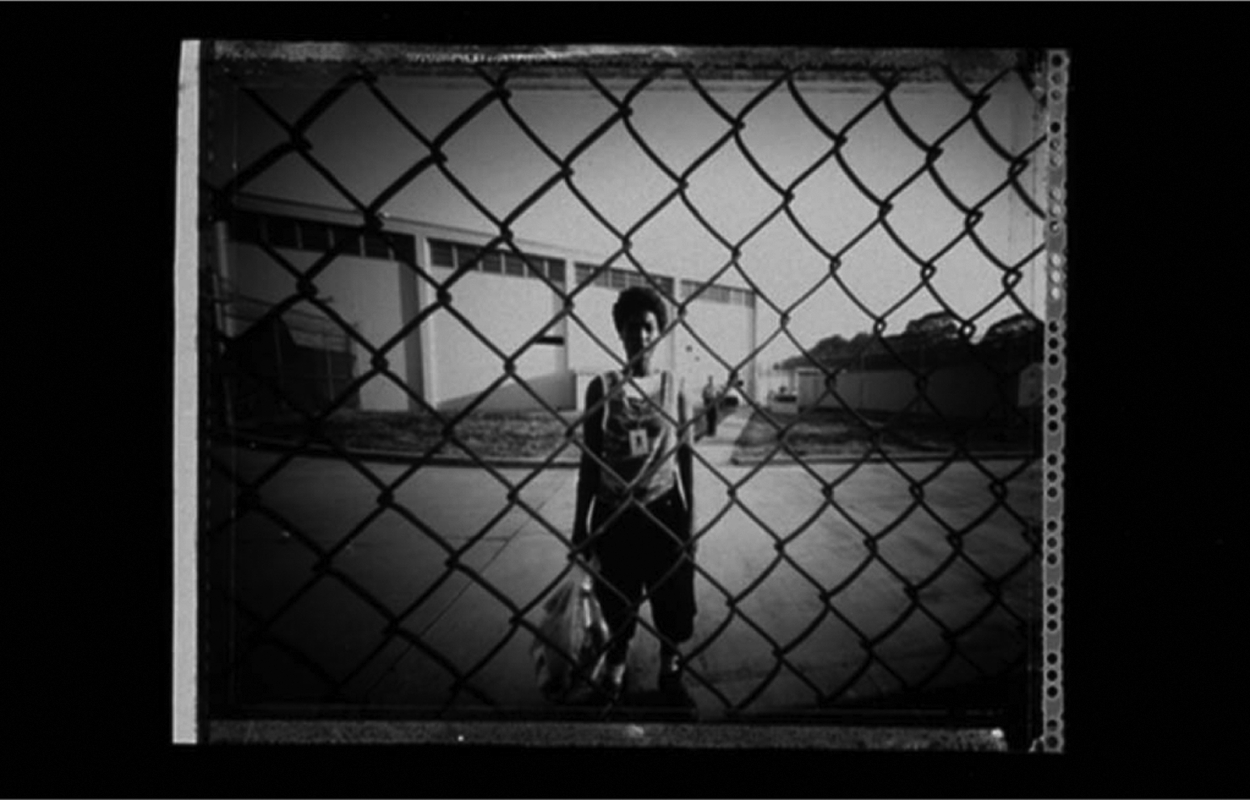
Still from Stranger, Shadow’s photo, Treasure’s memory of Shadow