







Abstract
While prisons proliferate in the rural landscape and sites of penal tourism expand, the carceral state structures the available visual and analytic vantages through which to perceive this growing visibility. Using examples from fieldwork in Kentucky, including Appalachian prison communities and a site of penal tourism, this article proposes ‘counter-visual’ ethnography to better perceive the ideological work that the carceral state performs in the spatial and cultural landscape. A counter-visual ethnography retrains our eyes to see that which is not ‘there’ but which structures the contemporary empirical realities we observe, record, and analyze: the ghosts of racialized regimes past, the sediment of dirty industry that seeps into and imbues the present, and the trans-historical and trans-local circulation of carceral logics and epistemologies. In addition, this article suggests the important role images play in shaping alternative vantages from which to better perceive the carceral state with historical, spatial, and political acuity.
Keywords
Legibility implies a viewer whose place is central and whose vision is synoptic. State simplifications of the kind we have examined are designed to provide authorities with a schematic view of their society, a view not afforded to those without authority. Rather like the US highway patrolmen wearing mirrored sunglasses, the authorities enjoy a quasi-monopolistic picture of the selected aspects of the whole society. This privileged vantage point is typical of all institutional settings where command and control of complex human activities is paramount. The monastery, the barracks, the factory floor, and the administrative bureaucracy (private or public) exercise many state like functions and often mimic its information structure as well.
Introduction
Field notes, July 2012 We stood on the side of a country road in the mountains of eastern Kentucky and opened the trunk of my car in order to begin unpacking Jill’s camera equipment. Across the rural highway, nestled in an otherwise bucolic eastern Kentucky valley, was Little Sandy, the state’s newest prison and, according to the Department of Corrections’ own website, its most technologically sophisticated. We saw no people, guards or prisoners. As a researcher and a photographer studying the political and cultural geography of incarceration in the state, our intention was to get a sense of the place the prison takes in the landscape. We popped the trunk and began discussing what equipment to use. A white pickup truck with official tags pulled up behind us. A correctional officer stepped out of the truck and began walking toward us, all the while speaking into the walkie-talkie attached to his shoulder. Friendly but curt he got right to the point: he would need to call the police and confiscate our equipment and photographs if we stayed any longer or took pictures of the facility. ‘You see those signs?’ he asked, pointing up and down the road to signs far in the distance on either side of us. ‘No photographs between those signs.’ He got back in his truck and started the engine. We could see him talking into his walkie-talkie. He shut off the engine and returned to our car before we could leave. ‘I’m going to need to see your IDs,’ he said, and promptly jotted down both of our driver’s license information before ushering us on our way.
The correctional officer’s role in this encounter from my field work eminently demarcated a visual hierarchy: only authorized personnel could look with anything other than a fleeting gaze at the embodiment of state power and violence that is a prison. Between signs that extended the prisonscape a hundred yards in either direction, the only permitted look was an ephemeral one obtained from a passing car. Those of us who would enjoy—or perhaps even demand—a ‘right’ to see prisons in a way that exists outside of their control are given a firm dismissal: ‘move on, there is nothing to see here’. 1 Of course, the very ability of the officer to interrupt our attempt to document the prison relied on the prison’s power to make us visible. The cameras that were undoubtedly trained on us from the prison and the surrounding landscape created a unidirectional sightline. The prison could remain largely invisible while we were subjected to surveillance, control, and the threat of detention, loss of property, and arrest.
According to visual culture scholar Nicholas Mirzoeff, the opposite of this ‘right to look’ is not censorship. Indeed, information about Little Sandy exists on Kentucky’s Department of Corrections website and images can be found there or through various Internet search engine map functions. 2 Rather than censorship, the appropriate oppositional force to a right to look is what Mirzoeff (2011: 474) calls ‘visuality’, or ‘that authority to tell us to move on and that exclusive claim to be able to look’. Mirzoeff argues that the complex of visuality is comprised of three constitutive components: classification (through naming, categorizing, and defining); separation (of those classified as a means for social organization); and aestheticization, by which he means the production of a normalized and hegemonic ‘common sense’. In other words, the opposite of such a right is the authorial role of the state in constructing, legitimating, and normalizing its own history and presence.
Once told to move on, we packed up our equipment and left, driving the 20 miles into nearby Prison Town, a community whose pseudonym seemed to choose itself because it is sandwiched between Little Sandy and a second state prison. In Prison Town, I experienced the most emotionally charged moments of the research: staring at the destruction of downtown residential and commercial buildings due to a devastating late winter tornado (see Figures 1–4). Here, the hub of Appalachian public and civic life remained decimated, five months after the tornado had struck. The prisons, however, persisted; their durability was literally inscribed architecturally and in the larger geography of the community. The contrast between the empty devastation of the proverbial and literal Main Street and the humming, fortress-like invincibility of incarceration raised layers of questions: about what it means to invest more human, financial, and political capital in institutions of exclusion than the public commons; about the physical and symbolic place of incarceration in the rural landscape; and about the role of the state and capital in structuring the future of communities. 3
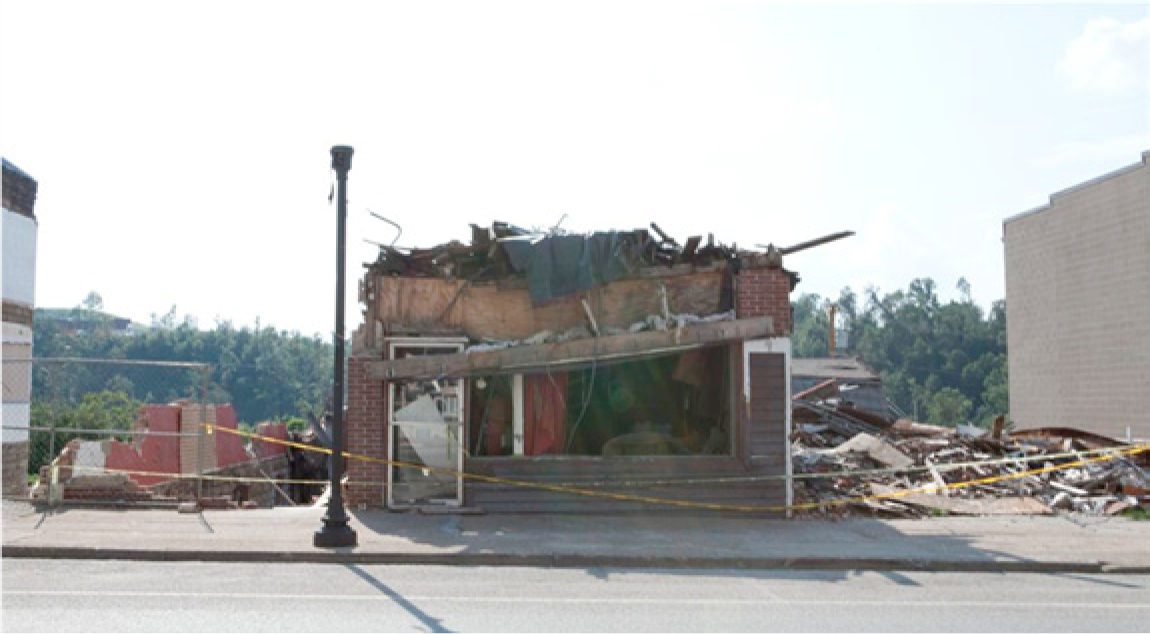
Prison Town’s Main Street, five months after a tornado.
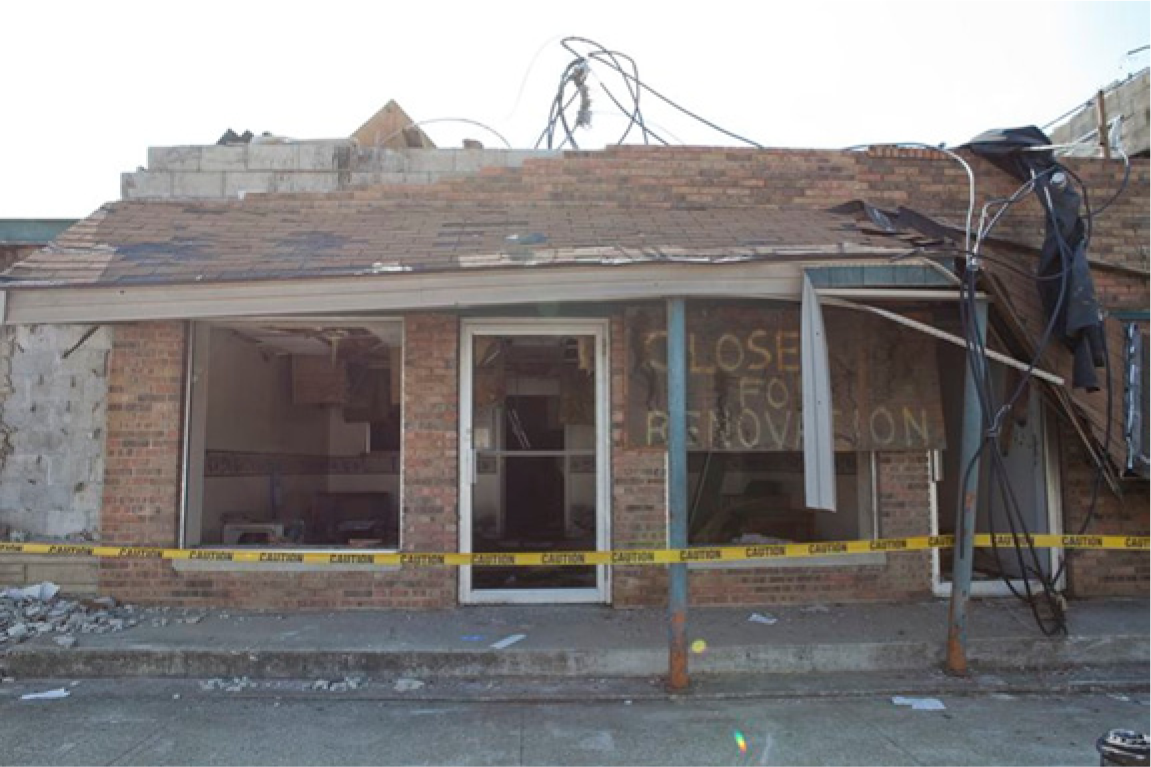
Closed for Renovation on Prison Town’s Main Street.
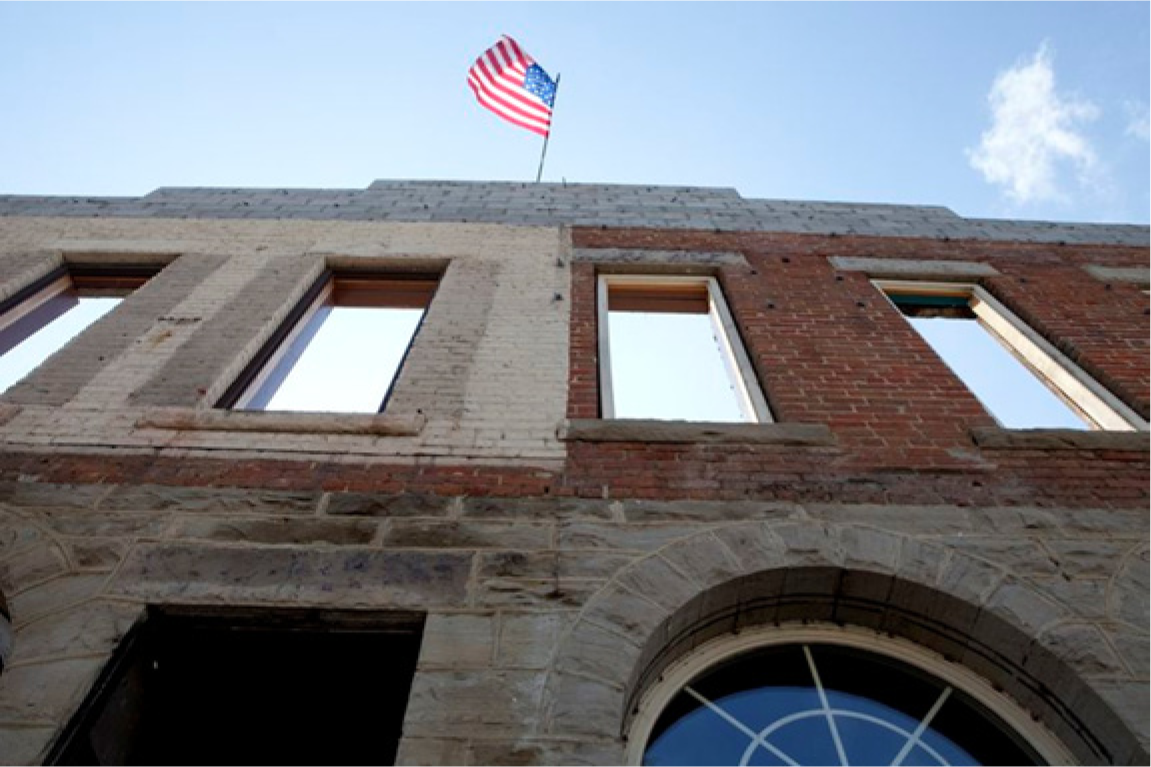
Flag on Prison Town’s Main Street.

China King Coming Soon, Main Street in Prison Town.
These encounters from my fieldwork index a broader relationship between state authority and the structuring of the visual field. Jill, a photographer, and I had wanted to visually integrate the prison into its geographical and historical contexts, situating its dominating presence in the dilapidated rural communities that are its host and in the migrations of capital and jobs out of Kentucky that structured its very potential. It is precisely this kind of inquiry that the state tries to preempt, and its visual documentation that the state finds suspect and thus subjects to securitization (Simon, 2012).
The visuality of prisons and other carceral institutions configures our ability to perceive them, the available vocabularies with which to speak of them, and the contexts in which to place them. That is, the carceral state has structured our very capacities to perceive this particular coercive constellation of state power, especially in its historical and spatial contingencies. This article examines the relationship between the growing visibility of carceral formations in the political economic, cultural, and geographical landscapes of Kentucky and the narratives and vantages that such visibility both enacts and precludes. I argue for a ‘counter-visual’ scholarly practice that can better perceive and intervene in the visual and ideological prevalence of the carceral state.
I draw from multi-sited fieldwork in order to illuminate the connection between carceral growth and the structuring of our visual and rhetorical means for understanding it. First, in rural prison towns in eastern Kentucky, I address the narrow and dubious narrative of economic development through which prison building is justified and which, in the process, buries other narrative vantages. Second, hundreds of miles west of eastern Kentucky prisons in a charming Bed and Breakfast built on and in an old jail and gallows and haunted by the ghosts of its executed and incarcerated former prisoners, I consider the ideological work that the carceral state performs in and through locations that would seem to operate outside of its reach. After progressing through brief examinations and analyses from this fieldwork, this article then engages in a broader reflection on what such experiences might suggest for ethnography—a methodology often caught up in the empirical moment—that engages the politics of visuality.
From visual to visuality: Reframing the image
In the context of this special issue on visual criminology, this article interrogates the relationship between visibility and visuality by examining what images exist and how the carceral state mobilizes those images into dominant narratives. In addition, in a preliminary attempt to reveal alternative vantages from which to perceive the growth of prisons and the increased circulation of carceral logics, I offer a counter-visual analysis. Such an approach attempts to disturb the prison as a ‘key ingredient of our common sense’ (Davis, 2003: 18) and intervene in the ‘naturalized landscape on which the political drama of other scenes of torture and terror take place’ (Rodriguez, 2006: 10). By putting carceral formations and logics into the same narrative and visual orbit as certain practices, histories, and industries that are often disconnected from both popular and scholarly examinations of incarceration, this article suggests analytical and visual vantages that delineate a committed and radical approach to the study of the prison industrial complex. Indeed, that term’s utility for analyzing the true scope of carceral logics and practices further underscores the necessity of new methodological approaches that destabilize and broaden the ocular obsession within criminology of narrowly looking at institutions and the captives and captors therein. The prison industrial complex in the United States extends beyond the sheer volume of this country’s world-leading incarcerated population and the constitutive miseries, political interests, and even resistances. Rather, the scope includes the collateral consequences of mass imprisonment in communities (Clear, 2007; Mauer and Chesney-Lind, 2002; Western, 2006), its representational performances in our living rooms through media (Hall, 1997; Hall et al., 1978; Kappeler and Potter, 2004), and in communities through other cultural forms (Brown, 2009), and its existence as a regime of knowledge, grounded in and structuring various intersecting and overlapping regions of logic and discourse, such as philosophies of punishment, neoliberalism, colonialism, and development (Agozino, 2003; Foucault, 1980: 47–48; Gilmore, 1999, 2007; Sloop, 1996), and the work all of these perform in structuring individual and community dispositions (Schept, 2012, 2013). As such, studying carceral growth and emergent forms of the culture of punishment requires a scholarly gaze that can account for such diffuse and diverse iterations and which can see the prison in the spatial, cultural, and political-economic landscape and excavate what its material presence obscures, hides, and buries (Loyd et al., 2012).
A counter-visual ethnography looks for what is not ‘there’ (Gordon, 2008): the ghosts of racialized regimes past, the sediment of dirty industry that seeps into and imbues the present, and the trans-historical and trans-local circulation of carceral logics and epistemologies that structure the contemporary empirical realities we observe, record, and analyze. This is thus an argument for a committed epistemology, an ‘ethnographic sensibility’ (Ferrell et al., 2008: 179) that foregrounds and then destabilizes the geographical and political-economic structuring of contemporary discourse and knowledge. Such an approach aims to reveal that our vocabularies of perception and our ‘visual language’ (Carrabine, 2011: 6) of the carceral moment are limited to the familiar and predictable refrains enabled by what Morrison (2004: 343–344) has called the ‘defining ability of state power [which] remains the key to criminological epistemology’.
This method offers a variation on existing calls for new methodological approaches to the visual including Ferrell and Van de Voorde’s (2010) argument for a critical visual analysis that integrates cultural criminology and the documentary photograph tradition (see also Courtney and Lyng, 2007; Greer et al., 2007). Such an analysis, they argue, furthers the important project of ‘unlearning’ conventional research designs, hegemonic representations of both criminal and crime control agent, and the larger and imperative task of orthodox criminological convention. And yet this article also departs from theirs in its insistence on historicizing the ‘decisive moments’ that Ferrell and Van de Voorde position as the target of a cultural criminology of the image. There is a distinction between critical study of the image and critical study of visuality. In the latter, the image is only a constitutive part of the larger scholarly and political project, both in the important role it can play in attaching epistemic legitimacy to representation but also in its strategic importance in looking back at the state. Indeed, as Wall and Linneman (no date) argue in an unpublished paper, visuality is never complete. Read by the authors as the aesthetic authority of police power, visuality is not absolute and/or uncontested, as slave revolts, colonial insurrections, revolutions, and everyday acts of resistance to the dominant order prove. Some form of countervisuality always exists in antagonistic relation to those peoples, institutions, and structures seeking to ‘authorize authority’ by aestheticizing a particular (im)moral geography.
Along with them, I argue for a committed methodological praxis that enacts a counter-carceral counter-stare. Following Hayward’s (2010: 3) important call for a ‘new methodological orientation toward the visual’, I suggest foregrounding the study of visuality and offering counter-visual analyses as the primary expression of such an approach’s ‘politically charged analysis’ (Hayward, 2010: 3).
Coal, capital, and the carceral
The ‘common sense’ of incarceration that naturalizes prisons in the landscape is, of course, the product of various processes and accompanying discourses, most notably the success of tough on crime movements. But prisons have also long been marketed to rural communities as keys to postindustrial economic development. This is nowhere more evident than in Appalachia where coal jobs have been on the decline since the 1970s and prison growth has risen dramatically. Indeed, a recent article announcing an economic development conference for eastern Kentucky notes that the region has lost nearly 6000 coal jobs just since mid-2011 (Estep, 2013). The region is also home to eight prisons, with a ninth currently undergoing the Environmental Impact Study process that often precedes construction. Once constructed, that prison will be the sixth federal facility built in central Appalachia since 1992 (Ryerson, 2013).
In the first decade of the 21st century, Kentucky was one of the faster growing carceral states. According to a press release from Kentucky Governor Steve Beshear’s office in August 2010 announcing the state’s partnership with the Pew Center on the States, Kentucky’s incarcerated population grew by 442 percent, from 3723 prisoners in 1980 to 20,200 in 2010, during roughly the same 30-year period in which the United States became known for its prison industrial complex. The press release notes that, Kentucky has seen one of the nation’s fastest growths since 2000, growing 45 percent since then, compared to 13 percent for the U.S. state prison system overall … To pay for this increase, total state spending on corrections in FY 2009 reached $513 million, up from $117 million in FY 1989.
4
Curiously little research in criminology has examined the cultural significance of, and political economy behind, prison growth in the rural American landscape. With the exception of compelling work into the ‘fading of rural community’ in Kentucky by a criminologist (Tunnell, 2011), there is no criminological scholarship engaging rural prison growth in the state, where farms, industry, and populations continue to decline while prisons rise. A Lexington Herald-Leader story from March 2011 confirms that, The only county in the eastern end of the state that grew more than 10 percent [in the first decade of the 2000s] was Elliott, but that was because the state opened a prison there in 2005. The 1,000-plus inmates at Little Sandy Correctional Complex accounted for all the county’s growth.
At times, the spatial exchange of farm and industry for carceral growth is quite literal. The excerpt from my field notes that began this article occurred in front of Little Sandy. The correctional officer who moved us along and threatened to confiscate our camera equipment did oblige us a few quick questions. In response to my inquiry about what had preceded Little Sandy on the land on which it was sited, the officer replied, ‘A small farm.’ Carceral architecture erased the small farm that had inhabited this rural geography, burying it under the prison that now occupies the (fleeting) visual register.
A similar pattern emerged in another Appalachian prison town. In a small community of 2000 about 90 miles south-east of Little Sandy, which I will call Valley View, a private prison sits empty due to a sex scandal and legislative changes in the state. The prison takes the literal and figurative place of a prior industry that both shaped and abandoned the community: coal. The actual land on which the prison now sits empty narrates the story of Valley View. The road into the prison is a short but steep and curvy drive up from the community’s main street. The road cuts a wide swath in a range of mountains that separates the ‘holler’ in which Valley View sits from the next one over. The prison perches above the town, literally casting it in its shadow, and demonstrates the intimate connection between the community and the space. Before the prison company built the facility in the early 1990s, it was a coal ash dumpsite. Before that, it was a mining site; two of the town’s residents, both former coal miners and prison guards, proudly showed me where the coal seam is still visible. Before that it was just another mountain in the chain that forms Valley View’s eastern perimeter. This historical lineage—from mountain to industry, from industry to industrial waste, from industrial waste to new industry, and from new industry to industrial abandonment—illustrates central features of the relationship between capital and place. First, the small community appears to be a prime example of what Neil Smith (2008 [1984]: 6–11, 196–206) calls the ‘seesaw movement of capital’. 5 The departures and arrivals of capital have structured Valley View’s constant state of both dependency on foreign capital and proneness to taking whatever form in which that capital comes (back). Second, these iterations of capital investment and divestment produce conditions and products that materially and symbolically leach into the land and form layers of sediment that seep into the body and soul of the community: the extreme health hazards of living near coal ash, 6 the potential violence of prison work, and yet the deep-seated identities that both industries structure. 7
The production of space is critical in the structuring of narrative vantages that accept the conditions wrought by coal and prison. In this regard, scholarship of coal has offered instructive points for a counter-visual study of the prison industrial complex. For example, Scott (2010) begins her study of mountain top removal (MTR) with observations about the geography of presence and absence, noting that, ‘mountain top mines are hidden just behind the ridge visible from the road … MTR is all but invisible to the casual observer.’ But she goes on to say that ‘MTR is rapidly becoming part of the everyday landscape, making its drastic alterations of the landscape seem ordinary.’ And finally, Once a mountain disappears, how do we know it was ever really there? It becomes a ghost, nearly possible to ignore. The repetitive redoings of modernity, the planned obsolescence, the constant remaking of the dualism of future and past make it hard to see what was there only a few moments before. What we see appears natural. As if it had been there always.
It is this seemingly contradictory presence/absence that marks visuality’s success. Removing mountains—rendering them invisible—is so quotidian a process that the ‘drastic alteration of the landscape’ appears natural, as common sense. I am asking variations of Scott’s question above. Instead of the disappearing mountains and the resulting uncertainty about knowing they were ever there, I am concerned that the growing appearance of the prison in the landscape both sediments its common sense prevalence and obscures the all too important questions of what was there before and what could have been there instead.
Other work from the United Kingdom on coal (Byrne and Doyle, 2004) questions the structured images of industry that are available for consumption. The authors note that mining is visible to the public only on the surface, in the ‘entrance to the underground and the rubbish left after coal has been extracted from below—as pit heads and spoil heaps … all that remains [after the industry departs] is the blighted landscape’ that, at least in Valley View, gets remade in the image of the next extractive industry. The point, however, is that ‘the actual activity of mining was carried on unseen—below ground—out of sight—hidden’ (2004: 168). The essay goes further and points toward the logical conclusion of suppressing dirty work underground and behind walls: the only images we have are those that are officially sanctioned. The authors write that few photographs of mining underground actually exist, save for a lone miner’s private photographs and instructional images. Of this latter collection, the authors observe that, these are staged and represent the view the mining machinery manufacturer or the colliery company wishes present. A photograph may depict objects out of place, or in a dangerous condition which, whilst accurate, is not something that the commissioner of the photograph wishes to portray.
Contained within both of these examinations of coal’s visibility are crucial insights for a counter-visual study of the carceral state. First, the work of visuality constructs authorial representations through the naturalization of industrial practices and in the structuring of available vantages for perceiving the industry. However, both studies also point to the potential for subversive image work. The ghosts of the mountain are ‘nearly possible to ignore’; the point, then, is to illuminate the specter and to denaturalize the absence of the mountain. Likewise, the work is to locate the prison in its historical contingencies and to disrupt the common sense of its place in the landscape. As Byrne and Doyle (2004) note, the photographic image can still capture the fissures in the armor of authority.
The Elk Horn Coal Company built Valley View in the early decades of the 20th century. The identity of the town and its residents is inextricably intertwined with coal, even as the local mines closed in the 1970s. I learned much of this from conversations with local residents, several of whom were miners turned correctional officers. One, whom I’ll call Rich, is a local city councilman who served as our primary point of contact to the community. Soon after arriving, he drove us to the closed facility for a scheduled tour. I had been somewhat surprised by his assurances that we could get into the prison. Sure enough, a voice crackled over the intercom denying our entrance. Rich responded asking who was in there; he seemed satisfied by the inaudible response and asked if the person might call in to what I presumed was the prison company’s national headquarters to ask. The company denied our entrance. Still, we were able to walk around the grounds and eventually Mike, the voice from within, emerged from the prison dressed in dirty work clothes, a far cry from the snappy uniforms featured on the prison company’s website. Mike’s large presence belied a soft spoken and thoughtful demeanor. He told me that despite sitting completely empty, the prison company still employed a few former correctional officers to watch over the facility 24/7. But employing three local people to watch over an abandoned prison doesn’t make up for the 180 jobs lost. When I pressed him on what it meant to lose the prison and what he’d do next, he shrugged, ‘There just hain’t no jobs in eastern Kentucky.’ Moreover, Rich and Mike noted that the prison’s departure had significant economic implications beyond job loss. As they explained, the absence of the prison can be felt in the empty gas station, the low utilities payments (which, during operation, accounted for as much revenue as the rest of the town combined, according to Rich), and the money that 180 people living and working in and around Valley View then spend in Valley View. When the jobs left, the money followed. By Mike’s estimates, 80 percent of the prison’s workforce lived within just a few miles of the facility. When I asked about pay at the prison, both men scoffed. As desperate as they were for the prison to return, the hourly rate was extremely low. The jobs start at about $8.75 an hour, they said; in contrast, average miner work and jobs at federal prisons started at double that rate. 8 But those jobs required long, sometimes multi-hour commutes. With this in mind, it is perhaps not hard to understand why Rich and others would be trying as hard as possible to recruit another private prison company to site in the community. See Figures 5–7.
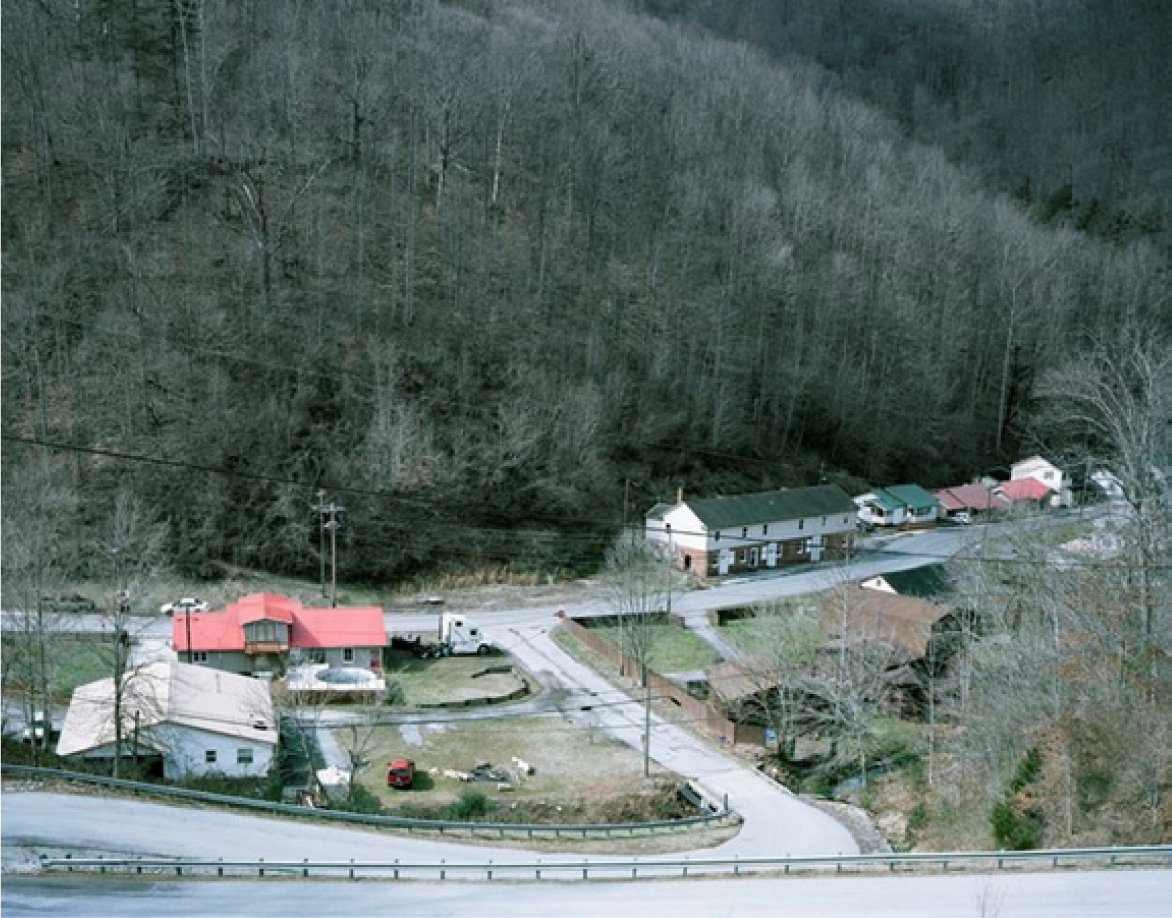
Valley View from the Prison.
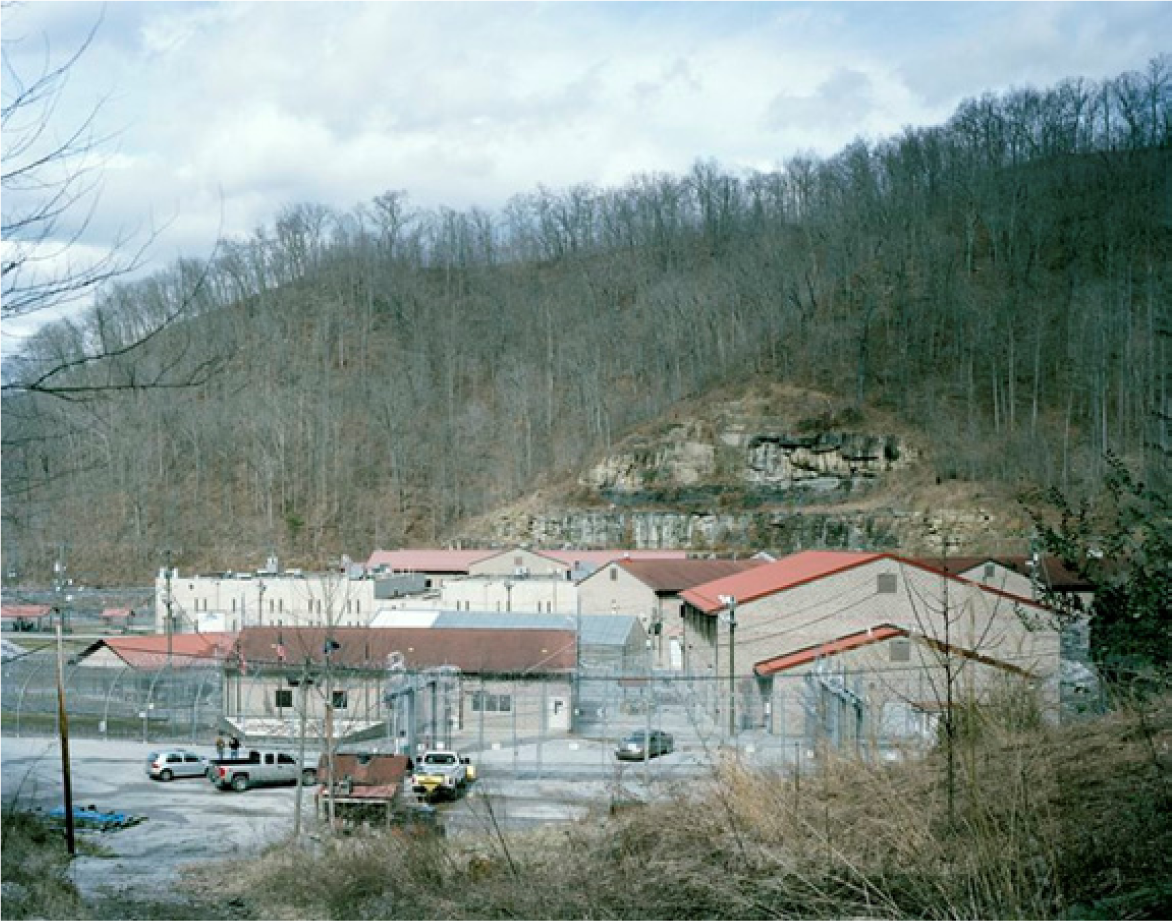
Abandoned Prison in Valley View.
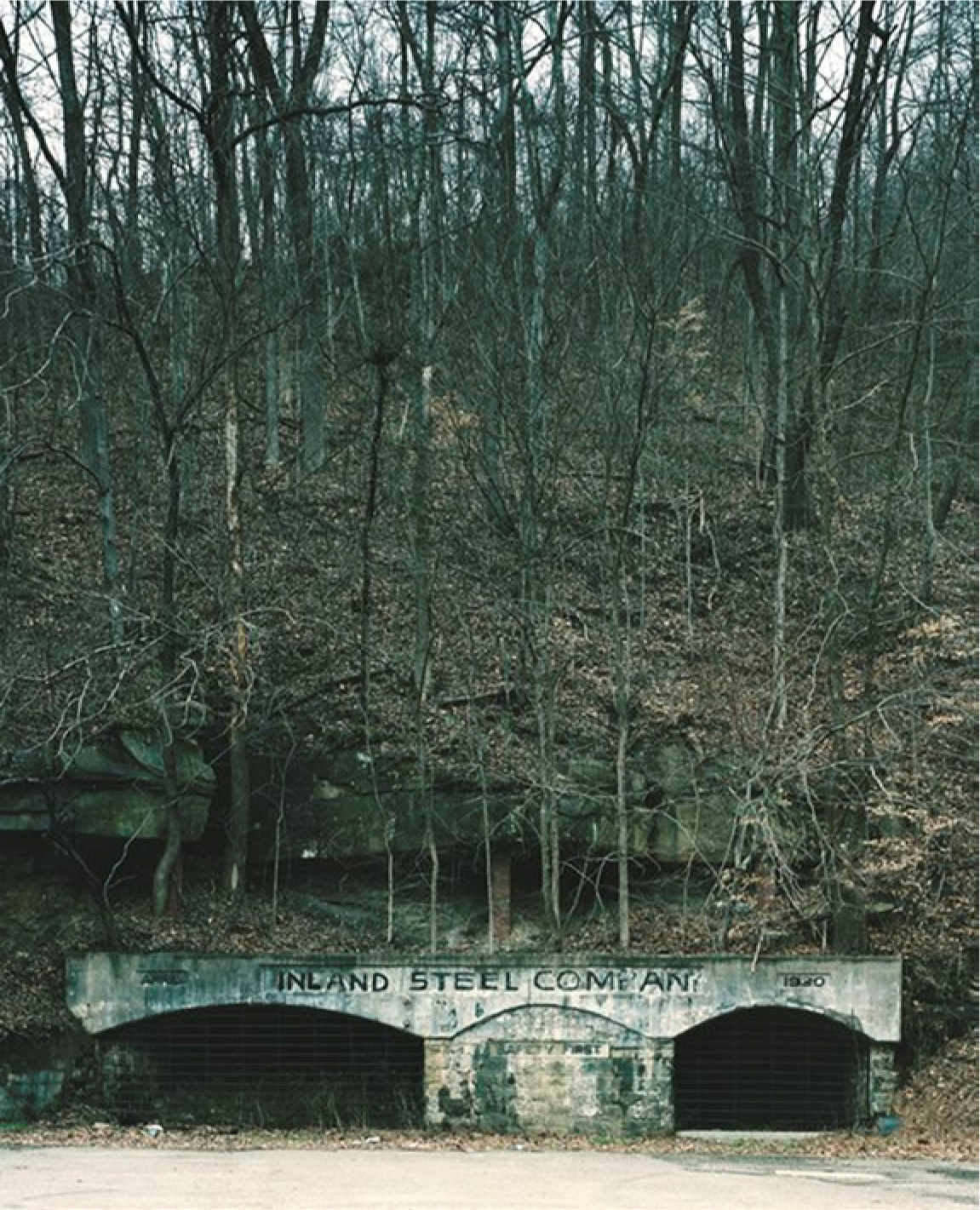
Old Entrance to the Mine in Valley View.
A counter-visual ethnographic scholarship must be able to engage such dispositions in two ways that may necessarily be in tension. First, following cultural criminology’s work on ethnography, a commitment to criminological verstehen—a methodology of engaged and reflexive empathy (Ferrell, 1998; Ferrell and Hamm, 1998)—requires ‘seeing like a prison’. It was with surprise and even some shame that I found it rather easy to understand where Rich and Mike were coming from in their mourning the loss of the prison and their dedication to recruiting a new private prison company to take over the facility (Ferrell and Hamm, 1998; Kraska, 1998). For them and their community it made sense to go after an industry perceived as the most reliable for rural economic development in order to provide the most immediate relief. But a commitment to seeing things from the perspectives of others must also require a second process: subjecting such ‘common sense’ conclusions to interrogation, historicization, and potentially rejection. The belief that prisons bring development is, of course, reflective of the official line from industry and the state, both of which position the prison as the best alternative to a coal industry in its fourth decade of decline. I have referred elsewhere to this individual and community embodiment of hegemonic logics of carceral growth as ‘carceral habitus’ (Schept, 2013). Following Pierre Bourdieu’s (1990, 1991, 2005) original formulations, carceral habitus is structured and structuring, inscribed with and constrained by hegemonic logics but also capable of varying and seemingly distinct iterations. In Appalachia, community leaders advocating prison growth clearly espoused heavily structured dispositions imbued with the narrative that prisons bring economic prosperity. Importantly, these dispositions also structured individual and community bodies to see the derelict space of former coal seams and dumping grounds in carceral contours. Indeed, as one scholar and activist has observed of the facility in Valley View, the iconography within the prison itself offers an explicit articulation of the two industries. As Ryerson (2010: 73) describes of a mural centrally located in the lobby of the prison, The iconic coalminer’s helmet, pick and shovel [is placed] underneath the state of Kentucky, locked up from east to west [behind bars]. And so [the prison company] defines the past, present and future of the state of Kentucky: prisons and coal.
Poor rural communities around the United States devastated by deindustrialization and the neoliberal withdrawal of the welfare state have turned to incarceration to provide relief from stagnating economies and unemployment (Bonds, 2009, 2012; Gilmore, 2007; Huling, 2002; Williams, 2011). Ruth Wilson Gilmore’s (2007) observation of the prison as a geographical ‘solution’ to deeply structured urban problems also resonates for understanding the rural lobby for prison siting. This is certainly true in Appalachian Kentucky, where numerous national and regional indexes point to its precarious and devastated status. For example, the Gallup-Healthways Well-Being Index, 9 which examines the six sub-indices of Life Evaluation, Physical Health, Emotional Health, Healthy Behavior, Work Environment, and Basic Access, ranked Kentucky’s fifth congressional district, covering all of Appalachian Kentucky and the counties studied in this project, 435th out of 436 United States congressional districts. In addition, the Appalachian Regional Commission ranked and studied county economic status in Appalachia from 1 October 2011 through 30 September 2012 and found that every Appalachian Kentucky county, including all of those included in this study, qualified for distressed status, meaning, according to the report, that they are in the bottom 10 percent of all United States counties for economic status.
Finally, Wang et al. (2013) examined national life expectancy over a 25-year span from 1985 to 2010. While the authors found overall increases in life expectancy, they also note a somber trend of widening disparity between counties. For men, the difference between the highest performing and lowest performing categories is 17.77 years. For women, the difference is 12.37. Perhaps unsurprisingly, the bottom 10 lists for men and women include three different Appalachian Kentucky counties: Perry and Leslie for females (with Perry having the lowest life expectancy for women in the country) and Perry and Floyd county for men. Floyd County is home to Valley View.
Along with the job loss from coal, it is a powerful and desperate context that buttresses prison siting as a hopeful solution to communities in crisis. But as Gilmore (2007) and others note, the ‘common sense’ of prisons bringing jobs and economic growth belies a body of scholarly work that suggests just the opposite. Hooks et al. (2004) looked at counties across the country and found that not only did prisons fail to bring prosperity or growth to the areas in which they were located, they actually obstructed it. In their study of 25 years of economic data from rural New York State, King et al. (2003) similarly found that no significant economic difference existed between seven counties with a prison and seven without a prison. Indeed, rural Kentucky communities lobbying for prison siting can turn to counties within their own federal congressional district for an instructive lesson in the effects of prison building. As Ryerson (2013) has argued recently, three Kentucky counties with federal prisons remain three of the poorest in one of the poorest congressional districts in the United States.
The prison’s place after and literally on top of coal—their historical, spatial, and economic continuity—suggests that the narrow story of rural economic development buries other stories that could be told about these two industries. Indeed, the coal seam still visible in the walls that surround the facility in Valley View does not just demarcate a piece of industrial history and signify a transcendent cultural identity; through a particular vantage, it also knits together the prison and coal through the overlap in their workforce, through their arrangement of space, through their lasting imprint on the communities in which they reside, and through the logics they assemble and articulate to justify the exploitation on which they rely.
It is only through paying attention to the ideology of landscape—the ‘particular means of organizing and experiencing the visual order of those things on the land’ (Mitchell, 2003: 242, emphasis in original)—that new vantages can be enabled. Following Mitchell (2000, 2003), the Valley View landscape performs important work, simultaneously erasing the relations of production that produced it while also aestheticizing the results through the authorial narrative that tells Appalachian residents to take pride in coal and prison.
Thinking of the prison as a ‘dirty industry’ like coal furthers this important analytic vantage. Both employ the same people (literally) to do their ‘dirty work’ in places that elude any kind of democratized gaze: under the ground, inside the mountain, and behind the barbed wire and walls. This ‘politics of verticality’ (Weizman, 2007) employed by the state and by industry requires thinking and photographing the presence of the prison along a three dimensional plane that looks horizontally (the Main Streets of communities like Prison Town), vertically (the prisons built on top of mountains; the underground mines) and with various layers of depth (the outsides of prisons and mines and the various interiors that contain increasingly ‘dirty’ work and constrained bodies and vantages). Such an approach enables a richer sense of mass incarceration’s presence than the narrow ocular logics we traditionally employ.
Perhaps what is most important in a counter-visual study of prisons and other carceral formations is providing what is otherwise ‘cropped out’. Following Gilmore (2007: 11), if the prison is not marginal—on the physical edge of space—but rather connected into contiguous and non-contiguous spatial and temporal relationships, then to understand the prison and see it we must examine its spatial and historical contexts. What is next to it? What came before it? What is it built on top of? In asking these questions and answering them through ethnographic engagement and visual representation—the dilapidated communities, the out of business small businesses, the overgrown homes, the small farms and former coal seams—perhaps we move toward asking and answering the more pressing, provocative, and inspiring question: what comes after prisons?
Specters of incarceration
Two hundred miles west of Appalachia, in a quaint town known for its bourbon tourism, is a site seemingly disconnected from mountain towns and their prisons. The Guard’s Guesthouse is a Bed and Breakfast constructed on and in an old county jail and gallows and haunted by the ghosts of its former prisoners. The Bed and Breakfast occupies two attached buildings, both of which housed the county jail and gallows at different times. The renovated front building, which opened as the original jail in 1819 and served as the jail until 1874, contains six quaint rooms for guests, each of which contained four pre-fabricated cages during its time as a jail. A substantial part of the back building, which served as the county jail from 1874 through 1987, remains unchanged from its carceral identity, including a number of cells.
The Guesthouse relies heavily on this historic continuity between the site’s former and current uses. The website, for example, offers the inn as a ‘unique and luxurious way to “do time”’. The Guesthouse also emphasizes its designation as one of the top 10 most haunted places in the United States. That is, the penal tourism (Brown, 2009) that the inn enjoys constructs a cultural life out of the lives lost at the gallows that once stood in what is now the courtyard. In a fascinating twist of logics on the Guesthouse’s website, the owners simultaneously suggest that residents cannot imagine the past uses of the location where they now lounge and, at the same time, rhetorically raise the very ghosts that haunt the site:
10
On spring and summer mornings, as you sip hot coffee and chat with other guests over a full breakfast in the courtyard, it’s difficult to imagine all of the previous uses of the courtyard—as a work yard for prisoners crushing limestone, a place to visit forlorn relatives, or even the centralized location of the county gallows.
The inn deliberately invokes the contrast of incarceration and high-end tourism; the latter is indeed predicated on guests’ fascination with the former. The Guesthouse is dedicated to enabling people to play with the concept of incarceration from a comfortable historical distance yet contemporary locality.
Carceral themes imbue every aspect of a guest’s stay. Driving up to the Bed and Breakfast, I first noticed the stockades out front on the sidewalk and in which a steady stream of tourists posed for the iconic photograph. Walking into the actual building are important signifiers that speak to the historical memorialization in which the inn engages. I noticed signs out front for ‘The Guard’s Guesthouse’ and, above it, ‘Old County Jail’. Once inside the building, there is a sign hanging over the proprietor’s room that says, ‘Remember the history so we can affect the future.’ What must be asked, however, is whose history is remembered, what future does The Guard’s Guesthouse create, and how is the present discussed?
Chris, the proprietor, welcomed me to the Guesthouse. After introductions, he smiled and said, ‘Let’s get you situated in your cell’, the first of many times that he would refer to the room in which I stayed—which did not resemble a jail cell at all—as a cell. The keys he handed me contained a normal-looking room key and a set of much larger and heavier steel keys; the rooms, it turned out, still had the old jail cell doors attached. The reference to my room as a cell was just the first of many similar jokes; the Guesthouse staff rely heavily on a linguistic register full of jail references and gallows humor, including referring to returning guests as ‘our repeat offenders’.
Other areas of the Bed and Breakfast maintained a similar distanced articulation of incarceration and tourism. The reception area where guests check in and out also serves as a gift shop. Here, one can purchase any number of items marking the time one did at the inn, including T-shirts, hats, backpacks, and magnets all advertising that ‘I did time at The Guard’s Guesthouse’. Walking through the reception room leads one into the back building, which remains largely untouched from its days as the county jail. Four cold, bare cells display memorabilia from its former carceral usage. In one cell, with two bunk beds, a display sits on a top bunk that contains various ‘home-made’ items, including weapons, a tattoo gun, and a shaving cream canister carved out in order to fashion a key. Above this display sits a sign that reads, ‘Examples of how the criminal mind works. These devices were found in the cells.’ The signage is clearly important. First, it encodes certain bio-pathological constructs about criminality as the accompanying narrative for tourists to apply to their tour of the jail and their reflection on its former inhabitants. But the present tense of the sign, combined with the paraphernalia, violates the memorialization found elsewhere in the Guesthouse and collapses the historical into the present.
Finally, on one of my visits during a warm spring day, the Guesthouse staff served complimentary breakfast in the bucolic courtyard overlooking the former site of the gallows. While guests ate, the inn’s proprietor narrated a well-rehearsed history of the site, including details of the executions that occurred 30 feet in front of the outdoor kitchen where we sat. Indeed, photographs on the walls inside the building show images from some of the executions that took place. Just as the online promotional material had suggested, we sat eating a delicious breakfast and drinking coffee, looking at an empty expanse of grass and finding it difficult to imagine the past while, simultaneously, being haunted by it (see Figures 8 and 9).
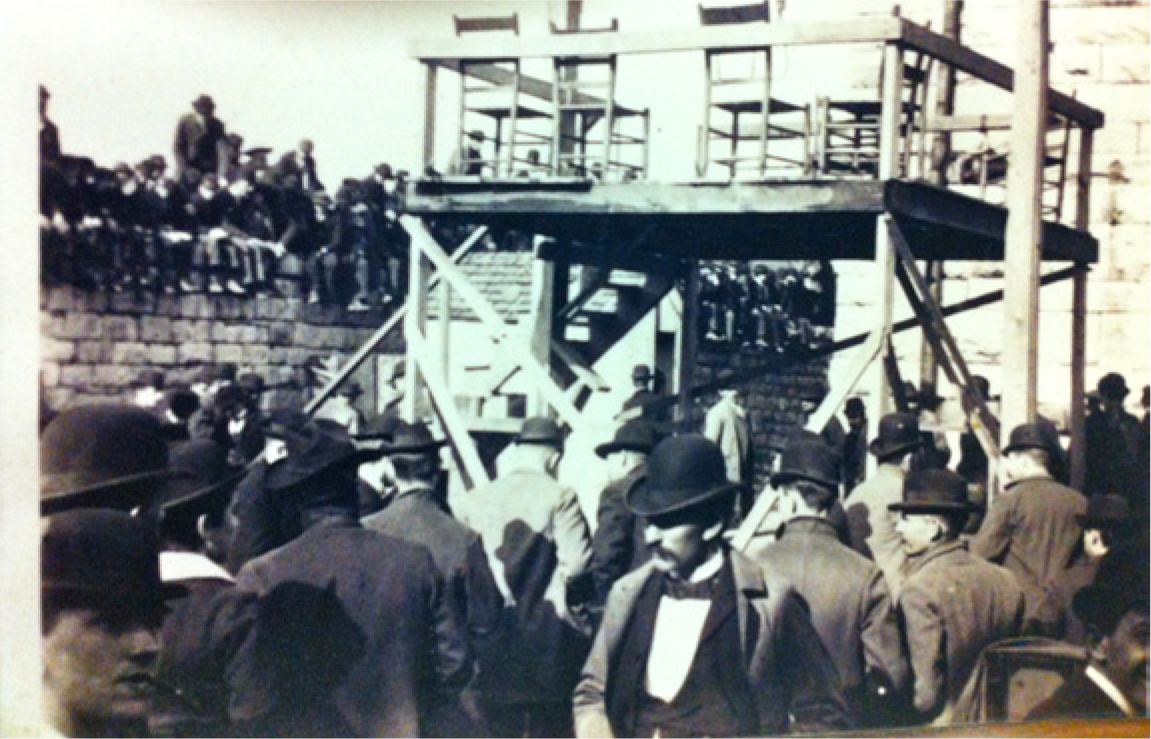
The Back Courtyard of The Guard’s Guesthouse is the Former Site of the County Gallows.
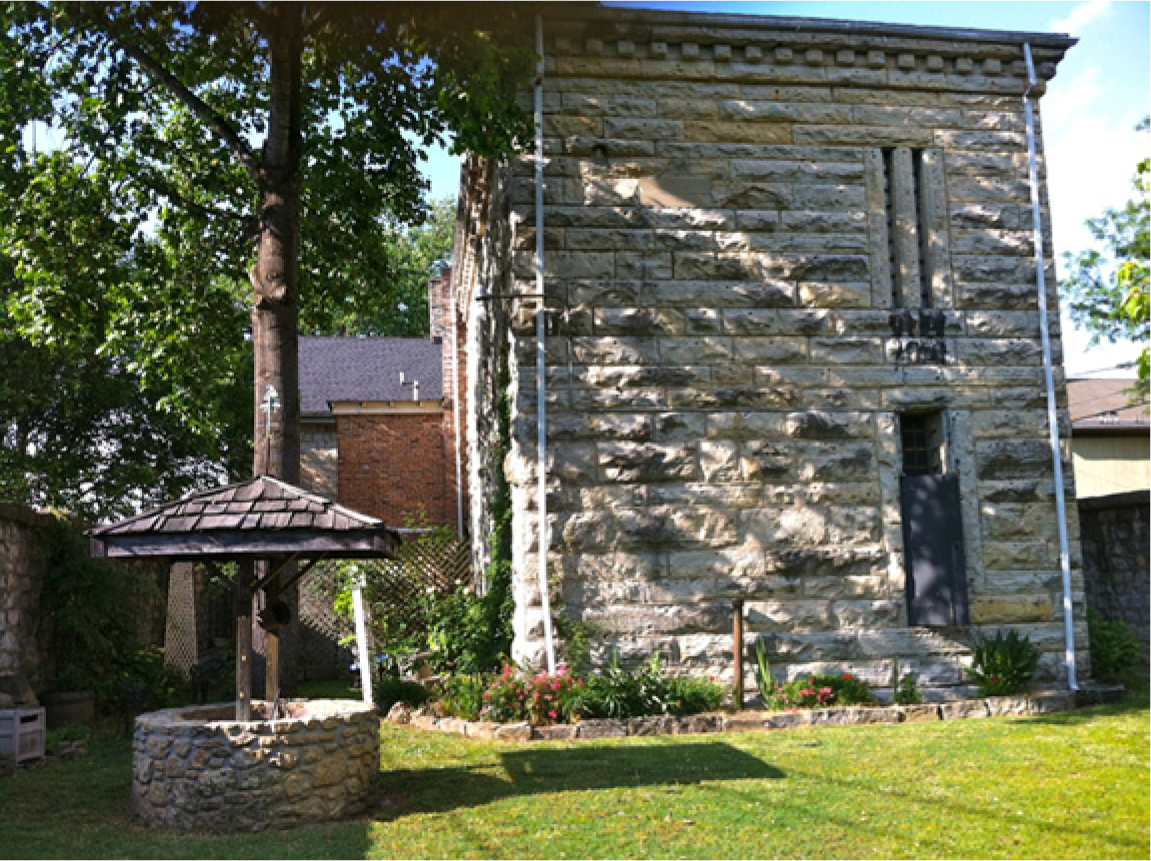
The Back Courtyard of The Guard’s Guesthouse.
In many ways, this part of the research follows the lead of Michelle Brown (2009), who argues that most Americans access punishment through cultural means that operate outside of formal institutions. As she observes, ‘across families, communities, schools, religion, the military, politics, the economy and beyond, punishment is practiced and played with in daily life’ (Brown, 2009: 4). She goes on to suggest that ‘Americans choose when and under what conditions they would prefer to see prisons and, in the particularity of that engagement, invoke and reproduce specific kind of logics and explanatory frameworks’ and that such quotidian engagement occurs ‘outside of the prison industrial complex’ (2009: 4). Importantly, preliminary findings from my research affirm Brown’s contentions as they also suggest an important point of departure. Namely, I question both what choices Americans have regarding the prison industrial complex and whether its boundaries actually end at the walls surrounding institutions. Rather, I suggest that the prison industrial complex performs crucial cultural work outside of its institutional formations, structuring the (limited) choices and frameworks available for how to see and experience it. In its suturing of signifiers of a pathological criminality to the death and imprisonment of the county jail, The Guard’s Guesthouse helps to circulate hegemonic carceral logics. It should be understood as an active site of the prison industrial complex and as assisting in the work of crafting a carceral habitus.
Applying such an expansive spatial-political role to the cultural work of the carceral state suggests an important additional quality of visuality. In its selective structuring of an authorized history, visuality must also apply to the ways in which the carceral state animates a particular future. In Valley View and other locations in Appalachia, it was clear that carceral habitus structured the ways in which county residents saw derelict spaces. In The Guard’s Guesthouse, the Bed and Breakfast largely mobilized its own carceral history in ways that memorialized actual carceral practices (Walby and Piché, 2011). When one tours the old jail cells or even elects to spend the night in their ‘jail cell’ room, the explicit suggestion is that one is stepping into a fleeting moment where history collapses into the present. Indeed, The Guard’s Guesthouse conspicuously avoids any discussions of the contemporary projects of incarceration that surround it in the form of county jails, state, federal, and private prisons. In this way, the inn makes visible the bricks and mortar continuity between its carceral past and its penal tourist present only insofar as it structures both the historical and contemporary gazes with which its tourist inmates can experience incarceration.
Visuality, epistemology, photography
In explicating visuality, Nicholas Mirzoeff (2011) argues that the analytic is not just composed of visual perception, but rather is formed by a set of relations combining information, imagination, and insight into a rendition of physical and psychic space. Like panopticism, visuality is a symbolic and discursive practice that has material manifestations. Beyond its useful analysis of relations characterized by domination and repression,
11
the analytic of visuality also implicates certain epistemological and methodological constructs in enabling and legitimating the state’s gaze (see also Neocleous, 2003: 39–71; Scott, 1998; Williams, 1981: 170). Mark Neocleous (2003: 55, emphasis in original) has observed that statistics emerged as an important technology of state power, not only by offering a ‘legitimate’ predictive capacity to render the complexity of society intelligible, but also by: insinuating itself into the practices of power by becoming a form of intelligence gathering of the most general kind since, as with information-gathering, there is by definition nothing beyond its scope: nothing may escape their gaze is how one nineteenth century statistician described their task.
But the epistemological work of visuality is not relegated to the perhaps obvious role of statistics. Some scholarship has identified the camera and the image as technologies often mobilized by the state and imbued with hegemonic logics and repressive inclinations. Artist and cultural critic Allan Sekula (1986: 16) argues for understanding the emergence of a ‘truth apparatus’ where the optical mode of the camera ‘is integrated into a larger ensemble: a bureaucratic-clerical-statistical system of intelligence’. Of course, many have examined this relationship between seemingly objective photographic depiction and the politics of representation, or what Hall (1981: 238) has called ‘an index of an ideological theme’. Perhaps most compelling are those who situate representational politics in their colonial histories (see Carrabine, 2012; Ryan, 1997; Said, 1978) and who reveal the colonial present (Gregory, 2004) that photographs of particular phenomena further instantiate (Rodriguez, 2006). 12
Mapped onto the ‘criminal’, scholars have recognized a similar relationship between photographic portrayal and hegemonic representation, or what Carney (2010: 18) has called the ‘social practice of production’. In contrast to the postmodern scholarly examination of the photograph as representation and signification, Carney (2010: 31) argues we must understand that it, ‘presents more than represents, produces more than reproduces and performs more than it signifies … the photograph performs in a field where the material realities of cultural practices in the field of power and desire are at stake’. Criminologist Katherine Biber (2007: 5) has similarly observed that legal images ‘purport to tell the truth … [and constitute] evidence’. For Sekula (1986: 5), images of the criminal might confirm the staying power of the 19th-century ‘new juridical realism’ and the instrumental potential of photography to enact ‘a silence that silences’ (1986: 6) through the contest between the univocal, essential, truthful image and the perceived duplicity and multiplicity of the criminal. In the invention of these latter characteristics, Sekula argues, a biotype ‘other’ distinct from the bourgeois ‘self’ emerges. The image of this ‘criminal’ indexes the mutually constitutive history of criminology and photography and reveals their intimacy with racist pseudo-sciences of physiognomy and phrenology (Sekula, 1986: 15–16; see also Linneman and Wall, 2013; Rafter, 2009). For Judith Butler (1993: 16), writing of the Rodney King trials, what is seen through images ‘is always already in part a question of what a certain racist episteme produces as the visible’.
The political-epistemological work of carceral visuality structures the very possibilities for perceiving mass incarceration. Against such heavily structured sight, I wish to end by arguing that ethnography attuned and committed to revealing the contours of visuality and disrupting its gaze presents a methodology perhaps best suited to enacting the right to look and enabling a counter-visual framework.
Counter-visual ethnography
Following Mirzoeff (2011), the right to look exceeds the accumulation of certain visual images that contest the state’s authorial narrative. Rather, he argues, it is ‘the grounds on which such assemblages can register as meaningful renditions of a given event’ (2011: 477). That is, the right to look is the integration of congregated images within coherent counter-hegemonic analysis. Building on Courtney and Lyng’s (2007: 178) argument about the power of the aesthetic imagination of artists, I suggest that ethnography shares the capacity to ‘challenge institutionalized procedures employed by the state system in constructing the official reality of crime and punishment’. It is this article’s contention that a counter-visual ethnography can engage this process through a commitment to see with historical acuity the relations of production and processes of representation that have structured the present empirical moment.
But a counter-visual ethnography is not without serious complications. Integrating photographs or visual methods into ethnography doesn’t guarantee deeper or more nuanced examinations of life. In fact, photographs can confirm or reify stereotypes already bound to images (Barthes, 1978, 1981; Ferrell and Van de Voorde, 2010; Sontag, 1977). ‘Letting a picture speak its thousand words’, Bourgois and Schonberg (2009: 14) write in their photo-ethnography of homeless injection drug users, ‘can result in a thousand deceptions’.
Traditionally, ethnography subjugates context to empirical observation; if it is not visible it does not matter. As Bourgois and Schonberg (2009: 17, emphasis added) note, ‘ethnography is attuned to fine-grained observations of individuals in action; it tends to miss the implications of structures of power and of historical context because these forces have no immediate visibility in the heat of the moment’. Sarah Pink, a visual ethnographer, astutely notes that this same issue carries important methodological and epistemological implications. She writes that: Material objects are unavoidably visual, but visual images are not, by definition, material … the rupture between visibility and reality is significant for an ethnographic approach to the visual because it implies that reality cannot necessarily be observed visually … the most one can expect is to represent those aspects of experience that are visible.
Of course, observation not attuned to context can easily miss the contingencies on which empirical reality is predicated and misrecognize as natural or cultural what are, in fact, deeply structured histories. As Nordstrom (2007: 208, emphasis in original) has argued, contests over visibility have very real and powerful implications: ‘People can see only what they have the conceptual tools to see. That makes the unseen a powerful tool of both hegemony and resistance: seeing is power.’ Nordstrom’s point here eminently, if implicitly, advocates for a counter-visual ethnography: a methodology that illuminates visuality—again, read as the structuring and authorial authorization of history—and mobilizes the unseen for the purposes of a right to see.
A counter-visual ethnography must intervene in the visuality of mass incarceration, primarily by revealing its historical contingencies, its instantiated and structured and yet its precarious place in the landscape. As my opening vignette demonstrated, prisons can control what we see when we look at their facades and when we tour (Brown, 2009; Goffman, 1961; Piché and Walby, 2010); 13 they do not have to structure our gazes into their pasts, our examinations of their effect on the landscape around them, and our imagining of a future without them. A counter-visual ethnography thus enables the visualization of what mass incarceration’s visuality otherwise obscures or hides.
In the case of Appalachian prison growth, this task is perhaps most salient in examining the spatial exchanges of industry and their structuring of the future of communities. It would be oversimplified to conclude that Valley View’s efforts to recruit prisons are the product of an inevitable choice to pursue the most immediate form of capital investment. We must look both to the longer histories of capital flows that have instantiated local positions and positionalities and the more recent ideological work of carceral logics that have inscribed common senses.
In the case of The Guard’s Guesthouse, a counter-visual ethnography excavates the depths of the contiguous relations between the carceral and deathly functions of the county jail and the contemporary work they perform in structuring the carceral imaginations of the Bed and Breakfast’s guests. This is, of course, a different variation of scholarship for the right to see than in Appalachia. There, the work involves illuminating relationships and alternative narratives rendered invisible by the dominating presence of coal and prison and the official stories of both. In contrast, The Guard’s Guesthouse’s success relies on the explicit presence of the spatial history of the site. But there is no doubt that it is an authorial history. The inn both memorializes and implicitly justifies the depraved conditions of confinement and premature death. The gallows, the torturous conditions, and the cage are presented as cultural artifacts of a prior era as opposed to technologies of racialized and classed punishment that characterize life for millions of people in the United States today. Moreover, set alongside various signifiers of criminal pathology, the inn suggests that such violent measures of punishment were acceptable.
The larger critique to be made here, and one with implications for a visual criminology, concerns the epistemological assumptions about the visible and the image. A counter-visual ethnography must be able to offer new vantages—imaged and narrative—while also undermining the ‘unwavering faith in the camera and the photograph’ as a form of ‘photographic positivism’ (Linneman and Wall, 2013: 321). Following Linneman and Wall’s (2013: 322) argument about mug shots, I suggest that the rural prison and the site of penal tourism are also ‘inherently political state projects awash in cultural tensions that cannot be “cropped away”’. Indeed, it is precisely the work of regimes of scopic power—the work of visuality—to render those tensions invisible.
As I have argued, the visual register of prisons and other carceral formations in the landscape is stitched to a regime of knowledge and a discourse that naturalizes their place. The common sense of their presence does not mean that other images and relationships cannot be seen. Rather, corporate and state power constructs particular vantages, fashions specific presentations of authority, and articulates certain relations and disarticulates others. Thus, the polluted lands, exploited labor, racialized and classed bodies, and capital accumulation that bring coal and prison into a relationship are not invisible; our naked eyes have been trained not to see them. A counter-visual ethnography rehabilitates our ocular vantages to see what is not there but which structures the present carceral moment by illuminating the invisible, excavating the underground, revealing the inscribed landscape, and raising the ephemeral ghoulish presence. In doing so, counter-visual ethnography attempts to envision and presage a counter-carceral future.