







Abstract
Prior research consistently documents that prisons are emotionally fraught places where successful adaptation depends, in part, on prisoners’ abilities to calibrate their emotional expressions and display strategies. Yet these accounts have largely overlooked theoretical insights from the psychological literature on emotion which can develop our understanding of exactly how and why prisoners regulate their emotions. By combining Gross and Thompson’s component model of emotion regulation with recent interview data (N = 16) from a medium security men’s prison (HMP Moorland), this research draws three conclusions. First, prisoners manage emotion by attending to different components of the emotion model (i.e. through situation selection, attention deployment and response strategies). Second, attempts to regulate emotion are often hampered by the unique challenges of close confinement and prison rules. Finally, emotion management may be influenced by both ‘hedonistic’ and ‘utilitarian’ goals: the latter may explain situations where prisoners harness ‘negative’ emotions (such as anger and fear) to achieve long-term aims such as health and social conformity. The implications of this research are twofold: it offers a way beyond dramaturgical models of prison life, while also offering suggestions which could promote the emotional health of prisoners.
In their 2013 article on the ‘emotional geography of prison life’, Crewe et al. set out to intervene in and present an agenda for research in the domain of prisoner emotion. Among the main aims of their article were to highlight some of the limitations in the ways in which prisoner emotions had been both described and conceptualized in previous studies. Specifically, they sought to critique a dramaturgical framework of ‘frontstage’ and ‘backstage’ domains, which limited discussions of emotional expression in prison, and to question some of the reductive terminology used to summarize how prisoners regulated their emotions. Drawing on Crewe et al.’s initiative, this article seeks not to develop their ideas in relation to the spatial differentiation of emotional expression in prison, but to focus instead on how individual prisoners regulate and express their emotions. In doing so, it promotes and develops an existing model of emotion regulation (Gross and Thompson, 2007) which enables a much more nuanced understanding of the emotion management strategies that prisoners may deploy within the particular constraints of the environment.
Beyond dramaturgical frameworks of prison life
The way in which the individual in ordinary work situations presents himself and his activity to others […] guides and controls the impression they form of him, and the kinds of things he may and may not do while sustaining his performance before them.
As Crewe et al. explain, most of the prior literature on prisoner emotion has drawn on Goffman’s notion of dramaturgy―a metaphor suggesting that daily interactions involve a degree of acting and stage management―which contrasts prisoners’ public and private ‘performances’ of emotion. According to this view, prisoners present a dramatized version of themselves in public which is markedly different from their off-stage, private selves. However, Crewe et al. also document a growing pool of evidence that challenges the idea that there are neat distinctions between frontstage and backstage areas in prison and thereby question the value of the dramaturgical metaphor. To give one example (see Crewe et al., 2013 for a review), being forced to share a cell with another prisoner blurs the boundary between public and private spaces. At worst, these shared living arrangements push prisoners into an ‘enforced state of frontstage’ (Jewkes, 2005: 54) where the private is made public. In response to these observations, Crewe et al. try to advance the existing framework and reconceptualize the carceral stage by explaining that prisons are ‘complex and spatially differentiated emotional domains’ (Crewe et al., 2013: 59). However, while the authors spend time looking externally at the ‘emotional maps’ (Crawley, 2004: 414) in prison, far less is said about prisoners’ internal regulation strategies—it is to this concern that we now turn.
The prisoner’s emotions: Fronting and masking
Goffman (1959: 13) argues that a person’s ‘front’ is ‘that part of the individual’s performance which regularly functions in a general and fixed fashion to define the situation for those who observe the performance’. In prisons research the term ‘fronting’ has been used interchangeably with other phraseology (for example, ‘masking’, ‘wearing masks’ and ‘putting on armour’) to explain how prisoners deal with the psychological and physical challenges of the ‘dog-eat-dog’ environment and defend against exploitation (Crewe, 2009; Crewe et al., 2013; De Viggiani, 2012; Jewkes, 2005; Karp, 2010).
While fronting has been described in general terms, few studies have highlighted the different types of front that prisoners present to others, though De Viggiani (2012: 287) offers a notable exception by contrasting bombastic displays of fronting with more stoic (‘autistic’) masks. Furthermore, Crewe et al. argue, the supposedly synonymous terms used in the literature may, in fact, be describing different processes. More specifically, they argue, a distinction can be drawn between ‘fronting’ and ‘masking’. In their framework, fronting refers to ‘cultivating a version of the emotional self that is inauthentic’ whereas masking is a more defensive strategy ‘requiring that one stifles or contains traces of fear, pain, weakness and vulnerability’ (Crewe et al., 2013: 64). In sum, then, Crewe et al. open up space to develop a more sensitive analysis of strategies of emotion management, without themselves doing so in a focused manner. This article builds on this prior article by disentangling a number of strategies that are often merged and by offering a terminology that does justice to their specificity. Doing so first necessitates engaging with literature outside the traditional purview of prison research.
A model of emotion regulation
When people feel that their emotions are inappropriate for a given situation, they generally attempt to regulate them (Gross, 2014). In this respect, there is an important difference between emotions as they are felt or experienced and emotions as they are processed and modified. The aim in this article is to focus on the latter by introducing a model of emotion regulation (Gross, 1998) and applying it to prisons research. Although a range of frameworks have been conceived to conceptualize emotion management strategies, the ‘process model’ has the most currency in the literature, being cited three times more often than competing models (Webb et al., 2012).
1
Emotion regulation is defined here as: the processes by which individuals influence the emotions they have, when they have them, and how they experience and express these emotions. Emotion regulatory processes may be automatic or controlled, conscious or unconscious, and may have their effects at one or more points in the emotion generative system.
In a broad sense, we regulate our emotions by trying to influence them in any direction. This may include the ‘transformation, exaggeration, or enhancement’ (Manstead and Fischer, 2000: 189) of emotional responses to increase their intensity or type, or the ‘down-regulation’ of an emotion to try to achieve a faster ‘return to baseline’ (Gross, 1998). Further, we may also try to maintain or extend the experience of an emotion over a longer period of time (Koole, 2009). More technically, we attempt to regulate our emotions by modifying one (or more) of the components in the emotion process as seen on the bottom row of Figure 1. To further explain how emotions are regulated, it is helpful to briefly consider the five different families of emotion regulation that feature in the top row of Figure 1, that is: ‘situation selection’; ‘situation modification’; ‘attentional deployment’; ‘cognitive change’; and ‘response modulation’. 2
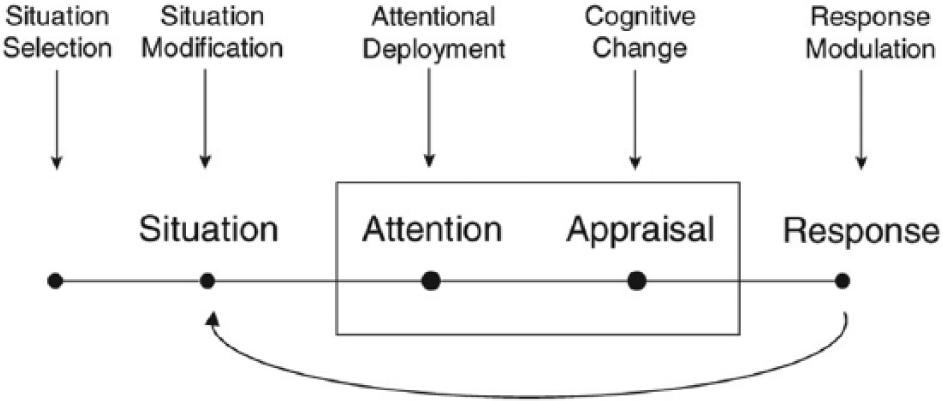
A process model of emotion regulation showing the five ‘families’ of regulation (top row), reproduced from Gross and Thompson (2007).
One way to influence emotion is by carefully selecting our environment (situation selection), a proactive form of regulation (Koole, 2009). By seeking out or avoiding particular people or places, we increase the probability of experiencing emotions that we desire and decrease the likelihood of being faced by emotionally problematic circumstances (Gross, 2008). Another proactive emotion regulation strategy involves attempting to alter the existing physical environment to meet our needs (situation modification). This may involve such acts as setting ambient lighting to encourage relaxation or playing loud music to generate excitement. In some instances however, the setting is fixed and neither of these strategies is feasible: when school children are presented with difficult problems or tests for example, the environment cannot be changed or modified (Vuillier, 2014). In these cases, it may be necessary for individuals to think about which aspect of the experience they chose to focus on (attentional deployment). Put in another way, attentional deployment is about concentrating one’s attention towards or away from an emotional situation (Gross, 1998).
The final antecedent strategy involves attempting to reappraise how we think about a specific situation (cognitive change). For example, being blanked by a colleague (which could initially be interpreted as a personal slight) might be cognitively re-framed to believe that the person may have been preoccupied in that moment (Gross, 2008). Reappraisal can help diffuse the emotional content of an event by putting it into terms in which we can more easily understand. In distinction to antecedent strategies, after an emotion is internally felt a person can try to modify their physiological, experiential or behavioural expressions directly (response modulation), which may include mental relaxation techniques such as exercise, sleeping, bathing, eating and smoking (Gross, 2008; Planalp, 1999).
This brief detour into the world of emotion regulation offers a useful lens through which we can now refocus on the prisoner world. Ultimately, this model may offer a better container in which to categorize the different strategies of emotion management (masking, fronting, etc.) which have been deposited sporadically in the literature. It may also offer new directions for research on emotion regulation and encourage a more systematic understanding of how prisoners ‘do’ emotion in prison.
The study
The research was conducted at HMP and YOI Moorland, a category-C prison in South Yorkshire. The operational capacity of the prison is 1006 and the prisoner population was at that exact limit during the period of data collection. The establishment opened in 1991, serving the dual function of a remand prison and a young offender institution (YOI). In more recent years (from 1998–2011), new house blocks have been constructed, additional prisoner populations have been introduced (320 sex offenders and 250 foreign national prisoners) and the remand function has been terminated (HMCIP, 2012).
The research site was selected in part for pragmatic reasons, based on an established relationship between the second author and the prison’s governor, who was willing to facilitate the research. Access was then sought through an application to the National Offender Management Service (NOMS). The prisoners selected for interview (N = 16) included eight ‘mains’ prisoners and eight vulnerable prisoners (VPs). 3 The sample comprised eight white British prisoners, two black British, one Pakistani, one Barbadian, one Iraqi, one Romanian, one South African and one Indian prisoner. The ethnically diverse composition of the sample reflects Moorland’s large foreign national population (up to 300 prisoners). The mean age of the sample was 36—the youngest participant was 22 while the oldest was 57. The overall sampling strategy was opportunistic, incorporating a mixture of snowballing techniques and the in situ selection of volunteers. All interviews were conducted by the first author, who entered classrooms before and sometimes during lessons and introduced the project to learners and clarified general questions. 4 All of the participants in this study came from art and informational technology classrooms. The first author mingled with the men, observed their projects and spoke informally about the nature of the study. At this stage, some prisoners were forthcoming and enthusiastic about the opportunity to be interviewed. Given the small and non-random design of the research, the conclusions that can be drawn are tentative and preliminary. A potential problem of snowballing participants is the danger of assembling like-minded individuals, as participants’ friends and associates are actively encouraged to take part. Further, each classroom had a memo on the wall stating that over a third of prisoners currently do not attend education or any form of work. It is worth questioning therefore whether perspectives on emotion management may be different for people who spend the working day in their cells.
The interviews were guided by a schedule which was structured around important themes flagged in the literature on emotion control in prison. 5 However, this was a non-linear process where the order of questions and amount of time spent on each topic varied according to prisoners’ responses. Overall, the interviews had an informal and free-flowing feel not unlike that which characterizes everyday conversation. The length of interviews ranged from 25 minutes to 1 hour 46 minutes, while the average length was 41 minutes. All of the interviews were recorded using a digital Dictaphone. Prisoners’ names have been anonymized and identifying features were removed from the transcripts prior to analysis.
There are inherent difficulties in asking individuals to self-report their emotions, which relate to memory (can a person accurately recall the last time they were angry?), awareness (can they distinguish between multiple emotions?) and accuracy (can their accounts of emotion be retold in the same way that they unfolded?). There may also be differences between how emotions are felt and how they are articulated to others, both due to issues of self-censorship and of translation from affect to language. Certainly, the second concern, emotional awareness, was pertinent for three interviewees for whom ‘the language of emotional expression was somewhat alien’ (Evans and Wallace, 2007: 500). More generally, variable levels of emotional ‘literacy’ present difficulties for this kind of research. That is, there are limits in the extent to which people can recognize and understand their emotions (Steiner, 2003), which in turn makes it difficult to have detailed conversations about emotion regulation. In an attempt to mitigate against these concerns during the interviews, the researcher employed an ‘emotion wheel’ to try to stimulate discussions of different types of emotion and various intensities of expression. 6
The problem of accuracy is also relevant here, precisely because the research was concerned with impression management in front of other men. It is possible, then, that such performances were also being played out under interview conditions (and specifically with the interviews being conducted by a young man). Masculinity can function as a ‘barrier’ to emotionality (feeling, expressing and articulating emotions). Steiner (2003: 1) argues that ‘the mere mention of the word “emotions”’ can create ‘extreme discomfort […] [because] men often fear that deep and painful secrets will be unleashed if they reveal their feelings’. Inhibition of emotion by men is hardly unique to the prison environment—in western societies, boys are taught from an early age that emotions are synonymous with weakness and that ‘to be a man is to be in charge; to be gentle is to be a wimp’ (Evans and Wallace, 2007: 485)—but in the absence of other avenues to achieve status prisoners may be especially prone to amplifying their ‘toughness’ and hypersensitive about revealing their ‘weaknesses’ (Soulliere, 2009 inter alia).
Clearly then, the data collected during interviews do not automatically form ‘experientially authentic truth’ and it should be accepted that each interview is a ‘methodically constructed social product’ (Gubrium and Holstein, 2002: 11). Importantly however, the fact that interviews are often ‘artful productions’ routinely influenced by ‘concerns about self-presentation’ does not mean that they cannot provide accurate representations of social reality (Hammersley, 2003: 123). Rather, these concerns should encourage scrupulous reflection from researchers, acknowledging that at times there may be a gap between interviewees’ words and actions.
Audio from the interviews was transcribed using dictation software (Express Scribe) and analysed using word processing software (Microsoft Word). The raw data were manually coded―a process that began by poring through the data and highlighting key phrases (Sandelowski, 1995). After handling the data many times, emerging patterns and themes were identified (Evans and Wallace, 2007: 491). This research followed Layder’s (1998) move towards adaptive theory: a fluid (ongoing) approach which involves combining existing theory (deduction) with theory construction grounded in the empirical data (induction). The following analysis locates prisoners’ accounts of prison life within the five corresponding ‘families’ of emotion regulation, as displayed in Gross and Thompson’s model (Figure 1).
Emotion regulation and prison life
Situation selection
There are a number of situations in which prisoners cannot exercise control over space. This was especially apparent in some cell sharing arrangements where prisoners lamented that they were being ‘forced to share a cell with someone’ (Gary) who they did not know and the suffocating environment made it feel like they were living ‘on top of each other’ (Eddy). This forced proximity was not just limited to cells, as prisoners related similar testimonies of having to occupy classrooms and workshops with those they did not like. More problematically, one vulnerable prisoner (VP) explained that he had once been made to wait in a large room with a group of aggressive general population prisoners (at the discretion of a prison officer), which was a particularly harrowing experience.
These tight living arrangements could lead to various degrees of emotional and mental discomfort. Frank discussed the strain of constantly having to listen to a cell mate protest his innocence: ‘as soon as I started settling down, he’d start talking about his sentence which would bring mine up. And then I would be upset again.’ The fact that prisoners were unable to avoid these situations—‘I couldn’t walk away’ (Brian)—meant that they could escalate, sometimes into physical conflict, as Nicholas attested: ‘I was too nervous and too pressured so I started screaming “yeah, yeah” and screaming for him to get out… He started to argue with me and push me. We started fighting.’ Further, the reverse situation (enforced isolation) was also deeply challenging for four interviewees. For those who took comfort in workday routines away from the wing, evening lock-up and the unstructured nature of weekends presented extended periods of down-time and a relative absence of sensory stimulation, where it became difficult to stave-off pangs of boredom and frustration. All of this is to say, the ability of prisoners to control emotion may be contingent on temporal and spatial factors over which they have only limited control.
Despite the obvious constraints on their freedom of movement prisoners can influence their emotions by selecting their environment. By seeking out or avoiding particular people or situations, they can vastly increase the probability of experiencing desirable emotions and decrease the chances of being faced with emotionally distressing conditions (see Gross, 2008). For example, Kyle stated that ‘sometimes I feel so happy. I play pool and see other prisoners […] And sometimes I don’t want to see any faces, so I just lock my pad.’
Education and art classrooms were highly valued spaces for some because the environment offered ‘chilling out time’ (Brian) and a break from the tense courtesy which characterized life on the wing. Nicholas embraced the monastic solitude of his cell: ‘[a]fter the door is closed I’m alone, me and my prayers. My books and my prayers […] you don’t feel pressure at that time.’ Personal cells were used as spaces where more challenging emotions could be processed and ventilated. While all of the prisoners in this study admitted the need—at some point—to cry in prison, the fact that these moments were almost unanimously contained ‘behind closed doors’ (Gary) indicated that prisoners still exerted a degree of control over such ‘breakdowns’. Actively retreating from one’s peers was often motivated by low affect, but it also helped prisoners avoid being implicated in arguments and physical conflicts: ‘when there’s a confrontation, I go back to my cell’ (Jacob). Taken together, these accounts suggest that prisoners exercise a degree of autonomy over both where and when they experience their emotions.
Situation modification
A second proactive emotion regulation strategy involves attempting to customize the physical environment to fit a particular purpose (situation modification). Eddy argued that ‘little things are big things in prison’ and that the ability to micro-manage spatial practices could have a potent effect on his mood: I can sit in my cell all day long with the door open. Sitting in the cell all day with it shut is different. Mentally it’s different. When the door is open you can walk out if you want. When it’s shut you can’t, you’re enclosed.
Prisoners personalized their cells through the visual display of pictures and artwork: ‘I’ve got old pictures of mountain bikes and skateboarding on my wall […] obviously it reminds me of home and the things I’m interested in’ (Oliver). However, such evocative triggers and enticements to personal reflection were not welcomed by all prisoners: ‘my wife wants to send me pictures but I said no […] because whenever I see her picture I feel so depressed’ (Kyle). For some, an ascetic living environment was an essential self-protection strategy, which warded off unnecessary emotional pain. By contrast, Frank, who had become passionate about art while in prison, lined the walls of his cell with his paintings, attempting to replicate and extend the feelings of relaxation and positivity which he associated with the art classrooms. In a similar vein, Collin explained that being able to fill his cell with music (from his radio) was both an essential relaxation tool and an escape from the wider world of the prison.
For those who shared their cells, however, living arrangements had to be carefully negotiated. Non-smokers complained about being paired with smokers, but by agreeing to exhale near cell windows, at scheduled intervals, smokers could strike some kind of compromise. At times though, elements of the physical environment provoked unwelcome reminders or uninvited social comparisons: I did start ticking off days [on a calendar] when I came in, but then some lad who’s in a pad with me wrote his release date on there, which is in about three months and mine is about two years. So I just ripped it off the wall and threw it in the bin.
Taken together, such responses resonate strongly with Hans Toch’s (1992) concept of prison ‘niches’, in particular, the way in which prisoners carve out spaces in the environment. Essentially, niches are attempts to create a ‘functional sub-setting containing desired objects, space, resources, [and] people’ (1992: 237). These privately cultivated spaces could provide a degree of escapism and psychological relief from the wider world of the prison. Indeed, having autonomy over even the smallest aspects of the environment could help prisoners get through their sentence by making the prison regime more predictable (Seymour, 1977).
Attention deployment
As suggested above, the prison environment is relatively fixed, and situation selection/modification is not always feasible. In these moments, it may be necessary for individuals to focus on a particular aspect of the emotional experience (attention deployment). Two common ways of doing this are through distraction and concentration. The former includes both seeking out external and internal diversions in the environment. By contrast, concentration (or rumination) involves focusing attention repeatedly on the emotional situation and its consequences (Gross and Thompson, 2007), a strategy which can markedly increase the duration and intensity of the emotion (Gross, 2008).
The use of distraction was widespread among the prisoners in this research. By seeking out preferred activities and establishing a stable routine, prisoners could stave off unpleasant emotions: as Henry put it ‘little tasks help to keep the mind busy’. Yet, the nature and function of distractors varied considerably. In one sense, distraction involves seeking out external activities to avoid an emotionally eliciting stimulus (Planalp, 1999; Rothbart and Sheese, 2007). In Moorland this included such examples as watching television, reading, exercising either in-cell or in the prison gym, listening to music, playing pool or table tennis, doing Sudoku or crossword puzzles, match-sticking and engaging in education, art and workshops. Such activities enabled prisoners to figuratively ‘escape prison for a couple of hours’ (Jacob) and ‘make the time fly’ (Gary).
A quite different form of distraction involves internal attempts to summon thoughts and memories that are inconsistent with unwelcome emotion states (Watts, 2007). Brian’s comments exemplified this strategy: ‘I can be concentrating on something else and then something will just come in my mind and I will think, no I don’t want that.’ His proficiency with emotion control afforded him a degree of mental tranquillity, but this was not a skill possessed by most interviewees. Indeed, Frank’s method of handling thoughts about missing his children—‘I try to put it to the back of my mind’—was more representative, and implied that such efforts were not always successful. Similarly, a small number of prisoners explained how meditative pursuits and prayer could help them gain a degree of control over their thought processes and divert upsetting feelings.
The separation here between internal and external distractions is to some extent artificial, since activities like reading, writing and drawing appear to involve elements of both. Frank explained that on one level writing helped him ‘to not think so much about being here’, but also that writing ‘is like therapy’—the latter statement implying a more powerful and enduring form of mental stimulation. Another way to present different distraction methods is to distinguish between surface distractions (or ‘time fillers’) and those that involve deep immersion or psychological ‘flow’ (Csikszentmihalyi, 2000). Paulo stated that ‘when you’re doing pad workouts, nothing else matters. At that moment in time you don’t feel any stress, your mind-set is focused on what you’re doing in the moment… your mind is free.’ Ultimately, the pursuit of mental and physical diversions ‘can be functional for its own sake—for energy and attention it consumes, for feelings it challenges, for distracting or anesthetizing effects’ (Toch, 1992: 25), all of which can prevent the emergence of negative thought patterns: ‘you know when I work hard, I feel so tired […] so I can’t think more’ (Kyle). 7
Concentration is the inverse of distraction and involves focusing attention towards a particular stimulus. Interviewees declared almost unanimously that, in prison, it was unproductive to try to tackle complex emotional issues directly. It was not advisable to think about family problems and life outside because ‘it’s just dead thoughts’ (Alan), which prisoners were powerless to change. That is, prolonged episodes of thinking could quickly become self-defeating, and could glide into rumination and obsession. However, it was difficult to stop this process entirely because of the repetitive and spartan nature of prison life: ‘you get yourself ready with a heavy heart every morning, same shit different day’ (Jacob). Over time, the lack of variation and positive stimulus in the environment made it difficult for prisoners to avoid thinking about their personal problems and life outside, which could ‘numb your soul’ and ‘drain you’ (Oliver). Although concentration can be a useful strategy for overcoming obstacles in wider society, the unique characteristics of confinement appear to render it less effective in prison. That is, restrictions on movement and limited access to personal resources impede prisoners’ abilities to resolve problems, which can increase feelings of sadness and frustration.
Cognitive change
Cognitive change involves attempting to reappraise or transform how we think about a specific situation. Reappraisal can help diffuse the emotional content of an event by putting it into terms in which we can more easily understand. Kyle reflected on his time in prison in no uncertain terms—‘I have wasted part of my life’—and a similar sentiment was shared by Alan:‘it’s a robot’s life […] it’s Groundhog day’. However, a number of participants actively sought to reconfigure these narratives into something more affirmative: If you pull your mind in a positive way it kind of helps because you know you’ve people out there that care about you and this is not the end of the world. There is going to be a day that you’re a free man again. Things that you think you’re losing right now could be a blessing.
This mode of thought enabled interviewees to see prison as a ‘learning curve’ (Ian), which offered a chance to ‘perfect yourself’ (Alan) and ‘build your skills’ (Nicholas). Imprisonment was presented as an enforced opportunity: ‘I think of all the things that I do in here that I would never have done outside. That always makes me feel better’ (Gary). Reappraisal techniques also enabled prisoners to make sense of physical altercations and aggression: It’s pretty horrible you know. But the thing you’ve got to think is they’ve done it to themselves […] I’m not saying I wish it upon them. But if you’re in masses of debt never get in debt in the first place.
By reframing violent events as actions that could have been avoided—but which occurred as a necessary consequence of norm violation—prisoners could rationalize these incidents. This could diffuse their fears of victimization and establish a sense that the environment was predictable. Similarly, when Collin was provoked by others, he stated: ‘I just tell myself a lot of them have problems and stuff. I’m in prison at the end of day. Most people in here have got some kinds of problems haven’t they?’ Through this approach he was able to avoid confrontation—and even empathize with his aggressors—by interpreting their behaviours as a sign of deep-rooted insecurity and mental instability.
In a different manner, humour also offers a powerful mechanism for cognitive re-framing. This is because it ‘tends to make situations seem less important by virtue of their absurdity or our detachment […] [making them] less threatening or anxiety producing’ (Planalp, 1999: 80). Interviewees affirmed this principle when they explained that humour allows ‘you to get your depression and stress out’ (Kyle) and that they eased tensions with officers by engaging in banter and ‘cheeky comments’ (Henry). But aside from interrupting the escalation of bad feelings, humour also helped to ‘bring the morale up again’ (Liam). A small number of prisoners explained that the content of prison humour typically gravitated towards ‘dark’ or grim topics, which at times directly related to prisoners’ criminal propensity or prior offences. Such ‘gallows humour’ can provide benefits by ‘generating positive emotion in the very darkest of moments, which may, in turn, help build social bonds that can be beneficial under conditions of stress’ (Folkman and Moskowitz, 2000: 116).
The prevalence of humour in this environment reflected a collective awareness of the dangers of prolonged bouts of sadness: ‘if I’m wound up or depressed or anything like that my mates will […] try and cheer me up and have a laugh with me’ (Liam). For some prisoners, the use of humour was a direct, pragmatic stance against the challenges of imprisonment. Interviewees were in consensus that if you have to serve time you might as well ‘spend it happily instead of being sad’ (Collin). Indeed, possessing a buoyant daily outlook was perceived to be an invaluable defence, both psychologically and physiologically: ‘you can’t just be miserable […] that would surely have a bad effect on your health in general’ (Alan). While a direct link between good humour and good health is empirically tenuous (see McCreaddie and Wiggins, 2008), those who engage with humour have more interpersonal contact and superior access to support networks than those who do not.
Response modulation
Distinct from the four antecedent strategies above, response modulation involves the attempt to modify physiological, experiential or behavioural expressions after an emotion is experienced. This may be achieved through using mental relaxation techniques, exercise, sleeping, bathing, eating and smoking for example (Gross, 2008; Planalp, 1999). There are two broad response strategies that deserve further elaboration here: expressive suppression (from here on, suppression) and social sharing. Suppressing a felt emotion may include attempts to decrease the visible display of interior feelings, for example, anxiety during in an interview or anger felt towards one’s boss (Gross, 2008). Suppressing emotion has been related to a number of detrimental health outcomes. In contrast, the social sharing of emotion ‘facilitates emotional adjustment due to the repeated confrontation with and reprocessing of the emotional information’ which can allow a person to reappraise the situation, compare their emotional reactions to that of others and reintegrate themselves into the social environment (Niedenthal et al., 2006: 189).
The majority of prisoners felt that open displays of emotion were hazardous. For example, Collin stated that ‘anger is a dangerous emotion to show in prison’ mainly because it can lead to fights and IEP (Incentives and Earned Privileges) set-backs. As most interviewees expressed a practical desire to ‘get out of here [prison] as quickly as possible’ they felt a compulsion to walk away from heated disputes and ‘cool off’ (Oliver) in their cells. The suppression of anger was closely coupled with situation selection, raising questions about the ways that different ‘moments’ and processes within the model interact.
It was not just aggressive affectations that had to be suppressed. Limiting the expression of sadness and pain—‘if I’m sad I’ll just put on a happy face’ (Gary)—was necessary because ‘if you come across as a soft person things go against you’ (Liam). This typically implied the threat of exploitation from predatory prisoners. Indeed, the fact that most prisoners attempted to mask anxious or troubling emotions in public spaces appeared to be motivated by a sense of necessity rather than choice: ‘if you express your feelings to anyone they will make a joke of you’ (Nicholas). Similarly, Eddy explained that people who attempted to share their emotions with others received ‘no sympathy from other prisoners, they get scorned, they get derided’. Furthermore, resistance to open social support was not limited to the prisoner population. It was claimed that the majority of officers and staff ‘don’t really care’ (Gary) and ‘don’t want to listen’ (Kyle) to prisoners’ problems either.
However, half of the participants explained that they sought out other (more concealed) avenues for social sharing. This involved cultivating close friendships with their cell mates over time and having what Brian called ‘some bloody good conversations’ with ‘the lads on the wing’ (Ian). The way in which Brian and Ian articulate their feelings here about relationships in prison is indirect, and serves as a reminder that men’s emotions can be both hard to elicit and easy to miss (Crewe, 2014). Yet, these bonds could offer an important outlet to help prisoners put their emotions and experiences in perspective: One of the gym officers was like ‘are they homemade hand straps? You’re not allowed them down here!’ I said ‘I’ve been using them for the last year and a half’. He says, ‘well, I’ve not seen them!’ It riled me up a bit, I took it a bit personal. Then I come back on the wing and I was on about it to someone else and they says ‘oh, it’s only him who’s like that’ he said ‘don’t take it personal, he’s been like it with me’, he says ‘he’s the only one who said something about them’. So, from it being a bit personal to me, and someone telling me ‘oh he’s done it to me as well’ then you think, well maybe it’s not personal.
Such forms of mutual ventilation and problem sharing could allow prisoners to think more clearly about the challenges they faced in prison, providing a degree of comfort and an escape from isolation. The majority of participants only shared their intimate feelings with loved ones via phone calls, visitations and letter writing. Liam explained that talking to his wife served a passive function, allowing him to ‘take out […] frustration’ while also providing a more active source of comfort and encouragement: ‘she says “you’re a good person, you just need to be positive and strong”’. Yet, gaining regular and equitable access to these valuable resources (especially telephones) was problematic, or as Jacob put it: ‘mission impossible’. This was partly because there were only a small number of phone booths on the wing, but also because prisoners were restricted by small time-windows in which to make their calls and by the financial cost of doing so (especially for foreign national prisoners). Further, half of the prisoners in this study stated telephone use was a catalyst for confrontations with others (due to, ‘alpha’ prisoners dominating the booths, or being pressured to abruptly end a phone call).
Another form of response modulation was self-harm, which was arguably maladaptive for long-term physical and social health, but provided immediate respite from the experience of distress. Two prisoners shared their accounts of using self-harm to discharge emotion in this fashion: ‘it’s just mostly to release my stress and my anger and stuff like that’ (Darren). Henry echoed these sentiments: ‘I was cutting my arms with a razor blade just trying to get rid of that frustration.’ Less extreme response strategies involved smoking cigarettes to provide regular stress relief, playing guitar in order to ‘process sadness’ (Gary) and dissect a melancholy mood and using the gym as a way of ‘letting off steam’ (Liam).
Discussion
One of the benefits of introducing the framework elaborated in this article is that it enables us to add breadth and clarity to previous accounts of emotion management, especially the ‘prisoner coping’ literature. As Gross (2014: 8) states ‘coping is distinguished from emotion regulation […] by its predominant focus on decreasing negative affect’, whereas the emotion regulation framework facilitates a broader approach. That is, because the model considers emotions as feelings states capable of being modified in all directions (e.g. increasing, maintaining or decreasing positive and negative affect) we can learn more about the emotional world of prisoners. More specifically here, the model offers a way to revisit the dramaturgical metaphor and Crewe et al.’s discussion of strategies of masking and fronting. Fronting is defined as ‘a form of evocation, in which the cognitive focus is on a desired feeling which is initially absent’ (Hochschild, 1979: 561, emphasis in original, in Crewe et al., 2013). Seen in the context of the emotion regulation model, then, it can be understood as a type of cognitive change, fitting alongside other forms of reappraisal discussed above (see Figure 2). Prisoners in this research explained that such behaviours were common: ‘I kind of put on a big front and walk around like a hard man and stuff like that, and argue with a lot of people’ (Darren). For the individual then, fronting is an attempt to modify or transform one’s appraisal of a situation. Put in a different way, it involves trying to manufacture or engineer a particular emotional response.
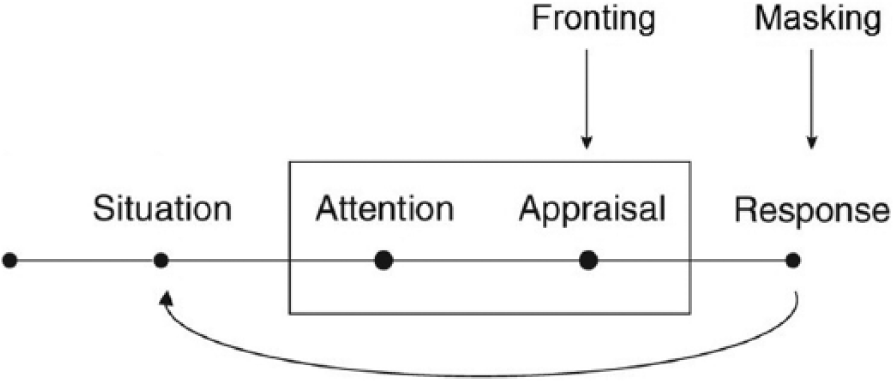
An adaptation of Gross and Thompson’s (2007) process model of emotion, with the integration of ‘fronting’ and ‘masking’ strategies.
Masking, by contrast, is a defensive behaviour ‘requiring that one stifles or contains traces of fear, pain, weakness and vulnerability’ (Crewe et al., 2013: 64). Because an emotion must first be felt in order to be hidden, masking represents a response modulation strategy (see Figure 2). However, it also appears to be synonymous with ‘expressive suppression’, the strategy of inhibiting emotional expression. The interpretation of masking and fronting through this model of emotion regulation thus provides a much more sensitive account of the emotional challenges of, and responses to, imprisonment at the individual level.
At the same time, the categorization of such concepts risks oversimplifying their breadth. Masking and fronting also have important implications for social relationships and the ways in which prisoners actively try to manage the environment (situation modification). More specifically, fronting can be an attempt to ward off threats in the environment by transforming the behaviour of other prisoners, and prisoners sometimes mask their emotions out of consideration for others or to conform to collective norms. 8 One limitation of this framework then, is that some emotion regulation strategies bridge across many parts of the model. The arrow at the bottom of the model (Figure 2) connecting ‘response’ to ‘situation’ attempts to show the cyclical nature of emotion regulation and the close proximity of the different phases. However, the model still implies that opportunities for emotion regulation unfold in a sequential manner and that there is neat separation between different parts. In reality, this process may at times be both nonlinear and embedded: ‘reappraisal’ and ‘situation selection’ strategies for example, may be deeply intertwined. These concerns notwithstanding, the value of the model is that it allows us to consider how different forms of emotion regulation can be distinguished from one another (Gross, 2014), in a way that moves us beyond some of the more reductive labels that have been applied within the literature on the sociology of imprisonment.
This article has focused almost exclusively on how prisoners regulate their emotions; little has been said about why they engage with these particular strategies. To some degree, this entails exploring how emotions are actually felt and experienced. A useful starting point here—and one that has been overemphasized in the wider emotion literature—is the importance of ‘emotional hedonism’, that is, individuals are primarily concerned with ‘promoting pleasure and preventing pain’ (Koole, 2009: 14). Put simply, we like emotions that make us feel good and try to avoid those that do not. However, it is also important to note that people value many things that are unrelated to pleasure (such as health and social conformity) and may be motivated to see the ‘utility of hedonically adverse states’ (Koole, 2009: 14). This is to say, at times people actively seek out unpleasant emotions (such as anger and fear) if such emotions can help to achieve long-term goals. The presence of such ‘delayed reinforcement’ is supported by Tamir’s (2009: 104) research on confrontations and aggression: ‘anger was more useful in confrontation, as angry participants were more likely than others to lead their interaction partners to concede to their demands’. In prison, choosing to harness feelings of fear and anger might help to decrease the chances of victimization. Thus, situational pressures and the uncertainties of the environment may lead prisoners to mobilize ‘negative’ emotion states in order to secure their long-term health and to show obedience to prison norms.
Furthermore, understanding the different motives for emotion regulation can help reconcile seemingly contradicting statements about prison life. For example, one vulnerable prisoner stated ‘just take me as I am, there’s no point being someone that you’re not’, but later he argued ‘you’ve just got to lie to keep yourself alive’ (Henry). In some situations, lying helps to mask fear and secure self-preservation, which in turn helps prisoners avoid victimization, conform to social expectations and maintain a basic form of psychological integrity. A nuanced understanding of emotion regulation needs to explain how prisoners adopt different presentation strategies and emotional problem solving techniques depending on the particular goals they are trying to fulfil (hedonistic, utilitarian, etc.).
More broadly, the effect of imprisonment on emotion regulation strategies has some critical implications. First, attempts to regulate emotion are constricted by the unique characteristics of the prison. This is clearly evidenced by the governance over space in prison which places limits on the opportunities of prisoners to use ‘situation selection’. The rigid and monotonous nature of the prison regime may be particularly challenging for extroverted prisoners who have to adjust to prolonged periods of isolation and confinement in cells. Similarly, constraints are placed on prisoners’ options for social sharing (a response modulation strategy): phone calls are expensive and are restricted to narrow times in the day, letter writing is slow, in person visits take weeks of pre-planning and coordination and there is often a degree of scepticism about the neutrality of prison ‘listeners’.
In a quite different sense, the prison environment and prisoner culture may also induce or shape particular forms of regulation, such as the suppression of emotion. The open expression of ‘weaker’ emotions (such as fear and sadness) was admonished by the prisoners in this research who said it could lead to exploitation at the hands of exploitative and ruthless prisoner groups. As previously suggested, such emotional inhibition reflects wider notions of masculinity in society but often takes on more virulent forms in the prison setting, where the absence of women, and of normal markers of masculine status, intensify the imperative to conform to a particular version of emotional stoicism (Newton, 1994). Problematically, Butler et al. (2003) find that when people keep their emotions to themselves a number of damaging social consequences can ensue, including difficulties forming relationships and increased levels of stress. It is beyond the scope of this article to evaluate the impacts of particular emotion regulation strategies—not least because emotion between men in prison often takes ‘camouflaged forms’ (Crewe, 2014: 397)—but it does raise some important questions for future research: does imprisonment force its charges to adopt more hostile ways of relating to one another emotionally? What are the long-term consequences (if any) of particular emotion regulation strategies for prisoner health and welfare? Finally, in what ways might imprisonment limit or expand particular emotion regulation strategies?
Conclusion
The dramaturgical metaphor of prison life is useful, yet it places limits on the way we think about emotion in prison. One limitation of the metaphor is that it prioritizes social interactions over emotion management at the individual level. The emotion regulation framework introduced here goes some way towards redressing the balance, although it may go too far in the other direction by overlooking important social factors and interactions. As Planalp (1999: 146) reminds us ‘emotion is not just a personal experience, but also an enactment of social structure’ which forms what she describes as an intricate ‘fabric’ with many layers. A thorough explanation of emotion in prison should integrate multiple levels of analysis, including the psychological (intrapersonal), social (interpersonal) and the wider environmental/architectural (the emotional geography) factors. Little has been said here about the third category, the interaction between emotions and space. Yet, insights from carceral geography continue to illuminate the ‘contested and fluid notions of public and private in confinement, highlight the ways in which prisons are spatially differentiated, and draw attention to the micro-geographies of imprisonment, including those experienced at the scale of the confined body’ (Moran, 2015: 40–41). Future research would benefit from melding the findings from emotion regulation and spatial geography to further develop our understanding. Little has been said here about the way in which emotion regulation between men might be shaped by issues of masculinity: it may be particularly instructive to contrast the experiences of different subgroups (e.g. between mainstream prisoners and sex offenders) who may display variable levels of machismo.
Since many men lack emotional fluency or struggle with emotional candour, asking them to reflect on their emotions during interviews may yield a particularly ‘rational’ set of responses. Yet, the fact that a number of participants broke down while talking about their children, or became visibly perturbed when narrating past confrontations with other prisoners, suggests that retrospective accounts can provide some basis for exploring emotionality. However, concerns about the possibility of emotional suppression and distortion suggest the benefit of supplementing interviews with more creative methodologies, such as prisoner shadowing, ‘walk-along’ interviews or the use of psychometric instruments.
By introducing the emotion regulation framework here, originally formulated outside prison walls, this article attempts to go beyond the binary divisions (e.g. frontstage versus backstage) that have orientated the literature. In so doing, terms like masking and fronting are integrated, imperfectly perhaps, into a broader framework of emotion regulation strategies that prisoners use to leaven the challenges and pains of imprisonment. This re-categorization can provide researchers with a uniform platform or currency to explore emotions and imprisonment more fully. That is, emotion regulation can complement prior studies of prisoner coping—which tend to focus solely on how prisoners decrease negative affect—by looking at the whole spectrum of emotion management in prison, including the management of ‘positive’ emotions. Further, the emotion regulation framework tries to look at emotion in a systematic way, breaking down parts of the experiential process into different types (e.g. situation selection, reappraisal) that can help to increase the specificity of our observations. This ground-clearing exercise hopes to provide a better position from which to evaluate and compare the ‘emotional survivability’ of our penal establishments.