







Abstract
In this article we offer a theoretical framework for conceptualizing the relationship between gang identification, place, and identity saliency. In our interviews with current and former street gang members, participants consistently described gangs as neighborhood-based entities, but also couched these local identities within much broader Crip or Blood affiliations. These amount to multiple, simultaneously claimed identities. However, we show that not all identities are equal—that as a social geographic area increases, identities become more diffuse and less salient, territorial, or “gang-like”, resulting instead in expansive, symbolic “umbrella identities” that cover several distinct places and gangs. These umbrella identities proved quite fluid, such that Crip and Blood affiliations had little relationship to one’s gang identity and even produced some gangs with mixed Blood and Crip memberships.
Keywords
In LA, it’s different. Bloods is on this side of town, Crips is on this side of town. [If] they come across each other, they fight and shooting at each other. But in Fresno, it’s different. You can have a Blood and a Crip from your hood cuz you know even though all you don’t wear the same color, you all from the same street, same hood.
Cynthia’s 1 explanation highlights inconsistencies in the meanings attributed to gang-associated affiliations. She explains that while gang-involved youth in Fresno—a city of approximately 500,000 in California’s Central Valley—commonly adopt “Crip” and “Blood” monikers, these names are nearly interchangeable in terms of group meanings. Whether an individual is a Crip or a Blood is a function of familial and homophilic relationships (see Zatz and Portillos, 2000). A single Fresno gang may include Bloods and Crips defending or expanding the same territory side-by-side; these designations are not the foundation of gang rivalries, as Cynthia imagines they are in Los Angeles. Instead, she notes that these rivalries, and the conflicting identities involved, are place-specific phenomena.
In referring to members’ “side of town” or “hood”, Cynthia reminds us of the importance of place for gang identity construction. It is not just that gangs are territorial and that territory implies place (Moore et al., 1983; Tita et al., 2005), but also that the rivalries, kinship, and meanings tied to a particular gang identity are all shaped, in part, by place (Maxson, 2011). Scholars have explored place as a factor shaping the likelihood of gang violence (Radil et al., 2010; Tita and Radil, 2011; Tita et al., 2005), and a vast literature on place attachment (for a review see Lewicka, 2011; Trentelman, 2009) includes empirical work demonstrating the emotional relationships people develop for places (Anton and Lawrence, 2014; Devine-Wright, 2009; Parker and Karner, 2010; Waerniers, 2017). These works reflect Cynthia’s sentiment and teach us that people and groups—gangs being a type of group—use place as a component of identity.
However, not all places are equal and neither are the identities tied to them. Moving from local neighborhoods to districts and cities and so on, the criminalized identities 2 that gang-involved youth may use are mapped onto increasingly larger places. There are territorial differences, for example, between one’s clique, the Rolling 60s Neighborhood Crips in Los Angeles, and the Crip umbrella moniker. That is, there is a nested social geography of territory and identification which must be considered if researchers are to avoid conflating the meanings that gang-involved youth attribute to their identities.
In this article, we combine ethnographic data from Southern and Central California to argue that criminalized identities are nested geographically, so that the smaller the social geographic area, the more meaningful the identity in terms of gang-involvement. Place is therefore not just a background element (see Gieryn, 2000) but a distinguishing feature of every encounter (Goffman, 1963, 1971), as well as a key resource in the situational “activation” (Burke and Stets, 2009) of any gang identity. Rethinking gang identities in this way provides important correctives. First, our nested strata approach more closely reflects how members actually understand these identities, as our participants consistently tether place to identity. Additionally, our perspective avoids what we see as conceptually problematic definitions of gangs as static “criminal” entities. This view too often leads to uncritical moralizing that persecutes poor youth of color while ignoring other groups and organizations involved in criminal activity. We hope that our focus on gang identity construction will contribute positively to definitional debates and move the field of gang studies toward more dynamic conceptions.
Gang identities and place
We begin by acknowledging that a gang is a type of social group: “an aggregation of persons that is characterized by shared place, common identity, collective culture, and social relations” (Fine, 2012: 160). Consistent with a symbolic interactionist perspective, a gang identity is one of many identities that constitute the self (Burke and Stets, 2009) that is invoked within contextualized social encounters (Brenner et al., 2014). When invoked, individuals try to align social behavior such that activated identities are acknowledged and verified during social encounters (Burke and Stets, 2009). 3 This identity verification is a “core motive” (Fiske, 2010) for social interaction (Turner, 1987, 2002, 2011), such that people seek validation of an activated identity—and its connotations—through interaction.
For gangs, this is partly accomplished through conflict (Decker et al., 2013; Sánchez-Jankowski, 1991; Thrasher, 1927; Vigil, 1988; Zatz and Portillos, 2000), be it with other groups or authority figures (Garot, 2010). Indeed, because social encounters have the potential to involve multiple identities from different social roles and social categories (Collins, 2015), gang rivalry may form around racial, ethnic, gendered, and class identities, and become a proxy through which members manage the cultural, racial, ethnic, and linguistic tensions present in their communities (Katz, 1996; Mendoza-Denton, 2008). Conflict may also further enhance the emotional stakes associated with gang identities (Miranda, 2003; Vigil, 1988), as these groups commonly incapsulate personal relationships with friends, neighbors, and family members that are already meaningful (Durán, 2013; Sánchez-Jankowski, 1991; Zatz and Portillos, 2000). Additionally, youth may value gang identities as empowering forms of resistance to internal colonialism (Durán, 2013), patriarchy (Mendoza-Denton, 2008; Miranda, 2003), criminal labeling (Rios, 2011), or extreme urban inequality (Hagedorn, 2008).
Part of why conflict validates gang membership so effectively is because the territories (or places) involved are key variables for activating gang identity. Gang members’ lived experiences navigating their communities lead them to strongly identify with these places (Fraser, 2013), and the immediacy of one’s neighborhood enables the frequent contact and clear sense of group boundaries that strengthen gang identity and involvement in gang violence (Hennigan and Spanovic, 2012). Neighborhoods are therefore important sites for triggering gang identity, as seeing gang and neighborhood identities as indistinguishable is a core group characteristic (Moore et al., 1978). Additionally, while members distinguish themselves from outsiders in myriad ways (including symbols, gestures, language, clothing, etc.), where these distinctions are made shifts how such measures are deployed, and how identities are subsequently embodied and recognized. For example, gang-involved youth recognize and address conflicts in punitive institutions and residential communities differently (Lopez-Aguado, 2018; Trammell, 2011) because gang identities are not constant or static, but rather fluid resources that can be used strategically and customized to their audience (Garot, 2010).
Recognizing place as the material and symbolic boundaries of meanings tied to specific geographies, 4 we can understand gang identities as emplaced group identities. Place and related concepts like place attachment and sense of place (Hildalgo and Hernandez, 2001; Lewicka, 2011; Manzo, 2003; Parker and Karner, 2010; Trentelman, 2009) and place identity (Proshansky, 1978; Proshansky et al., 1983; Twigger-Ross and Uzzell, 1996) connote the emotional bond between persons and places. In this article, we understand place as one resource among many that sustain an identity during social interaction (Burke, 2004; Burke and Stets, 2009), and as an important resource for constructing and bounding gang identities in particular (Loader, 1996; Vigil, 1988).
Definitional debates on gangs
One of the goals of this article is to rethink what constitutes a gang in light of the significance of place for constructing and sustaining gang identity. 5 Early analyses of gangs centered on youth living in close proximity to each other, arguing that childhood play-groups developed into gangs as adolescent members forged stronger collective identities in response to conflicts they encountered with other groups (Thrasher, 1927). The importance of shared place remained prominent in subsequent studies for several decades, particularly as researchers highlighted how neighborhood dynamics shape gang formation (Moore et al., 1978), and how territoriality characterizes members’ commitments to gang identity and conflicts (Sánchez-Jankowski, 1991; Vigil, 1988; Zatz and Portillos, 2000). For young members impacted by multiple forms of marginality (Vigil, 1988), limited social mobility largely confines them to specific urban spaces, giving local neighborhoods a prominent role in daily life and establishing them as bases of identity (Loader, 1996). Long-term feuds between neighborhoods magnify this effect, as the violence of these conflicts condition local youth to value bonds of mutual protection that are based in shared neighborhood identities (Harding, 2010).
But since the 1970s, criminalized youth have commonly appropriated popularized brands of gang culture like Crips, Bloods, Sureña/os, or Mara Salvatrucha—broad affiliations that neighborhood groups adopt even as their identities and activities remain primarily limited to the local (Durán, 2013; Zilberg, 2011). Researchers, however, have described these affiliations as large gangs while also increasingly incorporating criminality into gang definitions (Brotherton, 2008), suggesting criminal syndicates unobstructed by neighborhood boundaries. Although many scholars acknowledge gangs as territorial local groups, 6 depictions of them as far-reaching organizations have nonetheless become common, such that “the boundaries that researchers have drawn between gangs and other types of criminal groups, particularly organized crime, are becoming blurred” (Ayling, 2011: 1). Gang evolution scholars for example argue that, given the right circumstances, gangs develop from recreational neighborhood groups into “full-scale criminal enterprises [and] systems of extralegal governance” (Densley, 2012: 521). 7 Similar explanations have characterized neighborhood crews involved in the crack cocaine crisis as “corporate gangs” with vertical organizational structures and profit-oriented business models (Levitt and Venkatesh, 2000), and local Salvadoran cliques as “transnational gangs” capable of international terrorism (see Zilberg, 2011). This changing image of gangs informs how suspected or actual members are studied, but also how they are policed and punished (Spergel, 1995), as gang-unit police have described groups with well-known Blood, Crip, or Sureña/o monikers as “more organizationally developed” than others, and framed them as expansive criminal enterprises “at gang conferences, in community forums, and in the list of RICO [the Racketeer Influenced and Corrupt Organizations act] indictments” (Durán, 2013: 143).
However, this reimagining may risk overstating the level of organization between neighborhood cliques, or the cohesiveness of criminalized affiliations entirely. In shifting their analyses of gangs to such large groups, researchers have gradually removed social geography or territory as a defining aspect of gangs. Consider that while originally understood as being fundamentally linked to the neighborhoods in which they live and socialize, gangs are now tied to the much more abstract terrain of “the street”. The popular Eurogang definition is exemplary: a gang is any “durable and street-oriented youth group whose involvement in illegal activity is part of their group identity” (Klein et al., 2006: 414). Laying aside the moral-legal problematic of this definition, let us deal with the notion of street orientation.
“Street-orientation” describes young people spending unsupervised time in public spaces (Weerman et al., 2009), but implicitly connects gangs to urban environments in which this public presence is most likely to be noticed, and singles out working-class and poor youth for whom private spaces are least accessible. So, despite intentions to include a broad variety of groups (Ayling, 2011), vaguely referencing “the street” focuses gang definitions on marginalized populations whose public visibility is already viewed as suspicious or problematic. This application is heavily racialized as well, as terms like “urban” or “street” often function as racially coded euphemisms for referencing Black and Latina/o communities, particularly in the USA (Bonilla-Silva, 2011). Consequently, the incorporation of such terms into gang definitions almost exclusively subject the peer networks of poor Blacks and Latina/os to being identified as gangs (Durán, 2013; Rios, 2011). Finally, evaluating street-orientation may lend itself to relying on street culture to recognize gang members, as cultural presentations designed to stand out in the public sphere make youth’s presence here more conspicuous. Indeed, the identification of unaffiliated youth of color as gang members is frequently based on their stylized use of expressive culture, 8 identified in items such as clothing, music, speech, gestures, drawings, or even handwriting (Durán, 2013; Lopez-Aguado, 2018; Rios, 2011). Consequently, labeling someone as gang-involved often then becomes a matter of diagnosing “street” culture rather than demonstrating involvement in any particular criminal group.
By critiquing this emphasis on street-orientation, we seek to highlight some of the conceptual problems related to disconnecting gangs from the places that give them meaning when researchers and policymakers marshal the “street” as a definitional component. This results in a deficient conception of gangs—one that broadens the definition to the point that it loses much of its theoretical utility, while also shifting definitional power from members to law enforcement institutions. In this article, we build upon critical gang studies (Brotherton, 2008; Fraser, 2013; Garot, 2010; Hagedorn, 2008) that prioritize contextualized accounts of how youth understand, use, and identify with gangs to better align scholarly conceptions with members’ and affiliates’ understandings of their own identities. We propose a nested strata model to depict the social geography of gangs and other criminalized group identities that gang-involved youth may adopt. Based upon responses from participants, we restrict the definition of gangs to neighborhood places and argue that broader criminalized entities like Crips and Bloods are not gangs but rather symbolic “umbrella identities” comprised of fluid and often personalized meanings for those who claim them. In this distinction, we can see how youth use space to construct and interpret identities, how broad affiliations operate as cultural divisions that are given localized meaning, and how youth situate gang membership across multiple forms of belonging.
Methodology
In this study, we combine insights from two independent ethnographies. While our present analysis is collaborative, 9 our data sources derive from separate studies of how carceral institutions shape the behaviors, interpersonal relations, emotions, and self-conceptions (among other social phenomena) of the populations they control. Altogether, we collected nearly 20 months of participant observations across a prisoner reentry center, county jails, a juvenile detention center, and a continuation high school, and recruited similar participant samples: men and women who had been incarcerated from primarily Black and Latina/o communities in Central and Southern California. Nearly all our participants—from teens to adult men and women—had some connection to gangs: some self-identified as current or former members, others had close friends and family members who were gang-involved, and all were impacted by the facilities themselves, which structured day-to-day life around gang labels, associations, and conflicts. 10
Central California data
While conducting an ethnography in Fresno, California, the first author interviewed 36 probation youth contacted through a juvenile detention facility and a continuation high school. In these sites, the author volunteered as a tutor and program facilitator under the supervision of organizations already working in the facilities. While volunteering in these sites, the first author spent one year collecting observations on students’ interactions with staff and their conversations with one another, and gradually recruited students for one-on-one interviews. In these interviews, participants were asked about how collective identities influenced day-to-day life in the juvenile facility, as well as how such identities impacted their experiences in the neighborhood. Among these youth, 15 identified as gang members, while others identified as associates, former members, or friends of active members.
Additionally, the first author interviewed 30 recent parolees. These participants were on parole at the time of their interview, and were contacted and recruited through two prisoner reentry centers in downtown Fresno. In these sites, the author attended weekly meetings for recent parolees using the center, explained the research being conducted, and scheduled one-on-one interviews with interested participants immediately following the meeting. These interviews discussed how racial and gang identities shaped participants’ time in the prison, as well as how these identities shifted before, during, and after imprisonment. These interviews consequently provided valuable accounts of how neighborhood youth experienced and used gang and criminalized collective identities in past decades and generations.
Southern California data
The second author conducted an ethnography while incarcerated in Southern California’s Sunland County jail system for approximately 133 days between 2006 and 2008, including 120 consecutive days in one facility. Because deputies often transferred inmates between jails to alleviate crowding and to mediate conflict, the author was ultimately housed in four separate jails throughout the county system. To circumvent the restrictions that the jail placed on interacting with other residents, the author availed himself of every jail service and program for which he was eligible, including mental health services, religious programs, and opportunities for recreation. Doing so permitted interactions with differently classified inmates, and conversations doubled as ad hoc interviews, as the author sometimes steered discussions toward topics of interest. However, much of the ethnographic data was observational or in the natural flow of interaction without the author attempting to guide conversations in any direction.
Many of the jail residents were gang-involved or otherwise impacted by gang culture and conflict, and a great many discussions involved gang activity and culture. These data are bolstered by 11 in-depth, semi-structured interviews with formerly incarcerated African-American men who, like the men in the jail ethnography, had various levels of involvement in gang culture. Interview sessions averaged nearly two hours with discussions focusing on how some participants navigated gang neighborhoods and involvement in Los Angeles County, as well as how others negotiated a non-member identity while living in neighborhoods marked by gang culture.
Analytical approach
Because these data are part of larger ethnographic studies, we relied upon each other’s intimate knowledge of the respective data for coding. However, our approach was the same. Having already coded our respective data sets according to general and more specific themes, the authors went back through their field notes line-by-line, treating the data as a composite data set to be reviewed, reinterpreted, and scrutinized in light of our research interest (Emerson et al., 2011). Reanalysis of this kind permitted an opportunity to see the respective data sets with new eyes—so to speak. While critically line-item reading the data sets, we recoded the field notes, yielding general themes such as gangs, gang identities, gang neighborhoods, and gang conflict.
We earmarked the relevant data for further analysis, and through a series of conversations, discovered areas of convergence and divergence in how participants discussed the relationships between gang identity, place, and the extent to which members are compelled to defend or expand the status of their groups. In presenting each other with relevant data for the current analysis, we settled on which data to marshal in evidence of the more general principles of gang identity, place, and territoriality evident in responses from participants.
Findings
In this article we frame a gang identity as an emplaced group identity—one that is nested within a range of criminalized identities that are associated with increasingly large social geographies. 11 We provide a model of this nesting in Figure 1.
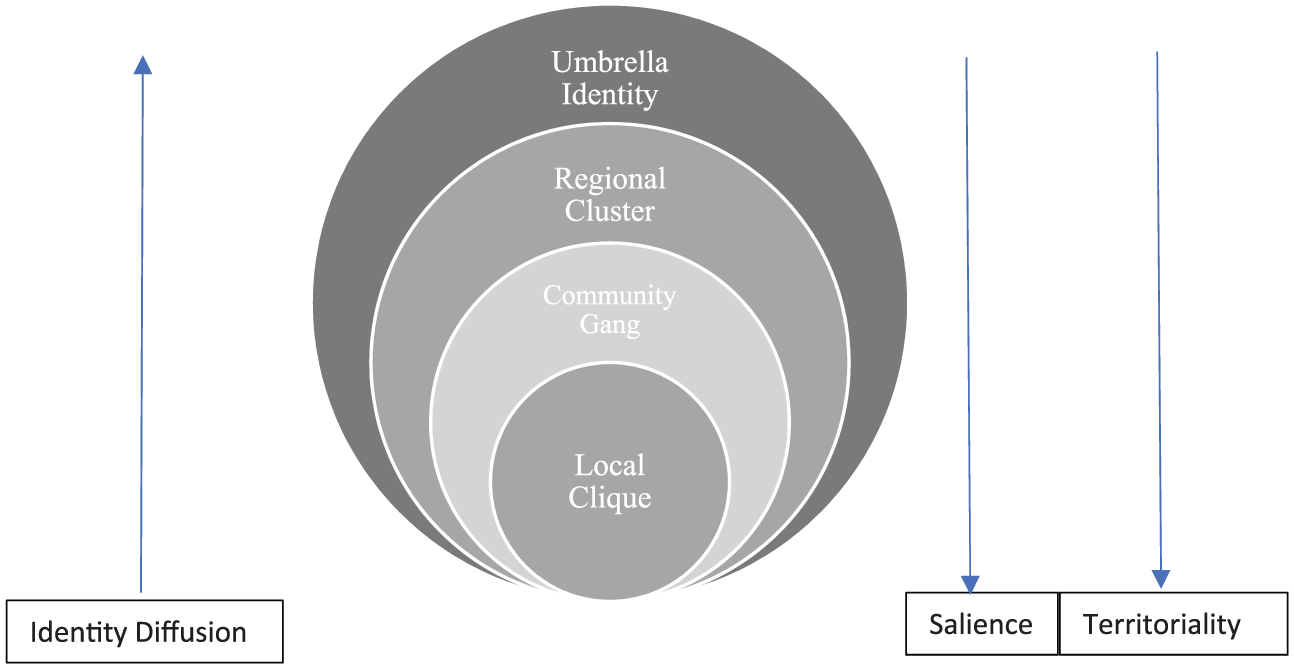
Nested strata model.
Three variables matter here: the degree of salience, identity diffusion, and territoriality. 12 Identity salience refers to the likelihood of a given identity being invoked or “activated” during a social encounter (Brenner et al., 2014). The degree of identity diffusion refers to the size of the place over which an identity is shared—the larger the area of the place, the greater the degree of identity diffusion. The degree of territoriality is the propensity for the defense and expansion of the symbolic and material bases of differentiation between groups.
Note that smaller territories are embedded within larger ones. Local cliques and community-based gangs tend to have relatively defined places to which the group’s identity is tied; the frequency of interaction among members within those places is relatively high, making the gang identity more salient. 13 Under those circumstances, we expect greater degrees of territoriality—perhaps violently so (Papachristos, 2009; Radil et al., 2010; Tita and Radil, 2011). However, as the size of the geographic area that corresponds to a given identity (and therefore the degree of identity diffusion) increases, the degree of identity saliency and territoriality decrease because there are fewer social situations in which an individual’s gang identity is invoked. Moving to yet larger social geographic strata—regional clusters like “Westside” or “Southside”—a gang identity’s connection to place is even more tenuous. At the highest strata, that of “umbrella identities”—those comprised of highly visible group symbols loosely connected to the cultures (e.g. values, beliefs, places, etc.) from which they originally derived—one finds categories like Sureña/os, Norteña/os, Crips, and Bloods. These monikers transcend place, being less like gangs in any traditional sense and more like symbolic White ethnic identities (Gans, 1979; Waters, 1990): optionally chosen or applied but not fully incorporated into a distinctive prominent identity.
In sum, the larger the social geographic area an identity covers, the less territorial, cohesive, and gang-like the group. Inversely, the smaller the social geographic area to which an identity refers, the more salient and territorial the group becomes, making its distinction as a gang more fitting. 14 These propositions derive from participants in our respective studies. While gang-involved youth also commonly adopted umbrella identities as part of their gang persona, these were largely symbolic in contrast to the deeply important meanings participants attributed to their neighborhoods.
Locating gangs at the neighborhood level
When discussing gangs, either their own or those of close friends, participants consistently used the neighborhood as a reference point for defining the group they were talking about. In doing this, they generally recognized gangs as small groups of peers who were identified by particular neighborhood markers—parks, streets, and even specific residential blocks. This follows what Thrasher (1927) originally described in terms of gangs being neighborhood-based groups, but these local foci of gang orientation are also intertwined with inconsistent relationships to broader criminalized affiliations.
Participants in Fresno described a number of local “hybrid gangs” (Bolden, 2014; Simi and Hoffman, 2012; Starbuck et al., 2004) comprised of mixed Blood and Crip memberships. In these groups, Blood and Crip affiliations hinged upon one’s personal relationships with gang-involved friends and relatives; shared gang identities were therefore not defined by umbrella affiliations, but rather by the neighborhoods in which groups resided. When asked about how Bloods and Crips could be from the same gangs in Fresno, 16-year-old Brandon summed it up succinctly: “Basically, like if you from the same hood, you good. Like if you grew up on the same hood, same block, you all together. They mainly just don’t get along with other hoods.” Brandon dismisses Crip and Blood affiliations as symbolic while explaining that specific neighborhood places generate high degrees of identity salience and territoriality—creating the bonds that collectively form group boundaries and relationships with other members.
This perspective of prioritizing neighborhoods as sites with low levels of identity diffusion and high degrees of gang identity salience and territoriality remains consistent even in Los Angeles, where there are no Blood–Crip hybrid gangs, as far as we know. C-Lean, a member of the 8Tray Gangsta Crips in Los Angeles, explains: “Your hood is really your everything. We got our park, our streets, our Ralph’s [grocery store]—our shit.” Pointing in an unfocused radius, he added: I know everybody here, and they all know me. We form a big ass unit; I got dudes I’m closer to, but it’s 8Tray Gangsta Crip G’s movin’ on mine and everybody in my hood, or you can’t claim it. That’s how we separate the real G’s from the lames.
Again, we see the significance of place for identity formation in C-Lean’s explanation, as the material resources of his neighborhood are marshaled to construct a gang identity. Moreover, a willingness to defend the brand (territoriality) is one of the standards by which C-Lean differentiates members from non-members.
Participants did not attribute this kind of territoriality to umbrella identities however. For example, CJ, a 30-year-old non-member from a Crip neighborhood near Los Angeles, explains the relationship between gang identity, umbrella identity, and territoriality thusly: I got more allegiance to Crips just cuz I grew up around that… When a nigga who really bang
15
the hood say where he from, he say, “I’m from Altadena Blocc”, and I don’t say that. I say I’m from Altadena—from the city.
CJ identifies with Crips because he grew up around them, but he explains that he is recognizably uninvolved in gangs because he only claims his city. He describes gang identification however as indicated here by claiming “Altadena Blocc” specifically, signaling a distinct local group and identity used when someone “bang[s] the hood” in and around Altadena. As such CJ illustrates gang identity as rooted in, activated by, and inextricable from place.
The relationship between territoriality, identity salience, and place becomes even more apparent as we consider gang violence. In Fresno, being a Blood or a Crip is inconsequential in terms of local gang conflicts; regardless of an individual’s own gang membership, they may support or fight with others with either identity. As 17-year-old gang member Curtis explains, what determined one’s enemies was strictly the neighborhood (or “set”) that they claimed: If I’m a Crip and you a Blood, I’m not gonna kill you, I’m not gonna funk with you or nothing cuz you a Blood. Most of the time I’ll be like “Oh you a Blood? What set you playing?” You don’t go by colors no more. We go by your set, what set you playing. Niggas be like “I don’t bang I’m just a Blood.”
Curtis explains that inter-gang conflict in Fresno is place-based irrespective of affiliations with umbrella identities. He describes umbrella identities as having little to do with local rivalries, and even states that for some (much like CJ), such affiliations may not indicate gang-involvement at all.
With Vanessa, a 16-year-old former gang member, we can again see this emphasis on place in shaping identity and conflict. When she compares being a Blood or a Crip in Fresno to being one where she used to live in Los Angeles, the neighborhood remains the central focus of group challenges and clashes: [In Los Angeles] they just don’t care. Like say if you’re in like a Crip area, [and] you come home with any red, they either gonna beat your ass or they gonna kill you. [But in] Fresno, you come in a Blood area, well they gangs got Bloods and Crips so it really don’t matter what you wear in they hood. Now if you say “fuck they hood” or something, that’s when you gon’ get killed or you gon’ get beat down… You can be a Blood or a Crip. Just know you from this hood, and don’t let nobody disrespect or nothing.
In describing neighborhoods as gangs’ primary bases of conflict, Vanessa couples gang identity salience and territoriality. She locates the nexus of neighborhood identification and territoriality as a principal source of inter-gang conflict, and describes the significance of umbrella affiliations (to the extent that they matter) as tied to place. In detailing the potential for lethal violence between Bloods and Crips in Los Angeles, she qualifies this as something that could happen if someone wearing red were to enter a “Crip area”, indicating that even in disputes between umbrella affiliations, place remains a central component of intergroup conflict. Indeed, as in Boston or Chicago (Papachristos et al., 2013), gang violence in Los Angeles is correlated with neighborhood proximity (Brantingham et al., 2012), meaning that having adjacent territories makes gangs more likely to feud than do different affiliations. When Blood and Crip sets do fight each other, it has less to do with being Bloods or Crips than it does with being from different neighborhoods.
Umbrella and neighborhood identities
Crip and Blood identities originally referred to the alliances that formed in the early 1970s between neighborhood cliques across south Los Angeles following the dismantling of the city’s Black power movements (Davis, 1990; Sloan, 2005). As these identities spread, entire neighborhoods became either Blood or Crip spaces. By the late 1970s, these same identities began appearing outside of Los Angeles among gang-involved youth in new cities and regions. However, it is unlikely that this resulted from Blood and Crip affiliates relocating or recruiting members in new territories, as gang youth generally have loose to nonexistent ties to gangs in other cities (Durán, 2013; Maxson, 1998; Waldorf, 1993). Instead, both the range and arbitrary nature of these identities’ appropriation suggest that their spread is perhaps best understood as the popularization of oppositional or outlaw cultures that local groups adopt and redefine with their own meanings.
Damon, a 43-year-old parolee who grew up on Fresno’s Westside, recalls the first local appearance of Crips and Bloods in the mid-1970s. He explains that by the time Crips appeared in Fresno, local youths who took on the identity did not seem to have much connection to the more extensive networks of Crips in Southern California: They came like about the 70s. That’s when they basically starting branching out, but they been here, you know. They were already here as far as like, but they wasn’t organized. They were just people calling themselves Crips. But now as far as like [being] structured, they lost all the potency. It wasn’t you know, it got watered down by the time they got here. It was just a gang. It wasn’t no organization at the time, you know.
Damon describes groups of local youth calling themselves Crips without necessarily having any connection to the original gangs in Los Angeles, explaining that any structural organization behind the moniker became “watered down” by the time it reached Fresno. In his recollection, we can see youth taking on a notorious identity and using it to brand their own local collectives. This is a common practice in which popularized umbrella identities are adopted as an empowering form of resistance to local marginalization; this type of “franchising” is found among 18th Street and MS-13 cliques throughout Central America (Brenneman, 2012; Zilberg, 2011), Crip-identified Surinamese youth in the Netherlands (Roks, 2017), and Mexican immigrant youth appropriating Sureña/o affiliations in the American Southwest (Durán 2013). In doing this, marginalized youth assert an oppositional stance against local authority figures while also intimidating rivals and outsiders by associating themselves with sensationalized public villains.
However, we must also consider the role of justice system institutions in the construction and distribution of criminal and gang labels. For example, Robert Durán (2013) demonstrates how both media sensationalism of gang violence in Los Angeles, as well as the Los Angeles Police Department’s subsequent national recognition as gang experts, proved instrumental in migrating gang identities (and even gangs as a social construct) from the West Coast to cities in Colorado and Utah. In California, the spread of criminalized umbrella identities has been closely linked to the very criminal justice institutions tasked with suppressing gangs. Norteña/o and Sureña/o affiliations—widely regarded as gang affiliations—originally stemmed from the geographic separation of Latino inmates in the state’s prison system, and the subsequent exportation of the resulting identities back to Chicana/o neighborhoods (Lopez-Aguado, 2018). As gang-involved young men were increasingly sent to state prisons, these umbrella affiliations became valuable institutional identities.
This racial and geographic sorting occurs within a range of carceral institutions (Lopez-Aguado, 2018; Walker, 2016), in which all individuals are divided upon entry by their supposed gang ties, irrespective of their actual degree of involvement or lack thereof. Criminalized umbrella identities are then institutionalized through the establishment and policing of divided spaces within the facility, and the socialization of other groups as threats to one’s physical safety. 16 Consequently, such identities become a way of understanding and articulating the conflicts and threats that people encounter in these uncertain environments. Paul, another parolee from the Westside, describes his time in prison:
Back then, would guys from Fresno and the Bay fight with guys from LA?
Yeah, that’s how it was. We was against LA. But the Bloods was with us. So that’s why when we would go in the prison, they would automatically classify us as Bloods. ’Cause we all ran together, know what I’m saying? The Bloods, the Bay Area, Fresno, all Blacks from up north, we all ran together.
Against all the Crips and all the LA guys?
Yeah, that’s how it was when I was going to prison. That’s why I told you it changed, you know. So, it’s like the Norteños and the Southsiders, that’s how it was. That’s how we were.
Would they house you guys separately like they do with Norteños and Sureños?
Oh, you have to. Yeah, you have to.
In Paul’s experience, Black prisoners from Fresno were institutionalized as Bloods as they were incarcerated to fit the divides imposed on Black inmates at the state level. It is unclear how extensively this particular sorting pattern was used in California prisons, or for how long, as now most facilities sort all Black inmates together, regardless of where they are from (Lopez-Aguado, 2018; Walker, 2016). 17 But for Black residents like Paul who were sent to prison during this time, this penal sorting was likely influential in shaping the affiliations they adopted and passed on to younger loved ones.
Regardless of how these affiliations came to Fresno, neighborhoods—not the umbrella identities themselves—were the principal factors in forming gang identities. Even as local youth began appropriating Crip and Blood identities, gang violence in Fresno remained defined by neighborhood conflicts. Here Troy, 54, describes how boys from his housing projects battled with those from other Black neighborhoods across Fresno before Blood and Crip identities became a popular framework for categorizing neighborhood cliques:
Since you said Bloods and Crips didn’t come in until the 70s, were there [other conflicts]? Did [your neighborhood] ever have rivalries or get into fights with other neighborhoods?
Yes, that would happen. [My apartments] would be against Fink White, where the Fink White playground is. It’s right over here, right down E street, turn, that’s the Fink White projects… Back in the day, yes we used to get into feuds, arguments, and fights behind Strother Street, or Fink White area, [or] Tulare. I remember a time when guys was standing on Eden, Myers, Strother, Hawes, all those streets, and when school was out I’d tell one of ’em “hey man come on, go to my house with me for a minute”. “Where you live at?” “I live in [my neighborhood].” “I’m not going down there!” Because anybody that come in there that don’t live there, fittin’ to get jumped on.
What is noteworthy here is that the neighborhood conflicts that Troy describes still largely characterize gang violence in Fresno, and some neighborhoods like Strother and Fink White are still active gangs today. The groups that youth identified and fought with throughout these decades have remained neighborhood-based, with Crip and Blood monikers eventually becoming incorporated into pre-existing networks and rivalries. However, this centrality of neighborhood identities in gangbanging has allowed for umbrella identities to take on much more fluid meanings for gang-involved youth.
This fluidity can sometimes manifest in surprising ways. Consider the conversation that unfolds between students at the probation high school when Manuel asks Derek what he knows about one local neighborhood:
You guys know anyone from 10th street?
Ain’t no such thing. There’s a 10-hundred block Modoc, but there ain’t no such thing as 10th street.
Not on the West, they’re on the Northside.
They ain’t no factor then… if they ain’t Crip or Blood then they ain’t nothing to us.
They say they don’t wanna be Crip or Blood cuz Crips and Bloods talk to each other and that ain’t cool.
That’s cuz we don’t bang colors, we bang gangs. That’s how it is in Fresno. How you gonna kill someone over a color? That’s stupid. “Oh I’m gonna shoot you cuz you like blue.” “Oh you like red so I’m gonna slap you.” That’s stupid.
Derek frames fighting over being a Crip or a Blood as a silly diversion from the more important conflicts between neighborhoods. In so doing, he links high degrees of gang identity salience and territoriality to low degrees of identity diffusion by locating meaningful gang conflicts within specific residential places, thus drawing a stark distinction between mere “colors” and actual (neighborhood) gangs. But at the same time, he also implies that it is important for gang members to identify with one of these umbrella identities. Considering how Derek dismisses 10th street once he learns they are from Fresno’s Northside, Crip and Blood identities in this context may say something about being from the Westside, the historically Black district of Fresno. The absence of these identities may in turn suggest that someone is not from this region, or perhaps unfamiliar with how gang culture operates here. Though not expected to fight over these identities, youth still find symbolic and contextual importance in claiming them.
Consistent with our other respondents, Derek pinpoints gang identity in local places with high degrees of identity salience; conversely, identification with Bloods or Crips says little about one’s gang ties or membership, as Curtis suggests when describing peers who claim “I don’t bang, I’m just a Blood.” More often than not, umbrella identities instead served as symbolic connections between individuals, their friends, and their family members.
We argue that this remains true even in Los Angeles, where neighborhood and affiliation identities are still closely linked. For instance, Mack, who is loosely associated with a Piru gang in Compton through family members and friends, explains: “From what I know, all them Blood gangs—the Tree Tops, Fruit Town, all them niggas—basically got started as niggas who didn’t wanna be Crips.” When asked what differentiates Bloods from Crips, he responds: Nothing. They both do the same shit. They all bang. I mean, you might have one hood that’s more about getting money than another, but they all gang bang and do the same shit. I guess it’s about who your homeboys are or where you grow up.
Mack’s emphasis on local friendships and associations for the determination of gang affiliation illustrates how meaningful constructions of gang identities (as well as which umbrella identities are adopted) are rooted in local relationships.
What an umbrella identity means to gang youth can vary depending on the influence of these relationships. Some participants described it as a simple matter of personal or aesthetic preference, but when umbrella identities were not directly tied to the neighborhood, identifying with one affiliation over another was often about honoring family history or loved ones. These affiliations then not only connected them to close peers and family, but also articulated something about their values and who they were as a person. Curtis explains: [E]verything got a history behind [it]. Some people become a Blood because they big brother was a Blood and he died and they want to carry on what they big brother got going on, because Blood stands for “Be Loyal Or Otherwise Die”. Crips stand for “California Revolution In Progress”. That’s how they label themselves and most of the time, you become a Blood or something because [of] your family members, because your big brother a Blood. So why would you be a Crip if your brother a Blood?
The meanings given to Crip or Blood identities are largely influenced by family members and close friends, and the understandings young people have of these identities are in turn based on what they have learned about their histories from these influential loved ones. As Curtis explains, these affiliations are passed down, and the appeal youth learn to recognize in them reflects the virtues they see themselves sharing with their loved ones: in this case, either loyalty or a revolutionary disposition. The patterns of adoption and use of these identities (and what they mean to the people who adopt them) likely change from city to city, and this is precisely the point: there is no consistent, static meaning for “Bloods”, “Crips”, or other umbrella identities. They are not uniform, nor do they constitute a claim to a cohesive organization. Instead, they are situational, symbolic, and at times even individualized identities.
Discussion and conclusion
In this article, we seek to sharpen the dominant discourse of street gangs by creating a more intricate understanding of how gang identities are used and understood by criminalized community members. Using a symbolic interactionist perspective on identities that builds upon contemporary small groups research, we analyzed data from two ethnographic studies to develop a set of propositions regarding the relationship between gang identity, place, and territoriality: P1: The greater the degree of gang identity diffusion: (a) the lower the measure of gang identity salience and (b) the lower the degree of territoriality. P2: The lower the degree of gang identity diffusion: (a) the higher the measure of gang identity salience and (b) the greater the degree of territoriality.
We depicted these propositional statements in a nested strata model that distinguishes between the layered criminalized identities described by participants, recognizing a truism in social psychology: identities are dynamic conceptions, and context matters greatly for the frequency of identity activation.
Building from extant literature and responses from research participants, we argue that gang identities are best understood as neighborhood or local phenomena, as our respondents repeatedly contended. This not only makes a strong argument for limiting our discursive use of “gangs” as a concept to describing neighborhood-based social groups, but also illustrates how the relationships one has at the neighborhood level construct the meanings one associates with the identities throughout the strata set. Consequently, our analysis suggests that umbrella identities like Crip or Blood affiliations are largely symbolic and untethered from place in ways that are consequential for the degree of territoriality. Crips, Bloods, and similar identities conventionally indicate alliances between distinct street gangs, but as they become increasingly broad and diffuse their meanings can shift and vary considerably, even within the same gang.
Here our nested strata model can help us conceptualize how youth find meaning in such broad identities. Young people’s appropriations of umbrella identities are largely determined by local relationships that then inform how they understand these identities’ meanings. When one affiliation is collectively embraced by a neighborhood clique, the relationships in this group compel members to individually embrace it. In hybrid gangs in which this is not the case, other local influences—family members or friends who may not even be in the gang—may inform this selection. Individually, participants described a range of meanings within these identities; they represent their ties to close peers, their family’s history, their own oppositional stances, and even aesthetic preferences. Thus, the fluid meanings that umbrella identities hold for those who claim them means that one’s affiliation may in fact say little about one’s gang ties or conflicts.
Having specified relationships between key variables related to gang identity, we can consider the implications of this work. Most immediately, our analysis encourages criminologists to lean upon social psychological studies of groups, identities, and emotions to open new lines of inquiry and generate more robust conceptions of gangs and gang identities. Additionally, this work finds extensive variations in how local articulations of criminalized identities are understood and manifest. Recognizing umbrella identities as largely symbolic monikers pushes us to question how these affiliations are used to label young people as criminal, and how gang definitions that include umbrella identities impact the punishment of marginalized youth. Indeed, interpreting the performance of Crip or Blood subcultures (through diction or dress for example) as evidence of gang involvement allows police to easily validate youth as criminal gang members, and lowers the prosecutorial bar for sentencing enhancements during criminal trials. Relying on umbrella identities to validate gang members or associates is therefore not only inaccurate, but also likely facilitates the arbitrary criminalization of poor youth of color.
Of course, there were some limitations to our study. Institutional turnover made it difficult to follow up with participants, and jail routines and controls restricted some access to participants and data collection methods. Our reliance on these data also limited our ability to assess how youth interpret umbrella identities before being institutionalized, or how these may be socialized within family or peer groups. However, these limitations also raise new questions for future study. Given the significance of place as a durable resource for group identity construction, subsequent studies may investigate how changing settings may solidify groups and shift identity meanings—making experiences like migration or incarceration particularly impactful—or why umbrella identities became so common in the latter decades of the 20th century. Recognizing how penal classification systems concretize umbrella identities as a function of institutional goals (Lopez-Aguado, 2018; Walker, 2016), further research might consider the role of the state in constructing or distributing these affiliations, or the extent to which umbrella identities may function as forms of resistance unrelated to gangs—resilient to institutional controls and even transformative under certain conditions (Brotherton, 2008). Continuing to interrogate the histories, meanings, and patterns of criminalized affiliations is essential for understanding and challenging the logics used to identify, monitor, and control young people of color as criminal gang members.
Footnotes
Declaration of Conflicting Interests
The author(s) declared no potential conflicts of interest with respect to the research, authorship, and/or publication of this article.
Funding
The author(s) received no financial support for the research, authorship, and/or publication of this article.
