







Abstract
Drug courts are widely praised as a therapeutic alternative to mass incarceration. Using ethnographic discourse analysis, our intersectional comparison of a Midwestern court demonstrates how gender and race create differentiated and unequal rehabilitative projects. Striking differences in treatment, sanctions, and requirements demonstrate the lasting power of long-standing historical addiction tropes. Our primarily white and African-American site re-inscribed the historical polarization between “white slaves” and “drug zombies”, between the (traumatized female) “involuntary addict” and the dangerous agency of the (racialized) male “criminal addict”. The explicit gender differentiation between therapy for women and work for men was thus cross-cut by race, with talk therapy for white women and neuro-scientific medicalization for white men set against deep racio-cultural reform for African-Americans. While Black women were encouraged to take on intensive mothering, Black men were subjected to the highest surveillance and suspicion, their struggles in the labor and housing markets misrecognized as cultural deficiency.
The drug court system is widely supported as a humanistic alternative to the enormous human costs of the 40-year War on Drugs. The number of drug offenders incarcerated increased by 1115% between 1980 and 2010, driven by unprecedented arrests and severe sentences for use, possession or small-time dealing (The Sentencing Project, 2021). Cascading reports, media treatments, protests, and social movements over the years challenged the practicality and ethics of aiming such severe measures at non-violent drug offenders.
Equally importantly, the drug war has become widely questioned as a racialized project from conception to execution (Alexander, 2012). Two-thirds of the drug war’s current prisoners are minorities (Carson and Mulako-Wangota, 2019) and at every stage of the legal process—from being stopped and questioned, arrested, charged, prosecuted, or sentenced to prison—Black, Latino, and Native people are drawn faster and deeper into the system than whites (Alexander, 2012; Walker, 1996). The hope for drug courts, thus, includes a strong desire to “cure” and redeem a non-white majority (Ho et al., 2018).
The over 3000 US drug courts that have opened since 1989 (Marlowe et al., 2016) propose a solution: a “synthesis of therapeutic treatment and the judicial process” (Hora et al., 1998: 453). The criminal legal system 1 identifies addiction-related crimes, then applies the threat of incarceration to force individuals into treatment and recovery. Forgoing the adversarial character of most criminal processes, court and treatment professionals collaborate to heal “clients” (not “defendants”) whose addiction renders them unable to rationally represent themselves. 2
Does redefining drug war defendants as “clients” suffering from addiction in fact deliver a reprieve from moral castigation and punishment? Despite claims to be forging a radically different, profoundly therapeutic way of dealing with crimes committed by those afflicted by addiction, the courts resemble several older forms of American punishment. Indeed, punitive practices have often been tangled with rehabilitative, medical, and charitable logics and projects (Platt, 1977; Rothman, 1980). Some identify a regular pendulum swing between punitive and reform movements, while others have questioned the “progressive” character of reform itself (Goodman et al., 2017). Whether looking at the development of juvenile courts (Platt, 1977) or the 1970s diversion of African-American prisoners into psychiatric wards (Metzl, 2009), critical criminologists have argued that rehabilitative or therapeutic projects tend to retain or even sharpen a punitive edge under the shadow of criminal legal control.
Indeed, drug courts and their partner treatment facilities generally require deep resocialization through intensive coercion, discipline, and surveillance difficult to achieve within regular incarceration (Gowan and Whetstone, 2012; Tiger, 2013). Yet a closer examination of drug courts shows a highly differentiated process. Using ethnographic discourse analysis, a method which draws out the interactional and embodied character of “lived” discourse (Gowan, 2010), we study both men’s and women’s hearings at one highly respected county drug court in an unusual intersectional comparison (Crenshaw, 1991). We show “criminal addicts” judged and treated differently according to their race, gender, and class, ultimately creating separate and unequal court trajectories. Furthermore, we show how the anxieties and strategies attached to different positionalities demonstrate strong lines of continuity with the representational field of historical media tropes.
Drug courts explicitly differentiate addicts by gender, framing female addict criminality as emotional and relationship dysfunction, while male addict criminality is attributed to poor impulse control and low work attachment. While women are seen as victims, involuntary addicts who need liberation from unhealthy intimacy with dangerous dealers and pimps (March, 2009; Wyse, 2013), strategies for men foreground work (often in no-wage/low-wage positions) as the primary “structure” reining in impulsivity and creating “responsibility” (Kaye, 2019; Wyse, 2013).
Structural differentiation by race, on the contrary, is unacknowledged within court proceedings. Yet quantitative evidence of such differentiation is undeniable. The assessment and admission process tends to overrecruit people of color with minor drug violations (net-widening), whereas white offenders tend to have multiple priors (Wolf, 2008). Then racially skewed decisions about treatment placement, and then testing and other post-treatment surveillance, tend to culminate in much lower Black graduation rates (Gross, 2010). Ho et al. (2018) argue that court staff have taken comfort in research pointing to correlations between race and unemployment, low socio-economic status (SES), and prior arrests, yet their own large study confirmed significant disparities even when controlling for these variables. Qualitative studies of racialization of the drug court process are therefore vital.
Mapping addict governance from historical trope to court interaction
Our own work argues that studies of addict governance should take stronger account of the continued significance of the tropes which have historically dominated representations of addicts across lines of race and gender (see Figure 1). Our approach here is therefore twofold, bringing together historical discourse analysis with court ethnography. Our historical discourse analysis synthesizes historical literature to place the addict tropes 3 framing different addicted subjects (Kerrison, 2017) in a relational intersectional field. Our ethnography then explores how these tropes are updated and reworked within a contemporary drug court—undercutting and complicating its therapeutic mission.
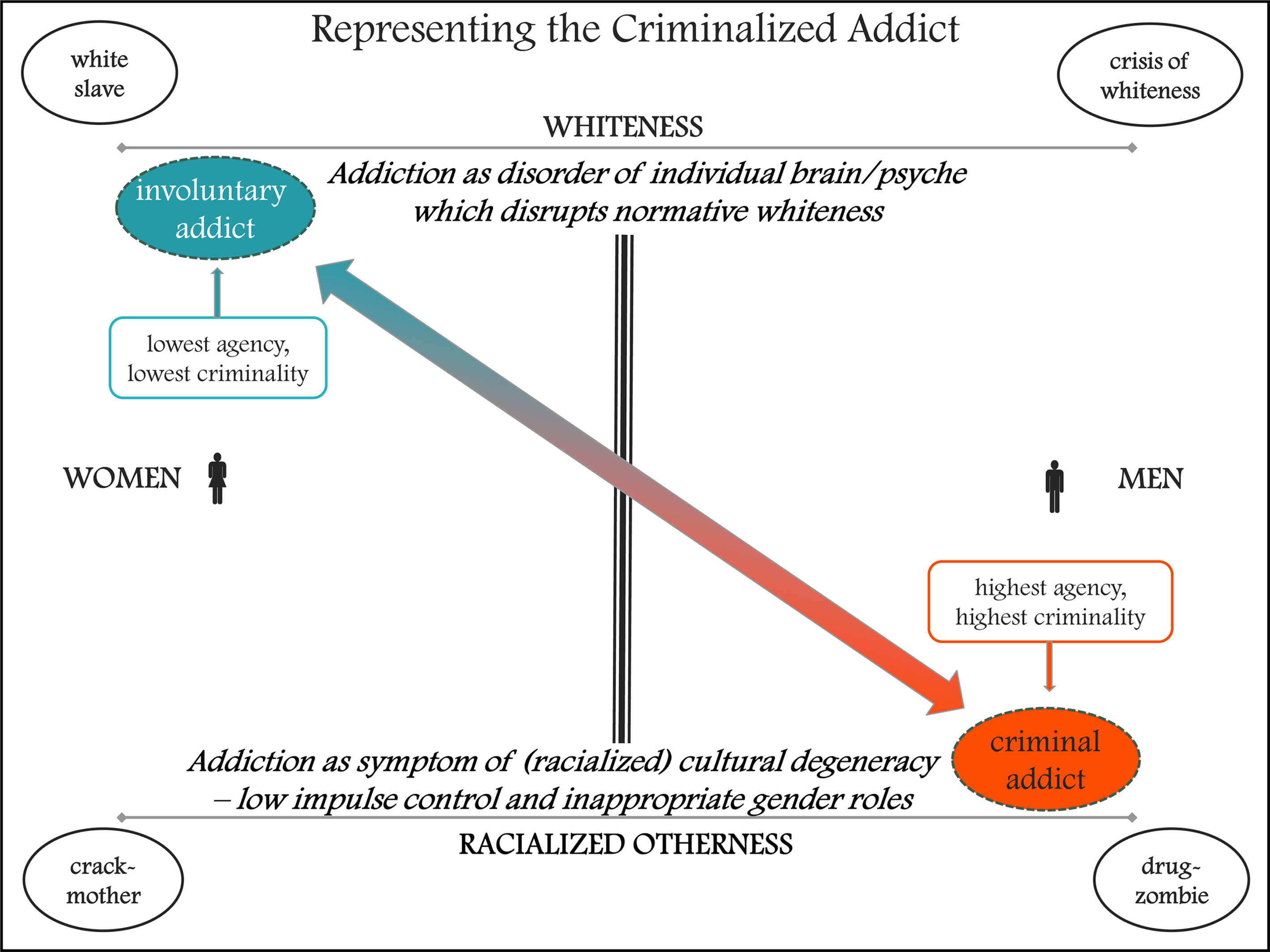
Representing the criminalized addict.
Different medicalized approaches are offered to white women and men, but for African-Americans, medicalization is largely replaced by projects of racio-cultural control. In the process, the court not only reproduces but produces unequal addicts.
We first demonstrate that the character of US addiction has been organized across a relational field for at least 150 years (see Figure 1). This field of representations draws its power from bedrock oppositions of gender and race within western culture, each trope maintained and updated through routinized institutional practices which naturalize the othering and domination of subaltern groups (Wetherell and Potter, 1998).
At one corner of this field lies the “white slave” trope, the low-agency white female drug victim. At the other symbolic pole stands the dangerous Black man, which we call the “drug-zombie” trope. As we sketch below, the highly dramatized historical tropes of “white slave” and “drug zombie” keep surfacing within both popular culture and dispassionate criminological expertise as an opposition between women traumatized or coerced into addiction—involuntary addicts—and dangerous, culturally deficient men, volatile “criminal addicts” who require fundamental resocialization. The involuntary addict continues to be typified by white women, while the ideal type of the criminal addict continues to be coded as African-American and male. Others inhabit less polarized but equally distinct positions within the symbolic field. Black and indigenous women remain ubiquitously suspect for deficient womanhood, especially motherhood. White men, in contrast, remain largely unmarked as white men—instead they are more likely to embody the ideal type of contemporary addiction science’s “hijacked brain”, their disease more individual and medical than cultural and collective (see Figure 1).
We then move through a discussion of our methods into our ethnography. Focusing exclusively on Selby Drug Court’s treatment of African-American and white court clients, we show how staff interactions, treatment, surveillance, and sanctions re-inscribe the historical polarization between the strong agency of the (racialized) criminal addict and the trauma of the involuntary (and especially white) female addict. Contemporary inflections of the female drug slave, the neglectful Black mother, and the out-of-control Black criminal addict still haunt the field, loaded with the symbolic weight of their more lurid media versions. By continuing to shape and differentiate treatment across lines of race and gender, the court restricts the destigmatizing potential of medicalization to white clients, culminating in striking differences in outcome.
Within the mild milieu of the drug court, as we illustrate in Figure 3, the dramatized poles organizing addict representations are partially obscured: this space of intermediate control governs neither the most monstrous nor most purely deserving. Yet our study revealed a court process still clearly organized through the different anxieties attached to each addict trope. This striking continuity supports the neo-Durkheimian contention that the relational symbols through which we make meaning change less over time than we might think (Alexander, 2012: 2), so that the controlling images baked into the national psyche are durable indeed (Collins, 1998).
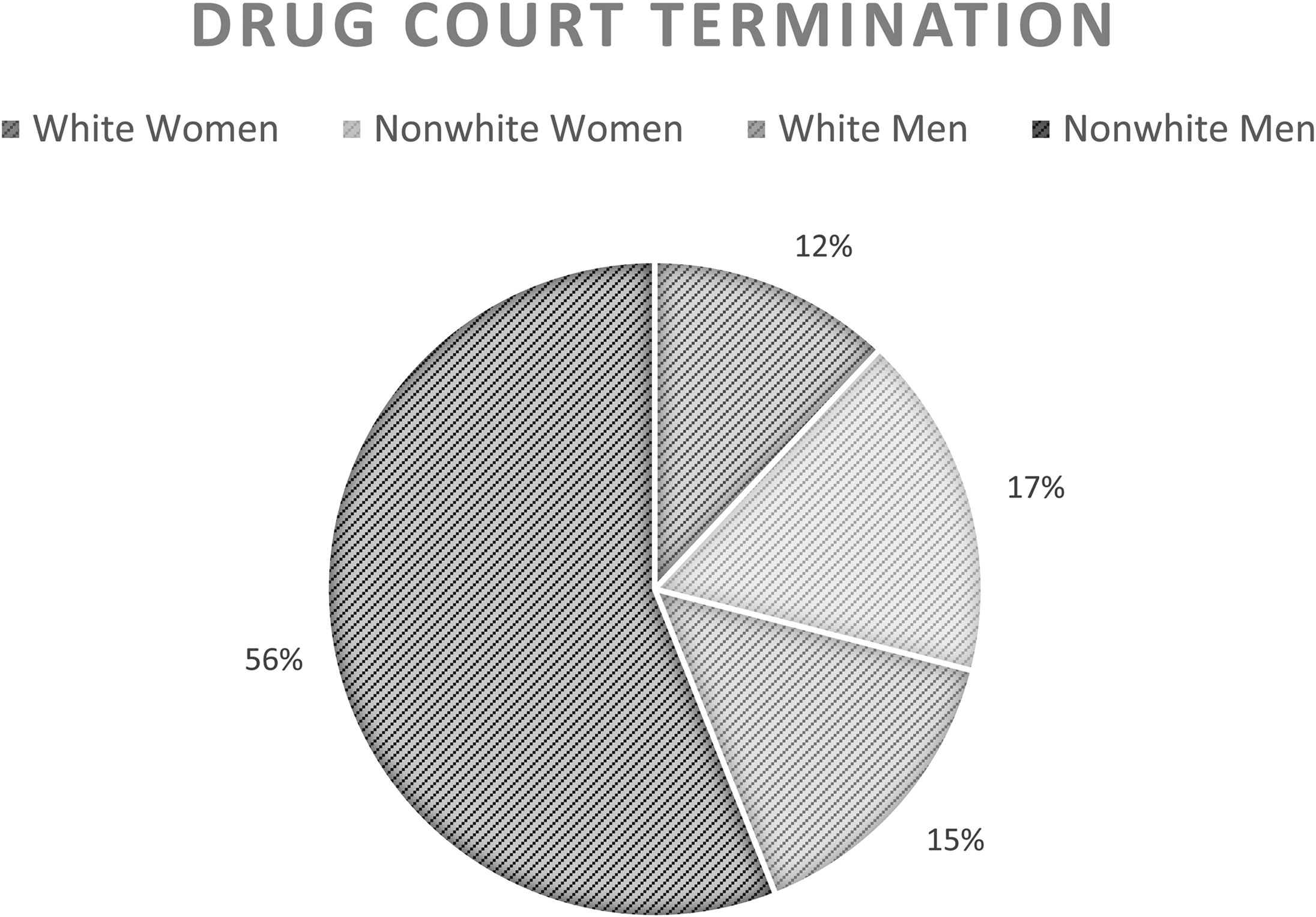
Drug court termination.
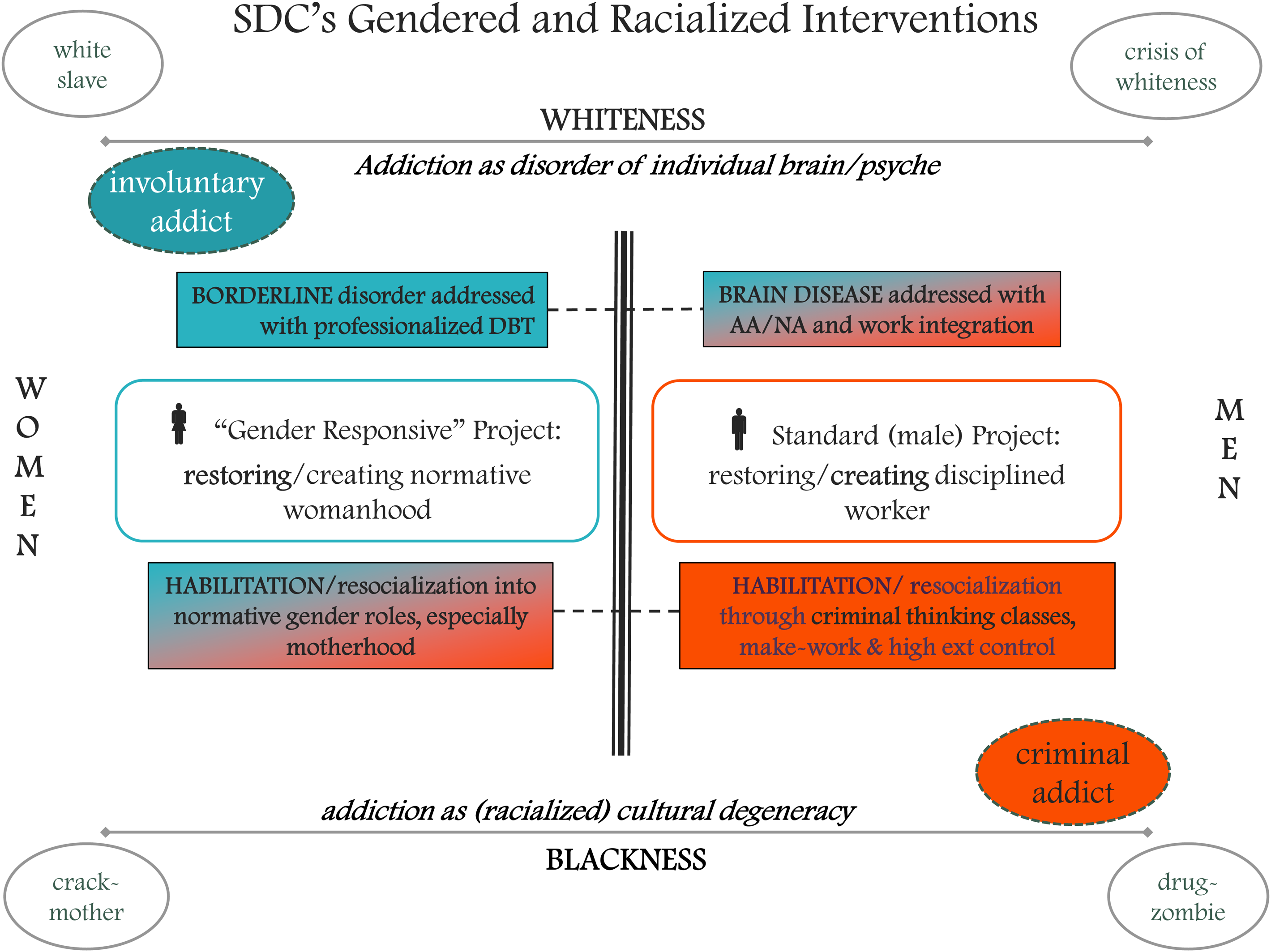
SDC’s gendered and racialized interventions.
We show how the court’s explicit gender segregation drew all the women into a therapeutic project to promote normative womanhood, while all men were subjected to punitive and moralistic resocialization into disciplined workers. However, these broad-stroke gender constructions were complicated by unspoken common sense about racial (“cultural”) difference, shaped by the longstanding racialization of the involuntary vs criminal addict binary. The following two sections show the racio-cultural reform projects of each court.
The women’s court primarily projected the ideal-type of traumatized involuntary addict onto white women, who were pressured into long-term therapy. African-American women, instead, were subjected to deeper resocialization. As they were pressured to take on intensive child rearing and other normative femininities, their own psychological needs were downplayed in relation to those of white women.
The men’s court, in contrast, generally held all clients within a strict (external) structure of constant surveillance and resocialization through responsible labor. Staff strove to create a “good attitude” toward hard work (framed as responsibility), and successful labor market outcomes became the ultimate measure of recovery. Black men, however, were subjected to the highest surveillance and suspicion, while white men willing and able to frame their needs in terms of addiction-as-disease elicited more sympathy and milder sanctions.
Finally, we discuss the racialization of success and failure, concluding that African-Americans in general were set up to fail, both because the court subjected them to stricter conditions, and because the court erased immense racial disadvantages in housing and employment, misrecognizing them as individual failures. Ultimately, the court reinforced the roles set up by the addict tropes, not only seeing but producing fundamentally flawed addicts of color.
Historical addict tropes, from white slaves and drug zombies to criminal addicts
The iconic white female drug-victim emerged in the late 19th century, building to a fin-de-siecle moral panic over a largely mythical “white slave trade”. Christian converts like Rose Livingston recounted how Chinese men forced them into sexual slavery and opium addiction. White men toured 1890s western Chinatowns, hoping to rescue (or ogle) helpless women collapsed in opium trances, their silk skirts shucked over their knees (Agnew, 2013: 148). The trope of men of color violating white womanhood concentrated the intense racism and xenophobia of the time, driving the 1912 “White Slave” or Mann Act (against sex-trafficking), and continued through subsequent decades around stories of Jewish, Italian, and Black men abducting and drugging white women to rape and enslave (Doezema, 1999).
While the white slave trope came to anchor representations of female forced drug use, male drug use was shaped by a very different icon—the man of color transformed into a violent, crazy, monster by demon drugs. This trope, we argue, has been constantly reinforced through its resonance with a core figure of the horror genre—the reanimated zombie (originating in Haitian cosmology). Like other zombies, the addict variant is mindless, ever-hungry, and terrifyingly strong, impervious to exhaustion or bullets.
The loss of humanity attributed to drug zombies was rooted in early 20th-century representations of African-American men. Both southern intellectuals and the inflammatory “yellow” press presented Black men as ignorant children with animalistic passions, dangerously unleashed by emancipation and inflamed into superhuman power by drugs (Hickman, 2007). Panics about cocaine-crazed African-American males expanded after Prohibition, as Anslinger turned the US temperance army against new substances and users. Crackdowns of the 1930s and 1940s targeted specific racialized subcultures: notably Black jazz musicians and Mexican Zoot Suiters of Los Angeles (Hari, 2015).
Post-war criminologists increasingly reflected the media’s essentialized representations of African-American criminality. Irwin and Yablonsky (1965: 183) delineated “new criminals” “primed … for addiction” due to immaturity, “other-direction”, and weak impulse control. Once drawn into substance use these “criminal addicts” then shifted to increasingly violent and “senseless” crimes. Four years later, in the wake of the Moynihan report (Roberts, 1999: 16), Hirschi (1969) developed a more explicitly racialized thesis of the deviant as uncontrolled savage. Hirschi saw inadequate parenting and low aspirations creating criminogenic immaturity and “low impulse control”, supposedly concentrated among African-Americans. This clustering of anxieties about racialized under-socialization, low impulse control and drug use produced a criminal-addict construct (see Figure 1) which is as inherently racialized as “the criminal” in general. 4
The media iconography of the drug zombie swelled into overdrive during the 1990s crack epidemic (Reinarman, 1997), flowing into the superhuman powers attributed to PCP users or Miami bath salts “zombies” (Swalve and DeFoster, 2016). Remember, for example, the “blank zombie stare” and “Frankenstein walk” attributed to the (drunk) Rodney King by the Los Angeles Police Department (LAPD) (Koon and Deitz, 1992: 21), echoed in 2021 by the Chauvin defense team’s portrayal of a massive George Floyd “rocking” the squad car, requiring “hog-tying” so he would not dangerously thrash like an enraged animal.
Working-class whites joined the drug-zombie hoards in the meth panic of the early 2000s (Kerrison, 2017; Linnemann and Wall, 2013), but the “crisis of whiteness” response mixed fear for downwardly mobile whites along with fear of rotten-toothed revenants. In all, it is the use of illicit substances by men of color that remained synonymous with the most frightening lack of control, irrational violence, and extreme danger (Murakawa, 2011).
As the explicit criminological racism of the 1960s evolved into “color-blind” variants, the drug-zombie trope continued to shape a racialized construct of the criminal addict. In particular, as the criminal legal system moved toward drug courts and other forms of coerced treatment, it chose facilities based on the “therapeutic community” model, already developed as a highly coercive environment designed to break down and fundamentally change criminal addicts. This form of coerced (court-mandated) treatment—summarized henceforth as “strong-arm rehab”—frames African-American men as the ideal-typical target, working to resocialize (“habilitate”) criminals mired in a racialized “culture of poverty” (Gowan and Whetstone, 2012; Kaye, 2019).
Gendered respons/ivity/ibility and mutating tropes of female addiction
Meanwhile, along with crazed Black men capable of any horror, the 1990s crack epidemic produced the enduring icon of the crack mother, a hypersexual and irresponsible African-American, neglecting her maternal role in her hunger for drugs. Although the supposedly enormous social burden of damaged “crack-babies” was largely disproved, the crack mother continually haunts criminalized black women. (Roberts, 1999, 2002). For example, McCorkel (2013) shows staff in a prison treatment program routinely labeling inmates as “crack-whores”, “bad mothers”, and “welfare queens”.
White women continued to be represented very differently. The Mann Act’s tragic white slave—usually the runaway or throwaway under-age girl—remained a staple of lowlife drama, finally reemerging as a major media figure in the moral panic around human trafficking (Bromfield, 2016; Doezema, 1999). Using the language of “modern day slavery” 1990s campaigns advocated successfully for increased legislation and government intervention (Bernstein, 2007), resulting in the Trafficking Victims Protection Act of 2000 (Bromfield, 2016). Initially advocates, media, and prosecutors focused on dramatized cases of young, white Eastern Europeans and Russians. Yet the new broader definition of “trafficking” as the “use of fraud, force or coercion” to obtain labor or commercial sex shed its earlier association with geographical transportation, hopelessly conflating sex work with enforced prostitution (Bernstein, 2007; Bromfield, 2016). In the subsequent years, the enslaved prostitute has increasingly come to mean domestic girls and young women exploited and “addicted by” pimps. In fact, the only large-scale study of domestic minor sex trafficking (i.e. prostitution) shows recruitment to have far less importance in bringing teenagers into “the life” than abusive families, poverty, and experiences of group homes, foster families, and youth authorities (Marcus et al., 2014), but an unfounded emphasis on coercive and fraudulent recruitment and broad interpretations of “forced” addiction have again suffused both legal practice and common sense, reinforcing a dramatized dichotomy between evil male trafficker and female victim.
The ideal-type victim of trafficking and/or “forced” addiction, then, is an innocent young white girl, an object of rescue rather than criminological taxonomy. The artificial purity of the icon makes it inaccessible to most criminalized women. Women entering drug court usually come from lower-class backgrounds, and have substantial criminal records. Within drug court and coerced treatment, then, the “involuntary addict” construct offers not a full moral reprieve but a softening light, addressing cases with some empathy for traumatized victims rather than attributing the strong agency of active criminality.
The feminized “involuntary addiction” construct intersects with “Gender Responsivity” (GR), the criminal legal response to decades of research examining gendered pathways to criminality and addiction (Belknap and Holsinger, 2006; Chesney-Lind and Pasko, 2012; Haney, 2010). Attempting to feminize a system created by and for men, gender responsivity in practice tends to essentialize gender differences, projecting low agency, dependency, and strong family orientation, reinforcing a more involuntary female addict “at risk” from men or their own fragilities (Hannah-Moffat, 2010: 198). GR practices may increase leniency and potentially beneficial services (counseling, support for parenting), yet the treatment of women as involuntary dependents in need of family socialization and therapeutic tutelage tends to infantilize, and indeed reinforce dependence.
One might expect a differential treatment of Black women, given their treatment as manual workers since chattel slavery (Haley, 2016) and a fierce push for “work first” by welfare since the 1990s (Collins, 2010; Haney, 2010). Yet recent GR penal strategies imposed on female drug users, specifically, echo historical concerns about inadequate motherhood. While some programs do focus on low-wage work (Kaye, 2019), more studies show a strong concern for family integration. For example, Haney’s (2010) 2002 community-based facility for criminalized mothers sought to reshape women’s desires toward intensive mothering, seeking to restore normative family forms, 5 while McCorkel’s (2013) drug treatment prison site sought to improve the parenting of Black women assumed to be “bad mothers”.
Addiction treatment for all women mandates public sharing of deeply personal and painful experiences, but Black women are held particularly responsible for bad choices and subjected to invasive and coercive practices in the name of promoting self-regulation (Haney, 2010; McCorkel, 2013; McKim, 2017).
The whiteness of brain disease
So what about white men? While the “brain disease” construct which motivates and legitimates drug court potentially expands the “involuntary addict” construct to every client, it is far more likely to be applied to white (and middle-class) men by courts (Netherland and Hansen, 2016), in treatment (Whetstone and Gowan, 2017), and by users themselves (Kerrison, 2015). So, if the moral reprieve for white women depends on their inherent dependency, white men’s reprieve lies in their embodiment of addiction as neuro-chemical disorder, less cluttered by deficient culture or female dependency. As such, white men embody the purest case of the contemporary “hijacked brain” trope. (Our own case presents a striking and almost exclusive differentiation between the neurochemical medicalization of white men (Whetstone, 2021) and the psychological medicalization of white women (Hill and Crawford, 1990).)
To the extent that male addicts are marked as white, notably with meth and opioid addicts, addiction represents a racial crisis: addiction’s “disease of the will” is eroding the self-control and high agency that should be the white man’s birthright. Yet white men remain more redeemable, positioned on the edge of the “criminal addict” construct, where they can either benefit from or lose white privilege (see, for example, Kerrison, 2015; Tiger, 2013). In integrated programs, they tend to be treated as prize pupils, “older brothers” who can teach their more culturally deficient brothers of color (Whetstone, 2021).
Studying the Selby Drug Court
Our primary method was ethnography, spending nine months in the men’s court and three in the women’s (starting August 2013). We interviewed three current or recent clients and drew indirectly on Teresa’s earlier interviews with 14 clients in the same court (2008–2012). In total, we observed 31 sessions and spent well over 150 hours in the courtroom. Altogether we recorded the court–client interactions of 120 different clients, some only once, some over a dozen times. We then coded our field notes in AtlasTI, gradually refining our comparative analysis. We identified primary areas of staff attention in routine interactions, such as parenting, work, and treatment. We compared court responses to similar violations, and noted how clients made their cases for leniency.
We both have long experience on different sides of the mandatory treatment divide. Veronica was one of the first clients in another Midwestern drug court. While her program was substantially different, she contributes a valuable insider perspective. Teresa has studied poverty management within homeless and addiction services for many years, including working in a court-mandated rehab facility in Missouri, and conducting previous research in Selby Court and its partner strong-arm rehab Arcadia House (Gowan and Whetstone, 2012).
The Selby Drug Court (henceforth SDC), founded in the late 1990s, serves a large Upper Midwestern county with over a million residents. The county population is 75% white with about 13% African-American, 7% Hispanic, and 1% Native American, divided by notably high racial disparities in incarceration, educational attainment, and economic inequality. African-American household income, for example, is less than half the median of $68,000. Of the roughly 100 SDC clients served annually, approximately 44% are white, 46% African-American, and 9% Native American. (Our state rarely marks Latinx ethnicity, and there were few in SDC.) Given insufficient numbers to build strong claims about the experience of other groups, we have to focus our race analysis exclusively on the treatment of African-American and white clients.
Our site is inherently limited in terms of class variation by the class- and race-skewed criminalization of drugs. More privileged addicts do not usually end up in court. Of Selby’s clients, though, 26% had not completed high school and an additional 45% had earned only their high school diploma/GED. Further, 97% of the clients qualified for a public defender—indicating indigence. Yet even within this disadvantaged group, racial disparities in family support and labor market possibilities clearly affected participants’ progress.
The court structure and space
SDC follows a pre-trial (vs post-trial) model, so clients were accepted into drug court following criminal charges, a risk-needs assessment, and a chemical dependency evaluation. To graduate, they had to complete four phases strongly shaped by AA understandings of recovery. Treatment (generally inpatient strong-arm rehab) was followed by housing and right-thinking, education/employment, and finally sobriety and giving back. Phase-specific requirements included numerous Alcoholics Anonymous (AA) or Narcotics Anonymous (NA) meetings each week, regular drug testing, and gradually attending more limited sessions. Most clients spent well over a year in court before graduation, termination, or expiration of their supervision. Violations or unsatisfactory participation often sent clients back to earlier phases or prolonged time in each phase, and even after graduation clients remained under probation for years, often forced back into the court for new violations. The court sessions were strictly gender-segregated (March, 2009; Wyse, 2013), convening men and women in 2–3 hour sessions on different weekdays, each preceded by a closed-door conference between court and treatment staff.
SDC was held in a medium-sized courtroom with a high ceiling dominated by a high judge’s bench at the back left corner, facing a podium a few feet away. Generally presiding was Judge Goodman, an austerely charismatic white man nearing retirement. To his right was a long wooden table for court staff (prosecutor, public defender, treatment representatives, Probation Officers (POs), and occasionally a psychiatric social worker or chemical health assessment representative). The lawyers’ roles were typically confined to making summary statements for court records. While the court staff created a theater of high moral authority, they gave the drug counselors and the POs the strongest influence over court decisions.
Stretching along the right wall, the clients were raised on display, and cued as audience during significant moments of court theater. In turn they filed to the podium to discuss their progress. With men this usually took only a few minutes, whereas the smaller women’s court tended toward longer conversations. Occasional family members, counselors, and ethnographers watched from the three rows of large armchairs behind the staff table.
Punitive therapeutics in the court
Gender responsivity: Therapy versus work
On an expert panel on women in the criminal legal system, Judge Goodman emphasized the centrality of female trauma: “The path to prison for women almost always involves trauma, and that that’s the common denominator of I think virtually all the women I’ve seen in the criminal justice system … healing trauma involves confronting and encompassing pain.”
The women’s program, self-described as “gender responsive” indeed constructed clients foremost as traumatized victims. After interminable group therapy in treatment, women had to move on to the post-residential “Beyond Trauma” class. As we show below, white women were particularly required to continue therapy throughout the process. Trying to get non-compliant clients to attend therapy, the judge exhorted them to delve into trauma: If there is something in your past that you don’t want to talk about, your mind makes a decision: I’m going to use. But we know that especially with women, a huge number of women with addiction are medicating past trauma. Will you set up those meetings?
Unsurprisingly, the women in general definitely benefited from leniency, receiving more chances before being kicked out of court for violations. They also spent fewer and shorter spells in jail (Doerner and Demuth, 2010; Freiburger and Hilinski, 2013). 6
The men’s program, in contrast, was set up around the curative powers of work. Submitting to the discipline of the market and learning a “good attitude” to work was taken for granted to be the best way for men to instill the self-control eroded by addiction. “That’s one of the primary theories of drug court”, the judge told the men, “that you can control your own destiny by working. I hear great reports all the time, you just keep it up.”
The central work requirement was combined with longer and stricter “structure” in the form of requirements and sanctions, showing the powerful underlay of the uncontrolled male “criminal addict”.
In opposition to this structured differentiation by gender, the court swiftly suppressed any mention of race. Indeed, when a Black man jailed without charges made a rare complaint that he had been “racially profiled” it was met with ridicule. Yet our ethnography showed racial differentiated treatment infusing both courts. In the following pages we examine each court in turn, foregrounding the racialized projects crosscutting the gendered programming.
The women’s court: Complicating gender leniency
We start with the exception that proves the rule—a client who did not get sent to the harsh residential treatment required of almost all other participants.
Jill, a young middle-class woman with flowing honey-brown hair, was brought in in handcuffs, reported to have absconded from treatment at Arcadia House. As soon as she was allowed to speak, Jill started pleading: “I don’t want to go back to Arcadia! I used to be in a relationship with someone that went there. That’s where I met him. I just don’t want to go back…”
In a classic involuntary addiction narrative, Jill attributed her downfall to the seductions and persuasions of her boyfriend Taylor. Jill’s excuses seemed thin—Arcadia is strictly gender-segregated, and her ex-boyfriend was no longer there. Yet her hand-wringing desperation won the sympathy of both judge and public defender: She told me before that she visited her boyfriend there. He is an abusive boyfriend. I talked to other family over the past few days. Her mom was looking to find another place, I know her mom is looking into the insurance situation. I worry that if we send her back there she will just leave and she will end up going to prison. I think she has made some great strides in reestablishing this relationship with her family, who she hadn’t seen since August.
After a discussion of Jill’s unfitness for prison, the judge continued to interrogate Jill about her family. The mother “looking into insurance” was already a sign of Jill’s middle-class status, and together the staff worked to shift Jill away from the danger of prison into more suitable treatment options.
Are your parents the parents of all three of you?
Mm-hmm
Do your parents work? Are they retired?
My dad works for American Bank and my mom works for Eastside Hospital 7
Is this family prepared to be involved in your recovery, and supportive and helpful to you?
Absolutely
Note the extensive inquiry into the moral and socio-economic standing of Jill’s family. Did they have skilled/middle-class jobs? Were they a normative two-parent family without criminal records or even complications of divorce? Jill’s positive attitude and correct answers, as she went on to emphasize the career orientation of her sisters and her family’s general supportiveness, reinforced the impression that this promising but vulnerable young white woman did not need Arcadia’s heavy-handed resocialization.
This episode shows “involuntary addiction” in full force, resonating strongly with the long history of the “white slave” trope. It also illustrates precisely how those who “don’t belong” get filtered out of this archetypical “rabble management” institution (Irwin, 2013). Jill’s youth, her class, and white privilege, her appropriately soft-spoken and melancholic gender performance, all blended to produce a “get out of coerced treatment free” card. Jill was released to her parents’ custody, destined for a private facility such as McKim’s (2017), with clients treated as fundamentally innocent women in need of sisterly support.
Therapy first
Unlike Jill, most of the women had no safe haven waiting. Longer criminal histories and lack of middle-class credentials excluded them from swift release. Yet white women were still treated primarily as victims, with the court emphasizing above all the need for therapy. Indeed, low-cost therapy served as a substitute for more material services such as safe housing or employment (Maurutto and Hannah-Moffat, 2006).
Dina, a 40-ish white woman with a brown ponytail, stood before the judge. She seemed to have made an effort to look positive, wearing a red button-up shirt with a giant American flag. Yet she soon dissolved into tears as she told the court that her mother, left alone and seriously disabled after her father’s death, had tried to commit suicide in front of her. “I suggest you get a therapist to deal with the grief issue you are facing”, said the judge. Dina’s own priority and consistent plea was different. She wanted the court’s help to move out of a transitional shelter with many active drug users and dealers, ideally into a place where she could look after her mother.
You are looking for housing?
I don’t have a job, so how am I going to look for housing?
Is Redemption House somewhere you can stay indefinitely?
Yeah. But I just don’t want to stay there because a lot of people use there. I’m sick of saying “No man I already told you!”
Over her months in court, Dina kept stressing the toxic environment at the shelter, explaining how the requirement to attend “joke” AA meetings full of active users also forced her to miss her GED classes: That’s part of what is stressing me out, the programming is from 8 till 11. If I miss anything—like I missed last Friday—I have to make it up tomorrow from 12–3 while I’m trying to be in school. [Crying] There are people in the group that are getting high … “Look man, why don’t you just go do what you was doing before we came in here?” It’s a joke.
Yet as the weeks went by, the staff ignored Dina’s obstacles to safe housing and education, focusing solely on the cure-all of therapy. Dina did not graduate, and was eventually sent back to prison on further drug charges.
The court’s white women frequently performed normative femininities by invoking not only trauma but caregiving discourses. Yet the court saw white women’s ability to care for others as contingent upon healing individual trauma. Reflecting the common sense of mainstream therapy culture, white women had to deal with their own needs before they could look after others.
Along the borderline
The white women were usually sent to attend Dialectical Behavioral Therapy (DBT), a form of therapy designed for those with borderline personality disorder diagnoses. This assumption of borderline personality disorder is itself questionable, given this diagnosis’ genealogy as a chaotic catch-all for “manipulative”, “difficult” patients (Sulzer, 2015). Yet Selby did not wield “borderline” in a stigmatizing way, but treated its white women as good women traumatized out of their natural roles. Staff described DBT positively:
It’s a good intensive program, to help [clients] be aware of their thoughts and get solid coping skills, to impress tolerance and understanding that every day isn’t going to be a good day, no one’s life is like that. … [Y]ou can even see the improvement in them in court.
The clients, though, showed their suspicion of DBT by persistent no-shows. Forty-something Laurie confided to us that DBT was by far the most useless and frustrating SDC requirement: I’ve been sober for a year, I mean I truly did do everything that treatment told me to do, you know, and it was just … so incredibly not helpful. My therapist just like, continued to think she was going to find some like, basically sexual abuse … How cliche can you be? … I like getting high. I like gambling. I like doing everything to excess. No, no one ever touched me inappropriately. The worst thing my parents did was want the best for me. Ooh poor me!
SDC thus persisted in seeing white women as “borderlines” in need of extended treatment, with the “hunt for trauma” reinforcing the old “involuntary addict” trope. Like Laurie, most seemed unenthusiastic about therapy, yet at the same time they did generally collaborate with the court’s therapeutic emphasis on hyper-medicalization by referencing pain and suffering.
Teaching Black women normative femininity
While Judge Goodman’s interactions with white women turned again and again to the need for psychological investigation of trauma, heavy-handed nudging of Black clients suggested strongly racialized concerns about women who have chosen drugs over motherhood (McCorkel, 2013; McKim, 2017; Roberts, 1999). Work at the expense of parenting was actively discouraged. When a Black woman with two children mentioned she was planning to find a job, the judge replied: “You are going to be doing mothering and working?!” 8 Despite the civility of the court, the crack mother trope continued to work its symbolic violence.
As in Haney’s (2010) site “Visions”, a community alternative for charged/sentenced mothers, Selby women were required to fundamentally transform their outlook and behavior to better conform to (white middle-class heteronormative) notions of womanhood by learning and demonstrating intensive mothering. 9
The court’s emphasis on motherhood was especially painful given that many of the Black women lost parental rights or custody of their children to a racially biased child welfare system (Child Welfare Information Gateway, 2016). For these women, defining success in terms of good mothering overdetermined failure.
One African-American woman, Eleanor, made good progress at first. Coming to the podium in smart black and white maternity wear, the Judge told her “You look good in white”, to general laughter. (The judge often approved clients for wearing clothes coded white middle-class, like patterned sweaters for men, and restrained “smart casual” for women.)
Eleanor expressed a strong commitment to her new family treatment facility. “[It’s] good. I wish I would have been there a long time ago.” “There’s a lot of rules and procedures at a place like Transitions” pushed the judge. “There’s a lot of rules but if I really want to have my baby I have to accept those rules”, Eleanor said firmly.
Shortly after childbirth, though, Eleanor’s daughter was taken from her. (This was not due to any current violation, but because she had previously lost custody of two children due to substance use.) After this shock, Eleanor struggled to maintain good standing, visiting her baby twice weekly.
Her affect in court now felt more like hollow “talking the talk”, as she desperately affirmed her mothering role against all odds. “It’s up to me to complete treatment and stay clean. I get to see her twice a week. That’s really helpful, seeing her.” Within a couple months, though, Eleanor had relapsed.
Beyond their caring roles, Black women felt under pressure to perform sweet and subservient femininity. 10 At a court graduation, Ebony, a middle-aged Black woman, accredited her success to her white male PO: “Before drug court, I had thought I was the boss. I thought I was in charge. Never let no man tell me what to do. But Justin [the white PO], he taught me how to treat a man.” With this highly loaded testimony, Ebony dutifully rejected the “over-assertive Black matriarch” trope (Collins, 1998), presenting her new-made soft femininity as central to her recovery.
The men’s court: Work, responsibility, and the limitations of medicalization
While white women were pushed to explore trauma, and African-American women to demonstrate normative femininity and mothering, men across racial lines had to show themselves to be responsible workers and tax-payers (Kaye, 2019; March, 2009; Wyse, 2013). For fathers, responsible parenthood meant financial self-sufficiency, not nurturing; hard labor remained the measure of the man. The men’s court resounded with celebrations of low-skill labor-intensive jobs: “Is it good to be doing something productive?” and many other reiterations of the value of doing “good” work and feeling “good” about it.
Vince, an unenthusiastic 28-year-old white male in jeans and a black T-shirt, told Judge Goodman about his new job. “What do you do exactly?” asked Goodman. “Pour, iron, operate a machine”, droned Vince. “So, responsibility.” The judge looked around the court, nodding approvingly.
Men were absolutely required to take on this responsibility— by taking a menial leadership position in the residential phase and then by any type of low-wage or make-work (no-wage) placement.
The labor market itself created substantial different experiences across race. Well-known labor market disparities (Pager, 2008) meant that the kinds of work found by these criminalized Black men were generally distinctly unpromising. Yet the determined color-blindness of the staff exacerbated these effects by misreading problems as lack of individual persistence, needing primarily a change of attitude.
The judge consistently celebrated even the most meaningless tasks. Men were required to express enthusiasm for volunteering for the Salvation Army, while minimum-wage fast food positions were talked up as an exciting gateway to a better life.
Ivan, a clean-cut Black male in his 30s, reported that he had finally gotten a job at Burger King. The audience (especially the staff) applauded effusively. Standing upright in a formal pin-striped shirt, Ivan made a desperate attempt to “talk the talk”:
Tell me about the Burger King thing, I think it has potential for you.
Well, it’s an opportunity. Its employment. It’s great for me right now because it’s going to help me with housing and it keeps me productive …
You work and you see progress.
Months later, after a first lapse for which Ivan was jailed, the judge said maybe a return to Burger King would help Ivan “meet his potential”. “No”, said Ivan baldly. Yet, without an alternative, he was forced to try again.
The medicalization of white addiction
Despite frequent references to “brain disease”, then, the cure emphasized by the men’s court and its treatment partners was an old-fashioned “attitude” transformation, to be effected by a combination of submission to external work discipline and internal cognitive restructuring. The treatment phase, in particular emphasized “habilitation” as deep moral/cultural reform. As an Arcadia counselor said, “We call it habilitation because a lot of the time there’s no re-[habilitation] about it. We have to train up these people from the basics.” So while women were doing “Beyond Trauma” and DBT, men were going through “criminal thinking” groups and the post-residential “Thinking for a Change” program, learning to reject irresponsibility, block “criminal thinking”, recognize risky moments, and develop social skills such as apologizing and taking criticism. Within this curriculum, unspoken “race” was translated into (deficient) “culture”, with numerous exercises using Black-coded language to indicate dangerous “addict thinking” (Gowan and Whetstone, 2012; Kaye, 2019; McCorkel, 2013; McKim, 2017; Skoll, 1992).
This broad resocialization project could however be shifted into a more sympathetic medicalized frame. White men themselves broadly employed narratives of faulty brain chemistry to claim low responsibility for violations, framing punishable actions in terms of psychological imbalance or inadequate access to psychotropic medications. Staff generally responded positively to those white men who “talked the talk”, allowing them to remain in the program rather than being expelled to jail, and even sending them for expert assessment.
Doug, a heavy, aging white man, was brought into the court in an orange jumpsuit and restraints, having served 30 days in custody following a relapse.
We talked about your situation at some length last week. And we have some significant uncertainty about what’s best for you. We tried some things, and we had some very intense periodic relapses, despite the fact you are very knowledgeable about recovery and have a lot of support in the community … Your medication and your mental health situation seems very important to you … I know you don’t like the side effects of your medication. We were thinking we should get a comprehensive neuropsychological assessment. See what it is that’s causing you to have these relapses. Maybe something, you know, with organic brain conditions because of things when you were a child or before you were born, or your use of drugs and alcohol.
I think I’ve got brain damage. That’s what happens if you were smoking crack for, you know, 32 years. I have urges and cravings and obsessive-compulsive thoughts of using crack.
While the staff worked with Doug and many other white men to construct their violations within a bio-medical register, Black men were never extended the neurochemical frame, their violations always representing risk and irresponsibility. Even physical problems were typically ignored, and one man reporting a violent attack by a woman was laughed at by the whole court.
Again, this difference arose not only from staff, but from differences in client self-medicalization across race and class. We can only speculate that the reluctance of the Black clients to do this is explained by differential access to professional medicine and thus lower practical and discursive engagement, as well as the troubled historical relationship of medical science to African-Americans (Kerrison, 2017).
Disproportionate sanctions and stipulations
In general, SDC’s mild atmosphere was less overtly punitive and moralistic than strong-arm partner Arcadia, where the “criminal-addict” label was indeed tied explicitly to African-American cultural styles (Gowan and Whetstone, 2012). Instead, the fear of the Black man as potential “drug zombie” manifested in otherwise inexplicable racial disparities in testing frequency, attendance requirements, and labor market controls.
Thin, greying Michael, an African-American graduate still on probation, was brought in in handcuffs for failing to stay in touch with probation. Michael explained that his phone had been stolen. Probation also had the wrong street address, apparently a bureaucratic error. Michael deferentially admitted he should have notified his PO immediately after losing his phone. The prosecutor argued that Michael should still know how the system worked: The state recognizes there was an issue of the address and Mr Smith did not have proper notice of the summons for what generated this. But, it concerns the state that Mr Smith is sort of lackadaisical. … this isn’t your first rodeo. You’ve been to prison numerous times, so I assume you’ve been on probation and parole.
Aside from these violations, though, Michael was doing well. He ran his own lawn care business, helped raise his daughters, and was attending school full time. Although Michael humbly took responsibility for both not reporting his stolen phone and the bureaucratic error, the court piled on additional sanctions, ordering this busy man to return to court bi-weekly, attend two NA meetings each week, and get tested on Mondays, Wednesdays, and Fridays.
Placing Michael’s stern sanctions and high surveillance in context, Black parolees are more likely than whites to receive all types of technical violations (Grattet and Lin, 2016) and more likely to have their parole revoked in consequence (Steen and Opsal, 2007). Indeed, SDC responded more harshly to African-Americans’ technical violations than they did to spectacular relapses by Jayson and other white men. Doug’s lapse, for example, incurred far more gentle treatment than Michael’s technical violations, with no use of moralistic language such as “lackadaisical”, and no implication that Doug posed a threat to public safety.
A strong distrust of Black men’s ability to maintain sobriety also appeared in housing stipulations. While some white clients could return to independent living straight after residential treatment, we never saw this privilege granted to Black men. Even Black areas with substantial class variation were referenced as “addictive”. For example, construction worker Victor was not allowed to return to live with his paralegal mother in their lower-middle-class African-American neighborhood, while a white counterpart with a more substantial criminal record was allowed to move into his brother’s house in an inner-ring suburb notorious for its lively (white) drug scene.
The racialization of success and failure
Successful SDC graduates sometimes reflected on their experience as a welcome and valuable alternative to incarceration, and at best a springboard for personal transformation, yet for many clients SDC represented a prolongation of state surveillance without the prize of graduation. Both women and men graduate at rates just below 50%, and, as in other sites (Gross, 2010; Ho et al., 2018), these rates are strongly skewed by race.
To understand the statistics of success, we have to distinguish between active termination (which resulted in reincarceration) and timing out. Figure 2, created from a state-funded evaluation of SDC, shows active terminations from SDC by race and gender.
While women are less likely to be actively terminated, this did not improve their collective relative graduation rate. Many women practiced lower-level non-compliance in the form of missed therapy and meeting requirements, which delayed phase progression so long that their maximum probation term expired, freeing them from the program. Those who failed—overwhelmingly men without work and women who had already lost custody of their children—had typically started SDC with multiple disadvantages. The coordinator confirmed that Black men, along with Native American women, were the least likely to succeed. Yet staff refused to acknowledge external constraints on these clients’ success.
“Research shows that men who are racial minorities with criminal records face even more barriers to employment than their white counterparts. Do you see this happen with drug court clients?” Veronica asked PO Justin. “Nope. There’s no difference”, he shrugged.
Yet as Black men struggled to find even the most precarious “real” jobs, the court’s own records confirmed what we were seeing—that many failed or got stuck at the “education/employment” phase.
The racialization of failure seems to have become clear enough to some potential clients. When Teresa first studied the court in 2008 the majority of male clients were African-American, but court evaluations confirmed that this trend had substantially shifted by 2014. As the former drug court director told her: I think it has something to do with the fact that they [African-American men] are just not prepared to get involved in the treatment process … [W]e are finding that less African-American men are saying yes to this arrangement of a therapeutic court. Most of the people who fail in drug court are young African-American men. You get them into treatment and—for whatever reasons, even if it’s culturally specific treatment, very, very culturally adept delivery of these services—they don’t stay.
While the former director acknowledged the court’s quantitative whitening, his explanation of the shift—that African-American men elected not to participate in SDC—implicitly reinforced the “bad choices” of the “culture of poverty” trope and erased how the striking local racial disparities in labor and housing disadvantaged them within the court. For poor Black men likely to fail or stall, choosing not to enter drug court programs may be neither self-destructive nor irrational.
Conclusion
Although all clients were officially classified as both “high risk” and “high need”, the combination of SDC’s gendered programming with its unacknowledged racio-cultural habilitation project in fact created a highly differentiated field. The uneven distribution of trauma and danger shows, we argue, the toxic continuity of historical addict tropes. Within the mild-mannered interactions of our undramatic site, the tropes become legible through the different constructions of addiction and recovery mapped onto distinct bodies. Yet, as illustrated in Figure 3, the field was still organized and marked by its symbolic extremes—“risky” Black men and “at-risk” white women.
In the women’s court, the goal was to anchor all the women to normative family forms, giving them safety and structure as victims, mothers, and caretakers. The treatment of white women in particular was molded by the historical archetype of the female drug slave, an involuntary addict who is primarily at risk rather than risk to others. However, the women’s court was shaped just as powerfully by race as by gender. As its axis of differentiation pivoted from its overt “gender responsivity” to racial (mis)recognition the staff produced a powerful differentiation between white women in need of therapeutic intervention and Black women in need of radical resocialization. This emphasis on motherhood put extra pressure on the women struggling hardest to maintain this role, as the severity of child protective services and the necessity of low-wage work combined to hold normative motherhood out of reach, reflected in Black women’s lower graduation rates. 11 Like many other sites, SDC governance obfuscated the structural inequalities faced by women, interpreting drug court failure as the result of individual pathologies (Haney, 2010; McCorkel, 2013; McKim, 2017).
The men’s court, in contrast, set up all male clients as unstable and dangerous to others and themselves, requiring high “structure” in the form of mandatory work, frequent testing, and court attendance. Only after the intensive moral reform of strong-arm rehab, followed by full-time work with close monitoring, could they eventually move toward productive independence. Yet the successful internalization of SDC’s external controls was signified by achieving a “good” job, positioning the mostly white men who could access real jobs as more successful recovering addicts. White men also gained sympathy and less sanctions by playing to staff biomedical discourses of involuntary addiction, a privilege not extended to Black men.
The multiple racisms at work in “color-blind” institutions represent far more than just unrecognized disadvantage (Bonilla-Silva and Embrick, 2006). African-American men, already treated as more dangerous than white men, neither received nor claimed the moral reprieve of disease. The court’s erasure of the extra barriers to jobs and stable housing faced by criminalized Black men kept them personally liable for failing these tests of “responsibility”. Similarly, failed Black mothers like Eleanor reinforced the “crack mother” connotations of self-indulgent neglect.
The resonance of historical addict tropes across the coerced treatment field overdetermines the perception of African-Americans as under-socialized workers and mothers. In the process, drug courts like Selby not only reproduce but exacerbate preexisting inequalities. By shaping disproportionate failure, they actively produce a more fundamentally flawed addict of color, unable to take advantage of the therapeutic turn.
Footnotes
Acknowledgments
Many thanks to Erez Garnai, Victoria Piehowski, Sarah Whetstone and our anonymous reviewers for their invaluable insights and suggestions.
