







Abstract
Immigration detention plays a critical role in maintaining the ever-expanding machinery of immigration enforcement. Yet, producing public knowledge about immigration detention remains a very difficult task. This article describes how immigration detention as a shadow carceral system trades in invisibility, instability, and inscrutability. These structural features that characterize immigration detention systems across different national and regional contexts present many challenges for researchers. Drawing on my review of the current empirical scholarship on immigration detention, as well as my own struggles as a researcher in this field, I argue that bringing light to immigration detention systems requires scholars to tap into a more diverse array of data sources and types, leverage mixed methods to a greater degree, and break the academic code of silence on missteps and mistakes in research process.
Keywords
Introduction
Over a decade ago, Katherine Beckett and Naomi Murakawa (2012: 222) called for a broad understanding of penal power and the carceral state, one that recognized “the more submerged, serpentine forms of punishment that work in legally hybrid and institutionally variegated ways.” Beckett and Murakawa described the policy and institutional innovations that gave rise to these forms of punishment as the “shadow carceral state” to emphasize how they operate outside the formal confines of the criminal justice system even as their functions mimic traditional forms of criminal punishment (Beckett and Murakawa, 2022).
This article focuses on immigration detention, a powerful instantiation of the shadow carceral state. 1 Every day, hundreds of thousands of individuals around the world are detained for reasons to do with their legal status, rather than because they are awaiting criminal proceedings or serving criminal sentences. Legally, governments treat immigration detention as administrative confinement. Yet, immigration detention is indistinguishable from criminal incarceration in many respects. The lived realities and effects of immigration detention are punitive (Bosworth, 2019; Tosh, 2022). Solitary confinement and other carceral practices, for example, are enduring features of immigration detention systems around the world (Campos-Delgado and Côté-Boucher, 2024). The institutional design and operation of immigration detention rely on, and are intricately enmeshed with, the criminal justice system (Platt, 2021; Ryo and Peacock, 2020). As with criminal incarceration, one of the most significant contemporary developments in immigration detention is the expanding role of private prison companies and their profit motive (Enns and Ramirez, 2018; Ryo and Peacock, 2023; Yin, 2023). Some of the key goals of immigration detention, such as deterrence and incapacitation, are no different from those of criminal incarceration (Campesi and Fabini, 2020; Leerkes and Broeders, 2010). In these and related ways, immigration detention blurs the boundaries between civil law enforcement and criminal justice.
How should we go about studying immigration detention as a shadow carceral system? Considering the basic nature of shadows is a helpful starting point for addressing this question. The three essential properties of shadows are their tendency to obscure visibility, shift shape, and create distortions that detract attention away from the real object. As I explain shortly, these are the same key properties that define immigration detention systems across different national and regional contexts. I argue that bringing light to these systems requires scholars to: (a) tap into a more diverse array of data sources and types, (b) leverage mixed methods to a greater degree, and (c) break the academic code of silence on missteps and mistakes in research process. To support these claims, I first describe how immigration detention systems trade in invisibility, instability, and inscrutability, and the ways that these features present challenges for research. Next, I examine methodological approaches that dominate the current empirical scholarship on immigration detention and suggest new directions for future research that might allow researchers to better address some of the challenges posed by the system's invisibility, instability, and inscrutability.
I also draw on my own experiences of conducting empirical research on immigration detention in the United States to illustrate the application of some of these new methodological directions and their payoffs. Over the years, I have engaged in a variety of different types of data collection and data analysis efforts related to immigration detention in the United States including: interviewing and surveying immigrants and prospective immigrants; observing immigration bond hearings in immigration courts and coding audio-recorded bond hearings; collaborating with nongovernmental organizations to obtain administrative records from the government relating to immigrant detainees under the Freedom of Information Act; visiting government and privately operated facilities in which immigrants (adults and minors) are detained; interviewing immigrant children in government custody and preparing their affidavits in class action litigation challenging the conditions of their confinement; assisting the California Department of Justice in the Attorney General's review of immigration detention facilities; and serving as a data expert in a number of class action litigation brought by immigrant detainees (Ryo, 2016, 2017a, 2017b, 2018, 2019a, 2019b, 2021; Ryo and Humphrey, 2021; Ryo and Levesque, 2024; Ryo and Peacock, 2018).
In integrating discussions about my own struggles with the research process, I follow other scholars who have argued that such reflections are critical to advancing not only methodological knowledge, but also substantive knowledge, about how immigration detention promotes the penal power of carceral states (Berg et al., 2022; Bosworth and Kellezi, 2017; Breuls, 2019; Fili, 2018; Kalir et al., 2019; Kononen, 2021). An important part of these reflections entails considerations of issues related to researcher subjectivity, positionality, and ethicality (Bloemraad and Menjívar, 2022; Damsa and Ugelvik, 2018; Maillet et al., 2017; Turnbull, 2018). In addition, given the commonalities that I have highlighted between immigration detention and criminal incarceration, I take inspiration from reflections of scholars on ethical and methodological challenges arising from studies of penal governance and confinement in the criminal justice context (Cunha, 2014; Martos-Garcia et al., 2022).
Three key features of immigration detention systems
There are considerable variations across, and within, countries in terms of which groups of migrants are detained and the specific conditions under which they are detained. For example, detained immigrants can be asylum seekers, refugees, individuals seeking family reunification or work in the host country, as well as long-time residents of the host country who have established deep social ties in that country. Individuals in immigration detention can include adults, children, and entire family units. Some of these immigrants are detained short term, whereas others are detained long term. Countries also differ in their laws and policies that govern which legal authorities can make custody decisions and engage in administrative and judicial review of custody decisions.
Despite these variations, a growing body of research suggests that immigration detention systems across different national and regional contexts share certain common structural features. In this article, I refer to these features as invisibility, instability, and inscrutability. Below, I draw on existing scholarship on immigration detention in such diverse geographical contexts as Canada, Europe, the United States, Australia, and Mexico, 2 to briefly discuss each of these features in turn and to highlight some of the key challenges that they present for researchers seeking to study immigration detention.
Invisibility
The first core feature of contemporary systems of immigration detention is that they seek to render immigrant detainees invisible to the law and the outside world. Immigration detention creates many barriers for immigrants in obtaining access to legal assistance and legal knowledge (Martinez-Aranda, 2023; Silverman and Molnar, 2016); these barriers render immigrant detainees voiceless in their own legal proceedings and thus “invisible” to the law. Immigration detention systems also make immigrants invisible to the public. Immigrants are often confined in locations that are physically isolated and remote (Bosworth, 2022; Ryo and Peacock, 2018). For some countries, placing detention facilities offshore has become a central strategy in keeping these individuals out of sight (Mountz, 2020; Peterie, 2018). In addition, many immigrant detainees are confined in highly securitized facilities with rules and practices that restrict their contact with the outside world (Conlon and Hiemstra, 2014; Danze et al., 2021). These conditions render the facilities practically inaccessible to the public, including detainees’ own families, legal representatives, advocates, and researchers. Consequently, scholars have described immigration detention as a “hidden world” (Aiken, 2018), one that is “veiled in secrecy” (Peterie, 2022).
The following description of an Australian detention facility (McLoughlin and Warin, 2008: 257) is illustrative of the system's insularity and inaccessibility: Port Hedland is a very isolated place. The detention centre is near the ocean and there are high fences all around the outside of the building, separating the centre from the rest of the world. … Access to detention centres is subject to stringent security checks, procedures and restrictions which are designed to regulate and control the visitor's experience of detention and discourage outsiders from entering the detention space.
These aspects of the invisibility of immigration detention facilities mean that researchers have a special responsibility to make detainees’ voices heard (Gomes and Duarte, 2020). Yet, invisibility is also precisely why many researchers struggle with accessing detention facilities (Esposito et al., 2022; Passardi et al., 2022). Even when researchers do manage to enter detention facilities, immigration authorities may impose a host of restrictions on their access, often without providing researchers with any explanations or justifications for those restrictions. Under such conditions, researchers typically cannot even attempt to estimate the level and type of sample bias introduced in their studies (Cleveland et al., 2018). In these ways, researchers’ efforts to make immigration detention visible through participant observations and interviews in immigration detention facilities can produce accounts of lived experiences in detention that are not merely fragmentary, but distorted. Katerina Rozakou (2019: 80), for example, in her chronicle of attempts to access the Moria camp, a detention camp in Lesbos, concludes: “The gaps in our understanding of migration governance sites such as the Moria camp are … less an outcome of a total lack of access and more the result of specific forms of access that provide food for accounts that reproduce and, in fact, conceptually reinforce the border and detention spectacles.”
Instability
The second common feature of contemporary systems of immigration detention is their instability. There are at least two types of instability. The first type of instability relates to what immigrants experience during detention. Daily living in immigration detention is fraught with ongoing uncertainties and volatility arising from threats of sudden transfers and deportations (Balgamwalla, 2022; Gashi et al., 2021; Griffiths, 2013; Ryo and Peacock, 2018; Singer, 2019; Turnbull, 2016). The result is profound instability that is both temporal and spatial in nature. In her study of Ecuadorian immigrants detained in the United States, Nancy Hiemstra (2013: 270) examines the nature and consequences of U.S. Immigration and Customs Enforcement (ICE)'s practice of engaging in frequent and unpredictable transfers that produce what she calls “chaotic geographies.” Hiemstra concludes that these chaotic geographies work to the advantage of the immigration industrial complex and nearly guarantee immigrant detainees’ deportation, in part because the forced mobility effectively severs their relationships with family members, advocates, and legal service providers.
For scholars who manage to gain access to detention facilities, this type of instability means frequent population turnovers that result in the sudden loss of study subjects and unpredictable patterns of attrition in study samples (Kononen, 2021). Equally importantly, this instability profoundly hinders researchers’ ability to build trust and rapport with immigrant detainees. This is in part because forced mobility destroys social networks that immigrant detainees form within facilities, on which they come to rely for support and information, including knowledge about what and whom to trust. In this way, instability of the kind that I have described here creates substantial hurdles to recruiting study subjects and heightens the risk that, even when researchers are able to secure interviews with immigrant detainees, their efforts might yield selective and filtered accounts (Breuls, 2019). For example, as van Houte et al. (2021: 1275) describe in their interview-based study of immigrant detainees’ perceptions of the legitimacy of immigration control in the Netherlands: “It sometimes became clear that participants did not want to fully disclose their strategies of resistance, presumably due to assumptions or uncertainty on the role of the researcher in the detention centre … .”
The second type of instability relates to immigrant detainees’ experiences post-release. Research shows that immigration detention is not only psychologically and physically traumatizing, but also economically destabilizing and socially destructive for immigrant detainees and their families. The release process itself can create additional financial burdens insofar as the immigrant detainee is required to post cash bail or pay ongoing enrollment fees for participation in alternative-to-detention programs (Boyce and Launius, 2020; Ryo and Levesque, 2024). Research shows that instability in the form of legal, economic, and social precarity is common for immigrants who have been released from detention (Griffiths, 2013; Klein and Williams, 2012). Consequently, released immigrant detainees remain an extremely difficult population to reach. Collaborating with service providers can facilitate the recruitment of study subjects, but such collaborations typically narrow the sample in significant ways. For example, insofar as interviewees are recruited through legal service providers, the sample includes only those with motivation and resources to seek legal representation (Diaz et al., 2022). Likewise, insofar as interviewees are recruited through healthcare providers who offer medical assistance to released detainees, the sample includes only those with serious medical conditions who sought help (Passardi et al., 2022).
Inscrutability
The third basic feature of immigration detention systems is what I call their inscrutability. There are at least two dimensions of inscrutability that are important to highlight. First, immigration detention is typically governed by notoriously complex and byzantine laws and policies. These laws and policies commonly appear arbitrary, inconsistent, and incomprehensible, especially given the language and cultural barriers that many immigrant detainees face (Hiemstra, 2019; Ryo, 2017a, 2017b; Turnbull, 2016). In her study of immigration removal centers in the UK, Sarah Singer (2019: 1) describes this inscrutability from the perspective of immigrant detainees in the following way: “Law here appears to manifest as rumour and suggestion rather than a definitive set of rules and procedures, and is perceived as being coloured by lies and deception on the part of the various stakeholders involved.”
Although immigrant detainees and their families find the legal system to be opaque, confusing, and practically impossible to understand and navigate on their own, most do not have legal representatives to assist them. Even when they do have legal representation, many immigrant detainees find themselves in the dark about the procedural and substantive laws that govern their legal cases (Montange, 2021). This inscrutability has important theoretical and practical implications for research. From a theoretical standpoint, immigrant detainees’ lack of information and knowledge about their own legal status and legal cases is revealing of how the system operates to exclude and subjugate those in custody (Singer, 2019; Sutton, 2016). From a practical standpoint, when immigrant detainees are rendered “legally impoverished” (Ryo, 2017a, 2017b) in this way, researchers cannot rely on immigrant detainees alone to properly situate and make sense of their legal problems and case history.
Second, detention-related records that government officials are willing to publicly release or provide to researchers are often incomplete, incoherent, and indecipherable. Researchers who seek to compel the production of relevant detention-related records from the government often encounter problems related to the destruction of records, extensive bureaucratic delays, or years of prolonged litigation that is more about drawn-out negotiations than actual data production (Evans and Koulish, 2020; Hiemstra and Conlon, 2021). Compounding this problem is that unlike government agencies, private prison companies are not subject to open records laws (Tartaglia, 2014). Moreover, private prison companies invoke confidentiality of commercial contracts to limit public and media access to basic information about their service agreements with the government (Penovic, 2014). In brief, “[J]ournalists, advocates, and others have no legal mechanism with which to demand private companies’ records concerning the conditions inside the facilities” (Jefferis, 2020: 180). Given these hurdles, some researchers who have attempted to obtain records on immigration detention describe their experience as an exercise in “profound frustration” (Hiemstra and Conlon, 2021).
Even when the government does ultimately produce requested records, they can be illegible by and large, because the records are often heavily redacted or lack critical details (Bauer and Johnston, 2020; Uppal et al., 2022). Essex et al. (2022: 989), for example, conclude the following about the quarterly health reports that they sought from the Australian government: “[I]n many ways, these reports say very little.” Likewise, in a study by Grassini et al. (2021: 8) that examines government reviews of deaths in U.S. immigration detention, the authors observe: The reviews “typically contained multiple redactions and generally supplied limited or no medical records.” In some cases, even the most basic demographic information about immigrant detainees—such as their age and country of origin—are withheld from researchers seeking information about them (Hedrick et al., 2020). Given these challenges, Sarah Hughes and Lauren Martin (2022: 417) argue, in their study of abuse in ICE detention, that “research on these documents requires cross-referencing, so that any research ‘value’ emerges from triangulating between documents rather than from any single document type.”
Dominant methodological approaches
An increasing number of researchers are training their scholarly focus on immigration detention in efforts to advance our empirical understanding of who immigrant detainees are, how immigration detention functions, and its effects on individuals, families, and their communities. The topics of inquiry in recent empirical scholarship—studies published in the past five years—are diverse. They range from death and suicide rates in immigration detention (Erfani et al., 2021; Grassini et al., 2021), to the ways that immigrants manage uncertainty and their social identities in detention (Gashi et al., 2021; Kellezi et al., 2019), to their perceptions of the legitimacy of immigration control (van Houte et al., 2021), and the lives that they lead after detention (Turnbull, 2018). By contrast, methodological approaches used in these studies are much more constrained. To illustrate this point and to identify new directions for future research that might allow researchers to better overcome some of the challenges that I have described in the previous section, I begin by presenting a typology of possible research approaches.
As shown in Figure 1, this typology contains twelve unique combinations of three possible data sources and four possible data types. The three data sources are: (a) detained individuals (current and former) and their families; (b) government, which includes officials involved in immigration detention, such as immigration enforcement authorities, detention facility staff, and immigration judges rendering custody-determination decisions; and (c) third parties such as lawyers, community advocates, the news media, private industry actors who operate or provide services to detention facilities, as well as current and prospective immigrants who face the threat of detention. The four data types are: (a) ethnographic field notes from participant observations; (b) in-depth interviews; (c) surveys; and (d) records and objects, such as administrative data, medical expert declarations (Zeidan et al., 2023), and objects created by actors involved in the immigration detention system (e.g., sandplays produced by immigrant children in detention [Kronick et al., 2018]; photovoice materials produced by released immigrant detainees [Turnbull, 2019]).
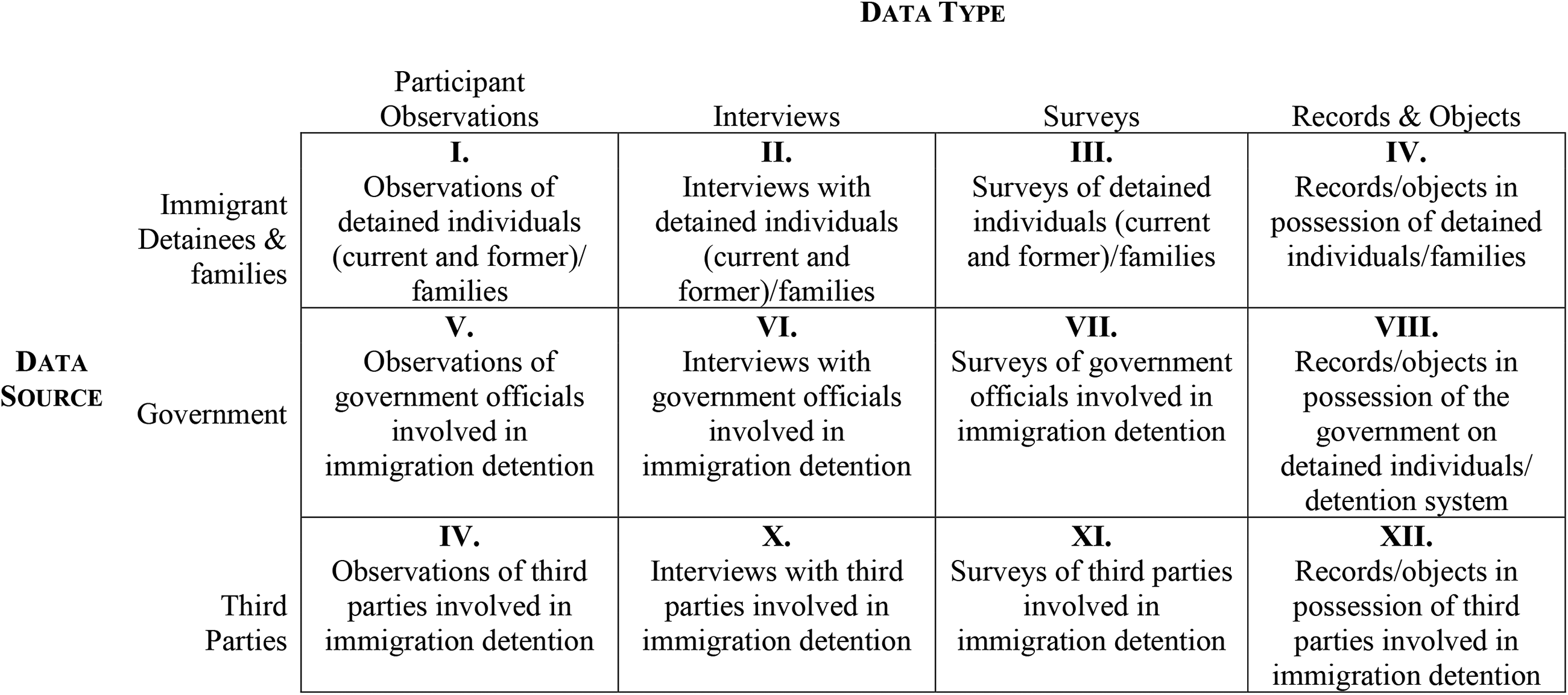
Typology of research approaches.
In applying my typology to recent empirical scholarship on immigration detention, I find that two methodological approaches predominate. The most common approach uses interviews with immigrant detainees (Methodological Approach II in Figure 1). Some studies draw on interviews with immigrants who are currently detained, whereas other studies analyze interviews with former immigrant detainees who have been released into the host country (Becerra et al., 2022; Diaz et al., 2022; Lee et al., 2023; Passardi et al., 2022), or former immigrant detainees who have been deported and are residing in their origin countries at the time of the interview (Gerlach, 2022). The next most common approach relies on records obtained from the government (Methodological Approach VIII in Figure 1). These studies typically report statistical findings insofar as they analyze large-N data sets (Collingwood et al., 2018; Evans and Koulish, 2020). Other studies that analyze small-N government records (e.g., death review records) report findings from qualitative thematic analyses (Parmar et al., 2021). Studies based on interviews with detention staff or government officials are rare, although notable exceptions exist (Bosworth, 2019; Campos-Delgado, 2021).
I argue that addressing the complex challenges stemming from the invisibility, instability, and inscrutability of immigration detention systems requires researchers to go beyond these dominant methodological approaches. In the next section, I suggest three specific directions for future research and discuss their potential payoffs.
Methodological directions for future research
The new directions for future research that I propose stem from the recognition that in existing research, a wide variety of data sources and data types are underutilized, mixed-methods studies that integrate qualitative and quantitative approaches are rare, and there is a dearth of discussion on unsuccessful research methods.
Tapping a diverse array of data sources and types
Other than the dominant methodological approaches that I have highlighted in the previous section, all other approaches shown in Figure 1 are scarcely found in recent scholarship on immigration detention. For example, surveys of immigrant detainees (Methodological Approach III in Figure 1) are uncommon and when conducted, the sample sizes tend to be relatively small (Esposito et al., 2022; Sen et al., 2022; Vogler and Rosales, 2023). 3 Surveys of government actors and third parties (Methodological Approaches VII and IX in Figure 1) are nonexistent. Studies that analyze records/objects that are in possession of immigrant detainees or third parties (Methodological Approaches IV and XII in Figure 1) are also rare. Yet, these methodological approaches can be extremely valuable in broadening our understanding of the experiences of certain detainee populations. For example, Kronick et al. (2018) were able to gain insights into children's experiences with immigration detention in Canada by engaging them in sandplays. Their study procedures were relatively simple: participating immigrant children were invited to create “a world” in a portable sand tray and given a box with a variety of miniature objects. After the children created a world, they were asked to describe the world that they had created.
I argue that there is an urgent need for us to consider a more diverse array of data sources and types than we currently do in studying immigration detention. Widening the net of data sources requires thinking expansively about not only who is confined and who is directly impacted by immigration detention, but also who benefits from, or fights against, immigration detention. For example, there are many actors involved in the maintenance and operation of the detention apparatus, including for-profit businesses that provide bed spaces, security, medical care, commissary, as well as food, transportation, cleaning, and communication services (Hiemstra and Conlon, 2016).
Some of the actors, such as local law enforcement, bail bonds companies, and immigration judges who make custody-determination decisions in courtrooms outside detention facilities are not visible to researchers in detention spaces, but they are critical actors in maintaining the current system (Kononen, 2021). Other actors who work outside detention spaces but have inside knowledge of immigration detention are those who work alongside immigrant detainees, such as lawyers and immigrant advocates (Manek et al., 2022). Journalists and the news media are another important source of information, particularly in light of their potential to shape public opinion and discourse about immigration detention (Ebert et al., 2020). Finally, an important set of actors who can inform our understanding of immigration detention's impact are immigrants who are not currently detained but whose lives, nonetheless, are impacted by the possibility or threat of immigration detention. Below, I briefly discuss my own research experience of collecting a new data type sourced from an important group that belongs to this last category—prospective immigrants.
Between 2018 and 2019, I conducted a randomized survey experiment that sought to examine the behavioral and attitudinal effects of U.S. immigration detention policy on prospective immigrants in their countries of origin (Ryo, 2021). More specifically, the study addressed two questions about immigration detention. First, does immigration detention deter immigration to the United States? Second, does immigration detention erode fairness perceptions about the U.S. immigration system among populations abroad? 4 To conduct the experiment, I worked with the Latin American Public Opinion Project (LAPOP), which administers AmericasBarometer, a high-quality comparative survey in North, Central, and South America, and the Caribbean. In close collaboration with the LAPOP team, I designed, pretested, and integrated an experimental module into the 2018/2019 AmericasBarometer survey that was administered to more than 6100 adults in Mexico, El Salvador, Guatemala, and Honduras. These four countries represent the top countries of origin among individuals apprehended by U.S. immigration officials, as well as those in immigration detention.
I faced a number of difficult methodological challenges in conducting this study. Most significantly, the basic requirements of the study were highly demanding. To name a few, the study required: (a) nationally representative samples of survey respondents in multiple countries; (b) a pre-existing survey that already administered a battery of basic demographic questions and migration-related questions that would allow me to test chance imbalances in covariate distributions between experimental conditions; (c) survey administrators who were willing to collaborate with an outside scholar to insert a new module within a pre-existing survey; (d) an established set of protocols and procedures to allow survey items to be pretested to ensure the accuracy and consistency of survey language across multiple countries; and (e) experienced and culturally sensitive survey interviewers who could be trained to administer a new set of items using a stratified random assignment of experimental conditions.
Overcoming these challenges, however, allowed me to generate a new set of knowledge about the far-reaching impacts of immigration detention and its unintended effects (Ryo, 2021). The survey results provided no evidence that a heightened awareness about the widespread use of immigration detention in the United States affected the intentions of Mexicans and Central Americans to immigrate to the United States. However, the results showed that such awareness negatively affected their assessments of the procedural and outcome fairness of the U.S. immigration system. In brief, the study revealed that immigration detention may foster delegitimating beliefs about the U.S. legal system without producing the intended deterrent effect. Notably, because the study subjects are prospective immigrants living in their own origin countries, the majority of whom did not have a history of migrating to the United States, what these findings illustrated is that personal experiences with immigration detention is not necessary to generate a “legitimacy deficit.”
I do not argue that survey data is the best, or the most appropriate, type of data to collect on immigration detention. Nor do I argue that prospective immigrants are the most valuable source of data on immigration detention. The usefulness of any given data source and data type depends on whether, and to what extent, it can address the research questions raised. However, what I have emphasized throughout this section is that there are a variety of methodological approaches that can, and should, be leveraged to investigate not only direct, but also indirect effects of immigration detention. Moreover, it is imperative that scholars consider the effects of detention on populations that reside not only within the host country, but also outside it, given that the latter group is the target population for the use of detention as a deterrence policy.
Leveraging mixed-methods approaches
The current scholarship on immigration detention is notable for its relative absence of mixed-methods studies (but see Díaz de León, 2023; Manek et al., 2022; Vogler and Rosales, 2023). Although there are varying uses of the term (Anguera et al., 2018), mixed-methods research is commonly defined as combining “elements of quantitative and qualitative approaches to gain greater understanding of the studied phenomenon, with the expectation that individual approaches are applied with the same rigor as when applied singly” (Parey and Kutscher, 2023; see also Johnson et al., 2007). 5 Over the past couple decades, there has been a distinct rise in scholarly interest in mixed-methods research across different disciplines (Timans et al., 2019). Mixed methods can serve important purposes such as triangulation (strengthening the validity of research findings through confirmation or corroboration) and complementarity (enhancing, elaborating, or clarifying research findings through a combination of different types of information) (Greene et al., 1989; Hall and Mansfield, 2023). In short, mixed methods can facilitate the production of more accurate and comprehensive understandings of complex and multifaceted phenomena.
There is a growing literature on how to conduct and evaluate the quality of mixed-methods research (Creswell, 1999; Leech et al., 2010; Stern et al., 2021). My goal is not to offer that type of guidance or a review of that body of work, but instead to illustrate in practical terms the advantages (and challenges) of using mixed methods in the context of studying immigration detention. To do so in concrete terms, I present one example—my own experience of conducting research on immigration detention as the principal investigator of a project called Immigrant Detention Study (IDS) in the United States.
The broad substantive aims of IDS were to understand: (a) the nature and operation of immigration bond hearings for long-term immigrant detainees; and (b) the effects of long-term detention on immigrants, their families, and communities during and after detention. As these substantive aims raised a complex set of “who,” “what,” “how,” and “why” questions, an important methodological goal of the project was to generate a diverse set of original data that could address those questions. Given the structural similarities between immigration detention and criminal incarceration, a critical initial decision that I made was to model IDS's survey and interview instruments, as well as the overall research design, after the Boston Reentry Study (BRS). The BRS, led by Bruce Western, is a mixed-methods, longitudinal study of Massachusetts state prison inmates who were released into neighborhoods in the Boston area (Western, 2018). 6
IDS had a number of data-collection components and phases. The particular aspects of the project that I focus on in this section took place between 2013 and 2015 and resulted in the following data sets pertaining to immigrant detainees who were members of a class action litigation called Rodriguez v. Robbins (Ryo, 2016): (a) in-person surveys of 565 long-term detainees (“baseline survey”) who were held in four detention facilities in Southern California; and (b) in-depth interviews with 79 of the baseline survey respondents who were released after a bond hearing (“post-release interviews”). The baseline survey largely consisted of closed-ended questionnaire items, whereas the post-release interviews were semi-structured to foster open-ended discussions (Ryo, 2017b). Each interview participant received a $40 in-kind payment (in the form of a gift card from a local retail store) per interview session. Between the baseline survey and post-release interviews, the research team conducted regular phone check-ins with released immigrants to update their contact information and to build rapport with them. Although each check-in typically lasted only a few minutes, they were critical for ensuring continued contact with released immigrants over time.
There are two distinct ways in which I engaged quantitative and qualitative methods in this project. First, during the data-collection stage, the research team collected survey and interview data simultaneously. From a logistical standpoint, it would have been significantly easier to focus on one method at a time. From a learning standpoint, such a sequential approach also would have been helpful because it would have allowed me to more systematically make use of the results from one method to develop a more informed and rigorous set of research instruments for the other method. For example, analyzing the survey data before implementing the interview phase of the project would have allowed me to first identify important issues that warranted deeper dives during post-release interviews. Under the simultaneous approach, however, I found myself having to repeatedly update both sets of survey and interview instruments as we gained incremental knowledge from partially developed/developing data sets that we were building in tandem. On the other hand, the simultaneous data-collection approach was necessary to ensure the success of post-release interviews. This is because the period shortly following immigrant detainees’ release from detention is a critical window for maintaining contact with them and retaining them as study participants.
Second, during the data analysis and interpretation stages of the project, I leveraged and integrated quantitative and qualitative data in ways that sought to generate results that were greater than the sum of individual data sets. These strategies took on both exploratory and explanatory flavors. I used relevant survey findings to guide decisions about whether a certain emergent issue in the interview data might be of sufficient importance and prevalence to warrant further analysis. For example, my analysis of the survey data showed that the type of treatment that immigrant detainees received, or observed other detainees receive, from detention facility guards and staff, were significant predictors of their perceived obligation to obey U.S. immigration authorities (Ryo, 2017a). These findings were instrumental in my decision to search for themes in the interview data that related to other types of legal attitudes among immigrant detainees. That decision, in turn, eventually led me to systematically analyze the nature and sources of immigrant detainees’ legal cynicism (Ryo, 2017b).
I also used quantitative results to further explain or rule out alternative explanations for certain qualitative findings. For example, my interview data showed that many immigrant detainees believed that the U.S. immigration system was punitive (Ryo, 2017b). In unpacking that belief, I drew upon the survey data to show that many detainees considered immigration detention to be a harsher form of punishment than criminal incarceration and that these assessments were not statistically related to the relative length and recency of each type of confinement. These results suggested that there was something distinct or unique about immigration detention—including, for example, its indefinite nature—that took a severe toll on immigrant detainees and their families. On the whole, attempting to fully integrate quantitative and qualitative data analyses in a single study is an analytically demanding and time-intensive task. However, my experience suggests that it has the potential to generate a richer and more nuanced understanding of detention experiences and their impacts.
Generating a discourse on unsuccessful research methods
Finally, notably absent in the existing scholarship on immigration detention are discussions on unsuccessful research methods. An analogous problem that arises in quantitative research more broadly is the absence of publications on nonsignificant results (also known as “null findings”). Insofar as the source of the problem is the refusal of scholars to submit null findings to publishers, the problem is described as a “file drawer problem” (Dalton et al., 2012). The problem, however, may also stem from reviewers and editors rejecting studies with null findings even when they are submitted for publication. A growing number of scholars across different academic disciplines have argued that publication bias against null findings is a significant problem that hinders the advancement of scientific knowledge (Franco et al., 2014; Mehler et al., 2019). Likewise, I argue that a lack of discussion on unsuccessful research methods hinders the advancement of knowledge about immigration detention. Specifically, an absence of such discussion is detrimental to building a repository of shared knowledge and insights about the potential costs and benefits of different methodological approaches.
My review of the existing research on immigration detention identified only one published article that provided in-depth critical reflections on where and how the researcher's efforts to collect a certain type of data went “wrong.” Sarah Turnbull (2019) takes on this task in a thought-provoking article that offers reflections on her failed attempts to incorporate a certain type of a participant-generated visual method called photovoice in her research on immigration detention in Britain. Turnbull examines the uses and limits of this method, which she had attempted to employ to explore themes relating to home, identity, and belonging for immigrants who had been released from detention and/or experienced deportation. As Turnbull explains, photovoice was developed in the 1990s as a way to render visible, and give voice to, marginalized or vulnerable groups (Turnbull, 2019). The images produced by photovoice can provide texture and depth to the lived experiences of study participants that words alone cannot capture. In addition, the images can be used during follow-up interviews to guide the participants in the telling of their stories and experiences.
Turnbull provided six of her study participants with disposable cameras once they were released from detention or after they had been deported. The participants were asked to photograph images from their lives that were meaningful to them and take notes on those images. Although promising in the abstract, the method proved to be difficult to implement in practice for a number of reasons. Recruiting study participants was challenging given the highly precarious positions that immigrant detainees occupied, and the urgency with which they were attempting to meet their basic daily needs. Participant attrition was high given the difficulty of following participants over time and across far-flung geographical spaces, as well as the intrusive nature of the request to photograph and document lives that had been upended by intense governmental scrutiny and censure. In addition, logistical and technical challenges of getting the cameras in the hands of the participants and retrieving the images from them proved to be unduly expensive and complicated. Finally, the method gave rise to serious ethical dilemmas. As Turnbull writes (2019: 159): “Receiving a request by me for a follow-up interview or a friendly enquiry as to how their photographing was going could have likely contributed to what was already a difficult daily existence.”
Turnbull does not conclude that photovoice is a method that would never work for studies examining immigrant detainees. Rather, her reflections are useful precisely because she details specific circumstances and characteristics of her particular set of study participants that presented what turned out to be insurmountable barriers for her study purposes. She also offers concrete reflections on how she might have adopted different approaches that could have been more effective in overcoming some of the barriers that she encountered on the field. At the same time, Turnbull is careful to avoid framing those reflections as “lessons learned,” which might risk implying that there are “neat solutions to messy problems” (2019: 162). In the remainder of this section, I adopt this framework to briefly present my own research experience with a certain method that fell short of my original research aims, but which became the basis for a different method that I successfully developed. I do so with the goal of promoting fuller scholarly discussions about the messiness of research on immigration detention and ways that we might build on those struggles.
In the summer of 2014, I designed a court-observational project on immigration bond hearings held in U.S. immigration courts. An immediate goal of the project was to obtain on-the-ground knowledge necessary for understanding the legal process through which immigrant detainees were seeking to obtain release from detention. I also planned to use this knowledge to develop an informed set of questions about bond hearings that could be placed on a survey of immigrant detainees. A separate, longer-term goal was to use the data collected from the court observations to conduct qualitative and/or quantitative analyses that would allow us to investigate such issues as predictors of bond hearing outcomes, the role of legal representatives in these hearings, and immigration judges’ decision-making process.
Working with a team of graduate students, I developed a worksheet that contained approximately 30 closed-ended items designed to capture basic characteristics of immigrant detainees and their bond hearings. The worksheet also contained a dozen open-ended items aimed at capturing more complex or less tangible aspects of the hearings, such as immigration judges’ explanations of their decisions; problems related to court technology and translation services; and the nature of interactions and exchanges between judges, immigrant detainees, and attorneys. In addition to completing the worksheet for each hearing, each team member prepared field notes that documented their impressions of, and reflections on, what they observed before, during, and after the hearings. In total, the team observed about fifty hearings across three court locations: an immigration court inside a detention facility in Adelanto, California, and two immigration courts in downtown Los Angeles, California.
The visits to the courthouse were extremely time-consuming and resource-intensive, and they presented difficult logistical problems. The use of phones, recorders, and computers was prohibited in the courtroom, and that meant that all notes had to be handwritten. The study protocol was to find a place where the team members could type up the handwritten notes as soon as the hearings ended, but accurately recalling the details of each hearing proved to be difficult when multiple hearings took place. Any given hearing could be continued by the judge for a variety of different reasons, and in such cases, obtaining information on the final outcomes of those hearings became all but impossible. Because the hearings were typically conducted quickly, and judges and lawyers frequently used shorthand to refer to forms, regulations, and case names, gaps in notes were unavoidable. Documenting even seemingly simple aspects of the hearings such as their duration was impossible if a team member forgot to wear a watch or did not note a recess that was taken during the hearing. Discerning whether or not procedural irregularities occurred during the hearing required deep knowledge of legal requirements and court procedures. Assessing whether a detainee received “fair” treatment was an inherently subjective task that often turned on each observer's baseline expectations. Finally, there was no way to gauge whether and to what extent the judges were affected by the presence of court observers.
Despite these challenges, the project generated valuable contextual information that advanced my overall understanding of the legal process through which immigrant detainees could obtain release. But over time, it became clear that these court observations could not generate a data set that would support systematic analyses with generalizable findings. Rather than abandoning that goal, I eventually turned to a different approach that would allow me to leverage insights from the court observations to build the necessary database. At the heart of this new approach was a collaboration with attorneys representing immigrant detainees in a class action litigation to obtain the audio-recordings of their bond hearings. I then embarked on an extended coding process with teams of law students. That law students are naturally attuned to, and interested in, court proceedings and legal processes, proved to be important in recruiting and training them as coders.
I used the court observations worksheet as a starting point for developing a detailed coding sheet that the team members could use to extract a discrete set of information from the audio-recordings. The coding sheet was finalized through an iterative process through which the team members individually coded a set of audio-recordings, followed by group meetings to ensure that all team members had the same understanding of each item on the coding sheet. Under this approach, we were no longer dictated by unpredictable and changing court schedules, and we could avoid gaps in information gathering that were unavoidable with in-person courtroom observations. This approach also afforded two significant advantages. First, the ability to play back the recordings allowed us to conduct accuracy audits and inter-coder reliability checks. Second, the new approach eliminated the possibility that the data-gathering process itself was affecting changes in immigration judges’ behavior. Through this audio-recording project, I was able to conduct studies that shed light on how immigration judges made their release decisions and on the role of lawyers in immigration bond hearings (Ryo, 2018, 2019a).
Conclusion
Immigrant detainees constitute a vulnerable population whose confinement demands close public scrutiny and scholarly attention. Yet, they are also one of the most difficult populations to study because immigration detention is a closed institution that is structurally defined by invisibility, instability, and inscrutability. In this article, I have used the term invisibility to highlight the ways that immigration detention renders confined individuals invisible—symbolically and physically—in the eyes of the law and the public. I have invoked the concept of instability to draw attention to uncertainties and precarities that immigration detention visits on immigrant detainees and their families—both while immigrants are detained and after they are released from detention. Finally, I have discussed the inscrutability of immigration detention systems to illustrate how governments render these systems opaque and incomprehensible both to immigrants and researchers.
Each of these three structural features of immigration detention—invisibility, instability, and inscrutability—gives rise to complex and daunting challenges for scholars seeking to study immigration detention. My review of the current empirical scholarship on immigration detention, as well as my own struggles as a researcher in this field, suggest that addressing these challenges requires us to explore new directions in methodological approaches. These approaches include employing a more diverse set of data sources and types, expanding the use of mixed methods, and engaging in wider discussions of missteps and mistakes in our research process. Integrating these methodological approaches in our individual and collaborative research endeavors will be critical in advancing a fuller and more nuanced public understanding of one of the most punitive shadow carceral systems that have emerged around the world.
Footnotes
Acknowledgments
The projects described in this article were supported by grants from the American Sociological Association/National Science Foundation Fund for the Advancement of the Discipline, Russell Sage Foundation (Award No. 93-16-06), Stanford Center on Poverty and Inequality, Stanford Center for Comparative Studies in Race and Ethnicity, USC Population Research Center, USC Gould School of Law, California Wellness Foundation, Carnegie Corporation of New York, and the National Science Foundation (Award No. 2213699). I am grateful to Alison Mountz for her helpful insights on the early conceptualization of this article. I thank Danielle Flores, Isabella Palmer, and Maia Wenger for their skillful research assistance.
Declaration of conflicting interests
The author declared no potential conflicts of interest with respect to the research, authorship, and/or publication of this article.
Funding
The author disclosed receipt of the following financial support for the research, authorship, and/or publication of this article: This work was supported by the Stanford Center on Poverty and Inequality, Carnegie Corporation of New York, American Sociological Association/National Science Foundation for the Advancement of the Discipline, National Science Foundation, USC Gould School of Law, Stanford Center for Comparative Studies in Race and Ethnicity, Russell Sage Foundation, USC Population Research Center, California Wellness Foundation, (grant number 2213699, 93-16-06).

Notes
Author biography
Emily Ryo is Charles L. B. Lowndes Distinguished Professor of Law and Professor of Sociology at Duke Law School. As a legal scholar and a social scientist, she uses a variety of empirical methods to study immigration enforcement, criminal justice, judicial decision-making in immigration courts, and access to justice. Her current research, funded by the National Science Foundation, focuses on investigating racial disparities in legal outcomes of immigrants in removal proceedings.