







Abstract
Criminology has examined impression management and moral discourse but has paid limited attention to hypocrisy as an interactional practice. This article analyzes televised interviews featuring Carmine Schiavone, a senior member of the Casalesi clan, who became a state witness and later re-entered public discourse through national and regional broadcasting. Using pragmatically informed discourse analysis, hypocrisy is treated as a situated strategy for managing conflicting moral identities and shifting responsibility and blame across mafia–state relations. Five analytical themes organize the analysis: honor, legitimacy, complicity, betrayal, and resistance. The findings show how contradictory positioning is used to preserve symbolic authority after defection, frame collusion as routine governance, and produce ambiguity about responsibility for harm. Hypocrisy is distinguished from neutralization, moral disengagement, and lying by its cumulative, relational, and temporally extended structure. A zemiological framing specifies how ambiguity-making can generate social harms in mafia-affected settings, including institutional distrust and reputational contamination.
Introduction: The pragmatic value of studying hypocrisy
Hypocrisy is commonly understood as a mismatch between professed moral values and actual conduct, yet its interactional and criminological significance remains underexamined. Existing scholarship – from Shklar's account of hypocrisy as a ‘necessary vice’ (1984) to Elster's critique of moral dissimulation (2005) – has largely addressed its broader social and political functions rather than the situated practices through which it is enacted, managed, and contested. Criminological traditions such as symbolic interactionism, cultural criminology, and theories of neutralization and moral disengagement have shown how deviance can be reconciled with moral self-legitimation, but they have paid less attention to hypocrisy as a pragmatic form of moral positioning (Poppi, 2023a, 2024a; Poppi and Sandberg, 2023). The present study builds on these traditions by treating hypocrisy not simply as moral inconsistency, but as a discursive strategy through which actors manage ambiguity, preserve credibility, and negotiate conflicting commitments under legal scrutiny and institutional expectations.
A zemiological perspective extends this argument by treating ambiguity-making as socially harmful rather than merely interpretive. Zemiology shifts attention from legal categories of crime to harms that persist when responsibility is diffused and accountability remains contested (Hillyard and Tombs, 2007; Raymen, 2019). In mafia-affected contexts, hypocrisy can help sustain gray-zone governance by blurring responsibility, weakening trust, and destabilizing the moral vocabularies through which legitimacy is publicly judged (Sergi, 2025; Sergi and Lavorgna, 2016). A pragmatic lens clarifies how this occurs: moral discourse is understood as social action shaped by audience expectations, reputational stakes, and role constraints (Brown and Levinson, 1987; Goffman, 1967). Under such conditions, sincerity and authenticity are not fixed qualities but socially organized expectations that can be strategically performed, contested, and withheld (Coupland, 2003; Davidson, 2004; Trilling, 1971). When speakers are expected to be morally consistent, recurrent misalignment invites condemnation and can erode not only interpersonal trust but also confidence in institutional accountability (Batson et al., 2006; Effron et al., 2018; Jordan et al., 2017; Rossi, 2021).
This article develops these claims through a case study of Carmine Schiavone, a senior member of the Casalesi clan who later became a state witness and re-entered public discourse through a series of televised interviews broadcast in 2013 and 2014. Schiavone provides a particularly revealing case because he occupies a highly unstable position at the intersection of organized criminal authority, institutional cooperation, and mediated self-presentation. The analysis draws on 13 televised interviews in which he speaks as former insider, public accuser, and morally compromised narrator at once. This combination makes the case especially useful for examining hypocrisy as a pragmatic and narrative resource: the interviews place conflicting moral identities under public scrutiny and show how legitimacy, blame, and credibility are discursively managed in a mafia-affected setting.
Three intellectual implications arise from this conceptualization of hypocrisy. First, it specifies hypocrisy as an analytic category defined by recurrent misalignment between moral stance and biographical positioning. Rather than treating hypocrisy as a vague moral defect, this approach identifies it through pragmatic markers such as audience design, face-work, and role negotiation, thereby making it analytically observable in situated discourse. Second, this approach extends narrative criminology by treating contradiction and moral reversal not as interpretive noise, but as structured narrative resources through which speakers maintain credibility under scrutiny. From this perspective, inconsistency is not simply a flaw in self-presentation; it can also be a means of managing competing expectations, preserving legitimacy, and negotiating unstable moral identities in public discourse. Third, the article develops a zemiological account of hypocrisy as a mechanism of ambiguity-making that can sustain gray-zone governance through three interrelated harm pathways. It can produce epistemic harm by weakening the attribution of responsibility across criminal and state actors, thereby reducing the public legibility of accountability (Hillyard and Tombs, 2007; Raymen, 2019). It can also produce institutional harm by normalizing selective enforcement and dual allegiances as routine rather than exceptional (Sergi and Lavorgna, 2016). Finally, hypocrisy can generate reputational and cultural harm by reattaching honor, family, and civic respectability to compromised biographies and thereby contaminating the vocabularies through which harm and legitimacy are interpreted (Sergi, 2025). Discursive complicity is one mechanism through which these harms are reproduced and stabilized (Verschueren, 2022).
The broader criminological value of this approach lies in showing how interactional positioning contributes to the reproduction of moral ambiguity, institutional entanglement, and social harm.
Hypocrisy as pragmatic moral positioning: Narrative, moral identity, and criminal meaning-making
Although often conflated with deception or lying, hypocrisy has a distinct pragmatic structure. Deception aims to produce false beliefs, typically by omitting or distorting information (Vrij, 2008), and lying involves knowingly asserting a falsehood in order to mislead (Chisholm and Feehan, 1977; Sorlin and Virtanen, 2024). Both primarily target the listener's epistemic state. Hypocrisy, by contrast, concerns a perceived mismatch between a speaker's professed moral values and that speaker's actions, past conduct, or motivations (Effron et al., 2018). Sorlin (2024) describes this as ‘hypocrisy without lies’, rooted not in propositional falsity but in the indexical alignment between what is said, how it is said, and who is speaking. Lies and deception are typically discrete acts, whereas hypocrisy is cumulative and relational, emerging over time through patterned moral dissonance and requiring contextual and discursive memory for recognition. Hypocrisy is therefore not only a breach of truth conditions but a relational rupture that undermines trust and challenges the coherence of a moral order (McKinnon, 1991; Trilling, 1971). This reframes hypocrisy as an analytic object with explanatory value for criminology: it captures how legitimacy is sustained through publicly credible moral stances that remain tethered to compromised biographies over time.
This pragmatic and temporal distinction is particularly relevant in institutional and criminal settings. Actors may adopt moral discourses to gain legitimacy or mitigate blame while remaining embedded in practices that contradict those claims. Criminological research has long examined the tension between moral claims and deviant behavior through frameworks such as techniques of neutralization (Sykes and Matza, 1957), moral disengagement (Bandura, 2002), and impression management (Goffman, 1967). These approaches clarify how individuals justify or excuse problematic actions by aligning them with broader cultural narratives, yet they tend to focus on internal rationalizations or cognitive dissonance rather than on the interactional and performative dimensions of moral coherence. Conceptualized pragmatically, hypocrisy addresses this gap. Neutralization and moral disengagement explain how actors justify particular acts, whereas hypocrisy foregrounds how a publicly credible moral persona is sustained despite patterned dissonance between conduct and stated values.
Hypocrisy also clarifies how moral identity is constructed and defended in morally condemned or institutionally risky contexts where reputational maintenance is central and where claims to legitimacy must remain plausible despite compromised biographies (Effron et al., 2018). In mafia-affected settings, this identity work is also harm-relevant: it can stabilize ambiguity about responsibility and normalize cynicism toward institutional accountability, with consequences that extend beyond individual reputation (Hillyard and Tombs, 2007). Reputation is a potentially harmful resource in such contexts, since kinship and family names can confer status and stigma simultaneously, binding individuals to organized crime in public perception even when distance is claimed (Ianni and Reuss-Ianni, 1972; Schneider and Schneider, 2003). Hypocrisy is therefore especially visible in narratives of corruption, organized criminal leadership, and informant testimony, where moral coherence and social accountability are expected but difficult to sustain (see McKinnon, 1991). In such accounts, hypocrisy operates at the crossroads of sincerity and strategy as a discursive tool for managing contradiction and preserving moral legitimacy under scrutiny (Sorlin and Virtanen, 2024).
Among criminological approaches, narrative criminology has come closest to addressing hypocrisy, even if rarely naming it directly. This field examines how storytelling shapes criminal behavior and moral identity by focusing on what stories do, why some emerge and others remain silent, and how narratives influence crime and justice (Maruna and Matravers, 2007; Sandberg, 2010). It is less concerned with factual accuracy than with the social effects of stories, including how they make criminologically relevant events happen and shape morally significant actions (Presser, 2016). Narrative criminology shows how moral selves are constructed and negotiated through stories marked by contradiction, ambiguity, and selective silence (Copeland, 2019; Poppi, 2023a, 2024b; Poppi and Sandberg, 2023; Presser, 2022; Sandberg et al., 2015). Drawing on dialogical and post-structuralist approaches, this literature emphasizes polyphony and moral open-endedness: narrators can voice competing evaluations, explore dilemmas, and resist fixed resolution while sustaining credibility under scrutiny (Frank, 2010, 2012). Moral narratives often oscillate between righteousness and ambivalence (Jackson, 2002; Morrill et al., 2000), including accounts that frame violence as rooted in solidarity, sacrifice, or necessity (Cottee and Hayward, 2011). Such ambiguity can invite identification and make morally fraught experiences tellable without alienating audiences, particularly when audiences impose expectations of remorse, redemption, loyalty, or coherence (Polletta and Lee, 2006; Presser, 2022).
This article builds on narrative criminology by examining hypocrisy as a situated form of storytelling embedded in material and symbolic hierarchies. From this perspective, the tension between what is said, what is done, and how coherence is discursively sustained becomes central to the narrative construction of criminal identity. In the sections that follow, I show how narrative inconsistency in mafia-affected settings must be read in relation to local cultural codes and moral vocabularies that organized crime can appropriate – family loyalty, omertà (understood here as the socially enforced code of silence surrounding criminal knowledge and cooperation with authorities), friendship, public service, and civic respectability – to legitimate authority and manage exposure (Allum, 2017; Behan, 2005; Paoli, 2008; Poppi and Ardila, 2023; Poppi and Di Piazza, 2017; Poppi et al., 2018). Within this repertoire, hypocrisy operates as a pragmatic resource through which speakers manage tensions between public morality and private interests while preserving claims to legitimacy under conditions of scrutiny.
Methodology: Hypocrisy as criminological insight
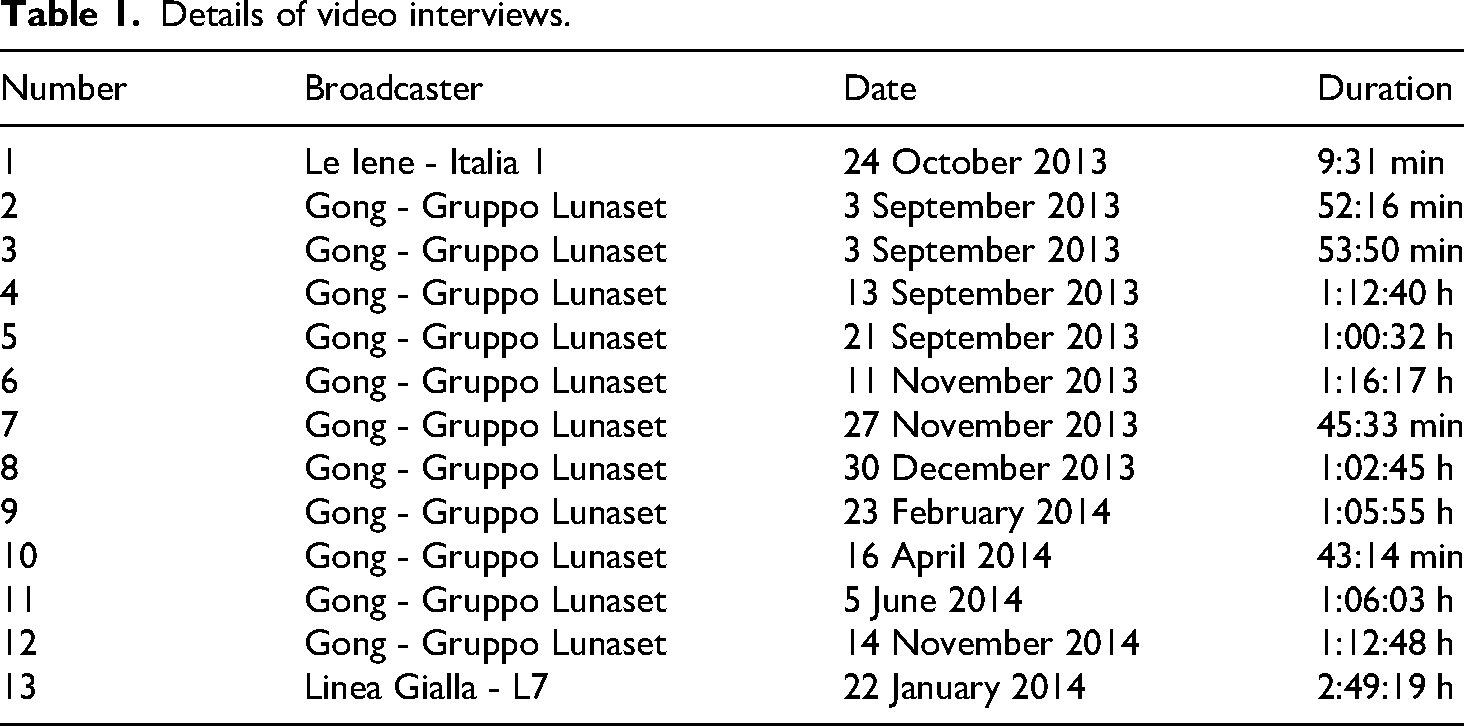
To examine the pragmatic functions of hypocrisy beyond existing interpretive frames, the study draws on 13 video interviews with Carmine Schiavone, conducted between 2013 and 2014 and broadcast on national and local Italian television (see Table 1). Carmine Schiavone is examined as a paradigmatic case situated at the intersection of organized crime, state cooperation, and mediated publicity. As a senior member of the Casalesi clan, Schiavone held responsibilities associated with logistics, internal coordination, and political mediation and was publicly framed as an organizational strategist in journalistic accounts (Cantone, 2012; Di Fiore, 2008). Kinship proximity to the clan's leadership positioned Schiavone as an intermediary within a governance structure blending coercion, brokerage, and electoral influence. Cooperation with the state began in 1993 and produced substantial judicial effects reported in secondary sources, including arrests and asset seizures (Cantone, 2012; Di Fiore, 2008).
Details of video interviews.
The interviews with Schiavone offer a rare opportunity to observe hypocrisy not as a fixed moral flaw but as a discursive resource for self-repositioning and public legitimacy. Their medium and context are analytically significant. The televised interviews analyzed here occurred in 2013–14, approximately two decades after the initial role transition. The broadcast format is consequential for case interpretation: interviews circulated through national and regional television broadcasting in areas where Schiavone was already a well-known figure and often reached audiences which included former affiliates, relatives, and residents of Camorra-affected communities with localized knowledge of the Casalesi, the witness program, and the surrounding political environment. Under these conditions, moral discourse functions as reputational management with material stakes. The case therefore provides a high-visibility setting in which hypocrisy can be analyzed as pragmatic practice for managing incompatible role expectations (criminal authority, state witness, public critic) while producing ambiguity about legitimacy, complicity, and responsibility for harm.
The interviews are not neutral data-collection instruments but media artifacts shaped by genre conventions, visual rhetoric, and expectations of public storytelling. The journalistic frame imposes a logic of visibility and recognizability, privileging narrative tension, moral framing, and performative revelation. This aligns with ‘media logic’ (Altheide and Schneider, 2012), whereby media formats shape both content and identity performance. Within this framework, the interview becomes a site for managing reputation as much as for providing testimony. Spectacularization is not incidental – it is integral to the communicative form in which hypocrisy is both enacted and made intelligible.
In such settings, self-presentation is a situated act. The visual dimension of the interviews – gestures, pauses, tone, and posture – further shapes perceptions of sincerity and duplicity. Hypocrisy here is not simply a verbal contradiction, but a consequential performance – a resource through which moral identity is claimed, contested, and exposed. This performative aspect of self-presentation must be analyzed both narratively and pragmatically.
As qualitative research shows (see Silverman, 2013), interviews – particularly those involving high-profile or notorious individuals – are performances shaped by audience, context, and strategic positioning rather than transparent expressions of identity or morality. The interviews do not simply reveal hypocrisy; they are also sites in which it is publicly produced and negotiated. This study therefore treats these moments as discursive events in which hypocrisy is pragmatically deployed and symbolically performed.
While this study centers on a single individual, case-based analysis remains a well-established approach in qualitative criminology, particularly when aimed at theoretical development rather than empirical generalization (see Flyvbjerg, 2006; Poppi, 2023a, 2024b). The article does not claim to offer statistical generalization to all mafia settings; instead, it proposes a conceptual lens – hypocrisy as a pragmatic mode of ambiguity-making – that can be tested, refined, and challenged in future comparative work.
Methodologically, the analysis combines close discourse analysis with pragmatically informed interpretation of positioning, face-work, and audience design in mediated interviews. Thirteen televised interviews (spanning more than 14 hours) were transcribed and translated into English. Translations were revised to preserve pragmatic force, including pacing, stance markers, and regionally inflected idioms, with attention to culturally salient terms (e.g. omertà, familism, territorial identification) that condition how hypocrisy is expressed and recognized. Segments were selected where moral reversals, contradictions, and role tensions were sustained across turns or revisited across interviews, allowing hypocrisy to be treated as patterned practice rather than isolated inconsistency. Analytic memos also coded where ambiguity-making plausibly supported epistemic, institutional, or reputational/cultural harms consistent with zemiological approaches to social harm in mafia-affected settings (Hillyard and Tombs, 2007; Raymen, 2019).
From this corpus, segments were identified where contradictions, reversals, or tensions surfaced – moments revealing hypocrisy as patterned communicative behavior. These clustered around four axes: his dual identity as criminal and critic; his ambivalent self-positioning as an informant vis-à-vis the state; his cooperation amid hostility toward institutions; and his invocation of family values while disowning relatives. Each axis reflects a layered tension between moral identity and narrative positioning. Hypocrisy here operates as performative work – negotiating expectations, audience alignment, and identity repair. In what follows, the analysis treats contradiction as interactional evidence of how moral authority is negotiated under public scrutiny.
Hypocrisy as analytical lens: Pragmatic and criminological insights
This section offers a focused analysis of five excerpts from the larger interview corpus. Selected for their analytical density rather than representativeness, the excerpts show how hypocrisy becomes legible through recurrent misalignments between moral stance and biographical positioning. The discussion is organized around five analytical themes: the redefinition of honor after defection, the reframing of complicity as institutional truth, the narration of electoral brokerage as governance, the normalization of mafia–state cohabitation, and the unstable moral repair of environmental resistance. Across these excerpts, hypocrisy operates as a pragmatic resource for negotiating authority, blame, and fractured identity under public scrutiny.
Excerpt 1. Honor reclaimed through betrayal
This excerpt stages a tension between honor and betrayal under conditions in which remorse, loyalty, and institutional trust are simultaneously in play. Hypocrisy is analytically significant here because it enables the preservation of symbolic authority even as defection is justified and institutional validation is withheld: I turned state's witness, I did it for real, but I still consider myself a man of honor, not a mafioso. I swear to you on my youngest son's life, I did it, I still believe in what I did, even if I would not do it anymore, or if I did it, I would do it to take the piss out of them, plain and simple. I would tell them those things that they would have the pleasure of hearing. I would not make enemies of the secret service, politicians, institutions, or magistrates. (Video 3: 36,00 – 36,25)
The passage condenses the article's central claim that hypocrisy operates as a pragmatic resource for managing fractured identities and institutional-moral tension (McKinnon, 1991; Sorlin and Virtanen, 2024). Schiavone simultaneously affirms and destabilizes his role as witness: the declaration ‘I did it for real’ claims sincerity and moral seriousness, yet the immediate turn to hypothetical future deceit recasts cooperation as contingent, reversible, and strategically manageable. What emerges is not simple inconsistency but a patterned oscillation between confession and disavowal.
This oscillation is oriented to multiple audiences at once. For a broader public, the language of oath, sincerity, and sacrifice invokes recognizable expectations of remorse and truth-telling; for proximate and potentially hostile audiences, however, the same utterance protects Schiavone from symbolic degradation by refusing full alignment with the institutions that should ratify his transformation. The claim that he would now tell authorities only what ‘they would have the pleasure of hearing’ turns sincerity into staged performance and recasts disclosure as tactical speech within a distrusted institutional field (Gill, 2024; Runciman, 2008). Hypocrisy thus appears here as an adaptive mode of self-positioning through which symbolic authority is preserved after defection (Sorlin and Virtanen, 2024).
The statement ‘I still consider myself a man of honor, not a mafioso’ is crucial because it detaches a culturally valorized identity from the legal category that should disqualify it (Paoli, 2008; Poppi and Di Piazza, 2017; Poppi et al., 2018; Uskul and Cross, 2020). Schiavone does not renounce the symbolic language of honor; instead, he reclaims it by severing honor from mafia criminality and reattaching it to his own narrative of principled action. The move is analytically important because it reframes betrayal not as the loss of honor, but as the very condition for its preservation. Hypocrisy lies precisely in this effort to conserve the moral capital of the prior self while publicly occupying a role that should negate it (Effron et al., 2018; McKinnon, 1991).
The oath ‘on my youngest son's life’ intensifies the claim to sincerity by attaching it to one of the speaker's most socially non-negotiable relationships. Its force lies not in contrasting fatherhood with mafioso identity, but in invoking a culturally recognizable warrant of seriousness: by swearing on his son's life, Schiavone presents the statement as bound to a form of value that should not be instrumentalized. In this sense, the oath dramatizes the stakes of his self-presentation as a speaker who wants to be heard as truthful while speaking from the compromised position of a former insider, collaborator, and public accuser. The tension is sharpened because this solemn sincerity marker is immediately followed by a hypothetical willingness to mislead authorities by telling them only what they ‘would have the pleasure of hearing’. The juxtaposition therefore lies within the utterance itself: a maximal claim to truthfulness is placed alongside an explicit account of tactical insincerity. Rather than resolving contradiction, the oath helps Schiavone manage it by shielding his credibility at the very moment he acknowledges the strategic manipulability of testimonial speech (Haugh, 2024).
The excerpt also shows hypocrisy as a metapragmatic strategy. Schiavone does not only recount events; he comments on the conditions under which testimony is made credible under surveillance, legal scrutiny, and political instrumentalization (Gill, 2024). Here, ‘institutional discourse’ refers to the broad repertoire through which magistrates, state agencies, media formats, and the witness regime itself evaluate collaborators as sincere, useful, and morally legible. Schiavone presents that repertoire as demanding recognizable performances of remorse, truthfulness, and civic conversion – performances that can also be supplied strategically. Hypocrisy thus appears both as institutional critique and as a reflexive response to a field in which sincerity is publicly required but also tactically manipulable (Runciman, 2008).
A zemiological lens highlights an ambiguity-making effect: responsibility and credibility are made jointly uncertain, supporting epistemic harm by weakening attribution of institutional and criminal accountability in mafia-affected settings (Boukli and Kotzé, 2018; Hillyard and Tombs, 2007; Sergi, 2025). This epistemic harm is intensified when cynicism becomes the interactionally preferred stance, since pervasive distrust can reduce the perceived feasibility of accountability claims and collective action against harm (Raymen, 2019).
Excerpt 2. Complicity reframed as institutional truth
The following passage repositions complicity as constitutive of institutional order. Its analytical importance lies in the displacement of hypocrisy from the informant to the state, thereby recasting insider accusation as a claim to moral and epistemic authority. They only want informants on one condition, that they have their assets seized, they only have thieves and murderers arrested as if the Mafia were a group of bandits, got it? They don’t want to admit that the Mafia is not a group of bandits, it is the armed wing of the state. Could the organizations exist at that level without state infiltration? (Video 8: 44,25 – 44,42)
Excerpt 2 is one of the most ideologically charged and criminologically revealing moments in Schiavone's discourse because it relocates hypocrisy from the compromised witness to the institutional order he claims to expose (Effron et al., 2018; Poppi, 2024a; Sorlin and Virtanen, 2024). It stages a dual move of subversion and legitimation: exposing institutional hypocrisy while reclaiming moral authority as insider-turned-critic. The central claim – that the Mafia is ‘the armed wing of the state’ – inverts state–crime dichotomies and forces a rethinking of where power and legitimacy reside (Bӧhm and Pascucci, 2020; Poppi, 2023b; Poppi and Ardila, 2023; Travaglino et al., 2023, 2025).
At its core, this is a discourse of exposure. What appears as performance is not ‘institutional morality’ in the abstract, but the institutional claim to legitimacy through law, justice, and truth-telling. Informants are presented as valued less for moral transformation than for their capacity to generate arrests, seizures, and evidentiary utility. The arrangement is framed as hypocritical because the language of legality and justice conceals a deeper accommodation with structural complicity (McCarthy-Jones and Turner, 2022). State institutions are depicted as selectively deploying justice – arresting ‘thieves and murderers’ while ignoring systemic infiltration. The real crime lies not only in individual acts of violence or theft, but in the state's denial of its embeddedness in the criminal networks it claims to dismantle.
In Schiavone's account, hypocrisy exceeds individual character and becomes a feature of governance itself. The issue is not only the duplicity of particular actors, but a broader arrangement sustained through the suppression of certain truths and the instrumental deployment of selective moral acts (Effron et al., 2018; Poppi, 2024a; Sorlin and Virtanen, 2024). The closing rhetorical question – ‘Could the organizations exist at that level without state infiltration?’ – functions as a demand to acknowledge complicity as foundational. This move destabilizes the moral architecture on which conventional criminology often relies, particularly the distinction between lawbreakers and law enforcers (Travaglino and Abrams, 2019).
Pragmatically, the passage performs a metadiscursive reversal: Schiavone does not merely denounce complicity but contests the state's claim to moral asymmetry (Sorlin and Virtanen, 2024). Both institutions and informants are represented as compromised, which opens a third position from which he can speak – as a disillusioned insider claiming privileged access to the joint workings of crime and legality. This counter-discourse borrows the institutional language of truth-telling and justice only in order to expose its selective deployment and moral limits (Runciman, 2008). The analytical force of the excerpt lies in this relocation of hypocrisy from the compromised witness to the institutional order itself, thereby converting insider accusation into a claim to moral and epistemic authority (Culpeper and Tantucci, 2021; Effron et al., 2018).
A zemiological reading clarifies why this matters. The formulation of the mafia as ‘the armed wing of the state’ is consequential because it renders responsibility structurally ambiguous and therefore harm-producing (Boukli and Kotzé, 2018; Hillyard and Tombs, 2007). It contributes to epistemic harm by weakening stable attribution of blame across criminal and state actors, and to institutional harm by normalizing selective enforcement as routine rather than exceptional (Raymen, 2019; Sergi, 2025; Sergi and Lavorgna, 2016). Hypocrisy becomes analytically useful here because it identifies the discursive mechanism through which legality is sustained while its entanglement with organized crime is simultaneously disavowed and made intelligible.
Excerpt 3. Legitimacy through hidden governance
The next passage is organized around the reframing of electoral manipulation as administrative competence and political utility. The excerpt is analytically revealing because it converts criminal embeddedness into a language of governance, thereby rendering clandestine influence legible as civic function. (When did you become a camorrista? [member of Camorra]) I became a mafioso when I was 22–23 years old (But aren’t the Casalesi camorristi?) We, as Casalesi, Maranesi, and Giuglianesi, were part of Cosa Nostra Campana (What's the difference between the Camorra and Cosa Nostra Campana?) The Camorra sought bribes, they would make deals asking for 10,000 lire per vote (And you?) We didn’t do that. We organized the elections, made the posters, we were within the state but hidden (Can you explain better?) They were interested in the vote, and we ran election campaigns even at our own expense to get them elected and then keep them in a position to solve our problems […] (Do you know how many votes you influenced?) In the province of Caserta alone, we moved 120–130,000 votes. (Video 1: 02,58 – 4,41)
The excerpt begins with Schiavone's use of the label ‘Cosa Nostra Campana’ to distinguish the Casalesi, Maranesi, and Giuglianesi area clans from other Camorra groups. This is best read as an emic, retrospective classification rather than as an analytically stable category. Other confederations, including the Alfieri and Nuvoletta groupings, also combined electoral manipulation, political brokerage, and deep forms of institutional penetration (Allum, 2017; Behan, 2005; Paoli, 2008; Schneider and Schneider, 2003; Sergi and Lavorgna, 2016). What matters analytically, then, is not the descriptive accuracy of the label but its rhetorical work: by naming his group in this way, Schiavone produces a hierarchy of criminal legitimacy in which the Casalesi appear more coherent, more consequential, and more deeply embedded in governance than rival actors. This is a form of identity work that enhances his standing as both former insider and present interpreter of organized crime. Hypocrisy enters the passage through this self-elevating reframing: values associated with order, discipline, and civic utility are attached to a criminal organization so that its violence and political penetration can be narrated as signs of competence rather than corruption (Behan, 2005; Travaglino and Abrams, 2019). Hypocrisy here is institutionalized: the clan situates itself both outside and inside the state, operating in the shadows while shaping electoral outcomes.
The claim that ‘we were within the state but hidden’ crystallizes a central point of the article: organized crime is narrated not as external contamination of political order but as one of its concealed operating logics. By depicting the Casalesi as organizers of elections rather than as buyers of votes, Schiavone mobilizes a paradoxical language of civic utility. The lexical field of organization, posters, campaigns, and problem-solving indexes bureaucratic competence and administrative labor, thereby casting the clan as a shadow institution that mirrors and at times supplants formal governance (Breuer and Varese, 2023; Lessing, 2021). Hypocrisy lies in this conversion of clandestine political intervention into a vocabulary of stewardship and practical usefulness.
This dual positioning reveals a complex form of hypocrisy: not merely dissonance between public virtue and private vice, but public vice performed as institutional virtue. The rigging of elections is reframed as political stewardship. This inversion rehabilitates the speaker's authority, portraying him as an administrator of order rather than a deviant, and simultaneously depicts the state as dependent on criminal infrastructure it publicly disavows. The claim to have shifted ‘120–130,000 votes’ denounces political institutions that rely on this capacity yet deny its existence.
Schiavone's discourse does more than describe electoral manipulation; it recodes it as a form of practical governance. The phrase ‘to solve our problems’ constructs a symbiotic relation in which elected officials, indebted to criminal support, are represented as instruments for managing collectively recognized needs, however illicitly defined. Electoral brokerage is thus narrated as effective problem-solving, allowing criminal intervention to assume the appearance of civic utility (Halmari, 2024). What emerges is a form of shared hypocrisy in which political and criminal actors are jointly implicated in arrangements that remain publicly disavowed even as they are presented as functional to local order (Travaglino and Abrams, 2019).
A zemiological perspective clarifies how this discourse becomes harm-producing. By reattaching civic competence and honor to electoral manipulation, the passage contaminates the moral vocabularies through which legitimacy, responsibility, and governance are interpreted (Boukli and Kotzé, 2018; Hillyard and Tombs, 2007; Sergi, 2025). This contamination matters because it renders gray-zone arrangements administratively reasonable, thereby supporting institutional harm through the normalization of political brokerage as governance rather than corruption (Raymen, 2019).
What emerges is organized crime as institutional hypocrisy in action, where crime is framed less as rupture than as clandestine scaffolding of political order. The narrative destabilizes accounts of transparent democracy corrupted by external criminality and instead frames corruption as a mode of governance (Travaglino and Abrams, 2019). Political legitimacy is maintained through denials, silences, and democratic rituals that obscure the informal yet consequential role of criminal networks (Presser, 2022; Sandberg et al., 2015; Travaglino and Abrams, 2019). A zemiological framing treats such routine ambiguity as harm-producing because it can diffuse responsibility and reduce the public legibility of accountability. Institutional harm follows when state–mafia cohabitation is normalized, lowering expectations of enforcement and making dual allegiances appear structurally inevitable (Boukli and Kotzé, 2018; Hillyard and Tombs, 2007; Raymen, 2019). In mafia-affected settings, this can stabilize gray-zone governance by making complicity an expected background condition rather than a problem requiring institutional disruption (Sergi, 2025; Sergi and Lavorgna, 2016). The excerpt therefore exemplifies the criminological value of hypocrisy as a structural phenomenon: moral duplicity is embedded in political–criminal alliances, and discourse renders these contradictions strategically usable as political technology.
Excerpt 4. The normalization of mafia–state coexistence
The excerpt constructs mafia–state entanglement as a durable condition of governance. Hypocrisy emerges here as a mechanism through which public disavowal and practical accommodation are made to coexist within a single account of political order. The Mafia has existed for hundreds of years. It has been possible because the state has always lived with it; it's not like the state was going to live with a gang that went out and did robberies. (Video 5: 38,30 – 38,41)
In this passage, Schiavone recasts the Mafia not as an external threat to political order but as a durable partner within it. What is normalized here is a historical relation of reciprocal utility in which organized crime appears as governable, negotiable, and politically functional (McCarthy-Jones and Turner, 2022; Travaglino and Abrams, 2019).
Hypocrisy gives this account its analytical force. The state is represented as publicly repudiating organized crime while practically accommodating the very organizations that provide order, mediation, and political utility. What comes into view, then, is a durable arrangement sustained through selective visibility, symbolic opposition, and routine coexistence (Presser, 2022; Sandberg et al., 2015). The significance of the passage lies in making this arrangement narratable from within testimonial discourse: hypocrisy names both the contradiction Schiavone attributes to the state and the interpretive logic through which that contradiction is rendered intelligible.
For criminological analysis, this shifts attention away from isolated instances of wrongdoing and toward the narrative conditions under which state legitimacy is maintained through disavowal of what it continues to use. The passage therefore challenges any simple opposition between legality and criminality by showing how moral coherence is preserved through the public denial of practical accommodation (Effron et al., 2018; Poppi, 2024a; Sergi and Lavorgna, 2016; Sorlin and Virtanen, 2024; Travaglino and Abrams, 2019).
From a pragma-dialectical perspective, the utterance operates as a strategic move within a broader argumentative project (Gill, 2024). Schiavone speaks as a participant-observer of the blurred boundary between state and syndicate, and this embeddedness underwrites the force of his ‘uncomfortable truth’. The excerpt also shows that hypocrisy is not always concealed: it may be backgrounded in official discourse yet openly articulated in testimonial space, especially by figures who shift roles from perpetrator to informant and insider to expositor. In such moments, hypocrisy functions both as social fact and interpretive lens, enabling the dismantling of binaries between crime and legality, insider and outsider, honor and betrayal (Travaglino et al., 2023, 2025; Uskul and Cross, 2020). Read alongside research on mafia cultures and criminal governance, the insistence on state–Mafia cohabitation appears as an exercise in manufacturing moral grayness, blurring the sources of harm and responsibility in ways that ultimately benefit clandestine power (see Hillyard and Tombs, 2007; Raymen, 2019).
Excerpt 5. Resistance, redemption, and ambiguous repair
In this passage, Schiavone constructs redemption through a morally charged account of environmental protection. The excerpt reveals how hypocrisy can sustain moral repair while leaving the speaker's implication in harm only partially resolved. I became a real informant, when I signed, when I saw that there was nothing more I could do to save these people, or about the garbage I had stopped for about a year […] I stopped the havoc of the toxic and atomic stuff, until ’91 when they had me arrested. They resumed, then I was re-arrested because as a fugitive I couldn't stay in that place anymore. (Video 8: 01,50 – 02,11)
Excerpt 5 captures the tension between ethical self-fashioning and systemic complicity. Schiavone presents his shift to ‘real informant’ status as a moral turning point – ‘when I saw that there was nothing more I could do to save these people’ – thereby framing cooperation as necessity rather than submission. Yet this claim to sincerity unfolds within a narrative marked by contradiction and institutional betrayal, which makes hypocrisy an essential analytic lens. Schiavone casts himself as a protector while representing the state as an agent of harm. His effort to halt environmental devastation is framed as moral courage amid systemic indifference. More specifically, Schiavone presents himself as having tried to interrupt forms of waste disposal and trafficking that he describes as involving ‘garbage’ and ‘toxic and atomic stuff’, that is, harmful dumping practices narrated as both environmentally destructive and institutionally tolerated. Yet this attempted moral transformation is quickly undermined by the state's punitive response. The force of the account lies less in coherence than in instability, precisely the condition hypocrisy helps illuminate (Sorlin and Virtanen, 2024).
The passage is emblematic of ‘reactive sincerity’: sincerity mobilized under pressure and continuously at risk. The claim to have ‘stopped the havoc’ rests on temporal ambiguity; it remains unclear whether his agency was instrumental, temporary, or ultimately futile. The environmental referent matters analytically because it allows Schiavone to convert prior proximity to harm-producing practices into evidence of belated moral intervention. The account thus derives part of its persuasive force from proximity: the same embeddedness that implicates him in organized harm is reworked as the basis of his authority to narrate rescue. The structure of the account – ellipses, retrospective conditionals, abrupt shifts – signals a discursive environment in which moral identity is fragile and must be renegotiated. Hypocrisy is the condition that makes this identity work possible (Virtanen and Lee, 2022), enabling simultaneous occupation of the roles of savior, victim, and repentant perpetrator.
Criminologically, the excerpt exposes the limits of binaries such as ‘criminal’ versus ‘witness’ or ‘guilty’ versus ‘redeemed’. Schiavone does not discard his past but repurposes it: knowledge of organized crime's internal workings, including its entanglement with environmental harm, is converted into moral capital and a discursive resource for identity repair (Raymen, 2019). The narrated transformation is non-linear and ambivalent and is shaped by legal vulnerability, personal loss, and political betrayal.
Pragmatically, the utterance functions as a face-saving account oriented to several audiences at once – interviewer, public, former affiliates, and institutions. The claim to have done everything possible pre-empts accusations of opportunism while preserving moral authority through the partial indeterminacy of responsibility. This is why hypocrisy is analytically productive here: the contradiction between prior implication in toxic dumping and later self-presentation as environmental rescuer redistributes blame, moral credit, and temporal responsibility in ways that remain difficult to stabilize (Halmari, 2024; Virtanen and Lee, 2022).
The zemiological significance of the passage lies in this redistribution. Temporal vagueness (‘for about a year’, ‘until ’91’) and role switching weaken clear attribution of who enabled harm, who interrupted it, and on what terms, thereby supporting epistemic harm (Hillyard and Tombs, 2007; Raymen, 2019). Reputational harm follows when moral credit accrues to a compromised speaker without clarified accountability, particularly in settings where harm is experienced as intimate wounding and durable distrust rather than as discrete legal injury (Sergi, 2025). Institutional harm also shadows the passage insofar as redemption is narrated through distrust of the very structures that should adjudicate responsibility. What emerges, then, is a form of ambiguous moral repair through which a compromised actor re-enters public discourse without fully resolving his implication in harm.
Discussion and conclusion: Moral legibility reframed through hypocrisy
The analysis developed in this study has shown that hypocrisy, approached pragmatically, offers a powerful key for understanding the discursive construction of criminal identity in the speech of a high-ranking mafia informant. Rather than treating hypocrisy as a mere moral flaw or as a simple mismatch between words and actions, the study conceptualizes it as a politically situated discursive resource through which speakers navigate contradiction, ambiguity and fractured moral positions within stratified systems of institutional power and credibility. Hypocrisy becomes analytically productive precisely where other frameworks struggle: in making sense of contradictory self-presentations that are neither purely confessional nor purely strategic. What appears as inconsistency – condemning and justifying, distancing and affiliating – can be read as moral positioning under pressure, a way of managing incompatible commitments, appealing to diverse audiences and preserving moral legibility despite deep narrative disruption.
For narrative criminology, this perspective offers both theoretical and methodological enrichment. Criminological narratives often oscillate between guilt, legitimacy, betrayal and transformation, yet few tools address the unresolved tensions of narrators performing multiple roles at once: victim and perpetrator, insider and dissenter. Hypocrisy offers such a tool. It shows how speakers reframe their relationship with crime, justice and society not through coherent arcs but through unstable and ambivalent discursive work.
The study also demonstrates that hypocrisy is central to the relational and institutional dimensions of criminal discourse. Across the excerpts, the speaker not only defends his actions but foregrounds the complicity of institutions – police, judiciary, politicians – in sustaining criminal ecosystems. He performs a double move: undermining their moral superiority while reaffirming his own credibility. Hypocrisy, in this sense, reveals blurred boundaries between deviance and legality and the negotiated nature of authority where criminal and institutional logics overlap. A pragmatic approach highlights how these effects are achieved: how contradictions are staged, how ethical claims are framed, how audiences are invoked or excluded. Through this lens, hypocrisy emerges as a mode of interaction – a way of sustaining communicative authority in morally precarious contexts.
For mafia studies, the implications are both analytic and political. If hypocrisy is one of the means through which mafia actors publicly stitch together honor, family and civic concern with histories of violence and collusion, then their performances do not simply mirror a morally gray reality; they help to produce and stabilize the conditions of ambiguity and social harm under which mafias consolidate their power (Hillyard and Tombs, 2007; Sergi, 2025). Hypocrisy opens a discursive space between justification and denial, enabling researchers to engage with moral ambivalence without forcing resolution.
A zemiological sensibility sharpens this by foregrounding the harms that discursive performances themselves can inflict. Schiavone's appearances are not only occasions in which a compromised actor negotiates his own moral legibility; they also participate in the ongoing construction of what ‘mafia’, ‘state’ and ‘community’ are taken to mean.
By binding culturally valued notions of honor, family and civic concern to a life story marked by violence, collusion and betrayal, his hypocrisy contributes to a symbolic environment in which those notions are persistently contaminated (Hillyard and Tombs, 2007; Raymen, 2019). In this light, Schiavone's strategic hypocrisy is not only a resource for identity management but also a socially consequential practice of discursive mafia-making. His narratives help sustain the grayness they describe by rendering the boundaries between legality and illegality, protection and exploitation, increasingly difficult to discern (Poppi, 2023b; Poppi and Ardila, 2023; Poppi and Sandberg, 2023).
Hypocrisy also highlights the temporal structure of criminal storytelling. It allows speakers to preserve elements of past identity even while claiming transformation. This is evident in the recurring assertion of remaining a ‘man of honor’ despite breaking the code of silence: hypocrisy becomes a means of conserving symbolic capital across narrative transitions, a technique of moral repair.
Finally, focusing on hypocrisy invites criminology to re-examine methodological assumptions that privilege coherence, thematic unity and linear causality. It demands a shift in analytic stance: from coherence to tension, from unity to fragmentation, from causality to positioning. Moments of contradiction should not be treated as interpretive noise but as part of the grammar of moral navigation and social intelligibility. The pragmatics of hypocrisy thus offer narrative criminology a flexible framework for analyzing how moral selves are constructed, disrupted and strategically repaired, foregrounding ambiguity and discursive instability. In a world where crime, law and power are increasingly entangled in performances of sincerity, betrayal and legitimacy, the study of hypocrisy provides a generative lens through which to rethink responsibility, complicity and the narrative architecture of moral authority.
Footnotes
Author's note on AI use
No analytical claims, interpretations, or substantive content in this manuscript were generated by artificial intelligence. Drafting, coding decisions, data interpretation, and all reported findings are the author's own work. AI tools were not used for literature extraction, analysis, or writing beyond routine copy-editing checks (e.g. spelling, grammar, rephrasing, style).

Ethical approval
The author confirms that ethical oversight was maintained throughout the study and that the research was conducted in line with applicable ethical standards for qualitative research involving human participants.
Informed consent
Informed consent was obtained from all participants prior to participation, including consent for audio-recording and the use of anonymized excerpts for publication.
Author's contribution
Dr Fabio Indìo Massimo Poppi: conceptualization; methodology; data curation; investigation; formal analysis; writing: original draft, review and editing.
Funding
The author received no financial support for the research, authorship, and/or publication of this article.
Declaration of conflicting interests
The author declared no potential conflicts of interest with respect to the research, authorship, and/or publication of this article.
Availability of data and materials
Due to the sensitive nature of the research context and the need to protect participant confidentiality and reduce deductive disclosure risk, the underlying interview transcripts and field materials are not publicly available. De-identified excerpts supporting the findings are included in the manuscript. Additional materials may be considered on reasonable request to the corresponding author, subject to ethical and confidentiality constraints.
Statement regarding research involving human participants and/or animals
This study involved human participants. No research involving animals was conducted.