






Abstract
This article explores why landscape is a crucial element in researching the relationship between environment and well-being. The main point we make is that human social agents are embedded in particular landscapes, and it is in landscapes that environmental changes are experienced, which can have implications for well-being. We draw from a variety of perspectives on landscape that understands a fundamental creative relation between humans and landscape and recent developments in neo-materialism theorising. Landscape is understood here as an assemblage of different forms of matter, animate and inanimate objects, as well as symbolic and cultural processes. A case study is also presented to indicate how landscape can be studied in relation to environment and change. Using the conceptual ideas laid out in the first section of the article, we analyse landscape, environment and well-being in Xuan Thuy National Park in North Vietnam. The area is part of a precarious coastal region where extreme weather events have impacted on the well-being of both humans and other matter. This article concludes with suggestions on the use of this landscape approach in researching environment and well-being.
Introduction
This article discusses why landscape is a crucial element in understanding the relationship between the environment and well-being. We argue that, since human beings are embedded within a landscape, a focus on landscape provides insights into how environmental changes are experienced and the specific linkages and relations environmental change has with well-being. It is, after all, in specific landscapes that social agents live. It is where they work, form relationships, exercise, seek solace and build cooperative identities. Landscapes can be protective of well-being or can be affected by rises in temperature, changes in sea level or extreme weather events which exert serious negative implications for well-being.
This article is structured in two sections. The first section ‘why landscape?’ develops a conceptual approach as to why landscape is important for the sociological imagination by analysing the relationship between environmental change and well-being. We draw on a diverse range of scholarship, which shares the common understanding that embodied human activity occurs somewhere, and that embodied humans and the landscape are relationally connected.
The second section ‘landscapes and wellbeing in XTNP’ provides an indicative case study of how landscape and well-being can be researched using the concepts developed in the first section. The Xuan Thuy National Park (XTNP) is located on a wetland floodplain, covering an area of 151 km2 in the core zone of the Red River Delta Biosphere Reserve in the north of Vietnam. XTNP has been ranked as having the highest biodiversity, largest biological yield and most sensitive ecosystem in Southeast Asia (Mabon et al., 2018). XTNP’s biological diversity and significance are illustrated by the fact that it contains over 3000 hectares of mangroves, 120 species of vascular plant, 10 mammal species, over 500 aquatic plant and mammal species and 220 bird species – of which nine are listed in the IUCN Red List, a globally recognised index of threatened species (Nguyen, 2015). In addition, citizens in the buffer zone around the park rely heavily on the natural environment to sustain their livelihood through fishing, farming and aquaculture. As such, XTNP provides a valuable illustration of how a changing climate can impact upon not only the natural environment but also the daily lives of those who rely on it yet may have limited capacity to adapt to changes in their surroundings. The case study consists of primary research undertaken by all the authors, recent research in the park undertaken by the Vietnamese authors and the use of secondary sources.
Part One: why landscape?
Our engagement with landscape emerges out of a logical extension with another development in sociology. The early 1990s witnessed the ‘embodied turn’ in sociology. The hitherto under-appreciated place of the body and embodiment within the social was brought to the fore, theorised and empirically researched. Key texts, such as Featherstone et al. (1991) and Shilling (1993), outlined the centrality of the body for multiple social processes. The body became the site of identity, consumerism, surveillance, power, resistance, and the reproduction and production of inequalities. Regardless of the theoretical positions (from strong social constructionism to the materialism of critical realism) that writers adopted, the central point made with the engagement with embodiment was that humans both are and have bodies. It is the existence of the body that makes the social possible, and social agents need bodies to act and to be phenomenological in the world. The body was also posited as an active entity too, capable of changing society as well as being inscribed by it. Gorringe et al. (2007) refer to the transformative capacity of the body where social agents mobilise embodiment for political or cultural goals.
The body can now be described, following Nisbet (1966), as a unit of analysis within sociology, moving the discipline away from a number of dualisms between minds and bodies, and between the social and the biological that are the product of disciplinary boundaries between sociology, psychology and biology (Williams and Bendelow, 1998).
A question emerges though: if sociology accepts embodiment, then where are these bodies located? Macnaghten and Urry (2000) raise this issue when they observe that the sociology of the body is neglectful of ‘… the various social practices that are involved in being in, or passing through, nature, the countryside, the outdoors, landscape or wilderness’ (p. 1). They argue that sociology must take the landscape in which people inhabit as seriously as embodiment. But what is landscape?
Following Ingold (1993, 2011), landscape is not simply what is external to interior human subjectivity. It is not synonymous with land, space or nature, and Ingold calls for an approach that reaches beyond binary oppositions. There are different conceptual treatments of landscape from a variety of different disciplines that are instructive here: sociology (Macnaghten and Urry, 2000; Urry, 2005, Yuill, 2006), anthropology (Ingold, 2011), geography (Rose, 2008) and archaeology (Tilley, 1994).
1
While each perspective adopts different disciplinary concerns, they all share the commonality that landscape and people cannot exist without the other and neither can be claimed to being ontologically prior to the other. As Ingold (2011) claims in his meditations on landscape that ‘… landscapes are woven into life and lives are woven into landscapes, in a process that is continuous and never ending’ (p. 47). Tilley (1994) too, in his theories on understanding the ancient past, points to a phenomenological informed and experiential understanding of landscape: A centred and meaningful space involves specific linkages between the physical space of the non-humanly created world. Somatic states of the body, the mental space of cognition and representation and space of movement, encounter and interaction between persons and between persons and the human and non-human environment. (p. 10)
This interconnectivity between landscape and people, therefore, entails that if there is a change in one element in the landscape that change ripples throughout all the others elements in the landscape. Landscape becomes an affective mediating power on what humans materially do and emotionally experience, in effect becoming both the stage and the co-director of human agency. Johnson (2003) expresses a similar point: This notion of landscape as theatre could be further extended, not solely as the backdrop in which action takes place, but as actively constituting the action. The stage acts as more than as the context for the performance; it is the performance itself. (p. 10)
Landscape is, therefore, more than what is visible as the external dualistic other side of interior subjectivity but a fundamental co-creative element of existence. Working in a similar vein, Stevens (2010) develops the useful concept of embedment that summarises the above discussion. Embedment, for him, ‘means that who we are is intimately connected to where we are’ (p. 266).
Urry (2002) has focused in sociology on emotional relationships with landscape as an extension of his work on the Tourist Gaze. He maintains that landscape must be differentiated from land as a process that stretches beyond the horizons of geometry. Landscapes are where social and material interactions occur and where distinct features form an ‘imagined presence’ that is distilled over time with collective memories and affects. They are also places of mobility and movement that people move in and through, which in turn shapes their experiences and self. Yuill (2006) in his work on ‘emotional landscapes’ also draws attention to the interconnectivity of emotion and landscape. Using ethnographic, historical, visual, documentary and interview data, Yuill (2006) analysed how the emotional well-being of young people was affected by the built physical form of the Northern Scottish private and council housing estates, and the wider landscape in which they lived. He found that the young people’s emotional selves developed because of their relation with the material properties of liminal spaces (back lanes, connecting pathways, patches of undeveloped ground and the bushes around a park) of their estates. The materiality of these spaces created places that were private and external to the gaze of adult governance, granting the young people spaces for autonomy to rehearse and engage with their emerging emotions and desires that were not available elsewhere.
Thinking of landscape in this way matters in a climate change context because it reminds us that a changing environment has potential to alter not only people’s physical experiences (e.g. availability of and access to food and water, and risk of exposure to disease) but also their emotional relationship to the world around them and their sense of being. The above discussion of landscape can be further enhanced conceptually through a reading of Fox and Alldred (2016). The implicit materialism of the landscape sits well with their recent work on (new) materialism that seeks to move beyond the idealism of social constructionism, one of the dominant theoretical frameworks within medical sociology. There are two refinements that can be made using their work.
First, the direct and indirect influence of Merleau-Ponty’s (2002) phenomenology 2 within both the sociology of the body and in the treatments of the landscape outlined above requires tempering. While his non-dualist philosophy brings the human body materially into focus, the primacy of a human subject still lingers – a criticism that Deleuze has made in his ambivalent relationship with Merleau-Ponty (Günzel, 2014). This is an important point. When we are discussing the human relationship with the environment, we need to guard against lapsing into an anthropocentric analysis that privileges and sets humans apart from other material matter (Braidotti, 2013). The lesson is that equal attention must fall on all material matter and beings (or nature) and their specific powers and affects need to be teased out. Merleau-Ponty can, therefore, take us conceptually as embodied beings into the landscape but we need to take a further step to allow for and include the presence and agency of all matter (nature, animals, rocks and so on). In essence, the position being marked out here follows the materialism of Spinoza, which advocates a monist ontology where all matter possess a power to be in the world (conatus), with its own power (potentia) to affect other matter.
Second, drawing on the work of Deleuze and Guatarri (1984, 1988), neo-materialism advocates that we need to attend to the connectivities and relations of whatever event is being researched. These connectivities and relations form an assemblage, which consists of material and immaterial entities, cultural practices, signs, power relations, bodies, discourses, humans and non-humans. The concept of an assemblage provides a useful epistemological approach to landscape and well-being as it requires identifying and analysing all relations and matter in a landscape.
What is the relationship between landscape and well-being? Our perspective of well-being and landscape is influenced by the work of neuroscientist Damasio (2003, 2005), who, in turn, is influenced by the materialism of Spinoza. He too advocates a monist ontology with relations and connections between human beings as fully embodied entities and the context of their lives when he states that, ‘The organism interacts with the environment as an ensemble: the interaction is neither of the body alone nor of the brain alone’ (Damasio, 2003: xvi–xvii, emphasis added)
The human body and its organs are still present in this perspective of health and well-being, but they are now placed in a series of ‘… relationships and connectivities that constitute non-organic bodies-without-organs’ (Fox, 2011: 360 emphasis in original). The exact composition of an assemblage will vary depending on each specific landscape, but in all cases human bodies and human emotions become part of the affect economy of a landscape, they become the body-without-organs, ‘plugged into’ a dynamic circuit where, depending on the micro-politics of power at play, overall well-being is positively or negatively affected. This conceptualisation of human embodiment is critical as it again underlines the essential place of humans in a flow of other matter beyond the molar body, or the body-with-organs that is centred in bio-medical discourses of health (Fox, 2011). Again, this point is significant in the context of considering the connections between changing climate and well-being, because it allows for an understanding that how one is affected by a changing climate is the result of numerous social, political and cultural factors working across a number of scales, but also acknowledges that there is a physical reality to climate change which has tangible and profound effects on people (and other matter too).
Part two: landscapes and well-being in XTNP
The first part of this article laid out the conceptual framework for understanding well-being in context with landscape. A monist ontology was advanced that embedded humans as embodied beings, bodies-without-organs, not in but as part of landscape with the power to be affected by and to affect landscape. Well-being is, therefore, an element within the flow of landscape, with human minds and bodies open to being affected by and affecting the micro-politics of landscape. In this second part of the article, attention turns to how this conceptual framework can be empirically deployed. It draws from primary research undertaken by the authors and from recent research undertaken by the Vietnamese researchers in XTNP.
Study design
Following on from the discussion above, we sought to include as much as possible of all material and symbolic matter into the frame of research. The activities, thoughts, cultural practices and agencies of human actors do not hold privilege over the agency and powers of other material entities. All matter must be entered into the analysis in what is an essentially flat ontological understanding of reality that is constant nomadic flux. Once the event assemblage has been configured, we then turn our attention to revealing the particular affect economy, which gives rise to the internal micro-political flows of power that exist between relations and how it shapes the capacity of the human (and other animals and plant life) for good health and well-being.
Multiple sources were used to gather data (group interviews, individual semi-structured interviews, a field visit and photography) and are used iteratively with each adding different perspectives and insights that produce a richer and more comprehensive final analysis. The different sources (particularly the last two) also guard against slippage into anthropocentrism by not restricting the data to the interpretations and accounts of humans living in XTNP. The field visit and photography were essential in capturing the materiality of place, or the feel of the landscape as Tilley (1994) has talked about. 3 Interviews were conducted with five sets of participants as laid out in Table 1.
List of participants.
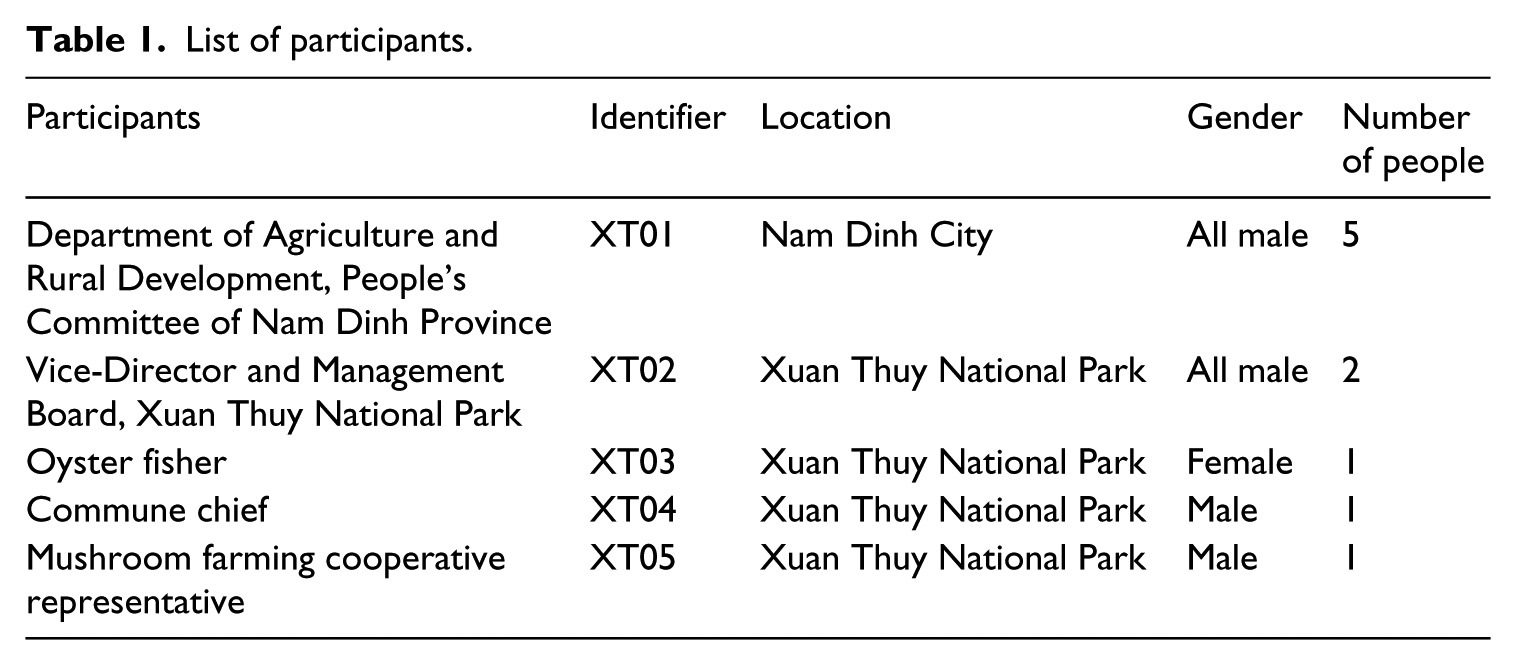
Some interesting micro-politics occurred during the research. Qualitative approaches, such as semi-structured interviews or ethnography that are the mainstay of much sociology in the United Kingdom, are utilised less frequently in Vietnam, compared with case study and survey-based approaches (e.g. Quyen et al., 2013; Truong, 2009). Recruiting participants, therefore, presents challenges as target populations may be unfamiliar with being asked to give their voice in a more open and unstructured manner. To overcome this issue, the Vietnamese researchers in this study undertook a great deal of work to select and build relationships with people in XNTP who could provide specific insights into that landscape. This is why the overall number of participants (10 in this case) is small. However, as residents of XTNP and/or Nam Dinh Province, the participants were well-positioned to provide rich narrative accounts of the lived experience of environmental change in their locale and hence offered significant analytical purchase into the complexity of well-being.
The Scottish and Vietnamese researchers held two workshops, drawing on the research experiences of each group, which generated the following questions relating to the following:
How has XTNP been affected by recent environmental changes?
How have those changes made a difference to daily life in a particular community?
How does the landscape in XTNP influence identity and culture?
How has health and well-being been affected by changes in the environment?
The Scottish researchers were informed that while participants were happy to be interviewed, it was not culturally appropriate to record the interviews. This prohibition negated the agency of the digital recorder, a taken-for-granted element in the research that they normally undertake. Without a recording, it was not possible to transcribe the interviews and iteratively analyse a printed transcription for codes and themes as laid down in many approaches to qualitative research. Close attention had to be paid instead to note-taking, and subsequent discussion and verification with the Vietnamese researchers who led the interviews, which again in turn was affected by the micro-politics of language and translation. As participants spoke, the translator provided summaries of what was being said or translated direct questions and answers. So, even though the modules of semi-structured questions were agreed in advance, the live data of what was being said by the interviewers and the participants were only partially captured. After each interview, the Scottish and Vietnamese researchers conferred to agree on what they perceived as being the second-order content of the interviews. This is why the presentation of this article lacks indicative extracts from the participants and provides summaries of what was said instead.
Further micro-politics relating to power dynamics were notable in the interviews with respondents XT01 and XT02, both of whom were representatives of statutory bodies. They set the form of the interviews by giving an official presentation first that outlined their interpretations of the issues and challenges of climate change in XTNP. Their presentation was followed by a question and answer session, which again was filtered through translation. After the meeting was concluded, the Scottish and Vietnamese researchers discussed and agreed on what both sets of researchers interpreted as the main themes of the meeting.
Finally, the empirical data collected ‘in the field’ were supplemented with meta-analysis of the findings of previous field-based research conducted by the Vietnamese research team in and around XTNP, and also of more environmental management-focused analysis written earlier by the research team from the same data pool (Mabon et al., 2018; Nguyen, 2012; Tran, 2015). This meta-analysis allowed extant research to be reconsidered and reinterpreted through a sociological lens, drawing out additional conceptual insights over and above the environmental management and governance-focused findings already identified by the research team.
Findings
Three inter-related themes were evident in the data gathered from the interviews and the recent research undertaken by the Vietnamese researchers described above: rising water levels; poor well-being in all matter; migration and social solidarities, each of which is summarised next.
Rising water levels
As the two figures 4 below indicate, XTNP is a flat precarious landscape dominated by water. The level of land is marginal. The walkway in Figure 1 is 2 m above water level while the beds of mangroves are just above water level. Any sudden or continual rise in water level can potentially radically transform the landscape. Figure 2 provides an indication of the landscape through which people move in order to work and engage in other activities in their daily lives.
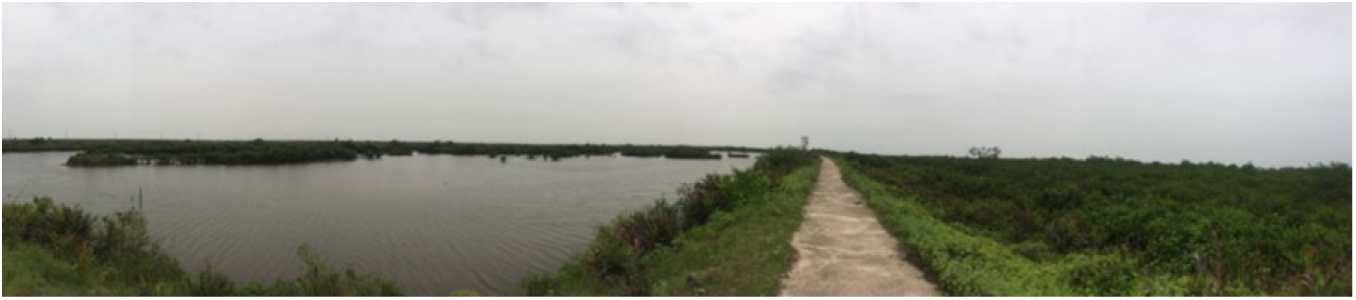
A panoramic photograph of a walkway in the Xuan Thuy National Park.
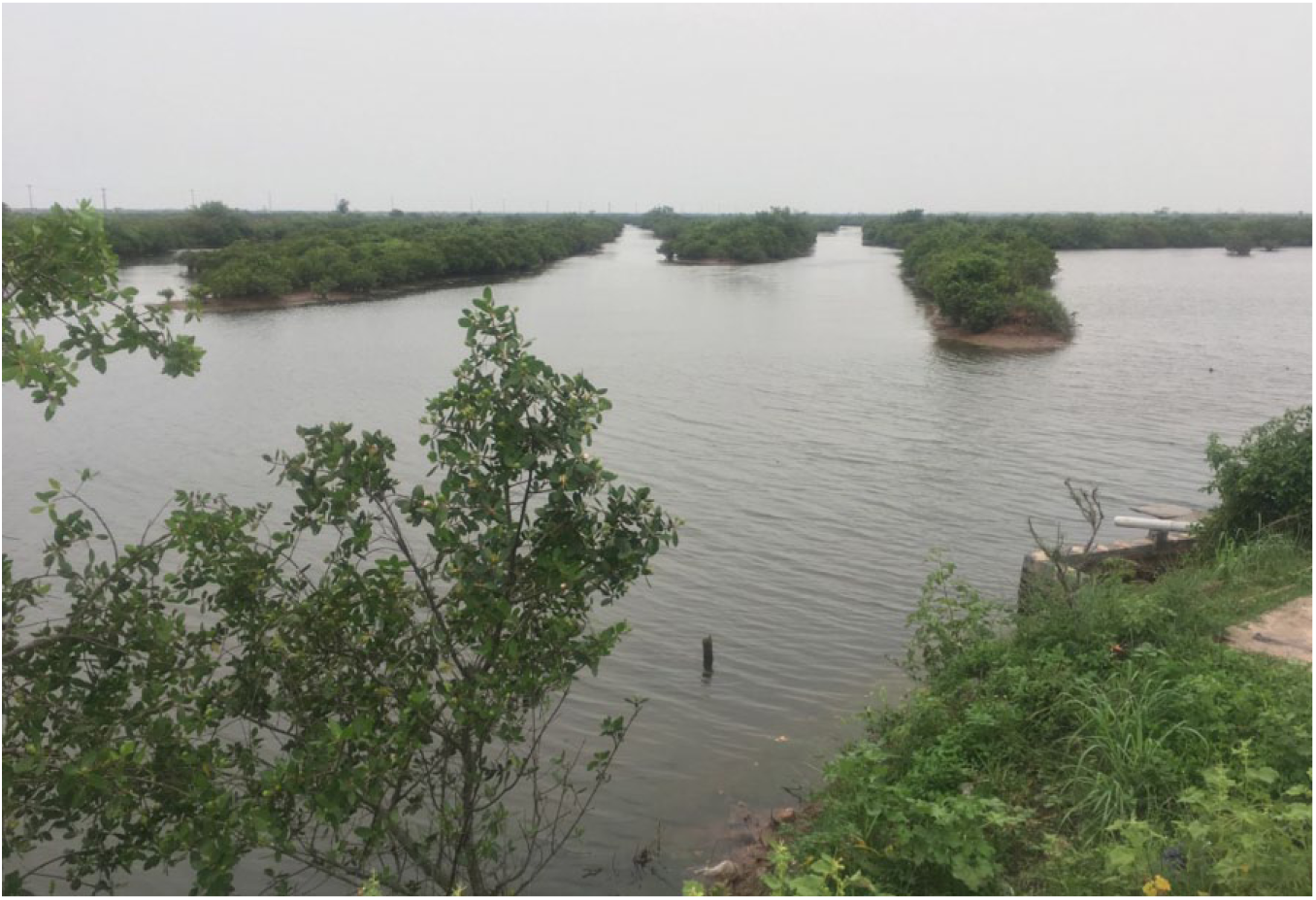
A photograph of the above walkway over the mangroves.
Water levels have been rising across XTNP for some time, with the sea level rising on average 2 mm every year and with a total rise of 10 cm between 2007 and 2013. Sea water intrusion with increased salinity now reaches 21 km inland (Tran, 2015). With the sea level rising by 2.15 mm every year, and with the effects of flooding and typhoons, the water takes on even more power in this landscape. In 2016, for example, a storm flooded 220 communes, which negatively impacted on 74,100 hectares of rice land, 8500 hectares of vegetable crops and 130 hectares of aquaculture land. The storm had an economic cost of circa VND 31,000 billion (€113.78 million).
The interview with XT02 and their recent report indicated that extreme weather phenomena have negatively impacted on thousands of hectares of cultivated and aquaculture land, resulting in losses reaching hundreds of billions of Vietnamese Dollars (Department of Agriculture and Rural Development of Nam Dinh Province, 2017). The effects are particularly pronounced on the Nam Dinh coast, where salinisation has reduced the rice cultivation productivity of soil. 20,000 hectares of paddy land are flooding in spring seasons, and over 5000 hectares of cultivated land suffer extreme salinisation. Mangrove areas – which are significant as a first line of defence against storm surges and also help to sustain biodiversity (e.g. Spalding et al., 2014) – are being reduced in XTNP by the sea level rises mentioned above. Rising seas also affect the biodiversity of mudflats at the mouth of the Red River. The consequence of this activity is a reduction of aquaculture land that negatively impacts upon coastal household incomes. Salt water intrusion onto land harms aquaculture species’ habitat, thus depleting fish stocks and creating difficulty for residents whose livelihoods depend on catching fish.
The threat of storm surges and sudden rises in water level arose in interviews with regional policymakers [XT01] and a commune chief within XTNP [XT04]. They reflected on the need to develop evacuation routes and drills for the eventuality of storm surges, reflecting the ever-increasing concern and need for vigilance that the physical environment imposes upon people dwelling in XTNP.
Poor well-being in all matter
Changes in all matter in XTNP due to environmental change were recurrent across all the data. Tran (2015) noted a decline of certain bird species in XTNP, with Anastomus oscitans (Asian openbill stork), Limnodromus semipalmatus (Asian dowitcher) and Tringa guttifer (Nordmann’s greenshank) observed less frequently in the park. Ha (2012) has recorded an increase in physical illnesses, such as stomach pain, diarrhoea and flu-like symptoms for older people and younger children, following flooding and storms. One consequence of rising water levels and storm surges was the overwhelming and flooding of waste and sewage systems. The contents of which would be deposited as a health hazard into the landscape (see also Ranganathan (2015) on the relationship between flooding and sewage in Bangalore). The members of the commune committee also reported a concern with the health impacts on people (mainly flu, stomach problems and diarrhoea) of raised water levels.
A clear theme of increased psychosocial distress, in addition to the physical illness and disease identified by Nguyen (2012), emerged in the interviews. What became evident in the interviews with XT01 and XT02 was that emotional distress and a harder life were common across Xuan Thuy. This prevalence can be accounted for by the increased demands made on farmers and aqua-agriculturalists by climate change. People needed to work harder for less return, because increased salinity presented problems for irrigation, which had consequences for the cultivation of rice and decreased suitable land for aquaculture.
The mushroom farmer (XT05) talked of the increased stress that he and his family experienced as they could not always anticipate the success of their crop due to climate change. The fragility of rice straw, an essential element in the growing of mushrooms, was an important issue for him and other mushroom farmers. Mushroom cultivation with straw byproducts from local rice cultivation has been proposed as an alternative livelihood model in climate-vulnerable areas of Vietnam such as the Nam Dinh Coast. The straw acts as a bedding, with spores placed in between layers of straw and stored in growing rooms on farmers family properties until the mushrooms come to fruition (see, for example, Fargreen (2018)). However, if the straw rots, mushrooms cannot grow. No mushrooms means no product to take to market. The lack of a mushroom crop impacts on the farmers’ livelihood and their overall well-being. The constant possibility of losing rice straw means that the farmers and their communities experience anxiety and stress on a daily basis. The fear of a sudden and complete loss of a crop was palpable.
The oyster fisher (XT03) spoke in great depth, from her 20 years of experience of working in XTNP, about how the changes in the landscape and the rise of the water level affected her work and reduced the capacity for good health and well-being. The increased water level had two direct affects for her and other fishers. First, it made moving amid the landscape harder. Roads and walkways were not as passable and increased the travel time through the landscape. Second, the increased water level alongside the dykes and walkways made it harder to fish, which meant that she and her team had to work longer to harvest the same yield of oysters as previously. In all, she noted that work time had increased by 3 hours over the last 10 years in addition to the increased travel time. The total working day was, therefore, around 10 hours. The main well-being effect she discussed was constant headaches, sometimes so painful that she had to leave work early. She also reported that overall she felt more tired and exhausted than she did before the water levels began to rise.
Migration and social solidarities
The Department of Agriculture and Rural Development within the Nam Dinh People’s Committe (XT01) reported that communities in the area were facing the challenge of migration. Younger working-age people were moving to urban areas in search of work or other opportunities resulting in a demographic shift in their home villages that were now disproportionately populated by non-working older people and children. This trend of out-migration in Nam Dinh Province has been studied extensively elsewhere (e.g. Kelly and Adger, 2000); however, what came across in our research was that this migration additionally led to an unravelling of social bonds between people and the decline of the cultural practices that produced and reproduced those bonds. The regional committee drew attention to one example of this trend. Until recently, different generations in a community would gather to collect crabs on the beach in the evening. The activity providing a rhythm to life and an opportunity for communal bonds and solidarities too be created and recreated. With the movement of younger people to the urban areas further inland, less and less people were in the villages to engage in this practice. Crab-picking still took place, but as a lone or small group activity.
The impact of internal migration was also raised by XT03, the oyster fisher. Her husband had reluctantly given up his job as a shrimp farmer in XTNP because increased salinity in the water had made this line of work untenable and unprofitable. He moved to Nam Dinh, the provincial capital, to find employment. For her, his absence meant increased pressure to run their household and attend to the household finances, as well as additional caring responsibilities, further reducing her capacity for good well-being. She also missed him, and it was her hope that he would move back.
The negative interpretation of urban migration was not always shared by other people that were interviewed. XTO5, the mushroom farmer, noted that the people living in XTNP understood urban migration to be more complex and nuanced than the negative interpretation advanced by the regional committee, reflecting conclusions reached by previous research over a decade ago in the same region (Kelly and Adger, 2000). They perceived it as a seasonal and temporary flow where migrants were more likely to return than to permanently move away. Critically, in terms of reproducing and maintaining solidarities, migrants could be called upon to return to assist in times of need and would support their communities in activities related to mushroom cultivation and other forms of farming and fishing.
It also became evident that a series of solidarities existed between the people, families, workers and committees. The recent history of Vietnam may provide an explanation of why this solidarity occurs. Even though the economy of the country has moved towards what can be characterised as a ‘socialist market economy under state guidance’ (or ‘Doi Moi’ in Vietnamese), certain socialist traditions and practices remain (Beresford, 2008). In the interview with the mushroom farmer (XY05), and also evident in the interviews with XY01 and XY02, there were appeals to socialist practices of solidarity and collective decision-making that have a provenance in the country’s revolutionary past, albeit, in this case, on a limited local scale. The commune chief [XY04] too expressed pride – and reported that his fellow residents were equally pleased – that local government interventions to reduce the impacts of climate change (education, training) were primarily intended to benefit the poorest and/or most vulnerable members of the community. These solidarities that stretched across the landscape provided both instrumental and affective support for the people in XTNP.
Analysis
It is apparent that causes of poor well-being outlined in the data are particular to the XTNP landscape. For the humans in that landscape, poor physical health was the outcome of disease spreading because of flooded waste systems and more demanding physical labour, while poor emotional well-being emerged from the constant stress that valuable crops could be suddenly lost or yields may be less productive. Water emerges as a powerful element in this assemblage. It possesses the capacity to order the landscape and to overwhelm other matter and objects. It affects how people exist in the landscape. It is a landscape that people move among rather than move through. Solid ground is marginal and does not necessarily connect areas of work and habituation. Mobilities by necessity require contact with water, whether by wading chest deep or travelling by boat. Water’s capacity to disrupt and destabilise the assemblage in turn impacts on health and well-being. When water rises, it floods the terrain drowning mangroves, disrupting wastage systems, thereby spilling toxic effluence into the environment, and, when it vaporises into humidity, it rots rice straw an essential material in mushroom farming. Everything flows both literally and metaphorically from the water. As the water destabilises the landscape, it also destabilises the well-being of all matter in XTNP. For humans with their bodies and emotions embedded in the flows of the landscape, the effects of changing water levels are telling.
As the interviews with XT01, XT02, XT04 and XT05 and previous research in the same area (Nguyen, 2012; Tran, 2015) indicated, emotional distress and a harder life were common across Xuan Thuy. This prevalence could be accounted for by the increased demands made on farmers and aqua-agriculturalists by climate change. Increased salinity presented problems for irrigation, which had consequences for the cultivation of rice, and the suitable land available for aquaculture was decreasing meaning that people needed to work harder for less return. The people who live and work in XTNP are, therefore, part of the flows and economy of power in that landscape. As embodied social beings, their emotions and physical bodies are embedded into that landscape, pace Damasio, responding to the changes that occur in the landscape in which they live. Rises in water level become part of the body-without-organs of the people in XTNP, one of the wider relations that affect their embodied minds and bodies.
There were also elements of the assemblage that could stabilise the XTNP assemblage and counterbalance the effects of rises in water levels and produce flows that were positive and sustaining for human well-being. As has been noted in other environment and well-being research (e.g. Chang et al., 2015; Klinenberg, 2002), solidarities within communities are protective. The strongest element in XNTP was the solidarity expressed between the various levels of political and social organisation. This was, in part, animated by the cultural practices bequeathed by the communist past of Vietnam, but also by local kinship, social networks and local culture. Again, we need to embed these elements within landscape. Social solidarities were critically reproduced as an embodied material practice emerging out of a connectivity with landscape with what other elements were present. The cultural practice of community crab-picking that was mentioned by XT01 provides an example of culture and identity connected to landscape, as does the continuing influence of communism in the distinct form it took here between workers, communities and local level government (as illustrated in the narrative of prioritising the most vulnerable in community-level climate responses given by XT04), that is, a legacy of Vietnam’s recent history.
The assemblage is always a dynamic entity, and solidarity is potentially undermined and made precarious by another mobility in the landscape. The migration of younger people to urban centres was noted by some as a threat to the solidarities, and pre-dates (although is intensified by) concerns over climate change. This element in the assemblage is also affected by the capacity of water mentioned above. If water levels rise and life becomes harder it could encourage more people to leave XTNP and that would further undermine the solidarities among the inhabitants of XTNP.
The interview with the mushroom farmer (XT05) provided an insight into a specific set of relations between humans, other material matter (mushrooms and its growing medium of rice straw) and the capacity of water to destabilise this relation resulting in poor well-being. In different assemblages, rice straw possesses the capacity to be harmful or beneficial to other elements, whether that is to the wider environment or the health and well-being of human agents. Standard agricultural practice in Vietnam has been to burn rice straw after the rice has been harvested, which can lead to significant emissions of green-house gasses (Arai et al., 2015). Using the straw to make beds for mushroom cultivation produces much lower levels of green-house gasses and thereby provides a more environmentally sustainable approach to dealing with this by-product from rice agriculture. As Rosmiza et al. (2016) have noted, mushroom cultivation produces many secondary gains. Certain varieties of mushroom are higher in protein and vitamins than vegetables. They also have distinctive flavours allowing them to occupy a speciality position in food markets, and the rice straw that has been used to grow the mushrooms can be recycled further as crop fertiliser. In the affect economy in focus here, the negative effect of environmental damage is removed as the straw is not burned but repurposed as a growing medium for mushrooms. It, therefore, produces a positive and stabilising flow though the assemblage. For the mushroom farmers, the rice straw, therefore, becomes the central material entity in the making of their livelihoods and in supporting their well-being. For other flora and fauna, the affect of rice straw is to reduce environmental degradation.
Concluding remarks
The above conceptual discussion and empirical case study provides an invitation to understand the importance and analytic power of landscape in relation to health and the environment. The central point that emerges here is that humans live in landscapes. As an interest in the environment and health develops in medical sociology, we urge that landscape is taken seriously to reach beyond ontological and epistemological approaches that delimit their analysis solely to the interpretations of humans. We need to be mindful of the various elements of where people live and how the other forms of matter, objects, symbolic orders and so forth all exist in a relational flow that can have a bearing on the well-being of all matter.
The landscape considered in this article is located in rural Vietnam, but the concepts outlined here provide a toolkit for analysing effects of environmental change on other landscapes. Such an analysis could focus, for example, on urban landscapes where an assemblage could include the fabric of the built environment, noise, car pollution, and political decisions as well as embodied humans. In the context of cities, for instance, Connolly (2018) argues that attempts to understand how to create genuine resilience through balancing ecological and social factors often run up against ‘entrenched definitions of what is desirable, acceptable, and who benefits’ (p. 8), but also that the institutions responsible for closing down the debate in this way may be slippery to pin down. The approach advocated in this article might, therefore, help to make this wider set of relations and policies visible, acting as a starting point for a discussion on how uneven vulnerability to climate change emerges and how it may best be addressed.
In terms of the empirical element of the article, we acknowledge the limitations of our data, and only some guarded points can be made. We can see that different relations can be protective or otherwise of well-being and that overall the XTNP assemblage is precarious with rising water levels possessing the capacity to destabilise many of the other elements. We can also see that social solidarities are vital in maintaining the people in XTNP. These two elements are most powerful in the assemblage flowing into the bodies and emotions of people, limiting and enabling what they can do.
There are some aspects of the study which could be developed further through future, more in-depth research. The ontological basis of the article was that of not privileging human activity and acknowledging other matters too. We have attempted that in our discussion of the capacity or potentia of water as a central destabilising element. However, other matters are silent. That may be accounted for by methodological issues and, in future research, being attentive to the situation of flora and fauna and incorporating their affects more within the analysis. There is also the issue of how to convey data other than what can be rendered as text or numbers. Tilley (1994) recommended ‘feeling’ the landscape and recording the experiences of landscape. Is this best achieved by written descriptions or does it require other modes of exposition? We used photographic images to illustrate this landscape, but video and sound recordings may have added more. Despite these limitations, the XTNP case study indicates how landscape can be analysed and what a landscape approach can contribute to researching relations between environment and well-being.
Footnotes
Declaration of conflicting interests
The author(s) declared no potential conflicts of interest with respect to the research, authorship and/or publication of this article.
Funding
The author(s) disclosed receipt of the following financial support for the research, authorship, and/or publication of this article: The research on which this paper was based was possible through a British Academy International Partnership and Mobility grant (number IPM160249) held by Dr Leslie Mabon and Dr Nguyen Song Tung; and Scottish Funding Council Global Challenges Research Fund Official Development Assistance funds allocated to Robert Gordon University and subsequently assigned by the university to Dr Leslie Mabon. The authors are grateful to the residents of Xuan Thuy National Park and the governors of Xuan Thuy National Park and Nam Dinh Province for participating in the research.
