







Abstract
This study contributes novel digital mixed methods and findings on how fear of paedophilia affects parents and children’s bodily relations. We explore how norms for appropriate behaviour between parents and children are constructed in the public debate on a specific case, where a mother has playful contact with her son’s genitals. The case triggered a public debate with both negative and positive reactions. A Laclau and Mouffe-inspired analytical framework and internet-specific tools for data collection as well as processing contribute to the development of a new form of discourse analysis. This new discourse analysis is based on a combination of the digital tools word cloud and topic models, and a qualitative in-depth reading. By exploring discursive constructions and articulations of right and wrong, the study supports earlier findings that the online public unanimously agrees with the dictum of child innocence. However, we find openness within the discourses on how to define respectively healthy and damaging parental behaviour towards children.
Keywords
Introduction
Villads and I laugh when we play ‘serpent and the blackbird’ – where my hand is a flying, hungry blackbird that confuses his small penis with a delicious, small earthworm. Yum.
The Danish Blackbird case is the focal point for this research study. We examine how norms for appropriate parental behaviour are constructed on online debate platforms in light of a general rise of fear of paedophilia. Within the article, no differentiation is made between paedophilia (a diagnosis) and sexual molestation (a criminal offense), as the empirical material of online discussion does not allow doing so. In the analysis of online norm construction, this article develops a novel mixed method discourse analysis that combines the digital quantitative analytical tools word cloud and topic models with a qualitative in-depth analysis, inspired by Laclau and Mouffe’s terminology.
The Danish Blackbird case inscribes itself in an international context, where people react with paedophilia accusations and condemnation when it comes to bodily contact or nudity between parents and children. Judgmental and hateful reactions similar to the Blackbird case erupted when an Australian photographer, Bill Henson, issued an invitation to his upcoming exhibition, which featured a photo of a naked 13-year-old girl. The opinion that the pictures were controversial and had paedophilic undertones gained sizable support in the debate. As a result, the exhibition closed down and the police seized the images, but a fierce media campaign about art, children, censorship and paedophilia followed (Simpson, 2011). A similar reaction occurred last year when American photographer Wyatt Neumann took his two-year-old daughter Stella on a road trip across the country, documenting their travels by taking pictures of beautiful landscapes and his naked daughter. The images attracted criticism from people around the world who called them ‘perverse’, ‘sick’ and ‘pornographic’ (Frank, 2014). In January 2015, the pop singer Sia was accused of child pornography by online debaters when she released a music video for her new track ‘Elastic Heart’. The music video shows an adult man and a girl dancing intensely in nude-coloured underwear. Many claimed the video was inappropriate and repulsive and that it had paedophilic connotations (Ellen, 2015). Most recently, a new American computer game named ‘Shower With Your Dad Simulator’ attracted a lot of attention. The game is designed with a pixelated 1980s look, and it revolves around a little boy who showers with his father in a public bath. Many Twitter users responded with tweets calling the computer game ‘disgusting’ or ‘nasty’ (Ditlevsen, 2015). The condemnatory comments towards the computer game are observed to be similar to the reactions to the Danish Blackbird case. The award-winning Danish movie Jagten (The Hunt) could be seen as a response to the scapegoating of men who are suspected of having sexual relations with children. The movie is told through the perspective of a man who becomes the target of moral judgments after being wrongly accused of sexually abusing a child. The movie can be seen as a critical comment in public condemnatory reactions towards people who are suspected of sexual assault.
Most studies on fear of paedophilia have roots in an Australian context based on qualitative methods and literature reviews (Baird, 2013; Davies, 2012; Hawkes and Dune, 2013; Robinson, 2012; Simpson, 2011). These studies have successfully established a focus on the multifaceted field of children, sexuality and fear of paedophilia. However, very few international empirical studies examine how fear of paedophilia influences society and norm constructions for appropriate parental behaviour. These matters are primarily discussed by experts and researchers who, to a lesser degree, base their statements on empirical, peer-reviewed research. To understand how societal fear of paedophilia affects relationships between adults and children, a more fundamental knowledge of the norms designed for parental behaviour towards children is needed. Thus presents the relevance of this study.
Increased fear of paedophilia
Research has pointed towards an increased focus on paedophilia in public debate over the last 15–20 years (Bech, 2005; Hawkes and Dune, 2013; Jewkes and Wykes, 2012; Leander et al., 2012; Marsh and Melville, 2011). This focus has led to a corresponding increase in public fear of paedophilia, branching into all parts of society. A widespread fear of paedophilia is particularly interesting in a Danish context, as Denmark traditionally has a reputation as a country with very liberal understandings and practices of sexuality. This reputation has been given the special Danish term of ‘liberal sexual outlook’ – or ‘Frisind’ in Danish wording (Edelberg, 2014).
Paedophilia became a major issue on the Western public agenda in the 1990s when a significant number of cases in England, Northern Ireland, the United States and Belgium received attention in the public debate. Cases such as missing children, priests’ exploitation of children and abuse in orphanages were largely discussed and distributed in the media. Researchers Maggie Wykes and Yvonne Jewkes (2012) state that the extended focus on paedophilia in the media contributes to the construction of paedophiles as today’s monsters in the global public consciousness. At the same time, children are constructed as the ultimate symbol of good and innocence in society (Angelides, 2004). Bech (2005) stresses that discussions about sexual matters are characterized by anxiety, worry and a fear of paedophilia. Jewkes and Wykes (2012) support this argument and they claim that the fear can draw parallels to societal panic. According to Hawkes and Dune (2013), this fear has resulted in an excessive and inappropriate control and monitoring of parents’ intimate interactions with children.
The Danish research group Paradox has shed light on the extent and influence of fear of paedophilia in society. Based on a survey (n = 1177) from 2012, Paradox found that the fear of being accused of paedophilia among child care workers and the population in general has affected their behaviour towards children. The research shows that 30 percent of men who do not work professionally with children fear paedophilia accusations. This figure suggests that men, in general, have a fear of being accused of paedophilia, for example from behaviour with their own children. This is further emphasized by the fact that nearly 17 percent of the general population of men state that they have changed their behaviour towards children as a direct consequence of the increased societal fear of paedophilia (Leander et al., 2012). These findings underpin that the fear of paedophilia accusations is not only experienced by professional child care workers, but it is now also found within the private sphere.
Methods: The need for new approaches
In Western societies, social media use is a fully integrated part of contemporary everyday life (Domingo, 2015; Ruppert et al., 2013). As online presence becomes more dominant, the internet becomes a powerful medium to construct and distribute social norms and discourses. Well-known sociological empirical methods are no longer sufficient when examining online social media platforms (Savage and Burrows, 2007). In order to keep track of the vast amounts of social data that are constantly generated and archived online, social scientists need to rethink methodologies for data acquisition and analytical tools (Venturini and Latour, 2010). To accommodate the need for new online methodologies, this article contributes to the development of novel sociological methods.
The methods section consists of four parts. The first part relates to data collection and processing with web crawling and scraping, the second part briefly introduces the relevant concepts of Laclau and Mouffe’s discourse analysis and the third part outlines the specific mixed-methods approach that we put forward as a model for empirical studies on norm construction in the light of fear of paedophilia. The fourth part functions as an introduction to the specific digital and non-digital tools and their purpose in the analytical process.
Data collection and processing: Web crawling and scraping
In order to analyze norm constructions for appropriate behaviour between parents and children, we need to gain access to comment threads debating the Blackbird case. This process is made possible by the internet-specific tool referred to as ‘crawling’ or ‘web-o-metrics’. This technique systematically crawls the internet and identifies URLs (websites) related to specific topics 1 – in our case, the topic of interest is the Blackbird case. More broadly, it can be described as ‘the quantitative study of Web-related phenomena’ (Thelwall et al., 2005).
Assisted by initial exploratory engine searches (in this case, duckduckgo.com), different word combinations were found that are adequate for capturing all URLs containing comments in relation to the debate on the Blackbird case. This process can be compared to the explorative production of a relevant search strategy for literature searches. The URLs are the initial starting point for our search strategy, where embedded links on the websites are pursued in order to identify previously undiscovered URLs containing debates on the Blackbird case. Through this rigorous process, we identified 51 unique URLs containing 2673 different posts commenting on the Blackbird case.
With help from the scraping technique, the 2673 different posts were then processed into a dataset (sometimes referred to as a text corpus). Each of the 51 websites containing debate posts consists of raw HTML code. Scraping is a translation technique that involves a series of steps that extract and translate the HTML codes into an analyzable and readable dataset. 2 Scraping extracts essential snippets like usernames, comments and names of discussion forums from each URL’s HTML body and ultimately forms the information bits into a dataset. This digital and carefully organized dataset is fundamental to the subsequent quantitative and qualitative analytical work.
A digital sequential discourse analysis
In order to identify how norms for appropriate behaviour between parents and children were constructed in the public debate on the Blackbird case, a discourse analysis inspired by Ernesto Laclau and Chantal Mouffe’s theoretical concepts is useful. Building on their understanding of language as relational, we can examine how social meaning is constructed, negotiated and reconstructed differently throughout the debate (Laclau and Mouffe, 2001). With this approach, we gain insight into how words through articulations are put together in different ways and form discourses that define appropriate and inappropriate parental behaviour.
Mixed-methods approach
Departing from a mixed-methods perspective, we develop a discourse analysis – a digital sequential discourse analysis (DSDA) – that combines qualitative and quantitative digital analytical tools. This DSDA is enabled by the digital data collection and processing. The combination of qualitative and quantitative analytics provides in-depth insight into and broader understanding of the discourses constructed in the debate. The DSDA is inspired by a sequential mixed-methods design with iterative elements. In practice, this means that this analytical process is driven by a dynamic interplay between findings from the quantitative and qualitative analyses respectively (Teddlie and Tashakkori, 2009). In this manner, the quantitative and qualitative tools inform and refine each other in an ongoing process (Combs and Onwuegbuzie, 2010).
The combined use of qualitative and quantitative digital tools in a discourse analysis is a relatively new analytical approach within the social sciences. Little scientific research has studied discourse construction using mixed methods, integrating computer-assisted tools with qualitative readings (Kim, 2014; Levy and Franklin, 2014; Montiel et al., 2014), and an unexplored analytic potential lies in further development (Bennett, 2015; Mautner, 2005).
In this article, we bring an in-depth qualitative reading in dialogue with two novel digital analytical tools: word cloud and topic modelling. The computer-assisted methods of word cloud and topic modelling detect themes and patterns in the debates that are not necessarily identified during qualitative reading, whereas a qualitative analytical reading provides an in-depth understanding of discourse formations. With the qualitative approach, we can detect irony and understand a greater context that quantitative tools fail to take into account. A short introduction to the three tools and their interplay in the DSDA is laid out below.
The word cloud is a quantitative analytical tool that visualizes the most frequently used words in the debate on the Blackbird case. This tool contributes to an exploratory approach to the text material by providing an overview of the dominating (most likely) words in the debate. The word cloud is a basic descriptive but highly inductive framework providing analytical direction for further analysis.
The systematic, qualitative in-depth reading provides a deeper understanding of the debate and assists in identifying relationships in the text material within a meaningful whole (Tanggaard et al., 2009). We locate key themes and discourses that are central to the debate based on our research questions, theoretical orientation and the word cloud’s initial findings.
Topic modelling is a quantitative analytical tool which can potentially reveal patterns and themes in textual material. Topic models have been used in a thematic analysis of 19th-century literature (Jockers and Mimno, 2013), a discourse analysis of news articles about art funding (DiMaggio et al., 2013) and an analysis of political discourse on encrypted internet markets (Munksgaard and Demant, 2016). Topic modelling presents textual themes through a variety of topics accompanied by a cluster of words created on the basis of words that statistically appear together in the text corpus – the debate on the Blackbird case. Such groups of words can be an indication of a thematic structure or discourse in the debate. This is also the case within qualitative analysis, but the ability to apply such a systematic to a very large set of data material is far more feasible with a digital analysis of the data (Blei, 2012; Levy and Franklin, 2014). The researcher defines no codes or categories beforehand. Instead, the model works inductively, deriving its solution from the data alone. This article makes use of the LDA-topic model introduced by David M Blei (Blei et al., 2003). The LDA model identifies a number of topics across the same texts.
Topic models are generated on the basis of a collection of statistical algorithms that automatically scan a text corpus (see Blei et al., 2003), unfazed by preconceptions and discourses that could influence the researcher during the qualitative coding work (Schmidt, 2012). However, researchers determine the number of topics that the model returns, and the researcher, therefore, cannot avoid influencing the outcome. Generally, it applies that the fewer topics chosen, the less specific and coherent the word cluster beneath each topic will be, and vice versa. Apart from providing quantifiable measures of the distribution of thematic content, the discovered topics can be used to navigate the original source material. Topic models, as such, enable a much-needed iterative alternation between the quantitative topics and specific text passages in the text material, making it possible to qualitatively explore the specific text passages constituting the models (Venturini and Latour, 2010).
Initial findings
On the basis of our first analytical step, the word cloud (see Figure 1), we find that words like ‘children’ [børn], ‘genitals’ [kønsdel], ‘mom’ [mor] and ‘dad’ [far] are frequently used in the public debate on the Blackbird case.
3
The 100 visually-ranked words in the word cloud indicate that the perceptions of these words are negotiated in the debate. The word cloud thus serves as a first-hand explorative tool that provides advantageous insights into the qualitative in-depth reading, where key concepts, meaningful words and central discourses are identified.
Word cloud.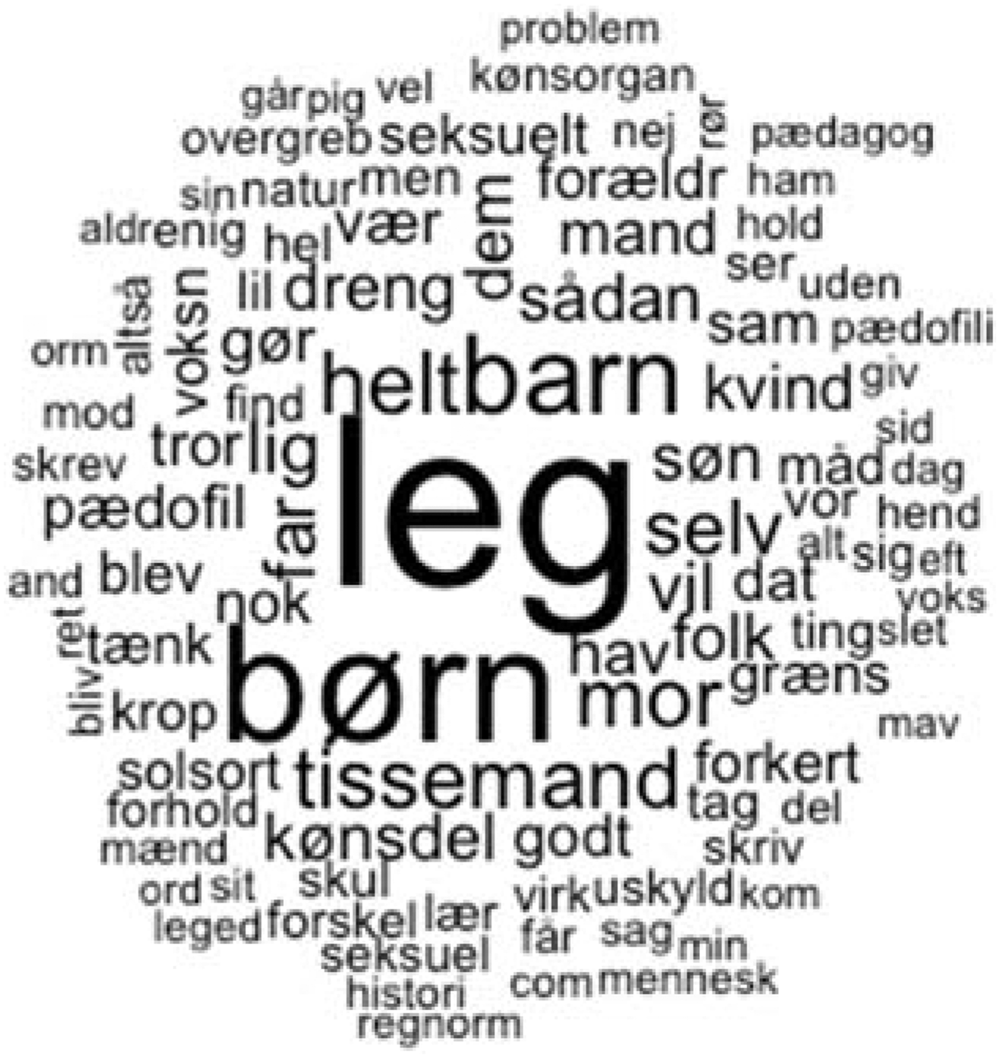
Through the qualitative, in-depth reading of the text corpus, we determined the following key themes: children, appropriate parental behaviour and gender. These themes are all central to the norm constructions of appropriate behaviour between parents and children in the debate of the Blackbird case. We found that the debate is characterized by discursive struggles between diverging positions among debaters – all aiming to validate their interpretation of the ascribed meaning.
We conducted a topic model analysis with 30 topics, each containing a word cluster of 15 words, on the basis of our text corpus containing 2673 comments (see Figure 2). This model presents topics with a high degree of specificity without jeopardizing the identifiability of the topic models, and hence without jeopardizing our ability to interpret a connection between the words in the clusters beneath each topic.
Topic model.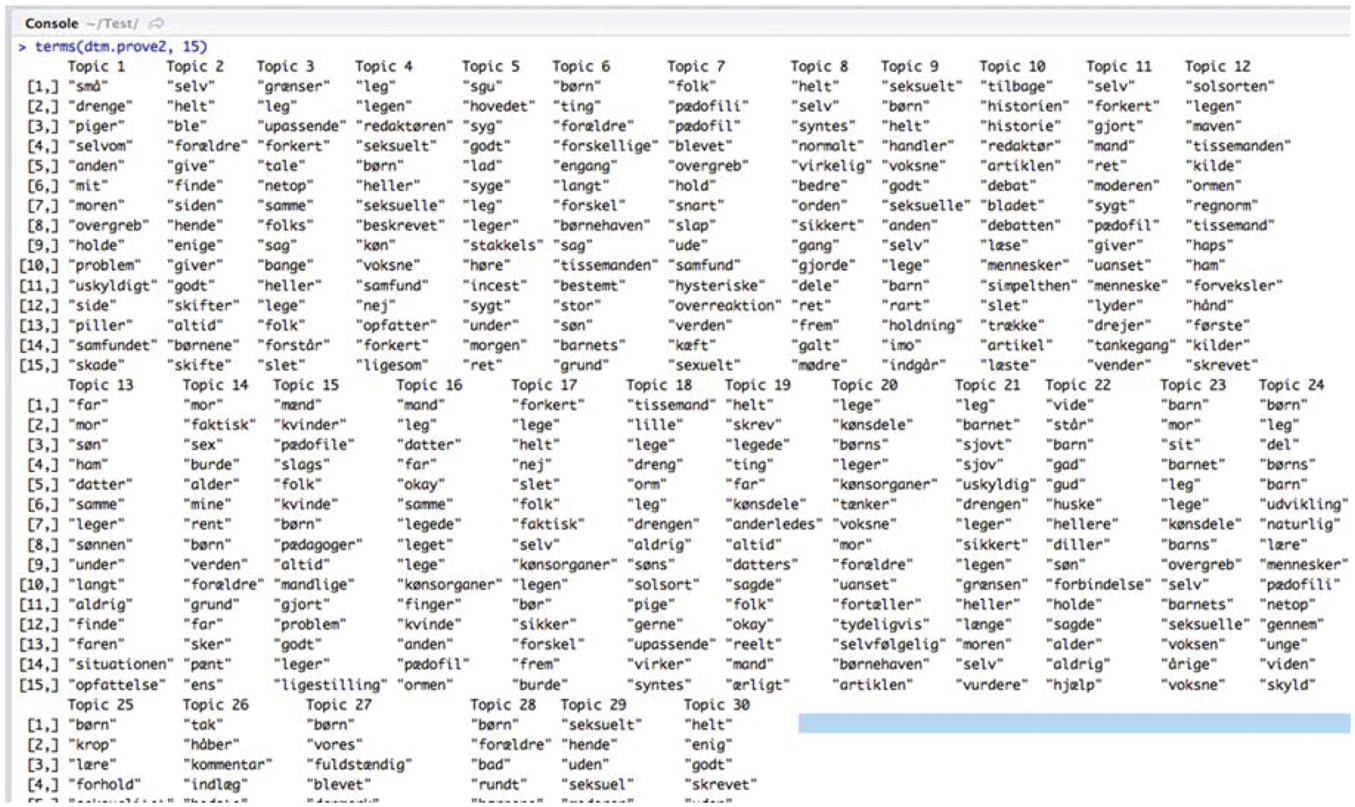
We selected 15 topic models whose word clusters appear to produce a coherent theme: 3, 5, 7, 9, 12, 13, 15, 16, 17, 21, 23, 24, 27, 28 and 29. The other 15 topics are invalid, as they present clusters of common curse words or likewise. The detection of valid and invalid topics is based on a qualitative assessment of the topic, and as such, is part of the iterative process between the statistical model and the qualitative analysis. A few of the coherent themes are presented below to illustrate how we analyzed the topic models. For example, we interpreted that topic 12, with a cluster of words like Blackbird-the play-belly-penis-tickle-worm-earthworm-yum-confuses-him-hand-first-write, is referring specifically to the editor’s description of the blackbird and earthworm play.
By using the topic model analysis, we find a key theme that we have not drawn special attention to in the previous analytical steps: contemporary society. Topic 7 consists of words like ‘overreaction’, ‘hysterical’, ‘paedophile’, ‘world’ and ‘community’ in a cluster, and the topic indicates that voices in the debate on the Blackbird case believe that the debate (and society in general) is derailing. Topic 7 is constructed on the basis of 123 comments that we qualitatively looked through again.
We carried out an iterative analytical process between quantitative topics and specific text passages where we looked into how the theme of contemporary society is constructed in the debate.
Departing from the thematic insights of the 15 selected topics followed by a qualitative reading of the debate comments that constitute them, we challenged, supported and deepened the discourses found in the previous qualitative and quantitative analytical steps.
Findings
In the initial analysis, we selected themes that we found central to the online debate on the Blackbird case, enabled by the DSDA. In this section, we further investigate how appropriate behaviour between parents and children is constructed in the online debate on the Blackbird case. We do this by dissecting the debaters’ articulations within the selected themes: children, appropriate parental behaviour, and gender and contemporary society.
Children are innocent
Children are a frequent matter of discussion throughout the debate. We find that children are constructed as innocent beings whose vulnerability and virtue ought to be protected by parents. This conceptualization of children as innocent is unfazed and assumes a hegemonic position across the public online debate. The Child Innocence-discourse is exemplified through this articulation: ‘My children should be allowed to enjoy their innocence and their experience of a natural body’ (Moar, Fashionmom.dk). This quote demonstrates that the Child Innocence-discourse is characterized by comments that emphasize the child and the child’s body as pure. ‘Innocent’, ‘natural’ and ‘vulnerable’ are words used to describe the child in the debate. The hegemonic position that the Child Innocence-discourse occupies in the debate indicates that the understanding of children as innocent simultaneously draws on and influences a contemporary sexual morality.
The construction of children as innocent is so paramount that the debate often turns from an underlining of child innocence into a widespread fear of the violation of this same innocence. This fear of violation can be amplified by the fact that debaters tend to confer characteristics to children’s sexuality that contrast characteristics of adult sexuality. Here, a child’s sexuality is constructed as naïve, playful and curious, whereas an adult sexuality has to do with procreation, pleasure and titillating fantasies: ‘Doesn’t she have a man she can play with instead? In my opinion, she is crossing the line… and it’s crossing the line, and not to mention nasty’ (Hanne Bagger, Dagens.dk). This quote is one among many that sexualize bodily play between child and parent, as the debater juxtaposes the motives behind the play with a sexual play between adults. As a result, we find that the Blackbird-play is associated with characteristics belonging to an adult sexuality, and this can be seen as a part of the reason why a fear of violation of the child has a presence in the public debate.
‘Appropriate’ parental behaviour
Through discursive constructions and articulations of parental behaviour, we identify two strong opposing positions in the debate, each offering a specific set of guidelines for parents to abide by. These positions relate strongly to rightful and wrongful parental behaviour.
No touching
On the one hand, the Blackbird-play is perceived negatively. This part of the public associates the Blackbird-play with paedophilia and abuse and condemns playful activities where children’s genitals are included. As a result, a parental scope of action is offered where parents are urged to respect children’s intimate boundaries. Parents drawing on this position equate appropriate behaviour with limited contact with children’s genitals, and genital touching is only accepted when having a hygienic purpose. The following quotes are examples of what we chose to call the No Touching-discourse: ‘You don’t play with children’s genitals. It’s sick, and it destroys a child’s ability to navigate between right and wrong’ (Johan Tandrup, Reddit.dk); ‘As a parent, you obviously wash or lotion your child’s genitals, but it is a sterile practice and not a fun game’ (Christian Kier, Facebook.dk/VoresBorn).
The two quotes use phrases like ‘don’t play’ and ‘sterile practice’ when describing appropriate parent behaviour. Through an in-depth reading of the text corpus, we expanded the No Touching-discourse with words such as ‘be careful’, ‘damaging’, ‘paedophile’, ‘genitals are no-go’ and a long list of similar phrases. Furthermore, the word clusters from the topic models guide us to identify quotes in the text corpus where phrases such as ‘brought for the court’ and ‘forced removal’ emphasize a need for defamation if a parent fails to exercise behaviour in accordance with the No Touching-discourse. Within this discourse, the importance of limited contact with children’s genitals is unambiguously articulated, and it becomes clear that playful contact with children’s genitals is wrong, damaging and sick. The words we found via the supplementary topic model analysis suggest that the play is illegal and criminal and that parents who touch their child’s genitals should be brought to court.
Unconditional intimacy
On the other hand, the Blackbird-play is also perceived positively. This part of the public sees the play as normal and appropriate and applies no sexual connotations to it. This position offers parents a scope of action where children’s genitals, as well as other body parts, are included in play. The supporters of the Unconditional Intimacy-discourse stressed that intimacy between child and parent should not be limited, as exemplified below: Parenting consists of an endless number of tasks related to the child’s body. And it’s not limited to a rational concern for nutrition or hygiene. A lot of pleasure between children and adults is associated with the body. Playing, touching, eating, dancing. If it tickles in the stomach, if it feels nice, is it forbidden? Of course not. (Siri Amtoft, Information.dk)
Gender differences: Men are intimidating
Gender has an effect on what kind of behaviour is appropriate between parent and child. We identify a discourse where men’s intimidating nature is being articulated. It is very interesting that this discourse relates to men, even though the case that is discussed is based on a mother and her relation to her child. Men are being constructed as offensive if they have intimate contact with children. Debaters suggest that a man is perceived as having an offensive nature contrasted with that of a woman, whose caring and loving nature prevents her from violating children in times of bodily intimacy. This Intimidating-discourse is articulated in the following quote: ‘We live in a society where men cannot give in to intimacy with children without potentially being labelled as intimidating. It’s the opposite with women’ (Søren Thomsen, Information.dk).
The quote suggests that men’s intimate contact with children is always under suspicion, whereas women are exempted from suspicion. That other norms apply to women than men is articulated multiple times in the debate. In the Intimidating-discourse, the male nature is described with words like ‘intimidating nature’ and ‘pervert’. The topic model analysis leads us to add similar words like ‘offensive’ and ‘insulting’ to the male nature. Men who play with children’s genitals in a similar fashion as the children’s magazine editor are thus attributed negative characteristics.
New Puritanism
The last presented finding centres on how contemporary society is addressed by the debaters. Commentators see a trend in contemporary society that they refer to as a presence of ‘new Puritanism’. The attention to this central theme in the debate is initially facilitated through the topic model analysis, meaning that it was an unnoticed topic during the thorough, qualitative in-depth reading. Topic model 7’s word cluster referred to societal conditions in various ways. This led to further investigation of the topic and its corresponding text passages in the corpus. On this basis, we found that some debaters articulated a discourse that characterizes contemporary society with words such as ‘new Puritanism’, ‘changed times’, ‘increasing narrow-mindedness’, ‘Puritanistic Denmark’ or ‘sterile society’, as demonstrated in the following quote: ‘I will certainly be the last one to take any step further away from the Danish liberalism and sexual liberal outlook. If we keep it up, we end up with American Puritanism’ (Warrior85, Reddit.dk). The quote stresses that condemners of the Blackbird-play are frigid and out of proportion. Proponents of the New Puritanism-discourse articulate a societal presence of bodily fright and point out that intimate contact between parents and children has become increasingly restricted.
‘Hide your kids, your neighbor is watching!’ (Bellucci, Sol.dk). This quote is a sarcastic debate post insinuating that parents must constantly be aware of other’s distrustful looks every time they have intimate and bodily contact with children. We interpret the New Puritanism-discourse as a desire for a showdown with suspicion and fear when it comes to interaction between children and parents. Within the discourse, it is articulated that standards for what you can do and say publicly have changed and become more restrictive. We identify a trend where it is dreaded that fears of paedophilia infiltrate parents’ behaviour towards children – at least publicly.
Discussion
In the following, we discuss and reflect on the empirical findings presented above. We address selected discourses and themes that we find particularly interesting in examining how norms for parental behaviour are constructed in the debate. We reflect on how the concern for violating children’s innocence can have consequences for children’s scope of action. We further discuss whether the increased focus on paedophilia and fear of paedophilia affect parents’ behaviour towards children. Finally, we discuss some ethical and methodological concerns.
Panicky tendencies
In the debate on the Blackbird case, we see tendencies that the reactions and severe concerns can, at times, appear excessive. This article’s methodological approach allows us to identify disproportionality when looking at the content and extent of the comments held against the female editor’s small magazine notice about how fun play between parent and child can unfold. The notice gained tremendous attention and quickly drew over 2600 comments, a lot of them spreading concern and harsh condemnation. This disproportion, combined with the verbally explicit comments using words like ‘sick’, ‘damaging’ and ‘spoils a child’, indicates that the fear expressed through some comments has panicky characteristics that can draw parallels to events where moral panic is present (Cohen, 1972; Goode and Ben-Yehuda, 1994; Thompson, 2005). We suspect that debates on, for example, ‘children and bullying’ or ‘children and traffic’ do not attract such a strong-minded audience to the same extent as debates concerning ‘children, innocence and sexuality’, despite the fact that it is far more likely for children to get injured in traffic than sexually assaulted by an adult. This reflection is in line with several research articles that state that fear of paedophilia, as well as reactions towards cases that can be interpreted to have paedophilic undertones, tends to have panicky characteristics (Critcher, 2003; Jewkes and Wykes, 2012; Thompson, 2005).
The tremendous concerns and condemnations can also indicate that the aforementioned Danish Frisind is not present among many of the debaters, and maybe the idea of a prevalent Danish liberal sexual outlook could be challenged. The debate on the Blackbird case is an example of how notions about (child) sexuality and questions regarding nudity or intimacy between children and adults can be seen as a modern-day battlefield. Therefore, we argue that the Blackbird case could be a symptom of the existence in modern Danish society of an increased need to establish defined boundaries between accepted levels of intimacy and transgressions. A more or less unequivocally liberal sexual outlook has become more fragmented in Danish society, and the narrative of Frisind that Danes pride themselves on could be questioned.
Children and sexuality
Due to the verbal intensity of the debate on the Blackbird case, the findings of this article indicate that matters involving children and sexuality generate strong opinions when debated on social media. Debaters are seemingly not afraid to publicly express or identify with a strong position, in spite of the fact that most commentators are associated with both an avatar and civil name. This finding can indicate that specific sets of norms encourage explicit and unequivocal utterances when morality positions concerning children and sexuality are discussed. Furthermore, the heated characteristics of the debate show how awareness rises quickly when concerns for child sexualization and molestation come up. This concern underpins that a hegemonic understanding of children as innocent is present in the debate.
The findings in this article point to a tendency for a fear of adult sexuality contaminating children, stemming from a general lack of recognition of children as sexual beings, exists. One can argue that innocence is constructed and emphasized as the pure and good, whereas bodily exploration and sexual desires are constructed as deviant and worrying. This finding is in line with earlier studies on children and sexuality, which stress that the public construction of children as innocent and non-sexual beings deprives them of their sexual flowering (Baird, 2013; Davies, 2012; Hawkes and Dune, 2013; Jewkes and Wykes, 2012; Robinson, 2012; Simpson, 2011). However, this contradictory relation between the innocent child and damaging sexuality is peculiar, as international and Danish researchers emphasize that children have both sexualities and sexual desires (Angelides, 2004; Graugaard, 2013).
Constructions of the child as innocent can contribute to a linguistic victimizing of the child. Children seen as victims can cause a monitoring and control of their sexuality. Research emphasizes the need for a societal distancing of innocence as a criterium for child sexuality (Angelides, 2004; Egan and Hawkes, 2009). This point obviously contrasts the omnipresent opinion among debaters on the Blackbird case, as they associate child sexuality with innocence and curiosity and fail to regard children as knowledgeable and lustful sexual beings. Parents’ control can deprive children from developing their own bodily self-control and prevent them from a healthy development of their own sexual identity, Angelides argues. Potentially, Angelides claims, the parental monitoring can make children more vulnerable to abuse (Angelides, 2004).
Parental behaviour influenced by paedophilia fear
In the debate, we identify antagonistic discourses struggling to define norms for appropriate parental behaviour towards children. We interpret these articulations and norm constructions as expressions of different positions of sexual morality that provide rules and guidelines for appropriate parental behaviour. We see indications that one side of the debate offers a parental position that condemns unnecessary intimate bodily contact with children, where on the other side a parental position is offered where intimacy between parents and children should be unconditional. Even though the discourses are antagonistic, and as such, hold very different ways of defining the behaviour, it is important to specify that the norms represented within them are expressed as a scale from one end to the other. The medium and the expectations related to the way arguments should be posed may also cater towards a more oppositional nature of the discourses.
Suspicious glances and fear of condemnation
Both parental positions appear with well-defined instructions of action, but in the analysis, we see indications that fears of suspicious glances can make it harder to occupy the more intimate parental role publicly because the other position has an immediate ascendancy, as it makes up a small majority of the debate.
With increased fear of paedophilia in society, it is reasonable to assume that some would find it more difficult to publicly support positions advocating for unconditional bodily intimacy between parents and children. According to our findings, fear of suspicion pushes the boundaries of what you do and say publicly. In a Foucauldian perspective, the spread of fear of paedophilia leads to a form of surveillance society where surveillance becomes self-surveillance. Thus, in this perspective, the parents that fear the suspicious gaze of another will eventually monitor themselves (Foucault, 1977). Thus, fear of paedophilia is not only directed towards external dangers, but it also affects bodily relationships between parents and children.
Faceless molesters
In the debate on the Blackbird case, we see indications that the growing fear of paedophilia influences the norm construction of appropriate parental behaviour. The fear of paedophilia does not target a specific social group characterized by class, ethnicity or other demographic factors. Instead, we see a tendency that everyone in today’s society can be exposed as a potential child molester. This finding is contrary to prior research that suggests certain social groups as subjects of suspicious glances (Warner, 2013), and that adults who violate the innocence of children generally have characteristics associated with the male sex and with a man’s behaviour and sexuality (Alldridge and Brants, 2001; Critcher, 2003). Even though men seem to be slightly more exposed as abusive and intimidating in the debate, the female gender of the editor bears witness to the fact that suspicion can strike anyone. This finding is interesting compared to the study conducted by Paradox in 2012. Their research showed that it is primarily men who fear the stigmatization of paedophilia and actively change their behaviour towards children on that basis (Leander et al., 2012). In light of our empirical findings, it is interesting to consider whether more women have adjusted their behaviour towards children due to the increased fear of paedophilia targeting women.
Furthermore, it is interesting that a potential child abuser is no longer restricted to dangerous acquaintances like ‘the teacher’, ‘the football coach’ or ‘the child molester’ (Grubin, 1998). Today, potential abusers can just as likely be parents. Our analysis suggests that the public today constructs the child abuser in broader terms than ever before. Today, all citizens can be thrown under suspicion or be accused. The person threatening children’s innocence and ruining social order has become faceless.
Methodological and ethical reflections
We have found that the combination of qualitative and quantitative tools into a DSDA enables a more inductive discourse analytical approach. With this combination, we thereby try to accommodate earlier criticisms that the method is too influenced by the researcher’s subjective assessments and interests (Bredsdorff, 2002; Jørgensen and Phillips, 1999). By combining both qualitative and quantitative analytical tools, we argue that this discourse analysis, to a lesser extent, is based on subjective choices. On this basis, we encourage further exploration of the fertile combination of word clouds, topic models and qualitative readings as a discourse analytical threesome.
Digital methods naïve without theoretical foundation
The digital discourse analytical tools allow a different exploration of the text material than what is possible with a solely qualitative reading. However, it is clear that the digital quantitative tools cannot stand alone, but must be combined with the qualitative analytical readings, since the quantitative approach risks overlooking specific contexts in the debate and blurring the nuances of discourse formations. Additionally, we have found that a theoretical framework is necessary to make sense of the visualization of the word cloud and the word clusters from the topic models.
Ethical considerations concerning digital data on social media
We use new tools for data collection, which is possible because the debates are largely available online. With the development of new tools and new platforms for social interaction, new and different ethical practices apply to our research because the lines between public and private become increasingly blurred (Hesse-Biber and Griffin, 2013). Zimmer (2010) describes very clearly that researchers need to reflect upon how public data is represented, although some would argue that this is not necessary since ‘the data is already public’. A key ethical aspect of digital data collection is to reflect on the use of content that may be considered private to the participants in the debates. Although posts on online forums – e.g. newspapers’ websites or social media – may contain personally identifiable information, it is unclear whether the personal information actually has a sensitive nature (Lomborg and Bechmann, 2014). This issue raises a number of ethical questions that must be considered in relation to the particular research (Kozinets et al., 2014). In this article, we argue that informed consent is not required as we are not interested in personal master data and because it would be too laborious to contact almost 3000 contributors to the debate. It is almost impossible to ensure full anonymity in research on online data, as avatar names and quotes are easily tracked by search engines (Lomborg and Bechmann, 2014). We have accommodated anonymity by providing debaters with alternate user names as well as translating the debate comments from Danish into English. By doing so, we make sure that the quotes do not appear exactly as posted online.
Conclusion
In order to understand how fear of paedophilia affects bodily intimacy between parents and children, insight into norm constructions in relation to children and sexuality is needed. We developed a digital sequential discourse analysis (DSDA), a novel mixed-methods analytical design combining internet-specific quantitative tools and qualitative in-depth reading. The DSDA reveals hidden textual themes and provides an analytical depth that expands insights into the discursive struggles that construct norms in the debate on the Blackbird case.
The DSDA points to a hegemonic understanding of children as innocent. Characteristics of child sexuality are interpreted by debaters as contrasting with adult sexuality. This notion can have the unintended consequence of depriving children of exercising bodily control and of their ability to experience a healthy sexual maturation.
Two conflicting positions are identified in relation to adequate parental behaviour. One side of the public debate articulates a discourse stressing the importance of limited genital contact with children, whereas the other side emphasizes a need for a more easy going approach to bodily intimacy. Parental behavioural adjustments towards children have a reinforcing nature, as behavioural change towards less physical intimacy is amplified due to double monitoring. Fear of accusations of paedophilia and double monitoring applies to both men and women – even though men are generally perceived as more intimidating than women – making the contemporary child abuser faceless. The analysis suggests that the prevailing fear of paedophilia within the debate appears disproportionate, and the fear of abuse and paedophilia can have panicky characteristics at times. The extensive condemnation of the Blackbird-play is also addressed by numerous debaters articulating that frigid condemners of the play jeopardize traditional Danish liberal sexual views and promote Puritanistic conditions.