







Abstract
During the COVID-19 pandemic, parents in consensually nonmonogamous (CNM) relationships navigated public health directives to social distance and avoid contact between households. Many parents practicing CNM share romantic, sexual, and coparenting relationships across households, and the pandemic introduced challenges and opportunities for innovation in maintaining connection. This qualitative study sought to explore the experiences, challenges, and adaptations of CNM parents, using survey and interview data from 70 US parents collected between May and December 2020. Thematic analysis highlighted that many parents spent less time with non-cohabiting partners and more time with cohabiting partners and children, but also adapted via creative strategies such as incorporating partners into a quarantine pod, inviting partners to move in, or connecting over technology. These data illuminate the diverse ways that CNM parents engaged in and “queered” family and partner relationships during the pandemic.
The COVID-19 pandemic significantly impacted individuals, families, and communities. Within the context of the United States, many parents experienced changes in employment such as job loss or a transition to remote work, while children moved to remote schooling, and overall stress levels increased (Brown et al., 2020; Goldberg et al., 2021). Parents in consensually nonmonogamous (CNM) relationships, particularly those with partners outside of their residence, faced unique challenges during the pandemic. For parents in CNM relationships, the risk of COVID-19 transmission and public health guidance urging individuals to restrict contact with people in other households (e.g., shelter in place orders) seemingly required parents to negotiate with partners about managing risk and maintaining relationships. According to Sheff (2020b), expert advice from the organizer of the COVID-19 Polyamory Townhall urged those in CNM relationships to “keep visits virtual, or just move in and cohabit,” as in-person visits to non-cohabiting partners could unintentionally transmit the virus. Yet, following these best practices has the potential to create or reinforce a relationship hierarchy among cohabiting and non-cohabiting partners or further isolate individuals living alone, according to Sheff (2020b). In addition, more time among cohabiting partners and disagreements about social distancing practices could lead to tensions and relationship breakdown (Sheff, 2020a). Single parents or parents working at home in particular may need to take on additional childcare responsibilities (Goldberg et al., 2021), potentially leading to less time with partners or non-coparent partners spending more time with children.
Yet, in addition to potentially introducing more complexities and challenges, relationship configurations with many parents living together may offer distinct benefits for pandemic life, providing more opportunities for socialization during a time of widespread isolation, as well as sharing childcare and other resources which may become more scant during the pandemic (Sheff, 2020a). Non-cohabiting partners who cannot see each other in person may find creative ways to maintain relationships as many have already developed skills to stay connected when physically distanced (Sheff, 2020a). The current study sought to understand how parents involved in CNM relationships experienced the changes and disruptions of the pandemic, as well as how families innovated and ultimately “queered” (Oswald et al., 2005) caregiving arrangements amidst the pandemic.
Impacts of COVID-19
Research has shed insight into the differential impact of the COVID-19 pandemic on various communities and demographics. Already marginalized populations such as racial and ethnic minorities (CDC, 2020; Van Dorn et al., 2020), uninsured or financially struggling individuals (Khatana and Groeneveld, 2020), women (Almeida et al.,2020), and LGBTQIA people (Moore et al., 2021; Phillips et al., 2020) have been identified as at higher risk for physical health, mental health, and/or financial effects associated with the pandemic. Economic inequality, discrimination in healthcare settings, preexisting healthcare disparities, and minority stress lay the groundwork for compounding challenges for people with intersecting marginalized identities. For example, one study of adoptive parents’ experiences with COVID-19 found that declines in mental health were common, and women in same-sex relationships were more likely to report such declines than men in same-sex relationships or parents in mixed-gender partnerships (Goldberg et al., 2021). Another study found that, compared to heterosexual women, lesbian and bisexual women perceived COVID-19 as a greater threat, which was partially accounted for by higher levels of possible exposure to the virus (i.e., through their workplace environment or social networks; Potter et al., 2020).
For parents in CNM relationships, potential network exposure may be higher through both children’s and partners’ social networks (i.e., children’s contacts through school or coparents and partners’ workplace or social contacts), which could impact family members’ protective measures as well as their levels of stress and anxiety. Sheff (2020a) described how polyamorous networks (polycules) provide more opportunities for emotional and material support, yet larger or more open polycules are also more vulnerable to infection. Of interest in this study is how parents in CNM relationships perceived and negotiated risk, how they described the pandemic’s impact on their relationships and well-being, and how parents’ behavioral responses to the pandemic resisted or reproduced heteronormativity.
Queer theory and CNM parenting
As theorized by Oswald et al. (2005), heteronormativity involves binaries of gender, sexuality, and family, in which one side of the binary is seen as “real,” natural, or acceptable and the other is seen as deviant, unnatural, or fake (e.g., “genuine” biolegal families vs. “pseudo” chosen families). Using this lens, the act of “queering” means challenging these binaries (e.g., through subverting gender/sex stereotypes, embracing complex and fluid sexual identities, or forming complex or chosen families) and thereby resisting heteronormativity (Oswald et al., 2005). Parents who engage in CNM queer family when they include members who are not biologically or legally connected, and they queer sexuality when they form relationships with more than one person; disentangle romantic, sexual, and coparenting relationships; and include same-gender partners. However, CNM relationships differ in their degree of compliance with and challenges to heteronormativity. For example, some polyamorous parents try to “pass” as monogamous, whereas others come out and actively compel institutions or other people to recognize their families (Pallotta-Chiarolli, 2010).
The current study focuses on parents engaged in CNM who are diverse in terms of sexual identity, gender of partner(s), approach to CNM, and household structure (e.g., number of adults living together). Of interest is how these parents accommodate or uphold heteronormativity or engage in queering practices, particularly when responding to the pandemic and social distancing guidelines. Prior research has documented how life transitions and upheaval can spark renegotiations or adjustments in CNM practices. For example, Huebner et al. (2012) interviewed gay male parent couples with varied relationship agreements, who reported that becoming parents decreased sexual opportunities with other partners. Similarly, in a study of sexual minority mothers, Manley et al. (2018) found that several women who expressed interest in CNM chose to focus on their primary relationship rather than seek new partners or relationship experiences during the pregnancy and postpartum period. Some of the mothers also described how increased caution (e.g., about STI risk, relationship stability, or impacts on family) led them to close the relationship temporarily or necessitated increased communication around boundaries and comfort (Manley et al., 2018). In the current study, parents are presented with the unique challenge of navigating partner contact and relationships amidst a pandemic and the risk of viral transmission. They may respond to such risk by prioritizing children and legal or primary partners and foregoing or ending relationships with secondary or more casual partners similar to the above-described subset of mothers in Manley et al. (2018). Alternately, parents in CNM relationships may challenge heteronormativity in responding creatively to the challenges of the pandemic, queering heteronormative notions of family and partnership to include more people in networks of intimacy, continuing a legacy of polyamorous parents’ inventive responses to challenging circumstances (Pallotta-Chiarolli, 2010). They may practice more varied expressions of care, such as creating and maintaining intimacy across distance through digital means.
Method
Participants and recruitment
These data are drawn from a larger mixed methods study on the experiences of CNM parents who have or whose partners have attractions to the same gender/sex (e.g., who are bisexual, queer, gay, or lesbian). Participants were recruited over social networks, including LGBTQ- or CNM-based pages on social media websites (e.g., Facebook groups and Reddit communities), the authors’ professional and personal networks, and snowball sampling. The current sample completed the study in the period between early May 2020, approximately 2 months after the pandemic was recognized by the World Health Organization, and late December 2020.
Eligibility criteria included being at least 18 years old, a parent, partnered, CNM within their current relationship, located within the United States, able to read and write English, and attracted to the same gender/sex or have a partner with same-gender/sex attractions. Online postings for the study included a link to a brief screener survey to confirm participant’s eligibility.
A total of 70 participants provided responses used in the current analysis (survey respondents or interviewees who did not give information related to the pandemic were omitted). A total of 44 people completed surveys only, 21 completed both surveys and interviews, and five participated only in interviews. In most cases, only one participant in a family unit provided interpretable data for this analysis due to a participant not providing a meaningful response to the survey question (one instance), partners not completing interviews (three instances), or interviewed partners not identifying as parents (eight cases). However, in seven cases (21 participants), multiple partners were included. Participants reported varied relationship structures and approaches, with polyamory and open relationships being most common, but relationship anarchists, swinging, monogamish relationships, combinations of the above, and currently closed relationships were all represented.
Participant demographic summary.
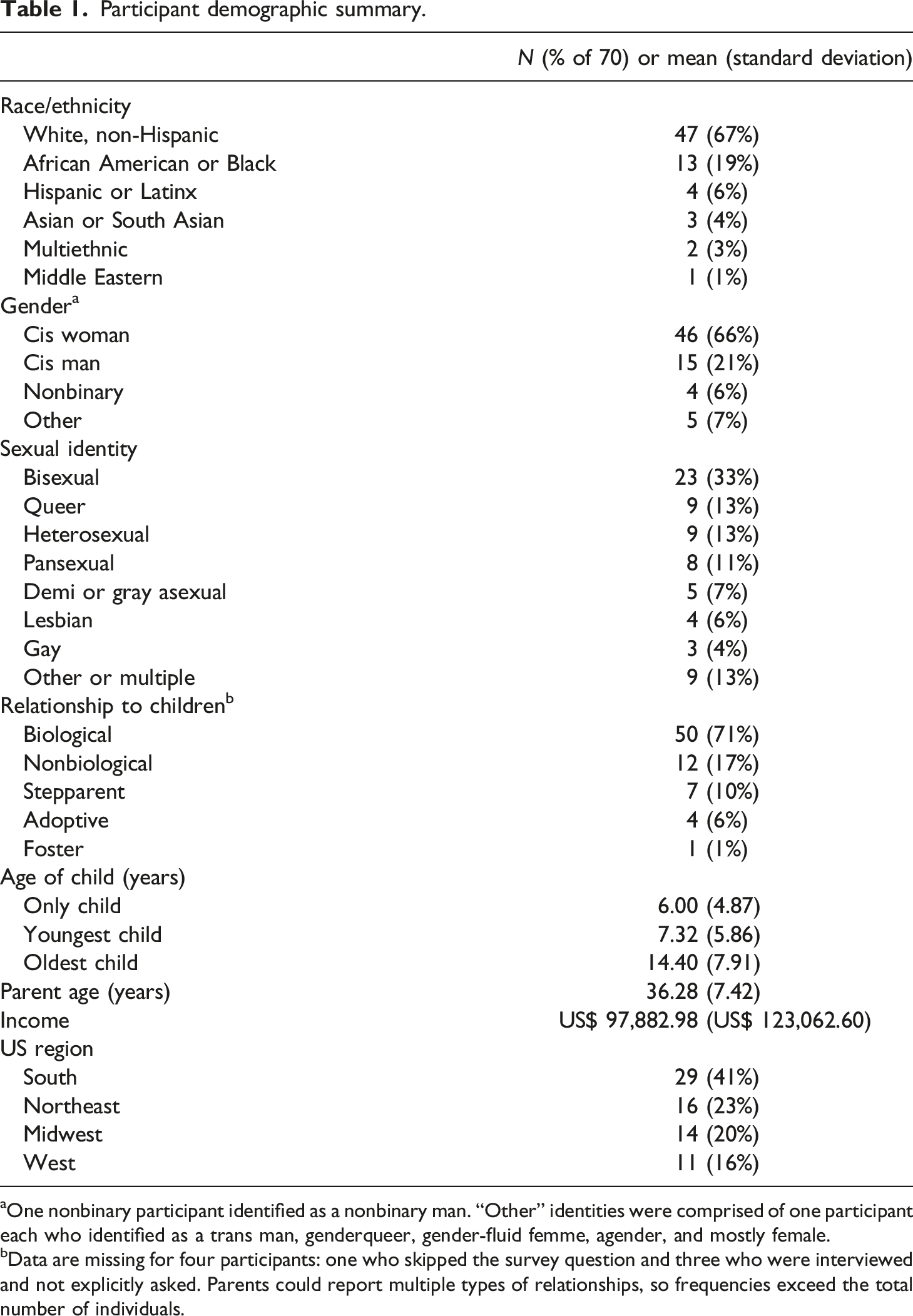
aOne nonbinary participant identified as a nonbinary man. “Other” identities were comprised of one participant each who identified as a trans man, genderqueer, gender-fluid femme, agender, and mostly female.
bData are missing for four participants: one who skipped the survey question and three who were interviewed and not explicitly asked. Parents could report multiple types of relationships, so frequencies exceed the total number of individuals.
Procedure
Eligible individuals were directed to an approximately 60-minute online survey, with open-ended questions about their demographics and experiences of CNM, including how they were affected by the pandemic. Several quantitative measures were also included. At the end of the questionnaire, survey participants could list their email to indicate interest in completing a 60–120 minute phone interview. Researchers sent an email to these participants to complete the interview consent form, schedule the interview, and ask whether their partners were willing to participate. Partners who participated in the interviews did so separately—they were not interviewed together. Interviews were audio-recorded and transcribed verbatim by a trained research assistant. Researchers did not use member checking although participants who expressed interest in receiving a copy of their audio interview were offered a copy of the recording. Researchers discussed with participants what they hoped would come from the research during the interview process, and as part of the survey, participants were provided opportunities to give feedback and to opt in to updates about study findings and publications. Participants were compensated with a US$ 20 electronic gift card for completing a survey and a separate US$ 50 gift card for participating in an interview.
Data analysis
The current analysis focused on participants’ responses to the online survey question, “How has COVID-19 and guidelines around social distancing impacted your intimate relationships and family life? For example, do you spend more or less time with romantic or sexual partners, coparents, or your children?” and the interview question, “How has your family been affected by the COVID-19 situation?” Responses to other questions were also reviewed for relevant data, which were incorporated into the analysis.
The first author used thematic analysis (Braun and Clarke, 2006) to analyze the data. Thematic analysis is a flexible, qualitative approach that allows researchers to interpret data using one or more theoretical lenses. To apply thematic analysis, the first author became immersed in the data, initially by conducting the interviews and then by actively reading survey responses and relevant portions of interviews looking for patterns and important themes. For instance, it became evident in reading survey responses that several participants spoke about difficulties seeking new partners or the decision not to seek additional partners in the context of the pandemic. The first author organized quotes and raw data from surveys and interviews in a separate coding document, coding for as many themes as possible. After the initial coding, the analysis became more focused, and themes were collapsed, refined, and reorganized to more clearly and concisely capture the narratives in the data. For example, codes related to socially distanced dates, using technology to maintain relationships, intensive planning for in-person visits, and adding a partner to one’s quarantine “pod” were all incorporated into a larger theme of maintaining relationships with partners outside of the home. In presenting quotes, the authors chose pseudonyms intended to match participants’ names in terms of gender and cultural background.
Results
Participant accounts revealed several key impacts of the pandemic on their partner and parenting relationships. Many discussed spending less time with partners (particularly non-cohabiting partners) and in some cases less time with children. Many parents did maintain relationships via use of technology, negotiating safety during partner visits, or incorporating partners into their pod. Several parents noted changes in family configurations, such as taking on additional childcare responsibilities, partners moving in, and generally more time at home with partners or children. Some also detailed decisions about whether or not to continue seeking new partners or CNM experiences and challenges in negotiating risk with partners and family members. Themes are elaborated below.
Decreased contact
A key challenge for parents was a decline in physical contact with partners, particularly those who did not share a residence. Given the possibility of asymptomatic or pre-symptomatic transmission of COVID-19 and public health guidelines to avoid contact with people outside of one’s household, parents were in the difficult predicament of minimizing or ending in-person contact with romantic and sexual partners—or risking possible health consequences for themselves, their family members, and their communities. Many spoke of the emotional hardship of not seeing partners in person, or expressed sympathy for partners who could not see significant others. Esther, a white bisexual/pansexual polyamorous stepmother with adult children, summarized that “COVID-19 has been painful for our network. I’m lucky—I’m in a quarantine pod with both partners as we can all work from home—but my partner has some of his partners outside the house.” In this way, Esther and other participants psychologically incorporated metamours (partners’ partners) within their emotional lives and larger intimate network; at the same time, certain members of the network were excluded from in-person contact.
Participants sometimes described characteristics that differentiated partners they saw in person from those they did not. Specifically, some parents were not able to or had chosen not to see casual or long-distance partners. As Sarah, a queer white polyamorous nonbiological mother who lived and coparented with three partners, said, “I spend way more time with my partners and kid, and no time at all with more casual sexual partners.” Although these changes could potentially reinforce relationship hierarchies or even push people toward a more monogamous relationship structure, participants rarely described the changes in this way. In a few cases, participants paused their exploration of CNM or had relationships end due to the pandemic, but many parents strived to continue to connect with partners in other ways.
Connection across distance
Participants explored a number of methods to maintain relationships, including various technologies, socially distanced visits, or bringing partners into quarantine pods. For some, text and Internet were methods to stay in touch with distanced family members, and other platonic contacts such as online friendships or virtual movie nights helped participants connect with partners and community members. Text and videochat were also used to support sexuality via online dating sites, flirtatious texting, or sexual videocalls. For some, these outlets provided a sense of connection, relief, and fun, such as one participant’s report of texting with a partner: “There’s a lot of kisses and hugs and, ‘Wish we could snuggle you.’ It’s very affectionate, and touchy, and lovey.”
Others detailed the lengths of the measures they would take in order to see partners in person, such as quarantining before or after visits. For Jessica, a queer white adoptive mother in an open relationship, quarantining around partner visits raised the question of whether or how much to disclose to a child about CNM: It’s only happened once so far, but it’s getting ready to happen again where my partner’s getting ready to see her other partner. And then we don’t see each other for two weeks. Like, last time I don’t think my kid even noticed that we didn’t have a Saturday night hangout with my girlfriend. But if they had noticed, I probably would have just said, ‘Oh, well she’s busy.’ Or, ‘She has to see someone else, and we have to wait two weeks.’
Several participants described plans for in-person visits that were unrealistic for the near future (“it’s going to be a while”), but shared how just the possibility of eventually visiting with partners seemed to provide a sense of connection and hope that buoyed them during their time apart. For example, Lia, a “gray asexual” white woman in an open marriage, expressed, “We ARE hoping that once lockdown eases, we can get a couple hotel rooms and I can sit on my butt and watch TV in one room and they can have fun doing whatever they want to do in the other. . .Maybe in August…a mom can hope, right?” Thus, even the imaginings and discussion of future connection and rest provided some comfort during the stress of the pandemic, echoing prior findings showing that positive future thinking is associated with psychological well-being and mental health (MacLeod and Conway, 2007).
Even amidst efforts to maintain connection, decreased time with partners still impacted several participants’ sexual and emotional wellness. A few parents who did not live with other sexual partners noted a marked impact on their overall sexuality. Amy, a queer white biological mother who identified as a relationship anarchist, wrote, “I haven’t had sex in more than 50 days and I hate it. I’m living at home with my child and it’s just been us here. . .it’s painful, but necessary.” Several parents also spoke to their sense of sadness and disappointment related to these changes, using phrases such as “COVID sucks” and “emotionally empty and lonely.” Notably, although a few participants stated that their children also spent less time with partners outside of the home, none discussed the impact this distance may have on relationships between their partners and children.
Distance from children
Significantly, seven parents discussed having less contact with children during the pandemic. Unlike the sample as a whole which was largely comprised of cisgender mothers biologically related to their children, only one of these seven parents was a cisgender woman or only a biological parent; rather, three were trans or nonbinary, two were cisgender men, and most were a combination of stepparents, nonbiological parents, biological parents, and adoptive parents. In turn, this suggests that the pandemic may have more of an impact on parent–child relationships when one or more characteristics of parents deviates from the dominant heteronorm of the primary parent (i.e., female, biological). In some of these cases, the children lived with other parents prior to the pandemic, and in others, parents made the decision for children to live with different caregivers such as grandparents or coparents during the pandemic due to risk of exposure (e.g., parent was a frontline worker) or socialization considerations (e.g., the desire to give the child more time with other family members). In one case, a family decided their 11-year-old child would benefit from a transition from the participant’s home to an ex-partner’s. Hsin-Yi, a pansexual Asian “mostly female” biological parent in a polyamorous relationship, shared, “As a family, we decided it would be good for my kid to spend some time with my ex. Once that happened I have been able to visit my boyfriend twice [after 3 months apart]. Both the kid and my ex is happier for the kid being up there.” Hsin-Yi’s account illustrates one way of resolving the desire to see their boyfriend and limit networks of risk exposure while also allowing their child to spend more time with other coparents.
For others, decreased contact with children during the pandemic represented more of a hardship and less of a choice. Mara, a queer Black genderqueer polyamorous parent with biological and nonbiological children, explained, “Both of my kids are immunodeficient. . .I was working at Walmart so I had to limit my interaction even with my kids. So that if I brought anything home from work, I wasn’t putting them at risk. And that’s been difficult because it’s a lot of like trying to be responsible in terms of my kids’ health, while still being responsible in terms of parenting.”
Thus, parents faced difficult decisions in balancing romantic or sexual relationships, parenting roles and relationships with children, and their own emotional and physical well-being. Economic conditions such as needing to work outside of the home, preexisting health conditions and immunodeficiencies, and factors such as one’s custody arrangement and shared or unshared housing shaped their decisions and experiences related to partner and child contact and living arrangements. In turn, parents sought ways to connect with partners and sometimes children over distance, subverting norms that family occurs only within one household or through physically close exchanges.
Changing dynamics and configurations at home
More time at home
Just as decreased contact with partners outside the home was a common experience, many participants also described increased contact with those within the home—most often, their children and coparents. This shift presented challenges and new opportunities in many families. Many participants lived with multiple partners before the pandemic, and four mentioned that partners moved in with them in order to spend more time together during quarantine. These parents further queered the notion of the “family home” by challenging the heteronormative expectation of two adults sharing a residence, one romantic and sexual relationship, and parenting roles. This practice of incorporating multiple partners into a living unit could be beneficial in having a “large, robust household” to combat isolation, but also introduced challenges related to sharing space and dividing time among partners. Isabella, a bisexual white polyamorous stepmother to a toddler, elaborated: Another partner of mine moved in, because it was either move in or not see me for months. So then we had yet another person in our house. And it was kind of like a sardine can. Definitely very, very stressful as far as there’s so many people in the house, there are only so many bathrooms and one kitchen. . .[What’s been challenging about that?] Mostly time. It gets… one partner will be like, ‘You spent more time with him than you did with me.’ Or, ‘How come you don’t want to have sex on our date night, but you’ll have sex with him last night?’ And just that balance of working out what time you want to spend with someone. What time you want to spend alone. Because like, I’m an introvert. Plus, managing a toddler who’s in a stage where she gets angry, she throws things. So… time I’d say is our biggest problem.
For these individuals, spending most of their time at home in limited space and with finite time to divide among partners required additional negotiation of time for self, parenting, and others—with less access to time outside of the house as an outlet. Indeed, several participants noted the strain of needing time away from partners or family. Jasmine, a demisexual queer Black polyamorous gender-fluid biological parent of a teenager, wrote, “I’m an introvert and dying to have some alone time. We all love each other but OMG I NEED SPACE.”
Fortunately, even those who discussed the stress of living in close quarters commented on the skills and strengths that they possessed as people who engaged in CNM, which enabled them to effectively communicate about their needs and boundaries. As one participant noted, alongside their emphasis on the challenges of constant togetherness, “but one thing polys are pretty good at is sort of working through issues as they arise.” Several parents spoke to the strengths of their communication and conflict resolution skills. For example, Ana, a pansexual Latina polyamorous woman with one biological child, stated, “we’ve learned to have even more patience and how to communicate even more.” These skills are often upheld as a key value within CNM relationships (Conley and Moors, 2014), and most parents spoke to their importance in both survey and interview responses.
Another approach to spend more time with partners while avoiding some of the complications of moving everyone into the same house was creating multihousehold quarantine pods, which sometimes further challenged heteronormative notions of family through the intentional and collaborative construction of small communities. These arrangements typically meant that all of those in the pod agreed to limit exposure to partners or other people who were not part of it. As Adrienne, a queer polyamorous white nonbiological mother, said: We are a closed, multi-household network: me, our baby, my coparent and his other partner, my other partner and their other partner and that partner's spouse as well as that partner's third partner and the third partner's spouse, and then also the friend who lives in the cottage behind our house. So we had a big group conversation, agreeing on exactly what a ‘socially distant hangout’ looks like, so that we’d know what's ok to do with people outside our closed loop.
As illustrated by Adrienne’s quote, and in line with the practice of queering families and social units, these pods often contained more individuals than just partners and children, including neighbors, other relatives, other housemates, and friends. Adrienne’s description of explicit and engaged communication to agree on boundaries and shared meaning (e.g., a “socially distanced hangout”) also highlights active communication as a central feature of CNM relationships, which facilitated the process of navigating relationships during the pandemic.
Increased parenting responsibility
Parenting dynamics also changed in some families in which children did not return to school or parents’ work situations changed. Increased parenting responsibilities due to these changes constituted an additional challenge for four parents, including a white heterosexual man whose wife worked full-time, a biracial gay man whose husband worked full-time, a Black heterosexual single mother, and a white gray asexual woman in a queerplatonic marriage to her wife. These participants generally expressed significant stress and desire for greater social support. Lia, the gray asexual white woman in a queerplatonic marriage who was a nonbiological parent to an infant, wrote, “We have no life? And never see anyone? I’ve been reduced to All The Time Mom, and don’t see any of my in person friends (I’m so glad I already had a vibrant community of online friendships or else I’d be losing my mind). None of the people who used to help us with childcare are able to any more.” In Lia’s case, a virtual network of support was crucial to maintaining mental health during the intense stress of parenting in a pandemic. Aside from a spouse working full-time (in three of the four cases), these parents lacked partners who took on a coparenting role. However, any support from partners tended to be appreciated. Chase, the pansexual biracial gay father, described how when his boyfriend visits, his young son is “like, ‘Hey! Another person who’s not dad! (laughs) Because I’m 100% sure he’s tired of me.’” Partner support could thus be rejuvenating for both parents and children.
Negotiating risk
As parents made decisions about how to keep themselves and others safe during a pandemic, they had to navigate whether and how to date, whether and how they would interact with others outside of their home, and reconcile different needs and perspectives between partners. For some, this involved a process of pausing and unpausing CNM relationships as participants made decisions about safety and relative risk. Among participants who were newly exploring CNM, the pandemic seemed to at least temporarily foreclose the possibility of opening the relationship. For other participants with established relationships, the labor and thought that went into seeing existing partners appeared to take priority over the work of trying to safely meet new partners. For example, Samantha, a bisexual polyamorous white biological mother to a young child, explained, “We all isolated for 3 months but now we have included our intimate partners in our bubble. We haven’t been going on Tinder dates.”
Others noted their reluctance to meet with new individuals given the politicization of responses to COVID-19. Karen, a bisexual white biological mother to school-age children who engaged in swinging, commented that “the pandemic obviously slowed down how and when we meet others. . .We are not currently meeting new people because of how politicized the pandemic has become. We do not want to endanger our household because of meeting up with a swingers couple who is careless about potentially spreading the virus. We are still in contact with established couples and have met them face to face this summer.” Despite concern about these risks, several parents did decide to cautiously resume dating as the weeks and months passed.
Perhaps because those in CNM relationships often have significant experience communicating needs and boundaries to partners (including negotiating expectations around safer sex behaviors), many participants mentioned the conversations they have with partners about COVID risk without characterizing them as challenging or conflictual. However, in some cases, tensions did arise. Riley, a queer polyamorous white biological mother with school-age children, explained that her ex-girlfriend may have ended the relationship because of anxieties about COVID as Riley was “doing less stringent social distancing because our ‘family’ is wider.” Riley’s partner was not the only person to worry that COVID-19 risk may be higher with someone whose network includes both children and multiple adults. Sierra, a white nonbinary relationship anarchist with several school-age children who was exploring their sexuality, also reported concerns about potentially spreading COVID-19. They shared a feeling of guilt and worry that because one child was in school and their work setting lacked a mask mandate, that “if someone is going to get sick, I’ll probably be the one to do it. That really sucks. And other people are going to have to make decisions about that.”
Nevertheless, such decisions were sometimes challenging, or contingent upon the preferences of others, such as the case of Abigail, a lesbian white nonmonogamous nonbiological mother to a young child. Abigail’s wife desired a higher level of protective measures than Abigail’s girlfriend and girlfriend’s family were practicing, precipitating tensions and disagreements. Abigail shared that her wife had asked her to have a difficult conversation with her girlfriend: She’s basically requested that I have this conversation that if [my girlfriend and her wife] don’t change things, that I don’t – it’s kind of like, it is just an awkward thing. Because it’s like, well if they aren’t willing to conform to our level of strictness then I don’t know that I want you spending time with them. That hurts, frankly. So that’s been a little tough to navigate.
Despite the strengths that many participants brought into their conversations around navigating risk, at times, parents’ needs for affiliation were at odds with others’ (i.e., partners’, coparents’, and children’s) needs for security and safety. For parents in CNM relationships, many had rich social networks including children, coparents, romantic and sexual partners, and important platonic relationships. While these relationships often served as a source of support, they could also create possibilities for viral transmission, and all individuals were aware of this as they navigated their relationships, which were in turn informed by their priorities and values.
Discussion
The current study explores ways in which parents who practice CNM experience unique challenges and strategies during COVID-19, and, specifically, the ways that they conform to and innovate dominant norms surrounding parenting and relationships. All participants in this study carefully considered how to best care for the well-being of themselves, their partners and children, and in many cases, other family members and members of their communities and networks. Many chose to avoid the possibility of asymptomatic transmission of the novel coronavirus by limiting (or eliminating) contact with partners outside of the home, which evoked feelings of sadness, frustration, and loss. In turn, most participants who reported decreased contact with partners also reported connection via technology such as flirting by text, virtual game nights, or sexual videochats, as well as socially distanced dates or meetups. Others invited partners to move into their homes or join multihousehold quarantine pods, innovating in a difficult time to strengthen or maintain relationships and resisting heteronormative pressures to live only with biolegal kin. However, living together sometimes involved frustrations as parents navigated their shared space and division of time between self, partners, and parenting.
Oswald et al. (2005) described how families’ compliance with or divergence from heteronormativity influenced how they were pulled towards the core of family membership or excluded from it. Families in this study varied in how their structures and practices resembled heteronormative ideals, which appeared in some ways to influence responses to pandemic parenting. For example, parents who already diverged from standards of biological (cis)motherhood more often reported distance from or decreased contact with children during the pandemic. Such a separation was experienced in one case as positive, allowing additional socialization opportunities for both parent and child. In other cases, the time apart was described as difficult and created tension in parents’ desire to engage in more active parenting practices.
Interestingly, some parents spoke to decision-making around prioritizing more committed partners and decreasing contact with more casual partners, or closing the relationship at least temporarily. Several parents also described spending more time with a spouse and coparent(s) with whom they lived. These changes, which mirrored decisions made by some mothers during the transition to parenthood in Manley et al. (2018), could in some ways resemble monogamous relationships and reproduce heteronormative relationship structures. However, parents rarely spoke of these changes as conflicting with their CNM practice or identity, and those with currently closed relationships spoke of openness to exploring CNM later. Other research has explored how bisexual participants in a mixed-gender relationship may “keep bisexuality (or plurisexuality) alive” by discussing or displaying their identities, connecting with LGBTQ communities, or imagining same-gender involvement in the future (Goldberg et al., 2019; Hartman-Linck, 2014). Similarly, participants in this study may have “kept CNM alive” by planning for future visits or encounters with partners, or discussing opening the relationship again in the future.
It is also useful to consider how parents’ experiences in the current study align with or differ from those of other parents during the pandemic. In the current sample, single parents and parents whose only coparent worked full-time sometimes described strain or fatigue related to the increased childcare they provided during the pandemic. This pattern mirrors that of Goldberg et al. (2021). In their sample of adoptive parents, they found that although most reported no changes in relationship quality, and some even reported improvements, a minority reported declines—particularly parents in couples where one parent worked outside of the home and the other felt overburdened with homeschooling (Goldberg et al., 2021). In the current study, some parents in CNM relationships similarly felt that they became closer and improved in patience and communication during the pandemic, yet some still experienced uneven parenting responsibilities as a stressor. However, even among parents who described taking on the bulk of parenting responsibilities due to partners’ full-time work in this study, none identified the division of labor as a source of conflict. Rather, it was more often described as just an additional challenge of the pandemic. This pattern suggests that parents were largely adept at managing and maintaining relationships and agreeing upon divisions of labor. Several parents did highlight communication skills as a strength of polyamorous relationships and communities and as an ability they had intentionally cultivated within their own relationships. The emphasis on communication mirrors previous research in which mothers discussed negotiating changes and setting boundaries to navigate CNM relationships during the transition to parenthood (Manley et al., 2018), as well as other literature on engaged communication as a strength of CNM relationships (Conley and Moors, 2014).
In their sample of adoptive parents during COVID-19, Goldberg et al. (2021) also found that parents frequently reported declines in mental health, particularly women partnered with women, who also had the lowest average income in the sample. Many of these parents who reported declining mental health explained this in relation to working and homeschooling constantly, uncertainty about the future, lack of time to themselves, social isolation, and other stressors. Parents in CNM relationships spoke to many of the same stressors although those with additional partners in coparenting roles may have experienced less strain related to homeschooling and childcare. Parents who lived alone appeared to suffer more from social isolation, whereas those who lived in multiadult households were more likely to discuss the strain of sharing time and space and the desire for more alone time. This reflects other findings that people living alone (along with women, young adults, and people with lower income) were at heightened risk of loneliness during the pandemic (Bu et al., 2020), and Sheff (2020a) suggested isolation and exclusion may be heightened for polyamorous individuals living alone, whose partners cohabit with other partners.
Conclusion
Parents in CNM relationships frequently experienced decreased contact with partners outside of the home and more time with children as well as partners and coparents within the home. Although some parents described the changes as stressful or difficult, many also adapted and found ways to maintain or even deepen connections with partners. These parents challenged binaries of “real” versus “pseudo” families by disentangling romantic, sexual, and coparenting relationships and by practicing relationships (including parenting) within households, over distance, and via technology. These queering practices were already present in some families or to some degree prior to the emergence of COVID-19, but responses to the pandemic spurred more parents to innovate and embrace more varied expressions and practices of partnership and family.
Footnotes
Declaration of conflicting interests
The author(s) declared no potential conflicts of interest with respect to the research, authorship, and/or publication of this article.
Funding
The author(s) disclosed receipt of the following financial support for the research, authorship, and/or publication of this article: This project was supported by a grant from the American Psychological Foundation.
