







Abstract
Incels represent a subculture born on the Internet and unified by their inability to establish and maintain sexual relationships with women. When new members enter, they are placed at the beginning of a subcultural process that uses their shared experience to introduce them to increasingly radical viewpoints. In order to analyze Incel subculture, this research uses a purposive sample of on-line discussion boards of Incel culture and traces the subcultural process of radicalization. Findings suggest that Incels use a series of increasingly radical “pills” to denote their position within the subculture and move new and prospective members along an ever increasing pipeline of extremism resulting in both advocating for and approval of violence.
Introduction
Incels represent a subculture born on the Internet. Their name, a portmanteau of “involuntary” and “celibate,” describes the unifying principle of their group. They are composed almost entirely of men who are dissatisfied with their inability to attain and maintain sexual relationships with women. However, Incels create a complex internal hierarchy of ideological purity within their culture. This hierarchy has been explored in other research (Daly and Reed, 2021; Fowler, 2021), but there has been little scholarship on the process that moves members along this continuum, radicalizing them into further more extreme positions culminating in prescribed violence.
The Internet contains a group of male-centered sites and communities often referred to as “the manosphere” by gender and deviance researchers. Groups like Men’s Rights Activists (MRAs), “pick-up artists” (PUAs), and Alt-Right Extremists make up many of the groups included in the manosphere, but arguably, the most common subgroup is Incels (Ging, 2019; Zimmerman et al., 2018). Incels, as a group, are bound together by their misogynist attitudes and the belief that women are subjugating men through “soft political power” (Díaz and Valji, 2019; Nye, 2004). Though Incels represent a new emergent digital deviant subculture, their extreme rhetoric and connection to mass violence has drawn the attention of both the media and scholars (Blais and Dupuis-De Ri, 2012; Marwick and Caplan, 2018).
This research examines the process of Incel radicalization using an inductive process-tracing approach (Beach and Pedersen, 2019), to understand their goal of recruiting new members, spreading their ideology, and restructuring society to advance the interests of men, and white men specifically.
1
This creates a virtual community where the Incel worldview, that men represent a marginalized group oppressed by women, is both respected and refined. One commenter encapsulates the culture, saying. Here people can relate to what I’ve been seeing for so many years. It’s almost like therapy talking about this, when so many others are here with the same view and experience. It feels pretty good not gonna lie. I just cannot handle normie forums, they will ban you ASAP if they sense you talk shit about women or whatever the fuck, those fucking white knight cucks
2
—(example 1).
Incels desire the implementation, both in general and specifically, of their views on the subordination of women and the distribution of power and resources within society. And when these goals are unmet, violence is both advocated for and approved of. The inner workings of their group are best understood as a prescribed social process that takes their shared experiences and uses them as a framework to excuse their extreme responses to a perceived lack of status and agency (Koehler, 2014; Torok, 2013).
Gender, violence, and Incels
In the past decade, there have been a series of mass violence events that have brought attention to the Incel subculture from both academics and the media (Sokmensuer, 2019). The Toronto van attacker drove through a crowd of people, killing eleven and injuring fifteen (Rocca, 2018). The Tallahassee shooter sought out various yoga studios, killing two and injuring six (Mack, 2018). But arguably, the event that first brought national attention to the Incel subculture was the 2014 Isla Vista killings, where the attacker directly targeted women because he believed they were deserving of punishment for his perceived rejection. He killed six women during a spree shooting and planned on many more, though ultimately ended his own life through a violent suicide (Dorell and Welch, 2014).
These three Incel attackers—and many other Incel community members—espouse attitudes long studied by gender scholars: hostile sexism, masculinity threat, gender role stress, and toxic masculinity to name a few (Dahl et al., 2015). Decades of research has linked such attitudes to a host of negative outcomes, such as rape proclivity (Casey et al., 2017), gender identity and intimate partner violence (Munsch and Willer, 2012), and even substance abuse as an indicator of hegemonic masculinity (Peralta et al., 2010). Some studies have shown that men can feel threatened by the social progress of women (Franchina et al., 2001), and they are more likely to hyper-conform to masculine identity traits resulting in a high gender role stress score (Willer et al., 2013).
The frustration of an inconsistent social status is not a new concept in the social sciences. Early research by Rush (1967) showed people can often perceive a kind of “status inconsistency,” where they feel their current position is in conflict with where they believe they should be. And this finding still applies to modern contexts, especially when talking about the ability of virtual communities to rally around a sense of communal injustice. Rush’s work even made the connection between gender, right wing extremism, and their perceived dissatisfaction with the broader culture becoming more visibly progressive long before the advent of the Internet. And it is this dissonance between the subculture and conventional society that results in Rush’s status inconsistency, framing violence as a form of political expression in response to their growing sense of injustice.
It is this status inconsistency and ardent devotion to hegemonic masculinity that is vital to understanding why Incels structured their communities and language in the manner they have. Incels view women as the gatekeepers of sex, which grants them both status and political power. In turn, Incels rationalize this as a status inconsistency for all but the most privileged men (Rush, 1967; Ging, 2019). And it is this perceived misaligned status that codifies the misogyny of the community (Díaz and Valji, 2019). Some of the earliest research on Incels framed the community via its oppositional social stance, identifying their antifeminist scapegoating as a key feature of the collective subculture (Blais and Dupuis-De Ri, 2012). In the eyes of Incels, privileged men and women are placed in their own discrete categories to denote their privileged position in society, “Chads” and “Stacys,” respectively (Blais and Dupuis-De Ri, 2012). And ultimately, these kinds of perceived status inconsistencies could lead to violent outbursts (Reidy et al., 2014).
This type of gendered violence is being studied increasingly in research, and starting to gain attention from policy makers and the public due to high-profile violence events with gendered motives (Dahl et al., 2015). Special attention is being paid to its relationship to power fantasies, (Scaptura and Boyle, 2020), and the construction of unique dialects that promote gendered violence in the Incel community specifically (Jane, 2018). The language of misogyny lends much of its evolution to its facilitation via virtual space (Jaki et al., 2019; Marwick and Caplan, 2018). This contributes to a culture of violence focused on asserting power over women (Díaz and Valji, 2019). This gendered subjugation is something that is consistent in extremist right wing communities and is, in turn, normalized in these virtual social settings (Zimmerman et al., 2018).
Masculinity threat and gendered violence have long been debated in academic circles but often get very little mainstream attention (Beauchamp, 2019). At its core “masculinity threat” is the perception that an external factor can threaten to expose a man’s masculinity as insufficient, in turn causing him to fail at fulfilling the societal expectations of his gender (Reigeluth and Addis, 2017). Until recently, the idea of masculinity threat focused mainly on interpersonal partner violence against women, evolving in the past decade to include communal discourses around sexual assault (Gotell and Dutton, 2016) and violence against people for their gender identity or sexual orientation (Dahl et al., 2015; Munsch and Willer, 2012).
Though these studies shed important light on the radicalization of men into antifeminist ideologies that both advocate for and approve of violence, the process by which people are socialized into radical ideologies is an important step in understanding how the Incel culture has not only survived in digital environments but also thrived. Doosje and his fellow researchers (2016) have outlined a three-part process, similar to the blackpill pipeline, that not only accentuated introductory, group membership, and action phases that explain the radicalization process in the abstract but also account for the subjective self-selection of radicalization. This process is similar to other research accentuating the escalating nature of violence, using the metaphor of a “staircase of terrorism” to denote the radicalization process (Moghaddam, 2007). This extends to other work that identifies cross-cultural radicalization processes, risk-factors for susceptible individuals, and the role media plays in constructing radicalization narratives (Borum, 2011; Leistedt, 2016). But as society quickly advances, the unique role the Internet plays in the radicalization process must also be considered (Odag et al., 2019).
Incels are a group born from the unique context of the Internet. They perceive their undesirability as an inherent social hierarchy, fueling a palpable sense of injustice. But these feelings are nurtured by the collective perception of a like-minded community (Daly and Reed, 2021). If society were constructed as Incels argue it should be, these hierarchies would place them, as well as all other white men, firmly at the top of the social structure in a position of unquestioned authority. And when Incels band together to acknowledge that these changes are not being enacted, this can lead to further radicalization and eventually violence. Incels represents a concentration of these kinds of attitudes. Members are socialized into a hateful, violent ideology in response to their perceived reality: a world they believe is against them and they are willing to take arms in response (Gillis and Powell, 2018; Waśniewska, 2020).
Current study
In 2019, discussion threads from the four most active Incel forums were sampled. 3 Following the prolific mass violence events of the Toronto van attack, Tallahassee yoga shooting, and Isla Vista shooting, many online communities revisited their user agreements to create restrictions on violent rhetoric. 4 The time period also represents an important moment in the development of Incel culture concurrent with the overall rise in white supremacy and misogynist figures in virtual spaces (Cullen, 2019).
In total, 98 discussion threads were sampled during this particularly turbulent time in the subculture’s development (Robertson, 2019). 5 The sample focused on the discussion threads that had the most activity that month to give a “snap-shot” of the Incel community in its time and place. This resulted in approximately 2760 pages 6 of usable conversations from within the Incel community. The size of the dataset allowed the research team to focus on the macro-level structural and situational mechanisms that foster the Incel socialization process.
First, the data were imported into the QSR NVivo software package and initially coded using a grounded theory method (Charmaz, 2006). 7 The initial coding revealed a plethora of topics, notably their views on women and their opinions on how society should be governed (Gee, 1999). However, as the team moved into the focused coding portion of the research many “in vivo” terms began to emerge. Charmaz (2006) notes that “in vivo” codes can come in three distinct varieties. Incels use the third variety—shorthand words to convey shared perspectives—with extremely high consistency. Potter and Wetherell (1987), two prominent discourse analysts, coined the term “interpretive repertoire,” to describe a set of specialized terms that focus on a central metaphor. Within Incel culture, “pills” are the metaphorical in vivo terms that appear most often and represent the different stages of their radicalization process.
Following this discovery, the data were then re-organized using the process-tracing framework suggested by Beach and Pedersen (2019) to best analyze the subcultural mechanism of radicalization. This approach was chosen because the “theory-building” version of process-tracing is adept at accounting for potential causal mechanisms within a subculture, but leaves room for cases that appear deviant, but have a place in the systemic process. In short, this framework suggests that the Incel blackpill pipeline can produce misogynistic, racist, or overall bigoted attitudes, but importantly, that violence—though a rare outcome—is both advocated for and approved of, as a matter of course.
Beach and Pedersen argue that “theory-building process-tracing seeks to uncover middle-range theories formulated as a causal mechanism that works within a bounded context” (p. 61). This makes the framework ideal for analyzing the Incel subculture since its radicalization process is constructed within the bounded context of a digital community, focusing on the concerns of primarily white, cishet men.
Theory-building process-tracing begins with the conceptualization of the condition that triggers a mechanism that results in an outcome. Then a mapping of the population in search of cases that link the cause, outcome, and potential contextual conditions. In essence, case selection is an inductive process of finding an empirical narrative that describes the underlying process—a “blow by blow” mechanistic link between the observed condition and the theoretical outcome.
Lastly, Beach and Pedersen suggest this be followed by a theory-testing method in an ever expanding “snowballing outward” strategy to test the newly discovered theory’s generalizability.
Blackpill pipeline process trace.
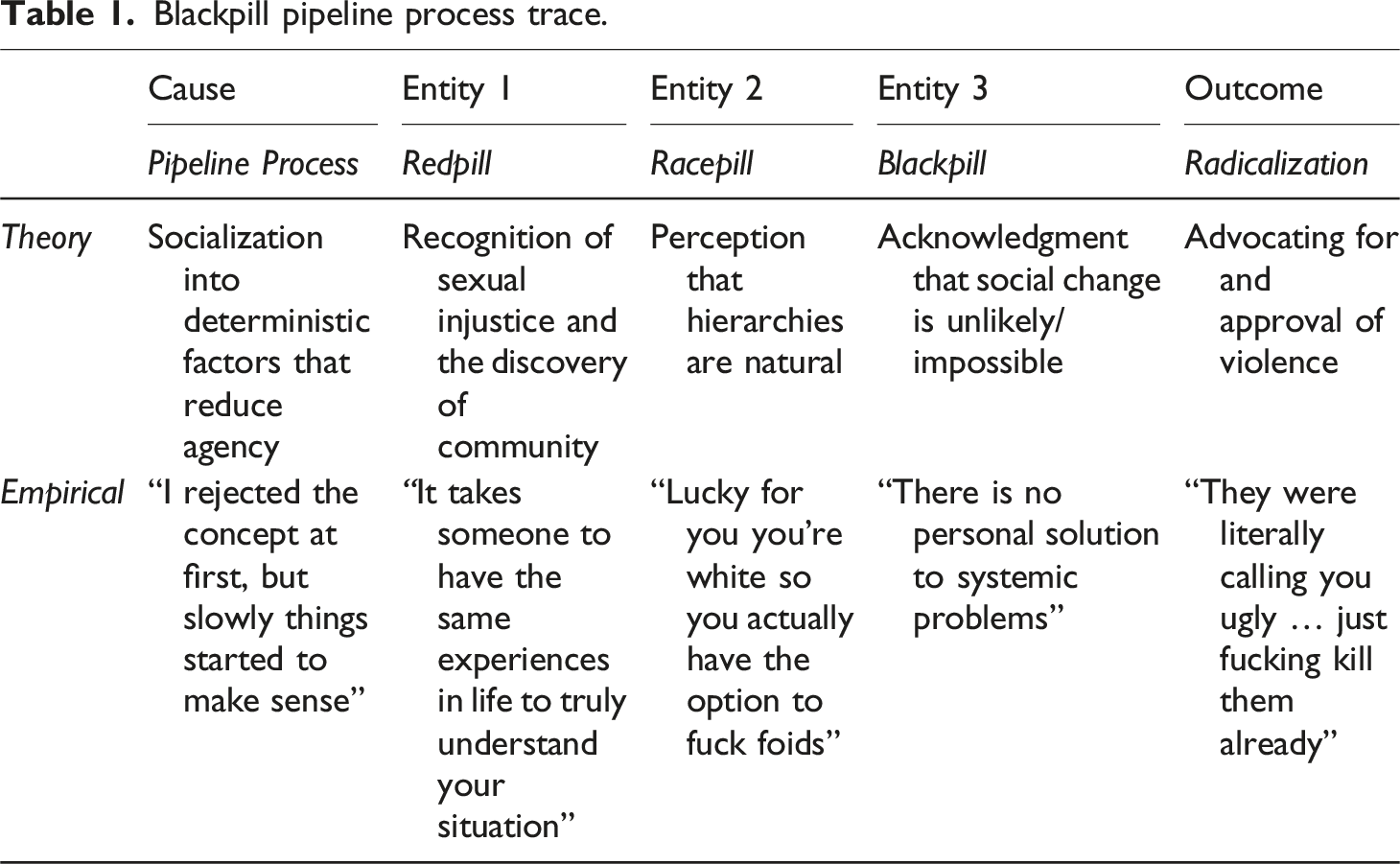
This relationship between sex and political power results in a series of hierarchical categories that move Incels along an ideological process that becomes increasingly violent and fascistic. First, new members are introduced to Incel culture based on their lack of ability to achieve sexual relationships via the redpill. Next, this is followed by a transition into an acceptance of their ascribed status via race or other sociopolitical factors, nesting them within the overall Incel hierarchy, via the racepill. Finally, the most extreme members will take Incel ideology to its static conclusion, advocating for and approval of violence, “blackpill” radicalization. This socialization process creates a kind of filtering effect, wherein each step concentrates members, suggesting an observable causal mechanism. Beach and Pedersen emphasize that causal mechanisms need to be understood in a systematic way. That when they are reduced to mere variables or limited to counterfactuals, they do not reveal the actions that take place between the cause and outcome. Instead, each aspect of the mechanistic process can be described “in terms of entities that engage in action”(p. 38). In this framework, the Incels hierarchy of “pills” becomes more than labels and levels of membership, but short-hand for the empirical fingerprints of a process that filters in the most susceptible members to that level of radicalization while maintaining existing members in their current categories. Ultimately, this process results in an outcome of a static ideology, advocating for and approving of violence done in the name of the group. This process is encapsulated in the Incel “pill” language, which comprises a complex dogma on how traditional gender traits and actions are both correlated and cause of their idealized political worldviews. And this language is one of the most important aspects of building a “mutual truth” based on Incels’ shared experiences (Charmaz 2006; Lindgren et al., 2011).
The Blackpill pipeline
Incels use ideological purity and adherence to subcultural values to define and categorize their place within the culture. These factors place members along a continuum that reifies their membership in the community and affirms their “level” within Inceldom. The titular quality that makes an Incel is their inability to achieve sex with women. 8 They talk about purity of the ideology based on ability (or lack of) to have sex, as well as race, and socio-political agency. Each of these factors combines to form the complex internal hierarchy of Incel culture. As a result, a subculture of hate is formed which spurs animosity over modern culture, advocating for and approving of violence.
This hierarchy has been explored in other research (Daly and Reed, 2021; Fowler, 2021), but there has been little analysis on the process of moving from one category to the next. This research examines the movement through this continuum and the process that facilitates it by way of tracing how ideological purity is tracked and what each step entails (Beach and Pedersen, 2019). This pipeline process moves the member closer to “the blackpill,” the most ideologically pure and extreme position held by Incels.
This process is important because it shows that members of Inceldom are dynamic and constantly moving toward radicalization: A process that is deviously unidirectional but is not rigid. For example, an individual can join the Incel movement and go straight into the part of the ideology that racializes why they are unable to have sex. This imperfect process allows people to filter in at any point and does allow for leaving the movement (albeit with low chance of success). Incels ascribe to the belief that they may one day “ascend,” leaving Inceldom through acquiring sex with a suitable mate; yet when discussed, it is roundly rejected as a possibility. Instead, they only readily acknowledge the downward extremist path within the subculture. This is best portrayed by one user who pointed out that with each successive step in the pipeline process they see the previous as a state of delusion, until they reach the “ultimate truth” of the blackpill. This is the irony of looking at this sub as a blackpiller. It’s basically like the bluepill vs redpill, except you guys are the bluepillers. More hope, more of the “we’re all gonna make it with our smv increasing techniques” (game, lifting, careermaxing), less retarded nihilism, in exchange for less overall [sexual market value] increasing techniques, so basically similar to the standard blue pill “take a shower, get a haircut, smile” in comparison (example 2).
Example 2 shows that not only does each successive level of Inceldom become more extreme, but its progression is only one of further extremism. Others reflect this idea in comments like: “I rejected the concept [of the red pill] at first, but slowly things started to make sense” (example 3), and its progression into the blackpill, “I hope someday [members] will learn to handle the blackpill truth” (example 4). As seen in the example, once a member has been “blackpilled” there is no going back to previous stages, meaning that the longer they both stay within Inceldom and embrace its contextual “truths,” the more extreme they become. Each stage of the process begins with the acceptance of a new “pill” that affirms a core tenet of Incel culture and further engrains new members within the culture, beginning with the redpill.
(Lack of) sexual opportunity and the redpill
The entry point for any prospective Incel is their lack of access to sex. This, alongside having an “epiphany” about the negative aspects of feminism, is known as being “redpilled” (Ging, 2019): A reference to the film “The Matrix” (1999), wherein the protagonist must decide between the illusion of reality (the blue pill) or an uncomfortable “true” reality (the red pill). However, in the Incel version, the uncomfortable truth is that men represent an oppressed class and women are somehow in control of most aspects of life, with an emphasis on sexual gatekeeping. This aligns with previous work on Incel ideology by Ging, who states the redpill “purports to awaken men to feminism’s misandry and brainwashing” (2009, p.3).
This first stage for an Incel in the blackpill pipeline is an acknowledgment of their social ostracism due to their lack of access to sex. This then leads them to embrace their nascent culture more deeply, allowing them to feel a sense of both security and camaraderie in their newfound community. One commenter illustrates this when describing how only Incels can share in their experiences, and therefore this is the only place they feel they belong. Normies call it an echo chamber, true to some degree but at least you don’t get the absolute worst bullshit advice like “keep trying”, “get a haircut”, “buy a nice outfit.” It takes someone to have the same experiences in life to truly understand your situation. I don’t mind redpillers, but bluepillers are the absolute worst (example 5).
Within Incel culture, bluepillers are woefully ignorant of the experiences of redpillers. Incels also portend that this framework they’ve created is omnipresent, that it exists a priori, regardless of its acknowledgment by those outside of Incel culture. One commenter explains this, saying “You can be a blue pilled Incel. It just means you aren’t very smart or you just don’t know much about life yet” (example 6).
However, it’s simply not enough to reject “normie” culture, but their growing dissatisfaction also means creating a common enemy, both for themselves and the community at-large. Another commenter reifies this when they say, “I finally went redpill and started to despise my cuck/beta 9 friends” (example 7). This exemplifies how the initial acceptance of redpill ideology separates new members from their outside friends, family, and communities through the use of “us” versus “them” mentality (Daly and Reed, 2021) and creates a welcoming atmosphere by acknowledging the struggles of new members and introduces them to external reasons for their perceived failings.
When a prospective community member discovers Inceldom, they find a group who has coalesced around their frustrations with dating and sex. They reinforce that they believe they’ve been the victim of a social construct that places them at a disadvantage. Their shared experience then validates these frustrations. This creates the fundamental Incel membership paradox: the further you are from sex, the more of an Incel you are. And though the stated overarching goal of Inceldom is to “ascend” (at least during this initial redpill phase), the internal hierarchy of Incels extols the members that are the furthest from achieving that goal.
This is most evident in their discussion of “trucels” as compared to “volcels” (true Incels versus voluntary Incels, respectively). One commenter discussed the violence wrought by the Isla Vista shooter and how, though he was lauded by the community, due to his wealth and relative attractiveness, the shooter wasn’t “really” an Incel: “Wrath can make a person go blind, he wasn’t a trucel by a longshot, but he was still a champion of the people (and by people I mean us, normies aren’t people).” 10
This first step in Inceldom is the most important because the acceptance that the world they inhabit is somehow false, or worse maliciously misrepresented, opens the door for the subculture to instill other beliefs and values. Once a new member begins to embrace Incel culture, the initial reason for joining seems to fall by the wayside as members become increasingly interested in two apparently contradictory goals: first, the subjugation and villainization of women; and second, subcultural validation through the rejection of “ascension.” One commenter illustrates the communities’ relationship to ascension, holding it up as a possible solution to new redpillers, while seeding the idea that it’s not a viable option. “I don’t find the stories [of ascension] particularly interesting or detailed enough to mention, but it is possible, although EXTREMELY rare, for an Incel to ascend” (example 8).
This lays the groundwork for keeping new members within the fold of Inceldom. The acknowledgment of a shared struggle, followed by a solution that leaves the new member blameless, creates a framework where women (and non-redpilled others) are cast as enemies.
One member encapsulates this in a scenario where they were interested in dating a coworker prior to joining the Incel community, but now views her differently. I had an 8 hour shift with the town thot
11
and she had the nerve to talk shit about this dude who poured out his heart to her. Now here she is the next day telling me how much of a bitch he is and sharing his business with me, shit that he shared with her in confidence and in the confines of his bedroom. But of course this slut doesn’t give a fuck because she just thinks her doormat of a pussy was made by God’s right hand (example 9).
The community then uses the member’s experience to reinforce the Incel version of social hierarchy with one explaining why sharing intimate details with a woman should be avoided at all costs. This is very important. I think it can signal low status and scarcity. You’re telling everything, which shows that maybe sex isn’t a common occurrence for you. It’s also low status. She’s suddenly higher in the hierarchy and is worthy to hear all your inner shit. Why would a man of higher status start telling all his secrets to someone lower in the food chain? …You could be telling your most intimate stuff, but if it makes her feel less attracted she might tell all her friends you’re a sappy loser (example 10).
Here, the blackpill pipeline comes into full view, a new member is imbued with the values of the community that demonstrate the importance of status, including the shame of being low status; having women be in a subordinate status; the risks of appearing vulnerable; and that sexual prowess is both correlate and cause of these socio-political positions. The new member is not merely comforted for their lack of access to sex through the shared experience of others, instead they are guided toward increasingly radical positions where violence is both advocated for and approved of due to the removal of agency because of their diminished ascribed social status.
Racism and the racepill
One of the most pervasive cultural positions within Incel culture is its racism. Over time within the subculture, Incels laud race as a sort of rallying cry, seeing those who are white as superior and categorizing races in a hierarchy of their own. To them, race defines an innate hierarchy that’s slowly being dismantled by society. This feeling of race becoming ancillary is a result of society becoming more integrated, which most Incels see as an erosion of power for the group they find to be most deserving: white cishet men.
Incels often harken back to imagery of the mid–20th–century patriarchy, where men, and specifically white men, had near total control over social institutions. They believe culture has moved away from its proper “natural” hierarchies and that “tradition” is the cure for these issues. One member notes, “we are in this mess because of birth control pills and the lack of traditional marriages. If you look at marriage statistics and the rise of Incels you will see the correlation” (example 11).
The Blackpill Pipeline is procedural in that it slowly and methodically opens members of the community to radicalization, and their views on race are one of the most apparent places this process presents itself. By using the guise of “tradition,” Incel culture draws in new members and extols the viewpoint that innate hierarchies simply mirror nature. That women should be subordinate to men, and that a society and culture oriented toward the desires of cishet men are not only appropriate but also superior to all other configurations.
This dedication and deference to tradition is how Incels introduce their views on racial hierarchy.
12
Chads (the Incel’s standard bearer for traditional masculinity) date Stacys (the standard of acceptable femininity to Incels). And when Incels discuss the goal of sexual conquest, Stacys are archetypally white, blonde, and young. Yes, a Stacy could be of another race or ethnicity, but these features will become qualifiers of the individual. One commenter, a self-identified “ethnicel,”
13
points this out in a thread about the Incel’s disapproval of race mixing and the importance of the hierarchy of race. I am so envious of you white men. Not only the most attractive women you have but your women are also THE most racist group of foids.
14
They would rather put a bullet through their brain than date a curry or sandcel.
15
I am so fucking envious. Your skin and eye colour I want it. Now (example 12).
Another commenter, a self-identified mixedcel,
16
continues this idea when they respond to a white member that was rejected by a Stacy. Your race caused this, including mixedcels like me who didn’t inherit enough white features. Other races are uglier on average, but you’re ugly too. Luckily for you you’re white so you actually have the option to fuck foids of other races near your looksmatch, instead of a 1/10 white foid. Ethnicels don’t have that option (example 13).
Incel’s views on hierarchy are not so subtly hidden within its calls for traditionalism. In one particularly revealing conversation, the community discussed how they should formally join forces with the alt-right political movement to enact the changes they want to see in society. They note their shared interest in “traditional” values as the foundation of this alliance, claiming that both blame the decline of the patriarchy as the reason for the rise of Inceldom.
One member points out that when Western society was more traditional, dominant groups were more aware of their position in society. “Whites were racially conscious and redpilled on females until the sexual revolution occurred, which was led by mostly Non-white (Jewish) Marxists” (example 14). This sentence is particularly telling since the commenter connected the “redpilling” of men concerning the role of women in society, with a specific racial group—whites.
Often the presentation of race as a traditional hierarchy starts with the concept of JBW, “just be white.” Once a new member is introduced to Inceldom through the shared experience of dating troubles, they are presented with the advantages of white privilege as merely another misaligned hierarchy, similar to and an extension of gender. And in this scenario, white privilege is seen as a constant and simply another level of natural hierarchy that members must either tacitly or expressly recognize. One commenter suggests that many Incels are POC, yet reaffirms that white privilege is the standard. The majority of Incels ARE ETHNIC, it’s like trying to recruit blacks into the KKK and wondering why you don’t have “any takers,” it’s like these guys don’t have any self awareness. The white race has it the easiest when it comes to getting laid as their typical looks are considered the universal standards of attractiveness. Not only that, having a white partner is a symbol of social status, especially for ethnic women, because the white race is seen as the world’s “conqueror race,” that’s never going to change, it’s an established historical fact (example 15).
And though the community debates these topics frequently—there was even a thread titled “racial allegiance is an extremely blue pilled cope,” and anything connected to the bluepill is considered a failure to recognize redpilled reality. Overall, their justification for Inceldom’s racist tenets is that ultimately they would benefit Incels. One commenter thought strict ethnostates where members of other races would be displaced and returned to ancestral homelands would ultimately lead to traditional patriarchy and improved the social position for Incels. An ethnostate would essentially improve the lives of ethnicels as they wouldn’t get exposed to the evil hypergamy of white women anymore and return to their patriarchal lands. Moreover, global anti-miscegenation laws would benefit ethnicels the most since JBW game wouldn’t work outside the West (example 16).
However, in order for Inceldom to flourish, the culture must frame itself as losing an on-going battle, creating a common enemy and fueling the sense of injustice at their ascribed status, be it gender, race/ethnicity, or class.
17
This step in the blackpill pipeline process shows that even if Incels achieved their desire to reshape society in a way that benefits them, they’d still be dissatisfied because their identity as an Incel depends on their status as an embittered underdog. A commenter explains that even if the world were to be completely reshaped to cater to the desires of men, they would still be shunned from society and denied their perceived rightful place. Your one race utopian vision seems quiet ambitious and commendable, but what you’re failing to see is when this indistinguishable shade of brown monorace will be created, only the best men (a.k.a Chads of every race) will be picked out along with best to average of foids (a.k.a Stacys and Beckys) many of us Incels won’t be allowed to participate in it for our apparent shortcomings. So why should I rally behind that? (Example 17).
Here the commenter even acknowledges that this new society would be a utopia, yet there would still be no place for the Incels amongst this newly constructed world. Incels identify themselves as the bottom of the spectrum of political agency, keeping them from achieving their political ends. But, ultimately these racial debates amount to little. This is because race is merely another example of the way Incel ideology takes the nascent experience of rejection among members and uses it to reshape their beliefs, ultimately accepting that change is impossible for Incels because of static ascribed statuses. “You’re both right and wrong, racial loyalism does benefit an Incel but the amplification of the ideology itself on a society/nation is what’s impossible in these times” (example 18). The blackpill pipeline treats radicalization as a logical progression: from rejection by women, to anger over perceived injustice due to inferior status, to frustration over the lack of agency to change society to their will, finally to violence—either against others or themselves.
Violence and the Blackpill
Once a member has fully embraced the worldview of Incel culture, they reach the final stage of the Blackpill pipeline. One member simply explains its foundations: “Blackpill is just the notion that there is no personal solution to systemic problems” (example 19). This lack of agency is due to social structures that they claim are static within society. The easiest way to illustrate this is with the core concept of the redpill: that Incel problems are a result of “lookism,” the concept of good looks and sexual desirability are social constructs, as such, Incels cannot personally change them, therefore blackpill violence—both against others and themselves—is not only an option, but importantly, it’s the prescribed response to the injustice of a system built on unchangeable arbitrary characteristics.
What makes the blackpill so pernicious is that the extreme response to their perceived social position is logical and reciprocatory. One commenter succinctly described it with: “Foids hate us. It is natural to respond with hate” (example 20). This is the core of the blackpill rationale. Incels believe they are mistreated because of their looks (and other ascribed statuses), and this mistreatment creates a new shared reality where their extreme beliefs, language, and behavior are not only accepted but also requisite. One commenter explains that this is the foundation of their perceived injustice. In life whether interactions are gonna be good or bad only depends on your looks. … The blackpill is this: The treatment from people you received your entire life was only because of the way you look e.g. People were more aggressive towards you simply because of the way you look and the impression they get from you. No need to act like that is not the reason. Every truecel deep down knows why people are so shit to him (example 21).
This differentiation of the function of violence is important because it places Incel violence in the category of a positive response, rather than an undesirable or unfortunate side-effect of their perceived injustice. It would be easy to say that not all Incels, or even all blackpillers, progress to violence, but the purpose of the blackpill pipeline is not to simply acknowledge the powerlessness of the individual to enact structural change but to extol that violence is the proper response to this injustice. This is most clear in the more extreme examples cited by Incels. In one thread, a young man lives with an attractive male roommate (a “Chad”), who brings a woman (a “Stacy”) back to the dorm room late at night. I dorm in uni with a Chad roommate and it’s daily [suicide] fuel. He comes in the room at 3am and is with some Stacy who wants to fuck him. I offer to get out of the room because I don’t want them to fuck next to me, and he said “No, we’re literally just sleeping” so I said ok and walked back to my bed. JFL [just fucking laugh] that was a lie. I start to fall asleep but am woken up by the roommate whispering “do you think he’s asleep?” Then I hear this wet and rubber noise and I realize that the Stacy is sucking his dick 5 feet away from me IN THE SAME ROOM AS ME. …[T]hey see me with my hands on my head while sleeping and Stacey whispers loudly “who does that? he’s CRAZY! he’s SO WEIRD! he SLEEPS like that!” and they both laugh and talk trash about me, saying that I look ugly when I sleep—(example 22).
The community responded to his story overwhelmingly with calls for violence. Most of these responses were general, “Normies need to be shot and killed” (example 23). And another suggesting “throw fucking acid in their face” (example 24). But many connected the incident to the causal need for violence. “You got cucked. You should have killed both of them” (example 25), and “They were literally calling you ugly while you pretended to be asleep, just fucking kill them already” (example 26).
This further illustrates the point that the blackpill is not simply an acceptance of existential social powerlessness but instead a call to action to respond to this powerlessness with the logical response of violence. One member even states “This is why shootings happen” (example 27), Placing the onus of violence on “Chad” and “Stacy” for the isolation that blackpill Incels feel. Blackpill ideology is a fundamental loss of hope in one’s ability to change society, through a process of the removal of agency, perpetuating suicidal ideation and encouraging them to take their enemies with them. One commenter reifies this idea by saying “Srs [serious] I would have gone ER on them” (example 28), invoking the Isla Vista shooter who ended the lives of six people and wounded fourteen others, before taking his own life.
Once Incels embrace their lack of ability to change society as they see fit, they increase their extremist rhetoric and calls for violence—on both a personal and social level. Usually, this stage begins with the most well-documented and obvious of Incel enemies: women. One user illustrates this after an unsuccessful first date. I had an epiphany. Every single date that I have ever had as a result of approaching
18
or before that has always ended the same way WITH THE WOMAN SAYING - REALLY NICE MEETING YOU and then the inevitable ghosting THE CONCLUSION IS PRETTY SIMPLE ---- REALLY NICE MEETING YOU = NAH, I NEED SOMEONE ELSE, SOMEONE BETTER. SO, IF A BITCH ENDS YOUR DATE LIKE THAT “KILL HER” (example 29).
These kinds of excessive statements are common in Incel culture, yet often when Incels speak on the violence inherent in their culture, they claim that these kinds of sentiments are not representative of the aims of their community. Following the Tallahassee yoga shootings, one of the administrators of a popular Incel message board was quoted as saying “A minority [of Incels] seems to have some anger toward women, yes. For the vast majority, there is no hatred” (Beauchamp, 2019). Yet, it takes only a cursory glance at an Incel message board to see how farcical this comment is. Incels discuss women more than any other topic, and the overwhelming majority of these comments are framed negatively, and very often violently.
Following the statement in example 29 above, the majority of users discussed the futility of “approaching,” whereas others echoed the sentiments of the original poster, and none voiced any disapproval at the core conceit that violence against women for rejecting them is appropriate. These kinds of responses aid in the pipeline process. Not every member of the Incel subculture will become blackpilled, and not all blackpillers will become violent against others, but the expressed approval of these ideas makes it clear to all members that the pipeline progression from redpill to various forms of intolerance to blackpill despair to violence is not just an acceptable transition but the perceived appropriate one. One commenter explains the depth and totality of the blackpill perspective and the logical ending of the radicalization process, a desire to end their own life from hopelessness. I am blackpilled and Incel. It’s not a cope. Its literally saying fuck you to women and doing what I want. I know they don’t want me. I lie down and rot because that’s all my body permits me to do. Not because I’m sad about Stacy. I don’t care that Stacy doesn’t want to fuck me anymore. I’ve seen Stacy’s true nature and don’t want anything to do with her anymore. Fuck all Stacys and Beckys. I’ll go my own way (example 30).
The concept of LDAR (“lay down and rot”) exemplifies the advocating for and approval of violence the blackpill extols, turning violence—be it fast or slow—into the prescribed response to their perceived powerlessness. This also reveals the first, often unidentified, victims of Incel culture: Incels themselves. Though not every Incel will become blackpilled, and every blackpilled Incel will not turn to violence, the hopelessness associated with the static ideology of the blackpill is harmful to all who come into contact with Incel culture. The blackpill pipeline is a social process that pushes Incels though increasingly extreme stages of radicalization, placing them along a hierarchical spectrum, removing agency, and advocating for violence, until their entire observed reality is reflective of this worldview.
Discussion
The blackpill pipeline is a process that facilitates radicalization. This is to say that not every member of the Incel community will or would become violent, but it is important to acknowledge that the pipeline exists as a valid and reliable path to affirming violence as a logical and appropriate response to the perceived slights of members. Importantly, this process is neither linear nor stepwise but instead should be conceived of in a Kuhn (1962) sense, wherein a cyclical process keeps Incels within their chosen category until enough “anomalies” spark a “revolution” to move them to the next phase of the continuum.
Entrance into the Incel subculture is functionally very easy. New members identify that they have difficulty dating and perceive their poor social performance as a flaw in existing society, casting themselves as victims of an unacknowledged injustice that is directly related to the advancements of women and (to a lesser extent) other marginalized groups.
Once members accept their diminished position in the overall social strata, presenting them with new hierarchies is part of the process of realigning their world view. Members often discuss how foolish they felt when they were a “bluepilled normie,” unable to see the folly of their previous worldview. Once members accept that “Chad” and “Stacy” are in a heightened position of power, pointing out other “natural” hierarchies around race, ethnicity, or class becomes the next step in the process.
The acknowledgment of these previously unrecognized power hierarchies then moves Incels along the pipeline to the next realization, which is the frustration of their inability to move society, or more aptly themselves, to a more advantageous position. Yes, introductory conversations often focus on “maxing,” 19 and other techniques to meet and impress women, but ultimately, continued exposure to the Incel subculture leads to despair over their failure to achieve these goals. This moves members to the final stage of the process, the blackpill, which advocates for and approves of violence as a logical and expected response to their misplaced status.
Often members will celebrate the violence of others or affirm its effectiveness. This juxtaposes the common excuse that the violent rhetoric of Incel forums, and blackpill members specifically, is “just a joke,” but there are two issues with this premise: (1)the consistency of this hyperbole and (2) “Poe’s Law” of the Internet. First, it may be true that commenters who repeatedly and vehemently applaud violence are merely expressing their frustration in “colorful” language (even the quote by the administrator in the above section is couched in comments about their acceptance of “politically incorrect” language), but how are new and existing members able to discern the difference between “venting” and the fundamental beliefs of the culture when these sentiments are voiced so frequently? Secondly, it is nearly impossible to discern the difference between a sincerely held belief and a parody of that very same position in virtual spaces. This adage of Internet culture has become known as “Poe’s Law,” after a 2005 comment on a creationist message board where user Nathan Poe joked that you could not parody beliefs on the Internet without people presuming you were being sincere. The outcome of these two issues is that as digital architecture elevates the voice of the most extreme members of a community, their radical rhetoric and positions are perceived as core tenets of the community, perpetuating the radicalization cycle (Lessig, 2009). 20
But, the ubiquity of this violent rhetoric may indicate that the blackpill pipeline is not a radicalization process at all but merely a confirmation of already existing prejudices amplified by self-selection bias. But this would discount the need for fertile ground to produce violence and the importance of subcultural contexts in normalizing deviant behaviors. The empowerment of group members is contextual. They look to the community to affirm their beliefs and encourage their behaviors (Zimmerman, 1995). In this sense, radicalization will always be a self-selection process. Blackpilled members are already present when they are introduced to redpill ideology, in essence, validating their beliefs and diminishing agency with each step in the process, in turn removing culpability for those beliefs and behaviors. The blackpill pipeline does not ensure violence as an outcome, but instead it is the advocating for and approval of violence done in the name of their ideology, that the process reliably produces.
Conclusion
The blackpill pipeline is not simply a descriptive process but rather a prescribed subcultural process where each step further solidifies a skewed worldview that implores violence, not as an unfortunate outcome, but instead as an intended response to the removal of agency. This process acts as a filter, rewarding Incels for their ideological purity with support and adulation. Not every Incel proceeds through the entire pipeline and embraces violent action, but the overwhelming majority of members endorse violence, and especially violence against women.
The pipeline also is both efficient and effective in its recruitment of new members and the act of moving those members through the various ideological thresholds. New members enter Inceldom because of a shared experience: rejection by women, but then the pain and vulnerability of these experiences are exploited to ingrain members deeper into the subculture. The first litmus test as to the dedication of new members is their willingness to embrace a variety of prejudices. The first and most obvious is a gender intolerance against women, allowing the subculture to redefine the identity and roles of gender into a relationship of pure hierarchical conflict. If the member is favorable to this kind of skew, then they’re free to embrace the racial, ethnic, and class biases of the subculture as well.
If a member embraces the internal logic of redpill ideology to further accept the Incel worldview, they will soon come upon the blackpill, the most extreme of Incel categories. The blackpill reframes the perceived reality of Incels to include a hopelessness that reframes the struggle of Incels from a problem to be solved (rejection by women), to a social restratification (a return to the perceived strict patriarchy of the midcentury), to a holy war (a recognition that society will not change and violent reprisal is the only acceptable response).
The blackpill pipeline is a prescriptive process and though the causality of violence among men, and specifically Incels, is still being debated, the intent and directionality of this subcultural process are hard to deny. Inceldom exists to recruit new members, introduce them to an extremist worldview, and filter in the most susceptible and radical members.
Footnotes
Acknowledgments
Thank you Martin Cioppi for your hard work in assisting with the editing of this manuscript who served as a research assistant. Also, thank you to the Penn State Criminal Justice Research Center (CJRC) for their backing in the research associated with this work.
Declaration of conflicting interests
The author(s) declared no potential conflicts of interest with respect to the research, authorship, and/or publication of this article.
Funding
The author(s) received no financial support for the research, authorship, and/or publication of this article.
