







Abstract
Indian mental health providers have suggested that the Hindu scripture the Bhagavad Gita (“Gita”) could be a source for psychotherapeutic interventions. This raises questions about how mental health practitioners have interpreted relationships between the Gita and psychotherapy, how these interpretations construct selfhood, and how these interpretations of selfhood relate to commentaries from Hindu religious scholars. This paper answers these questions through a critical narrative review of studies on the Gita and psychotherapy, along with textual analyses of authoritative Gita commentaries, analyzed through the pattern theory of the self framework. An April 2025 search for studies that explored psychotherapy and selfhood in the Gita in five databases along with forward citation and backward bibliographic analyses uncovered 17 studies, all suggesting that principles of the Gita could be used within psychotherapy, with eight studies naming cognitive behavioral therapy. Thirteen drew on Hindu concepts of ātman, dharma, and karma to postulate an ideal self to help patients reflect on thoughts, emotions, and behaviors. Authoritative commentaries from Ādi Śaṃkarācārya, Swami Vivekananda, and Swami Chinmayananda show that ātman as the eternal soul, dharma as morally prescribed behaviors, and karma as actions without expectations of results have religious connotations without equivalents in Euro-American forms of psychology. A post-colonial approach to psychiatry can read the Gita alongside its commentators—ancient and modern, religious and non-religious—to uncover ways of conceptualizing selfhood before assuming that religious concepts have direct correspondences with psychotherapy.
Introduction
The Bhagavad Gita (“The Holy Song” in Sanskrit, henceforth “Gita”) is a text of 700 verses with pan-Hindu influence that contains the words of Krishna, a figure whom Vaishnava Hindus consider to be God in an incarnation of Lord Vishnu (van Buitenen, 1981). The World Religion Database at Boston University estimates that there were over 396 million Vaishnava Hindus in 2020, making it the largest movement in Hinduism (Zurlo, 2025). The Gita was likely composed in the first or second century of the common era as part of the Mahabharata epic, and a scholar of Hinduism has summarized the Gita in this manner: On the brink of a great battle between warring branches of the same family, Arjuna is suddenly overwhelmed with misgivings about the justice of killing so many people, some of whom are his friends and relatives, and expresses his qualms to Krishna, his charioteer—a combination bodyguard and court historian. Krishna's reply expresses the central themes of the Gita. He persuades Arjuna to do his duty as a man born into the class of warriors (Kshatriyas), which is to fight. (Doniger, 2025)
Recently, newspapers in India have publicized non-violent interpretations of the Gita for mental health. In 2017, the President of the Indian Medical Association stated, “What we call cognitive behavioural therapy [CBT] in allopathy came from Bhagavad Gita. Arjuna, who gets an acute panic reaction in the battlefield, goes to Krishna, who holds 18 counselling sessions” (Kaul, 2017). A practitioner of Ayurvedic medicine won prizes at the World Sanskrit Conference in 2023 for his paper “Nutritional Psychiatry Concepts in the Bhagavad Gita” (Dominique, 2023). And a psychologist in India writes, “According to Gita, an attachment is essential, but detachment is also equally important in our daily activities (5.10). This helped me in my relationship with clients” (Kumar, 2024).
Attempts to identify psychological practices in the Gita have led to technological solutions that rely on its religious authority for widespread dissemination. In 2024, Microsoft announced that it would fund the world's first controlled, generative-artificial intelligence, CBT-based application named IWill GITA to offer six sessions for mild to moderate anxiety and depression, targeting 615 million Hindi speakers in India (Tanase, 2024). The founder of IWill GITA stated that, “IWill GITA is CBT-based & inspired by Lord Krishna's ethos and the immense significance of GITA” (KRON4, 2024). CBT emerged in the 1960s (Nakao et al., 2021), nearly two millennia after the Gita (van Buitenen, 1981), prompting three questions pursued here: How have mental health practitioners interpreted relationships between the Gita and psychotherapy? How do these interpretations construct selfhood? And how do their interpretations of selfhood relate to commentaries from Hindu religious scholars?
I answer these questions through Shaun Gallagher's (2013) pattern theory of self (PTS), a framework to compare selfhood across cultures. Gallagher (2013) argues that, “We think of these aspects as organized in certain patterns, and that a particular variation of such a pattern constitutes what we call a self.” The PTS—detailed ahead—is a typology to identify these pattens (Gallagher, 2013). Psychiatrists and psychologists have established that psychotherapy knowledges and practices depend on patterns of selfhood that are culturally constructed. As Laurence Kirmayer (2007) notes:
Effective psychotherapy must appeal to values that are intelligible in terms of the individual's cultural background even as it articulates the tensions between traditions and new choices or opportunities brought by social change or migration. Every cultural community embodies a distinctive concept of the person. (p. 251)
Sociocultural practices impose moral obligations, prescribe/proscribe behaviors, and inform conceptions of our ideal selves (Daly et al., 2024). Models of selfhood underlie goals in psychotherapy, such as the psychoanalytic model that brings unconscious aspects of the self into conscious awareness (Kohut, 1977), the humanistic model that promotes authentic self-expression (Rogers, 1951), or the narrative model that traces the self's shaping through stories and cultural contexts (Neimeyer, 2009). Cultural patterns of selfhood underlie models of psychotherapy, justifying why scholars should examine attempts to draw equivalences between psychotherapy orientations and the Gita.
Accessing the Gita and its commentaries raises questions about intercultural dialogues. As the anthropologist Giles Bibeau (1990) observes:
We have to become fully aware not only of different conversational styles, of specific cultural roots and turns of mind, but also of world geo-politics that give power to a few and impose dependance on others through the hegemony of a limited number of languages and the dominance of certain theories and intellectual styles. (p. 299)
To diversify data beyond Euro-American samples, cultural psychologists recommend comparing theories about selfhood in texts around the world (Muthukrishna et al., 2021). Researchers advancing a postcolonial psychiatry have endeavored to recover theories and practices from different intellectual traditions without pre-fitting them into Euro-American theories (Kirmayer, 2020). Ahead, I undertake a critical narrative review to analyze writings from mental health providers about the Gita through the PTS, explore similar concepts in authoritative commentaries within Hinduism, and discuss conceptual convergences/divergences, consistent with explaining assumptions and findings in intellectual traditions on their own terms before fitting one in terms of the other (Aggarwal, 2025). I demonstrate a paradox in using the Gita within Euro-American psychotherapies: whereas mental health professionals suggest that the Gita's teachings can strengthen the reflective, cognitive, behavioral, and emotional aspects of the self, the Gita also emphasizes unique concepts like the soul's eternal nature, a religious conception of human duty, and moral conduct as the basis of behavior. Not all patients may believe in these concepts, warranting caution before introducing the Gita in psychotherapy. Moreover, the ways that professionals translate terms like ātman, dharma, and karma for psychotherapy depart from authoritative religious understandings.
Reflexivity prompts researchers to consider how identities influence study questions and research designs (Brown & Lloyd, 2001). I acknowledge my education as a cultural psychiatrist with graduate training in South Asian medical and linguistic anthropology. I was the campuswide Hindu Fellow through the Chaplain's Office at the university where I completed my psychiatry residency. I identify as a practicing Hindu who reads Hindu scriptures. I publish on concepts of selfhood and psychopathology in texts written in South Asian languages, pursuing dialogues across psychotherapy and Hinduism. Methodologically, I work across paradigms with different conversational styles in the health research and South Asian intellectual traditions.
Below, I report the results of a critical narrative review of studies on psychotherapy and the Gita. Narrative reviews are non-exhaustive, flexible interpretations of studies whose goal is to provide new theories by synthesizing studies across research traditions (Greenhalgh et al., 2018; Horsley, 2019). The Hindu Sanskritic commentarial tradition does not share assumptions in health scholarship, namely that a single material reality exists that can be empirically tested through the body's five senses (Gordon, 1988). Instead, the Hindu Sanskritic commentarial tradition values debate over ideas (Goneri, 2010).
The Gita in Mental Health Scholarship: A Critical Narrative Review
Critical narrative reviews synthesize theories across research traditions through qualitative analyses (Grant & Booth, 2009). Javeed Sukhera (2022) notes that, “Critical reviews involve an interpretative process that combines the reviewer's theoretical premise with existing theories and models to allow for synthesis and interpretation of diverse studies” (p. 416). Unlike systematic or scoping reviews, critical narrative reviews do not have consensus guidelines. Sukhera (2022) posits that a critical narrative review should report search terms, databases searched, inclusion/exclusion criteria, and a framework to analyze studies. Others disagree that search methods and the analytical framework need reporting (Grant & Booth, 2009; Gregory & Denniss, 2018). For transparency, I follow Sukhera's (2022) guidelines, sharing his perspective that the goal of a critical narrative review is synthesis and critique, not an exhaustive tabulation of studies as in a systematic review.
Search Strategy
In April 2025, I undertook a critical narrative review of peer-reviewed journal articles with the aim of using the PTS to analyze how health professionals have interpreted the relationship between the Gita and psychotherapy, and how their interpretations rely on constructions of selfhood. As Derek Hook (2003) observes, there is no definition of psychotherapy that would satisfy everyone, but he broadly defines psychotherapy as:
a one-to-one verbal engagement between a practitioner of sorts, a psychotherapist, generally a psychologist, psychiatrist, counselor or mental health professional—that is, a particular kind of professional listener or healer—and a layperson, a client, a patient, that is, a subject of such professional interventions, someone in “need of help”, a sufferer, or an individual seeking greater self-knowledge or insight. (p. 606)
I used his conceptualization rather than restricting my review to practices specific to psychiatry or psychology.
I searched the databases PubMed, PsycInfo, Embase, CINAHL, and the Cochrane Library from their inception date to the present without language restrictions, as these databases index the most psychiatric and psychological studies worldwide (Löhönen et al., 2010). To ensure that the most articles were screened for inclusion, I undertook preliminary searches in each database to discover the subject terms by which studies were indexed (Montori et al., 2005). I paired different transliterations of the Gita from Sanskrit into English with those for psychotherapy and counseling, using Boolean search terms to capture suffix variations, such as “psychotherap*” for “psychotherapy” and “psychotherapeutic.” Table 1 lists terms entered into each database, along with numbers of results.
Details of Database Searches.

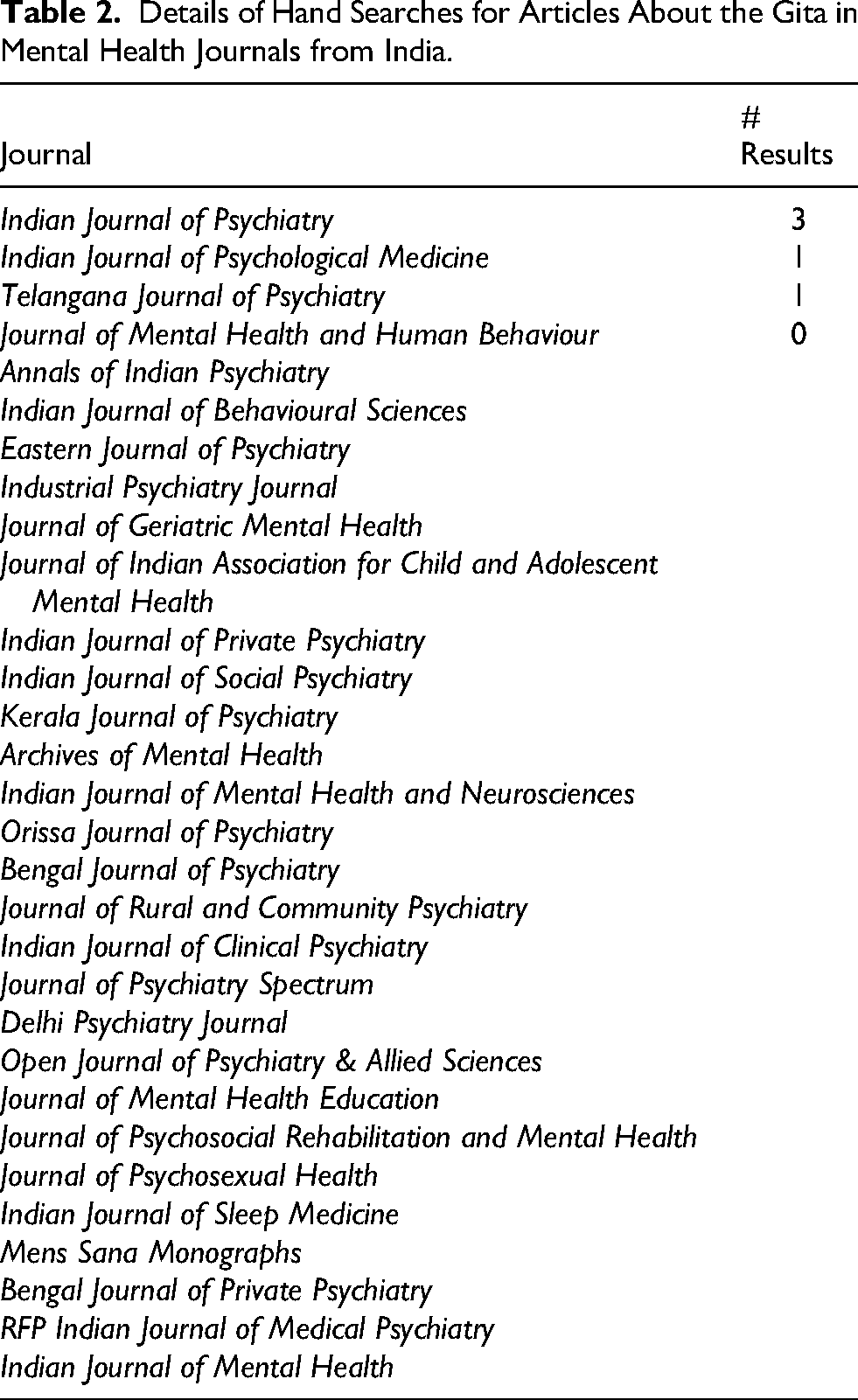
Not all Indian medical journals are indexed in global medical databases because of variations in study quality and peer review (Satyanarayana & Sharma, 2010). So as a second step, I searched for articles by screening titles for references to the Gita in back issues of the 30 most circulated mental health journals from India (Praharaj et al., 2022), shown in Table 2. Of the world's 1.1 billion Hindus, 94% live in India (Evans, 2022), so I reasoned that relevant articles absent from international databases would be in Indian mental health journals.
Details of Hand Searches for Articles About the Gita in Mental Health Journals from India.
Articles of interest were screened by reading titles and abstracts according to predetermined, narrowly defined inclusion criteria for relevance to mental health professionals. The inclusion criteria were: any studies that appeared in peer-reviewed health journals describing the use or relevance of the Gita in psychotherapy and that made claims about the self. For this review, a “study” was defined as any presenting original empirical findings, systematic analysis, or conceptual scholarship relevant to the topic. Eligible evidence could include quantitative, qualitative, mixed-methods, and theoretical publications. The exclusion criteria were: studies that did not report on the relevance of the Gita in mental health, such as Gita-based interventions for patients with physical illnesses; studies that did not relate the Gita to psychotherapy, such as those discussing psychological concepts like wisdom, resilience, or personality development without clinical application; studies that did not make claims about the self in postulating relationships between the Gita and psychotherapy; studies not in mental health journals, such as those in religion or philosophy journals; studies that were literature reviews of other studies; and studies that were not peer reviewed, such as master's theses, conference abstracts, doctoral dissertations, or book chapters. Excluding non-peer-reviewed sources would limit results, but peer review appraises the validity, accuracy, and reliability of findings (Sackett et al., 1996).
Screening, Data Extraction, and Qualitative Analysis
I assessed each retrieved paper following these inclusion/exclusion criteria, compiling a single list without duplicate records. I debriefed with a research assistant, another psychiatrist of South Asian ancestry with a master's degree in anthropology, when eliminating irrelevant studies to ensure that my reasoning was valid. Articles assessed for eligibility were retrieved in full to determine inclusion/exclusion criteria. After producing an initial set of included studies, I conducted forward citation analysis and backward bibliographic snowball sampling until no additional papers met inclusion criteria as a form of data saturation. Forward citation analysis was conducted by examining citations in Google Search since it covers more international, non-English language journals than Web of Science or Scopus (Meho & Yung, 2007). Backward bibliographic snowball sampling was conducted by reviewing titles in reference lists for relevant studies (Jalali & Wohlin, 2012).
Narrative reviews use content analyses as their qualitative method to interpret individual studies (Sukhera, 2022). Content analysis is a systematic method to describe phenomena through replicable, valid inferences from data (Krippendorff, 2013). To answer the first question of how mental health professionals have interpreted relationships among the Gita and psychotherapies, I analyzed all articles inductively by classifying each sentence based on whether authors mentioned any specific psychotherapeutic orientations and grouping relevant sentences into categories. To answer the second question of how authors construct selfhood, I used deductive content analysis, a way to analyze new data through a preexisting theory (Elo & Kyngäs, 2008). I analyzed each sentence of each article for text that could be interpreted through the PTS's definitions for different aspects of the self (Gallagher & Daly, 2018). The PTS posits that theories of selfhood involve patterns of 10 aspects: (1) minimal embodied aspects, which are biological and distinguish a self from non-self, (2) minimal experiential aspects, by which individuals experience a first-person self through sensory-motor modalities and agency over actions, (3) affective aspects of emotions, (4) behavioral aspects of actions, (5) intersubjective aspects involving relationships with non-selves, (6) psychological/cognitive aspects of self-consciousness, personality traits, and memory, (7) reflective aspects, by which individuals ponder actions and desires, (8) narrative aspects involving language, (9) extended aspects of what we own or use as material items, and (10) situated/normative aspects like families, environments, sex, race, economic status, and sociocultural practices (Gallagher & Daly, 2018).
I debriefed with my research assistant to ensure that my deductive analyses were valid. I clustered sentences about different patterns of the self into categories. I drafted descriptive memos through data examples. For rigor and validity, I used an audit trail of analytical memos (Hsieh & Shannon, 2005). Because critical narrative reviews focus on qualitative analyses of concepts, they do not include quality assessments of studies or quantify results into meta-analyses (Grant & Booth, 2009; Gregory & Denniss, 2018; Sukhera, 2022). I present findings narratively based on general characteristics of the studies, their postulated relationships with psychotherapy, and their claims about patterns of selfhood.
Results
General Characteristics
Seventeen studies met the inclusion criteria, and all were retrieved electronically. Figure 1 presents a flow chart of the included studies.
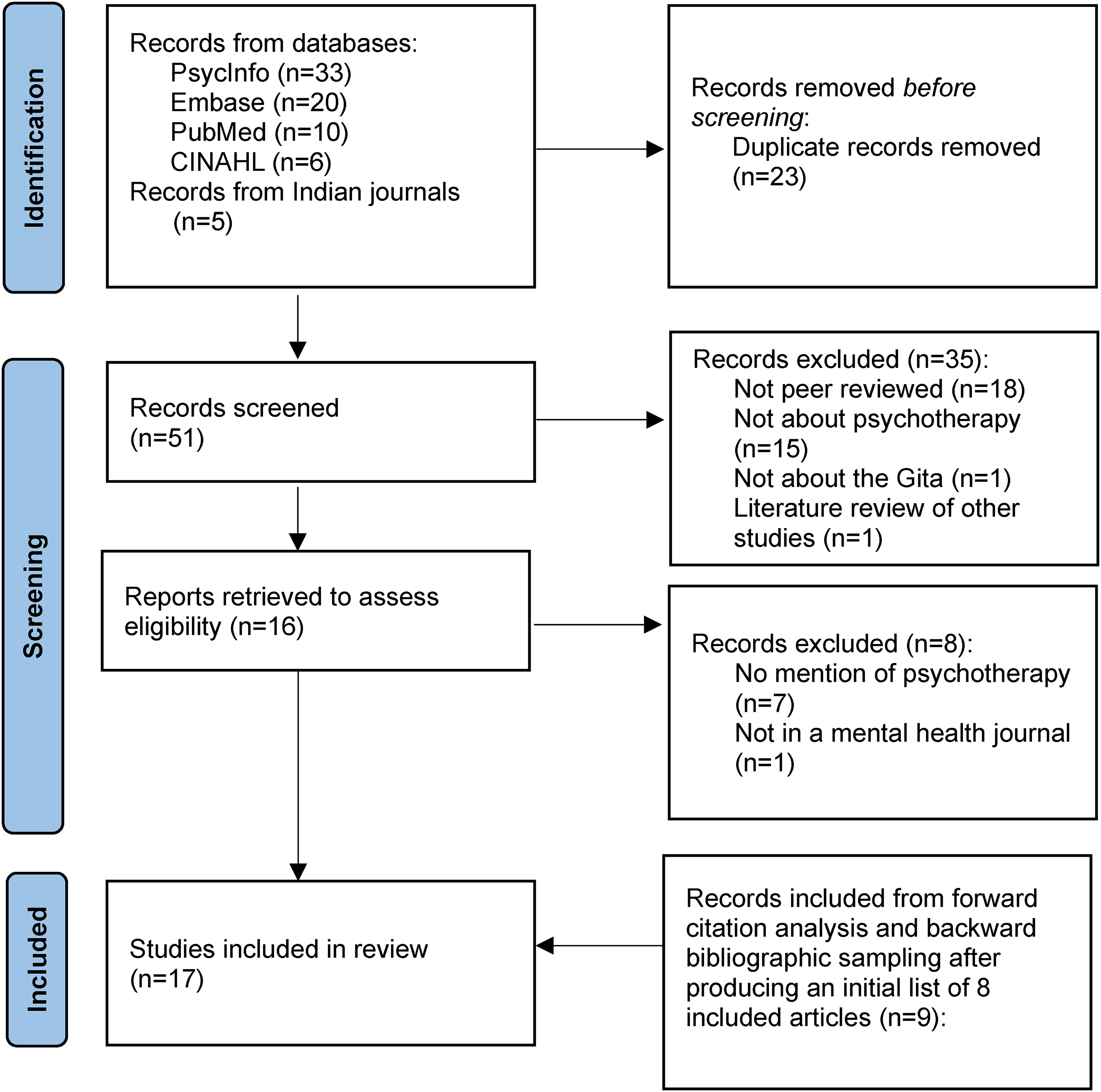
PRISMA flow of studies with inclusion/exclusion criteria.
All studies offered conceptual analyses about how the Gita is relevant to psychotherapy and establishes unique patterns of selfhood. No study enrolled any human research subjects, a finding confirmed by one included article (Keshavan & Tandon, 2023). Hence, there is no study design, study population, intervention, control condition, study outcome, or study duration to report, per the PRISMA guidelines (Page et al., 2020). Nine studies came from citation analyses, compared to eight from international databases, indicating that studies from the Global South are not always indexed in international databases (Praharaj et al., 2022).
Relationships Between the Gita and Psychotherapy
Inductive content analysis revealed that authors postulated three relationships between the Gita and psychotherapy: those suggesting that the Gita was useful for psychotherapy in general (n = 6), those recommending the Gita's use for a specific psychotherapy (n = 6), and those demonstrating the Gita's applicability to multiple psychotherapies (n = 5).
Six studies suggested that the Gita is useful for psychotherapy across orientations (Abhyankar, 2015; Balodhi & Keshavan, 2011; Keshavan, 2023; Manickam, 2013; Mishra et al., 2023; Rao & Devi, 1974). Studies have characterized the dialogue between Arjuna and Lord Krishna as psychotherapy, with some asserting that “Krishna is a pragmatic therapist” (Keshavan, 2023, p. 2), that “Lord Krishna represents the master healer of the minds of humanity while Arjuna symbolises the person in a state of anguish” (Abhyankar, 2015, p. 66), and that “The Gita can thus be hailed as the masterpiece and exactitude in psychotherapy” (Rao & Devi, 1974, p. 41). Two studies observed that the Gita offers therapists flexibility; one author wrote that, “The therapeutic framework that is provided in Bhagavad Gita directs how a therapist has to be flexible in using different approaches” (Manickam, 2013, p. S326). According to another group, the Gita “supports the integrative concept of a person, and promotes connectedness, restorative relationship between the patient and the therapist and provides a flexible model” (Mishra et al., 2023, p. 498). These studies identified elements in the Gita that resemble “common factors” across psychotherapies: patient–therapist alliance, therapist empathy, and positive treatment expectations (Wampold, 2015).
Six studies related the Gita to a specific psychotherapy. Three centered on CBT. Some argued for interpreting “Krishna's analysis and counseling with elements of cognitive-behavioral and metacognitive principles” (Pandurangi et al., 2014, p. 828). Another group contended that, “Fundamental concepts from Bhagwad Gita like renunciation, non-detachment to the task and its consequences, meditation, and faith in the therapist may be used to clarify the concepts of CBT” (Saini et al., 2023, p. 100). One author stated that, “This book is a compilation of cognitive behavioral therapy sessions” (Sharma, 2014, p. 45). Other referenced orientations included “dynamic psychology” (Rao, 1980), “reliance-focused psychotherapy” (Keshavan, 2020), and “existential psychotherapy” (Shukla, 2018).
Finally, five studies related the Gita to more than one psychotherapy (Bhatia et al., 2013; Keshavan & Tandon, 2023; Phogat et al., 2020; Reddy, 2012; Risal, 2024). A representative quotation comes from Bhatia et al. (2013), who presented their study's aim as follows: “We ascertain the analogies between the principles of Gita and CBT, grief emancipation, role transition, self-esteem, and motivation enhancement, as well as interpersonal and supportive psychotherapies” (p. S315). Others listed psychotherapies for which the Gita could be relevant. Phogat et al. (2020) wrote, “The interaction between Arjun and Lord Krishna encompasses many psychotherapeutic principles, especially crisis-oriented, behavioral, motivational, humanistic and existential” (p. 1903). Risal (2024) enumerated that, “The Krishna-Arjun conversation during that time can be easily interpreted in the modern psychotherapeutic procedures: supportive, cognitive, behavioral, grief-resolution, motivational enhancement, hypnosis, etc.” (p. 129).
CBT was the psychotherapy most frequently named to correspond with the Gita, appearing in eight studies (Bhatia et al., 2013; Keshavan & Tandon, 2023; Pandurangi et al., 2014; Phogat et al., 2020; Reddy, 2012; Risal, 2024; Saini et al., 2023; Sharma, 2014).
Constructing Patterns of Selfhood Through the Gita
Four patterns appear across the 17 studies: nine drew on the Hindu concepts of ātman, dharma, and karma to postulate an ideal self; four drew only on ātman in realizing the ideal self; two expressed reservations that Hindu concepts of the self cannot be translated into psychology; and two offered general ways by which the Gita promotes a reflective self without relying on Hindu concepts. To highlight difficulties with translating across Hindu and psychological constructs, I analyze the results from least to most prevalent.
Two studies (Abhyankar, 2015; Shukla, 2018) did not rely on Hindu concepts to argue that the Gita promotes an ideal self. Abhyankar (2015) asserted that:
Arjuna's arousal is from three areas of inactivity — from ignorance to knowledge, from apathy to a positive feeling and from inertia to purposeful activity. It is important to note that the healer Lord Krishna did not force the ideas but suggested that certain things have been discussed, and it was up to Arjuna to act as he liked. (p. 66)
Abhyankar's pattern of the self emphasized interconnections among the reflective (“arousal”), psychological (“ignorance to knowledge”), emotional (“apathy to a positive feeling”), and behavioral (“inertia to purposeful activity”) aspects. Shukla (2018) stated that in the Gita, “There exist various forms of physical, breathing, and mental exercises which have been developed to build up awareness of self and sharpen one's perception of reality” (p. 150). Shukla's pattern of the self emphasizes embodied (“physical”), experiential (“breathing”), psychological (“mental”), and reflective aspects (“awareness of self”).
Two studies (Manickam, 2013; Rao, 1980) observed difficulties with translating insights from the Gita. Manickam (2013) noted that a scripture known as the Taittirya Upanishad established that humans have five dimensions (kosa) of existence: “the annamaya (closer to physical or anatomical and physiological), pranamaya (breathing related to body—psychophysical), manomaya (related to mind or mental mechanisms/feelings or emotions), vijnanamaya (related to knowledge, higher cognitive functions), and akasmaya (transcendence, or the spiritual dimension)” (p. S324). Manickam (2013) pointed to Ayurvedic medicine's theory that individuals have three qualities (gunas) whose configurations constitute personalities. From these bases, Manickam (2013) asserted that the Gita “appears to support the integrative concept of person, wherein the text refers to acceptance of the five kosas and its functioning, the three qualities of satva, rajas and tamas and the[ir] connectedness” (p. S326). Manickam's pattern of the self emphasized embodied (annamaya kosa—anatomical dimensions), experiential (annamaya and pranamaya kosa—physiological), psychological (manomaya—mental mechanisms), and affective (manomaya—feelings) aspects. Rao (1980) observed that, “It is difficult to say whether the term ‘mind’ used in Gita is applicable in the way it is used today. Probably ‘mind and bhuddhi’ complex of Gita to some extent approximate the modern usage of the word” (p. 23). According to Rao (1980), there is a patterned connection across the experiential (“the senses”), psychological (“intellect”), and reflective (“mind”) aspects of the self, but he expressed concerns about translations.
Four studies (Keshavan, 2020; Keshavan & Tandon, 2023; Risal, 2024; Saini et al., 2023) underscored the Gita's understanding of ātman—often translated as “soul” or “spirit”—as fundamental to an ideal self. Notably, the PTS does not have an aspect of the self that corresponds to ātman. Keshavan (2023) contended that Krishna “first teaches Arjuna how the mind works, how the mind is related to the body and spirit” (p. 2). Keshavan's pattern of the self connects the psychological (“mind”), embodied (“body”), reflective (“teaches”), and spiritual aspects. Keshavan and Tandon (2023) praised “Krishna's teaching of the integrative nature of the mind, body, intellect and the spirit, and the origins of psychopathology as emerging from faulty self-appraisal and misplaced attachment to ego-driven desires” (p. 1). In their pattern of the self, there is an interconnection among the psychological (“mind”), embodied (“body”), reflective (“faulty self-appraisal”), affective (“ego-driven desires”), and spiritual (“spirit”) aspects. Risal (2024) indicated that, “Krishna tried to alleviate Arjun's guilt regarding the thought ‘I am the killer’, anxiety of sin, and untimely compassion or grief, showing the importance of an incorruptible, eternal soul” (p. 139). Risal's pattern demonstrates an interconnection among the reflective (“tried to alleviate”), emotional (“guilt,” “anxiety,” “grief”), psychological (“the thought ‘I am the killer’”), and spiritual (“incorruptible, eternal soul”) aspects. Finally, Saini et al. (2023) stated, “Lord Krishna further addresses Arjuna's conflicts by introducing the concept of the soul being eternal and that Arjuna would not annihilate the enemies by destroying their worldly bodies” (p. 100). Their pattern recognizes interconnections among the embodied (“worldly bodies”), psychological or emotional (“Arjuna's conflicts”), behavioral (“annihilate the enemies”), and spiritual (“the soul being eternal”) aspects.
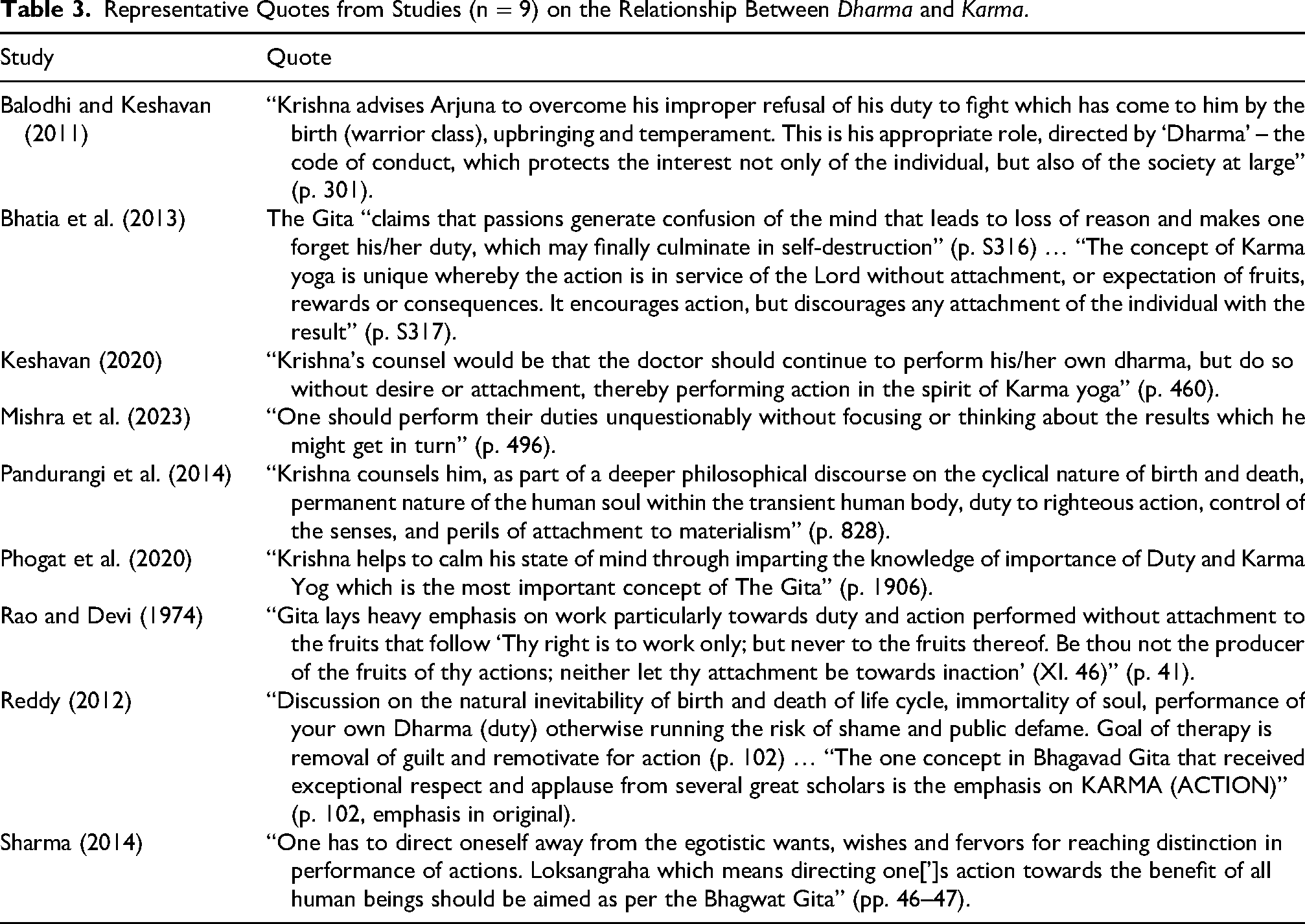
Finally, nine studies (Balodhi & Keshavan, 2011; Bhatia et al., 2013; Keshavan, 2020; Mishra et al., 2023; Pandurangi et al., 2014; Phogat et al., 2020; Rao & Devi, 1974; Reddy, 2012; Sharma, 2014) drew on concepts of ātman, dharma, and karma to postulate an ideal self. These studies share the same understanding of ātman as an eternal soul, so I do not analyze them to avoid redundancy. Table 3 presents illustrative quotes from the nine studies on the relationship between dharma which is often translated as “duty” and karma which is often translated as “action.” Each exhibits an interconnection among the PTS's reflective, behavioral, and normative/enacted aspects in that individuals must ponder their actions and desires to behave in accordance with sociocultural practices (Gallagher & Daly, 2018).
Representative Quotes from Studies (n = 9) on the Relationship Between Dharma and Karma.
Taken together, 13 studies used concepts like ātman, dharma, and karma to posit an ideal self through the Gita that contrasts with the self in psychotherapies developed in Europe and North America. As Kirmayer (2007) notes, expressive individualism underpins psychotherapies:
This vision of the person is reflected in a commonsense psychology that attributes both somatic and emotional illness to holding back (and, consequently, not knowing or showing) one's true feelings. It is central to the theories of client-centered, humanistic, and expressive-cathartic schools of psychotherapy. (p. 241)
In contrast, these studies deemphasized the relationship of the self to the body and emotions, emphasizing a “cosmocentric self” connected to the spirit (Kirmayer, 2007). Kirmayer (2007) also describes a “North American self” that “is autonomous and uniquely deserving of the free pursuit of his or her own private goals” (p. 240); these studies suggest that dharma is not privately defined but a sociocultural obligation which determines karma or right actions (Balodhi & Keshavan, 2011; Sharma, 2014). All 17 studies contended that the Gita could be used in psychotherapy. As Kirmayer (2007) emphasizes:
While the declared aim of psychotherapy is usually the alleviation of psychological distress, psychotherapy, even of severe pathology, always involves subtler normative questions of how to live the good life. Thus, the goals of psychotherapy are tied to the cultural concept of the person. (p. 248)
What remains unanswered is whether individuals with an egocentric sense of self centered on autonomy also affirm cosmocentric concepts like ātman, dharma, and karma if the Gita is used in clinical practice.
Selfhood in Authoritative Hindu Commentaries of the Gita
Across Hindu sects with textual traditions, spiritual teachers who have obtained religious, intellectual, and hierarchical status by living in monasteries for years and following strict rules to interpret texts acquire adhikāra (“eligibility”) and āptatvā (“reliability”) (Sarma, 2000). To be sure, commentators do not encompass all possible views within a religion, but they represent scholarly traditions that Bibeau would consider as having different conversational styles and cultural roots. Three such Gita commentators are Ādi Śaṃkarācārya, Swami Vivekananda, and Swami Chinmayananda. I have selected these commentators because they belong to the Advaita Vedanta tradition, the most prevalent philosophical orientation among Hindus today (Flood, 1996). Within Advaita Vedanta, the Gita is part of the Prasthāna Trayī (“Three Sources”) textual tradition—along with the main Upaniṣadas which observant Hindus consider to be eternal without human authorship and the Brahma Sūtras by Badarayana dated between the second and fourth centuries of the common era (Isayeva, 2016).
Ādi Śaṃkarācārya was an eighth-century Vedantic philosopher who did not believe in the distinction between a created universe and a divine creator, with whom all souls should aspire to reunite in escaping suffering across cycles of life and death (Comans, 2000). Śaṃkarācārya established four monasteries throughout India (Geaves, 2008). His scriptural interpretations have been the most influential within Hinduism since the 19th century (Harzer, 2008), and he is the most famous Hindu philosopher who ever lived (Flood, 1996). His commentary is known as the Gita Śaṃkarā Bhāṣyā.
Swami Vivekananda (1863–1902) was born as Narendranath Datta. At 18 years old, he met Swami Ramakrishna, whose influence prompted him to embrace monasticism. In 1893, he traveled to Chicago to participate in the Parliament of World Religions and introduced Vedanta and Yoga to the United States, which prompted lecture tours worldwide (Badrinath, 2006). He founded the Vedanta Society of New York, the Vedanta Society of San Francisco, and the Ramakrishna Mission in India as institutions which still disseminate Vedantic learning (Jackson, 1994). The Ramakrishna Mission runs 295 branches worldwide, with 226 in India (Ramakrishna Math & Ramakrishna Mission, 2026).
Swami Chinmayananda (1916–1993) was born as Balakrishna Menon. A journalist who embraced monasticism in 1949 through the Divine Life Society in North India, he began giving public discourses in 1951 with a mission of “having the Bhagwad Geeta (Hindu sacred text) and Upanishads (Hindu philosophical texts) accessible to every Indian” (Pandya, 2016, p. 209). Swami Chinmayananda encouraged devotees to listen to Hindu scholars, study scriptures, pray regularly, and meditate (Locklin, 2017). Chinmaya Mission has over 400 centers worldwide (Chinmaya Mission, 2023). It is one of the most influential contemporary Hindu movements, with over 6 million people participating in its Chinmaya Gita Chanting Competition (Central Chinmaya Mission Trust, 2025) and 20,000 children attending weekly classes in North America (Chinmaya Mission, 2023).
Below, I translate and analyze illustrative Gita verses in Sanskrit on ātman, dharma, and karma, along with the commentaries of Ādi Śaṃkarācārya in Sanskrit and Swami Chinmayananda in English to show how ideas of personhood from the Gita have been received among religious readers. Swami Vivekananda did not write a verse-by-verse commentary on the Gita, so I present his views after the other two commentators. My translations follow principles of dynamic formal equivalence to (1) make sense, (2) convey the intent of the original text in the source language, (3) have a natural form of expression, and (4) produce a similar response for readers in the target language (Nida, 2000). Readers can validate my translations through transcriptions in accordance with the International Alphabet of Sanskrit Transliteration.
Ātman
Verse 2.20 of the Gita states, “Na jāyate mriyate vā kadācinnayaṁ bhūtvāabhavitā vā na bhūyaḥ / ajo nityaḥ śāśvatoayaṁ purāṇo na hanyate hanyamāne śarīre.” I translate this as, “This is not ever [kadācit] born [na jāyate] or dies [mriyate], and this was not born or will be born again. It is unborn, eternal, everlasting. It is ancient. It is not killed when the body is being killed.”
Ādi Śaṃkarācārya's commentary on the first half of the first line explained that: Na jāyate, it is not produced. The characteristic of birth (janilakśaṇā) and the transformation of an object (vastuvikriyā) is not to be found in the soul, that is the meaning. And it does not die. The word vā is with respect to the meaning “and.” And na mriyate, i.e., the final transformation which is the characteristic of destruction (vināśalakśaṇā) is forbidden (pratiṣidhyate). The word kadācit is connected with all prohibitions on transformation; it is not ever born and it does not ever die – that is the meaning. (Goyandka, 2024, p. 41)
Swami Chinmayananda (1959a) accepted Ādi Śaṃkarācārya's argument, stating that:
The verse insists that the self cannot be killed. This is an assertion, which amounts to a repetition since it has already been said that it is deathless. Sankara, therefore, interprets the idea in “It is not slain” as “It has no transformation”: the Self is not subject to any transformation or transmigration. (p. 127)
In fact, Ādi Śaṃkarācārya's tone is stronger in contending that it is “forbidden” and there are “prohibitions” for the soul to have transformations.
Furthermore, verse 13.32 of the Gita states, “Yathā sarvagataṁ saukśmyādākāśaṁ noplipyate / sarvatrāvasthito dehe tathātma noplipyate.” I translate this as, “Just as the sky which goes everywhere [sarvagataṁ] out of its subtlety is not polluted, so also the soul which is settled everywhere [sarvatrāvasthito] is not polluted in the body.”
For Ādi Śaṃkarācārya, the meaning was so self-evident that he only provided synonyms for sarvagataṁ, ākāśaṁ, and noplipyate in a single sentence (Goyandka, 2024, p. 349). Swami Chinmayananda (1959b) translated ākāśaṁ as “space” and stated:
Space, being subtle, it allows everything to remain in and, yet, nothing that it contains can contaminate it. The Supreme Self, which is the very cause of the Akasa itself, and, therefore, subtler than the Akasa, “It pervades all: nothing pervades It …” It cannot be contaminated by anything that is existing or happening in the world of plurality. (p. 229)
Swami Chinmayananda (1959b) concluded, “The Self, though it permeates and pervades the whole body, is not soiled, just as space cannot be dirtied by all the amount of filth that it may accommodate in itself” (p. 229).
Swami Vivekananda (1992) distinguished between nature and the self. He wrote:
By the word nature is meant not only all this external world, but also our bodies, the mind, the will, even down to what says “I.” Beyond all that is the infinite life and light of the soul – the Self, the Atman … According to this philosophy, the Self is entirely separate from nature. (pp. 61–62)
These ideas challenge spacetime concepts of selfhood in Euro-American psychotherapies. The Gita posits an eternal soul, to which Ādi Śaṃkarācārya and Swami Chinmayananda added that the soul does not physically transform. The Gita distances the soul from the body. Swami Chinmayananda reasoned that a divine force creates space which cannot be soiled, and that the soul is not soiled from inhabiting the body. Swami Vivekananda emphasized that the Self has a separate reality from physical nature. Herein lies the difficulty of translating concepts cross-culturally; in emerging from the philosophy of neuroscience, the PTS has no aspect of selfhood for the soul. While the Gita prioritizes a reflective aspect of the self, it refutes the relevance of embodied, experiential, and situated/normative aspects to selfhood. Mental health researchers who see convergences between the Gita and psychotherapeutic orientations do not address how to reconcile discrepant ideas of spacetime in clinical practice.
Dharma
Verse 3.35 of the Gita states, “Śreyānsvadharmo vigunaḥ paradharmātsvanuṣṭhitāt / svadharme nidhanaṁ śreyaḥ paradharmo bhayāvahaḥ.” I translate this as, “One's dharma [svadharma], imperfect [vigunaḥ], is better than another's dharma well performed. Death in one's dharma is better than another's dharma which procures fear [bhayāvahaḥ].”
Ādi Śaṃkarācārya added an innovation. He stated, “Paradharmo bhayāvahaḥ, since another's dharma leads to fear (bhaya) which is a symbol of the underworld, etc. (narakādilakśaṇaṁ)” (Goyandka, 2024, p. 101). In equating fear with the underworld (naraka), Ādi Śaṃkarācārya suggested that negative emotions are not inherent to the self.
Swami Chinmayananda (1959a) recognized that dharma had no translation. He stated:
The term Dharma in Sanskrit is the most illusive term for translation into English. It is used generally in more than one definite meaning. Terms like righteousness, good conduct, duty, quality, etc., are some of them. We have explained it earlier and found how Dharma essentially means “the Law of being” of anything in the world. (p. 255)
Swami Chinmayananda (1959a) offered a cosmic interpretation of svadharma:
Pre-determined “channels of thinking” created by one's own earlier ways of thinking are called the Vasanas. Thus Dharma here should be conceived as the Vasanas in our mind for no other explanation will be correct since the very discussion now is upon mental control. The word “Duty”, used by us in our translation, is, in this special sense, to be understood as “Vasanas.” (p. 255)
As Swami Chinmayananda (1959a) pointed out, “predetermined” and “earlier ways of thinking” come from the soul's prior lives. Hence, dharma does not mean “duty” in a non-religious sense, because “the Law of being” is defined religiously and “channels of thinking” continue from earlier births. These cosmocentric connotations are absent in mental health scholarship.
The meaning of dharma becomes a focus of debate in verse 4.8 of the Gita: “Yadā yadā hi dharmasya glanirbhavati bhārata / abhyutthānamadharmasya tadātmānaṁ sṛjāmyahaṁ.” I translate this verse as, “Whenever there is a decrease [glani] of dharma, Oh Bharata [another name of Arjuna], and a rise [abhyutthānam] of non-dharma [adharmasya], then I create myself.”
Ādi Śaṃkarācārya explained:
Yadā yadā hi dharmasya glanir is destruction (hāniḥ) of the influence (lakśaṇa) of the four social orders of life, etc. (varṇāśramādi) of living beings (prāṇinām) which is the most prosperous and best means (abhyudayaniḥśreyasasādhanam), bhavati bhārata, abhyutthānam is rising of non-dharma, then I create myself through maya. (Goyandka, 2024, p. 109)
Ādi Śaṃkarācārya's term varṇāśramā reflected his conviction that dharma requires preserving the four varṇās—often translated as “caste”—of Brahmins, Kshatriyas, Vaishyas, and Shudras (Sinha & Saraswati, 1978). The implication is that one's duty is connected to one's social position.
Swami Chinmayananda (1959a) did not mention varṇāśramā and treated dharma as personal conduct:
Dharma “The Law of being” is a sacred truth, and when the majority of the members of a community obeys not this great Truth, there is a conquest of the world by a herd of biped animals, and not a co-operative happily living family of man, in his full dignity as an intelligent social being. In all such dark periods of history some great master comes to present himself as the leader of men to revive “the standard of life” and its moral valuations. (p. 276)
Consistent with his idea of vasana as “channels of thinking,” Swami Chinmayananda emphasized individual morality rather than social positioning.
Swami Vivekananda (1992) saw duty as a reflection of love for God. He wrote, “The soldier works for no results. He does his duty. If defeat comes, it belongs to the general, not to the soldier. We do our duty for love's sake – love for the general, love for God” (Vivekananda, 1992, p. 24).
Even though all three commentators differ in characterizing dharma, they concur that a broader order beyond the individual informs personal behavior. This understanding departs from the self in Euro-American forms of psychotherapy who is free to pursue private goals. Translated into the PTS's terms, the reflective aspect of the self in the Gita appreciates that situated/normative aspects, i.e., sociocultural obligations, dictate behavior.
Karma
Verse 2.47 of the Gita states, “Karmaṇyevādhikāraste mā phaleṣu kadācana / mā karmaphalaheturbhurmā te saṅgoastvakarmaṇi.” I translate this verse as, “In action [karmaṇi] alone is your right [ādhikāra], never in its results [phaleṣu]. Not the reason [hetu] of the results of actions. Not to you should there be an attachment [saṅgo] in no action [akarmaṇi].”
Ādi Śaṃkarācārya interpreted this verse to mean: In action alone is the right, not in loyalty to knowledge. Te, yours. And here, karma is what is being done (kurvato). May there not be a right with respect to its results. May there never be a thirst (tṛṣṇā) for the results of actions for anyone, indeed, with respect to the situation (avasthāyāṁ). That is the meaning. When you have a thirst for the result of actions, then there is a reason with respect to accomplishing the results of actions. Therefore, do not be someone who has a reason for the result of actions. For, if an attachment (prayuktaḥ) to the thirst for the result of actions exists with respect to actions, then there would be a reason for birth which, alone, would be the result of action. If the result of actions is not desired, then what is there through action that takes the form of sorrow? Therefore, may you not have attachment. May there not be joy in no action (akarmaṇi), not doing (akaraṇe). (Goyandka, 2024, pp. 60–61)
The Gita emphasizes that one should act for the sake of the action itself, not from attachment to desired results. Ādi Śaṃkarācārya extended that argument to all worldly actions where individuals may not see themselves as possessing agency, such as birth.
Swami Chinmayananda (1959a) interpreted this verse as a technique for spiritual advancement, stating, “Single-pointed Karma without desire for the fruits shall bring about inner purification” (p. 165). He explained: Almost all of us refuse to undertake great activities being afraid of failures, and even those who dare to undertake noble endeavours invariably become nervous ere they finish them, again, due to their inward dissipation. To avoid such wasteful expenditure of mental energy and work with the best that is in us, dedicated to the noble cause of the work undertaken, is the secret prescription for high inspiration; and such work must always end in brilliant success. This is the eternal law of activity in the world. (Chinmayananda, 1959a, p. 166)
Swami Vivekananda (1992) also defined karma as “law” (p. 34) and that “the goal of man is to go beyond law. And enjoyment can never be the goal, because enjoyment can only be in nature” (p. 35).
The Gita and its commentators suggest that one should behave without desiring results and without an excuse to not behave. However, these justifications vary. Ādi Śaṃkarācārya deploys an argument that understands all actions—including birth—as part of a divine order. Swamis Chinmayananda and Vivekananda posit that all work done without attachment ends in success because of “eternal law.” These understandings posit a divinity to the environment that is absent from non-religious psychotherapies. Perhaps what is most untranslatable for psychotherapy is the Gita's suggestion that one should behave without expecting results, for the action itself. In the PTS's terms, the reflective self behaves while minimizing cognitive and affective aspects and with no regard to material aspects in the situated/normative environment.
Discussion
This critical narrative review has uncovered 17 studies suggesting that the Gita can be used in psychotherapy. I have shown that the ideal self in this scholarship differs from models of selfhood in psychotherapies developed in Europe and North America, raising questions about reconciling cosmocentric concepts like ātman, dharma, and karma in clinical practice. I have analyzed interpretations from three Hindu commentators of the Gita to demonstrate the religious underpinnings of these concepts. These differences are crucial to highlight because the Gita's authority has been invoked in applications like IWill GITA to disseminate CBT to millions of people as a technological solution for mental health services.
This study builds upon a scholarship that has searched for convergences between Hindu and contemporary mental health practices. Some speculate that psychological interventions in India could be more acceptable to patients if approaches from the Gita were integrated with evidence-based psychotherapies (Bhargava et al., 2017), though this review problematizes the possibility of integration based on differing ideas of the self. Studies from Hindu therapists and counselors have described the Gita's personal significance to them (Mukherjee, 2012; Tummala-Narra, 2022), and I have analyzed differing viewpoints within Advaita Vedanta to avoid a monolithic presentation of the Gita's significance among Hindus. Older studies have used the Gita to contrast a “Hindu”/“Indian” self with a “Western” self (Bharati, 1985; Roland, 1991), which neglects how many people—such as authors of studies in this review—find themselves working in multiple traditions in today's globalized world.
One risk of uncritically accepting scholarship that finds equivalences between the Gita and contemporary psychotherapies is promoting archaic modernity, Banu Subramaniam's (2000) characterization for how “ideals of a modern Hindu nation exist alongside contradictory visions of a glorious precolonial Hindu past—the ‘scientific,’ ‘technological,’ and philosophical scriptures of ancient Hinduism” (p. 73). Contending that the Gita's 18 chapters represent 18 counseling sessions, that Lord Krishna is a psychotherapist par excellence, and that Arjuna is the first psychiatric patient attempts to establish a post-Enlightenment, positivistic scientific lineage to an ancient scripture through which millions of people still find meaning. As Subramaniam (2000) elaborates, “Even as it supposedly focuses on recovery from the violence of colonialism by recovering the past, archaic modernity disavows both the violence of modernity and the science and technology that it embraces” (p. 82).
A post-colonial approach to psychiatry can recover the violence of colonialism by asking how formerly colonized populations have understood the world by analyzing texts in their languages on their terms (Aggarwal, 2025). To do so, psychiatrists must embrace theories, methods, and data without assuming that clinical trials yield the most persuasive scientific evidence, which is a cultural assumption among psychiatrists laboring to bring research in line with biomedicine (Kirmayer, 2012). This embrace requires us to move away from an epistemic inequity that centers Euro-American psychological theories and methods toward an epistemic equity that brings into conversation the knowledge and everyday experiences of underrepresented peoples (Adames et al., 2024). This stance may entail psychotherapists acknowledging unfamiliarity, inviting patients to explain the function of scriptures in their lives, and treating them as cultural experts through prompts like, “I’m not trained in the Gita, but I would like to understand what this work means to you and how you use it in your life – like when you turn to it and how it makes you feel. Are there different interpretations that you find meaningful? Is your understanding connected to a teacher, family heritage, or community practice?” With epistemic equity, psychiatry and psychology do not absorb (or colonize) an unfamiliar text. Therapy becomes translational and dialogic across the therapist's psychological and the patient's spiritual vocabularies for behavioral change.
This review has limitations. First, I may have missed articles for inclusion, though this is a limitation of all reviews and I have documented all steps transparently. Second, I have selected only three Hindu commentators based on their contemporary social significance, and future studies could explore how other Hindu scholars understand these terms. Third, this review explores concepts of the self in texts without exploring how these ideas are enacted in people's everyday lives, including in clinical situations. Fourth, my social positionality as a cultural psychiatrist, social scientist, and observant Hindu has influenced my analyses. My positionality offers familiarity with Sanskrit terminology and interpretive traditions. Still, my religious affiliation and socially minoritized status in the American academy sensitizes me to psychologically reductionist readings of the Gita. I have prioritized interpretations from Hindu scholars within Advaita Vedanta to highlight their untranslatability. Despite these limitations, this review brings different intellectual styles and cultural traditions into conversation to ask how patterns of selfhood can differ in psychotherapy.
Conclusion
In closing, this study has used the pattern theory of the self framework to understand how contemporary authors have constructed relationships between the Gita and psychotherapy and selfhood. It has also compared ideas from these authors with commentaries from traditional Hindu religious scholars. Findings show that ideas about ātman as the eternal soul, dharma as morally prescribed behaviors, and karma as actions without expectations of results may not have direct equivalents in Euro-American forms of psychology. Mental health providers working across cultures should therefore ask patients who mention the Gita in clinical work what the text means to them and how they envision its role in care rather than assume that the text has the same meanings for all people. This work offers a broader method to decolonize mental health knowledge in comparing what secular and religious scholars have to say about selfhood and psychotherapy.
Footnotes

Funding
The author received no financial support for the research, authorship, and/or publication of this article.
Declaration of Conflicting Interests
The author declared no potential conflicts of interest with respect to the research, authorship, and/or publication of this article.