







Abstract
This article explores the challenge of education reform and presents an alternative to dominant approaches. In doing so, it draws on the work of three projects: first, the ‘Advancing Education Quality and Inclusion’ initiative; second, the APREME (Advancing the Participation and Representation of Ethnic Minorities in Education) project which followed it; and third, the International Teacher Leadership project with which these two projects had strong links. The article discusses the large-scale survey of parents and school principals across 10 countries in South East Europe and the follow-up case studies in five of these countries. The focus then shifts to the practical intervention which was based on the idea of non-positional teacher leadership. Reports of all three projects are analysed to support a particular view of education reform led by teachers’ own development initiatives.
Educational reform is a highly political matter driven by economic pressures and often triggered by some kind of national panic (Goodson, 1990). Take for example, the reaction to the fact that the Soviet Union demonstrated their technological advancement when they launched the Sputnik satellite in 1957. Three years later Jerome Bruner published a report of a 10-day conference of major educational experts and scientists, convened by the National Academy of Sciences and funded by organizations such as the US Department of Education, the US Air Force and the Rand Corporation (Bruner, 1960). This was a very serious attempt to figure out how American schooling had let the country down in the space race. With every election we see fresh attempts to change what is happening in our schools and, to the continued disappointment of academics, policies tend not to be based on evidence but on politics (Fuller, 2010). To compound this problem we have evidence from a recent book about policy formation in the era of New Labour in the UK which reinforces the suspicion that policy-making is heavily shaped by anecdote, spin and the need to appear to have changed something within the four-year election cycle (Bangs, MacBeath, & Galton, 2011).
However policy is arrived at, the question remains: how does educational change occur? Can policy-makers actually reach for levers, a sharp tug on which will bring about demonstrable change? The relationship between reform and innovation is a complex one (CERI, 2008) and politicians may mistakenly assume that one leads inexorably to the other. The water is further muddied in the era of globalization as we see more and more instances of ‘education policy borrowing’ (Halpin & Troyna, 1995; Steiner-Khamsi, 2004). According to the conservative American policy analyst Chester Finn, there are four distinct theories of action that inform approaches to educational reform (Finn, 2002). The first is for government to provide the professionals with the resources they ask for and trust them to use them wisely. The second is to draw on the experts and to enable them to wield influence. The third focuses on the setting of standards and the levers of high-stakes testing to secure compliance with centrally determined goals. The fourth is to rely on creating a climate of competition in which market forces will have a similar effect to the standards and testing regime. This may well be a useful summary of policy thinking in the US but it is an inadequate menu of possible approaches to reform.
None of the four categories outlined above addresses the question posed some time ago by Susan Rosenholtz in ‘Education reform strategies; Will they increase teacher commitment?’ (1987). Fullan reinforced this idea when he said: ‘Managing moral purpose and change agentry is at the heart of productive educational change’ (1993, p. 8). What Finn does not seem to consider in his four-part categorization is the potential of re-professionalization as a strategy for educational reform. This maybe because, in the US, following the ‘Nation at Risk’ report (National Commission on Excellence in Education, 1983) the emphasis has been on credentials and training. Linked to that, the teacher quality discussion has focused on ‘instructional leadership’ (Blase & Blase, 1998; Smith & Andrews, 1989) and supervision. In contrast to this rather behaviourist approach, the process of ‘professionalization’ has been defined as the process whereby workers ‘increasingly meet the criteria attributed to a profession’ (Hoyle, 1982, p. 161). However, the question for me is whether, and to what extent, training and certification can result in teachers becoming more committed and driven by an enhanced sense of moral purpose to innovate and address the challenges of inequity in our schools. I want to argue that a particular approach to teacher leadership may hold the answer and I want to explore this in the specific context of a large-scale reform programme involving 10 countries in post-Soviet South East Europe.
Research and advocacy to address inclusion of ethnic minorities
The break-up of the Soviet Union and the dissolution of Yugoslavia led to conflict and a variety of moves on the part of different ethnic and national groups to secure territorial advantage and economic resources. Social integration and cooperation were at a premium (Delcour, 2011). Social capital was weak in a number of respects with issues of fragmentation, mistrust and divisiveness (Pop-Eleches, 2007). The long period of isolation led to difference or otherness being perceived as a threat rather than enrichment. Minority groups are easily scapegoated. Ethnic identity for many became a matter of life and death in war-torn countries such as Bosnia and Herzegovina and Kosovo (Tanter & Psarouthakis, 1999). Following the Dayton Peace Agreement in 1995, the collective rights of ethnic groups were protected by legal frameworks that reflect the principles established in the UN convention on human rights. Nevertheless, marginalization, segregation and social exclusion persisted (Ramadanovic, 2010).
In 2007 an ambitious programme of research and advocacy was launched under the banner of ‘Advancing Education Quality and Inclusion’ (http://www.see-educoop.net/aeiq/). This project arose out of a series of meetings of members of the Open Society Institute, ministries of education and civil society representatives of 10 countries in South East Europe: Albania, Croatia, Bosnia and Herzegovina, Bulgaria, Kosovo, Macedonia, Moldova, Montenegro, Romania and Serbia. A clear priority was agreed: in order to enhance education quality and inclusion, the lack of the meaningful parental involvement in the education of their children must be addressed. The initiative was funded by the Education Support Program of the Open Society Institute and jointly implemented with the Center for Education Policy Studies at the University of Ljubljana, a number of Soros Foundations and other NGOs (non-governmental organizations) in the region.
A literature review undertaken by a member of the Serbian team, on behalf of the whole international team, focused on models of family–school partnerships (Petrovic, 2009). It rested heavily on Epstein’s (1995) framework of parent involvement that included: good parenting and support for parenting, effective home–school communication, parent contributions to school activities, learning at home, parent involvement in decision-making and collaboration between school and community. A number of points emerged from this review. It was made clear that there can be no fixed prescription; rather, good programmes will be ones where the school develops practices to meet the specific needs of their students and families. It also became clear that, in order for the undeniable benefits of home–school partnership to be realized, there would have to be changes in behaviour on the part of both parents and schools (Mattingly, Prislin, McKenzie, Rodriguez, & Kayzar, 2002). Perhaps the most important insight, however, is that it is the effort of teachers to include parents from all socio-economic groups that mediates the extent to which parents endeavour to engage in the life of the school (Petrovic, 2009).
The literature review referred to above informed the design of two very substantial surveys, one of school principals’ views and one of parents’ and students’ views. In 2008, following two exploratory meetings of focus groups meetings in Albania, Bosnia and Herzegovina, Kosovo, Macedonia, Moldova, Montenegro and Serbia, 2273 school principals’ views were surveyed through face-to-face structured interviews. A cross-national analysis identified what schools across the region were doing or not doing to promote an inclusive and democratic environment for students and parents (Pop, Powell, Miljevic, & Crighton, 2009). Principals applauded parents getting involved by supporting school activities, but requests from schools tended to be for parents to participate in periodic school ceremonies and social activities rather than to contribute to what takes place in the classroom. Perhaps not surprisingly, the lack of parental interest was often cited as the main factor in explaining poor home-school communications. Principals were asked about strategies to enable parents to support their children’s learning at home. An interesting gap was evident between principals’ perceptions of the value of support for parents with their attempts to support learning at home and the actual provision of such services. On the whole, principals seemed satisfied with parental membership of School Boards and Parent Councils; they believe that this is valuable, but also that it makes little difference to what actually happens in school.
The survey of parents was equally rigorous and substantial with a total of 11,125 parents being consulted through structured face-to face interviews. The sample was stratified to represent the various regions and both urban and rural contexts. A group of 20–40 parents were indentified from each of the 30 schools selected in each country. Particular attention was paid to schools in communities with a high proportion of inhabitants who are Roma. The outcomes of this survey stood in sharp contrast to those from the principals’ survey. For example, the report included this statement: Schools do not recognize parents as resources . . . they usually exclude them from decision-making . . . almost 70 percent of parents have never received any written information about [such things as] school rules, content or how to help with learning, or a newsletter on school activities; 66 percent have never received invitation to volunteer with sports, social and cultural activities, about 85 percent have never received an invitation to help with lessons – tell a story, talk about their job, play an instrument, or assist with additional school services such as the library, playground, lunchroom. (Kovacs-Cerovic, Vizek-Vidović, & Powell, 2010, p. 7)
This list of what parents were not consulted about included financial management, extracurricular matters, health and safety issues, school management issues, teacher selection and the usual range of educational matters such as lesson content, textbooks, assessment and homework. It is also interesting that, in the main, parents did not expect to be consulted. In interviews they often echoed the principals’ views about parental disinterest being the root cause of the problem, although many expressed a desire for greater influence. It was abundantly clear that Roma families are more excluded than others.
Parents’ representatives were highly valued where they were seen to be effective, but they tended to see their influence as being only slight. In spite of the fact that such representation has been established by law, many parents said that they did not know who their representative was. Representatives themselves tended to say that they lacked the support of the school in carrying out their role. Those parents who actively sought to influence what happens at school expressed the least satisfaction with the education system and had a negative view of their own influence. A key recommendation of this report highlighted the potential of the role of schools.
Schools should invest time, energy and creativity to discover, set up, and make use of the currently neglected dimensions of parent participation, and develop partnership-oriented co-operation with parents. (Kovacs-Cerović et al., 2010, p. 8)
It was also a key recommendation that attention should be paid to nurturing the inclusion of parents from vulnerable groups, especially Roma. While the report recognized the importance of legislation to secure change, the most significant recommendation for the purposes of this analysis is that it was necessary to identify and disseminate examples of ‘best practice’ through inter-school collaboration.
The APREME project
The challenge presented by the survey reports referred to above was taken up by the APREME (Advancing the Participation and Representation of Parents of Ethnic Minority groups in Education) project coordinated by the Kosovo Education Centre. This project, funded by the European Union and the Open Society Institute, included participants in Albania, Bosnia and Herzegovina, Croatia, Kosovo and Serbia.
Researchers in each of the participating countries carried out a desk-based study to clarify the context, particularly in relation to the nature and distribution of ethnic minority groups in each of the countries. My own role was to join the team as an ‘EU expert’ working alongside a research team from Romania. Our task was to design a process for conducting case studies in the five countries. These would identify the barriers to the involvement in the life of the school of the parents of ethnic minority students and the strategies to overcome these barriers. Reports from each country research team were synthesized in the form of a single ‘Regional Synthesis’ report published on the project website (Frost, Nedelcu, & Palade, 2010).
The case studies would be based on interviews and focus groups in five communities with significant ethnic minority groups in each of the five countries. Principals were asked about the school’s strategies for enabling parents/students to participate as well as the opportunities and obstacles to achieving this. In separate focus groups, students, teachers and parents were asked about participation, influence and involvement, how the school enabled this and the opportunities and obstacles. Everyone was asked to comment on special arrangements for minority students.
The ‘Regional Synthesis Report’ (Frost et al., 2010) provided a view of the barriers to inclusion, identified innovative practice and made recommendations regarding intervention and advocacy. Overall, it was clear from this report that, although there were strong legal frameworks in place, and school principals expressed commitment to the involvement of the parents of all ethnic backgrounds, there remained a paucity of deliberate and innovative strategies to tackle the problem and, as a result, many parents felt marginalized. However, on the positive side, the report was able to point to examples of ‘breakthrough’ practice under the following headings:
formal representation in governance
representation in the teaching staff
use of languages
language classes
cultural events
extracurricular activities
parent–teacher meetings
written communications
direct contact between teachers and parents
improving facilities
supply of resources
respecting traditions/political loyalties
security measures (Frost et al., 2010: 22).
I use the term ‘breakthrough practice’ rather than ‘best practice’ or ‘good practice’ because of doubt that it is possible to define or adequately portray a practice that can be simply mimicked or replicated in all contexts. Breakthrough practice, on the other hand, is that which breaks a barrier and sets a process of innovation in motion.
The report concluded with the following remark which opened the door for the practical action to follow.
There seems to be a widespread lack of deliberate strategies with many principals and teachers expressing the view that all is well and those minority families do not experience inhibitions to participation. It is clear that there is considerable scope for raising awareness of the issue and for examining what can be done to develop a more participative approach. (Frost et al., 2010: 27)
Specific recommendations included the initiation of programmes to strengthen parents’ and students’ participation, involving students from ethnic minorities in activities to build knowledge and acceptance of each other’s cultural identity and to encourage regular communication between school and students’ families.
Practical intervention: The role of teacher leadership
One of the aims of the APREME project was to support practical intervention to develop further innovative practice. A suitable methodology had already been developed within the International Teacher Leadership (ITL) project, founded in 2008 in Cambridge. The ITL project was also supported by the Open Society Institute, with many of the research team members common to both projects. In each of the five participating countries, team members would support six schools in facilitating small-scale innovations led by teachers. Tools, materials and techniques developed in the context of the HertsCam Network in the UK, and subsequently adapted through the ITL project, would be used to scaffold teacher leadership. Teachers would be enabled to lead small-scale initiatives designed to increase the participation and inclusion of ethnic minorities in the life of the school. The expected outcomes would be a collection of vignettes portraying teacher-led projects in 30 schools across the region.
The ITL project has supported teacher-led innovation in 15 countries including many in South East Europe in an effort to discover how teacher leadership can contribute to educational reform. Materials and techniques developed in the UK over many years have been adapted and translated to enable partners in participating countries to support teachers as leaders of development work. Members of the international project team have worked in collaboration with school principals and other facilitators to establish programmes that enable teachers to identify agendas and priorities for change, develop negotiated action plans and act strategically to embed innovations in their schools. Facilitators have established the infrastructure of local knowledge networks through which teachers can come together to inspire each other and share accounts of their leadership of innovation. Vignettes and reports of teacher-led innovation have been captured and disseminated in order to build a body of knowledge about how to improve teaching and learning (Frost, 2011).
Although the primary aim of the ITL project was to make something concrete happen in an immediate and practical sense, there were nevertheless more ambitious aims which go to the heart of the challenge of education reform. The project aimed to contribute to the development of democratic civil society by challenging the cultural contexts within which educational practice is shaped and demonstrating the value of more distributive approaches to learning and leadership. At the same time, the project aimed to engage with policy-making in a direct and immediate way, in the flow of the project rather than relying on post hoc reporting. This form of policy advocacy is not limited to policy analysis and comment; it involves not only drawing policy-makers’ attention to examples of breakthrough practice, but also giving teachers a platform from which they can speak for themselves.
We were sensitive to the hazards of ‘policy borrowing’ across cultural and national boundaries (Phillips & Ochs, 2003; Steiner-Khamsi, 2004) when the ITL project was first launched. Team members from each of the 15 countries undertook an analysis of their national and local contexts. The cultural challenges identified were discussed at our team conferences. Foremost among them was the idea that, for many of the participating countries, democracy is very much ‘a work in progress’. This may be assumed to be an issue that is particularly relevant to the post-Yugoslavian countries, but it became clear that for all participating countries ‘the existence of formal democratic rights doesn’t necessarily translate into much substantive democracy in people’s everyday lives’ (Skidmore & Bound, 2008: 48 after Zakaria, 1997). In many of the educational systems with which we are concerned, teachers’ experience is characterized by hierarchy and authoritarianism rather than collegiality and mutual respect amongst professionals. A related study commissioned by Education International, the global association of teacher organizations, enabled us to ask teachers in 20 countries for their views on the extent to which they had a voice and played a part in determining their professionality. The general picture globally seems to be one in which teachers see themselves as ‘voiceless’, as one teacher put it. The policy environment in most cases is one in which teachers remain ‘the ghost at the feast’ (Bangs & Frost, 2011). Centralist approaches to reform tend to be driven by governments’ need to increase their country’s performance in rankings such as PISA which inevitably leads to top-down change strategies based on low expectations of teachers. As an international team, we embraced alternative perspectives based on the recognition that teachers’ sense of self-efficacy and empowerment are the key to authentic and sustainable innovation and improvement. The way we conceptualized teacher leadership was a key dimension of this alternative perspective.
Conceptualizing teacher leadership
Teacher leadership of one kind or another has been seen as a key lever for educational reform, particularly in the USA (Katzenmeyer & Moller, 2001; Lieberman, 1992; York-Barr & Duke, 2004). However, the approach most commonly labelled as teacher leadership tends to rest on the assumption that leadership is only undertaken by individuals with special aptitude who are selected for designated roles as ‘teacher leaders’. This assumption is evident in the recent publication of the Teacher Leader Model Standards in the USA (Teacher Leadership Exploratory Consortium, 2011).
In contrast, the ITL project adopts a conceptualization which could be termed ‘non-positional teacher leadership’ in which it is assumed that all teachers have the capacity to lead innovation, that they are entitled to exercise leadership (Lambert, 1998) and that leadership can be cultivated in all members of the teaching profession, if they are provided with appropriate support. The delegation of responsibility within increasingly complex organizational structures may be often described as ‘distributed leadership’ as I think is assumed in the OCED report on school leadership (Pont, Nusche, & Morman, 2008), but I suggest that we need a fresh paradigm in order to radically impact on school improvement. It would be more productive to pursue distributed leadership as implying something more akin to what Sergiovanni (1992) calls ‘leadership density’ where the maximum number of members of a community exercise the maximum degree of leadership. The ITL project approach casts teachers as members of professional learning communities (Bolam et al., 2005) in which they lead processes of enquiry-based development generating shared knowledge about pedagogic innovation. This approach focuses on enhancing human agency and the development of a culture of shared responsibility for reform and successful learning outcomes for all students. In the ITL project there is a shared assumption that all members of learning communities have some capacity for leadership which does not depend on designated positions of authority.
The vehicle for enacting teacher leadership in the ITL model is the development project. The advantage of this is that it contains within it the idea of an action plan, a development process within a particular time frame and a conclusion which lends itself to celebration and documentation. The concept of teacher-led development work provides a framework which enables teachers to initiate and lead projects that can be enacted over the course of an academic year (Durrant, 2004; Frost & Durrant, 2002, 2003; Frost 2011).
In the HertsCam programme this is explained in a PowerPoint slide as in Figure 1 below. Another key assumption is that, in order to be able to exercise leadership, teachers need deliberate and sophisticated scaffolding and support. This may take the form of guidance materials, programmes of workshops and tools for planning and reflection. Direct, face-to-face support is provided by facilitators such as university based academics or activists within NGOs who collaborate with experienced/senior teachers in schools. Members of the ITL project international team – over 50 in number – formed a network in order to build their own capacity to support teacher leadership. An action research methodology enabled us to trial, evaluate and adapt the tools and techniques shared by the HertsCam team. Coming together for a series of international conferences fuelled the process of critical discourse through which we refined our theoretical understanding and practical know-how (Frost, 2011). Collaboration and dialogue were maintained through an online facility provided by the University of Cambridge. This enabled us to share regular bulletins and documents that portrayed our international meetings and other events using photographs and other visual techniques.
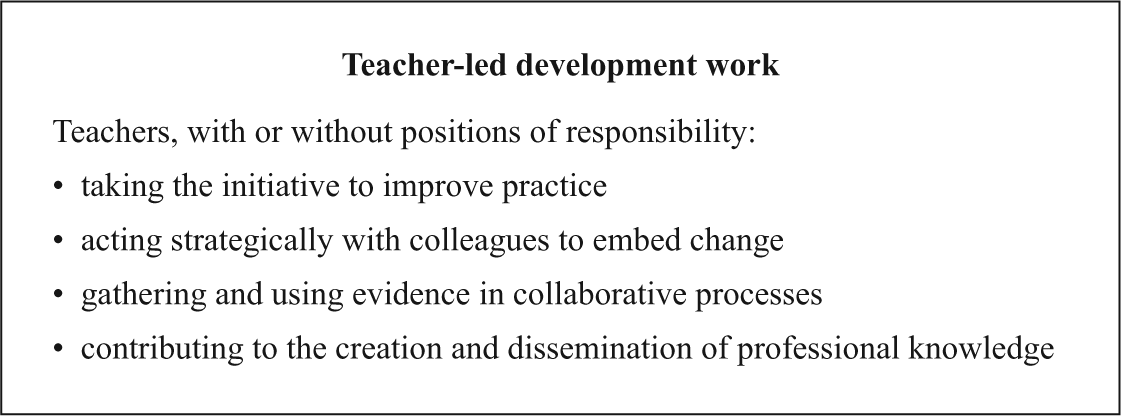
Teacher-led development work.
The project activities
At the outset of the project it was agreed that each participating site would seek to work with at least three schools, a goal which has been exceeded by a considerable margin. The first challenge was to establish partnerships in order to be able to provide the support and to find schools amenable to what, for some, was a courageous experiment. Some colleagues reported that school principals were initially fearful because of the possibility of weakening their authority and opening up the school to criticism from the authorities. In many cases a somewhat euphemistic title for the programme was adopted – for example, in Turkey, ‘21st Century Teachers’, in Bulgaria, ‘Active Teachers Club’, in Montenegro, ‘Teachers of the Future’ and in Bosnia and Herzegovina, ‘Supporting teachers to lead change’.
In most cases, programmes consisted of a series of two-hour meetings for groups of volunteers at the end of their school day. Sometimes the groups came together to share experience and, in a minority of cases, the meetings were held on Saturday mornings. The meetings featured workshops that enable teachers to reflect on their concerns and values, to plan development projects and to share experience of their leadership of those projects. The tools developed in the HertsCam programme were shared and adapted for use in the workshops. The tools exemplify and illustrate the action the teacher might take. For example, a vignette based on another teacher’s experience would be used to help teachers imagine their own intervention; a facsimile of another teacher’s action plan might help teachers to plan their own projects. Other tools provide structures for reflection, conversation or planning. Others provide formats for documentation such as a record of participation.
The process through which teachers were supported can be represented as a series of steps set out in the list below.
Step 1 Values clarification
Step 2 Identification of professional concerns
Step 3 Negotiation and consultation to clarify agenda for development
Step 4 Action planning
Step 5 Negotiation and consultation to clarify action plan
Step 6 Leadership of enquiry-based development work
Step 7 Networking to contribute to professional knowledge
Workshops provided teachers with focused support to enable them to work through the process outlined above which begins with structured reflection on professional values and the extent to which actual practice in their own classrooms, and in the school more generally, corresponds with those values. This reflection enables each participant to identify a professional concern or priority for development – for example: ‘I want to address the problem of student disengagement.’ The third step involves discussion with a range of appropriate colleagues and stakeholders, partly to clarify the problem or concern, and partly to build the collaborative relationships that are essential to successful development work. Once the focus for development is clear and acceptable to interested parties, the teacher is supported in designing an action plan for a project which is again the subject of negotiation and consultation to ensure acceptability, practicality and maximum collaboration. Step 6 is the most substantive in that it is the leadership of a process of development or innovation which might entail teamwork, enquiry, experimentation and improvement. The final step in the model is contributing to the enhancement of professional knowledge by sharing accounts of the development work in networking scenarios. Leading workshops to support this kind of process is an art that corresponds with a facilitative view of pedagogy rather than one which is a matter of instruction or training.
Teachers in all the participating sites found that they were able to lead development projects and compile evidence of this work in portfolios which were assessed for the purposes of the award of a certificate. The idea of a portfolio of evidence presented a challenge where the tradition had been to assess knowledge through some kind of written test. Nevertheless, it is clear that this approach to certification is viable whatever the cultural context. In a number of sites, the project partners were able to come to agreement with the Ministry of Education such that the certificate could be awarded by the partner organizations, for example an NGO, in association with the ITL project itself; it could then be counted as worth a particular number of credit points within the official career development system.
What has been achieved?
The Advancing Education Quality and Inclusion project as a whole and, on a smaller scale, the APREME project, have generated robust evidence that can inform policy-making across South East Europe and in the European Union about the issues of participation and inclusion. What remains to be seen is the extent to which activists have been able to draw this evidence to the attention of those individuals and organizations who need to take action at the level of policy.
Looking specifically at the APREME project in alliance with the ITL project, we can point to a number of clear achievements:
we have created knowledge about how schools can act to improve the participation and inclusion of minorities in the life of the school;
we have shared that knowledge through small-scale networking events and publications;
we have clarified a theory about educational change;
we have clarified a set of principles to guide the practice of supporting non-positional teacher leadership.
I now discuss each of these in brief outline.
Knowledge about how schools can act to improve participation and inclusion
It is clear from the reports received from the participating countries that teachers were very creative in developing strategies for improving a wide range of practice including that devoted to improving participation and inclusion of minorities in the life of the school. The impact of teacher leadership on inclusion in the ITL project was not limited to those projects that arose because of the APREME project. It is axiomatic that teacher leadership will foster inclusivity because the teachers involved feel a direct benefit from their own enhanced sense of participation and voice. These feelings lead to a heightened awareness of the morality of participation. This combines with the promotion of the value of self-evaluation and inquiry in which students’ and parents’ voices are solicited to create an environment in which inclusion, in its broadest sense, is nourished.
Impact on the involvement of parents in the life of the schools is evident right across the ITL project. This commitment could be seen for example reflected in Bulgaria where a website created by the teachers themselves carried the slogan: ‘Teachers who offer support, trust and mutual assistance to build a team with students, parents, teachers and experts.’ The ITL project report includes an account of a project in which teachers had collaborated to find new ways to include Roma children in the process of education (Frost, 2011). In many countries, but especially in those with significant ethnic minorities, teachers have been successful in engaging parents who would otherwise have been reluctant to come into school. This is exemplified well in the vignette below.
Zana was concerned with the low level of enrolment of ethnic minority students, their early drop-out and a low level of parent involvement. She invited colleagues to meet to discuss how to address the problem. They realized that, although parents from the minority community may not be well-educated, they are good at playing various instruments, so they decided to establish the ‘Music Lab’. They invited the teacher of music and parents from the community and made the plan together. They refurbished the floor of the room to make it appropriate for dancing. Musical instruments and traditional outfits from both communities were bought. They made a schedule for rehearsals where parents would come and help the teacher of music. They decided who would play instruments and who would help with dancing lessons. In cooperation with the Principal, they organized an event where students, with the help of teachers and parents, sang, danced and played instruments. Through this event they were able to distribute information about the Music Lab to parents, teachers, education department officials and teachers from other schools.
The activity described here goes far beyond what is required by legal frameworks. The creativity and practical collaboration involved has a direct impact on participation and inclusion.
A vignette: Working with the community in rural Serbia Jelena is a young elementary school teacher who works in a satellite classroom in a village where the majority of students are Roma. She had been receiving complaints from parents from the village that their children did not have proper school yard and they felt discriminated against because the main school had a very well-equipped school yard. She talked to the school principal about this problem and together they decided to do something about it. They talked to parents and discovered that the main motivation behind the request they made, was desire for their children to spend some quality leisure time, because this rural area is lacking activities designed for children and youth creating bigger problems, such as violence, alcohol and drug abuse, etc. They understood parents’ fears and told them that the school would be willing to make a school yard, but they needed help from parents with such things as cutting the grass, cleaning the field, painting sports equipment and so on. Parents volunteered to help, so the joint action for building the school yard began with a collaboration between teachers, students and parents. During this process Jelena and the school principal thought about how to use the school yard effectively; they suggested joint activities for parents and their children. This would provide opportunities for them to spend some quality time together and would strengthen parent–school cooperation. During the opening day of the school yard, sports games were organized; parents were both organizers and participants in sports games together with their children and teachers.
The sort of activity illustrated above led to a much greater involvement of parents in the life of the school as indicated by the detailed account in the report from the Serbian section of the international team.
Teachers reported increased level of parents’ participation and motivation to be involved in different aspects of school life. Parents were very glad to be informed about different opportunities for their involvement, they were motivated to participate and they attracted more parents to become involved. (Final Report, July 2011, Serbia)
This involvement was not restricted to the sort of activity described in the vignette above, but also extended to involvement in the curriculum and classroom activity more widely.
Sharing the knowledge through networking
The knowledge created through teacher-led development work was shared and developed through networking. Accounts of teachers’ development projects were shared on web sites and through a variety of face-to-face network events. Such events have been well established in the HertsCam context (UK) for some years and have occurred under the auspices of the ITL project in places including Athens, Belgrade, Bucharest, Istanbul, Ohrid, Zagreb, Niksic, Sarajevo, Veliko Tarnovo and Sofia. A network event dedicated to the APREME project was also held in Durrës, Albania. These events have enabled teachers to come together and share accounts of their projects and to engage in discussion about them. Often, other teachers from the surrounding region were invited to attend. Representatives from the media and government organizations were also invited.
In some cases the events involved teachers from more than one site coming together to build their professional knowledge through presentations and workshops. In Bucharest for example, teachers travelled from Moldova and from the north of Romania to exchange accounts and discuss ways to improve teaching and learning. In Belgrade, teachers from Bosnia and Herzegovina drove for nine hours to participate in an event. In Sarajevo, teachers from Montenegro, Serbia, Croatia and Macedonia came to join teachers in Bosnia and Herzegovina to talk about their projects and celebrate their achievement. The event in Ohrid brought together teachers from all over Macedonia. In spite of ongoing political problems across the region, it is encouraging to find that teachers and other educational activists can collaborate happily.
A theory of educational change
A full discussion is beyond the scope of this article, but it has been documented elsewhere (Frost, 2011, 2012). In outline, the experience of the ITL project in conjunction with the APREME project has enabled us to articulate a theory which connects non-positional teacher leadership, the building of professional cultures in schools and the building of professional knowledge in educational systems. In this model professional learning is inextricably bound up with teachers’ strategic action which is scaffolded and supported by expert facilitation. Knowledge creation arises from teachers’ leadership of development work. This activity is most likely to flourish within cultures that can be characterized as professional learning communities which demand that school principals prioritize culture building (Schein, 1985). The principal’s job is also to ensure coherence such that project work led by individual teachers or groups of teachers is linked to and resonates with the general direction of the school’s development priorities (Hill, 2009; Mylles & Frost, 2006). The third component is concerned with building professional knowledge in the system which starts with teachers’ development work, accounts of which are subject to scrutiny and critical discussion in networking contexts. By working beyond single schools and, where possible, across regional and national boundaries, teachers are able to build knowledge that is credible and transferrable.
Principles for practice
Our experience of adapting, developing and evaluating our own practice in supporting teacher leadership enables us to put forward a set of principles which might guide others who wish to follow a similar path. These are appended to this article. It is hoped that these principles will enable others to apprehend at a glance the nature of the approach we have developed. It is also envisaged that such a list could be a useful tool for self-evaluation and reflection for those contemplating adopting a similar approach.
Changing the paradigm
This article began with the question of whether those at the top are able to effect change in the system and solve what they perceive to be the problem. I want now to turn that on its head and pose an alternative set of questions. How can teachers who wish to influence educational practice make their voices heard? How can they get the attention of policy-makers and secure from them the space and the support they need, in order to be able to transform not only their own practice, but also the practice they see around them?
The ITL project report contains persuasive evidence that, given the right kind of support, teachers are able to be influential even in the most challenging circumstances. This comment included in the report from Moldova is typical.
The teachers’ projects made a difference not just to classroom practice, but more widely. It made a difference to their colleagues’ capacity – their teaching, their understanding, their dispositions and their work motivation, in spite of teacher low status and salaries in our country. (Final Report, July 2011, Moldova)
When teachers come together to exchange accounts of development work and build professional knowledge together, the impact they have on each other goes way beyond the sharing of technical know-how.
I caught myself participating in discussions with all my heart, getting excited about the most ordinary talk between colleagues from our school and the colleagues from Hrasno. Exchanging ideas, listening to each other with respect, giving support to each other, one gets tremendous self-esteem, and that is all I need. So I managed to go beyond the limits of my previous work, I set my goals on a higher level. Having seen the results of what I initiated with my idea in cooperation with my colleagues, I am encouraged to make new ways to continue something that improves the quality of work with children, which encourages me personally, thereby making me happier. (A teacher from Sarajevo quoted in Bosnia and Herzegovina Final Report)
A vision of advanced professionality is evident in this teacher’s comment. The evidence in the ITL project report suggests that working as leaders of development projects enables individuals to build stronger sense of self-efficacy. This is illustrated by this typical extract: At the start teachers were sceptical about the idea that they can change schools. . . . At the end of the sessions most of them said that change could be achieved, and it is teachers who can make that change. (Final Report, July 2011, Montenegro)
The type of professionality implied here is one in which education reform is what teachers do. They do it with support from headteachers/school principals who understand the need for such professionality and know how to cultivate the conditions within which it will flourish. They do it also when they have expert facilitation as described above. Distributed leadership of the kind discussed above leads to cultures of innovation in our schools where the central aim of all activity is to maximize the life chances of children and young people. The cultivation of such moral purpose is arguably the way we will develop a more democratic way of life in schools and communities around the world.
Footnotes
Appendix: Principles for supporting teacher leadership
Acknowledgements
The author would like to express gratitude to Ivona Čelebičić of ‘proMENTE Social Research’ in Sarajevo, Gordana Miljević of the ‘Centre for Education Policy’ in Belgrade, Vlasta Vizek Vidović of the ‘Institute for Social Research’ in Zagreb and Jelena Vranješević of the Faculty of Education, Belgrade University for helpful critical comments on a draft of this article.