







Abstract
In school systems around the world, there is an increasing focus on students’ academic achievement. The challenge of how to improve schools is an important issue for all levels in the school system. However, a central question of both practical and theoretical relevance is how it is possible to understand why (or why not) school-development efforts are successful. The purpose of this article is to explore the ecology of local school development through the case of a medium-sized municipality in Sweden, based on empirical data from two follow-up research projects. The analytical framework draws from organisational theory and new institutional theory, where focus is directed towards how different sub-systems of the school organisation interact with and respond to aspects of development work and the implications for outcomes of school-development initiatives. Findings show that great investment of resources from the central level in the local school organisation necessarily does not lead to changes in teaching practice. School-development initiatives are unlikely to be successful unless they engage and re-couple the involved sub-systems. Finally, we discuss how the introduction of Expert Teachers as a new sub-system has the ability to work as a link between other sub-systems and to promote school development.
Introduction
This article explores local school development from a perspective inspired by organisational theory and new institutional theory (Orton & Weick, 1990; Scott, 2008; Vanderstraeten, 2007; Weick, 1976). While the local is the empirical area of main concern, this study is discussed against the backdrop of current global developments in school systems which place stronger emphasis on academic achievement and performance and increasing demands on school decision-makers to gradually improve school results. Around the world, new policy spaces that transcend national borders are taking shape (Sassen, 2006). Transnational actors, such as the Organisation for Economic Co-operation and Development (OECD) and the European Union (EU), and soft policy agreements and educational standards put pressure on nation-states’ education systems (Grek et al., 2009; Ozga, Dahler-Larsen, Segerholm, & Simola, 2011).
This emerging transnational educational policy space offers strong incentives for imposing change on schools (Levin, 1998; Storey, 2007). It is important to recall the global picture as educational policy makers generally see the local as the site where all the promises and aspirations of educational reform are to be accomplished and fulfilled. Many countries have recently undertaken reforms concentrated on restructuring school systems, curriculum and resource allocation which nevertheless have little impact on classroom activities (Cuban, 1998; Dumont, Istance, & Benavides, 2010; Håkansson & Sundberg, 2016). At the same time, it is important to notice that this is not a new phenomenon. In Fullan’s (2000) overview of implementations of large-scale educational reforms from the 1950s until the year 2000, he concludes that ‘putting ideas into practice’ (p. 6) seems to be an eternal challenge for policy makers and actors in the school system. Today, the significance and potential of the local and regional management of schools for school development and improved student achievement is a highly topical issue, especially considering the interactions of actors at different levels in the school system. A major question, however, remains how major programmes of school-development solutions can be implemented when research has repeatedly shown that such efforts need to be context specific and sensitive to local conditions (Hopkins, Stringfield, Harris, Stoll, & Mackay, 2014).
In recent years, Sweden has seen national policy initiatives in line with transnational policy trends that, in different ways, have triggered school-development initiatives in public and independent schools: the establishment of new authorities, such as the School Inspectorate (2008); a new curriculum for compulsory and upper secondary schools (2011); a new education act (2010); and reform of career services for teachers (CST, 2013). The CST reform in July 2013 introduced ‘Expert Teacher’ 1 as a new category of teachers in Swedish public and independent schools (there are about 14,000 Expert Teachers in Sweden; Swedish National Agency for Education (NAE), 2014). The state authority allocates a number of positions for Expert Teachers based on the number of students, and funding is based on government grants (Promemoria from the Government, 2013). To be appointed, a teacher must be certified, have a minimum of 4 years of documented excellence in teaching and the ability to improve student achievement (Government Grant Ordinance, 2013, p. 70; NAE, 2013). With the appointment follows a quite substantial salary rise (about €540 per month). There is no strict government regulation for the duties of the Expert Teacher. They may be responsible for coaching colleagues, pedagogical discussions, subject development, teacher students on placement and so on. The reform itself is flexible, and due to a decentralised school system, municipalities and independent schools are free to recruit and designate the duties of the Expert Teachers. Thus, there is a plethora of solutions and great variation in design between municipalities.
The aim of the CST reform is to promote the status of teachers and offer career opportunities by appointing skilled teachers and engaging them in school development. To some extent, the idea of Expert Teachers resembles the National Board Certified Teachers in the United States (Bond, Smith, Baker, & Hattie, 2000; Vandevoort, Amrein-Beardsley, & Berliner, 2004), the ‘Advanced Skills Teachers’ (AST) in England (Fuller, Goodwyn, & Francis-Brophy, 2013) and the Chartered Teacher Standard in Scotland. However, unlike these programmes and initiatives, there is no requirement for Expert Teachers to have a specific education, degree or accreditation. Research has shown that Expert Teachers can become an important support for school development and continued professional development and reinforce distributed leadership throughout schools (Alvunger, 2016) but might, to some extent, challenge existing leadership relations and authorities, primarily principals (Alvunger, 2015b). Our aim in this article is not to highlight the enactment of the CST reform as such, but it is important to be aware of the particularities of this reform as we move on to the scope and research questions of this article.
The research problem and questions
School development is a dynamic research field. During the past decade, important empirical findings and theoretical models explaining and supporting successful school development and school leadership have emerged (Fullan, 2001; Hargreaves & Fullan, 2012; Hallinger, 2011; Harris, 2012; Leithwood et al., 2007), but there are no ready-made solutions or quick fixes for school development that can be rolled out. A central question of both practical and theoretical relevance is how it is possible to understand why (or why not) school-development efforts are successful. In this study, this general question serves as a point of departure for exploring the ecology of local school development through the case of a medium-sized municipality in Sweden. The following research questions are investigated:
How do school actors in the different sub-systems of the local school organisation interact with and respond to core aspects of development work?
Based on the former question, what implications for the outcomes of local development work can be identified?
How is it possible to strengthen the organisational capacity for reinforcing local school development?
Background
In this study, insights from classical organisational theory and new institutional theory are applied and related to empirical data collected from two ongoing evaluation projects conducted in the same medium-sized Swedish municipality between 2013 and 2016. As discussed, those years saw several educational reforms and national and local school-development initiatives. The first project, ‘Learning schools’ (LS), studied the processes and outcomes of development work at nine schools based on data collected from different levels of the local school system (2013–2015). The second project, ‘Implementation of Expert Teachers’ (FT), analysed the implementation of Expert Teachers, focusing on the local school organisation; formulation of the duties assigned to Expert Teachers; and relationships between different agents in school development and their challenges, needs and strategies (2014–2016). Although the two projects had somewhat different approaches and targeted different contexts, they shared a common interest in the factors that promote school development and capacity building. Together, these projects generated rich empirical materials from various contexts in a local school organisation that enable a thorough analysis of the school-development work at different levels in the same municipality. Therefore, it is appropriate to use these two projects together as a case study to better understand the processes and outcomes of local school-development work.
Theoretical points of departure: the local school system as an open, nested and loosely coupled system
School-development initiatives that accomplish change are embedded in practice. In this study, we understand school development as a capacity-building process, where individuals, groups and organisations develop capability not only by obtaining knowledge and skills but also by creating motivation and sometimes change attitudes, with the aim to improve conditions for students learning (Resnick, 2010; Stoll, 2009). From this point of view, it becomes important to develop a theoretical understanding of the local school system, its different parts and the relationships between them. The perspective on the local school organisation presented in this section consists of two pillars that together form a theoretical scaffold for focusing on (1) the relationship between the local school system and the surrounding environment and (2) the relationships between different levels and sub-systems of the local school system.
School organisation as an open system
The first pillar builds on the understanding of the local municipal school organisation as an open system (Scott, 1995, 2008). In contrast to a closed system, schools in an open system have permanent external interactions with the surrounding environment, for example, exchanging information, people and knowledge. This presents both opportunities and challenges: schools face constant pressure to change and conform to the prevailing rules and belief systems in order to maintain their legitimacy. Vanderstraeten (2002) described this as ‘the paradoxical conclusion that an open system has to change in order to maintain its equilibrium’ (p. 245; italics in original).
In total, three dimensions are central to understanding the ‘how’ of external pressure and schools’ legitimacy: the regulative, normative and cultural-cognitive/discursive dimensions. The regulative dimension emphasises rules and sanctions and gives institutions legal legitimacy. For a school, this means, for example, adhering to the Education Act, curriculum standards and being transparent to auditing authorities (e.g. the School Inspectorate). The normative dimension concerns evaluation and moral legitimacy. These external pressures may arise from work norms, expectations and attitudes towards how schools should work and take appropriate action even in the absence of any legal obligations. Such normative expectations can operate through soft regulations, such as voluntary rules with no formal legal sanctions attached. Finally, the cognitive-cultural/discursive dimension consists of the shared conceptions and frames through which meaning is understood. In this dimension, external impulses are translated and re-contextualised at the discursive level. For example, a school’s attempts to make sense of a curriculum or reform paves the way for action and inserts meanings and patterns into the institution’s cognitive structure (Scott, 2008).
School organisation as a nested and loosely coupled system
Building on the concept of nested systems (Resnick, 2010), the second theoretical pillar conceptualises the internal structure of the local school system as consisted of a number of sub-systems on different organisational levels: the local school administration, school level and teacher/teaching level. Although internally related, these sub-systems each have their own logic, conditions and specific functions in relation to the others. In a school context, the sub-systems might be composed of teacher teams, school leadership teams, the local administration and classroom teachers. The function of the local administration is primarily linked to the organisation of resources (e.g. organisational, financial and human) at the municipal level, while school leaders’ function is similarly determined at the school level. In turn, the function of teachers derives primarily from the organisation of learning environments in the classroom (Resnick, 2010).
Nested sub-systems can be seen to have loosely coupled relationships (Orton & Weick, 1990; Weick, 1976). Thus, within an organisation, such as a school, various elements or sub-systems have weak relationships and couplings. Even if the sub-systems are connected to each other – belong to the same system with a common main function – they often possess knowledge bases and functions specific to themselves. Although the sub-systems in local school organisations are dependent on each other, the complex structure of the organisation complicates their communication and interaction and, from a systems theory perspective, forces sub-systems to reduce the complexity of different situations to enable meaningful communication (Vanderstraeten, 2002). In line with Davis, Sumara and D’Amour’s (2012) discussion about complex systems, the relationships between the sub-systems within a loosely coupled system is characterised by: ‘being not fixed. Rather, the components and their interrelationships are subject to ongoing co-evolution’ (p. 375). Unlike in more tightly coupled systems, this might result in multifaceted goals and means and variances in problem definition and priorities between sub-systems. Such organisations become difficult to centrally coordinate and control. Consequently, the actors in different sub-systems do not accord to central policy directives and intentions but rather their own knowledge base, experiences, priorities and needs (Lipsky, 2010).
Although loose coupling between the sub-systems in organisations can create internal management and communication problems, loosely coupled organisations are by nature generally more open, which makes them more resistant to external pressures to change, such as political directives and public opinion. As Weick (1976) emphasised, these organisations ‘retain a greater number of mutations and novel solutions than would be the case with a tightly coupled system’ (p. 7). Loosely coupled organisations might not follow the intentions of policy makers but can better adapt to the surrounding environment. As well, as explained later, this comprehensive (semi-)autonomy of the sub-systems can affect the processes and outcomes of local school-development work.
Research design
The empirical data upon which this article is based come from two ongoing evaluation research projects (LS and FT) conducted in a compulsory school in a medium-sized municipality (population: 67,000) in south-eastern Sweden between 2013 and 2016. The projects had different designs. The LS was aimed at supporting the development work of nine compulsory schools. The processes and outcomes of the development work were studied and evaluated based on the collection of different kinds of data. The results from the ongoing evaluation were continually communicated to the schools and used for the school-development work (Adolfsson & Håkansson, 2015). The FT project analysed the introduction of Expert Teachers in the local school organisation, investigating recruitment, principals’ and teachers’ expectations of Expert Teachers and the challenges and strategies on different levels. This project explored teachers’ views of the impact of Expert Teachers on teacher learning, teaching and assessment practices; the development and communication of teaching aims and goals; knowledge of teaching and the curriculum; and teachers’ ability to change and challenge their teaching practices (Alvunger, 2015a; Alvunger & Trulsson, 2016).
Both projects closely followed and documented the progress of school-development work at all levels of the school organisation (local school management, administrators, principals and teachers) through document analysis, semi-structured interviews and surveys. Moreover, both projects had a mixed-method approach (Creswell, 2010) in which qualitative data and results were collected and analysed to inform semi-structured interviews and surveys gathering quantitative data to analyse the experienced effects and impacts of the school-development measures implemented. This design made it possible to obtain different but complementary types of data on the same phenomenon (Creswell & Plano Clark, 2007). Data on the case studied here from both projects include the following:
Contextual analyses: Core documents on the local school organisation, policy and vision, leadership and management structure, evaluations, school-development strategies and Expert Teachers’ assignments and position within the organisation were collected and analysed.
Teacher surveys (n = 250, n = 160, n = 157): In the first two surveys (LS), the teachers’ views of the central dimensions of local development work and their notions of changes due to that work were examined at the beginning and end of the project. The third survey (FT) was aimed at evaluating the impact of Expert Teachers on teaching and assessment practices, knowledge of teaching and ability to change and to initiate development work.
Semi-structured focus-group interviews: These interviews were conducted with local school administrators (8 interviews), principals (12 interviews) and Expert Teachers (14 interviews). In the FT project, the interviews focused on the experiences and notions of school-development work among local school administrators, principals and Expert Teachers. The aim of the principal interviews in the LS project was to investigate experiences of the current development work and its possible effects on and changes in teaching practices and student achievement.
The collected data provide an overall picture of the local school-development organisation (sub-systems) that helps answer questions about the process and interactions between actors in different sub-systems and the results and outcomes of the local development work. The conditions for capacity building are discussed in an analysis of carefully selected empirical examples.
The case
Expert teachers and local organisation for school development
The reform introducing Expert Teachers in July 2013 allowed the local school authorities (public and independent) to appoint Expert Teachers and decide their assignments within a framework established by the government. These authorities were responsible, for instance, for introducing newly employed teachers, coaching other teachers, initiating pedagogical discussions and leading projects to improve teaching or a subject (Government Grant Ordinance, 2013, p. 70). The municipality used as a case in this study assigned Expert Teachers at the school level, but they could also be selected to perform temporary assignments at the school network or municipal level. Such assignments were generally based on evaluations by the development unit of the local school administration. The school-development organisation differentiated three types of assignments based on their character (see figure 1 below).
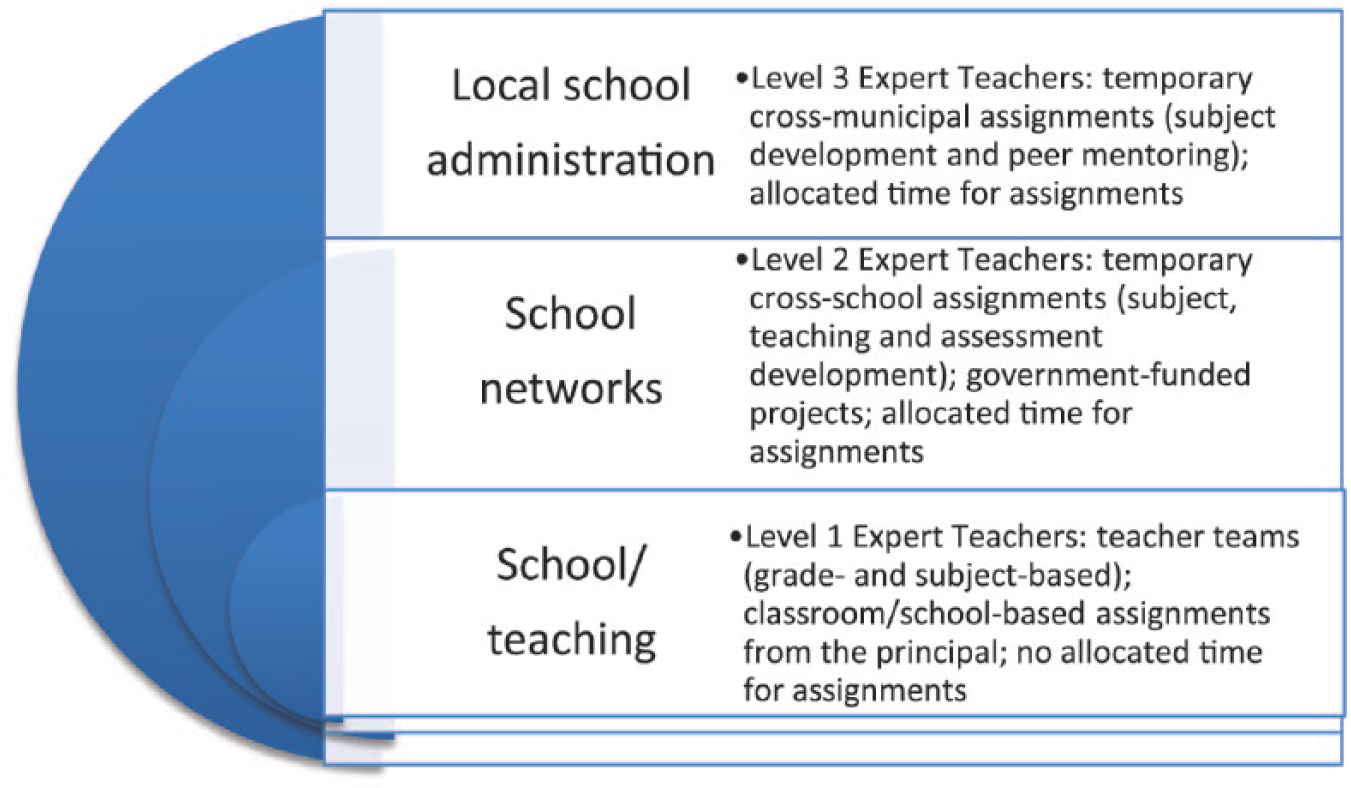
The local school organisation for school development.
In some examples of assignments, Expert Teachers might lead development within a subject (e.g. STEM education, reading and social sciences) and instructional practices (e.g. classroom leadership, language- and knowledge-development strategies and learning assessments). They lead pedagogical discussions; develop new teaching and assessment materials; arrange reading projects; model and design lessons; invite teachers to observe their teaching; share new research; and observe, assist and mentor teachers. Principals and representatives of local school administration considered Expert Teachers to be important resources in development processes, agents and catalysts for change and support for principals in school leadership.
In the focus-group interviews, several challenges Expert Teachers faced in their assignments, principals and school-development organisation were identified: (1) the legitimacy and position of Expert Teachers in the collegial structure (including the ability to resist envy and suspicion); (2) the clarity, character and communication of assignments and duties; (3) endorsement from other teachers and preparedness to engage in development work; (4) support, commitment and mandate from principals; (5) preconditions such as time, resources and education; (6) a lack of common arenas for collaboration, coordination and support, in other words ‘communicative gaps’; and (7) ‘project overload’ and ‘innovation fatigue’ or too many ongoing projects and a failure to find synergies.
The absence of arenas or networks for Expert Teachers to communicate, coordinate and exchange ideas, experiences and good examples within and across different levels was problematic. Level 3 Expert Teachers met regularly and were affiliated with development managers in the local school administration but, unlike Level 1 and 2 Expert Teachers, had no formal links to other parts of the organisation – even if schools had several collaborative groups created by Expert Teachers. A couple of years after the introduction of Expert Teachers, though, informal arenas on subject development were formed for Level 1 and 2 Expert Teachers. More significantly, these arenas were later sanctioned by principals, who saw them as natural spaces for Expert Teachers to introduce ideas on school development. It is important to note that principals also clearly expressed a need for a common arena for the exchange of ideas and experiences.
Two-and-a-half years after the introduction of Expert Teachers, the principals and Expert Teachers were interviewed about what they considered to be effects of Expert Teachers’ assignments. A survey was also administered to explore teachers’ (not Expert Teachers) experiences of the significance and impact of Expert Teachers’ work. The overall feedback was that it was difficult to point to any clear impacts of school development on teacher and teaching level related to the introduction of Expert Teachers; rather, such impacts resulted from a combination of factors. The principals emphasised that Expert Teachers were agents of change who could lead teacher teams and effect changes in classrooms. A convincing majority of the teachers denied seeing any effects, but one-third agreed that the introduction of Expert Teachers had increased their knowledge of instructional practices and classroom leadership and strengthened their ability and willingness to change teaching practice. It is possible to speak about the influences of Expert Teachers’ work in two main areas: the visualisation of common goals to pursue, and the development of teachers’ subject matter knowledge and knowledge of the curriculum and instructional strategies (e.g. classroom leadership and language- and knowledge-development strategies).
Schools’ capacity building for the sustainable development of teaching practices and student achievement
The initiation of the LS project should be seen in the light of a general trend in Sweden of increased focus on students’ academic achievement and greater accountability for local authorities, schools and teachers. The municipality launched a 3-year school-development programme focusing on two school networks with low student achievement and large number of students with special needs. The schools were asked to collaborate with the local school administration in identifying weaknesses and challenges in teaching practices. Almost immediately, it became clear that actors on different levels of the local school organisation could agree on two broad development areas: (1) the development of classroom management and (2) the development of language in all subjects. However, the need to further specify these development areas also gradually became obvious. As a result, the different schools began to work with more specific content in development work, including classroom questioning, formative assessment and instructional structure. In particular, the principals revealed that specification and differentiation of development areas were important ways to legitimise the development work and receive commitment and engagement from teachers.
The school actors in the municipality had quite similar views on what needed to be developed in the schools and classrooms, but disagreement arose on strategies and methods for dealing with the challenges. These differences became obvious at the beginning of the project during the discussion on introducing two basic strategies to promote the development of teaching in every school: pedagogical discussions and peer observation of teaching. Local school administrators; principals; and, to some extent, Expert Teachers stressed peer observation, and a tremendous amount of financial, time and educational resources was invested in implementing this strategy. However, principals and Expert Teachers early noticed strong resistance to peer observation among teachers. One teacher in a teacher focus-group interview described the problems with the peer observation strategy she had experienced:
Many of us feel that it takes too much time to do these observations . . . At the same time . . . sometimes . . . it was also hard to find the ‘right’ moment when to do these observations. In addition, when the observations were made in another classroom, many students were noticeably affected by a stranger sitting in the back of the classroom. (Teacher in Grade 6)
The principals and Expert Teachers clearly recognised that teachers favoured pedagogical and research-informed discussions about their instructional practice:
I would say that the pedagogical discussions have increased significantly at our school. All the teachers talk about pedagogy . . . The teacher teams have pedagogical discussions and reflect on teaching, everyone together. (Primary school principal)
During the course of the school-development projects, Expert Teachers and cross-school subject groups engaged in pedagogical discussions based on the research literature and their practical experiences. This positive attitude towards pedagogical discussions was also indicated in the results from the teacher questionnaires at the end of the project: 66 percent of the teachers (n = 160) claimed that pedagogical discussions – despite almost no additional resource input – were an established method in the schools. Compared to peer observation of teaching, the difference in support was striking: only 16.5 percent of the teachers claimed that this strategy was an established method to improve teaching practice.
Discussion
External pressures and the legitimacy of sub-systems
In the conceptualisation of the school organisation as an open system, a number of external forces influence the internal interactions and relationships of different sub-systems in the local school organisation examined. Accordingly, the local school administration has experienced external regulative pressure and soft governance (Grek et al., 2009; Ozga et al., 2011) exerted by, for example, national legislation and auditing by the School Inspectorate. The administration has annually reported student achievement and described in different templates how they have fulfilled the obligations stipulated by the Education Act and General Ordinances. However, there were also examples of technologies exerting normative control (Powell & DiMaggio, 1991). Municipalities competed in national school rankings (Hamilton, 2007) issued by the Swedish Association of Local Authorities and Regions (of which all municipalities were members) and in benchmarks and appointments, such as awards for the best school municipality of the year given by teachers’ unions.
These external pressures extended into a kind of internal control exerted by the school administration on schools. In the actual case, this control was manifested in the accountability processes for student achievement and goal attainment and the school administration’s initiation of school-development projects. The sub-system that first and foremost had to handle these projects was school management. Many principals reported that the normative pressure from the school administration tended to cause what they called ‘project crowding’. To maintain legitimacy in relation to both the school administration and the teachers, the principals strove to find a balance between the external pressure from the school administration and the internal and specific needs and conditions of their schools. Some principals described themselves as ‘gatekeepers’ who regulated the flow of information and tasks to spare their teachers from the external pressure.
Even when the principals intended to relieve teachers of the burden of accountability to the ‘top’, the principals still held expectations regarding teachers’ ability to improve student performance and learning. In this way, the teachers’ sub-systems were under strain from processes primarily linked to the normative but also to the discursive dimension of control and pressure directed towards teaching practices. In the focus-group interviews, the teachers gave examples of how the principals addressed questions about how to ensure that all students fulfil the knowledge standards in the curriculum. There might have been classroom visits by teachers paired with discussions of what could be considered to be ‘good’ or ‘proper’ teaching and learning. According to the teachers, external pressure was exerted by parents’ expectations for teaching, assessment and grading.
Interactions of sub-systems and the consequences for school development
The external pressures on local school organisations have led to the initiation of extensive school-development efforts in many Swedish municipalities. In the municipality studied, the local school administration launched two main development strategies through a top-down approach: pedagogical discussions and peer observation of teaching. The data show an inverted relationship between invested resources and outcomes in established development methods. Despite generous resource allocation for implementing peer observation in the schools compared to pedagogical discussions, the empirical evidence showed that the teacher sub-systems favoured pedagogical discussions. This tendency can be understood when conceptualising the school as a nested, loosely coupled system (Orton & Weick, 1990; Resnick, 2010; Weick, 1976).
The implementation of peer observation of teaching clearly encountered a severe lack of support among teachers. The teacher sub-systems distrusted the method, perhaps due to the desire to sustain professional autonomy and the local administration’s failure to communicate the purpose and significance of the method, define the problems and find solutions between the sub-systems. In other words, the central sub-systems (the school administration and the principals) could not manage to connect or couple together the other sub-systems, especially the teachers. This lack of successful communication resulted in the failed implementation of the current strategy. In contrast, the success in implementing pedagogical discussions (despite the lack of resources) can be seen as an example of successful couplings between the different sub-systems in the local school organisation. In other words, it seems that even autonomous sub-systems can re-couple based on the belief in pedagogical discussions as an effective, legitimate school-development strategy. Viewing the local school organisation as an open, nested and loosely coupled system and based on empirical findings from the two ongoing evaluation projects, some conclusions regarding the organisational conditions for the implementation of school-development initiatives can be drawn:
As an open system, the local school organisation needs to respond to and have the ability to adapt to external pressure (here, demands for improved teaching and student achievement). This adaptability comes with a price: a risk of top-down, multifaceted development initiatives which result in project crowding at schools, leading to negative consequences for school development.
Great investment of resources from the central level in the school organisation does not necessarily lead to changes in teaching practice.
School-development initiatives are unlikely to be successful unless they actively engage and (temporarily) re-couple the involved sub-systems in the local school organisation (Adolfsson & Alvunger, 2016; Cuban, 2013).
To re-couple sub-systems and create a common vision of goals and means, it is necessary to improve internal communication between the sub-systems.
This list of conclusions is not exhaustive but nonetheless points to fundamental keys to the successful implementation of school-development strategies. It is necessary to find a balance between the autonomy and the interdependence of the sub-systems, identifying and recognising the specific functions performed by actors in the organisation. Following Mitchell and Sackney (2015), such a balance between top-down and bottom-up can create better conditions for what they term as an ‘organic’- or ‘living’-oriented organisation. This means that the local school system and the current school development is understood from a holistic perspective, where all sub-systems to a large extent are integrated and share a common view of problem definition, goals, means and priorities to resolve their issues. From this point of view, it is especially interesting to focus on Expert Teachers as a new function in the school organised as an open, nested system. The final section of this article further explores the re-coupling of sub-systems, particularly the role of Expert Teachers, and discusses the implications for strengthening organisational capacity in local school development.
Expert Teachers as a new sub-system and resource in school development
Applying the theoretical and analytical framework based on organisational theory and new institutional theory supports the conclusion that communication between different sub-systems needs to be improved, for example, to achieve greater coherence in the views on goals and means. However, the findings also reveal a need to create collaborative arenas or networks for communication within the sub-systems of Expert Teachers and principals: in the former case, to exchange ideas and experiences and prevent parallel processes, ‘innovation fatigue’ and congestion of projects and, in the latter case, to strengthen educational leadership, collaborate and avoid competition. Expert Teachers clearly emerged as a new sub-system operating on different levels, so they may create conditions for coupling and re-coupling the nested sub-systems in the organisation to serve school-development purposes. Figure 2 illustrates the school-development organisation, focusing on the role and position of Expert Teachers.
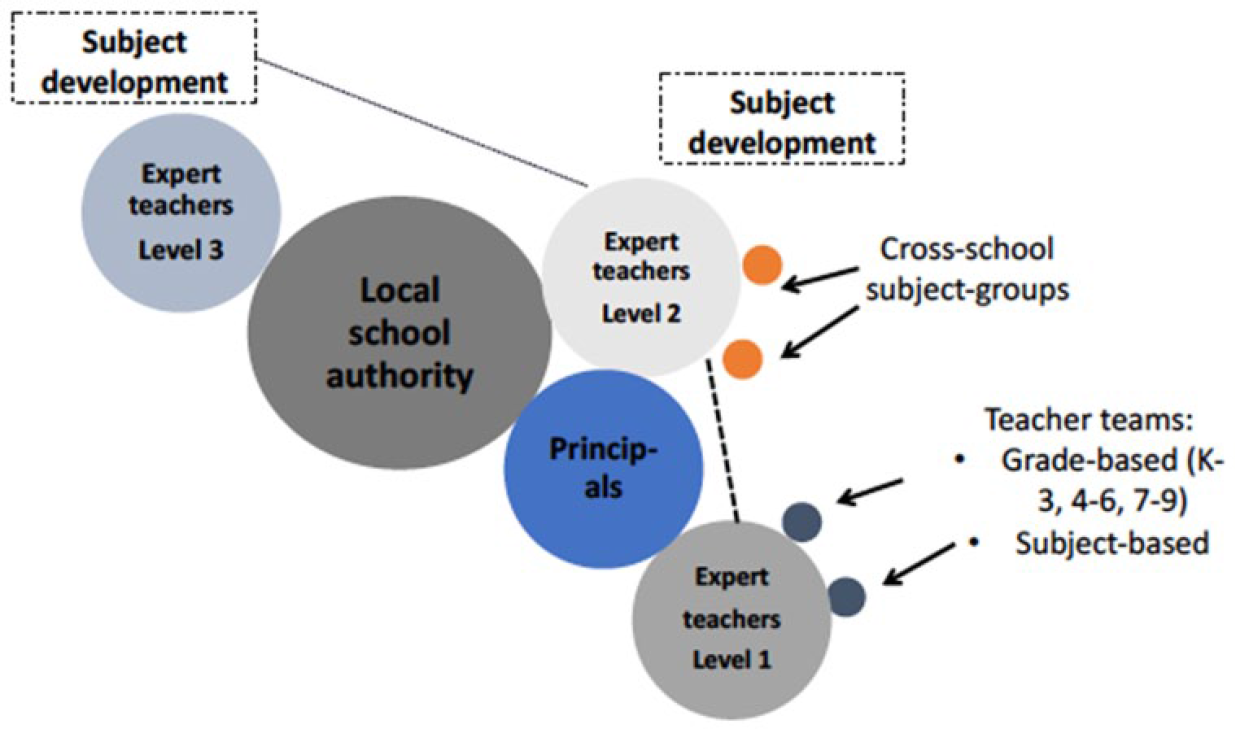
The nested systems of the local school organisation.
This flat image of the organisation (compare Figure 1) reveals the relationships between the various sub-systems and the specific functions of Expert Teachers. Above all, this figure highlights the connections between Level 1 and 2 Expert Teachers (bold dotted line) and Level 2 and 3 Expert Teachers (dotted line). These connections concern subject development as Level 3 Expert Teachers may analyse assessment principles and develop instructional materials for the cross-school subject groups (red circles). These groups are chaired by Level 2 Expert Teachers and involve Level 1 Expert Teachers and subject-based teacher teams in a school network in pedagogical discussions. In turn, Level 1 Expert Teachers bring ideas and materials from these pedagogical discussions to their own schools, where they, with their principals, create conditions for dissemination of, for example, instructional material and collegial learning among the teachers at the school. Thus, a chain is formed, connecting all the layers and sub-systems of the local school-development organisation.
The results from the FT and LS projects show the significance of Expert Teachers to the visualisation of common goals, development of teachers’ subject matter knowledge, knowledge of the curriculum and instructional strategies and pedagogical discussions as an established method in the schools. Integrating Expert Teachers in school development as links between other established sub-systems seems to be a successful strategy. There is evidence to suggest that the new function may promote a balance between incentives moving from the top and downwards in the organisation as well as initiatives from below in the ‘grass root’ segments of the organisation (cf. Mitchell & Sackney, 2015). In turn, this creates conditions for capacity building, where a shared understanding of goals, means and solutions encourages individuals and groups to develop knowledge and skills for increased student achievement (Resnick, 2010; Stoll, 2009).
As have been illustrated earlier, there are both similarities and differences between Expert Teachers and examples from other parts of the world, such as National Board Certified Teachers in the United States. Even though the assignments and duties of Expert Teachers may vary between municipalities – and even between schools in the same municipality – they can be characterised as ‘teacher leaders’, exercising educational leadership by leading development processes and becoming ‘brokers’ and a link between school management and colleagues. Our main focus in this article has not been on leadership practices, but it is clear that in terms of rethinking relationships between the different nested systems of local school development, the implications of the introduction of Expert Teachers may suggest a rethinking of leadership for school development. Expert Teachers engage in leadership practices and are part of distributed leadership (Alvunger, 2015b; Harris, 2012; Leithwood et al., 2007). To some extent, Expert Teachers as a new function responsible for school development, leading teacher teams and with influence on collegial discourse, may ‘force’ the principals to distribute leadership in a more apparent way than before (Alvunger, 2015b, 2016). What the long-term effects of this new function and position in Swedish schools will be is still not clear. Crucially, Expert Teachers neither function foremost as an extended arm for school management nor solely represent teachers’ views but act more autonomously to promote better communication and, in this respect, make the school – as a system – less loosely coupled.