







Abstract
Despite a lack of conclusive evidence connecting autonomous schools and academic success, school autonomy is regularly championed as being a way of not only improving schools but as a way of improving the quality of education in socially and economically deprived areas. This research builds on a recent paper published in Irish Educational Studies that argues that school autonomy should not be advanced in Ireland by exploring how teachers feel about features of autonomous schools. Irish teachers who have previously worked in academy schools in England, and who now teach in disadvantaged schools in Ireland, were interviewed about their experiences and how they would feel about features of autonomous schools being implemented in Ireland. The experiences the participants had in England indicate how school autonomy can be experienced in different ways – morally proper ways that engage with the broad purposes of schooling such as focusing on students and their learning, and morally improper ways that prioritise looking good on external measures at the expense of students and their learning. Overall, the participants were opposed to schools in Ireland becoming more like English academies but felt that having greater local flexibility over the curriculum in schools and offering a wider range of subjects would be beneficial, provided that it was embraced and enacted in a morally proper manner.
Introduction
School autonomy has, in recent decades, regularly been promoted as a way of making schools more productive in both developing and developed countries (Han, 2018). It is one of the key principles of the Global Education Reform Movement, a concept that indicates that most reforms being adopted around the world respond to similar problems and priorities and follow a very similar policy rationale (Verger, Parcerisa, & Fontdevila, 2019). Policy ideas and strategies ‘have travelled around the world and have been enacted in a range of countries’ (Carrasco & Gunter, 2019, p. 67) and autonomous schools have become a familiar form of school improvement policy (Eyles, Machin, & McNally, 2017). Within current movements, school autonomy is considered to be a driver for school improvement as part of a competitive system with parental choice, or as part of a policy that places responsibility over the processes in the hands of those who know best what schools need (Klein, 2017). Autonomous schools are granted more freedom in relation to school finances, staffing, the curriculum and so on. The theory is that if control over these areas is vested in teachers, school leaders and parents who are closer to the students, then decisions will better address students’ needs and consequently performances will increase (Wohlstetter, 2018). Examples of autonomous schools from around the world include academy schools in England, charter schools in the United States, free schools in Sweden, and independent schools in Australia, while proposals have been put forward for establishing autonomous schools in Spain, Norway, New Zealand, and Ireland (Salokangas & Ainscow, 2018).
In 2009, the National Council for Curriculum and Assessment in Ireland published a discussion paper on leading and supporting change in schools that, among other things, identified the key role of teachers in the implementation of change and explored how lasting change in areas such as school culture and implementation could be achieved (Coolahan, Drudy, Hogan, Hyland, & McGuiness, 2017). The need to give schools greater autonomy in setting the agenda for change at the local level, and the need to involve teachers and schools in both planning for change as well as involving them in the process of change, was recognised (Coolahan et al., 2017, p. 33). However, policy-makers around the world continue to be preoccupied with identifying the ‘right’ policies to secure change and improvement, rather than considering the conditions and contextual factors that are most likely to make any chosen policy effective in practice (Harris & Jones, 2018). It has recently been argued that advanced school autonomy is not suited to the Irish context (Skerritt, 2019a), and this paper explores how Irish teachers feel about features of autonomous schools in England. Irish teachers who have previously worked in English academy schools, and who now teach in Ireland, are interviewed about their experiences, and how they would feel about similar features of school autonomy being implemented in Ireland. Little is currently known about how school autonomy is used in practice (Neeleman, 2019), and the voices from inside academies are largely missing from the research literature (Braun, 2017), so it is not only important that this lacuna be filled, but from an Irish perspective, if Irish schools are to be ‘academised’ to any extent, it is imperative that the experiences of Irish teachers, and especially those with experience in both Ireland and in England, be heard and listened to.
Policy context
Ireland
Ireland’s education system has been referred to as a highly centralised one by many (see for example, Hearne & Galvin, 2015; Jeffers, 2011; MacVeigh, 2012). As O’Neill (2000) says, it is ‘notoriously centralised’. Many aspects of the financing and administration of the Irish system are in the centralised control of the Department of Education and Skills (DES). With the exception of about 35 per cent of post-primary schools, a striking feature of the school system is that there is no intermediate tier of administration between the DES and individual schools (Coolahan et al., 2017). The DES prescribes curricula, establishes regulations for the management, resourcing and staffing of schools, and centrally negotiates teachers’ salary scales (Darmody & Smyth, 2013). Furthermore, cultural traditions have excluded other stakeholders from formal levels of involvement in school decision-making. According to Daly (2009, p. 215), for example, in the past ‘Irish parents were denied a formal role in their children’s schooling by the combined forces of state, church, and the teaching profession’. Today, this is something that has remained largely unchanged. Thus, Ireland’s education system can be best characterised, as the Organisation for Economic Co-operation and Development (2013) puts it, as a ‘centralised school system’ ‘steered’ by the government and the DES.
England
Since 1988, all schools in England have had considerable autonomy over matters of organisation, staffing and finance, albeit operating within a framework of oversight provided by local authorities and strongly circumscribed by a performativity regime which judges schools both on their test, examination and inspection outcomes (Moreton, Boylan, & Simkins, 2017). In recent years, however, the move towards school autonomy has intensified greatly. The transnational trend towards school autonomy has been enacted through the academies programme (Boyask, 2018), that is, schools that are directly funded by the government but controlled by companies and charities and given greater autonomy and freedom to be innovative (Brown & Greany, 2018), and ultimately more business-like. A process of ‘mass academisation’ has occurred since 2010, whereby all state schools have been encouraged to become academies (Regan-Stansfield, 2018), 1 removed from the control of local education authorities so that they can plan for their own local needs and specifically cater for students as they see fit. This may include adjusting teachers’ pay and working conditions, experimenting with the school curriculum and providing more meaningful roles for parents. While all schools in England are publicly ranked and judged in a system which has become increasingly high-stakes for schools and school leaders, given their autonomy and freedom academies perhaps face more intense pressures to gain and maintain a positive position in the school marketplace. The national performativity regime remains in place – and is arguably more rigorous in academies than in other schools.
School autonomy and accountability
Internationally, somewhat paradoxically, there is a perceived need for greater accountability to counterbalance the increased autonomy given to schools (Brown, McNamara, O’Hara, & O’Brien, 2016). New systems of inspection are required to monitor and control newly autonomous institutions (Baxter, 2019) and school autonomy and accountability tend to come to be conceived as being inseparable as governments grant more autonomy to schools in organisational, budgetary, and/or curricular terms to the extent that schools accept stricter supervision and control (Verger & Parcerisa, 2019). The pressures to perform, especially in marketised education systems such as in England, are therefore likely to restrict the autonomy of practitioners. As I have said elsewhere, the rhetoric of autonomy is very much that – rhetoric, as autonomy for the school equates to a lack of autonomy for the teacher (Skerritt, 2018a). While the English education system is often considered to be one of the most high-stakes in the world, the Irish education system is not as severe (Mac Ruairc, 2019) and continues to operate as part of a low-stakes accountability environment (O’Brien, McNamara, O’Hara, & Brown, 2019). However, if school autonomy is advanced, this can be expected to change and to start resembling what is happening in other countries. As the Chief Inspector, Dr Harold Hislop, has previously said, what is inevitable, is that any moves to grant greater autonomy and decision-making powers to schools is likely to have to be balanced by greater public scrutiny of the work of school leaders, teachers, boards of management and school patrons. (Hislop, 2012, p. 6)
Rationale
Background
Ireland’s DES recently published both a research paper (DES, 2015a) and a consultation paper (DES, 2015b) on the potential decentralisation of decision-making to schools and local communities. One possible model is the English academy model, which many take to exemplify greater autonomy and scope for initiative. In light of these papers, however, it has been argued that although some features of autonomous schools may be enticing in Ireland, advanced school autonomy is not suited to the Irish context (see Skerritt, 2019a). For example, it is argued that Irish teachers are more intrinsically and altruistically motivated and may wish to remain as classroom teachers as opposed to aiming for other positions, that Irish parents do not tend to formally engage in school life and may wish to remain in informal roles, and that a reconstructed curriculum, that may lead to a narrower one, possibly with easier qualifications, may limit students’ opportunities in the job market given how important formal qualifications are in Irish society and in the Irish employment market (Skerritt, 2019a). Moreover, at a more general level, autonomy may not be what it seems in practice. As noted already, school autonomy tends to bring about greater accountability and can therefore be misleading. Similarly, Smyth (2011, p. 98) summarises the movement as making schools more accountable and responsive to parents and students, removing supposed inefficiencies that exist in the form of bureaucratic red tape, enabling schools and communities to make decisions in their own best interests, giving greater curriculum choices and bringing schools much more into the orbit of the competitive practices of the business sector: None of these seem at first glance to be particularly objectionable ideas–after all, who could possibly be against increased efficiency, greater accountability, enhanced transparency, and giving schools and parent bodies more power? (Smyth, 2011, p. 98)
Some might say, however, that it is actually ‘a process of deception that has been carefully orchestrated and nurtured’ (Smyth, 2011, p. 99).
School context
Academies in England were originally intended to be based in disadvantaged areas (see for example Gorard, 2005, 2009; Kerr & Dyson, 2016; Wrigley, 2012). The hype surrounding them is that they will address the social class attainment gap, and they have been heavily promoted as a means of improving the achievement of working-class students (Reay, 2017). However, academies do now also operate in all kinds of areas. In the Irish context, this research specifically focuses on DEIS (delivering equality of opportunity in schools) schools. DEIS schools are schools that serve locations identified as being areas of socio-economic disadvantage. In operation since the 2006/07 academic year, DEIS is an initiative that has been aimed at being the strategic response of the DES to filling in the gaps that were missed in earlier programmes aimed at combating educational disadvantage in Ireland. DEIS schools and many academies, and particularly the earlier ones, are therefore similar in terms of the composition of students they cater for. Furthermore, as a key dimension of the rationale underpinning the DEIS programme was the increased autonomy given to these schools (Mac Ruairc, 2009), it is the contention of this paper that DEIS schools are Ireland’s most similar schools to England’s academy schools. It is also notable that in the Irish context, albeit where evaluation, inspection and accountability can be considered to be light-touch, DEIS schools face greater scrutiny than non-DEIS schools. They are obliged to set clear targets and to monitor progress through systematic evaluation (McNamara & O’Hara, 2012) and the intensity of focus on test scores and measurable outcomes adds to what is an already rigorous testing regime that the DEIS programme obliges participating schools to implement (Burns, 2016a). Some teachers in DEIS schools can therefore feel like they are under surveillance (Burns, 2016b) – a common theme in English academies.
Recent proposals
More recent developments in Ireland bear further resemblance to the academy model in England, and particularly to Multi-Academy Trusts (MATs) – chains of academy schools run by a Trust (Ehren & Godfrey, 2017). England has recently introduced several reforms that aim to create a ‘self-improving system’ where schools collaborate in networks to exchange good practices and maximise inter-school professional development (Ehren et al., 2017), as the collaboration of schools under the authority of a Trust is supposed to improve the quality of teaching and learning because, compared to other schools, academies within a Trust can respond with greater flexibility to local context and ensure innovative and affordable services (Ehren & Perryman, 2018). In Ireland, the Minister for Education and Skills has said that he is keen for Irish schools to encourage innovation in education and that he is planning to build a number of ‘clusters’ to help schools work together, including connecting up to 100 schools in creative clusters and helping disadvantaged schools to work together (The Irish Times, 2018). While establishing collaborative clusters of schools is not an exclusive feature of academies, the official discourse in Ireland bears strong resemblance to the academy model and MATs.
Reforms that combine the increasing autonomy of schools with school-to-school relationships are seen as a way of ensuring that the most disadvantaged students have access to high-quality education (Eddy-Spicer, 2017), and to improve the learning experiences and learning outcomes for learners impacted by disadvantage in Ireland, a stated aim of Ireland’s DES (2016) is to create networks and clusters for teachers and schools and better integrate the work of schools and local community supports. The School Excellence Fund (SEF) initiative, targeted primarily at DEIS schools, was introduced in 2017 to support and reward innovative practice in schools. The aim is to encourage schools to work in clusters to explore and use new, innovative solutions to tackle educational disadvantage and to improve learning outcomes for students (Government of Ireland, 2018). While DEIS schools have already been more autonomous than non-DEIS schools in Ireland, the autonomy afforded to schools under this new programme indicates a major shift away from the traditional centralised nature of Irish education and represents a move towards greater independence. According to the DES website (www.education.ie), Never before have schools been funded to work together on innovative solutions and given the freedom to experiment with new projects to see what works and what doesn’t. The benefit of this approach is that it gives school leaders on the ground the support to collaborate on ideas based on their local experience and unique perspective.
While consideration may be given to the inclusion of non-DEIS schools in the project where a proposed cluster of schools consists of a mix of DEIS and non-DEIS schools, the SEF is specifically targeted at DEIS schools because of the priority attached to increasing student attainment within these schools (DES, 2018). Given these developments, and the similarities between DEIS schools and academies, this research specifically focuses on DEIS schools in Ireland.
The research
Not only are many aspects of the Irish education system highly centralised but Irish schools do not currently face the same performance pressures as schools in England do, given the absence of any real competitive school marketplace. For example, school league tables are outlawed in Ireland, and there is no system of sanctions or rewards related to either school or teacher performance (Jones et al., 2017). Decentralising greater autonomy to schools, a shift that is likely to involve making them more business-like, competitive and accountable, is therefore a significant change. This small-scale research aims to investigate how teachers from Ireland have experienced school autonomy in England and how they would feel about Irish schools adopting this freedom.
Qualitative data were generated through one-to-one interviews with five Irish teachers who had each previously worked in English academies and who now teach in DEIS schools in Ireland. Qualitative research methods involve verbal descriptions of real-life situations (Silverman, 2014) and therefore produce data in the form of words as opposed to numbers. This descriptive data allow the participants to speak more in-depth about their feelings and experiences and helps us to better understand their perspectives. Qualitative research was chosen for three main reasons. First, because relative to quantitative research, qualitative research produces deeper, richer data that will help us to better understand Irish teachers’ perceptions of and experiences in academies and DEIS schools. Second, because it would be very difficult to design a questionnaire or conduct any type of quantitative research when there is very little currently known about teachers in academy schools, and specifically Irish teachers in academies, and third, because qualitative research facilitates, accommodates and embraces the interpretivist approach that is necessary to understand the participants’ experiences. Thus, qualitative research was the most suitable and appropriate approach due to the exploratory nature of the research.
Interviewing is one of the most common and powerful ways in which we try to understand our fellow human beings (Denzin & Lincoln, 2005) and is most effective when the research wants to explore complex phenomena such as opinions, feelings, emotions and experiences (Denscombe, 2014), as this research does by investigating how Irish teachers have experienced life in English academies and in DEIS schools in Ireland. Interviews were particularly beneficial for this research because different people experience life in different ways and from different perspectives, and so each participant’s answers reflect his or her unique perceptions of what has happened in their life and what is happening at present (Tuckman and Harper, 2012). Each interview consisted of open-ended, semi-structured questions where the emphasis was on the interviewee elaborating on and developing ideas (Denscombe, 2014).
An Interpretivist approach was taken in this research, in that real-world, first-person, subjective experiences were prioritised. An interpretivist approach was appropriate here because this research was not concerned with objective ‘hard data’ but with the complex and intricate interpretations individuals had of objectivity. Interpretivism is based on the belief that individuals construct a personal reality by attaching specific meanings to local situations, giving structure and meaning to everyday life (O’Donoghue, 2007) and assumes that reality as we know it is understood intrasubjectively and intersubjectively through the meanings and understandings collected from our social world (Angen, 2000). This approach also recognises that different stakeholders, such as Irish teachers, interpret situations in different ways (Vidgen & Braa, 1997).
Elsewhere (see Skerritt, 2019a), I have argued that four features of autonomous schools 2 that may initially seem enticing in Ireland are not actually suited to the Irish context:
More career progression for teachers.
More involvement for parents.
More meaningful experiences for students.
More philanthropic activity for funding.
This research explored how Irish teachers feel about these features of school autonomy but, as classroom teachers, it was not expected that participants would have a deep understanding of philanthropic activity, so it was decided that interviews would focus on three areas:
More career progression for teachers.
More involvement for parents.
More meaningful experiences for students.
Three key questions guided the research:
How have Irish teachers experienced these features of school autonomy?
How do Irish teachers feel these features of school autonomy compare with DEIS schools?
How do Irish teachers feel about DEIS schools becoming more like academies?
The participants
The five participants were all teachers from Ireland, where they were educated as school students and as pre-service teachers. Each participant was now teaching in a DEIS school in Ireland but had previously worked in an academy school in England. Of the five participants, four had worked in an academy that was part of an MAT. The participants had worked in academy schools in different parts of England (Cambridgeshire, Essex, Kent and London) and were now all teaching in DEIS schools across two counties in Ireland. It is also worth noting that the academies the participants had worked in were based in disadvantaged areas. Further information on each participant is available in Table 1.
Further information on each participant.
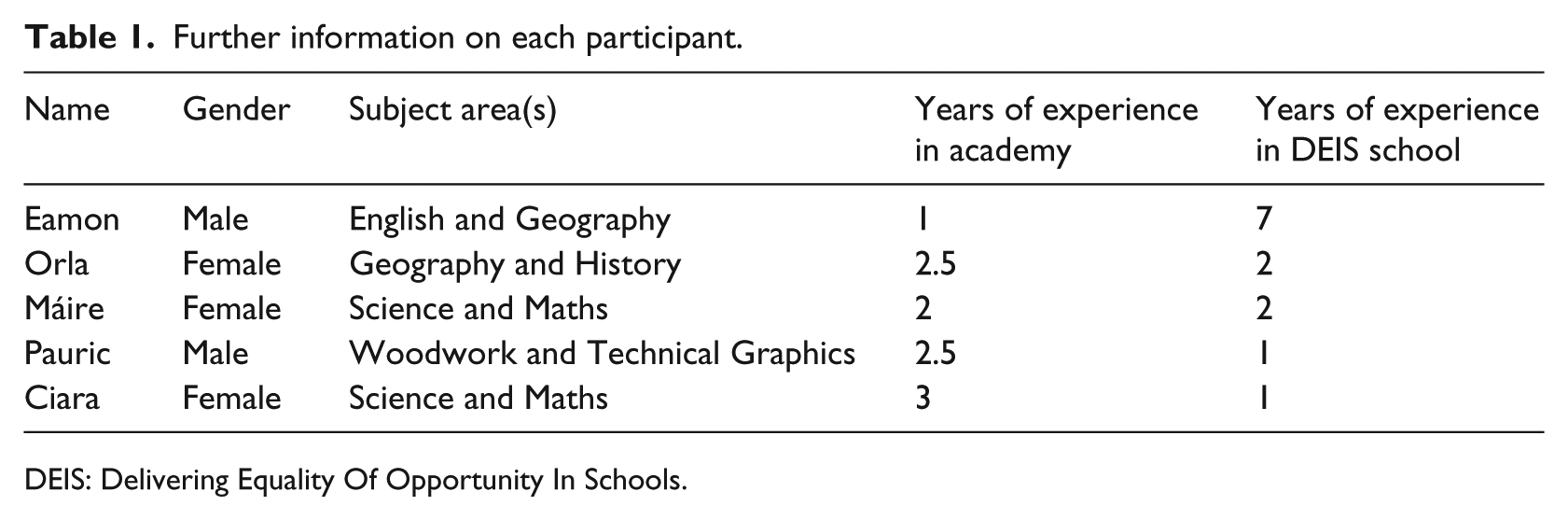
DEIS: delivering equality of opportunity in schools.
Limitations
This was a small-scale study with a very small sample size, meaning that the results are not generalisable. However, there are no data available on how many Irish teachers have previously worked in English academies and who now work in DEIS schools in Ireland. It is likely that only a minority of the workforce in DEIS schools also have experience working in an English academy, so a small sample of participants was always expected.
At times, prejudiced viewpoints were expressed by the participants. It is therefore worth reiterating the point that all participants left the teaching profession in England to return to Ireland. As shown in Table 1, the longest time any participant spent working in an academy was three years, and while there are a range of possible reasons why these teachers might have returned to Ireland, the negative tone of the interviews might indicate that in leaving the teaching profession in England, these particular participants did not enjoy their experiences. Thus, this negativity is reflected in how they spoke in the interviews.
Findings
More career progression for teachers
Until the mid-1990s, educational leadership was not regarded as a priority in Irish education policy or in the management and the daily work of schools (Coolahan et al., 2017). There has been only a limited tradition of what is sometimes called ‘middle management’, and appointment to a position such as ‘assistant principal’ has been, in most schools, on the basis of seniority (Jeffers, 2010). According to Ryng (2000), posts of responsibility came to be considered a long-service reward in Ireland. While each staff member was theoretically eligible to apply for an advertised post, the general practice was that only the longest serving teacher would apply, with more junior staff reluctant to challenge the status quo (Ryng, 2000). While this custom may have changed slightly over the years, salary cutbacks and the removal of promotion posts in recent years (Coolahan et al., 2017) meant that that the participants felt that there were little to no opportunities available for career progression in their schools in Ireland. Some felt that this was something that could be improved on, like in England: The thing that’s missing in Ireland that the English system does well is the management structure in the school. There’s more layers to it, there’s more levels, and I feel that in our school the principal and vice-principal are swamped with work, you know? (Eamon)
The consensus among the participants was that academies offered teachers lots of opportunities for career progression: There’d be a huge level of progression. Like in a year, I was there after my first year and took the option to become Head of Department then and that’d be a paid role, so we’d get a couple of thousand extra pounds for doing it. (Pauric) There’s . . . massive room for promotion and for more teachers to move up through the ranks. (Orla) There were massive opportunities for promotions for teachers. (Máire)
This is not a specific feature of academies, although some have created idiosyncratic and elaborate management structures. A large part of this is caused by large numbers of teachers leaving the teaching profession in England and difficulties in teacher recruitment, which has reached crisis levels. More opportunities for career progression in DEIS schools were notably welcomed by both male participants. Pauric and Eamon felt that a lack of opportunities for promotions in DEIS schools, and Irish schools more generally, meant that teaching could become somewhat mundane. They therefore welcomed the possibility of replicating this model of formal hierarchies – something they found to be more motivating: It gives you a goal that you can strive towards . . . I imagine 15 years down the line if you keep doing the same thing with no opportunity it’s going to be quite hard to reinvent yourself. I think when you reinvent yourself that’s when your enthusiasm continues to grow, you grow as a person or as a teacher. (Pauric) I’ve been doing the same thing for seven years. There’s no opportunities and there’s a whole squad of us sitting around there and yeah, I think it’s having a detrimental impact on staff morale, absolutely. Because you’re doing the same thing, day in, day out for years and years. There’s guys there I’m pals with, he’s 40, he’s doing the same thing since he was 25 there, you know? No management opportunity, no roles, no posts, nothing. There’s a lot of us there who are very enthusiastic about teaching, love teaching, but to be honest like, you get fed up too. I kind of worry. I might only be doing this now – Same thing when I’m 40, when I’m 45. (Eamon)
However, most participants expressed strong concerns about the need for, and the purpose of, these roles in academies, and it was this discussion that provoked the most passionate responses from them. Orla said that jobs ‘were created for the sake of creating jobs’. Furthermore, she contended that ‘lots of these jobs are completely void and invalid’ and are ‘not actually benefitting the school’. Similarly, Máire said that ‘they don’t all necessarily mean anything and some of them are unnecessary, and there’s too many of them almost because you end up with a situation where you have too many people at the top’. In a study by Salokangas and Ainscow (2018, p. 100), the academy they were researching was ‘running out of titles for its senior school leaders’, with frequent changes and implementations in the school causing a degree of confusion, especially among more junior staff (Salokangas & Ainscow, 2018, p. 53). This appears to be common in academies, and indeed may be one of the areas in which academies or academy chains have exercised their autonomy, and is best encapsulated by Orla’s attempted description of the formal hierarchy in the academy she had worked in: There’s Heads of Departments, there’s Heads of Key Stage 3, Key Stage 4
3
in every subject. There’s (Heads of) Teaching and Learning. There were two people in charge of promoting attendance. There were (academic/pastoral) communities themselves: there were about five people. There was, I think we had seven Heads or Assistant Heads in the school. There were roles created I would say every other month to the point where I don’t know what half of them are or what half of them do.
Negative impacts of these opportunities in academies were reported. According to Ciara ‘there would be competitiveness among the people that have applied for certain positions’ and ‘some confrontation’. Orla similarly felt that these positions ‘created resentment’, ‘competitiveness rather than collegiality’, and ‘a very negative atmosphere’, as ‘people were trying to jump over each other to get jobs’. According to Page (2018), the ever-improving professional ensures that they stand out from competitors, all seeking the same rewards, promotions and pay rises. Similar to some comments made by participants in other English schools elsewhere (Maguire, Braun, & Ball, 2018), including by Irish teachers in English schools (Skerritt, 2018b), Máire argued that the teachers she had worked with in an academy were ‘out for themselves and looking after themselves as opposed to maybe putting the kids first’. Even Eamon, who would welcome more opportunities for career progression in DEIS schools, admitted that he saw some unsavoury motives during his time in an academy: There were definitely careerists and there were guys there who had no interest in kids, no interest in education and they were there to make money and move up the ladder. There was definitely that.
The concerns most participants had were best articulated by Máire. Máire acknowledged that these opportunities presented both positives and negatives, but she concluded that the benefits were not worth the problems they create: It can make people work harder to get somewhere, so it can be positive in that sense, but more often than not it ends up being negative in that people, instead of wanting to help each other, they backstab each other and they don’t necessarily be truthful about all the work they’re doing or just passing in conversation that such a person is doing this, knowing that it will affect their chances of promotion . . . So that’s not a positive atmosphere, it’s a very negative, and backstabbing and bitchy atmosphere.
Máire was therefore of the view that more career opportunities for teachers would not have a positive impact in DEIS schools: I think that it would be exactly the same in attitude and atmosphere and it would create a negative atmosphere, and also, I think the kids lose out because you’ve got people vying for promotions and therefore forget what their real job is which is to teach the kids and ensure that they are able to function as adults and be positive human beings in the world . . . And if I’m competing to outdo somebody else then I’m not considering what that child has had for breakfast or has the child had breakfast? ‘Is that what’s wrong with them today?’ Or ‘what I can do to help them?’ as opposed to just going ‘Oh well I just need to do this, and I’ll tick this box, and I can put that on my CV and then I can get that other job’. It would have a very negative impact, I would hate to see Irish schools go down that route.
More involvement for parents
Formal parental involvement is limited in Ireland, and few play an active role in either the Parents’ Association or the Board of Management (Gilleece & Eivers, 2018), but autonomous schools such as academies can provide more meaningful roles for parents. However, as classroom teachers strongly segregated from the senior management teams in academies, no participant was able to comment on the level of formal involvement parents had in these schools. For example: I wouldn’t be aware of that much – now there probably are a lot of things going on behind the scenes but in my position, I wouldn’t have really been made aware of them . . . It would have been irrelevant to my job. (Pauric) Perhaps if I was working higher up I might see more of it, but I didn’t actually see them having huge involvement in the actual day to day running . . . but then again, I was only a classroom teacher – I wasn’t involved in any of the higher ranks. (Máire)
This lack of awareness might be because the boards of most academies are appointed (Honingh, Ruiter, & Thiel, 2018) rather than elected, meaning parents can be excluded from school decision-making, or because the governance of schools shift from being shared and decentralised to increasingly centralised and brokered by central staff as MATs grow (Ehren & Godfrey, 2017). Furthermore, it might also be because it can be more difficult to recruit secondary school parent governors than in primary schools, and especially in disadvantaged settings (James et al., 2014). Nonetheless, while the participants were unsure of the level of formal involvement parents had in academies, conversations did turn towards the platform that was given to parents to share their viewpoints: Parents were very eager to give their opinions on the school and it wasn’t always favourable kind of opinions . . . there would have been a lot of the idea that ‘parents have complained so we have to do this’ kind of thing. (Ciara)
Education policy discourse in England has constituted parents as engaged, responsbilised agents of education services – active, supportive, discriminating, challenging and so forth (Olmedo & Wilkins, 2017). Crozier (1998, p. 135) previously warned that as ‘parents gain more confidence in utilising their “rights”, it will become increasingly important for schools to harness their power’ and some participants felt that how academies dealt with parents was insincere and for show – for the purpose of maintaining good public relations in the market. Like the participants in Braun’s (2017) research, it was felt that priority lay with the reputation of the academy and the academy’s goals: What parents would have said would have held a lot of weight with the management but . . . I think it was very much ‘OK, that’s fine, we’ll take that on board’ but nothing would have been done. (Orla) They’re very conscious of what parents think of the school, but not for the reason that they want the kids that are already attending to think well, that they want the parents to think well, it’s more for a word of mouth in a business point of view, that if ‘I think that the school is great because my child goes there, well then I’m going to tell somebody else and I’m going to send more kids there’. (Máire)
In DEIS schools, the important role of parents in education was acknowledged by all, and Ciara was the only participant to concede that she did not know ‘what kind of communication the parents are making to the school . . . if there is any communication’. All other participants pointed out that parents are represented on Parents’ Associations and Boards of Management and were all quite satisfied with the current arrangements which typically involved parents being positioned as outsiders, or as receivers of information, with teachers being positioned as authoritive figures. In addition to the underdeveloped formal roles for parents in Irish schools, Eamon, for example, added that the ‘newsletters sent out’ allowed for ‘good communication’ with parents, and specifically referencing meetings about student performance, Pauric complemented parents in DEIS schools as being ‘probably most supportive of all the schools’ he has been in. However, despite the participants’ satisfaction with the level of involvement of parents in DEIS schools, it still appeared to be underdeveloped and largely informal. While there was no outright resistance to parents, it is likely that the tradition of parents being positioned as outsiders in Irish education influenced how participants felt about providing a greater role for parents in school decision-making. This was not an area that was deemed necessary to change. It was largely felt that the current level of parental involvement in DEIS schools was appropriate, and if parents wanted to raise an issue, they would do so on their own accord, so there was no need for them to be given a platform to do so: I think that if a parent does have a problem they’ll come into the school, and the school if they think it’s right, the teacher is right or the way the school is run is right they’ll justify it and explain to the parent that that rule was put in place for a reason, or you know, this subject was put in place for a reason. (Orla)
How the participants felt, as reflected in Orla’s comment, is similar to what Byrne and Smyth (2011, p. 159) found in their study of parental involvement in post-primary education in Ireland: In general, parents tended to be satisfied with their existing level of contact with the school. Their approach was in many ways reactive rather than proactive; they viewed the school as being open to contact if they had a ‘problem’ but had not had significant levels of interaction with teachers since their children had not experienced any particular difficulties.
Indeed, for parents in Ireland, the ‘legacy of leaving education to others, originally to the Church, but now to school management and teachers persists to a great degree’ (Fleming, 2016, p. 377). This historical arrangement would appear to still shape how many teachers and parents feel about the formal involvement of parents today.
More meaningful experiences for students
The Irish education system is relatively undifferentiated in the sense that most students follow a similar pathway (Canny & Hamilton, 2018). A particular issue with the Irish school curriculum, however, is that it tends to be constrained by the Leaving Certificate (a terminal examination taken at the end of post-primary education, with students typically aged 18). The Leaving Certificate is often criticised for the reliance on memory recall over higher-order thinking skills in the assessment process (Burns, Devitt, McNamara, O’Hara, and Brown, 2018) and for having a backwash effect on teaching and learning. Indeed, in this sense, the Irish school system can be particularly challenging for students in DEIS schools and from working-class backgrounds (see Skerritt, 2017). Similarly, the dominance of rote learning at Junior Cycle (where Irish students, typically aged 15, sit Ireland’s equivalent of England’s General Certificate of Secondary Education) in preparation for terminal examinations can have a particularly adverse impact on students from disadvantaged backgrounds (Murchan, 2018). The broad curriculum and range of subjects that were available to students in academies, however, was something that the participants spoke positively about – this, they felt, was of great benefit to students from disadvantaged backgrounds and was something that they would welcome in DEIS schools: There’s a lot more on offer in an academy . . . They had a lot of tech, what we call tech; woodwork, mechanical drawing (Eamon). There were definitely lots of things they could have done . . . catering . . . drama and things like that that they can get involved in more than they can in Ireland. In Ireland things like music and drama have to be done outside of school, and parents may not be able to afford it, whereas in an academy it’s offered, it’s offered to every student and its part of the school curriculum, where if they’re not that academic they can always take that route which is definitely a good point. (Ciara) I definitely think DEIS could take on board having more non-academic based and opening that up . . . in the UK the academies have widened it with things like drama and performance, like loads of other opportunities for kids to succeed in. (Máire)
While the subjects mentioned by participants are commonly found in various school types across the English system, the participants’ comments do point to limitations of a centralised system which is highly traditional and impeded by a national state examination, as in Ireland. Pauric was the only participant teaching a practical subject – a subject he felt students in DEIS schools ‘normally thrive’ in, but the lack of autonomy over the curriculum in DEIS schools, coupled with the small size of the DEIS school he was teaching in, was something he flagged as being detrimental to the students, as the subject was not always available to certain year groups: There would have been limitations say, unfortunately if there hadn’t been enough students, if only six picked the subject or ten then that subject mightn’t run.
Ciara also raised concerns about the curriculum on offer in her current DEIS school: The subjects are the same. Although my DEIS school doesn’t have LCA, Leaving Cert Applied,
4
so it was the same as another school in terms of subjects and the curriculum was the same, they’re still expected to do the same thing as non-DEIS schools.
As attractive as autonomy over the curriculum was to the participants, they did voice concerns about the standards agenda in England, which was in stark contrast to the ethos of DEIS schools: I think the school in Ireland tries teaching, tries not only educating the students, which in the UK was just education, whereas here I feel I kind of create or mould people who can go into society and have an impact. (Eamon)
While in DEIS schools ‘you’re more realistic in what your students could achieve’ (Pauric), market pressures meant that participants felt academies were ignoring the traditional purposes of schooling by focusing solely on data relating to students and their academic performances: It’s brilliant to have all that bank of information to justify your job but would you not be better spending the hour or two to put that data together, on the student? (Pauric) They push students to achieve grades that put them under immense pressure and I know that lots of teachers felt the same, that students were under immense pressure to get grades purely for the school’s reputation . . . I think attainment and attendance is only important for Ofsted,
5
and that in general schools don’t care who turns up, or how they do, other than facts and figures . . . I think academy schools want students to do well for paper, for Ofsted. (Orla)
Furthermore, ‘whereas in the DEIS School you’re focusing on improving them all’ (Pauric), it was felt that academies were not improving the quality of education for all students, as some students, particularly those seen as being more valuable, were prioritised: There’d be a huge focus on their grade and it was nearly like they were deemed maybe more important than other students’ grades . . . But then at the same time does that mean that other students were neglected? Not ‘neglected’ but not given the same guidance or help. (Pauric) In the academy . . . they only look after their gifted and talented and if they’re not gifted and talented then, you know . . . (Máire)
The importance these schools place on students’ academic performances meant that teachers were in the firing line, irrespective of context: They (students) do fall through the Academy system, because it’s all about (measurable and quantifiable academic) progression, progression, progression and if you don’t get it it’s your fault for the kids not getting it, not what actually was going on there, in their lives, that would actually have caused that. (Máire) The kids were constantly monitored grade-wise, and if they dropped or the grades went down, you were really hauled in basically to explain why that happened. (Eamon)
Nonetheless, despite some reservations, the overall view was that it would be a positive development for DEIS schools to have more autonomy over the curriculum and what was taught within individual schools. No concerns were raised about the status these subjects would hold in Irish society – the feeling was that non-academic subjects would provide an enriching and positive experience for disadvantaged students that would serve them well in the long-run. As long as schools were not put into competition with other schools like in England, this was a development that was very much welcomed: At the end of the day they may never work in it, but they have found something that they can enjoy and that should be a large part of the learning, once it’s something you can enjoy you can figure everything out from there. (Máire) Just having the opportunity to teach them things that they can use in the outside world in terms of getting a job. (Pauric)
Discussion
This study has sought, through careful attention to the voices and opinions of some teachers with experience of different systems, to clarify and make important distinctions around issues of autonomy. In particular, it has looked at the significance of greater autonomy in terms of the staffing structure, parental involvement, and curricular flexibility. All participants agreed that having greater local flexibility over the curriculum in DEIS schools and offering a wider range of subjects, particularly practical subjects, would be a good move for DEIS schools, provided it did not lead to a system where data on student performance, linked with the reputation and performance of the school in a competitive marketplace, became the priority. Some autonomy over the curriculum, it was felt, could provide more meaningful experiences for students, and it was clear that participants believed that this could be achieved by focusing on the holistic development of students, as opposed to their academic attainment.
Participants were also in agreement about the formal role of parents in schools. They were critical of how academies, from their perspective, were acutely conscious of their reputation among parents and the local community and maintained positive relations with them to maintain a positive position in the market. This, they felt, was disingenuous. Perhaps because of their experiences in academies, and because of how they have been socialised into seeing parents as outsiders in Irish education as opposed to key stakeholders, there was no sense among the participants that DEIS schools should provide more meaningful roles for parents. The important role parents play in education was acknowledged, but the current arrangements were deemed satisfactory and appropriate. It facilitated, they felt, a genuine relationship with parents.
Most notably, most participants were strongly opposed to the idea of more career progression for teachers. It has previously been suggested that this is something that Irish teachers would be uninterested in (Skerritt, 2019a), and that Irish teachers would struggle with a business-like model of education such as an academy where teachers need to be more extrinsically motivated (Skerritt, 2019b), and this was supported by most. However, two participants did express a strong interest in the idea of more career progression, and significantly, they were the only two male participants. This might be indicative of the more masculinised organisational cultures of Irish education as one moves from primary level to higher education (Devine, Grummell, & Lynch, 2011), but given the emphasis they placed on finding these opportunities motivating while they are currently finding their teaching positions mundane and repetitive, it could also be indicative of how Irish teachers take promotion opportunities mostly as they arise instead of embarking on their careers with aspirations to move into management in mind (Ummanel, McNamara, & Stynes, 2016). Nonetheless, despite their interests, both male participants at some point inadvertently supported the views of the others. Eamon, as quoted earlier, conceded that he saw ‘careerists’ in his academy, while Pauric stated that the staff in his DEIS school were ‘very close’, had a ‘huge sense of comradery’ and ‘were very supportive of each other’ – something he felt was ‘much more so than in other schools’ he had worked in. It must be wondered if this environment would be maintained if there were more opportunities for career progression like in academies. The other participants would not think so.
While the small size of the research sample makes it difficult to draw strong conclusions, it is the contention of this paper that school autonomy can be experienced in different ways (Keddie, 2014). As Keddie’s (2014) research argues, the power afforded to autonomous schools may be directed towards morally proper goals that engage with the broad purposes of schooling, but it may also be directed towards morally improper goals such as looking good on external measures. Participants strongly rejected immorally focused goals such as teachers focusing on or at least being distracted by career ambitions, schools maintaining positive public relations with parents for the academies’ goals and market value, and student performance being prioritised over the holistic development of students, again for the reputation of the academy.
Conclusion
Through the autonomous school movement, marketing schools and running them like businesses has become commonplace (see Holloway & Keddie, 2018). For example, in a speech given by John Nash, one of England’s schools ministers between 2013 and 2017, to the national conference of the Independent Academies Association in 2013 he stated that, Running a school is in many ways like running a business, so we need more business people coming forward to become governors. (Olmedo & Wilkins, 2017, p. 581)
However, corporatised leadership, which has intensified over the years in England, primarily fulfils the purposes of corporations, and not children or teachers (Courtney, 2015). Perhaps unsurprisingly, the participants in this small-scale study regularly positioned academies as what could be understood as immoral institutions: 6
I think the school . . . is run like a business . . . I think the problem with the academy is . . . giving the principal all that money . . . It’s too much power. And it skews the vision of the school down to just what they want. And I don’t think money and education mix very well (Eamon). An Academy is a business, not a school. It’s not there for the best interests of the child or any child that attended, they are just the byproduct of it . . . I do feel that the higher up you go in management, the less care is given . . . the higher up you go it becomes statistical, it becomes about facts and figures and money, and whilst you might be doing the best for the child, that is not what the senior staff – and I mean senior, senior members – would be. (Máire) Academies are more like businesses so a lot of them think of, kind of money. And my school thought a lot of it was to do with money so they targeted the A-levels more because they’d get more money per student for the A-Levels and things like . . . Schools should be about the education and not ‘Oh, how many students can I get in at A-Level?’. (Ciara) There is (financial) corruption. I’m not saying that there was in the school I was in, I don’t think there was any corruption, but I know there is corruption – there is talk of corruption in different schools. (Pauric)
Throughout Orla’s interview, she regularly remarked that DEIS schools just need to continue doing what they are already doing – or something to that effect. Here is one example of Orla’s remarks, which could be interpreted as Irish schools acting in morally proper ways: I think Irish schools need to keep doing what they’re doing, keep those relationships, genuine relationships with parents, teachers and the way the schools actually care about the students.
Some changes, or perhaps tweaks, in DEIS schools would be welcomed by the participants but they largely felt that Ireland should not replicate England’s academy model, and that at present, the DEIS programme is already a better and more effective model. As Pauric said, for example, I think a mixture of both systems would be good, like a blend of the positives of the two, but I don’t think a drastic switch over. I would say from looking at the Irish system it seems to be better, or I do think that it’s better than an English system.
It is hard to argue against the consensus among all participants that as it stands, the DEIS programme is a better-performing model than the academy model. Many have commented on the lack of evidence showing a connection between school autonomy, including academies, and educational success (see for example Ball, 2017; Chapman, 2013; Greany, 2018; Keddie, 2015), and while schools becoming more autonomous and taking responsibility for their own improvement is central to English reforms, there are increasing concerns that students from poorer backgrounds are in risk of being further disadvantaged (Armstrong & Ainscow, 2018). As Keddie (2017, p. 374) explains, there remains little conclusive evidence linking greater school autonomy to improved academic attainment. Whether examining the efficacy of academies in England, ‘self-managed’ schools in Australia or charter schools in the USA (Academies Commission 2013; Darling-Hammond and Montgomery 2008; Jensen et al. 2013), no definitive links can be found between school ‘autonomy’ and school ‘improvement’ . . . what is evident are links between this reform and increasing social injustice in schools and education systems across the globe.
In Ireland, however, despite the emphasis participants placed on DEIS schools focusing on the holistic development of students, the DEIS programme is the first programme to address educational disadvantage that has shown evidence of improvement in achievement scores (Smyth, McCoy, & Kingston, 2015). There has been an overall national improvement in Ireland, but improvement has been more marked in DEIS schools than in non-DEIS schools, and the data are suggestive of a significant change in trend around the time that the DEIS programme might have been expected to have its first impact (McAvinue & Weir, 2015). According to Weir, McAvinue, Moran, and O’Flaherty (2014, p. 51), Outcome data, including student retention levels and performance in the Junior Certificate Examination, reveal increases in both since the programme was introduced. Although not clear cut, there are indications that progress in these outcome measures may be associated with the introduction of DEIS.
While information on differences in Leaving Certificate grades have not yet been published (Smyth, 2017), there has been a significant improvement in the number of students in DEIS schools remaining in school until their Leaving Certificate examination (Coolahan et al., 2017) and progressing to further and higher education (DES, 2017).
While there is clear evidence from the research undertaken to date that the DEIS programme is tackling educational disadvantage (DES, 2017), disadvantage does still exist. This research, albeit small scale, supports previous work that argues that business models of education would be problematic for Irish teachers (Skerritt, 2019b). However, while it has also been advised that school autonomy should not be advanced in Ireland (Skerritt, 2019a), perhaps increased autonomy could be a viable option if it can be enacted in a morally proper way. To draw on the advice of Holloway and Keddie (2018, p. 3), we must
understand how competitive conditions shape the way autonomy is both conceptualised and enacted. On the one hand, we can think of autonomy as providing schools the freedom to make decisions about what is best for their students and their communities. On the other hand, we must also consider the types of performance and practices that are valued by a marketised configuration of education. This presents a complicated tension between autonomy as being potentially good for students, schools and the public, and how autonomy gets constituted through and by the conditions of privatisation, commercialisation, and marketisation.
If school autonomy can be advanced in Ireland in a morally proper manner, then perhaps further improvements can be made through the DEIS programme. If, however, it is enacted in a way that puts teachers into competition against each other, and schools into competition against other schools, consequently reducing school–parent relationships to public relations exercises and eroding the traditional purposes of schooling through a narrow focus on student achievement, then it is a movement that should be avoided. There is certainly scope for more research in this area in Ireland, particular with the new drive towards clusters of schools, but as a starting point, this paper has shown that Irish teachers, albeit from a small sample, are largely opposed to the autonomous school model in England, but feel that DEIS schools could make some improvements if autonomy was to be embraced and enacted in a morally focused way that honours the traditional purposes of schooling and prioritises the students instead of extrinsic motivations.