







Abstract
Despite progress over the past decade in math and reading, proficiency scores of African American boys continue to trail behind those of White, Latino, and Asian male counterparts. African American boys’ reading and math disparities have been attributed to the negative portrayal and the pervasive deficit-oriented discourse about these young men. Using salient characteristics of organizational culture as a framework, this paper offers strategies for creating a culturally responsive environment that supports and promotes high academic performance among African American boys. Attention is given to policy, practice, personnel, programs, and process in schools and their role in culturally competent approaches for improving schools and individual academic achievement.
Introduction
National attention to the Black-White academic achievement gap gained impetus with the passage of the Elementary and Secondary Education Act of 1964 (Braun et al., 2010). While the academic gap between African American and European American students garnered attention over 50 years ago, the achievement difference between these two groups is still significant and alarming. From 1970 to 1990, the academic gap between Black and White children narrowed significantly, but from 1990 to 2008, the narrowing of the gap stagnated. This gap is even more glaring when comparing African American boys to their counterparts when examining subject areas reading and literacy (Lesnick et al., 2010; U. S. Department of Education, NCES, 2012). Although reading scores of African American boys in grades 4 and 8 have increased in the past decade, they still trail behind those of White, Latino, and Asian males; and a large majority fall short of grade-level proficiency (U. S. Department of Education, NCES, 2012). Further, in many large urban districts across the country, the average reading achievement scores for 8th grade African American boys are consistent with the reading scores for 4th grade Asian American and White boys (U.S. Department of Education, NCES, 2012). Similar achievement gaps in the subject area of math are also evident between African American males and their counterparts. Despite progress over the past decade in math, proficiency scores of African American boys continue to significantly trail behind those of White, Latino, and Asian male counterparts (U. S. Department of Education, NCES, 2012). These reading and math disparities have been attributed to the negative portrayal of African American boys and the pervasive deficit-oriented discourse about these young men (Howard, 2014). African American boys behaviors are often adultified and criminalized which places emphasis on problems and not promise (Goff et al., 2014; Wright & Counsell, 2018). To illuminate this point, Howard (2014) documented terms frequently used in describing African American males in education literature. A selection of the most commonly used terms included “at-risk”, “endangered”, “remedial”, “in crisis”, “uneducable”, “extinct”, and “left behind”. These terms shed light into the way in which much of the literature has fallen short in providing a more holistic, positive, and an affirming account of African American males in society and in schools (Howard, 2014). Further, it contributes to a cycle of deficit that is pervasive in schools toward African American boys (Counsell, 2017).
Many scholars, educators, and administrators use deficit-based theories to justify the nominal progress African American boys have made in closing the achievement gap. Oftentimes these theories place unwarranted blame on parental styles, parental educational level, and home-community resources. Ruby Payne’s Culture of Poverty Theory serves as a standard bearer for this negative discourse. According to Payne (2005), parents living in poverty are unable to see the tangible steps required to successfully progress through each educational milestone. Further, Payne (2005) purports that educators in public schools find it more difficult to teach because the number of students of middle-class culture is decreasing, while the number of from low-income backgrounds is increasing.
It has been suggested that Payne’s theory is rooted in Reaganism (i.e. compassionate conservatism) (Dudas, 2009). President Ronald Reagan believed desegregation was a heavy burden on whites and was a dismal failure (Altenbaugh, 2004). In a number of his speeches, President Ronald Reagan would provide narratives of these individuals as violent or welfare cheats, so he could justify a need for racial discrimination under the guise of “law and order” (Dudas, 2009). An underlying problem with deficit theories like Culture of Poverty is that it blames school failure solely on students’ social and economic conditions, their families, and culture (Lipman, 1998) and does not consider how the disconnect between schools and homes could be a direct result of racism, cultural oppression, sexism, and social injustices (Cholewa et al., 2014; Kunjufu, 2006). The Culture of Poverty theory allows teachers, who are primarily white, middle-class, to use culture “as a code word for difference and perhaps deviance in the world of teacher education” (Ladson-Billings, 2017). Shuffelton (2013) argued culturally interventionist programs like Ruby Payne’s theory places white middle class professionals in an authoritative position having a supreme position over ethnic minority parents and their children. Not only does the work by Payne ignore systematic factors, it is based on a pseudoscience encapsulated in personal ideology (Valencia, 2010). Payne’s work is based on her own individual experiences and not supported by empirically validated research (Dworin & Bomer, 2008; Gorski, 2008). Payne (2005) stated in her book, A Framework for Understanding Poverty:
Where I had gotten the data? First of all, I was married more than 30 years to Frank, who grew up in poverty. . .Over the years, as I met his family and the many other players in the “neighborhood”, I came to realize there were major differences between generational poverty and middle class but what put the whole picture into base-relief were the six years we spent in Illinois among the wealthy. (p. 1)
To counter deficit-based theories in popular education culture that is grounded anecdotal observations, communities should demand objective research studies (Ladson-Billings & Donnor, 2005). “Teacher educators need to be aware of the siren call of deficit perspectives in public discourse and popular culture, to better help their students develop an alternative discourse, one that sees students, whatever their background, as competent, inventive, worthy, and respectable” (Dworin & Bomer, 2008).
Changing the narrative: At risk to at promise
This article offers how paradigm shifts in the salient organizational and cultural characteristics of schools can contribute to higher academic levels of success for African American boys. Impetus to this shift is the examination of school policies. Most decisions made by school leadership are anchored in organizational policies. These policies drive the process, practices, and programs that are operationalized by school personnel. Integral in understanding the significance of these organizational characteristics and their cultural implications is a rudimentary understanding of the multiple cultures at play in everyday school interactions. As part of a “null curriculum,” often not visible to community members outside of the school, culture has powerful influences on the way administrators, teachers, and staff, interact with students and their families (Diaz et al., 2006). This system of meaning shapes the way people think and define “normal” and how to sanction those who are not “normal.” Therein lies the problem for many who operate within this culture. Students associated with the school arrive with varying degrees of understanding of what is acceptable and what is not. Students whose cultural characteristics are more consistent with the culture, norms, and expectations of the school have greater opportunities for academic success (Milner, 2010). Further, this “cultural capital” promotes their social mobility in a racially stratified society (Wright & Counsell, 2018). Students experiencing a “cultural mismatch” between their community and school are often less successful (Ladson-Billings, 2017). Schools can address this disparity by aligning to the child’s community, rather than forcing the issue the other way around (Ayers, 2010). In short, it is critical that school improvement plans identify intersections between the school and community values, beliefs, and norms if they are to achieve a high level of academic success for all students. The following section describes the organizational characteristics of policies, process, practices, programs and school personnel and their roles in making changes to each create a safe environment that can produce a positive educational experience for African American boys.
Policy
The culture of an organization is the embodiment of several elements. One of these elements is policy. Policy is a high-level, overall plan that outlines the general goals and acceptable procedures of an organization. This characterization of policy highlights several important implications. First, policy is a method of action that establishes expectations for organizational norms, beliefs, and behaviors (Szilagyi & Wallace, 1990). Second, policy guides and determines decisions. Lastly, policy occurs “in light of” conditions. For example, federal and state policies dictates that schools must implement and monitor the progress of their efforts to close achievement gaps between all students regardless of their race, ethnicity, social class, income, language, or geographic location (Grant & Sleeter, 2007). Zero tolerance is trademark of a policy which has detrimental effects on African American boys. Data provided the U.S. Department of Education’s Office for Civil Rights (2016) supports this position.
African American boys are 2.6 times more likely than White students to be suspended from school
African American boys are more likely than any other racial or ethnic group to be expelled from school
When African American and White boys commit the same infractions, White boys are more likely given multiple warnings – African American boys receive suspensions
An interview with a school psychologist employed by a charter school network located in a southern urban city detailed similar findings made by the Department of Education’s Office of Civil Rights. He offered the following commentary.
“At the beginning of each school year, principals were strongly encouraged to make examples of students to ensure a strong school culture. Overwhelmingly, male students were suspended for engaging in nonviolent behavior. One particular African American student was suspended because the principal suspected he was in gang although no evidence was provided.”
Based on data and anecdotal information, it is imperative that school improvement plans are created to exemplify how policy is implemented and guide equitable and fair decision-making. Defining policy as an overall plan suggests that policy is systemic, specific, and concrete. Policy is the conduit for educational accountability and can be instrumental in developing mandates respective to cultural competence and equity.
Process
A process is marked by gradual changes that lead toward a particular outcome as a result of established routines or set of procedures (Szilagyi & Wallace, 1990). Processes should not be tangential discussions about fragmented applications of ideology, or the offshoots of political or personally biased diatribe. Rather, processes should be clearly articulated in school improvement plans, whereby process is a specific, intentional, distinct, and tangible construct that is measurable and routinely monitored. For example, the outcome of a special education placement is the ratification of a process. The absence of a culturally responsive process can be detrimental for students of color; especially for African American boys. Oftentimes, biased processes result in African American boys being overrepresented in high-incidence special education areas that allows for greater subjectivity in the evaluation process (Wright & Counsell, 2018). They include but not limited to:
Emotional and Behavioral disorders
Intellectual disability
Developmental delay
Learning disability
To illustrate this point, the school psychologist documented earlier shared his own personal experience of how the ratification of the special education process can be driven by personal biases and not the data of testing results. He reported,
“A principal was displeased with the classification I determined with a series of tests. This resulted in the principal reporting me to the CEO of the charter school network. The principal was extremely irate that the African American male student did not qualify for the services under Emotional Disturbance and felt it was my responsibility to make sure he qualified for the services, even if it violated special education law.”
School culture has been found to be a likely determinant of special education placement, rather than the characteristics of children themselves (Harry & Klingner, 2006). Skiba et al. (2008) suggests that the disproportionate representation of African American boys in special education may be attributed to teachers who simply lack the knowledge and skills to successfully interact with students that are culturally different from themselves. This explanation may also explain why African American boys have the lowest chances of being placed in gifted education (Ford, 2013). Noted below are some measures identified by Gentry (2009) to establish and maintain fair and equitable process resolutions for special education placement:
Increase family involvement by providing resources to promote active participation in planning their child’s education;
Require staff development–becoming knowledgeable about underlying theories, approaches, and ideologies of multicultural education processes that promote equity and inclusion;
Adopt multifaceted culturally competent assessment and intervention plans; and
Revise teacher education programs to emphasize culturally responsive teaching and educational systems.
The disproportionate number of African American boys who find themselves in special education often leads to les access to high quality instruction and academic enrichment (Noguera, 2008). An examination of school process can result in a meaningful transformation whereby the potential and promise of African American boys is visible to their families, administrators, teachers, and staff.
Instructional practices
Classroom practices establish habits or customs on a daily basis. Many pedagogical practices enable schools to function as caring, inclusive, and cohesive learning communities (Tomlinson, 2003). This sociocultural perspective is directly related to the social interactions among the individual, society, and culture. Culturally responsive practices in schools create a stronger core culture that is part of the formal curriculum and is known, supported, and sustained by all members of the community (Gay, 2010). Wright and Counsell (2018) have reported how this form of school culture benefits African American boys.
“Taking a culturally responsive strengths-based approach focuses on what African American boys know, understand, and can do as opposed to what they cannot do or what they do not know and understand. This (strength-based) approach does not engage African American boys from a deficit perspective, but rather seeks to learn about the strengths, gifts, and talents of African American boys, and the best practices to leverage these strengths and assets toward school success (Wright & Counsell, 2018, p. 20).”
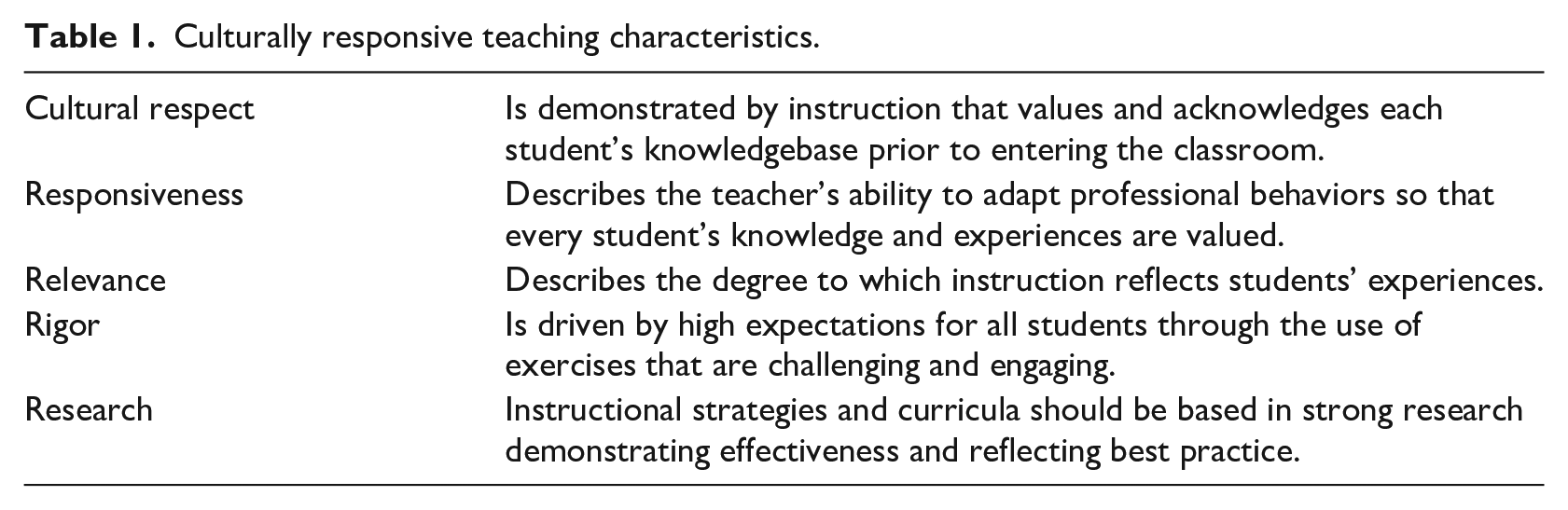
Geneva Gay (2010) offers primary characteristics of culturally responsive teaching in Table 1. These culturally responsive teaching characteristics contends that people produce knowledge and form meaning based on personal experiences and cultural factors (Gay, 2010).If educators want African American boys to construct a positive, strengths-based, empowered self-identity in which they feel themselves as capable, intellectual, talented, creative, and adventurous, then educators must create and cultivate classroom cultures that help promote and support those outcomes (Wright & Counsell, 2018). Culturally responsive instructional practices can serve as a vehicle to these outcomes. Children benefit and prosper from multiple and varied opportunities to actively observe, engage in, interact with, and interpret authentic, open-ended learning experiences with hands-on multisensory materials and rich opportunities for group work within diverse, inclusive settings (Counsell & Wright, 2018). These practices are supported by Ladson-Billings (1994) seminal work which highlighted that the most effective teachers of African American children stress the following: (a) inclusion and equity; (b) helping relationships with students and families; and (c) high expectations. Banks (2006) also argues that classroom practices should equip students with social action and decision-making skills necessary to encourage social action in the communities where students live.
Culturally responsive teaching characteristics.
Brain research can serve as a guide to creating and fostering an environment where African American boys can thrive. All over the world there is evidence that boys are struggling in school with lower grades, more discipline problems, more learning disabilities, and more behavior disorders than girls (Gurian, 2001). A study based on research by Gurian and Stevens (2005), found that most classrooms are generally better fit for the verbal-emotive, sit-still, take-notes, listen carefully, multitasking girl. Moreover, this research suggested that teachers tended to view the assets that many boys bring to learning—impulsivity, single-tasked focus, spatial-kinesthetic learning, and physical aggression—as problems (Gurian, 2001). A word of caution is warranted as Gurian’s and Stevens’ findings reflect stereotypical behaviors that are typically generalized toward boys and girls. Nevertheless, King and Gurian (2006) offer the following recommendations to improve the academic performance of boys; girls also benefit from these practices.
Increase experiential and kinesthetic learning opportunities – task oriented discussions and interaction, physical movement, accesses boys’ neurological strengths, by keeping them energized and attentive.
Support literacy through special-visual representations – by incorporating pictures into a storyline the pictures will prompt the brain to remember relevant words.
Let boys (and girls) choose topics that appeal to them – giving students greater choice in what they read and write has improved writing among both boys and girls.
Helping boys with homework – get parents/guardians involved by requiring a signature on their homework. By doing so, homework is supervised and keeps parents/guardians apprised of the quality of the homework their child is turning in.
Offer opportunities for single-gender groupings – Provides opportunities for boys and girls to incorporate topics and interests that better suite their specific learning styles.
Make reading and writing purposeful – Make reading and writing assignments relevant to the everyday lives of students. Provide opportunities where they can share their written ideas in front of an audience. Competition and the opportunity to earn public respect have helped motivate many under motivated students – especially boys.
Seek out male role models – Actively encourage men to visit the classrooms to share their own writing and speak about their favorite books.
Helm and Katz (2011) cautioned educators to avoid and eliminate mindless activities that largely fail to promote academic or intellectual goals. African American boys prosper from stimulating, hands-on experiences that engage higher-order thinking and learning (Murphy & Nesby, 2002).
Professional development for teachers, staff, and administrators is critical to the development of culturally responsive classroom practices. School improvement plans should clearly articulate opportunities and varied types of professional development that specifically speaks to validating cultural experiences in instructional practices.
Programs
A program is a sub-system established to attain a specific goal. For example, an afterschool tutoring program may be created to reduce achievement gaps between student populations. School programs should be equitable and accessible to all populations within the student body. This is achieved by considering what programs are being offered, where programs are being offered, when programs are offered, what type of accommodations (i.e., interpreters, accessibility ramps, etc.) are needed for students with special needs, and which supplemental services (i.e., transportation, meals, etc.) are needed to maximize participation for all who require academic support. Equally important, programs should be representative of the demographics of the school population (i.e., racial, socio-economics, gender, ability levels, etc.). For instance, if African American boys are primarily in athletics and rarely present in accelerated academic programs, school leadership and educators should take corrective steps to address this disparity (Milner, 2010). The democratic goal of educating all students for participation in intellectual and academic complexity means breaking down barriers to full participation of historically oppressed or excluded groups (Ayers, 2010).
Programs outside the auspices of school can also play a major role in the positive development of African American boys. The disproportionate vulnerability of African American youth to certain negative outcomes, including teen pregnancy, low academic achievement, HIV infection, and violent death, has emphasized the need for out-of-school time programs (Bandy & Moore, 2011). These programs can offer varying degrees of services with different levels of success. Research conducted by Bandy and Moore (2011) suggest the following criteria should be considered when selecting out-of-school time programs for African American children.
Programs that foster partnerships between the community and schools.
Strategies that garner family buy-in.
High-intensity programs that meet on a consistent basis.
Mentoring is an essential element to any program developed to support the needs of youth, especially African American boys. Mentoring is a strength-based approach that can point young people in the direction of a more positive future (JarJoura, 2013). Ideally, this approach should be sensitive to culture, context, and prior experiences whereby culturally competent mentors are coupled with a structure that celebrates and inspires the development of a positive ethnic identity (JarJoura, 2013). There are numerous benefits to effective mentoring programs. Noted below is a selected listing of those benefits (Youth.gov, 2019).
Increased high school graduation rates
Healthier relationships and lifestyle choices
Better attitude toward school
Higher college enrollment rates and higher educational aspirations
Enhanced self-esteem and self confidence
Improved behavior, both at home and at school
Stronger relationships with parents, teachers, and peers
Improved interpersonal skills
Decreased likelihood of initiating drug and alcohol use
School and out-of-school programs can play an instrumental role in the social, emotional, cultural, (Howard, 2014), and physical development of African American boys which all can have a positive impact on academic achievement.
School personnel
School personnel includes the principal, teachers, support staff, and volunteers. Culturally responsive school personnel are collegial, respectful, and value cultural differences. In a report by Charles Payne (2006) on research conducted by the Consortium of Chicago School Research, he concluded that there is a relationship between school culture and academic performance. Further, findings from this ongoing research suggests that when comparing highly rated schools to the lowest performing schools, schools with the highest level of trust and respect for teachers were the best predictors of school performance (Payne, 2006). Hoy et al. (2006) coined this school behavior as “academic optimism” and identified its three general characteristics:
A consensus of trust among faculty, parents and students.
A press for academic achievement.
A shared collective efficacy among teachers (i.e. a shared belief among teachers that they can help students succeed).
In short, a positive school culture celebrates success, emphasizes accomplishments and collaboration, and fosters a commitment to staff and student learning; while a toxic school culture blames students for lack of progress, discourages collaboration among staff.
A hallmark of a culturally responsive school and personnel is addressing the traumatic experiences that children may experience in or outside of school. African American boys are more likely to have been raised in neighborhoods and homes where violence is prevalent which may delay the achievement of developmental milestones (Cooley-Strickland et al., 2011). Traumatic experiences may also occur at school for African American boys. Formal education can intentionally or non-intentionally be used as a mechanism to traumatize African American children. Whether or not a teacher “believes in” in his/her students and expects them to succeed has been shown to have a traumatic effect on how well that student does in school (Flannery, 2015). Most often, these beliefs are based on implicit biases which are fueled by stereotypes perpetuated in the media or beliefs promoted by parents, peers, and other community members (Flannery, 2015). Unfortunately, scholars have indicated that as a society we do not actively address racial trauma (Jernigan & Daniel, 2011).
Deficit thinking fueled by stereotypes is a racial micro-aggressive tool, which when experienced by African American boys results in feelings of isolation, self-doubt, and frustrations (Solorzano et al., 2002). Racial micro-aggressions are brief and commonplace verbal, behavioral, and environmental indignities, whether intentional or unintentional, that communicate hostile, derogatory, or negative racial slights and insults to the target person or group (Sue, 2007). In some cases, the most harmful micro-aggressions can occur in schools. Racial micro-aggressions based on prejudicial White beliefs of teachers not only impede the learning process, they also “prevent educational stakeholders from recognizing and acknowledging their students strengths” (Allen et al., 2013). Micro-aggressions are primarily structural or individual (Losen & Skiba, 2010). Structural microagressions pertains to systemic policies and climates. The disproportionate suspensions of African American boys exemplifies a structural micro-aggression. For example, Howard (2014) reported that preschool African American children account for half of preschool suspensions, while they make up less than 20% of the U.S. preschool population. The curriculum can serve as an example of individual micro-aggressions. School curriculum is often shaped to reflect the interests of the dominant social class (Allen et al., 2013). Monolithic targeting is another form of individual micro-aggressions whereby White teachers perceptions frame African American boys in collective deficit terms, including being incapable of exceeding expectations and not interested in being successful academically, based on a singular experience (Hotchkins, 2016). Conversely, if African American male exceeds academic expectations, they are viewed in an odd and unique manner (Hotchkins, 2016). The racial daily micro-aggressions experienced by some African American boys when interacting with White teachers presents a hurtful realization that the classroom is not a safe nor welcoming place for them or to learn (Hotchkins, 2016).
A step toward empowering African American males is committing resources for teacher professional development that facilitates the dismantling of structural and individual racist and racially charged micro-aggressive practices of teachers and administrators who operate within the confinements of educational institutions (Hotchkins, 2016). The process of changing and developing a new school culture that reflects the described values can become fragile by attention slips, new people, retirements, and waning awareness (Fisher et al., 2012). Nevertheless, leadership should be committed to the development of culturally responsive school personnel. This process includes the entire staff, from the principal to the teachers, support staff, and even volunteers. Fisher et al. (2012) have suggested the following practices for building cultural capacity within a school:
Discuss the cultural pillars of the school during the hiring process with candidates.
Allow regular feedback between the leadership team and staff to determine what is going well, what needs support, or what needs to be changed. This process also promotes ownership in the development of the school culture by all.
Implement brief daily standing meetings to quickly get everyone on the same page each morning. These meetings also offer the time to build culture through symbolic gestures and celebrations.
Give recognition to and celebrate staff who are well-prepared, dedicated, and committed individuals.
Design a staff development plan invested in a school culture that reflects commitment to high academic performance among all students.
In short, schools in the United States are becoming more ethnically, racially, culturally, socially, and linguistically diverse. Therefore, it is imperative that administrators hire individuals whose commitment to multicultural education is embedded in their core beliefs about teaching and learning. These actions will ensure school personnel are culturally responsive when adapting cognitive and physical behavior in cross-cultural situations (Bennett, 1993) to meet the needs of all students.
Conclusion
There is no single variable that accounts for closing achievement gaps between African American boys and their counterparts. . It is a multifaceted problem that requires a comprehensive planned approach involving schools and families (Mimms, 2007). Creating a positive school culture which embodies academic optimism for all students is an important component of a school improvement plan. Essential to this plan is executing policies that promote equitable and fair outcomes for subpopulations within the school; developing clearly articulated processes that are not driven by attitudes and beliefs, but rather by specific and distinct data that can be measured and routinely monitored; implementing culturally responsive instructional practices to establish an inclusive and cohesive learning environment; creating programs that are equitable and accessible to all populations within the school; hiring and developing school personnel who value cultural differences and are responsive at adapting cross-cultural situations. In closing, culturally responsive schools are essential to replacing a “cycle of deficit” with a “cycle of strength” undergirded by critical, reflective, and culturally responsive practitioners who believe that strengths and potential exist in African American boys (Wright & Counsell, 2018).