







Abstract
An in-service training programme was used as an accelerator that scaffolded teachers in four school units in Lappeenranta, Finland, the aim being to find a shared understanding and shared practices, or ‘praxis’, in terms of promoting student participation. In this study we examine the practices that either supported or prevented participation from the perspective of the teachers. We also examine how the arrangements of the practice architectures – cultural-discursive, material-economic and social-political – appear in the teachers’ accounts of student participation. The data consists of 22 diamond-ranking forms made by 86 teachers, and an audio-recorded and videotaped group interview. The teachers in the school units found praxis both in the support of student participation (emphasising the students’ role in school councils and giving them a recognised role in everyday practices) and in the challenges (turning participation into pedagogical practice). The arrangements of the practice architectures were identified in the group interview.
Introduction
Finland has contributed to the trend of closing small school units and creating bigger ones in recent years. In many cases this has meant closing schools in rural areas and transferring both teachers and students to bigger units. Problems with school buildings such as mould have also led to their demolition and the merging of teachers and students under the same roof in a new building. When teachers and students from different contexts with different traditions are brought together there is a need to find a shared way of doing things. This raises questions among teachers and administrative staff. What should we do? Why it is worth doing? How can we do it? In Kaukko and Wilkinson’s (2018b) words this means arriving at a shared understanding of ‘praxis’. What is the ‘good life’ that teachers want individual students to achieve, and what is the ‘world worth living in’ that they hope to see in societies as a result of education?
The literature defines praxis in many ways. One definition goes back to Aristotle, according to whom praxis could be understood as ‘action that is morally committed, and oriented and informed by traditions in a field’ (Kemmis & Smith, 2008, p. 4). According to Kemmis et al. (2014, p. 26), on the other hand, praxis goes back to Hegel and Marx, understood as ‘history-making action’, in other words action with moral, social and political consequences – good or bad – for those involved in and affected by it (Kemmis et al., 2014, p. 26).
Praxis in the school context relates to educational theory and practice. Teachers, for example, can transform their practice, their understanding of it and the conditions under which it is carried out by engaging in critical and continuous reflection on their work (Kaukko and Wilkinson, 2018b). According to Edwards-Groves and Grootenboer (2015), who cite Freire (1985, p. 31), when praxis is connected to the Aristotelian tradition it operates from a premise that allows practitioners to interrogate and transcend the limitations of their own inherited traditions of looking at the world, enabling the design of morally and historically appropriate practices.
This study concerns four school units in Lappeenranta, Finland. Kuusimäki, Lavola and Skinnarila are primary schools teaching students aged 7 to 12, whereas Sammonlahti is a lower-secondary school, teaching students aged 13 to 15. These four units were connected administratively in 2017 and renamed the Sammonlahti school, the same as the lower-secondary school. All four schools will be fully merged and moved to a new building (Sammontalo) in 2023 to create one larger unit. Inherent in the merging of communities is the potential alignment of different values and practices among staff members, which could send conflicting messages to students and damage the process of building up the new community. When these units were connected a project entitled ‘From Students’ Participation to Students’ Leadership’ was launched to help the teachers in them to reach a shared understanding of ‘praxis’ in terms of student participation, and to develop a shared view and traditions of practice that promote it. The project comprised four in-service training days. Between each one the four units developed their own practices based on the views shared in the session.
This study reports action research in which the authors had a triple role: we worked as consultants whom the schools could contact whenever they needed help; we conducted the in-service training sessions; and we worked as academic researchers, collecting data and reporting on the project. We used the theory of practice architectures as our starting point to give us some understanding of teacher involvement in the practices, behaviours, conditions and situations that take place in lessons, classrooms and school communities. The theory was first conceptualised by Stephen Kemmis and Peter Grootenboer in 2008, and was further developed by Stephen Kemmis, Jane Wilkinson, Christine Edwards-Groves, Ian Hardy, Peter Grootenboer, and Laurette Bristol in 2014. It offers a systematic way of understanding and representing the conditions and circumstances in which the social, physical and political worlds exist (Edwards-Groves, 2018).
We planned our in-service training according to this theory (Kemmis et al., 2014), which we also apply in analysing our data. Our research questions are:
What were the teachers’ perspectives on practices that supported or prevented student participation?
How are the cultural-discursive, material-economic and social-political arrangements of the practice architectures manifested in the teachers’ perspectives on student participation?
We start by defining the theory of practice architectures, and consider how such architectures relate to student participation. Next, we describe how our in-service training was planned, and how we theorised student participation in the training as well as in this article. Then we move on to the methodology, the context and the data collection. We present our findings in the results section, and in our conclusions we analyse how the programme facilitated the reaching of a shared praxis.
The theory of practice architectures
The theory of practice architectures is one among a broad group of practice theories (Edwards-Groves, 2018; Edwards-Groves & Grootenboer, 2015; Kemmis et al., 2014;). It has its advantages, specifically in the analysis of shared values and situations, as well as of intentions, which is why it has been used previously to examine refugee education (Kaukko &Wilkinson, 2018a), youth work (Kiilakoski, 2018), school pedagogy (Edwards-Groves, 2018), professional development (Olin et al., 2016), partnership and recognition in action research (Edwards-Groves et al., 2016) and architectures of educational practice (Heikkinen et al., 2018), to give a few examples.
Kaukko and Wilkinson (2018a) summarised the ontological starting point of the theory of practice architectures, which according to them lies in what practice philosopher Theodore Schatzki (2002) has termed a site ontological understanding of practices. The site ontological approach focuses on the actual site in which practices take place, which in this sense is not only a context or receptacle in which they unfold, but also creates a crucial ‘set of conditions’ or arrangements that render particular practices possible. These practice conditions at specific sites are the ‘site ontologies, that is, the nexuses of arrangements that make practices possible at particular sites’ (Kaukko & Wilkinson, 2018a; see also Kemmis et al., 2014, p. 14).
Schatzki (2002) introduced ‘doings’ and ‘sayings’ as manifestations of the actions and discourse of a certain practice. However, he did not pay attention to the ways in which people relate to one another in practice. Kemmis and Smith (2008) and Kemmis et al. (2014) further developed the theory of practice architectures to account not only for sayings and doings in practices, but also for relatings. As Kemmis et al. (2014, p. 30) put it:
We thus include sayings, doings and relatings in our conceptualization of practices, and understand practices as enabled and constrained by three kinds of arrangements that occur at sites, namely, cultural-discursive, material-economic, and social-political arrangements (respectively).
According to Kemmis et al. (2014, p. 31), therefore, individual and collective practice shapes and is shaped by what we refer to as practice architectures, meaning that the sayings, doings and relatings that are characteristic of the practice hang together in projects. These three dimensions simultaneously shape and are shaped by one another, in that the history of the happenings of the practice allow it to be reproduced and to act as a kind of collective ‘memory’. The architectures that enable and constrain practices exist along three dimensions in parallel with the activities of saying, doing and relating, and which constitute enabling and constraining preconditions for the conduct of practices. These dimensions are:
the cultural-discursive arrangements, which are the resources that make possible the language and discourses used in and about this practice;
the material-economic arrangements, which are the resources that make possible the activities undertaken in the course of the practice; and
the social-political arrangements, which are the resources that make possible the relation- ships between people and non-human objects that occur in the practice (Kemmis et al., 2014, p. 32).
Kemmis et al. (2014, p. 32) further explain how the cultural-discursive arrangements enable and constrain the sayings that are characteristic of the practice. This means, for example, constraining what is relevant or the language and concepts that are appropriate. Material-economic arrangements, on the other hand, enable and constrain the doings that are characteristic of the practice, meaning what can be done and how physical environments are arranged. Finally, social-political arrangements refer to the relatings of the practice, creating the organisational functions, rules and roles, for example. They also relate to the communicative requirements of the lifeworld process of arriving at a shared understanding, and agreeing on the practical arrangements.
According to Kaukko and Wilkinson (2018a), a crucial premise of the theory of practice architectures lies in its ontological perspective on practices. It examines how, in practice, in this specific site, this practice and these arrangements have achieved this distinctive shape and form. Given its site-ontological approach, it recognises that specific practice architectures (cultural-discursive, material-economic and social-political arrangements) may be found in or brought to a site. It also examines how particular arrangements (e.g. cultural-discursive in the form of language and ideas; material-economic in the form of objects and spatial arrangements; and social-political in the form of relationships between people) may unfold as particular practices (sayings, doings and relatings) within a specific site such as a school (Kaukko & Wilkinson, 2018a; see also Kemmis et al., 2014, p. 31–32).
According to Schatzki (2010, p. 4), what people do today is rooted in the past and oriented towards the future. The memory that practices hold could be termed practice traditions (Kemmis et al., 2014, p. 27, see also Kaukko &Wilkinson, 2018a). For an individual teacher, for example, practice traditions are practices similar to those that have been meaningful and significant in the past and represent ‘the way we do things around here’ (Mahon et al., 2017, p. 25; see also Kaukko & Wilkinson, 2018a).
In this article we connect the theory of practice architectures to teachers’ perspectives on student participation. We focus on how student participation is recognised, talked about and debated among teachers (cultural-discursive arrangements/sayings), how it is oriented towards practices that take place at the sites (material-economic arrangements/doings), and how it relates to pedagogy as a way of being in a relationship with students (social-political arrangements/relatings). Next, we describe our context and how we planned our educational programme based on the theories of student participation and practice architectures.
The context of the study
The combined Sammonlahti school is a typical Finnish school representing inclusive education: there are 86 staff members of and approximately 880 students from the area, from very different backgrounds. The mother tongue of 17% of the students is a language other than Finnish, and Finnish is the second language of 35% of students in the Skinnarila unit. One principal serves all the units, each of which has its own vice-principal. At the time of this study the units were still located in their own buildings throughout the area, and the staff members and students did not see each other in daily life.
Kuusimäki, Lavola and Skinnarila are primary schools teaching grades 1 to 6. Primary school teachers, special-needs teachers and school assistants comprise the teaching staff (42 women and nine men altogether). When this study was conducted there were 106 students in Kuusimäki, 224 in Lavola and 199 in Skinnarila. In Sammonlahti lower-secondary unit the teachers are subject teachers and special-needs teachers, and several assistants working with them: 24 women and 11 men working with 352 students. Given the financial and time constraints, as well as the scarce employee resources, it was not possible for the entire staff to be present at the full-day in-service training sessions during the school year. However, 15 teachers from the units participated in the training and shared their acquired knowledge in their own units.
Building an educational programme of student participation specifically for the school
We, meaning the authors and in-service training educators, based our educational programme on our understanding of participation as a relational and dynamic concept. It involves an individual and a social community such as a group of friends, a class of students, a family or a society, and could also refer to the dynamics between an individual and a society. Such dynamics could be considered from the following three perspectives. First, the experience of participation involves having a recognised position as an agent, which forces communities to be inclusive in giving all those involved the opportunity to speak aloud and to act. Second, participation should manifest in action. People need to experience being able to make an impact on the community both in the present and in the future. In school contexts this also means that the students should be active. Third, participation should promote a self-image and identity that allows all students to perceive themselves as valuable members of the community and to understand their contribution and meaningfulness (Kiilakoski et al., 2012; cf. Niemi & Kiilakoski, 2019).
As we understand it, participation comprises two dimensions, the political and the social, which are manifest in sayings, doings and relatings. Political participation is the traditional form, meaning making an impact, influencing the community, taking part in decision-making and taking responsibility Kiilakoski, 2017; Kiilakoski et al., 2012; Niemi & Kiilakoski, 2019; Niia et al., 2015; Thomas, 2007). This dimension is strongly emphasised in the Finnish national core curriculum (Finnish National Board of Education, FNBE, 2014), and is most commonly implemented through working with school councils and thus mimicking the representative political structures of adult society. Social participation, on the other hand, refers to a sense of community, belonging, membership and positive social interdependence. It involves social relationships: one must be a member of the group or the community; one has to be able to act in a group with others and to feel accepted as part of it (Niemi & Kiilakoski, 2019).
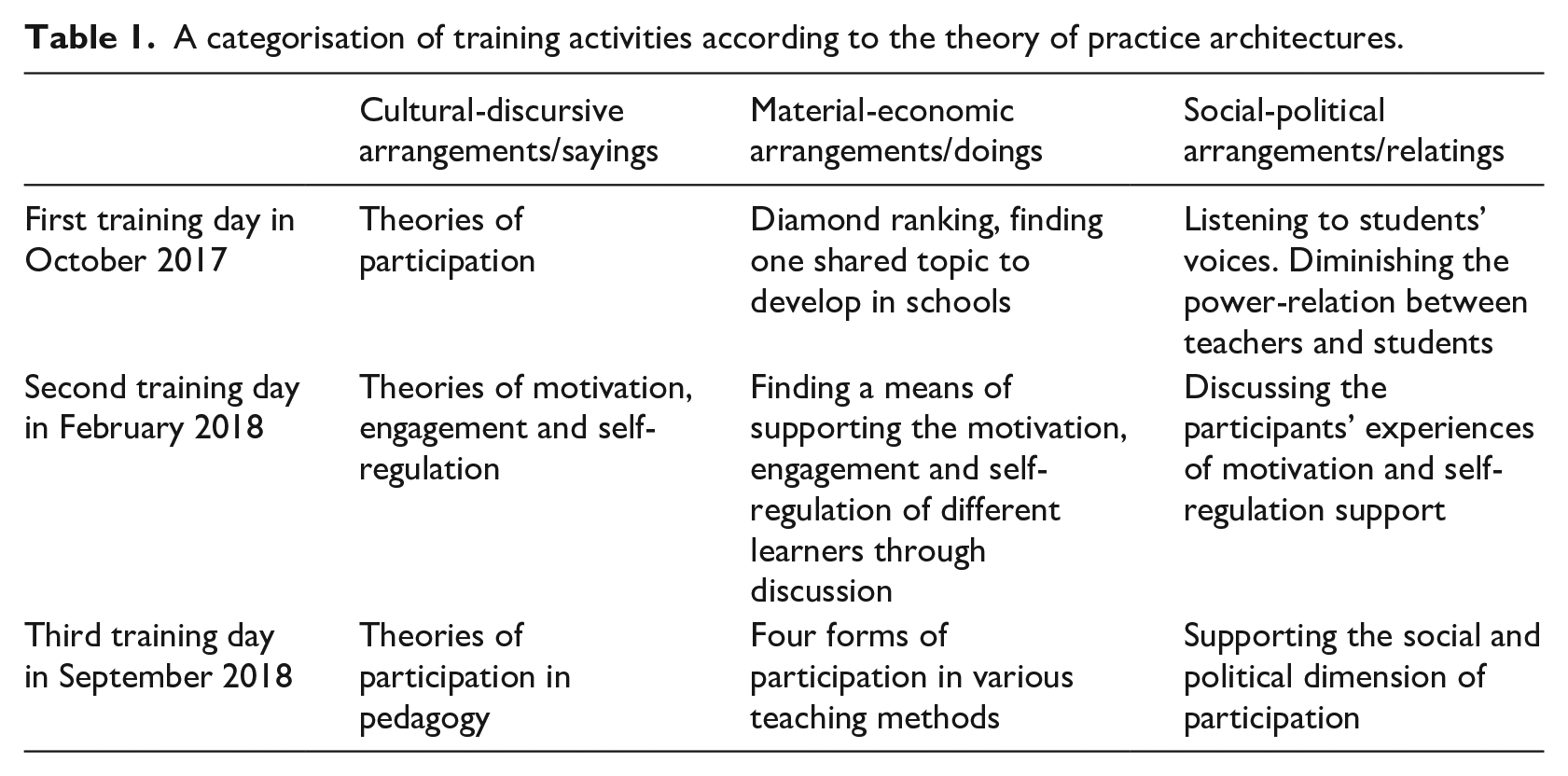
Our training programme comprised three full-day in-service training sessions and one half-day meeting. The purpose of the training was to scaffold the teachers and the units to find praxis by providing tools enabling them to understand, analyse, create and evaluate the sayings, doings and relatings of student participation. The first workshop took place in the autumn of 2017, the second in the spring of 2018 and the third in autumn 2018. The project ended in February 2019 with a day in which all the teachers from the four schools met and presented their practices to each other. The teachers also had the opportunity to listen to brief 15-minute presentations from each of the trainers.
The educational programme was built as follows. The first in-service training session focused on how student participation is recognised, talked about and debated in the educational literature (cultural-discursive arrangements/sayings). We introduced the teachers to Article 12 in the United Nations Convention on the Rights of the Child (UNCRC, 1989), which defines the rights of children (students in this study) to participate in making decisions related to them. We also presented four different modes related to the participation of children (students): Hart’s (1992) ladder of participation, which is still probably the most well-known model internationally, was our starting point, followed by those of Shier (2001), Lundy (2007) and Landsdown (2010). The basic idea is the same in all of them: students need to have the time and space to express their views, which must be taken into account and should be implemented in the school community.
We also focused in the first session on how student participation, as presented in the literature, can be turned into practices that are adopted in school communities (material-economic arrangements/doings), and how these practices may help to balance the power relationship between teachers and students (social-political arrangements/relatings). The teachers were introduced to the diamond ranking method 1 as a tool to encourage them to listen to the voices of all students and to join them in developing the school culture. After this session the teachers were asked to consider how they could listen to the voices of students in their own school, and to choose one issue to develop.
The second training day covered the role of self-regulation and the affective side of engagement. Self-regulation is crucial from the perspective of participation, because in order to be a responsible participant in a community an individual should first be able to regulate his or her own actions and behaviour. We started by giving the participants a brief theoretical overview of the field of motivational psychology and the various theoretical perspectives. They familiarised themselves with the concepts of autonomous motivation and self-regulation, as defined in self-determination theory (Ryan & Deci, 2002). We also explained how different values and costs may be associated with a certain task, and how the competence beliefs of individuals have a crucial role in their performance. The theoretical context in this overview was the expectancy-value theory of Eccles and her colleagues (Eccles, 2009), but the participants were also introduced to the theory-based aspects of supporting learner motivation and self-regulation. During the second session of the day the trainer presented authentic learner cases for the participants to examine. The anonymity of the people concerned was ensured. The participants read the cases and collaboratively discussed how to support the case learners’ motivation and self-regulation. This procedure was intended to facilitate the adoption of the theoretical ideas.
The focus during the third in-service training day was on student participation from a pedagogical perspective. Cultural-discursive arrangements/sayings were the starting point. We introduced the teachers to a four-form model of participation in school pedagogy (Niemi et al., 2018; Niemi, 2019) showing how different classroom practices (material-economic arrangements/doings) may support various forms of participation, namely active joining, collaborative, child-oriented and child-led participation. Then we focused on how the four forms could support both the social and the political dimensions of participation (Niemi & Kiilakoski, 2019), and how they relate to the students’ participatory role in planning, implementing and evaluating their own learning. Finally, the teachers analysed their own teaching methods (e.g. lectures, investigative learning, learning stations and think-pair-share) in terms of how they supported a sense of relatedness among students, and their impact on the power relationship between student and teacher (social-political arrangements/relatings). Table 1 presents the implementation of this in-service training.
A categorisation of training activities according to the theory of practice architectures.
Methodology and data collection
This study could be classified as participatory action research (see e.g. Brydon-Miller & Maquire, 2009; Kemmis et al., 2014; McIntyre, 2008). We focused on creating opportunities for schools, in partnership with one another, to work together on solving problems and addressing issues through a mutually agreed topic. We might add, as Kemmis and Wilkinson (1998, p. 21) suggest, that we attempted to investigate the school reality together with the teachers in order to change it, and that we aimed to change the reality in the schools in order to investigate it.
The study also represents a form of teacher research in which trainers critically reflect on their in-service training practices. As Caro-Bruce et al. (2013) and Cochran-Smith and Lytle (2009) define it, we worked with the teachers in the in-service training sessions, examined our own assumptions, and developed local knowledge about the workability of our educational programme in terms of research methods. What is most important, however, as Cochran-Smith and Lytle (2009) state, is that teacher research is aimed at improving social justice in schools. In this study this meant finding a shared praxis of student participation, which we did through in-service training during which we scaffolded the participants to help them find their own ways of changing their own practices.
We examined the change by means of diamond ranking, thereby engaging all the teachers in evaluating their practices. Diamond ranking is a recognised tool for developing thinking skills, and is used to stimulate talk and to capture individuals’ thinking. When the participants rank the items, be they statements, objects or images, and discuss their ranking choices, they are required to make explicit the basis on which they organise knowledge (Clark, 2012; Clark et al., 2013; Woolner et al., 2010, 2012, 2014). The method was originally based on pre-written statements (Rockett & Percival, 2002), but it is also suitable for visual materials, photographs in particular (Clark, 2012; Clark et al., 2013; Woolner et al., 2010; 2012, 2014), and it has been adapted for digital devices (Niemi et al., 2015; 2018; Niemi & Kiilakoski, 2019). It was introduced to the teachers in visual form in the in-service training. We used the same method in the data collection, but in the form of written statements.
We gathered the data on the teachers’ perspectives of practices in a group interview in May 2019. The group interview also served as a way of learning from one another. In April 2019, before the group interview took place, all 86 teachers at the four school units conducted diamond ranking activities in the pedagogical teams in which they worked in their schools on an everyday basis. On the first row the team members wrote a statement on the practice they thought supported student participation the most, and on the second row they wrote two statements on the next-best supportive practices. They wrote three statements on the practices that were of medium value in supporting student participation on the third row, and two statements on the practices or topics that caused some challenges in this respect, or the reasons for these challenges, on the fourth. Finally, they were asked to write one statement on the fifth row concerning the practice or topic that caused the most challenges, or the most weighty reasons behind not being able to support student participation.
After completing the diamond ranking, the pedagogical teams explained their diamonds to the teachers who had joined the in-service training and who were representing the school unit in the group interview. The interviewees presented the diamond rankings conducted by the teacher teams in their unit. They also did a diamond ranking of their personal experiences related to their role as a consultant teacher in their own unit. The purpose of the group interview was to meet for the last time and to learn from the units’ experiences: to share best practices, to learn from the challenges, and to develop the practices further in the schools. The interview lasted for 87 minutes, and it was both audio-recorded and videotaped. The data also includes 12 diamond rankings created in the school teams and 10 made by the teachers who joined in the group interview. The data collection, including the diamond ranking made by the staff and the group interview, was carried out during official school meeting hours so that it would not cause extra work for the teachers.
According to McIntyre (1984), ethical considerations in practitioner research relate to the researcher’s role in the practices (see also Niemi & Kiilakoski, 2019). Care must be taken to ensure that the point and purpose of this role are not compromised during the process. We carefully followed the principle of informed consent in this research. The group interview started with a discussion about roles. We explained to the participants that the study could not be used to put any employee in a harmful position, and they had the right to cancel their participation at any time with no negative consequences. In the group interview we focused solely on the phenomena experienced among all the teachers that were presented in the diamond ranking sheets, and no names or specific examples of any individual’s work were mentioned. We further assured the participants that the results would be reported such that neither the school units nor the interviewees could be recognised, although we are aware that full anonymity is almost impossible in action research (Zeni, 2013). To make sure that this article reports the study ethically and correctly, we gave the teachers who were in the group interview and who were privy to the data gathered there the opportunity to read this manuscript and to comment on it before it was sent to the journal for peer review.
Analysis
We analysed the data in two phases. During the first phase we focused on the diamond ranking (Clark et al., 2013). After examining all the diamonds we counted the frequencies of the practices or topics mentioned in the ranking and explored in the interviews. Next, we organised these practices and topics in four themes: 1, the political dimension of participation; 2, the students’ recognised role in everyday activities; 3, the students’ participatory role in pedagogy; and 4, the employees’ commitment to a shared programme. Finally, we organised the themes into the following categories: practices that supported student participation the most, practices that had a medium value in supporting student participation, and practices and topics that caused the most challenges in terms of supporting student participation, or were given as reasons for not doing so.
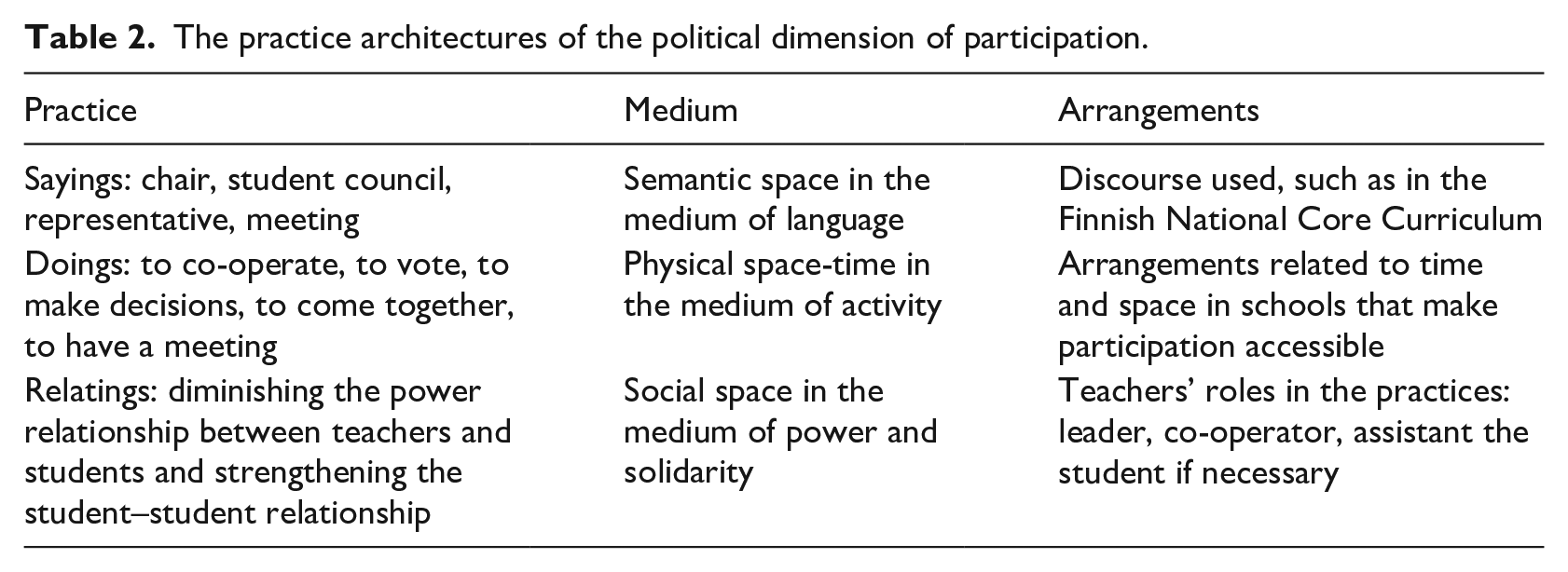
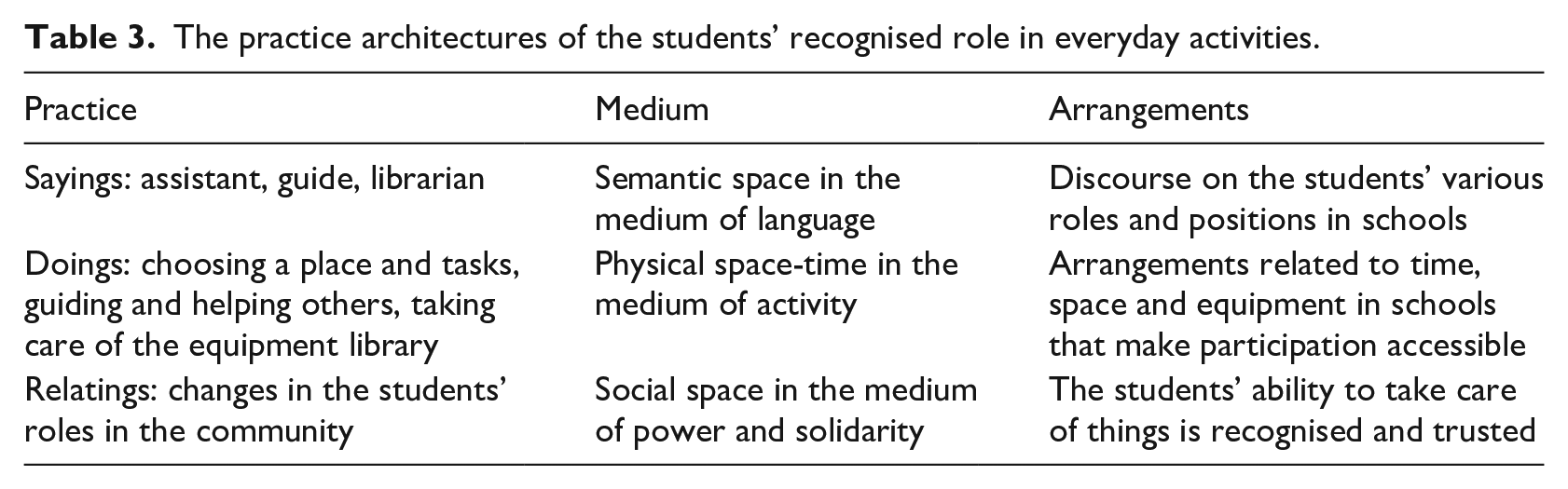
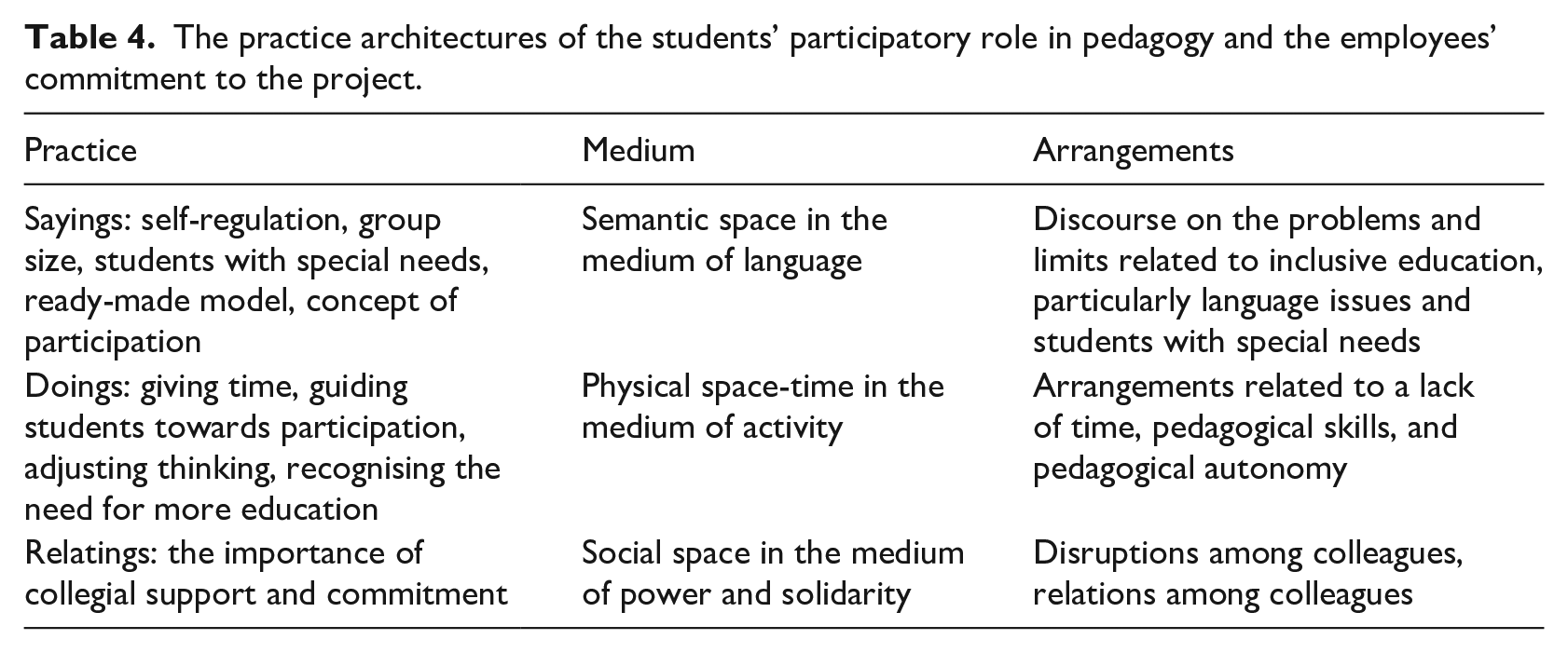
The second phase of the analysis related to practice architectures. We analysed the themes that arose (i.e. practices related to the political dimension of participation and to the students’ recognized role in everyday activities, the students’ participatory role in pedagogy, and the employees’ commitment to a shared programme) in dialogue with the theory of practice architectures (Kemmis et al., 2014). We followed Kaukko and Wilkinson’s (2018a) use of transcript extras and tables (Tables 2–4) to exemplify the key findings and show how the sayings, doings, and relatings were identified in the teachers’ perspectives.
The practice architectures of the political dimension of participation.
The practice architectures of the students’ recognised role in everyday activities.
The practice architectures of the students’ participatory role in pedagogy and the employees’ commitment to the project.
Results
The analysis of the diamond ranking revealed that, from the perspective of the teachers, the practices that supported student participation the most related mainly to the political dimension of participation: making an impact, influencing the community, taking part in decision-making and taking responsibility. Two topics in particular were ranked above the others: the students’ role in planning special school days and/or occasions, and the workability of the student council in schools.
In this data, the teachers ranked practices giving students a recognised role in everyday activities as of medium value in supporting participation. Accordingly, the practices or topics that were the most challenging for the teachers, and the reasons why, as well as those that prevented them from supporting student participation related to the students’ participatory role in pedagogy, and to the resources and commitment that teachers were able to give to the project. In particular, the challenges related to inclusive education and students with special needs, and the need to develop self-regulation skills were emphasised.
In the following we present our interpretations of the practice architectures related to student participation revealed in our data.
Practice architectures of the political dimension of participation
In every unit, the role of the student council and/or the students’ role in being the ‘classroom chair’ were considered among the practices that supported student participation the most, or at least had medium value. The teachers talked about these practices in the group interview as follows:
‘In our school the role of the class chair is a topic that was considered one of the top practices. Especially how it has strengthened the relationship and co-operation between the teacher responsible for the classroom and the student who is the chair.’
‘In our school the best has also been the most challenging. Due to scheduling arrangements it has been possible to arrange meetings of the student council. But when the representatives of the student council come together, how can students who are in the classroom participate? (. . .) However, the common room in our school makes it possible to support student participation, because it is easy to go there and to connect with all the students, not only with your classmates.’
‘In our school the student council is considered important, because in it you vote and make decisions, and the students know that somebody is representing them. Arranging these occasions is also important, because before there was nothing fixed, but the students now have the chance to plan from the beginning.’
These extracts identify a number of key sayings related to student participation, exemplified in words such as ‘chair’, ‘student council’, ‘representative’ and ‘meeting’. These sayings also relate closely to doings, because the students co-operate, vote and participate in the decision-making in the student council and during the meetings. The extracts also refer to other doings such as coming together and planning issues together, as well as having a student council meeting on the concrete level. Both sayings and doings relate to relatings. In our data the relatings emerged in terms of diminishing the power relationship between teachers and students and strengthening the student–student relationship.
The sayings, doings and relatings reflect the arrangements that prefigure these practices. Cultural-discursive arrangements relate to the shared language the teachers use to talk about participation, employing concepts used mainly in the national core curriculum for basic education (FNBE, 2014). Material-economic arrangements facilitate the undertaking of certain activities. In this data, for example, arranging the school’s daily schedule such that it is possible to arrange student council meetings is a good example of material-economic arrangements that support student participation. The teachers also mentioned the physical set-up in various rooms and the indoor and outdoor spaces within the school area among their experiences. They further emphasised the social-political arrangements related to their various roles of leader, co-operator, or assistant helping the students when needed.
The practice architectures of recognized role of students in everyday activities
The teachers talked about their experiences related to the students’ role in everyday activities as follows:
‘Situations in which the student could choose where to work or how many tasks to complete were considered practices that had a medium value in supporting participation.’
‘The fourth graders in our school also act as school restaurant guides. Their role used to be focused more on helping adults, such as cleaning and wiping the tables. When we changed the role from restaurant arranger to restaurant guide such that they were helping the younger students in returning dishes, for example, they became much more enthusiastic.’
‘In our school the students independently planned and organised a sports-equipment “library” for the breaks, with the help of a teacher. They take care of it themselves and make sure that the students use the equipment respectfully and do not break any of it.’
A number of key sayings can be identified in these extracts in terms of having a recognised role. The interviewees used words such as ‘assistant’, ‘guide’ and ‘librarian’. There were also references to doings such as choosing a place in which to work as well as the tasks, including guiding younger students, helping others and taking care of the equipment library. Both sayings and doings relate to relatings, which emerged in the changes in the students’ roles in the community.
Cultural-discursive arrangements relate to the shared language the teachers use to talk about these roles. Students are considered and recognised as experts of their position. The material-economic arrangements that enable them to undertake these activities relate to time, space and money. The ways in which the students use their time in the school restaurant and on breaks affect the success of these practices. In addition, the founding of the sports-equipment library was only possible with the financial help that the students were given. The social-political arrangements relate to the power relationship between teachers and students. The teachers gave responsibility for taking care of the sports equipment and guiding younger students in the school restaurant to the students, thereby trusting them to take care of things.
Practice architectures of the students’ participatory role in pedagogy and the employees’ commitment to the project
The teachers described the challenges that arose related to the students’ participatory role in pedagogy and the employees’ commitment to the project as follows:
‘In terms of participation, we saw self-regulation as a topic we would like to concentrate on more. How the students can be guided in taking more responsibility and having a bigger role in that. That is our key interest, but there are so many things that prevent this. The teaching groups are big, there are special needs students in each group, and as a teacher you cannot give as much time to students as you wish.’
‘In the schools we have many kinds of programmes in which there are different ready-made models and goals, so what is needed are tools and models that will show the students how to participate in groupwork, how to make suggestions in groups, and how to take responsibility for the groupwork. Only certain students participate in the student councils, however. We should have more dialogue about how to connect participation to pedagogy. (. . .) The teachers have a lack of time as a resource to discuss student participation in pedagogy or to guide it. (. . .) Also, the concept of participation is not clear to all teachers. How can you develop something if you don’t know what it means?’
‘If we had started this project by forcing teachers to change their pedagogies it would have caused resistance and made them say, “I do in my classroom what I see is the best.” Now everyone has had time to adjust their thinking on this topic and to find new practices step by step.’
The extracts revealed a number of key sayings in terms of limits on student participation: ‘self-regulation’, ‘group size’, ‘special needs students’, ‘ready-made model’ and the concept of ‘participation’, for example. They also included doings such as giving personal time to the students, guiding them towards participation, adjusting the teachers’ own thinking, and recognising their need for further training. Both sayings and doings relate to relatings: how to support student participation in peer groups and how to create collegial support in finding a shared idea of what participation means in pedagogy.
Cultural-discursive arrangements relate to the shared educational discourse that teachers use to talk about the problems they face in their classrooms. However, the diamond ranking also revealed the lack of any shared discourse or any understanding of the phenomenon. In the group interview the teachers referred to material-economic and social-political arrangements such as finding time in the units to share all the information received in the in-service training, and struggling in their own position in relation to other teachers as major challenges in the project.
When we consider these results in terms of the goal of the programme, finding a praxis, our interpretation is that we partly succeeded. The units have a shared understanding and shared arrangements supporting the political dimension of student participation. The schools also have shared values and practices supporting the recognised role of students in everyday practices. The schools are still in the process of determining student participation in their pedagogy. The project was a starting point in the shared journey of these school units, and initiated a process that will continue developing. The final extract summarises the spirit of the units:
‘Actually, now I realised that the way we talk and act these days has changed. For example, if we teachers think about changing the daily schedule, we now say that we should ask the students’ opinions first to see how they feel about the question.’
Discussion
Praxis in education could be seen in terms of the double purpose of education: ‘preparing people to live well in a world worth living in’ (Kemmis et al., 2014, p. 27). We have considered praxis from the perspective of teachers on students participation. In our study we used in-service training as a tool to scaffold four school units in the city of Lappeenranta with a view to transforming their practices and their understanding of them, and the conditions under which their practices could evolve so as to support student participation. We planned our in-service training according to the theory of practice architectures (Kemmis et al., 2014), and we used the same theory to analyse the results. We asked the teachers about their views on practices that supported or prevented student participation, and how the practice architectures – cultural-discursive, material-economic and social-political – affected their perspectives. We analysed our data in two phases. First, we conducted a diamond ranking analysis to understand the teachers’ perspectives on the practices that either supported participation or caused challenges and second, we identified their respective sayings, doings and relatings.
In the view of most of the teachers, practices that supported student participation the most related mainly to the political dimension: in schools in Finland this usually means working with the school council and thus mimicking the representative political structures of adult society (Kiilakoski, 2017; Kiilakoski et al., 2012; Niemi & Kiilakoski, 2019; Niia et al., 2015; Thomas, 2007). The role of the school council was also emphasised in this study: the teachers ranked practices in which students had a recognised role in everyday activities as being of medium value in supporting participation. This aspect of participation is also highly defended and recognised as important in the educational literature. As Kiilakoski et al. (2012) argue, for example, participation involves having a recognised position as an agent.
If we consider these results from the perspective of praxis, we could say that the project scaffolded the units to help them find a shared understanding and to make shared cultural-discursive, material-economic and social-political arrangements to support student participation on the political dimension. The schools also have shared values and practices in supporting the recognised roles of students in everyday practices.
The political dimension of participation and an emphasis on the role of children in decision-making as a form of participation are complex issues, however. Our data revealed, for example, that school councils provide opportunities for only a few students to be present at meetings. From our perspective, the threat is that if student participation in schools is reduced to a phenomenon that is only realised through establishing school councils, which simply ticks a box of meeting a goal set in the curriculum, it excludes most students from any experience of learning participatory skills. As Sinclair (2004) points out, it is crucial for those involved to understand the complexities of the students’ role in decision-making, so that they could appropriately match the nature of their activity to its purpose as well as to the decision-making context and the appropriate level of power-sharing. He also suggests that only after the adults have carefully considered this issue will they be able to engage effectively with children. We observed in this study that the teachers had thought through this complex issue, and showed in their sayings, doings and relatings that they had found their praxis in it.
The Finnish national core curriculum for basic education (FNBE, 2014) also emphasises the role of participation in school pedagogies, meaning the students’ role in planning, implementing and evaluating their own learning. However, according to the teachers, transforming student participation into pedagogical practice was the most challenging issue. This finding relates to the results of previous studies on student participation. It is common for instances of participation in schools to be organised around specific projects, which tend to be ‘added on’ to normal classroom activities (Malone & Hartung, 2010, pp. 32) instead of being part of the lessons and teaching practices.
The teachers also had a shared understanding of the cultural-discursive, material-economic and social-political arrangements that caused challenges. They referred to inclusive education, particularly language issues and students with special needs, as causing difficulties in terms of supporting student participation. Moreover, they did not have enough time to teach their students participation skills. The teachers’ sayings, doings, and relatings concerning student participation in pedagogy also reflect what is stated in the literature: it is not a state that either exists or does not exist. It is a process that demands certain skills we can teach our students (Niemi et al., 2018; Niemi & Kiilakoski, 2019), but it also needs time and the will to do so.
The lack of time to discuss the nature of participation in pedagogy with colleagues, and the lack of a shared understanding of its nature were considered challenges. This result reflects Schatzki’s (2002) view of a site-ontological understanding of practices: practices are created on sites among all site members. In this case, only 15 teachers were able to be fully involved in the in-service training due to material-economic arrangements, and they were the only ones who were given the opportunity to participate in creating the language of participation in pedagogy, which is a topic that has less shared meaning with the educational literature. Because not all site members had been able to create sayings, it was difficult to create doings, which then had an impact on relatings.
Even though we achieved promising results in this study, it also had its shortcomings. Due to material-economic arrangements, we could only offer training to 15 members of the school units, and only teachers who had previously been interviewed joined the group interview. Even though we used diamond ranking as a tool to engage all 86 teachers in expressing their voices, we cannot guarantee that they all felt that their voices were heard. The data-collection choices we made relate to our methodology as teacher researchers, and we used the methods we considered to be the best possible options in the circumstances. However, we believe that the Sammonlahti school is an interesting case and should be followed in the future through other methodologies that would enable the voices of all teachers, school assistants and students to be heard.
Despite the shortcomings however, we believe that our findings raise issues to be followed up in other contexts. School units are being combined in many other parts of Finland, for instance. In this case, the project of finding a shared praxis had already begun when the four school units were connected on an administrative level, 6 years before moving under the same roof. Through the project the members of the units now meet each other regularly and share ideas on how to develop their school culture. This study also sheds light on how teachers understand student participation, and gives ideas for the development of both pre-service and in-service teacher training in a new direction that thus far has been considered challenging both nationally and internationally. We hope that our study will also transfer and strengthen the emphasis from political participation towards student participation in both pre-service and in-service teacher-training pedagogy.
The notion of praxis and its connection to practice and practical action has created a new direction of thinking about educational practices in schools in recent years (Edwards-Groves & Grootenboer, 2015). In this study we took the theory of practice architectures as a starting point, and created an in-service training programme in scaffolding four school units to find praxis in promoting student participation, in which we focused on sayings, doings and relatings. In the educational field our study gives ideas of other contexts in which this kind of in-service training could be used as a starting point in finding praxis on matters to do with student participation or other topics aimed at improving schools and school pedagogies in different sites.
Footnotes
Funding
The author(s) disclosed receipt of the following financial support for the research, authorship and/or publication of this article: The project reported in this article has been financially supported by the Finnish Board of Education [Project no. 226/587/2016].