







Abstract
The assumption that research is out-of-reach, irrelevant, or unusable for practitioners has been a theme echoed throughout academia. Research alliances such as Research-Practice Partnerships (RPP) attempt to alleviate this problem by having researchers, practitioners, and/or community-based organizations form a collaborative partnership that uses research to solve tangible problems of practice. Previous works have highlighted the complexities inherent with forming and maintaining these long-term partnerships including politics, trust building, time, and available resources. In this paper, we engage in reflective analysis of our own RPP around three key elements we believe are at the heart of RPPs: politicized trust, mutualism, and use of research. This paper illustrates successes and points of failure in each of these areas, which have been previously unconnected in RPP literature. We conclude with recommendations for school and university partners and future research on RPPs.
IntroductionThe assumption that research is unusable for many practitioners has been a theme echoed throughout academia (Coburn et al., 2013; Penuel et al., 2015; Tseng et al., 2017). Research-Practice Partnerships (RPP) attempt to alleviate the theory-to-practice gap by having researchers and practitioners take joint ownership of research that addresses problems of practice. Coburn et al. (2013) define RPPs as ‘Long-term, mutualistic collaborations between practitioners and researchers that are intentionally organized to investigate problems of practice and solutions for improving district outcomes’ (p. 2). RPPs emerge from and overlap with a variety of areas including international development and community based participatory research (CBPR) (Drahota et al., 2016; Ferguson, 2005), which focus on developing equitable partnerships with community members, building on shared expertise, and sharing decision making. These types of participatory research designs belong to a field of critical inquiry that expands participation in knowledge creation and contribute to an epistemological shift in what has historically been deemed ‘worthy’ research. Still, complications are likely to emerge as participants co-construct the partnership, project goals, and study design (Johnson et al., 2016; Severance et al., 2014).
Two core assumptions of an RPP are that it must be mutually beneficial (Coburn et al., 2013), but that it also must be driven by tangible outcomes and district-identified needs. Two challenges emerge from this idea: the first is about who is included in the ‘mutually beneficial’ aspect and the second is the concept of determining outcomes or, in the language of some stakeholders, actionable results. Are questions about the purpose of school and the needs of the community included in the RPP design? Are families, students, teachers, and staff represented in the partnership? Or, do we assume that the partnership is just between district leaders and researchers, which also presents challenges given that the structures of universities and schools are very different, particularly as they relate to timelines, needs, and reward structures. Districts need immediate and actionable information, while researchers need time to build theory and conceptual models. Districts need practices that will have clear impact, while researchers need publications that showcase the rigor of their research (Henrick et al., 2016). Additionally, district leadership turnover, the politics inherent in that, and the shifting priorities caused by turnover and resulting in new/revised legislation can create barriers in building and sustaining a long-term RPP (Penuel et al., 2015). Issues of power and purpose further complicate the partnership. While mentioning the importance of mutual benefit, Muñoz (2016) advocates for the development of RPPs that are district-led, prioritize district needs, and ‘result in practical (rather than theoretical) implications’ (p. 185). Muñoz (2016) ends his article with the statement, ‘Research is a means toward an end, not an end in itself’ (p. 189). As researchers, this dismisses what is a priority to many of us: that research matters for the purposes of constructing knowledge and contributing to theory as much as to impact practice.
Our RPP context
Despite these challenges, we entered into an RPP with Overlook School District (OSD, a pseudonym) in 2017 to explore whether equity is ‘present in all parts of the educational system, including environment and resources’ (Skrla et al., 2009). Overlook City is consistently ranked one of the poorest and most dangerous cities in the United States. Located in the northeast region of the country, the city’s 74,000 residents are predominantly people of color: 48% Black, 47% Hispanic/Latinx, and 5% White/not-Hispanic. Further, approximately 40% of the city’s residents live below poverty level. Within the past decade, the state assumed authority over Overlook’s 18 public schools due to the district’s consistent ratings of academic underachieving, low graduation rates, and high dropout rates.
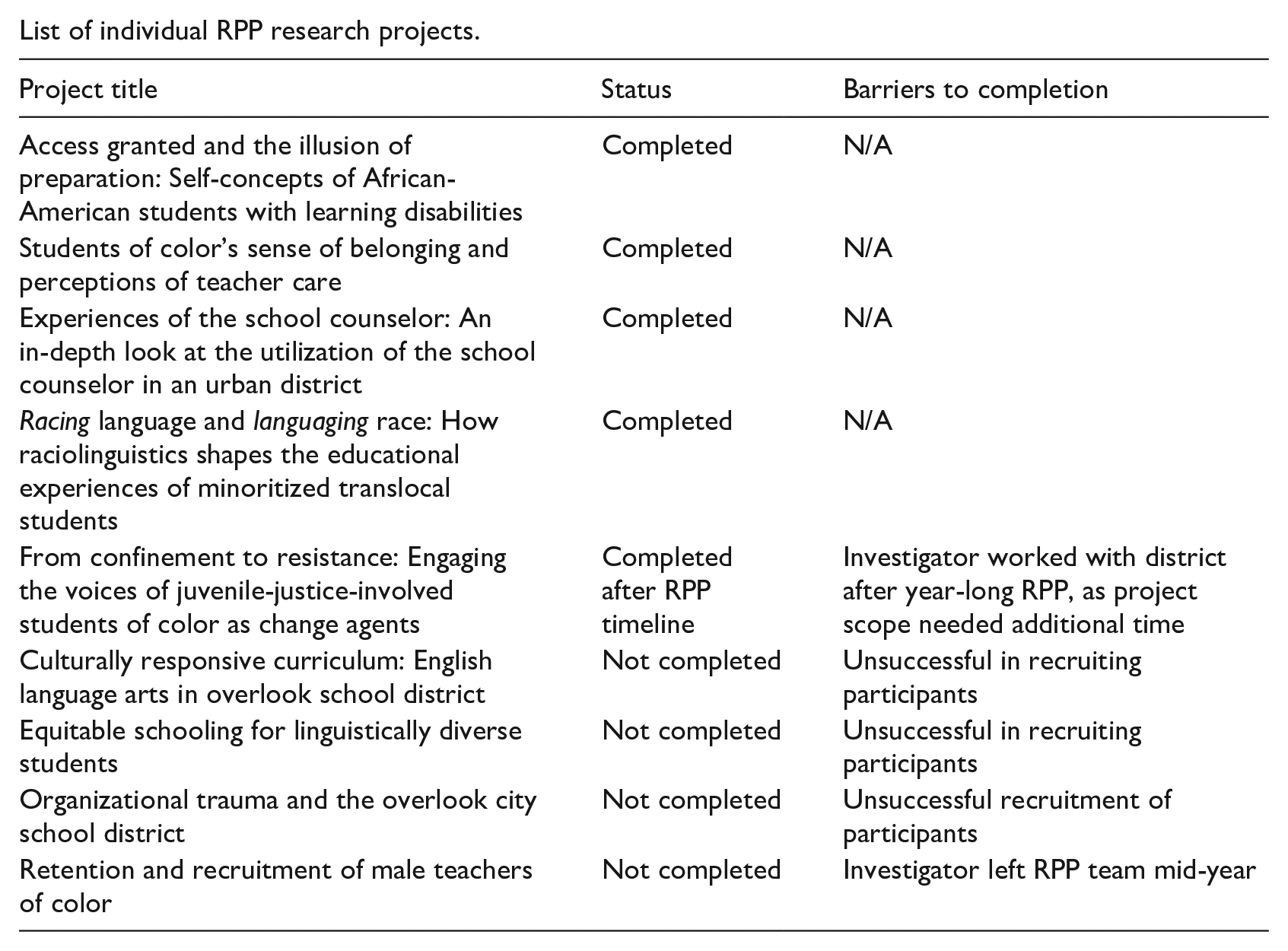
All eleven core RPP members, ranging from Ph.D. students to lawyers, were highly educated. The university team consisted of nine Ph.D. students in a research seminar course and a full professor whose work, since 2001, has focused on school reform to create equitable, socially just policies, and practices. The Ph.D. students were engaged in several fields of study including special education, postsecondary and higher education, language and literacy, and school counseling. Demographically, university partner members were predominantly female and ranged in age from low 30s to 50s, consisted of three African Americans, one African, one Egyptian American, one Indian American, one biracial, and three Whites. On the practitioner side, the two members were African American and held roles in central district administration, including Nell, the district’s Manager of Equity Initiatives. Nell was our primary RPP school partner contact and had an authentic commitment to leading change that could result in justice and equity for Overlook students. Thus, all RPP members were epistemologically grounded in ideals of social justice. The team benefited from diverse backgrounds and each approached the project uniquely based on personal experiences, knowledge, interests, and identities. Through our own unique lenses, we examined four core areas: student learning, social-emotional resources, educational access, and support systems within the district for teachers, staff, students, and families (see Appendix A for a list of individual research projects). To ensure we fully represented multiple perspectives of the RPP relationship, we invited team members to member-check this article (Rossman & Rallis, 2017).
While we approached this work with an idealistic commitment to equity and ‘good intentions’, we faced challenges we were unprepared for. Consistent with previously published warnings, we experienced turnover, leadership changes, limited engagement of school partners, lack of resources including time and personnel, and failure to establish a meaningful and long-term partnership. Despite varying degrees of engagement and resistance from district offices and school personnel, we submitted an equity report to the district that ultimately remained unshared.
In this article, we reflected on our lessons learned to contribute to the knowledge base about RPPs. As described above, existing literature primarily describes how to conduct RPPs, challenges associated with RPPs, and successful case studies, but there is limited discussion of failed RPPs and/or the points of failure. In an attempt to address this gap, we examined our RPP through a critical lens using perspectives of trust, power, and politics. We structured our reflection around three key aspects that we now view as the heart of RPPs: politicized trust, mutualism, and use of research.
Heart of an RPP
As illustrated by Figure 1, the heart of an RPP lies in the intersection of politicized trust, mutualism, and use of research. We are not suggesting that missing one or two of these elements will result in a failed partnership: as examples, one can still use research results without establishing politicized trust and one can still establish politicized trust without a focus on mutualism. However, these three aspects impact one another and have the potential to drive the partnership dynamics overall. Through our own experience in establishing an RPP with Overlook School District, we hope to illustrate how careful attention to these factors is critical to establishing a successful RPP.
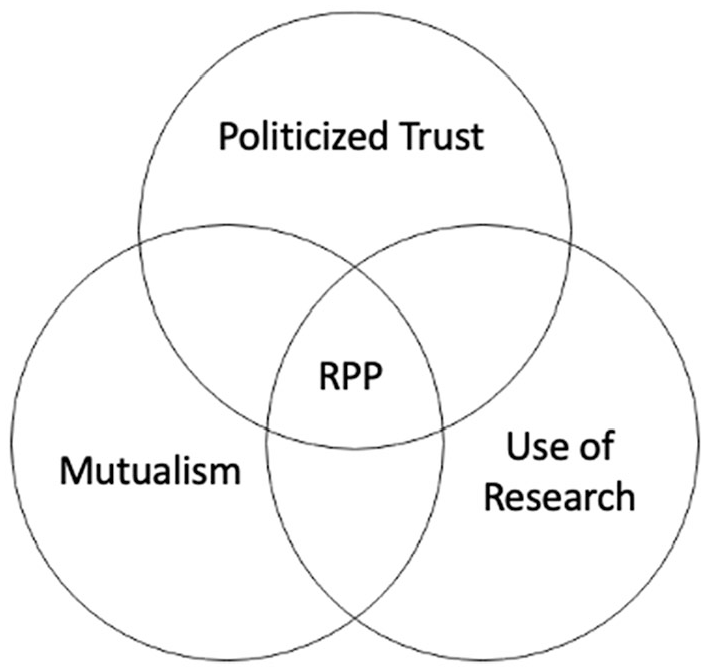
The heart of an RPP.
Politicized trust
The complexity of establishing trust is a key aspect of an RPP. However, trust-building in relationships can be difficult, especially in collaborative projects such as RPPs wherein multiple groups take ownership of the work. Vakil et al. (2016) examined relationship-building in participatory design research, particularly around notions of power, respect, care, and trust. They suggest that researchers who have privileged identities or outside status need to establish authentic solidarity early in the partnership if the research involves a largely minoritized group (Vakil et al., 2016). Further, they argue ‘neither trust nor solidarity is gained (nor should it be) by the assertion of good intentions’ (Vakil et al., 2016, p. 199). What they refer to as politicized trust is critical in developing ‘respectful and mutually reciprocal relationships between communities and researchers’ (Vakil & McKinney de Royston, 2019, p. 549). We argue that the ability to establish and maintain politicized trust impacts the relationship between researchers and the researched, partnership benefits, and ultimately how research is used.
Mutualism
Critical to establishing and maintaining politicized trust is being able to communicate one’s own self-interests and ‘move beyond a discourse of “good intentions” and toward a candid discussion’ of what the partnership means to each person (Vakil et al., 2016, p. 201). This idea of mutualism in an RPP refers to a mutually beneficial or symbiotic relationship between university and school partners (Chorzempa et al., 2010). Building a relationship of mutualism and trust is a ‘developmental process requiring interaction and reflection to ensure that the resulting partnership is collaborative and that the relationship is beneficial for all stakeholders’ (Lefever-Davis et al., 2007, p. 204). The core of mutualism lies in the development of trust, as referenced above, as well as the belief that the interests of all the partners are being considered. Further, ‘the themes of mutuality and reciprocity emphasize that all stakeholders in a specific partnership benefit from the partnership in a way that is meaningful and beneficial to them as well as to the larger shared goals’ (Perkins, n.d.). One way university and school partners can both benefit in an RPP is through the research findings.
Use of research
In referring to use of research in this paper, we are not investigating how research data is used as part of evidence-based organizational decision-making, but rather how school partners and other stakeholders envision the purpose of the research findings and whether this aligns with university researchers’ needs to ensure that all parties involved achieve mutually beneficial outcomes. Pelz (1978) identified three types of research use: instrumental, conceptual, and symbolic (also referred to as political). Instrumental use of research describes direct applications, conceptual use of research is when findings are used for less specific purposes, and symbolic/political use of research refers to research used to maintain the status quo or legitimize certain beliefs or positions (Beyer & Trice, 1982). Symbolic use of research can be beneficial and unproblematic unless research is distorted, misrepresented, or monopolized for purposes of maintaining inequity (Stevens, 2007; Weiss, 1979). Beyer and Trice (1982) describe several factors that affect the use of research including timing as it relates to organizational problems and decision-making processes, available resources, how results are translated and who translates them, ability to communicate results to a wide audience, and the amount of attention the audience is capable or willing to give to such communication (Beyer & Trice, 1982).
We argue that these three key aspects – politicized trust, mutualism, and use of research – are instrumental in shaping an RPP and its outcomes. To illustrate how these aspects influenced the dynamics of our own RPP, we engaged in a reflective analysis approach grounded in a portraiture methodology.
Reflective analysis approach
As we tried to conceptualize this RPP relationship, we were guided by a phenomenological approach grounded in sociopolitical and critical theories. We knew our methodological approach needed to capture ‘the essence of the human experience’ and ‘record and interpret the perspectives of the people’ within the study (Hill-Brisbane, 2008, p. 644). By utilizing elements of portraiture (Lawrence-Lightfoot, 1983, 2005; Lawrence-Lightfoot & Davis, 1997), along with the artistic techniques and goals of ethnography, we sought to capture and understand how a small group of researchers and practitioners thought, behaved, and interacted within a given context. We aimed to illuminate both the possibilities for change and struggles of this partnership.
By employing this methodological approach, we listened for the story, rather than only listening to the stories of the various stakeholders involved in this study. This does not mean that our self-inquiry was ‘designed to be documents of idealization or celebration’ (Lawrence-Lightfoot & Davis, 1997, p. 9). Rather, in the search for goodness we aimed to establish an expected balance of ‘virtue and evil’ and ‘strength and vulnerability’ (Lawrence-Lightfoot & Davis, 1997, p. 9). We attempted to understand the ‘deep meaning’ of our experiences by relying on ‘description, interpretation, and critical self-reflection’ (Clandinin, 2013; Rossman & Rallis, 2017, pp. 85–86). By using storytelling (Lawrence-Lightfoot & Davis, 1997), we hoped our work would inform, inspire, and ‘capture the fluidity and complexity of the living world’ (Lawrence-Lightfoot & Davis, 1997, p. 8). We anticipated deepening and broadening the conversation around mutualism and partnerships by living up to a standard of ‘authenticity’, defined by Lawrence-Lightfoot and Davis (1997) as capturing the ‘essence and resonance of the actors’ experience and perspective through the details of action and thought revealed in context’ (p. 12).
We reflected upon research data collected over a period of 18 months from 2017 to 2019 including personal analytic memos, field notes, interviews, observations, and group panels. With the assistance of district partners, key informant sampling was used to identify individuals who could help form and sustain the partnership and research efforts (Patton, 2015). In total, we spoke to 55 district constituents including teachers, students, a dean of students, a former board member, legal counsel, a diversity officer, parents/guardians, principals, community members, and school counselors. In addition, the RPP team analyzed 71 publicly available and internal district documents including school climate surveys, school report cards, brochures, curricula, external assessments, and school improvement plans. These district-level data contributed to our understanding of school contexts and equity gaps.
In our qualitative analysis of the data, we engaged in reading and color-coding data that indicated a pattern or theme (Miles et al., 2015). For example, in looking at field notes describing visits to the principals of each school, sentences that had words like ‘willing, receptive, helpful’ were highlighted in green, others that had words like ‘not available, unwilling’ were marked in red, while some with words like ‘delegating’ were colored yellow. These patterns were labeled ‘willingness to engage’, ‘unwillingness/reluctance to engage’, and ‘delegation of tasks’ and then clustered under the heading ‘practitioner attitudes’. Other data, including our own weekly reflections and fields notes, were coded similarly following techniques outlined by Miles et al. (2015). Thematic analysis of these data sources enabled us to conceptualize findings related to politicized trust, mutualism, and use of research, which we described below.
Findings
Politicized trust
Early in the RPP, it was clear there were complex trust issues to be navigated and sustained. The professor directing this RPP moved to Overlook City in the summer of 2016 upon taking a position to develop a university center on educational access, success, and equity that would engage in community partnerships. She relates her account of how her partnership with Overlook evolved: My biggest question when leaving the city I had grown up in and established deep community roots in was if it were possible to develop authentic relationships in a community where one was an outsider. I was introduced to Overlook City leaders who were working on a Promise Neighborhood Grant and a Community Development Grant funded by U.S. government agencies. I noticed most of those individuals had deep connections to Overlook and/or the local community. In an effort of good faith to share some of my experiences, I introduced myself as the lead author of a Promise Neighborhood Grant application in my former city. Within an hour of the meeting’s end, my dean received a phone call from that group asking that I sign a confidentiality agreement ensuring that I didn’t tell anyone “back home” about any of their plans. This was my first insight into the complexity of the local political and relational landscape.
As the excerpt suggests, the ability to establish trust quickly and authentically would be critical to establishing any partnership.
The RPP formally began once a successful connection was made with Nell, but trust issues persisted outside of our team. For example, we did much of the foundational equity work during class sessions that only Nell attended with a few stakeholders she invited. These honest and open discussions were effective in developing trust within our group, but did not help build long-term trust with the stakeholders. In other words, we relied too heavily on Nell’s relationships and her position of perceived power in the district. This caused issues during data collection, particularly when seeking internal data from principals and recruiting participants.
Specifically, we scheduled meetings with each of the 18 building principals so Nell could introduce the RPP team and our data requests. Because this was the only time many of the researchers engaged with the principals, the team encountered various levels of enthusiasm and helpfulness. Some of the field notes taken by researchers reflected positive receptions: ‘the principal stated that he was willing to participate in an interview to provide any additional information’; ‘he was extremely receptive’; ‘he was courteous and helpful’; ‘said we were welcome there any time, whether it was for this project, or simply to be there and observe’. Some principals openly divulged concerns they had about their school. These concerns included lack of resources to fund ESL teachers and poor supports for LGBTQ students. Another principal expressed frustration at the lack of Title I funds for afterschool programs for the students, enrichment activities, Saturday School, and transportation, despite the school being eligible for Title I funds.
However, other principals seemed unwilling or reluctant to get involved in the study, as evidenced by these field notes: ‘Principal was not available to meet [after being called/paged multiple times]’; ‘She was very brief and kept saying it was a big ask and a lot of work, but that she would make an effort’. Others preferred not to get involved in the research directly, passing the task to others in the school. One researcher reflected that a principal ‘Is delegating all data collection we requested to the school counselor’. One principal refused to meet with RPP members at all, responding that they had been ‘researched’ many times before and no benefit had come of it. In hindsight, we did not do a good job at making our presence consistently known and felt, and with the academic year (and research seminar course) winding down, we found ourselves making just a few more visits to the schools to wrap up our equity audit.
School practitioners also complained that similar partnerships had been developed and abandoned over the years. An ESL teacher referred to himself as ‘jaded’ not only of overall reform efforts, but also of being a guinea pig of what he considered a mismanaged district. To be thought of as guinea pigs, to be over-studied due to under-achieving, weighed on the minds of many practitioners we engaged with and rightly affected their perception of the RPP team and its intentions. In fact, some employees believed that the more data they provided to external groups like ours, the worse their jobs got. The same ESL teacher above indicated that the last time his school provided data, several positions had been cut. He was now stepping up to teach eighth grade math because sometimes ‘you have to do what you have to do’. This attitude of distrust and negative correlation did not surprise Nell. Nell was frank with us in a follow-up interview we conducted with her in 2019, 6 months after the partnership had dissolved: I mean, if you help somebody wipe the tables after lunch or if you help with the recess duty, if you are in classrooms when a teacher has to go to the bathroom, if you are supporting the school environment, they will see you as part of the school community. And if you’re part of the school community, you have a right to the information and the experiences happening in that school community.
In essence, the RPP team did not explicitly communicate to practitioners that we hoped this would be the first step of a deeper partnership, one in which university faculty and doctoral students would continue to collaborate annually on equity-based practices and research. In fact, several doctoral students on the RPP team were able to continue their dissertation research in the district even after the partnership ended, but overall the RPP failed to garner a deep enough politicized trust to convince practitioners that equitable educational reform was at the heart of who we were as researchers and practitioners. Although the research had the possibility to transform some aspects of the school district, the vision laid out by the RPP team did not engage practitioners effectively, presumably due to their past negative experiences as ‘the researched’ and the perceived outcomes of that research.
Mutualism
As the RPP team held early conversations, reviewed data, and reflected on tasks, we realized we needed a common definition of equity that would guide the project design, data collection, and data analysis. We examined various school documents and relied on personal knowledge and prior research to drive our conceptualizations of equity. The resulting definition (Appendix B) suggests that in an equitable school: students should define their ‘why’ through student-centered critical consciousness, be encouraged to challenge and change the status quo, and be provided with a connective community that encourages partnerships and establishes services; school employees have the necessary resources and qualifications to perform their jobs effectively and be heard when they do not; and school leaders ensure school policies are just. While we kept the needs of Overlook students’ at the center of our work, we over-relied on the two core RPP district partners to provide student-based feedback. Although we did not realize the significance at the time, our definition of equity was largely created by the RPP team itself, and we did not create enough opportunities in the early months of the RPP to hear what students, their families, teachers, or staff thought of equity or what issues they faced. Further, in 2019, Nell told us the definition of equity was never distributed to district stakeholders for additional feedback and refinement.
By the end of the RPP in 2018, the district and city were undergoing changes of the highest magnitude. In March, the Overlook Mayor announced that she would be stepping down, setting the stage for a power scramble in the city, and in April, the superintendent resigned. This resulted in an exodus of people in the district including our two RPP school partners and Nell’s supervisor. When Nell delivered to her supervisor (still employed at the time) the final equity report that included the definition, she recalled an unspoken reception: ‘the entire thing is burning down around me and here you come with a cup of water’. Had we engaged more stakeholders in co-owning this definition, perhaps there would have been hope for keeping their concept of equity alive even after district and city leadership changes. Parents could have referenced the definition at board meetings when advocating for their children. Teachers could have referred back to it during professional development. Nell made this mistake clear to us after the RPP had ended: A mom in the district may not have the time to sit down and read the research, but these fantastic researchers told me this, and it’s line with what I know about what I’ve experienced as a parent. So I’m going to be vigilant about seeing it happen because you’re arming people with the information they need to validate the claims they make. . . democratize the information in such a way that it’s not left up to the stakeholders to decide whether they want to fund these resources or make things move, but it’s left up to parents now: here’s the research that says that your child will be safer or would be more successful.
As it was, the definition that the RPP team spent months researching, creating, and debating had minimal benefits for the stakeholders in the district. RPP team members joked in an early meeting that we were conducting the equity audit to ‘arm soldiers of equity’: yet we failed to distribute mutually beneficial ammunition.
Use of research
Understanding how research can be mutually beneficial is inherently complex. One co-author acknowledged her position of privilege in the ivory tower and questioned whether the research would even be used by practitioners. She writes in an early reflection: I don’t imagine many K-12 districts have access to expensive scholarly journals (particularly poorer districts who need the most assistance), nor do teachers or administrators have time to read them, digest the material, reflect upon their programs, and implement change in an era of data-driven accountability.
From a practical point of view, she appears to struggle with the notion of instrumental use of research in practice, and her ‘data-driven accountability’ comment hints at a worldview that suggests practitioners may use research symbolically when responding to increased calls of accountability. This reflection could have been partially true; while district representatives indicated that the purpose of engaging in the RPP was to have research drive decision-making, they admitted that they did not fully understand what RPP outcomes would actually look like or how they might use the research for instrumental purposes. Nell said the district wanted ‘qualified researchers on the ground assessing what was working, what wasn’t working, things that were silent or invisible for us, and things that were visible to us’. Even if the research was disseminated to stakeholders, Nell questioned whether the findings would be useful: Do the people who hold the purse strings [agree with] the research? And what are the competing priorities? What does the strategic plan look like? Is it in line with the strategic plan or is it kind of throwing a wrench in?
As described above in the politicized trust section, teachers and community members were very suspicious of research use, often correlating data with decisions that harmed them, their schools, or their students. One district practitioner we spoke to explained that data could be irrelevant or unhelpful: his successful school building was closed in order to lease the building to a non-profit Renaissance School. Similarly, when we asked another practitioner about the biggest issue impacting the school district’s ability to provide an equitable educational experience, she replied, ‘poverty’. Addressing poverty as a problem of practice was not a focus of our RPP, so how useful would the research actually be? Could the results of our district-based research yield any practical applications to combating the effects of poverty?
Nell understood the practitioners’ concerns. She suggested they are often ‘given info, but not the method to connect it. They get numbers, but don’t know the formula to do the math’. Even if we had been able to distribute our research findings to stakeholders, this statement casts doubt on whether the RPP research would be contextualized in ways that district constituents would find valuable. Yet teachers and staff were exactly those who needed the research most to lead long-term, meaningful change according to Nell: Is there a desire to have agitation behind it? Because I know the agitators. I know them by name. I know the people that would carry the torch for it, but do you politicize research in this way? Because parents aren’t interested in things that are going to happen in 10 years because their children will be out of school.
Ultimately, she said, the report had only been ‘accessible to the people who have no desire to do anything about it, but not accessible to the people who need it to shift the needle’. In this way, the research findings remained an abstract concept to many of the RPP stakeholders.
Similarly, the research team did not make our use of research intentions explicit, either. How would we use research? Would we help the district implement some of our recommendations into practice? For some university partners, the RPP was simply a component of a mandatory research seminar course that could produce research used instrumentally like this: published in an article with no district partner as co-author. Others were eager to use RPP connections to get school access to conduct their dissertation research. Thus, researchers’ self-interests ranged widely from learning research methods to publishing articles.
Implications for partnerships and future research
Understanding that all RPP experiences will be different, we provide recommendations based on our own successes and failures. We arranged this section according to the main RPP partners (school district partners and university partners) so that each can be prepared to ask specific questions before engaging in an RPP. We conclude this section with directions for future research.
In addition, school partners need to be honest about school and/or district politics and trust issues so that the university partners are aware of the power dynamics and all members can work together to ensure the accessibility of the findings to all stakeholders. In our experience, our inability to fully understand the district’s power structure and engage stakeholders who were left on the periphery was a major contributing factor in limiting stakeholders’ access to research findings. Involving a wide range of school/district members and stakeholders in the RPP design plan, data collection, and data analysis will ensure that research findings leading to tangible outcomes are actually an achievable goal of the RPP. School partners need to actively engage all stakeholders who will be impacted by the research and findings stemming from the partnership.
We also suggest that university partners be intentional about where they hold meetings. During the course of our RPP, we found that we were unprepared to spend extended amounts of time in the schools (separate from the time needed for data collection) that was critical to develop trust with the stakeholders. Although the RPP team met weekly in Overlook city, we met at the university campus, which was a few blocks from the Overlook School District offices but nowhere near the actual schools. Scheduling our weekly research team meetings in one or more school buildings would not only have enhanced our understanding of those schools, it would have provided us with the opportunity to create authentic relationships with principles, teachers, staff, students, and community members.
Finally, we recommend university researchers be strategic about disseminating findings. While our RPP group disseminated three versions of the definition of equity (detailed, talking points, and a one-liner, see Appendix B) and two versions of the final report (one technical report and one jargon-free report), we recommend planning for multiple modes of communication. Avenues could include social media blasts, infographics, short reports or blogs, update briefs, and/or reports presented at Board of Education or Parent Council meetings. This will expand the number of stakeholders who have access to and can potentially the research, especially if these materials are disseminated in multiple languages that reflect employee, student, and community demographics.
Conclusion
As prior literature and our own reflective analysis illustrates, RPPs require close attention to develop, maintain, and sustain (Coburn & Penuel, 2016; Severance et al., 2014; Tseng et al., 2017). What we learned throughout our own RPP was that we failed to build politicized trust and experienced a misalignment between researcher and practitioner expected benefits and outcomes. Research is a slow, systematic process that often moves too slowly to enable practitioners to make quick course corrections. In our situation, the district’s urgency to act was something to which the RPP team could not adequately respond. In addition, existing distrust among school district administrators, teachers, and staff prompted our reception to be fraught with tension and suspicion. Ultimately, the success of the RPP was hindered by previous negative partnerships and our team’s failure to communicate clear and mutually beneficial outcomes/results that engaged stakeholders at all levels. Our aim in writing this reflective analysis was to highlight RPP challenges we experienced from a critical perspective of trust, power, and politics and provide recommendations for university and school partners who are considering a research-practice partnership.
Footnotes
Appendix A
List of individual RPP research projects.
| Project title | Status | Barriers to completion |
|---|---|---|
| Access granted and the illusion of preparation: Self-concepts of African-American students with learning disabilities | Completed | N/A |
| Students of color’s sense of belonging and perceptions of teacher care | Completed | N/A |
| Experiences of the school counselor: An in-depth look at the utilization of the school counselor in an urban district | Completed | N/A |
| Racing language and languaging race: How raciolinguistics shapes the educational experiences of minoritized translocal students | Completed | N/A |
| From confinement to resistance: Engaging the voices of juvenile-justice-involved students of color as change agents | Completed after RPP timeline | Investigator worked with district after year-long RPP, as project scope needed additional time |
| Culturally responsive curriculum: English language arts in overlook school district | Not completed | Unsuccessful in recruiting participants |
| Equitable schooling for linguistically diverse students | Not completed | Unsuccessful in recruiting participants |
| Organizational trauma and the overlook city school district | Not completed | Unsuccessful recruitment of participants |
| Retention and recruitment of male teachers of color | Not completed | Investigator left RPP team mid-year |