






Abstract
Social media is considered a relevant method of communication between Australian secondary schools and their various constituents. While there is a general awareness of the importance of communication with stakeholders, there is a lack of detailed research into the content of secondary school social media information and the relative frequency of released content to the schooling community. This study provides an understanding of how secondary schools communicate with their students and school community in the social media landscape as well as how students are portrayed by schools in their social media communications. Sixteen government secondary high schools Facebook pages were analyzed over a year period. The highest number of total posts and reactions from across all schools were general reminders/announcements, sports activities, wellbeing programs/presentations and student promotions. There was a statistically significant association between number of posts and reactions but not between student population and number of post or reactions. The study provides results showing what posts are highly communicated by schools and what posts are highly engaged with by the schooling community. In turn, this also provides insight into how students are portrayed by schools in their social media communication and how school administrators can manage their social media pages to ensure a variety of context is communicated.
Keywords
Introduction
Social media is used as a tool to communicate events and information (Junaedi & Edmond, 2024; Magalhães et al., 2024; Rayward et al., 2019; Saprykin et al., 2016; Yanchenko & Humprecht, 2025), with the types of social media platforms including, but not limited to, Facebook, YouTube, TikTok and Instagram. Regardless of the platform, social media is used as a tool for communication across various industries. For example, the fashion (Chowdhury et al., 2024) and wellness industry (Zimmermann et al., 2024) use social media to promote their products. Similarly, schools utilize social media to communicate to their wider school community (Cox & McLeod, 2014; Baxter & Toe, 2023; Ohara, 2023). The reason for the establishment of social media pages differs between industries, with the schooling sector most likely utilizing social media to communicate information quickly, more frequently and at less expense (Cox & McLeod, 2014; Kaban, 2021). Hence, social media is used across various industries for a variety of reasons, with the overall impacts potentially differing dependent on the purpose and nature of the industry.
Leaders within the schooling sector have identified a range of positive benefits of social media communication, including it being quicker, allowing for more frequent communication and building connections and culture within the schools local and external areas (Cox & McLeod, 2014; Ohara, 2023; Sunarso et al., 2024). Research also indicates that social media is now an expected mode of communication, which has contributed to increased engagement among parents and caregivers across age groups in their children’s education and development (Abualrish & Khasawneh, 2024; Mestry & Grobler, 2007; Sunarso et al., 2024). While the use of social media has become common practice for school communication, the literature reveals that the content of the message significantly influences readership. For example, within the higher education sector, certain content themes such as athletics, school spirit, promotions and admissions increased engagement with their social media community when compared with other content themes, such as academic events, research and programming (Peruta & Shields, 2018).
The impact of the different content themes communicated by schools is also likely to vary, particularly when they relate to key factors/themes influencing student success. Key themes can include student wellbeing (Kase et al., 2017), sense of belonging (Anderman, 2003; Ibarra, 2022), and school transitions (Jindal-Snape et al., 2020; Mander & Lester, 2017; Simpkins et al., 2025) that play essential roles in supporting positive educational outcomes. Promotion of student endeavors and achievements on social media can foster a sense of belonging for both students and caregivers, particularly when engagement with these posts comes from key individuals. For example, Scissors et al. (2016) noted that individuals ranging in age from 13 to 90 showed more positive feelings to Likes that were from close friends, romantic partners, and family members other than their parents. This aligns with the broader incorporation of wellbeing, social and emotional programs within schools, which has been shown to positively influence not only students’ wellbeing but also their academic outcomes (Kase et al., 2017) and their sense of belonging (Ibarra, 2022). Communication is also of particular importance in the transition between primary to secondary schooling, where strong parent-school communication is vital for positive transitions (Gilbert et al., 2021; Simpkins et al., 2025).
Understanding the interplay between school social media communication and community engagement requires a theoretical lens that accounts for both the relational dynamics of digital communication and the broader ecological context in which schools operate. Bronfenbrenner’s Bioecological Systems Theory (BBST), particularly the Person-Process-Context-Time (PPCT) model (Bronfenbrenner, 1995; Bronfenbrenner & Morris, 1998), provides a framework for understanding how school communication functions as a ‘process’, meaning a mechanism through which relationships between schools and families are developed and maintained within the ‘context’ of school culture and climate. From this perspective, the themes that schools choose to communicate, and the frequency with which they do so, both reflect and shape the school’s cultural priorities. School leaders play a pivotal role in this process, as leadership communication serves as the mechanism through which organizational culture is transmitted to and reinforced by the broader school community (Teasley, 2017). Complementing this ecological view, Actor-Network Theory (ANT; Sayes, 2014) conceptualizes social media platforms and their content as active participants, or ‘actants’, in the construction of school-community relationships, rather than mere channels for information transmission. ANT suggests that the interactions between human actors (parents, students, administrators) and non-human actors (social media posts, engagement metrics) collectively produce and reproduce school culture in the digital space. Together, these theoretical frameworks predict that (a) schools’ posting patterns will reflect their cultural and administrative priorities, and (b) community engagement patterns will reveal which cultural values resonate most strongly with stakeholders. This theoretical grounding is applied as conceptual frameworks to interpret observed patterns of posting and engagement on public school Facebook pages, rather than being empirically tested within this study.
Hence, the use of social media to communicate important matters to parents, caregivers, and the wider community regarding significant aspects of a student’s educational journey is increasingly expected in today’s world. Furthermore, sharing information on these topics through social media enables schools to provide instant and accessible communication about issues that are essential for supporting student success. Additionally, not all information that is communicated by schools is likely to be engaged with or seen by the schooling community. This is of particular importance for schools to note when promoting their material, as certain material that may be of vital importance for communication may be missed or not engaged with by the targeted parental/school community audience.
Despite the growing reliance on social media within the schooling landscape, there is little peer-reviewed research that examines the context or volume of information secondary schools communicate. For example, research from over a decade ago showed interactions on a school’s Facebook page as being predominantly ‘school information, questions, interesting links, events, places and photo and video albums’ (Chairatchatakul et al., 2012, p. 379) with 189 interactions on posts from the schooling community. Baxter and Toe (2023) also noted social media communication was primarily descriptions or images of children learning in the classroom environment. When looking at a range of communication from social media platforms, it was found that information/announcements, communication and photograph etc. sharing were the top three of six purposes for communication (Kaban, 2021). Other social media research in schools have addressed different aspects of this form of communication. For example, in Saudi Arabia best practise was formation of groups on social media platforms as well as displaying content on Twitter (now X) and Instagram (Abualrish & Khasawneh, 2024). These studies, however, did not look at the specific content that was posted or the interactions that occurred per post category. This gap in the literature is significant given that school communications vary widely in importance, ranging from critical messages related to student success (e.g. wellbeing or transition programs) to routine administrative information.
Addressing this gap in the literature will inform researchers and administrative staff about the volume and nature of content published on school social media sites. In doing so, it will enable school personnel to determine whether critical messages related to key factors in a student’s education are communicated more or less frequently than non-critical messages, thus allowing schools to refocus their communication messages where needed. This will also support the recommendations of Sunarso et al. (2024), who emphasize that educational institutions must develop effective social media communication strategies to enhance parental involvement.
Given the gaps identified in the literature about the use of social media in the education field, the focus of our study is to determine the themes communicated on secondary school’s social media pages and the level of engagement of the school community to each theme. This, in turn, will allow for schools to identify areas for greater communication in key schooling areas that may be missed by parents/caregivers due to the posting of ‘popular’ or ‘less popular’ themes. Hence, our three primary research questions were: (1) What themes appear in school social media posts, and how frequently are they communicated?; (2) How does community engagement vary across different post themes? and (3) What proportion of posts focus on student wellbeing programs, primary-to-secondary transitions and student promotions, and how does the school community engage with this content?
Methods
The study targeted fully government funded public schools Facebook posts using a quantitative content engagement analysis. The unit of analysis was individual Facebook posts posted on those school pages. A coding framework was conducted across an initial inductive pre-test, resulting in 27 thematic categories. Each post was coded according to the theme, and engagement was measured using the number of reactions. Quantitative analyses (proportional engagement and linear regression) were undertaken to determine the relationship between posts and reactions.
Social Media Platform Selection
Students in middle schooling years engaged with the social media platform Instagram the most, followed by YouTube, Snapchat, Vine, Pinterest, Facebook and X (Martin et al., 2018). M. Anderson and Jiang (2018) found similar results, with the most popular social media platform for teens being YouTube, Instagram and Snapchat. However, social media sites with the most usage for middle school students differed, with Instagram, YouTube and Snapchat being in the top three for social media usage (Martin et al., 2018). More recent reports from Australia found similar findings, with Youtube (73%), Snapchat (63%), Instagram (56%) and Facebook (41%) reported as being used by teenagers aged between 13 and 15 between January and September 2024 (eSafety Commissioner, 2024). Adult social media usage differed from middle schoolers/teenagers, with adults engaging, in ascending order: YouTube, Facebook, Instagram, Snapchat and X as the top five social media platforms for usage (Hruska & Maresova, 2020). A more recent study by Auxier and Anderson (2021) saw the ascendency of Pinterest and LinkedIn to replace Snapchat and X, however Facebook was still widely used. Therefore, the type of social media platform used to share information is likely to reach specific age groups and demographic segments, depending on who uses it most frequently. This is important to note to give an idea of what types of users are from the given community.
Facebook was therefore used as the social media platform for analyze as it was widely used by both adults and teenagers. Additionally, Facebook was selected due to the availability of posts being public and without the need to sign up to a Facebook group. The ability to easily determine engagement (by reactions) was also a reason for Facebook selection. Finally, all schools that were viewed had an easily accessible Facebook page, making it the platform of choice for data collection.
Sampling Technique
A preliminary test to determine the themes that differing posts aligned with was conducted by the primary author on the 1st June 2024 for the prior 6 months on a random school Facebook page. During this pre-test stage all posts were analyzed and a theme that best represented the post was assigned. These themes were then analyzed to determine if any themes could be combined. For example, music was combined within the cultural theme. The exception of this were themes outlined within the initial focus of this study (student wellbeing programs, transitions between primary and secondary schooling and student promotion) that were already included as a theme. ANZAC events (Table 1) were also placed into a theme of its own due to the large number of likes when compared with other events within the cultural theme. This resulted in 27 themes being identified (Table 1).
Categories Used for Analysis of Social Media Posts. Definitions of Categories Used in the Study are Shown.
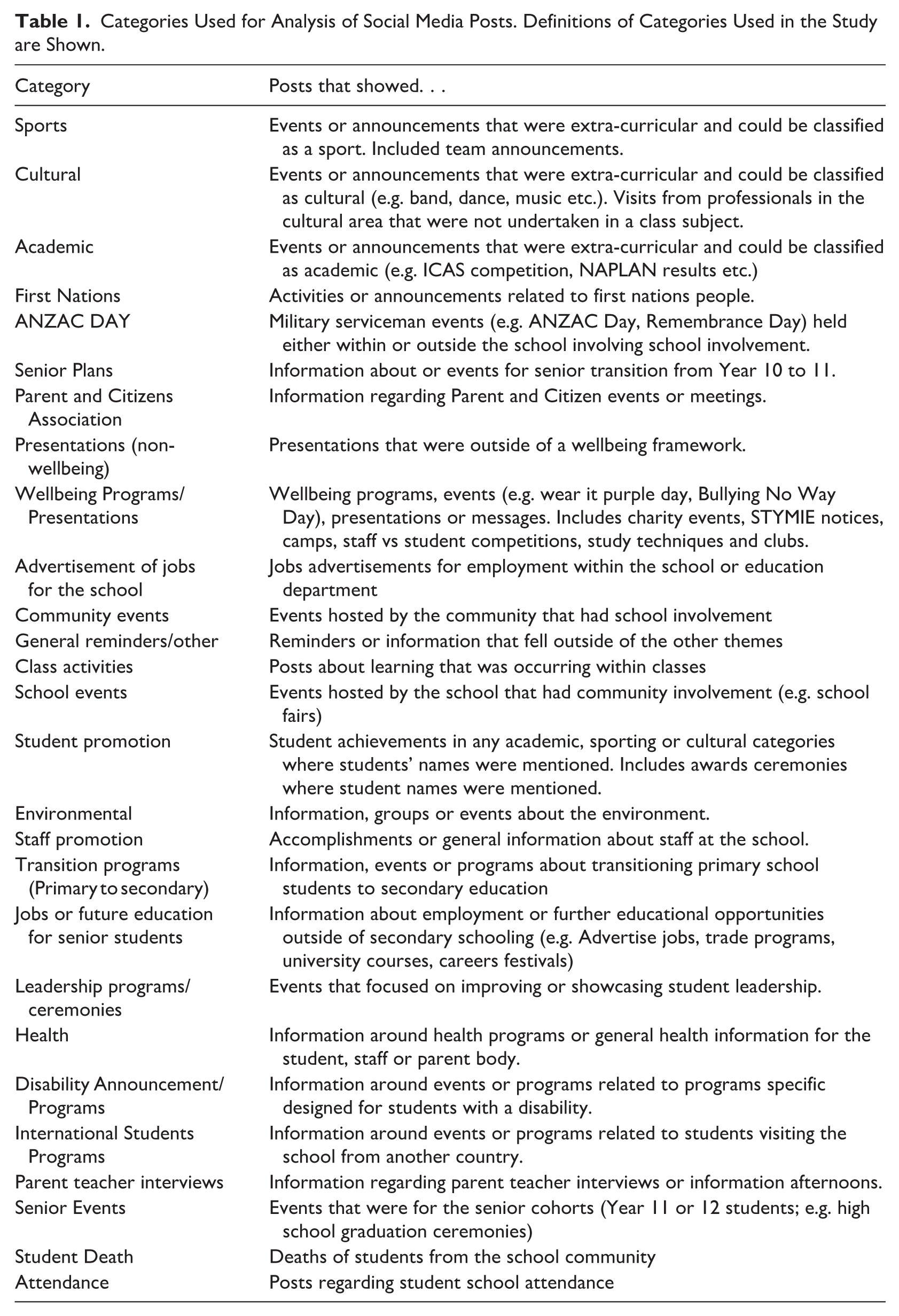
Posts from 16 Australian government run secondary schools Facebook pages were manually collected for the timeframe between 11th June 2023 to the 11th June 2024. Analysis of Facebook pages occurred between June 2024 and February 2025 and was conducted by the first three authors (hereby referred to as samplers). Each sampler analyzed a distinct set of school Facebook pages, with no overlap between samplers. Samplers used the descriptions outlined in Table 1 when determining post themes for different schools to ensure consistency in coding and reduce classification errors. Despite this method aimed at reducing discrepancies between samplers a ‘sampling effect’, where different samplers can record different data, can happen when different samplers obtain data (e.g. Diefenbach et al., 2003; Simpkins et al., 2014) and this needs to be acknowledged for data analysis and interpretation. Schools were only considered for analysis if they had cohorts of Year 7 to Year 12, a state government school (e.g. not private, catholic, boarding etc.) and that had a Facebook page that was not required to have a user subscribe to the page to view the content. These year levels are the designated years for secondary school in Australia for the states of Queensland (QLD) and New South Wales (N.S.W.). Schools were selected by typing in a city or town name followed by ‘state high school’ using Google Maps. The first school within the search results that met the above selection criteria in each city or town was selected for analysis. The cities or towns selected were major cities or towns located along the eastern seaboard of QLD and N.S.W., Australia.
Data Analysis
The number of posts relating to a given theme were manually added together. The number of ‘likes’, as defined as occurring per each different theme were also added together. For the purposes of this study, a ‘like’ is defined as occurring when a Facebook user clicks the ‘like’ link below a post (Peruta & Shields, 2017, p. 133) using one of the seven like emojis (Like, Love, Care, Haha, Wow, Sad, Angry). We used a similar calculation to Peruta and Shields (2017) to determine the engagement of each theme. That is, theme engagement was determined as ‘proportional engagement’ by dividing the number of total reactions by the number of page reactions during the sample time.
Simple linear regression analysis was performed in Microsoft Excel using the Analysis Tool pack adding to determine if there was a significant association between school student population and the total number of school posts and school reactions. Linear regression analysis was also used to determine if there was a significant association between total number of school posts and school reactions.
Results
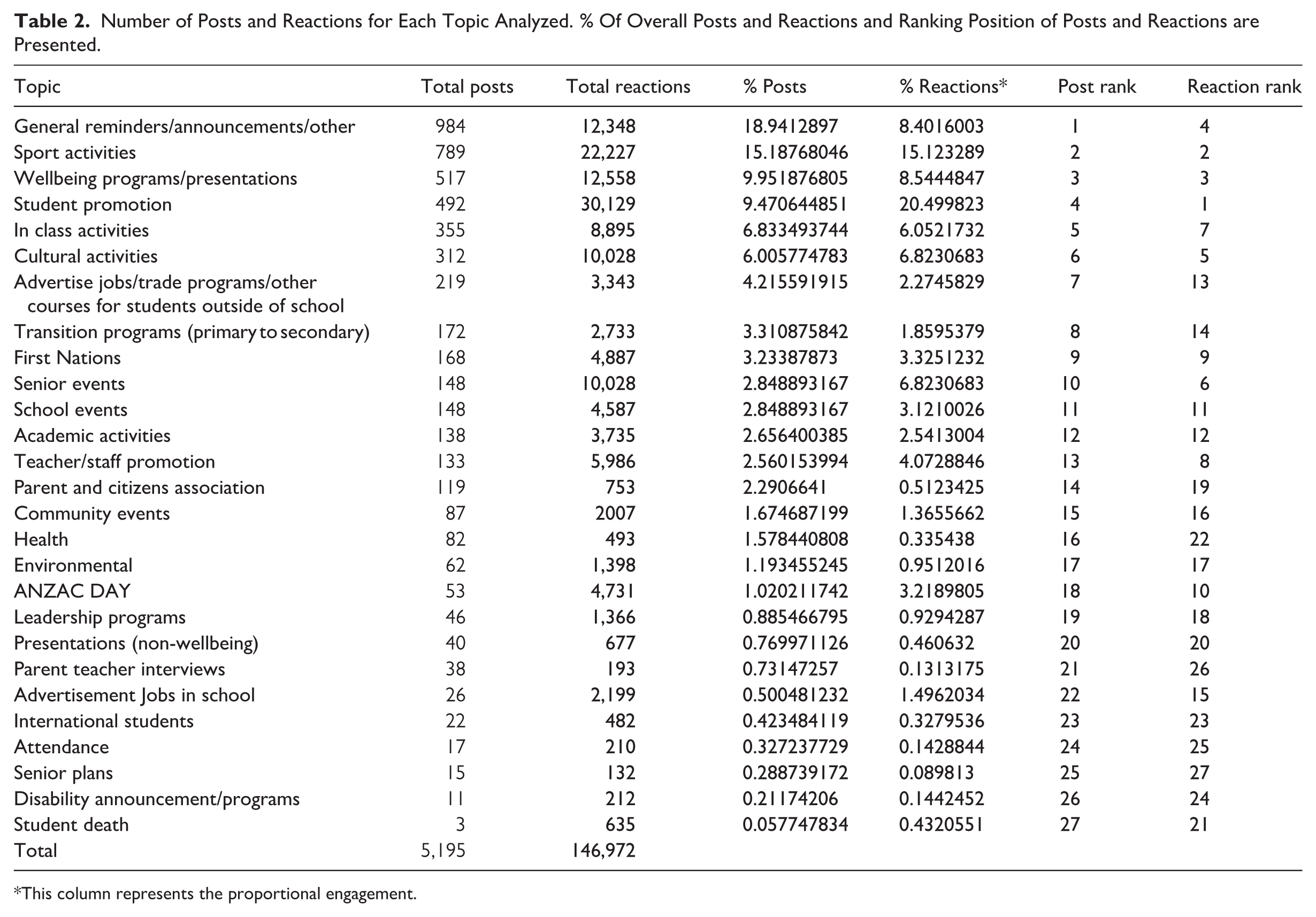
A total of 16 secondary schools Facebook sites were manually analyzed to collect 5,195 posts. From these posts, a total of 146,972 reactions were recorded (Table 2). The number of posts analyzed for QLD schools was 2,783 and the number of posts analyzed for N.S.W. schools was 2,412. The number of reactions analyzed for QLD schools was 77,833 and the number of reactions analyzed for N.S.W. schools was 69,139. There was a significant statistical association between total number of posts and total number of reactions (F (1,14) = 37.39, R2 = .74, p = 3.69E−05). There was no statistically significant association between student population and the total number of posts (F (1,14) = 0.11, R2 = .008, p = .74) or total number of reactions (F (1,14) = 1.07, R2 = .077, p = .32).
Number of Posts and Reactions for Each Topic Analyzed. % Of Overall Posts and Reactions and Ranking Position of Posts and Reactions are Presented.
This column represents the proportional engagement.
The highest number of total posts from across all schools were general reminders/announcements, followed by sports activities, wellbeing programs/presentations and student promotions. The lowest total number of posts from across all schools were student deaths, followed by senior plans and attendance (Table 2). Standard deviation for the means of post themes varied, with the highest number of total post themes having large standard deviations when compared with lower post themes (Figure 1). The highest total number of reactions from across all schools was in the student promotion theme, followed by sporting activities, wellbeing programs/announcements and general reminders/announcements. The lowest total number of reactions from across all schools was in the senior plans theme, followed by parent teacher interviews, attendance and disability announcements/programs (Table 2). Standard deviation for the means of reaction themes varied, with the top two highest number of total reactions themes and the ANZAC theme having larger standard deviations when compared with other posts (Figure 2).
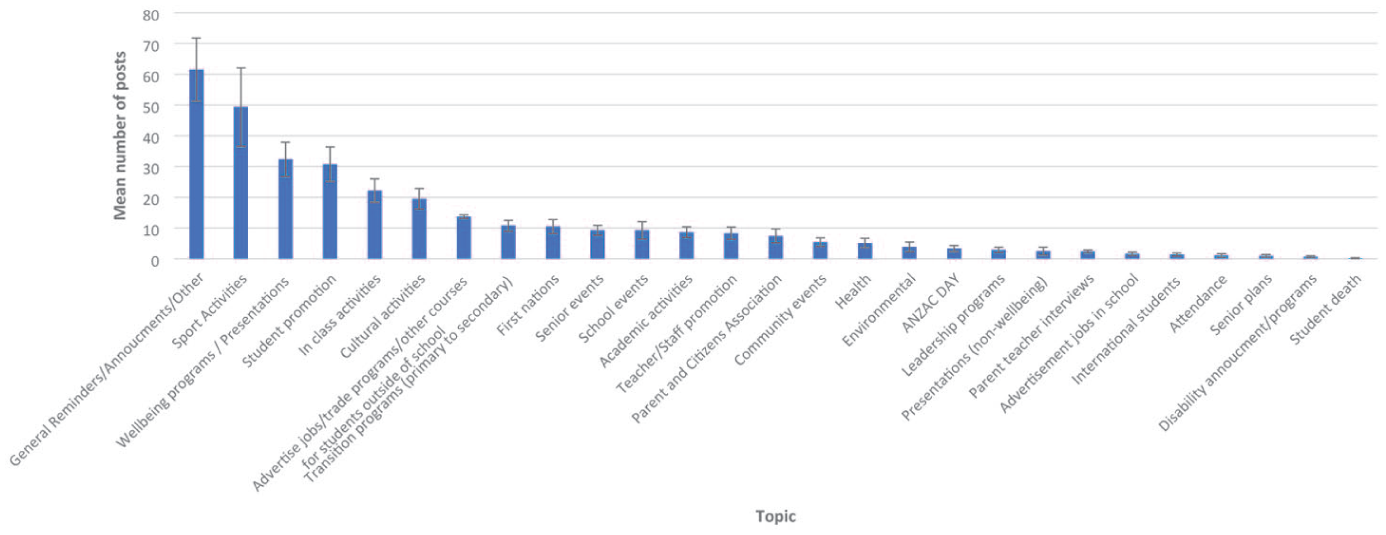
Mean for posts per category. Standard deviation of the mean are presented.
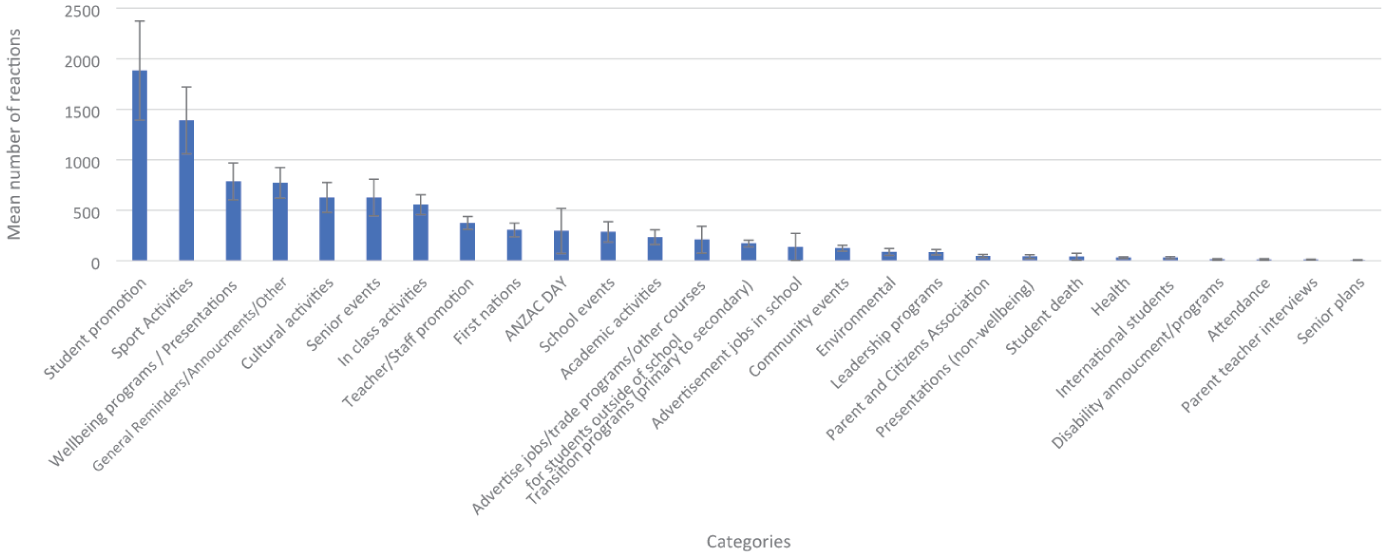
Mean for reactions per category. Standard deviation of the mean for each category are presented.
The number of posts for transitions between primary and high school varied across schools, with the highest number of posts from one school being 22 and the lowest being 1. The percentage of transitions between primary and high school posts ranged between 1.2% and 8.4% of posts for an individual school. The number of posts for wellbeing programs/presentations and student promotion also varied, with the highest number of posts for wellbeing programs/presentations from one school being 74 and the lowest was 8. For student promotion, the highest number of posts from one school was 100 and the lowest was 9.
Discussion
The number of posts communicated per theme was dependent on the school. This is evident when comparing the standard deviation for means of post themes. This needs to be considered when comparing the differing post themes as different themes could be posted more from one school when compared with another. For example, the school from Emerald had Sporting Activities and Advertise jobs/trade programs/other courses for students outside of school as both the second highest theme for posts, contradicting the combined total ranking for both these themes. The same situation applies to reactions and is seen in the ANZAC theme for the school from Mackay that reflected 3,645 of the 4,731 reactions. Hence, overall results for total posts and reactions may not necessarily reflect individual schools and the variability around the data averages (represented by standard deviations (Figures 1 and 2)) needs to be considered for all post themes and reactions. The differences amongst schools’ communication may be explained by school policies or alternative methods of communication (e.g. school newsletters). For example, Gainsborough State School utilizes multiple forms of communication for the school community and has roles on how each form of communication is utilized (Gainsborough State School, 2021). Regardless, the information presented does provide valuable information on what post themes are highly promoted when compared with other posts themes from across multiple schools. This same scenario applies with post engagement.
It was found that some content themes increased engagement while other content themes lowered engagement. The high level of engagement within the student promotion, wellbeing programs/announcements and senior events themes give evidence that engagement by the Facebook schooling community is surrounding posts where the themes are largely focused on students and student events. This is also evident within the promotion of schooling sporting activities but less evident within the academic and cultural themes. A similar result was found within American higher education institutes, where athletics content had a higher engagement when compared with academic events, performances and exhibits (Peruta & Shields, 2018). Overall, this shows that the schooling community’s engagement with schools Facebook communication through posts is highest where students are being displayed and where students’ wellbeing, including how the school is catering to improve wellbeing through events and activities, are being communicated.
The total number of posts was shown to have a significant effect on the overall total engagement while student population had no overall significant association on the number of posts or reactions. Hence, and unsurprisingly, an increase in the amount of communication via social media posts is more likely to be engaged with, and therefore seen, by the schooling community. The data collected cannot determine if the individuals reacted more than once across the time period and the data can only be presented as proportional engagement. Regardless, school administrators looking to increase their communication outreach through social media need to consider the theme of the posts as well as the number of posts that are communicated through social media.
The wellbeing programs/initiative’s theme was within the top five themes communicated by schools. This is important as the effect of school climate on engagement is mediated by well-being experience (Lombardi et al., 2019), meaning schools are showing their understanding of the importance to communicate wellbeing programs through social media communication channels. Additionally, wellbeing programs/initiatives theme was in the top three themes for number of reactions. The high ranking of reactions for this theme indicates that the school community engages with these types of posts.
Transitions posts ranked seventh for the overall number of posts, highlighting that the schools surveyed understand the importance of communication needed to help with a positive transition (Gilbert et al., 2021). This could be due to ‘transition day’ activities, where many primary students visit their future secondary school, predominantly happening over a shorter time period toward the latter part of the schooling year when compared with other schooling events/information (e.g. classroom activities occur throughout the entire schooling year). Alternatively, permission from parents of primary students to post pictures on secondary school’s social media sites may not have been obtained from the secondary school during the transition activities that occur throughout the year. If the latter scenario is the case, then it would be beneficial for secondary schools to communicate transition events/information without the addition of pictures of students and secondary schools should prioritize these types of posts to ensure additional communication around transition occurs. Reactions/engagement was ranked 14th when compared with other posts, indicating that the schooling communities are not as involved in this process when compared with other posting themes. This may be due to parents/family members of the incoming primary school students not yet signing up to the high school’s Facebook site and, therefore, not having access to these posts.
The student promotion theme was ranked forth for the total number of average posts. This indicates schools are understanding the importance of promoting student achievements through social media communication. Additionally, the student promotion post was the top theme for engagement, indicating the school community’s positive interaction with these types of posts. Promotion of students, in the form of extra-curricular involvement (King et al., 2021) or student participation (D. L. Anderson et al., 2022; as being presented as student promotion within this study) has been shown to influence students’ educational outcomes.
Theoretical Implications
The given data makes it difficult to link the effects of social media on a student’s overall wellbeing or engagement. However, the ‘process’ (e.g. relationships with people and objects) and the ‘context’ (e.g. school climate or culture) form part of the BBST Person-Process-Context-Time (PPCT) model. Additionally, the interaction of actors (school community and social media) as defined by the ANT can be implied as showing how the school may be perceived (through ‘Likes’) and portrayed (through theme posts) through digital social media. Hence, from an ANT perspective, social media can function as an active participant in showing school–community relationships. The process of school generated content being shared or ignored by the community demonstrates how digital actors interact with human actors within the school-community to identify highly popular themes. Hence, the interaction patterns between engagement and posts strengthen the interpretation that actors in the digital space actively engage with certain aspects of school communication (e.g. sporting, academic etc.) rather than simply transmitting information. For this study, it is noted that the schooling community communication (via social media communication) is focused highly on student promotion and sporting events. This aspect of the schooling community culture links to the overall Australian culture, which has been shown to have over half of the Australian population participating yearly in a sport (Sport Australia & Department of Health, 2018) and approximately 78% of teenaged Australians (aged 15–19) participating in sport or physical activity at least once a week (Australian Sports Commission, 2023). The results, as indicated by strong engagement in the Student Promotion and Sporting Activities categories, also show a culture where student promotion is valued within the digital landscape. The promotion of school themes, regardless of the topic, is important for a variety of reasons, including student engagement (Danacı & Totan, 2024; Khan, 2022) and academic results (Bayar & Karaduman, 2021), particularly when digital actors actively construct and frame representations of school values rather than merely transmitting information. These outcomes could be applicable to social media communication in schools from countries with a similar sporting and student promotion culture as to that of Australia.
Practical Implications
The study shows which themes are communicated most on school’s Facebook sites. This allows school administrators to see what type of posts are lacking in communication from schools. The themes with a lower number of posts may be lower due to the nature of the post theme (e.g. parent-teacher interviews only occurring at certain times in the year) and, hence, increasing the amount of communication around these themes may be difficult and not have an overall significant impact on engagement levels. However, other theme posts that do not fall into this theme need to be considered for communication to the schooling community. Attendance, for example, has been shown to be declining since the COVID-19 pandemic (Dee, 2024) and students with English as a second language, a disability, different ethnic backgrounds or social disadvantaged students are more likely to have lower attendance (Gee, 2018). Effective communication by schools has been shown to have an impact on student attendance (Martes, 2024; McConnell & Kubina, 2014) and further social media communication around this topic could help to improve schools’ attendance. This is important for school administrators to note as the attendance category was the fourth lowest category for number of posts and third lowest for engagement. Having said this, more direct research is needed to determine if an increase in attendance communication would result in an increase in attendance. Another example is environmental posts, which were ranked 12th for theme posts and may not have an immediate impact in the schooling community. However, the worldwide decline of the environment through anthropogenic processes (e.g. Akhtar et al., 2021; Madu, 2009; Slukovskii, 2023) highlights the importance of schools communicating information and events on the environment that is occurring within the school for the future wellbeing of young adolescents. Hence, direct and indirect themes (e.g. attendance and environmental posts) that had a lower number of posts need to be considered by school administrators for communicating on social media sites. These types of posts are also not restricted by certain school events that occur throughout the year and are therefore not restricted on when they can be posted. In doing so, administrators could help improve their schools via shaping or influencing school perspectives on the themes by strategically emphasizing targeted themes in their social media communications.
The study also provides results for school administrators to determine the post types that are most engaged with by the schooling community. School administrators attempting to increase engagement of their school community toward their social media content should focus on these types of posts to increase overall engagement. This can be applied to social media or non-social media communication, as results of interactions may be transferable between different types of media. While not specifically related to school communication or interactions, this can be seen in communication strategies used by businesses, where multiple communication methods are employed (Priyowidodo et al., 2021). Nonetheless, school administrators should still promote the theme posts that received lower engagement due to the importance of student’s education and wellbeing. An example of this is academic activities (e.g. homework (Cooper et al., 1999) and other related activities (Valentine et al., 2002)) that have been shown to help with a student’s overall academic success. Despite this, the ‘Academic Event’ theme was ranked 12th in terms of engagement by the school community.
Student population not having a significant effect on the number of post or reactions gives evidence to the theory that students may not be engaging as highly in social media posts when compared with other members of the schooling community. This supports results showing Facebook was at the lower end of the social media platforms used by middle schoolers (eSafety Commissioner, 2024; Martin et al., 2018). Alternatively, from a child’s perspective, communication around these factors may not play a vital role for a sense of belonging within the schooling community. This is because students identified a sense of belonging around friendships and the psychological need to fit in during secondary school. This is seen during transitions from primary to secondary school where Year 6 primary students differed on their feelings of a sense of belonging to factors associated with the classroom, school and friendships (Longaretti, 2020). Regardless of the reason, the potential lower use of Facebook by students indicates that school administrators need to consider what other forms of communication can occur to communicate messages to their student body. Having said this, school administrators should be mindful around potential harmful effects of promotion of students on social media as lower Likes have been noted to cause depressive symptoms both daily and at the end of the school year for victimized adolescents (Lee et al., 2020).
Limitations and Future Research Recommendations
The study does not compare primary school posts and transition photos may be communicated through primary school social media sites more so than secondary schools. This is because parental permission for posting on social media may be given to the primary school but not the secondary school. Other themes may also differ between school types and further study is warranted in this area.
The study is also limited in the context of locality (Eastern Australia) and school types (secondary, government run). Simpkins et al. (2025) highlighted variations across localities and school types in transition research, indicating the need for further studies to examine these differences within the social media landscape. This study is furthermore limited to the time frame it was conducted over, with results possibly varying if undertaken outside of this period. For example, online or at home learning was implemented during the COVID-19 pandemic lockdowns by multiple schooling types (Lubis & Dasopang, 2021; Garg et al., 2020; Pozas et al., 2021; Yates et al., 2021) and results would likely vary if undertaken during this time.
Research across different forms of school communication need to be undertaken to determine if results are applicable to different media/communication settings. Additionally, future studies are required to determine if the high engagement interactions recorded for student promotions influence the educational outcomes of students indirectly by exposing the school community to these achievements.
Conclusion
The information presented provides school administrators with a guide on what themes are engaged with and promoted within the school social media landscape. This, in turn, has the potential to provide insight into aspects of culture amongst the school’s community. Knowing this can allow schools to improve their school’s communication in areas of importance or areas that are lacking. Additionally, this information will help schools identify areas where their culture needs improvement, allowing them to better focus their communication efforts and strengthen their overall school culture in areas of the school’s interests. Having said this, schools will need to ensure they look at other aspects of the school community to ensure all aspects of the school cultural network are taken into consideration.
Footnotes
Acknowledgements
The primary author conceptualized the manuscript, wrote the majority of the manuscript and analyzed data. The primary, second and third authors collected data on schools. All authors contributed toward the overall direction of the paper, comments and amendments on the manuscript. The third author was supported by project UJEP-SGS-2025-43-004-2 from the Jan Evangelista Purkyně University in Ústí nad Labem, Czech Republic.

Ethical Considerations
There was no ethical approval required by the university for this project: Social media for school leaders: content engagement analysis of secondary schools’ social media (Facebook) pages.
Consent to Participate
There was no consent approval required by the university for this project.
Funding
The authors received no financial support for the research, authorship, and/or publication of this article.
Declaration of Conflicting Interests
The authors declared the following potential conflicts of interest with respect to the research, authorship, and/or publication of this article: The primary author declares a conflict of interest as they are employed by the Queensland Department of Education. All other authors have no conflicts of interest to disclose.