






Abstract
Through analysis of Deborah Cao’s ‘translation proficiency’, the criteria and strategies for translating legal terms are proposed and then applied in translating the legal term ‘物证(Wu Zheng)’, having reference to law dictionaries and common usage in America, the UK, Hong Kong and Taiwan.
Keywords
Words are the building blocks of language. As we all know, one distinctive feature of legal language is the complex and unique legal vocabulary. As a result, the translation of legal terms is the main difficulty when translating legal documents.
Nowadays, most studies of legal translation deal for the most part with the translation of legal terms. The reason is that the quality of translating legal terms is the key to the quality of legal translation. Professor Zhang Falian pointed out in 2009 that translating every legal word well is, in practice, the key to improving the quality of legal translation. However, translating legal terms is not an easy job. On the one hand, translating legal terminology requires linguistic equivalence and legal equivalence. On the other hand, in practice, many legal terms in one language have no linguistic or legal equivalent in another language, because of the cultural difference between the subject language (SL) and target language (TL), particularly the difference in legal culture. These difficulties mean that legal translators not only need to have a thorough knowledge of the legal systems in both the SL and the TL and proficiency in both languages, but also need to know how to use translation strategies flexibly. In reality, these onerous requirements are seldom realised. In practice, incorrect translation and ambiguous translation remain the two biggest stumbling blocks in legal translation work in China. In short, due to the demand of practice, it is vital to look for appropriate translation criteria and strategies.
The paper starts with an investigation into ‘translation proficiency’, as described by Deborah Cao, and identifies suitable translation criteria and strategies. Next, having reference to law dictionaries and common usage in American, UK, Hong Kong and Taiwan, the identified criteria and strategies for translating legal terms are then applied to translating the legal term ‘物证’ (Wu Zheng).
Deborah Cao’s ‘translation proficiency’ and its implication for legal translation
According to Deborah Cao’s theory, ‘translation proficiency’ is defined as the ability to mobilise translation competence to perform translation tasks in context for intercultural and interlingual communication purposes. Moreover, ‘legal translation proficiency’ refers to the ability to mobilise translation competence to perform legal translation tasks in the legal setting for intercultural and interlingual communication purposes.
Translation proficiency is described as being comprised of three sets of variables, interacting with one another in the context of situation (Cao, 1997): (1) translational language competence; (2) translational knowledge structures; and (3) translational strategic competence (see Figure 1).
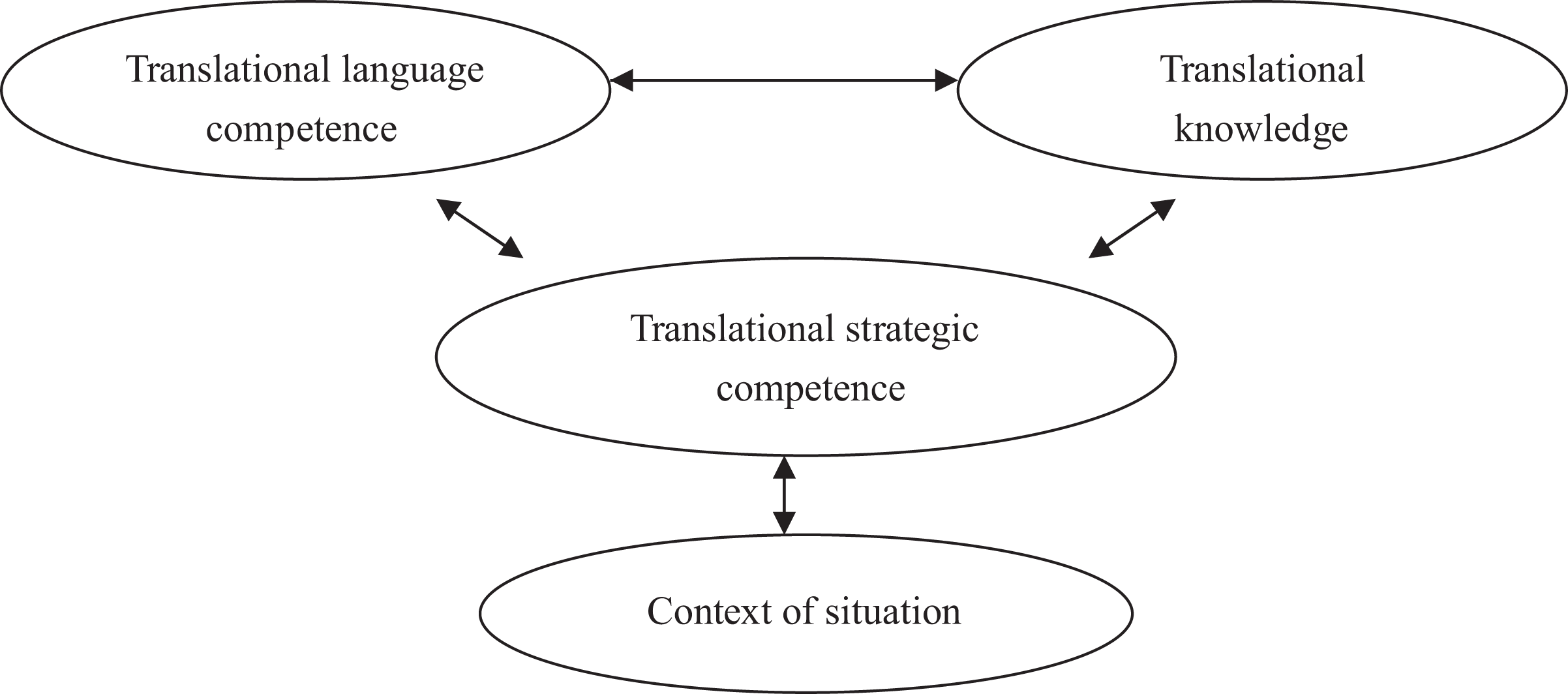
Translational strategic competence is used to describe the integrated mental ability inherent in the translation task when a translator carries out an operation on a text and employs language and knowledge competence for communicative purposes in translation (Cao, 1997).
Translational language competence is the ability to utilise, relate and mediate the SL and TL linguistic variables in the total communicative act of translating to achieve communicative goals (see Figure 2) (Cao, 1997).

Within the present model, translational knowledge structures are defined as the knowledge that is essential to achieve interlingual and intercultural communication in translation. Translational knowledge structures include general, specialist and literary knowledge (see Figure 3). General knowledge refers to knowledge about the world. It includes knowledge about ecology, material culture, social organisation and other areas of both the SL and TL communities. Specialist knowledge is the subject knowledge that includes technical knowledge in a specialist field such as medicine, law, economics and science and technology. In legal translation, legal knowledge is the knowledge of propositions of law in a narrow sense and the knowledge of legal culture in a broad sense, including legal systems, legal order, legal institutions, history and practices and practitioners. Literary knowledge includes knowledge in such areas as the Bible, stage, film, lyric, poetic and literary works, cultural history and literary studies (Cao, 1997).

In short, legal translation work involves translational strategic competence, translational language competence and translational knowledge structures, and these three variables interact with one another in the course of translating legal documents. The model of translation proficiency is suitable not only for general translation work but also for the work of translating legal terminology.
According to Deborah Cao’s point of view, legal terminology translation not only involves different language systems but also the unique concepts found in different legal systems in different countries. Therefore, it is not reasonable to require the perfect legal terminology translation. In reality, legal concepts from different countries are seldom, if ever, identical. It is futile to search for absolute equivalence when translating them (Cao, 1997). However, in practice, translating legal terminology is a necessity. Thankfully, finding the appropriate terms and avoiding the wrong ones is achievable. The question that arises is: How to find the appropriate translation version?
Taking Deborah Cao’s idea, it can be predicted that the appropriate translation version should not be wrong, which is the first threshold of finding an appropriate translation version which can also satisfy the requirement of translational language competence.
Next, translation versions vary under different conditions. To be more specific, when translating legal terminology, different conditions will be encountered.
These conditions can be divided into two categories. The first condition is that there are no equivalent terms in the SL and TL, irrespective of the language dimension or the concept dimension. Under this condition, legal terminology translators are supposed to fully mobilise translational strategic competence. Translators can add new words, borrow, create or introduce new legal terms. Therefore, borrowing and neologism are the translational strategic competence in non-equivalence situations. For instance, in the late 19th century and early 20th century, China borrowed many new terms from Japan. These new terms actually did not originate in Japan and were borrowed from Europe much earlier. These legal terms are ‘human rights’, ‘sovereignty’, ‘civil law’, ‘criminal law’ and ‘constitution’. Even though these terms are borrowed, created and introduced from a totally different language system, the practical application will make these terms more exclusive and accurate. Therefore, these new words can be recognised as appropriate translation version.
The second condition is that similar words exist in the SL and TL, even though they are not completely identical. Nevertheless, they may be close equivalents or partial equivalents on the language or concept dimension. In other words, the concept and usage provided by the legal systems in one language is not exactly the same in another language. Usually, these terms still need to be used in practice. However, in this situation, it must be remembered that translators are supposed to use their translational strategic competence, translational language competence and translational knowledge structure abilities flexibly. At such times, two methods may be helpful: using the corresponding term on the condition of close equivalence and enlarging the meaning of the terms on the condition of partial equivalence (Tan and Xiang, 2012). Of course, even though these terms have some equivalence on the language and concept dimension, they can not be picked randomly. The selection progress is supposed to satisfy the necessary criterion of appropriate translation. In other words, these terms chosen cannot be wrong and must have some connections in the SL and TL. At the end of the process, native speakers of the TL should not find these terms strange when using them; they will not feel confused and misunderstand the terms and will accept the translated version.
Therefore, in order to translate the legal term ‘物证(Wu Zheng)’, translators need to satisfy one criterion and can apply three strategies. The translation criterion is that the translated version should not be wrong and not make misunderstandings. The translation strategies are using the corresponding terms on the condition of close equivalence, enlarging the meaning of the terms on the condition of partial equivalence and interpreting, borrowing and creating new words on the condition of non-equivalence. With the help of one translation criterion and three translation strategies, the mistake caused by empiricism can be successfully avoided.
Should the legal term ‘物证(Wu Zheng)’ be translated as ‘material evidence’?
In Chinese, ‘物证(Wu Zheng)’ consists of two parts. One part is ‘物’, which means the ‘object’ or ‘material’ in Chinese. The second part is ‘证’, which means ‘evidence’ in Chinese. ‘物证(Wu Zheng)’ combines two elements together and refers exclusively to one typical category of evidence.
When it comes to translating the legal term ‘物证(Wu Zheng)’, legal translators whose mother tongue is not English may easily be misdirected by its literal meaning and translate the legal term ‘物证(Wu Zheng)’ into ‘material evidence’. However, can legal term ‘物证(Wu Zheng)’ be translated as ‘material evidence’? Because the translation of ‘物证(Wu Zheng)’ involves different languages and the concepts are offered by different legal systems, the process of translating ‘物证(Wu Zheng)’ is not an easy task. This translation version needs further investigation.
Take the following example from Chapter V (evidence) of the criminal procedure law of the People’s Republic of China: Article 42 All facts that prove the true circumstances of a case shall be evidence. There shall be the following seven categories of evidence:
material evidence and documentary evidence; testimony of witnesses; statements of victims; statements and exculpations of criminal suspects or defendants; expert conclusions; records of inquests and examination; and audio-visual materials. Any of the above evidence must be verified before it can be used as the basis for deciding cases.
Then compare this example, from the English version of a report (The case of Chinedu Ogbanna’s drug smuggling): Public prosecutor The Prosecutor has the following evidences to present to the court: Documentary evidence and material evidence.
In this material, the legal term ‘物证(Wu Zheng)’ is also translated into ‘material evidence’.
What is ‘物证(Wu Zheng)’? Analysis from the perspective of translational knowledge structure
Article 48 of the criminal procedure law of the People’s Republic of China and article 36 of the civil procedure law of People’s Republic of China are clear regulations. In the case of the criminal procedure law of the People’s Republic of China, evidence is those materials which can be used to prove the truth of the case, and the evidence is divided into eight categories. ‘物证(Wu Zheng)’ is one of the categories.
From the perspective of academic studies, ‘物证(Wu Zheng)’ refers to those tangible objects and traces that can be used to prove the truth of the case with its external characteristics, existing forms and physical properties. ‘物证(Wu Zheng)’ is a very big concept, including criminal tools, objects affected by the criminal acts, the tangible subjects and traces left during the criminal acts, and other objects or traces which can be used to prove and uncover the truth of the case.
In summary, the legal term ‘物证(Wu Zheng)’ has the following features: ‘物证(Wu Zheng)’ uses its external characteristics, existing forms and physical properties to help prove and confirm the truth of the case. It is much easier to have access to ‘物证(Wu Zheng)’ because it is more visual. ‘物证(Wu Zheng)’ is more objective and authentic. ‘物证(Wu Zheng)’ is usually used as indirect evidence.
Obviously, academic studies have already given a clear definition to ‘物证(Wu Zheng)’.
What is ‘material evidence’?
According to Black’s Law Dictionary (Garner, 2004), ‘material evidence’ refers to ‘evidence having logical connection with the consequential facts or the issues’. Merriam-Webster’s Dictionary of Law (Merriam-Webster, 2011) also gives ‘material evidence’ a clear definition, pointing out that ‘evidence that is likely to affect the determination of a matter or issue; specif: evidence that warrants reopening of a claim or a reversal of a conviction because but for the circumstances that the evidence was unavailable the outcome of the first proceeding would have been different’. The English–Chinese Dictionary of Anglo-American Law (Xue, 2003) also gives a similar definition of ‘material evidence’. The definition is written in Chinese and the meaning is almost same as in Merriam-Webster’s Dictionary of Law. In addition, there is no definition about ‘material evidence’ in the Dictionary of Law (Curzon, 2002). Apparently, three dictionaries all give a thorough definition to ‘material evidence’ and these definitions can be resolved into ‘important evidence’, which is different with the concept of ‘物证(Wu Zheng)’.
Nevertheless, a dictionary from Taiwan, English–Chinese Dictionary of Law (Jin, 1988), introduces a different definition. In this dictionary, ‘material evidence’ means essential evidence or ‘物证(Wu Zheng)’ which plays an important role in trying a case. This interpretation differs from the interpretations in the other three dictionaries, specifically indicating that ‘material evidence’ contains the meaning of ‘物证(Wu Zheng)’. However, this interpretation also adds a limitation. The evidence still needs to play an important role in trying a case for it to be called ‘material evidence’. The meaning of ‘material evidence’ here is wider than the meaning provided by the criminal procedure law and civil procedure law of People’s Republic Congress.
Is it appropriate to translate ‘物证(Wu Zheng)’ into ‘material evidence’?
The foreignisation principle gives the guidelines for appropriate translation version (Zhao and Qu, 2008). (Wikipedia gives a specific definition of foreignisation: foreignisation is the strategy of retaining information from the source text, and involves deliberately breaking the conventions of the target language to preserve its meaning.) According to the above four dictionaries, ‘material evidence’ can be understood as ‘important evidence’ or ‘essential evidence’ rather than ‘物证(Wu Zheng)’. This translation version is absolutely wrong and cannot satisfy even the lowest translation criterion. The exclusive meaning of ‘物证(Wu Zheng)’ provided by the criminal procedure law and civil procedure law of the People’s Republic Congress cannot be demonstrated accurately in this translation version. Readers may easily misunderstand the meaning, which may lead to unforeseen legal effects, especially to those whose mother tongue is English. Therefore, it is inappropriate to translate ‘物证(Wu Zheng)’ as ‘material evidence’. This translation version should be avoided.
The other five common translation versions of ‘物证(Wu Zheng)’ – analysed from the perspective of translational language competence and translational strategic competence
What, then, is the appropriate translation version of ‘物证(Wu Zheng)’? According to Black’s Law Dictionary, English–Chinese Dictionary of Anglo-American Law, Merriam-Webster’s Dictionary of Law, English–Chinese Dictionary of Law, and The English–Chinese Glossary of Legal Terms (Department of Justice, 2004), there are five other common translation versions of ‘物证(Wu Zheng)’. They are: ‘physical evidence’, ‘real evidence’, ‘exhibit’, ‘demonstrative evidence’ and ‘tangible evidence’. In order to find the most suitable and appropriate translation version, translators of legal terms could stand on the shoulder of giants, flexibly apply the translation strategies and borrow the translation versions of other regions to reduce the difficulties. For instance, people in Hong Kong and Taiwan all use Chinese as their official languages. Borrowing translation versions from Hong Kong and Taiwan will efficiently reduce the translation difficulties caused by translational language structure and translational language difference in translating legal documents. However, the legal system in Hong Kong is totally different from the legal system in mainland China, because the legal system in Hong Kong is a common law system. From this perspective, Taiwan is a better choice due to its civil law system. Moreover, Taiwan not only has the classification of criminal procedure law and civil procedure system, but also has a definition for ‘物证(Wu Zheng)’. Hence the translation version of Taiwan will be more suitable and useful.
In the English–Chinese Dictionary of Law from Taiwan, ‘物证(Wu Zheng)’ is translated as ‘physical evidence’. Apparently, people in Taiwan tend to translate ‘物证(Wu Zheng)’ into ‘physical evidence’. The following example (taken from an introduction for a course at Taiwan’s Soochow University) further proves that the common translation version of ‘物证(Wu Zheng)’ in Taiwan is ‘physical evidence’: Forensic science has emerged as a significant element in efforts to control crime while maintaining a high quality of justice. The value of physical evidence and its analysis has been demonstrated in many ways on many occasions, and law enforcement officials have become increasingly dependent on results derived from scene search and laboratory analysis for evidence not obtainable by other avenues of investigation.
However, is ‘physical evidence’ a good translation version? First of all, Black’s Law Dictionary and Merriam-Webster’s Dictionary of Law clearly point out that ‘physical evidence’ has a synonym: ‘real evidence’. Hence, in order to analyse ‘physical evidence’, ‘real evidence’ should be taken into consideration. In Black’s Law Dictionary, ‘physical evidence’ is explained as ‘physical evidence (such as clothing or a knife wound) that itself plays a direct part in the incident in question’. In Merriam-Webster’s Dictionary of Law, ‘physical evidence’ is explained as ‘tangible evidence (as a weapon, document, or visible injury) that is in some way related to the incident that give rise to the case’. In English–Chinese Dictionary of Anglo-American Law, ‘physical evidence’ is ‘物证(Wu Zheng)’. The object itself can be used as evidence. The trial jury can directly observe what happened without an oral confession. For instance, someone’s appearance, wound, fingerprints, weapons, tools and other related staff are all ‘physical evidence’. The foreignisation principle and the comparison with ‘real evidence’ demonstrate that ‘physical evidence’ has the meaning of ‘物证(Wu Zheng)’ and can express the meaning of ‘物证(Wu Zheng)’ offered by the civil procedure law in Taiwan.
It is appropriate to translate ‘物证(Wu Zheng)’ into ‘physical evidence’ in Taiwan. Two reasons support this conclusion. The ‘physical evidence’ in a common law system includes the meaning of ‘物证(Wu Zheng)’, which can avoid the mistake like ‘material evidence’ and satisfy the lowest translation criterion. During the translation process, the translator cleverly used the strategies to help the translation, which is enlarging the meaning of the vocabulary on the condition of partial equivalence. Compared with the translation version in Taiwan, it would be appropriate to translate ‘物证(Wu Zheng)’ into ‘physical evidence’.
Besides ‘physical evidence’ and ‘real evidence’, ‘物证(Wu Zheng)’ has also other three common translation versions. These are: ‘exhibit’, ‘demonstrative evidence’ and ‘tangible evidence’.
Inheriting the UK’s tradition, Hong Kong are accustomed to translating ‘物证(Wu Zheng)’ into ‘exhibit’. In the English–Chinese Glossary of Legal Terms, ‘exhibits’ is explained as ‘证物’. Besides, the Dictionary of Law, as a dictionary published in the UK, explains ‘exhibit’ as ‘something produced to be viewed by the judge or jury, or shown to a witness who is giving evidence, or an object referred to in an affidavit (q.v.)’ and also points out that the meaning of ‘exhibit’ to some extent is same as ‘real evidence’. However, with the reference to Black’s Law Dictionary, English–Chinese Dictionary of Anglo-American Law, Dictionary of Law and The English–Chinese Glossary of Legal Terms, ‘exhibit’ refers more to the meaning of displayed product or displayed evidence. If the target readers are native English speakers, it is fine to translate ‘物证(Wu Zheng)’ into ‘exhibit’ in translating legal documents. However, if the target readers are not English, translating ‘物证(Wu Zheng)’ into ‘real evidence’ would be a better choice.
Compared with the other four translation versions, ‘demonstrative evidence’ is not as popular as the other translation versions. When readers try to seek help from dictionaries, they find no help from Dictionary of Law and The English–Chinese Glossary of Legal Terms. Fortunately, the Black Law Dictionary has an explanation: ‘physical evidence that one can see and inspect (i.e., an explanatory aid, such as a chart, map, and some computer simulations) and that, while of probative value and usu. Offered to clarify testimony, does not play a direct part in the incident in question.’ However, Black’s Law Dictionary has also demonstrated clearly that translating ‘物证(Wu Zheng)’ into ‘demonstrative evidence’ is a little bit ambiguous and requires further consideration. In Merriam-Webster’s Dictionary of Law, ‘demonstrative evidence’ is explained as ‘evidence in the form of objects (as maps, diagrams, or models) that has itself no probative value but is used to illustrate and clarify the factual matter at issue’. In English–Chinese Dictionary of Anglo-American Law, ‘demonstrative evidence’ is equated to ‘real evidence’ in a broad sense. In a narrow sense, ‘demonstrative evidence’ itself does not have probative value but can be used to clarify and illustrate controversial facts, such as maps, charts, models, photos etc. Hence, it is appropriate to translate ‘物证(Wu Zheng)’ as ‘demonstrative evidence’. Nevertheless, it is still too wide to translate in this way.
‘Tangible evidence’ cannot be found in Merriam-Webster’s Dictionary of Law and Dictionary of Law. It is be explained as ‘physical evidence that is either real or demonstrative’ in Black’s Law Dictionary. It is clearly demonstrated in English–Chinese Dictionary of Anglo-American Law that ‘tangible evidence’ is ‘物证(Wu Zheng)’. There is no specific explanation of ‘tangible evidence’ in the English–Chinese Glossary of Legal Terms, but there did exist explanations about ‘tangible’. ‘Tangible’ means ‘hypostatic’. Considering all the above dictionaries, it is feasible to translate ‘物证(Wu Zheng)’ into ‘tangible evidence’ but it is still in the minority.
To conclude, all the five common translation of ‘物证(Wu Zheng)’—’physical evidence’, ‘real evidence’, ‘exhibit’, ‘demonstrative evidence’ and ‘tangible evidence’—satisfy the lowest translation criterion. Nonetheless, taking general relevance and accuracy into consideration, ‘physical evidence’ and ‘real evidence’ are preferable. ‘Exhibit’ is extremely suitable to English readers. When it comes to the readers from other countries, the applicability of ‘physical evidence’ and ‘real evidence’ is wider than ‘exhibit’. ‘Demonstrative evidence’ and ‘tangible evidence’ lack of general applicability and ‘demonstrative evidence’ is ambiguous.
Conclusion
To sum up, even though it is difficult to find the most suitable translation for legal terms, it is feasible to find an appropriate translation version. In order to find this, legal translators need not only to fully mobilise translational language competence and translational strategic competence but also to have a thorough understanding of different legal systems. Having looked up enough dictionaries, the translators of a legal term are supposed to obey one lowest criterion: that the translation will not lead to misunderstandings, confusion and inaccuracy. In real life, translators of legal terms ought to pick their translation strategies in such a way as to find the most appropriate translation version. These strategies are: using the corresponding term on the condition of close equivalence, enlarging the meaning of the terms on the condition of partial equivalence and interpreting, borrowing and creating new words on the condition of non-equivalence.
Footnotes
Declaration of Conflicting Interests
The author(s) declared no potential conflicts of interest with respect to the research, authorship, and/or publication of this article.
Funding
The author(s) disclosed receipt of the following financial support for the research, authorship, and/or publication of this article: This paper is supported by the Opening Project of Key Laboratory of Evidence Science (China University of Political Science and Law), Ministry of Education, Grant Number: 2016KFKT09.