







Abstract
Based on the tenets of ethnolinguistic identity theory, this paper provides an insight into the complexity of ethnolinguistic identity and its relationship to ethnolinguistic vitality among young Finns with a Swedish-Finnish, mixed language family background. Questionnaire data was collected in Swedish language secondary schools in 2014 (N = 115). The data was analyzed with structural equation modelling. The results showed that ethnolinguistic identity may comprise affiliation with both Swedish and Finnish speakers as well as bilinguals. Further, higher subjective vitality of Finnish was significantly related to higher identification with Swedish speakers but it was not significantly connected to Finnish-speaking and bilingual identities. In parallel, higher subjective vitality of Swedish was significantly related to higher identification with Finnish speakers but it was not significantly related to Swedish-speaking and bilingual identities. Findings and their implications are discussed.
Based on the tenets of ethnolinguistic identity theory (Giles & Johnson, 1981, 1987; for a review, see Burns, 2010), the present paper addresses the relevance of multiple ethnolinguistic identities among young Finns with a Swedish–Finnish, mixed language family background. More specifically, we explore the possibility of simultaneous identification with Swedish speakers, Finnish speakers and bilinguals, and also how these identities are linked to ethnolinguistic vitality (Giles, Bourhis, & Taylor, 1977; for recent reviews, see Bourhis & Barrette, 2006; Bourhis, Sioufi, & Sachdev, 2012).
Identity is today a very popular concept in social research and used in many different ways to shed some light on how people conceive of themselves and are characterized by others (e.g. Joseph, 2004; Verkuyten, 2005). At the same time, while the notion of identity is widely studied, the different disciplines (such as linguistics, sociology, philosophy, psychology and others) have developed their own theoretical and methodological approaches, which led to markedly different, and at times even contradictory, conceptions of identity (e.g. Elliott, 2011; Schwartz, Luyckx, & Vignoles, 2011).
The present study is grounded in the social identity framework (Tajfel & Turner, 1979), which is one of the most influential approaches to study the concept of identity with particular focus on intergroup contexts. According to Tajfel (1981), the social part of an individual’s identity is that part of the self-concept which derives from the recognition of and value attached to a membership in a social group (or memberships in various social groups). Every individual simultaneously belongs to a great number of social categories/social groups, but as social identity is socially constructed and negotiated, the memberships may change and the meaning and salience of the memberships may vary in different contexts and over time (e.g. Joseph, 2004, pp. 76–77; Pietikäinen & Dufva, 2006). Identities related to ethnicity, nationality, race and religion, however, often involve more enduring collective definitions (Verkuyten, 2005). Much research on multiple identifications has been concentrating on simultaneous identification in different identity domains, e.g. ethnicity and gender (see Crisp & Hewstone, 2007). However, in this study we focus on simultaneous multiple identification within the same identity domain, i.e. language.
Being an offspring of social identity theory, ethnolinguistic identity theory posits that in cases where language is a salient component of identification, individuals may strive for a positive psychological distinctiveness along ethnolinguistic dimensions, and adopt strategies to promote linguistic differentiation (Reid, Giles, & Abrams, 2004). Ethnolinguistic identification depends on factors like the permeability of ethnolinguistic boundaries; that is, how easy it is to cross from one language group to the other, and also the relative importance of ethnolinguistic identity in the totality of social identities an individual has (for more, see Giles & Johnson, 1981).
Additionally and importantly, the formation and maintenance of ethnolinguistic identity may depend on the ethnolinguistic vitality of the language groups (Giles et al., 1977). Vitality stands for the overall strength of a language compared to that of its rival language based on factors such as demography, status and institutional support. Vitality has both objective and subjective aspects. Objective vitality implies measuring the strength of the language groups objectively and factually based on the available information (e.g. official statistics) to provide an overall assessment, while subjective vitality focuses on individuals’ assessment; that is, how they perceive the vitality of their ethnolinguistic ingroup and outgroup (Bourhis, Giles, & Rosenthal, 1981). Ethnolinguistic identity theory postulates that people are likely to maintain a strong ethnolinguistic identity when they perceive the relative vitality of their own language to be high. However, the theory also asserts that ethnolinguistic identity may be strong even when the relative vitality is perceived to be low. This may be the case when the ethnolinguistic boundaries are not permeable and individuals cannot change their ethnolinguistic group memberships (Giles & Johnson, 1987) or when the objective vitality is low and ‘high identifiers tend to feel a large discrepancy between objective vitality and ideal vitality’ (Ytsma, Viladot, & Giles, 1994, p. 76); that is, the vitality their ethnolinguistic group should ideally possess.
Ethnolinguistic identity theory has stimulated not only an appreciable body of empirical research (e.g. Giles & Johnson, 1987; Giles & Viladot, 1994; Harwood & Vincze, 2012; Hildebrandt & Giles, 1983; Hogg & Rigoli, 1996), but its propositions have also been incorporated in large theoretical models (Abrams, Eveland, & Giles, 2003; Landry, Allard, & Deveau, 2007; Reid et al., 2004; Sachdev, Giles, & Pauwels, 2013).
One of the major criticisms against the theory has been concerned with the ‘dichotomized view’; that is, the so-called monolingual-assimilationist bias (Husband & Khan, 1982; see also Liebkind, 1999; Oakes, 2001). The monolingual bias refers to the concept that the theory is incapable of handling bilingual identity; that is, when two ethnolinguistic group memberships are integrated into a double ethnolinguistic identity encompassing both. Likewise, the assimilationist bias implies that the theory regards ethnolinguistic development to be an exclusive process ending in either separation or assimilation.
However, based on more recent theories on acculturation (e.g. Berry, Phinney, Sam, & Vedder, 2006; Liebkind, 2001) we argue that an individual in a multilingual society may very well retain a strong minority language identity, while also identifying with the majority language group, and thus have an integrated bilingual identity (Phinney & Alipuria, 2006; Phinney, Horenczyk, Liebkind, & Vedder, 2001). Bilingual identities can be developed in various ways. For one thing, immigrants, who often live in a diglossic situation, may develop bilingual identities if they retain their heritage language within the family but also develop a sense of affiliation with the language of their new home country (e.g. Fuller, 2012; Simmons, 2010). However, bilingual identities can also be developed in traditional bilingual settings, among long-established language groups.
For instance, numerous empirical studies addressed the question of bilingual identities in Canada (e.g. Dallaire, 2003; Dallaire & Claude, 2005; Dallaire & Denis, 2000; see also Clément, Shulman, & Rubenfeld, 2010). As Dallaire (2003) notes, bilingual identities are typical among minority francophone youth whose parents do not share the same ethnolinguistic origins. Likewise, mixed language families (e.g. Finnäs, 2000, 2002) and their related linguistic identities (Liebkind, 1995; Lojander-Visapää, 2008) have also been the subject of considerable scientific interest in Finland, where the number of individuals growing up in bilingual homes has noticeably increased (Saarela & Finnäs, 2014). In the Finnish context, research even suggests that individuals raised in bilingual homes constitute a distinct community in the country, which is connected to both Swedish speakers and Finnish speakers (Lojander-Visapää, 2001, 2008). As a consequence, individuals can develop multiple ethnolinguistic identities because identification not only with Swedish speakers and Finnish speakers but also with bilinguals is possible (Henning-Lindblom & Liebkind, 2007).
Against this background, the focus of the present study is on the complexity of ethnolinguistic identification and its relation to ethnolinguistic vitality among a group of young Finns with a mixed language family background. Although the multiple ethnolinguistic identities of Swedish-speaking Finns have been studied before (Henning-Lindblom & Liebkind, 2007; Lojander-Visapää, 2001, 2008), no study has examined how these identities are developed in relation to the objective and subjective ethnolinguistic vitalities. Consequently, the present study poses two research questions: how are Swedish-speaking, Finnish-speaking and bilingual identities related to the overall ethnolinguistic identity of individuals with a mixed language family background, and how are these identities related to the perceptions of ethnolinguistic vitality?
Swedish in Finland
Finland is a bilingual country with two official languages, Finnish and Swedish. Although the Swedish language group is comprised of a mere 291,000 persons; that is, 5.4% of the population of the country (Finnäs, 2013); Swedish is supported by a broad institutional network, which provides extensive cultural autonomy for the Swedish language group. Among Swedish-speaking Finns, the proportion of mixed marriages has been about 40% since the 1980s, and about 60% of new-born children in mixed language families are registered as Swedish speakers, while an even higher proportion of these children attend a Swedish school (Finnäs, 2013). Compared to several other minority–majority settings, the intergroup relations between Finnish speakers and Swedish speakers can overall be regarded as relatively harmonious and amicable.
Method
Respondents
Questionnaire data were collected in 2014 among students in Swedish language secondary schools in Esbo/Espoo and Raseborg/Raasepori. The two municipalities (for map, see Figure 1) were chosen because of the differences in their linguistic structure: while Esbo/Espoo represents a case where Swedish speakers make up a minority of the local population (9%), in Raseborg/Raasepori 1 they constitute a local majority (66%). The total sample included 267 participants; however, in the current analysis we included only those who came from Swedish–Finnish, mixed language families (N = 115). All participants were between 16 and 18; 49% were girls and 51% boys.
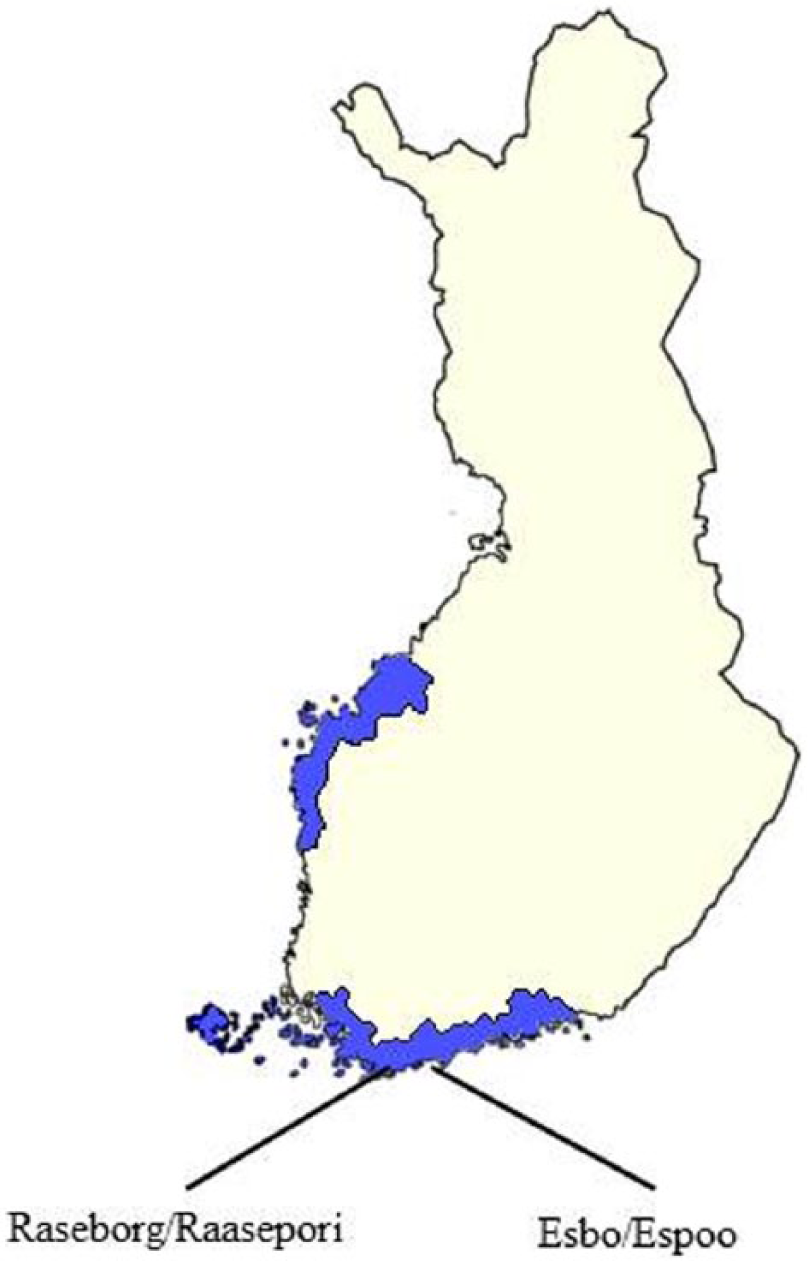
The figure shows the map of Finland. The highlighted areas represent the geographical areas where Swedish is spoken. The two municipalities where data was collected are located on the southern coast of the country, in the region Nyland/Uusimaa. 9% of the population of Esbo/Espoo and 66% of the population of Raseborg/Raasepori speak Swedish as mother tongue (see also Note 1).
Measures
Objective vitality
As the linguistic composition of the municipalities is also an important proxy for the status and institutional support of the languages (Henning-Lindblom & Liebkind, 2007; Landry & Allard, 1994), we considered municipalities as a basis for the variation of objective vitality 72% of the respondents were from Espoo/Esbo, where Swedish speakers make up 9% of the population (low Swedish/high Finnish vitality). 28% of the respondents were from Raasepori/Raseborg, where Swedish speakers make up 66% of the population (high Swedish/low Finnish vitality).
Identity
Identification with Swedish speakers, Finnish speakers and bilinguals was measured on three separate scales. All three scales included five 7-point items; that is, five statements about which participants were asked to express their opinion (1 = fully disagree, 7 = fully agree). The measure (based on Mlicki & Ellemers, 1996; Phinney, 1992; see also Landry et al., 2007) included both cognitive components (e.g. ‘I consider myself to be a Swedish-speaker/Finnish-speaker/bilingual’) and affective components (e.g. ‘I am proud to be a Swedish-speaker/Finnish-speaker/bilingual’), and also a reversed item (i.e. a statement, the meaning of which is the opposite of the other ones in that scale; e.g. ‘I am ashamed that I belong to the Swedish language group/Finnish language group/bilinguals in Finland’). All three scales had acceptable reliability (for Swedish-speaking identity α = .75, for Finnish-speaking identity α = .74, for bilingual identity α = .65). The participants reported the highest identification with bilinguals (M = 6.37, SD = .71), lower with Swedish speakers (M = 6.17, SD = .75), and even lower with Finnish speakers (M = 5.58, SD = 1.02).
Subjective vitality
Subjective vitality for Swedish and Finnish in Southern Finland was measured separately with 12 items from the subjective vitality questionnaire (Bourhis et al., 1981). Participants were asked to evaluate the vitality of Swedish and Finnish based on a set of questions (e.g. ‘How proud are Swedish/Finnish speakers in southern Finland of their cultural history and achievements?’); the participants indicated their answers on 5-point scales (e.g. 1 = not proud at all, 5 = very proud). Four items were used to assess each of the three dimensions of vitality: status, demography, and institutional support. The reliability of the scales was good both for Swedish (α = .81) and Finnish (α = .81). Respondents perceived the vitality of Finnish (M = 4.05, SD = .42) to be significantly higher than the vitality of Swedish (M = 2.99, SD = .49), and the size of the effect was huge, t(106) = −16.76, p < .001, η2 = .72.
Analysis
Structural equation modelling was employed with maximum likelihood estimator by the means of Mplus (Muthen & Muthen, 1998–2012). Objective vitality was defined as an exogenous variable impacting the subjective vitality of Swedish and Finnish, which, in turn, contributed to our three identity variables. Although our sample size did not allow a full latent variable analysis because of the requirement for a minimum case-to-parameter ratio for coefficient stability (see Kline, 2011, pp. 11–12), we included one latent variable relating to Swedish-speaking, Finnish-speaking and bilingual identities. This was intentional as we wanted to investigate whether the three examined identities may simultaneously be components of the overall ethnolinguistic identity of the participants. When evaluating the fit of our model, we report absolute fit index (standardized root-mean-square residual; SRMR), a parsimony adjusted index (root-mean square error of approximation; RMSEA) and an incremental fit index (comparative fit index; CFI) in addition to chi-square test.
Results
The results of the structural equation modelling are summarized in Figure 2. The model had a good fit, χ2 (4) = 5.11, p = .28, RMSEA = .05, CFI = .98, SRMR = .05. Objective vitality significantly predicted the subjective vitality of Finnish but not that of Swedish. In other words, participants who live in Esbo/Espoo perceived a higher vitality of Finnish than participants in Raseborg/Raasepori. The higher subjective vitality of Finnish was significantly related to a higher identification with Swedish speakers; that is, the more vital participants evaluated Finnish to be, the more they identified themselves with Swedish; yet the subjective vitality of Finnish was not significantly connected to Finnish-speaking and bilingual identities. In parallel, the higher subjective vitality of Swedish was significantly related to a higher identification with Finnish speakers; that is, the more vital participants evaluated Swedish to be, the more they identified themselves with Finnish; however, the subjective vitality of Swedish was not significantly connected to Swedish-speaking and bilingual identities. Finally, the latent variable of ethnolinguistic identity was significantly related to all three identity variables, most strongly to Finnish-speaking identity, then to bilingual identity and most weakly to Swedish-speaking identity. To put it differently, this set of results shows that all three identities may simultaneously be components of the ethnolinguistic identity of our participants.
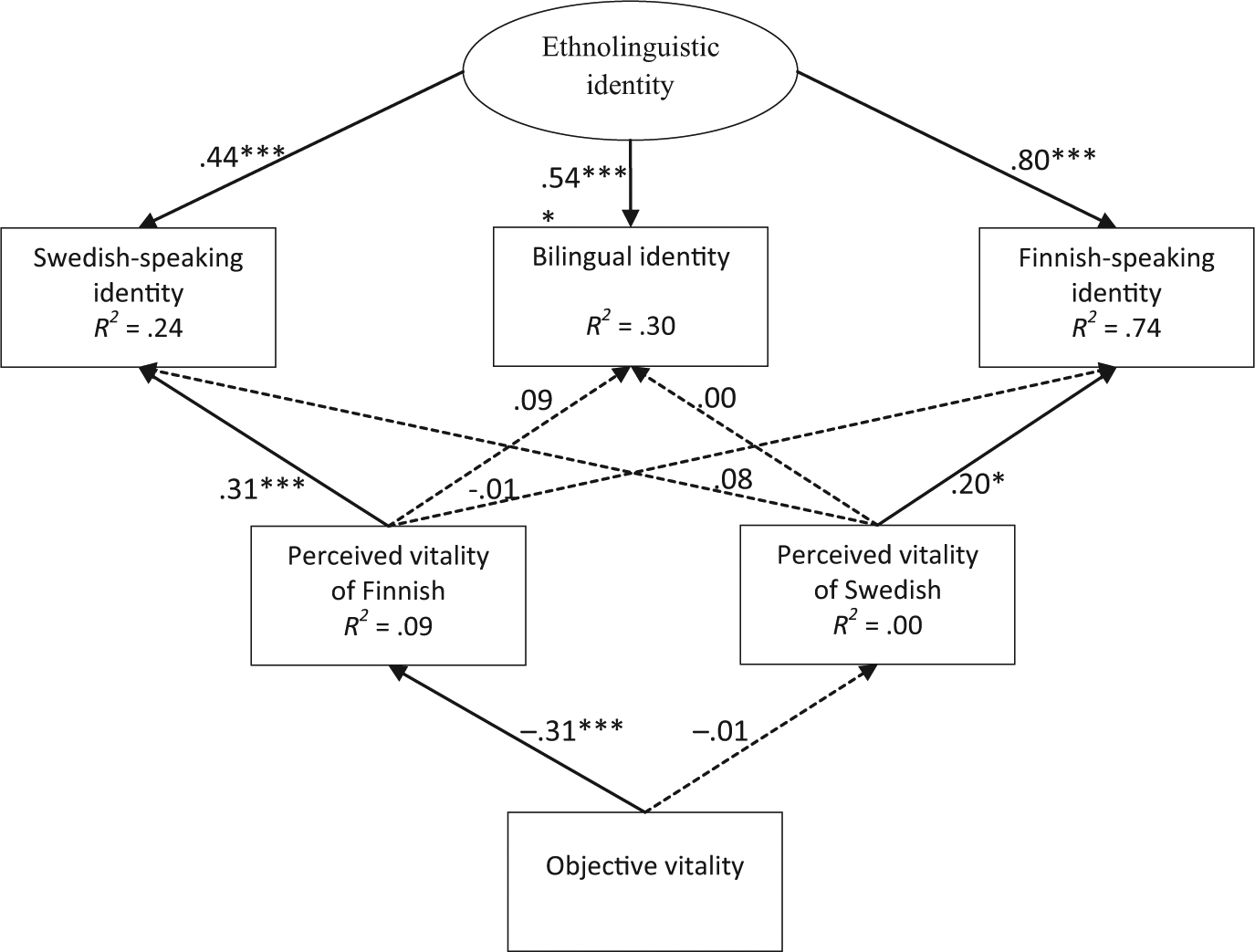
Results of structural equation modelling. The figure shows standardized coefficients. Non-significant paths are shown with dashed lines.
Discussion
The purpose of the present paper was to provide some insights into the complexity of ethnolinguistic identity and its relationship to ethnolinguistic vitality among young Finns with a mixed language family background.
The findings painted a rich portrait around their ethnolinguistic identification, pointing toward a complex ethnolinguistic identity, which may comprise affiliation with both Swedish and Finnish speakers as well as bilinguals (Henning-Lindblom & Liebkind, 2007; Lojander-Visapää, 2008). This finding supports earlier considerations (Lojander-Visapää, 2001, 2008) that individuals with a Swedish–Finnish mixed language family background constitute a distinct ethnolinguistic group, which exists ‘between and alongside’ Swedish speakers and Finnish speakers in contemporary Finnish society. As noted in the introduction, within the broader theoretical framework, the social identity paradigm, multiple identifications are often studied, but typically including different identity domains (e.g. gender and religion). Our results showed, however, that under certain conditions multiple identifications may be possible and meaningful within the same identity domain (i.e. language). This observation is of importance, and might serve to inform both theoretical development and future empirical research on multiple identifications.
Additionally, the results have shown that it is the identification with Finnish speakers which primarily defines the content of this compound ethnolinguistic identity; identification with bilinguals contributes less and identification with Swedish speakers least to it. This phenomenon can most probably be attributed to the fact that all our respondents have a Swedish language school background. In bilingual settings, the language of education is a key determinant of ethnolinguistic identity (e.g. Cummins, 2003; Landry & Allard, 1998). Since all our respondents went to Swedish schools they received the greatest ethnolinguistic input in Swedish, but this implies, correspondingly, that the variation is the smallest in their identification with Swedish speakers, whereas it is greater with bilinguals, and considerably greater with Finnish speakers.
Interestingly, we have found that Swedish-speaking identity was related only to the subjective vitality of Finnish, while Finnish-speaking identity was related only to the subjective vitality of Swedish. This may be explained within the framework of ethnolinguistic identity theory (Giles & Johnson, 1987). When individuals are members of several groups, and each is a part of their social identity, the different parts might not be equally salient at any one time. Just as language behaviour (such as code switching) has been shown to function as a strategy to manage psychological distinctiveness between the ethnolinguistic ingroup and outgroup (e.g. Auer, 2005; Cashman, 2005; Myers-Scotton, 2006; Sachdev, Giles, & Pauwels, 2013), our respondents may wish to emphasize that part of their identity that they feel is threatened. Hence, as the respondents identify themselves to some degree with both the Swedish and the Finnish language group (and as bilinguals) simultaneously, they may choose to emphasize that part of their ethnolinguistic identity, which receives less support in the particular ethnolinguistic environment. This finding is noteworthy as ethnolinguistic identity theorists traditionally examine the identification with a language in relation to the subjective vitality of the same language, whereas our results suggest that in certain situations the degree of identification with a language might be meaningfully related to the subjective vitality of the other language.
Lastly, there is no self-evident reason why objective vitality, unexpectedly, predicted only the subjective vitality of Finnish but not that of Swedish. However, it is important to note that we measured subjective vitality at a regional level asking for the vitality of the languages in the larger bilingual region, Southern Finland. At the same time, we measured objective vitality at a local level, as our variable included information about the local variation in objective vitality. In other words, our findings imply that local level differences in objective vitality had an effect on the perceptions of the regional vitality of Finnish but not on the regional vitality of Swedish. It is probable that measuring subjective vitality at a local level would yield different results mirroring more closely the differences at an objective level. Also, when contextualizing these results, it is necessary to keep in mind that almost three quarters of our respondents came from Esbo/Espoo, where Swedish speakers constitute only a small share of the local population, and subsequently have considerably more contact with Finnish than those living in Raseborg/Raasepori, which may have an impact on our results (see also Note 1).
In addition, it was shown that our respondents perceived the vitality of Finnish to be far higher than that of Swedish. In reality, Southern Finland has 1,500,000 inhabitants and Swedish speakers make up just 9% of the population. Accordingly, our respondents may indeed have a firm view about the low vitality of Swedish and the high vitality of Finnish in the region. However, as noted above, identification with Swedish speakers is the most stable part of their ethnolinguistic identity, and as they are members of a minority group it is possible that they are simply more aware and cognizant of the status of the minority group, independently of objective factors, than of the status of the majority group. This phenomenon is often present in minority–majority settings (Simon, Aufderheide, & Kempmeier, 2001).
In recent years, an important body of research addressed the relationship between bilingualism and identity in different linguistic contexts. However, whereas most current studies approach and conceptualize identities as constructed in and through discourse and narratives (e.g. Bamberg, Fina, & Schiffrin, 2011; Golden & Lanza, 2012, 2013; see also Joseph, 2004), the present study was able to deliver empirical evidence for and justify the formation of simultaneous multiple ethnolinguistic identities from a rather different theoretical and methodological perspective. Hopefully, our findings will contribute to the understanding of the relationship between language and identity, and also widen the discussion about multiple ethnolinguistic identities. Indeed, we are confident that our observations are pertinent and valuable not only to ethnolinguistic identity and social identity theories but also to constructionist and critical approaches to understanding multiple ethnolinguistic identities. On the one hand, it was shown that individuals may identify themselves not only with the Swedish and the Finnish language groups but also with the group of bilinguals. On the other hand, we could also see that the degree of identification with the Swedish language group may be an outcome of the perceived social strength (i.e. vitality) of Finnish, whereas the degree of identification with the Finnish language group may be an outcome of the perceived social strength of Swedish.
One caveat of this study is the difficulty of measuring identification with language groups, especially with the bilinguals, since we cannot know to what extent the respondents are referring to language skills and to what extent they refer to their identification with the given language group. As several scholars have emphasized (e.g. Auer, 2005; Liebkind, 1995), language use and language skills do not necessarily impact linguistic identity. Furthermore, the term bilingualism is known to be a challenging concept (e.g. Hamers & Blanc, 2000; Skutnabb-Kangas, 2007) which can be interpreted in many ways. We do, however, believe that using identity scales that include both cognitive and affective components (see above) might be a step in the right direction when one wishes to capture the notions of multiple ethnolinguistic identities.
Despite its limitations, we hope this study contributes to a discussion of the complexity of ethnolinguistic identity among people with a mixed language background in traditional bilingual settings. Indeed, querying the notion of monolingual-assimilationist bias (Husband & Khan, 1982), our results provided an initial support for successfully contextualizing multiple ethnolinguistic identities within the framework of ethnolinguistic identity theory. Clearly, future research should address this issue to provide more precise guidance for theory development and implications.
Footnotes
Funding
The author(s) disclosed receipt of the following financial support for the research, authorship, and/or publication of this article: The work of the first author was supported by a grant of the Ella and Georg Ehrnrooth Foundation, Helsinki, Finland.