






Abstract
Aims and objectives:
In the present study, we investigated whether Moroccan- and Turkish-heritage children living in Flanders, the Dutch-speaking part of Belgium, acquire new Dutch vocabulary to the same extent when they are provided with exactly the same type of language input. Turkish-heritage children seem to have significantly lower language proficiency in Dutch, compared to their Moroccan-heritage peers. Previous studies have shown that existing language skills in the second language can affect sequential bilingual children’s vocabulary acquisition in the second language considerably.
Design/methodology/approach:
The novel word learning of Moroccan- and Turkish-heritage six-year-olds (N = 52) was investigated by means of four dynamic storytelling sessions in which six new object labels and six new action words were incorporated.
Data and analysis:
The children’s conceptual and linguistic knowledge of the novel words was extensively tested. Six analyses of covariance were conducted, with origin as a between-subjects factor and proficiency in Dutch as a covariate.
Findings/conclusions:
Our findings indicate that Turkish- and Moroccan-heritage children acquired the novel words to almost the same extent when their prior language proficiency in Dutch was taken into account. However, Moroccan-heritage children still outperformed their Turkish-heritage peers, producing the novel object labels.
Originality:
For this study, we used a methodology specifically developed for this age group. In addition, we statistically controlled for the children’s initial proficiency in Dutch, in order to get a better insight in the actual learning processes of new Dutch vocabulary of Moroccan- and Turkish-heritage children.
Significance/implications:
Our outcome suggests that initial language proficiency in Dutch is an important predictor of novel vocabulary learning. Furthermore, we argue that linguistic properties of the children’s first language may play a role in second language acquisition, suggesting that a different approach to the stimulation of second language (vocabulary) acquisition in minority children of different ethnic origin may be necessary.
Keywords
Introduction
In many western countries, children with a foreign background appear to be less proficient in the language of instruction in school, their second language (L2), which complicates their educational attainment: they have to stay down a class more frequently than mainstream group children, they leave secondary school prematurely without a degree and only a few of them move on to higher education (Baysu & de Valk, 2012; Belfi et al., 2014; Heath & Birnbaum, 2007; Heath, Rothon, & Kilpi, 2008; OECD, 2010; Quiroz, Snow, & Zhao, 2010). In Flanders, the Dutch-speaking part of Belgium, especially Moroccan- and Turkish-heritage children enter primary school (i.e. age six) with a rather limited vocabulary in Dutch (Belfi et al., 2014; Duquet, Glorieux, Laurijssen, & Van Dorsselaer, 2006). Like many other western European countries, Belgium attracted migrants of rural areas of southern European and Mediterranean countries such as Morocco and Turkey in the years after the Second World War in order to perform semi- or unskilled labour. Even though the immigrants’ stay as ‘guest workers’ was initially only meant to be temporary, their families joined them in the years that followed as a result of family reunification and family formation, and most of them settled permanently (Baysu & de Valk, 2012). Nowadays, immigrants of Moroccan and Turkish origin are the largest non-European immigrant groups living in Belgium (Npdata, 2015; Phalet, Deboosere, & Bastiaenssen, 2007). In addition, migration from Morocco and Turkey continues even today, mostly because of endogamous marriages (Phalet et al., 2007).
Since academic skills are crucial in our modern information society, the language proficiency gap between Moroccan and Turkish ethnic minority children and their peers has been a major concern for policy makers and scholars of various disciplines (Baysu, 2011; Belfi et al., 2014; Duquet et al., 2006; Groenez, Nicaise, & De Rick, 2009; Verhaeghe & Van Damme, 2007). As Dixon, Zhao, Quiroz, and Shin (2012, p. 542) indicate, ‘vocabulary knowledge is clearly essential for understanding and using a language’. In this respect, the present study is aimed to shed more light on the vocabulary acquisition process of Moroccan- and Turkish-heritage pupils.
Most children of Moroccan and Turkish origin grow up as early sequential or successive bilinguals, like their minority peers with different ethnic backgrounds; they acquire the ethnic language of their parents, in this case Moroccan-Arabic and/or a Berber language, or Turkish, in the early stages of their lives and later on, usually by age three, they shift to Dutch, the dominant language of the host country (Domínguez, 2009; Unsworth & Hulk, 2009). Nevertheless, Moroccan- and Turkish-heritage children do not only seem to be less proficient in Dutch by contrast with their majority peers, but also when compared with their peers of different foreign origin (Clycq, Timmerman, Van Avermaet, Wets, & Hermans, 2014; Duquet et al., 2006; Verhaeghe & Van Damme, 2007). Two major reasons for Moroccan- and Turkish-heritage children’s lower language proficiency in Dutch have been proposed. First of all, compared with their majority peers and their minority peers of different ethnic origin, many Moroccan- and Turkish-heritage children lack or are less frequently exposed to Dutch language input in the home environment (Belfi et al., 2014; Duquet et al., 2006). Indeed, ‘frequency of exposure affects the amount of vocabulary bilingual children will know’ (Dixon, Wu, & Daraghmeh, 2012, p. 26). Furthermore, most of the Moroccan and Turkish immigrants have a low socioeconomic status (SES; Clycq et al., 2014; Duquet et al., 2006). According to Scheele, Leseman, and Mayo (2010, p. 118), ‘there is considerable evidence that SES-related qualitative and quantitative differences in language learning experiences, or “input”, explain variability in children’s language skills’. Research has shown that children growing up in low SES environments receive less language input that stimulates language development, for example, the language used in literacy activities (Dixon et al., 2012; Duquet et al., 2006; Prevoo et al., 2014; Quiroz et al., 2010; Scheele et al., 2010). Moroccan- and Turkish-heritage children are consequently believed to be put at a double disadvantage when it comes to majority language proficiency.
As Nap-Kolhoff and Van Steensel (2005) point out, it is possible that proficiency in the L2 is important to benefit from Dutch interactions in the school context, a hypothesis that also has been formulated by Jaspaert (2015). According to Hassall (2015), a low initial proficiency may well hamper learners’ informal L2 learning, because ‘their low lexico-grammatical knowledge base places a high cognitive burden on their working memory, which prevents them from processing or producing long strings of linguistic material […]’ (Hassall, 2015, p. 34). The study of Kan (2014), investigating the novel word learning in English (L2) and Hmong (first language; L1) in sequential English–Hmong bilingual children, seems to confirm this hypothesis. The outcome indicated that children with stronger existing language skills in the L2 were able to retain more novel words in the L2 than their peers with less extensive existing L2 skills. Furthermore, Messer, Leseman, Boom, and Mayo (2010) found that Turkish-Dutch early sequential bilingual four-year-olds’ lower phonotactic knowledge affected their ability to acquire novel Dutch words compared with native Dutch children. These findings seem to confirm the hypothesis that existing L2 skills affect a learner’s novel vocabulary learning in the L2, as formulated in the studies reviewed above.
Children with a Moroccan or Turkish background have been considered as one homogeneous group in most of the reports examining educational inequalities and language proficiency in ethnic minority children (see, e.g., Groenez et al., 2009; Laevers et al., 2004; Opdenakker & Hermans, 2006). However, over the years, considerable differences between children of both groups have been noted as well. For example, a comparison of the results on the TAL-K, a pretest for language proficiency in Dutch, already in 1996 showed differences in language proficiency between Turkish and Moroccan minority children living in Flanders, with the first scoring 15.5 on average and the latter 17.9 on a maximum score of 30 (Cucchiarini & Jaspaert, 1996). A study conducted with elementary school pupils in the Netherlands found similar results, with Moroccan-heritage children being more proficient in Dutch than Turkish-heritage children (Droop & Verhoeven, 2003). Furthermore, the first results of the longitudinal study of primary school careers of the Steunpunt studie- en schoolloopbanen (SSL), the research institute that investigates school careers in Flanders, indicate that the Turkish-heritage pupils perform lower on reading ability than both Flemish and Moroccan-heritage pupils in the first years of primary school (Verhaeghe & Van Damme, 2007). In addition, Belfi et al. (2014) indicated that the initial lower performances of Turkish pupils in spelling and reading comprehension remain the same throughout primary school. According to Droop and Verhoeven (2003), the difference in Dutch language proficiency between minority children of Moroccan and Turkish origin should be attributed to a different amount of usage of Dutch outside of the school context. Whereas Moroccan-heritage children often use Dutch to interact with their siblings and friends, Turkish-heritage children tend to use Turkish for such interactions. In fact, because of their migration history, immigrants of Turkish origin are more likely to live in a neighbourhood with high ethnic Turkish concentration (Van Craen, Vancluysen, & Ackaert, 2009; Vancluysen, Van Craen, & Ackaert, 2007), which is, according to Vervoort, Dagevos, and Flap (2012), indirectly related to weaker majority language proficiency and less majority language use through social contact with natives and co-ethnics. We expect the different initial proficiency in Dutch to affect the children’s L2 (vocabulary) acquisition process, resulting in an unequal L2 proficiency between Moroccan- and Turkish-heritage children.
On the other hand, Messer et al. (2010) argued that ‘because phonotactic knowledge starts to develop during infancy and is language specific (Jusczyk et al., 1994), it could be that the specialized knowledge of the native language impedes short-term memory in the second language’ (Messer et al., 2010, p. 318). More specifically, this could indicate that the acquisition of novel L2 words in which occur phonotactic structures that are ‘illegal’ in the L1 may be hampered. Another hypothesis is therefore that intrinsic linguistic characteristics of Moroccan-Arabic and/or Berber languages or of Turkish may have an impact on the novel word learning in Dutch of minority children of Moroccan and Turkish origin as well. The study of Cornips, van der Hoek, and Verwer (2006) indicated, for example, that Moroccan-heritage children showed more correct use of the determiner het (the) and the relative pronoun dat (that/which) with respect to neuter nouns than Turkish-heritage pupils. The authors argued that cross-linguistic effects seemed to play a role in the children’s acquisition of grammatical gender in Dutch, since Moroccan-Arabic and/or Berber has a gender feature showing an overlap with Dutch, in contrast with Turkish (Cornips et al., 2006, pp. 47–48).
In the present study, the aim was to investigate whether there are significant differences in the extent to which Moroccan- and Turkish-heritage children learn new Dutch vocabulary when being exposed to the same type of language input. Or, in other words, when being provided with exactly the same type of language input, do children of Turkish origin learn fewer words compared with children of Moroccan origin? In particular, we wanted to find out whether the children’s ethnic origin still has an impact on their novel vocabulary acquisition when their proficiency in Dutch is taken into account. Like some previous studies suggest, existing language skills affect ethnic minority children’s novel vocabulary acquisition in the L2, resulting in this case in a disadvantage for Turkish-heritage children. In particular, we believe that an examination and a comparison of Moroccan- and Turkish-heritage children’s vocabulary acquisition can give us more insight into the functioning of the L2 vocabulary acquisition process of ethnic minority children in general, indicating whether potential differences in vocabulary acquisition have to be attributed to differences in L2 proficiency or whether other factors, such as L1 characteristics, play a role as well.
In order to investigate the novel vocabulary acquisition process of Moroccan and Turkish minority children, we used a quasi-experimental design, investigating the children’s Dutch vocabulary acquisition in a type of classroom setting. In this way we were able to examine the children’s vocabulary acquisition in a setting that is familiar to them. We used a specific methodology developed by Boderé and Jaspaert (2015). For their study on language learning through addressed speech and overhearing, Boderé and Jaspaert (2015; in review) developed a fantasy story in which 12 novel Dutch-like words were incorporated. The words referred to six novel objects and six novel actions. The participants in the current study were 52 ethnic Moroccan and Turkish kindergarten pupils at the age of six. In order to expose the children frequently to the novel words, four storytelling sessions of 20 minutes each were spread over two days. The day after the treatment, children’s knowledge of the novel words was extensively tested.
Method
Data collection and participants
The data of the children with a Moroccan background were collected from September 2013 until January 2014, as part of a larger research project investigating the effect of social and cultural aspects on language acquisition. The data of the Turkish children were collected from February 2014 until March 2014.
Since the children had to be present during three different days (the two days of the treatment, and the day of the post-treatment tests), we had some data loss. Five Turkish-heritage children were absent on the second day of the treatment and had to be excluded from the analysis. In the final sample, the participants were 52 children in the final year of kindergarten (28 girls, 24 boys, M age = 5.6 years, SD = 0.43), and were recruited in six schools in Antwerp, Genk and Beringen (regions in Flanders with a high number of Turkish and Moroccan immigrant workers). Twenty-three children had a Moroccan background (14 girls, M age = 5.5 years, SD = 0.54) and 29 had a Turkish background (14 girls, M age = 5.6 years, SD = 0.32). We considered a child to have an ethnic background when at least one grandparent or parent was born in Morocco or Turkey. In addition, all children selected had a low socioeconomic background. Their mothers have at the most a degree of higher secondary education (i.e. age 18).
Materials
In order to conduct this study we used the same materials as used by Boderé & Jaspaert (2015). The materials consisted of a fantasy story in which 12 Dutch-like nonwords were incorporated and of several tests to assess the children’s knowledge of the novel words.
The story was about a princess who discovered a kameut, a little man with a tomato head. Six nonwords referred to novel objects, while the other six nonwords were used to indicate actions. All novel object labels had two syllables and consisted of five sounds (kameut, kikoon, piefan, tassat, viddon, baloep), whereas the novel action labels had four sounds in the stem each time (stak, timb, bast, kuimp, spoek, must) and ended on -elen or -eren, two nonfrequent verb endings in Dutch, in order to avoid guessing. All target words occurred with a natural frequency in the story, ranging from 20 (the action words) to 120 (kameut, which was the main character in the story).
To make sure the children understood the story, the storyteller used several stage-props and performed the actions. Consequently, the storytelling was very active and dynamic and held middle ground between storytelling and story performance.
Test battery
The test battery consisted of a story line test in order to measure the children’s proficiency in Dutch, two subtests with respect to content (conceptual knowledge test for both novel objects and actions) and four subtests with respect to language (production and comprehension test for both novel object and action labels).
Because our study design deviates from typical experimental design conducted in a laboratory room, we used an appropriate test for measuring the children’s proficiency in Dutch. By means of a test that examined the children’s comprehension of the story line, we were able to control for the children’s proficiency in Dutch within this particular context. The Story Line test examined whether the children could answer questions about the plot. The test consisted of nine questions, for example, ‘How did the naughty doll turn into a nice one?’ or ‘Who lived in the castle?’
The Conceptual Knowledge test was aimed to draw attention to the target objects and actions specifically, and examined whether the children had some basic information about them. The emphasis was put on their content and purpose, and not on the words themselves. The children were shown the target object or the researcher performed the target action and asked why it was used or performed during the story. In addition, the children were asked which characters used the objects and performed the actions. There were 9 questions about the objects and 11 questions about the actions.
The Production tests examined whether the children could produce the novel object and action labels. The target objects were shown and the children were asked to label them. Similarly, the children had to label the target actions as demonstrated by the researcher.
The Comprehension tests examined whether the children understood the meaning of the novel labels. For the novel object labels, the child was asked to point to the target object from 10 objects (six target objects and four distractors). To test their comprehension of the novel action labels, the children were asked to perform the six target actions successively.
Procedure
The experimenter introduced herself as a new teacher who was going to perform several activities with the children. She accompanied the children selected for the experiment to the classroom in which the experiment was going to take place. The children were seated in a semicircle around the storyteller. When everybody was seated, the experimenter addressed the children directly by inviting them to listen to a story. The treatment consisted of four storytelling sessions of 20 minutes each. The sessions took place on two consecutive days, before and after the children’s morning break, in a separate classroom. In this way the children could be addressed directly. During the storytelling, the children were allowed to interrupt the experimenter when they wanted to ask questions about the story, in order to approach realistic classroom interactions.
Importantly, the experimenter never alluded to the fact that novel words were going to be used during the storytelling and neither did she indicate that the children were going to take a test on the story line and the novel words afterwards. In that way, it was assured that the language experiment could also trigger implicit learning mechanisms. The experimenter used a script to make sure the story was told in the same way each time.
Testing procedure
The day after the two experimental days, the post-treatment tests were administered, in which the children participated individually in a single half-hour visit. All sessions were conducted by the same female experimenter. The subtests were always administered in the same order, in that the production test always preceded the tests aimed at measuring comprehension. Indeed, as Boderé and Jaspaert (2015, in review) point out in the description of their methodology, during the comprehension tests, it was necessary for the experimenter to use the target words herself. Starting with the comprehension tests would possibly stimulate and influence children’s productive knowledge of the words.
The children first took the story line test, in which they had to answer nine questions regarding the events of the story. The experimenter followed a script that prescribed her reactions depending on the answer of the child, in order to prevent her giving away the correct answer for a following question. Throughout the task, the experimenter also made sure she did not use the target words herself, because producing the target words during the story line task would affect the children’s performances on the other tests. The stage-props were used to point at so that the children would be able to understand what the experimenter was talking about. Each correct answer was rewarded with a score of 1.
Next, the conceptual knowledge tests were administered. At one side of the room, there was a table with the target objects. The children were asked what the object was used for and who used it in the story, without producing the novel label. For the test of the action labels, the actions were performed by the experimenter. Again the children were asked why the action was performed and who performed it in the story. For each correct answer given, the children were rewarded with a score of 1 (maximum score = 9 for the object labels, 11 for the action labels).
For the production tests, the children were shown the target object or the experimenter performed the action. The experimenter asked them what the object or action was called if the child itself did not produce the novel label spontaneously. In case the child did not respond, or indicated that he or she did not know it, two sound segments were given, inviting the child to complement the word. A score of 1 was rewarded when the child was able to give at least two correct sound segments.
Finally, the comprehension task was held, in which the children had to point to the correct object or they had to perform the right action themselves. Regarding the comprehension test of novel object labels, the experimenter warned the child that she might ask for an object that was not on the table. In those cases, the child had to say that it was not there. This aspect was added to the task in order to reduce guesswork. For the performance of the actions, the children were able to use the objects that were also used by the experimenter during the storytelling. Each correct answer was rewarded with a score of 1.
Results
Preliminary analyses revealed no effect of age or gender on the performances of the children on the conceptual and linguistic tests, except for the comprehension test of the novel object labels. Moroccan-heritage boys turned out to outperform the Moroccan-heritage girls. We therefore included gender as an independent variable in the analyses of the children’s performances of this test.
Next, we first assessed whether all children were able to understand the general story line to the same extent. Results showed that the children with a Moroccan background (M = 6.00, SD = 2.32) understood the story line (maximum score = 9) better than the children with a Turkish background (M = 4.79, SD = 2.48). This difference was not significant (F(1, 50) = 3.21, p = 0.079). However, since initial proficiency in Dutch is very likely to affect the children’s performances on the conceptual and linguistic tests, the performances on the story line test were included as an independent variable in the analyses of the children’s performances of the subtests. Using these scores as a covariate, we were able to control for the children’s initial language proficiency in our analyses of the children’s performances on the linguistic and conceptual tests. Preliminary analyses showed that the children’s performances on the story line test were significantly related to their performances on all conceptual and linguistic subtests (Table 1).
Correlation analysis of the performances on the story line tests and the conceptual and linguistic subtests.
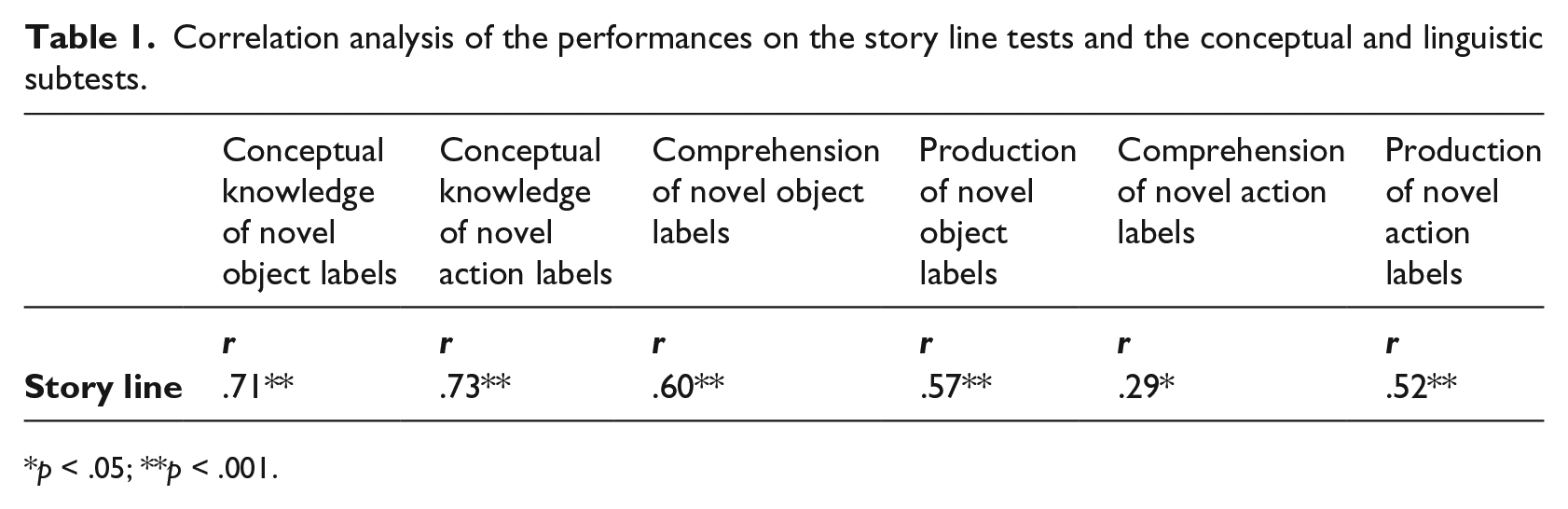
p < .05; **p < .001.
To examine the effect of ethnic background on conceptual, productive and comprehensive outcomes, we conducted six analyses of co-variance (ANCOVAs) with origin of the children as a between-subjects factor, outcomes on the story line test as a covariate and the children’s performances on the conceptual, production and comprehension tests of both nouns and verbs as dependent variables. For the analysis of the children’s performances on the comprehension test of novel object labels, gender was included as a second covariate.
Conceptual knowledge of novel object labels
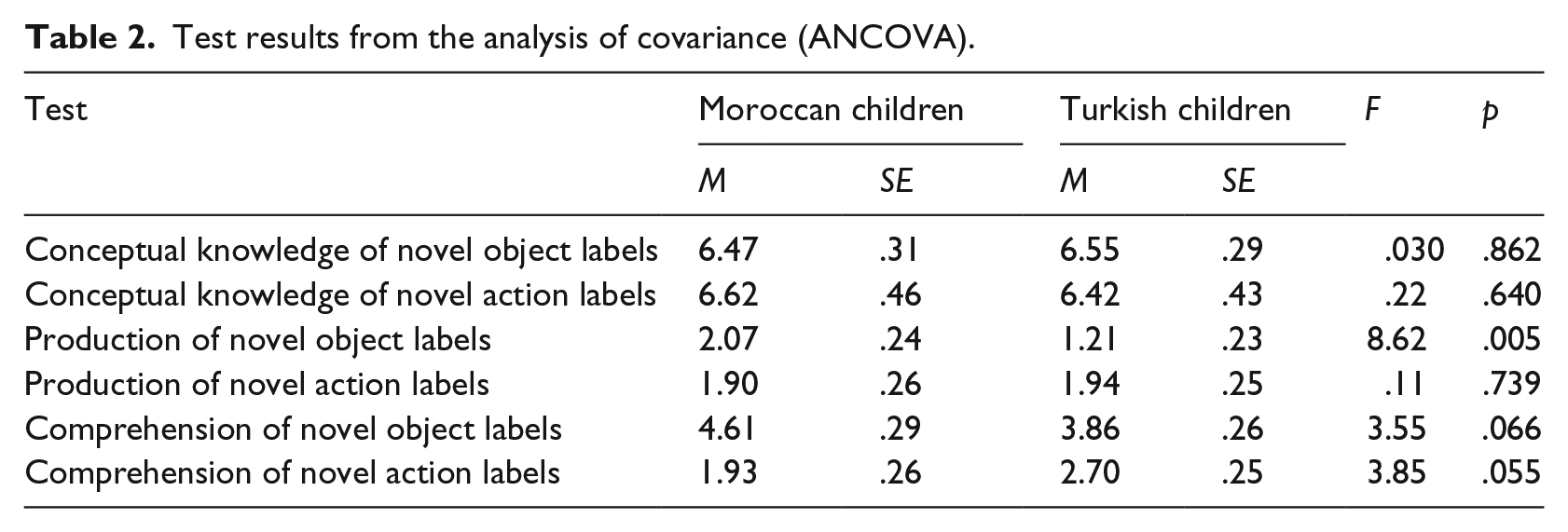
An ANCOVA with the children’s performances on the story line test as a covariate, the children’s performances on the conceptual knowledge test of novel object labels as dependent variables and the children’s origin as an independent variable, revealed no significant effect of the origin of the children on the performances on the conceptual knowledge test of novel object labels, F(1, 48) = .030, p = .862.
Conceptual knowledge of novel action labels
No significant effect of origin was found on the performances on the conceptual knowledge test of novel action labels after controlling for the effect of the children’s performances on the story line test, F(1, 49) = .22, p = .640.
Production of novel object labels
An ANCOVA showed a significant effect of the origin of the children on their performance on the production test of novel object labels after controlling for the performances of the story line test, F(1, 49) = 8.62, p = .005. Planned contrasts revealed that children of Moroccan origin (M = 2.06) significantly outperformed their peers of Turkish origin (M = 1.09).
Production of novel action labels
An ANCOVA with the children’s performances on the story line test as a covariate, origin as between-subjects factor and the performances on the production test of novel action labels as dependent variables showed no significant effect of the origin of the children, F(1, 47) = .11, p = .739.
Comprehension of novel object labels
Preliminary analyses revealed a main effect of gender on the performances of the Moroccan-heritage children on the comprehension task of novel object labels. An ANCOVA with the children’s performances on the story line test and gender as covariates, origin as between-subjects factor and the performances on the comprehension test of novel object labels as dependent variables revealed that the origin of the children did not significantly affect the children’s comprehension of the novel object labels, F(1, 49) = 3.55, p = .066.
Comprehension of novel action labels
An ANCOVA with the children’s performances on the story line test as a covariate, origin as between-subjects factor and the performances on the comprehension test of novel action labels as dependent variables showed no significant effect of origin, F(1, 48) = 3.85, p = .055 (Table 2). In summary, we found no significant effect of the children’s origin for the overall understanding of the story line. However, since the studies of Boderé and Jaspaert (in review) and Kan (2014) revealed an effect of initial language skills on novel word learning in the L2, we decided to take the children’s performances on the story line test as a covariate in all analyses. After controlling for the effect of the comprehension of the story line, no effects of the children’s origin were found on word learning, except for the production of novel object labels, with Moroccan-heritage children outperforming their peers with a Turkish background.
Test results from the analysis of covariance (ANCOVA).
Discussion and conclusions
The research findings from previous studies suggest that there may be important differences between Moroccan and Turkish minority children in Flanders with regard to educational achievement and language proficiency. According to several researchers, it is possible that ethnic minority children need to have at least a basic proficiency in the L2 to be able to acquire new vocabulary (Hassall, 2015; Jaspaert, 2015; Kan, 2014; Messer et al., 2010; Nap-Kolhoff & Van Steensel, 2005). On the other hand, linguistic characteristics of the L1 may have had an impact on the acquisition of novel L2 vocabulary as well (Cornips et al., 2006; Messer et al., 2010).
The present study examined whether novel word learning in the majority language, Dutch, is different for ethnic Moroccan and ethnic Turkish six-year-olds when their initial proficiency in Dutch is held constant. We set up a quasi-experimental design in order to examine the children’s vocabulary acquisition. We used a fantasy story, which contained six novel objects and six novel actions with novel object labels. By means of a story line test, in which the children had to answer questions regarding the events that occurred during the story, we were able to control for the children’s existing language skills in Dutch in this particular context. Afterwards, the children’s knowledge of these words was tested, using an elaborated test battery in which the children’s conceptual, receptive and productive knowledge of the novel words was tested.
Since previous research indicated that existing language skills are important to novel vocabulary acquisition, we first assessed whether the children understood the story line as a means of measuring their proficiency in Dutch. Although the comparison did not come out as significant, the Turkish-heritage children showed less understanding of the story line than the children of Moroccan origin. Furthermore, the following ANCOVAs all showed a significant effect of the children’s performance on the story line test on the performances on the other tests. This outcome corroborates the idea that learning vocabulary depends to a large extent on the language proficiency already present. As our results show, a better language proficiency leads to a better understanding of the verbal input on offer, and augments the chances of acquiring unknown words significantly, thereby confirming the hypothesis of Jaspaert (2015), Kan (2014), Messer et al. (2010), and Nap-Kolhoff & Van Steensel (2005).
Furthermore, after controlling for the children’s performances on the story line test, the children of Turkish origin turned out to acquire the novel Dutch words to almost the same extent as the Moroccan-heritage children. However, there was one exception: the Turkish-heritage children still performed significantly lower on the production task of novel object labels than the Moroccan-heritage children. Since they showed equal receptive and productive mastery of the novel action words and equal receptive mastery of the novel object labels after controlling for comprehension of the story line, this finding is puzzling. The fact that all children performed equally well on the comprehension of both novel object and action words seems to be rather logical, as receptive competence generally precedes productive competence (see the threshold hypothesis, Paradis, 2009), and is believed to be easier than production. However, nouns are believed to be learned before verbs in most languages (Bornstein et al., 2004; Chan et al., 2011, p. 1460; McDonough, Song, Hirsh-Pasek, Golinkoff, & Lannon, 2011; for Dutch, see Bornstein et al., 2004, p. 1116), because nouns are more frequent (Chan et al., 2011) and ‘concepts of objects are perceptually and conceptually more stable, and therefore more easily acquired than concepts of actions or events, which involve relations among objects’ (Waxman et al., 2013, p. 156).
A possible explanation is that there may be a cross-linguistic effect. Turkish is believed to be ‘very close to a verb-friendly language’, that is, there is a larger focus on actions and verbs, indicating a weaker noun-bias hypothesis (see Altınkamış, Kern, & Sofu, 2014, pp. 540–541, for an overview). This implicates that verbs are acquired early in Turkish, at almost the same time, rate and frequency as nouns. In Moroccan-Arabic, similar to Dutch, nouns appear to be acquired before verbs (Boerma, 2005). The Turkish-heritage children in our study may consequently be disadvantaged in the acquisition of the novel object labels, and advantaged in the acquisition of the novel action labels with respect to the Moroccan-heritage children. The children’s scores on the receptive test of novel action labels seem to point in the same direction, with the Turkish-heritage children outperforming their Moroccan-heritage peers (see Table 2). This outcome is nearly significant (p = 0.055). The children of Turkish origin did perform slightly better on the production test of novel action labels than their Moroccan-heritage peers as well, although this difference was not significant (p = 0.739). However, the scores on this test were very low for both Moroccan- (M = 1.90, SE .26) and Turkish-heritage (M = 1.94, SE = .25) children. Since verbs are generally more difficult to acquire, this task might have been too difficult for both groups.
Overall, it can be concluded that Moroccan- and Turkish-heritage children perform equally well on nearly all subskills (conceptual knowledge of novel object and action words, comprehension of novel object and action words and production of novel action words) when being provided with the same type of language input. Our findings show that the extent to which novel word learning occurs is mostly dependent on one’s initial language proficiency in the target language. However, L2 proficiency alone cannot explain the differences between ethnic Moroccan and ethnic Turkish minority children acquiring new vocabulary in Dutch, since we also found a cross-linguistic effect on ethnic minority children’s novel object label learning in the L2. The Moroccan-heritage pupils significantly outperformed their Turkish-heritage peers in the production task. The fact that Turkish is a more verb-friendly language than Moroccan Arabic and/or Berber is believed to be a relevant clue. In fact, the finding that the Turkish-heritage children showed more understanding and production of the action labels compared to their Moroccan-heritage peers seems to confirm this hypothesis as well, although the outcome was not significant. These findings seem to implicate that a different approach to the stimulation of Dutch language acquisition in Moroccan- and Turkish-heritage children is necessary. Dutch language education in children of Turkish origin, for example, should focus more profoundly on the acquisition of novel nouns, compared to language education in Moroccan-heritage children, whereas Dutch verbs are picked up more easily by children of Turkish origin. More research is needed to look into other differences between ethnic minority children’s L2 vocabulary acquisition and the effects of linguistic characteristics of their L1 on their L2 learning outcomes.
Future research should particularly focus on the factors affecting the majority language proficiency of ethnic minority children, since our study indicated that existing language skills in the L2 are an important predictor of novel L2 vocabulary learning. Furthermore, our outcome indicates that not all minority children of different ethnic origin acquire their L2 and L2 vocabulary in the same way; in addition to L2 proficiency, linguistic properties of the L1 seem to have an impact on L2 vocabulary acquisition as well.
Footnotes
Acknowledgements
The authors would like to thank all the school directors, teachers, parents and children that participated in this study. Special thanks go to Carolien Frijns for selecting and contacting the schools and for her valuable insights and comments during the study, to the anonymous referee(s) for the constructive comments and to Sara Verbrugge for her helpful comments on earlier drafts of this article.
Declaration of Conflicting Interests
The author(s) declared no potential conflicts of interest with respect to the research, authorship, and/or publication of this article.
Funding
The author(s) received no financial support for the research, authorship, and/or publication of this article.