






Abstract
Aims:
With language characteristics shown to be a factor mediating bilinguals’ metalinguistic awareness, the present study attempts to give a clearer picture of the impact of language characteristics, avoiding confounds such as exposure opportunities and language experiences, which previous studies with comparisons made between monolinguals and bilinguals were subject to.
Design:
Two groups of bilinguals speaking the same first language (L1) but different second languages (L2s) were tested for their performance on a morphosyntactic awareness task. Other confounds (L1 proficiency and nonverbal intelligence) were statistically controlled.
Data and Analysis:
After five outliers were deleted, data from 22 Chinese–English bilinguals and 20 Chinese–Southern Min bilinguals were analyzed, by mainly using analyses of covariance.
Findings:
The results showed that, with nonverbal intelligence and Chinese proficiency controlled for, Chinese–English bilinguals scored significantly higher than their counterparts only on the past tense suffix task, one tested feature in which Chinese and English differ but which both Chinese and Southern Min lack. They did not, however, differ on the other contrasting feature, present suffix, probably due to its inconsistent presence in English. The two groups showed no difference on subject–object–verb and inflectional negation features that both their L1s and L2s lack.
Originality:
Unlike the metalinguistic awareness measure (grammatical error detection and correction) commonly used in previous studies, our task was adapted into a version using an unlearned third language (L3) (Japanese), which could reflect children’s cross-language transfer of metalinguistic knowledge. Besides, our metamorphological awareness measure was focused on inflectional morphology, whose influence on the bilingual advantage should be important but has yet received scant attention in the earlier literature.
Significance:
The overall results cross-validated the important role of language characteristics in bilinguals’ development of metalinguistic awareness and suggested that the metamorphological awareness is likely to facilitate bilinguals’ learning of an L3.
Keywords
Introduction
Metalinguistic awareness refers to the understanding that language is a system which can be analyzed. It allows language users to reflect on and apply the logic of language (Ter Kuile, Veldhuis, Van Veen, & Wicherts, 2011). Prior studies on metalinguistic awareness usually focus on its relationship with second language (L2) learning and bilingualism. Many have suggested that bilinguals have more metalinguistic awareness and perform better on different language tasks than monolinguals (Bialystok, 1988; Cummins, 1978; Galambos & Goldin-Meadow, 1990; Reder, Marec-Breton, Gombert, & Demont, 2013). For example, in a study conducted with a grammatical correction task that involved syntactic and morphological awareness by Galambos and Goldin-Meadow (1990), it was noted that bilingualism can speed the transition of children’s focus on language from content to form, thus enabling bilinguals to pay attention to not only semantic but also structural contents. This is consistent with the interpretation of other studies (e.g. Bialystok, 1997; Campbell & Sais, 1995) that metalinguistic concepts reside in bilingual children and accelerate language development more than in monolingual ones. Reder et al. (2013) also found that even L2-learners, not necessarily bilingual, outperformed their monolingual counterpart on certain morphological awareness tasks.
Metalinguistic awareness has been investigated from its different facets: phonological; syntactic; and morphological awareness. Morphological awareness, as defined by Carlisle (1995), is “children’s conscious awareness of the morphemic structure of words and their ability to reflect on and manipulate that structure.” Divisions of morphology are usually made into three categories: (a) inflection; (b) derivation; and (c) compounding. Inflectional morphology, without changing the meaning of the word stem, is concerned with the systematic marking of grammatical function as required by the syntax. For instance, the final “-s” attached to nouns as a plural form in English or attached to verbs as an agreement required by a third-singular-person subject. Derivational morphology refers to the rules regulating the formation of new words; new words derive from the base stem but their meaning or part of speech is altered (e.g. happy → unhappy). Compounding is the way of constructing one word from two roots words (e.g. Bluetooth). As morphology itself is subcategorized into specific ones, morphological awareness also can be classified into the same three kinds.
Morphological awareness comes with notable advantages; it plays an important role in reading (Deacon, Wade-Woolley, & Kirby, 2007; Pasquarella, Chen, Lam, Luo, & Ramirez, 2011; Wang, Cheng, & Chen, 2006), though the relationship between morphological awareness and reading may be mutual-facilitated rather than unilateral (Kuo & Anderson, 2006). Studies show the correlation even in a bilingual context, suggesting that morphological awareness can be applied to reading across orthographies (Deacon et al., 2007); the study by Wang et al. (2006) pointed out a cross-language transfer of morphological awareness from Chinese first language (L1) to English L2. That is, morphological awareness mediates in reading comprehension of two distinct writing systems. Pasquarella et al. (2011), following Wang et al. (2006), further used structural equation modeling and found that the cross-language model (an addition of the cross-language paths to the within-language paths) fit significantly better than the within-language-path-alone model. This indicated clearly that the L2 (English) morphological awareness had a transfer on L1 (Chinese) reading comprehension (Pasquarella et al., 2011).
Most research on bilingualism and metalinguistic awareness is centered on their effects on L1 and L2. In fact, metalinguistic awareness can even enhance third language (L3) acquisition (Lasagabaster, 1998; Ter Kuile et al., 2011; Thomas, 1988). A study by Ter Kuile et al. (2011), for instance showed that, with the general intelligence factor controlled for, students in the bilingual classes scored higher than those in monolingual classes on a test of understanding an unknown language, arguably due to their greater metalinguistic awareness. The study by Lasagabaster (1998) found that bilingual children (Spanish–Basque) had higher metalinguistic awareness and they also learned English (L3) better than monolinguals, suggesting the positive influence of bilinguals’ metalinguistic awareness on learning an L3.
Given the documented benefits, one may wonder what it is in bilingualism that contributes to the development of metalinguistic awareness. Cummins (1976) proposed the threshold hypothesis where two levels of language competence should be reached in order to benefit from bilingualism in cognitive or linguistic ability. Less balanced bilingual children who have only one of the two languages reaching age-appropriate competence are considered at the middle floor, that is, having stepped over the first threshold, and they neither benefit nor suffer from bilingualism. Balanced bilingual children who have both two languages reaching age-appropriate competence are at the top floor (over the second threshold) and they are likely to have positive bilingual advantages. Others, on the other hand, suggested a lower threshold for bilingual advantages (Bialystok, 1988; Cromdal, 1999; Davidson, Raschke, & Pervez, 2010; Hakuta & Diaz, 1985). Their studies showed that highly bilingual pupils’ metalinguistic awareness was found higher than less balanced bilingual ones and was significantly higher than monolingual ones. Besides, age of acquisition was also found to correlate with metasyntactic awareness; for example, Flege, Yeni-Komishian and Liu (1999) and Johnson and Newport (1989) found that native-Korean-speaking immigrants’ ability to judge grammaticality varies from age of arrival to the US. The earlier age the Korean moved in (and acquired English), the better they can judge grammaticality. Simultaneous Korean–English bilingual students made errors the least. Taken together, level of bilingualism (balanced or not, early or late) should be considered when metalinguistic awareness is assessed.
In addition to level of bilingualism, language characteristic is also a factor that influences bilingual advantages. As Davidson and Raschke (2008) argued, it may not be bilingualism per se, but characteristics of the languages that affect children’s metalinguistic awareness, particularly in terms of syntactic awareness. Davidson et al. (2010), for example, investigated the properties of languages that affect syntactic awareness. Subjects included English monolinguals and bilinguals. The bilingual children were Urdu and English speakers. All children’s receptive vocabulary was tested. No significant difference was observed between monolinguals’ and bilinguals’ competence in their English receptive vocabulary, and the bilingual group did not show differences in their receptive vocabulary of English and Urdu, either. Syntactic awareness test was formed with 15 grammatically correct and 15 grammatically incorrect sentences. Three dimensions, gender, subject–object–verb (SOV)/ subject–verb–object (SVO) word order, and tense, which are different in the two languages, were embedded in the sentences. Subjects were asked whether the sentence sounded fine and asked to explain the error if they could. Bilingual children were found to be much better than monolinguals at detecting grammatically incorrect sentences. Further analysis on proportion correct of gender, word order, and tense categories revealed that the bilingual children were particularly better at detecting incorrect gender sentences than monolingual children and able to detect correct and incorrect gender sentences equally well. This is probably because gender is more heavily represented in Urdu than in English. The analysis on correction proportion of gender feature thus implied that properties of the L2 may play a critical role in the development of metalinguistic awareness, hence in the observed bilingual advantage (Galambos & Goldin-Meadow, 1990).
This hypothesis was also supported by Reder et al. (2013), who examined phonological, morphological, and syntactical awareness in French first grade monolinguals and bilinguals (L1: French; L2: German). Two shared characteristics of French and German – affixes morphology and phonology – were expected to have no influence on subjects’ metalinguistic awareness. The results were congruent with the hypothesis and previous findings: bilingual children showed no notable phonological awareness (a feature shared by the two languages) but better compound-morphological and syntactic awareness (the distinct features) compared to their monolingual peers. The importance of language characteristics should thus be taken into consideration when metalinguistic awareness is evaluated.
Present study
This study is to compare metalinguistic awareness from two groups of balanced bilingual pupils to see the role of L2’s characteristics. A Japanese (an unknown L3 language) grammatical task was designed to measure pupils’ metalinguistic awareness. While bilingualism has been shown to correlate with the development of syntactic/morphological awareness (Bialystok, 1988; Cummins, 1978; Galambos & Goldin-Meadow, 1990; Kuo, Ramirez, de Marin, Kim, & Unal-Gezer, 2017; Reder et al., 2013), what it is in bilingualism that contributes to the well observed bilingual advantage is not yet clear. One alternative hypothesis is language characteristics. It has been pinpointed that properties of the L2 (shared or not shared with L1) may affect metalinguistic awareness (Davidson et al., 2010; Reder et al., 2013). That is, L2-learners whose two languages differ in certain aspects may be better motivated to develop awareness than those whose L2 characteristics do not differ from their L1’s. Nonetheless, most studies aimed at investigating the role of language characteristics made the comparisons between monolinguals and bilinguals. Such comparisons however could be confounded by other factors, such as language learning experience or language exposure: bilinguals may have better metalinguistic awareness because they have one more language learning experience than their counterparts or because of their greater amount of exposure to languages, as implied in the earlier discussion of the impact of age of acquisition (Flege et al., 1999; Johnson & Newport, 1989) and proficiency (Bialystok, McBride-Chang, & Luk, 2005; Cromdal, 1999; Cummins, 1976; Galambos, 1990). To control for these possible confounds, the present study compared syntactic and morphological awareness of two groups both of whom are bilinguals. This would enable one to focus on the effect of language characteristics with the extraneous effects controlled. That is, if both groups are selected from bilinguals with the same L1 yet different L2s, do they benefit from bilingualism to the same extent?
In this study, the metalinguistic awareness was focused on morphology, and more specifically, inflectional morphology. Although many have pointed out the importance of morphological awareness in bilitaracy reading comprehension or word recognition (Deacon et al., 2007; Pasquarella et al., 2011; Wang et al., 2006), the morphological awareness they referred to most was derivational and compounding. Inflectional morphological awareness was less investigated in the literature, but they are in fact an essential aspect that influences L2, or L3, acquisition (DeKeyser, 2005; Jiang, 2004; VanPatten, 1990). DeKeyser (2005) pointed out that, in learning morphology of a new language, there are “problems of meaning” and “problems of form”. Problems of meaning refer to the fact that some affixes in a new language denote abstract notion which learners are not able to make sense of because the semantic system of the L1 is so different from that of the L2; inflectional morphology is especially the case, as inflectional affixes are mostly semantically non-essential: their functions are overshadowed by other semantically-salient cues. Furthermore, even if learners know “what (the meanings)” to be expressed, they have difficulty in “how (the forms)” to put them in the right place. The difficulty is seen especially in learners in the early stage (VanPattern, 1990). Jiang (2004) further argued that such difficulty or errors made by second language learners could be attributed to their lack of sensitivity; if true, inflectional morphological awareness – the sensitivity to inflectional morphology – is likely to have an effect on learning a new language, and thus worth investigating.
At last, this research adds to the literature of bilingualism in L3 acquisition especially in a grammar-learning aspect. Because of the syntactic and morphological differences in the two acquired languages, children might have developed cross-linguistic awareness of the structure of languages so as to understand their dissimilarities (Davidson et al., 2010; Galambos & Goldin-Meadow, 1990; Reder et al., 2013). But can this be applied to an unknown language with different language features? Previous studies using the task of known languages (either L1 or L2) might simply reflect bilingual children’s linguistic knowledge about the two known languages. In the present task, however, to answer correctly, subjects had to analyze the grammatical rules of this new language by applying their linguistic knowledge from L1 and L2 (which, as hypothesized, should render them metamorphological awareness if the two languages differ in morphological structures). The L3 task used in this study thus shows children’s cross-language transfer of metalinguistic knowledge that will be needed in learning an L3.
Four languages are involved in the research: Chinese, English, Southern Min and Japanese, with the first being the common language and the last the unlearned language to both groups. The language characteristics of the four languages were summarized in Figure 1.

Summary for the characteristics of the four languages involved in the study.
Chinese is a highly isolating language (Li & Thompson, 1981) in terms of morphological complexity, as there are barely inflectional morphemes, despite its richness in compound words. Noticeably, Chinese has no morphological tenses (Li & Thompson, 1981; Lin, 2006). This is a stark contrast between Chinese and English, the latter of which mandatorily requires an inflectional suffix of tense, for both present and past tense. The only quasi-morphological device in Chinese is markers of aspects. In Chinese, le/guo is used to express perfective/experiential aspect of a sentence (for an elaboration on the functions of aspects markers in Chinese, see Klein, Li, & Hendriks, 2000). It should be noted, however, that tense and aspect are exclusively different categories (see Li & Thompson, 1981, pp. 184–185) and although some maintained that le and guo markers have a default interpretation of past tense (Lin, 2006), they do not necessarily occur in past tense (Lin, 2000), as in (1), and a sentence can have a past tense interpretation independently without le or gou, as in (2). Therefore, despite the existence of le and guo, Chinese is unanimously considered a language without morphological tense. As for negation, particles, such as bu bie mei, follow the subject and precede the verb phrase, but no inflectional suffix is used for negation. Finally, the default structure of Chinese is SVO.
(1) Yaoshi Lisi dang-le zongtong, wo yiding quanli bangzhu ta if Lisi select-Asp president I definitely all-effort assist him ‘If Lisi is selected as president, I will definitely assist him with all my effort.’ (2) Wo zuotian qu taibei I yesterday go to Taipei ‘I went to Taipei yesterday.’
Southern Min shares almost the same structures that Chinese has. Like Chinese, Southern Min has scarce use of inflectional morphology; neither does it have any inflectional suffix to mark tense. It does not have inflectional suffix for negation, either; it is also a SVO language. The main difference between Chinese and Southern Min lies in their phonetics and phonology.
In the L3 task that we used to measure metalinguistic awareness, four grammatical error types were manipulated, namely word order (SOV), present tense inflectional suffix (-masu), past tense inflectional suffix (-mashita), negation inflectional suffix (-masen). It was hypothesized that, if language characteristics indeed play a part, Group 1 who speak English as their L2 should detect and correct more grammatical errors on only present and past inflectional suffix types than Group 2 who speak Southern Min as their L2. This is because English has these two features that are different from Chinese, and when learning English, Group 1 students were likely to notice these differences, which motivated their development of metalinguistic awareness. In contrast, Group 2 students learned two languages that are very similar in morphological structures. That they had no experience seeing differences between two languages might lead them to less or no metamorphological awareness. As for negation inflectional suffix, only Japanese, the tested language, has this feature. Therefore, it was predicted that both groups would score comparably low on negation inflectional suffix. The same case is for word order: only the testing language has SOV sentence structure. Both groups had had no chance to become aware of differences in sentence structure between two languages. Thus there was no trigger for metasyntactic awareness for both groups. Taking advantages of Japanese, some of whose characteristics are similar to and some different from the other three languages, the role language characteristics played in metalinguistic awareness of bilingual children was clearly explored.
Method
Participants
Forty-seven fourth-grade students participated in this study. Five subjects’ data were ruled out as they were identified as outliers in regard to their L1, L2 proficiency, nonverbal intelligence, and their performance on the metalinguistic task. The 42 remaining subjects were grouped into one Chinese–English bilingual group (Group 1) and one Chinese–Southern Min bilingual group (Group 2). Group 1 consists of twenty-two fourth-graders (mean age 9–9; range 9–3 to 10–2) studying in Yu-Tsai Bilingual Elementary School where half of the subjects were taught in Chinese and the other subjects taught in English. Group 2 consists of twenty fourth-graders (mean age 9–9; range 9–3 to 10–2), with 13 of them from Rende Elementary School and seven from Tucheng Elementary School. The two schools were not bilingual schools, yet Southern Min was taught as an individual subject and residents in these two suburban areas in Tainan have highly frequent use of Southern Min. Eleven females and eleven males were in Group 1; thirteen females and seven males were in Group 2.
In order to pick up students who are qualified to be considered bilingual, the teachers in the schools were asked for help with the selection. Possible confounds such as non-verbal intelligence quotient (IQ) and Chinese proficiency were measured and included as covariates in analysis of covariance (ANCOVA) to control for their influence.
Materials
Metalinguistic awareness tasks
A Japanese task was designed to measure subjects’ metasyntactic and metamorphological awareness. Since Japanese is a new language for all the subjects, Japanese kana was replaced with subjects’ most familiar transcription system, Zhuyin, throughout the task. The task is made up of two parts – the acquisition part, where subjects learned how Japanese sentences work, and the testing part, where they judged and corrected the grammatically incorrect sentences.
The acquisition part showed six exemplar sentences (three as a set; two sets in total). As shown in Figure 2 (for the complete version, see Appendix), the first row presents the transcription of Japanese words, the second row each glossary, and the third row the whole-sentence-translation. Three sentences were presented together as one example set; the agent, patient, and event were held the same with the variation lying in the tense and negation (present, past and, negative form, respectively). What are different among the sentences were highlighted as implicit hints to facilitate subjects to see the differences. However, no explicit rules (e.g., why the suffixes are different) were taught; subjects could only count on their metalinguistic awareness to induce the rules.

Examples of Japanese sentences provided in the acquisition section.
The second part is the testing part. This part was further divided into two parts, the morphological awareness task and the syntactic awareness task. The morphological task contained eighteen sentences – six with present tense, six with past tense, and six with negation. The syntactic task contained six sentences all with present tense but with different word orders (SOV or SVO). Examples of the testing items are shown in Figure 3 (for the complete version, see Appendix). Each question contains three rows: the first row is the target sentence in Chinese; the second row is the transcription; and the third row is the glossary. Subjects were asked to judge whether the second row (the Japanese sentence) is consistent with the first row (the Chinese translation). If the two were not consistent, they needed to correct the incorrect part in the Japanese sentence (see Figure 3). Half of the items were fillers, grammatically correct sentences, and the other half were grammatically incorrect ones that required amending.

Examples of the testing items.
The presentation order of the syntactic and morphological task was counterbalanced so that half of the subjects took the syntactic task first and the other half took the morphological task first. The scores on each error type tasks ranged from 0 to 3. The task lasted for twenty-five minutes (including the five-minute instruction).
Receptive vocabulary
Adapted versions of the Peabody Picture Vocabulary Test, Fourth Edition (PPVT-IV) (Dunn & Dunn, 2007) were used as an index of subject’s level of bilingualism. Modifications were made so that subjects needed not to go through all the items, to shorten administration time and to allow for group administration. The test was translated into Chinese and Southern Min versions. Theoretically, each group only should take PPVT tests of their two languages (Chinese and their L2). However, given that both groups of the subjects have exposure to more or less English or Southern Min, another PPVT test of the other L2 (the weak L2) was also conducted. This was to ensure that the subjects’ relatively low proficiency on the other L2 did not suffice for them to be trilingual and thus should have little influence on their metalinguistic awareness (Cummins, 1976).
Five sets of the items of Form A (Set 6 to Set 10, with 56 items) were given in subjects’ L1, Chinese, and five sets of the items of Form B (Set 6 to Set 10, 56 items) in their L2, while only two sets (Form B, Set 4 and 5, with 22 items) were given in the weak L2 version on the assumption that their proficiency was extremely low. Overlap in the specific vocabulary tested was avoided by using different forms of the test. Some items were taken out because of the difficulty in finding equivalent translation into Chinese and Southern Min from English.
Scores on Chinese PPVT ranged from 48 to 55; scores on English ranged from 25 to 45; and scores on Southern Min ranged from 33 to 48. Bilingual-balanced-ratio, the ratio of L2 PPVT score to L1 PPVT score (Bialystok & Barac, 2012) in Group 1 ranged from 0.47 to 0.83; bilingual-balanced-ratio in Group 2 ranged from 0.63 to 0.94.
English morphological awareness
Since our hypothesis is that development of metalinguistic awareness of bilinguals is triggered when dissimilarities of characteristics exist between their two learned languages, it was necessary to ascertain that subjects in Group 1 had had the concept of present and past tense inflectional suffix. An English morphological awareness measure that required subjects to detect and correct errors on present and past tense suffix was given. Totally twelve items were given, half of which were in present tense and the rest in past tense. Half of the items were fillers (grammatically correct sentences). Scores ranged from 0 to 3.
Nonverbal intelligence
Non-verbal intelligence was measured with the Pattern Completion subtest of the Matrix Analogies Test (Naglieri, 1985) for later statistics control. Sixteen big pictures of geometric forms each with a missing part were shown to the subjects. Subjects were asked to choose the small picture that matched the pattern of the big picture when put on to the missing part. Five to six candidate pictures were given in each item. Scores ranged from 10 to 16.
Procedure
Given students’ limited capacity of attention, the whole process was divided into two days; each time lasted for about 35 minutes. Subjects were tested all at the same time, not individually. All tasks were administered in Chinese. The order of the tests given was as follows: (a) metalinguistic awareness task; (b) L2 PPVT (English for G1; Southern Min for G2); (c) English morphological awareness task; (d) Chinese PPVT; (e) weak L2 PPVT (Southern Min for G1; English for G2); and (f) nonverbal intelligence task. The English morphological awareness task was given only to Group 1.
Results
Means and Pearson correlations
Table 1 shows the means and standard deviations for scores on PPVTs, bilingual-balanced-ratio, and nonverbal intelligence.
Means and standard deviations for scores on Peabody Picture Vocabulary Tests (PPVTs), bilingual-balanced-ratio, and nonverbal intelligence.
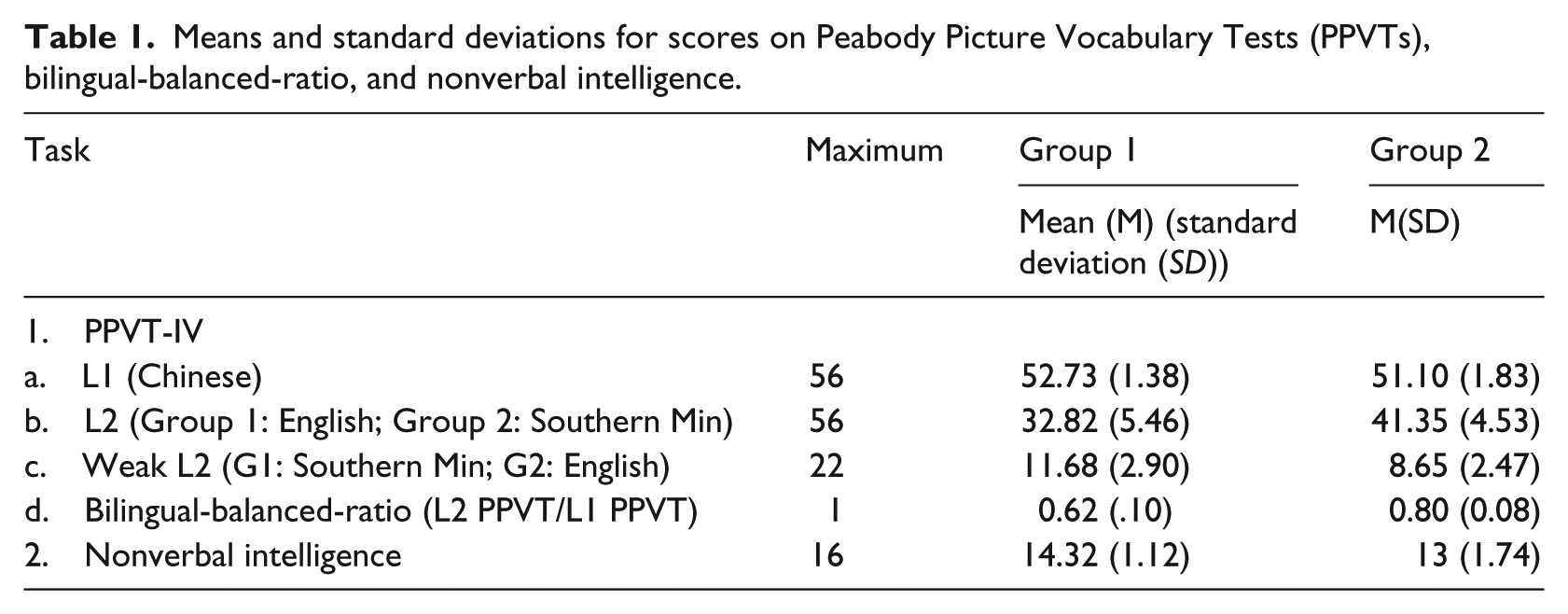
Given that Group 2 students had begun their English lesson in school for one year (two hours/week), they were not zero-experience learners of English. However, their English proficiency was still extremely low, as reflected by their weak L2 PPVT scores. Even if we assume they could obtain extremely high scores in the first three sets, which were not tested, the most optimistic estimation of their PPVT scores would be 40 (i.e. 32 plus 8), which corresponds to an age equivalent of three-year-olds. Compared with the estimated age equivalent of 5;7 of the Chinese–English bilingual group based on the same assumptions, the Chinese–Southern Min group were apparently far less proficient in English. According to Stoel-Gammon (2011), 2;6-olds have a productive lexicon of 570 on average, but when they get to the age of four, their productive vocabulary size grows exponentially to an average of 3000 words, and by six, to 6000 receptive words, which is five to ten times larger. Therefore, Group 2 pupils could not be deemed trilingual (neither could Group 1, who had no experience in learning Southern Min) and any different performance on their metalinguistic measures was unlikely attributable to the excessively low proficiency of the weak L2 of both groups. In fact, Pearson coefficients indicated no correlation between weak L2 PPVT and any metalinguistic awareness measure for both groups (all ps > 0.05).
Since subjects were from different backgrounds, independent t-tests were performed to see if the two groups differed in Chinese proficiency or nonverbal intelligence, other than in their L2. The results showed that the Chinese–English group were significantly better in Chinese and nonverbal intelligence, t(35.27) = 3.22, p < 0.01, two-tailed; t(31.99) = 2.87, p < 0.01, two-tailed, respectively.
Table 2 shows the means and standard deviations for accuracy scores on metalinguistic awareness tasks, and English morphological awareness tasks.
Means and standard deviations for accuracy scores on metalinguistic awareness and English morphological awareness tasks.
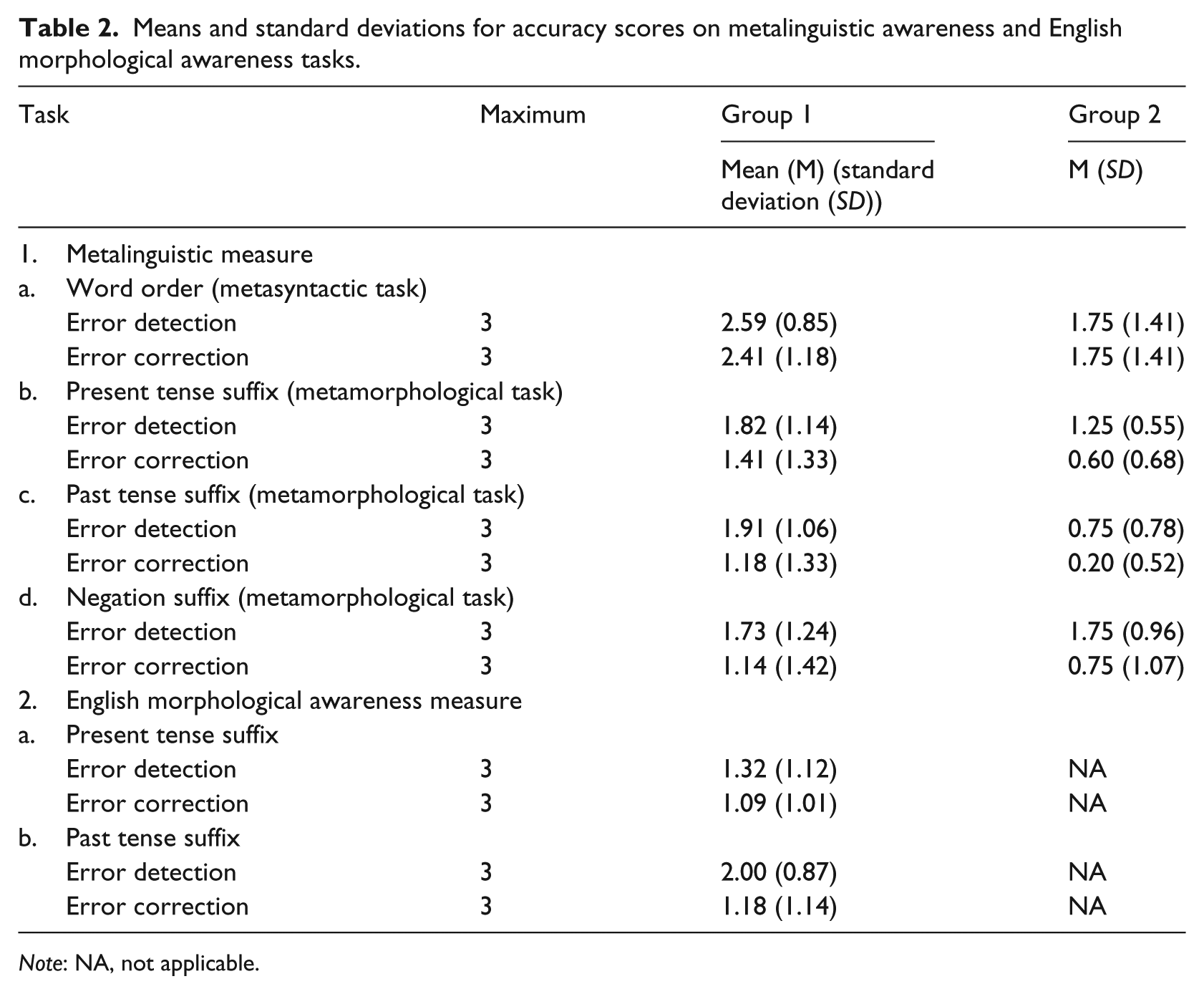
Note: NA, not applicable.
Possible confounds were first evaluated by looking at their Pearson correlation coefficients with the awareness measure. As shown in Table 3, L1 PPVT scores as well as nonverbal intelligence were significantly correlated mostly with metamorphological awareness, but not with metasyntactic awareness.
Pearson correlation coefficients between metalinguistic awareness and possible confounds.
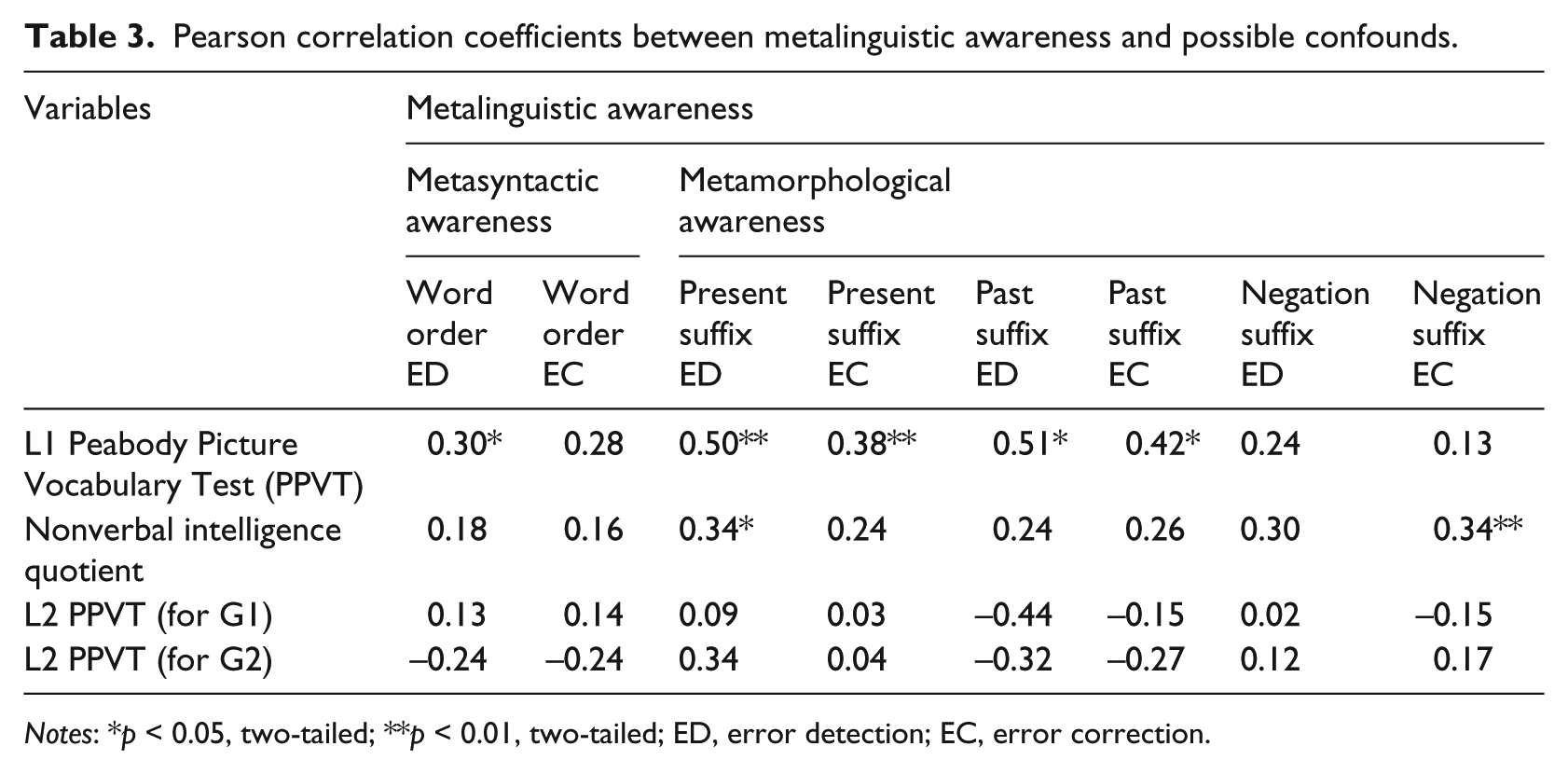
Notes: *p < 0.05, two-tailed; **p < 0.01, two-tailed; ED, error detection; EC, error correction.
Given that the two groups differ in their L2, it is meaningless to combine scores from the two groups and look at their correlation with the awareness measure. Correlation tests were therefore performed separately for the two groups. For both groups, no significant correlation was found between metalinguistic awareness and their L2 receptive vocabulary scores.
The role of L2 (language characteristics)
A multivariate analysis of covariance (MANCOVA), controlling for nonverbal intelligence and Chinese proficiency, was performed to determine differences between the two groups on the eight metalinguistic awareness subtasks. The assumption of homogeneity of regression was retained with no interaction between L2 group and nonverbal IQ and between L2 group and Chinese proficiency. There was a significant difference in metalinguistic awareness between different L2 groups, F (8, 31) = 3.409, p < 0.01; Wilks’ Λ = 0.532. Pairwise comparisons located effects of L2 group only on past tense suffix error detection (F(1, 38) = 5.49, p < 0.05, partial η2 = 0.126). No significant difference was obtained in the other tasks, all Fs(1, 38) < 2.94, all ps > 0.05.
An additional repeated-measure ANOVA would be helpful in vindicating the hypothesized role of language characteristics in metalinguistic awareness. A split-plot, 2 (L2) × 4(characteristic type), ANOVA was first performed, and an interaction between L2 and characteristic type was found, F(3, 36) = 5.71, p < 0.01; Wilks’ Λ = 0.677. Given the interaction, the characteristic type effect was analyzed within the two groups respectively.
For Group 1, Mauchly’s sphericity was violated, and after Greenhouse–Geisser correction, there was a significant effect of characteristic types on their task performance, F(2.17, 45.71) = 6.12, p < 0.01. Bonferroni tests located the differences between word order task and the other three morphological tasks (all ps < 0.06). No significant difference existed among the three suffix tasks.
For Group 2, Mauchly’s sphericity held, and there was a significant effect of characteristic types on their task performance, F(3, 57) = 6.11, p < 0.01. Bonferroni tests located the differences between word order and past tense suffix task (p < 0.05) and between negation suffix and past tense suffix task (p < 0.01).
The role of level of bilingualism
Given that bilingualism is not a categorical variable but a continuous spectrum (Bialystok et al., 2005) and because of the well-documented but inconsistent findings about effects of different levels of bilingualism (Bialystok et al., 2005; Cromdal, 1999; Cummins, 1978; Hakuta & Diaz, 1985; Reder et al., 2013), the role of level of bilingualism, in addition to the role of language characteristics, was also focused in this study.
Within each of the groups (G1 and G2), subjects were bisected into two subgroups according to their bilingual-balanced-ratio. Highly balanced groups were compared with partially balanced groups within their language group. Two one-way MANCOVAs (one for Chinese–English group and the other for Chinese–Southern Min group) were performed, controlling for Chinese proficiency and nonverbal intelligence. For both language groups, no significant difference was obtained between the highly balanced and partially balanced group, for G1, F (8, 12) = 0.348, p > 0.05; Wilks’ Λ = 0.812; for G2, F (7, 11) = 0.353, p > 0.05; Wilks’ Λ = 0.817.
The role of L2 awareness
Our hypothesis was that bilingual children develop metalinguistic awareness when they notice the structural differences between the two learned languages. Their knowledge about the structure of L2 (i.e. their English morphological awareness) was measured as a reference of their knowledge about those differences and was hypothesized to be a variable. Thus, another ANCOVA was performed to determine the role of L2 awareness.
The Chinese–English group was bisected into two groups according to their error correction scores on the English morphological awareness task. A one-way MANCOVA was performed to determine differences between the high-English-morphological-awareness and low-English-morphological-awareness group on the eight metalinguistic awareness subtasks, controlling for Chinese proficiency. The role of English morphological awareness was significant, F (8, 12) = 2.854, p < 0.05; Wilks’ Λ = 0.345. Significant differences between the two groups were found on the present tense suffix detection task (F(1, 19) = 5.38, p < 0.05) and negation suffix detection task (F(1, 19) = 6.50, p < 0.05).
Discussion
The main purpose of this study is to investigate the role of language characteristics in metalinguistic awareness. Given that many previous studies have shown that bilinguals have greater metalinguistic awareness than their monolingual counterparts (Bialystok, 1988; Cummins, 1978; Davidson et al., 2010; Galambos & Goldin-Meadow, 1990; Kuo et al., 2017; Reder et al., 2013; Ter Kuile et al., 2011), we wonder what it is in bilingualism that motivates the greater development of metalinguistic awareness. Language characteristics have been argued to be a critical factor. One theory, structural sensitivity, states that when learning two languages, bilingual children have to overcome cross-language interference, to figure out the similarities and differences between languages, which helps to build up representations of language structure at a more abstract level and thus bilingual children develop more metalinguistic awareness (Kuo & Anderson, 2010). In this study, we, partialing out other possible factors, give a clearer picture of the ways in which language characteristics can influence metalinguistic awareness.
The role of language characteristics
As was predicted, language characteristics (the L2 group effect) play a role in metalinguistic awareness. The Chinese–English group scored significantly higher than the Chinese–Southern Min group in detecting and correcting past tense inflectional suffix errors. This was because Chinese and English differ in this feature (i.e. the -ed suffix) while both Chinese and Southern Min have no such feature. This difference between the two groups was manifested in the L3 Japanese task, because Japanese has this feature (i.e. the -mashita suffix).
However, the prediction that the Chinese–English group should score significantly higher than the Chinese–Southern Min group in detecting and correcting present tense inflectional suffix errors failed to occur. The same logic was supposed to apply here as the past tense inflectional suffix case, because English (the L2) has present tense inflectional suffix (i.e. -s) feature that is shared with Japanese (L3, -masu) but not with Chinese (L1). One plausible explanation is that although the present tense inflectional suffix exists in English, its usage is not quite consistent. That is, in English, the present tense inflectional suffix is required only with a third singular person, but not with other persons. Compared with learning the past tense suffix, learning the present tense suffix involves one additional burden – to bear the inconsistency of number, person and verb agreement. This may render the representation of the present tense inflectional suffix confusing to English as Second Language (ESL) learners and thus make this characteristic a harder-to-master feature. This possibility was consistent with the findings of Johnson and Newport (1989) where the third singular present tense suffix was found more prone to errors than past tense suffix was, not only for Chinese early learners of English but also for native English speakers. They attributed the difference to universal factors in learnability rather than to the similarity degrees between L1 and L2. Likewise, in our study, subjects in Group 1 scored significantly lower in detecting the English present tense suffix than in detecting the English past tense suffix. In fact, the scores on English present tense error detection were likely due to chance (one sample t-test against chance level, p >0.05), showing that subjects in Group 1 might not have mastered the more difficult usage of present tense and thus did not show a transferrable advantage onto L3. In other words, the inconsistency of present tense agreement could be one inhibition for the awareness from transferring to an L3.
In spite of the present tense issue, the language characteristics effect was still quite obvious in that, as predicted, no significant difference was discovered in word order and negation suffix detection and correction task. This was because Chinese, English, and Southern Min share the same sentence structure (SVO) and thus when both groups were learning their L2, they had no chance or need to develop metasyntactic awareness. This is the same for negation suffix.
With a closer look at the results of the within-subject ANOVA, however, more factors should be taken into account. If our hypothesis holds true, it should be the case that, within Group 1, subjects score better on present and past tense suffix tasks than word order and negation suffix tasks because Chinese and English differ in the former two features. Within Group 2, there should be no difference among the four task scores, given that Chinese and Southern Min share almost the same structure on these four features (refer back to Figure 1 for a summary of the features). The obtained patterns within the two groups were nevertheless deviant from the prediction. One plausible explanation is the inherent essence of each language feature.
The inherent essence of the language characteristics came into play, as, for Group 2, differences were found between word order and the past tense suffix task as well as between negation and the past tense suffix task. The results suggested that, inherently, the word order feature and negation suffix feature might be more easily captured than past the tense suffix feature, arguably because of different levels of saliency. Firstly, word order is a sentence-level feature concerning syntax, in contrast to word-level suffix, which is about morphology. It is no surprise that a difference in word order of a new language from the two learned languages is more easily noticed than that in suffix and that subjects performed better on this task. Secondly, though both are word-level features, the negation suffix feature can be easier to observe than past tense suffix. This is because of their different saliency from a semantic perspective. Negation denotes an opposite meaning from an affirmative, while past tense only denotes a chronological difference from present tense. The difference in proposition is sharper between negation and affirmation than that between past tense and present tense; hence semantically speaking, negation feature is more salient than tense feature. Therefore, Group 2 subjects performed better on negation task than past tense.
The above speculation about the role of characteristics’ inherent difficulty was also evidenced from Group 1’s results. That Group 1 subjects scored significantly higher on word order task than the other three suffix tasks reflected the sentence-level and word-level feature discrepancy. Besides, that no difference was obtained between negation and the present tense suffix task nor between negation and the past tense suffix task supported that negation is an easier feature and this easiness offset the hypothesized advantageous effect of metalinguistic awareness on the present tense and past tense suffix features.
The role of level of bilingualism
The role of level of bilingualism was not found in this study: no difference existed between highly-balanced group and partially-balanced group for both language groups. For Group 1, the results might suggest that after subjects have reached a partially-balanced-bilingual level, the balance level does not matter that much thereafter. This is consistent with findings from earlier studies where partially-balanced-bilingual children could benefit from bilingualism in certain linguistic aspects as well (Cromdal, 1999; Reder et al., 2013). For Group 2, however, the results suggested that when the two learned languages do not differ in syntactic and morphological aspects, metalinguistic awareness hardly develops, and level of bilingualism does not mediate either.
The role of L2 awareness
Our hypothesis was that bilingual children develop metalinguistic awareness when they notice the structural differences between the two learned languages. Having L2 linguistic awareness would mean having had seen that difference. Therefore, their awareness of the L2 structure was assumed to be a factor mediating their metalinguistic awareness.
The high English morphological awareness group scored significantly higher on the present tense and negation inflectional suffix, but not on past tense suffix. No difference found in the past tense suffix indicated that when the concept of past tense suffix became well-built, subjects knowing this difference between the two languages, the concept could be easily transferred to an L3, whether for the high or low English morphological awareness group.
It is more difficult for ESL learners to conceptualize the present tense suffix than past tense suffix (as discussed in the previous section). Hence, only subjects with high English morphological awareness scored high on the present tense suffix error detection task.
The fact that the high English morphological awareness group scored higher than their low counterpart on the negation suffix task implied that, although English has no negation inflectional suffix feature, ESL learners can extend the concept of tense suffix and transfer their knowledge to the negation inflectional suffix, when they well master the concept of inflectional suffix in English, given that it is also about suffix. This indicates the extendibility and transferability of morphological awareness across different features (i.e., from tense to negation) and languages (i.e. from English to Japanese).
Conclusion
The major finding in the present research is that bilingual children are equipped with metalinguistic awareness when they speak two languages with dissimilar features, as they scored higher on specific kinds of metalinguistic awareness tasks than their bilingual counterparts who speak two similar-feature languages. This finding reconfirms the importance of language characteristics in the development of metalinguistic awareness (Davidson et al., 2010; Reder et al 2013).
Although the two cohorts in this study did not exactly parallel, in terms of type of bilingualism and level of bilingualism, best attempt had been made to find out the most eligible subjects in Taiwan. Overall speaking, Group 2’s subjects had significantly higher L2 proficiency (and thus were more balanced), which theoretically should endow Group 2’s subjects with higher metalinguistic awareness. However, despite Group 2’s higher balanced ratio, the results showed that it was Group 1 who scored significantly higher on the past tense suffix detection task. That the difference was only found, among four different aspects, in past tense suffix task reinforced the robustness of the role of language characteristics in metalinguistic awareness development.
While the shared characteristics among the learned and new languages play a significant role, they do not fully account for the obtained results. It is possible that the inherent essence of each feature (i.e. the inconsistent presence of present tense suffix and both the morphosyntactic and semantic saliency) play another role in metalinguistic awareness. Therefore, the two factors should both be taken into consideration when the issue of metalinguistic awareness is addressed.
Furthermore, we also attempted to explore the effect of metamorphological awareness. The awareness task itself, along with measuring metamorphological awareness, was also a simulation of learning a new language for the bilinguals. Given the results, it can be inferred that bilinguals who speak two languages that saliently differ in more morphological aspects possibly will learn a new language faster, if not better, than those who speak languages similar in morphology, owing to their greater metamorphological awareness. While studies have pointed out that the learning problem of morphology in L2 is especially serious in the early learning stage and could last even after long-time exposure to the L2 (DeKeyser, 2000; Johnson & Newsport, 1989), Group 1 (Chinese–English) subjects in the study, surprisingly grasped the rule of past tense suffix in Japanese, an unlearned new language, within merely twenty-five minutes at their first-time exposure. The effect of metamorphological awareness on learning a new language was thus in fact quite potent.
Though further direct evidence is still needed, given the results of this study, it is conceivable that inflectional metamorphological awareness is a factor in learning a new language (in bilinguals’ case, an L3), at least in the learning of grammar. The implication from the study might thus add to the value of research on inflectional morphological awareness, which is yet scant in the current literature.
Whether this advantage appears only in competence (i.e. in naturalistic learning of Japanese, are subjects in Group 1 better in producing correct past tense suffixes than Group 2?) remains unknown. Future studies can also explore the role of inflectional metamorphological awareness in reading comprehension, as many studies have revealed the advantageous influence of derivational or compounding morphological awareness on reading comprehension, both in monolingual and bilingual contexts (Deacon et al., 2007; Pasquarella et al., 2011; Wang et al., 2006).
In conclusion, the present study reaffirmed the role of language characteristics in bilinguals’ development of metalinguistic awareness (Davidson et al., 2010; Reder et al 2013). Our thesis was that children benefit from bilingualism when the two languages they speak differ in their structures. Their metalinguistic awareness is triggered when they realize that different languages can differ in not only lexicons but also structures. Thus, for metalinguistic awareness to develop, it is a prerequisite that dissimilarity exists between the two languages. The results also suggested that the metamorphological awareness is likely to facilitate bilinguals’ learning of an L3.
Footnotes
Appendix: The Japanese task
Instruction and acquisition part:
Word order (metasyntactic awareness) task:
Suffix (metamorphological) task (excerpted):
Acknowledgements
The data collection was granted by the Ministry of Science and Technology, Taiwan. The author would like to give special thanks to Professor Aleck Shih-Wei Chen for his generosity in giving review, comments, and advice. The author also expresses his gratitude to the students and teachers from Yu-Tsai Bilingual Elementary School, Rende Elementary School, Tainan, and Tucheng Elementary School for their participation in the study.
Declaration of Conflicting Interests
The author(s) declared no potential conflicts of interest with respect to the research, authorship, and/or publication of this article.
Funding
The author(s) disclosed receipt of the following financial support for the research, authorship, and/or publication of this article: This research was supported by the Ministry of Science and Technology, Taiwan (104-2815-C-006-050-H).