







Abstract
In language contact situations in which people use more than one language, changes in the linguistic inventory of the languages involved might be observed. This process which entails incorporation of linguistic elements from one language system into the other is defined as borrowing (Haugen, 1950). Among all categories, the major category of borrowing concerns lexical borrowing (Myers-Scotton, 2002), which involves the incorporation of lexical items of one of the languages into the discourse of the other language. These borrowed lexical items often undergo phonological adaptation to conform to the phonotactics of one of the involved languages and they occupy a sentential position dictated by its syntax (Poplack, Sankoff, & Miller, 1988).
The aim of this research note was to introduce a unique language contact situation involving Turkish and Arabic and add to the findings of the studies that had looked into it (Aytaç, 1994; Karaağaç, 2002, 2004; Masliyah, 1996; Prochazka, 2002). The present study is part of a comprehensive project aiming to identify peculiarities of Çukurova, namely Antakya, Adana, Tarsus and Mersin, which have different historical and social compositions. This research note, in particular, intended to examine the following research questions.
What extent has Turkish basic vocabulary penetrated into the local variety of Arabic spoken in Çukurova region to?
What phonological adaptations has the basic vocabulary undergone while being borrowed into the Arabic?
Since borrowing is inherently a diachronic process, first, it is necessary to say something about the history of contact between these languages.
Historical background
The Arabic and the Turkish languages have been in contact in Turkey for ages, which resulted in emergence of Arabic dialects spoken in the south and south-east of Turkey (Jastrow, 2004). One of them is spoken in the region of Çukurova, where Arabic-speaking people moved during various periods in the course of history. Starting from the 7th century, the region changed hands repeatedly between Byzantines and Muslim Arabs. During the 11th century when Turks came to Anatolia, the administrative structure also changed and the region came under the control of the Turks. However, starting with the first Crusades in the 12th century, the region was alternatively governed by Crusaders and Turks until the Ottoman reign began in 1516. The second wave of migration took place in the 18th century, when the Egyptian governor of the Ottoman Empire, Mehmet Ali Pasha of Kavala, brought farmers from Egypt and Syria to promote agriculture. As a consequence of these historical events a language island was formed by people who were cut off from the rest of the Arabic-speaking world, who were mostly illiterate in Arabic (but not necessarily in Turkish), and who did not have any contact with other Arabic dialects (Prochazka, 2002).
Methodology
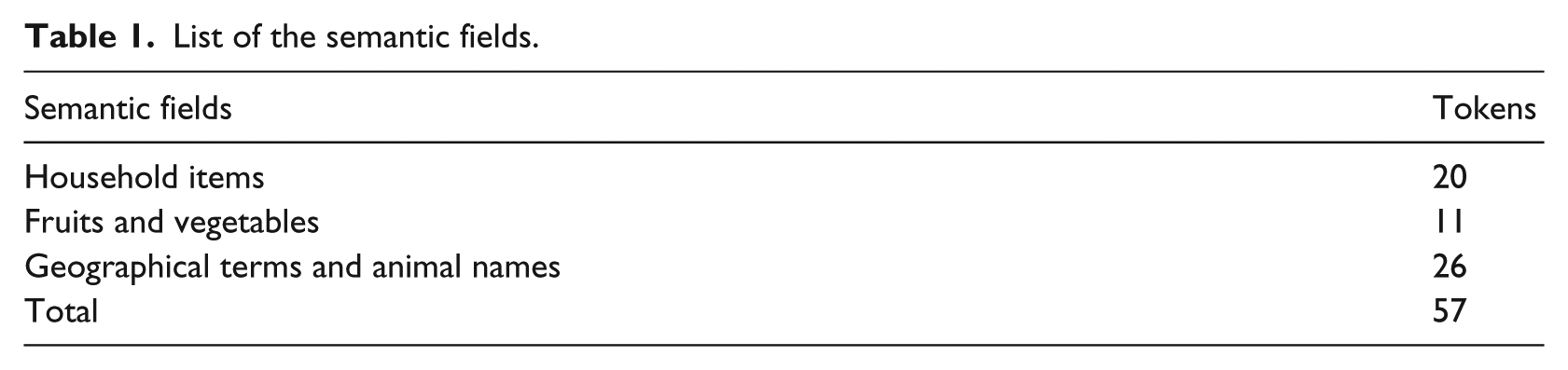
The study focused on basic vocabulary in the variety of the Arabic spoken in Çukurova region since, following Thomason and Kaufman’s (1991) borrowing scale, basic vocabulary is among the content words least vulnerable to borrowing in language contact. Earlier work suggests that some of the basic vocabulary in this variety is Turkish-origin, and we aimed to see how much of the basic vocabulary could be shown to be borrowed. Prior to the data collection, the semantic fields suggested to be vulnerable by Aytaç (1994), Karaağaç (2002) and Prochazka (2002) were adopted for analysis in the present study and a list of lexical items relevant to these fields was formed. The semantic fields examined in this research note include: household items; fruits and vegetables; and geographical names. The selected lexical items were screened using an essential Turkish Dictionary (1998) for words that were borrowed from Arabic into Turkish, and those were excluded from the analysis, leaving a list of 57 words (see Table 1 for their distribution over the semantic fields). In this study, a picture-naming task was used to collect data from 40 Turkish–Arabic bilingual speakers (18 male and 22 female) with an age range of 50 years and above. During the data collection the researchers, who were also Turkish–Arabic bilinguals, showed the pictures of the selected words to the Turkish–Arabic participants and the participants were asked to say which word, a Turkish or an Arabic one, they would normally use to name the particular concepts.
List of the semantic fields.
Findings
The data analysis revealed that of the 57 concepts, 38 were named by the Turkish-origin word by at least some of the participants. In the semantic field of household items, a Turkish-origin word was used to name 15 out of 20 items (Table 2).
Semantic field of household items.
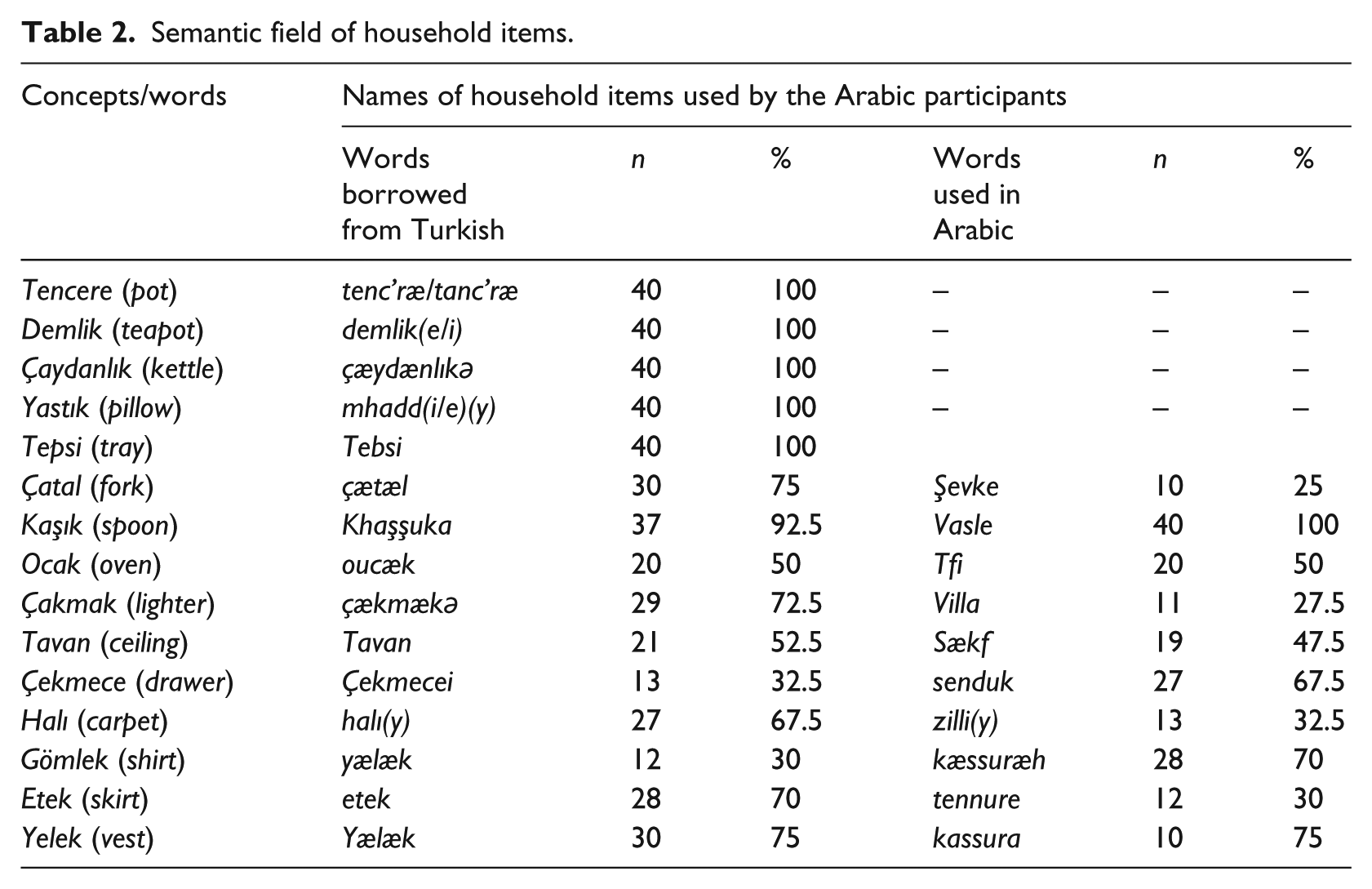
As is evident from Table 2, for ten household items, the Turkish-origin word co-exists with the Arabic one in the repertoire of the Turkish–Arabic participants. For example, 50% of the participants used the word oucæk (oven), which is a borrowing from Turkish, and 50% used the word tfi, which is of Arabic origin, to name an oven. In five cases (a pot, a teapot, a kettle, a pillow and a tray), the Turkish-origin word was used exclusively.
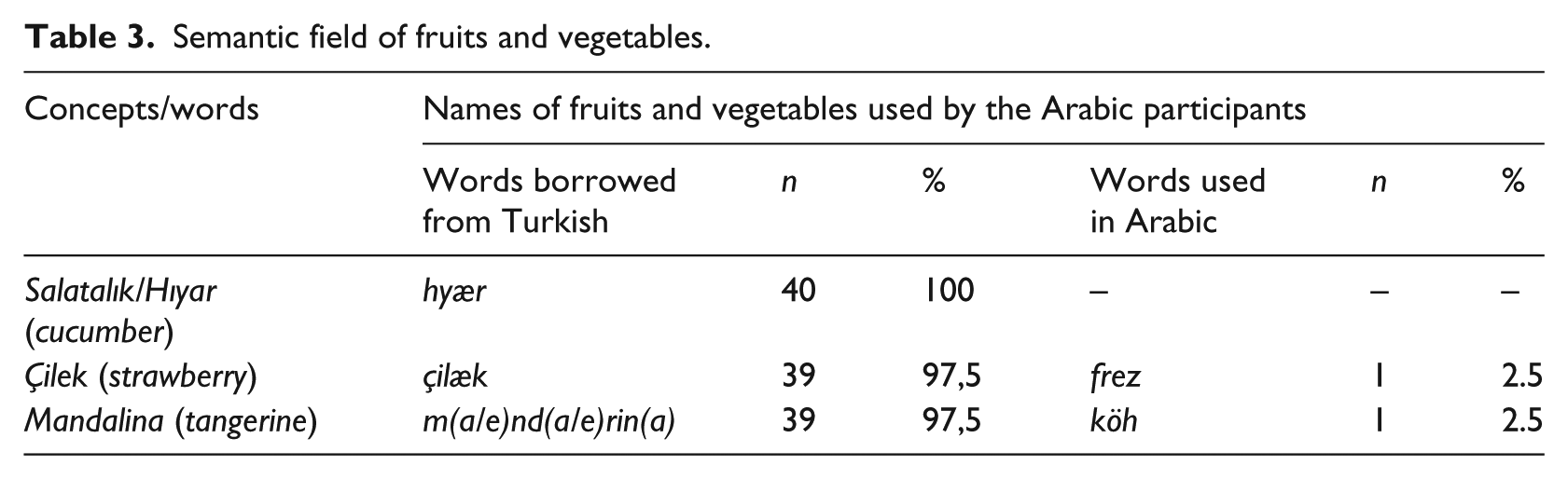
In the semantic field of fruits and vegetables, a Turkish-origin word was used to name 3 out of 11 items (Table 3). Only one participant used the Arabic-origin equivalent for a strawberry and tangerine.
Semantic field of fruits and vegetables.
In the semantic field of geographical terms and animal names, the Turkish-origin word was used to name 15 out of 26 items (Table 4).
Semantic field of geographical terms and animal names.
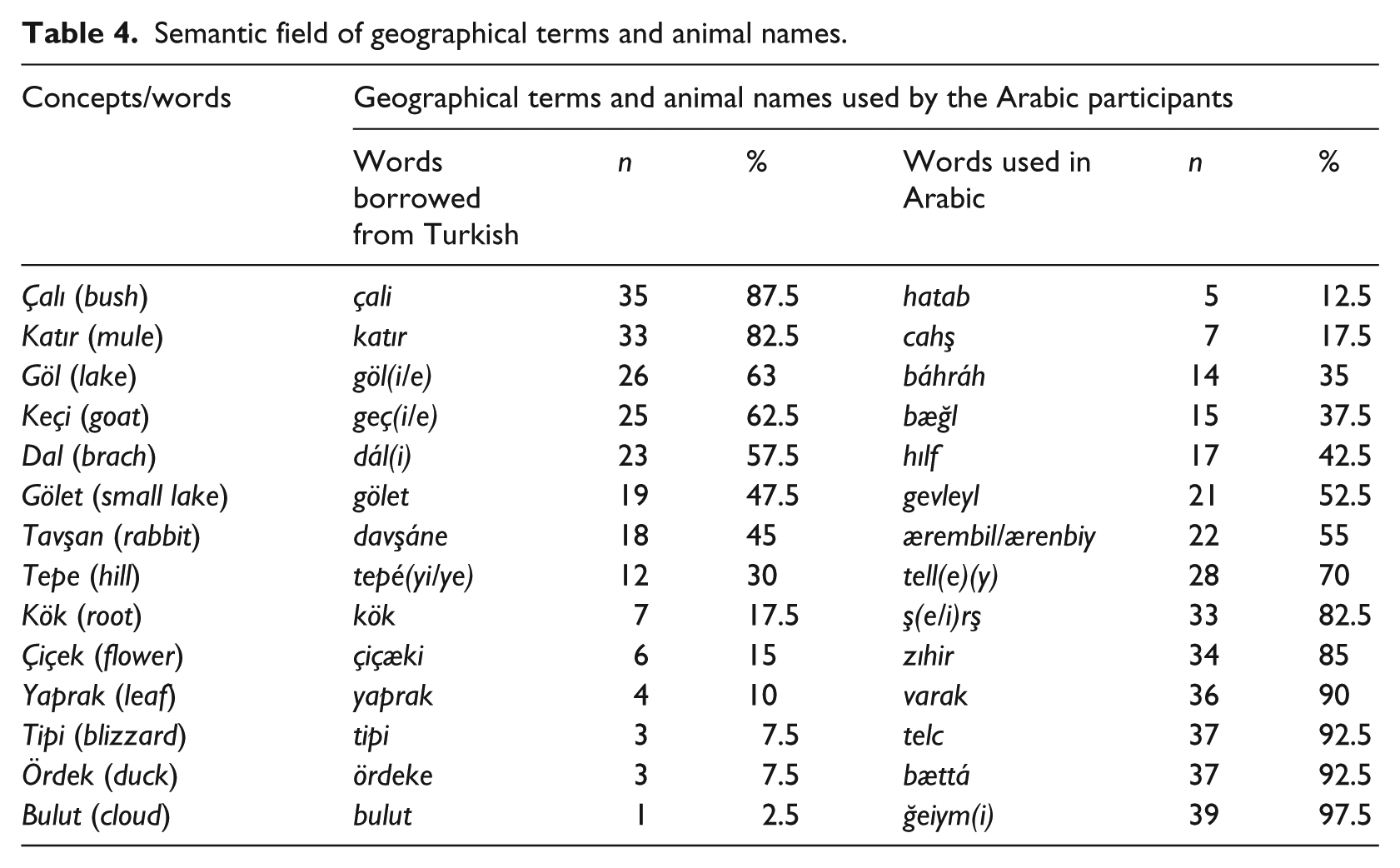
As it is evident from Table 4, in these cases, the Turkish-origin word was used by virtually everyone.
The data analysis further showed that the borrowed Turkish words were sometimes borrowed unchanged, while others went through some phonological changes.
The phonological changes observed included vowel and consonant changes as presented in the following examples.
(I) Vowel changes (a). short /a/ in Turkish is lengthened /a>ā/: (1) çatal çātāl
(fork) (2) ocak oucāk (oven)
(3) tavşan tavşāne (hare)
(4) dal dāli (branch) (5) çakmak çakmāka (light) (b). /ı/ changes to /i/: (6) halı hali (carpet) (c). /e/ changes to /eyi/ or eye/: (7) çekmece çekmeceyi (drawer)
Among the vowel changes, the most common pattern included the lengthening of the short /a/, change of the word-final vowel /ı/ into /i/ and the change of word-final /e/ into /eyi/ or /eye/.
(II) Consonant change (8) tepsi tebsi (tray)
As for the consonant changes the only pattern which the data revealed was the change of /p/ into /b/. Since /p/ is not available in Arabic, when Turkish words including this sound were borrowed into Arabic, /p/ changed into /b/.
To conclude, the data presented in this research note show that Turkish–Arabic bilinguals have incorporated particular Turkish lexical items into their Arabic and that they adapt some of them in accordance with the phonological features of Arabic. Following Thomason and Kaufman’s (1991) borrowing scale, the borrowing of basic vocabulary might be considered to reflect intensive contact between Turkish and Arabic in the region. On the other hand, the fact that many Turkish words are phonologically adapted to Arabic suggests less intensive contact. The fact that the Arabic-speaking community in Çukurova region has been in constant contact with the Turkish-speaking community for a very long time and that the people have been cut off from the rest of the Arabic-speaking world, are probably mediating factors. The first increases the possibility that some basic words get borrowed despite the tendency of languages to preserve their native basic vocabulary; the second makes it likely that knowledge of the Arabic equivalents has not gotten much reinforcement from the speech of other Arab speakers. Further study needs to investigate whether basic vocabulary is also borrowed in other semantic fields, how widespread the use of these borrowed words is, and why particular phonological adaptations occur and not others.
Footnotes
Declaration of conflicting interests
The author(s) declared no potential conflicts of interest with respect to the research, authorship, and/or publication of this article.
Funding
The author(s) received no financial support for the research, authorship, and/or publication of this article.