







Abstract
Aims and objectives/purpose/research questions:
Using a modified dot-probe task, the present research examined the time-course of attentional bias for culture-related cues in Mongolian-Chinese bilinguals.
Design/methodology/approach:
Using a mixed experimental design, children with different language fluency (fluent bilingual, limited bilingual and mandarin monolingual) were recruited (N = 168; 51% boys; Mage = 9.88 years, SD = 0.38 years; 59% Mongolian) to complete a dot-probe task in which they were shown pairs of pictures representing Mongolian and Han culture for short (60 ms) and long (500 ms) exposure durations. The difference between fluent and limited bilinguals lies in their proficiency in Mongolian.
Data and analysis:
The attentional bias scores (d) were entered into a 2 × 3 mixed design repeated-measures analysis of variance with language fluency (fluent bilingual versus limited bilingual versus monolingual) as a between-subjects variable and the time-course (60 versus 500 ms) as a within-subject variable.
Findings/conclusions:
In the task, compared with pictures representing Han culture, all students showed preferential attention to pictures conveying Mongolian culture across presentation durations. However, for 60 ms, fluent bilinguals showed a smaller attentional bias than did monolinguals, with no difference between limited bilinguals and monolinguals; there was no significant difference among the three groups at 500 ms.
Originality:
Relatively less research has been performed on comparative analysis between fluent and non-fluent bilinguals, and most of the culture-related content is measured by subjective methods. This study attempts to directly compare these two bilinguals’ attentional bias for culture-related cues using a dot-probe task.
Significance/implications:
The results of comparative analysis showed that fluent bilinguals were more familiar with Mongolian language and preserved their ethnic culture better, which may indicate a close relationship between language and culture.
Introduction
It is commonly accepted that language is a part of culture and that it plays an irreplaceable role in cultural heritage and culture exchange. Byram (2012) stipulates the inseparable relationship between culture and language, and that they cannot exist without each other (Jiang, 2000). Kramsch (1998) believes that the language used by the members of a social group has a natural association with cultural identity. Language can help individuals identify the self and others (Salomone, 2010), and it can also bind individuals and communities together (Simpson, 2007). Because the use of language in general is related to social and cultural values, language is considered to be a social and cultural phenomenon (Cakir, 2006). The heritage language is not only a tool of communication but also a symbol of cultural identity and a basis of national emotion (Ma & Dong, 2012). Based on these statements, if the heritage language disappears/weakens, then does this weakening mean the culture that matches this heritage language will lose/decline with it?
Compared with monolinguals, bilinguals have many benefits, both cognitively and socially (Verdon, Mcleod, & Winsler, 2014). However, bilinguals are divided into fluent and non-fluent bilinguals. There is also a remarkable distinction between these two groups (Jacob, Heyer, & Veríssimo, 2017; Karapetsas & Andreou, 2001; Kroll & Sholl, 1992). For Chinese adolescents, fluency in the heritage language plays a greater role in the ethnic identity of first-generation immigrants than in that of second-generation immigrants (Kim & Chao, 2009), suggesting better cultural preservation for fluent bilinguals. However, relatively less research has been performed on comparative analysis between these two types of bilinguals. Moreover, most of the culture-related content is measured by subjective methods, such as interviews (Imbens-Bailey, 1996) and questionnaires (Felixortiz & Others, 1994; Whitesell, Mitchell, Spicer, & the Voices of Indian Teens Project Teamet, 2009). Based on dual-process theory (Reber, 1993), these methods can measure only individuals’ explicit cognition, failing to measure implicit cognition, which plays a great role in people’s actual behavior. What will occur if objective indicators are tested by experiments?
Previous research suggested that there is a close relationship between language fluency and cultural identity. Yet, it is not clear how different levels of language fluency affect one’s culture. Further, there is a lack of research using experimental methods to examine the relationship between language fluency and culture. Thus, we asked two questions and attempted to answer the questions by examining the influence of language proficiency on culture, using experimental methods. Specifically, a sample of students with different levels of fluency in Mongolian and Chinese were recruited. Meanwhile, a modified dot-probe task was used to examine students’ attentional biases for culture-related cues in the current study. As culture-related cues may symbolize different cultures and compete for attention resources in the dot-probe task, attention bias toward a specific cultural symbol may indicate the levels of preference to a culture. Hence, we believe, measuring attentional bias toward cultural symbols relating to different cultures among students with different levels of language proficiency may serve to illuminate the relationship between language and culture.
Mongolian-Chinese bilinguals
Most Mongolian-Chinese bilinguals come from the Inner Mongolia Autonomous Region, which is an area where most Mongolian ethnic groups in China reside. The sixth census figures showed that the permanent Mongolian population in Inner Mongolia accounted for 17%, while the permanent Han population accounted for 79%. A large number of Han people live in Inner Mongolia, which is closely related to the Chinese history of “Zou Xikou.” “Zou Xikou” is one of the five most famous migration events in Chinese modern history. Inner Mongolia has a vast territory, a sparse population and abundant resources, with very good grassland natural conditions. The government has relaxed its immigration policies and encouraged inland farmers to develop agriculture in the Inner Mongolia area. Therefore, over the course of a long history of more than 400 years from the mid-Ming Dynasty to the early Republic of China, countless people in Shanxi, Shaanxi and Hebei left their hometown and went to Inner Mongolia. They opened up the economic and cultural channels of the Central Plains and the Mongolia prairie.
To promote the integration of these two ethnic groups, bilingual education is necessary. The government has recognized the importance of developing students as fully bilingual and bicultural. The significance of bilingual learning lies not only in the instrumentality of language but also in the deep multicultural inheritance. There are three different teaching modes (Type 1 Mode, M1; Type 2 Mode, M2; and Common Mode, CM) in Inner Mongolia, with two kinds of bilingual education. Regarding the three teaching modes, in the M1 of bilingual education, “all classes are taught in Mongolian, plus one class of Chinese.” Students’ main language is Mongolian, but they also have a good level of Chinese; thus, they are called fluent bilinguals. In the M2 of bilingual education, “all classes are taught in Chinese, plus one class of Mongolian.” Students’ main language is Chinese, and they almost lose their heritage language because of poor use; thus, they are called limited bilinguals. In the CM, “all children are placed in a Chinese only class.” Their main language is Chinese and, thus, they are called Mandarin monolinguals. Therefore, these three different teaching modes can directly reflect students’ fluency of Mongolian and Chinese.
Cultural symbol
Culture, which refers to the characteristics of a particular group of people (Zimmermann, 2012), contains a group’s history, traditions, beliefs, values, interpretation of reality, common sense and language (Riley, 2007). China is an ancient multiethnic country where most ethnic groups have their own cultures, languages and customs. In Inner Mongolia, generation after generation of Mongolians have lived on the prairie. Their culture is a typical grassland culture. However, the Han culture is a typical farming culture. Mongolian and Chinese also belong to different language families. Chinese belongs to the Sino-Tibetan language family, while Mongolian belongs to the Altai language family. Therefore, these two languages differ pronouncedly in writing, pronunciation, expression mode, language habits and grammar rules.
Cultural symbols, which can transmit cultural traditions from one generation to the next, are an abstract embodiment of an ethnicity or a country’s unique culture, and they are an important carrier of cultural connotations. Covering material and spiritual aspects of life, in this study, pictures (such as figures, words, utensils, food, clothes, musical instruments, myths and legends and wedding customs) that are related closely to people’s lives were chosen as culture symbols. These pictures, which can represent the Mongolian culture and the Han culture as experimental materials, have unique social values and significance for students under different language fluency.
Attentional bias and exposure duration
The dot-probe task has proven to be an effective measure of attention allocation and pre-attentive bias toward different kinds of stimuli. In this task, a pair of stimuli was presented on a computer screen for a fixed period of time (usually 500 ms), followed by the appearance of a visual probe in one of the two stimulus locations. Participants are asked to respond to the probe as soon as possible (MacLeod, Mathews, & Tata, 1986). According to the biased competition model, attention is the mechanism through which this conflict is resolved in favor of one stimulus over the other (Desimone & Duncan, 2003). That is, attentional bias can be interpreted as a preference (Innocenti, Rufa, & Semmoloni, 2008) or refer to the selective allocation of attentional resources to specific aspects of stimuli (Williams, 1988). Therefore, using this method, we can detect participants’ attentional bias toward different stimuli and how groups differ.
One advantage of the dot-probe paradigm is that we can investigate the time-course (the time between the onset of the stimuli and the appearance of the probe) of attentional biases by varying the stimuli exposure durations. A large number of studies have found that different exposure durations moderated the pattern of attentional biases (Yu et al., 2014). These findings revealed that different exposure durations can reflect different stages of attention processing, with short and long exposure durations reflecting automatic/unconscious attention and strategic/conscious attention, respectively (Friese, Hofman, & Wilers, 2011; Treisman & Gelade, 1980). With regard to the time-course, there is no consensus standard for short and long exposure durations. A short time-course involves an exposure duration of less than 67 ms (Kiefer, 2007), 70 ms (Bekhtereva, Craddock, & Müller, 2015), 85 ms (Bardeen, 2015), 100 ms (Cooper & Langton, 2006), 161 ms (Rabellino et al., 2017) and 300 ms (Huffman, Al-Aidroos, & Pratt, 2017), while a long time-course involves an exposure duration of more than 130 ms (Bekhtereva et al., 2015), 150 ms (Bardeen & Orcutt, 2011), 200 ms (Kiefer, 2007) and 500 ms (Rabellino et al., 2017).
On the one hand, for shorter durations, unusual/atypical items or materials with high salience features attract more attention and are detected faster than those items or materials that involve common items or low salience features (Boyer, Smith, Yu, & Bertenthal, 2011). When the cue is more salient, it is more likely to cause activation in the channels representing it, which, when the duration between the stimuli and probe is short, facilitates detecting that feature again (Huffman et al., 2017; Stein, 2012). Therefore, stimuli with visual salience can initially attract attention, and this attentional bias occurs automatically, reflecting a bottom-up control and a stimulus-driven process (Casagrande, Mereu, Martella, Marotta, & Marino, 2009; Itti & Koch, 2001; Klein, Wang, Dukewich, He, & Hu, 2015; Memelink & Hommel, 2013). On the other hand, when exposure durations are sufficiently long, the feature activation turns into habituation (Hu, Samuel & Chan, 2011; Klein et al., 2015). Individuals will adopt strategic processing because of the sufficient attentional resources, and the effect of automatic attention that is driven by physical characteristics (salience of stimulus) will likely be weakened. Therefore, a long time-course can reflect top-down expectations (Memelink & Hommel, 2013) that are influenced by the importance and social values of information (Treisman & Gelade, 1980).
Based on these findings, in this study, 60 and 500 ms were chosen as the short and the long time-courses, respectively. Regarding the former, 60 ms, this short amount of time does not allow any shifts in attention (Becker, 2012; Melfsen & Florin, 2002; Vasey & MacLeod, 2001), reflecting the automatic processing driven by the salience of stimuli; regarding the latter, 500 ms is long enough for top-down goal-directed mechanisms to exert an effect on attention allocation (Cooper & Langton, 2006; Rabellino et al., 2017; Wolters et al., 2012), reflecting the strategic processing affected by the importance of stimuli.
The current study
In this study, we use a dot-probe task to investigate the attentional bias of students with different language fluency. There are two primary aims: (Aim 1) to evaluate the attentional bias between fluent and limited bilinguals compared with monolinguals; and (Aim 2) to compare the difference between the automatic and the strategic processing stage by manipulating the exposure durations (60 or 500 ms) in the dot-probe task. For Aim 1, we predict that proficiency in one’s ethnic language will contribute to attentional bias: fluent bilinguals will show larger attentional bias than limited bilinguals, indicating that language fluency may be related to preference for a specific culture. With regard to Aim 2, because automatic processing is driven by the salience of stimuli and strategic processing is affected by the importance and social values of information, we anticipate that a difference will be found at 60 ms but not at 500 ms, indicating the different attentional biases to culture cues in the early and late stages of attention processing.
Method
Participants
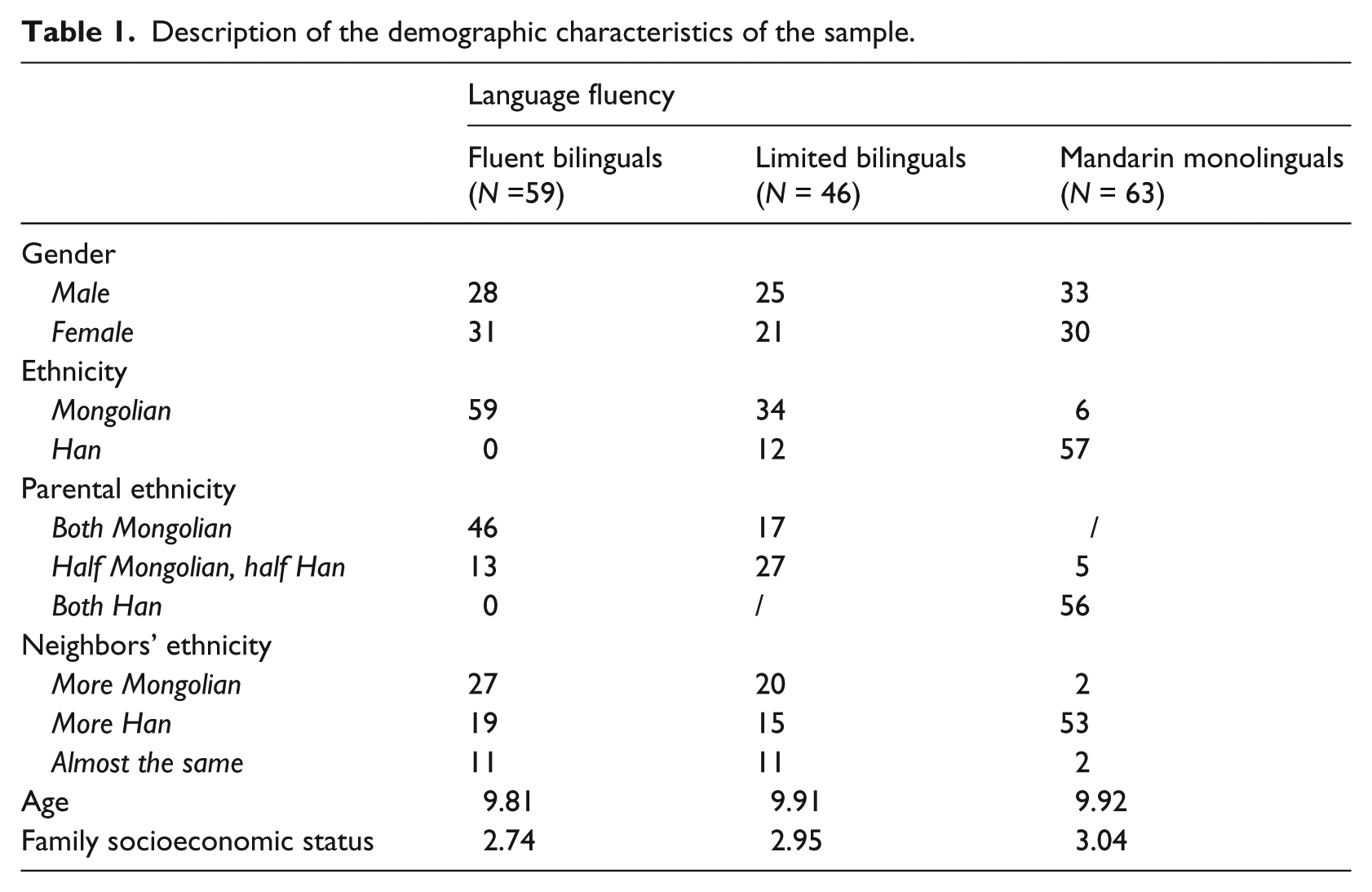
The sample for this study included 168 pupils in Grade Three under three different teaching modes in Hohhot City, Inner Mongolia, China (51% boys; Mage = 9.88 years, SD = 0.38; 59% Mongolian), with 59 fluent bilinguals (fluent bilinguals, 47% boys; 100% Mongolian), 46 limited bilinguals (limited bilinguals, 54% boys; 74% Mongolian) and 63 mandarin monolinguals (monolinguals, 52% boys; 10% Mongolian). There was a significant difference in ethnicity among the three groups, χ2(2, N = 167) = 152.11, p < 0.001, with most Mongolian students being fluent bilinguals (100%) and the least Mongolian students being monolinguals (10%). We also considered their parents’ and their neighbors’ ethnicity (Table 1). No differences were found for gender (χ2(2, N = 167) = 0.27, p > 0.05), age (F(2, 167) = 1.47, p > 0.05) or family socioeconomic status (F(2, 138) = 0.69, p > 0.05). All students reported normal or corrected-to-normal visual acuity and normal color vision.
Description of the demographic characteristics of the sample.
Procedure
This study was approved by the institutional review boards at the participating schools. All students were guided in Mongolian or Chinese by research assistants, depending on the students’ main language. The participants were informed that the measures and experimental task were voluntary. They completed the measures first and then performed the dot-probe task. The survey took less than an hour to complete. All students received stationery to thank them for their participation.
Materials and measures
The dot-probe task stimuli
The stimuli consisted of 32 picture pairs. We first collected 100 pairs of pictures that were Mongolian and Han cultural symbols from multiple channels. Secondly, we obtained 53 pairs of pictures after matching their content and tone. Finally, five students who know Mongolian culture well and five students who know Han culture well were asked to rate each pair of pictures on five-point Likert-type scales according to their conformity to the corresponding culture (1 = not at all representative; 5 = very representative) and matching degree of this pair of pictures (1 = not at all fitting; 5 = very fitting), which resulted in 32 most representative picture pairs, with a mean Mongolian culture conformity of 4.35 and a mean Han culture conformity of 4.14, in addition to a mean picture pair matching degree of 4.10.
All pictures were standardized by Photoshop CS2 software and unified with a white background (RGB: 255, 255, 255) and picture pixel quality of 200 × 200.
Language fluency
The present study also investigated the students’ self-reported language abilities, which have been proven to be reliable (Portes & Hao, 2002). The students’ fluencies in Mongolian and in Chinese were assessed by the following four items. (1) What is your Mongolian proficiency? (2) What is your Chinese proficiency? (3) How frequently do you use Chinese? (4) How frequently do you use Mongolian? All responses were based on a scale with the rating range was 0–100 points, with 0 being “very bad”/“never use” and 100 “very good”/“very frequent.” A higher score means a higher language level or more frequent use.
Experimental design and the dot-probe task
Experimental design
This study adopts a 2 (time-course: 60/500 ms) × 3 (language fluency: fluent bilingual/limited bilingual/monolingual) mixed experimental design. The time-course represents within-subject variables, and the language fluency is a between-subjects variable. The dependent variable is the correct reaction time for the students to respond to the probe.
Dot-probe task
E-Prime 2.0 software (Psychology Software Tools, Pittsburgh, PA) was used to present the stimuli and to record the responses during the dot-probe task. Each trial started with a fixation cross “+” (2 × 2 cm, 1000 ms), followed by the picture pair (3 cm apart, within 1.5◦ visual angle for each picture and 3.0◦ visual angle for the center-to-center distance of the two pictures), with one picture left and the other picture right of the center of the screen. One picture of the pair represented Mongolian culture and the other represented Han culture. The picture pair presentation time varied randomly between 60 and 500 ms. The students were told that a probe would randomly replace either of the displayed pictures. The probe could be either a “3” or an “8,” corresponding to the “F” and “J” on the keyboard, respectively (Figure 1). The students were asked to respond as quickly and accurately as possible. After their response, the probe disappeared, and the next trial began. The inter-trial interval was 500 ms. There were 32 picture pairs, and each pair was shown eight times (i.e., a total of 256 trials) to counterbalance the location of the probe (left or right), the location of either picture (left or right) and the presentation time (60 or 500 ms). The participants had 24 trials for practice. Each trial took 3 s, and all tasks took 12 min without a break.
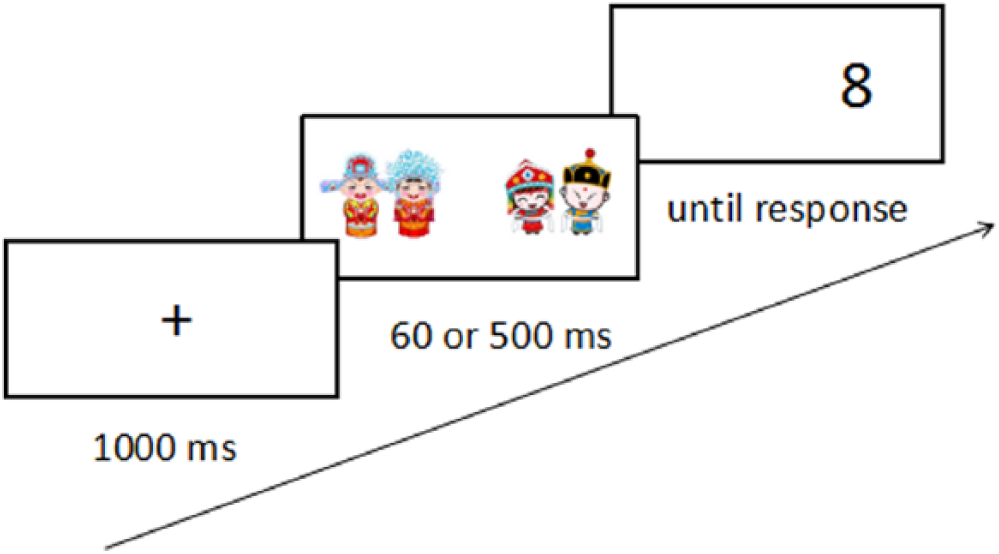
Procedure for the dot-probe task.
Results
Self-reported language fluency
We compared the three groups (M1, M2 and CM) on the self-reported items using variance analysis. Significant group differences emerged in language fluency (Table 2). Overall, the Chinese and Mongolian languages were well mastered by fluent bilinguals; there was no difference between limited bilinguals and monolinguals in Chinese fluency (MD = 1.88, p = 0.67), but limited bilinguals had a better grasp of Mongolian fluency than monolinguals (MD = 17.26, p = 0.001), but a weaker grasp than fluent bilinguals (MD = −39.85, p < 0.001). The result supports our grouping.
Self-reported language fluency among students under the three teaching modes.
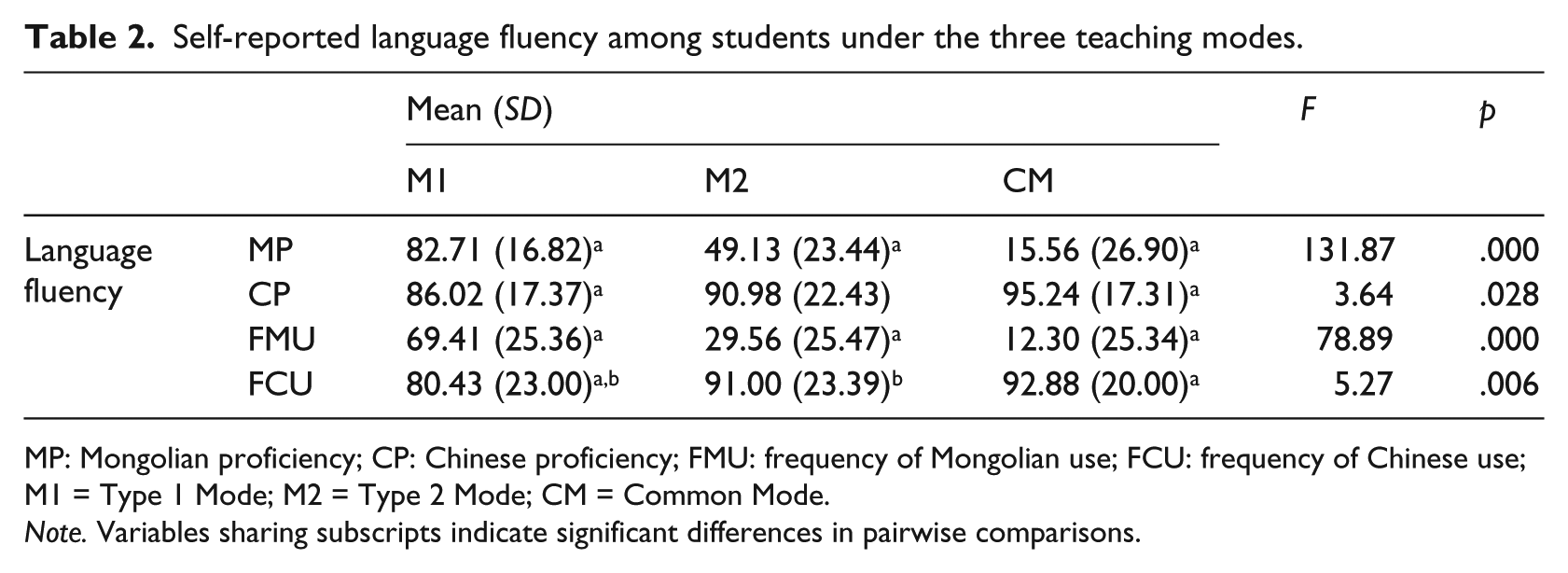
MP: Mongolian proficiency; CP: Chinese proficiency; FMU: frequency of Mongolian use; FCU: frequency of Chinese use; M1 = Type 1 Mode; M2 = Type 2 Mode; CM = Common Mode.
Note. Variables sharing subscripts indicate significant differences in pairwise comparisons.
Results for the dot-probe task
The data in the task were automatically recorded by the computer. Trials with errors, participant response latencies of less than 100 ms or greater than 2000 ms, an error rate of more than 20% or an average reaction time more than three standard deviations below or above the mean latencies were excluded from the analyses (Yu et al., 2014). A total of 150 students ultimately entered the analysis, with 54 fluent bilinguals, 40 limited bilinguals and 56 monolinguals.
To facilitate comparisons, a bias score (d) was calculated by subtracting the reaction time for probes following the pictures representing Mongolian culture from the reaction time for probes following the pictures representing Han culture (Yu et al., 2014). Thus, positive bias scores indicated that attention was directed toward Mongolian culture, whereas negative bias scores indicated attention to Han culture.
All the d scores were entered into a 2 × 3 mixed design repeated-measures analysis of variance (ANOVA), with language fluency (fluent bilingual versus limited bilingual versus mandarin monolingual) as a between-subjects variable and the time-course (60 versus 500 ms) as a within-subject variable (Figure 2). There was no significant language fluency × time-course interaction, F(2, 147) = 1.06, p = 0.35, η2 = 0.01, and no significant main effect of language fluency, F(2, 147) = 1.23, p = 0.30, η2 = 0.02; however, there was a significant main effect of time-course, F(1, 147) = 5.21, p = 0.02, η2 = 0.03. The d scores were significantly lower under the 60 ms condition (M = 35.06, SD = 5.14) than under the 500 ms condition (M = 53.30, SD = 6.01). The non-significant interaction between language fluency and time-course meant that no evidence supported the difference in attentional bias between two time-courses varied under different language fluency. However, one of the main aims of our study was to investigate the difference in attentional bias between 60 and 500 ms among three different language fluencies. Therefore, a one-way ANOVA of d scores was carried out in each exposure condition. The differences among the three groups were marginally significant at 60 ms, F(2, 147) = 2.69, p = 0.07, with a significant difference between fluent bilinguals and monolinguals (p < 0.05) and no difference between fluent bilinguals and limited bilinguals (p > 0.05) or between limited bilinguals and monolinguals (p > 0.05) by a post hoc test; in contrast, there was a non-significant trend at 500 ms (p > 0.05). In addition, a paired-samples t-test of the d scores was carried out for each language fluency to compare the difference between 60s and 500 ms. For fluent bilinguals, there was significant difference between these two conditions, t(53) = −2.31, p = 0.03, showing a stronger trend for Mongolian culture at 500 ms, but no differences were found for limited bilinguals and monolinguals, t(39) = −1.13, p = 0.27 and t(55) = −0.43, p = 0.67, respectively.
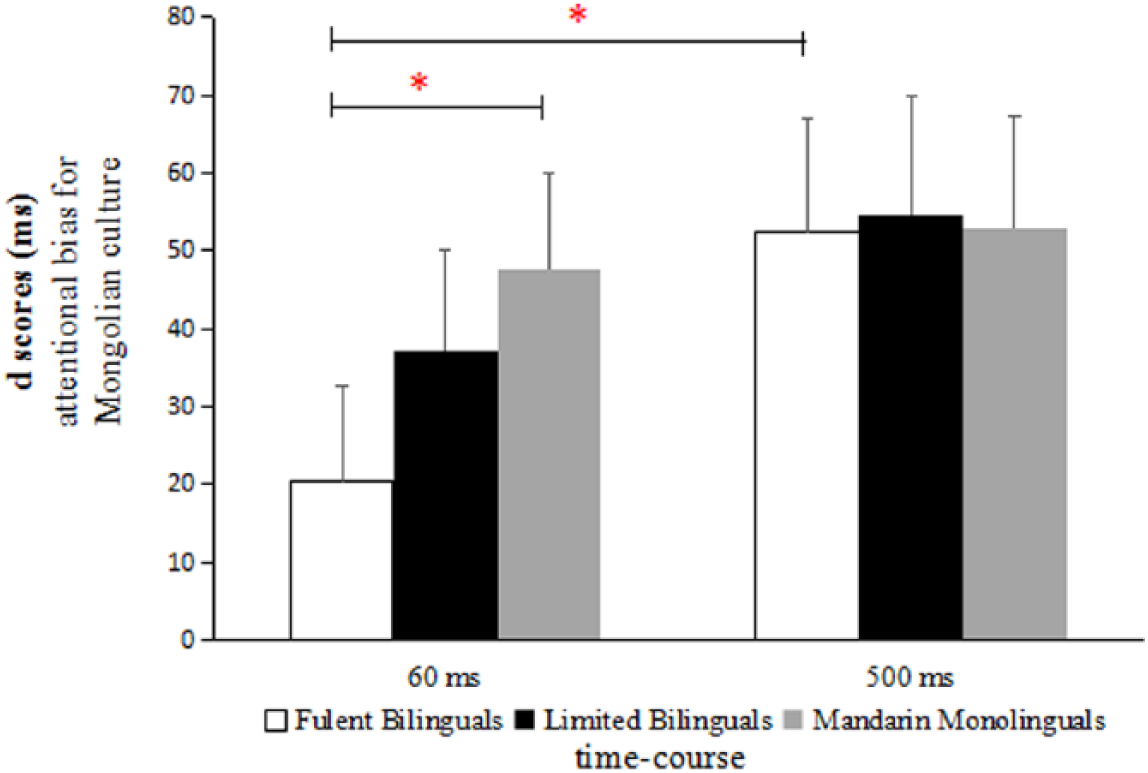
The d scores for the three groups at 60 and 500 ms.
To clarify whether there was attentional bias, one-sample t-tests between the d scores and the value of zero were performed within the two time-courses in each language fluency. Significant differences were found for all conditions (p < 0.05), as shown in Table 3.
D scores compared with the value of zero.
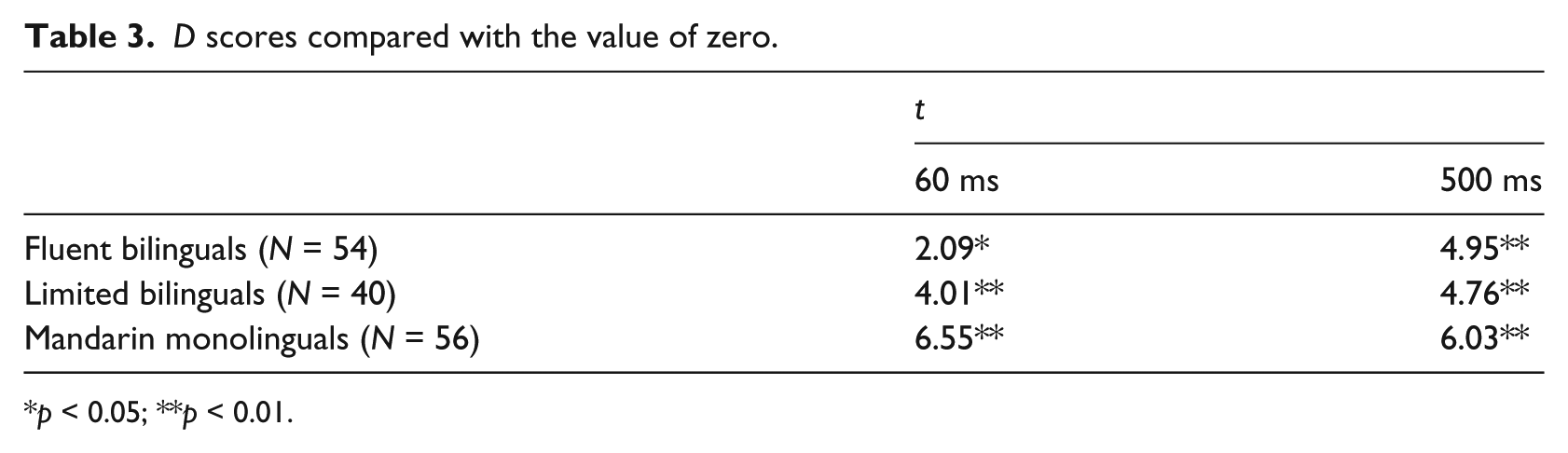
p < 0.05; **p < 0.01.
Discussion
Using a dot-probe task, this study examined attentional bias toward culture-related cues on a sample of non-immigrants in ethnic minority bilinguals and mainstream cultural monolinguals. All students were biased toward Mongolian culture rather than Han culture in the dot-probe task, but a difference between the two exposure times was found. There were differences across the three groups at 60 ms (automatic processing stage), with fluent bilinguals showing a smaller attentional bias toward Mongolian culture than monolinguals, while there was no difference between limited bilinguals and the students in other two groups. However, the difference disappeared at 500 ms (strategic processing stage). Using a behavioral experiment, we found a difference between fluent bilinguals and limited bilinguals, suggesting that the weakening of heritage language may be related to the lower familiarity to a specific culture. The current pattern of results supported the close relationship between language and culture. Future research may combine different experimental tasks to examine the language–culture relationship.
There are two possible reasons why all the students showed an attentional bias toward Mongolian culture. One is the saying “When a thing is scarce, it is precious.” Mongolian cultural symbols are currently rare in Inner Mongolia because of the high degree of modernization. In particular, the pupils are exposed to elements of Mongolian culture less and, therefore, Mongolian culture is unique to everyone. Students are more curious about this kind of information because of its rarity and salience. The other reason concerns the adaption to the environment. Living in Inner Mongolia, students may show their concern with and preference for Mongolian culture naturally. In addition, the different cultural groups need to gradually adapt to each others’ culture in continuous contact and finally reach a state of acculturation (Berry, Phinney, Sam, & Vedder, 2006). This claim is also in accordance with the Chinese traditional idea of “harmony but not sameness.”
It is important to note that there was a trend toward between-group differences in attentional bias at 60 ms, demonstrating pronounced difference between fluent bilinguals and monolinguals. The results are supported by previous studies. For example, in the task of recognition and recognition for the own ethnic face, the results are better than those with regard to alien faces because of the greater amount of contact with family members (Malpass & Kravitz, 1969; Slone, Brigham, & Meissner, 2000). The duration of 60 ms is a very short period of time, which can reflect the automatic processing driven by the salience of stimuli (Vasey & MacLeod, 2001). Based on the social cognitive contact hypothesis (Stephan, 1987), the more one is exposed to one culture, the more one will internalize and identify with this culture. Table 1 shows that the ethnicity for the majority of parents and neighbors is Mongolian for fluent bilinguals; thus, they come from culturally and linguistically diverse communities, which is the opposite for monolinguals. Limited bilinguals had limited exposure to the Mongolian environment. Therefore, the Mongolian cultural symbols are more salient, and it was easier to capture the attention for the monolinguals and limited bilinguals.
Based on previous studies, 500 ms is long enough to reflect strategic processing affected by the importance and social value of stimuli (Wolters et al., 2012). The greater the importance and high social value of one culture, the more people will pay attention to it. All students showed their preference for Mongolian cultural symbols consistently, which may be closely related to the Chinese history of “Zou Xikou.” This migration enhanced the national feelings between Mongolians and Hans. These two ethnic groups respect and cooperate with each other to reach a cross-cultural consensus, which has a positive impact on the prosperity and stability of our multiethnic country. The Han students’ preference for Mongolian culture can help them adapt to cross-cultures and support successful living in multicultural societies. Viewed from this perspective, it is not only the ethnic minorities that are affected by the dominant culture. Cultures are interacting with each other.
The current research has some implications for bilingual education. In order to cultivate a proficient and balanced bilingual in the national language and the Chinese language, we should enhance the opportunities for the two groups to communicate with each other, in addition to increasing the proportion of second language teaching. In this way, bilingual education may serve to preserve language and inheriting culture more effectively.
Limitations and future directions
Although the present results find different levels of attentional bias for culture-related pictures across cultural groups, there are several limitations that need to be addressed. Firstly, the current study was conducted with a sample of students living in Inner Mongolia, and it may not be applicable to students living in other ethnic minority areas or to minority and Han students living in non-ethnic minority areas. Future studies are necessary to explore students in other areas. Secondly, the pictures of the experimental materials are not edited into black and white. Considering that color is an important characteristic of culture, in this study, we kept the original color of the pictures. However, color may be a factor that affects attentional bias. Thirdly, the fluent bilinguals were Mongolian, and the majority of limited bilinguals were Han people. The proportions of Mongolian and Han were different in the three groups. We learned in our interviews that the ethnicity may not be an effective indicator to distinguish different groups. However, more studies are needed in the future to confirm that the results did not mix the language proficiency and the nationality. Finally, the current findings need to be interpreted with caution because of the non-significant interaction between language fluency and time-course. More research is warranted to investigate the influence of language on culture using experimental methods.
Conclusion
To summarize, this study revealed that all groups showed a preference for Mongolian culture. Fluent bilinguals showed different levels of attentional bias with monolinguals at the early stage (60 ms) of attention processing but not at later processing (500 ms). There was no difference between limited bilinguals and the other two groups at any stage of attention processing. Thus, fluent bilinguals were more familiar with Mongolian language and preserved their ethnic culture better than limited bilinguals, which may indicate a close relationship between language and culture.
Footnotes
Appendix
Material of picture-pairs.

| Picture-pairs | Mongolian cultural symbol | Han cultural symbol |
|---|---|---|
| 1 | ||
| 2 | ||
| 3 | ||
| 4 | ||
| 5 | ||
| 6 | ||
| 7 | ||
| 8 | ||
| 9 | ||
| 10 | ||
| 11 | ||
| 12 | ||
| 13 | ||
| 14 | ||
| 15 | ||
| 16 | ||
| 17 | ||
| 18 | ||
| 19 | ||
| 20 | ||
| 21 | ||
| 22 | ||
| 23 | ||
| 24 | ||
| 25 | ||
| 26 | ||
| 27 | ||
| 28 | ||
| 29 | ||
| 30 | ||
| 31 | ||
| 32 |
Acknowledgements
The authors would like to thank Sude bilige and Mei Yuan for their help in the early stages of this project.
Declaration of conflicting interest
The author(s) declared no potential conflicts of interest with respect to the research, authorship, and/or publication of this article.
Funding
The author(s) disclosed receipt of the following financial support for the research, authorship, and/or publication of this article: This work was supported by the Youth Education Project of the National Social Science Fund of China, “the Impacts of Bilingual Education in Ethnic Areas on Students’ Cognitive, Emotional and Socialized Development” (project number: CMA150131; grant number: 046/60381701) and the Key National Research Project of the National People’s Committee, “Study on the Cognitive Laws of Minority Students for Bilingual Learning” (project number: 2017-GMA-004; grant number: 2017-GMA-004).