







Abstract
Aims and Objectives:
This article examines semantic convergence of bilinguals’ two languages in the case of words that overlap semantically but are not fully isomorphic in meaning and application. To what extent do the type of bilingual, type of category, and relative semantic width across the languages matter?
Design:
The primary method involves eye tracking while participants chose pictures corresponding to an English word heard. The data examine potential differences in simultaneous Spanish–English bilinguals’, early Spanish L1–English L2 bilinguals’, and monolingual English speakers’ durations and numbers of fixations on potential candidates for referents.
Data and Analysis:
Thirty-eight participants were administered the task in relation to 48 English words from three types of words (classical, radial, and homophonic), half with wider semantic extension in English, half with wider semantic extension in Spanish. Durations and numbers of fixations were analyzed with ANOVAs with participant group, word type, and semantic width treated as variables.
Findings/Conclusions:
Data revealed minimal influences from Spanish on English with homophonic words, but for classical categories, and to some extent radial categories, bilinguals showed influence from Spanish on English words: participants considered referents that would be relevant for Spanish but not English.
Originality:
Eye tracking provides a window into the online processing of words and their referents, and thus provides more subtle clues to bilinguals’ processing of these categories relative to monolinguals’. The results support a special status relative to semantic convergence for words whose referents correspond to categories whose members lie close together in the conceptual space.
Significance/Implications:
For us to best account for semantic convergence in bilingual speakers, these data indicate that the type of category and the category structure in the conceptual space matter, the relative widths of the categories in bilinguals’ two languages matter, the task demands matter, and the type of bilingual matters.
This article examines convergence, or the inter-language influence, of bilinguals’ two languages. There is considerable literature examining morpho-syntactic and phonological influences, and also lexical access in bilinguals, but there is less concerning semantic interaction between bilinguals’ two languages. Of primary interest in all work on convergence is how bilinguals’ systems and processing deal with structural aspects that differ in their two languages, whether the concern is word order, determiner use, tenses, or something else. The manner in which bilinguals’ systems may or may not be similar to those of monolinguals has both theoretical ramifications regarding language in bilinguals and practical ramifications in relation to, for example, bilinguals’ comprehension and production in real-world contexts.
The focus here is on bilinguals’ use of words that differ semantically in their two languages, particularly words that overlap semantically but are not fully isomorphic in meaning and application. Prior research and anecdotal evidence suggest that such words can pose particular difficulties for bilinguals. For example, a five-year-old Spanish–English bilingual child gleefully exclaimed in a game, “Carlos, I am winning you!” for “beating you”; an adult L1 English–L2 Spanish speaker, asking if the addressee was going to play drums with a friend, said “Va (a) jugar con Chris?” (‘Are you going to play with Chris?’), where tocar should have been used instead of jugar); 1 and French President Macron recently complimented the Australian Prime Minister’s wife by saying, “I wanted to … thank you and your delicious wife for your warm welcome,” where he meant “delightful” instead of “delicious.” In all of these cases, a single word in the L1 subsumes two contrasting words in the L2: Spanish ganar covers both win and beat; English play both jugar (‘play (a game)’) and tocar (‘play (a musical instrument)’), and French delicieuse both delicious and delightful.
Such overlapping words can be found in any two languages. To what extent is there semantic convergence in fully fluent bilinguals in such cases? Do simultaneous versus sequential bilinguals differ? What is the relationship between linguistic semantics and cognition in the impact observed? We argue that the type of category and the category structure in the conceptual space matter, the relative widths of the categories matter, the task demands matter, and the type of bilingual matters in the phenomena observed.
Background
Two early models addressing the relationship between words and meanings in bilinguals’ two languages in relation primarily to L2 speakers were the Word Association Model and the Concept Mediation Model (Potter, So, Von Eckardt, & Feldman, 1984), later updated to the Revised Hierarchical Model (Kroll & Curley, 1988; Kroll & Stewart, 1994). These held that the L2 word gets mapped directly onto the L1 word or onto the concept underlying the (common) meaning of the L1 and the L2, with a possible progression from word associations toward concept mediation with greater L2 proficiency. These models were largely based on translations to and from the L1 and L2 and on crosslinguistic priming, but focused on cross-language equivalents in the two languages. When extensionally (referentially) or intensionally (semantically, see Fitting, 2015) equivalent words are considered, then it makes sense that one might wish to equate semantics and concepts, and it makes sense to ask whether the L2 word is mapped onto the L1 word or directly to the concept.
However, language relations are rarely so clear-cut. Even with simple examples like those above, there is not usually a one-to-one correspondence between the two languages. Accordingly, some studies of semantics in bilinguals and L2 learners have examined how speakers deal with the multiplicity of ways in which the words of their languages might be related – sub-set relations, overlapping relations, mis-matches, and the like (Elston-Güttler & Williams, 2008; Jarvis & Pavlenko, 2008; Malt & Majid, 2013; Prior, MacWhinney, & Kroll, 2007; Stockwell, Brown, & Martin, 1965; Tokowicz, Kroll, De Groot, & van Hell, 2002). Studies have documented inter-language influences between the two systems of bilinguals, especially L2 bilinguals, in such cases, in areas such as “personal space” and “privacy” (Pavlenko, 1999), causal expressions (Wolff & Ventura, 2009), categories for “dishes” and “bottles” (Ameel, Storms, & Sloman, 2005; Malt & Sloman, 2003), and placement verbs (Gullberg, 2009). Some suggest that in learning such non-isomorphic systems, the L2 learner undergoes reorganization of the conceptual space with the addition of the L2 (Jarvis & Pavlenko, 2008; Lucy, 2016; Pavlenko, 1999, 2009). Others suggest that word types may differ – e.g., concrete words may have a shared conceptual store across languages while abstract words may have language-specific stores (van Hell & de Groot, 1998).
We have argued (Gathercole, Stadthagen-González, Pérez-Tattam, & Yavaș, 2016; Gathercole & Moawad, 2010; Viñas-Guasch, Gathercole, & Stadthagen-González, 2017) that, because word meanings even within a single language can vary considerably in their complexity, we also need to consider the internal semantic complexity of the words within the individual languages to understand where semantic interaction may occur. We have separated words into three major types, according to the relation between linguistic encoding and the conceptual space. If we consider any two items, x and y, in the conceptual space, as depicted in Figure 1, those items might lie close together and be conceptually homogeneous, as on the left side of the figure, or they might lie far apart and be conceptually distant, as on the right. For example, fingers and toes share many similarities, while candles and sails do not. In between these, two items might be similar but clearly distinct, such as an arch and a bow (as in “bow and arrow”). While one language, like English, may have different words to refer to the x and y in each case, another language may have a single word that pulls x and y together under the same label. Spanish has a single word, dedo, that encompasses fingers and toes, one form, vela, that is used for both candles and sails, and a single word, arco, that refers to both arches and bows (see Figure 2). Examples for the converse situation, for which English has one word and Spanish two, are, on the conceptually close end, wall – pared (internal wall), muro (external wall); on the conceptually distant end, chest – pecho (on a human), baúl (as in treasure chest); and in between, cap – gorra (type of hat), tapa (as on a pen).
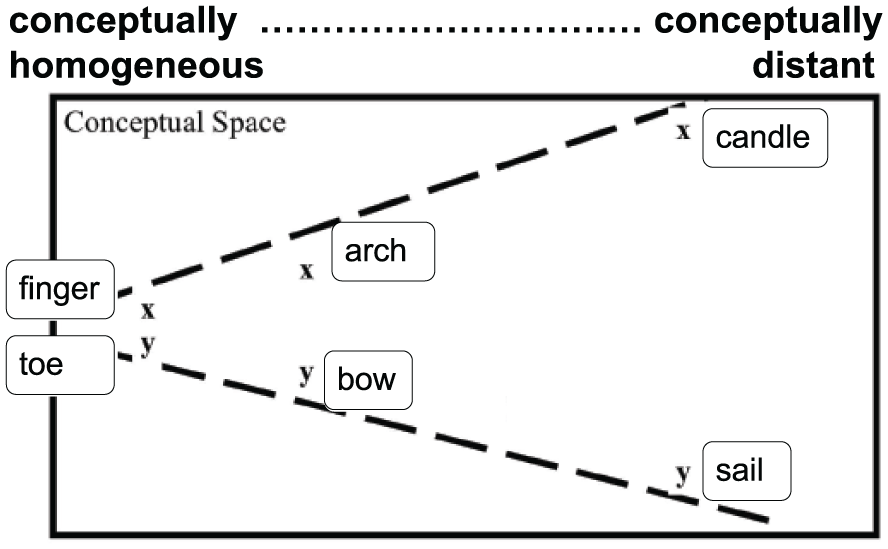
Location of X and Y in conceptual space, English labels.
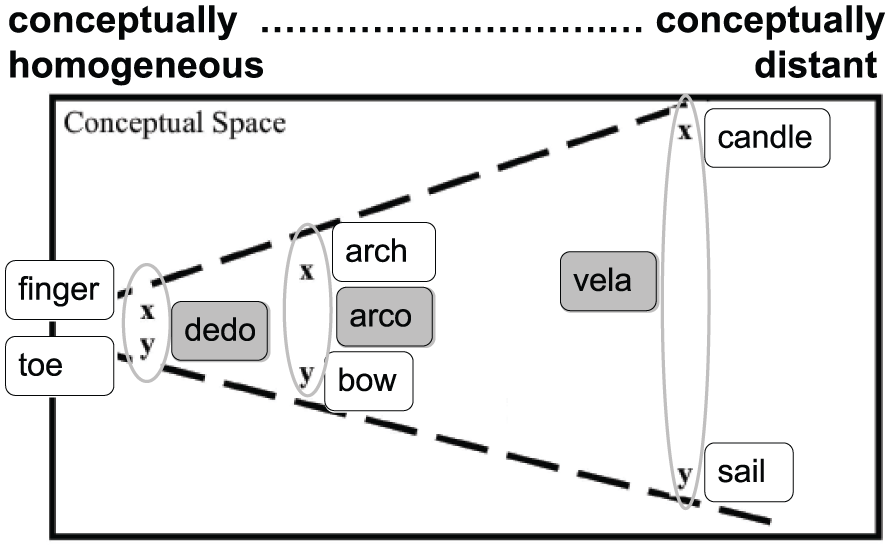
Location of X and Y in conceptual space, English labels and Spanish labels.
The words falling along this continuum of distance in the conceptual space can be classified into three major types.
“Classical” categories (Lakoff, 1987) – there are necessary and sufficient conditions for membership in the category. For example, dedo can be defined as [+appendage to arm/leg, +1 of 5, +human]. These criterial features highlight the “similarity” of the referents of the word, all lying close together in the conceptual space.
“Radial” categories (Lakoff, 1987) – there are differential uses of the word (one of which is central) that are linked via extension based on, for example, metaphor, metonymy, parallel structure (see Gathercole et al., 2016, for Radial Taxonomic vs. Radial Thematic categories). The referents are less similar than in classical categories, but, despite their clear dissimilarity, some commonality links them – for example, a bow has the same shape as arches. In radial categories, there are no necessary and sufficient conditions that apply to all uses, but the applications of the word are conventionalized, and the links are what Lakoff calls “motivated,” or make semantic sense.
Control: Homophonic words – pairs of words, like vela in Spanish, that have the same pronunciation. Their referents are so distant conceptually that no one would consider them to belong to the “same” category, even though the language is “offering” that possibility. Homophones are traditionally considered two words, two categories. They thus serve as a type of control for comparison with single words that are either unspecified (Sennet, 2016) with respect to possible internal differences, as for classical categories, or polysemous with respect to meaning, as for radials.
In our work, we have asked whether these different types of words provide differential evidence on (a) the extent of inter-language semantic impact in the language of bilinguals, especially simultaneous and early sequential bilinguals, (b) the location of inter-language semantic influence, (c) the direction of inter-language impact (some have suggested that the wider language always “wins out”; Alferink & Gullberg, 2014), and (d) the extent to which non-linguistic cognition plays a role in interaction. The procedure in these studies has largely consisted of picture choice tasks, asking the participant what item(s) can be called by a given word. These studies have provided insight on the contributions of the type of word involved and of the relative semantic width between the two languages, and on the direction of influence.
Two studies that involved picture choice tasks with six simultaneous choices were those reported in Gathercole and Moawad (2010), involving Arabic–English bilinguals, and Gathercole et al. (2016), involving Spanish–English bilinguals. In both cases, the method entailed words of the above types that differed in breadth of application in the bilinguals’ two languages.
Participants were shown slides like that shown in Figure 3 and asked, in the relevant language, to identify all items (if any) that could be called, for example, “leg.” In every slide, there were two “target” items: “T1” (item E in Figure 3) was the referent that is appropriate for both the term in the wider language (here, leg in English) and the term in the narrower language (here, pierna in Spanish). “T2” (item A in Figure 3) was the referent that is relevant only to the term in the wider language (leg in English), but not in the narrower language (pierna in Spanish). (This use of “T1” and “T2” is followed throughout in the studies reported below.) In the Arabic–English study, participants were early (before age 6) and late (after age 12) L2 learners of English (as well as monolinguals in each language); in the Spanish–English study, participants consisted of monolinguals and three types of bilinguals – simultaneous bilinguals born and raised in Miami; early sequential bilinguals born and raised in Miami; and sequential bilinguals arriving in the USA between the ages of 2 and 13 with Spanish as their L1 and English as their L2.
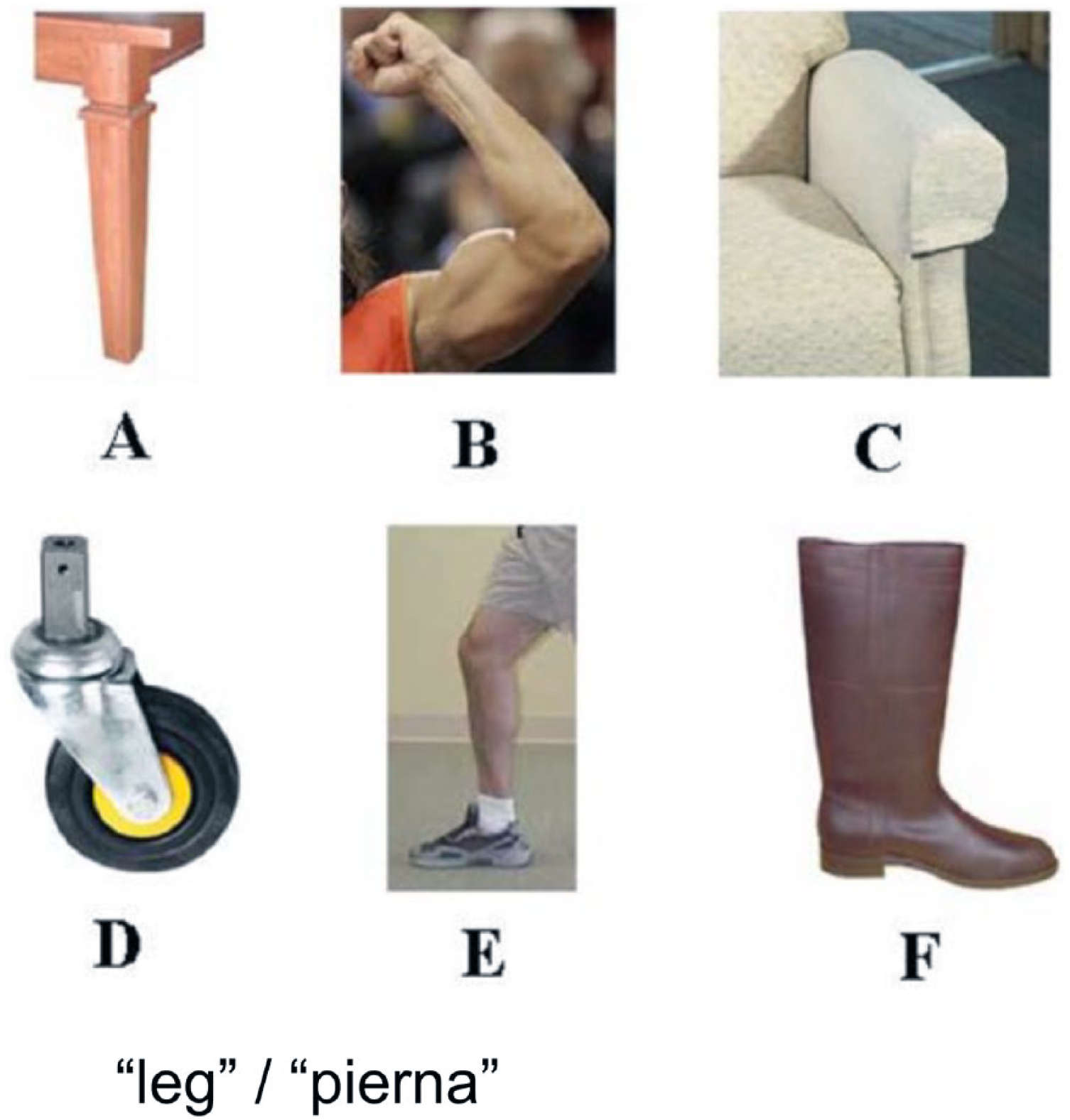
Sample slide in picture choice tasks.
In both studies, one general result was a difference in accuracy by width depending on the category type. It was easier for participants to respond correctly to the homophones when the language had the narrower application (for which the correct response was the choice of a single item) than when it had the wider application (for which the correct response was the choice of two targets). Thus, for example, doll in English and murciélago (an animal bat) in Spanish are easier than bat in English (for both a baseball bat and the animal bat) and muñeca in Spanish (for both “doll” and “wrist”). In contrast, for classical words, it was easier to respond when the language had the wider application, as for bell in English (for both a church-type bell and a jingle bell) or dedo in Spanish (for both fingers and toes) than when it had the narrower application, as for finger in English or campana (only church-type bells) in Spanish.
Additionally, there was an effect of participant group in either language. For example, for the Spanish–English study, there was a high level of parity in English, but in Spanish, both early bilingual groups performed less well than monolingual Spanish speakers; in the Arabic–English study, in English, when English was the narrower language, early bilinguals performed less well than monolingual English speakers on the homophones, and both the early and the late bilinguals performed less well than the monolinguals on the classical items; in Arabic, the bilinguals’ L1, there was general parity across groups when Arabic had the wider categories, but when Arabic had the narrower categories, the early bilinguals performed less well on classical words than both the monolinguals and the late bilinguals. These data suggested that while bilinguals who are weaker in an L2 (e.g., late Arabic–English bilinguals) may under-apply the wider categories in the L2, more advanced/proficient bilinguals show special vulnerabilities in the classical domain, as demonstrated by the Spanish–English bilinguals in both languages and by the early L2 Arabic–English bilinguals in Arabic when Arabic had the narrower classical categories.
In a follow-up study, McLeod (2015) conducted a similar task with Portuguese–English (P-E) bilinguals living in the USA, but with four stimuli per slide. Each slide contained a picture of either T1 or T2 (but not both), plus three distractors. Separating the targets onto different slides could clarify the reasons for earlier results showing differential effects on classical and homophonic items by width. Was the fact that narrower homophones were easier than wider homophones, and that wider classical items were easier than narrower classical items a function of the word type or a product of perceptual properties of the stimuli? It could be that classical items are more “naturally” inclusive of similar referents, while homophones are more naturally exclusive. Alternatively, it could be that when examining six-picture slides, it was easier to find two (similar) referents on the classical slides and harder to find two (dissimilar) items on the homophone slides. If, when T1 and T2 appeared on distinct slides, participants still showed such an effect of word type by width, this would argue in favor of the former; if the effect disappeared, it would argue in favor of the latter. McLeod’s study showed no word-type-by-width effect (in fact, participants showed somewhat better performance on the T2 slides of homophones than on T2 slides of classicals, contrary to the previous effects). This supports the view that the differential effects found in the previous studies could be attributed to the perceptual properties of the six-picture stimuli, not to deep-seated differences in the processing of homophonic and classical categories.
The results also showed that, for English, when English was narrower than Portuguese, there was evidence of extending the Portuguese range to the English terms. In Portuguese, the P-E bilinguals also showed influence of English on Portuguese, especially with classical items for which Portuguese was narrower than English.
These results collectively revealed particular vulnerability of classical categories, with “bleeding” from one language to the other in both directions. However, all these studies relied on participants’ overt responses. It may be that bilinguals’ overt responses look identical across groups, but that speakers of different groups arrive at their responses differently. In order to examine more closely the extent to which bilinguals’ covert processing of these types of stimuli is influenced by their knowledge of the two languages, we conducted an eye tracking study with simultaneous and early sequential Spanish–English bilinguals.
Method
Stimuli involving words in relation to sets of four pictures were shown to adult Spanish–English bilinguals and English monolinguals to examine their processing of English words.
Participants
Thirteen monolingual English (MonE) speakers (mean age 23.9), 12 simultaneous (SimBil) bilinguals (exposed to English and Spanish at home from birth) (mean age 24.2), and 13 EarlyL2 bilinguals (exposed to English before age 5) (mean age 25.7) participated. Participants completed the PPVT III (Dunn & Dunn, 2007) for English vocabulary, and the bilinguals also completed the TVIP (Dunn, Padilla, Lugo, & Dunn, 1986) for Spanish vocabulary. The mean raw vocabulary scores for English were comparable across groups, and at or above adult norms: MonE 206.5, SimBils 206, and EarlyL2 207.5 (norm: 196); the mean raw vocabulary scores for Spanish were comparable for the two bilingual groups, 107.3 and 112.5 for the SimBils and EarlyL2 bilinguals, respectively (norm: 106).
Stimuli
Linguistic stimuli
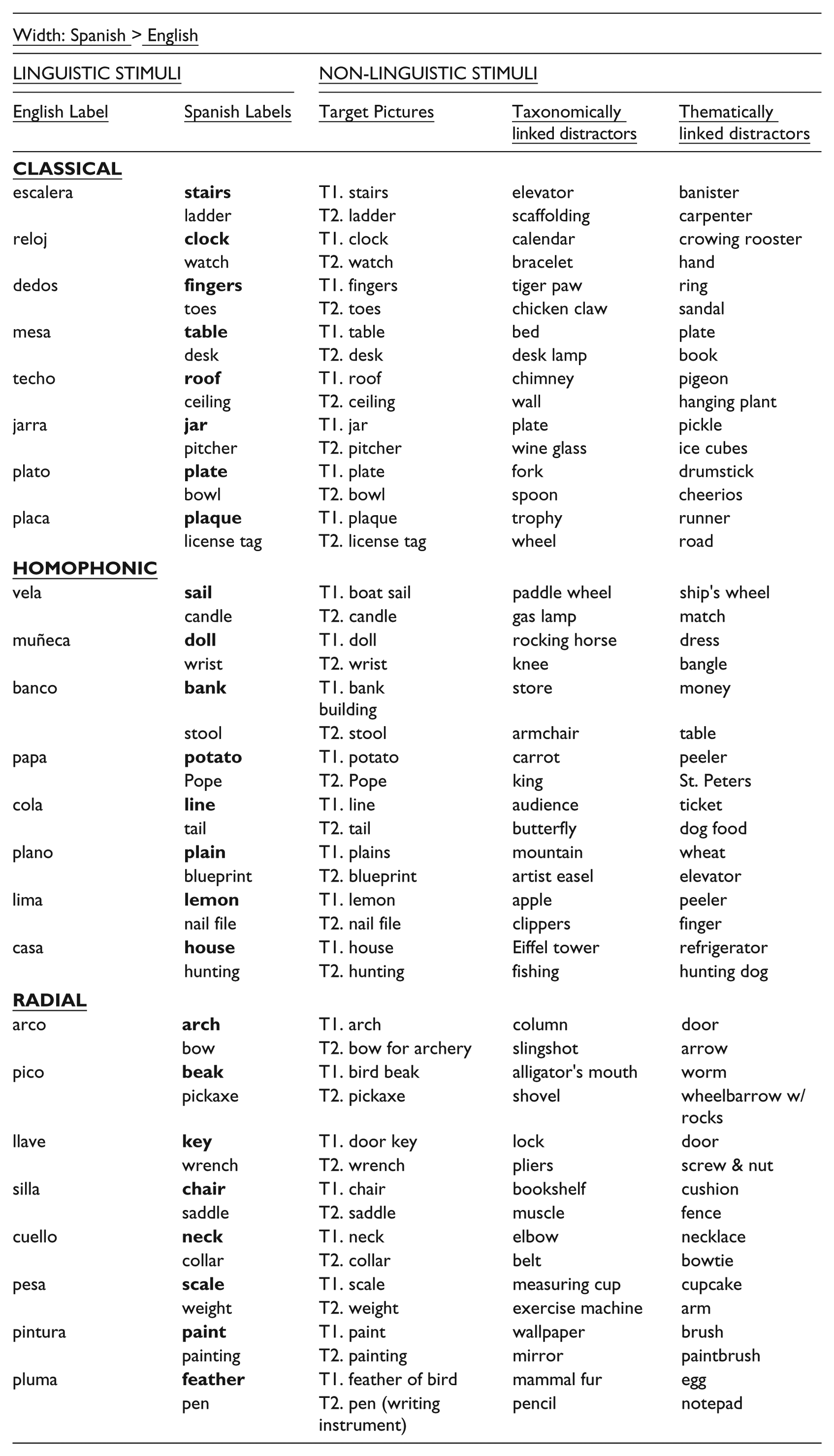
Stimuli words fell into the three category types identified above, classical, radial, and homophonic words. We tested 24 sets of words in which English was wider, 24 in which Spanish was wider, eight sets for each word type and width (see Appendix 1). The word used was always the term for the T1 referent, whether the English word was wider or narrower than Spanish. This word was appropriate for the T1 slide; a correct choice would be the choice of the picture depicting the T1 referent. When English was the wider language, this word was also appropriate for the T2 slide, and choice of that target item was considered correct; however, when English was the narrower language, the word was not appropriate for the T2 slide, so the appropriate response was to indicate that none of the pictures depicted the word heard. Verbal stimuli were recorded by native speakers of English and were presented aurally along with the pictorial stimuli. Each word was tested in relation to both T1 and T2.
There were sixteen practice trials, involving categories that did not differ between languages (e.g. two shades of blue). Practice trials included eight words presented twice.
Non-linguistic stimuli
For each word, there was one slide in which T1 occurred alongside distractors, and another in which T2 occurred alongside distractors, for a total of 96 (plus 16 practice) slides. Each slide depicted one ‘target’ stimulus, one taxonomically linked item (belonging to a superordinate category of the target), one thematically linked item (associated with the target item in some way), and one unrelated distractor (See Appendix 1).
The items were presented in four randomized orders, and each target was placed in two different positions, for a total of eight variants of presentation, which were counterbalanced across participants in each language group.
Procedure
Each participant was tested individually. Language background surveys and vocabulary tests were administered before the semantic categorization task. Each participant heard only English stimuli. We used the Tobii Eye Tracker Pro T120 to measure eye movements.
At the start of each trial, a central fixation point appeared on the screen while participants heard the audio stimulus twice, followed by a slide with four pictures. They were then to give, as quickly as possible, the letter associated with the picture that corresponded to the word they heard, or to say “none” if there was no match.
Results
Participants’ responses were examined in four analyses: (a) accuracy of choices of target items (T1 and T2), (b) latency to first fixation on the target item, (c) fixation duration on each picture, (d) number of fixations on each item (see Allopenna, Magnuson, & Tanenhaus, 1998; Conklin & Pellicer-Sanchez, 2016).
Accuracy of choice of target items
The response for each trial was coded with one point if it was correct and zero points if it was incorrect. Choice of T1 in both widths and choice of T2 in the English wider (E>S) condition were coded as (1), and choices of T2 in the English narrower (S>E) condition were coded as (0) because in English, target choices in S>E T2 slides were incorrect. ANOVAs examined these accuracy scores by word type (classical, homophonic, radial), width (E>S, S>E), slide type (T1 slide, T2 slide), and language group (MonE, SimBil, and EarlyL2).
Analyses revealed significant main effects of word type, F(2,70)=27.1, p<.001, width, F(1,35)=15.3, p<.001, slide type, F(1,35)=220.2, p<.001, and participant group, F(2,35)=4.3, p=.022. The effect of word type revealed higher performance on homophones (7.27, SE=.062, out of 8) than on either classical (6.54, SE=.081) or radial (6.73, SE=.094) words, ps<.001 (multiple comparisons with Holm-Bonferroni correction, used throughout below for all multiple comparisons). The effect of width revealed better performance on E>S words (7.07, SE=.069) than on S>E words (6.62, SE=.088). Participants performed better on T1 slides (7.41, SE=.047) than on T2 slides (6.29, SE=.081). And EarlyL2 bilinguals (6.65, SE=.093) had lower overall scores than MonE speakers (7.03, SE=.093), p=.006. (SimBils, 6.86, SE=.097, were not significantly different from either of the other groups.)
These main effects were modified by significant interactions of Slide Type X Participant Group, F(2,35)=9.10, p=.001, Word Type X Width, F(2,70)=18.11, p<.001, Word Type X Slide Type, F(2,70)=102.37, p<.001, Width X Slide Type, F(1,35)=14.57, p=.001, Word Type X Width X Slide Type, F(2,70)=36.11, p<.001, and Word Type X Slide Type X Participant Group, F(4,70)=2.68, p=.039.
Performance by Word Type X Width X Slide Type is shown in Figure 4.
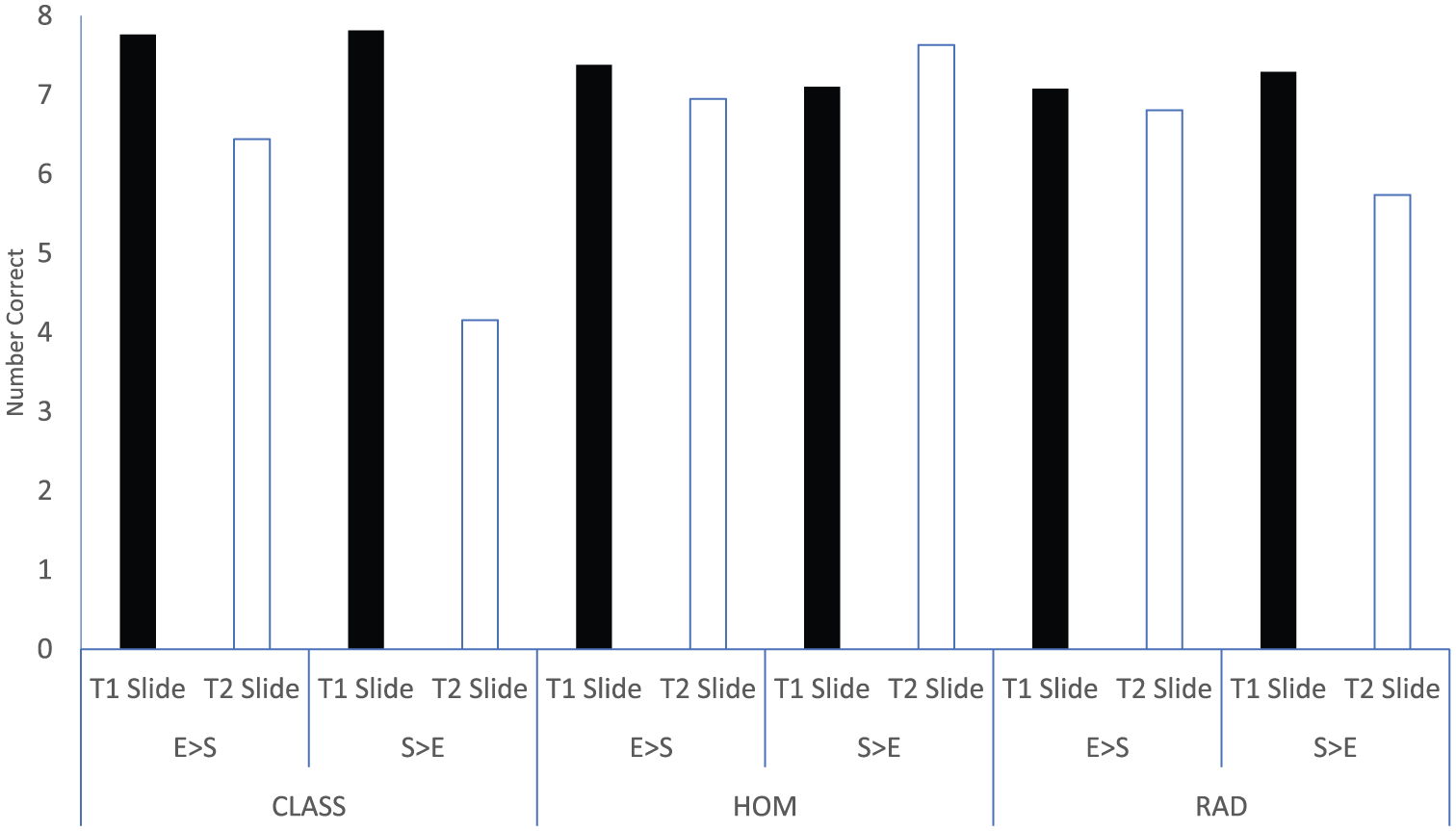
Accuracy, by word type, width, and slide type.
Paired-sample t tests comparing performance on T1 slides and T2 slides in each word type and width indicated that, overall, participants were more accurate on T1 slides than T2 slides for E>S classicals, t(37)=8.20, p<.001, S>E classicals, t(37)=10.69, p<.001, and S>E radials, t(37)=8.64, p<.001, and more accurate on T2 slides for S>E homophones, t(37)=-3.14, p=.003. This commonality across the groups reveals, first, with S>E slides, for classicals and radials, it was easier to accept the correct T1 referent on T1 slides than to reject the incorrect T2 referent on T2 slides, and for homophones, it was easier to reject the incorrect T2 referent on T2 slides than to accept the T1 referent on the T1 slides. Second, for E>S classicals, it was easier to accept the correct T1 on the T1 slides than to accept the correct T2 on the T2 slides.
Given the commonality across participant groups in differential performance on the T1 and T2 slides by width, the interaction of Word Type X Slide Type X Participant Groups was explored further with t tests comparing performance by participant group for each word type by width by slide type condition. Performance is shown in Figure 5. The EarlyL2 bilinguals had lower scores than MonE speakers for S>E T2 classical items, t(24)=3.90, p=.001.
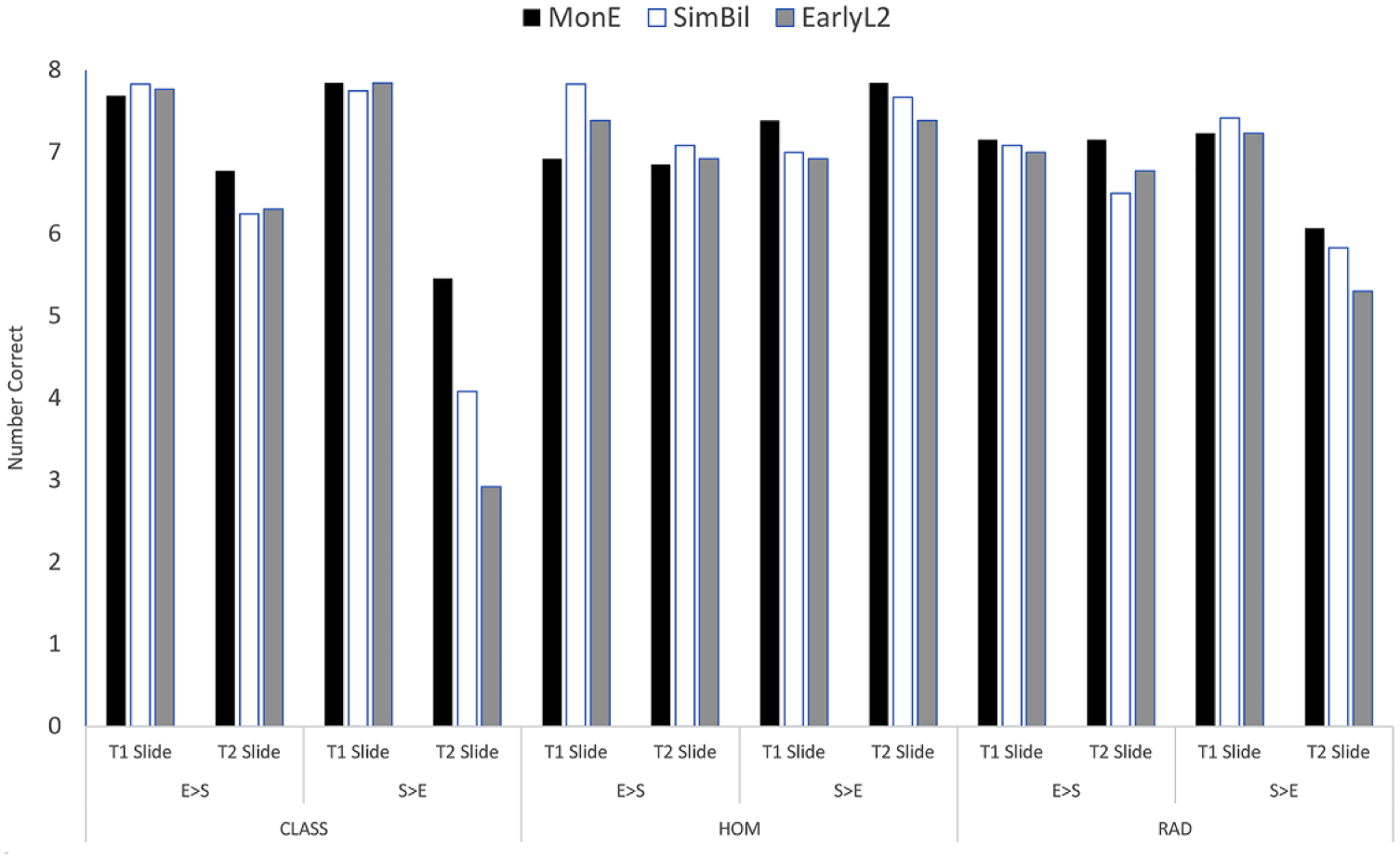
Accuracy, by word type, width, slide type, and participant group.
These results for accuracy are consistent with those of previous studies, showing a difference in performance across word types and a difference between the monolinguals and the EarlyL2 bilinguals, especially in one crucial condition, S>E classical categories in relation to the (inappropriate referent) T2.
Latency to first fixation
We examined participants’ latency to first fixation on the target items to determine whether there were differences across participant groups in initially locating the target items.
ANOVAs examined latency to first fixation on targets by word type (classical, homophonic, radial), width (E>S, S>E), slide type (T1 slide, T2 slide), and language group (MonE, SimBil, and EarlyL2). Analyses revealed significant main effects of word type, F(2, 70)=28.0, p<.001, and slide type, F(1, 35)=15.7, p<.001. For word type there was a significant difference between classical word types (493ms, SE=18) versus homonym word types (599ms, SE=21) and classical versus radial word types (576ms, SE=22), ps<.001. In general, participants’ first fixation on classical target items was faster than on targets of any other word type. For slide type, participants were significantly faster to find targets on T1 slides (524ms, SE=19) than on T2 slides (588ms, SE=22).
There were no significant differences involving language groups in how quickly they fixated on targets.
In summary, the results suggest that the time to first fixation on targets was quickest for classical word type trials, and faster for T1 than for T2 slide type trials. Crucially, there were no significant differences across language groups in time to first fixation on the target items.
Duration of fixation
Preliminary analyses for durations examined responses on targets versus distractors. ANOVAs examined the total fixation time on each item (target, taxonomic distractor, thematic distractor, unrelated distractor) by word type, width, slide type, and language group. Participants generally looked significantly longest at targets, least long at unrelated distractors, and intermediately at thematically and taxonomically related distractors. Figure 6 shows mean fixation durations. Thus, participants were focusing primarily on the targets and quickly discarding the distractors. There were no significant interactions by participant group in relative time spent looking at the distractors, so all subsequent analyses examined exclusively the durations of looking at targets in the various conditions.
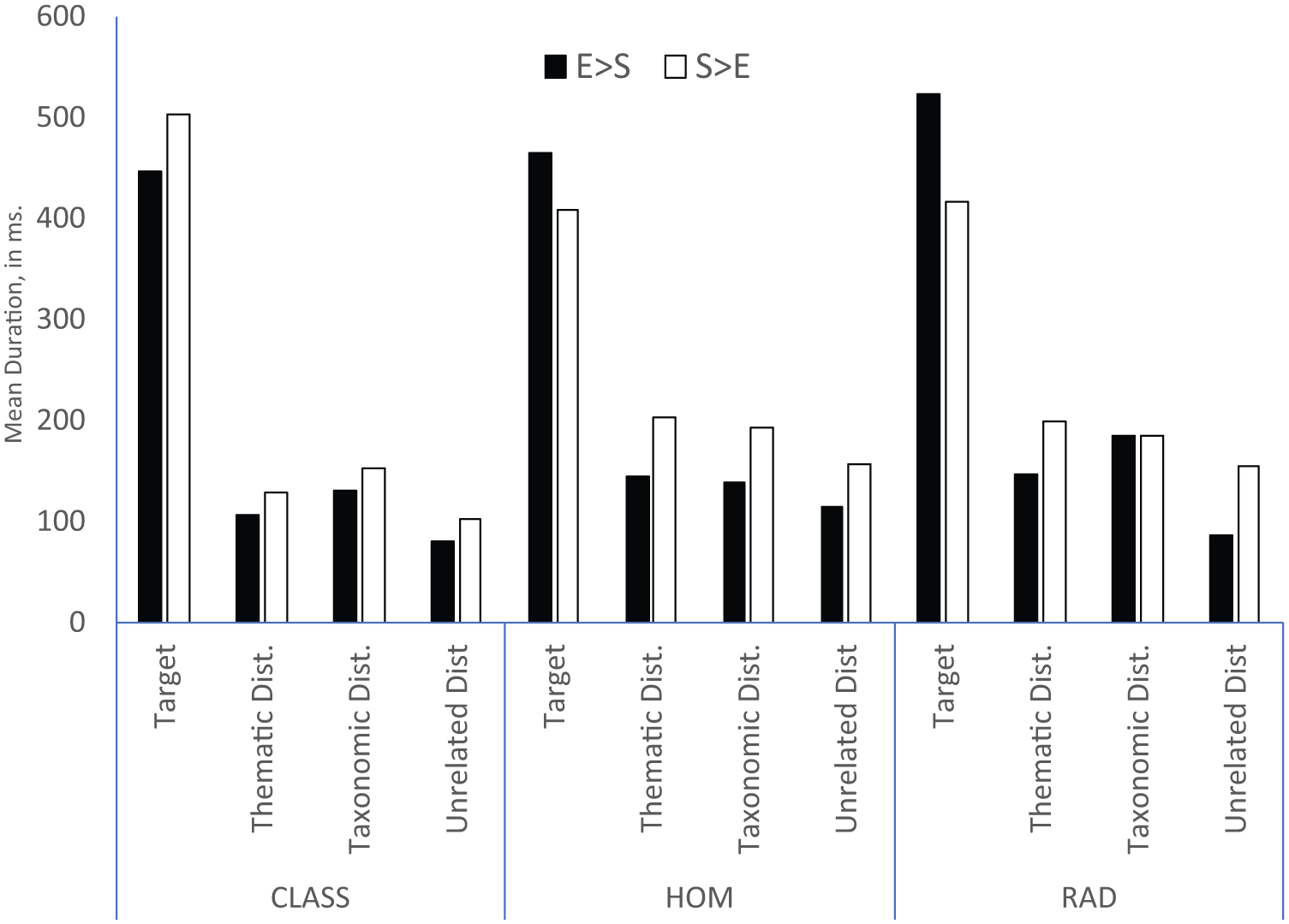
Mean durations, targets and distractor types, by word type and item type.
For targets, analyses in which word type, slide type, width, and participant group were again entered as variables revealed significant main effects of width, F(1, 35)=6.40, p=.016, and slide type, F(1, 35)=4.94, p=.033. The effect of width indicated that participants generally spent more time looking at targets in E>S trials (479ms, SE=27) than in S>E trials (443ms, SE=21). And the effect of slide type revealed longer looking times for targets in T1 slides (478ms, SE=25) than in T2 slides (444ms, SE=24).
These main effects were modified by Word Type X Width, F(2,70)=10.12, p<.001, Word Type X Slide Type, F(2, 70)=8.62, p<.001, Width X Slide Type, F(1, 35)=20.64, p<.001, Word Type X Width X Slide Type, F(2,70)=20.47, p<.001, and Word Type X Width X Slide Type X Participant Group, F(4,70)=3.32, p=.015. Performance by word type, width, slide type, and participant group is shown in Figure 7.
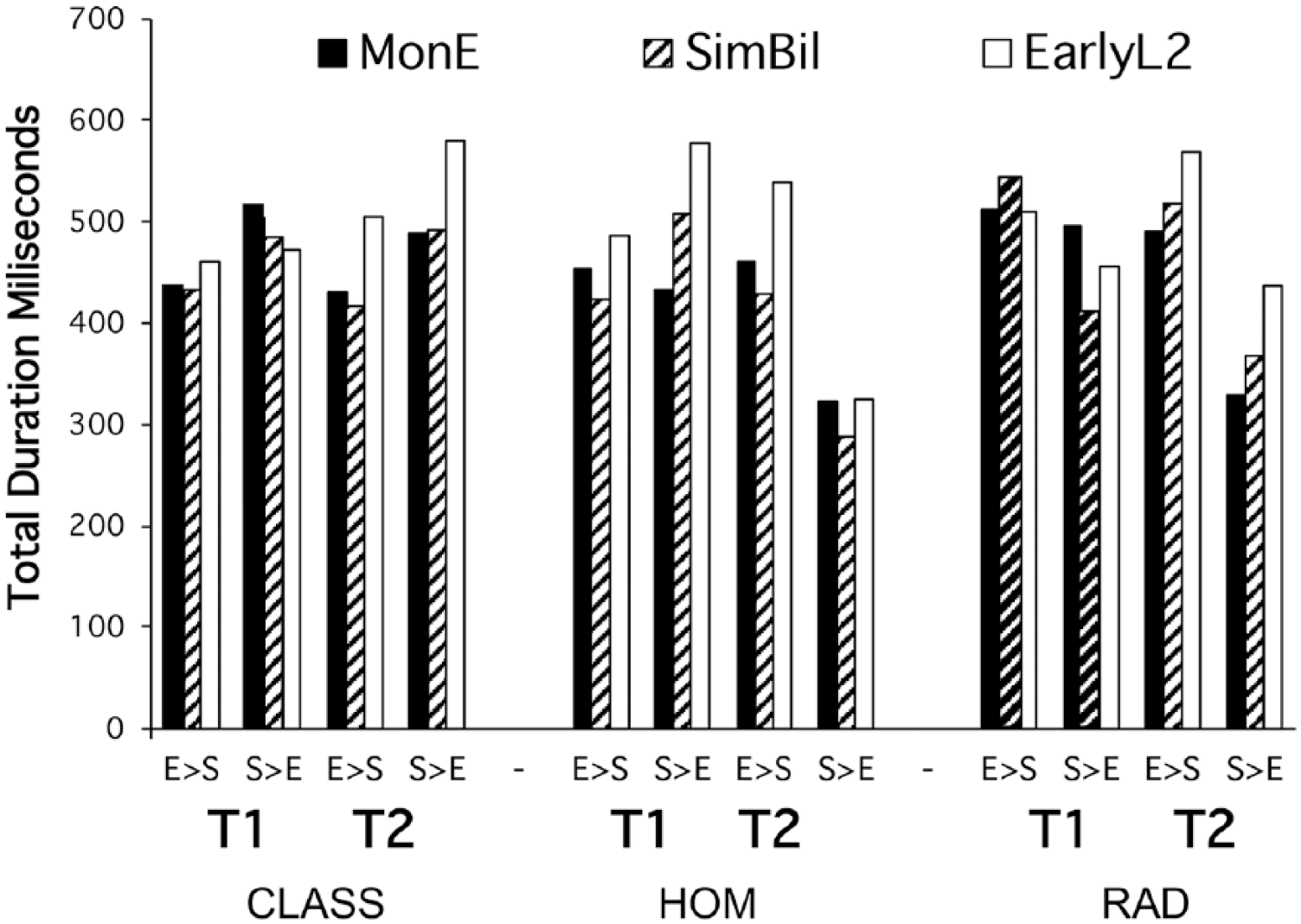
Durations, targets, by word type, slide type, width, and participant group.
To explore these interactions, separate ANOVAs were conducted for each word type and width per participant group, to compare performance by slide type. For E>S categories (for which both T1 and T2 were appropriate referents), there were no significant differences in duration for any word type for any participant group.
For S>E categories (for which only T1 was an appropriate referent), there were significant differences between durations for T1 and T2 trials, as follows.
Homophones: SimBils and EarlyL2 Bils had significantly longer fixation durations (and MonE near-significantly longer durations) for T1 than for T2: SimBil: F(1,11)=16.11, p=.002; EarlyL2: F(1,12)=16.3, p=.0016; MonE: F(1,12)=6.25, p=.0279. This indicates that all groups easily discarded the inappropriate T2 as a relevant referent for the homophonic words.
Radials: SimBils and EarlyL2 Bils showed no significant difference in durations for T1 and T2 referents, while MonE participants showed significantly longer durations for T1 than T2 referents, F(1,12)=16.31, p=.0016. Thus, MonE speakers easily discarded the T2 for these trials, while the SimBils and EarlyL2 Bils spent more time considering the (inappropriate) T2 referents.
Classicals: MonE and SimBils showed no significant difference in durations for T1 and T2 referents, while EarlyL2 Bils looked significantly longer at T2 referents than T1 referents, F(1,12)=10.00, p=.008. This suggests that, whereas MonE and SimBil participants took about the same time considering T1 and T2 as referents for these words, EarlyL2 participants took especially long to consider the (inappropriate) T2 referents.
These results for duration suggest that (a) all groups performed equivalently on E>S trials, regardless of word type or whether T1 or T2 targets (both appropriate referents for English) were involved; (b) on S>E homophones, all groups performed equivalently, showing shorter durations for (the inappropriate) T2 items than for the (appropriate) T1 items; (c) for S>E radials, MonE had shorter durations with (inappropriate) T2 items than T1 items, indicating they were able to quickly discard the T2 items as possible referents, whereas neither SimBil nor EarlyL2 bilinguals showed a significant difference in performance on T1 versus T2 items, suggesting they were considering the T2 items as possible referents. Finally, (d) for S>E classical items, MonE and SimBil participants showed equivalent durations for T1 and T2 items, suggesting they were considering the T2 items as possible referents, but (e) for S>E classical items, EarlyL2 participants had longer durations for the T2 trials than the T1 trials, suggesting prolonged consideration of those T2 items. The differences in performance between the monolinguals and the two groups of bilinguals in the S>E radial contexts and in the performance of the EarlyL2 bilinguals versus the other two groups in the S>E classical contexts suggest some influence from the bilinguals’ other language, Spanish, for which the T2 referents would be appropriate in those contexts. The similarity of the three groups in the context of S>E homophones suggests that for homophonic items, the bilinguals’ other language does not impose the same level of interaction with English as for the radials and classicals.
Number of fixations
We first examined participants’ numbers of fixations on each item (target, thematic distractor, taxonomic distractor, unrelated distractor), by word type, width, slide type, and language group. Preliminary analyses showed for every condition that there were more fixations on the target items than on distractors, and fewest fixations on the unrelated distractors than thematically and taxonomically related distractors (see Figure 8). There were no differences across participant groups in the number of fixations for distractor items, so all subsequent analyses focused exclusively on the analysis of numbers of fixations on target items.
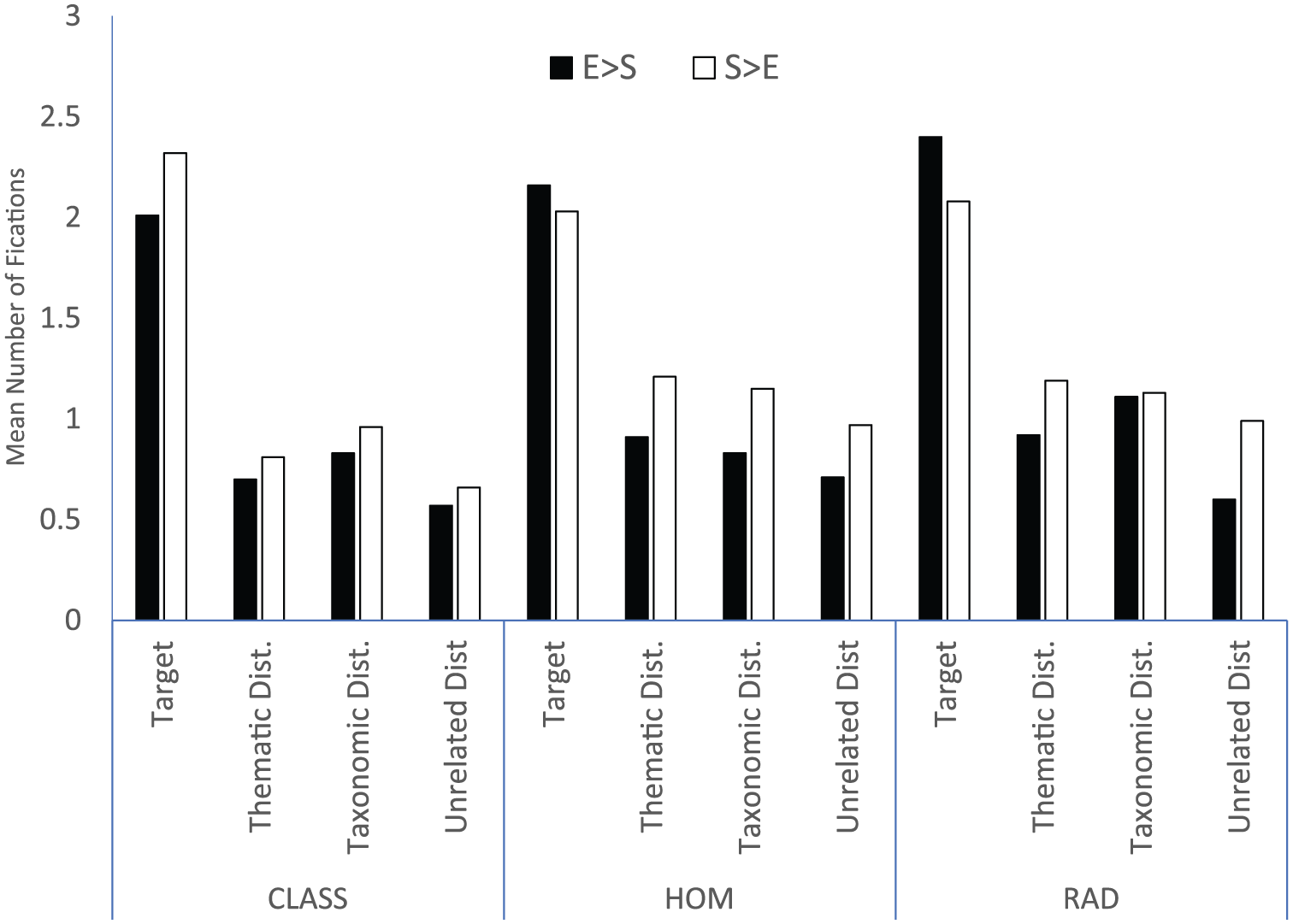
Number of fixations, by word type and item type.
For the targets, analyses in which word type, slide type, width, and participant group were again entered as variables revealed a significant main effect of word type, F(2, 70)=5.10, p=.009, with radial targets receiving more fixations (2.24, SE=.105) than homophone targets (2.10, SE=.10), p=.003. (Classical targets received an average of 2.16 (SE=.10) fixations.)
This main effect was modified by significant interactions of Word Type X Width, F(2,70)=21.28, p<.001, Word Type X Slide Type, F(2,70)=8.13, p=.001, Word Type X Width X Slide Type, F(2,70)=20.78, p<.001, and Word Type X Width X Participant Group, F(4,70)=3.27, p=.016. Performance by word type, width, slide type, and participant group is shown in Figure 9.
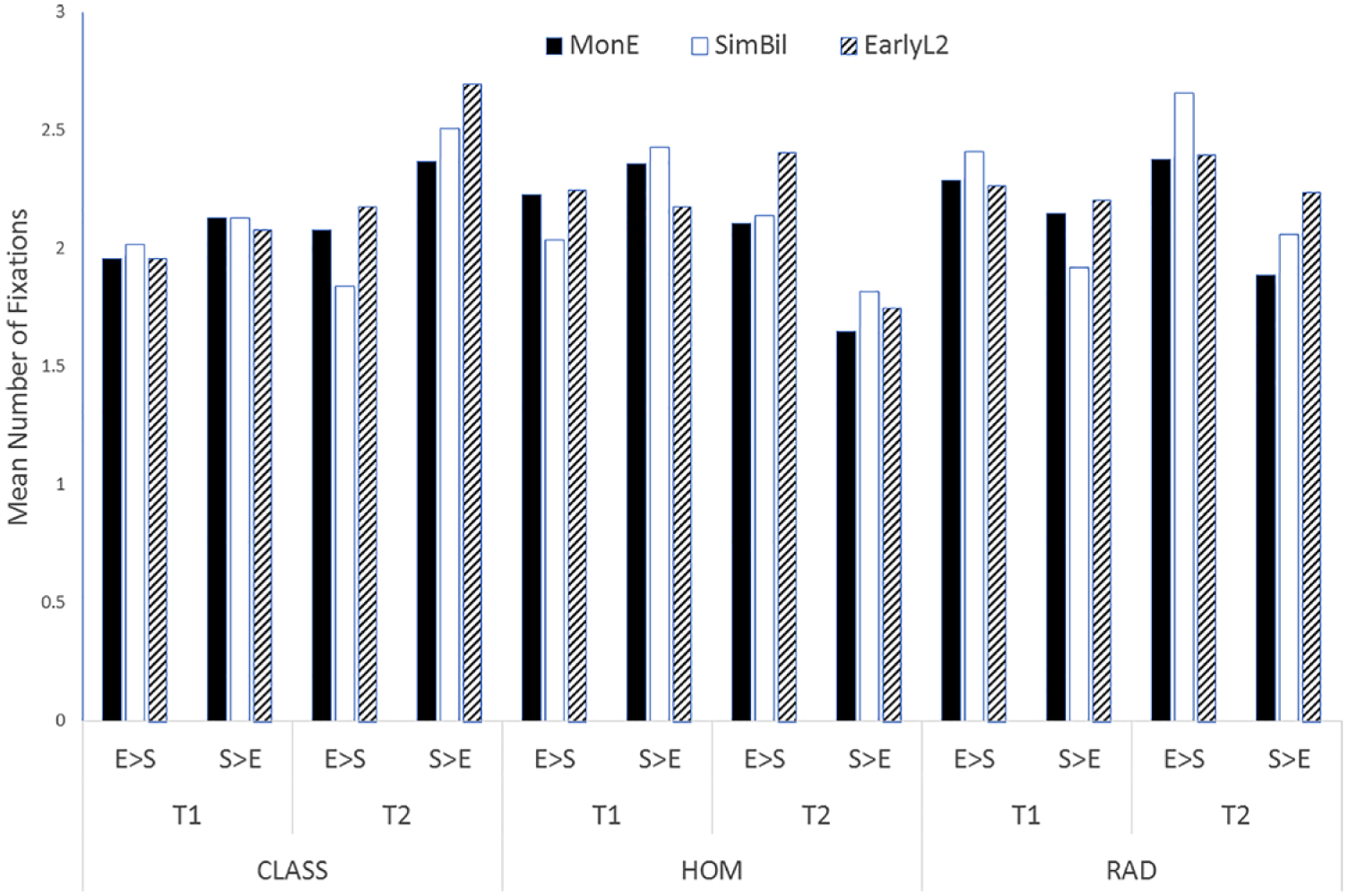
Number of fixations, by word type, width, slide type, and participant group.
To explore these interactions, separate follow-up ANOVAs were conducted for each word type. For classicals and homophones, there were Width X Slide Type interactions, F(1,35)=9.08, p=.005, and F(1,35)=21.82, p<.001, respectively, but not for radials. Figure 9 shows that for classicals, there were generally more fixations on targets in S>E contexts for T2 than for T1, while for homophones, there were fewer fixations in S>E contexts for T2 targets than for T1 targets.
To further explore the interactions involving participant groups, separate ANOVAs were conducted for each word type and width per participant group, to compare performance by slide type. For E>S categories (for which both T1 and T2 were appropriate referents), there were no significant differences in number of fixations for any word type for any participant group.
For S>E items (for which only T1 was an appropriate referent), there were significant differences between number of fixations for T1 and T2 trials, as follows.
Homophones: MonE participants showed significantly more, and the SimBils near-significantly more, fixations for T1 referents than for T2 referents: MonE: F(1,12)=21.86, p=.0005; SimBils: F(1,11)=7.21, p=.0212. This shows, similar to the duration results, that MonE (and possibly SimBil) participants were able to easily discard the (inappropriate) T2 referents for S>E homophones.
Radials: There were no significant differences in number of fixations on T1 and T2 referents in S>E trials.
Classicals: MonE and SimBil participants showed no significant difference, while EarlyL2 speakers showed a near-significant difference, evidencing more fixations for S>E T2 targets than S>E T1 targets, F(1,12)=9.112, p=.0107. This suggests influence from these speakers’ other language, Spanish, in their responses to classical S>E words.
These results for number of fixations reveal slightly distinct differences across groups than the durations. In particular, there was no difference across groups for E>S trials or for S>E radial trials. For S>E homophone trials, MonE discarded the T2 referents with fewer fixations than the T1 trials, but the two bilingual groups showed no difference in number of fixations for T1 and T2 trials. For S>E classical items, EarlyL2 bilinguals showed more fixations for T2 than T1, mirroring their longer durations for T2 trials than T1 trials in this condition.
Comparing the results for the number of fixations with those for the durations of fixations reveals that the primary differences across participant groups were in the number of times that they looked at a particular referent and in how long they looked. For the S>E radials and S>E classicals, but less for S>E homophones, one or both bilingual groups performed differently from monolinguals in how long and how often they looked at T2 targets, indicating influence from their other language, Spanish.
Proficiency or semantic organization?
These data show influence from Spanish on these bilinguals’ processing of words in English, particularly classical and radial categories. There might be two ways in which such an effect might arise, related either to proficiency in English or to the organization of the semantic space for these categories. It might be that bilinguals with lower proficiency may have more tenuous grasps of the word meanings and, thus, e.g., struggle to discard the T2 referents of S>E classical categories. In this case, a connection with proficiency level and performance should be evident. On the other hand, classical categories may undergo more crosslinguistic organizational effects in bilinguals because of the conceptual proximity of the referents in such words; in this case, a connection with proficiency and performance on the T2 S>E classical words is unlikely. In order to explore this issue, correlations were calculated between PPVT III scores and duration and number of fixation scores for each Word Type X Width X Participant group.
Significant correlations were present only for MonE participants, and only in three cases: number of fixations for S>E T2 classicals, r=-.657, p=.032, and for S>E T2 radials, r=-.657, p=.03, and durations for S>E T2 radials, r=-.628, p=.052. The higher the vocabulary scores, the more easily MonE participants discarded the irrelevant T2 referents (fewer fixations, shorter durations) (see Figure 10 for scatterplots).
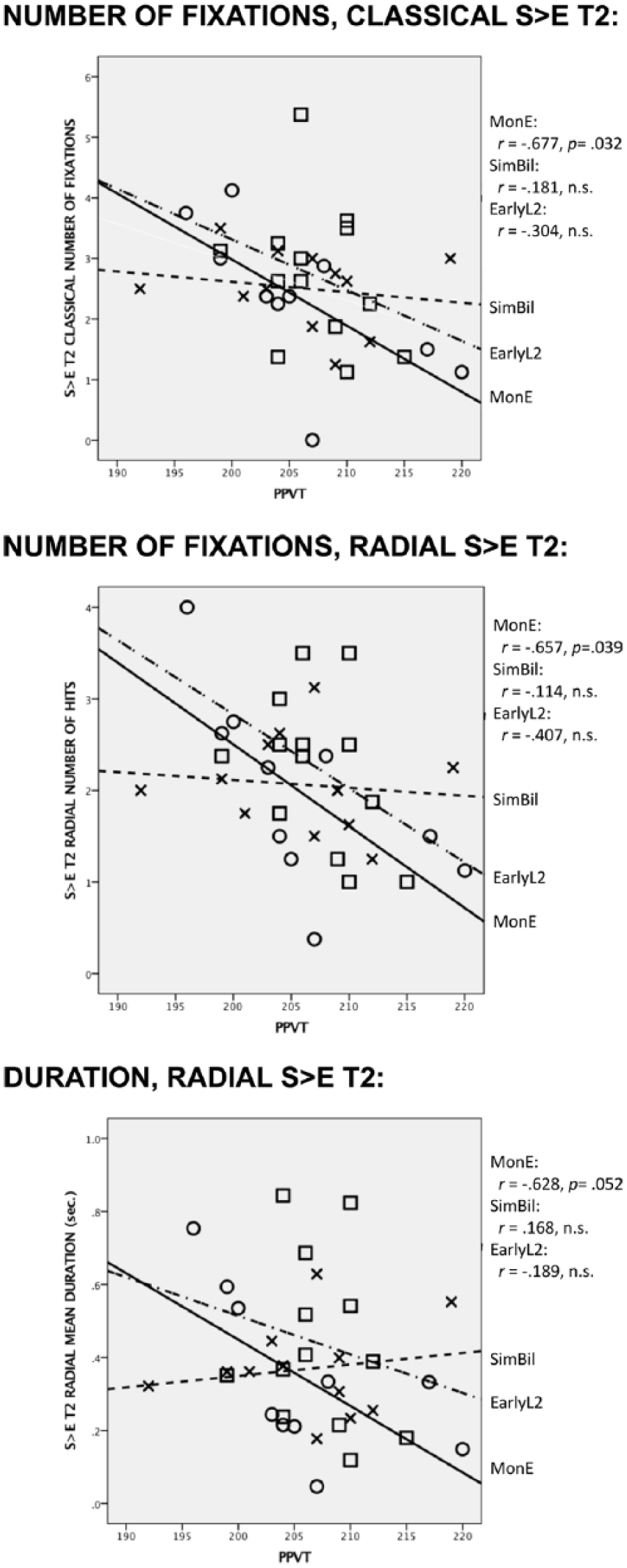
Scatter plots for performance in three conditions: Number of fixations, Classical S>E T2; Number of fixations, Radial S>E T2 Durations, Radial S>E T2.
The fact that the correlations were only significant for monolinguals, and only in these three contexts, suggests that proficiency level played no role in bilinguals’ response profiles. However, for comparison, the scatter plots for the SimBils and the EarlyL2 bilinguals are also shown in Figure 10. It is intriguing that the SimBils, in particular, show flat trend lines, supporting the suggestion that their performance was not, in fact, related to proficiency, but, rather, was likely reflective of deeper-rooted semantic organization in these speakers.
Discussion
These data and analyses together support the following conclusions.
When there is no one-to-one correspondence between two sets of lexical items in bilinguals’ two languages, a variety of factors conspire to lead to convergence (or impede interaction): the relative widths of the words in the two languages, the category type and its mapping in the conceptual space, the type of bilingual.
Regarding 1b, influence is more likely to occur in classical or radial domains than in homophonic.
The best explanation for this is that both linguistic structure and conceptual underpinnings play roles in semantic processing in such forms: on the linguistic level, the organization of the semantic space in the bilingual’s two languages and the presence or absence of a category linking two referentially distinct items matters; and on the conceptual level, if the referents are conceptually distant, the items are likely to be kept separate (and, for homophones, likely learned separately), whereas items that are conceptually close can be considered “the same” by speakers of the language (much as allophones of a single phoneme in a language may escape differentiation by native speakers).
Both types of bilinguals were susceptible to crosslinguistic influences. Both showed prolonged durations for S>E radial T2 trials; EarlyL2 speakers showed prolonged durations and higher numbers of fixations for S>E classical T2 trials; both groups showed high numbers of fixations on S>E homophonic T2 trials; and there are hints from the vocabulary correlation plots that SimBils in particular may show a very deep-seated organizational influence of Spanish on English.
The results from the accuracy data and the eye tracking data reveal slightly different aspects of the processing of these categories. When asked to make explicit choices in English (the dominant language for most bilinguals in Miami, see Gathercole et al., 2016), bilinguals’ performance is largely similar to that of monolinguals, except for classical S>E words, where EarlyL2 speakers showed lower accuracy scores than MonE speakers. SimBil speakers did not perform significantly differently from MonE speakers. In comparison, the eye tracking data show subtle differences across groups in the route taken to making those choices, particularly in relation to categories for which Spanish has wider scope than English. In such cases all groups appear to be processing homophonic words in a similar fashion in terms of the durations of fixations (although MonE speakers’ low numbers of fixations for S>E T2 referents showed they discarded those referents more easily than SimBil and EarlyL2 speakers).
However, in relation to S>E radials, SimBil and EarlyL2 speakers took the same amount of time considering (incorrect) T2 referents as T1 referents (while MonE speakers took less time with T2 than T1 referents), and in relation to S>E classicals, the EarlyL2 speakers actually took more time considering the incorrect T2 referents than the T1 referents. These effects reveal covert influences from the bilinguals’ other language, Spanish, when Spanish had wider application.
Such findings have theoretical and pedagogical implications. Theoretically, these studies support a view in which the semantic organization of each language provides its speakers with a “filter” through which the world is viewed (much in line with, e.g., the work of Levinson, 2003; Lucy, 2014, 2016). Human cognition provides for a common conceptual space shared across communities, but the language helps to shine a focus on particular distinctions or dull particular distinctions, much as phonemic structure serves to highlight certain phonetic distinctions and to downplay others. Conventionalized language-specific semantics and semantic intensions (Fitting, 2015) of words lead speakers of that language to “notice” some distinctions, ignore others.
This, in turn, has pedagogical implications. Some argue that a learner is unlikely to “notice” some areas of L2 language structure unless we bring explicit attention to the difference between the L1 and the L2, in which case there needs to be a “focus on form” in L2 learning (Cadierno, 2008; Ellis, 2008; Ellis & Cadierno, 2009). For semantics, that explicit attention is likely to be most relevant to classical and radial words, least necessary with homophones.
Regarding the relationship between the bilingual’s two languages, these data are compatible with various views of that relationship. Either a two-store view or a single network view of the two languages can accommodate the possibility of linkages that predominate or gain weight precisely where the two languages “meet.” For semantics, the two languages meet in two ways – in having pairs of words for referents and in bumping into each other in the conceptual space even when they provide somewhat distinct solutions for the organization of that conceptual space, as for classical categories. Further research is needed to explore such possibilities in more depth.
Supplemental Material
Appendix_1_Stimuli_copy_(1) – Supplemental material for Eye tracking investigation into semantic convergence in fully fluent Spanish–English bilingual adults
Supplemental material, Appendix_1_Stimuli_copy_(1) for Eye tracking investigation into semantic convergence in fully fluent Spanish–English bilingual adults by Virginia C. Mueller Gathercole, Hans Stadthagen-González, and Samia Mercedes DeCubas in International Journal of Bilingualism
Footnotes
Appendix
|
|
||||
|---|---|---|---|---|
|
|
|
|||
|
|
|
|
|
|
|
|
||||
| escalera |
|
T1. stairs | elevator | banister |
| ladder | T2. ladder | scaffolding | carpenter | |
| reloj |
|
T1. clock | calendar | crowing rooster |
| watch | T2. watch | bracelet | hand | |
| dedos |
|
T1. fingers | tiger paw | ring |
| toes | T2. toes | chicken claw | sandal | |
| mesa |
|
T1. table | bed | plate |
| desk | T2. desk | desk lamp | book | |
| techo |
|
T1. roof | chimney | pigeon |
| ceiling | T2. ceiling | wall | hanging plant | |
| jarra |
|
T1. jar | plate | pickle |
| pitcher | T2. pitcher | wine glass | ice cubes | |
| plato |
|
T1. plate | fork | drumstick |
| bowl | T2. bowl | spoon | cheerios | |
| placa |
|
T1. plaque | trophy | runner |
| license tag | T2. license tag | wheel | road | |
|
|
||||
| vela |
|
T1. boat sail | paddle wheel | ship's wheel |
| candle | T2. candle | gas lamp | match | |
| muñeca |
|
T1. doll | rocking horse | dress |
| wrist | T2. wrist | knee | bangle | |
| banco |
|
T1. bank building | store | money |
| stool | T2. stool | armchair | table | |
| papa |
|
T1. potato | carrot | peeler |
| Pope | T2. Pope | king | St. Peters | |
| cola |
|
T1. line | audience | ticket |
| tail | T2. tail | butterfly | dog food | |
| plano |
|
T1. plains | mountain | wheat |
| blueprint | T2. blueprint | artist easel | elevator | |
| lima |
|
T1. lemon | apple | peeler |
| nail file | T2. nail file | clippers | finger | |
| casa |
|
T1. house | Eiffel tower | refrigerator |
| hunting | T2. hunting | fishing | hunting dog | |
|
|
||||
| arco |
|
T1. arch | column | door |
| bow | T2. bow for archery | slingshot | arrow | |
| pico |
|
T1. bird beak | alligator's mouth | worm |
| pickaxe | T2. pickaxe | shovel | wheelbarrow w/ rocks | |
| llave |
|
T1. door key | lock | door |
| wrench | T2. wrench | pliers | screw & nut | |
| silla |
|
T1. chair | bookshelf | cushion |
| saddle | T2. saddle | muscle | fence | |
| cuello |
|
T1. neck | elbow | necklace |
| collar | T2. collar | belt | bowtie | |
| pesa |
|
T1. scale | measuring cup | cupcake |
| weight | T2. weight | exercise machine | arm | |
| pintura |
|
T1. paint | wallpaper | brush |
| painting | T2. painting | mirror | paintbrush | |
| pluma |
|
T1. feather of bird | mammal fur | egg |
| pen | T2. pen (writing instrument) | pencil | notepad | |
Acknowledgements
We are grateful to Lydda Lopez and Daniella Quesada for help in the preparation of the eye tracking stimuli. Some aspects of this study are reported in DeCubas’ Master’s thesis.
Declaration of conflicting interests
The author(s) declared no potential conflicts of interest with respect to the research, authorship, and/or publication of this article.
Funding
The author(s) received no financial support for the research, authorship, and/or publication of this article.
Notes
Author biographies
References
Supplementary Material
Please find the following supplemental material available below.
For Open Access articles published under a Creative Commons License, all supplemental material carries the same license as the article it is associated with.
For non-Open Access articles published, all supplemental material carries a non-exclusive license, and permission requests for re-use of supplemental material or any part of supplemental material shall be sent directly to the copyright owner as specified in the copyright notice associated with the article.
