







Abstract
Aims and Objectives/Purpose/Research Questions:
This study investigates the significance of the linguistic environment’s role in accounting for the nature of wh- in situ transfer. Previous research shows structural transfer from wh- in situ languages towards non-wh- in situ languages in bilingual children, usually affecting the weaker language. Explanations variously argue in terms of dominance of the child’s language and/or structural overlap and complexity, but transfer is said to be blocked if the languages are not isomorphic. However, these explanations fail to account for cases where all the above conditions are met but transfer does not materialise. We propose to re-examine the issues focusing on wh- in situ transfer in a Mandarin-English bilingual child. Our research questions centre around whether structural conditions and the child’s dominant language sufficiently account for transfer or lack thereof and whether the (neglected) role of the environmental language is significant.
Design/Methodology:
From wh- in situ research we identify 10 separate configurations differing with respect to some variable(s) and examine longitudinal data from a Mandarin-English bilingual child (age 1;7–4;6) growing up in a context-bound one language–one environment situation.
Data/Analysis:
The data consists of 83 audio-recordings and diary entries of naturalistic productions collected over three years. The distribution of wh- questions in context in each language was analysed in all transcriptions.
Findings/Conclusions:
No evidence was found of wh- in situ transfer, despite the child’s Mandarin dominance and the English-Mandarin isomorphism. The environmental language (Lε) cannot be underestimated.
Originality:
New evidence on wh- question development in a constellation not previously considered becomes critical when compared to earlier studies and identifies a significant, and hitherto neglected, role for the environmental language in understanding the nature of transfer.
Significance/Implications:
The findings suggest that approaches considering internal factors (structural overlap, complexity, isomorphism), or the child’s language dominance, do not exhaustively cover the conditions that predict whether or not transfer occurs.
Keywords
Introduction
This paper aims to show the relevance of linguistic ecology and its varying input conditions for the conceivable emergence or non-emergence of transfer in the development of bilinguals when confronted with competing options offered by their two languages. To show how different environment and experiences may lead to different linguistic outcomes, we focus on a currently controversial linguistic issue, namely structural transfer in wh- question constructions, since we agree with Yip and Matthews (2007, p. 87), that “[t]he acquisition of wh- interrogatives is fundamental to the child’s developing grammar”. We also wish to relate the acquisition of wh- interrogatives to specific patterns of language exposure in the real-life experience of children (cf. Weisleder, 2017), including family language values and practices, as important quantitative and qualitative components of that experience. This influence on children’s language development has probably been underestimated in favour of an exclusively linguistic approach. Investigations have mostly focused on the structural reasons and conditions for transfer between the child’s languages (e.g. Yip & Matthews, 2007).
The bilingual child, we reason however, may develop in ways that allow the structure of each language to be replicated independently, drawing on the norms of its speech community, including the family speech community and, as Li Wei (1993) points out, the child’s social network contacts. Children naturally have direct experience and observations of the behaviours of both family and community members, regarding the languages being acquired. These behaviours and values are often investigated by means of questionnaires to parents and other family members (e.g. Oller & Pearson, 2002; Paradis & Genesee, 1996). However, this method may have limited credibility, as underlined by Carrol (2017), given the complexities and diversity of bilingual family situations and the fact that answers from respondents may be more a reflection of what they believe they do rather than what they actually do. Moreover, as De Houwer (2007) points out, the child is exposed not only to the languages of the parents, but also to their (the parents’) attitudes towards the languages. The way each language is actually used and viewed by the parents and peers in the various contexts contributes significantly to the child’s experience, as much as the perceived degree of harmony or conflict (De Houwer, 2014) in the context of the use of each or both languages.
The method we follow here is first of all to collect natural linguistic data, that is, primary linguistic data (Meisel, 2007), by audio-recordings at regular intervals over time, supplemented by diary notes and some video-recordings (e.g. at birthdays). Secondly, we extract from the language performance the data instantiations relevant to a specific area of language development and compare our results with those of other language constellations in the same performance domain, that is, wh- questions. Thirdly, we describe the family and extra-domestic environment, pointing out critical roles, behaviours and observed situations relating to language development, including time measurements. This allows for the development of hypotheses about possible influences from family settings and extra-domestic communities. In our view the linguistic outcomes on transfer (or non-transfer) and their impact hinge crucially not only on patterns of linguistic input but also on patterns of both family practices and extra-domestic environments, in the context of the child’s social and psychological development. Also, as Mufwene (2014) claims: . . .language evolution . . . [l]ike biological evolution, . . . proceeds by competition and selection among variants under particular ecological conditions. That is, it does not proceed by successive and parallel transformations of the kind A → B in the environment E, as traditionally hypothesized in historical linguistics. Rather, it involves competition between alternatives A and B, with A or B prevailing because it was favored by particular ecological factors.
This is compatible with our view that environmental conditions tip the balance towards a particular choice.
In this paper we claim, then, that purely linguistic explanations are insufficient to accommodate the range of cases proposed in the literature without reference to the predominant environmental language (Lε) in the extra-domestic environment. To make explicit the domestic input conditions we also take into account family language values and practices. Our primary data comes from a case study of a Mandarin Chinese-English child where Mandarin is the principal language of communication at home, and English prevails in every other context, such as childcare and English storytelling time at home (Qi, 2011, 2010). Such exposure conditions, which we characterise as “context-bound one environment–one language” (1E1L), are prevalent in migration diasporas worldwide (Qi, Di Biase, & Campbell, 2006). Our case study shows a pattern of development in which the child adapts to both linguistic environments. We propose that the input available from the extra-domestic environment (Lε) should balance out the dominance of the home environment, allowing the child to keep two structural templates distinct during acquisition.
The remainder of this paper is organised as follows. The next section briefly surveys family approaches to language development, since most of the studies presented later on use the one parent–one language (1P1L) approach, which does not involve Lε. The third section outlines the theoretical issues leading to the research questions. A comparative review of six empirical studies involving wh- transfer generates 10 separate bilingual configurations covering the typological spectrum and differing from each other with respect to some variable(s). The fourth section presents the research design and method of our case study followed by its linguistic results in the fifth section, with a closing discussion and conclusion in the sixth section.
Family language approaches to bilingual upbringing
Most documented studies of early bilingualism describe family language approaches as explicit and overt policy and planning within the home and among the family members (Shiffman, 1996; Shohamy, 2006). Such policies and actual family practices are crucial in raising multilingual children because they set the frame for the interactions of the child with the caretakers within the family (De Houwer, 1999) and provide insights for the child into family members’ values and attitudes. The most studied is the 1P1L approach, both in classical and modern investigations (De Houwer, 1990; Döpke, 1992; Lanza, 1997; Leopold, 1939–1949; Meisel, 1994, 1989; Ronjat, 1913; Taeshner, 1983; Yip & Matthews, 2000, 2007, 2017). Within this strategy each parent speaks a different language to the child, usually the native language of parents (but cf. Saunders, 1982). The parent-to-language association is meant to be adhered to rigidly in this approach.
Another approach, which we assume represents the majority of families in diasporic or migration situations, is what has been called a 1E1L approach (e.g. De Houwer, 2009; Di Biase & Qi, 2015; Qi, 2010; Qi & Wu, 2017). Such an approach emerges, for instance, in situations where the language used within the home environment is predominantly the language shared by most family members, whereas in the extra-domestic environment the language used is predominantly the mainstream language, which is different from the home language but is shared by the majority of the population. As we will see later, more than one language may be used in each environment, but this will depend on the specific context. For instance, in a Chinese-speaking home in Australia, there may be contexts in which parents chose to have a regular story-time or TV-time in English. In contrast, in the extra-domestic environment there may be contexts in which Chinese is used instead of the mainstream language (English). So, in a Chinese shop or restaurant, Mandarin, rather than English, may be used quite naturally among Chinese speakers. This is different from the 1P1L approach because the choice of language is determined by the environmental context: that is, it is context-bound. Such an approach exploits the strengths of learning language in context, with a wide variety of speakers, and has the capacity to evolve and adapt fairly naturally to the perceived child’s needs and interests.
Exploring the development of content questions
In this section we show that it is not possible to explain developmental phenomena using exclusively linguistic approaches and ignoring the role that the linguistic environment and the input conditions play over the course of linguistic development. More specifically, we focus on the acquisition of wh- questions in a child who is developing his languages in a Mandarin-English environment. This is due to the ongoing debate about bilingual development when the input languages exhibit opposite content question typologies. This may affect bilinguals’ acquisition differently from monolinguals’, who develop their question formation with respect to patterns drawn from one language only, without typological conflicts. The advantage of looking at bilinguals is precisely the fact that both languages, with all their divergences, develop within the one mind (Meisel, 1994). This makes it possible to encounter different developmental trajectories because of the influence that each of the two languages may exert on the other, and there are indeed reported cases of transfer effects between languages employing different wh- question strategies. However, while having different linguistic structures as input may be a necessary pre-condition for transfer, it does not follow that this is a sufficient condition. We shall argue that the linguistic environment(s) and contexts in which the bilingual is acquiring their two languages will play a crucial role in whether or not the child will exhibit transfer.
As mentioned, in this paper we approach the issue of environmental effects on linguistic development by examining the bilingual development of content questions in typologically different language pairs. We choose wh- questions because, crucially, they are well-defined phenomena and have been thoroughly studied in first language acquisition. Wh- questions have also been used for testing claims of transfer effects in bilingual acquisition. Current studies show mixed results because transfer outcomes show up prominently in some studies while others show no apparent transfer, and, as we discuss below, no consistent and satisfactory explanation has emerged so far to account for such different developmental outcomes.
From a typological standpoint, wh- questions exhibit three positional patterns (Dryer, 2013): (I) the interrogative phrase is obligatorily in the initial position, for example, Dutch, English, Italian; (II) “wh- in situ languages”, in which the interrogative phrase is not obligatorily in the initial position, such as Cantonese, Japanese, Korean and Mandarin; (III) mixed, in the sense that some interrogative phrases are obligatorily initial and some are not, such as Indonesian. Among the 902 languages surveyed for this syntactic feature by Dryer (2013), the largest group of languages is (II), the wh- in situ languages, which account for 68% of languages in the World Atlas of Language Structures (WALS) sample; 29% belong to (I), while under 3% are mixed. Interrogative-initial languages, of type (I), are said to involve “movement” of the questioned element (wh- movement) from its basic structural position to the initial position in the sentence (compare John saw
The cases we are looking at involve children learning to ask questions in two languages with distinct typologies: in most cases one belongs to type (I), that is, the question word must be sentence-initial (e.g. English) as exemplified in (1), and the other belongs to type (II) (or type III), where the question word appears in situ (e.g. Mandarin, Cantonese, Indonesian), as exemplified in (2).
(1) (2) Ba4ba chi1 le Daddy eat PFV
The difference is not evident in English when the subject is questioned, as noted just above, and exemplified in (3), nor in Chinese (4). Further, the position of wei4sheme (why), which does not question an argument of the verb, is variable, as illustrated in (5a) and (b). The same is true for the position of queried adjuncts in Chinese. English, on the other hand, keeps the initial position for all of its wh- question words.
(3) James: Who wants one chocolate? (4) James: (5) a. b. You4er2yuan2 Childcare centre
For all other types of structural positions (objects, indirect objects, locations and so on), the position of the question word remains initial in English but in situ (as in the corresponding declarative) in Mandarin.
Yet, English is not completely rigid in that respect since it allows so-called echo questions, which are structurally in situ, for particular pragmatic situations involving surprise, or disbelief or unfamiliarity with a word and other pragmatically marked contexts (Quirk, Greenbaum, Leech, & Svartvik, 1985), in which a speaker repeats their interlocutor’s statement using question intonation (this is why they are called “echo questions”, that is, the questioned element is already known). However, when such questions are found in English monolingual children, they are produced early (around age 1;6) and in pragmatically appropriate contexts (Guasti, 2000). In any case, Yip and Matthews (2007, p. 91) point out the de Villiers and de Villiers’s (1985, p. 91) comment that, in the context of monolingual development, children themselves do not use such occasional wh- in situ questions. This highlights their sparse use and highly marked nature.
In their authoritative and well-documented study of Cantonese-English bilingual children in Hong Kong, Yip and Matthews (2007) observed a number of areas that demonstrate cross-linguistic influence in early grammatical development. A striking example of systematic (i.e. not occasional) “transfer” is in the area of wh- questions words in English, which often lack the so-called wh- movement to initial position, as exemplified in (6) and (7), where the question word is produced in situ. This was the case in their four Cantonese-dominant acquirers, where the direction of transfer was from the children’s dominant Cantonese towards their weaker English. Two other children (Kathryn and Charlotte), however, were not Cantonese-dominant and “consistently applied wh- movement”. Yet, even these two children “show occasional use (our emphasis) of wh-in situ” (Yip & Matthews, 2007, p. 120).
(6) Sophie: You eat (7) Alicia: Daddy, Lulu birthday you give to Lulu
As these researchers point out, these wh- in situ questions (where the direct object is being questioned) are genuine content questions, not echo questions, and hence they appear to deviate from their monolingual English peers’ usage. Why does the systematic wh- in situ question pattern happen in bilingual children? One of the important factors identified by these authors as promoting transfer is language dominance. They in fact point out that in the two bilinguals who are not Cantonese-dominant, such behaviour is only “occasional”, that is, not systematic. For this reason these two learners are presented as separate cases in Table 1, which enumerates the main cases reviewed in the current work.
Summary of cases in bilingual children wh- question studies.
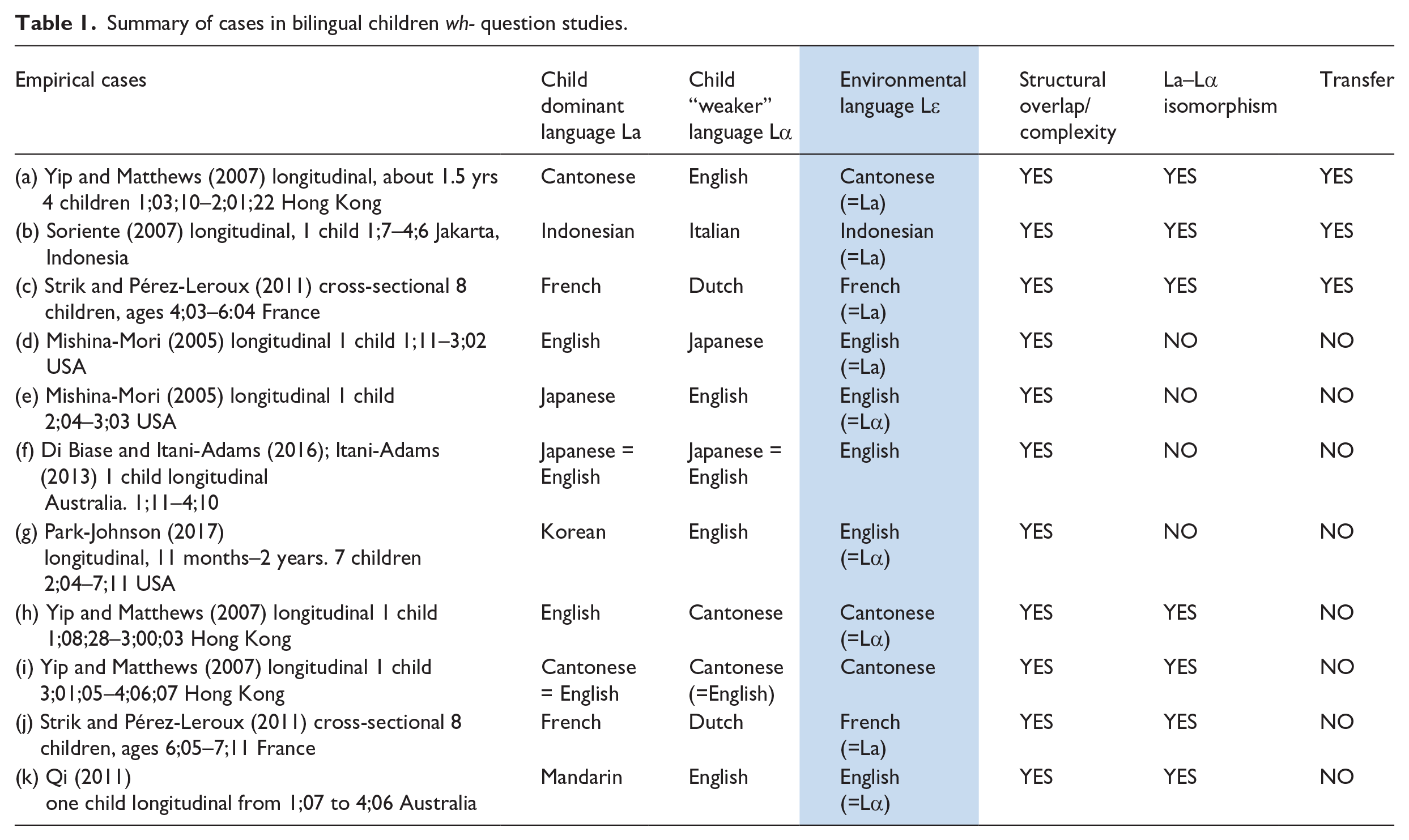
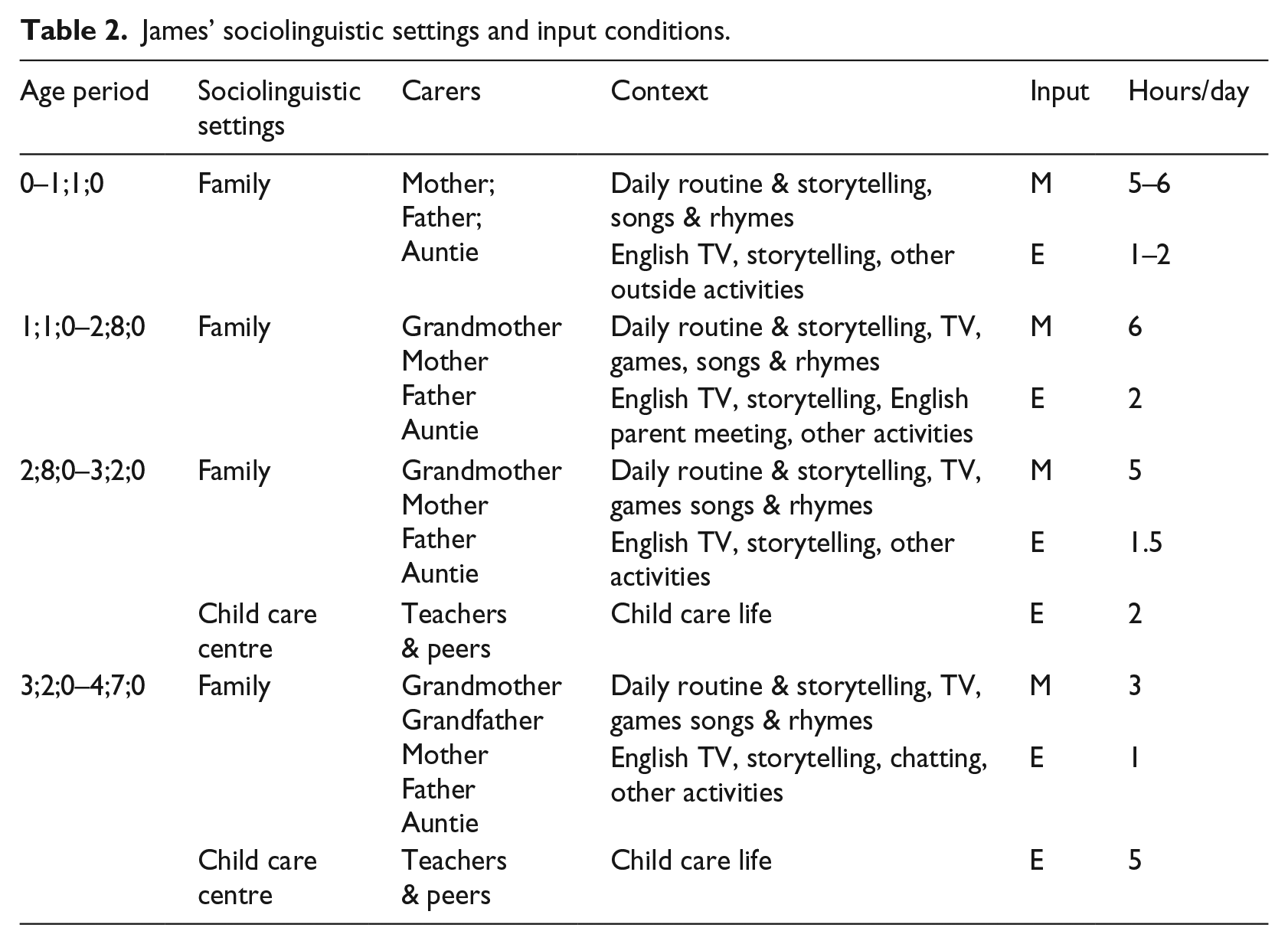
But how can language dominance be characterised and measured? Yip and Matthews (2007, p. 73) take the Mean Length of Utterance (MLU) as “the most objective indicator of a child’s linguistic development in each language, and hence of language dominance”. Other authors, such as Li Wei (1993, 2010) and Zhu Hua and Li Wei (2005), add a usage dimension – that is, more frequent use and in more functional domains – of one of the languages of the bilingual. Dominance, however, is not static and may change over time and life circumstances (Romaine, 1995). In the current study we consider MLU in words, counted with the child’s age (Qi, Di Biase, & Campbell, 2006; Qi, 2010) as one of the possible indicators of dominance, following Yip and Matthews (2007), since Mandarin, like “Cantonese and child English can both be treated as predominantly isolating languages” (Yip and Matthews, 2007, p. 74). We also use MLU differentials to chart changes in dominance patterns over time (Yip and Matthews, 2007, p. 76). Several other studies, such as those reviewed below (see Table 1) also adopt MLU as an indicator of dominance. Hence, using MLU facilitates comparability. We also add usage dimensions as indicators of language dominance, such as input quantity and quality, variety of functional domains and interlocutors, as suggested by Li Wei (2010) and Zhu Hua and Li Wei (2005). The latter are illustrated in Table 2. In any case, as Meisel (2007) observes, language dominance focuses on factors that are extrinsic to the languages themselves.
James’ sociolinguistic settings and input conditions.
Along with external factors, however, “internal” linguistic factors have also been advanced to account for transfer in various studies, as we now briefly review. Hulk and Müller (2000), for instance, claim that language dominance is not a sufficient explanation since transfer can occur independently of dominance, for example, in the one-year study of word order in a two-year-old French-Dutch bilingual child (Hulk & van der Linden, 1996). In this case, the child used Dutch word order patterns in her dominant French. So, rather than dominance, Hulk and Müller (2000, p. 228) propose instead that transfer occurs where there is structural overlap between the two grammars provided that the domain involves an interface level, such as the interface between syntax and pragmatics. Structural overlap may cause “input ambiguity” in bilingual children because “two different grammatical hypotheses are compatible with the same surface string” (Müller, 1998, p. 153). This position is further elaborated and clearly exemplified by Yip and Matthews (2007, 2009), who situate the overlap at the level of surface strings where Cantonese and English share basic subject–verb–object (SVO) word order. They show that languages such as English have two options for asking questions, whereas other languages, such as Cantonese, only have one. Thus, Cantonese only allows wh- in situ for asking content questions, whereas English allows both wh- in situ, like Cantonese, and wh- fronting (or movement). In such cases transfer may happen, and its direction will be from the language that allows one option only towards the (ambiguous) one that allows both options. However it must be pointed out that the English wh- in situ option, used in so-called “echo” question, while perfectly acceptable is an “extremely rare” question form in English (Stivers, 2010). So, for Hulk and Müller (2000), on the one hand, dominance may not be at all relevant, which would mean that only structural overlap (responsible for input ambiguity) is relevant in the explanation of transfer in their opinion. On the other hand, Yip and Matthews (2007) show that both dominance and structural ambiguity contribute to transfer and its direction.
An interesting study among those that did observe transfer is Strik and Pérez-Leroux (2011), who, by contrast, deem structural overlap insufficient as an explanation for transfer. In the bilingual children they studied they found that not only one but “two qualitatively different structures were produced as a result of transfer from French: wh- in situ questions and wh- fronted questions without inversion; hence, they argue that “a complexity based theory of transfer provides a better account for the presence of the attested structures than a structural overlap approach”. Their study involved 16 Dutch-French bilinguals growing up in France and attending French schools, so French was the predominant Lε. The children’s parents, one French-speaking and one Dutch-speaking, followed a 1P1L approach at home. The researchers elicited questions in Dutch, a language that only allows wh-VS order questions as in (8), (except for echo questions, like English).
(8) Who push.2Sg you Who are you pushing?
French, however, including colloquial French, allows a range of structures in the construction of questions, including, crucially, wh- in situ, wh- fronting without inversion and wh- fronting with inversion, as exemplified in (9a)–(c).
(9) a. Tu film You film.2Sg who Who do you film? b. Who you film.2Sg Who do you film? c. Who film.2Sg you Who do you film?
Significantly, some of the bilingual children did produce illicit wh- in situ questions in Dutch, which is not attested in monolingual Dutch development.
So, in this case, a language with multiple options (French) influences a language with a single option (Dutch). In order to solve the theoretical limitation posed by the “overlap” hypothesis, which involves two structural options in one language versus one option in the other, Strik and Pérez-Leroux (2011) propose that transfer can be explained through derivational complexity, that is, the structures lower in the derivational chain are more likely to be transferred. These authors argue that wh- movement, as, for example, in Dutch, takes place in different steps at increasing levels of complexity starting from a basic, or deeper, SVO structure. That is, wh- in situ – as in (9a) – is the simplest structure in the derivational chain because it preserves the basic SVO order. The next level of complexity is represented by “wh- fronting without inversion”, as in (9b), followed by wh- fronting with inversion, the most complex level of derivation, as in (9c). Hence, in situ structures such as (9a) will be more likely to transfer towards languages with a single option at a more complex derivational level. It must be pointed out here that the nature of this explanation is not, in essence, different from the one using structural overlap (basically it augments the reach of structural overlap). Both the proposed levels of derivation (wh- in situ and wh- initial without inversion) are non-target in Dutch.
Notably, however, only the younger children (ages 4;03–6:04) in the study by Strik and Pérez-Leroux (2011) showed evidence of transfer. The older children (ages 6;05–7;11) did not manifest transfer effects (hence they are presented separately in Table 1). So, we may infer that “age” could be the critical factor for lack of transfer in this group: that is, the “transfer” stage observed in the younger children in the same study may have already passed. However, since this is a cross-sectional study we cannot be certain that this is the case. The inference, however, would find support in Yip and Matthews’ (2007, p. 123) finding that, although such transfer effects may characterise earlier stages of acquisition, children eventually converge towards target-like use. We note, in addition, that the older group of children are of school age; hence, the school environment may contribute to keeping the two languages apart (cf., Medojević, 2014). Strik and Pérez-Leroux (2011) also observe that the children who manifested transfer “were in the transfer-favorable context, living in France. It is important to note that, to date, identified cases of transfer of wh- in situ questions happen only when the in situ language is the majority language”. This observation on the majority language is congruent with the environmentally prominent language we have been calling Lε in the present study.
Further evidence attesting transfer of wh- in situ questions, this time in a completely different constellation, is provided by Soriente (2007), who studied an Indonesian-Italian bilingual child growing up in Jakarta. Systematic transfer occurred in this child from Indonesian to Italian. Typologically Indonesian belongs to type (III) languages, that is, the “mixed” group according to Dryer (2013), and Italian is a type (I) wh- initial language. A syntactic analysis of wh- questions in Indonesian (Cole, Gil, Hermon, & Tadmor, 2001) shows that although sentences with wh- initial questions may occur, Jakarta Indonesian is essentially a wh- in situ language. From their (i.e. Cole et al., 2001) Indonesian database study it turns out, then, that wh- words usually occur in the same position as their non-question counterpart. Given the great word order freedom allowed by Indonesian, Soriente (2007) observes, some objects can appear in pre-verbal position and adjuncts appear in either pre-verbal or post-verbal position; hence, questions of time, place, manner and reason can appear before or after the verb, but there is no evidence of obligatory movement to the beginning of the sentence. Further, Soriente claims that Jakarta Indonesian children prefer the in situ structure, especially in object position. The child in her study would use this Indonesian question structure also in his Italian when visiting Italy. His Italian grandmother, however, found it difficult to understand his wh- in situ questions and the child soon converged towards the Italian question patterns (Soriente, 2007). Now, given that Italian and Indonesian share SVO basic word order, this study supports both the dominance hypothesis (Indonesian is the child’s dominant language (La)) and the complexity hypothesis put forward by Strik and Pérez-Leroux (2011), since the derivationally simpler Indonesian structure (wh- in situ) is used in Italian (the weaker language (Lα) of the child at the time of the study), which is wh- initial and exhibits some SV inversion. In addition, expressed subjects in Italian content questions (whether pronominal or referential) are post-verbal unless the wh- word is itself the subject (Bettoni & Di Biase, 2011).
In contrast to the above cases, however, transfer is not observed in three other studies despite the fact that the participating bilingual children fulfil the criteria of dominance and structural overlap as well as the complexity conditions. The first of these studies is Mishina-Mori’s (2005) one-year longitudinal study of two Japanese-English simultaneous bilingual children: a boy (from age 1;11 to 3;02) and a girl (from age 2;04 to 3;03). These children were from two different families growing up in the USA in a 1P1L context, where the mother is a Japanese speaker and the father a speaker of American English. The boy was English-dominant, as both parents worked and he attended English-speaking kindergarten three days per week. The girl, on the other hand, was primarily looked after by her Japanese mother and was Japanese-dominant. For this reason, they are presented as separate cases in Table 1. Neither of the two children, however, despite the different dominance patterns, transferred their Japanese wh- in situ questions into English.
Another Japanese-English study is reported by Di Biase and Itani-Adams (2016). They found no wh- in situ transfer in their four-year longitudinal study of a bilingual first language acquirer (from age 1;11 to 4;10) growing up in a 1P1L family in Australia. This study corroborates Mishina-Mori’s lack of transfer in Japanese-English regardless of dominance. In this case, in fact, the dominance variable is neutralised since the child shows a consistently balanced development in both languages, as shown by a strikingly similar MLU curve in both languages over the four-year study (Itani-Adams, 2013).
The third in this series of empirical studies that found no transfer is Park-Johnson’s (2017) longitudinal study of seven Korean-English sequential bilingual children, aged between 2;04 and 7;11. They were followed for a period of between 11 months and up to about two years while growing up in the USA. In each of these cases both parents had migrated from Korea and, with one exception, all families exclusively used Korean at home. So, most of these children had only limited exposure to English until they attended preschool. Korean was also strongly used in the immigrant community among friends, in church and in Korean Saturday school. Unlike all the above cases, then, Park-Johnson’s informants were not being brought up in a 1P1L approach but in a 1E1L approach. Despite Korean dominance at home and in the immigrant community, none of those children manifest transfer of Korean wh- in situ questions in English questions. Both the dominance and the complexity hypotheses, however, would predict transfer of the Korean wh- in situ question construction into the children’s English. So why did the predicted transfer not materialise in these cases?
A possible solution to this puzzle is put forward by Yip and Matthews (2007, 2009), who introduce an important language-internal constraint: for transfer to occur the two languages must be isomorphic, that is, they must share basic word order as happens, for instance, in Cantonese and English, which share SVO basic structure. In the case of the last three studies, both Japanese and Korean are, instead, SOV, that is, they are not isomorphic with English SVO. In Yip and Matthews’ account, then, isomorphism is a pre-condition for transfer. So, as Park-Johnson (2017) concluded, “[t]his requirement of isomorphism of base word order may provide a key to the presence or absence of cross-linguistic influence, at least for the syntactic level”. Also, importantly, practically all of the cases of transfer, so far, are from the La to the Lα of the child (we follow De Houwer (2009) in the La and Lα labelling).
So far, then, the role of the Lε in the transfer debate is generally underspecified. In Table 1 we summarise the wh- studies reviewed above devoting, however, a different row to each of the cases discussed (n = 11 rows from (a) to (k)) when one of the important variables (e.g. the child’s La) has a different polarity, even if they belong to the same study. Thus, for instance, the six children in Yip and Matthews’ study (2007, pp. 63–66) are listed in three separate rows – (a), (h) and (i) – as they represent three distinct cases for the purposes of our current study: the first is a group of four children who transfer wh- in situ and are Cantonese-dominant (row (a) in the table); the second case is one child who did not transfer wh- in situ and is English-dominant (row (h)); and the remaining case is one child who did not transfer wh- in situ and appeared to manifest no dominance in either language (row (i)). The last case we now add to Table 1 is based on data from Qi (2011) and is listed in row (k)). The latter represents our key study, which is detailed below.
As for the columns in Table 1, the first lists the 11 cases just referred to. The next three columns pick out the “external” variables: the La and the Lα of the child followed by the (shaded) column indicating the ecologically prominent language (which we call Lε). The next two columns pick out the “internal” linguistic variables: structural overlap/complexity and whether the languages involved are isomorphic. These summarise the principal explanations offered so far for observed transfer or its absence, as itemised in the last column. It is worth noting at this point that, given this range of studies, and because they examine primarily the same linguistic construct, that is, wh- questions, it is possible to compare variables across diverse language constellations covering considerable typological distance. Such a comparative approach lends legitimacy to studies of empirical transfer, because it enables the analyst to exclude from counting as cases of transfer phenomena that could be purely developmental, that is, phenomena that may occur in development regardless of the languages involved (see e.g. Pienemann, Di Biase, Kawaguchi, & Håkanson, 2005). The case under discussion (that is, the transfer of the wh- in situ question pattern) is shown not to be an exclusively developmental phenomenon because it does not occur in all language constellations. Furthermore, such a range of constellations and informants also helps exclude individual variation as a possible explanation.
So far, then, independent “external” conditions (the child’s La/Lα) and internal linguistic-structural conditions (structural overlap/complexity and isomorphism) have been claimed to be critical for transfer to occur. Where transfer does happen it occurs towards Lα, (perhaps better termed “non-La”) of the child, in all three cases. Curiously, both structural overlap and complexity variables (Colum 5) appear to have a positive value in all of our language constellations. Crucially though, for these conditions to work the two developing languages are required to be isomorphic (Yip & Matthews, 2007, 2009), as Column 6 demonstrates when compared to the transfer (Column 7). The shaded column (Column 4; Lε) represents the ecologically predominant language(s) in the extra-domestic environment of the bilingual families. This variable also appears to play a key role in accounting for why transfer may be blocked even when other variables might point in the opposite direction. As can be seen in Table 3, the Lε always coincides with lack of transfer. This would prompt a re-consideration of the “poverty of the stimulus” position in language acquisition (Chomsky, 1980).
Conditions for transfer.
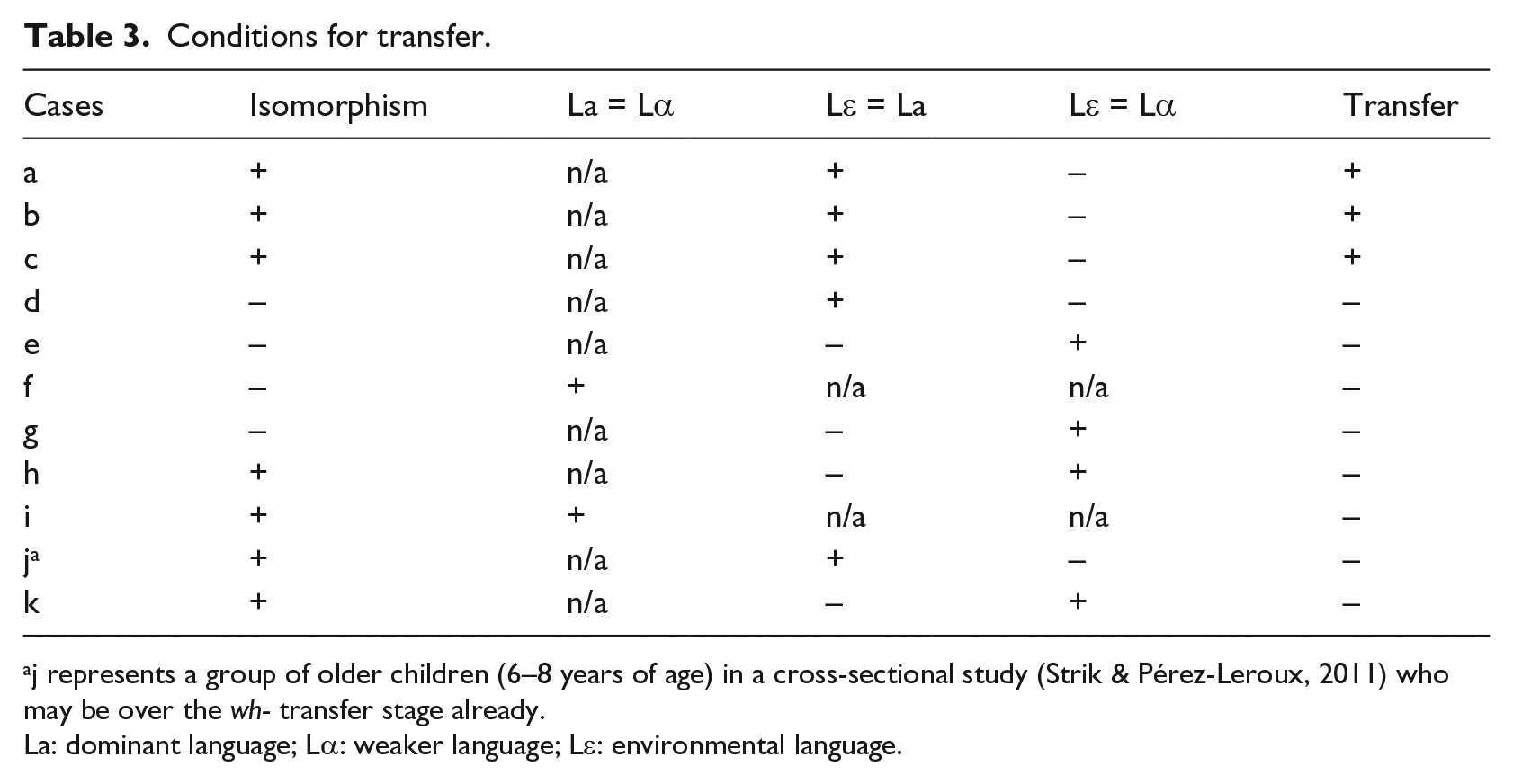
j represents a group of older children (6–8 years of age) in a cross-sectional study (Strik & Pérez-Leroux, 2011) who may be over the wh- transfer stage already.
La: dominant language; Lα: weaker language; Lε: environmental language.
The leftmost column in Table 3 lists each of the cases in Table 1 reviewed earlier, followed by the internal variable isomorphism (Column 2), which appears to make a difference to the appearance or non-appearance of transfer (Column 7). Hence, the overlap and complexity variables, which are constant across the language constellations in the studies, do not appear here. The next three columns look at “dominance” through the languages of child (La is the stronger language and Lα is the weaker language). Column 3 says that when the languages are in balance La = Lα (only cases ‘f’ and ‘i’ are positive on this score). The next two columns ascertain whether the Lε coincides with the child’s La or Lα. The crucial internal variable, then, seems to be “isomorphism”. Thus, in the first three cases (a)–(c) in the table, where isomorphism is positive, transfer occurs, while in the next four cases (d)–(g), where isomorphism is negative, transfer does not occur. The cases that remain to be explained are the last four (h)–(k), that is, those where isomorphism is positive but transfer does not occur. Case (j), however, should be excluded because of the age of the children involved.
This offers a lead into our research questions, which are as follows.
a. Are structural conditions, whether external and/or internal, sufficient to account for the occurrence of transfer? b. Is there a significant role for Lε to account for the nature of transfer?
We hypothesise that purely structural conditions are not sufficient to predict all cases of systematic (i.e. not occasional) transfer or its absence, and that the role of the language environment is observable and measurable, as we show in our case study in the next section. We are not proposing that Lε by itself provides the full environmental story. Other sociolinguistic settings and input conditions operating in the family, which we will treat in the next section (see Table 2), also contribute to strengthen the role of the environment surrounding the child over the course of development.
The case study
The child in his family, social and linguistic environment
Turning to our own study in Australia, English (in its Australian varieties) is the mainstream and La of everyday life. However, the language ecology of the country has more recently accommodated many languages brought in by its immigrant communities in a broadly accepted multicultural environment (Clyne, 1991; Rudd, 1994). Over 300 languages were identified as spoken at home by the Australian Bureau of Statistics [ABS] in 2016, with Mandarin being the language other than English most spoken at home.
The present longitudinal and naturalistic study involves a Mandarin-English bilingual child of a Mandarin-speaking family who migrated to Australia from mainland China in the early 1990s. The time period examined extends from the age of 1;7 to 4;6. The child, who will be referred to as James, is the first born son of a middle-class family growing up in Sydney. The parents spoke Mandarin to each other at home. Work-related issues, however, were discussed in English, often at the table. At age 2;8, the child was sent to a local childcare centre where he reportedly kept silent for the first six months or so. During that time, one of his teachers questioned his vocal production ability, which worried the child’s father. The teacher conceded that the child did understand what she said but also that he refused to speak any English at the centre. However, the child’s mother noticed that when he came back home from the childcare centre he immediately practised English while playing with toys and speaking to himself, often for more than 1 hour each day.
One month after starting childcare attendance, the father modified his strategy by speaking English to the child during their daily half hour of jogging. Generally speaking, the child’s bilingualism was accepted as positive not only in the family but also more generally in the community, with Chinese friends and peers. The childcare shared the general community view of acceptance of multiculturalism and multilingualism, but they expressed their concerns about the development of English in the child.
Family language approaches
The family’s strategy and practices in raising James bilingually can be defined as context-bound, 1E1L exposure. In the home environment, the child was exposed to Mandarin most of the time. The five family adults around him are speakers of Mandarin (Anhui, Nanjing and Fujian varieties). The two grandparents (the mother’s parents) are monolingual speakers of Mandarin and do not comprehend or produce English. The two parents and the aunt are also native speakers of Mandarin and speak it to each other at home. However, they are fluent speakers of English as well, and use it primarily outside the family context.
James was exposed to English regularly from birth. He was born in an Australian hospital and received English input from the first day of his life. The mother set time aside for playing in English from the first year of James’ life, for instance naming and pointing games, singing nursery rhymes (both in Chinese and English) and some small amounts of TV watching. The mother also joined an English-speaking mothers’ group for one whole day per week, until James was one year old. Later on, English was spoken to the child in specific home contexts: a daily English story-reading time by the mother (5–15 minutes at first but as the child grew older this time increased to 30 minutes or so), with a further 5–10 minutes of playtime in English before and after the story. This time increased later to 30 minutes or so. The parents and auntie would speak English to talk about Australian, American and British TV children’s programmes, such as Mullygrubs, Play School, Bananas in Pyjamas, Teletubbies, Sesame Street, The Wiggles and so on, which James would watch regularly for 15 minutes or so after about age 1;0. This TV watching time later increased to 30–60 minutes or so daily. Another context for English use at home would be an occasional visit from English-speaking friends and neighbours, averaging one day or so per month. The extra-domestic family’s daily activities, such as shopping, outings or visits from neighbours, friends, peers and doctors, were all conducted in English.
As for Mandarin input, both parents mainly addressed the child in Mandarin at home. When he was 1;1, his grandmother came to Australia and became his day care giver, so that daily Mandarin contact increased until he was 2;8, when he joined an English-speaking long day care centre for two days per week. This became full-time day care six months later. Traditional Chinese nursery rhymes and games, watching Chinese children’s stories, comics, songs, videos and fairy tales were used practically from the very first moments as appropriate to his age. Story-time in Chinese was introduced, especially from his grandmother, for 1 hour or more per day as well as playtime in Chinese with Chinese toys, puppets and construction games and puzzles. Outside the home, regular visits to Chinese family friends and their babies and children took place at least once a week. Table 2 illustrates his sociolinguistic settings and input conditions.
As can be seen, the context-bound 1E1L bilingual exposure typically follows the natural course of events and daily life of the immigrant family and is fundamentally different from the 1P1L strategy. Most studies of bilingual development investigate 1P1L contexts. Yet, most immigrant families would not be in a position to adopt such a strategy, since it requires families with members being native speakers of different languages, although there are exceptions (e.g. Saunders, 1988, where both parents were Australian English native speakers who adopted a 1P1L approach to bring up their children bilingually, with the mother speaking English and the father speaking German (second language (L2)) to the children).
By tracing recordings and diaries of the interactions between the child and his caregivers in different contexts and environments, it transpires that James experienced a rich quality of input. Richness of input is defined as providing input to the child from a variety of sources and interaction with a variety of native speakers in both languages in the child’s social network (Li Wei, 1993, 2011) as well as TV, reading and other literacy-related activities, offering the child opportunities for language input and observation, as well as consistent interaction and use in a range of environments.
Method
This study is a longitudinal investigation into development in two languages following a time-honoured tradition in the bilingualism field. It is a focused study based on a subset of audio-recordings in each language that were carried out fortnightly, mostly at home, by the researcher (mother of the child and first author), from age 1;7;0 to age 4;5;2 in naturalistic contexts yielding around 2000 minutes of tape-recordings. The data are complemented by diary entries that were kept from the child’s birth to adolescence, but only the relevant subset was used in this study. Diary entries were recorded at least four times every week by the researcher and the grandmother of the child. Transcriptions were carried out using romanised Pinyin instead of Chinese characters, with tone represented by the first four digits (tones 1–4) to reflect child production and its context. The fact that Mandarin and child English can both be treated as isolating languages facilitated cross-language counting of words. Our computation, then, is MLUw (in words), especially since the child had not fully developed English morphology (cf. Yip & Matthews 2007, p. 74). Digitally transcribed data was ordered by the use of concordancing software developed by the Summer Institute of Linguistics (Conc 176) and transferred onto Microsoft Excel worksheets. For our wh- questions study we examined 83 transcripts up to age 4;5;2 and also diary entries to about 4;7;0. The appearance of one or more dots in transcribed text below indicates shorter pauses (one dot) or longer ones (two or three dots).
Linguistic results
In light of the above discussion, the most important overall finding from our case study is that the child developed wh- questions separately in each of the languages and that no transfer was attested in either the recordings or the diary entries. This lack of transfer is all the more remarkable, because the conditions obtained should have facilitated transfer in the child: he was Mandarin-dominant. Moreover, English and Mandarin display structural overlap relationship, and are isomorphic. As indicated earlier, we compute the MLU values for each language over the developmental stages (one-word stage, two-word stage, and so on). We also excluded mixed utterances from the count (see Bernardini & Shlyter, 2004). The pro-drop and object-drop in Mandarin against obligatory subject and object in English are more likely to inflate the count for English, which nevertheless is mostly below the count for Mandarin, as shown in Figure 1. This would point towards English as most likely being the Lα over the period of the investigation (James’ data source is Qi, 2011).

James’ Mandarin-English development expressed in three-monthly interval Mean Length of Utterance (MLU) in Mandarin (M) and English (E).
Given this relationship between the languages of the child, one might expect that the Mandarin wh- in situ question structure might influence English. It must be pointed out that in the cases where transfer of wh- in situ occurred (Table 1(a)–(c)), the children’s La (Cantonese, Indonesian and French, respectively) coincided with the predominant language of the environment that is, what we call language epsilon (Lε). In the present case (Table 1(k)), instead, the extra-domestic predominant language Lε coincides with the Lα of the child, that is, English. Yet, contrary to expectation, no transfer was recorded.
As for the emergence of wh- questions in Mandarin, the first naturally recorded multi-word wh- question occurred at age 2;6;3, as in (10a). One month later, wh- in situ questions emerged clearly, as in (10b) and (c). The child then proceeded with wh- in situ over time (10d) and (e), that is, these questions were target-like from the beginning, even when his questions became more complex. Notice also that his Mandarin wh- questions show no sign of fronting influence from English, despite the possible pressure from the increased English input from peers and teachers in that period of time (see the last two rows in Table 2).
(10) a. (2;6;3) (what does ‘boy’ mean?) b. (2;7;3) do (what are you doing?) c. (2;9;22) ci4wei2 zai4 hedgehog PROG (What is the hedgehog doing?) d. (3;0;14) mei4mei zai4 younger-sister LOCin (Where is my sister?) e. (4;1;13) ma1. wo3 xiao3 shi2hou4 he1 mum, I childhood time drink (Mum, in my childhood what cup did I drink with?)
As for the production of English questions, there was a total of 108 questions produced in 20 audio-recordings in an English context between emergence at age 3;6;2 and age 4;5;2. Polar questions accounted for nearly a quarter (22%) of the total. So, most of the questions (84 out of 108, i.e. 78%) were wh- questions. These are shown in Table 4. Single word wh- questions and formulaic questions (in song) accounted for only eight recorded occurrences. To complete the developmental picture, however, all questions found in diary entries occurring up to age 4;6;26 were also counted (n = 62), 19 of which were polar questions (31%) and 43 were wh- questions (i.e. 69%). Only the wh- questions are shown in Table 4. So, the total number of wh- questions in English spontaneously produced by the child over approximately one year amount to 127 and they emerged in the following order: what, how much, where, who, what about, why.
James’ emergence and development of English wh- questions.
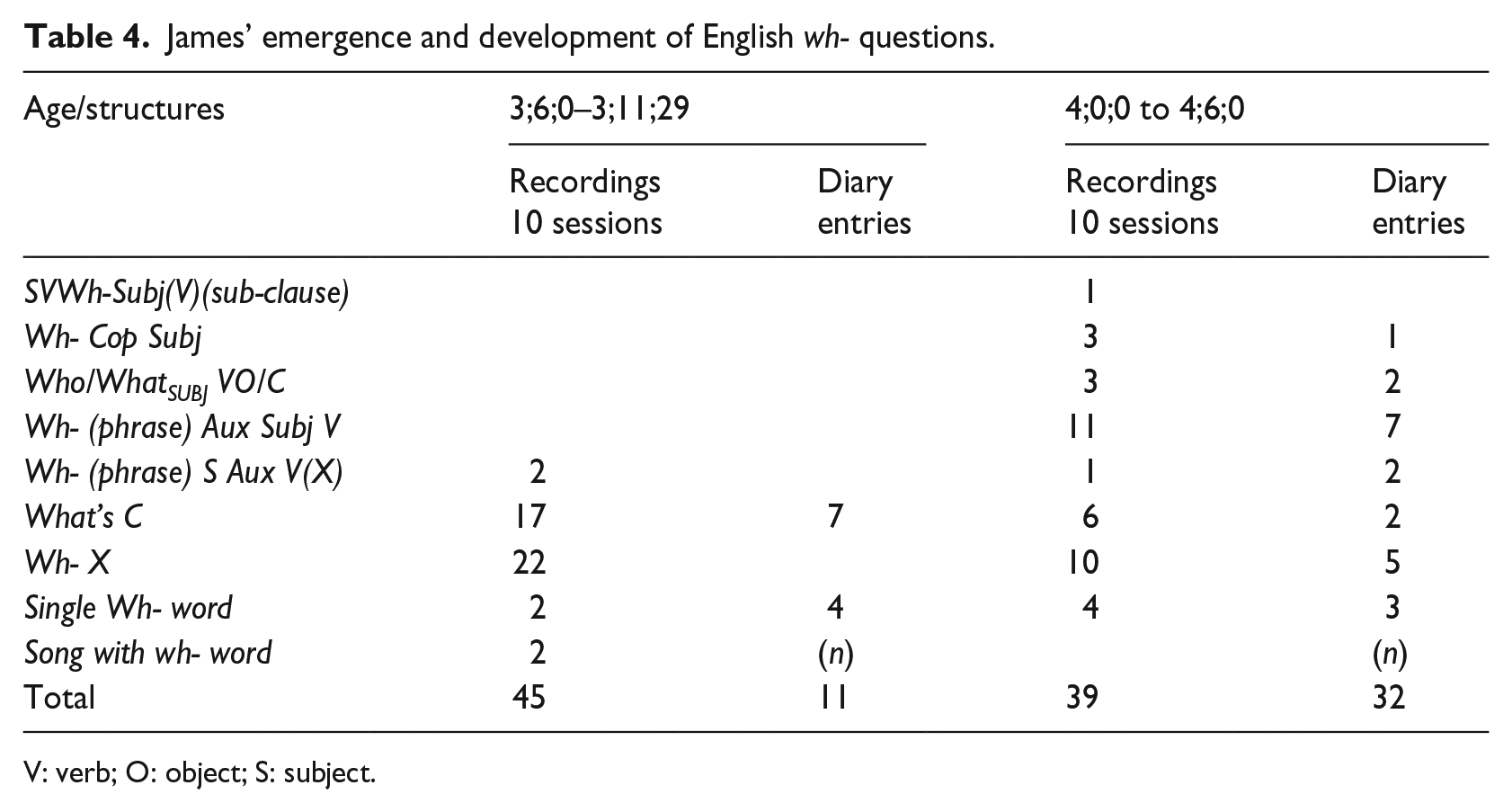
V: verb; O: object; S: subject.
English wh- questions, then, emerged almost one year after their emergence in Mandarin. We grouped all of the 127 wh- question tokens into nine structural types, listed in the first column of Table 4. We further subdivided the 12-month data into two semesters to capture the paucity of structure types above single words in the earlier six months (three types only) compared to the flourishing of structural types and their complexity in the later semester (seven types).
Each structure in the first column of Table 4 is illustrated below with examples from James’ English context database. The other columns indicate whether the structures were found in the recordings or in the diary entries over each of the last two semesters. Diary entries note frequent singing of children songs, such as Twinkle twinkle little star, how I wonder what you are (signalled by (n) in the second last raw of Table 4). Such memorised chunks provided many opportunities for the child to pronounce wh- words, such as what and how, producing, even though formulaically, patterns of higher level syntactic structure, such as indirect questions and subordinate clauses. Wh- structural development follows, by and large, a similar path to that of monolinguals, with one notable exception: wh- in situ questions are produced by monolinguals, however infrequently, in discourse-pragmatically appropriate context, as noted by Park-Johnson (2017), but not by bilinguals. This is corroborated in our case study.
Each of the structural types that emerged in the English context and that were exhaustively quantified in Table 4 are exemplified below for the first six months from emergence, beginning with single wh- words in (11a) and (b), followed by Wh- X in (12a) and (b) and What’s C in (13a)–(c). More than one example is offered to provide evidence of lexical variation, which ensures that production is not exclusively formulaic (see Pienemann et al., 2005). Uninverted Wh- S(Aux)V(X) is shown in (14). Notice that these early structures are also produced later.
(11) Single Wh- word a. (3;6:2) What? b. How much? (12) Wh- X (Wh- question phrase) a. (3;6;2) what this? b. (4;3;8) what colour? (13) What’s C (What’s Complement) a. (3;7;9) what's your name? b. what's baby name? c. (4;4;16) what's that car? (14) Wh- (phrase) S Aux V (X) a. (3;7;0) what colour lolly you have eat? b. (4;6;26) why I cannot talk to you?
A little over one month from age 4;0;0, in a sort of “question spurt”, all of the more complex wh- structures from inversion to indirect question had practically emerged, such as SV inversion, as in (15a)–(d), Copula inversion, as in (16a)–(c), and wh- structures questioning the subject, which do not require inversions, as in (17a)–(c) up to the only wh- in subordinate clause emerging in the recordings in (18).
(15) Wh- (phrase) Aux Subj V (Subject-Auxiliary inversion) a. (4;0;0) what colour (lolly) have you eaten? b. (4;1;5) where is daddy going? c. Joy . what do you want? d. (4;3;8) mummy . what can I do? (16) Wh- Cop Subj (Subject-Copula inversion) a. (4;1;5) how old are you? b. what's your name? c. (4;4;1) where is my lolly pop? (17) Who/WhatSUBJ VO/C (Subject wh- followed by V and Object or Complement) a. (4;1;5) who have one chocolate? (who wants one chocolate?) b. (4;1;15) what happened this? (what happened to this? – something broke) c. (4;3;25) who did it? who broke that? (18) SVWh-Subj(V) (subordinate clause) (4;1;5) I don’t know where daddy (is)
Lack of wh- in situ transfer does not mean that there is no interaction between the bilingual’s languages. Indeed, in the production of utterances some Mandarin words occur in an English context or vice versa, as exemplified in (19) and (20), respectively.
(19) Mixed utterance in English context (4;0;0) shen2me that? what dollar that? shen2me that chocolate? what that? what dollar that? what that chocolate? What is that? How much is that? What chocolate is that? (20) Mixed utterance in Mandarin Context (from diary entry) (2;4;0) ba1ba huai4 . ba1ba naughty dad bad . dad naughty Dad is bad. Dad is naughty
Discussion and conclusion
Results for Mandarin display target-like wh- in situ questions from the point of emergence. Results for English are also target-like from emergence onwards, that is, they show no wh- in situ. In fact, Table 4 shows that the English wh- question word is always fronted, even in the case of the sparse mixed utterances using Mandarin question words such as shen2me (what), as reported in (19) above, which typically appears in situ in Mandarin.
According to the existing transfer theory, however, transfer of wh- in situ into English should be predicted in this case for several reasons. Firstly, in terms of dominance, the child was Mandarin-dominant throughout the three years of the study, as can be inferred from the MLU graph in Figure 1. In the cases discussed by Yip and Matthews (2007) and Soriente (2007), the Lα, English and Italian, respectively, are affected by transfer from dominant Cantonese and Indonesian, which were also the predominant language in the extra-domestic environment (Lε). So, the Lα receives no support from the Lε (i.e. Lε ≠ Lα). In contrast, in James’ situation (Table 3(k)) his Lα is not negatively affected by Lε but rather it is supported since Lε = Lα. Notice also that in all of the cases summarised in Tables 1 and 3 there appears to be no transfer whenever Lε = Lα. In all three positive cases of transfer all three variables (isomorphism, dominance and Lε) appear to converge to favour transfer.
Secondly, from the “complexity” perspective, the wh- in situ structure is derivationally simpler than fronting without inversion or with inversion. This is why, according to Strik and Pérez-Leroux (2011), transfer was found in the Dutch of their younger child informants from the simpler wh- in situ French option (which is used in colloquial French). Dutch wh- questions, they remind us, only allow a derivationally complex structure with fronting and inversion. Also, wh- in situ questions are illicit in that language (except for echo questions) and do not emerge in Dutch monolingual development. In terms of structural complexity, then, in our Mandarin-English case Table 3(k), one would expect transfer from Mandarin to English due to the fact that Mandarin uses the simpler structure, wh- in situ, while English uses the more complex structure, wh- fronting. Again, this was not borne out.
Thirdly, in terms of structural overlap, the two languages share one of the structural options in terms of wh- question formation (i.e. the wh- in situ in both Mandarin and English), which could provide ambiguous input to the child, leading to transfer of the shared structure, as Yip and Matthews (2007) report in the case of Cantonese-English bilingual children. Further, in agreement with Yip and Matthews (2007), we find that when there is no isomorphism, as in the four cases in Table 3(d)–(g), such transfer did not occur. That is, transfer is blocked because languages such as Japanese and Korean are not isomorphic with English. This, however, leaves unexplained the last four cases in Table 3(h)–(k) – all of which present isomorphism and therefore challenge both the “dominance” and the “isomorphism” explanations for transfer. We can conclude then that all of these “structural” explanations for transfer are insufficient; hence, the answer to our research question 1 (whether structural conditions are sufficient to account for transfer) is resolved in the negative.
Why, then, was there no transfer when all the structural conditions for transfer are met? We submit that what was overlooked in studies over the last two decades is the role played by the predominant language in the environment the child actually grows up in: that is, the Lε, with its complex set of interactions and network contexts of the child. We can then answer our second research question, as to whether there is a significant role for environmental conditions in accounting for transfer, in the affirmative. That is, when the conditions that may promote transfer are favourable (i.e. language dominance, structural overlap, complexity and isomorphism) the Lε kicks in to support the Lα and block transfer. For instance, in our own case (Table 3(k)) the fact that the child had adequate exposure to the Lε, that is, English, is shown in Table 2, which documents the strength of language inputs to the child from a variety of contexts and speakers, both at home and in the extra-domestic environment. These distinct inputs and associations help the child keep the two linguistic templates separate. The transferable structures (e.g. wh- in situ) are dispreferred in the Lε norms. By way of comparison to other biological systems sensitive to the nature–nurture divide, it is not meaningful to ask, according to the neurobiologist Donald Hebb (1949), what a gene does but rather what it does in a particular environment.
One of the reviewers encouraged us to wonder why it is that the Lε did not assist the Lα (English) in transferring wh- properties to the stronger language (Mandarin Chinese) in the case reported here. It needs to be noted first of all that our analysis of the Mandarin data showed no such transfer. There is no modelling or support for such transfer in the extra-domestic or the domestic environments. At home, the grandparents are monolingual Mandarin speakers and when the parents used English it was in the context of story-reading and TV watching or from English native visitors, whereby the native models are robust. To clarify, we are not claiming that the other factors considered in our review have no role in transfer. For example, both dominance and isomorphism seem to play important roles in favouring or blocking transfer in conjunction with Lε, as Table 3 shows.
We can conclude then that Lε plays an important role in development and that the Lα does not necessarily remain “weak”. Development of the Lα occurs where the child finds support from the extra-domestic environment, with its variety of sources, interactions and literacy-related activities in different contexts as well as having input-providers speaking standard or nonstandard varieties (see also Cornips & Hulk, 2008; Larrañaga & Guijarro-Fuentes, 2012), including native and non-native speakers. This ensures variability in the signal from which the child will extract the necessary categories to support comprehension and production in each code (Place & Hoff, 2011). So, when the Lε coincides with the Lα of the child, it can balance out the dominance of the home environment and allow the child to keep distinct structural templates during acquisition.
The present study does review a number of cases but challenges previous transfer theory with a single case. To overcome this limitation it would be helpful to have further supporting evidence from other empirical studies with different language constellations where the Lα coincides with the Lε. In our Sydney study it seems plausible that input from the extra-domestic English-speaking environment, which is the crucial model for the development of question structures, consistently offers wh- word initial and never in situ question structures, unlike, for instance, colloquial Singapore English (Sato, 2013) and colloquial Hong Kong English, whose speakers have been shown by testing studies to often be more at home with the in situ strategy (Boyle & Falvey, 1994, p. 217).
In conclusion, as Evans (2003) puts it, bilingual children are prime examples of human adaptability: humans continuously adapt to variation and change while endeavouring to communicate with other humans. This insight, together with our findings, would suggest that studies of bilingual transfer need to look at the Lε (including its colloquial varieties) in addition to the linguistic dynamics of the home environment, as a key variable in understanding the nature of transfer.
Footnotes
Acknowledgements
Thanks are due to many colleagues who have contributed in various ways to the lead up to this paper, early versions of which were presented at the China-Australia Bilingualism Symposium at Jinan 2015 and ISB 11 (International Symposium on Bilingualism) in Limerick in 2017. In particular, we wish to thank Nicholas Evans, Annick De Houwer, Aafke Hulk, Peter Hutchings, Satomi Kawaguchi, Stephen Matthews, Jürgen Meisel, Satomi Mishina-Mori, Antonia Soriente, Li Wei and Virginia Yip for fruitful discussions and correspondence in advancing our thinking. The insightful comments of our anonymous reviewers greatly helped improve this paper. We wish to thank Camilla Di Biase-Dyson for reading through the manuscript and pointing out language issues and typos to us. All remaining errors are our responsibility.
Declaration of conflicting interests
The author(s) declared no potential conflicts of interest with respect to the research, authorship, and/or publication of this article.
Funding
The author(s) received no financial support for the research authorship, and/or publication of this article.
