







Abstract
Aims and objectives/purposes/research questions:
The aim of the article is to describe what language contact phenomena are present. The research questions are as follows: (a) what types of code-switching (CS) are at work; (b) is there any preference for any particular type of CS; and (c) what Jewish (seemingly) monolingual songs in Slavic languages can tell us about contact varieties of Slavic used by Jews.
Design/methodology/approach:
Collecting texts of Yiddish–Slavic and Jewish folk songs in Slavic languages; and qualitative analysis of CS and structural change.
Data and analysis:
Sixty-two Slavic–Yiddish texts were chosen from Jewish songs’ collections and CS instances analysed.
Findings/conclusions:
Both insertions and alternations are present but alternations are preferred. There is an asymmetry between Yiddish insertions into Slavic (nouns) and Slavic insertions into Yiddish (all parts of speech). Alternations may be just renditions of the same meaning in another language but most often they play the same role as in naturalistic speech described in the literature on multilingual communication (change of topic, addressee, etc.).
Originality:
Previous research on multilingual Jewish songs concentrated on the choice of languages and interpretation of the symbolic role that each language plays but not structural analysis of multilingual texts.
Significance/implications:
Now that some tendencies are identified, it remains to be seen whether naturalistic Yiddish–Slavic speech exhibits the same patterns of CS.
Introduction
The aim of the current paper is to investigate Yiddish–Slavic multilingual folksongs in terms of modern contact linguistics. To the best of my knowledge, no such research exists. Jewish multilingual folksongs (including Yiddish–Slavic) have so far been investigated from the point of view of code choice and labour division between languages (i.e., what language introduces what topic, what it stands for, etc.). Seminal works such as Berehovs’kyj (1930) 1 , Goldberg (1928), Ginzburg and Marek (1901), Lukin (2014), Vajnrajx (1950) discuss the linguistic repertoire of the Jews who coined and performed these songs, their proficiency in Yiddish and the co-territorial Slavic languages. This research also addressed song genres where multilingualism is manifested, that is, religious, humorous, songs of romance, etc.
There are two groups of multilingual songs (MS) from the point of view of their form: overtly and covertly multilingual. The songs of the first group display code-switching (CS), commonly defined as usage of several languages or their varieties in one utterance or conversation. CS is probably the most visible and studied language contact phenomenon, the hallmark of multilingual speech. The second group includes seemingly Slavic monolingual songs but in fact there are features such as lack of case markers, non-standard gender assignment, etc., that may be ascribed to the Yiddish impact. The features occur not only in modern popular songs of the 20th century but in traditional religious songs as well, which hints at internalization of such varieties for in-group purposes. Thus, one may assume that the varieties of Slavic were not just “learner varieties” or examples of “imperfect acquisition” but rather ethnolects. These are varieties that emerge as a result of language shift and exhibit substratal features. 2
Rothstein (2001) discusses among other things this type of Jewish songs from Odessa where the main language is (Jewish) Russian, yet Yiddish substratum and Jewish topics are present and occasional switches to Yiddish occur there as well. 3
The phenomenon of multilingual Jewish songs and Jewish songs in Slavic languages was discussed as early as the beginning of the 20th century. Berehovs’kyj (1930, p. 38) explains that Ginzburg and Marek (1901), as well the renowned Jewish historian Dubnov (1909) suggested that the songs emerged among Jews who lived in areas with scarce Jewish population, for instance, in Russian villages, or among so-called Nicholas I soldiers. In the view of these scholars, the Jews in question were already shifting from Yiddish to other languages.
This idea was criticized by Goldberg (1928) and Berehovs’kyj (1930) on several grounds. According to Berehovs’kyj (1930, p. 38), if these songs were creations of village Jews, simple people or Nicholas I soldiers, the same phenomena in all categories of songs and mostly in everyday and soldiers’ songs would be observed. Second, Berehovs’kyj (1930, p. 38) notes that “distortions” (перекручування) do not occur in Hebrew–Yiddish sections but in parts formulated in other languages, that is, Slavic, so the claim about forgetting Yiddish appears false. I will return to what he calls “distortions” later in the discussion of ethnolects. Third, he mentions that if the linguistic impact of other languages were so significant, there should also be a foreign impact on the melody. Berehovs’kyj (1930, p. 38) states that Jewish folklore collectors and ethnographers An-ski (1925) and Prilutski (1911) did not discuss the origins of MS and just mention that multilingualism is characteristic of religious songs. However, it appears that not only religious songs can be multilingual. Finally, it is emphasized that songs have been collected in the area of dense Jewish settlement and not one single song comes from outside of the Pale of Settlement (a western region of the Russian Empire with varying borders that existed from 1791 to 1917 in which permanent residency by Jews was allowed and beyond which Jewish residency, permanent or temporary, was mostly forbidden) (Berehovs’kyj, 1930, p. 39). The discussion is summarized by Vajnrajx (1950) who supports Goldberg’s and Berehovs’kyj’s arguments and calls for further research. 4
From the point of view of contact linguistics, traditionally, the preference has been given to contact phenomena in naturalistic speech, that is, the most typical data for contact-linguistic research consists of unedited spontaneous conversations. It is true that deliberate CS is discussed in studies that explore pragmatic motivation; however, very few studies consider structural aspects of change by deliberate decision (Thomason, 1997, 2007) as one of the mechanisms of contact-induced language change. This includes deliberate CS, too. An exception is Golovko (2003), who shows the relevance of “folk linguistic engineering” for contact linguistics and provides some illustrative examples from folksongs as well; this will be discussed later in the fourth and fifth sections of this article. As it will be demonstrated, multilingualism is not limited to religious songs; folk songs in general were not free of CS.
My research questions are as follows: (a) what are the types of CS in MS; (b) is there a prevalence of any particular type of CS; and (c) what Jewish (seemingly monolingual) songs in Slavic languages may tell us about contact varieties of Slavic used by Jews.
A note on the sociolinguistic situation of Yiddish among co-territorial Slavic languages is necessary. The majority of speakers of Eastern Yiddish varieties inhabited Poland starting from the 13th century and Grand Duchy of Lithuania from the 14th century. Eastern Yiddish varieties developed in a close contact with varieties of Polish, Ukrainian and Belarusian (and less so with the Baltic languages). Ukrainian and Belarusian had a low status (non-standardized varieties of peasants), and national awakening together with standardization occurred in the second part of the 19th century–early 20th century. The Russian Empire acquired the territories densely populated with Jews in the late 18th century after the partitions of Poland (the final one in 1795), and contacts with Russian are relatively recent (on the history of Yiddish see more in Jacobs, 2005).
The article is organized as follows. First, I discuss my data and methods. Then I briefly introduce the main concepts of CS research, that is insertional CS, alternational CS, and congruent lexicalization (CL), as proposed by Muysken (2000). I also describe cases that are not covered by this classification. Then the analysis of data will be provided, followed by discussion and conclusions.
Methodology and data
Contact linguistics is still to a greater extent qualitative and interpretative, and I choose the same approach in the current study. This approach appears reasonable in an exploratory research, that is, when it is necessary to discover and establish phenomena that remain outside the focus of the mainstream research (although multilingual (folk) songs and (folk) poetry as such are not uncommon or marginal by themselves). Recall that most of the previous research on Jewish multilingual folk songs did not address contact linguistics issues.
In the beginning, a corpus of song texts was created. The song texts were retrieved from various well-known and less known collections. Songs from different periods were included, and it is important that 19th century songs and later songs come from different sociolinguistic situations. 5 I ended up with 62 texts for analysis. MS that do not include Slavic languages were not considered because they remain out of the scope of Yiddish–Slavic language contact research. If a song was present in more than one collection in exactly the same version, it was counted as one single text. Jewish songs that look like monolingual songs in Slavic languages but exhibit non-lexical contact phenomena (word order, case marking, morphosyntax, etc.) were included as well. Then, structural analysis was applied where items were categorized either as insertion, alternation, CL or Jewish ethnolectal speech (Jewish–Russian, Jewish–Ukrainian, etc.), as explained in the third section. 6
Of course, it might be a tricky question, what Slavic one-word lexical items count as CS and what are established borrowings. In my view, there are no firm formal criteria, and it is only safe to make claims after an item has become conventionalized. One-word CS and established borrowing behave in the same way synchronically, so there are two ways: frequency in corpora; or response data from experiments (Backus, 2015, pp. 26–27). However, the situation may become clearer with established Slavic borrowings, and I rely on my Yiddish-speaker judgement and experience with different varieties of Yiddish. 7 This topic will be discussed in the “Insertion” subsection .
Rather than counting every occurrence of CS, I opted for looking at the text of a particular song in order to understand what mechanisms prevail in the entire text. A song functions as an autonomous text, so a mere counting of CS occurrences for each song will not tell much. Providing a total number of CS of different kinds will reveal little because every song is a whole, governed by poetics and genre rules, rather than an assemblage of discrete (multilingual) utterances.
A brief introduction to CS
The phenomenon of CS is probably one of the most studied phenomena in contact linguistics. The existing approaches to the subject can roughly be categorized as grammatical and pragmatic. The grammatical approach concentrates on topics such as grammatical properties of CS and the impact of CS on morphosyntax, general tendencies and interconnections between CS tendencies in a speech community and extra-linguistic (sociolinguistic factors). It has to be noted that this article is mostly concerned with structural phenomena. Sociolinguistic factors are also a part of the pragmatic approach.
The pragmatic approach does not oppose the grammatical one but supplements it. It concentrates on the roles of languages in CS, the meaning of CS as such, symbolism of language choice and the role of CS in conversation. Pragmatic aspects cannot be ignored because addressee, topics, the genre itself and the author’s intention determine the way in which the message is rendered. An extensive overview of the various facets of CS research can be found in Bullock and Toribio (2009) and Gardner-Chloros (2009).
It has to be mentioned that the terminology in CS studies is rather diverse and confusing at times (Clyne, 2003, pp. 70–72 on “troublesome terminology”). Some scholars differentiate between CS and code-mixing (CM); for some the former equals intersentential and the latter intrasententional CS; and some use either CS or CM as generic terms. Muysken (2000, p. 1) prefers CM as a generic term and CS refers to “rapid succession of several languages in a single speech event”. However, as Clyne (2003, p. 71) indicates, there is a general tendency to use CS as an umbrella term and I am doing this in this article. Thus, I am using CS where Muysken mostly uses CM.
Despite the vast range of approaches to CS, many scholars have accepted the classification of CS proposed by Muysken (2000) because of its descriptive usefulness. He subdivides CS (in his terminology, CM) into: insertional (intrasentential); alternational (intersentential); and CL. According to Muysken (2000, p. 3), insertional CS occurs when lexical items or constituents from one language are inserted into the structure of another language; alternations occur between structures of two different languages; and CL juxtaposes material from both languages onto shared structures.
A prototypical insertion is a single word or a constituent from another language; the base language (or matrix language, in the terms of Myers-Scotton, 1997) is clearly definable, see Example (1) where Yiddish refues “medicine”
8
and Russian tebe “to you” is inserted into an Ukrainian sentence (Yiddish is in boldface type, and Russian is underlined): (1) i and medicine-PL you.SG-DAT FUT-3SG give-INF “and will give you medicine” (Goldberg, 1928: 41)
A prototypical alternation occurs when a constituent in language A is followed by a constituent in language B (Muysken, 2000, p. 7). It occurs usually at a clause boundary. As Muysken (2000, p. 5) renders it, it is “a true switch from one language to the other, involving both grammar and lexicon”. Alternation is illustrated in Example (2) which is a Ukrainian–Yiddish song quoted by Berehovs’kyj (1930, p. 50). There are two syntactical constituents, the first one in Ukrainian and the second one in Yiddish: (2) oj- žal, žal, žal, taj ne vernetsja, “oh, pity, pity, pity, and (she) will not return/
Some instances are less clear and can be placed on the continuum between prototypical alternations and prototypical insertions (Demirçay, 2017, pp. 9–10). I will analyse some examples where insertions and alternations are dense and occur in the same utterance.
Muysken (2000, pp. 122–155) speaks also about CL that occurs in CS between closely related or typologically similar languages where shared grammatical structures may be filled with lexical items from both varieties. If the languages are not related but particular structures are similar, they can also be filled with lexical items from either variety (see below analysis of Example (5)). Such instances may look like dense insertions combined with alternations.
Muysken (2000, p. 249) also suggests that, in addition to typological differences, strict norms and competition between languages make alternation more probable. This makes the varieties more prone to CL. However, one has to consider the dynamics of contact-induced language change. In the course of time, Yiddish varieties co-territorial with Slavic varieties have undergone structural change and have become structurally closer to Slavic varieties (Jacobs, 2005, p. 268).
As for norms, emergence of Modern Standard Yiddish is a relatively late phenomenon and even in the era of Yiddish-medium education (the period between the World Wars in Eastern Europe), Standard Yiddish was no one’s first and single variety. That is, no one was completely monolingual in Yiddish, let alone Standard Yiddish, and co-territorial Slavic peoples, depending on their occupation, place of residence and frequency of interaction with Jews, had some command of the local Yiddish variety, too. It is most probable that in the beginning of the 20th century populations of shtetls, 9 be it Jews or Slavs, were not familiar with the concept of the (monolingual) standard and the ideology of strict language separation. As it will be shown below, in the so-called mixed songs, one finds both alternation and insertions, and this is typical not only for Jewish songs or songs in general (Golovko, 2003; see the fifth section).
While CS involves overt use of other-language elements (content words, as opposed to the functional words mentioned below, phrases, chunks, etc.), one has to take into account non-lexical impact, usually referred to as structural change or transfer. Take for instance Slavic influence on Yiddish morphosyntax (aspect, change of word order in relative clause, prefixed verb based on Slavic model, etc., see Krogh, 2001, pp. 25–27, 46–60). This is relevant for CL, as it will be discussed later on.
In connection with covertly MS, it is necessary to refer to Jewish varieties of Slavic that differ from the mainstream varieties (Wexler, 1987, pp. 5–9). Some scholars in Jewish linguistics use terms like Judeo-X or Jewish-X language (Judeo-Slavic, Judeo-Arabic and so on). Still, in more general terms, such varieties may be labelled as ethnolects. Jacobs (2005, pp. 303–306) uses the term “post-Yiddish Jewish lects” (see discussion in Verschik, 2018, pp. 627–628). Such varieties look like a version of mainstream co-territorial varieties with a minor lexical impact from Yiddish. They are results of language shift and may exhibit first language (L1) phonological traces, morphosyntactic patterns and word-for-word renditions of idioms to a smaller or greater extent.
Ethnolects may or may not become one’s single varieties 10 in the case of complete language shift; their difference from the so-called learner varieties of the target language is not so much in structure but in the degree of their conventionalization as in-group varieties that later may become a register used for specific purposes such as signalling identity, jokes, and expressivity (Verschik, 2007). 11
To the best of my knowledge, Jewish varieties of Polish, Ukrainian and Belorussian have not been studied in depth; for Jewish Polish see Brzezina (1986) and critique in Stankiewicz (1990). As will be shown, varieties that appear in Jewish songs in Slavic languages sometimes differ from mainstream Slavic varieties. As for Jewish Russian, it is a relatively late phenomenon because contacts with Russian proper and shift to Russian among some segments of the Jewish population started only in the 19th century (Estraikh, 1996, 2008).
In the next section, examples of insertions, alternation and combinations thereof will be analysed as well as features of Jewish varieties of Slavic.
Analysis
I will discuss contact phenomena in the following order: insertion; various kinds of alternation (“multiplication”, quotation/change of addressee, and so forth); CL (that looks like co-occurrence of insertion and alternation); and, finally, Jewish varieties of Slavic languages in folk-songs
Insertion
As shown in Example (1) of the previous section, prototypical insertions are one-word other-language items. One may ask how one-word insertions are different from lexical borrowings. The problem has been discussed in the literature but there is little agreement. In my view, formal criteria of differentiation (i.e., the presence inflections with code-switched stems as opposed to bare stems) are not helpful for several reasons: (a) some languages, including Yiddish, have relatively little inflectional morphology; (b) in some syntactic positions (nominative singular, to take one example) inflections are not required; and (c) even within the same community there may be a lot of inter-speaker and intra-speaker variation. I concur with the usage-based school of thought (see especially Backus, 2012 on lexical borrowing) which, instead of formal criteria, proposes one of conventionalization. If a foreign-origin lexical item is conventionalized in a given community or individual user, it may be considered a borrowing. There is a continuum between one-time insertions and between fully conventionalized items. 12
Due to the significant impact of Slavic on Yiddish, mechanisms of integration of Slavic nominal and verbal stems have been conventionalized, for instance, the ending –a in nouns becomes –e, hence Ukrainian/Belorussian bul’ba (бульба) “potato” becomes Yiddish bulbe, kaša (каша) “porridge” becomes kaše; Slavic verbal stems end in Yiddish with/–e/such as Ukrainian pravyty (правити) “to celebrate” becomes prave-n as opposed to German proben “to try” > Yiddish pruv-n. Therefore, integration of any new Slavic stems into Yiddish morphosyntax goes along well-established paths and poses no difficulties for language users.
Remarkably, insertions of Slavic items into Yiddish appear in songs of a particular kind. These are comic songs that probably make fun of Russified Yiddish and/or modern customs in general. Contacts between Yiddish and Russian proper started relatively late (19th century) as compared to other Slavic languages. For that reason, such songs can be classified as relatively modern, as the shift to Russian among some Jews started at the turn of the 20th century. Example (3) is an excerpt from Beregovski (1962, p. 127). The song is written in the form of a dialogue between courting young people. Russian stems are inserted into the Yiddish morphosyntactic frame. Russian is in boldface type: (3)
- Efšer vilt ir, Fajve-Joše, farzuxn fun majn
‘Maybe you want, Fajve-Joše, to try my - Šabesdiker lokšn-kugl, s’ara ‘Sabbath noodle pudding, what a - Efšer vilt ir, Fejge-Soše, mit ‘Maybe you want, Fejge-Soše, (that) I
- Vajl ba ajx, Fajve-Joše, vel ix
‘Because from you, Fajve-Joše, I will Note that Russian items, when required, get Yiddish inflectional morphology as in conventionalized Slavic borrowings
13
(cf. for instance, conventionalized Ukrainian/Belarusian kačka “duck” > Yiddish kačke, pl. kačkes; Ukrainian hoduvaty “to feed” > Yiddish hodeven) as in Example (4): (4) Russian semetšk-i ugoštšaj- prinimaj- seed-PL treat- accept- Yiddish
semetšk-es ugoštaj-eve-n prinimaj-eve-n
seed-PL treat-DER-INF accept-DER-INF
The song is comic because insertions are quite dense and also because of the “refined” Russian words such as ugoštšajeven “treat” and prinimajeven “accept”, and because some words are semantically and stylistically out of place such as prodovol’stvije “foods” that has a dry, bureaucratic sound to it. As mentioned, Russian was a late newcomer to the scene of Yiddish–Slavic language contacts, and, being the language of the Empire, was associated with officials, state, bureaucratic machine, and so forth, so overuse of Russian is associated with trying to be pompous and fancy. If the code-switched elements were conventionalized, the comic effect would be absent. Here, one may ask whether such frequent insertions occurred in a naturalistic setting. Vajnrajx (1950) called for a comparison of multilingual Jewish songs to instances of real-life Jewish multilingual speech but, to the best of my knowledge, such research has never been conducted.
14
Another example (Mlotek, 1977, p. 118) demonstrates even more dense insertional CS where in some sentences almost every content morpheme comes from Russian. This can also be interpreted as CL because there is a considerable congruence between the structures. I referred to this consequent substitution of stems elsewhere as jocular relexification (Verschik, 2008, p. 172); Golovko (2003, p. 192) calls it lexical re-orientation. My label emphasizes the humorous intention but basically Golovko and myself refer to the same thing. Consider Example (5). There are also conventionalized borrowings such as tsitsene “of cotton” but the degree of conventionalization is not important here; the comic effect is achieved through dense piling up of Russian elements.
15
Russian is in boldface type. For the sake of illustration, Polish (P), Ukrainian (U) and Russian (R) are also added: (5)
Un ix vel zix onton a
I (ja) sobie wdzieje І я одягну И я надену
Un ojscvogn mit
I wyczeszę Та вимою И вымою
Mir veln
(My) Będziemy Ми будемо Мы будем
Un firn a
I prowadzić Та вести И вести “And I will put on a satin dress and wash my hair with kerosene. We shall walk with a slow walk and conduct a tender conversation” Russian platice “(little nice) dress” requires no inflection Russian gulja-j walk- “walk” (present tense stem) > gulja-eve-n walk-DER-INF Russian medlen-n-yj slow-DER-ADJ.MASC “slow” > medlen-e slow-ADJ Russian poxodka “walk” (noun) > poxodke-le walk-DIM Russian nežn-yj tender-ADJ.MASC “tender” > nežne-m tender-ADJ.MASC.ACC Russian razgovor “conversation” requires no inflection
This is not a folksong but a popular song, written by the folklorist Wolf Younin and the poet Sh. Kahn in the late 1920s (Mlotek, 1977, p. 118). It was widely performed in Yiddish Revue theatres in Eastern Europe and several versions of the song appeared. The text is clearly humorous with a touch of a parody on modern mores. CS is highly intentional and goes under the heading of switching by deliberate decision (Thomason, 1997, 2007). 16
Let us turn now to Yiddish insertions into Slavic. They occur in a handful of songs where the base language is clearly definable (a variety of Slavic, sometimes Ukrainian with some Russian forms, sometimes Jewish–Ukrainian or Jewish–Russian). Insertions refer to realities of Jewish spiritual and material culture (names of prayers, customs, buildings such as ritual baths, etc.). Consider Example (6), taken from Prilutski (1911, pp. 73–74) where Yiddish lexical items (of Hebrew origin, i.e., merged Hebrew) are inserted into Ukrainian. Yiddish is in boldface type: (6)
Taj v
Jak v
“On Sabbath I get up early And run into the prayer-house. As I run into the prayer-house, I put on phylacteries and prayer shawl” Altogether there are 15 stanzas in this manner. Another version of this song was attested by Bastomski (1923, p. 104), containing only one stanza where a semantically-specific item negl-vaser “washing hands after waking-up” (literally, “nail water”)
17
is of Germanic origin (Example 7): (7) Rano utrom ustavaju,
Rano v školu postupaju
“Early in the morning I get up wash my hands, put on phylacteries and prayer shawl, walk to the synagogue early”
In all examples, Yiddish insertions are nouns, unlike in the case of Slavic insertions into Yiddish. The song would be sung by Jewish recruits in the tsarist army 18 , and the choice of inserted lexical items is not accidental: all are term-like, specific words referring to the Jewish tradition and religion. One possible explanation of why there is a Slavic template with Yiddish insertions could be the asymmetry in bilingual communication between the Jews and the Slavs. Jews were more likely to talk the language of co-territorial Slavs than the other way round. In the terms of Grosjean (1982), it would be monolingual mode (bilinguals talking to monolinguals). Occasional insertions, from Yiddish especially semantically-specific terms referring to Jewish culture and customs, would be much more under control. These patterns of communications may have become internalized and applied to folk songs: as Matras (2009) shows, situational language use eventually shapes bilingual repertoire. As for the in-group communication between Yiddish-speakers, there are no limitations because everyone is bilingual (bilingual mode in Gorsejan’s terminology). Similarly, Matras (2009, pp. 101–106) shows that when limitations are lacking, one is free to code-switch. These examples can also be considered as CL; in fact, bilingual mode and habitual CS may lead to CL.
Alternation
Alternation appears in my data in different forms and plays different pragmatic roles, depending on the context. There are instances where alternation has no particular functions. Quite early, Berehovs’kyj (1930) noted that in many MS each next stanza is a translation of the first one into yet another language. Clearly, this says something about the multilingualism of the authors/performers but also at least some multilingualism among the audience can be assumed: unlike isolated lexical items (insertions), longer stretches in another language (alternations) would work only if the audience has some understanding of that language.
In this case, it is hard to tell what the matrix, or base language is, as stretches in different languages are syntactically autonomous; they can be added or omitted, a stanza in a new language can be easily incorporated, and so on. Thus, every language has an equal representation. Berehovs’kyj (1930, p. 47) calls this “multiplication”. He concurs with Prilutski (1911, pp. VII–XX) who believes that it is characteristic of religious songs when the religious ardour is so intense that the borders of one language appear too tight. However, multiplication can occur in other genres as well. Several songs, initially borrowed from Slavic peoples (mostly Ukrainians) exhibit great variation: for instance, Skuditski and Viner (1936, v. 2., pp. 367–385) provide several monolingual versions of some Ukrainian/Russian/Belarusian songs, Yiddish monolingual versions of the same songs and various mixed Slavic–Yiddish versions where each stanza is performed in several languages.
Multiplication is illustrated in Example (8) where the first stanza in Yiddish is followed by mixed Ukrainian–Russian translation (Skuditski & Viner, 1936, v. 2, p. 170). The Ukrainian section is transliterated in Yiddish spelling in the collection; thus, little can be said about real pronunciation of the Ukrainian stretches, for example, non-distinction of Ukrainian i (i) and y (и) and of palatalized versus non-palatalized consonants. Russian kon’ (конь) is underlined, cf. Ukrainian kin’ (кінь): (8) Yiddish
Ukrainian (transliterated from Yiddish)
Jak bi v mene sivi kon’, a sidele maju, pojixav bi do divtšini, ja divtšinu znaju
“Should I have a horse, and I have a saddle, I would ride to a nice girl, I know a nice girl”
19
In other cases, alternation is used either to render a direct quotation or to indicate the change of the addressee. Rendering direct speech in the variety in which it was produced (or in the variety of the imagined speaker) is also characteristic of naturalistic speech (Gafaranga, 2007, p. 156; see also Example (19)). For instance, in a version of a popular multilingual song Pastexl “Shepherd”, a Jewish shepherd has lost one of his sheep and asks a Ukrainian peasant whether the latter had seen it somewhere (Kipnis and Zeligfeld, n.d., part 1). The metalanguage is Yiddish (in boldface type) and the direct speech is Ukrainian. The shepherd obviously addresses the peasant in Ukrainian and the whole exchange between them occurs in this language: (9)
- Čoho?
- Čy ty ne bačyv moju ovtšen’ku?
- Jakuju?
“ - What? - Have you seen my little sheep? - Which one?”
In some songs the change of addressee is less obvious because the indications of direct speech (he says, she tells, etc.) are lacking. In a tragic song where a child has lost his/her mother (Kahan, 1920, v. 2, p. 102) the main language is Yiddish but the two lines in the end before the refrain formulated in an in-between variety of Slavic (probably ethnolect) hint that the child asks strangers about the mother (Example 10): (10) Slavic kažete mene novaja kramka,
agdie kupit novaja mamka
“tell me (where is)/show me to the new store, where to buy a new mummy” Yiddish
nito kejn mame, nito kejn nexome
“no mother, no consolation”
Note also the use of the nominative kramka “store”, mamka “mummy” instead of the expected accusative kramku and mamku. I will return to the default nominative in the “Jewish varieties of Slavic” subsection.
In several instances, the only function of alternation is to add a rhyming line in another language to the main body in Yiddish. Combination of elements of various songs into one new whole is not unusual in folklore, so there is no reason why it should not happen in multilingual Jewish songs. Kahan (1938: 46) provides an example when the first line is in Polish (in boldface type), probably borrowed from a Polish song and added for the sake of the rhyme or to hint at the original song for those who know it, and the rest is in Yiddish, as in Example (11). Apparently, there is no logical connection between the first line and the rest: (11) a šejn mejdl bin ix dox,
a šejnem boxer vil ix dox
“ I want a handsome young man, in fact”
All these cases can be considered as prototypical alternation where the border between stretches in different varieties is clear. Berehovs’kyj (1930, p. 50) calls these songs “truly macaronic”. However, there are other instances where the border is not so clear; these will be considered in the next subsection.
CL
The phenomenon of CL may look like dense insertion or dense alternation or alternations combined with insertions. The whole clause has a congruent structure in both languages.
20
Consider Example (12), a Yiddish–Russian song (Skuditski & Viner, 1936, p. 68). Yiddish is in boldface type: (12) “ Ja “I will not go Milenjkaja Roza, začem tebe bojatsja “Dearest Roza, why should you be afraid of Another example of a combination of insertions and alternations is Example (13), from Skuditski and Viner (1936, v. 2, p. 67): (13) “ Jesliž tak, “If so, my
Unlike in the cases of prototypical alternations that are either repetitions of the same content in different languages or renditions of different voices/topics, it is hard to ascribe a clear function to each language here. In fact, this lack of function is characteristic of CL. Note also that insertions in Examples (12) and (13) do not refer to semantically-specific items (see Backus, 2001). Although my dataset is limited, it appears that this kind of CL is characteristic of modern (20th century) songs and not of traditional ones. Instances of this kind are in general characteristic for bilingual communication where CS is a usual mode (see similar examples in Golovko, 2003, pp. 184–190 and Auer’s (1999) model of the dynamics of CS towards a fused lect).
In addition to bilingual alternations, there are songs where even more languages are involved. Ginzburg and Marek (1901, pp. 310–311) provide a text of a song where someone asks a young girl whether she is going to dance and she answers that she will if the rabbi will, too. The same stanza is repeated in Ukrainian, Polish, High Lithuanian, Yiddish, and Low Lithuanian. Usually, the number of languages involved is two or three, so this is an atypical example. Whatever the number of languages is, these are instances of multiplication, in Berehovs’kyj’s (1930) terms. There are examples of Yiddish–Slavic–Hebrew songs with combination of insertions and alternations but, unlike Examples (13) and (14), each language there has a particular function (see especially Lukin, 2014). A detailed analysis of language symbolism and the reasons for language choice was described by Berehovs’kyj (1930) in general and with a focus on a well-known Ukrainian–Yiddish–Hebrew trilingual song Stav ja pyty (Став я пити) “I started drinking” by Lukin (2014), so I will not discuss this matter here.
Finally, there are some ambiguous cases that employ bilingual puns and it is impossible to classify a lexical item as belonging to a particular variety (bilingual homophones in Clyne, 2003, p. 164 and homophonous diamorphs in Muysken, 2000, p. 13). Example (14) is in Ukrainian and Yiddish (Kipnis, 1949, pp. 229–230). Ukrainian jideš (їдeш) “(you SG) go, drive, travel” and the name of the language jidiš “Yiddish” sound almost identically. The ambiguous item triggers alternation into Yiddish: (14) Ukrainian:
Oj, jideš, kudy jideš?
Zatšem jideš?
Jideš, jideš, jideš/jidiš, jidiš, jidiš
“Oh, you are going, where are you going? What for are you going? Going, going, going/Yiddish, Yiddish, Yiddish” Yiddish: Un az men traxt,
traxt men jidiš.
Un az men redt,
redt men jidiš
“And when one thinks, one thinks in Yiddish. And when one speaks, one speaks Yiddish”
Jewish varieties of Slavic
Many Yiddish folksong collections contain songs in Polish, Belarusian, Ukrainian and Russian. Prilutski (1911) implicitly distinguishes between songs in mainstream Slavic varieties in the repertoire of Jews by means of rendering the texts in Polish orthography, whereas mixed songs or Jewish songs in non-mainstream Slavic varieties (compromise between Russian and Ukrainian or between Polish and Russian, Jewish varieties of Slavic, etc.) are in Yiddish spelling. Other authors render all Slavic varieties in Yiddish spelling, which makes analysis difficult because we cannot establish how Slavic elements were really pronounced. In this respect, Berehovs’kyj’s (1930, p. 43) statement is quite telling: he refuses to transcribe songs from Kipnis’ collections and encourages researchers interested in phonetics to get directly to the informants and to record from the “mouth of the folk”.
It would be instructive to look into the non-mainstream varieties of Slavic languages in Jewish songs. Sometimes it is impossible to clearly define a variety because of compromise forms (Russian–Ukrainian, Polish–Russian, etc.). For instance, Example (6) looks like Ukrainian with some Russian elements: in an otherwise Ukrainian text there is Russian-influenced nadivaju (надеваю) “put on” instead of Ukrainian nadjahaju (надягаю). As it is well known, contacts between closely related varieties may produce a range of in-between varieties, with a different degree of conventionalization. Apparently, these varieties existed in the linguistic repertoire of both Slavs and Jews. The above Example (10) illustrates some compromise forms: it is unclear whether kažete mene implies Russian skažite mne (скажите мне) “tell me” or Ukrainian kažit’ meni (кажить мені) “id”.
Alongside the in-between Slavic lexical forms, there are grammatical and morphosyntactic features (argument structure, inflections, gender assignment, etc.) that look strikingly non-Slavic. Wexler (1987, p. 189) suggests that until descriptions of Jewish–Slavic speech are produced, the safest way to interpret the non-target forms is to ascribe them to “Yiddish substratal features”. I suggest using the term “ethnolect”, “ethnolectal”, as explained in the introduction.
Take for instance the absence of case marking. Wexler (1987, p. 189) analyses several examples from folksongs and suggests that it may be Yiddish impact because there is almost no case marking in Yiddish. Consider Example (15) from Skuditski and Viner (1936, v. 2, p. 169) from a modern song (judging by the content about romance and the non-Jewish name Anjuta): (15)
Anjuta sidit na balkontšik
“Anyuta sits on the (little lovely) balcony” Cf. Russian na balkontšik-e (на балкончике) “on balcony-ACC”
The same phenomenon, that is, non-marking of the case or usage of nominative singular and plural in all positions, occurs in traditional religious songs as well. Possibly, a phenomenon occurring in naturalistic speech by language learners later became a deliberate feature in artistic use. In a version of the well-known song Jerušolajim, slavny gorod (“Jerusalem, glorious city”) in Example (16), nominative plural is used instead of genitive plural (Prilutski, 1911, p. 39): (16)
mnogo ovts-i, mnogo deng-i
many sheep-NOM.PL much money-NOM.PL “many sheep, a lot of money” Cf. Russian (zero ending in genitive plural)
mnogo ovets, mnogo deneg
many sheep: GEN.PL many money: GEN.PL
There are also instances of non-target gender assignment; for instance, in Example (17) a Russian masculine adjective is used with the female first name Roza (Skuditski & Viner, 1936, pp. 169–170): (17)
Oi-oi, mil-i Roz-a
oh, dear-MASC.NOM Roza-FEM.NOM “oh, dear Roza” Cf. Russian
mil-aja Roz-a
dear-FEM.NOM Roz-a FEM.NOM
Grenoble (2015, p. 347), following Rothstein (2001, p. 783) notes that “misuse of cases” was characteristic of Jewish speech in Odessa, that is, among the speakers of the local variety of Jewish–Russian. Kantarovich and Grenoble (2017, pp. 10, 13) quote several sources on Odessa (Jewish) Russian that report non-standard gender assignment. Since the use of the nominative as a default case occurs in traditional songs as well, these features are probably older than the turn of the 19th century and 20th century and not limited to Odessa. However, here one has to distinguish between serious and humorous songs because in the latter the use of non-standard features is a conscious device either to render authentic speech or just for fun. It is a step on the way of turning an ethnolect as a default variety into a register (see more in Verschik, 2007).
The usage of Slavic lexical items in a new meaning, connected to Jewish tradition and religion is attested in the literature. The origins of this semantic change are not always clear (Wexler, 1987, pp. 113–114). Wexler (1987, p. 113 ff.) discusses several such items in East-Slavic languages and Polish; for instance, zakon is not just “law”, but also “Jewish law and tradition” (Wexler, 1987, p. 122 attests it in Belarusian); reznik “ritual slaughterer”, according to Wexler (1987, p. 122) in Ukrainian; both words are also known in modern Jewish–Russian (Verschik, 2007). Some lexical items of this kind occur in traditional songs, both in varieties of Slavic and multilingual ones.
Example (18) from Bastomski (1923, p. 104) has škola in the meaning of 2synagogue2 and not “school” (Ukrainian, Belarusian, and Russian школа); it is the continuation of the stanza discussed in Example (7). The song is presented in Yiddish script; for the sake of clarity, I transliterate here v školu “to the synagogue” instead of original vškolu where the preposition v “into, to” and the noun are orthographically lumped together: (18) Tales-tfilin nakladaju,
rano v školu postupaju
“I put on prayer shawl and phylacteries and walk to the synagogue early”
According to Wexler (1987, pp. 124–125), Belarussian and Ukrainian škola denotes both “school” and “synagogue” like in Yiddish: Wexler believes that Yiddish influence is unlikely and Jewish use of škola displays individual dynamics, and the immediate source of (Jewish) Slavic škola “synagogue” cannot be determined with certainty. Still, similarity with the Yiddish polysemy of šul “school”, “synagogue” is obvious, and Wexler does not provide any explanation for his claim. In this case, it is important that whatever origins of the lexical item are, it is used by Jews in the Jewish song.
Results
To summarize, some quantification is presented in Table 1. Table 1 demonstrates the number of songs according to the types of contact phenomena (insertions, CA, CL, and ethnolectal use). Mostly, there is a single or predominant phenomenon in each song; when a song contains both insertions and alternations, it is grouped together with CL because it is hard to differentiate between the types in dense CS. Ethnolectal varieties may occur both in seemingly monolingual and in MS.
Distribution of contact phenomena in the data.
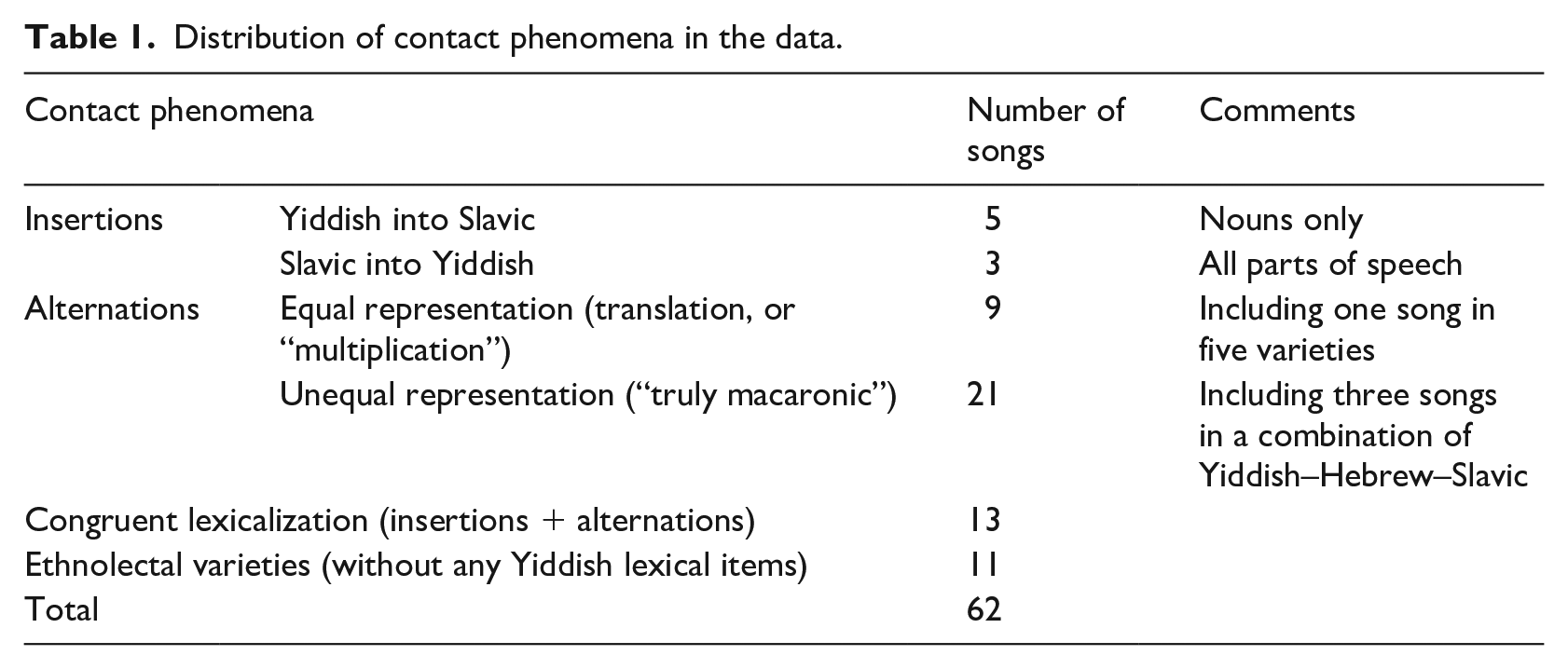
Table 1 shows that various kinds of alternation and combination of insertions and alternation prevail over insertions. This and other findings will be discussed in the next section.
Discussion
Although my corpus is small, it shows that alternation is the most preferred mechanism, whereas equal representation via translation is less frequent. Insertion is the least frequent mechanism. I doubt that it has to do with typological features of Yiddish and Slavic languages, community norms or language proficiency, as suggested by Muysken (2000). One of the questions for future studies would be a comparison between deliberate CS in songs and CS in naturalistic speech; in order to answer it, one has to undertake a separate research (some texts are available in Geller, 2001, Kiefer, 1995, also recordings in AHEYM Project, 2021). Addressing this topic would facilitate understanding whether different contact-induced language change mechanisms, outlined by Thomason (1997), namely, CS and change by deliberate decision, would yield similar or different kinds of change.
There is asymmetry between insertions from Yiddish into Slavic on the one hand and from Slavic into Yiddish on the other. Yiddish insertions in Slavic are semantically-specific, referring to Jewish religion and tradition. Nouns are the most frequently borrowed parts of speech and this happens because they their meaning is par excellence more specific than that of other parts of speech (Backus & Verschik, 2012). This may be explained with internalized patterns of out-group communication (bilingual talks to monolingual; occasional semantically-specific insertions are under control).
One reason may be in the general asymmetry in Slavic to Yiddish and Yiddish to Slavic impact (both the number of lexical borrowings and their semantics; the scope of morphosyntactic influence). This may be explained with asymmetrical patterns of communications between Jews and Slavs: Yiddish was a non-standard minority language, and it appears that Jews were more likely to have at least a working command of a co-territorial Slavic language than Slavs in Yiddish; although some Slavs had competence in Yiddish, too, the proportion of Jews able to communicate in Slavic languages was much higher than the other way round. Therefore, the impact of Slavic on Yiddish is deeper and goes beyond lexical borrowing; it includes phonology and morphosyntax (constructions, word order, argument structure, etc.). Also, the topic and time when a particular song appeared may matter: dense insertions from Slavic is characteristic for modern humorous songs (Vajnrajx, 1950, referring to Goldberg, mentions that Slavic elements were required because, unlike the mixture of Latin and European vernaculars among non-Jews, the mixture of Yiddish and Hebrew was natural, so Slavic elements were necessary to achieve a comic effect). 21
Finally, it is relevant which group’s linguistic repertoire was changing: it was a segment of the Jewish population in the late 19th century for whom Russian began to play a major role and not vice versa (i.e., no shift to Yiddish among Slavic populations occurred).
Alternation, especially if it means joining together parts of different songs in different languages, like in Example (11), seems to require less efforts for smooth integration or of elements into a new whole: one does not have to consider addition of inflection markers, gender assignment or word order. The same applies in CL, where lexical items are inserted into the morphosyntactic frame, common or similar in Yiddish and Slavic. Translation may require considerable cognitive efforts (the rendition of the content in the same style and following the given metre, rhythm, etc.) but again integration of isolated items into a new whole is not difficult. Translation appears to be one of the most common devices in modern popular MS alongside CS (Davies & Bentahila, 2008).
In general, CL appears to be an understudied phenomenon. Languages may share patterns, so to say, by default, that is, because they are closely related or because of accidental similarity (for instance, many unrelated languages have subject–verb–object word order). On the other hand, similarity in structure may emerge though contacts, as in the case of Yiddish and Slavic languages. Discrepancies between morphosyntax in two languages are not an obstacle for CS, in fact, CS may affect morphosyntax (Backus, 2005), and similarities increase, which enables more CS, and so forth, so at some point, the difference between dense insertion and CL may be unclear.
When alternation has a clear pragmatic or sociolinguistic function (quotation, addressing speakers of a certain language and so on), like in Examples (9) and (10), at the first glance it looks very much like alternation in naturalistic speech (this has to be investigated further by comparison with CS in spoken Yiddish). In my experience, speech of Estonian and Lithuanian multilingual Jews exhibits the same function for alteration (see Gafaranga, 2007, p. 156 on quotations); consider Yiddish–Lithuanian alternation in Example (19) where the speaker talks about her visit to her doctor. Her speech is in Yiddish and the reported speech in Lithuanian (in boldface type): (19) Un ix zog: “And I say: doctor, I don’t want to go to work anymore! He says: madam, but you don’t have to, this is poisoning”
The same is valid for the combination of insertion and alternation where no social meaning is attached to the use of a particular variety, as in Examples (12) and (13). Golovko (2003, p. 189) discusses smooth and dense CS and suggests that “play with CS in folklore is a typical situation of ‘fluid’ CS. It demonstrates a very high linguistic skill of speakers living under conditions of contact-induced melange”. He compares his examples with those of naturalistic speech (Golovko, 2003, p. 184).
Jacobs (2005, p. 272) suggests that macaronic folksongs represent a marked choice of “consciously performed linguistic activities”. At the same time, Jacobs (2005, p. 306) agrees that traditional internal Jewish multilingualism (Hebrew–Yiddish) serves as a template and is carried over to other situations of Jewish multilingualism, including post-Yiddish ethnolects and macaronic folksongs.
As for the songs in Slavic languages, one encounters mainstream varieties as well as in-between varieties (Ukrainian–Russian, Russian–Polish). Both the in-between varieties and ethnolectal Jewish varieties of Slavic appear in overtly MS with CS and in seemingly monolingual songs.
Both traditional and some modern songs display default nominative in positions where Slavic languages employ other cases. Sometimes there is gender confusion, too. These features can be attributed to Yiddish substratum influence, as Yiddish has almost no case marking for nouns. Based on my experience with contemporary varieties of Jewish–Russian, non-standard gender assignment and default nominative do not occur any more but semantic extensions have been maintained for lexical items referring to Jewish customs (see more in Verschik, 2007, 2018). Traditional Jewish songs in Slavic languages do not show word-for-word renditions of Yiddish idioms and Yiddish morphosyntactic patterns, present in contemporary ethnolects; yet this is not a reason to assume that such features did not exist in older ethnolects. It would be counterintuitive to assume that the transfer of the L1 argument structure and loan translations, so characteristic of learner varieties and language shift, did not occur back then but occurred in later ethnolects only. Gender assignment confusion and default nominative that are quite strikingly non-standard, may have disappeared as mainstream varieties of Russian became more available, while other, less striking features have been preserved (see some idioms in Rothstein, 2001, pp. 784–785).
Modern songs do have Yiddish-like word order and word-for-word renditions of fixed expressions: see, for example, the analysis of a popular Jewish–Russian song Škola bal’nyx tantsev (Школа бальных танцев) “School of ball dancing” (Rothstein, 2001, pp. 798–799). Here the speech of the dance teacher Solomon Pliar, or Kliar, is intentionally rendered in “not so grammatical Russian” (Rothstein, 2001, p. 798). It is an instance of so-called secondary ethnolect, that is, when speakers have a choice between ethnolectal and mainstream varieties and choose to use the former for stylistic purposes or as a marker of identity especially in artistic genres. Unlike traditional songs with ethnolectal features, the song in question is deliberately comical.
In future, it would be instructive to see the evolution of CS and ethnolectal features from traditional songs into modern ones. It has to be stressed that the linguistic repertoire of the audience changed as well: if in the traditional setting Jews knew some Hebrew, Yiddish and, to various extent, local varieties of Slavic, then after the shift to Russian had occurred, Hebrew disappeared, some bits and pieces of Yiddish remained, and (Jewish) Russian became the main language. 22
Conclusions
In this section I will summarize answers to the research questions.
Questions (a) What types of CS occur and (b) whether there is any prevalence of any particular type of CS can be answered together because they are closely connected. CS is by and large the main mechanism in overtly multilingual texts, whereas many Slavic texts are monolingual on the surface only and exhibit ethnolectal features: copying of L1 (Yiddish) structures; or L1 transfer to second language (Slavic) texts.
Among CS, alternation is the most frequent type. One type of alternation is the rendition of the same stanza in several languages, called multiplication here. It is, however, less frequent than alternation in the function of quotation or change of addressee. CL is also present and is facilitated by similarities in morphosyntax.
The low number of insertions is surprising. Moreover, there is asymmetry between Yiddish to Slavic insertions (semantically-specific nouns) and Slavic to Yiddish insertions (all parts of speech). The latter may be rather dense and occurs in comical songs and is labelled jocular relexification that is a common phenomenon in multilingual folklore (Golovko, 2003).
Question (c) asks what Jewish (seemingly) monolingual songs in Slavic languages may tell us about contact varieties of Slavic used by Jews. Traditional folksongs exhibit some non-mainstream features such as default nominative and non-standard gender assignment. Since these features occur also in traditional religious songs, they indicate that such Slavic varieties were internalized among Jews. These features are attested also in the so-called Odessa Russian (Grenoble, 2015; Kantarovich & Grenoble, 2017; Rothstein, 2001) that exhibits a considerable impact of Yiddish. Semantic changes (i.e., ascribing Jewish cultural meaning to Slavic words) are not necessarily a product of transfer and their origin is not entirely clear. Occasionally, they occur in the folksongs and are in use in present day Jewish Russian varieties.
It would be worthy of further consideration, whether deliberate CS is different from CS in naturalistic speech (see Vajnrajx’s (1950) suggestion for a systematic comparison between multilingual Jewish folksongs and real-life multilingual speech remains relevant for future research). Recall that Thomason (1997, 2007) describes change by deliberate decision and CS separate mechanism of contact-induced language change but we do not know whether different mechanism lead to same, similar or different results.
The low number of insertions has to be looked into (and also asymmetry between Slavic to Yiddish and Yiddish to Slavic insertions). Translation (“multiplication”) or joining chunks of different songs in different languages is highly conscious and deliberate; it is hardly characteristic of spontaneous speech. It may be assumed that alternations with clear pragmatic function (quotation, changing of addressee) and dense combinations of alternation and insertion are reminiscent of the speech of those Jews who still have Yiddish as one of their languages (based on examples from various contact situations, Golovko (2003) makes a similar observation); this would require a separate research. Such a question is relevant not purely from a historical perspective but also from a theoretical point of view.
Studies on modern multilingual performative art attest as well that translation and various types of CS are universal devices of multilingual creativity in songs of various genres (Davies & Bentahila, 2008; Picone, 2002). This is also in line with Matras’ (2009) conclusion that a bilingual will attempt to use his/her full linguistic repertoire to the extent possible in the given communicative situation. One can extrapolate this to bilingual poets; the difference being in the grade of deliberateness with which natural multilingual means of expression are used in lyrics. A case in point could be the CL-like transition from Slavic to Yiddish mid-clause for the sake of rhyme. The scope of inquiry into MS can be broadened and include research on Yiddish–Slavic mixed songs and Jewish songs in Slavic languages.
Footnotes
Declaration of conflicting interests
The author(s) declared no potential conflicts of interest with respect to the research, authorship, and/or publication of this article.
Funding
The author(s) received no financial support for the research, authorship, and/or publication of this article.
