







Abstract
Research questions:
This study asks whether an interface phenomenon such as noun incorporation (NI) displays meaningful socially conditioned variation in the endangered polysynthetic language, Chukchi, by investigating whether speakers of all levels of experience or proficiency make use of NI in a consistent, rule-governed way.
Design and methodology:
This study compares production data from small groups of speakers of a moribund language. Study tasks include a controlled production task in which speakers are asked to construct sentences using provided lexical items. The lexical items were conditioned so as to trigger NI in certain stimuli (on the basis of verbal valency and argument animacy).
Data and analysis:
The production data was transcribed and coded for the occurrence and structural type of NI (compounding vs. syntactic incorporation). The results were compared across three groups of speakers: conservative older speakers, younger attriting speakers, and new speakers.
Findings/conclusions:
NI frequency and productivity clearly differ among the three groups. CSs use incorporation frequently and productively in the expected contexts, while ASs use productive incorporation only in familiar contexts, followed by NSs who make little to no use of incorporation. All speaker groups display knowledge of the appropriate circumstances in which to use incorporation.
Originality:
This study makes use of a novel experimental methodology in studying several under-researched areas: variation in traditional Chukchi, shift-induced variation in a polysynthetic language, and NI as a locus of variation.
Significance/implications:
This study contributes to our understanding of the behavior of non-normative speakers of endangered languages and demonstrates that they play a role in language preservation. The study shows that the diffuse nature of the Chukchi speech community is different from comparatively well-studied shift settings (especially in the North American and European contexts) in its lack of a community of use or practice, which presents unique challenges in language maintenance.
Speakerness in the endangerment context
Notions of linguistic ownership and authority can be fraught in a language endangerment context, and can be inadvertently shaped by linguists working in these settings. As linguists prioritize the documentation of threatened languages, we are faced with two challenges that are at odds with one another: creating a thorough record for future speakers and scholars, but doing so efficiently. As a result, endangered language scholarship has prioritized work with the “best” remaining speakers—that is, the oldest, most conservative speakers who show the fewest effects of contact with the dominant language.
While this triage is understandable given the considerable logistic and temporal limitations of fieldwork in remote locations, it has resulted in a dearth of documentation of the variation in underdescribed Indigenous languages, especially among speakers who are dominant in the majority language. Different subsets of this group have gone by a variety of names: semi-speakers, rememberers, and, more neutrally, heritage speakers (see Grinevald & Bert, 2011 for a taxonomy of speakers in an endangerment setting, as well as Aalberse et al., 2019 and Polinsky, 2018 for further discussion). What they have in common is that they are regarded by many scholars as distinct from “full” speakers; that is, they are thought to not make use of a complete grammatical system in speaking the endangered language.
In this paper, I demonstrate that there are meaningful and systematic linguistic differences between conservative older speakers of an endangered language and more contact-affected speakers, and that these differences can be rigorously captured using the same types of experimental tools that are applied in robust languages. While there has been research on language variation and change in the endangerment context, it has often been initiated when the alternative—working with conservative speakers—was no longer possible and a rigorous comparison between speakers with different backgrounds was not feasible. In other cases, heritage speakers or semi-speakers of these languages have been overlooked due to either practical limitations or scholars’ assumptions about these speakers’ capacity to perform certain linguistic tasks. Whatever the reasons, traditional documentation of structure in language obsolescence (e.g., Campbell & Muntzel, 1989; Dorian, 1981; Hill, 1973; Sasse, 2001; Schmidt, 1985) reported on broad patterns of loss and decay in the speech of less experienced language users. Still, a number of these studies—notably, Dorian’s work on progressive changes among different generations of East Sutherland Gaelic speakers and Schmidt’s investigation of ergativity among different generations of Dyirbal speakers—are careful in observing variation in the community.
Recently, scholars have become more attuned to variation in endangered languages and the importance of accounting for this variation in documentation (see Mansfield & Stanford, 2017; Nagy, 2017, and other papers from the same issue). These studies provide indispensable documentation of language use in shift. While the field of endangered language scholarship has started to consider the creative potential that remains among speakers of moribund languages (see, for example, Kasstan, 2019 on phonological variation among younger speakers of Francoprovençal), there remains a tendency to frame the changes in endangered languages as a matter of language contraction, death, or interference. This is especially true of scholarship on endangered polysynthetic languages, e.g., Mithun (1989) and Vakhtin and Gruzdeva (2017). They focus on what is lost in the endangerment context, rather than what remains and, most importantly, what is innovated. At the same time, these studies focus on idiolectal differences and are reluctant to make strong claims about sociolinguistically motivated differences owing to the difficulty of statistically analyzing endangered language data, which tends to be highly variable and difficult to compare across speakers.
The case study examined in this paper addresses these two issues directly. I report on differences in the frequency, productivity, and categories of noun incorporation that exist among modern speakers of Chukchi, an endangered Indigenous language of Siberia. The study was conducted via fieldwork with modern speakers in 2018 and 2019 (n = 20). The speakers participated in a series of experimental production tasks. The production data was qualitatively coded for differences in the semantic contexts where incorporation is used, as well as which verbs and nouns are more likely to participate in incorporation. The data shows that, although less-proficient speakers use noun incorporation with less frequency, they maintain a prescriptive set of rules as to when noun incorporation should be used and are able to reject certain instances of NI as ungrammatical. Thus, while these speakers can radically differ compared to those of previous generations, they make use of a fully fledged linguistic system that is distinct from both conservative Chukchi and the dominant language, Russian.
These findings have implications for the way we theorize about “the last speakers” of an endangered language (Evans, 2001), as well as how we understand the sociolinguistic position of attriting and heritage speakers in shifting communities. Just as “new speakers” of minoritized languages (in the European context or in the case of other Indigenous languages discussed in this volume, e.g., Basque and Navajo) should be considered capable of actuating and spreading linguistic changes, so too should the non-normative speakers of an endangered language be acknowledged as capable of contributing to variation and change in the language. The speakers who are typically not counted as “the last speakers,” i.e., older speakers who have not had the opportunity to regularly use the language (rememberers or attriting speakers) and younger speakers who did not receive fluent command of the language in the home, are not sociolinguistically inert: they use the language with conservative speakers and with one another, and must then navigate the feedback on their language use. Moreover, situations where speakers have varying levels of proficiency in multilingual contexts are the norm throughout the world. Ignoring more divergent speakers of moribund languages runs the risk of undertheorizing an important domain of variation: the multilingual speaker.
The sociolinguistic context of Chukchi
The modern and historical status of Chukchi in the northeastern Siberian linguistic ecology
Chukchi is a Chukotko-Kamchatkan language spoken in several regions in northeastern Siberia. Most Chukchi reside in the Chukotka Autonomous Okrug, a zone encompassing the extreme northeastern corner of Russia, but there are also speakers in neighboring regions: in the Nizhnekolymsky district of the Sakha Republic to the west and the Penzhinsky district of the Kamchatka Krai to the south. The zones where Chukchi is spoken are shown in Figure 1 (Pupynina, 2018, p. 114).
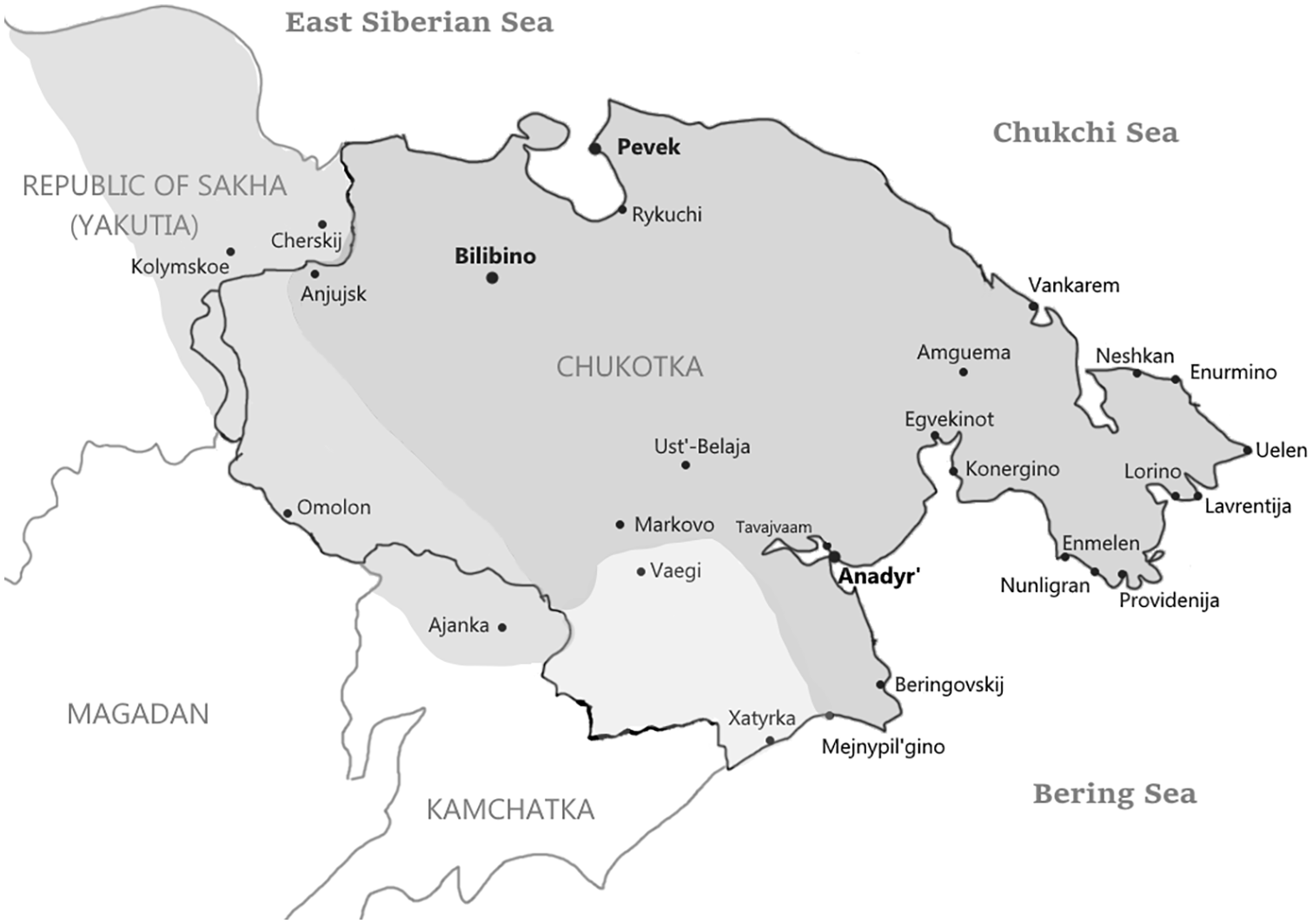
Geographic regions where Chukchi is spoken, with distinct dialect zones indicated.
The Chukchi people are indigenous to northeastern Siberia and were traditionally nomadic hunters and reindeer herders, although some Chukchi settled along the Bering Coast in the 16th–17th centuries and took up maritime lifestyles. Prior to the arrival of Russian colonists in the region in the 17th century, the Chukchi were the locally dominant ethnic group and famously resisted external linguistic influence (Vakhtin, 1998).
The Chukchi defied Russian colonization until the 20th century. Although language shift did not begin in earnest before this time, it has progressed rapidly. The onset of shift can be traced to several disruptive social and educational policies implemented by the Soviet regime in the mid-20th century. These included mandatory instruction in Russian beginning in elementary school, boarding schools for Chukchi children where speaking Chukchi was prohibited and punished severely, collectivization of the reindeer herds, and forced settlement (and resettlement) of the Chukchi in villages, irrespective of their existing social organization (Forsyth, 1992). The combined effect of these policies was to severely interrupt language transmission for an entire generation.
Today, Chukchi is moribund: it is no longer being transmitted to children at all (except possibly in families that still herd reindeer together). All of the remaining speakers are bilingual in Russian to some extent, with virtually no proficient speakers under the age of 50, although there are some exceptions in rural villages (Pupynina & Koryakov, 2019). In the last Russian census (2010), the total number of self-identified Chukchi speakers was 5,096. This figure was inflated even at the time of collection, as people tend to identify as speakers without knowing more than a few words or phrases in the language—for most ethnic groups in the Russian Federation, one’s ethnicity and one’s “mother tongue” are presumed to be the same, an ideology that is reflected in all official documents.
There is limited Chukchi language instruction in schools: where it exists, it is optional and is only offered for one or two hours a week. Thus, teachers tend to prioritize transmitting cultural knowledge (lexical items and phrases) over grammatical knowledge (morphology and syntax); no one who completes these courses receives functional knowledge of Chukchi.
The modern Chukchi “speech community”
An important way in which Chukchi differs from other endangered languages, especially those in the North American context, is that there is no proper “speech community” in any meaningful sense. There is no physical or virtual space where speakers regularly use the language: the remaining speakers do not compose a “human aggregate characterized by regular and frequent interaction by means of a shared body of verbal signs” (Gumperz, 1968, p. 66). Nor is there a “speech community” in the Labovian sense of “participation in a set of shared norms” (Labov, 1972, pp. 120–121). While some degree of interspeaker variation is expected in any speech community, what we find among Chukchi speakers is a set of conflicting norms from different sources that come together to impede language use and transmission: those associated with the vernacular language vs. those associated with an artificial “literary language” developed by linguists in the 1960s–70s (Skorik, 1961, 1977). While there are only minor grammatical differences between Chukchi dialects, many speakers reject the literary language because it is based on eastern coastal varieties, which contain many lexical items particular to the local ecology (Dunn, 1999). The literary language also differs grammatically from all spoken Chukchi dialects, due to unintended Russification on the part of its inventors or a deliberate regularization of poorly understood phenomena. It is characterized by a lower degree of polysynthesis (including noun incorporation, a robust feature of spoken Chukchi), which is metalinguistically salient for speakers. Still, as has been shown in other minoritized contexts, the standard language enjoys considerable prestige regardless of how artificial it is (O’Rourke et al., 2015). Because the literary language was taught in schools and is the subject of all educational materials for Chukchi, speakers regard it as the authoritative variety while dismissing it as unnatural compared to varieties that were actually used in reindeer brigades.
Despite the existence of a so-called “standard language,” there is no centralized authority, such as a group of elders, advocating for the preservation of Chukchi, and there is no major revitalization effort. My consultants point to two difficulties in launching a revitalization program: a lack of money to fund the program and a lack of financial incentive for young Chukchi to participate. (It is difficult to convince young people who could be spending their time learning practical languages, such as English, to invest that time in a language that has no obvious economic value.) Thus, L2 learners are a small, self-motivated group, having had some exposure to Chukchi at home but not enough to acquire it fully.
These remaining speakers do not represent a cohesive physical community or community of usage or practice (Bucholtz, 1999): they are largely isolated from one another, living in different regions alongside not only ethnic Russians but other ethnic groups with their own linguistic interests. The situation is more favorable in places with a visible Chukchi population. In Anadyr, the capital of Chukotka, Chukchi speakers convene a cultural club called Eek “Lamp,” where there are presentations about the Chukchi language and culture followed by a reception. These meetings are attended by proficient Chukchi speakers, who use the language with one another, and aspiring speakers, who can hear Chukchi being spoken. Still, conversations seldom take place entirely in Chukchi and there is considerable code-mixing with Russian. Larger spaces exist online, in the form of WhatsApp groups, that facilitate communication between Chukchi of different regions; there are also online courses that are offered by volunteer teachers. Nevertheless, the vast differences in proficiency among the participants in these venues limit the ability to teach advanced linguistic structures or hold sustained conversations, and a number of my consultants reported dropping out of these communities because they did not provide opportunities for meaningful language practice. More than nominal use of Chukchi, therefore, takes place in much smaller circles, within families or between friends.
We can ultimately expect such a setting to impede the entrenchment of changes at the level of the entire language due to the absence of stable social networks among large groups of speakers (Milroy & Milroy, 1992). However, it is exactly the kind of setting where we expect significant variation between micro-communities (individual families, friend groups, and small meeting circles) due to the small number of interlocutors available to individual speakers and the limited inputs for learners.
Chukchi argument encoding and the nature of noun incorporation
Chukchi argument encoding encapsulates several typologically interesting features that have not been targeted by other studies of shift. These include canonical features of polysynthesis (Baker, 1996; Mithun, 2017; Sapir, 1921), such as subject and object agreement, argument drop, elaborate derivational morphology, and noun incorporation. These features also represent areas where Chukchi differs from the dominant local language, Russian. Although Russian is more synthetic than the dominant language in most well-studied shift scenarios (English), it lacks object agreement and incorporation and has limited verbal derivation and argument drop.
While these features have remained relatively stable among the oldest generation of speakers, attriting speakers and younger speakers display different degrees of variation in these domains. In this paper, we are concerned specifically with the variation evidenced by speakers in their use of noun incorporation (henceforth NI).
Chukchi displays both lexical compounding-type NI as well as more syntactically involved NI (Types I-III in Mithun’s (1984) typology, or what is termed Compound NI by Rosen (1989)). Lexical compounding [Type I NI] includes N-V pairs of the kind we find in English (e.g., ‘berry-picking’, ‘bird-feeder’, and ‘baby-sitter’), which exist as conventionalized chunks in the grammar. That is, they are not constructed by an active syntactic process that joins a nominal argument to the verb that governs it. (For different theoretical approaches to incorporation, see Baker, 1988, 1996; Haugen, 2008; Rosen, 1989).
Lexical N-V compounds are often identifiable by their lack of strict semantic compositionality and the lack of a corresponding non-incorporated construction. This is clear from the English examples noted above: there is no expression ‘to sit (for) a baby’ that conveys the same meaning as ‘to baby-sit.’ Furthermore, these types of compounds do not necessarily entail a change in the valency of the verb compared to its bare form; e.g., the valency of the verb ‘apple-pick’ remains transitive, as evidenced by the possibility of a sentence like ‘I apple-picked some Galas.’
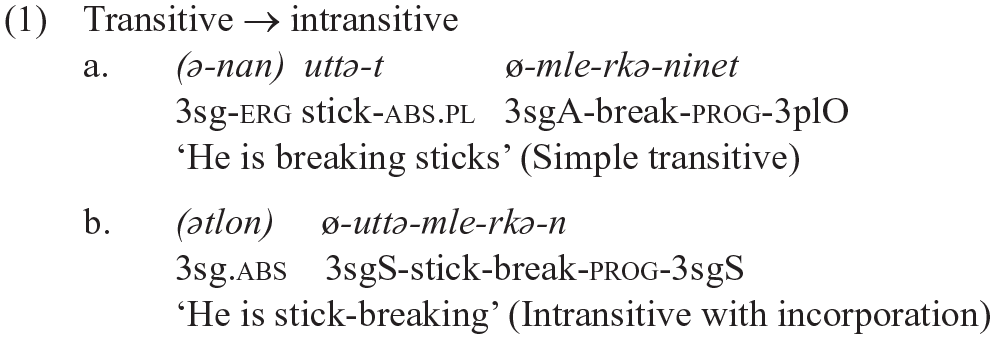
Type II in Mithun’s typology is a more productive form of NI where the noun and verb in question are regularly used independently of one another and where the incorporation of the noun can result in a change in the morphosyntax of the clause, evidenced either by a change in case marking or agreement marking. In Chukchi, incorporation is reflected syntactically through the detransitivization of the verb, which is indicated through a change in both agreement and case. This is illustrated by the following examples from the traditional language (Bogoras, 1922, pp. 830–831; unincorporated examples are my own):
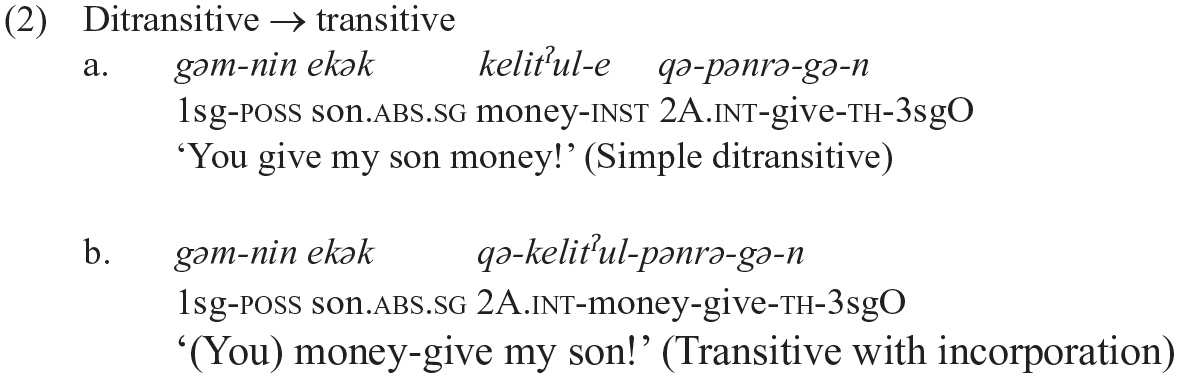
‘(You) money-give my son!’ (Transitive with incorporation)
Broadly, Chukchi uses two separate sets of agreement affixes for transitive and intransitive verbs. The verb contains two slots for agreement: in intransitive verbs, both slots agree with the sole argument, the subject, while in transitive verbs, the prefix position agrees with the subject and the suffix position with the object. 1 Core case marking in Chukchi is ergatively aligned. Transitive subjects are marked with a special ergative case, and intransitive subjects and objects receive the (usually morphologically unmarked) absolutive case.
In (1), the clause’s argument encoding is consistent with that of an intransitive verb: the subject is marked with the absolutive case and both agreement slots agree with the subject (indicated through the use of affixes from the intransitive morpheme set). In (2), incorporation has reorganized the verb’s argument structure. The patient (‘money’) of the underlying transitive verb (‘to give’) has been incorporated, promoting the remaining recipient argument (‘my son’) to the role of object, so that it now receives absolute case. The agreement marking remains as expected for a transitive verb: the prefix agrees with the subject (‘you’, indicated by 2nd person agreement), and the suffix with the object.
Mithun’s Type III NI is difficult to concretely distinguish from Type II based on the examples provided in the 1984 paper. In Chukchi, it can be understood as a more productive version of Type II that is used to manipulate discourse structure but which is otherwise structurally equivalent to Type II. Chukchi NI is motivated by the prominent status of the absolutive argument; in transitive verbs where the agent of the verb is more important to the discourse than the object, the object is incorporated so that the agent receives absolutive case marking as the subject of a now-intransitive verb. NI is also common in cases where the object is typical for the verb (e.g., qora-gənretə-k ‘reindeer-herd-

Mithun’s NI typology is of interest here because it makes predictions about the co-occurrence of different types of incorporation in robust vs. obsolescing languages. Mithun proposes that her NI types form an implicational hierarchy, where the types furthest along the hierarchy imply the existence of the less-productive types (i.e., if a language has Type III, it should also have Types II and I). By the same token, languages lose incorporation along the same hierarchy, where Type III is alleged to be lost before Types II and I.
The present study investigates these predictions by targeting NI of varying degrees of productivity in Chukchi through a combination of different controlled tasks. If this model is correct, we expect NI that is discourse-motivated (i.e., unexpected for that particular verb-noun pair and specific to a particular context) to be less common among younger speakers. As we will see, younger speakers do indeed make little to no use of productive NI; however, they maintain strict judgments about the N-V compounds they have retained.
Methodology: qualitative comparison of small speaker groups
The methodology employed in this study focuses on controlled collection of “small data” from as many speakers as possible in two cities: Anadyr, the capital of the Chukotka Autonomous Okrug (n = 14), and Yakutsk (n = 6), a major city in Siberia where Chukchi regularly visit in the summer. The goal is to derive a comparable sample of utterances and narratives on similar topics using similar lexical items from speakers of different backgrounds. The tasks administered in this study include:
- a production task in which speakers were shown pictures and provided lexical items in citation form in Chukchi and asked to construct sentences
- a guided narrative task (in which speakers were instructed to retell events from a cartoon or picture book) 2
- elicitation of acceptability judgments about NI (acceptable vs. unacceptable N-V pairs, pragmatic contexts where NI is allowed vs. where it is marked)
- an in-depth biographical interview
Experimental production task
In the controlled production task, speakers were shown a series of 27 pictures depicting different events and provided with the verb they were expected to use as well as the expected nominal arguments of the verb. Speakers were instructed to use only the words provided but to modify them as needed in order to produce a grammatical sentence. The stimuli varied according to the conditions in (4) (see Figure 2 for an example stimulus):
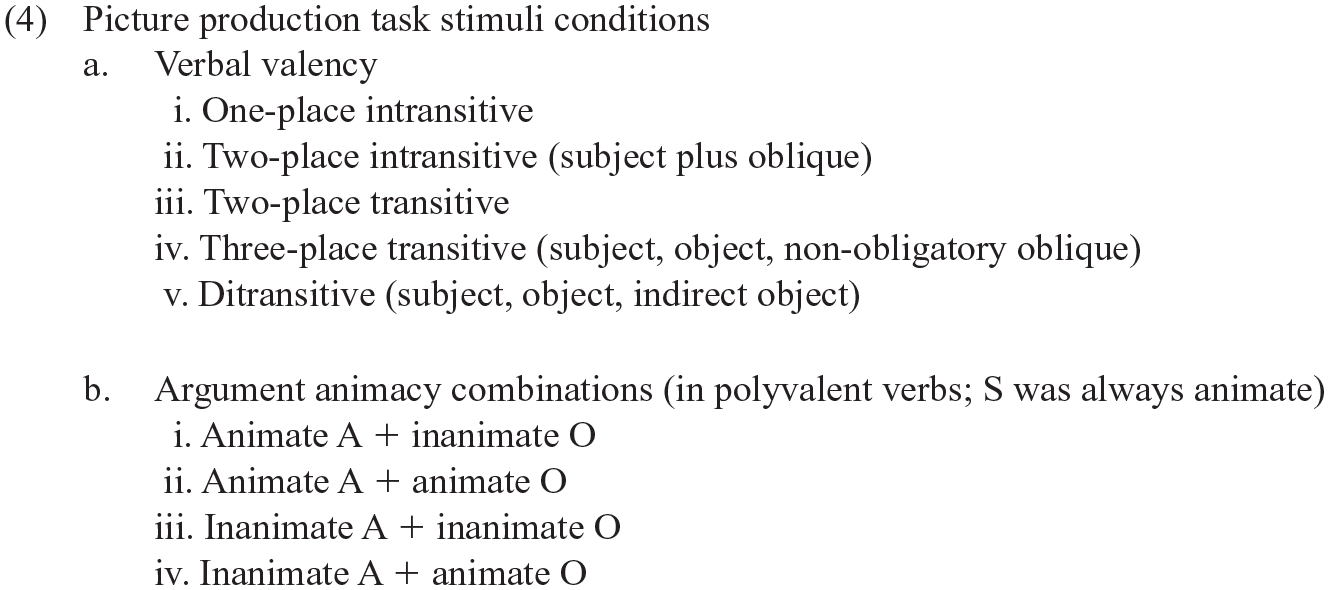
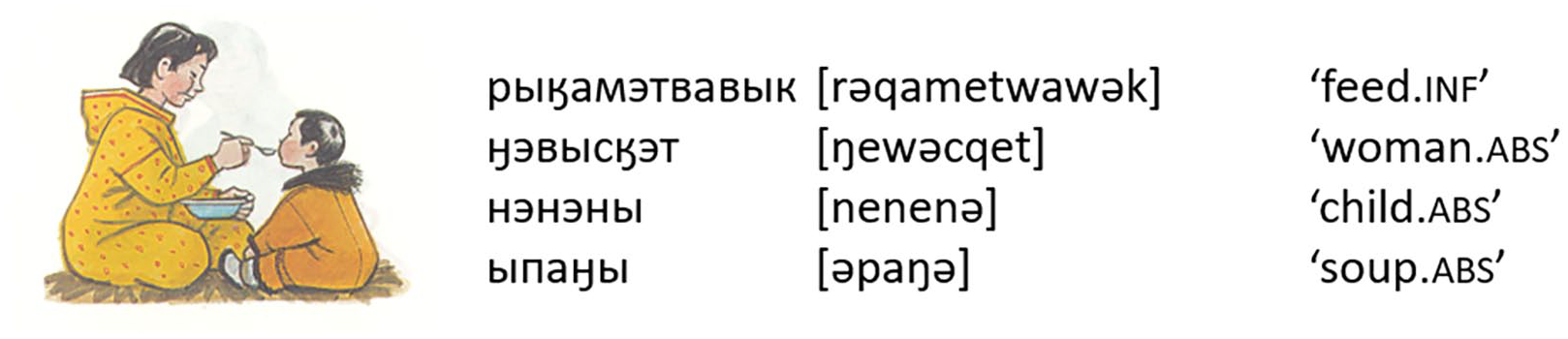
Example stimulus in the experimental production task (participants were shown only the first column).
These particular conditions were selected because they are known to condition argument structural alternations in Chukchi (and cross-linguistically). Verbal valency is fixed in Chukchi: a verb is underlyingly specified for the number of arguments it obligatorily takes. However, verbal valency can be changed through the use of derivational voice morphology (e.g., antipassive, causative) or via NI. Unusual or marked argument combinations, such as an inanimate agent acting on an animate undergoer, are one example of a clear scenario where a valency change may be preferred to demote or de-emphasize the subject (through a passive or antipassive valency reduction). Meanwhile, examples where an animate agent is paired with a typical inanimate undergoer for that verb are prime candidates for valency reduction through object incorporation. Since the sentences were produced outside of a broader discourse, this task targeted NI Types I and II.
Speakers were encouraged to provide metalinguistic commentary about their choices, especially in cases where there was derivational manipulation of the provided lexical items. There are several reasons for this approach. The first is that features such as NI—specifically, when and how it should be used and which nouns are more likely to be incorporated into which verbs—are not well understood in Chukchi. There is a tremendous amount of scholarship on the subject of NI in Chukchi (e.g., Bogoras, 1922; Dunn, 1999; Nedjalkov, 1977, 1982; Polinskaja, 1991; Skorik, 1977), but there are numerous differences among these accounts; the documentation is also not directly comparable because it was collected during different time periods and using different methodologies. (For a thorough account of these issues, refer to Kantarovich, 2020, ch. 4.) Second, there is tremendous regional lexical variation, which inhibits the use of an experimental protocol (such as an acceptability task) in which speakers do not communicate their reasoning to the experimenter. Finally, due to the low number of remaining speakers and the lack of easy access to them, it is more informative to use a small set of stimuli that do not vary across participants and to debrief with them afterward. This also enables us to draw conclusions about speakers’ grammaticality judgments from their metalinguistic assessments. Although this methodology is not given to statistical analysis, there is an increasing (and heartening) body of evidence that large data samples are not always necessary for drawing accurate conclusions about utterance grammaticality (see Mahowald et al., 2016 for a discussion of the generalizability of acceptability judgments from small groups of participants).
Speaker groups
Speakers who participated in the study were divided into three groups on the basis of their biographical interviews. These groups are defined by their similar acquisition experiences and self-reported proficiency in the traditional language. As expected from other investigations into language shift, they correspond roughly to different generations.
The group sample sizes below reflect the numbers of speakers that were able to complete the experimental production task and provide at least one narrative; regrettably, this has resulted in the exclusion of four new speakers from the data set and two speakers each from the other groups. Due to the advanced state of shift, many new speakers use the language only in the service of scholarly and artistic pursuits and report that they are unable to construct sentences, even with lexical items provided. The descriptions of each group are representative of the relevant generations, not merely the speakers that participated in the experiment, and are based on my own interviews as well as scholarly work about language maintenance among the Chukchi (Pupynina & Koryakov, 2019).
Differences in noun incorporation by group
Let us now turn to differences in NI that can be linked to these different groups. First, it is clear that these groups do differ from one another in their use of NI; while members of each group do not always display identical patterns, they are alike in the frequency with which they use incorporation and the types of arguments they are more likely to incorporate. The findings from this study support the predictions made by Mithun’s (1984) hierarchy. CSs make use of all types of NI up to and including Type III, the productive spontaneous incorporation that is motivated by discourse-specific factors, which was observed in their narrative production. ASs use incorporation productively but infrequently, restricting it to prototypical verb-noun combinations (Types I and II). Finally, NSs make little to no use of NI at all and avoid spontaneous NI entirely, only using lexicalized N-V compounds.
The following sections provide specific examples of the uses of these different NI types among the three groups.
Group differences in the sentence production task
Table 1 summarizes the distribution of responses containing NI in the sentence production task by individual speaker.
Instances of incorporation by participant and speaker group in the experimental production task (outliers italicized).
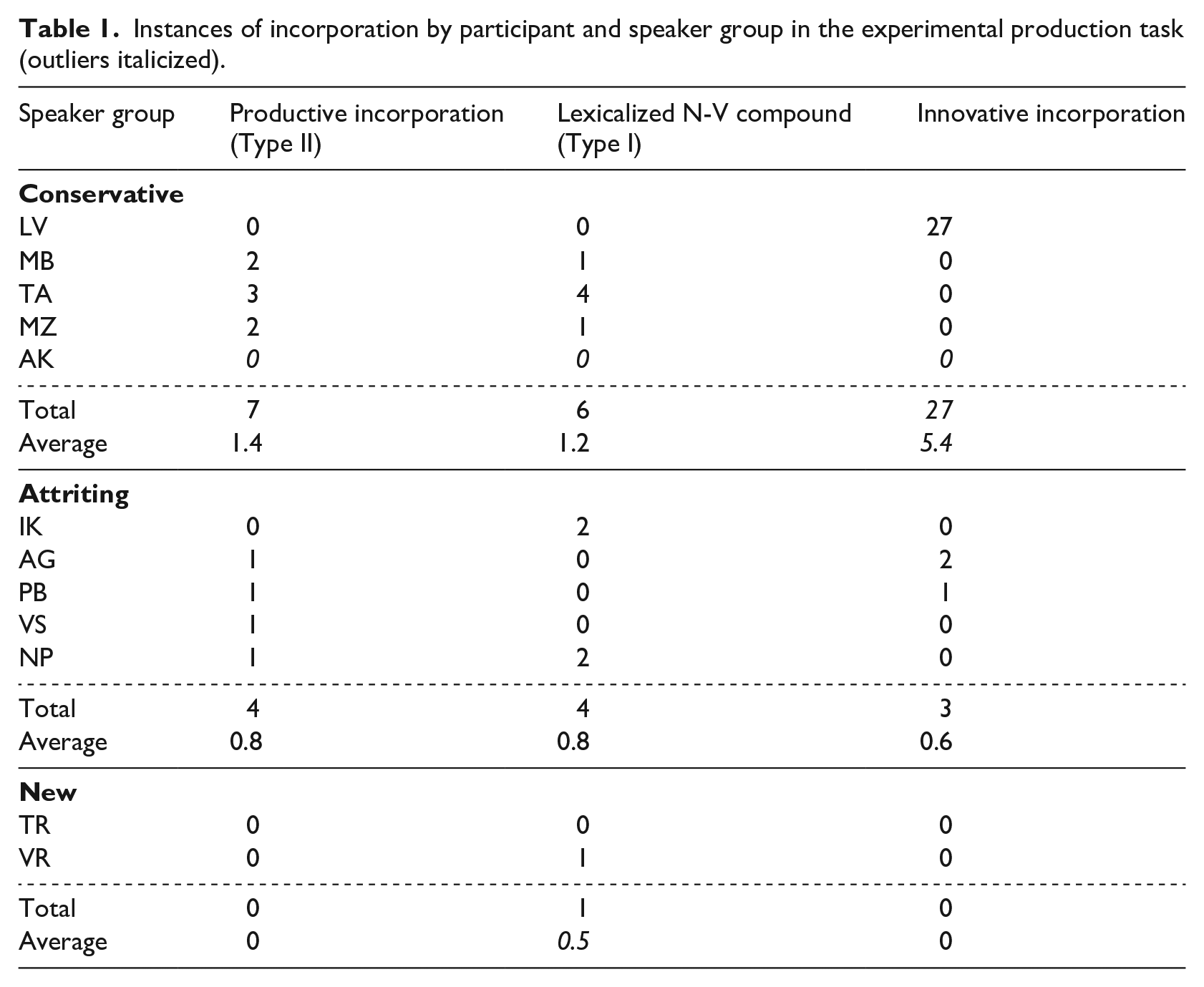
Out of 27 total stimuli, 12 contained combinations of verbs and nouns where NI was a viable strategy for expressing the event in the picture in traditional Chukchi. These are polyvalent verbs with an animate agent and an inanimate direct object or instrument. Instances where speakers incorporated the given object argument into the given verb (or used semantically equivalent substitutes) are coded under the first column. Instances where a speaker substituted both the verb and its argument with a lexicalized noun-verb compound are given in the second column. Finally, instances where speakers used incorporation in a way that was structurally unconventional or in an unexpected context are counted in the third column.
From the table, it is apparent that there is considerable variation in the frequency and types of incorporation used by speakers within a single group. Such variation is expected of the traditional language as well: while incorporation is considered more felicitous in certain contexts, it is not considered ungrammatical to avoid it. For stimuli where speakers used productive incorporation, they mentioned that a construction with free-standing arguments would also be correct but would sound stilted or “literary.” One CS (AK) did not make use of any incorporation in this task, although she did so in other tasks in the study. This speaker is formally educated in Chukchi and likely thought that the task was actually targeting the literary language and avoided incorporation deliberately. Another formally educated speaker, LV, performed similarly in the task, avoiding incorporation in the expected contexts (although she provided an innovative incorporative complex for every stimulus in addition to using analytic sentences with free-standing arguments—this is further discussed in section 5.3).
Except for these outliers, there are generalizations within the different speaker groups. CSs used both Type II and Type I NI for a greater number of the expected NI stimuli than either ASs or NSs. While the ASs used NI for fewer stimuli, all of them made use of some type of NI for at least one stimulus. The sets of stimuli for which CSs and ASs used Type I or II NI also overlapped. NSs made virtually no use of incorporation at all, and in the sole instance of NI in this group, the participant (VR) tellingly used a Type I N-V compound.
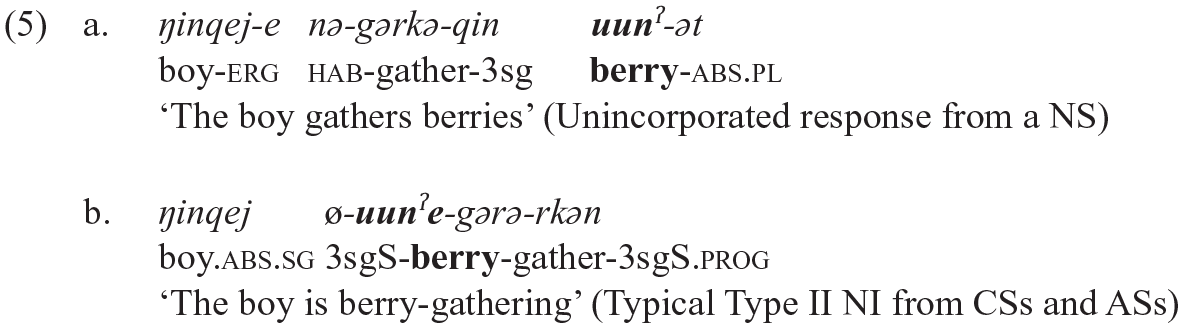
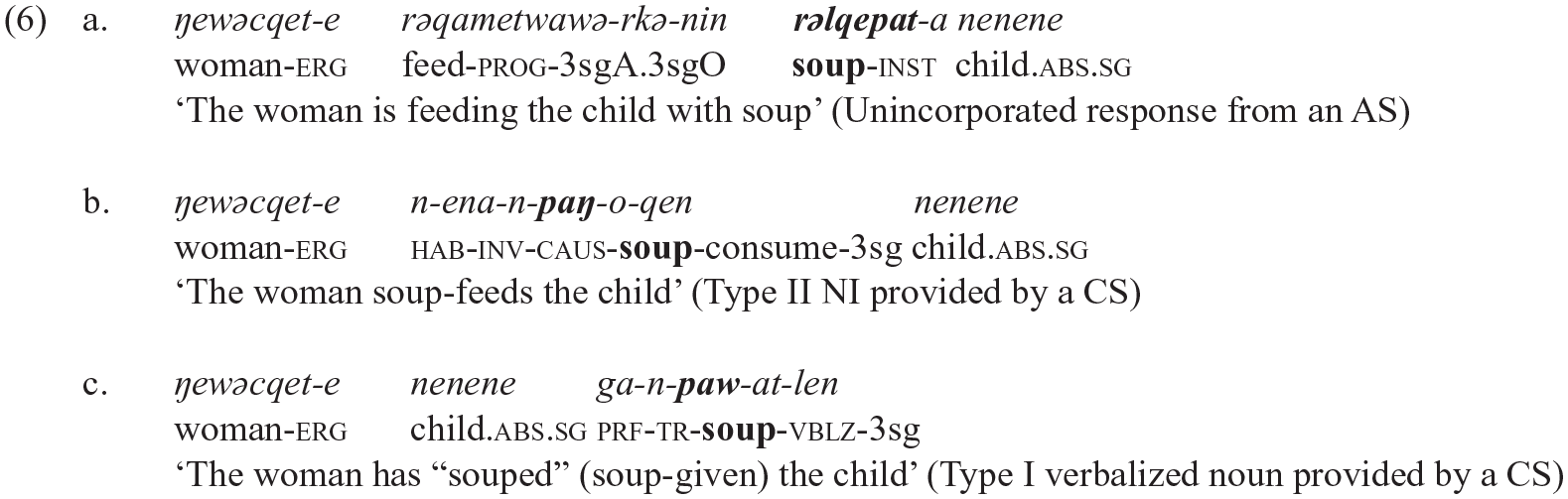
Three stimuli in particular triggered incorporation: one in which a woman is feeding soup to a child, one where a boy is gathering berries, and one where a woman is buttering a slice of bread. In the case of the boy picking berries, the motivation for incorporation is clear: ‘berry’ is a prototypical undergoer of ‘gather’. This stimulus featured incorporation for almost all of the CSs and ASs (the noun which can be optionally incorporated is bolded):
In the other two examples, the motivation for incorporation is a general avoidance of so many free-standing case-marked nominals, which CSs claim sounds bizarre, or as though there is some pragmatic reason to emphasize all of the arguments as being specifically involved in the act. Thus, although (6a) is grammatical, experienced speakers perceive some emphasis on ‘the soup’, e.g., ‘It is with soup that the woman is feeding the child’.
The sole instance of incorporation used by a NS featured a conventionalized N-V compound, ‘to play ball’. The speaker offered the following response to a stimulus that targeted the sentence ‘The youth tossed the ball to the boy’:

No other speaker offered this response to this stimulus, instead using the provided verb, rintək, ‘to throw’. This NS likely used a conventionalized compound in this case because it is a context he is more likely to have actually heard described, even though it is not a faithful response to the stimulus. In this case, despite not identifying as a “fluent” speaker, the NS was confident enough in his judgments to reject the stimulus lexical items as unnatural for the picture and to offer a more colloquial alternative.
While ASs may use incorporation with less frequency than CSs, like this NS, they have strong judgments about when incorporation is acceptable. Despite the optionality of NI in Chukchi, the incorporation of some nouns is considered outright unacceptable. Four speakers additionally took part in a separate acceptability questionnaire that was administered orally. The questionnaire design was similar to that of the sentence production task, where the chosen verbs and nouns were conditioned by the same criteria (valency and animacy). For each combination of a verb and its arguments, speakers were asked to assess the same construction with a variety of valency-changers applied, including NI. While there were differences in judgments across the speakers, they were unanimous in rejecting constructions where a human noun was incorporated, like the following:
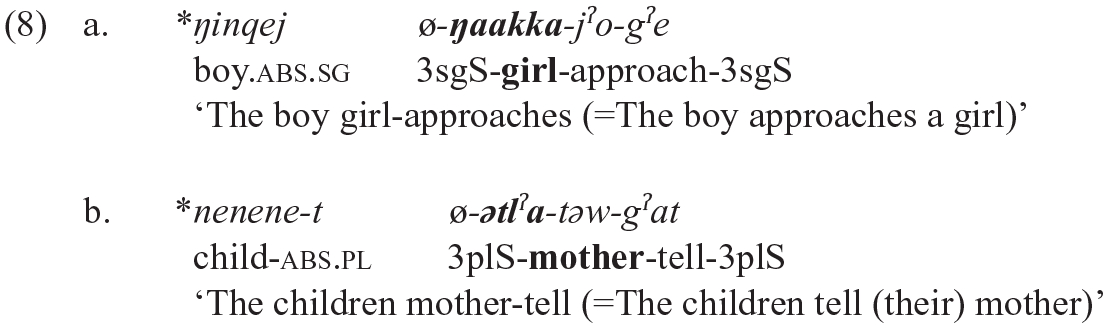
Thus, although ASs and NSs are less likely to use NI, the cases where they do use it are deliberate and rule-governed.
Spontaneous use of Type III incorporation in narratives
While Type III NI was not targeted in the production task, it occurred with regularity in narratives produced by CSs and to a far lesser extent in narratives produced by ASs. NSs could not produce more than a few consecutive sentences in the story retelling tasks, and so made no use of Type III NI by default.
It is difficult to quantify the extent to which CSs used Type III NI “more frequently” than ASs—while the narratives were on similar topics, some speakers were more loquacious than others or did not focus on the same parts of a story. Most AS narratives contained no examples of incorporation of any kind, or else only high-frequency conventionalized examples such as the following:

We can compare this example to the following context-dependent incorporation from a CS, about a traditional Chukchi belief:

The motivation for the incorporation of ‘web’ in this example is purely contextual, as ‘web’ is not the prototypical subject of ‘to stretch’: the speaker first introduces the web as the object of ‘make’, and then explains where the web ends up. The effect of the incorporation of the second mention of ‘web’ is to demote its salience in the discourse, focusing instead on where the web is placed (on the chimney, where the speaker goes on to explain that evil spirits are now barred from entering).
Ultimately, while Type III incorporation is the least commonly utilized type even among CSs, there is evidence that it remains a part of their linguistic repertoire, while ASs (and to an even greater extent, NSs) tend to avoid more productive, pragmatically laden incorporation.
Innovative types of incorporation that surfaced in the study
Table 1 notes a final response category: innovative incorporation, which occurred (in different ways) for one CS (LV) and two ASs (AG and PB).
So far we have only considered verbal incorporation, the incorporation of either the object or an oblique argument by the verb stem. Traditional Chukchi also has modifier incorporation, where nouns can incorporate adjectives, verbs, or other nouns, which are interpreted as modifiers of the head noun (Dunn, 1999; Skorik, 1948). In addition to full clauses, LV provided a paraphrase with modifier incorporation by the subject noun for every stimulus in the production task. These included examples typical of the traditional language, with just the verb incorporated, such as the following (the incorporated element is bolded):
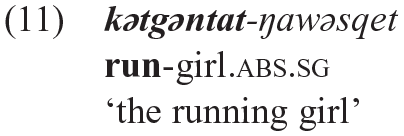
For transitive verbs and verbs presented with three arguments, however, this speaker produced incorporation into nominals of a kind that is not seen in the literature, incorporating not only the verb but the non-subject arguments:

This type of holophrastic modifier incorporation is far more productive than documented examples, which only incorporate one (or at most, two) modifiers. It is also more syntactically complex: typically, nouns incorporated by other nouns are understood to provide a description or quality of the head noun and are not governed by an incorporated verb. This is not to say that this type of incorporation would be deemed ungrammatical by other CSs. Rather, this may be an instance of a proficient speaker trying to highlight a special feature of Chukchi compared with the dominant language: the productivity of word formation.
The two ASs evidenced a different type of innovative incorporation from the CS but had the same unexpected innovation despite not being acquainted with one another, growing up in different regions, and presently living in different cities. These speakers used a passive-like incorporation construction where the subject was incorporated instead of an object or oblique:
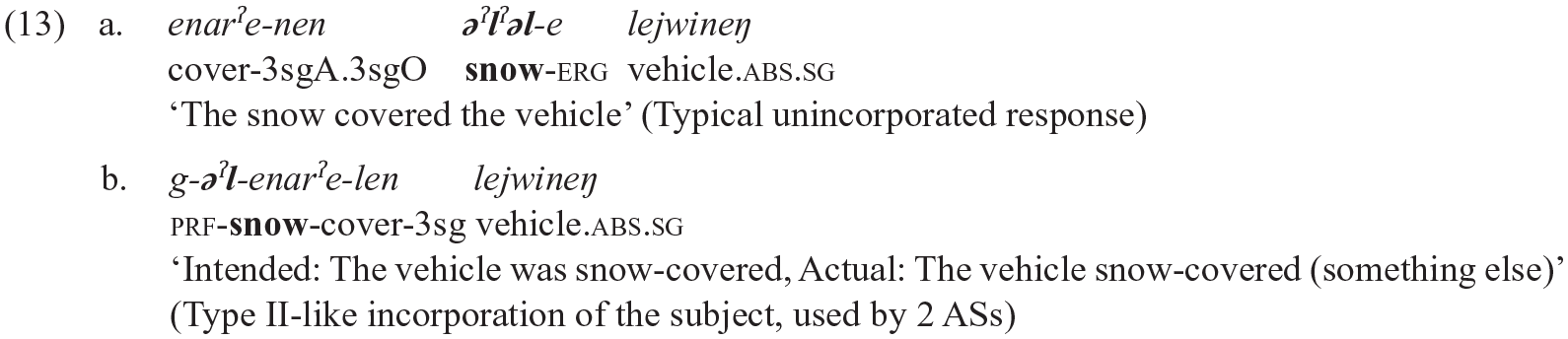
The production of zero-place intransitives through incorporation of a natural phenomenon subject is well-attested in the traditional language, where there is understood to be an unexpressed expletive subject (Nedjalkov, 1982). 3
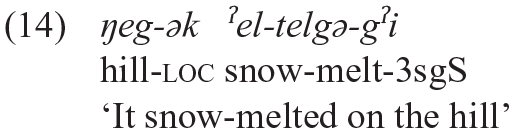
However, this is distinct from the structure of (13b), where the subject can only be interpreted as the absolutive (unmarked) argument, ‘vehicle’. Still, it is possible that both speakers were drawing on their knowledge of these types of constructions when producing (13b).
Discussion
Use of incorporation among modern speakers of Chukchi is subject to variation along the following cline: (15) Variation in incorporation in modern Chukchi

The differences between these speaker groups are clear-cut and are attributable to a number of causes stemming from their unique sociolinguistic backgrounds. NI is a distinctive feature of Chukchi that is lacking in Russian; thus it is not surprising that as Russian dominance increases in the speaker pool, the use of features that have no Russian equivalent decreases. Still, we must be careful to distinguish a decrease in the occurrence of a feature from loss or structural decay: NI—and the rules governing NI—have not entirely vanished from the grammars of NSs. The differences in the frequency and productivity of incorporation among the different speaker groups can instead be felicitously explained as a direct result of variable acquisition experiences: derivational morphology and word formation rules are known to be acquired progressively during childhood even in analytic languages such as English (Park, 1980; Tilstra & McMaster, 2007; Tyler & Nagy, 1989). These facts explain why both ASs and NSs are sensitive to frequency effects, but why NSs are far less likely to use incorporation (due to their near-complete lack of immersive acquisition).
There are also ways that speakers do not differ from one another: CSs and ASs (and, to a lesser degree, NSs) maintain a shared system of rules governing incorporation. With the possible exception of the passive-like incorporation, the examples of incorporation in this study are consistent with what is known about the traditional language, underscoring the fact that non-conservative speakers are still “native” speakers. Similarly, the variation observed in this study is not idiolectal or chaotic: the ASs and NSs that do not have any contact with one another nevertheless display similar deviations from the traditional language, including the two ASs that independently innovated the same type of subject-incorporation. Thus, we can observe, in real time, trends that are not the results of the propagation of a change but of a consistent set of pressures (disrupted acquisition, Russian interference, and language universals) separately producing similar results in different speakers’ grammars.
It is worth examining the ways that these findings complement—and differ from—those of another thorough examination of noun incorporation in a heritage language. Sherkina-Lieber and Murasugi (2015) discuss findings from experimental work on NI in Inuktitut, a polysynthetic language of Eastern Canada. The linguistic ecology of Inuktitut differs from that of Chukchi in several noteworthy ways. Although it is a minority language, it is relatively robust, with over 35,000 speakers according to the 2016 Canadian census; thus, there is a large number of adult heritage speakers with a higher degree of proficiency than most Chukchi NSs. Speakers have far greater access to educational resources and more opportunities to use the language and hear it spoken. Thus, it is ultimately not surprising that the Inuktitut results differ from those of this study: Sherkina-Lieber and Murasugi (2015) found that heritage speakers showed no obvious preference for analytic constructions over synthetic (incorporated) ones, whereas new and attriting Chukchi speakers demonstrate a noticeable decline in the frequency and productivity of incorporation in favor of expressing arguments as free-standing nominals. Still, the results had two dimensions in common: (i) heritage speakers of Inuktitut retain the necessary grammatical operations to use NI appropriately and (ii) they can be shown to have difficulty with constructions that depend on lexical knowledge.
Conclusion: variation and change in fractured communities
The social reality for the remaining speakers of Chukchi (and other marginalized languages) has significant implications for variation, when and why different features are deployed by speakers, and ultimately, the entrenchment of change.
The lack of a Labovian speech community in the Chukchi context has both facilitated linguistic creativity and stemmed the spread of innovations throughout the language as a whole. While older speakers continue to use Chukchi with one another when they can and work to create educational materials on the traditional grammar, most ASs and NSs tend to engage with the language alone, as a hobby. Many CSs are unenthusiastic about using the language with their children, who end up studying Chukchi through existing pedagogical materials. CSs are critical of both ASs and NSs; while they acknowledge that there is considerable (lexical) variation in traditional Chukchi, they tend not to regard unfamiliar or innovative features of younger speakers’ idiolects as variation. The findings from this study suggest that CSs’ perceptions of younger speech are also not consistent with how different or “incorrect” they actually are; still, as the de facto keepers of linguistic authenticity in the community, their perceptions play an outsize role in the continued maintenance of Chukchi among younger generations.
Still, although older speakers stigmatize the “mistakes” that younger speakers make, the two generations often do not engage with one another enough to facilitate the correction of these errors. This isolation is liberating for younger speakers to an extent, since they know that the older speakers regard their speech as substandard. Many of them have admitted to being inventive with the language and speaking it in a way that “sounds pleasing to them.” In fact, it is solely among younger ASs that anything resembling an emergent speech community with diffusion of change is observed. Two of the ASs are colleagues at a local radio station and use the same marked features. For example, they both use case markers from the high animated noun class (which applies to certain kin terms and names) for most human nouns, where other speakers would use the common noun class.
These facts about Chukchi language use and ideology among the remaining speakers ultimately inhibit the continued use of a shared variety, and the younger generations of speakers do not make up a large enough class to sustain the language. Today, Chukchi is primarily socially indexical: it is a way for speakers of all levels of experience to signal membership in a larger cultural community.
Footnotes
Acknowledgements
The author is grateful to Lenore Grenoble, Karlos Arregi, Ming Xiang, and Brian Joseph for providing feedback on earlier iterations of the work. Ming Xiang also offered substantial input on the research design and Lenore Grenoble assisted in collecting the data. Anna Gyrgol’gyrgyna performed the indispensable work of transcribing speakers’ narratives. The author is also thankful for initial feedback from the special issue editors, Itxaso Rodríguez-Ordóñez, Jonathan Kasstan, and Bernadette O’Rourke, who helped make this a much more interesting and concise paper. Finally, the author thanks the two anonymous reviewers for their helpful assessments.
Declaration of conflicting interests
The author declared no potential conflicts of interest with respect to the research, authorship, and/or publication of this article.
Funding
The author disclosed receipt of the following financial support for the research, authorship, and/or publication of this article: Fieldwork and data analysis for this study were funded by the National Science Foundation (grant no. BCS #1761551) and are part of a larger project investigating the effects on language shift on languages of Siberia. Data analysis was additionally supported by the Megagrant from the Government of the Russian Federation under Grant 075-15-2021-616 for the project “Preservation of Linguistic and Cultural Diversity and Sustainable Development of the Arctic and Subarctic of the Russian Federation.”
