







Abstract
Aims:
This study evaluates the Bilingual Language Profile (BLP) in characterizing bilinguals in Catalonia, where Catalan and Spanish coexist across daily life, education, and other contexts.
Methodology:
A sample of 254 Catalan-Spanish bilinguals, predominantly university students, were categorized as Catalan-dominant, Spanish-dominant, or balanced bilinguals based on their BLP dominance scores. The four BLP modules—language history, use, proficiency, and attitudes—were analyzed to identify differences among the groups.
Data and Analysis:
Comparisons across groups and within modules were conducted to evaluate the BLP’s effectiveness in distinguishing bilingual profile groupings.
Findings:
The BLP effectively distinguishes Catalan- and Spanish-dominant bilinguals, reflecting clearly polarized linguistic experiences. In contrast, the balanced bilingual group is more heterogeneous and harder to define, suggesting that their language dominance is more context-dependent. The language-use module provides the clearest differentiation among groups, while language proficiency and attitudes exhibit less variation.
Originality:
This study offers a novel evaluation of the BLP in Catalonia’s complex sociolinguistic environment.
Significance:
The results underscore the BLP’s strengths and limitations in profiling bilinguals in Catalonia. Suggestions for improving the questionnaire are made to better reflect the region’s particular bilingual dynamics and emphasize the value of a tailored tool.
Keywords
Introduction
Catalonia is a bilingual society where Catalan and Spanish coexist, both holding official status and widely used across different domains. The majority of the population is highly proficient in both languages, making it an interesting context for studying language dominance. Language dominance, a complex and multifaceted concept, reflects the relative strength of each language in a bilingual’s repertoire. While traditionally linked to proficiency, it is, in fact, broader and multidimensional. Scholars like Silva-Corvalán and Treffers-Daller (2016), de Houwer (2011), and Birdsong (2016) emphasize its dynamic and gradual nature.
Language dominance affects a range of linguistic dimensions and varies depending on the context of language use and the individual’s exposure to each language. Concentrating in the case of Catalan-Spanish bilingualism, it has been shown to affect phonetics (Amengual & Simonet, 2020), lexicon (Ferré & Brysbaert, 2017), morphosyntax (Benito, 2023; Perpiñán, Soto-Corominas, 2021; Puig-Mayenco et al., 2018), and pragmatics (de Rocafiguera, 2022).
Given its multifaceted nature, language dominance must be measured through a comprehensive approach that goes beyond simple proficiency tests, as proficiency is only one component among a constellation of dynamic, experience-based factors such as frequency of use, exposure, language attitudes, and so on. Several methods have been developed to operationalize this construct, often using questionnaires designed to capture different dimensions of bilingualism. The Language Experience and Proficiency Questionnaire (LEAP-Q; Marian et al., 2007) and the Bilingual Language Profile questionnaire (BLP; Birdsong et al., 2012) are two of the most commonly used questionnaires that have been used in studies providing a more holistic view of language dominance.
However, there is no standardized and widely-used questionnaire specifically designed for bilinguals who were born and raised in bilingual communities like Catalonia. The BLP has been increasingly used in research on Catalan-Spanish bilinguals (Benito, 2023; de Rocafiguera, 2022; Puig-Mayenco & Judy, 2025), although it was originally developed for North American contexts with a dominant and a minority language, which differs from the Catalan-Spanish setting where both languages share official status. Ad hoc questionnaires have been created for specific studies (e.g., Aparici et al., 2024; Arnaus Gil, 2021; Bel & García-Alcaraz, 2018), including the Language and Documentation Questionnaire (LaDoQ; Perpiñán & Soto-Corominas, 2021), but a universally accepted tool remains elusive.
This study aims to assess how well the BLP characterizes the language dominance profiles of individuals raised in a bilingual society like Catalonia. The goal is to contribute to more accurate and contextually relevant tools for evaluating language dominance in bilingual populations. This research aims to test the usefulness of the BLP in profiling Catalan–Spanish bilinguals and to explore how its modules help distinguish among dominance groups, contributing to the broader understanding of language dominance.
Defining language dominance in bilingualism
The concept of language dominance has been interpreted and defined in various ways across research studies. Generally, it encompasses the idea that bilingual individuals typically have a stronger or dominant language and a weaker or non-dominant language. The distinction between these languages can be based on several factors, including proficiency, usage patterns, and exposure to each language.
However, the definition of language dominance varies by perspective and context. Birdsong (2016) defines it as “asymmetries of skill in, or use of, one language over the other” (p. 1), focusing on bilingual behaviors. Argyri and Sorace (2007) define it as “the language in which the bilingual child obtains more input regularly” (p. 83), emphasizing exposure. Meisel (2021) highlights societal language dominance –i.e., the dominant community language, and its influence on perceptions-, though it may not always align with individual dominance (Schmeißer et al., 2016). Moreover, biographical factors like age of acquisition, residence, language input, use, and proficiency also shape individual dominance profiles (Montrul, 2016). These factors interact, influencing how bilinguals navigate linguistic environments and shaping language dominance.
We start by recognizing that the age at which bilinguals acquire their languages plays a crucial role in shaping their language dominance (Meisel, 2021). However, an early age of acquisition alone does not ensure native-like competence in both languages; sufficient exposure and input are also crucial (Birdsong, 2016; Meisel, 2009, 2021).
Regarding language exposure, it refers to the amount and quality of input that individuals receive in each language, at home, in the community or at school. Exposure plays a key role in language development and proficiency, especially for bilingual children. Hervé et al. (2016) found that the language children are most exposed to is often the one they use more and in which they develop greater proficiency, highlighting the importance of input quantity and quality in shaping dominance profiles.
Language use, or active production in communicative contexts, is closely linked to exposure. Bilinguals often exhibit use patterns reflecting their dominant and non-dominant languages. Bedore et al. (2012) categorize bilinguals as balanced when both languages are used similarly and unbalanced when one is used more frequently and proficiently. Grosjean (2024) notes that use patterns vary by context, with societal dominant languages used in formal settings and non-dominant languages in informal ones. While this division aligns with the classical concept of diglossia à la Ferguson, it doesn’t fully apply to the Catalan context. Historically, Catalonia exhibited diglossic features, with Spanish as the high language and Catalan as the low. However, this balance has become more complex, with both languages now used across various domains and shaped by evolving ideologies and practices (see Costa, 2023).
Finally, language proficiency refers to the skill level in speaking, listening, reading, and writing. Research shows a correlation between proficiency and dominance (Wei, 2007), often leading to the conflation of the two. While standardized proficiency tests often measure dominance, they may oversimplify its dynamic nature and context-dependent nature, especially in bilingual settings where proficiency can vary across domains (Gertken et al., 2014). Montrul (2016) argues that proficiency alone doesn’t fully capture dominance, as highly proficient bilinguals may still show asymmetries in use and sociolinguistic competence.
Considering all these facts, it can be argued that language dominance is a multidimensional, dynamic construct, making its measurement in bilingual populations complex. To address this, researchers have developed questionnaires and tools to capture the different aspects of the bilingual language experience. For example, the Bilingual Dominance Scale (Dunn & Fox-Tree, 2009) measures perceived dominance through self-reports of language abilities and preferences. LEAP-Q (Marian et al., 2007) assesses language proficiency, use patterns, and exposure across different contexts, and the BLP (Birdsong et al., 2012) also incorporates various components to comprehensively assess dominance; both tools are available in Spanish and Catalan. The BLP, used in this study, will be detailed later.
In a recent systematic review, Kašćelan et al. (2022) identified 48 questionnaires assessing bilingual experience, underscoring variability in methods and tools exploring correlations with cognitive and learning differences. This diversity complicates efforts to quantify language exposure, use, and proficiency consistently across studies. Greater transparency in defining bilingual profiles is crucial to resolve conflicting results stemming from differing approaches to bilingualism’s multidimensional nature (De Cat et al., 2023). A central aim remains to classify bilinguals by dominance profiles, with various frameworks proposed to distinguish bilingual types and acquisition trajectories (Treffers-Daller, 2019; Wei, 2007).
Language dominance, alongside age of acquisition, serves as a key criterion for classifying bilinguals. Treffers-Daller (2019) distinguishes between dominant bilinguals, who exhibit higher proficiency and use of one language, and non-dominant bilinguals, with more balanced proficiency and use. Another category, balanced bilingualism, refers to individuals using both languages similarly across contexts (Grosjean, 2024).
Beyond the effort to group bilingual individuals, conventional labels risk oversimplifying multilingual experiences and may lead to conflicting findings on cognitive impacts (Leivada et al., 2021). Such labels often fail to account for variability within and across groups, as many bilinguals resist clear classification. Viewing bilingualism as a continuum offers a more nuanced approach to capturing its complexity (Rothman et al., 2023). However, measuring language dominance, categorically or as a continuum, remains challenging due to its multidimensional nature and diverse influencing factors. Despite various assessment tools and classification schemes, no consensus exists. Given this situation, our study evaluates the BLP, a well-established questionnaire providing a continuum-based quotient, as a tool for classifying societal bilinguals.
Bilingualism in Catalonia: some reflections and data
Catalonia’s linguistic landscape reflects a complex interplay between bilingual individuals and a bilingual society. This distinctive context arises from prolonged language contact between Spanish, the majority language, and Catalan. Despite being classified as a minority language, Catalan holds co-official status alongside Spanish, enjoys significant linguistic vitality, and retains substantial recognition and capital despite fluctuations in social prestige over recent decades, prompting debates about its minority language status.
By late 2023, Catalonia’s population exceeded eight million, with bilingualism being common particularly among the youth educated in Catalan schools, where Catalan is the primary language of instruction. Recent migrations have transformed Catalonia into a multilingual society, with over 100 languages spoken and 1.4 million residents speaking languages other than Catalan and Spanish (Idescat, 2023). The current study focuses on Catalan-Spanish bilinguals.
Catalan-language schools adopt tailored linguistic projects to address diverse contexts, from predominantly Spanish-speaking environments to highly multilingual ones. By the end of compulsory education (age 16), students are expected to achieve CEFR C1 proficiency in both Catalan and Spanish, fostering balanced bilingualism. Early immersion in Catalan, starting at age three, strengthens its educational role.
Overall, Catalonia’s educational policies and societal dynamics emphasize a commitment to bi-multilingualism, aiming for proficiency in Catalan and Spanish while promoting broader linguistic diversity through foreign language education. However, geographic and sociolinguistic diversity, coupled with varied school outcomes, contribute to significant bilingual diversity across the region, as reflected in official data.
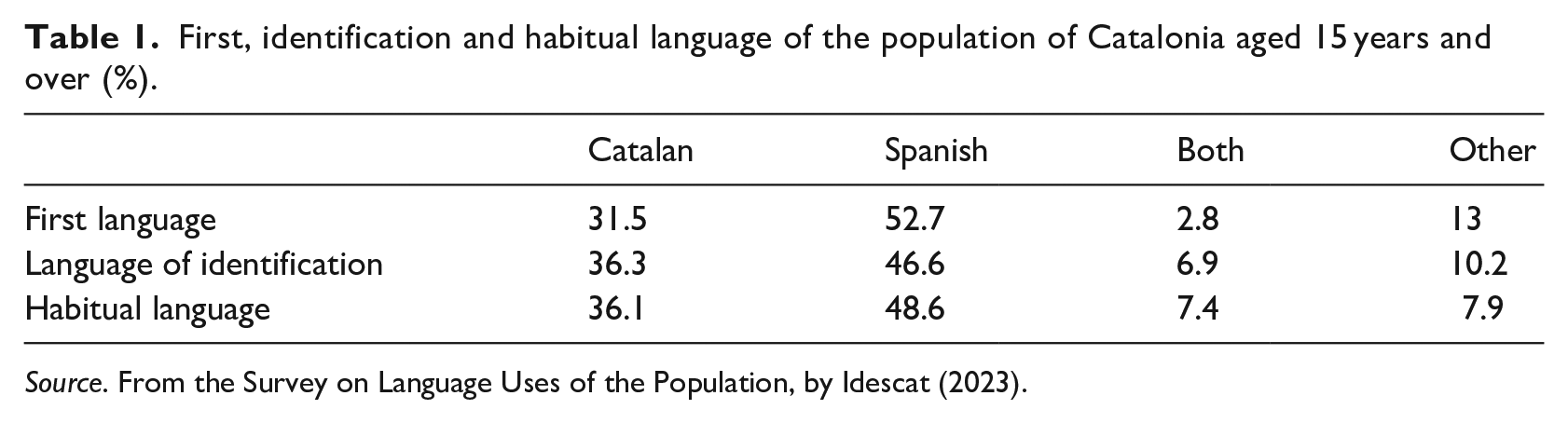
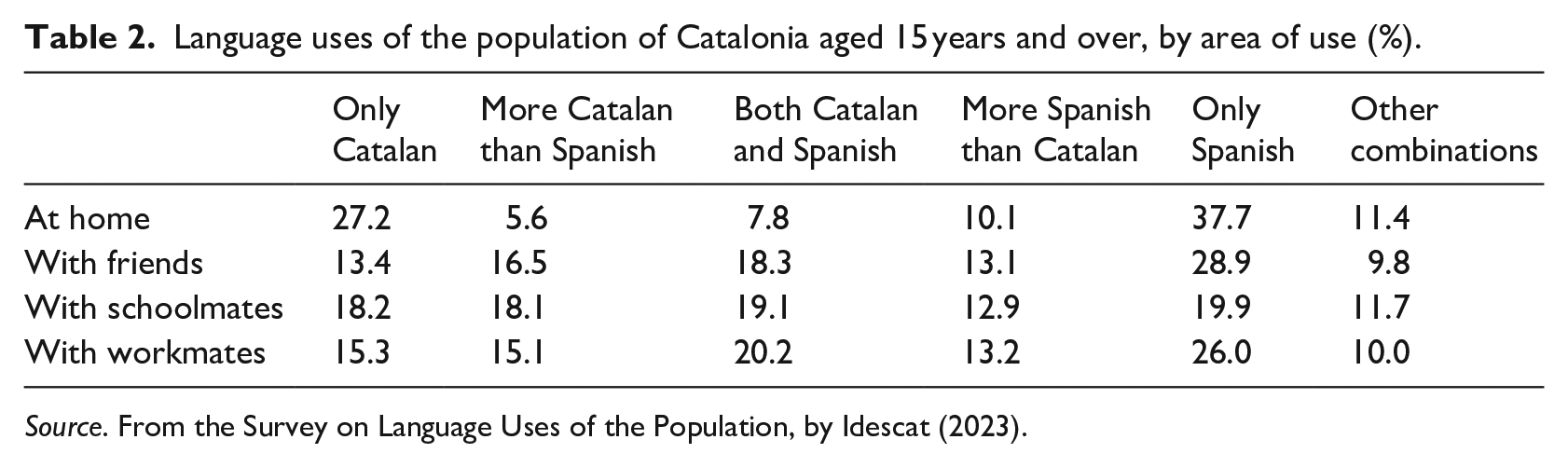
The results in Table 1 highlight Catalonia’s complex linguistic landscape, where Spanish is the majority first language and dominant in identification, but Catalan remains prominent in habitual use and self-identification. Table 2 shows the coexistence of both languages in daily interactions, with Spanish being more prevalent outside the home.
First, identification and habitual language of the population of Catalonia aged 15 years and over (%).
Source. From the Survey on Language Uses of the Population, by Idescat (2023).
Language uses of the population of Catalonia aged 15 years and over, by area of use (%).
Source. From the Survey on Language Uses of the Population, by Idescat (2023).
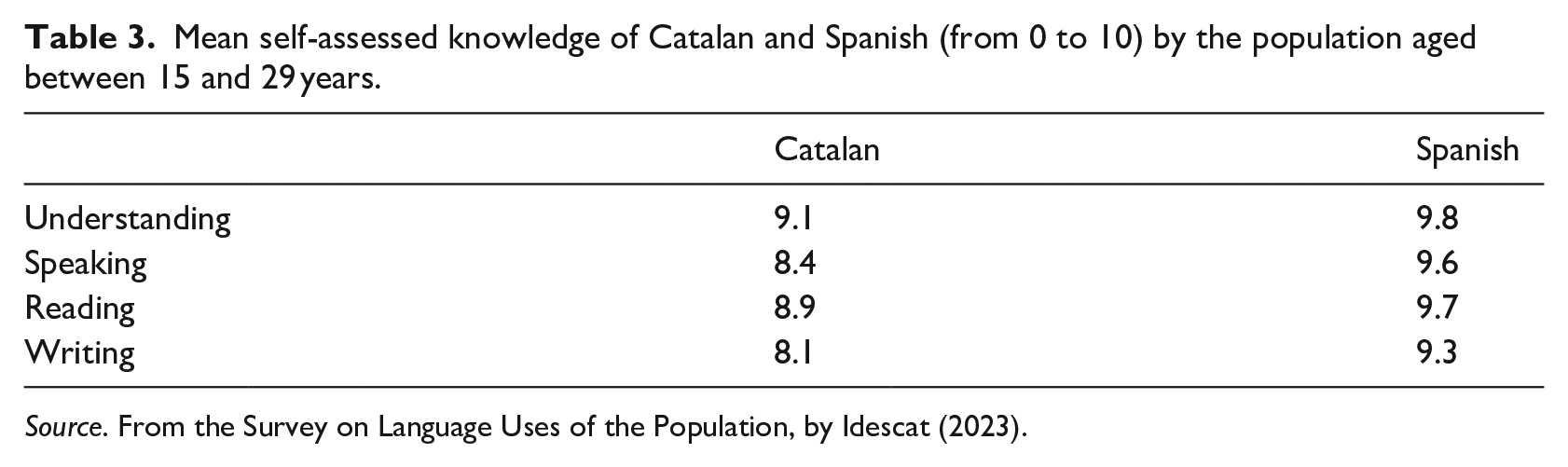
In terms of proficiency, 94.4% of Catalonia’s population claims to understand Catalan, but only 64.7% feel confident in all language skills (listening, speaking, reading, and writing). Conversely, 97.5% report proficiency in all facets of Spanish. These statistics reflect individuals aged 15 and above across Catalonia. When focusing specifically on the age bracket of 15–29 years—the demographic encompassing most of the participants in the present study—88.4% claim proficiency in all aspects of Catalan, compared to 99% for Spanish.
Self-assessed proficiency in Catalan and Spanish is consistently high (see Table 3), with Spanish rated higher. However, standardized tests at the end of primary and secondary education, as well as university entrance exams, consistently show that the Catalan educational system effectively ensures equivalent proficiency in both languages (Consell Superior d’Avaluació del Sistema Educatiu, 2021). Recent data from a study of 15-year-olds reveal a decline in Catalan use in classrooms despite it being the primary language of instruction. Students also tend to use Spanish more frequently in their interactions with teachers (Consell Escolar de Catalunya, 2022).
Mean self-assessed knowledge of Catalan and Spanish (from 0 to 10) by the population aged between 15 and 29 years.
Source. From the Survey on Language Uses of the Population, by Idescat (2023).
In this bilingual society, tools are needed to comprehensively assess bilingualism. Recent studies by Serrat et al. (2021) and Aparici et al. (2024) contribute to this effort. Serrat et al. investigated the impact of Catalan and Spanish exposure on language development in 801 bilingual children, grouped by age and linguistic context. Using the Catalan MacArthur-Bates CDI-II questionnaire, they found no major differences except that children aged 26–30 months with medium bilingual exposure showed higher vocabulary levels, suggesting caregiver linguistic diversity as a key influence. Aparici et al. developed a tool to assess demographics, literacy practices, and language proficiency in 268 Catalan students across educational levels. Results indicated strong bilingual oral comprehension but weaker writing skills, with language preferences varying by task and context—Catalan was preferred for counting due to its role in education, while thinking tasks revealed diverse language use. The study highlighted the interplay between linguistic competence and situational or personal language use. While both tools account for Catalonia’s sociolinguistic context and factors shaping bilingualism, neither provides a quotient, continuum, or grouping mechanism to comprehensively measure bilingualism. Their effectiveness in assessing bilingual practices or identifying dominant language profiles remains unclear.
The study
This study assesses the effectiveness of the BLP (Birdsong et al., 2012) in characterizing bilinguals raised in Catalonia, where both Catalan and Spanish are widely spoken and play prominent roles in daily life, education, and different contexts. Focusing on a cohort of young Catalan bilinguals, primarily university students, our research examines how well the BLP captures the complexities of bilingualism within a sample that is homogeneous in terms of age and educational background, while situated in a broader sociolinguistically diverse context. If the BLP can detect these nuances, it should also be effective in more heterogeneous bilingual populations.
Participants
A sample of 267 bilinguals, predominantly university students aged 18–35 (M = 21.21; SD = 3.03), completed the BLP. All participants were Catalan-Spanish bilinguals born and educated in Catalonia. Geographically, participants primarily belong to two regions: the city of Barcelona and its metropolitan area, where Spanish predominates in the environment, and the central area of Catalonia, where Catalan is more prevalent in social contexts and in communicative exchanges.
A note on the unevenness of groups is needed at this point. For the purposes of other studies, we collected two groups of Catalan-dominant bilinguals: one from the metropolitan area of Barcelona and one from central Catalonia. Consequently, our sample includes a larger number of Catalan-dominant participants. However, we decided to include as many participants as possible in the present study to thoroughly test the usefulness of the BLP.
Based on their BLP scores, where negative values indicate greater Catalan dominance and positive values indicate greater Spanish dominance, participants were categorized into three groups: Catalan-dominant bilinguals (scores below −40), balanced bilinguals (scores between −35 and 35), and Spanish-dominant bilinguals (scores above 40). 1 This is shown in Table 4.
Participants grouped by language dominance categories (from the BLP).
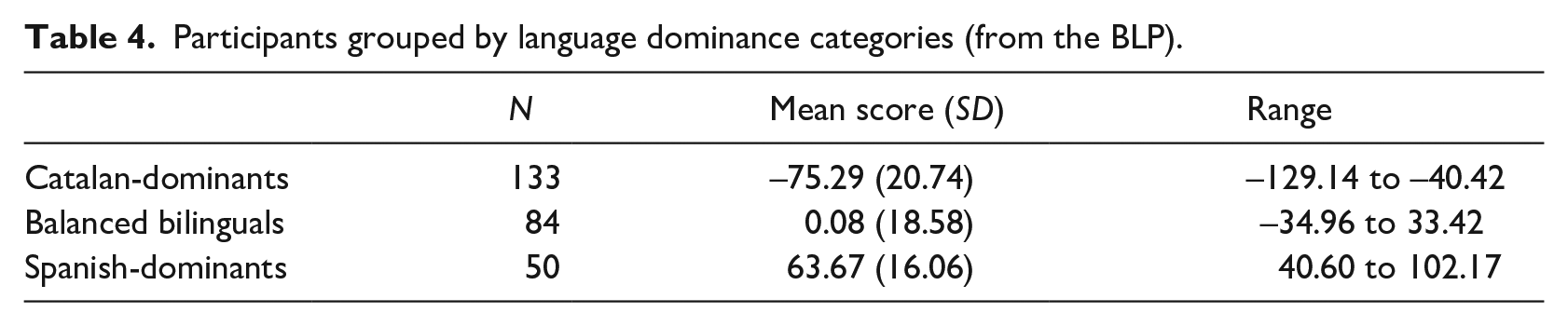
These thresholds were chosen somewhat arbitrarily, but participants scoring above 40 or below −40 typically showed clearer indications of greater exposure to and use of one language over the other. We excluded participants with BLP scores between 35 and 40 and between −35 and −40 to ensure clearer distinctions between dominance groups (see footnote 1). This approach, aligned with our main goal, allowed us to focus on participants with more defined language dominance profiles, avoiding ambiguity near category boundaries. In total, we excluded 42 participants based on this criterion. In addition, it is worth noting that most scores clustered between −90 and 70, with fewer scores at the extreme ends of the continuum. Figure 1 shows the distribution of bilingual participants by groups along the continuum of the BLP scores. 2
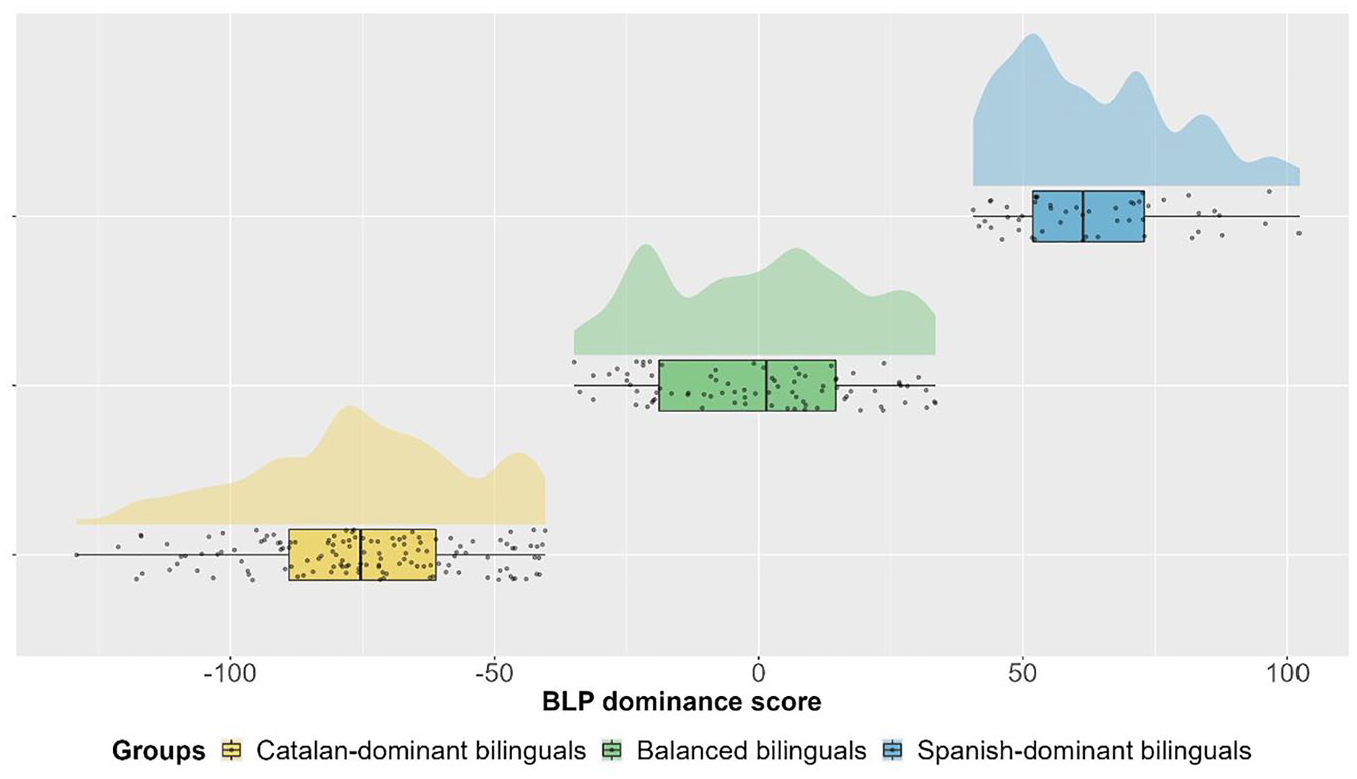
Distribution of participants by language dominance groups.
Methods: the tool (bilingual language profile)
The BLP is a self-reported questionnaire that conceptualizes language dominance as a multidimensional, gradual, and dynamic construct. It comprises four modules: (1) language history, which includes questions about age of acquisition and measures of language exposure, (2) current language use in different contexts and environments, (3) proficiency in their two languages, and (4) attitudes toward each language. Scores from each module are aggregated to create a global score, with each module weighted equally despite having a different number of questions. As mentioned earlier, this overall score ranges from −218 to 218. Scores closer to these extremes indicate more pronounced monolingual profiles, whereas scores near 0 indicate a more balanced bilingual profile.
Comparative descriptive analyses across the different modules of the BLP were conducted to explore similarities and variations in language dominance profiles among our three bilingual groups. The complete results, the data and the questionnaire are available at https://osf.io/v8zwr/?view_only=850e26ad0e824bd3915ca44ac531ccd6. In the following Results section, we will describe and analyze the questions and the responses obtained in each of the four modules of the BLP.
Results (by module)
To analyze how the BLP (Birdsong et al., 2012) characterized the three groups of bilinguals—Catalan-dominant, balanced, and Spanish-dominant bilinguals—we will follow the structure provided by the BLP. Initially, we will discuss biographical information, which is not factored into the BLP dominance score, and we will subsequently examine each module in detail to analyze how language history, use, proficiency and attitudes define the linguistic profiles of our participants.
Biographical information
Biographical information includes details such as age at the time of testing, highest educational level attained, and place of birth. In addition to the BLP questions, we included three supplementary questions to gather additional insights: current place of residence, languages they feel most comfortable with, and languages used within their family (see Table 5). This information allowed us to exclude participants who did not meet the criteria outlined in our methodology. Given that the BLP most of the time considers only two languages (Catalan and Spanish in this case), it may also be useful to include some questions about the other languages the bilinguals know.
More comfortable language and home language by group.
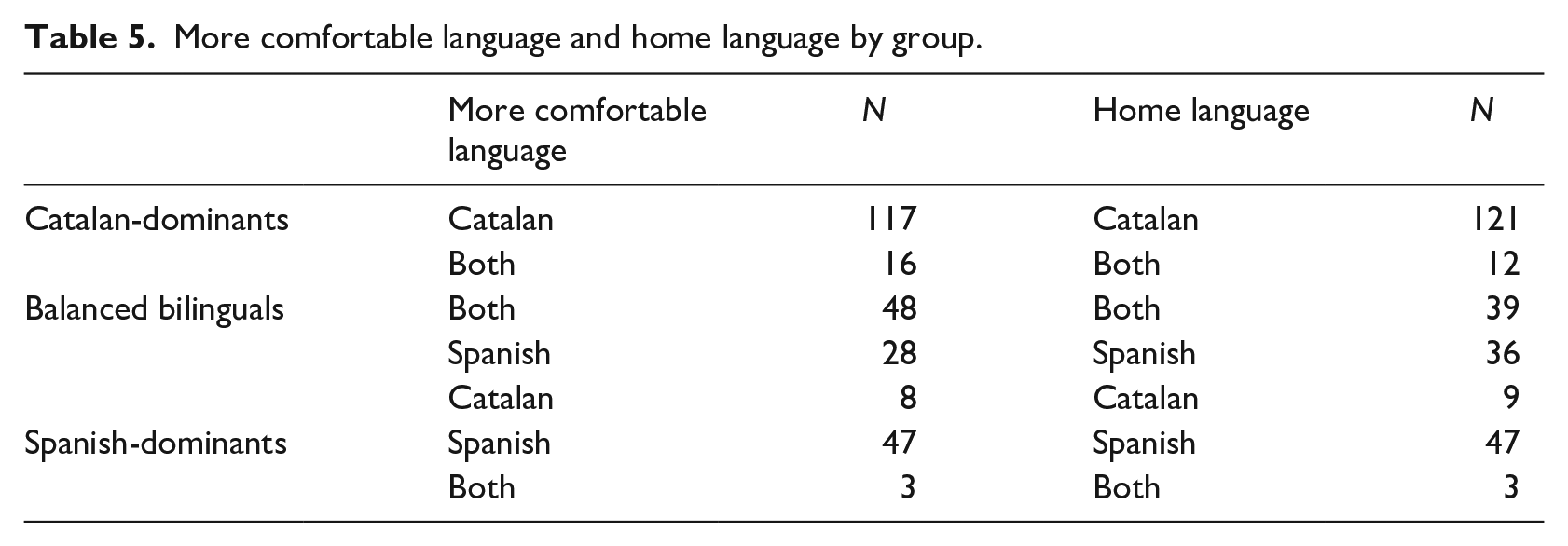
Regarding the question about the language in which participants feel most comfortable, the BLP-based groupings align well with self-reported comfort. Most Catalan-dominant bilinguals selected Catalan, and Spanish-dominant bilinguals overwhelmingly chose Spanish, supporting the validity of the BLP classification for clearly dominant individuals. As expected, balanced bilinguals showed more variation: while the majority reported feeling comfortable in both languages, a notable portion leaned toward Spanish, and a small number toward Catalan. This pattern reflects the more fluid and dynamic nature of bilingual experience within the balanced group, as well as a certain bias toward Spanish. Overall, while the BLP effectively captures dominant profiles, it also accommodates the variability inherent to balanced bilingualism.
Similarly, in response to the question about which language they used with their parents or caregivers—often reflective of home language use—we observed a similar pattern. Most Catalan-dominant bilinguals use Catalan, Spanish-dominant bilinguals use Spanish, and balanced bilinguals use either both languages or primarily Spanish. These responses suggest that the balanced bilingual group shares more similarities with the Spanish-dominant group than with the Catalan-dominant group in terms of language comfort and home language use.
Language history
In this module, the BLP questions inquire about (1) the age of onset of language acquisition, (2) the age at which respondents began feeling comfortable using each language, (3) the years of schooling in each language (we decided to split this question and to distinguish between primary school and higher education, to make it easier to answer), (4) the years spent in a country or region where each language is spoken, (5) the years spent in family settings where each language is spoken, and (6) the years spent in work environments where each language is used. Given the age of the participants of the study, this last question did not provide much information.
Taking language history as a comprehensive module, Catalan-dominant bilinguals and Spanish-dominant bilinguals exhibit clear differentiation, while balanced bilinguals fall in between. The data further reveal a considerable overlap in Spanish language history scores between balanced bilinguals (Catalan: M = 94.75, SD = 12.68; Spanish: M = 90.98, SD = 9.97) and Spanish-dominant bilinguals (Catalan: M = 78.94, SD = 15.96; Spanish: M = 94.44, SD = 11.77), indicating that their experiences with Spanish are somewhat similar. In contrast, Catalan language history scores show a more marked difference compared to the patterns of the other two groups (Catalan: M = 103.94, SD = 8.17; Spanish: M = 69.27, SD = 18.52). Figure 2 visually underscores these distinctions and overlaps, showing the earlier and more sustained exposure to Catalan among Catalan-dominant bilinguals than among Spanish-dominant bilinguals.
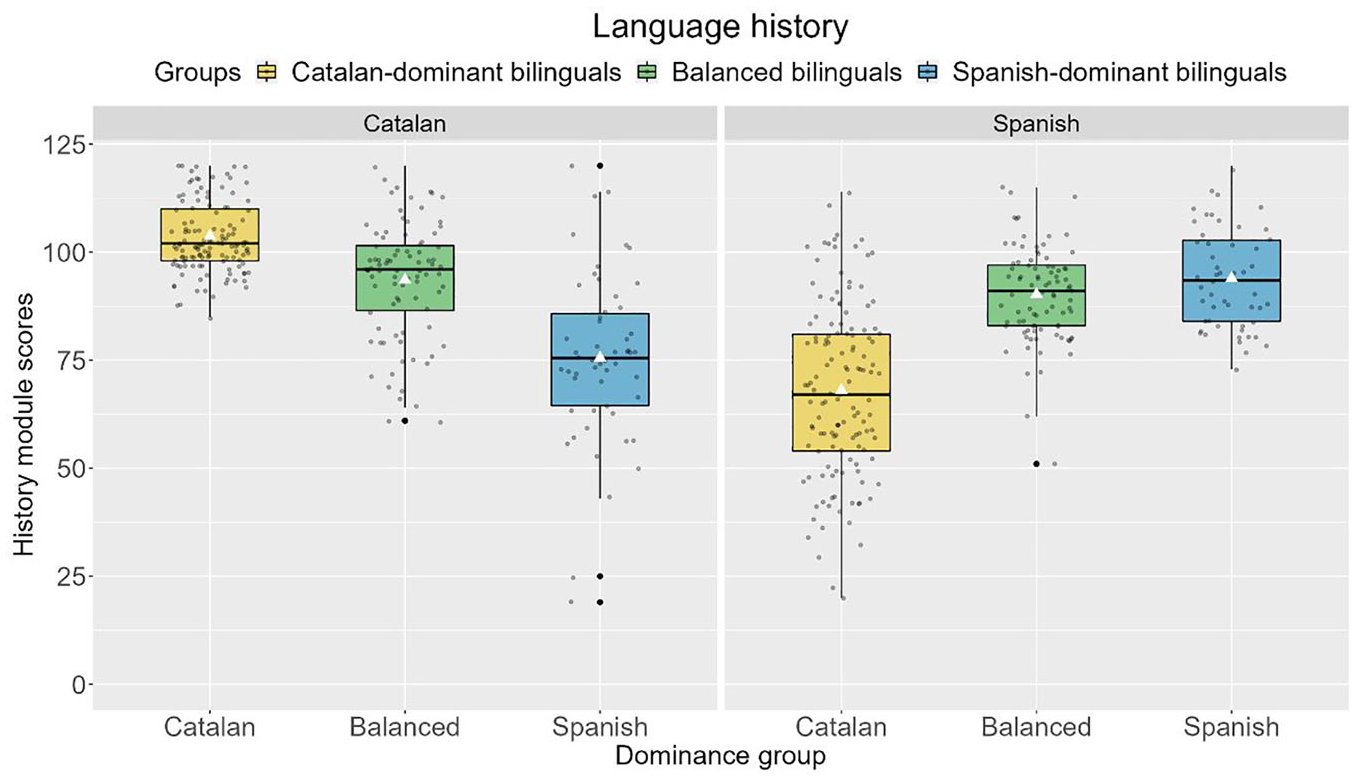
Distribution of the three bilingual profiles in the language history module.
The questions from this module reveal distinct patterns across the groups. Concerning the age of onset of acquisition, Catalan-dominant bilinguals begin acquiring Catalan at birth (0 years) and Spanish afterwards, around 1.53 years, whereas the other two groups are exposed to Spanish earlier than to Catalan. Balanced bilinguals start learning Catalan at approximately 0.6 years and Spanish at 0.2 years and Spanish-dominant bilinguals start acquiring Catalan around 1.46 years and Spanish at birth.
Comfort in using each language further highlights the differences. Catalan-dominant bilinguals feel comfortable with Catalan by 0.6 years but take longer with Spanish (6.14 years). Balanced bilinguals achieve comfort in Catalan by 1.82 years and in Spanish by 0.86 years. Spanish-dominant bilinguals feel comfortable with Catalan by 4.38 years and with Spanish by 0.13. These patterns emphasize the early familiarity of Catalan-dominant bilinguals with Catalan and the parallel advantage for Spanish-dominant bilinguals with Spanish.
Family language use also varies significantly. Catalan-dominant bilinguals report having used Catalan for 19.48 years and Spanish for 8.11 years (maximum: 20 years). Balanced bilinguals distribute usage more evenly, with 14.81 years for Catalan and 19.07 years for Spanish. Spanish-dominant bilinguals predominantly use Spanish, with 19.4 years of usage compared to 5.6 years for Catalan. These data indicate that Catalan-dominant speakers predominantly use Catalan in family settings, balanced bilinguals maintain a relatively balanced usage of both languages, and Spanish-dominant bilinguals primarily use Spanish.
While it is important to recognize the significance of linguistic practices in education, these practices show minimal distinctions among the groups, particularly in Catalan, which is the main language of schooling, as all participants attended the Catalan education system. Subtle differences emerge in the mean years of Spanish exposure in school: Catalan-dominant bilinguals report 17.75 years of Catalan and 4.86 years of Spanish, balanced bilinguals report 16.69 years of Catalan and 7.38 years of Spanish, and Spanish-dominant bilinguals report 16.00 years of Catalan and 9.16 years of Spanish. The remaining questions in this module, regarding the language of their country or region and their work environment, are not very informative.
In summary, this module highlights the critical role of early and consistent exposure in language acquisition across family and educational contexts. Catalan-dominant bilinguals benefit from early and sustained exposure to Catalan across domains, while Spanish-dominant bilinguals follow distinct patterns aligned with their primary language.
Language use
This module includes questions about the average percentage of time when they use Catalan, Spanish, or another language in a typical week across familial, social, and educational/professional settings. In addition, it examines internal language use through questions about the languages used for self-talk and for counting, two questions that have proven to be particularly informative when characterizing our three groups of bilinguals.
The overall scores from this module (maximum value: 50) provide clear distinctions among the three groups, as shown in Figure 3. Catalan-dominant bilinguals predominantly use Catalan (M = 42.78, SD = 4.70) and rarely use Spanish (M = 5.51, SD = 3.77). Conversely, Spanish-dominant bilinguals predominantly use Spanish (M = 43.58, SD = 4.28) and declare a minimal use of Catalan (M = 5.29, SD = 4.24). Balanced bilinguals, as expected, show similar scores for both languages, indicating a more balanced usage pattern (Catalan: M = 22.22, SD = 6.97; Spanish: M = 25.97, SD = 1.51), although they also show more variability than the Catalan-/Spanish-dominant groups. Importantly, there is no overlap among the groups, making this module more effective in distinguishing between the bilingual profiles than the language history module (see Figure 1). In addition, the results in Catalan and Spanish are complementary, mirroring each other in the scores of the Catalan-dominant and Spanish-dominant groups.
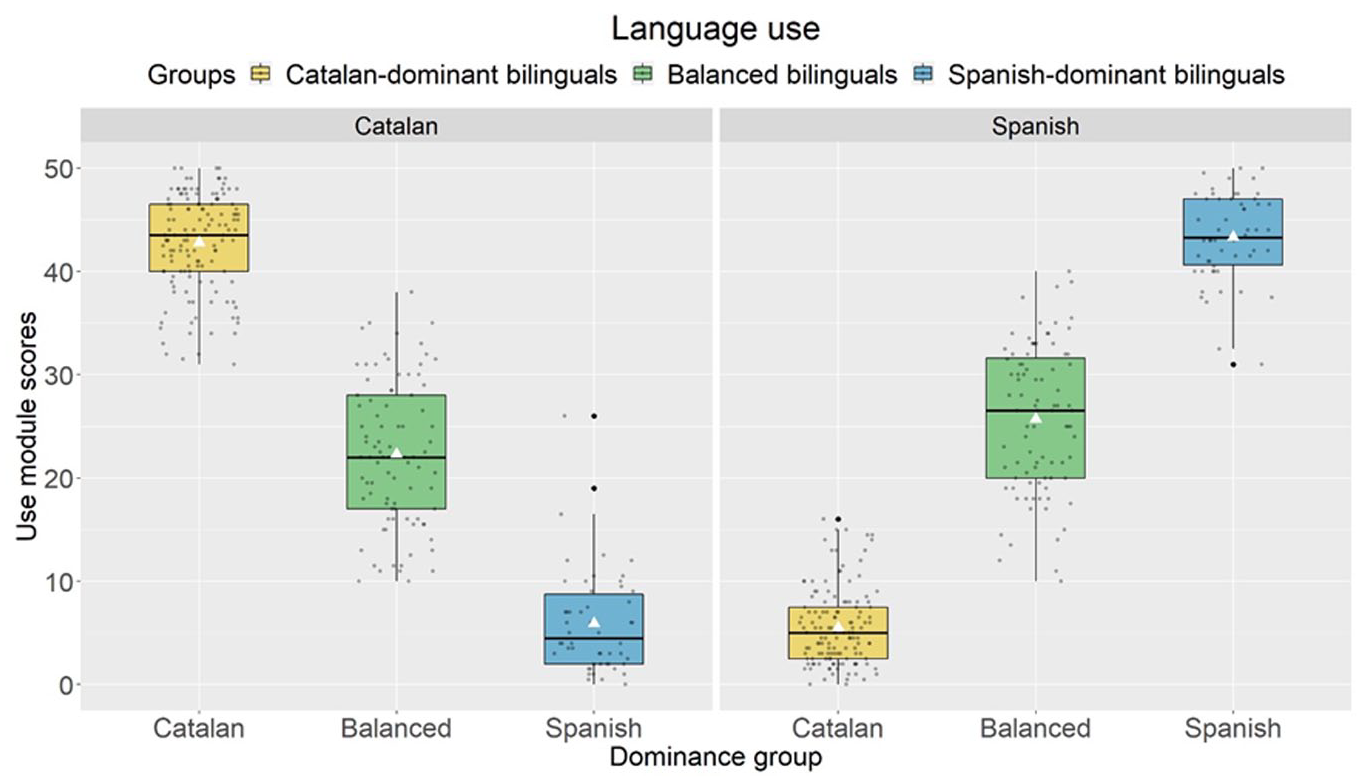
Distribution of the three bilingual profiles in the language use module.
The answers to the module’s specific questions follow the same tendencies. Catalan-dominant and Spanish-dominant bilinguals mainly use their dominant language with family, for counting, and for self-talk (over 90% of the time). Usage slightly decreases with friends (Catalan-dominants: 78% Catalan; Spanish-dominants: 86% Spanish) and at school/work (Catalan-dominants: 68% Catalan; Spanish-dominants: 63% Spanish). Balanced bilingual speakers show more variability, with mean scores around 50%. They report slightly higher percentages for Spanish with family (66%) and for counting and self-talk (54%) and higher percentages for Catalan at school/work (56%), making this group less homogeneous and well-defined.
These findings align with previous research showing that self-talk and counting reveal language dominance and cognitive processing preferences. Self-talk reflects an individual’s dominant language through their internal monologue, while counting refers to the habitual language used for numerical calculations. Studies suggest these internal processes often reflect dominant language use, providing deeper insights into true bilingual capabilities (Aparici et al., 2024; Grosjean, 2024; Pavlenko, 2014 on Catalan-Spanish bilinguals).
In conclusion, the language use module of the BLP effectively differentiates between the predetermined bilingual profiles in our design—Catalan-dominant bilinguals, Spanish-dominant bilinguals, and balanced bilinguals—by analyzing their language usage across contexts such as interactions with friends, family, and at school/work. This differentiation highlights the critical role of context-specific language practices and environments in shaping and understanding bilingualism. The inclusion of self-talk and counting questions also adds valuable insight into language dominance, complementing external language use data. Together, these metrics underscore the value of comprehensive assessments in bilingual research.
Language proficiency
Regarding the language proficiency module of the BLP, it relies on self-reported data and evaluates proficiency in both oral and written comprehension and production. The module employs an ordinal rating scale ranging from 0 to 6. We made slight modifications to the original questions to better fit our specific context. The original format was: “How well do you speak/understand/read/write . . .?” We revised these questions as follows: “Which level of oral/written comprehension/production do you have in . . .?”
From the data in Figure 4, scores in this module are generally high, approaching the scale’s ceiling (maximum value: 24). Catalan-dominant bilinguals report slightly higher skills in Catalan (M = 23.50, SD = 1.10) than in Spanish (M = 21.87, SD = 2.10), and we observe the mirror image with Spanish-dominant bilinguals (Spanish: M = 23.72, SD = 0.75; Catalan: M = 20.58, SD = 3.05). This suggests uniformly high proficiency in the dominant language but a broader range of self-reported proficiency in the less dominant language. Interestingly, Catalan-dominant bilinguals report lower oral production skills in Spanish than in Catalan, while Spanish-dominant bilinguals rate both oral and written production in Catalan as lower. Balanced bilinguals show very similar scores in the two languages (Catalan: M = 22.88, SD = 1.61; Spanish: M = 23.19; SD = 1.51).
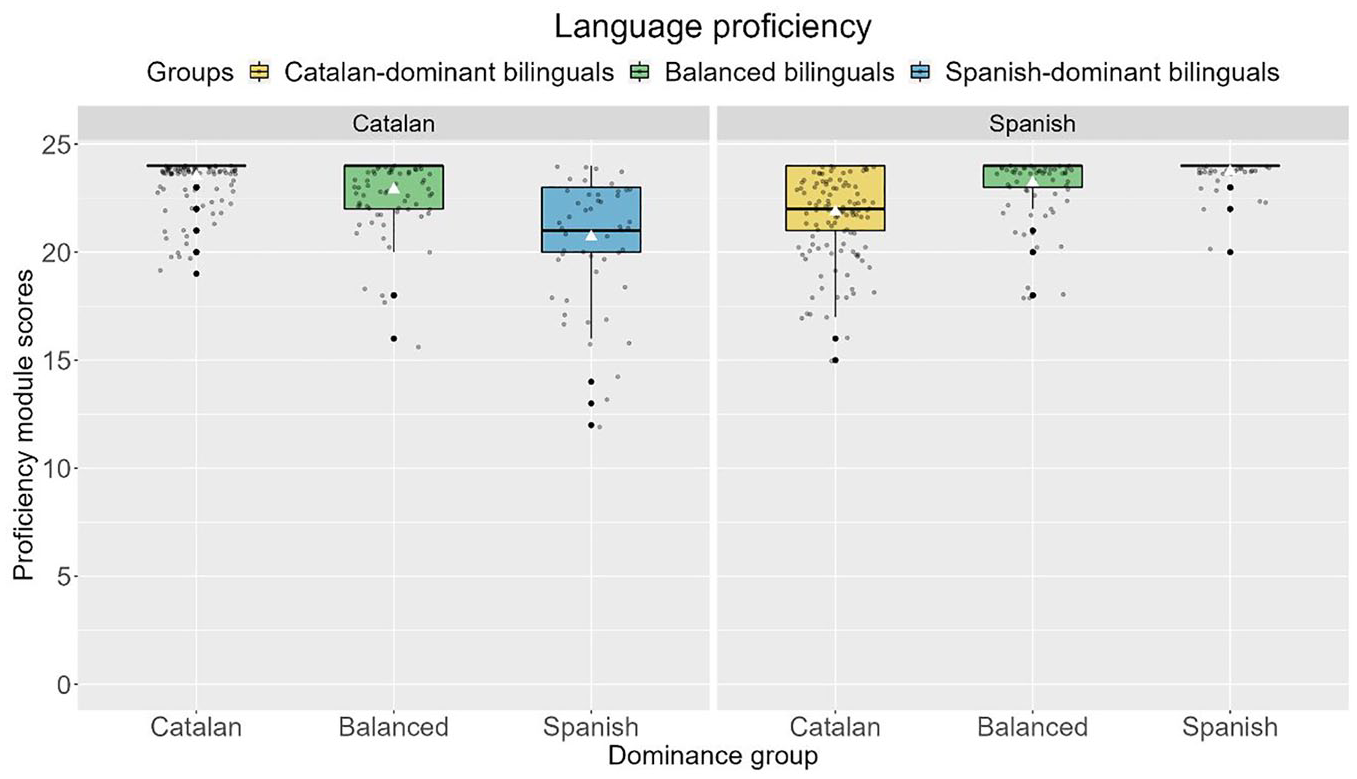
Distribution of the three bilingual profiles in the language proficiency module.
Despite the subtle nuances, these findings indicate that language proficiency alone does not clearly differentiate among Catalan-Spanish bilinguals. As noted previously, all participants attended the Catalan educational system from kindergarten, sharing similar linguistic and educational experiences. This context explains why proficiency is not a distinguishing factor among groups, aligning with self-reported ratings from official surveys (Table 3).
Language attitudes
Finally, the BLP includes a module on attitudes, which assesses participants’ feelings toward the languages they speak using an ordinal rating scale ranging from 0 to 6. The questions are designed to capture aspects of linguistic and cultural identification as well as attitudes toward language use.
The original questions referring to attitudes focused on native-like features, so that they were slightly modified to better fit our bilingual population. Instead of asking about features related to nativeness—such as “It is important to me to use (or eventually use) Catalan/Spanish like a native speaker” and “I want others to think I am a native speaker of Catalan/Spanish”—we tried to adapt these to reflect more relevant concerns for our bilingual speakers, who are native speakers of both languages. The revised questions are: “It is important to me to use Catalan/Spanish adequately and correctly” and “I want others to think I do not have an accent in Catalan/Spanish.” These modifications aimed to address the bilingual context more accurately.
The results from this module (see Figure 5) reveal a pattern similar to other modules, with a scalar but somewhat more overlapping distribution across the three groups (maximum value: 24) and considerable variability. Catalan-dominant bilinguals scored higher in Catalan (M = 19.89, SD = 2.84) than in Spanish (M = 13.39, SD = 4.24), Spanish-dominant bilinguals scored higher in Spanish (M = 17.76, SD = 3.11) than in Catalan (M = 14.46, SD = 3.65), and balanced bilinguals showed similar scores in both languages (Catalan: M = 17.82, SD = 3.01; Spanish: M = 16.39, SD = 3.47). Questions about attitudes toward correctness and accent showed no differences between groups and similar responses for both languages. However, questions on whether participants feel like themselves when speaking Catalan or Spanish were more revealing: balanced bilinguals equally identify with both languages (Catalan: 5.3, Spanish: 5.32), Catalan-dominant bilinguals identify more with Catalan (5.95) than Spanish (2.91), and Spanish-dominant bilinguals identify more with Spanish (5.88) than Catalan (3.06) (maximum value: 6). Cultural identification questions, considered controversial or unnecessary by some participants, showed gradual scores for Catalan (Catalan-dominant: 5.73; balanced: 5.17; Spanish-dominant: 4.5) and slightly more distinct, but still gradual, scores for Spanish (Catalan-dominant: 2.16; balanced: 3.61; Spanish-dominant: 4.58).
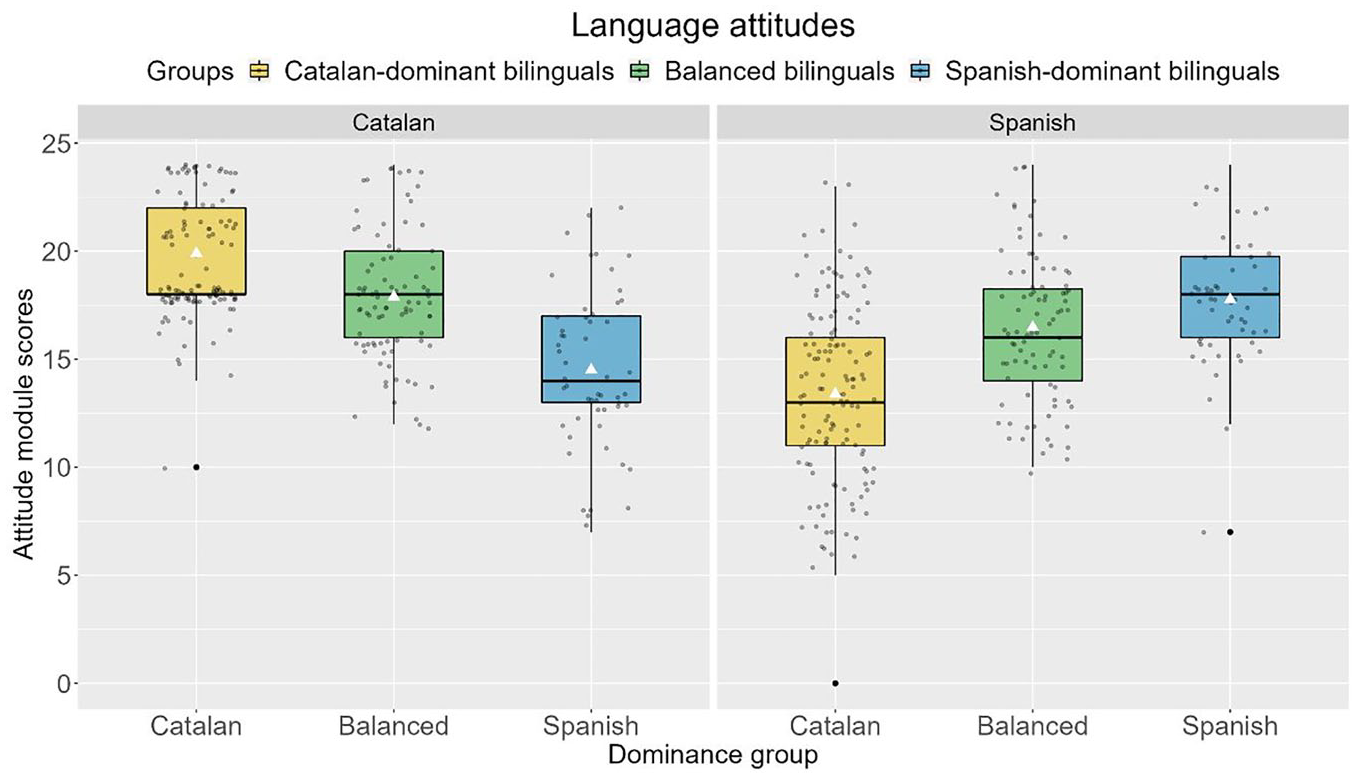
Distribution of the three bilingual profiles in the language attitudes module.
Overall, the attitudes module shows moderate contrast among groups, with some patterns emerging but not distinctly distinguishing them to the same extent as language history and usage modules. This blurry effect may be due to two main factors: first, language attitudes may not significantly distinguish bilingual profiles in this context; second, there may be limitations in the suitability of the questions for the sample despite our adaptation efforts. While language attitudes can influence language use and proficiency (Gardner, 1985), recent studies minimize their impact on language dominance (Baker, 2011). In addition, question formulation can affect the ability to identify meaningful differences in bilingual contexts (Baker, 2011). The role of attitudes in shaping or modulating constructs such as language dominance remains complex and debated, with some researchers suggesting that attitudes may contribute to language maintenance or shift rather than directly influencing dominance (Grosjean, 2024; Pavlenko, 2014).
In summary, the attitudes module shows some discriminatory power among our bilingual groups, although with overlapping distributions. However, it remains particularly effective in individual language identification. These findings underscore the need to rethink attitude measures to better capture bilingual experiences of this specific population and their impact on language dominance and use.
Discussion and conclusions
The findings of this study highlight the strengths and limitations of the BLP in distinguishing among bilinguals within the sociolinguistic context of Catalonia. The BLP successfully differentiates between Catalan- and Spanish-dominant bilinguals, who exhibit polarized linguistic experiences in their respective dominant languages. However, the balanced bilingual group is more pervasive and difficult to characterize due to its inherent variability, as their linguistic experiences differ from those of Catalan- and Spanish-dominant bilinguals, often exhibiting more fluid and variable profiles. This variability is expected in a balanced bilingual group, where individuals may show subtle or shifting dominance between languages depending on the context. The BLP seems to capture this variability, especially in distinguishing balanced bilinguals from those with more pronounced dominance in one language. However, it is crucial to explore the origin of this variability, as such differences can stem from multiple sources. In our study, we observed that the balanced bilingual group appears to differ more in terms of language use rather than language history. This suggests that their language dominance is more context-dependent, influenced by factors such as social settings, language exposure, and specific communicative needs, which can fluctuate over time. Understanding these sources of variability is essential for a more accurate interpretation of bilingual profiles.
One of the study’s key observations is the higher overlap between bilingual groups in the language history module compared to the language use module. This suggests that shared experiences, such as early exposure to both languages, are more emphasized than the experiences that distinguish bilinguals. This finding points to the need for refinement in how the BLP accounts for varying levels of bilingualism. The language use module, however, proves to be effective for distinguishing between Catalan-dominant, Spanish-dominant, and balanced bilinguals. On the other hand, the language proficiency module shows minimal differences between groups, casting doubt on its relevance in bilingual societies like Catalonia. Furthermore, the language attitudes module can be controversial in our specific context and has shown limited effectiveness in differentiating bilingual profiles, particularly in Catalonia, where nativeness is not always reflective of actual language use or dominance.
Based on these findings, we propose several modifications to improve the BLP’s application to Catalan-Spanish bilinguals, especially regarding the modules of language history and proficiency. First, the history module would benefit from clarifying what is meant by “starting to learn a language,” as participants may interpret this question in various ways. In addition, it would be helpful to specify that “languages of schooling” refers to the vehicular language or to distinguish between language exposure in-class and during leisure time. More specific questions, such as asking about the years spent in predominantly Catalan or Spanish-speaking neighborhoods, would yield more relevant data than asking about “countries/regions”.
For the proficiency module, we suggest adjusting the interpretation of the 0–6 scale, where 0 would correspond to “good” and 6 to “very good,” to ensure clearer differentiation. The attitude module could also be revised to reduce or remove the emphasis on nativeness, as it may not correlate with language use or dominance in a bilingual context. Moreover, the weight of language attitudes in the overall assessment should be reconsidered, as these measures are often influenced by cultural and social pressures that may not reflect actual language proficiency or dominance. To enhance the BLP’s utility, it could be supplemented with a focus on functional proficiency—assessing real-life performance in specific tasks or contexts rather than relying solely on general proficiency levels. This approach, combined with insights from self-talk and internal language processing (e.g., counting), which have proven highly informative, would provide a more nuanced understanding of bilingual profiles, particularly for balanced bilinguals.
While native-likeness has proven to be a less-effective measure of language dominance in Catalonia, it remains important to reconsider the role of such measures in bilingual contexts. In many cases, bilinguals prioritize functional proficiency (i.e., being able to effectively communicate in different contexts) over achieving native-like perfection, and in bilingual societies such as Catalonia, speakers may consider themselves native speakers of the two languages, which makes questions about native-likeness less relevant for assessing language dominance.
An important point raised by this study concerns the use of continuous numerical variables in grouping participants into discrete categories. While language dominance is inherently a gradual construct, we demonstrate that somewhat discrete, identifiable groups can still be effectively drawn from questionnaires like the BLP when required by the methodological design of a study.
In conclusion, measures on language exposure, use, and proficiency are all needed to define the language dominance profile of bilingual individuals and should be considered when choosing and describing the participants in an empirical study. In this regard, we have shown that the BLP makes it possible to place bilinguals with different linguistic backgrounds along a language dominance continuum and to successfully create relatively homogeneous Catalan-dominant, balanced, and Spanish-dominant bilingual groups. We have also proposed a minimal adaptation of some BLP questions to make it more accurate and appropriate for our societal bilingual context. Moreover, using a widely recognized tool like the BLP to characterize bilinguals ensures comparability with other bilingual populations. However, for certain studies on Catalan-Spanish bilingualism, it could be valuable to have a tool specifically designed for this context, one that can also be consistently applied across studies and reliably operationalizes the factors shaping language dominance in bilinguals living in a functionally bilingual society. The weight of each module or question in the BLP could be reconsidered and, in addition to the BLP’s questions, such a tool could include items on sociopolitical identity, code-switching frequency, language maintenance practices, dialectal variation, language use and exposure in digital and other domains, such as administration, commercial contexts, reading, and so on, to more accurately and complexly reflect the realities of bilingualism in Catalonia.
Footnotes
Acknowledgements
We thank all the participants of the study, since without them, this work would not have been possible.

Author contributions
Conceptualization and methodology, N.R., R.B., A.B.; Data curation and analyses, N.R., R.B., Writing—original draft, N.R., A.B.; Review & editing, N.R., R.B., A.B..; Funding acquisition, A.B.
Funding
This research has been supported by research grants #FFI2016-75082-P and #PID2020-114276GB-I00 from the Spanish State Research Agency, and grant #2021 SGR 00472 from AGAUR (Catalan Agency for the Management of University and Research Grants).
Declaration of conflicting interests
The authors declare no potential conflicts of interest with respect to the research, authorship, and/or publication of this article.
Informed consent
All subjects gave their informed consent for inclusion before they participated in the study.
Statement concerning human participants
The protocol was approved by the Institutional Committee for Ethical Review of Projects (CIREP-UPF) (Reference code 0032).