







Abstract
Aims:
This study investigates language attitudes and practices among first-generation Ukrainian migrants in Naples (Italy) after the 2022 Russian invasion of Ukraine. It examines how war-related experiences reshape the symbolic and affective values of Russian and Ukrainian within speakers’ repertoires.
Methods:
The study adopts a mixed-methods approach, combining sociolinguistic questionnaires and the language portrait technique. Data from Ukrainian-speaking migrants in Naples were analyzed qualitatively and quantitatively, focusing on metalinguistic commentary and visual representations of linguistic repertoires.
Results:
The findings show a process of sociolinguistic realignment. Despite high proficiency, Russian is often associated with trauma, stigma, and political aggression, and positioned as a language to be rejected. Ukrainian, by contrast, gains affective and symbolic value as a marker of identity and resistance. The study highlights how geopolitical events reshape language practices and contribute to the renegotiation of individual and collective identities in the diaspora.
Keywords
Introduction
As part of the research project HELLO CAMPANIA (Moro & Di Salvo, 2026), our research group set out to analyze the linguistic repertoires, multilingual practices, and family language policies of six immigrant communities residing in Naples and the Campania region (Sri Lankan, Senegalese, Ukrainian, Filipino, Bangladeshi, and Ghanaian). Within this broader project, the Ukrainian community of Naples was also included. This inclusion, somewhat unexpectedly, allowed us to investigate the impact of the conflict between Russia and Ukraine that started in 2022 on the linguistic practices and language attitudes of this community, which has been addressed in other Ukrainian communities abroad (among others, Makarova & Hryshyna, 2025). The following sections address this issue in detail, with particular attention to the war’s effects on the intergenerational transmission of Ukrainian and Russian, as well as on prevailing language attitudes within the community.
Previous Studies on the Interplay Between War and Language With a Focus on Ukraine
It is well known that language is both an act of identity and a political act, implying that linguistic choices are never neutral but inherently carry political significance and function as acts of identification (Racek et al., 2024; Le Page & Tabouret-Keller, 1985). In the specific case of Ukraine, the political dimension of language has been confirmed by previous studies demonstrating how language policies adopted by certain politicians have influenced electoral outcomes. For instance, Kulyk (2017) argues that Leonid Kuchma’s victory in 1994 was shaped by his pro-Russian language policies, just as Viktor Yanukovych’s election as president in 2010 contributed to elevating the status of Russian in Ukraine.
It is also known that natural disasters and wars in particular have significant repercussions on linguistic behavior, as documented in numerous studies (Brinkman, 2004, on Angola; Makoni et al., 2010, on Zimbabwe).
Previous studies have demonstrated that the war has had profound consequences both within and beyond Ukraine. These transformations have particularly affected speakers’ choices concerning the public use and domestic management of Russian–Ukrainian bilingualism. With respect to the former, studies on the distribution of Russian and Ukrainian in online spaces have shown a notable increase in posts written in Ukrainian following 22 February 2022 (Kulyk, 2018; Racek et al., 2024). As demonstrated by Racek et al. (2024, p. 12), the likelihood of tweeting in Ukrainian increased from 48% to 76%. According to this study, while part of this increase can be attributed to Russian-speaking users leaving the platform and Ukrainian users joining (+87% higher odds of tweeting in Ukrainian), the main driver is a behavioral shift (+249% higher odds of tweeting in Ukrainian). This change is reflected in a rise in Ukrainian-language tweets (+56%) and a decline in Russian-language tweeting activity (−20%). Remarkably, about half of the users who mainly tweeted in Russian before the war now tweet more in Ukrainian.
This increased (and conscious) use of Ukrainian appears to be a deliberate ideological choice, as suggested by an analysis of the data in light of existing literature (see also Yaremko & Levchuk, 2023). Even within Ukrainian diaspora communities, such as those in Austria and Germany, a shift in the status of Ukrainian has been observed. Warditz and Meir (2024) argue that the symbolic and practical value of Ukrainian and Russian among the surveyed groups is uneven: Ukrainian has gained symbolic importance, while Russian, though widely viewed negatively, still holds greater practical value. This imbalance makes it difficult to predict the future of both languages in Ukrainian diasporic communities in Austria and Germany and the evolution of Ukrainian–Russian bilingualism.
These findings, obtained through the remote administration of a questionnaire with Ukrainian refugees in Austria and Russia, are further supported by studies that include a broader sample of Ukrainian families, not necessarily refugees. Through an analysis of posts in public groups on language education and the management of family bilingualism, Yaremko and Levchuk (2023) highlight the link between the conflict and the (negative) evaluation of Russian, alongside a more favorable perception of Ukrainian: some responses about changing attitudes toward Ukrainian during the war appear surprising, such as statements claiming it is “no longer shameful to speak Ukrainian.” It would be worth asking why that young person once felt ashamed of speaking it, as a citizen of Ukraine would not express such feelings. The respondent even finds it embarrassing that some youth think this way. However, they later describe a shift in perspective, explaining that they began to reason internally about why the aggressor’s language should no longer be tolerated.
This study highlights how the war has affected not only speakers’ online behavior but also language practices within Ukrainian diaspora families, where there is an increasing emphasis on the intergenerational transmission of Ukrainian—sometimes even replacing Russian.
Previous studies on this topic, given the ongoing nature of the war, have primarily relied on snowball sampling through social networks or the administration of written questionnaires with researcher-imposed categories. While the first, quantitative, approach enables the reconstruction of a public image that, due to large sample sizes, can be generalized, the second approach—characterized by predefined descriptive categories and the rigid structure of the questionnaire—does not allow for an in-depth understanding of how speakers construct their ethnolinguistic identity. In our view, this process can only be adequately documented through ecologically valid and interactional methods, as we will discuss in the next section. Notably, in their psycholinguistic study, Protassova and Yelenevskaya (2024, p. 11) demonstrate that, on the one hand, the war has changed family language policies leading to adjust family’s practices and priorities. Many switched to Ukrainian, either immediately or later. Some chose to keep multiple languages to preserve their culture and foster unity, while others prioritized the Russian to ease communication with external networks and access new educational opportunities for their children.
On the other hand, people in Ukraine have started to feel a stronger sense of Ukrainian unity in response to the aggression. In many bilingual families, the war has led to a greater focus on using Ukrainian as a way to strengthen cultural ties and show support for the country (Protassova and Yelenevskaya 2024, 11).
It appears that when family language choices are analyzed through the lens of linguistic ideologies, a strong correlation emerges between ideologies and attitudes toward a language (McGroarty, 2010) and its use or abandonment. This is particularly relevant in diaspora contexts, where the parents’ native language becomes a heritage language for those born abroad—that is, a language that enables both first- and second-generation migrants to express their attachment to their roots (Aalberse et al., 2019, p. 1).
Theoretical Framework
In the studies mentioned in section “Previous Studies on the Interplay Between War and Language With a Focus on Ukraine,” scholars have investigated linguistic ideologies and attitudes, family language policies, the intergenerational transmission of Ukrainian, and its increasing use on social media. These themes are unified by a common theoretical thread: the identificational value that languages hold for their speakers. The symbolic and affective ties that speakers maintain with their languages acquire particular salience in situations of conflict and in migratory contexts. In contexts of conflict, as Diarmait Mac Giolla Chríost (2003, p. 9) has argued: “[t]he idea of language, in part, and especially of language in conflict, resides in a complexity of relationships between self-identification, group cohesion and world-view.” From this perspective, a group’s identification with language X allows its members to position themselves and to construct a sense of Self in opposition to the Other—an Other who may, in turn, be hetero-identified precisely through the use of a different language or language variety.
In migratory contexts, as Aalberse et al. (2019, p. 1) argue, the very definition of a heritage language is grounded in speakers’ identification with the cultural roots that the language represents in their imagination. The dynamic relationship between the heritage language and the dominant language of the host society is, for the first migrant generation, often framed as a complex narrative opposition between a constructed “us” and “them” (Di Salvo, 2018).
So, processes of identification and positioning (Rubino, 2014), as well as the nexus between language and identity, therefore constitute the theoretical foundation connecting the literature reviewed in the previous section with the present contribution. Adopting a constructivist perspective on identity, as developed in earlier anthropological (Remotti, 1997) and sociolinguistic studies (Bamberg et al., 2007; De Fina et al., 2006), we work from the premise that a qualitative analysis of speakers’ discourses about their linguistic resources can shed light on complex dynamics of ethnic and social identification—dynamics that can both shape and be shaped by language maintenance. As argued elsewhere (Di Salvo, 2017), biographical narratives are a particularly fruitful site for observing how speakers articulate strategies of ethnolinguistic identity construction and positioning. Building on these theoretical premises, the study of language attitudes emerges as a valuable tool for understanding how individual speakers relate to the languages within their repertoires, each of which may or may not carry identity-related values.
A further theoretical reference adopted in this study is Garrett et al.’s (2003) tripartite model of language attitudes, which conceptualizes attitudes as comprising three interrelated components. The cognitive component encompasses beliefs, knowledge, and perceptions regarding a language or language variety. The affective component refers to the emotional or evaluative reactions speakers associate with the language—such as pride, attachment, or aversion. The conative (or behavioral) component concerns speakers’ predisposition to act in particular ways toward the language, for example, by choosing to use, promote, or avoid it. Although originally designed for the study of attitudes, we argue that this model can also be fruitfully applied to the analysis of the narrative processes of identity construction (De Fina et al., 2006).
Our Study
In light of the literature summarized in section “Previous Studies on the Interplay Between War and Language With a Focus on Ukraine”—which is largely based on studies using online corpora or remote surveys conducted through online questionnaires—this contribution adopts a micro-sociolinguistic and qualitative approach to qualitatively investigate attitudes and language uses collected in person within the Ukrainian community of Naples, through questionnaires and language portraits (see section “Materials and Methods”). These complementary data made it possible to reconstruct individual repertoires and to observe speakers’ relationships with the languages that constitute them, as well as to examine the effects of the war on these relationships. The collected materials also allowed us to observe the ways in which Ukrainian speakers represented their own ethnolinguistic identity.
Aims and Scope
The aim of this study is to investigate how speakers’ uses and attitudes toward the languages of their repertoire have shifted as a result of the war in the Ukrainian diaspora in Naples, Italy, specifically in relation to Ukrainian and Russian. Examining in depth the impact of the conflict on speakers’ linguistic attitudes and language choices allowed us to address the following research questions:
Regarding the first research question, we asked whether the war has altered speakers’ attitudes, either reinforcing or discouraging the use and intergenerational transmission of Russian and Ukrainian within the community under investigation. Theoretically, this perspective offers an opportunity to reflect more broadly on the extra-linguistic factors that may contribute to redefining language attitudes and, potentially, to encouraging innovative linguistic practices and behaviors.
The second research question addresses the ethnolinguistic identity of the speakers. Drawing on the theoretical references discussed in section “Theoretical Framework,” we hypothesize that, in situations of conflict, speakers discursively construct their ethnolinguistic (and, more broadly, ethnic and social) identities in opposition to an “Other” who may be perceived as different but not only on the basis of distinct linguistic behaviors (Tullio-Altan, 1996). Similar mechanisms have been described in diasporic communities, where such processes are used to reconstruct the positioning of migrants with respect to both the society of origin and the host society. The case of the Ukrainian community in Naples provides a unique opportunity to analyze both dimensions simultaneously: it is a diasporic community that is also in regular contact with a local Russian minority. As will be shown in the analysis, participants position themselves in subtly different ways in relation to this minority. Our hypothesis is that such positioning is discursively negotiated through languages, since—following the theoretical framework outlined in section “Theoretical Framework”—language functions as a key marker of identity both in conflict situations and in migratory contexts.
The Ukrainian Community in Naples
Before the onset of the war, the Ukrainian population in Naples was 7,053, a number that has undoubtedly increased due to the conflict in 2022. As of 1 January 2023, there are 7510 foreign residents of Ukrainian origin in Naples, representing the second largest community after the Sri Lankan one. No data on the number of refugees in Naples are available.
Ukrainian immigration to Naples dates back to the 1990s. This wave of migration was primarily driven by the economic crisis following the collapse of the Soviet Union, which led many women to migrate and seek employment in domestic work and caregiving sectors (Mykhaylyak, 2023, 2024).
These sectors remain the primary employment opportunities for Ukrainian migrants, who continue to be predominantly adult women; the average age of the Ukrainian community in Naples is 44 years. While Ukrainians are also present in central areas of Naples, their presence is also notable in the wealthier neighborhoods of Vomero and Arenella, where many Ukrainian women are employed.
The Ukrainian community is characterized by a significant incidence of mixed marriages, accounting for 23%, according to a recent survey conducted by Dedalus (Cooperativa Sociale) (2023). This survey also revealed that, at least until the outbreak of the war, many Ukrainian women in Naples tended to leave their children in Ukraine (Dedalus [Cooperativa Sociale], 2023, p. 63). This pattern may explain the difficulties in identifying second-generation members over the age of 15. However, the data collected in the HELLO CAMPANIA! project indicate that, after the war, some recently immigrated Ukrainian families with children moved to Naples, a city that, along with Italy, has implemented integration policies for refugees. From a sociolinguistic perspective, the Ukrainian community in Naples has been already studied by Della Putta (2021), who mainly observed the use and status of Neapolitan dialect in the linguistic repertoire of 10 women, reporting negative evaluations toward the dialect and a rare occurrence of code-switching phenomena.
For a more in-depth examination of reception strategies, practices of cultural mediation, opportunities for maintaining the language and culture of origin, and interactions with the host environment in Naples, see, in particular, Mykhaylyak (2024).
Materials and Methods
Data Collection
Data were collected using two different tasks, a sociolinguistic questionnaire and a language portrait, both approved and validated for HELLO CAMPANIA! project by the Ethics Committee of the University of Naples Federico II.
The sociolinguistic questionnaire, developed by Margherita Di Salvo and Francesca Moro for data collection within the HELLO CAMPANIA! project, consists of four sections. These focus on (1) biographical information, (2) linguistic biography, (3) migratory trajectory and future plans, and (4) self-perceived linguistic competence and reported language use in key communicative domains, with particular attention to interactions with specific interlocutors. The questionnaire is available in Moro and Di Salvo (2026).
Through direct questions about linguistic competence and uses, as well as the emotional and practical value attributed to the languages in their repertoire, the questionnaire allowed us to document language ideologies and identity issues. The questionnaires were administered orally and in Italian. For the other ethnic groups involved in the project, when this was not feasible, a widely used international language was chosen—English for Sri Lankan, Bangladeshi, Ghanaian, and Filipino migrants, and French for Senegalese participants. In the case of the Ukrainian participants, only one speaker, who arrived after the outbreak of the war (UK1M02), experienced difficulties answering the questionnaire in Italian and, subsequently, even in English—the only language shared with the interviewer. So this questionnaire is incomplete. The data obtained through the questionnaires allowed the researchers to assess the participants’ language proficiency in Italian and to evaluate their overall competence according to the Common European Framework of Reference for Languages (CEFR). Moreover, the material provided valuable insight into the multilingual practices of first- and second-generation speakers. Collecting not only self-reported evaluations and information on linguistic repertoires, but also spontaneously produced speech, was therefore particularly beneficial for the study.
The second task used for this study is the Language Portrait (LP), first proposed, as a research method, by Gogolin and Neumann (1991) and Krumm & Jenkins (2001), who explored language awareness in plurilingual primary schools. This practice was later popularized by Busch (2010, 2013, 2018), who applied it in a variety of contexts: schools, psychotherapy meetings and second language courses. It has also been widely used in adult education and proposed by the Council of Europe as a tool to be used also with low-literate migrant subjects (Council of Europe, 2017).
As stated by Busch (2017), LPs help to explore the “lived experience of language,” to elicit information about self-perceived individual linguistic repertoires and to observe affective schema related to each code composing them. Language experiences are seen as inscribed in a “corporal memory” (Busch, 2012, p. 521).
In this research, participants were proposed with an empty whole-body silhouette and they were instructed to imagine that the figure represented their own body and to reflect on all the languages, dialects, varieties and any other kind of code they had encountered in their lives, regardless of their proficiency. It is a visual-drawing-based tool: using pens, pencils, and colors, they were asked to place these languages inside or outside the silhouette, based on their personal linguistic experiences.
While we are aware that language portraits are not the most suitable methodology for capturing the effects of the war on the restructuring of linguistic attitudes, they nevertheless proved particularly useful, as they encouraged participants to provide insightful reflections on the issues investigated in this article.
Through both methodological tools—the questionnaire and the language portraits—we collected narratives concerning their personal relationship with the languages that make up their linguistic repertoire. In line with the research objectives outlined in section “Aims and Scope,” our analysis will focus on Russian and Ukrainian, with particular attention to the role of the war in shaping shifts in language ideologies as revealed by the data.
Participants
Twenty-eight participants (19 females, 9 males), with a mean age of 43.7 years, were included in the study. The sample consists mainly of migrants who arrived before the war (26 participants) and two people who arrived after February 2022 with refugee status.
All participants were born in Ukraine and arrived in Italy as adults. Their average length of residence (LOR) in Italy is 14.7 years (max: 40 years; min: 1 year). Migration patterns include an initial economic migration wave, mostly composed of men and women, followed by a second wave post-2022, driven by the war, predominantly involving women and children.
Educationally, most of the speakers have high levels of education, with six having completed university and 11 attending high school. Employment is mostly in domestic work, with a few in specialized roles like cultural mediator, musician, or educator. Male participants typically work in construction or ethnic commerce.
Notably, four mixed marriages are present in the sample, all involving Ukrainian women and Neapolitan partners.
The Corpus
The oral administration of the questionnaire enabled the collection of a semi-spontaneous spoken corpus totaling 11 hours, 50 minutes, and 43 seconds. The entire corpus was transcribed using ELAN, following the CLIPS conventions (Savy, 2006).
While it was possible to complete the questionnaire with all participants (with the exception of UK1M02), it was not always feasible to collect the LPs. Creating an LP required both space and a suitable surface to color in the blank silhouette, conditions that were not always available, which limited our ability to ask participants to complete this task. As a result, while we have spoken data for all participants, we obtained only 15 LPs.
Importantly, neither the LP task nor the questionnaire included direct questions about Russian or the impact of the war on individual language attitudes. Consequently, any comments made by participants about Russian emerged spontaneously, rather than as a response to specific prompts from the researcher.
Analysis
In line with the theoretical framework outlined in section “Theoretical Framework,” a complementary methodological approach was adopted. In the first stage of the analysis, data on the composition of individual repertoires were examined quantitatively, with the aim of providing an overview of the responses collected through the sociolinguistic questionnaire. The core of the study, however, consists of a qualitative analysis of the passages in which participants narratively reconstruct their relationship with the languages in their repertoires, with particular attention to the ways in which the war has reshaped these relationships. This analysis draws on both the responses given during the administration of the questionnaire and the comments and descriptions accompanying the LP task.
So, for the analysis, we considered all questionnaire responses concerning Russian and Ukrainian as well as those addressing the linguistic consequences of the war. The analysis adopted a qualitative approach, and speakers’ statements were classified and examined following the framework proposed by Garrett et al. (2003), as discussed in section “Theoretical Framework.” Given the absence of a comparative corpus collected in Naples before February 2022, our analysis will be limited to testimonies gathered after this date, focusing on the comparisons drawn by the speakers themselves. Particular attention will be given to the ethnolinguistic significance of these testimonies, considering them not only as data on perceived language use but also as part of a discursive practice through which speakers construct and negotiate their identity.
Regarding the portraits, we included in the study all those in which Russian and Ukrainian were present.
Results
Russian and Ukrainian in Migrants’ Repertoires: Choices and Uses
During the interviews, a total of 12 languages were mentioned by the participants, while the average number of languages per repertoire is 5.
The languages that appear in all repertoires are Italian and Ukrainian. In third place, in terms of occurrence, there is the Russian language, which is absent in only three cases.
The data on the mother tongue reveals that Ukrainian is considered to be the L1 by almost all the participants involved. There are very few cases in which Russian was also indicated as L1, either together with Ukrainian or exclusively, as we can observe in Table 1.
Reported Mother Tongue in Ukrainian Speakers Involved in the Research.
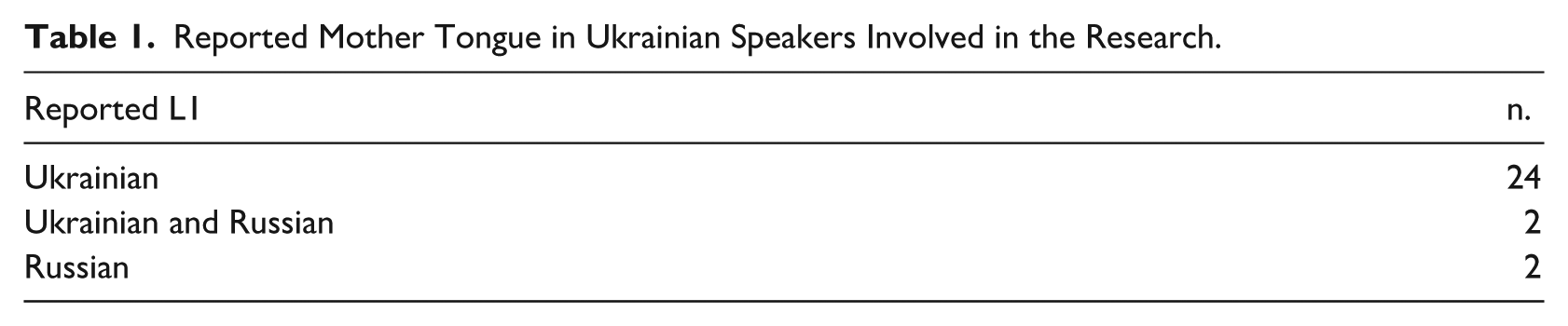
Participants stated that they knew other languages in addition to these, with varying levels of proficiency. These are heterogeneously distributed in the repertoires, as can be seen from Table 2, which shows, for each language, the number of speakers who included it in their repertoire
Reported Languages in Ukrainian Speakers Involved in the Research.
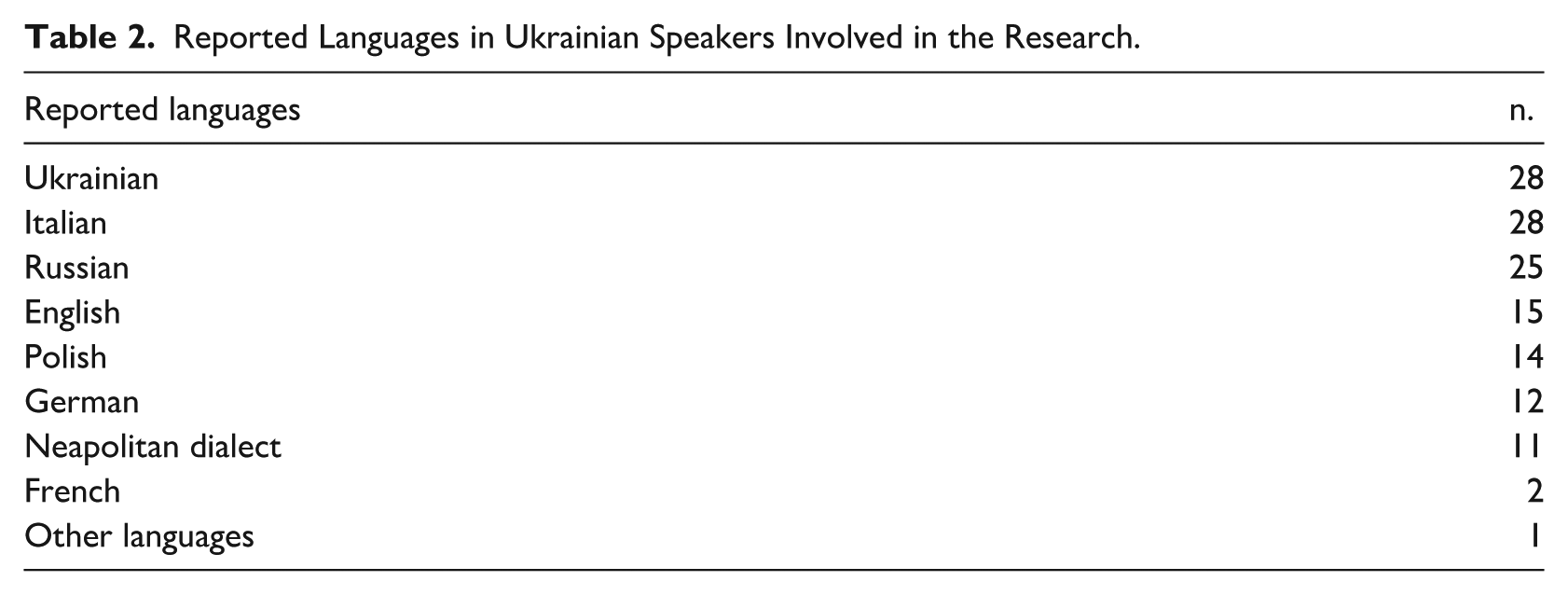
It is noted that the most represented languages (apart from Ukrainian, Russian, and Italian) are English, Polish, which in most cases is not studied at school, and there is a passive knowledge of the language and German. The latter is studied in Ukrainian schools as an alternative to French, which is present in only two repertoires. The category of “Other languages” includes the occurrence in the repertoires of the Czech, Belarusian, Romanian and the Avellino dialect. Finally, we observe a significant presence of the Neapolitan dialect, for which the declared proficiency varies between those who consider themselves to know the dialect “well” and those who claim to have only passive proficiency.
Respondents were in fact asked to rate their competence in the language on a scale ranging from “very well” to “not at all well.” Almost all of the speakers recognized the highest level of competence in Ukrainian and Russian: the Ukrainian language is known “very well” (20 participants) or “well” (7), while the Russian language is known “very well” (12), “well” (8) or in very few cases “not very well” (2).
In spite of the good proficiency in the Russian language, a widespread negative attitude toward it emerges, as discussed in section “Language Attitudes Toward Russian and Language Portraits in Ukrainian Immigrants in Naples.”
The declared competence in Italian, on the other hand, fluctuates between “well” (13 participants) and “not very well” (9), with a few cases of those who know it “not at all well” (2).
With respect to the data on language use, the analysis focuses on 26 of the 28 participants, for whom sufficient data are available: one migrant and one refugee were excluded because they did not complete the questionnaire, and the available data were incomplete.
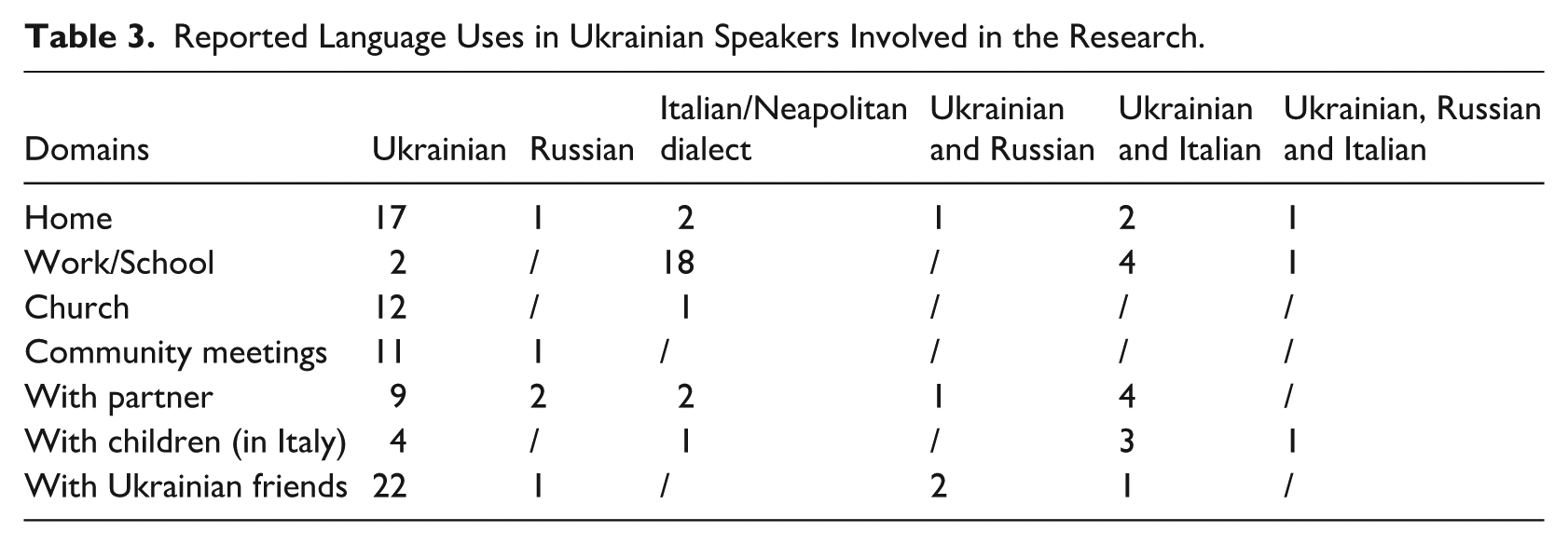
According to the data collected, the languages shared by the participants following migration and used in communication in Italy are mainly Ukrainian, Russian and Italian. Very often, even within the same context—whether in the workplace, at home, during peer socialization, or in community gatherings—the use of multiple languages was reported. Table 3 shows, for each communicative situation, the number of speakers who answered the question and which languages they mentioned.
Reported Language Uses in Ukrainian Speakers Involved in the Research.
Before migration, the most widely spoken language in the household was Ukrainian, indicated as the only language used at home or with family members by 21 out of 28 participants. Five participants said that they used to switch between Russian and Ukrainian, while Russian was used exclusively in only two cases.
Observing the table, we see that in the home context, following the migration, these habits have not changed much: most of the participants continued to speak Ukrainian, only in few cases alternated with Russian or Italian.
In the work context the use of Italian or the Neapolitan dialect prevails, while in church or at community meetings the use of the mother tongue is predominant, as well as with Ukrainian friends.
Most participants use Ukrainian or Russian with their partner, although there is a fair number of those who use Italian, either alone or together with Ukrainian, and only in two of these cases the partner is Italian.
With regard to the data concerning communication with one’s children, it should be pointed out that only nine participants state that they have children living with them in Italy. Among these, seven continue to use the Ukrainian language with them, three of whom alternate it with Italian. From the point of view of Ukrainian language transmission, therefore, there seems to be a strong motivation, but the same does not seem to apply to Russian, which is mentioned only once, even though the language is very well known by almost all the participants.
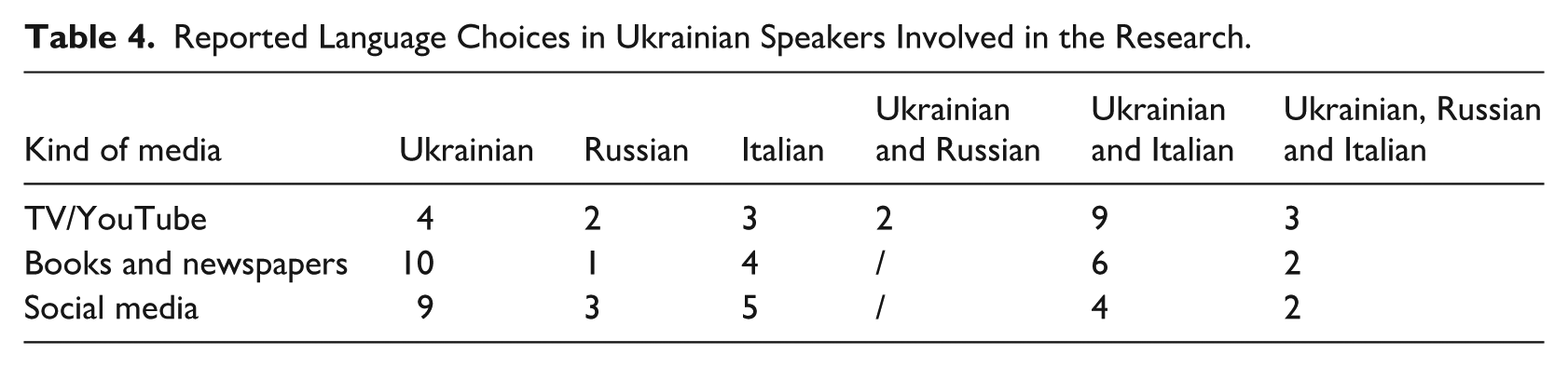
In Table 4, however, an increase in the choice of Russian is observed when watching videos or using social media, although very often alternating with Ukrainian or Italian.
Reported Language Choices in Ukrainian Speakers Involved in the Research.
In addition to providing information about their own language uses, speakers were asked to rate the affective and practical importance of their mother tongue and of Italian. The answers to these questions are shown in Figure 1.
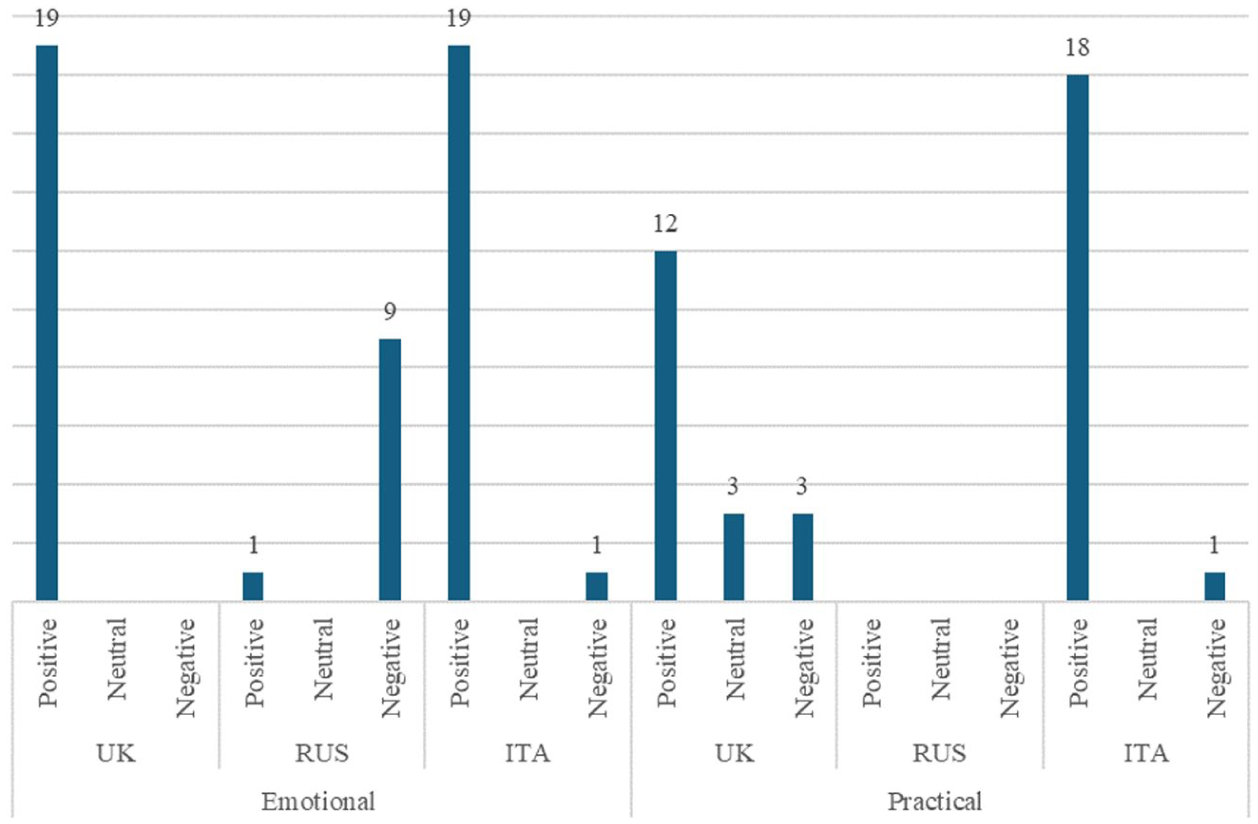
Reported emotional and practical importance of Ukrainian, Italian and Russian in Ukrainian speakers involved in the research.
As mentioned earlier, the interviews were designed with no specific questions about Russian and war. However, the data show that when speakers spontaneously provided information about this language, they attributed an extremely negative value to it. In only one case, in fact, a positive value is associated with Russian: in this case, however, Russian is the first language learned by the speaker. Regarding Ukrainian, the positive emotional judgment and the hesitation concerning its practical aspect are not surprising. On the contrary, it is evident that the presence of both a positive emotional and practical judgment for Italian, the dominant language of the host Country.
Language Attitudes Toward Russian and Language Portraits in Ukrainian Immigrants in Naples
As mentioned in the methodology section, the questionnaire did not include any specific questions on Russian or on the impact of the recent war on the attitudes and language habits of the participants: no preconstituted lists of response options were provided, and the interviews had a degree of flexibility in their structure to encourage spontaneity of responses. This resulted in speakers answering freely, introducing, without any prompting from the researcher, the correlation between the Russian invasion and language attitudes and habits.
In a study conducted by Cognigni (2007) before the war and in a different Italian region (Marche) on immigrants’ linguistic autobiographies, Ukrainian participants showed varied attitudes toward the Russian language, defined as the language of prestige and norm, but also as a corrupting language, imposed by the Soviet regime, the language of the enemy. However, the study highlighted the fundamental role of the Russian language as a vehicle for sociocultural cohesion among immigrants from various countries of the former Soviet Union.
If we refer to the afore-mentioned tripartite model of attitude, consisting of a cognitive, an affective and a conative dimension (Garrett et al., 2003), we can observe how the particular geopolitical circumstance of war has caused a kind of misalignment of these three aspects with respect to the Russian language in the involved subjects.
From a cognitive point of view, all the speakers report the important presence of the Russian language in their educational past. For example, in (1), UK1F15 1 emphasizes the prestige of Russian culture and literature and the privileged role of teachers of this language in Ukraine.
(1)
la mia madre defunta era insegnante di lingua russa mia sorella insegnante di lingua russa ma+ maggior parte diciamo di<ii> di parenti hanno finito università con la lingua russa perché in epoca era prestigioso<oo> la lingua russa parlavano tutti non avevano difficoltà di trovare il lavoro perché subito in ogni scuola in ogni università che prendevano anche / perciò <unclear> perché anche stipendi erano alti gli insegnanti di di lingua russa perciò <unclear> università e subito trovavano non tenevano difficoltà di<ii> trovare posto
quindi tu sei / la sai benissimo la lingua russa
Purtroppo si <laugh>
my deceased mother was a Russian language teacher my sister is a Russian language teacher most of the relatives let’s say have finished university with Russian language because at that time the Russian language was prestigious, they all spoke it and had no difficulty in finding work because immediately in every school in every university they also took / because even the salaries of the Russian language teachers were high, so after the university they immediately found a job
so you know the Russian language very well
Unfortunately yes)
Similarly, UK1F06 in (2) states that he has studied the Russian language and literature written in Russian to a high level, and UK1F12 in (3) claims to know as much Russian (‘sta lingua, with a somewhat pejorative form) as he knows his own language, i.e., Ukrainian.
(2)
alla scuola ucraina lingua ucraina no quella quando io ho studiato anche lingua russa studiato lingua russa bene io so <eeh> ma <unclear> ancora usiamo poco <eeh> noi io so studiato tutti Tolstoj Čechov Puškin Dostoevskij li molto tutto studiato no adesso questa *ghera <sp> vogliamo dimenticare proprio si si si si
at the Ukrainian school when I studied, I also studied Russian language I know it well but we still use it little I studied all Tolstoy Čechov Pushkin Dostoevsky there very much all studied no now with this war we want to forget about it yes yes yes)
(3)
io conosco ‘sta lingua <sp> come la lingua mia
I know this language like my own)
In the words of UK1F12 in (3), however, a need emerges to assert a distinction, a distance: Russian is not her own language. In fact, the same speaker in (4) reports the promise she made to herself not to speak Russian in Naples after the beginning of the war.
(4)
si solo<oo> mi sono data la parola <sp> da<aa> ventiquattro febbraio duemila ventidue che non parlo mai la lingua russa dimentico che non volendo lo stesso che tu senti passano persone che tu senti <sp> però se mi chiedono / perchè quando porto sto fiocchetto ucraino se viene qualche filorussa sarebbe e mi chiede qualcosa dove si ferma sto pullman ho detto io non vi capisco praticamente io capisco che lei<ii> che dice ma voi siete ucraina <sp> parla russo voi siete ucraina mi capisce no non vi capisco parlate italiano <sp> o parlate mia lingua o parlate italiano
I’ve given myself the word since February 24 2024 that I never speak Russian, I forget it, people pass by and you hear but if they ask me / because when I bring this Ukrainian bow if some pro-Russian comes and asks me something where this bus stops I say I don’t understand you, basically I understand what they say, but you are Ukrainian you speak Russian you are Ukrainian you understand me, no I don’t understand you speak Italian, either you speak my language or you speak Italian)
UK1F12 represents Russian in her portrait (Figure 2), far away from the silhouette, in the corner of the paper, and defines it as a “black stain,” a language to be forgotten because of the harm Russia has done to the Ukrainian population (5).
(5)
sì lo voglio dimenticare sì <sp> hanno fatto troppo male
per questo è nero?
nero sì questa macchia nera
yes I want to forget it yes they hurt too much
that’s why it is black?
black yes this is black stain)
Language self-portrait of UK1F12.
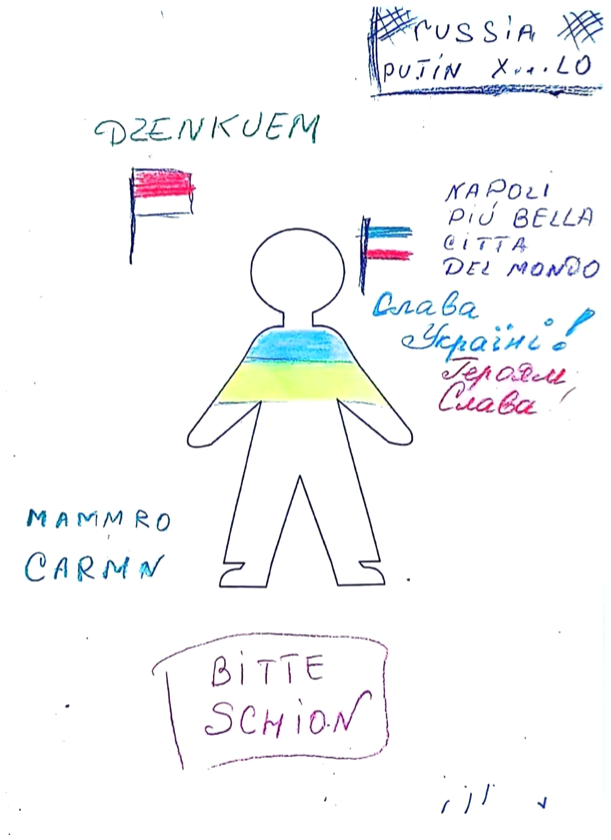
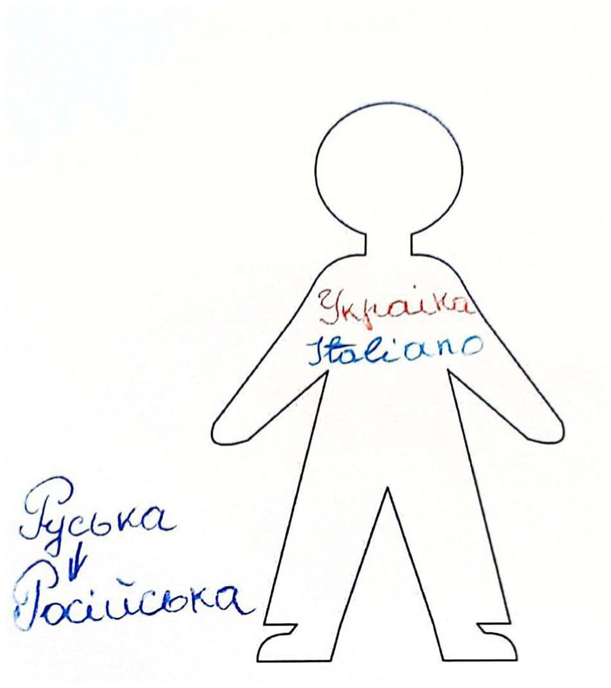
The graphic pattern inside/outside, like an extreme version of the core-to-periphery schema already detected by Coffey (2015) in LPs, is also proposed in (6) by UK1F08: a sort of repulsion and distance from Russian are evident in her discourse, in which she clearly distinguishes her level of linguistic competence (il russo conosco anche bene benissimo, “I also know Russian very well”) from her actual use and emotional relationship with this language.
(6)
ma il russo conosco anche bene benissimo però <laugh> non voglio parlare di questa lingua
ok, infatti l’hai messa fuori dal corpo
eh
ok perché non ti piace
no no
but I also know Russian very well but I don’t want to talk about this language
ok in fact you put it out of your body
eh
ok because you don’t like it
no no)
In UK1F08’s LP, in Figure 3, while Ukrainian and Italian share a central space in the symbolic body, Russian is outside, just as the war is outside, for those in the diaspora. From an affective point of view, this clearly expresses a negative attitude toward Russia and Russian language.
Language self-portrait of UK1F08.
In the words of UK1M08 in (7), the perceived sense of shame in speaking Russian in Naples after the beginning of the conflict is reported, together with the will of improving the competence in Ukrainian language. Although Russian is the language in which he expresses himself better, he says he is afraid of being identified with Russophiles or war refugees.
(7)
la lingua con cui ti esprimi meglio?
ma sempre russo perché nato con lingua russa e tutta la vita da piccolo cresciuto
E la lingua che usi di più?
Ma sempre russo perché in famiglia parlo sempre russo mia moglie mio figlio <eeh> diciamo amici qua ma maggiore parte russo pure abbiamo un po’ di vergogna però mo noi che venuti qua venti anni fa prima di questa guerra prima di / noi non non non sentiamo questa vergogna diciamo perché non<nn> io come si dice non sono scappato da guerra io venuto qua molti anni fa io già trasferito <sp> non sono scappato [..] a<aa> parlare russo pure pure questo ci sta un po’ che non non piace però piano piano stiamo togliendo da mezzo stiamo studiando più ucraino stiamo usando più ucraini
the language you express yourself with best?
always Russian because I was born with Russian and all my life grew up with it
And the language you use the most?
always Russian because in my family I always speak Russian my wife my son let’s say friends here but mostly Russian, we have some shame but we who came here 20 years ago before this war, we don’t feel this shame because I didn’t escape from the war I came here many years ago I already moved here I didn’t escape [. . .] to speak Russian also this is a little bit we don’t like but step by step we are taking out of the way we are studying more Ukrainian we are using more Ukrainian)
The negative emotional connotation of Russian is also metaphorically expressed by other speakers: in example (8) Russian is called a “poison in the blood,” a definition that implicitly emphasizes how this language is something intimate but extremely dangerous, as your own brother who wants to kill you.
(8)
come ti posso dire allora <ehm> ormai è veleno sta dentro nostro sangue per questa cosa che sta s+ succedendo allora con come questo di fratello ti vuole uccidere <sp> capito
How can I tell you now, the poison is in our blood because of this thing that’s happening, so this brother wants to kill you)
Or, in UK1F11’s LP (Figure 5), it is represented in the left hand because it is the “hand of the traitor.” This speaker, in fact, seems to use a graphic strategy based more on the symbolic value of the different parts of the body. Thus, the head is the place of the mother tongue, the one in which one thinks, while in the right hand, the one used most, are Italian and English, both defined as “useful languages.”
With regard to the conative dimension of the attitude, as emerges from the previous examples, the self-reported language behavior of (almost all) the participants in this research consists of choosing not to speak Russian in diaspora, in favor of Ukrainian (or Italian). It appears from their words as a forced but necessary choice (9). Speaking the “pure” Ukrainian (as they called it) is, therefore, a form of pride and self-respect (10).
(9)
adesso iniziano studiare nostra lingua ucraina questo è proprio disastro perchè non parlano bene adesso mischiano russo e parlano ucraino tutto misto e non era normale questa cosa
[. . .]
<eeh> <eeh> si perchè adesso è già come <ehm> nostra <ehm> noi dobbiamo per forza imparare nostra lingua per essere <eeh> forti e diversi di <eeh> staccarsi da Russia che faceva influenza tra lingua tra cultura diceva che noi siamo russi ma noi siamo ucraini proprio diversi diversa cultura diversa nazione siamo proprio diversi
now they start studying our Ukrainian language this is really a disaster because they don’t speak well now they mix Russian and speak Ukrainian all mixed up and it was not normal this thing
[. . .]
yes because now it’s already like our we have to learn our language to be strong and different to break away from Russia that made influence between language between culture said we are Russian but we are Ukrainian just different different culture different nation we are just different)
(10)
e pure ucraina <sp> precisa precisa pulita ucraina non ucraina mista con così io cerco anche io qualche volta penso quale parola è giusto ucraino perchè non sia+ siamo cresciuti <sp> ambiente così <sp> <mhh> sotto influenze diciamo allora io cerco di parlare per me per per orgoglio per rispettare sé stessa per questo
the Ukrainian language, precise, clean, not mixed Ukrainian, so I sometimes think which word is right in Ukrainian because we grew up in such environment under the influences let’s say, then I try to speak Ukrainian for me, for pride, to respect myself)
It is clear, from participants’ words, that not only did the war impact attitudes toward Russian in Naples in the diasporic community, but it also had the effect of reevaluating one’s linguistic biography in light of this new view of the Russian–Ukrainian relationship.
This interpretation is also supported by the example in (11), in which the speaker refers to the recent Sovietic past.
(11)
<eeh> purtroppo noi siamo stati in Ucraina s+ sempre sotto tanto tempo sotto <eeh> piede di russi e<ee> Russia faceva <mhh> sua aggressione tra anche tra <eeh> cultura tra lingua allora siamo costretti siamo stati costretti <eeh> imparare più russo di nostra lingua ucraina anche università <eeh> io dovevo <eeh> parlare russo [. . .] Russia proprio<oo> schiacciava tutto eliminava nostro lingua eliminava nostra <eeh> usanze nostra <ehm> cultura tutto
Unfortunately in Ukraine we have always been, for a long time, under the foot of the Russians and Russia made its aggression even over culture and language so we were forced to learn more Russian than our Ukrainian language even at university I had to speak Russian [. . .] Russia really crushed everything eliminated our language eliminated our customs our culture everything)
Only in two cases in our data, speakers reported that they did not change their linguistic behavior due to the war. In (12), UK1F02, born in Dnpro, in the Russian-speaking region of Ukraine, claims, for example, that she does not want to change her language habits for fear of being considered Russian, even in an ethnic (Ukrainian) shop. Nevertheless, she admits that something has changed after the declaration of war, also from the linguistic point of view.
(12)
guarda io no cambio quando a+ anche quando io entro negozio nostro dove sta<aa> mercatino <sp> Piazza Cavour ci sta<aa> negozio nostro <sp> di là tutti parlano di ucraino però<oo> io quando entro non è<ee> cambio lingua abituata così non è<ee> penso che devo cambiare qualcosa perchè<ee> devo<oo> mettere paura [. . .] <eeh> perché no<oo> parli così io sono abituata a parlare così non è<ee> <sp> no penso che problema con con lingua
[. . .]
guarda <sp> prima di guerra tutto voglio+ come vogliono parlare parlano parlato <sp> e poi quando iniziata guerra inizia questo precisamente che<ee> bisogno parlare solo di lingua<aa> ucraina
look I no change also when I enter our shop where is market Cavour Square there is our shop there everyone speak Ukrainian however I when I enter is not change language used to so is not I think I have to change something because I have to put fear [. . .] why no you speak so I am used to speak so is no I think that problem with language
[. . .]
look <sp> before war all I want how they want to speak speak speak <sp> and then when war started this precisely that need speak only language Ukrainian)
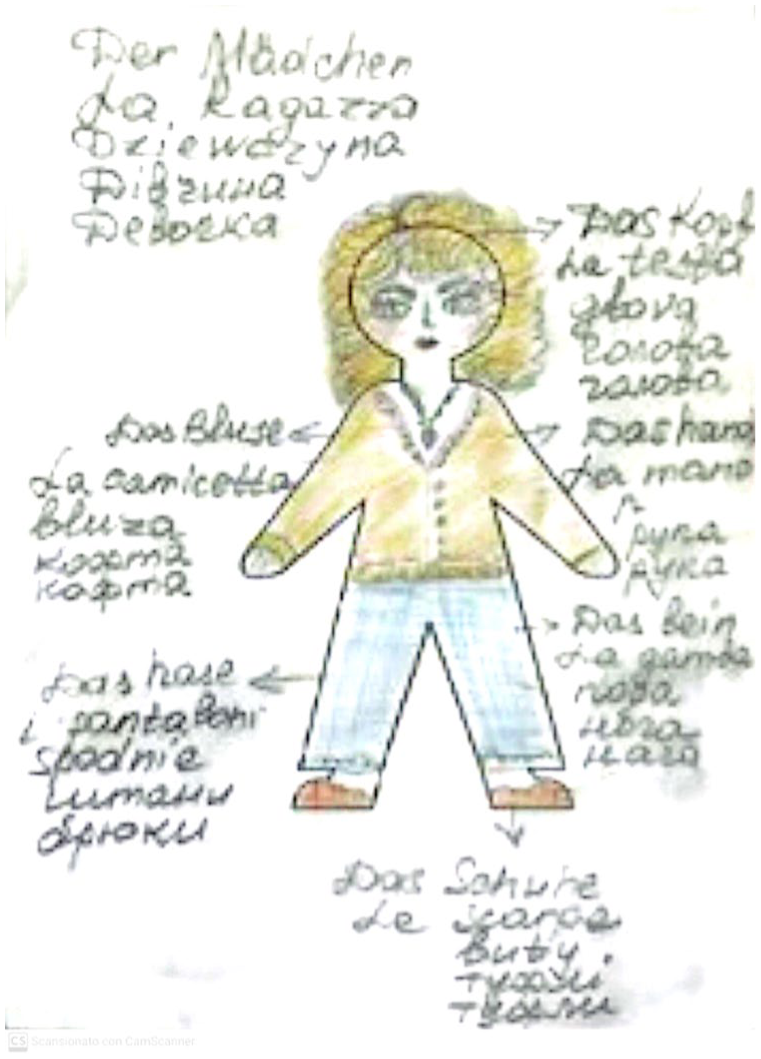
In the same way, UK1F03 includes in her portrait (Figure 4) all the languages of her repertoire, through the plurilingual labeling of body parts or dresses. Languages do not appear in conflict in this representation but they all contribute to the speaker’s definition of (linguistic) identity (13).
(13)
io sono ucraina <sp> mia lingua materna ucraina [. . .] parlo anche lingua Russia e<ee> scrivo Russia come Ucraina uguale
I am Ukrainian <sp> my mother tongue is Ukrainian [. . .] I also speak Russian and write Russian as well as Ukrainian)
Linguistic self-portrait of UK1F03.
Nevertheless, it is probably no coincidence that the woman in the portrait, whose physical features resemble those of the participant, is wearing yellow and blue clothes, the colors of the Ukrainian flag.
Language Attitudes Toward Russian and Language Portraits in Ukrainian Refugees in Naples
As mentioned earlier, only two refugees were included in our sample: a woman aged 56 and a 17-year-old boy. The latter experienced considerable difficulties responding to the questions in both Italian and English, and the data collected from him are insufficient for meaningful analysis. Consequently, the discussion focuses solely on the female participant, UK1F18.
The speaker narrates how she was used to speak Russian in Ukraine and how it was considered somehow an unmarked choice before the war. But she now reflects with criticism on the language policy in which she grew up, which, in accordance with the evidence in the previous studies recalled in section “Previous Studies on the Interplay Between War and Language With a Focus on Ukraine,” encouraged the use of Russian, at least until the Orange Revolution. She herself, as a Russian language teacher, encouraged the use of Russian, telling her students “che russo lingua bella” (that Russian is a beautiful language).
The (linguistic) violence of the past is intertwined with the experienced and contemporary state of conflict, in the words of UK1F18, one of the few participants who arrived in Italy after the beginning of the war (13).
(13)
già quando iniziato *guera <eeh> <ehm> due giorni e in mia città arrivato russo soldato e<ee> nove mesi <eeh> in mia città solo russo soldato solo solo solo russo soldato <sp> e sempre bombardare <sp> in mia città Cherson si chiama <eeh> <sp> ses+ sessanta *scole e tutti tutti già <sp> <ehm> bombardare <sp> tu+ tutti tutti tutti tutti <sp> tutti tutti *ospidale tutti policliniche tutto e sempre tutti i giorni bombardare tutti tutti i giorni adesso in mia città abita poco poco persone <eeh> <sp> *quindici percento massimo venti perchè tuttti scappare
[. . .]
russa lingua lingua Russia prima mi piace molto perchè io in *diplome ru+ <eeh> / l’insegnante russa lingua <sp> io *quando lavorava <eeh> *quando noi iniziato *gverra <eeh> prima duemilaquattordici anni io insegnante russa lingua <sp> e adesso io no parlo li+ / russo lingua perchè<ee> *guerra <sp> e russo lingua <laugh> adesso <sp> russo lingua adesso <sp> penso che così <sp> penso che così <laugh>
[. . .]
campagna si come come adesso quando tu dice <eeh> parla di+ <eeh> di+ dici *lingua italiana *qvesto più buono quando napoletano <sp> no molto buono eh anche russo e ucraina lingua Russia sempre fatto così <sp> Russia altro paese e fatto in Ucraina tutto che voleva Russia molto molto anni piano piano piano perchè molti persone moltissime persone prima <sp> parlano in rus+ / in Ucraina russo *lingva *questo no normale e prima *pensave che normale perchè Russia sempre p+ prima parlato che amici che vicine fratelli tutto bene Ucraina<aa> Ucraina avere documento che Russia Putin <eeh> fatto<oo> come se+ firma che no toccare mai Ucraina che fratelli e piano piano sempre<ee> Uc+ / <eeh> politica in *scola anche che Russia<aa> molto brava <eeh> russo lingua molto<oo> bella <sp> io in / anche in *scola sempre <eeh> parlato mio studenti che vedi che russo lingua bella
already when *war started two days and in my city arrived Russian soldier and nine months in my city only Russian soldier only only Russian soldier and always bombing in my city Cherson is called sixty schools and all already bombing you all all all *hospital all polyclinics all and always every day bombing all every day now in my city inhabits little little people fifteen percent maximum twenty why all run away
[. . .]
Russian language Russian language first I like very much because I was a Russian language teacher when I worked when we started war first two thousand fourteen years I Russian language teacher and now I no speak Russian language because war and Russian language now Russian language now I think so I think so
[. . .]
country yes like now when you say speak of you say Italian *language this good when Neapolitan no very good eh also Russian and Ukrainian language Russia always did so Russia other country and made in Ukraine all that wanted Russia very very very years slowly slowly because many people many people before speak in Ukraine Russian language *this no normal and first think that it is normal because Russia always first spoken that friends that neighbors brothers all good Ukraine Ukraine have document that Russia Putin made as signature that never touch Ukraine that brothers and slowly slowly always politics in school also that Russia very good Russian very beautiful language I also in school always spoke my students that you see that Russian beautiful language)
In UK1F18’s portrait in Figure 6, once again the deep wound is also rendered graphically: here the topological dichotomy used concerns the distinction between the top and bottom of the silhouette (Coffey, 2015; Platzgummer, 2021; Soares et al., 2021). While Ukrainian is placed in the heart, together with Italian (thus revealing the affective value of both languages, despite the recent arrival in Italy), Russian occupies the lower part of the legs, clearly divided, by two lines, from the rest of the body.
Both in terms of language attitudes and overall profile, the data elicited from the female refugee appear similar to those of the Russian migrants. However, the imbalance between the two groups is too great to allow for meaningful comparisons.
Discussion
The data analysis revealed the presence of Russian within the linguistic repertoires of the Ukrainian community in Naples as a consequence of the widely documented Russian–Ukrainian bilingualism in Ukraine prior to the war with Russia (Hentschel, 2024; Hentschel & Taranenko, 2021; Protassova et al., 2021). Many studies on this subject had already highlighted the use of Russian, even outside the southern regions of Donetsk and Donbass (Cognigni, 2007). This use of Russian, even before the war, appeared to be already detached from the ethnic identity of the speakers residing in Ukraine, as demonstrated by the data from an extensive perceptual survey conducted prior to 2022 (Hentschel & Palinska, 2022).
In the Ukrainian diaspora community in Naples, it is therefore unsurprising to find proficiency in Russian, which in some cases is considered the first language learned (either alone or alongside Ukrainian) or the dominant language. However, the analysis also documented some previously unexplored aspects: first, the competence in Russian is considered by the speakers to be independent of their personal will—a given that is attributed to Russian linguistic imperialism and oppression experienced across Ukraine, as reported by the speakers themselves. The interviewed migrants, thus, describe their study of and proficiency in Russian before the war within this context of linguistic imperialism.
Although, as noted in section “Russian and Ukrainian in Migrants’ Repertoires: Choices and Uses,” Russian is considered an integral part of the linguistic repertoires, speakers generally report, on the one hand, a positive attitude toward Ukrainian, referring to it as “our/my language” and, on the other hand, an extremely negative attitude toward Russian, which is labeled as “poison in the blood,” among other derogatory terms.
Quantitatively, the collected data indicate that only 9% of the sample identify as Russian, while 59% declare themselves as Ukrainian, and 23% recognize a mixed identity (Russian and Ukrainian). The remaining 9% identify as Italian. The choice of Ukrainian thus appears to be politically and ethnically charged: it is only with the onset of the conflict that the use of Russian becomes an ideological marker for most respondents.
These same speakers, in particular, assert that, despite their proficiency in Russian, this language has, since the war, become an alien element to be forgotten. Russian is now external to their identity and sense of self, which is why it is often positioned outside their body in the language portrait. In cases where it is placed inside, it is still associated with culturally motivated body parts, such as the left hand, which one speaker referred to as “the hand of the enemy” or the lower parts.
In the narratives of Ukrainian migrants, therefore, the level of linguistic competence is detached from that of language use and emotional or affective attitudes: the refusal to use this language, in particular, becomes an identity marker, acquiring symbolic value alongside other elements such as the blue and yellow ribbon that many interviewed migrants wear on their hearts, the display of Ukrainian flags in public spaces, or the custom of singing the national anthem before lessons in the weekend Ukrainian school. While these elements are present, visible, and displayed, Russian becomes an absent element because it is its denial that symbolizes the speaker’s sense of belonging to Ukraine. In this dynamic, the choice not to use or to attempt to forget Russian thus becomes a symbol of alignment with cultural values shared by those still in Ukraine, and at the same time, an element of distancing from the Russians present in Naples, as exemplified in example (4).
The self-identity of Ukrainians in Naples is, in particular, constructed in the testimonies both in continuity with those Ukrainians who remained in the homeland and in relation to Russians and Russian speakers in Naples. Following the outbreak of the war, many of the interviewees ceased to interact in Russian with these individuals. Thus, examining the linguistic attitudes of the Ukrainian group can also serve as a perspective for understanding the cultural and social habits of the group, especially in relation to the Russian minority still present in the area—an aspect that warrants further in-depth investigation.
Regarding linguistic attitudes in a narrow sense, we lack pre-war data that could fully demonstrate that the conflict was the driving force behind the emergence of negative attitudes toward Russian. However, the spontaneous testimonies collected in Naples, that is, without direct prompting, document such strongly adversarial attitudes, which are coupled with an extremely negative evaluation of Russian in attitudinal terms. On the issue of language use, finally, we do not have enough data to assess family language policies, as there are few speakers with children in Naples. Ukrainian immigration is characterized primarily by the migration of elderly women without children to Italy (Dedalus [Cooperativa Sociale], 2023). However, it is significant that all the speakers who have children in Naples have chosen Ukrainian, along with Italian, as the language to pass on. None of the interviewees, despite Russian being part of their linguistic repertoire, have chosen it as the language to transmit to the next generation.
In 1987, Peter Nelde emphasized that linguistic conflicts are shaped by both bottom-up and top-down dynamics. Local grievances can trigger conflict “from below,” which political and economic elites may then reinforce “from above.” This mutual escalation increases the symbolic weight of language and risks masking the deeper structural causes of the dispute (Nelde, 1987, p. 35).
In the Ukrainian case, top-down forces have also influenced linguistic diversity—particularly the use of Russian in the previously mentioned regions of Donetsk and Donbas. Meanwhile, bottom-up choices made by local communities have contributed to the emergence of conflicts and tensions, even in neutral contexts such as Naples, where both Ukrainians and Russians constitute non-native minority groups.
Within this diasporic framework, the ongoing war, combined with the historical memory of prior linguistic imperialism, has led Ukrainian speakers to perceive Russian as “poison in the blood” or as the language of the enemy. Furthermore, knowledge and use of Russian—still possible for some speakers (see example (13))—do not serve as an element of identification with the values conveyed by the language. In this context, proficiency in Russian does not necessarily imply alignment with its associated cultural or ideological framework, as shown by the data in Figure 1 which provide evidence of a negative attitude toward this language. So, this may reinforce distinctions between language and identity.
Turchetta (2003, p. 496), in analyzing cases of frontier identities, argued against a one-to-one correspondence between language and ethnicity, drawing on examples from the Akan world: in this perspective, the construction of linguistic identity and the language choices of Ukrainian migrants in Naples are described not so much in opposition to the dominant group (Italians), as shown by the affective and practical attitude toward Italian (Figure 5) and by the possibility that both Ukrainian and Italian may be represented in the heart of a LP (Figure 6).
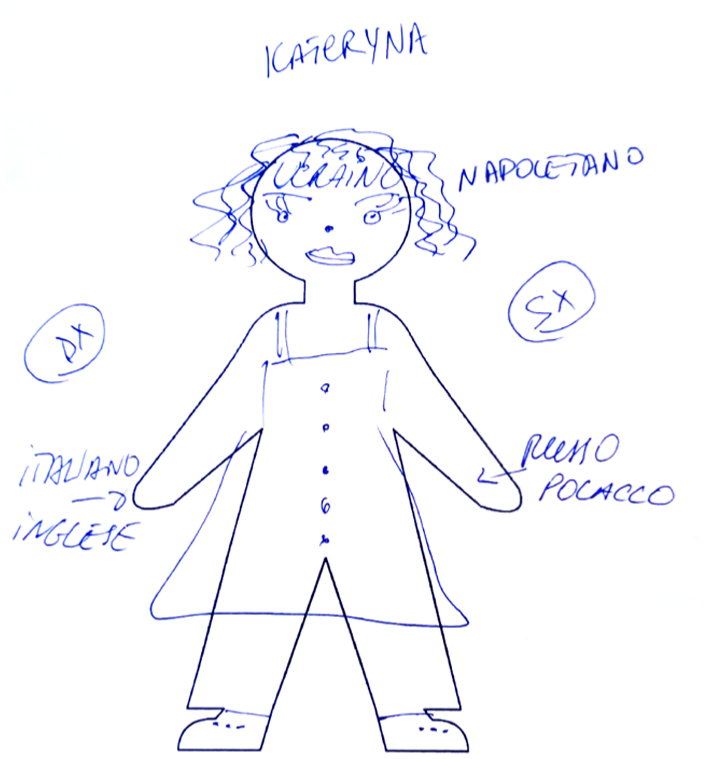
Language self-portrait of UK1F11.
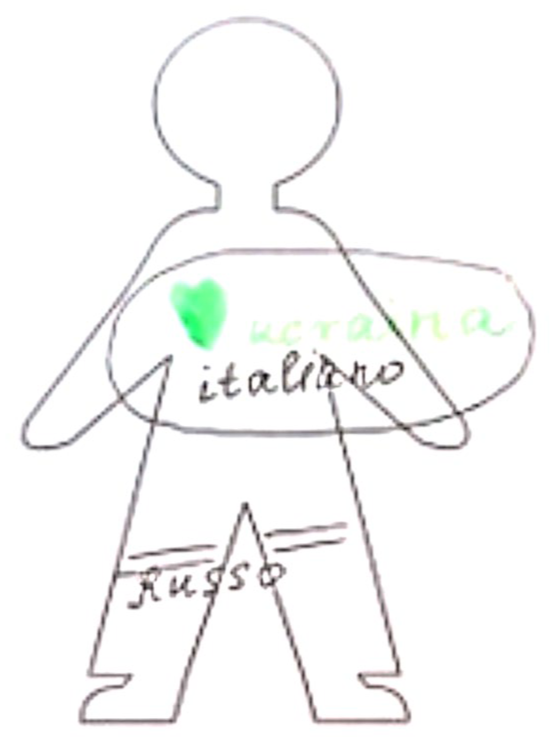
Linguistic self-portrait of UK1F18.
The construction of identity is in opposition to Russians, revealing the presence of latent tensions and conflicts that were somehow unexpected at the beginning of the research.
These findings refer to the migrant community in Naples and only partially to refugees. The sample included two refugees, but one was excluded because it was not possible to conduct the interview, as the researcher lacked proficiency in Russian or Ukrainian, the only languages in which the participant reported fluency. The presence of a single refugee does not allow for meaningful comparison with the larger group of migrants who arrived before the outbreak of the war in February 2022. Nonetheless, these observations indicate that (1) the attitudinal changes described also concern individuals who have not directly experienced the war, and (2) despite the numerical imbalance between the two groups, there are noteworthy similarities that could be further explored through future research with a larger sample.
In this framework, we sought to examine the shift toward Italian not primarily from a quantitative perspective—traditionally the most common approach for understanding processes of language maintenance and shift—but rather through a qualitative lens. Drawing on the portraits and testimonies we collected, this approach aims to uncover the underlying motivations that inform speakers’ linguistic choices.
Conclusion
Based on the descriptive data on linguistic repertoires and the qualitative analysis of narratives and Language Portraits—interpreted through the tripartite model of attitudes (cognitive, affective, conative)—we can now provide a concise and explicit answer to the two research questions. This concluding section highlights how the war has reshaped both language use and evaluative stances in the diaspora, and how these shifts have redefined participants’ ethnolinguistic identities, while acknowledging the limits of the sample size and the non-inferential nature of the analysis.
As far as Research Question 1 is concerned, we demonstrated that the war has clearly altered both language attitudes and uses within the Ukrainian diaspora in Naples. Despite widespread proficiency in Russian, participants now evaluate it negatively on affective and moral grounds and report curtailing its use across private and public domains; conversely, Ukrainian gains salience as a preferred code for everyday interaction and intergenerational transmission (often alongside Italian). This shift is not statistical but conative and ideologic: speakers actively avoid Russian and frame Ukrainian as the language of dignity, solidarity, and continuity.
For Research Question 2, we found that ethnolinguistic identities are discursively reconfigured through this renegotiation: Ukrainian is re-indexed as a core identity marker, while Russian—though part of many repertoires—is re-situated as external or stigmatized, used, if at all, with caution and without identificational value. Identity is thus enacted not only by the language speakers use, but also by those they deliberately refrain from using, particularly in positioning vis-à-vis local Russian speakers. Patterns are comparable among pre-war migrants and the (single analyzable) refugee, with differences of intensity rather than direction.
So, the sociolinguistic analysis of the Ukrainian community in Naples suggests that the war has acted as a factor redefining linguistic choices, reinforcing the use of Ukrainian as an identity marker and as a means of ethnic and political distinction. The study contributes to the debate on the variability of linguistic attitudes in response to major sociopolitical events and proposes an integrated methodological approach for analyzing linguistic dynamics in the diaspora. In the data analyzed in this contribution, from being a language of mediation, useful for communication and recognition among immigrants from the countries of the former Soviet Union (Cognigni, 2007), Russian shifts to being represented as a language of the past, a taboo language, no longer usable in the diaspora.
The study acknowledges several limitations. In particular, the relatively small sample size may constrain the generalizability of the findings, and the focus on participants from the post-2022 period limits the temporal scope of the analysis. These factors should be taken into account when interpreting the results and considering their broader applicability.
However, from a methodological perspective, the study has demonstrated the effectiveness of combining different instruments for analyzing linguistic repertoires and attitudes toward languages. In particular, the integration of sociolinguistic questionnaires and LPs has proven to be a valuable strategy for eliciting both qualitative and quantitative data.
Combining oral sociolinguistic questionnaires with Language Portraits offers high ecological validity. Spontaneously produced stance-taking (metaphors; spatial placement of codes outside the body, or relegated to peripheral zones) complements self-reports, making visible affective and conative layers that fixed-category surveys often miss. The inside/outside and top/bottom mappings provide a comparable semiotic space for tracing identity work across participants.
This approach has allowed for detailed documentation of the transformation of linguistic repertoires and their symbolic value in constructing diasporic identity.
From a more general perspective, the findings challenge established assumptions of one-to-one language–ethnicity mapping by showing strategic disalignment: identity may be enacted by not using a highly proficient language (cf. Hentschel & Palinska, 2022). Second, they extend the attitudes model (Garrett et al., 2003) by demonstrating conflict-triggered dissociation across components and foregrounding semiotic re-indexicalization as mechanism. Third, they speak to ethnolinguistic vitality in diaspora: as pointed out in previous studies (Hentschel, 2024; Hentschel & Taranenko, 2021; Protassova et al., 2021), Ukrainian’s affective vitality increases even where Russian remains pragmatically useful in selected domains.
Footnotes
Appendix 1

Ethical Considerations
The study was approved by the Ethics Committee of University Federico II (date: 27 June 2024).
Consent to Participate
Informed consent was obtained from all subjects involved in the study.
Authors Contributions
Conceptualization, M.d.S. and M.M.; methodology, M.d.S. (questionnaire) and M.M. (language portrait); investigation, M.d.S. and M.P.N..; data curation, M.P.N.; writing—original draft preparation, M.P.N.; writing—review and editing, M.d.S. and M.M.; supervision, M.d.S.; project administration, M.d.S.; funding acquisition, M.d.S. All authors have read and agreed to the published version of the manuscript.
Funding
The authors disclosed receipt of the following financial support for the research, authorship, and/or publication of this article: This research was funded by the Ministry of University and Research (PRIN PNRR program), grant number P2022WJ8YF.
Declaration of Conflicting Interests
The authors declared no potential conflicts of interest with respect to the research, authorship, and/or publication of this article.
Data Availability Statement
The publication of the data used for this study is under review at EURAC CLARIN CENTER (Bozen).