







Abstract
Research questions:
Some researchers propose that using a second language (L2) enhances empathy by broadening perspectives, while studies on the foreign-language effect suggest L2 may reduce empathy by dampening emotions and increasing cognitive control. This study examines the influence of L1 and L2 on empathy and ethnocentrism, employing virtual reality (VR), a tool fostering understanding of diverse perspectives.
Design:
Polish university students, late bilinguals (N = 111), participated in a 2 (L1 vs. L2) × 3 (Pretest, Posttest 1, Posttest 2) mixed-design study, with all materials and subtitles in the assigned language. During a 9-minute VR experience, participants embodied Polish and Chinese students involved in a misunderstanding, heard their thoughts, and received cultural explanations.
Data and analysis:
L2 exposure significantly enhanced cognitive empathy and reduced ethnocentrism immediately after the VR experience, with cognitive empathy remaining elevated 2 weeks later.
Conclusions:
Results suggest that foreign language use in immersive VR environments may facilitate perspective-taking and cultural understanding through mechanisms consistent with the stunted intuitions model and cultural frame-switching.
Originality and implications:
As the first to test the foreign-language effect in VR, we situated our findings within existing literature and outlined future research directions.
Keywords
Introduction
The foreign-language effect refers to a systematic pattern whereby individuals exhibit different decision-making and judgment tendencies when operating in a non-native language compared to their native tongue. This phenomenon has been documented across multiple domains, including moral decision-making (Costa, Foucart, Hayakawa, et al., 2014; Muda et al., 2018), risky decisions (Costa, Foucart, Arnon, et al., 2014; Keysar et al., 2012), and even superstitious beliefs (Hadjichristidis et al., 2017).
Two main explanatory mechanisms have been proposed for the foreign-language effect. The predominant explanation is the emotional mechanism hypothesis, also known as the “feeling less” hypothesis. This account suggests that using a foreign language reduces emotional reactions elicited by decision problems (Harris, 2003; Pavlenko, 2012). When individuals process information in a foreign language, emotional responses are attenuated because foreign languages are typically acquired in emotionally neutral classroom settings, unlike native languages, which are learned in emotionally rich environments (Dewaele, 2010).
A secondary explanation, the cognitive mechanism or “thinking more” hypothesis, suggests that foreign language use increases deliberative processing. However, evidence for this account remains limited, with several studies directly contradicting its predictions (Białek et al., 2020; Mækelæ & Pfuhl, 2019; Milczarski et al., 2023).
Recent research by Romero-Rivas et al. (2022) investigated emotional changes underlying the foreign-language effect. The study tested whether reduced emotional reactivity applies primarily to self-related emotions, empathy toward others, or both. Results showed that when processing moral dilemmas in a foreign language, participants demonstrated greater willingness to sacrifice themselves to save others, suggesting that using a non-native language creates psychological and emotional distance from the self. Importantly, participants who completed the empathy scale in their foreign language showed lower affective and cognitive empathy scores compared to those using their native language.
These findings present an intriguing paradox. While some studies suggest reduced empathy when using L2, a substantial body of literature indicates that L2 use in cross-cultural contexts may actually foster empathy and mitigate ethnocentrism. Such effects may be attributable to the adoption of a more unified, expanded and global perspective and a shift in focus from local concerns to a broader, more contextually adaptive outlook when using a foreign language. This shift has been defined and operationalized as the term global mind-set (Shaules, 2019; Thomas & Inkson, 2017), based on Hall’s pioneering works (Hall, 1976, 1980; Hall & Hall, 2000). In addition, consistent with the well-known Sapir–Whorf hypothesis, when acquiring a second language, individuals assimilate into the corresponding culture by adopting, to a greater or lesser degree, a cultural repertoire (e.g., social norms, reasoning styles, systems of meaning associated with that culture) (Grosjean, 2015; Nguyen & Benet-Martínez, 2013; Pavlenko & Blackledge, 2004). Research demonstrates that the use of second (and consecutive) language activates the frame-switching mechanism (Benet-Martínez et al., 2002) and leads to shifts in emotional and behavioral patterns associated with the corresponding culture (Li & Costa, 2025). The use of a non-native language in intercultural contexts may foster greater empathy and ethnorelativism by activating broader cultural frames and increasing psychological distance from entrenched in-group norms.
This apparent contradiction raises important questions about the relationship between language, emotion, and social understanding. The current study addresses this gap by testing the foreign-language effect in an immersive, ecologically valid environment—first-person 360 degree virtual reality. This methodological advancement enhances the ecological validity of FLE research while providing greater applicability to real-world intercultural encounters.
Virtual Reality and the Foreign-Language Effect
Due to its multisensory characteristics—immersion, presence, and embodiment—VR is highly effective for perspective-shifting interventions (Bailenson, 2019; Van Loon et al., 2018). In VR, participants experience scenarios with heightened presence and emotional intensity (Cummings & Bailenson, 2016). This enhanced immersion can amplify emotional responses (Diemer et al., 2015), while foreign language use may attenuate these emotions. This dynamic makes VR a powerful tool for examining whether the foreign-language effect arises from reduced emotionality.
If the foreign-language effect occurs and is driven by emotional attenuation, we would expect a lower level of empathy and a higher level of ethnocentrism when participants use a foreign language in VR. If L2 use involves a cultural frame-switching mechanism, it may shift emotional patterns associated with the corresponding culture. Alternatively, if L2 use activates a global mind-set, it may increase empathy and decrease ethnocentrism. By providing a realistic, multisensory platform that mirrors real-world interactions, VR allows us to test these competing explanations in a controlled yet ecologically valid manner.
Our study also contributes by testing the long-lasting effects of VR exposure on empathy and ethnocentrism. Research demonstrates that virtual reality perspective-taking (VRPT; Van Loon et al., 2018) is effective in reducing implicit bias and reversing racial in-group bias (Banakou et al., 2016; Hasler et al., 2017), decreasing prejudice (Oh et al., 2016) and ethnocentrism (Hekiert et al., 2021; Romak et al., 2024), as well as increasing empathy (Hekiert et al., 2021; Romak et al., 2024; Van Loon et al., 2018). Growing evidence suggests that virtual reality perspective-taking effects are evident immediately following VR experiences, with some examples of longer-lasting effects. For instance, Banakou et al. (2016) demonstrated that implicit bias reduction lasted at least 1 week after virtual embodiment, while Herrera et al. (2018) found that participants who experienced homelessness in VR retained more positive attitudes toward homeless people after 8 weeks compared to those in the traditional perspective-taking condition— although similar percentages of participants reported feeling empathy in both conditions.
The Present Study
Our three-phase study adopts a micro-longitudinal design, including an immediate postexposure assessment and a follow-up after approximately 2 weeks. The study focuses on the impact of simultaneous exposure to L1 (Polish) or L2 (English) and VR using 360° video depicting a cross-cultural misunderstanding between Polish and Chinese students. We hypothesized that VR would function as a tool for eliciting changes in empathy and ethnocentrism, with effects lasting at least 2 weeks. All analyses and data are available at: https://osf.io/kun4j/overview?view_only=61d303f794d44160810d5240691e81c7.
Hypotheses
Method
Participants
The study involved 111 Polish university students (Mage = 22.72, SD = 2.35), including 57 females, 49 males, and 5 participants identifying as “other” (non-binary). Students were randomly assigned to either the L1 condition (N = 53) or the L2 condition (N = 58).
Participants in the L2 condition completed all questionnaires in English across all three measurement points and read English subtitles in the VR video. The L1 condition followed the same procedure in Polish. All participants were late bilinguals with self-reported English proficiency ranging from B2 to C2 according to the Common European Framework of Reference for Languages. Language groups did not differ significantly in listening (χ² = 1.992; p = .369) or reading (χ² = 3.674; p = .159) proficiency levels. The calculations for the additional control variables are provided in the Supplementary Materials.
Materials
VR Scenario and Equipment
Our 360° video portrayed a misunderstanding between Polish and Chinese students. The video began with Polish students conversing in Polish (approximately 1 minute), followed by English dialogues between the main characters and a cultural explanation at the end (about 8 minutes). Subtitles matched the assigned language condition throughout.
The VR Video Included Five Main Scenes
Polish students discussing a joint project at the university restaurant.
Third-person perspective of Damian (Polish) and Zhiqiang (Chinese) discussing statistical analyses.
First-person embodiment of both characters (counterbalanced), with participants hearing heartbeats and internal dialogues.
Text message interface revealing the misunderstanding.
Cultural explanation of the miscommunication.
Participants experienced the VR video using first-generation Oculus Quest headsets (72 Hz refresh rate, 1,440 × 1,600 per eye resolution) with natural head tracking and stereoscopic viewing. The design process of our 360° video can be found in Hekiert et al. (2021) and in the Supplementary Materials.
Measures
Operationalization of General Empathy and Ethnocultural Empathy
Davis (1983) identifies four core components of general empathy: two cognitive (perspective-taking and fantasy) and two emotional (empathic concern and personal distress). Cognitive empathy involves understanding others’ mental states, linking it to the theory of mind (Dvash & Shamay-Tsoory, 2014). Affective empathy includes recognition of others’ emotions and emotional contagion (Dvash & Shamay-Tsoory, 2014; Singer & Klimecki, 2014).
Closely aligned with general empathy (Rasoal et al., 2011), ethnocultural empathy—a construct established by Wang et al. (2003)—specifically applies to interactions with individuals from different ethnic backgrounds. It comprises four components: empathic feeling and expression, empathic perspective-taking, acceptance of cultural differences, and empathic awareness. Ethnocultural empathy is significantly associated with greater diversity among family, friends, and neighbors (Cacciattolo & Aronson, 2023), as is reduced ethnocentrism.
Measure of General Empathy—Interpersonal Reactivity Index (IRI)
(Davis, 1980; Polish version: Davis, 1999): 28-item scale measuring four empathy dimensions on 5-point Likert-type scales. The author of the scale indicates four subscales (PT, PD, F, and EC), as described in the “Operationalization” section. Based on the results of the exploratory factor analysis (EFA), for further analyses, we included one cognitive component—perspective-taking (PT)—and one affective component—personal distress (PD). The reasons for this decision, along with information on the EFA results, can be found in the Supplementary Materials.
Measure of Ethnocultural Empathy—Scale of Ethnocultural Empathy (SEE)
(Wang et al., 2003; back-translated to Polish): 31-item scale measuring ethnocultural empathy on 6-point Likert-type scales. The authors of the scale identify four subscales in the item pool: EFE, EP, AC, and EA, as mentioned in the Operationalization section. Based on the results of the EFA, we combined EFA and EA (forming EFEA) as well as AC and EP (forming ACEP). Details can be found in the Supplementary Materials.
Operationalization of Ethnocentrism
Bennett’s developmental model (as cited in Hammer et al., 2003) outlines the progression from ethnocentrism to ethnorelativism as a framework for developing intercultural sensitivity. Ethnocentrism involves ignoring cultural differences by denying, defending against, or minimizing them (Bennett & Bennett, 2004). In contrast, ethnorelativism entails accepting cultural differences (the first step in moving away from ethnocentrism), adapting behaviors from another culture into one’s own repertoire, and integrating the behavioral standards and norms characteristic of at least two cultures (Bennett & Bennett, 2004). Cultural contact may reduce ethnocentrism, supporting Allport’s (1954) contact hypothesis. While Bennett’s model offers detailed insights into the stages of ethnocentrism and ethnorelativism, we employed a single overall score—a culture-general measure—to assess the level of ethnocentrism.
Measure of Ethnocentrism—Ethnocentrism Scale (ES)
(Neuliep & McCroskey, 2013; back-translated to Polish): 22-item scale with 15 items used for analysis, measuring ethnocentrism on 5-point scales. Following the EFA, we opted to retain the original structure.
Procedure
Participants completed a Pretest survey in their assigned language condition via Qualtrics. After a minimum of 1 week, they attended the laboratory for the VR experience lasting approximately 9 minutes. Immediately after viewing the VR video, participants completed Posttest 1 surveys on laboratory computers. After a minimum of 2 weeks, participants completed Posttest 2 surveys via Qualtrics. The scheme of the procedure is presented in Figure 1.
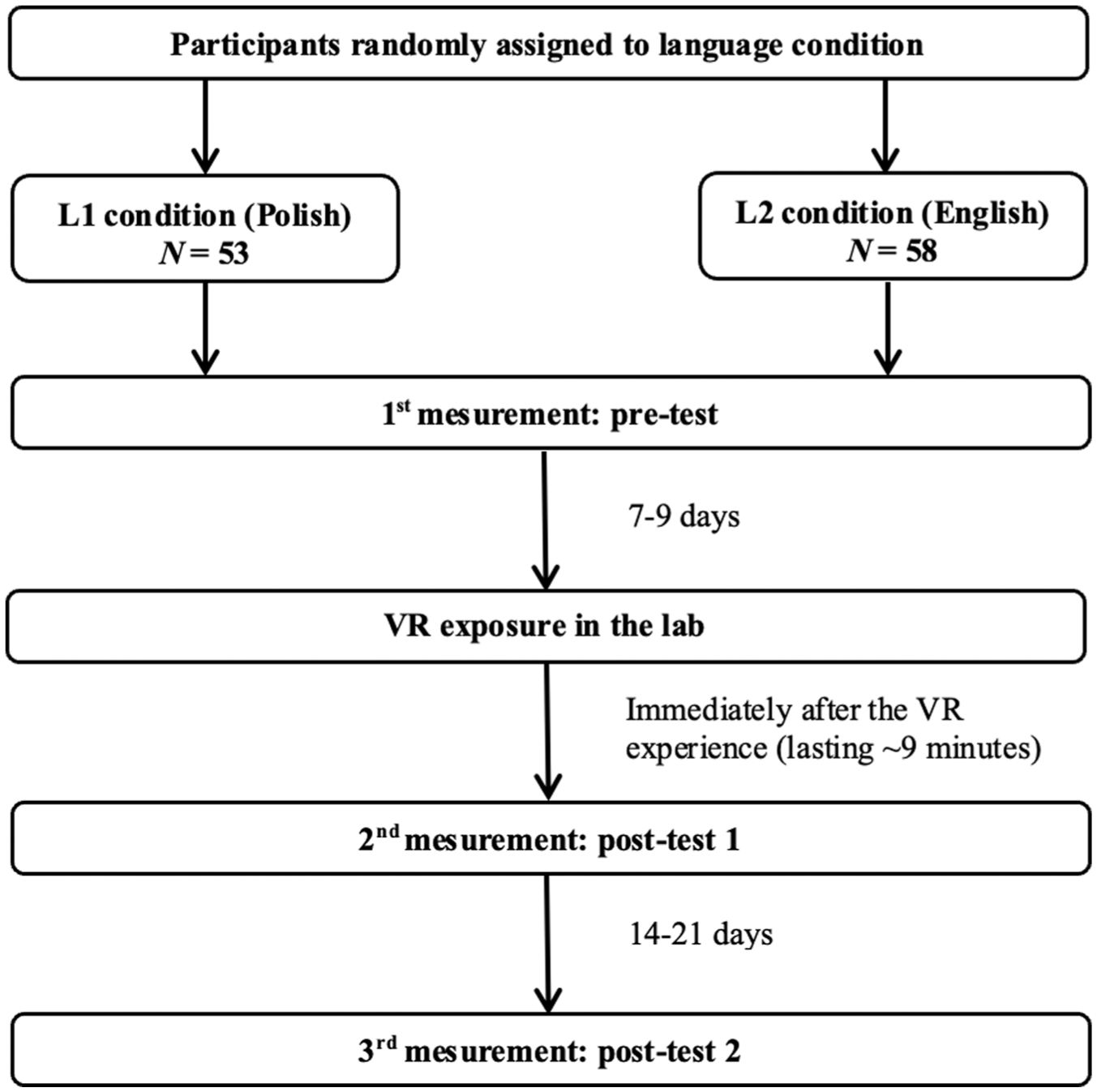
The scheme of the procedure.
Data Analysis
We analyzed the data using Linear Mixed Models (LMM) implemented in Jamovi 2.6 (The jamovi project, 2024) with the GAMLj module (Gallucci, 2019). The models included measurement time (three levels: Pretest, Posttest 1, Posttest 2) and language condition (two levels: L1, L2) as fixed effects, with participant as a random effect to account for repeated measurements. We used maximum likelihood estimation with the bobyqa optimizer and Satterthwaite approximation for degrees of freedom. All models converged successfully. Model fit was assessed using conditional R² (variance explained by fixed and random effects) and marginal R² (variance explained by fixed effects only). Conditional R² represents the proportion of variance explained by both fixed effects (time, language, interaction) and random effects (participant), while marginal R² represents variance explained by fixed effects alone. High conditional R² values indicate strong within-subject consistency across repeated measurements.
To verify the robustness of our findings, we compared LMM results with traditional repeated-measures analysis of variance (ANOVA). Both methods showed complete agreement in significance patterns (see Supplementary Materials for detailed comparison).
Results
We analyzed hypotheses using Linear Mixed Models with measurement time (Pretest vs. Posttest 1 [immediately after the VR experience] vs. Posttest 2 [at least 2 weeks after the VR experience]) as a within-subjects factor and language (L1 vs. L2) as a between-subjects factor. Pairwise comparisons for significant main effects and interactions were conducted using estimated marginal means with Bonferroni correction.
Empathy Components
Perspective-Taking (PT)—H1a
The main effect of measurement time was significant, F(2, 218) = 6.08, p = .003, revealing an increase in perspective-taking between Pretest and Posttest 1 (p = .003). The main effect of language was not significant, F(1, 109) = 0.19, p = .662. The Measurement Time × Language interaction was significant, F(2, 218) = 3.37, p = .036. Pairwise comparisons revealed differences only in the L2 condition, with significant increases in perspective-taking between Pretest and Posttest 1 (p < .001) and between Pretest and Posttest 2 (p = .022). No differences were identified in the L1 condition. The model showed excellent fit (conditional R² = .815, marginal R² = .013), indicating high consistency within participants across time points. The results are presented in Figure 2. Note that the scales shown in Figure 2 and the following Figure 3 differ from the original measurement scale to improve readability.
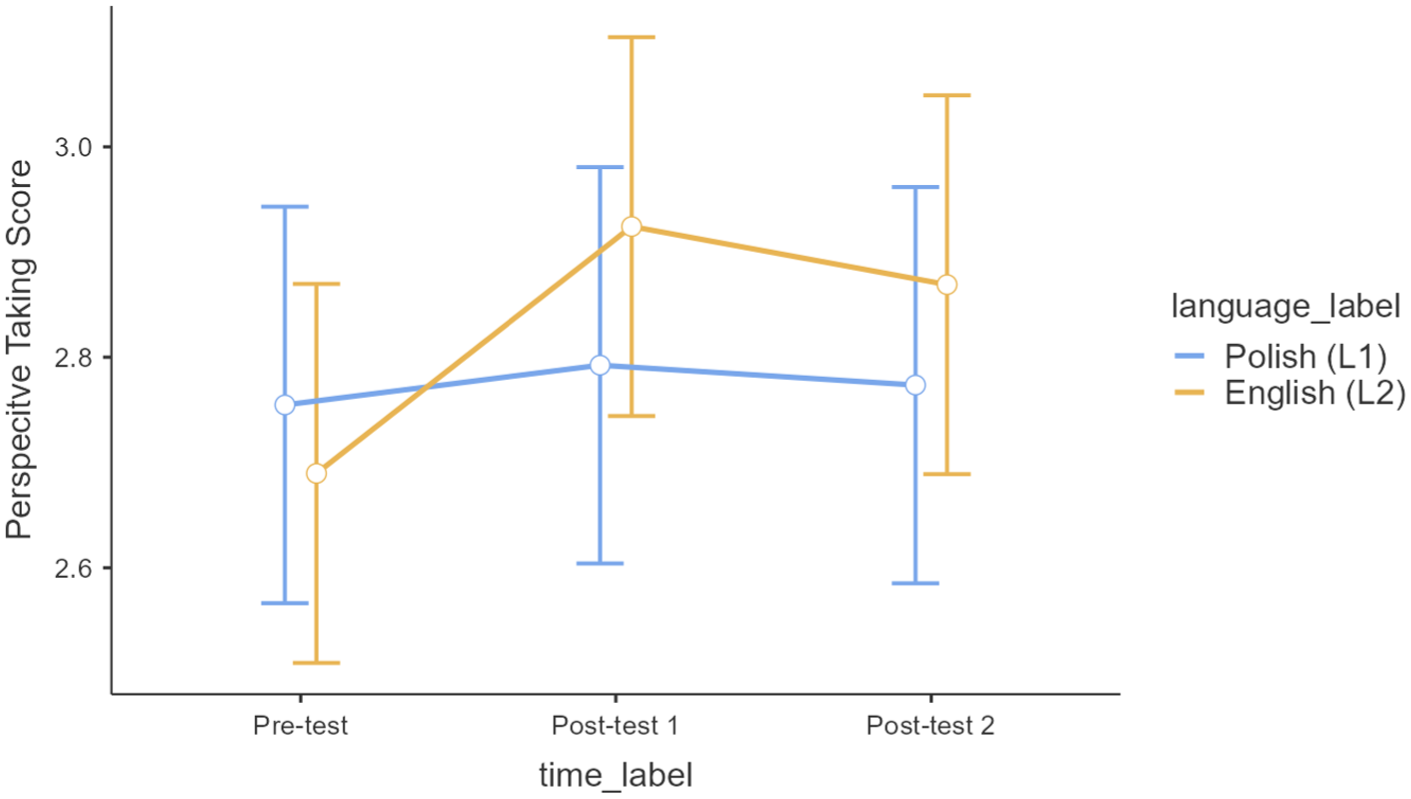
Perspective Taking (PT) scores divided by language (L1; L2).
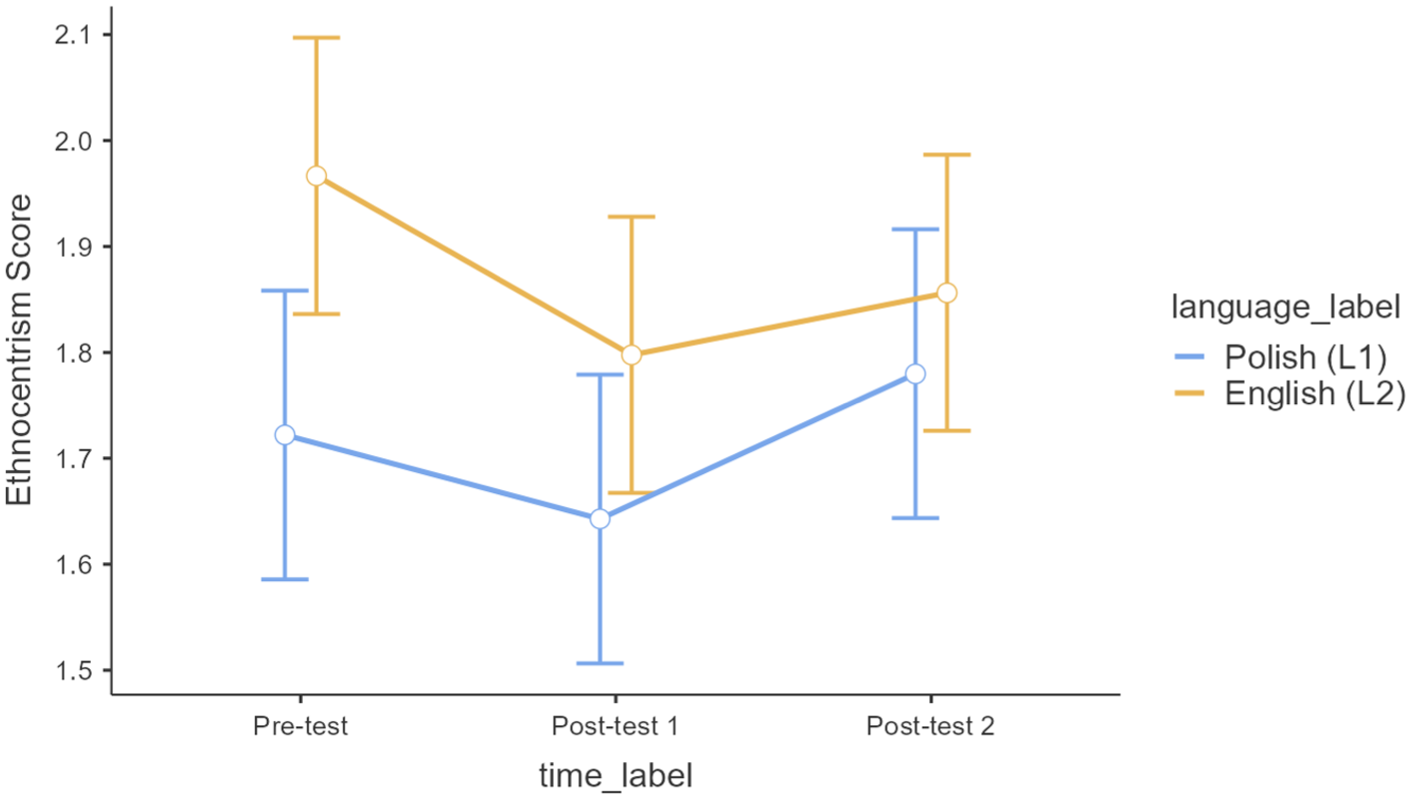
Ethnocentrism scores divided by language (L1; L2).
Personal Distress (PD)—H1b
The main effect of measurement time was significant, F(2, 218) = 4.66, p = .010, with significant decreases in personal distress between Pretest and Posttest 2 (p = .008). The main effect of language was not significant, F(1, 109) = 1.32, p = .254. The Measurement Time × Language interaction was not significant, F(2, 218) = 0.94, p = .391. The model showed excellent fit (conditional R² = .851, marginal R² = .016).
Empathic Feeling, Expression & Awareness (EFEA)—H1d-e
The main effect of measurement time was significant, F(2, 218) = 3.39, p = .036, revealing increases in empathic feeling, expression, and awareness between Pretest and Posttest 1 (p = .049). The main effect of language was not significant, F(1, 109) = 3.32, p = .071. The interaction effect was not significant, F(2, 218) = 0.57, p = .566. The model showed excellent fit (conditional R² = .924, marginal R² = .029).
Acceptance of Cultural Differences & Empathic Perspective Taking (ACEP)—H1f-g
The main effect of measurement time was significant, F(2, 218) = 8.75, p < .001. An increase was observed between Pretest and Posttest 1 in acceptance of cultural differences and empathic perspective taking (p < .001). The main effect of language was not significant, F(1, 109) = 2.56, p = .112. The interaction effect was not significant, F(2, 218) < 0.01, p = .999. The model showed excellent fit (conditional R² = .806, marginal R² = .030).
Ethnocentrism
The main effect of measurement time was significant, F(2, 218) = 9.06, p < .001, revealing a decrease in ethnocentrism from Pretest to Posttest 1 (p < .001) and an increase from Posttest 1 to Posttest 2 (p = .005). The main effect of language was not significant, F(1, 109) = 3.21, p = .076. The interaction effect was significant, F(2, 218) = 3.75, p = .025. Pairwise comparisons revealed a significant decrease in ethnocentrism in the L2 condition between Pretest and Posttest 1 (p = .001). In contrast, the L1 condition showed a significant increase between Posttest 1 and Posttest 2 (p = .034). The model showed excellent fit (conditional R² = .801, marginal R² = .040). The results are presented in Figure 3.
Discussion
In our study, we were the first to test whether the foreign-language effect occurs in an immersive and close-to-real-life environment. We used the 360° VR movie to verify the immediate impact of a foreign language use on different aspects of empathy and ethnocentrism. In addition, by implementing follow-up measurement that took place 2 weeks after the VR experience, we tested whether potential changes have a long-lasting effect. Our results reveal the significant effect of interaction for (a) one of the empathy measurements (the cognitive empathy, PT) and (b) ethnocentrism. We observed a significant increase in cognitive empathy and an immediate decrease in ethnocentrism in the foreign language users’ condition. While the cognitive empathy increase persisted at both Posttest timepoints, the ethnocentrism decrease was observed only immediately after VR exposure and was not maintained at the 2-week follow-up. Such differences were not observed for native language users. Note, however, that differences between language pairs were not significant. Thus, we cannot claim that foreign language use globally increases empathy or reduces ethnocentrism compared to native language users.
How can we interpret such results? We believe that the design of our study might be an important factor. More precisely, we used a longitudinal design consisting of three measurements, one of which was conducted in a laboratory setting using VR. The gap between the first and third measurement was about 3 weeks. With this extremely complex design, we were able to recruit over 110 participants. Unfortunately, considering the observed effect size for the foreign-language effect, which is about d = 0.3 (small to medium; Circi et al., 2021), 111 participants give only 47% chances to observe the main effect of language and even less for the interaction. The situation changes when we make the power analysis for within-subject comparisons (i.e., differences between measurement moments). With 111 participants, we have over 99% chances to observe the existing effect. Given the perfect convergence between repeated measures ANOVA and Linear Mixed Models in our data (r > .999; see Supplementary Materials), these power estimates apply to both analytical approaches. Of course, these are only statistical calculations, and we need experimental evidence to confirm them. Hopefully, future research will solve this puzzle. Nevertheless, being cautious with our claims, we will dive deeper into our results and try to interpret what observed differences between measurement moments in a L2 group after VR experience might mean for the foreign-language effect domain.
Increased Cognitive Empathy
As we mentioned in the “Measures” section, cognitive empathy connects with the ability to adopt other individuals’ mental perspectives. Initial research on the foreign-language effect assumed that foreign language use increases deliberation. Further studies found little evidence for this claim; however, an alternative explanation that finds confirmation in evidence suggests that the foreign-language effect might arise due to changes in metacognitive functions (Białek et al., 2020). How does this match our results?
This model, called the Stunned Intuitions Model, proposes that using a foreign language weakens intuitions in general. When people encounter situations involving outgroup members and must make judgments in their native language, they typically experience immediate, intuitive emotional responses containing implicit biases and stereotypes. These automatic responses frequently occur before deliberative processing can intervene. In addition, intergroup attitudes are heavily influenced by internalized social norms, delivering intuitive clues regarding how we should feel about and interact with outgroup members. What is important, previous findings revealed that the use of a foreign language reduces the activation of social norms (Geipel et al., 2015; Muda et al., 2018), which creates space for these automatic negative intuitions toward outgroup members to become attenuated. The reduction in the strength of these intuitive biases creates cognitive possibility for more deliberative processes, including perspective-taking–a key component of cognitive empathy. With weakened intuitive prejudice, individuals can more readily consider the outgroup member’s point of view, circumstances, and mental states. In our study, where the VR scenario involved misunderstanding with a Chinese student, this enhanced consideration of the outgroup member’s perspective may have transferred to participants’ empathy scale responses.
These observations are in line with findings showing that the use of a foreign language suppresses superstitions (Hadjichristidis et al., 2017). Superstitious beliefs are typically acquired early in life through interactions with parents and friends in one’s native language. These beliefs become encoded and stored in native-language memory networks. What is important, intuitive thinking depends fundamentally on associative memory—a repository of interconnected ideas, concepts, emotions, and images. When an individual encounters a superstitious circumstance (like a broken mirror) in their native language, this activates a cascade of associations that have been reinforced through cultural learning. This network activation happens automatically and effortlessly, triggering emotional responses that feel intuitive and compelling despite being rationally unjustified. In contrast, when superstitious stimuli are presented in a foreign language, the activation of these associative memory networks may be weakened through several mechanisms: (a) reduced lexical-semantic connections between foreign language words and emotional memory traces; (b) mismatched linguistic context between encoding (native language) and retrieval (foreign language); (c) attenuated spreading activation throughout the associative network (Dijkstra & Van Heuven, 2002; Marian & Neisser, 2000; Pavlenko, 2012). This weakened activation means that the intuitive, emotion-laden response to superstitious stimuli is diminished, making the superstitious belief less compelling in a foreign language context. In the context of our research, where the misunderstanding involved a conversation with an outgroup member, the processes underlying memory recall may be similar. When encountering and evaluating outgroup members in a native-language context—especially in problematic situations like the one depicted in our VR movie—negative stereotypes and emotional reactions may be automatically triggered through the same associative memory networks that activate superstitious responses. The reduced automatic activation of these biases in a foreign language context could create cognitive space for more deliberative social cognition, including perspective-taking processes central to cognitive empathy.
An alternative explanation for our findings on the influence of language on cognitive empathy aligns with the global mind-set assumption (Shaules, 2019; Thomas & Inkson, 2017), suggesting that using an L2 may enhance empathy by encouraging individuals to shift their focus from immediate, local concerns to a broader, more contextually adaptive perspective. Moreover, referring to studies on cultural frame-switching (e.g., Nguyen & Benet-Martínez, 2013), communicating in English may have led late bilingual Poles to align more closely with liberal values and a broader tolerance for alternative ways of thinking, which are characteristic of Anglo-Saxon and other Western European cultures (Boski, 2006).
Decreased Ethnocentrism
Regarding our second hypothesis about differences in ethnocentrism between the L1 and L2 conditions, we observed a decrease between the Pretest and Posttest 1 (following the VR experience) in the L2 group. Notably, while Banakou et al. (2016) showed reduced implicit bias lasting at least 1 week post–virtual embodiment, the decreased ethnocentrism in our study was observed only immediately after VR exposure and did not persist at the 2-week follow-up. The L1 group, in contrast, showed a significant increase in ethnocentrism between Posttest 1 and Posttest 2. We believe this might be explained by reduced interference from self-centered representations and emotional reactions. While the vividness of one’s own mental imagery is reduced when using a foreign language (Hayakawa & Keysar, 2018), this reduced self-reference may paradoxically facilitate perspective-taking by decreasing the dominance of egocentric representations that can interfere with understanding others’ mental states (Epley et al., 2004). This interpretation aligns with research on psychological distance, which suggests that increased distance can enhance abstract processing and reduce egocentric biases (Trope & Liberman, 2010), potentially benefiting certain forms of perspective-taking and cultural sensitivity.
Moreover, the VR experience itself—which provides both third-person and first-person perspectives of an outgroup member—can be regarded as a form of intercultural contact. As noted earlier, contact with outgroups has been shown to reduce bias (Allport, 1954; Pettigrew & Tropp, 2006), thereby mitigating ethnocentrism. Based on our results, both the ethnorelative view and empathy—key components of intercultural competence (Deardorff, 2006)—appear to be fostered not only through international collaboration and educational trainings, but also through immersive technologies. This presents an intriguing paradox: perhaps one does not always need to leave their own room to become more culturally inclusive. Future research should examine factors that may promote more sustained effects of foreign language use on ethnocentrism.
Limitations
In the L1 condition, participants encountered an interesting methodological feature–L2 dialogues accompanied by L1 subtitles throughout most of the VR experience. This linguistic configuration may have influenced processing fluency in ways that offer additional insights about comprehension processes that required heightened cognitive effort (Formanowicz & Suitner, 2020; Hansen et al., 2014). The cognitive mechanisms involved in processing L2 speech while reading L1 subtitles within immersive VR environments could have introduced dynamics that affected how participants engaged with the intercultural content (Bialystok et al., 2009). This methodological aspect provides an opportunity to consider how different language presentation formats might interact with cognitive empathy and ethnocentrism in virtual reality contexts. It’s important to note that our research examined intercultural differences and ethnocentrism in conditions approximating real-life interactions. Creating an entirely L1 scenario (e.g., a Polish and Chinese person both speaking Polish) would have been unrealistic. In actual intercultural encounters, people from different linguistic backgrounds typically communicate in a shared language like English (our L2 condition), rather than one person’s native language.
Furthermore, additional methodological challenges would arise in an L1-only condition. Having a Chinese speaker use flawless, accent-free Polish would undermine cultural embodiment—participants would likely perceive them as someone of Asian appearance from their own culture rather than as a representative of another culture. Conversely, introducing a non-native accent would introduce confounding factors related to the foreign accent effect, as research shows that accented speech influences person perception (Foucart & Brouwer, 2021).
We therefore designed our study with both interlocutors (Polish and Chinese) speaking English, each with their respective accents. This approach provided the most neutral and controlled experimental setup. Nevertheless, we acknowledge the limitations in our design regarding language switching and encourage future researchers to explore alternative approaches to validate our findings.
Conclusion
This study provides the first evidence that the foreign-language effect operates in immersive VR environments, specifically with a possible effect on cognitive empathy and ethnocentrism. These findings reconcile apparent contradictions in the literature by demonstrating that while foreign language use may reduce certain emotional responses, it can simultaneously facilitate perspective-taking and cultural understanding in appropriate contexts.
The practical implications are significant—VR-based intercultural training incorporating foreign language elements may represent a powerful tool for developing empathy and reducing cultural biases. As our interconnected world increasingly requires cross-cultural competence, such technologies offer promising solutions for fostering understanding across cultural divides.
Supplemental Material
sj-docx-1-ijb-10.1177_13670069261447430 – Supplemental material for Virtual Reality as a Tool for Examining the Role of L1 and L2 in Enhancing Empathy and Reducing Ethnocentrism: Evidence From a Micro-Longitudinal Study
Supplemental material, sj-docx-1-ijb-10.1177_13670069261447430 for Virtual Reality as a Tool for Examining the Role of L1 and L2 in Enhancing Empathy and Reducing Ethnocentrism: Evidence From a Micro-Longitudinal Study by Daniela Hekiert, Gabriela Górska, Iga Stasiak, Wojciech Milczarski, Magdalena Igras-Cybulska, Łukasz Kmiotek and Rafał Muda in International Journal of Bilingualism
Footnotes
ORCID iDs

Funding
The authors disclosed receipt of the following financial support for the research, authorship, and/or publication of this article: This work was supported by Miniatura grant no. 2021/05/X/HS6/01498 from the National Science Center (NCN, Poland), awarded to Daniela Hekiert. The work by Rafał Muda and Wojciech Milczarski was supported by grant no. 2020/38/E/HS6/00282 from the National Science Center (NCN, Poland), awarded to Michał Białek.
Declaration of Conflicting Interests
The authors declared no potential conflicts of interest with respect to the research, authorship, and/or publication of this article.
Supplemental Material
Supplemental material for this article is available online.
Author Biographies
References
Supplementary Material
Please find the following supplemental material available below.
For Open Access articles published under a Creative Commons License, all supplemental material carries the same license as the article it is associated with.
For non-Open Access articles published, all supplemental material carries a non-exclusive license, and permission requests for re-use of supplemental material or any part of supplemental material shall be sent directly to the copyright owner as specified in the copyright notice associated with the article.
