






Abstract
Aims and objectives:
This study investigates how Chinese–English (C-E) bilinguals and Chinese–English–Japanese (C-E-J) trilinguals express English caused state change events (CSC), focusing on the similarities and differences between the two groups. It explores the underlying motivations with an emphasis on cross-linguistic influence, particularly the inverse typological effect of the L3 (Japanese) on the L2 (English), as modulated by L3 proficiency.
Design and methodology:
This study employed a video description task to compare C-E bilinguals and C-E-J trilinguals differing in Japanese proficiency (low-to-intermediate/high). Participants (no. 96) described 12 video clips depicting CSC events.
Data and analysis:
The database comprised CSC descriptions of C-E bilinguals (no. 32), C-E-J trilinguals with low Japanese proficiency (no. 32), and C-E-J trilinguals with high Japanese proficiency (no. 32). Analyses focused on two dimensions: (1) semantic structure and (2) cognitive mechanisms.
Findings and conclusions:
(1) Trilinguals showed more inaccuracies in employing S-constructions and reduced semantic precision in expressing [manner] information. They also exhibited lower frequencies of employing alternative manner expressions, complete causal chains, and causal tight forms. (2) The impact of L3 (Japanese) typological framework features was primarily negative, with cognitive aspects showing clearer signs of change than semantic aspects. As learners’ Japanese proficiency increased, reliance on transfer from L1 Chinese declined, while the shared V-language typology of Japanese and English became salient in L2 (English) production.
Originality:
This study advances novel research on the inverse effects of L3 on L2, with a particular focus on CSC as a new research object.
Significance and implication:
Our findings confirm that in multilingual acquisition, the linguistic distance and proficiency of the subsequent language (L3) influence the previous language (L2).
Keywords
Introduction
In recent years, understanding how multilingual learners with typologically different language backgrounds express macro-events has been a key focus in cross-linguistic influence research (e.g., Liu & Chen, 2021; Skordos et al., 2020). Talmy’s (2000b) macro-event theory identifies motion events, temporal contouring events, action correlating events, realization events, and state change (SC) events as core semantic categories in language and cognition. His typological dichotomy classifies languages into verb-framed (V-languages) and satellite-framed (S-languages). To account for languages with serial verb constructions that do not fit neatly into this binary, Slobin (2004) further proposed equipollent-framed (E-languages) as a third type. Grounded in the tradition of linguistic relativity, Slobin’s (1996) thinking-for-speaking hypothesis, bridges Talmy’s typology with the relationship between language and thought, suggesting that language acquisition involves internalizing language-specific patterns of conceptualization for speaking.
Talmy’s typological framework and Slobin’s hypothesis thus provide a solid foundation for examining language acquisition and cross-linguistic influence from a macro-event perspective. However, existing research has predominantly focused on second language acquisition (SLA) and motion-related phenomena (e.g., Anastasio, 2023; Aveledo & Athanasopoulos, 2023; Brown & Gullberg, 2011), with relatively few studies extending this approach to multilingual contexts. Other subordinate event categories remain comparatively underexplored. Despite the motion-based orientation of Talmy’s typological classification and its extensive discussion in the literature, its core claim, that conceptualization constrains linguistic encoding, calls for validation across different event types. In this respect, SC events, as a pervasive phenomenon in both linguistic expression and cognition, offer a particularly promising domain for examining cross-linguistic influence and the construction of learners’ cognitive models in language acquisition, especially from the perspective of causal logic.
In research on cross-linguistic influence, multilingual acquisition has primarily been examined in terms of how previously acquired languages shape the learning of an additional language. Accordingly, empirical studies have focused predominantly on unidirectional transfer patterns, particularly L1-to-L2 and L1/L2-to-L3 transfer (e.g., Hopp & Jackson, 2023; Rothman, 2010). By contrast, the inverse influence of a newly acquired language on previously established language systems, such as L3-to-L2 transfer, remains insufficiently examined, despite its theoretical relevance for understanding the plasticity of the multilingual linguistic system. Moreover, the extent to which this reverse influence is modulated by language distance and learners’ proficiency levels has yet to be systematically addressed. In the domain of CSC events, L3-to-L2 transfer is particularly informative, as it reveals how newly acquired typological constraints interact and compete with already stabilized L2 representations in the encoding of causality and resultant states.
Drawing on Talmy’s typological framework of CSC events and prior research on cross-linguistic influence, the present study explores the similarities and differences in the representation of English CSC between Chinese–English–Japanese (C-E-J) trilinguals and Chinese–English (C-E) bilinguals. It further examines the degree to which L3 (Japanese) typological features and its proficiency levels contribute to the observed patterns from a cross-linguistic influence perspective.
Current Research on SC Events
SC has been discussed within Talmy’s (2000b) macro-event framework, where it is defined as ‘a type of framing event, consisting of a change in, or unchanging continuation of, that property’ (Talmy, 2000b, p. 237). From a cognitive semantic perspective, SC can be viewed as conceptually related to motion events, sharing similar conceptual structures such as causal chains and result states (Talmy, 2000b). Based on the presence of causation and agentivity, SC events can be further classified into three types: non-agentive SC with manner, non-agentive SC with cause, and agentive SC with cause (Talmy, 2000b). All three types differ systematically in their underlying conceptual structures. In particular, only the latter two types explicitly encode an external causal source. Following the research paradigms of Du et al. (2018) and (Li, 2023), the present study focuses on the latter two types, which are collectively referred to as CSC events, as they allow for a more coherent examination of causal conceptualization and linguistic encoding.
Existing research on SC has primarily developed along two complementary lines: cognitive semantic approaches and syntactic semantic approaches. Cognitive semantic studies focus on how SC and CSC events are conceptualized and lexicalized, examining issues such as cognitive mechanisms, event representation, and lexicalization patterns (e.g., Croft et al., 2010; Deng, 2020; Du et al., 2018; Tham, 2013). In contrast, syntactic semantic approaches investigate how CSC meanings are structurally encoded at the clausal and constructional levels, with particular attention to sentence patterns and verb constructions (e.g., Haspelmath, 1993; Jin, 2022). Together, these two perspectives offer complementary insights into CSC events by linking conceptual representations with their formal linguistic realizations.
Despite these advances, most studies have treated SC as a unified category, with relatively little attention to specific subtypes such as CSC. Existing CSC-related research remains limited and fragmented. Theoretically, previous work has examined caused change-of-state verbs and event-encoding patterns (e.g., Alexiadou, 2014; Tham, 2018). Empirically, some studies have investigated the cognitive mechanisms of agentive SC conceptualization and CSC-related issues, including lexicalization patterns, representational development, and English-Chinese translation strategies (Du et al., 2018; Li, 2023; Li & Deng, 2021). However, empirical research on CSC is still limited in scope. Most studies focus on Mandarin Chinese speakers or Chinese-English bilinguals, with little attention to multilingual acquisition contexts. Moreover, the roles of language typology and language proficiency in cross-linguistic influence have rarely been examined. As a result, how CSC events are acquired and expressed in multilingual settings remains insufficiently understood, underscoring the need for further empirical research.
Cross-Linguistic Influence in Multilingual Acquisition
Previous studies have shown that bilingual learning experiences facilitate trilingual acquisition, particularly meta-linguistic awareness and language learning strategies, giving bilinguals an advantage over monolinguals in learning additional languages (Schepens et al., 2016). Current research on multilingual transfer primarily focuses on the influence of pre-existing languages on subsequently acquired languages at the lexical (e.g., Busterud et al., 2023; Conner et al., 2018; Efeoglu et al., 2019), syntactic (e.g., Devlin et al., 2015), phonological (e.g., Gut, 2010; Wrembel et al., 2019), and conceptual (e.g., Jarvis, 2015; Soler, 2021) levels.
As Herdina and Jessner (2002) noted, the development of a learner’s multilingual dynamic system involves both the acquisition of a new language and the reorganization of the entire language system. Accordingly, the acquisition of a new language will have an impact on the learner’s existing language system. In multilingual learning, most learners share the intuition that learning a new foreign language makes them forget previously learned foreign languages (Mickan et al., 2024). The reverse effect of multilingual learning on existing language systems, referring to whether and how learning a new language influences earlier languages, has garnered academic attention. However, most studies have focused on the impact of L1 and/or L2 on L3 acquisition. There is still limited experimental evidence documenting the reverse influence of L3 on L2 acquisition or elucidating how and why learning a new language might affect previously learned ones, with very few exceptions (e.g., Lin, 2025; Mickan et al., 2024; Olszewska, 2025; Seo & Dmitrieva, 2024). The manifestation of this reverse effect in CSC event acquisition, along with its relationship to L3 typological features and proficiency levels, warrants further exploration.
To this end, this paper aims to investigate the inverse effects of L3 (Japanese) acquisition on the expression of L2 (English) CSC from two dimensions, semantic structures and cognitive mechanisms, to provide valuable references for effectively consolidating multilingual learners’ acquired languages.
Language Typological Differences and Cross-Linguistic Influence in CSC Events
In terms of language family, English belongs to the West Germanic branch of the Indo-European language family, while Chinese is part of the Sino-Tibetan family. The classification of Japanese remains debated (Ying, 1999), making its relationship to other languages uncertain. Within Talmy’s typological framework, modern Chinese and English have been argued to exhibit prominent features of S-languages (e.g., Talmy, 1985, 2000b). In contrast, other scholars have argued that Chinese should be classified as a V-language (e.g., Tai, 2003). The typological classification of Chinese is contentious due to its lack of morphological markers and the inclusion of both manner and path verbs (Cai & Wang, 2022). Importantly, however, in the domain of SC events, Chinese exhibits strong S-language features, wheresa English permits both S- and V-language patterns (Li, 2022; Talmy, 2000b). With respect to Japanese, although direct typological classification in SC events remains underexplored, previous research has treated Japanese as a V-language based on its expressions (Wei & Guo, 2025). Accordingly, drawing on previous discussions and the present study’s focus on prototypical state change expressions in English, Chinese, and Japanese, the present study treats Japanese as a V-language in the domain of SC events.
Since Chinese, English, and Japanese belong to different typological groups based on their language family and Talmy’s framework, several studies have examined the acquisition of motion events in this language combination (Inagaki, 2002; Ji & Hohenstein, 2017; Spring & Horie, 2013), indicating that selecting Chinese, English, and Japanese is feasible, as the influence of language typology may be present. However, to the best of our knowledge, there is no empirical research exploring the acquisition of English CSC events among C-E-J trilinguals. Thus, this study examines Chinese as the native language, English as the second language, and Japanese as the third language, taking into account both typological differences and Japanese proficiency in investigating reverse L3-to-L2 transfer.
Research Questions
In light of the aforementioned research gaps, this study formulated two research questions:
What are the similarities and differences in the representation of English CSC between C-E-J trilinguals and C-E bilinguals?
From a cross-linguistic influence perspective, how do L3 (Japanese) typological features and L3 (Japanese) proficiency affect these similarities and differences?
Methods
Participants
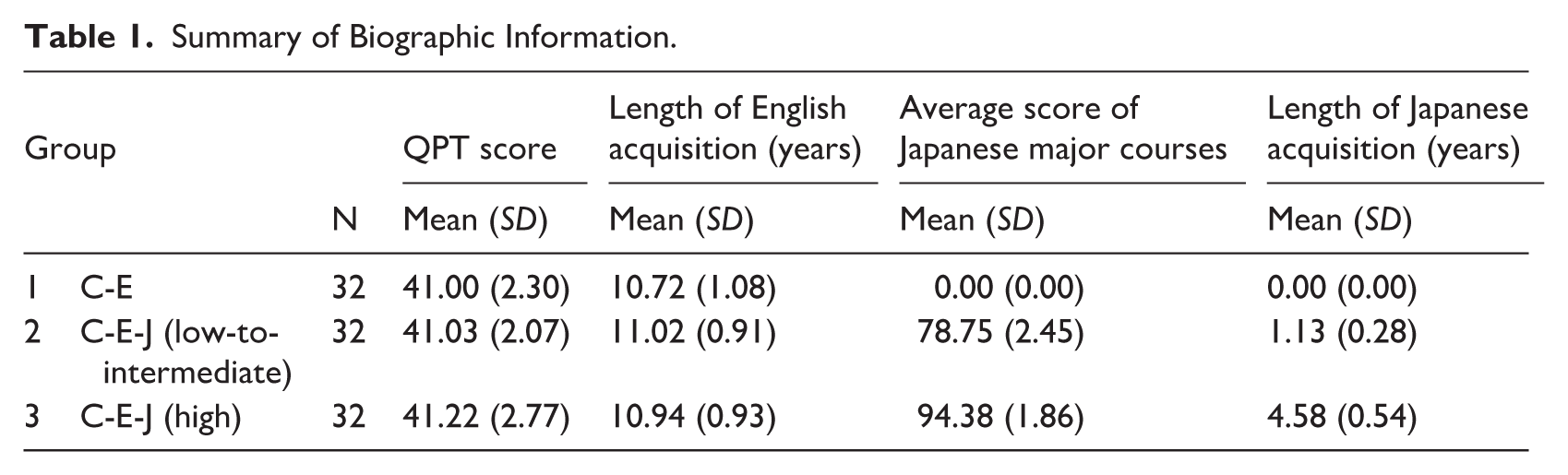
This study recruited 128 L1 Chinese participants from a public university in China. All participants completed the Quick Placement Test (QPT; Oxford University Press & University of Cambridge Local Examinations Syndicate, 2001) and a language background questionnaire. The study finally screened 96 L1 Chinese participants with intermediate English proficiency levels (B1 and B2), including 32 participants in group 1 (C-E bilinguals), 32 participants in group 2 (C-E-J [low-to-intermediate proficiency] trilinguals), and 32 participants in group 3 (C-E-J [high-proficiency] trilinguals), all of whom were between 19 and 22 years old, had normal listening and language skills, and were able to complete the experimental tasks. Japanese proficiency levels were determined based on performance in core Japanese major courses, JLPT certification (when available), and relevant background information. Detailed grouping criteria are provided in the Supplementary Materials. All participants participated voluntarily and received compensation. The summary of biographic information is shown in Table 1.
Summary of Biographic Information.
Procedure and Instruments
To investigate CSC acquisition, this study employed a video description task to conduct an oral elicitation experiment, adhering to Talmy’s (2000b) methodological requirements for macro-event research (p. 27). Three steps were used to screen the experimental material. First, following the experimental paradigms of Du et al. (2018) and (Li, 2023), videos had to meet two criteria: (1) they must clearly depict a state change caused by an action; (2) at least 2 seconds of the 10-second video must show the result of the change. Next, a pilot study with five students was conducted to identify and exclude videos with unclear causal relations, insufficiently salient result states, or inconsistent interpretations of the state change event, based on both participant feedback and author discussion. Finally, minor adjustments were made to the retained videos to ensure clarity and consistency across stimuli.
After this process, 12 videos were retained: 10 for formal experiments and 2 for pre-experimental trials. During the experiment, participants watched all 12 videos in a quiet room, but only responses to the 10 formal videos were transcribed for analysis. It should be noted that the CSC data analyzed in this study were drawn from the first part of a larger experimental procedure, in which participants also completed a subsequent video description task involving non-caused state change events. These additional videos helped reduce task predictability and minimize potential response strategies.
Data Coding and Analysis
The oral responses of all 96 participants were recorded and transcribed. According to a predetermined screening criterion, grammatically incorrect expressions were included as long as their meanings remained clear, while 12 (1.2%) utterances were excluded due to intelligibility issues. After supplementary trials, a total of 960 valid English CSC expressions were collected.
In this study, the between-group independent variable was L3 (Japanese) proficiency, operationalized into three levels: non-acquired, low-to-intermediate, and high proficiency. The dependent variables included (1) semantic structures, analyzed through lexicalization patterns and alternative manner expressions, and (2) cognitive mechanisms, examined through causal-chain windowing patterns and the patterns of windowing of attention in subevent.
Similarities and Differences of English CSC Expressions
Lexicalization Patterns of English CSC Expressions
Data were coded at the clause level, following Berman and Slobin’s (1994) definition that each clause contains a single predicate representing one state change event. The distributions across groups are illustrated in Figures 1 and 2.
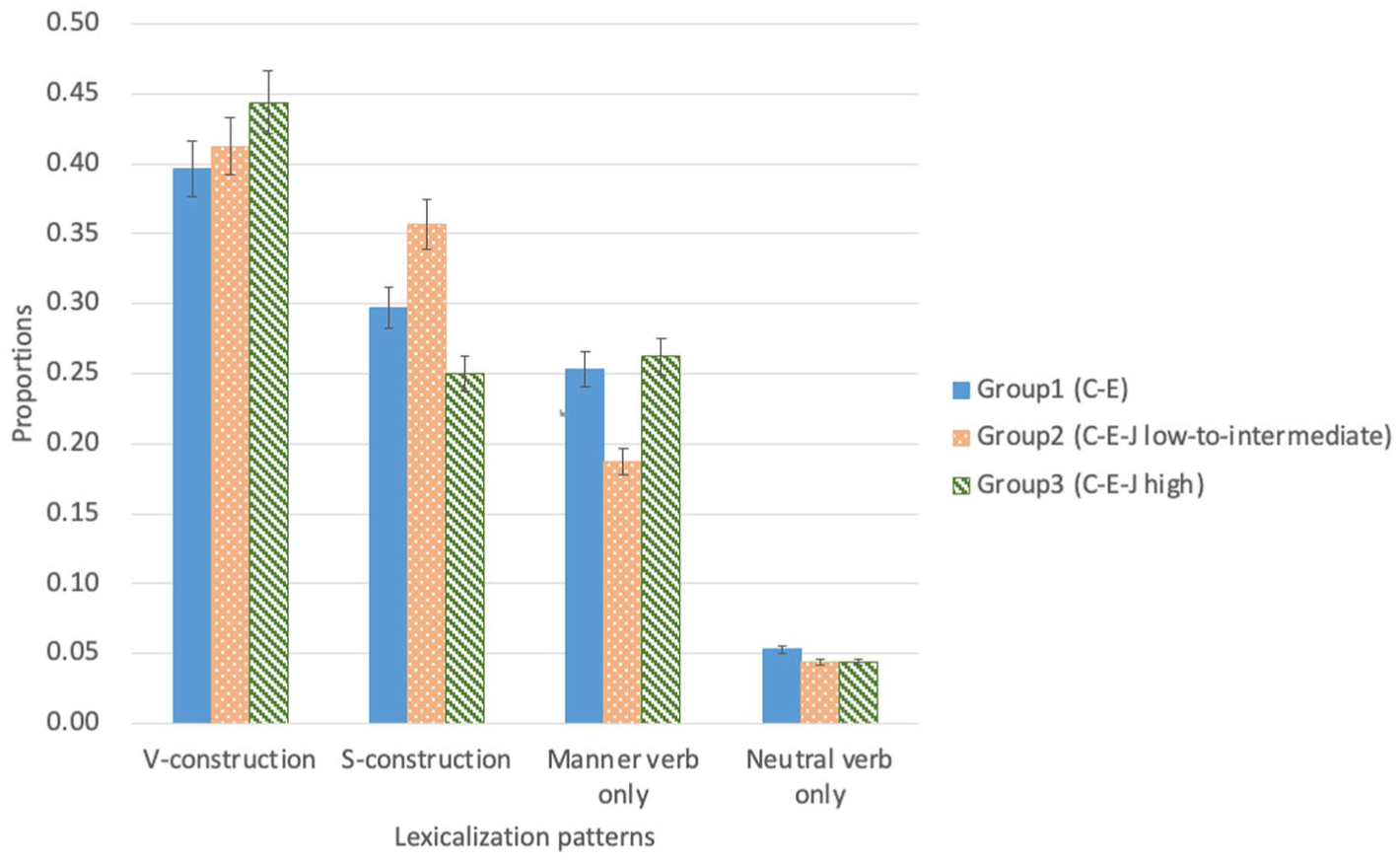
The distribution of lexicalization patterns of English CSC expressions.
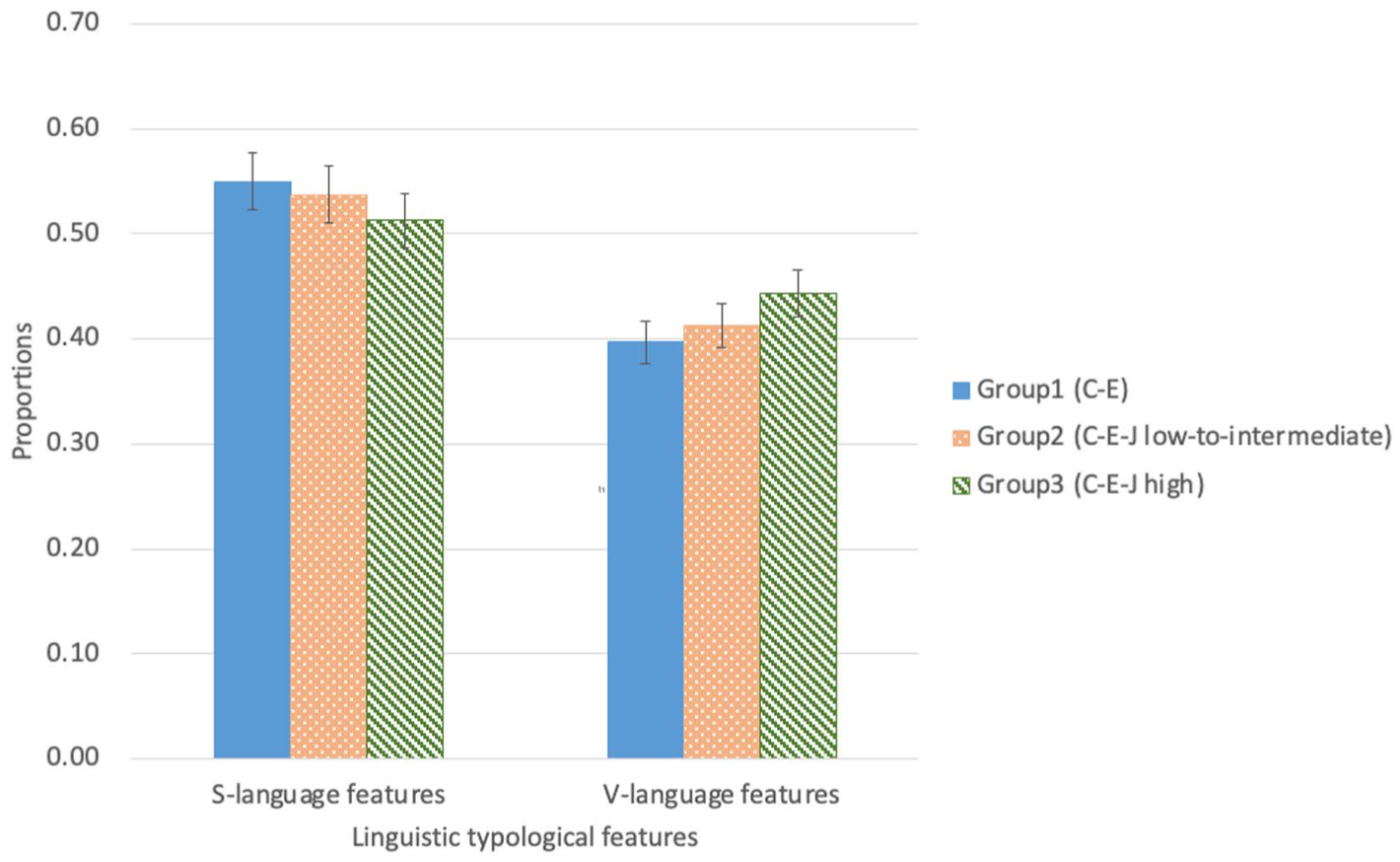
The proportion of linguistic typological features of English CSC expressions.
Figure 2 shows that S-language features (S-construction + MV only) account for 55%, 53.75%, and 51.25% of CSC expressions in the three groups, indicating more satellite-framed language features. Due to a certain proportion of the use of MV only, English CSC expressions do not show a strong S-language feature. Meanwhile, V-language features appear in 39.69%, 41.25%, and 44.38%, respectively, suggesting that higher Japanese proficiency corresponds to a slight increase in V-language features and a decrease in S-language features.
Group comparisons were conducted on participant-level percentages using one-way ANOVAs. Japanese proficiency was entered as the independent variable with three levels: non-acquired, low-to-intermediate, and high proficiency. Results showed that there was a significant difference in the use of MV only (F (2, 93) = 3.682, p < .05), while no significant differences were observed for S-constructions (F (2, 93) = 2.805, p = .066), V-constructions (F (2, 93) = 1.084, p = .342), or NV only (F (2, 93) = .231, p = .794).
Post hoc multiple comparisons revealed significant differences in MV-only usage between C-E bilinguals and C-E-J (low-to-intermediate proficiency) trilinguals (p < .05), as well as between C-E-J (low-to-intermediate proficiency) and C-E-J (high-proficiency) trilinguals (p < .05). Similarly, a significant difference was found in S-construction use between C-E-J (low-to-intermediate) and C-E-J (high) trilinguals (p < .05). These findings suggest that Japanese proficiency influences lexicalization patterns in English CSC expressions, particularly in S-constructions and MV-only usage. At the initial stage of Japanese acquisition, trilinguals tend to add adjuncts or constructions after MVs. As proficiency increases, reliance on MV-only expressions rises.
Alternative Manner Expressions of English CSC Expressions
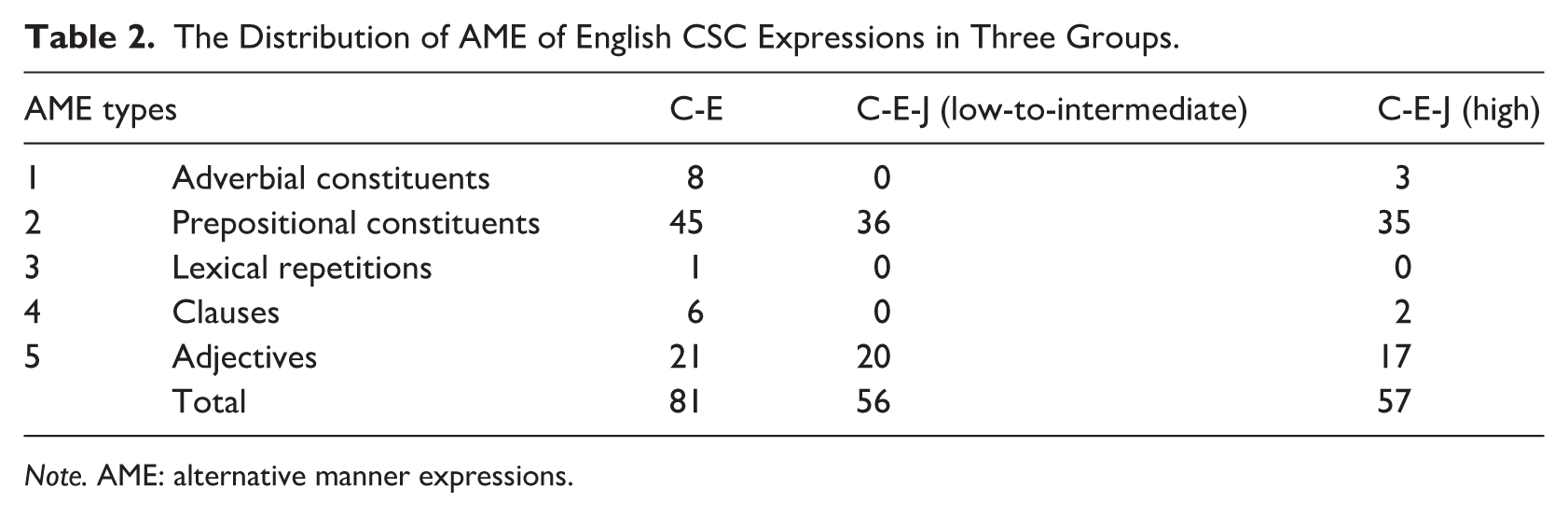
To examine the prominence of manner information, we annotated the categories of alternative manner expressions (AME) of English CSC expressions, including adverbial constituents, prepositional constituents, adjectives, repetitions, and clauses. The annotation results and their distribution across the three groups are shown in Table 2.
The Distribution of AME of English CSC Expressions in Three Groups.
Note. AME: alternative manner expressions.
Adverbial constituents play a crucial role in conveying attitudes, intensity, and direction in language. However, their use declines among C-E-J trilinguals after acquiring L3 (Japanese), as they pay less attention to detailed information about the behavioral process of CSC events. Notably, C-E-J (low-to-intermediate) trilinguals omit adverbial constituents entirely, while C-E-J (high) trilinguals use them at less than half the rate of C-E bilinguals.
Prepositional constituents primarily express the [tool] element, which can be categorized into physical tools (e.g., hands) and material tools (e.g., knives, lighters). Compared to C-E bilinguals, C-E-J trilinguals tend to overlook physical tools when describing CSC events, but mention material tools when they are visually salient. In addition, lexical repetition, which reinforces [manner] information, is rare in all groups, occurring only once in C-E bilingual expressions.
Clauses, which independently encode [manner] semantics, also decrease significantly among C-E-J trilinguals. No clauses appear in the expressions of C-E-J (low-to-intermediate) learners, and usage among C-E-J (high) learners is only one-third that of C-E bilinguals. The use of adjectives, however, shows no significant differences among the three groups.
Overall, C-E-J trilinguals show a consistent decline in AME frequency compared to C-E bilinguals, particularly in adverbial constituents, prepositional constituents, and clauses. This suggests that AME distribution in English CSC expressions is more influenced by L3 (Japanese) acquisition than by proficiency level.
Causal-Chain Windowing of English CSC Expressions
Talmy (1996, 2000a) introduced the windowing of attention theory, arguing that the attentional system is highly flexible, foregrounding selected portions of a referent scene while backgrounding others to conserve cognitive resources and improve cognitive processing. He defined windowing of attention as the placement of focal attention over specific parts of a scene and classified it into five types based on event-frame structures. CSC falls under causal-chain windowing.
We annotated the causal-chain windowing patterns in English CSC expression across three groups, categorizing them into three types: complete causal chain, causative event only, and resultative event only. By examining the language output of C-E bilinguals and C-E-J trilinguals at different L3 proficiency levels, we explored their different patterns of the windowing of attention and their cognitive characteristics. The distribution of causal-chain windowing patterns across groups is shown in Figure 3.
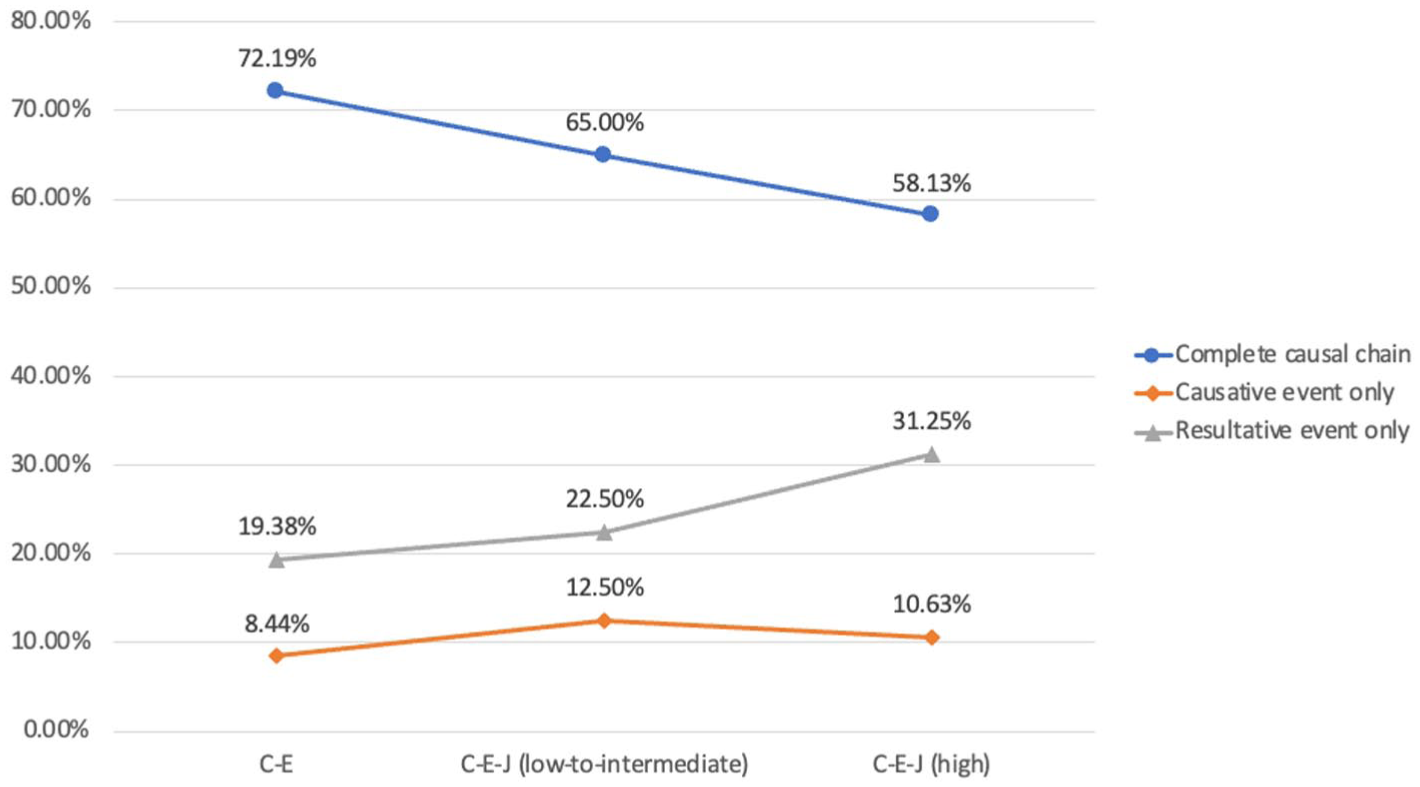
The distribution of causal-chain windowing patterns across groups.
As illustrated in Figure 3, with L3 (Japanese) acquisition and increasing proficiency, the proportion of complete causal chain windowing decreases significantly (p < .001), while resultative event only windowing gradually increases (p = .127).
This shows that C-E-J trilinguals, especially those with high proficiency in Japanese, tend to focus more on the resultative event in the causal chain. To some extent, the acquisition of Japanese and the improvement of Japanese proficiency have an attrition effect on the acquisition of English CSC expressions.
The Windowing of Attention Patterns on Subevents
This study further analyzed subevents in expressions with complete causal-chain windowing, following the annotation method of Du et al. (2018). In the cognitive processing of CSC events, the windowing of the attention mechanism functions as a filter. Foregrounded subevents, which receive strong attentional focus, are explicitly represented in expressions and shape conceptual construction. In contrast, backgrounded subevents gain implicit representation or are omitted. Table 3 presents typical windowing patterns of causally chained subevents in English CSC expressions, while Figure 4 illustrates their distribution across groups.
The Patterns of Windowing of Attention and Typical Examples for Causally Chained Subevents of English CSC Expressions Across Groups.
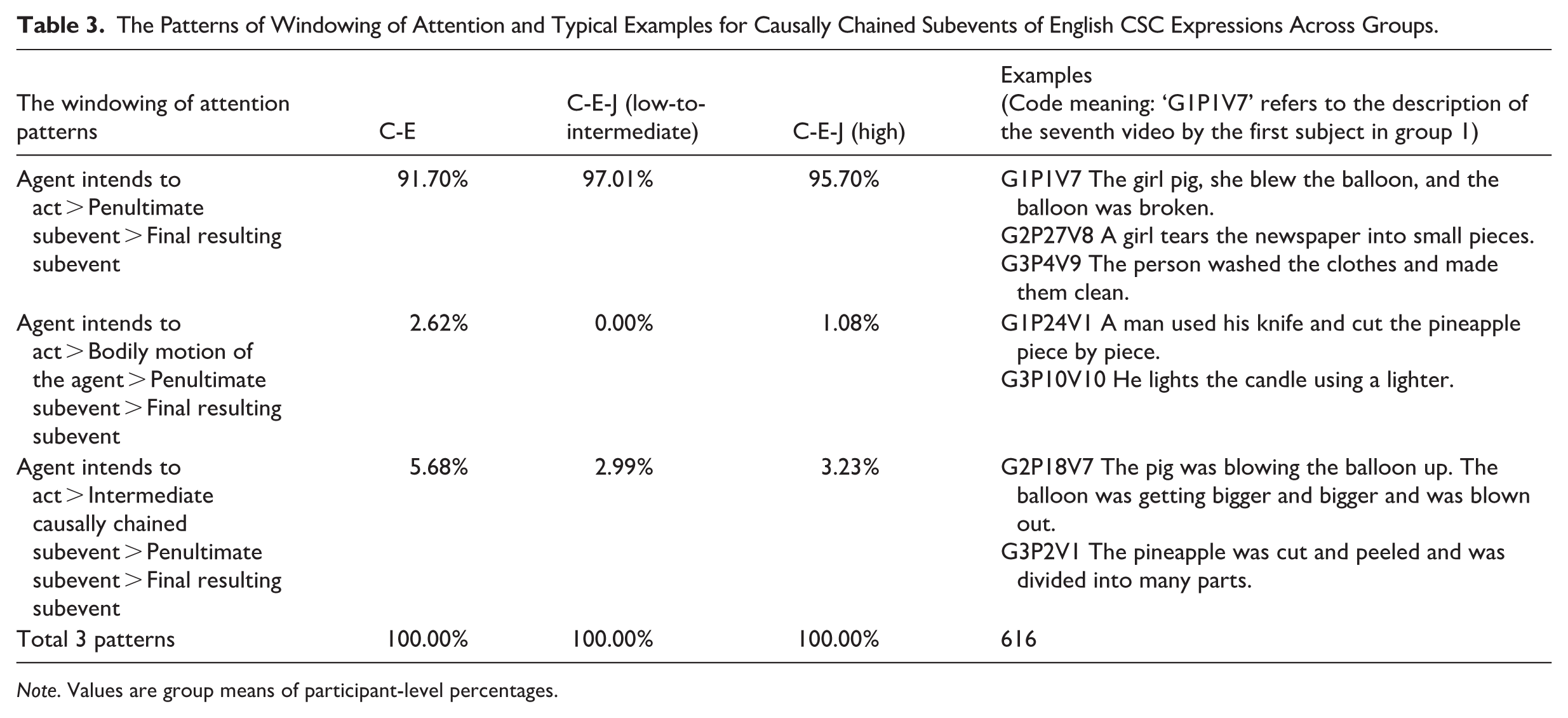
Note. Values are group means of participant-level percentages.
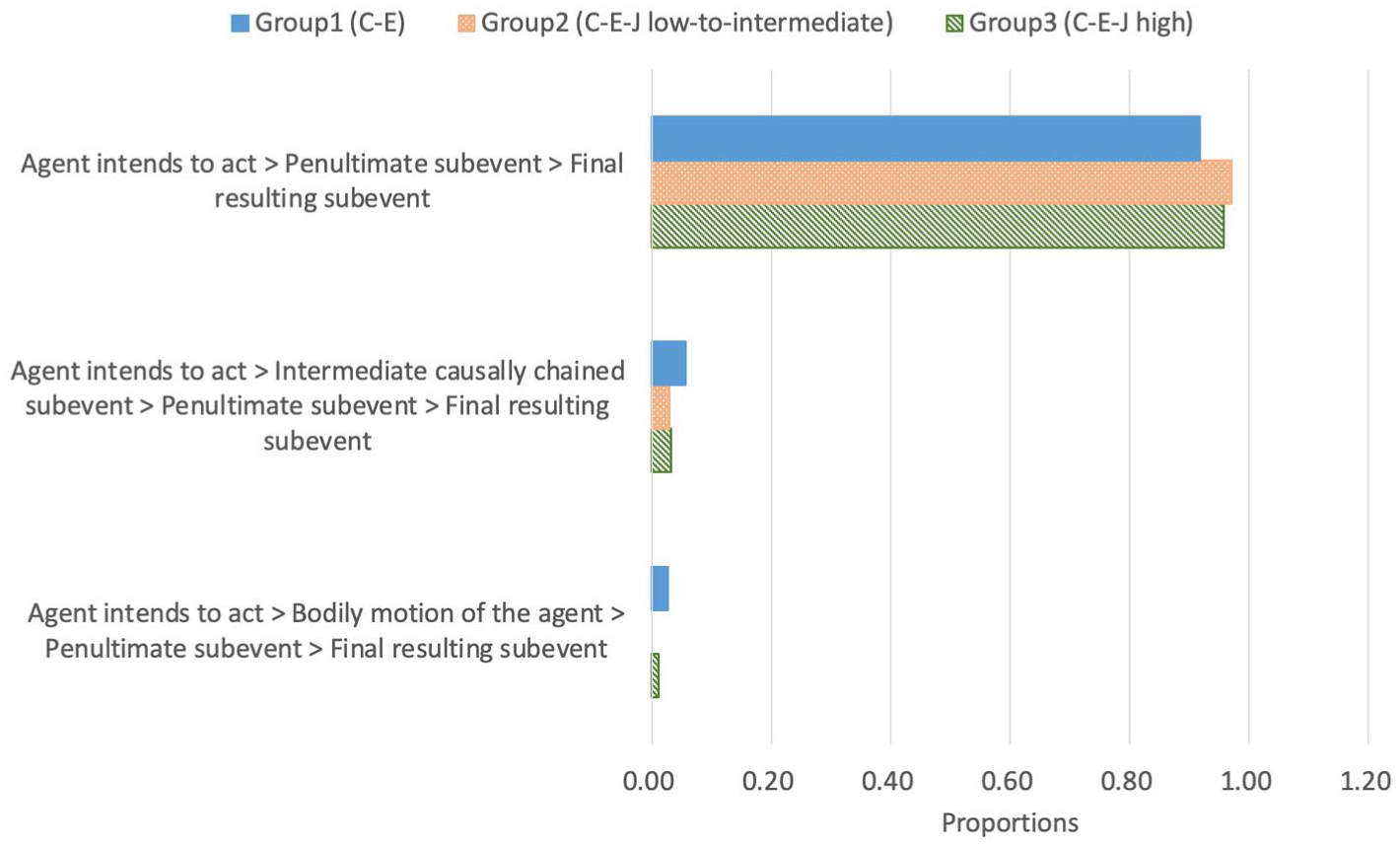
The proportion of the patterns of windowing of attention in subevents across groups.
Compared to C-E bilinguals, C-E-J trilinguals at different Japanese proficiency levels exhibited a consistent pattern: after acquiring L3 (Japanese), they showed a significant increase in adopting ‘Agent intends to act > Penultimate subevent > Final resulting subevent’ (p < .05), while the adoption rate of ‘Agent intends to act > Intermediate causally chained subevent > Penultimate subevent > Final resulting subevent’ significantly decreased (p < .05).
For instance, in Video 7 (blowing up the balloon), 70 participants used a complete causal chain in their descriptions. All 70 foregrounded three highly salient subevents (e.g., G1P1V7): the agent’s intention to blow up the balloon, the act of blowing, and the balloon bursting as a result. Among the three groups, only 7, 3, and 2 participants, respectively, foregrounded the intermediate causally chained subevent (the balloon getting bigger and bigger, for example, G2P18V7). In addition, the subevent of the bodily motion of the agent (taking a deep breath) was foregrounded only occasionally across the three groups.
In conclusion, with L3 (Japanese) acquisition and increasing proficiency, the windowing of attention mechanism of C-E-J trilinguals drives them to subconsciously window the three less predictable and more salient subevents, namely the agent’s intention, the act of blowing, and the balloon bursting, while omitting less salient, encyclopedic subevents such as the balloon getting bigger.
Conceptual Splicing Patterns of English CSC Expressions
This study analyzed the conceptual splicing pattern of subevents based on Xing et al.’s (2004) discussion of causality sentences. The conceptual splicing mechanism functions as an adhesive, linking and combining subevents that are activated and windowed, based on two event perceptual factors, ‘order’ and ‘distance’, to complete the conceptual construction of the event (Langacker, 2008; Talmy, 2000a). Empirical studies have identified four splicing patterns in CSC events: causal tight form, causal loose form, linkage form, and loop form (Xing et al., 2004). In this study, three conceptual splicing patterns were identified in English CSC expressions produced by the three groups. Table 4 presents the statistical results for these patterns.
The Descriptive Statistical Results for the Conceptual Splicing Patterns.
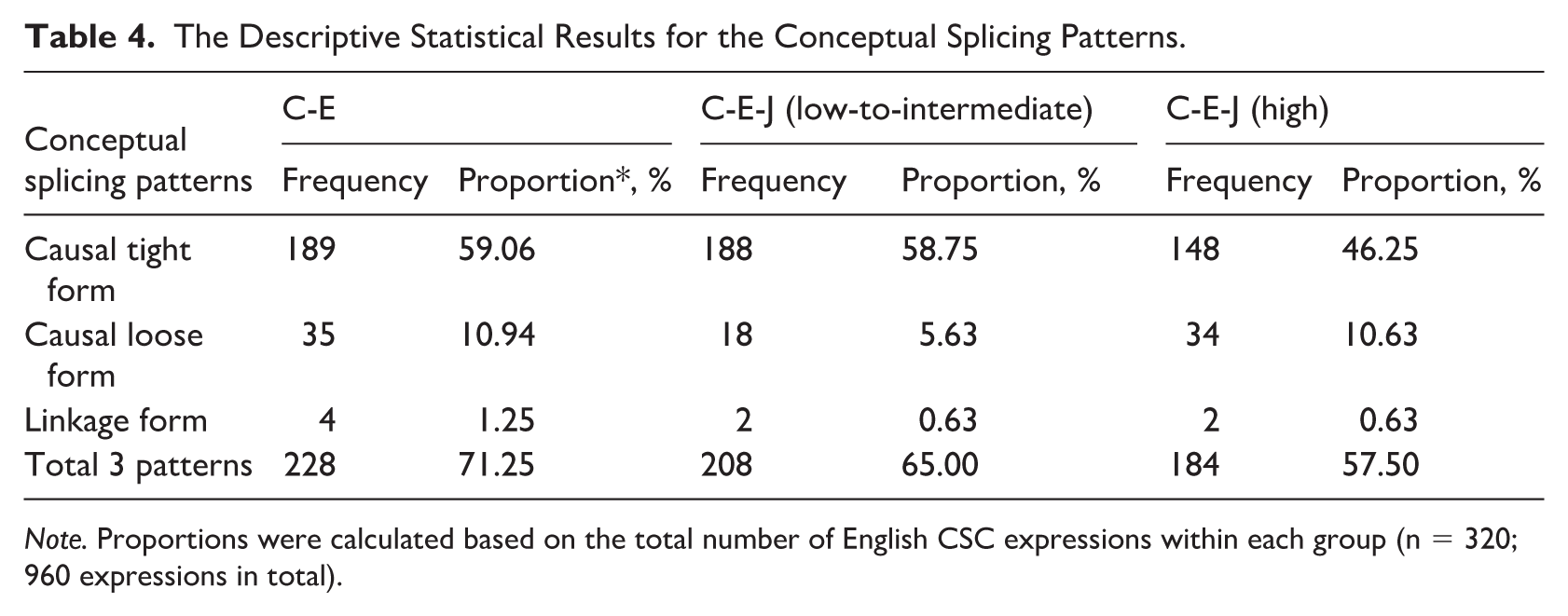
Note. Proportions were calculated based on the total number of English CSC expressions within each group (n = 320; 960 expressions in total).
Overall, both C-E bilinguals and C-E-J trilinguals preferred the causal tight form, followed by the causal loose form and the linkage form. However, as Japanese proficiency increased, C-E-J trilinguals showed a decreasing tendency to use the causal tight form. The differences among the three groups in the use of the causal tight form were statistically significant (p < .05).
Discussion
Effects of L3 (Japanese) Typological Framework Features
The Increase of V-Language Features and S-Structure Misuse Rate
All three groups exhibited more S-language features in English CSC expressions. However, as Japanese proficiency increased, S-language features decreased while V-language features slightly increased, though the difference was not statistically significant.
Notably, C-E-J trilinguals misused S-constructions at a significantly higher rate than C-E bilinguals. They frequently added redundant satellites to V-constructions or incorrect satellites to manner verbs. For example, in Video 2 (picking flowers), trilinguals often added a satellite after the V-construction, ‘pick’, which already encodes [manner] and [state change], resulting in semantic redundancy. Thirteen trilinguals misused ‘pick up’ , and one trilingual misused ‘pick out’. Similarly, in Video 6 (blowing out a candle), trilinguals struggled with fixed collocations in ‘manner verb + adjunct’ constructions, misusing alternatives such as blow up (8 learners), blow off (4 learners), blow down (2 learners), and blow over (1 learner).
The Decrease of Semantic Fineness
Regarding semantic fineness, manner verbs can be divided into superordinate manner verbs and subordinate manner verbs. For example, among the English manner verbs that mean ‘to die’, ‘kill’ belongs to the superordinate manner verbs, while ‘drown’ and ‘suffocate’ belong to the subordinate manner verbs. Compared to C-E bilinguals, C-E-J trilinguals relied more on superordinate manner verbs, thus decreasing semantic fineness. They also misused manner verbs more frequently. For example, in Video 5 (cracking an egg), ‘beat’ (2 learners), ‘dig’ (1 learner), and ‘hit’ (1 learner) were misused. The rest of the C-E-J trilinguals mostly used V-constructions such as ‘break’ and ‘open’, while few used more fine-grained manner verbs like ‘crack’.
Special Cases of Sentence Structure
A unique syntactic pattern was observed in C-E-J high-proficiency trilinguals. While most of the 960 expressions followed a chronological subevent sequence, three cases from C-E-J high-proficiency trilinguals exhibited a [[BECOME [x < STATE >]] BY [x ACT < MANNER > Y]] structure. These special cases are assumed to be influenced by the Japanese SOV order. Japanese is a head-final language. Since the predicate verb indicating a state change cannot appear in the position of the causative subevent, there are only cases where the action causes a state change. SC events include non-agentive changes and agentive changes, while resultative events are limited to the latter, which overlap with CSC to some extent. The structure patterns of Japanese resultative events are as follows:
(I)[[ x ACT < MANNER > y]CAUSE[BECOME[y < STATE > ]]]
This structure pattern indicates that the actions of V1 cause the resultant states of V2.
(II)[[BECOME [x < STATE >]]BY[x ACT < MANNER > y ]]
This is an important structure pattern of Japanese resultative events-‘result followed by cause’, which indicates that the resultative state appears due to the action at the end of the sentence. Take G3P3V9, ‘The shirt got clean by washing’, as an example, which can be seen as the result influenced by the structural pattern of ‘result followed by cause’ in Japanese resultative events.
Effects of the L3 (Japanese) Proficiency Level
This study compared English CSC expressions from C-E bilinguals and C-E-J trilinguals with varying Japanese proficiency levels across several dimensions, including lexicalization patterns, surface structure characteristics, and causal-chain windowing patterns.
First, even a low proficiency level of L3 (Japanese) has a transfer on C-E-J trilinguals to acquire English CSC events. However, there is a threshold that must be reached for L3 proficiency, and if L3 proficiency is too low, this cross-linguistic influence appears weak. At the initial stage of L3 (Japanese) learning, low-to-intermediate Japanese proficiency may mask its disruptive effect, making trilinguals more susceptible to the influence of Chinese. As Japanese proficiency increases, the dependence on Chinese in trilinguals’ English CSC expressions decreases, while the influence of Japanese increases.
Second, different dimensions of English CSC events are affected by L3 (Japanese) proficiency to different degrees. While surface structures such as typological features and alternative manner expressions are less impacted, cognitive patterns like semantic integrity and windowing of attention are more strongly influenced by Japanese proficiency. The differences in English CSC expressions between C-E-J trilinguals at different Japanese proficiency levels are not significant for surface structures. However, in causal-chain windowing patterns, higher Japanese proficiency leads to a significant decrease in the use of complete causal chains, with trilinguals, especially those with high Japanese proficiency, focusing more on resultative events in the causal chain.
Language Distance for L1 & L2 and L3 & L2
There are significant differences in the salience of [manner] elements between S-languages and V-languages. S-languages describe [manner] elements more frequently, using a richer vocabulary and at a finer granularity (Slobin et al., 2014). For the languages under investigation, Chinese exhibits strong S-language features in encoding CSC. English presents a parallel system of conflation, allowing both satellite- and verb-framed patterns; however, for some state-change notions, only the verb-framed construction is colloquially available (Talmy, 2000b), and existing research indicates a tendency toward verb-framed language in the domain of CSC events (Li, 2022). Japanese has been analyzed as a V-language in its expression of SC events (Wei & Guo, 2025). Therefore, the distance between L2 (English) and L3 (Japanese) is closer than that between L1 (Chinese) and L2 (English).
Although English tends to display more V-language features in CSC events, making it typologically closer to Japanese than to Chinese, the empirical results reveal a more complex pattern of cross-linguistic influence. Specifically, L3 Japanese, despite its typological proximity to L2 English, exerts less influence on English CSC expressions than L1 Chinese at the initial stages. At low-to-intermediate proficiency levels, C-E-J trilinguals rely more heavily on Chinese, reflecting the dominant role of the first language in early stages of multilingual development. As trilingual proficiency increases, the typological affinity between English and Japanese becomes more salient, enabling learners to better distinguish between the two languages and gradually shift from Chinese toward Japanese-influenced patterns in their English CSC expressions.
L3-Related Effects on L2 CSC Expressions
For C-E-J trilinguals, their L2 (English) shows performance modulation during L3 (Japanese) acquisition, suggesting that active L3 learning may temporarily modulate L2 retrieval and deployment. L3 interference in English CSC expressions can be observed not only in reduced lexical and grammatical accuracy, fine-grained manner verb use, AME variety, and syntactic flexibility, but also in reduced complete causal chain windowing and semantic integrity.
These differences are more plausibly attributed to cross-linguistic influence associated with L3 acquisition. Trilinguals tend to borrow lexicalization patterns from L1 (Chinese). During the experiment, many trilinguals were observed thinking aloud in Chinese, for example, “摘下。‘摘’是‘pick’, ‘下’是什么呢?” (‘Zhai’ means ‘pick.’ What about ‘Xia (down)’?). This suggests they construct L2 sentences through an L1 cognitive framework. Influenced by S-language features of Chinese, trilinguals frequently misuse S-constructions such as ‘pick off’, leading to ungrammatical or non-native expressions.
Statistical analyses of alternative manner expressions, windowing of attention, and semantic completeness further show that, compared to C-E bilinguals, C-E-J trilinguals exhibit reduced semantic fineness, accuracy, complexity, and completeness in English CSC expressions. This indicates that the L2 knowledge system already acquired by C-E-J trilinguals is subject to interference from L3 learning, as linguistic information from L3 competes for cognitive resources with L2. These findings align with Mickan et al. (2020, 2024); demonstrating that interference from subsequently acquired languages on previously acquired ones extends to CSC event acquisition.
Conclusion
This study examines CSC descriptions produced by C-E bilingual and C-E-J trilinguals, shedding light on the cross-linguistic influence of L3 typology on L2 CSC expressions, as modulated by Japanese proficiency. The findings suggest that acquiring L3 (Japanese) has an inverse effect on expressing CSC in L2 (English). Beyond theoretical insights, the study highlights that difficulties in L2 CSC learning may arise not only from L1 interference but also from reverse influences from L3. These results can help teachers and students better understand the impact of L3 typology and thinking-for-speaking on L2 acquisition, while also contributing to further assessments of linguistic distance in multilingual learning and encouraging the application of these insights.
Supplemental Material
sj-docx-1-ijb-10.1177_13670069261453020 – Supplemental material for The Acquisition of English Caused State Change Events by Chinese–English—Japanese Trilinguals: A Focus on Cross-Linguistic Influence
Supplemental material, sj-docx-1-ijb-10.1177_13670069261453020 for The Acquisition of English Caused State Change Events by Chinese–English—Japanese Trilinguals: A Focus on Cross-Linguistic Influence by Yinxia Wei, Lin Shi and Lianrui Yang in International Journal of Bilingualism
Footnotes

Funding
The authors disclosed receipt of the following financial support for the research, authorship, and/or publication of this article: This work was supported by the National Social Science Fund of China (22CYY037).
Declaration of Conflicting Interests
The authors declared no potential conflicts of interest with respect to the research, authorship, and/or publication of this article.
Supplemental Material
Supplemental material for this article is available online.
Author Biographies
References
Supplementary Material
Please find the following supplemental material available below.
For Open Access articles published under a Creative Commons License, all supplemental material carries the same license as the article it is associated with.
For non-Open Access articles published, all supplemental material carries a non-exclusive license, and permission requests for re-use of supplemental material or any part of supplemental material shall be sent directly to the copyright owner as specified in the copyright notice associated with the article.
