






Abstract
Aims and objectives:
This qualitative research investigates the evolution of Heritage Language Maintenance (HLM) investment in Chinese-American families, exploring how learner commitment evolves from early childhood into young adulthood, and how it is shaped by affordances and constraints across micro-, meso-, and macro-levels.
Methodology:
This study adopts a retrospective, life-course perspective to examine the HLM trajectories across critical developmental stages: early childhood, adolescence, and young adulthood.
Data and analysis:
Data were triangulated from semi-structured interviews with two Chinese-American parental couples and their three adult children (ages 18, 23, and 28), recorded family conversations, and cultural artifacts. It employs a directed content analysis approach, deductively coding the data against the constructs of Darvin and Norton’s Model of Investment within an ecological framework spanning micro- (family), meso- (institutional), and macro-levels (societal).
Findings and conclusions:
Results indicate that parental investment remains ideologically stable but practically unsustainable. Children’s investment follows nonlinear, context-activated paths. While micro-level family involvement creates an early foundation, learners’ trajectories diverge significantly during adolescence, and move to autonomous “ideal self” or permanent disengagement in young adulthood. Successful outcomes are often triggered by strategic repositioning of the HL as symbolic capital in young adulthood, whereas divestment results from systemic constraints at the meso- and macro-levels.
Originality:
This research provides a quasi-longitudinal perspective on HLM by prioritizing the retrospective reflections of adult learners alongside parental accounts. Its significance lies in tracing the nonlinear evolution of investment across two decades, offering a multi-level ecological analysis of how learner agency is negotiated within the shifting tensions of micro-, meso-, and macro-systems from childhood into autonomous adulthood.
Significance/implications:
The study advocates for a model of cross-level ecological synergy. Practically, it calls for integrating HL into formal secondary curricula and adopting project-based pedagogies to align learners’ “ideal selves” with institutional support.
Keywords
Introduction
“English,” I said, raising my voice. “Speak English.” “Speak English to him,” Dad said to Mom. “You knew this was going to happen someday. What did you expect?” Mom dropped her hands to her side. She sat, looking from Dad to me, and back to Dad again. She tried to speak, stopped, and tried again, and stopped again. “You have to,” Dad said. “I’ve been too easy on you. Jack needs to fit in.” Mom looked at him. Dad shook his head.
In Liu’s (2016) short story The Paper Menagerie, a mother struggles to explain the emotional weight of her heritage language (HL) to her American-born son: “If I say ‘love,’ I feel here (pointing to her lips). If I say ‘ai’, I feel here (putting her hand over her heart).” This unpleasant conversation captures the friction inherent in immigrant family language practices (FLP), where HL maintenance is not merely a linguistic choice but a “site of struggle” (Darvin & Norton, 2015) between emotional attachment, identity, and the socialization pressures of a dominant-English environment. HL maintenance is a multi-level phenomenon shaped by learners’ attitudes, motivation, and investment, which are mediated by affordances and constraints at the family level (micro), institutional level including both public and HL schools (meso), and the broader community and societal level (macro). As Spolsky (2004) notes, while internal family factors such as respect, authority, and relationships are foundational, they are perpetually contested by external forces such as peers, schools, and the environment (p. 29). The family is not “a self-contained institution” but a “porous” space allowing for influences from broader social forces (Canagarajah, 2008, pp. 170–171). This necessitates an ecological approach to exploring and understanding family language policy processes (Hornberger, 2002; Shen et al., 2021).
In the United States, Chinese immigrant households frequently encounter an ongoing struggle between preserving their ancestral culture and adjusting to the surrounding social and political environment in which they live (da Costa Cabral, 2018; Lee, 2002). Studies of Chinese immigrant families in the United States and Canada show that parents value Chinese primarily for family communication and future opportunities but face challenges including children’s declining motivation over time, limited resources, and pressure from English-dominant schooling (Chen et al., 2018; Huang & Liao, 2024; Li & Lin, 2025; Liang & Shin, 2021; Zhang et al., 2025).
Extensive research has examined parental attitudes and goals concerning maintenance of heritage languages (HL) (Nesteruk, 2010; Park & Sarkar, 2007), with scholarly attention only recently shifting to learner’s experiences. Earlier research primarily focused on parents as the main architects of language policy decisions or viewed young children as passive recipients of such policies. More recent empirical research has started to recognize children’s agentic roles (Fogle & King, 2013; Torres & Turner, 2017) and to capture the voices of both parents and children (Shen et al., 2021). However, these studies focus mainly on childhood and preteen years (Huang & Liao, 2024; Shen & Jiang, 2021; Zhang et al., 2025). Critically, the retrospective perspectives of young adults who have completed the journey from early childhood to autonomous adulthood are underexplored. The present study addresses these gaps by adopting a quasi-longitudinal (Gorter & Berardi-Wiltshire, 2026, p. 211) research design that offers the retrospective reflections of adult children alongside their parents’ perspectives over a 20-year span. By exploring these individuals’ life-course journeys in two Chinese immigrant families from different communities, the study moves beyond “static moments” of HL maintenance to explore how their investment endeavors to maintain the heritage language (HL) evolve across development stages for both parents and children.
Literature Review
The Model of Investment
To respond to today’s globally mobile, fluid and diverse world, Darvin and Norton (2015) proposed an organic model of investment that positions language learners’ investment at the intersection of ideology, identity, and capital (see Figure 1). Distinct from the psychological construct of “motivation,” investment treats learners as social actors focusing on how histories, lived experiences and social practices shape language learning (Darvin & Norton, 2023, p. 29). Investment is driven by the dynamic interplay of the following three core constructs.
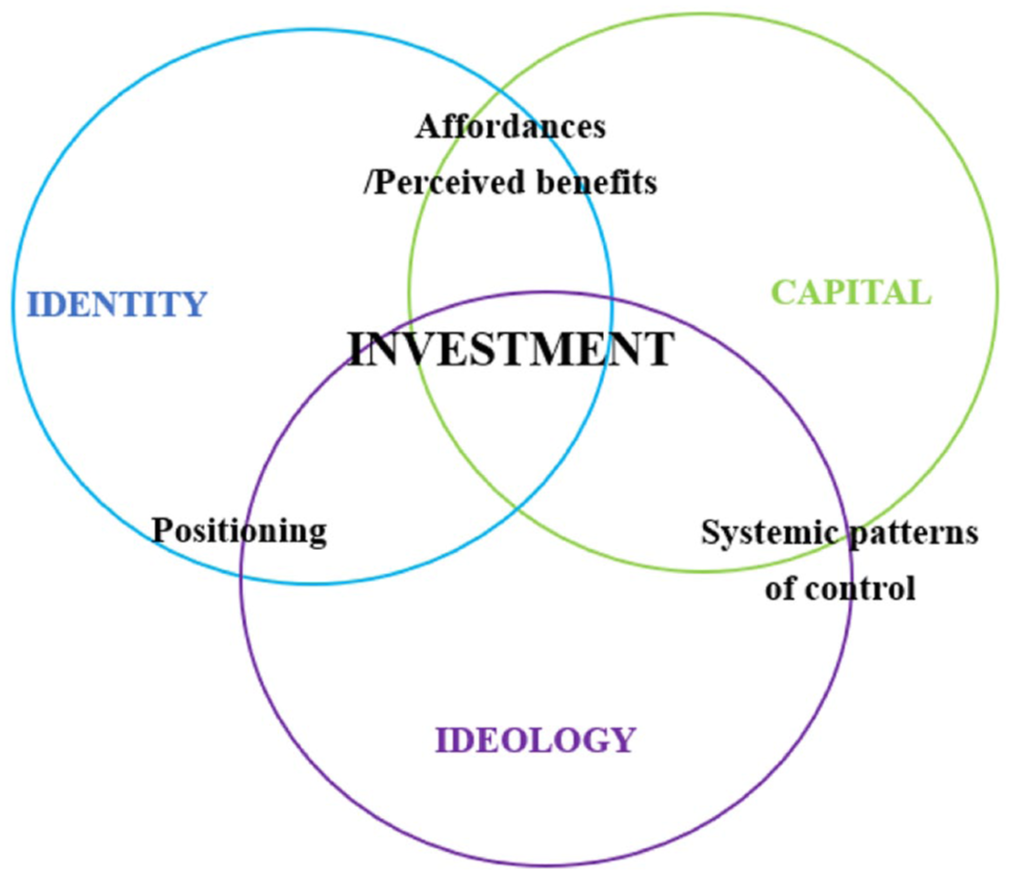
Darvin and Norton’s (2015) model of investment.
Ideology represents the dominant ways of thinking that can organize and stabilize groups and entities (Darvin & Norton, 2023, p. 36). It reflects subconscious beliefs and assumptions about the social utility of a particular language in a given society (Schiffman & Ricento, 2006) and is based on the perceived value, power, and utility of various languages (Curdt-Christiansen, 2009, pp. 354–355). Rather than a static and monolithic worldview, ideology is “a complex, layered space where ideational, behavioral, and institutional aspects interact and sometimes contradict one another” to determine modes of inclusion or exclusion (Darvin & Norton, 2015, p. 43)
Capital, drawing on Bourdieu (1986), encompasses economic, cultural, and social resources a learner possesses and serves as a “tool of both social reproduction and transformation” (Darvin & Norton, 2015, p. 44). As the rules of the game may evolve and vary in different fields, the value of a learner’s capital is fluid, shifting as it travels across time and space (Darvin & Norton, 2015, p. 44). Learners invest in a second language with the understanding that they will acquire a wider range of symbolic and material resources, which in turn increases the value of their cultural capital (Norton Peirce, 1995, p. 17).
Identity, drawing particularly on Weedon’s (1987) conception of subjectivity, is defined within this model as “a person understands his or her relationship to the world, how that relationship is constructed across time and space, and how the person understands possibilities for the future (Norton Peirce, 1995; Norton, 2013). Recognizing how power flows in different directions through congruous social spaces, learners operating in different fields perform multiple identities (Darvin & Norton, 2015), and can involve both investment in and divestment from particular practices (Darvin & Norton, 2023).
In this model, these constructs of investment do not exist in isolation, instead operating in dynamic interactions to contribute to the investment process (Cui & Zheng, 2021, p. 4). Investment occurs when learners recognize that their capital can serve as affordances to their learning within a specific ideological field (Darvin & Norton, 2015, p. 46). Conversely, if dominant ideologies do not accord symbolic value to a learner’s capital or if systemic patterns of control block access to the capital a learner desires, the result is often reduced investment in or purposeful divestment from the learning process (Darvin & Norton, 2015). As Kramsch (2013) notes, investment is synonymous with “language learning commitment” and is based on a learner’s intentional choice and desire (p. 195). The model enables researchers to examine not only “what” learners invest in, but also “how,” “why,” and “to what extent” certain conditions shape their investment (Darvin & Norton, 2023, p. 33). This widened lens helps shed light on why L2 learners may be highly motivated yet have limited investment in specific language practices.
The Model of Investment and HL Maintenance
While originally developed for L2 contexts, the model of investment offers powerful insights for understanding the complexities of heritage language maintenance. Unlike L2 learners who normally begin language learning in institutional settings, heritage language learners start in early childhood within the family and may navigate identities and capital that are recognized or denied as they move across home, school, and community spaces. This model can well capture “the complex, contradictory, and in a state of flux” nature of heritage learners’ relationships with their ancestral language, because a learner’ linguistic capital is continually measured against shifting “orders of indexicality” (Darvin & Norton, 2015).
Empirical research applying the investment model has illuminated the tensions between internal family valuations of heritage languages and external societal pressures. Studies show that even highly motivated learners may experience divestment if their HL is marginalized in broader social contexts. For instance, Wu et al. (2014) found that middle school students’ investment in Mandarin learning was significantly undermined when their actual heritage languages (e.g., Cantonese, Fujianese) were devalued in favor of institutionalized Mandarin, revealing how language ideologies and power relations shape investment. Furthermore, scholars have utilized the model to examine how ideology, identity, and capital shape family language planning during transnational migration (Cui & Zheng, 2021; da Costa Cabral, 2018; Kwok, 2024), and impact long-term retention in higher education (Bai & Mu, 2025).
Early Childhood: Family Language Policy and Parental Investment
Research consistently shows Chinese immigrant parents’ strong ideological commitment to HL maintenance, viewing Chinese as essential for ethnic identity, family communication, and future economic opportunities (Wang & Hamid, 2022; Zhang & Slaughter-Defoe, 2009). Parents employ diverse strategies including establishing home language rules, enrolling children in heritage language schools, and creating Chinese literacy environments (Curdt-Christiansen, 2009; Liang & Shin, 2021). However, these efforts involve emotional complexities—irritation, guilt, anguish, and shame—alongside pride and accomplishment (Wang, 2023a, 2023b). Children’s investment during this stage varies considerably, with many experiencing HL learning as forced obligation competing with mainstream schooling (Mu & Dooley, 2015; Tang & Zheng, 2023).
Adolescence: Identity Negotiation and Shifting Ideology
Adolescence represents a critical period as teenagers actively construct ethnic identities and negotiate relationships with heritage and mainstream cultures. HL learning facilitates positive ethnic identification, though outcomes vary from strong identification to passive engagement (Lei, 2013). Heritage language schools serve as important meso-level contexts recognizing learner identities (Jia, 2006; Li & Shen, 2024), yet tensions persist between HL education and mainstream schooling demands (Tang & Zheng, 2023). Intriguingly, several studies document potential transitions from resistance to commitment during adolescence, with some learners developing internal motivation after initially resisting formal instruction (Mu & Dooley, 2015).
Young Adulthood: An under Investigated Transition
Limited research examines HL maintenance in young adulthood. Studies of college-level heritage language learners provide glimpses into young adult engagement (Bai & Mu, 2025; Li, 2022), but focus on self-selected populations continuing formal study. Research examining how investment evolves from childhood through autonomous adulthood or soliciting young adults’ retrospective reflections on their entire HL journey remains relatively scarce.
Research Gap
Despite the contributions in existing scholarships, three critical gaps limit our understanding of heritage language investment trajectories. First, existing studies have majorly captured cross-sectional findings at particular life stages but have seldom tracked learners from childhood through young adulthood to understand how investment transforms, persists, or is resisted over time. Second, research has primarily relied on parental perspectives or obtained learners’ views during their formative years when learners are still situated in family contexts. What remains underexplored are the retrospective perspectives of young adults who have completed the journey from early childhood language socialization to autonomous adulthood. By comparing their current understandings with their childhood experiences and their parents’ expectations, they can offer mature reflections on how their investment evolved. Moreover, while heritage language maintenance is not a static achievement but rather a fluid and evolving process, existing research has rarely examined how learner investment interacts with affordances and constraints across multiple levels—the family (micro), educational institutions (meso), and wider societal structures (macro)—throughout the learner’s developmental trajectory from childhood to young adulthood.
The Present Study
Building on the existing scholarship and the model of investment (Darvin & Norton, 2015), this study adopts a retrospective perspective to explore how investment in the HL maintenance evolves dynamically for both parents and children from early childhood through young adulthood, and how it is shaped by affordances and constraints across micro-, meso-, and macro-levels. Two research questions are addressed:
To maximize the understanding of how young adults reflect upon their heritage language learning journey, this study adopted a qualitative research approach and employed a comparative case study design to gather views from two focal families (including all core family members, namely both parents and their adult children). Using comparable cases enabled us to explore how different family/individual-level investments and practices contribute to divergent HL development paths within the household.
Methodology
Participating Families
The two families’ lengths of residence in the United States were 23 years and 31 years, respectively. In both cases, the parents were born and educated in China and migrated to the United States in the 1990s to advance their education and careers. Detailed demographic profiles of all participants are presented in Table 1. Children (Yue and Yi from Jie & Bin’s family—Unit 1, Ran from Lan & Zha’s family—Unit 2) were all born in the United States. The parents in both families were long-standing personal contacts of the first author, who met with the families approximately once a year, typically during their visits to China to see family members or engagement in academic exchanges. In addition, the researcher had substantial informal contact with both families in everyday settings before their migration to the United States. To address potential ethical concerns associated with close researcher–participant relationships, the study observed established qualitative research protocols. Prior to data collection, the two participating families were informed of the study’s objectives and procedures. Participation was voluntary, and written informed consent was obtained from each participant.
The Participants’ Demographic Profiles.
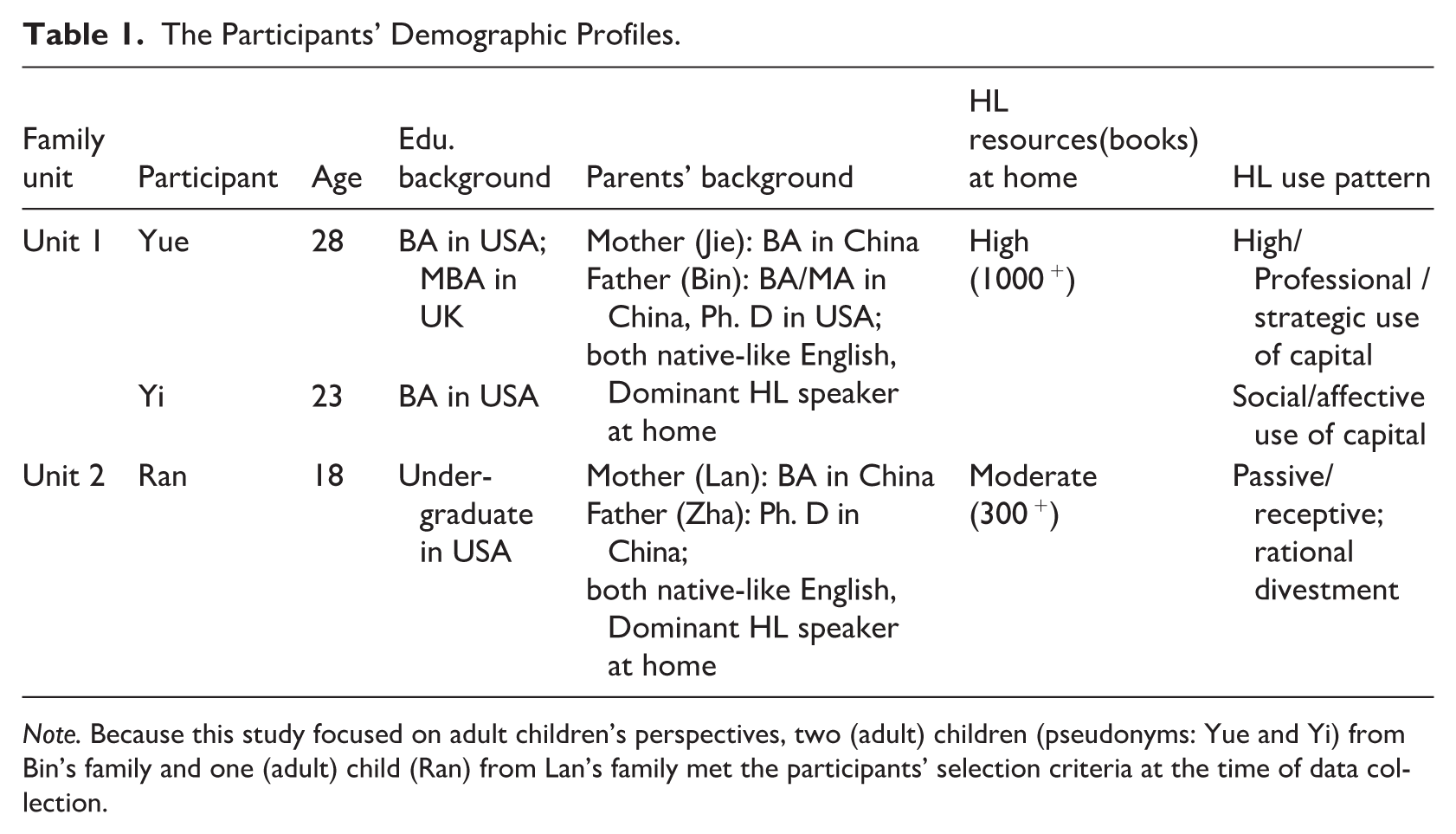
Note. Because this study focused on adult children’s perspectives, two (adult) children (pseudonyms: Yue and Yi) from Bin’s family and one (adult) child (Ran) from Lan’s family met the participants’ selection criteria at the time of data collection.
Data Collection
Data were collected through in-depth semi-structured interviews, cultural artifacts, and multimodal resources (videos). Multiple data sources were triangulated to explore the complexity of family language practices across two distinct linguistic environments (California and New Hampshire). In addition to semi-structured interviews, the families shared pictures of Chinese-language books at home, which served as indicators of their home literacy environments. They also shared two video recordings (3–5 minutes each) produced to celebrate the 90th birthday of the children’s grandpa in China. In these videos, family members used Mandarin to send greetings and blessings, reminisce about the past, and discuss plans for a future family reunion, thus offering naturally occurring evidence of HL use in transnational family interactions.
Semi-structured interview protocols were developed for parents and children, respectively (see Appendix), informed by prior literature on family language policy and HLM. Semi-structured interviews were conducted via WeChat video calls over a 2-month period. To capture a holistic family perspective, joint interviews were conducted with each parental couple, allowing for collaborative elaboration on shared family histories. Conversely, children were interviewed individually to capture their individual agency and retrospective reflections without parental influence. Although the interviews followed the protocols, the researcher pursued any emerging topics to allow for further clarification. Interviews with parents were conducted in Mandarin or their shared dialect, whereas interviews with children were conducted predominantly in English, with occasional use of Mandarin, reflecting the participants’ linguistic repertoires and preferences.
The interview with each participant ranged from 20 to 75 minutes, was audio-recorded, and the relevant parts were later transcribed by the first author. Notes were taken to complement the audio content. Transcripts were sent back to participants for cross-checking to ensure the faithfulness and accuracy of the data.
Data Analysis
Data were analyzed using qualitative directed content analysis (Hsieh & Shannon, 2005). The goal of a directed approach to content analysis is to validate or extend conceptually a theoretical framework or theory (Hsieh & Shannon, 2005, p. 1281). Because our study is grounded in model of investment (Darvin & Norton, 2015), this method allowed us to use their core constructs (identity, capital, and ideology) not just as emergent themes but as predetermined “variables of interest” that guided our initial coding scheme (Hsieh & Shannon, 2005, p. 1281). This ensured our analysis focused on testing the specific mechanisms of the model of investment, and we were able to examine how these constructs operate across micro-, meso-, and macro-ecological levels.
All data, comprising interview audio recordings with relevant transcripts, video recordings, and artifacts, were processed using MAXQDA 2020, a professional software package for qualitative data analysis. Two researchers independently reviewed the audio recordings and transcripts to achieve immersion in the data. In accordance with the directed content analysis approach (Hsieh & Shannon, 2005), an initial deductive coding scheme was developed based on the model of investment (Darvin & Norton, 2015). This predetermined scheme focused on segments related to different forms of capital, shifting ideologies and identity and learner agency. To ensure inter-rater reliability, the researchers compared their initial coding, discussing any discrepancies until a consensus was reached. During this process, any text that could not be categorized with the initial coding scheme was given a new code (Hsieh & Shannon, 2005, p. 1281). This step allowed the ecological dimensions (micro-, meso-, and macro-levels) to emerge inductively from the data, thus effectively extending the model. Finally, these codes were clustered into broader categories: shifting ideologies and identities over time and space, the varying forms of capital within their linguistic repertoires, parental expectations, investment patterns and heritage language maintenance outcomes. These categories were then synthesized to address the long-term trajectories of heritage language (HL) maintenance.
Findings
Findings are presented across three developmental stages—early childhood (ages 0–10), adolescence (ages 11–17), and young adulthood (ages 18–28)—to reveal how factors at the micro- (family), meso- (institutional), and macro-levels (societal) shaped parents’ and children’s investment in Chinese HL maintenance.
Early Childhood Investment
Micro-Level Factors: Parental Agency and the “Labor of Persistence.”
Heritage language maintenance during early childhood was characterized by what we term the “labor of persistence,” namely parents’ sustained effort to establish Chinese as the home language and create supportive literacy environments. Both families demonstrated high parental investment driven by ideologies viewing Chinese as essential for family communication, cultural heritage and future economic capital.
Lan’s family faced a structural void without any access to HL schools in their small northeastern town. In response, parents exercised a high degree of collective agency by initiating a co-teaching program with five to six families, meeting weekly for 1–2 years:
1 I recall something when you just mentioned, creating opportunities. When we were in the East, we initiated a co-teaching program to teach our kids Chinese for some time. About five or six families joined to get together once a week. It lasted one or two years. Everyone (parents) took turns to teach. The children were different in ages. We put them together anyway.
This collective effort was a direct response to a structural void. Parents also invested in material capital, purchasing Chinese textbooks (Grades 1–12), picture books, and bilingual resources from the Chinese Consulate (see Appendix 2). Lan taught her children at home for approximately three grades, though she acknowledged that “persistence is no easy job.” Her decision to stop at Grade 5 suggests a point of forced divestment where the increasing difficulty and lack of external recognition made the labor unsustainable. Parents positioned Chinese as a multifaceted asset. As Lan explained:
(Note: In all extracts, Wu refers to the researcher/interviewer.)
Do you want your children to learn Chinese?
That’s for sure! (laugh)
Why?
Think about it: there is one more language. Two languages are definitely better than one. First, we still have to go back to China often. They need to communicate with their grandparents in Chinese. Second, we also hope they can use Chinese to communicate with us. Third, China is such a big economy, and its development is so amazing. So it’s not just because of practical reasons, but it must be a good thing that you have one more language. Learning other languages, such as French and German, is not that useful, given that it (France, Germany) is so small a country in size. Because China is a country with such a large population, with 1/3 of the world’s population speaking Chinese, if you learn Chinese and are able to speak it, then you have a competitive edge.
This pragmatic perspective in addition to affective family connections drove sustained parental investment despite emotional challenges including frustration and exhaustion.
Bin’s family in California had greater access to formal HL schools. However, parents still supplemented institutional learning with home teaching, including Tang poetry recitation and character practice. Bin’s investment shared similar ideologies like regarding Chinese as family heritage, communication tool, and economic capital.
Meso-Level Factors: HL School Access and Pedagogical Conflict
The two families’ access to institutional support diverged significantly during early childhood. Lan’s family had no access to formal HL schools at that time. The local public schools offered French (not Chinese) as a foreign language, and the small-town context offered no Chinese-language programs. The parent-organized co-teaching program represented an endeavor to create meso-level support, but lacked professional pedagogical training. As Lan later reflected:
Children think this is boring. Because the way the children in the US are taught is completely different from ours (in China). Many of the lessons are taught through doing activities here. And when our parents taught them Chinese, note that we were not trained to teach them, it was very boring, just reading them the textbook. The Chinese language itself is very difficult to teach, coupled with the fact that we lacked any teaching experience. So it turned out that it was our parents that just pinned them there to learn for an hour or two.
This pedagogical conflict between the traditional textbook-centric teaching and the activity-based, student-centered pedagogy that children experienced in U.S. mainstream schools led to early divestment from HL learning.
Bin’s family enrolled their children in Saturday Chinese schools from early childhood. Yue and Yi attended for 4–5 years (aged 5–10), with sessions lasting from 9 am to 2–3 pm weekly. However, children considered this a burden rather than enrichment:
When I was young, I think I didn’t enjoy learning Chinese that much. It was just expected then I did it. I took a lot of different classes when I was a child, Chinese was one of them. Right, when we were kids, my dad taught us some too . . .
Tang poetry? Ancient poems?
yeah.
Still remember some?
I don’t remember (laugh). I didn’t like it that much as a kid, (just) because of parental expectations.
There were no Chinese courses at school then, right?
We learned it at weekends, on Saturdays. I had been learning it for about 4 to 5 years. When I was little, I had one more day of classes and extra homework, that is . . . I think it was very difficult. (Unlike your children), there’s not much competition at school (here), but if children study so hard, it is not a particularly normal situation in the US.
Yes. I heard from Yi that there was a lot of reading, writing, testing in the Chinese school. That is a bit like the Chinese way of teaching. We were taught to read, write and do grammar tests when we learned English. You said there was a day’s class. How long?
About the same time as my normal school session, 9 am until 2 or 3pm, something like that.
Once a week?
Right.
The traditional pedagogy, characterized by reading, writing, and grammar tests created a meso-level constraint. While parents viewed Tang poetry and character writing as cultural capital, children perceived it as a “not normal” burden competing with their socialization in the U.S. context. Thus, access to HL schools did not necessarily guarantee engagement in HL learning, and pedagogical misalignment undermined children’s investment despite high parental investment.
Macro-Level Factors: English Dominance and Market Value
During early childhood, macro-level factors shaped both families’ investment trajectories. The dominant English-only ideology of the U.S. context positioned Chinese as a “foreign” language with limited immediate utility in children’s daily lives.
For Lan’s family in a small northeastern town, the absence of a Chinese-speaking community meant Chinese had no exchange value outside the home. The local “field” did not accord symbolic value to Chinese; parents had to build their own “field” where linguistic capital could be exchanged. The broader societal English-dominant context made the return on investment invisible in the short term.
For Bin’s family in California’s high-density Chinese community, the macro-context was slightly more supportive, with greater visibility of Chinese language and culture. However, children still experienced pressure to assimilate. The broader U.S. societal ideology positioned multilingualism as “not normal” rather than as an asset, creating tension between parental expectations and children’s desire for homogeneity with English-speaking peers.
Both families’ parental investment during this stage was driven by anticipation of future market value—China’s economic growth and the potential competitive edge of bilingualism—rather than immediate societal recognition. This mismatch between parental long-term vision and children’s immediate social context created early resistance.
Investment Patterns in Early Childhood
Parents’ investment during early childhood remained consistently high across both families, driven by ideologies positioning Chinese as family heritage, communication tool, and economic capital. Parents mobilized diverse resources, namely home teaching, textbook purchases, co-teaching programs, and HL school enrollment in our case, demonstrating sustained “labor of persistence” despite emotional and physical costs.
Children’s investment during this stage was characterized by passive compliance rather than agentic engagement. As Yue reflected, “It was just expected then I did it. . . (just) because of parental expectations.” Children experienced HL learning as an extra burden competing with mainstream schooling and peer socialization. The “ought-to self” (meeting parental expectations) dominated this stage, with little alignment between HL learning and children’s “ideal self” or immediate social needs (Dörnyei, 2019).
The interaction of micro- (family pressure), meso- (pedagogical mismatch), and macro-factors (English-speaking dominance) created early divestment despite high parental investment. Lan’s family faced a structural void without access to institutional support, while Bin’s family faced pedagogical conflict between rote learning and engaging pedagogy. In both cases, the absence of synergy across ecological levels restrained children’s investment during early childhood.
Adolescent Investment
Micro-Level Factors: Negotiation and Resistance
During adolescence, micro (family)-level dynamics shifted from parental control to parent-child negotiation. Parents in both families continued to value Chinese and encouraged HL school attendance, home practice, and summer visits to China. However, adolescents gained increasing agency to resist or renegotiate family language policies.
Ran (Lan’s elder son) reflected on this period: “I never worked that hard when I was learning Chinese as a child, as I didn’t understand its importance at the time.” The family’s co-teaching program had ended, and without institutional support, the burden fell entirely on sporadic home teaching. As Ran noted, “My parents have tried to teach me Chinese at home occasionally, though the effort dies as we are both too busy.” This “dying effort” signifies forced divestment during adolescence, where competing academic and social demands undervalued the HL learning.
Yue and Yi (Bin’s children) discontinued Saturday HL school around ages 10–12, though they continued annual summer visits to China. During adolescence, their investment remained low, characterized by passive resistance. As Yi later reflected, the forced literacy training during childhood made his reading and writing skills “awful” despite oral proficiency maintained through family communication.
Family-level investment during adolescence was undermined by adolescents’ growing awareness of the mismatch between parental expectations and their immediate social realities in English-dominant peer networks and schools.
Meso-Level Factors: Discontinuation and Emerging Opportunities
Institutional engagement with Chinese during adolescence diverged across families and individuals. Ran had no access to Chinese courses in his public high school (which offered French instead) and discontinued all formal HL learning after the parent-led co-teaching program ended in late childhood. The absence of meso-level support during critical adolescent years contributed to his declining investment and proficiency. Yi discontinued Saturday HL school but received no formal Chinese instruction during middle and high school. His investment during this period was minimal, sustained only by family communication and annual China visits. Yue, however, experienced a critical turning point when her public high school offered Chinese-language courses with project-based pedagogy:
I took Chinese in high school. . . In high school they made us build lots of fun projects, like films, movies, and learn to make them using Chinese. That was funny, that’s fun activities. . . we wrote play scripts by ourselves, recorded it, and edited it, like the low-grade amateur.
This meso-level support in the form of creative, student-centered projects contrasted sharply with the rote learning of childhood HL schools. It provided a “practical sense (sens practique)” (Bourdieu, 1986) of the language’s utility. By engaging in scriptwriting and filmmaking, Yue became an active producer of cultural artifacts instead of a passive recipient of family language policy. It was this pedagogical shift that nurtured her growing investment during late adolescence.
Macro-Level Factors: Socialization Pressure and Emerging Diversity Awareness
During adolescence, macro-level factors continued to exert pressure toward English monolingualism, but adolescents also began developing awareness of linguistic diversity and Chinese’s potential value. Yue reflected on the socialization pressure of her childhood and early adolescence:
I think in the US it’s like, at least when Yi and I were little, it’s not really, like, cool to be different, it’s not cool, kind of, to be Chinese, to be Asian or something like this. Everyone wants to be the same thing. And as you got older, you realize it’s actually unique, that makes me unique, that makes me kind of proud. You got a kind of shift. It’s more like a mental shift.
This macro-level ideology positioned Chinese proficiency as a “marker of foreignness” (Wang & Hamid, 2025) rather than an asset, because the pressure to assimilate created a desire for homogeneity. However, by late high school, Yue began to perceive a shift: “Probably in university, or the end of high school, you start to be appreciative. . . As you got older, you realize it’s actually unique, that makes me unique, that makes me kind of proud.” Yi and Ran experienced similar assimilation pressures during adolescence but lacked the institutional or peer support that might have regarded Chinese as valuable capital. For them, the social context was characterized by English-speaking dominance with little immediate recognition of Chinese’s utility.
Investment Shifts in Adolescence
Parents’ investment remained high but became increasingly difficult to sustain as adolescents gained autonomy and resisted HL learning. Parents’ “labor of persistence” faced growing challenges from adolescents’ competing priorities such as mainstream schooling, peer socialization, extracurricular activities, and limited institutional support. Meanwhile, adolescents’ investment during this stage experienced resistance, negotiation, or, in Yue’s case, growing appreciation. Most adolescents experienced a “dying effort” (in Ran’s words) where HL learning was overshadowed by more immediate priorities. However, Yue’s access to engaging, project-based Chinese courses in high school reflected a critical turning point where investment began to shift from passive compliance toward personal interest.
The interplay of parent-child negotiation in family context (micro), discontinuation versus engaging pedagogy (meso), and socialization pressure versus emerging diversity awareness (macro) caused divergent trajectories. Ran experienced forced divestment due to structural voids at all levels. Yi maintained minimal investment through family communication alone. Yue began transitioning toward increased investment due to supportive meso-level pedagogy and late-adolescent identity shifts recognizing Chinese as “unique” rather than burdensome. Adolescence emerged as a pivotal period where investment could either collapse (Ran), stagnate (Yi), or begin to revitalize (Yue), depending on the presence or absence of synergy across ecological levels.
Young Adult Investment
Micro-Level Factors: Retrospective Reflections and Intergenerational Communication
By young adulthood, participants had gained autonomy over their language choices and could reflect retrospectively on their childhood HL experiences. Family-level factors shifted from parental control to adult children’s independent decisions about maintaining Chinese for family communication. Yi (age 23) maintained oral Chinese proficiency primarily for affective reasons—connecting with grandparents and extended family in China:
It was like self, ME choosing to learn for my own reasons. That was a much bigger help than anything, any class that my parents force me to take.. . . I just want to communicate with people I love. I don’t need to write. I just need to talk.
Yi’s emphasis on “ME choosing” represents a shift from childhood’s “ought-to self” (i.e., parental expectations) to young adulthood’s “ideal self” (i.e., personal identity goals). Yi’s annual visits to China several years ago afforded him ample opportunities for exposure to the Chinese language. His investment in oral communication while neglecting written literacy was well-aligned with his emotional attachment to family connection. Yue similarly valued Chinese for family communication but also began leveraging it for career advancement. Her retrospective view acknowledged her parents’ role: “you start to have more appreciation that you have some knowledge and understanding of this language.” Ran, however, expressed regret about his limited proficiency:
I sometimes feel worried that the culture as well as connection to the rest of my family in China will end with my generation, as neither my brother nor I read or write Chinese to a proficient level.
His remorse that “it’s a shame I didn’t learn it better as a child” reflects his recognition of lost opportunity, yet he lacked any institutional support to reinvest as a young adult.
Meso-Level Factors: University, Workplace, and Transnational Contexts
Institutional contexts during young adulthood provided new opportunities for some learners to reinvest in Chinese learning. Yue continued formal Chinese study in college and later moved to London for graduate school and work. Her university and workplace contexts, characterized by linguistic diversity and global mobility, positioned Chinese as valuable capital. She described how her multilingualism was admired by peers and recognized as professionally advantageous:
I live in London now. At school, everyone is diverse, from everywhere. . . everyone thinks it’s very cool that you can speak another language. . . They begin to admire me . . .It’s a different mindset or attitude. Many second-generation Asian Americans cannot speak their mother tongue. Then I realize it’s something I should be proud of myself for.. . . They also think it’s good for your career, because China is so big an economy.
Yi completed an internship in Shanghai, which represented a critical meso-level context where his Chinese oral proficiency gained immediate utility. He described this experience as creating “spikes” in his HL learning:
Every time I come to visit China I would speak Chinese a lot, then there’s progress. But when I go back to the U.S. I will forget a lot and my Chinese will go backwards. . . It’s like a spike. Every time I go back to China, my Chinese language improves a lot.
The Chinese context makes learning occur naturally because the language becomes a tool for communicating and building relationships. The “spike” metaphor Yi used shows that learner agency is most powerful when the social context provides immediate and tangible returns. In the United States, the lack of recognition by the society, coupled with the traditional rote learning pedagogy, may lead to linguistic regress and learner’s demotivation. However, the transnational field reactivates the learners’ agency in heritage language learning. Ran, however, pitifully lacked institutional affordances or professional incentive to reinvest, contributing to continued divestment.
Macro-Level Factors: Transnational Mobility and Professional Capital
By young adulthood, macro-level factors had shifted significantly for participants. China’s economic growth and increasing global presence repositioned Chinese as valuable transnational capital. Yue experienced this shift most dramatically in London’s diverse, multilingual context:
Sometimes I wonder in my career. . . maybe at Google. There are some things I’m in a better position for, because I can speak that language to some extent, or at least I can understand the culture. . . I think there’s a little career impact. There were some Chinese companies, like Tencent, staff recruiting.
This sens practique responds to the complexities of global era. Yue successfully converted her linguistic repertoire into economic capital, envisioning career opportunities at global corporations. She underwent “mental shift” from childhood’s “it’s not cool to be different” to young adulthood’s “it makes me unique, that makes me kind of proud.” The shifting ideologies, by valuing multilingualism and China’s economic significance, enabled her to reclaim her “right to speak” and transform Chinese learning from burden to symbolic capital. Yi’s transnational experiences in China similarly repositioned his Chinese proficiency as high-value capital in that specific field, though his U.S.-based career did not provide equivalent recognition. Ran, remaining in a U.S. context without transnational mobility opportunities, experienced no such revaluation like Yi and Yue. The macro-level ideology in his immediate environment continued to position English as dominant, with limited recognition of Chinese’s value.
Investment Outcomes in Young Adulthood
Parents’ investment by this stage had largely stopped, though parents continued to value Chinese and express hope that their adult children would maintain proficiency. Parents reflected on their “labor of persistence” with mixed emotions—pride in their efforts but also regret about limited outcomes, especially Lan (Ran’s mother) regarding Ran’s proficiency. Lan went to extraordinary lengths to maintain the HL but expressed deep regret over the lack of institutional resources:
Chinese schools must be helpful, with qualified teachers. They teach more systematically. Children are grouped into different grades, and will have some friends. Friends will have some mutual support. It should be better than learning by children themselves.
Young adults’ investment diverged dramatically based on their developmental trajectories and access to contexts where Chinese held exchange value. Yue successfully converted childhood HL learning into professional and social capital through transnational mobility, diverse institutional contexts, and alignment of “ideal self” with multilingual professional identity. Yi maintained oral proficiency for affective family connections and experienced “spikes” during transnational contexts, but limited written literacy and U.S.-based career reduced sustained investment. Ran uttered regret about limited proficiency but lacked institutional support or transnational opportunities to reinvest, and Chinese remained a “dying interest” in English-dominant contexts.
All participants recognized the value of their parents’ efforts in hindsight, but their current investment levels reflected whether they had access to transnational, professional, diverse peer network contexts where Chinese was deemed as symbolic and economic capital. As Yue reflected, the shift from childhood resistance to young adult appreciation required both personal maturation and environmental contexts that accorded Chinese as valuable. Long-term investment in young adulthood was sustained only when learners’ “ideal self” aligned with contexts where Chinese provided tangible returns—family connection (Yi), professional mobility (Yue), or cultural identity (Yue). Without such alignment (Ran), childhood HL learning did not translate into sustained young adult investment.
Investment Trajectories and Heritage Language Maintenance Outcomes
Investment trajectories across the three developmental stages reveal patterns of continuity, change, and critical transitions. Parental investment remained consistently high from early childhood through adolescence, fueled by stable ideologies viewing Chinese as family heritage, communication tool, and symbolic capital. However, the “labor of persistence” became increasingly difficult to sustain as children gained autonomy and structural support remained limited. By young adulthood, parents had largely transitioned from active teaching to hoping their adult children would independently value and maintain Chinese. By contrast, children’s investment followed nonlinear trajectories across different stages.
As illustrated in Figure 2, the investment trajectories of Yue, Yi, and Ran demonstrate a similar foundation with parents’ strong “impact belief” (De Houwer, 2009) in early childhood but undergo critical divergence during adolescence.
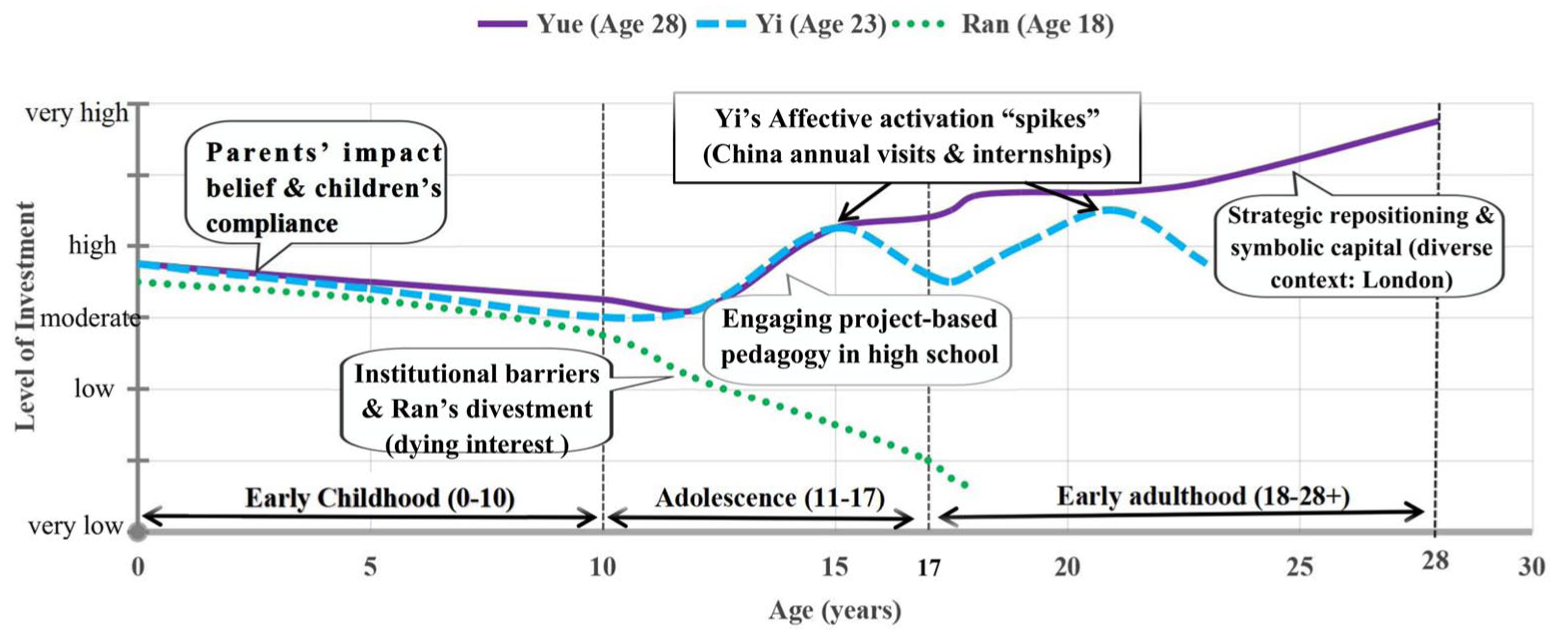
Investment trajectories in Chinese HLM from early childhood to young adulthood.
Critical transition period occurred where investment either collapsed (in the case of Ran), stagnated (in the case of Yi), or began revitalizing (in the case of Yue). During young adulthood, divergent outcomes emerged depending on whether “ideal self” aligned with contexts providing tangible returns. Yue achieved high investment through transnational mobility and professional capital conversion, whereas Yi maintained moderate investment for family connection. Regrettably, Ran experienced continued divestment and regret. The trajectories confirm that investment is “complex, contradictory, and in a state of flux” (Darvin & Norton, 2015), shaped by spatiotemporal contexts rather than linear development. For Yue, the late engaging high school project-based pedagogy and her diversity awareness in the university enabled her to shift from resistance to appreciation concerning HL learning. For Yi, his annual China visits and internship created “spikes” of reinvestment in transnational contexts. For Ran, lack of access to institutional support or any immediate tangible returns on Chinese learning in his field caused his discontinuation of HL learning in late childhood, and his “dying effort” never got revitalized.
Discussion
This study examined investment trajectories in Chinese heritage language (HL) maintenance across developmental stages through retrospective accounts from two Chinese-American families. By integrating Darvin and Norton’s (2015) investment model with an ecological perspective (Canagarajah, 2008; Hornberger, 2002; Shen et al., 2021), we traced how identity, ideology, and capital together shaped parents’ and children’s engagement with Chinese from early childhood through young adulthood.
Investment Trajectories: Divergence Between Parents and Children
To address RQ1, our findings have revealed different investment trajectories for parents versus children.
Parental Investment: Stable Ideology but Declining Capacity
Parental investment remained ideologically stable but practically unsustainable across developmental stages. Both families demonstrated what we term the “labor of persistence” to maintain Chinese despite emotional exhaustion, pedagogical limitations, and structural barriers. This finding extends the previous research on Chinese immigrant parents’ strong ideological commitment (Wang, 2020) by revealing a critical temporal dimension. While parents’ ideologies remained stable, their capacity to translate ideology into practice declined as children gained autonomy.
The family’s language policy decisions of Lan’s family appeared to “be born from a lack of local institutional and communal support for HLM efforts” (Gorter & Berardi-Wiltshire, 2026, p. 219). However, it regrettably failed to yield the intended results due to a lack of professional teaching resources. Parents’ insufficient knowledge of pedagogy killed the young learners’ interest. Lan’s “pinning them there” vividly illustrates that parents had to rely on traditional, textbook-centric teaching methods. However, this deviates from the activity-based, student-centered pedagogy the children experienced in the U.S. mainstream school system. Therefore, successful HL development requires a strong relationship between home environments and school practices (Gregory, 2017). Despite Lan’s strong “impact beliefs” (De Houwer, 2009) that she was responsible for her children’s maintaining heritage language, the challenges caused by structural constraints proved insurmountable.
Lan’s reflection that “Persistence is no easy job” and her decision to stop home teaching by fifth grade represent a form of forced divestment. The growing challenges she faced, coupled with a lack of institutional support, made the labor unsustainable (Little, 2020). It echoes Wang’s (2020) observation that this informal alliance (grouping children together) is vulnerable to various difficulties and obstacles occurring in migration contexts, and is difficult to sustain on a long-term basis” (p. 148). This perspective revealed that structural constraints rather than weakening commitment are what undermine long-term parental investment. Admittedly, parents’ emotional struggles (Park & Sarkar, 2007; Wang, 2020) are not merely psychological. They result from complex realities, including limited pedagogical training, the absence of institutional partnerships, and a commitment to preserving a language that broader society tends to devalue.
Children’s Investment: From “Ought-to Self” to “Ideal Self” or Divestment
Children’s investment in HL learning followed nonlinear paths marked by critical turning points rather than steady progress, aligning with Darvin and Norton’s (2015) view of investment as “complex, contradictory, and in a state of flux.” Our findings build on this model by identifying a developmental shift: from an externally driven “ought-to self” (Dörnyei, 2019) in childhood to either the integration of autonomous “ideal self” or permanent disengagement in young adulthood. In early childhood, investment was commonly characterized by passive compliance. As Yue shared, “It was just expected then I did it. . . because of parental expectations.” This echoes research showing children often experience HL learning as a forced obligation (Curdt-Christiansen, 2009; Zhang & Slaughter-Defoe, 2009); however, our retrospective perspective reveals that the strong influence of “ought-to self” during childhood makes individuals more vulnerable to later divestment when parental control declines.
Our study revealed that adolescence emerged as a pivotal period where life trajectories began to diverge. Ran experienced forced divestment as institutional support faded and competing priorities intensified. His divestment reflected how the absence of meso-level support during critical developmental transitions may lead to irreversible disengagement. Ran’s admission that his “effort dies” suggests that familial effort cannot withstand the pressure of a dominant-language society if the macro-environment does not accord symbolic value to heritage language. When the HL is not integrated into the learner’s academic or professional life (as it was later for Yue), it is shifted to a “hobby” that can be easily crowded out in the dominant-language society. As Curdt-Christiansen et al. (2023) found, the ongoing linguistic competition between minority and dominant languages has involuntarily forced many parents to make a pragmatic decision to discontinue home language learning. Ran was caught between the strong societal “pull” (Song & Wu, 2024, p. 209) toward English and the family’s efforts to maintain the heritage language (HL), complicated by a child’s limited pragmatic motivation at a young age. He experienced “dying interest” and rational divestment because the absence of a systemic support (specifically at the meso- and macro-levels) made the cost of HL maintenance higher than the perceived return.
Young adulthood outcomes reflected whether learners’ “ideal self” aligned with societal contexts providing tangible returns. Yue’s success in converting linguistic capital into professional opportunities (Bourdieu, 1986) contrasts sharply with Ran’s demotivation, regret and continued divestment. Critically, Yi’s “spike” metaphor of Chinese gains during China visits but regressing in the U.S. demonstrates nonlinear trajectories of language maintenance. His trajectory reveals that investment is context-activated, fluctuating alongside the perceived exchange value of Chinese in his immediate environment. This finding extends Norton’s (2013) highlighting investment’s situatedness by revealing its temporal instability even within individual learners. In Yi’s case, his sustained interest in Chinese learning and the priority placed on speaking was family- and relationship-driven, because of his “emotional attachment” (Little, 2020) to communication with his grandparents. This aligns with findings on the interconnectedness of HL learning and family well-being (Song & Wu, 2024; Wang, 2023b). Meanwhile, Yue’s growing love of learning Chinese was driven by both family relationships and career development, affording her a better position and more opportunities for the future. Following Mandela’s (2011) sentiment that speaking a language “goes to the heart,” Yue recognizes that her Chinese proficiency is an asset for building professional relationships.
Multi-Level Factors: The Necessity of Cross-Level Synergy
The divergent investment trajectories and multi-level factors suggest that heritage language maintenance is a complex negotiation mediated by the bidirectional interactions between individual agency, institutional affordances, and broader societal ideologies, as synthesized in Figure 3.
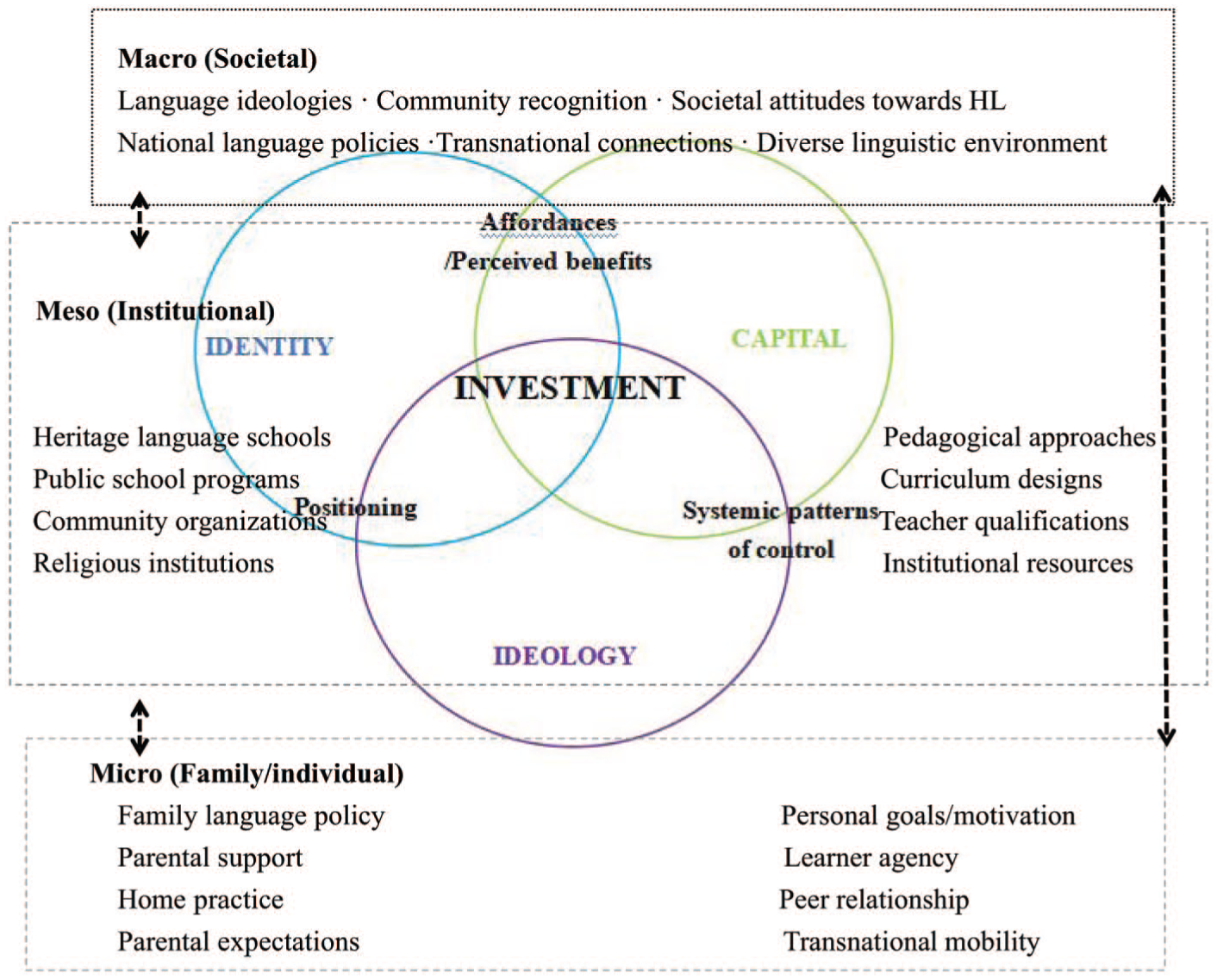
An illustration of multi-layered factors in HL maintenance built upon Darvin and Norton’s (2015) model of investment.
Concerning RQ2, our findings reveal that long-term maintenance requires synergy across ecological levels. Family investment alone proves insufficient when institutional and societal contexts fail to accord Chinese valuable capital. This demonstrates the limits of family-level investment despite the pivotal role of “parental agency” (Curdt-Christiansen, 2009).
The Limits of Family-Level Investment
Both families demonstrated high parental investment through consistent home language use, material resources (textbooks, picture books), and creative institutional partnerships (e.g., Lan’s co-teaching program). Yet outcomes diverged dramatically. Ran’s limited proficiency despite Lan’s sustained “labor of persistence” illustrates that family investment cannot compensate for structural voids at meso- and macro-levels. This finding extends Canagarajah’s (2008) view of families as “porous” spaces shaped by social forces, showing that porosity acts as a constraint, not merely an influence—external pressures can overwhelm family efforts despite parental commitment. Following Curdt-Christiansen’s (2014) findings in Singapore, we see that family language policies are never “self-contained”; instead, they are constantly interacting with and shaped by national language policy.
Institutional Access and Pedagogical Reform
A striking finding was that institutional access at the meso-level did not guarantee positive outcomes when pedagogy conflicted with learners’ broader educational experiences (see Table 2 for an overview of affecting factors across micro-, meso- and macro-levels).
An Overview of Multi-Level Factors Affecting Chinese Heritage Language Maintenance.
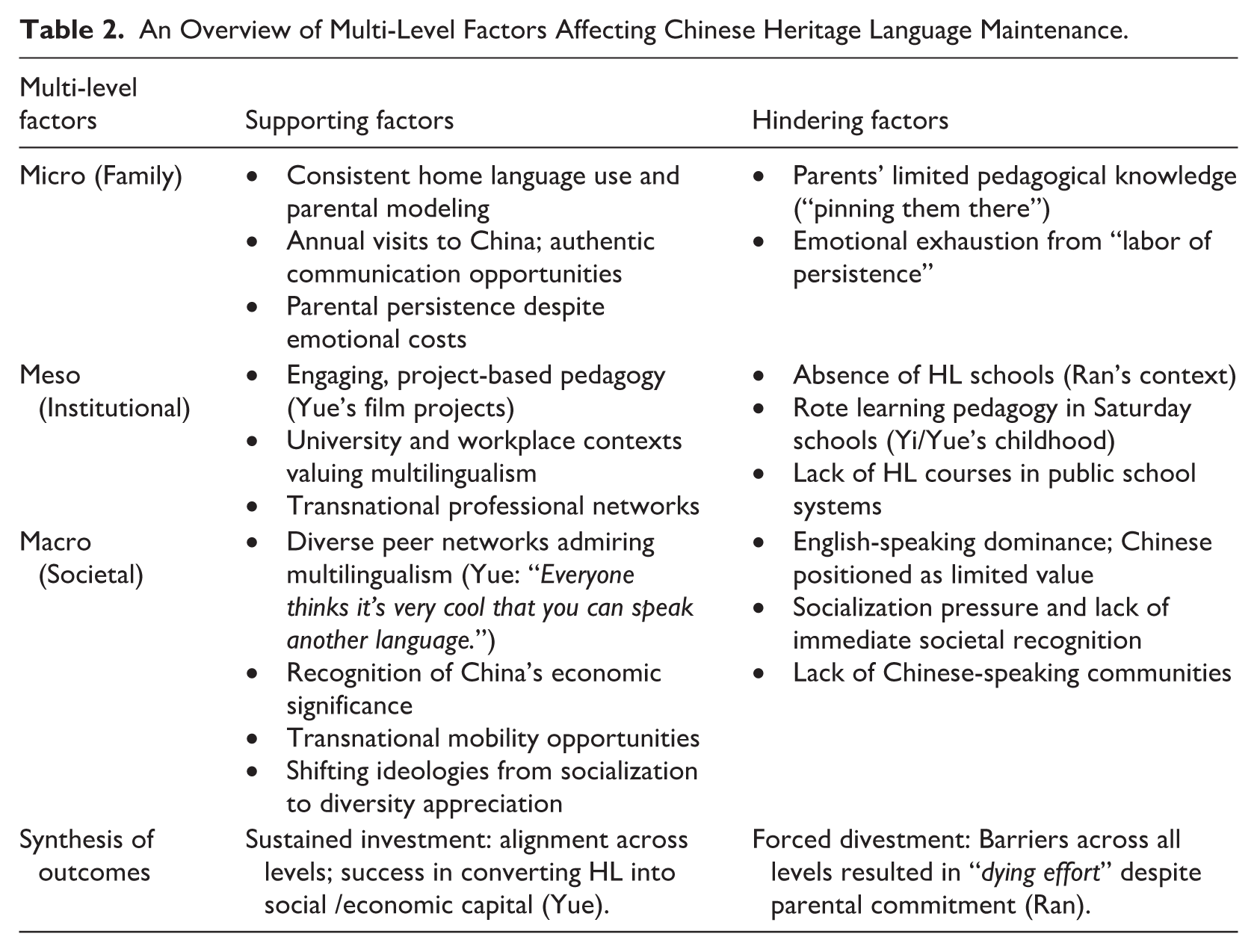
Bin’s children (Yue and Yi) attended Saturday HL schools for 4–5 years. However, this experience was perceived as burden because the traditional rote learning pedagogy centered on “reading, writing, testing”—what Yue described as “not a particularly normal situation in the US.” New immigrant families often faced challenges in accessing supporting resources (Gorter & Berardi-Wiltshire, 2026). HL schools can foster motivation and a sense of belonging by offering structured learning environments (Alshihry, 2024; Kim et al., 2025; Liang & Shin, 2021). But inconsistent program quality means that simply enrolling in an HL school does not guarantee effective language development or maintenance, or even undermine learner identity (Kisselev et al., 2025; Pastushenkov et al., 2025; Wu et al., 2014). Yue’s transformation through high school project-based pedagogy—where students created films and scripts—shows that positioning learners as active cultural producers rather than passive recipients can catalyze investment shifts, even after years of resistance. This suggests that pedagogical reform may be more critical than simply expanding HL school access.
Macro-Level Ideological Shifts and Geographic Inequality
Yue’s “mental shift” from “It’s not cool to be different” during childhood to “It makes me unique, that makes me kind of proud” during young adulthood reflects broader societal changes toward valuing multilingualism (García & Wei, 2014; Leeman, 2015; Song & Wu, 2024). However, our findings reveal that these macro-level shifts are geographically and socioeconomically uneven (see Table 2, Macro-level). Yue found herself in cosmopolitan London, where people often thought it was really cool to speak another language, whereas Ran stayed in environments where English was the main language and there wasn’t much recognition of the value of Chinese.
This geographic inequality challenges research treating “U.S. context” as monolithic. Our study finds the unequal access to the means and tools that parents need to support and be involved in their children’s development (Riches & Curdt-Christiansen, 2010). The stark contrast between Lan’s northeastern small-town “structural void” and Bin’s California access to Chinese-speaking communities and institutional resources demonstrates that HL maintenance challenges vary dramatically within the same national context. Policymakers need to recognize these internal inequalities instead of attributing outcomes solely to individual or family factors.
Ran’s trajectory highlights how barriers at different ecological levels compound in complex ways rather than simply adding up (see Table 2, Synthesis of outcomes). The combination of a structural void at the meso-level (no high-level schools), small-town English dominance at the macro-level, and parents’ pedagogical limitations at the micro-level created a context where heritage language maintenance became nearly impossible, even with high parental commitment.
On the other hand, Yue’s success showcases an example of positive synergy (see Table 2, Synthesis of outcomes). Her success was not merely a result of individual effort, but a convergence of family support, engaging pedagogy, and institutional access, ranging from high school projects, university experiences in London to career development opportunities. These “transnational” (Wang & Hatoss, 2024) contexts collectively transformed linguistic capital into social and economic capital. This finding extends Darvin and Norton’s (2015) model by showing that converting capital requires aligned opportunities across different levels of one’s environment. Linguistic capital alone is invisible and insufficient without “fields” (Bourdieu, 1986) that recognize its exchange value. In addition, her imagined identity as a multilingual professional at global corporations like Google or Tencent illustrates how HLM provides a competitive edge in the global market. This “awareness of the symbolic benefits” (Li, 2022, p. 131) accords with the arguments of Wang and Hamid (2022) that viewing heritage languages as transnational linguistic capital facilitates social and economic mobility across diverse global fields.
Conclusion
By examining two Chinese-American families’ trajectories from childhood through adolescence to young adulthood, our study demonstrates that heritage language maintenance is neither a linear outcome of parental commitment nor determined by early childhood experiences alone, but emerges through dynamic interactions across developmental stages, and mediated by multi-layered factors at micro-, meso-, and macro-levels. While parents maintained stable ideological commitments to Chinese, children’s investment shifted in nonlinear, context-activated ways. Despite comparable family investment, Yue achieved professional multilingualism through transnational mobility, Yi maintained moderate oral proficiency for family connections, and Ran experienced rational divestment—divergent outcomes underscoring how adolescent and young adult contexts prove as decisive as early childhood in shaping whether HL learning becomes a lifelong asset or a missed opportunity.
Our findings add to the model of investment in three ways. First, we demonstrate that investment must be understood developmentally, not just situationally. While Darvin and Norton (2015) emphasize investment’s temporal flux, our data reveal systematic developmental patterns: childhood’s “ought-to self” dominance, adolescence as critical transition, and young adulthood requiring “ideal self” alignment. Second, we show that identity, ideology, and capital operate differently for parents versus children within the same household. Parents’ stable ideologies could not translate into children’s investment when children inhabited social worlds where those ideologies determine modes of inclusion and exclusion (Darvin & Norton, 2015). This intergenerational divergence challenges family language policy research assuming household-level analysis captures individual investment (Curdt-Christiansen, 2009). Our study has revealed instead that family members occupy different “fields” (Bourdieu, 1986) with different capital exchange values even while sharing a household. Third, we demonstrate that investment requires cross-level ecological synergy, not just individual-context interaction. Yue’s success resulted from aligned contexts across family, institutional, and societal levels simultaneously, while Ran’s forced divestment resulted from cross-level compounding where barriers at all levels created insurmountable obstacles despite high parental commitment. This reveals that single-level interventions will have limited impact without corresponding changes at other ecological levels.
Supporting HL maintenance requires systemic intervention across multiple levels. First, student-centered, project-based teaching approaches, for instance, Yue’s transformation through film projects, may matter more than simply increasing instructional hours. Second, integrating HL courses into public schools provides institutional support during adolescence when weekend school attendance declines. Third, policy makers need to recognize geographic inequality by targeting resources to contexts that lack ethnic community infrastructure. Critically, these interventions must work in harmony across levels. Improving family language policy without addressing pedagogical mismatch or societal ideologies that undervalue multilingualism will likely yield limited results.
While our retrospective design allowed us to capture young adults’ thoughtful reflections, future research might benefit from employing longitudinal approaches that follow heritage speakers in real time. Our focus on middle-class families naturally limits the generalizability of our findings; therefore, future studies should explore diverse socioeconomic backgrounds, where structural barriers may be more pronounced. Investigating sibling differences within families (e.g., Yue and Yi) could shed light on individual variations that our family-level analysis was unable to address. In addition, examining the mechanisms underlying critical turning points, for instance, what specific features of Yue’s film projects ignited her investment shift, could illuminate how pedagogical interventions transform resistance into engagement. Finally, as the field of heritage language maintenance increasingly moves online (Darvin, 2025), exploring how heritage language learners utilize social media and generative AI tools in their language preservation efforts presents an exciting area for future inquiry.
Understanding heritage language maintenance requires recognizing that learners are active investors whose commitment depends not on parental willpower alone but on whether the social worlds they inhabit recognize their linguistic capital. As immigration continues to create multilingual families worldwide, the question is not whether parents invest enough in heritage language maintenance, but whether the institutions and societies surrounding these families invest in creating contexts where children’s linguistic capital can flourish. Our findings underscore the urgency of building cross-level support systems that enable heritage languages to thrive beyond the family home—recognizing HL maintenance as a collective responsibility requiring coordinated action across families, schools, communities, and policy makers.
Footnotes
Appendix: Semi-Structured Interview Protocols
Acknowledgements
We sincerely thank the participating Chinese-American families for sharing their time and experiences. We also thank Professor Qi Shen for his helpful comments on an early draft, and the anonymous reviewers for their constructive feedback and suggestions.

Funding
The authors disclosed receipt of the following financial support for the research, authorship, and/or publication of this article: This research was supported by a Grant from the National Education Sciences Planning of Chinese Ministry of Education (No. DBA210298).
Declaration of Conflicting Interests
The authors declared no potential conflicts of interest with respect to the research, authorship, and/or publication of this article.