






Abstract
Aims and Objectives/Purpose/Research Questions:
This study examines how active multilingual language use, socio-cognitive (Langerian) mindfulness, and foreign-language listening anxiety (FLLA) relate concurrently and prospectively among Bangladeshi EFL undergraduates.
Design/Methodology/Approach:
A three-wave longitudinal design (baseline, +3 months, +6 months) was used. Primary analyses employed a cross-lagged panel model (CLPM) within the structural equation modelling (SEM) framework to estimate autoregressive and cross-lagged relations; sensitivity checks used a random-intercept decomposition (RI-CLPM approximation) to separate between-person from within-person dynamics.
Data and Analysis:
The sample comprised 145 EFL undergraduates (83 female) at a private university in Dhaka. Measures included the LMS-14 (Langer mindfulness), Kim’s FLLA scale, and a seven-item contextual language-use inventory. Data screening indicated nonnormality; models were estimated with robust maximum likelihood (MLR) in lavaan. Measurement invariance and reliability were assessed for the language-use inventory; multiple sensitivity analyses tested latent versus observed scoring and baseline covariates (years of English study; listening frequency).
Findings/Conclusions:
Concurrently, greater active multilingual use and higher mindfulness are associated with lower FLLA. The CLPM showed modest prospective links (e.g., mid-semester language use → later mindfulness), but RI-CLPM checks substantially attenuated these cross-lags, indicating effects largely reflect stable between-person differences rather than robust short-term within-person causal coupling. FLLA demonstrated short-term stability (Phase 1 → Phase 2) but less predictability by Phase 3.
Originality:
The study uniquely combines longitudinal modelling, measurement invariance testing of an active language-use inventory, and RI-CLPM sensitivity checks to examine the multilingualism-mindfulness-FLLA relationship in a South Asian EMI context.
Significance/Implications:
Results suggest that pedagogies that leverage students’ multilingual repertoires and sustained, scaffolded mindfulness-informed instruction, alongside institutional EMI transition supports and translanguaging-friendly practices, are more promising than brief interventions for reducing listening anxiety.
Introduction
Foreign languages are increasingly integral to tertiary education across Asia, with many universities adopting English as the medium of instruction (EMI) to prepare students for global careers. Yet students in Bangladesh, where transitions from Bangla-medium schooling to EMI-heavy university programmes compound the challenge, often experience anxiety in English classes, especially during listening tasks, which undermines confidence and progress (Kayum, 2025; Khatami et al., 2025). Research documents that students at private Bangladeshi universities operating under EMI demonstrate limited English proficiency, with L1-dominant schooling backgrounds, traditional pedagogical methods, and restricted oral practice identified as contributing factors (Islam & Stapa, 2021). Foreign-language listening anxiety (FLLA) is distinct from general foreign language anxiety (FLA) and denotes the cognitive fear and emotional distress associated with understanding spoken input (Liu & Yuan, 2021; Zhang, 2013). Left unchecked, FLLA constrains listening comprehension and promotes avoidance of listening opportunities. And while instructional remedies show promise, they are rarely examined longitudinally. Moreover, since affective states evolve (Wu, 2024), cross-sectional snapshots risk missing developmental trends.
Interventions targeting emotion regulation and cognitive control have particular relevance. One candidate is mindfulness, defined in the socio-cognitive sense as openness to novelty and deliberate attention to novel features (Langer & Moldoveanu, 2000). Mindfulness is associated with improved attention, creativity, vocabulary retention, resilience, and reduced stress and anxiety in language-learning contexts (Babanoğlu & Atalmış, 2025; Cheng, 2023; Khatami et al., 2026; Rui et al., 2025; Zeilhofer & Sasao, 2022). However, most studies are short-term, culturally narrow (often in China and Turkey), and focus on overall FLA rather than listening-specific anxiety, rarely examining individual differences in responsiveness. One individual difference likely to matter is learners’ linguistic background. Active multilingual use, defined as regular engagement with multiple languages, cultivates cognitive flexibility, inhibitory control, and metalinguistic awareness (Calafato, 2025; Greve et al., 2024; Jessner & Allgäuer-Hackl, 2020; Woll, 2017). These capacities overlap substantially with those implicated in mindfulness (e.g., attentional control, cognitive flexibility, openness; J. H. Chang et al., 2018; Giancola et al., 2024).
While knowing multiple languages per se does not always reduce anxiety (Dewaele & Al-Saraj, 2015), the role of active language use and its interaction with mindfulness remains underexplored, especially for FLLA. This three-wave longitudinal study examines directional relationships among active multilingual use (operationalised as the active use of multiple languages across contexts), socio-cognitive mindfulness, and FLLA across an academic year among Bangladeshi EFL undergraduates. We ask how these constructs relate concurrently, whether they prospectively influence one another over time, and the extent to which they show stability or change during the year. The findings carry direct implications for EMI curriculum design, multilingual pedagogy, and institutional support for students transitioning into English-heavy university environments.
Literature Review
FLLA
FLLA is rooted in the cognitive-affective dynamics of language processing. Krashen’s (1982) Affective Filter Hypothesis proposes that negative emotions impede input processing; empirically, anxiety reduces working-memory capacity, which undermines comprehension, particularly during listening, where spoken input is transient and demands real-time processing (Moran, 2016). High FLLA is consistently associated with poorer listening outcomes (Elkhafaifi, 2005; Namaziandost et al., 2018), and the relationship is directional: FLLA reduces listening performance, while the reverse pathway, that is, performance predicting anxiety, is not supported (Zhang, 2013). Larger working-memory spans, conversely, predict better performance (Namaziandost et al., 2018). Multiple factors exacerbate FLLA in instructed contexts, including inadequate classroom attention to listening and assessment pressures (Bekleyen, 2009; A. C.-S. Chang, 2008).
Mindfulness and Language Learning
Review and intervention studies across diverse EFL settings report that mindfulness benefits learners’ attention, self-efficacy, willingness to communicate, and anxiety reduction (e.g., Ayala & Acuna, 2025; Charoensukmongkol, 2019), likely by lowering the affective filter and preserving cognitive resources for comprehension (Fallah, 2017). Research designs have varied between dispositional studies, which correlate trait mindfulness with anxiety outcomes and reveal stable between-person differences, and intervention trials, which test whether mindfulness training reduces anxiety within persons (Babanoğlu & Atalmış, 2025); the latter remain fewer in number and shorter in duration than correlational work. However, most evidence focuses on general FLA, not listening-specific anxiety, and individual differences in responsiveness remain underexplored.
Multilingual Repertoires
Regular engagement with multiple languages enhances executive function, attentional control, inhibitory control, and metalinguistic awareness (Greve et al., 2024; Jessner & Allgäuer-Hackl, 2020; Woll, 2017). Such experience exposes listeners to diverse phonetic realisations, accents, and prosody, supporting perceptual learning and flexible decoding strategies (Boumeester et al., 2019; Rost, 2014). Evidence suggests that use, not merely the number of languages known, predicts lower classroom anxiety (Dewaele & Al-Saraj, 2015). Conceptually, active multilingual use, as operationalised here, that is, the number of languages individuals use across communicative contexts, is distinct from code-switching, which involves alternation between discrete language systems (Dewaele & Li, 2014), and from translanguaging as Wei (2018) theorises it: fluid practices that transcend the boundaries of named languages within an integrated multilingual repertoire.
Multilingualism, Mindfulness, and Anxiety: Shared Mechanisms
Anxiety, mindfulness, and active multilingual use converge on shared mechanisms, such as attentional allocation, working-memory availability, and cognitive control (J. H. Chang et al., 2018; Giancola et al., 2024), pointing to both independent anxiety-buffering effects and possible synergistic interactions, such as multilingualism enhancing the efficacy of mindfulness. Dynamic systems theory (DST) highlights that interconnected subsystems (e.g., language use, affect, and cognition) evolve through feedback loops, so cross-sectional snapshots can miss temporal coupling and phase changes (Jessner, 2008; Larsen-Freeman, 2012). A longitudinal perspective is therefore useful in distinguishing stable between-person differences from within-person temporal couplings (Mahmoodzadeh & Gkonou, 2015; Skoranski et al., 2019). To date, no study to our knowledge has examined how active multilingual use, Langerian mindfulness, and FLLA interact prospectively within a South Asian EMI context.
The Bangladeshi Context
English language teaching in Bangladesh has faced long-standing systemic challenges, including inconsistent language policies and gaps in communicative language teaching implementation, that shape the linguistic preparation students bring to university (Rahman et al., 2019). Urban Bangladeshi students routinely mix languages, often anglicising Bengali and negotiating identity through heteroglossic practices (Khan & Akter, 2022; Sultana, 2014, 2015). Studies of university classrooms report frequent code-switching and pragmatic translanguaging: students favour using both their mother tongue and English in learning, while teachers’ attitudes vary and L1 use in practice is often moderate (Khatun & Pinki, 2017; Saha & Rahman, 2022). Rahman and Hu (2025) similarly document translanguaging and positive beliefs about EMI even under English-only policies, a pattern also observed in earlier work at comparable private institutions (Rahman et al., 2020). Despite these ethnographic and classroom studies, empirical research on how multilingual practices in Bangladesh affect language-learning anxiety and proficiency is limited (Saha & Rahman, 2022), leaving a gap for longitudinal studies.
Research Questions
To address these gaps, this longitudinal study investigated the evolving relationships between active multilingual use, mindfulness, and FLLA across an academic year. Specifically, it addressed the following research questions (RQs):
Methods
Research Design
We used a three-wave longitudinal quantitative design to examine reciprocal relations among multilingualism, socio-cognitive mindfulness, and FLLA. Self-report questionnaires were administered at baseline (Phase 1), 3 months later (Phase 2), and 6 months after baseline (Phase 3). The 3-month spacing matched course schedules and reduced participant burden while permitting observation of change during an academic year. Primary analyses employed a cross-lagged panel model (CLPM) within the structural equation modelling (SEM) framework to estimate autoregressive (stability), cross-lagged (directional), and within-wave covariance parameters corresponding to the study’s RQs.
Participants
A purposive sample of 145 EFL undergraduates (83 female, 62 male), aged 18–24 (M = 20.50, SD = 1.80), was recruited from a private university in Dhaka. This institution was selected as a theoretically representative case of urban private universities undergoing EMI expansion in Bangladesh, rather than as a statistically representative sample of all institutions. Given evidence that language-learning anxiety can differ by gender (Dewaele & Al-Saraj, 2015; Piniel & Zólyomi, 2022), the sample composition warrants caution in generalising findings across gender groups. Nearly all participants reported Bengali as their first language (98.2%); the remainder reported Chakma. Participants reported an average of 5.50 years of English study and a mean self-reported English listening frequency of 3.08 times per week (academic use, media, and social interaction). Identical English questionnaires were administered in class by trained research assistants in quiet rooms; each session lasted approximately 30 min. Participants provided written informed consent and were debriefed after Phase 3. The study received institutional ethical approval; all 145 participants completed all waves, and data were de-identified and stored in compliance with data-protection rules.
Instruments
Mindfulness was measured with the 14-item Langer Mindfulness Scale (LMS-14; Pirson et al., 2012), with items rated on a 7-point Likert-type scale (1 = strongly disagree to 7 = strongly agree). The LMS-14, grounded in a socio-cognitive perspective that emphasises active information processing, openness to novelty, and cognitive flexibility, was operationalised as the item mean; internal consistency was α = .91 (Phase 1), α = .87 (Phase 2), and α = .88 (Phase 3). We explicitly frame findings in terms of Langerian (socio-cognitive) mindfulness and caution that results do not necessarily generalise to meditative forms of mindfulness. FLLA was assessed using Kim’s (2000) listening-anxiety scale (items rated 1–5) and operationalised as the scale mean; Cronbach’s α = .93 (P1), .94 (P2), and .94 (P3). Active multilingual use was measured with a seven-item contextual language-use inventory (see Supplemental Appendix B) averaged to a composite score; internal consistency was α = .83 (P1), .84 (P2), and .79 (P3). Each item asked how many languages the respondent uses for a given communicative function or context, yielding a breadth-of-use operationalisation. This measure captures the extent of a person’s multilingual engagement across domains instead of the manner of language use; it does not index code-switching (alternation between discrete language systems) or translanguaging as Wei (2018) theorises it (i.e., fluid practices transcending named language boundaries within an integrated repertoire). Future work employing observational or discourse-based measures could examine whether these interactional phenomena have differential effects on FLLA and mindfulness.
We evaluated the dimensionality and longitudinal measurement properties of the language-use inventory. Single-factor confirmatory factor analyses at each wave supported unidimensionality, P1: χ²(13) = 21.8, p = .074; comparative fit index (CFI) = .99; root mean square error of approximation (RMSEA) = .04; P2: χ²(13) = 20.5, p = .092; CFI = .99; RMSEA = .03; P3: χ²(13) = 24.2, p = .028; CFI = .99; RMSEA = .04, with standardised loadings approximately .58–.75 across items and waves. Longitudinal invariance testing (configural → metric → scalar) using confirmatory factor analysis (CFA) with maximum likelihood (MLR) showed minimal fit declines (configural → metric ΔCFI = .003, ΔRMSEA = .002; metric → scalar ΔCFI = .005, ΔRMSEA = .003) and nonsignificant Satorra–Bentler-scaled χ² differences, supporting full scalar invariance across the three waves. Item-level test–retest reliability in a pilot sample (N = 48, 2-week interval) ranged ICC = .81–.92 across the seven items; the scale mean ICC (2, 1) = .89 (Pearson r = .89). Item-level Pearson correlations between timepoints ranged r = .78–.91. Given this measurement evidence, multilingual language use was modelled as a latent construct in sensitivity analyses and as an observed composite (item mean) in the primary CLPM.
Data Screening and Analysis
Data screening comprised inspection of univariate distributions (histograms, skewness/kurtosis), Q–Q plots, and bivariate scatterplots to assess linearity and homoscedasticity. Mardia’s tests for the nine manifest variables (language use, mindfulness, anxiety across the three phases) indicated significant multivariate skewness and kurtosis; consequently, structural models were estimated using robust MLR in lavaan (R), which yields robust standard errors and scaled test statistics under nonnormality. The primary analysis was a three-wave CLPM using observed composite scores (scale means) to estimate autoregressive and cross-lagged effects while allowing within-wave correlations. Constructs were modelled as observed composites for three reasons: the scales showed high internal consistency; factor scores from single-factor CFAs correlated highly with observed means in auxiliary simulations (r = .94–.97); and latent CLPMs (three constructs × three waves) substantially increase parameter counts and risk convergence or identification problems at modest N. Sensitivity checks that replaced observed composites with latent factor scores produced only modest changes in focal standardised cross-lags (e.g., Phase 2 language use → Phase 3 mindfulness decreased from β = .29 to β = .26, and Phase 1 mindfulness → Phase 2 anxiety decreased from β = .07 to β = .05).
Model fit was evaluated with χ², CFI, Tucker-Lewis Index [TLI], RMSEA (90% confidence interval [CI]), and standardized root mean square residual (SRMR), using conventional cut-offs as guidelines (CFI/TLI = .90–.95; RMSEA = .06–.08; SRMR = .08). Two Phase-1 covariates, years of English instruction and weekly English listening frequency, were measured and included in auxiliary robustness checks as time-invariant baseline covariates rather than in the primary CLPM. Adding these covariates to the primary model would have increased parameter counts and risked estimator instability; if endogenous, they could also bias focal estimates. In the sensitivity checks that included these covariates, focal coefficients changed only trivially.
Findings
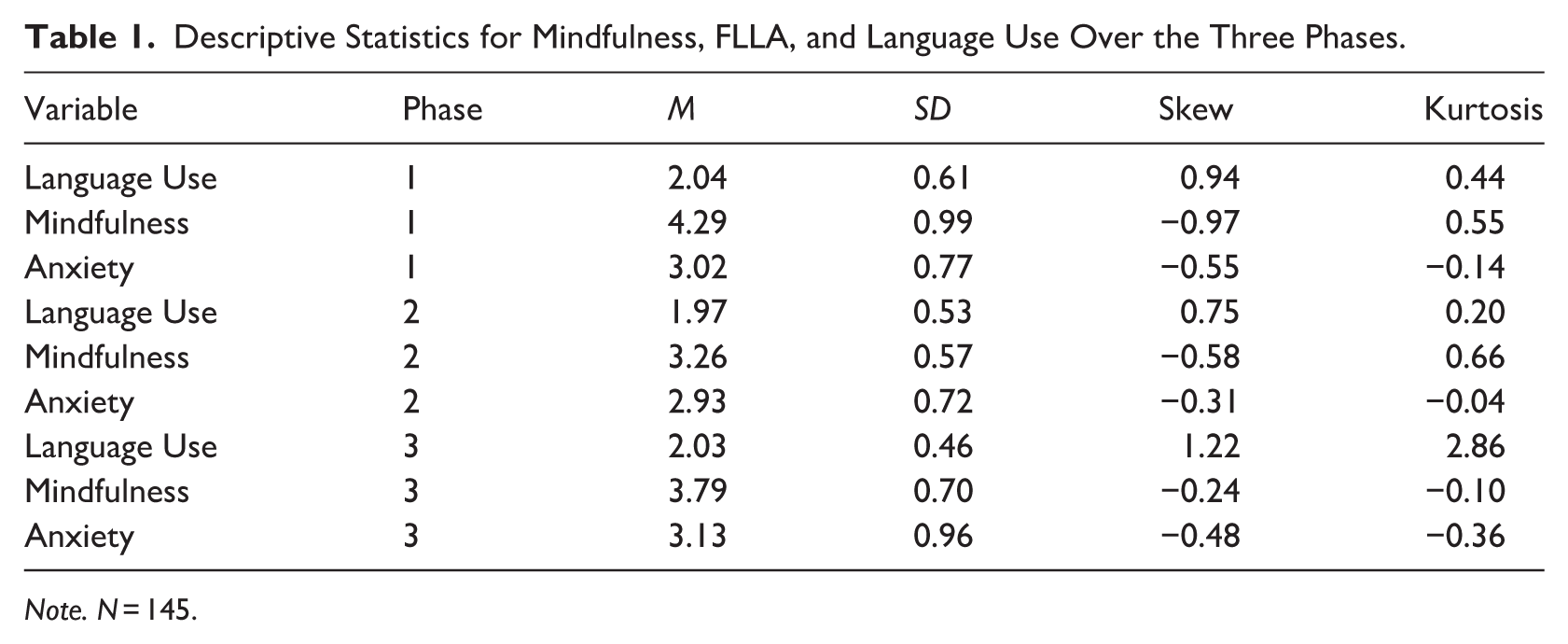
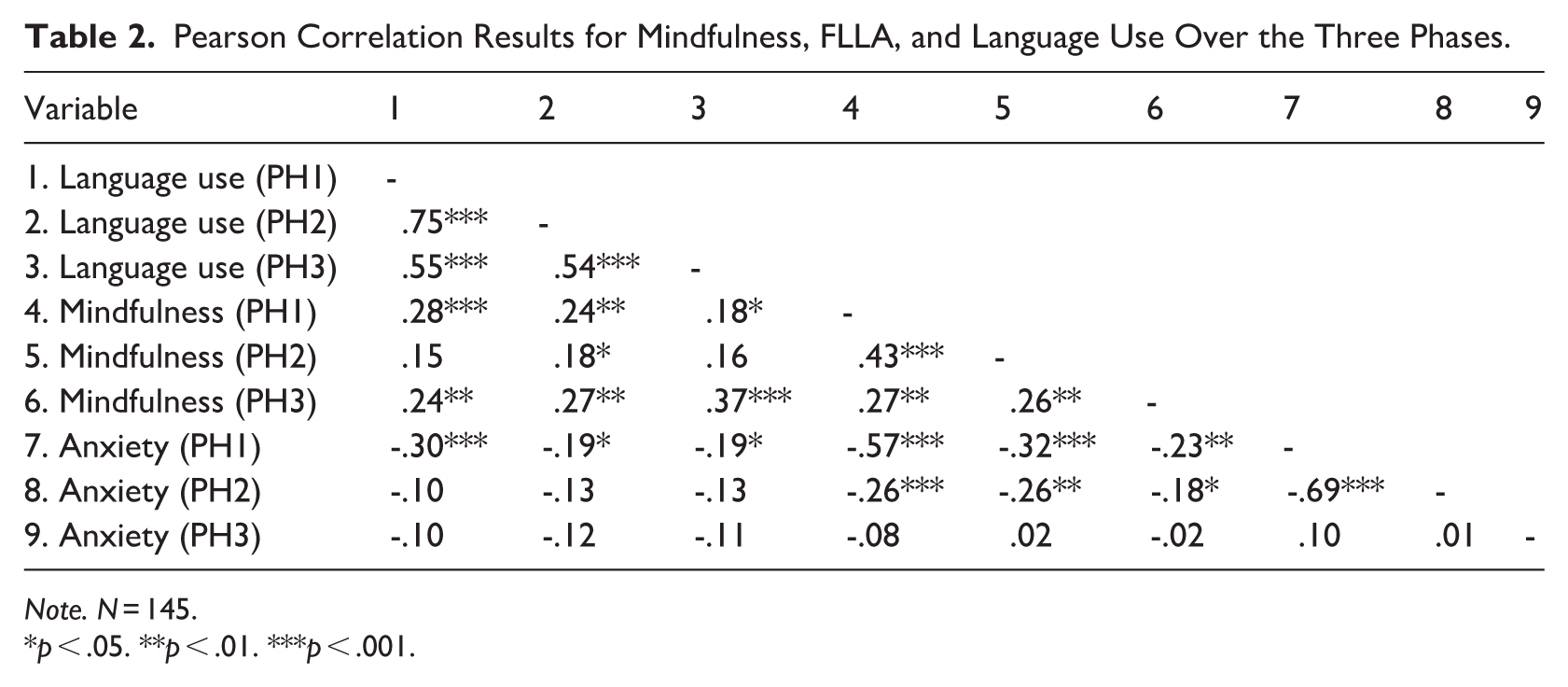
Descriptive statistics and bivariate Pearson correlations for the primary study variables are presented in Tables 1 and 2, respectively. Correlation patterns were consistent with expectations: language use and mindfulness were positively associated at each phase, and both were negatively associated with FLLA (concurrent correlations are reported in Table 2).
Descriptive Statistics for Mindfulness, FLLA, and Language Use Over the Three Phases.
Note. N = 145.
Pearson Correlation Results for Mindfulness, FLLA, and Language Use Over the Three Phases.
Note. N = 145.
p < .05. **p < .01. ***p < .001.
The CLPM was estimated using observed scale scores (item means after appropriate reverse-scoring); lavaan’s standardised estimates are reported below. Overall model fit was good: χ² (9) = 13.58, p = .138; CFI = .989; TLI = .954; RMSEA = .059 (90% CI [.000, .085]); SRMR = .028. CFI and TLI indicate excellent fit. RMSEA’s point estimate is within conventional acceptable limits. Because formal tests indicated departure from multivariate normality, Mardia’s skewness b₁p = 13.46, χ² (165) = 323.06, p < .001; Mardia’s kurtosis b₂p = 106.41, z = 3.16, p = .0016, models were estimated with MLR, as already mentioned.
Autoregressive paths indicated that the constructs were mostly stable across phases, although to varying degrees (see the path diagram in Figure 1).
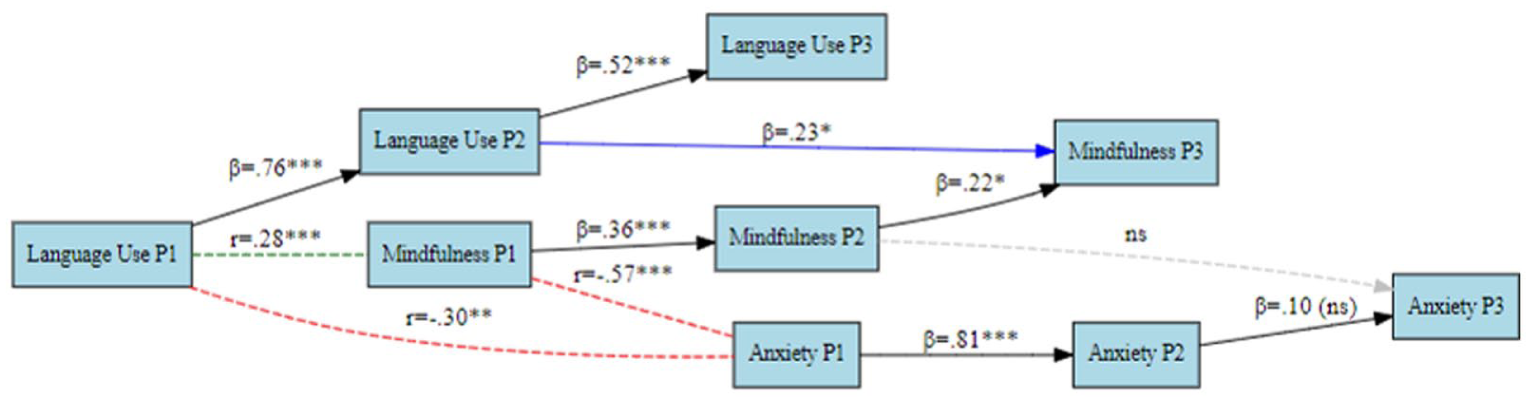
Path diagram for the CLPM.
Mindfulness and anxiety showed different stability patterns across the three waves. Language use demonstrated the strongest continuity across waves (see Figure 1): Phase 1 language use strongly predicted Phase 2 language use (standardised β = .76, Est = 0.67, SE = 0.05, z = 13.46, 95% CI [0.57, 0.77], p < .001), and Phase 2 also predicted Phase 3 language use (β = .52, Est = 0.45, SE = 0.08, z = 5.72, 95% CI [0.30, 0.61], p < .001). Mindfulness showed moderate stability over time (Phase 1 → Phase 2: β = .36, Est = 0.21, SE = 0.06, z = 3.72, 95% CI [0.10, 0.32], p < .001; Phase 2 → Phase 3: β = .22, Est = 0.24, SE = 0.10, z = 2.42, 95% CI [0.05, 0.44], p = .015). FLLA was stable from Phase 1 to Phase 2: higher FLLA at Phase 1 predicted higher FLLA at Phase 2 (β = .81, Est = 0.42, SE = 0.04, z = 11.17, 95% CI [0.34, 0.49], p < .001), while the Phase 2 → Phase 3 autoregressive path for FLLA was small and not statistically significant (β = .10, Est = 0.23, SE = 0.21, z = 1.13, 95% CI [−0.17, 0.64], p = .257). Several cross-lagged effects were small in magnitude. The CLPM estimated here used observed scale means, and one focal cross-lag – Phase 1 mindfulness → Phase 2 FLLA – was small (standardised β = .17, p = .032). However, a post hoc sensitivity calculation indicates the present sample (N = 145) had ~.80 power to detect standardised effects of approximately β = .23 or larger; therefore, effects smaller than this threshold (including the β = .17 cross-lag) should be treated as exploratory and interpreted cautiously (full parameter estimates are provided in Supplemental Appendix A).
Regarding cross-lagged effects, the analysis revealed a pattern that merits careful attention: mindfulness at Phase 1 showed a small but statistically significant positive cross-lagged effect on FLLA at Phase 2 (standardised β = .17, unstandardised estimate = 0.07, SE = 0.03, z = 2.15, 95% CI [0.01, 0.13], p = .032). In other words, higher initial mindfulness predicted slightly higher subsequent listening anxiety during the first interval. However, this relationship was not maintained in the second interval, as the cross-lagged path from mindfulness at Phase 2 to FLLA at Phase 3 was nonsignificant (standardised β = .06, p = .437). In the reverse direction, FLLA at neither Phase 1 nor Phase 2 significantly predicted subsequent mindfulness levels (Phase 1 FLLA → Phase 2 mindfulness: β = −.11, p = .212; Phase 2 FLLA → Phase 3 mindfulness: β = −.10, p = .275). The most robust cross-lag effect in the model was multilingual language use at Phase 2 predicting mindfulness at Phase 3 (standardised β = .22, unstandardised est. = 0.29, SE = 0.12, z = 2.33, 95% CI for the unstandardised estimate [0.05, 0.53], p = .020). This indicates that greater relative language use during the mid-semester interval was associated with small but reliable increases in subsequent mindfulness, controlling for prior levels. Concurrent (within-wave) correlations were generally in expected directions (strongest at Phase 1). At β = .22, this cross-lag approaches the study’s detection boundary (β ⩾ .23 for ~.80 power) and should accordingly be interpreted with caution.
To test whether the cross-lagged effects in the main CLPM reflected within-person change (as opposed to stable between-person differences), we ran sensitivity checks using a random-intercept decomposition: for each participant, we subtracted their person-mean on each construct (language use, mindfulness, and FLLA) and then estimated autoregressive and cross-lagged relations among the within-person scores (see Hamaker et al., 2015). Because full latent Random Intercept CLPM estimation can be unstable with three waves and modest N, we implemented this as a robustness check on the observed data structure. The results attenuated the previously reported cross-lagged effects. Averaged across 200 simulation draws (N = 145) that reproduced the observed between-person variances and covariances, the within-person effect of Phase 2 language use on Phase 3 mindfulness declined from the observed CLPM standardised β = .22 to β = 0.07 (95% CI [−0.23, 0.37], p = .430) in the RI-CLPM approximation. Likewise, the small positive cross-lag from Phase 1 mindfulness to Phase 2 anxiety was reduced from standardised β = .17 in the CLPM to β = 0.01 (95% CI [−0.06, 0.09], p = .480) within-persons. Within-person autoregressive coefficients were smaller and more variable than the observed CLPM autoregressions. Taken together, the checks indicated that the significant cross-lags reported in the standard CLPM were largely driven by between-person differences (stable individual differences), not strong, systematic within-person temporal coupling across waves.
R² values from the model indicated that predictors accounted for a substantial portion of variance in language use (Ph2 R² = .57, Ph3 R² = .30) and modest portions for mindfulness (Ph2 R² = .19, Ph3 R² = .13). Predictors explained a large share of mid-semester anxiety (Ph2 R² = .50) but very little of end-of-semester anxiety (Ph3 R² = .02), suggesting Phase 3 anxiety was relatively unpredictable from the variables included in the present model. To test robustness to baseline English experience and exposure, we ran auxiliary regressions including time-invariant Phase 1 covariates (years of English instruction; frequency of English listening). In an adjusted ordinary least squares (OLS) regression predicting mindfulness at Phase 3 (controlling for Phase 2 mindfulness and the two covariates), Phase 2 language use remained a similar and statistically significant predictor (standardised β = .22, SE = .10, 95% CI [0.02, 0.42], p = .028), supporting the robustness of the CLPM result. Years of English instruction did not materially change the focal coefficients in sensitivity checks; listening frequency was associated with lower Phase 2 anxiety in one auxiliary specification (standardised β = −.22, p = .008), a result we report as exploratory.
Discussion
The CLPM results reflect robust between-person associations (individuals who generally use more languages report higher mindfulness), but evidence for strong short-term within-person causal coupling was weak in this dataset. Contextualising these patterns for Bangladesh helps explain why between-person differences dominate. Urban Bangladeshi students commonly engage in routine code-switching and translanguaging, and language use is tightly bound up with prior schooling, social networks, and symbolic capital (Khan & Akter, 2022; Khatun & Pinki, 2017; Sultana, 2014, 2015; Tang & Calafato, 2022). Such background factors (i.e., years in English-medium or English-rich environments, family and peer practices, and access to English media) are relatively stable over an academic year. They are therefore more likely to manifest as between-person differences than as rapid within-person shifts (Tang & Calafato, 2025). In other words, students who habitually use multiple languages may already possess enduring cognitive and experiential resources (metalinguistic awareness and exposure to varied input) that align with higher dispositional mindfulness; these stable socio-educational advantages are consistent with the translanguaging and EMI findings reported in Bangladeshi classroom studies (Rahman & Hu, 2025; Saha & Rahman, 2022) and with Kayum’s (2025) characterisation of transitions from Bangla-medium schooling to EMI-heavy university settings.
Relations involving FLLA were more complex and generally less stable across waves. For RQ1, we observed consistent concurrent associations at each wave: participants who, on average, reported using more languages and greater mindfulness also reported lower FLLA. These are robust between-person correlations, but the within-person evidence that changes in a person’s own language use predict later changes in their anxiety was weak in the sample. The findings align with prior work on the negative relationship between anxiety and mindfulness (e.g., Gao, 2024) and multilingualism (e.g., Dewaele & Al-Saraj, 2015; Dewaele et al., 2024; Thompson & Lee, 2013). Regarding multilingualism specifically, some studies report that the number of languages known reduces FLA (e.g., Dewaele et al., 2024), while others find it is active use instead of knowledge that predicts lower anxiety (e.g., Dewaele & Al-Saraj, 2015), a distinction the present inventory directly operationalises. The patterns also align with established theory. Mindfulness can help learners focus on the unfolding listening task rather than ruminate about failure or misunderstanding. This heightened awareness likely blocks worry and reduces the affective filter (Krashen, 1982). Likewise, learners who use multiple languages regularly may approach listening tasks with greater confidence. Bialystok et al. (2012) note that bilinguals exhibit enhanced mental flexibility and attentional control, which likely aids processing of unfamiliar input and dampens anxiety.
Moreover, multilingualism often fosters metalinguistic awareness, creativity, and an openness to novelty (Dewaele & Botes, 2020; Fürst & Grin, 2021; Jessner, 2008; Tang & Calafato, 2024), so learners may be less fearful when tackling spoken English. Turning to RQ2, a small positive cross-lag from Phase 1 mindfulness to Phase 2 FLLA was observed in the CLPM. This effect was small, did not replicate in the second interval (Phase 2 → Phase 3), and attenuated in the RI-CLPM approximation. We therefore treat the mindfulness → FLLA cross-lag as exploratory and possibly driven by stable between-person differences or unmeasured confounders rather than robust within-person temporal coupling. Two plausible (nonmutually exclusive) interpretations are (a) increased mindfulness may temporarily heighten learners’ awareness of their perceived shortcomings in listening, increasing self-reported anxiety (see Britton, 2019), or (b) the effect is an artefact arising from other confounding variables not accounted for in the CLPM. Crucially, the concurrent (within-wave) associations remained negative (higher mindfulness and greater language use were associated with lower FLLA), and the mindfulness → FLLA cross-lag did not replicate in the second interval (Phase 2 → Phase 3).
Cultural and measurement factors also warrant consideration as alternative explanations. Response tendencies in Bangladeshi academic settings, including social desirability norms and the timing of data collection relative to examination cycles, may have shaped self-reports of anxiety and mindfulness in ways not fully captured by the model. Unmeasured stable factors, such as socioeconomic background and differential access to English-rich environments, could similarly contribute to the between-person dominance observed across waves and represent an important focus for future research. The prospective association between mid-semester language use and later mindfulness, while statistically significant in the CLPM, attenuated to a nonsignificant within-person effect in the RI-CLPM approximation, suggesting it primarily reflects stable between-person differences: individuals who habitually use more languages tend to report higher mindfulness than others, rather than increases in a person’s own language use causing subsequent increases in their mindfulness. Taken together, the directional findings suggest a complex and asymmetrical interplay: while multilingual language use appears associated with subsequent mindfulness, the relationship between mindfulness and FLLA is more nuanced, showing a positive longitudinal effect in the short term despite negative concurrent correlations.
These results carry important practical implications. Interventions aimed at increasing mindfulness should be designed with caution, as they may not yield immediate reductions in FLLA and could even be associated with a short-term increase in anxiety awareness. Indeed, meta-analytic evidence indicates that mindfulness interventions significantly enhance language learning outcomes (Babanoğlu & Atalmış, 2025), but our results suggest that the relationship with anxiety may be more complex than a simple inverse correlation. In our context, mindful exercises or teacher modelling of composed, attentive listening behaviour may need to be implemented in ways that directly address any emerging anxiety awareness. Conversely, promoting regular use of multiple languages may create a more supportive affective climate by fostering mindfulness, though its impact on anxiety appears more indirect. RQ3 addressed the stability and change of each construct over time. We observed moderate stability for each construct at the between-person level: within-person fluctuations were generally modest, and much of the longitudinal covariance arises from stable between-person differences. FLLA showed reasonably high short-term consistency (Phase 1 → Phase 2), but the Phase 2 → Phase 3 autoregressive path was small and nonsignificant, and predictors explained virtually none of the variance in Phase 3 FLLA.
The near-complete unpredictability of end-of-semester anxiety, alongside the nonsignificant correlations between Phase 3 FLLA and all other study variables, suggests that late-semester anxiety was driven by factors outside the model, plausibly including the approach of summative assessments or accumulated fatigue effects specific to the exam period, consistent with the measurement timing concerns noted above. This pattern accords with meta-analytic findings that foreign-language anxiety can be surprisingly steady but also subject to change (Hsiao & Tseng, 2022) and confirms that these constructs, while moderately stable, are not fixed traits. Mindfulness demonstrated similar moderate temporal stability, reflecting both its trait component and susceptibility to change, with learners’ relative ranking largely persisting despite some overall decrease across the year. Language use was the most stable of the three constructs, changing little over the academic year. These stability patterns suggest that meaningful reductions in FLLA or increases in mindfulness are unlikely to emerge without sustained pedagogical effort, such as mindfulness training, supportive feedback, and multimodal listening instruction, instead of brief, episodic interventions.
At the same time, several limitations bear on the interpretation of the study’s findings. The purposive single-site design restricts generalisability beyond urban private Bangladeshi universities. All constructs were measured via self-report, susceptible to social desirability and recall bias, and the absence of objective performance measures or observational language-use data limits methodological triangulation. Statistical power was sufficient only to detect standardised effects of β ⩾ .23, leaving smaller but potentially meaningful effects undetected.
Conclusion
The present study’s longitudinal findings provide a nuanced picture of the relationships between multilingualism, mindfulness, and FLLA. Concurrently, more extensive active multilingual use and higher levels of socio-cognitive mindfulness were associated with lower FLLA; longitudinally, however, the dynamics are more complex. Active multilingual use correlated prospectively with higher dispositional mindfulness in the standard CLPM, but sensitivity checks that isolated within-person change (RI-CLPM approximation) indicated that much of the apparent temporal coupling reflects stable between-person differences, not strong short-term causal effects. The unexpected small positive cross-lag from early mindfulness to later anxiety was transient and attenuated in within-person analyses, suggesting that greater meta-awareness may initially heighten learners’ conscious appraisal of difficulties even as mindfulness and reduced anxiety are negatively correlated at single time points. As urban Bangladeshi students’ language practices are tightly tied to prior schooling, social networks, and access to English-rich resources, socio-educational conditions remain relatively stable over an academic year, plausibly accounting for the dominance of between-person differences in our results and implying that short, one-off classroom interventions are unlikely to equalise outcomes.
Pedagogically, curricula should explicitly draw on students’ linguistic repertoires through multilingual tasks and L1 scaffolding; mindfulness-based elements should be introduced gradually with psychoeducation and scaffolded listening tasks so that heightened awareness translates into incremental progress instead of increased anxiety. At the policy level, institutions could consider EMI transition supports, such as bridging courses, listening labs, and policies permitting flexible L1 use in formative activities, to address the structural exposure gaps that underpin stable between-person differences; students from less English-rich backgrounds may require sustained, resource-rich programmes rather than brief workshops. For future research, several concrete directions would strengthen causal inference and practical relevance. Methodologically, longer panels with more measurement waves (⩾ 4) and larger, more diverse samples would better capture nonlinear dynamics and enable full RI-CLPM or latent change modelling. Experimental designs (e.g., randomised controlled trials of sustained mindfulness programmes, multilingualism-friendly curricula, or combined strategy and mindfulness interventions) would clarify causal effects and potential moderators.
Measurement should be diversified beyond self-reports: objective listening comprehension tests, experience sampling to capture momentary anxiety and language use, and physiological indices (e.g., heart-rate variability and skin conductance) can triangulate findings and illuminate short-term affective dynamics. Qualitative or mixed methods work (in-depth interviews and stimulated recall) would be especially valuable for unpacking why heightened mindfulness sometimes accompanies greater self-reported anxiety and for understanding how students interpret and enact multilingual practices in classrooms. In sum, the findings point to two central lessons. First, active multilingual use and mindfulness are linked to lower listening anxiety at the between-person level, suggesting that leveraging students’ linguistic repertoires is a promising pedagogical avenue. Second, the predominance of stable between-person differences and the weak within-person coupling observed here imply that meaningful reductions in FLLA and durable increases in mindfulness are likely to require sustained, context-sensitive, and equity-minded interventions rather than brief one-off treatments. Thoughtfully designed programmes that combine multilingual pedagogy, graded listening exposure, strategy instruction, and carefully scaffolded mindfulness practices offer the most promising route to fostering more mindful and less anxious EFL listeners.
Supplemental Material
sj-docx-1-ijb-10.1177_13670069261462806 – Supplemental material for Longitudinal Interactions Between Mindfulness, Foreign-Language Listening Anxiety, and Multilingualism Among EFL Learners in Tertiary Education
Supplemental material, sj-docx-1-ijb-10.1177_13670069261462806 for Longitudinal Interactions Between Mindfulness, Foreign-Language Listening Anxiety, and Multilingualism Among EFL Learners in Tertiary Education by Raees Calafato, Mojtaba Khatami, Ferdi Çelik and Mohammad Golam Mohiuddin in International Journal of Bilingualism
Footnotes

Ethical Considerations
This study was reviewed and officially approved by the departmental ethics committee within the Department of English at Green University of Bangladesh (Ref/Protocol No. GUB-ENG-ETH-2025/02). All procedures were conducted in accordance with the conditions specified therein, including provisions for informed consent, data anonymisation and secure storage, low-risk and non-intrusive activities, and aggregate reporting to preserve participant confidentiality. Data were de-identified and stored in compliance with applicable data-protection regulations.
Consent to Participate
Written informed consent was obtained from all individual participants prior to participation, in accordance with the conditions of ethical approval. Participants were informed that they could withdraw at any time without consequence and were debriefed following the completion of Phase 3.
Funding
The authors received no financial support for the research, authorship, and/or publication of this article.
Declaration of Conflicting Interests
The authors declared no potential conflicts of interest with respect to the research, authorship, and/or publication of this article.
Data Availability Statement
The data that support the findings of this study are available from the corresponding author upon reasonable request and subject to any necessary institutional or ethical restrictions to protect participant confidentiality.
Supplemental Material
Supplemental material for this article is available online.
Author Biographies
References
Supplementary Material
Please find the following supplemental material available below.
For Open Access articles published under a Creative Commons License, all supplemental material carries the same license as the article it is associated with.
For non-Open Access articles published, all supplemental material carries a non-exclusive license, and permission requests for re-use of supplemental material or any part of supplemental material shall be sent directly to the copyright owner as specified in the copyright notice associated with the article.
