






Abstract
Formative research is needed to develop effective interventions that eliminate secondhand smoke exposure (SHSe) and prevent tobacco use (TU) among children with asthma. This online study included 300 parents who smoke and had a child with asthma (ages 10–14) and evaluated their perceptions about prototypes of parent-directed and child-directed feedback intervention messages focused on reducing child SHSe and future TU; correlates of perceptions were explored. Parents rated examples of parent-directed messages on motivation and helpfulness for eliminating SHSe and promoting conversations about TU and also rated child-directed messages on acceptability and helpfulness for promoting conversations about TU. Messages differed by level of personalization, theoretical background, or message content. Parents found all parent-directed messages similarly motivating and helpful and all child-directed messages similarly acceptable and helpful for reducing child tobacco exposure. Differences in perceptions about feedback emerged based on parent gender, parent readiness to quit, smoking ban status, and the presence of additional smokers in the home. Overall, parents rated parent-directed and child-directed feedback message prototypes positively, including established and novel types of feedback. Parent–child feedback interventions may hold promise for breaking the intergenerational transmission of smoking among families with a parent who smokes and a child with asthma.
Introduction
Tobacco exposure among youth with asthma is a serious public health problem. Secondhand smoke exposure (SHSe) is associated with asthma onset; increased asthma severity, exacerbations, and morbidity; and decreased asthma medication effectiveness among youth (Bossley and Saglani, 2009; Rabinovitch and Reisdorph, 2011; U.S. Department of Health and Human Services, 2006). Active smoking is linked to increased risk for asthma severity, exacerbations, and mortality (McLeish and Zvolensky, 2010). There is a vicious cycle of smoking among families with a child with asthma; youth with asthma are more likely to have parents who smoke (Otten et al., 2005), and parental smoking is a stronger predictor of smoking initiation among youth with asthma versus youth without asthma (Van de Ven et al., 2007a,b). Compared to adolescents without asthma, adolescents with asthma (1) smoke at comparable or higher rates (McLeish and Zvolensky, 2010), (2) accelerate to higher levels of smoking and nicotine dependence faster (Van De Ven et al., 2013), and (3) are less likely to quit smoking once they start (Van De Ven et al., 2013). There is a critical need for SHSe reduction and tobacco prevention interventions for children with asthma to prevent the intergenerational transmission of tobacco use (TU).
Formative research is focused on gathering feedback from the target population to inform intervention development and is a critical for health communication intervention development (Noar, 2006). Pretesting intervention messages is a common formative research method. Willoughby and Furberg (2015) recommend a health communication pretesting continuum: identify established messages, gain expert feedback, have target audience examine sample content and individual messages and provide feedback about perceptions (e.g. acceptability), and pilot test messages using the intended platform (e.g. phones, internet, etc.). To this end, the current study engaged parents who smoke and have a child with asthma and had them evaluate prototypes of feedback messages. Providing feedback to individuals about their smoking is a common modality for the delivery of health information to motivate change. There is significant variability in the degree of personalization provided, theoretical bases, and information content in feedback messages; therefore, the current study explored differences in parental responses to feedback prototypes based on the messages’ level of personalization, theoretical bases, and content.
Personalization was examined in the present study because meta-analyses indicate that tailored (or personalized) feedback is more efficacious than nontailored feedback for smoking cessation (Krebs et al., 2010; Noar et al., 2007). Further, personalized feedback on risk and/or behavior is often included in motivational interviewing and motivational enhancement interventions (Borrelli et al., 2010, 2016; Walker et al., 2007), which have reduced youth SHSe (Baxi et al., 2014) and smoking (Hollis et al., 2005). This study provides preliminary data on how these high-risk parents perceive examples of messages that appear personalized versus generic.
Health promotion theories provide guidance on what feedback content and theoretical constructs may be most effective (Fishbein and Cappella, 2006). Two types of feedback often emerge in tobacco interventions: feedback to enhance perceived risks of smoking and feedback to change perceived norms about smoking. These types of feedback are often delivered concurrently and can be delivered to parents to reduce SHSe or to children to reduce SHSe or prevent TU initiation. These two types of feedback are detailed below, followed by a description of potential novel feedback foci for motivating behavior change among families with a parent who smoke.
Risk perceptions
The Precaution Adoption Model hypothesizes that enhancing risk perceptions, or perceptions about how a behavior is harmful (e.g. parental perceptions about how smoking impacts their children), will motivate behavior change (Weinstein et al., 2008). Overall, parents who smoke underestimate SHSe-related risk for children with asthma (Farber et al., 2008). Feedback to parents who smoke about their child with asthma’s health risk motivates parental cessation (Borrelli et al., 2010, 2016).
Norms
The Theory of Planned Behavior suggests that feedback focused on addressing attitudes, subjective norms, and/or perceptions about behavioral control will increase intentions to change and consequently result in behavior change (Ajzen, 1991). Descriptive norms, that is, perceptions about others’ smoking, are an additional key construct when addressing health-risk behaviors among younger populations (Ajzen, 2002; Rivis and Sheeran, 2003). Social Norms Theory posits that correcting misperceptions about perceived social norms and actual norms (e.g. discrepancies between perceived and actual youth smoking rates) can lead to health behavior changes (Berkowitz, 2003). Misperceptions about smoking rates are predictive of youth smoking (Primack et al., 2007); interventions that address these misperceptions have reduced youth smoking initiation (Botvin, 2000).
Potential novel feedback messages for families with parents who smoke
Feedback on child risk for smoking initiation
Having a child who smokes may motivate changes in parental smoking behavior. In one study, longitudinal trajectories of child smoking and SHSe were correlated; one pattern indicated that as child smoking increased, child SHSe decreased (Clawson et al., 2018b). One identified hypothesis was that parents may be aware of increases in their child’s smoking, which could motivate them to smoke less around their child. Therefore, preliminary data suggest that providing feedback to parents about child risk for smoking may motivate some parents to reduce their child’s SHSe. The current study investigated whether parents who smoked would be receptive to receiving feedback about their child with asthma’s risk for TU initiation.
Feedback on antismoking socialization
Antismoking socialization is described as efforts to promote views and behaviors against smoking (Jackson and Dickinson, 2006). Examples of antismoking socialization include parent–child communication about tobacco and parental reinforcement of child abstinence from smoking (Jackson and Dickinson, 2006). Children exposed to antismoking socialization through their parents report less smoking (Chassin et al., 1998). In one of the few smoking prevention programs focused on families with a parent who smokes, increasing antismoking socialization decreased child smoking initiation (Jackson and Dickinson, 2006). The current study examined whether parents who smoke found it acceptable and/or helpful for their children to receive feedback about their parents’ views about smoking, a potential antismoking socialization strategy.
Current study and hypotheses
This formative study extended the literature by examining the perceptions of parents who smoke and have children with asthma on different types of feedback messages that are focused on eliminating their child’s SHSe and preventing them from using tobacco. Parents were presented with prototypes of different types of fictitious feedback messages through an online survey and asked to rate each message on different dependent variables. Feedback messages differed by personalization level (whether the message appeared personalized or generic), theoretical background (risk perceptions, perceived norms, or both), and message content (parent-directed: child SHSe or risk for starting to smoke; child-directed: SHSe, smoking, or parent views on child smoking). No active personalization was completed because this was an observational, preliminary pretesting study.
The study aims were as follows: Aim 1: Evaluate parental perceptions about which types of feedback messages they would prefer to receive (i.e. parent-directed feedback) and which feedback message types they would prefer their children with asthma to receive (i.e. child-directed feedback).
Hypotheses:
1) Messages that appeared personalized would be rated higher than messages that appeared generic. 2) Because all of the examined theories have been associated with reductions in child tobacco exposure (Ausems et al., 2004; Borrelli et al., 2010, 2016; Botvin, 2000) and TU (Ausems et al., 2004; Botvin, 2000), no specific hypothesis about which theoretical background parents would prefer was identified. 3) Novel feedback foci (feedback to parent about child risk for starting to use tobacco; feedback to the child about parental views about smoking) would be rated similarly or higher to the other content areas addressed in feedback messages (i.e. child SHSe or smoking). Exploratory Aim: Examine if parental preferences about parent-directed and child-directed feedback types differed by key sociodemographic, smoking, and asthma-related variables given that differences in feedback preferences have been found based on similar variables (Choo et al., 2012). No specific hypotheses were identified.
Methods
Recruitment and enrollment
Participants were recruited using online representative sampling strategies through Toluna™ (ITWP Acquisitions Ltd; ©2018). Panel members were recruited through websites, social media, and affiliate partnerships. Participants signed a consent form prior to answering questions. Procedures were used to prevent participants from taking the survey multiple times. Participants earned points for survey completion that can be redeemed for vouchers or gifts. Toluna’s security protocols to protect personal information exceed research industry standards. Data were collected from December 2015 to February 2016.
Participants
Participants were 300 caregivers who smoked and had a child with asthma. Parents completed a cross-sectional, observational online study of parental smoking. To be eligible, caregivers had to have smoked at least 100 cigarettes in their lifetime and currently smoke ≥3 cigarettes per day, be ≥18 years old, and be the caregiver of a child with physician-diagnosed asthma who was between 10 and 14 years old and was not a tobacco user. Participants were recruited from the United States. This study was approved by our Institutional Review Board (#: 796219-3). Informed consent was obtained from all participants.
Of the 4736 who completed the screening questions to assess eligibility, 4091 (86.4%) were not eligible. Participants who took the 70-item survey too quickly (i.e. < six minutes) and who engaged in patterned responding (e.g. straight liners) were identified. No patterned responders were detected. Of the 645 who were eligible, 331 (51.3%) were removed because they completed the survey too quickly. Initially, speeders were conceptualized as participants who completed the survey in less than half of the median completion time. When reviewing incoming data, median response times were faster than what would be expected, given the questionnaire length (approximately 70 questions) and content; therefore, the speeder cut-off was increased to increase response validity (Greszki et al., 2015). Thirteen people (2.0%) were eligible but terminated the survey prematurely. The final sample was comprised of 300 caregivers. Descriptive statistics for participant characteristics are provided in Table 1.
Participant characteristics.
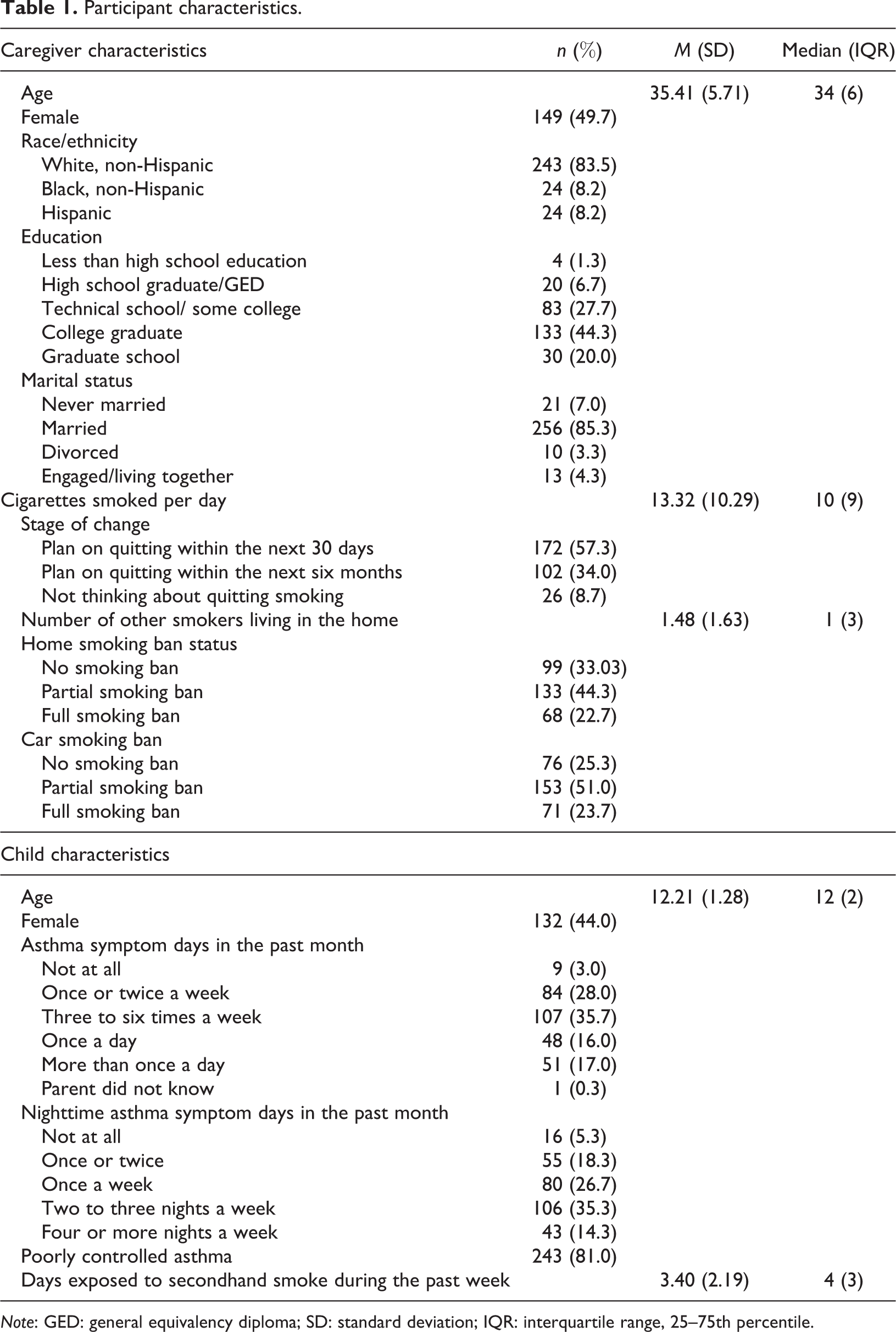
Note: GED: general equivalency diploma; SD: standard deviation; IQR: interquartile range, 25–75th percentile.
Procedure
Once enrolled, parents viewed 12 prototypes of feedback messages focused on eliminating SHSe and TU prevention for their child with asthma. Parents were told that we were developing a program that may use these statements and to rate them as if the messages were created for themselves or their child. No active message personalization was completed because this was an observational, preliminary pretesting study. Table 2 details the messages. Novel messages included feedback to parents about child risk for smoking and feedback to children about parent views on child smoking.
Feedback messages.
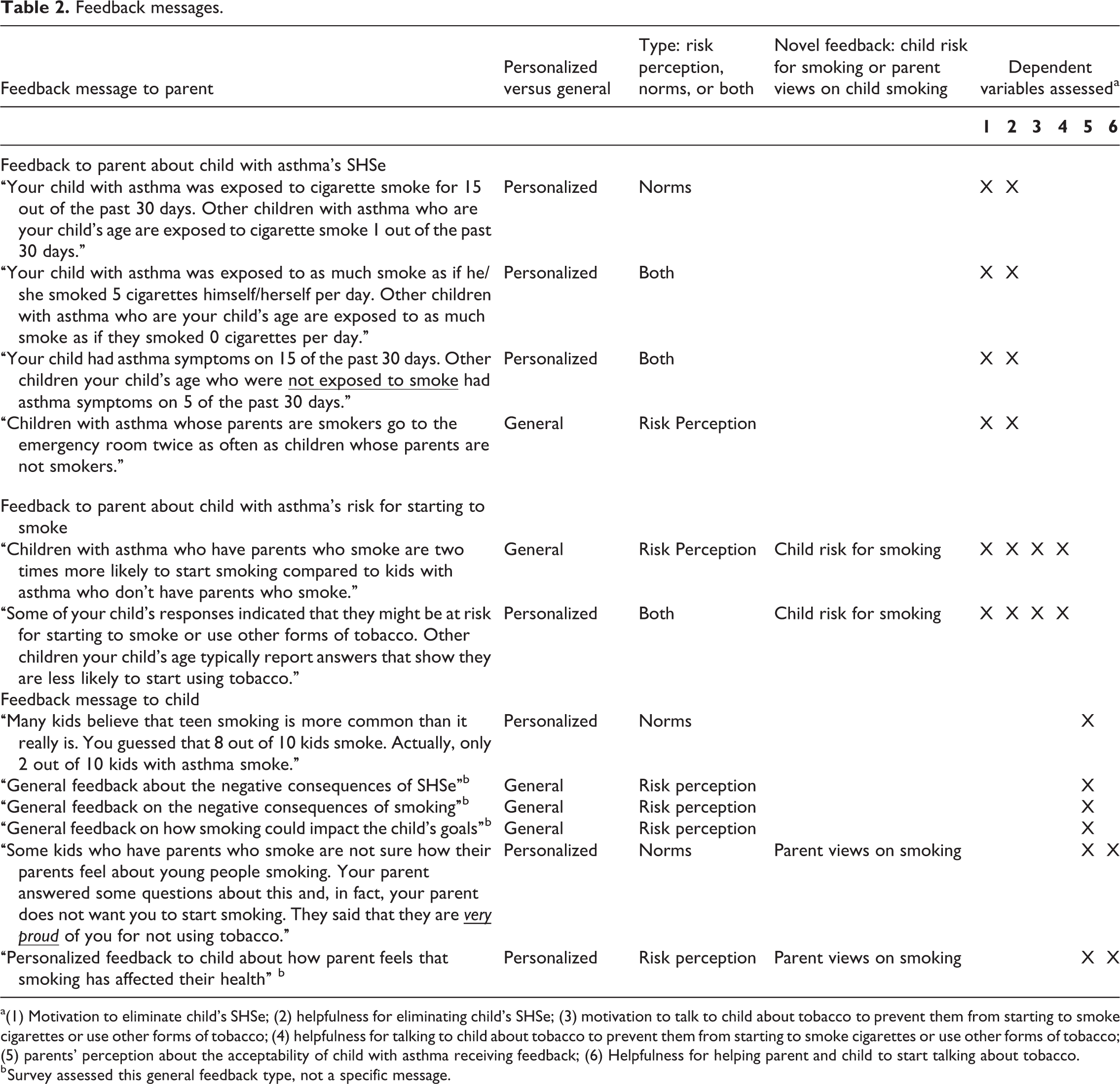
a(1) Motivation to eliminate child’s SHSe; (2) helpfulness for eliminating child’s SHSe; (3) motivation to talk to child about tobacco to prevent them from starting to smoke cigarettes or use other forms of tobacco; (4) helpfulness for talking to child about tobacco to prevent them from starting to smoke cigarettes or use other forms of tobacco; (5) parents’ perception about the acceptability of child with asthma receiving feedback; (6) Helpfulness for helping parent and child to start talking about tobacco.
b Survey assessed this general feedback type, not a specific message.
Measures
Demographics
Parents reported on their sex, race/ethnicity (Black, Hispanic, White), education, and age, and their child’s sex and age. To be eligible, caregivers were queried about whether their child currently had physician-diagnosed asthma. Asthma symptoms were assessed via two questions from the Asthma Control Test (Nathan et al., 2004). The internal consistency reliability of the full five question Asthma Control Test is .84 (Nathan et al., 2004). Children with greater than two days of shortness of breath per week and/or greater than two nighttime awakenings per month due to asthma symptoms were characterized as having poorly controlled asthma (National Asthma Education and Prevention Program, 2007).
Smoking behavior/ history
Parents reported on parent and child lifetime cigarette use and cigarettes smoked per day (CPD). Internet-based smoking assessments have good construct and concurrent validity and reliability (frequency of use: r = .80; CPD: r = .90) when compared to other self-report smoking measures (Klein et al., 2007; Ramo et al., 2011). Parent stage of change was also assessed, that is, readiness to quit smoking in the next 30 days, in the next six months, or not at all (DiClemente et al., 1991). Test–retest correlations range from .93 to .95 (Etter and Sutton, 2002).
Children’s SHSe was assessed by asking on how many days during the past week their child with asthma was exposed to others’ cigarette smoke; parent-reported child SHSe has been positively associated with air nicotine levels (Gehring et al., 2006). Gehring et al. found that the misclassification rate, or the rate of when parent reported child SHSe and biomarkers disagreed, was about 7% (Gehring et al., 2006).
Caregivers also reported on the presence of home and car smoking bans (no smoking allowed, partial ban, or no ban) and the number of other smokers in the home. Children with more smokers in the home have higher cotinine levels (mean cotinine levels for children with no smokers in the home: 1.19 and mean cotinine levels for children with four smokers in the home: 11.06) (Butz et al., 2011). Children with no home smoking bans (4.02) have higher cotinine than children with a full smoking ban (1.62) (Butz et al., 2011).
Parental perceptions about feedback messages
Parents rated each feedback message on the degree to which it would (1) motivate them to eliminate child SHSe, (2) be helpful for eliminating child’s SHSe, (3) motivate them to talk to their child about tobacco prevention, (4) be helpful for talking to their child about tobacco, (5) be acceptable to give the feedback to their child, or (6) be helpful to initiate parent–child conversations about tobacco. Dependent variables were assessed using a Likert-type scale (1–5; e.g. “How much would hearing this information motivate you to…?”). Higher scores indicate higher motivation, helpfulness, or acceptability. Messages are displayed in Table 2.
Data analysis
First, descriptive statistics were completed. The dependent variables were log transformed due to skewness. Second, six repeated-measures general linear models (GLMs) were used to examine within-person differences in how parents rated different messages (Aim 1). One GLM was conducted for each of the six dependent variables (Table 2). Next, analyses focused on examining whether parents’ perceptions about messages differed by covariates (Exploratory Aim). A model building approach was used. Covariates were first examined individually in a series of repeated measures GLMs, in which covariate by feedback type interactions were evaluated. If the interaction had an α of ≤.1, that covariate was included in a multiple predictor model (Harrell, 2001). Covariates included: parent minority status, education, sex, age, CPD, and stage of change; child age, sex, asthma control (well vs. poorly controlled), and past week SHSe; and the number of smokers in the home, home smoking ban status, and car smoking ban status. The Greenhouse–Geisser correction (GGC) was used if the sphericity assumption was violated.
Results
Aim 1: Parental preferences for feedback message types
Preferences for parent-directed messages
There were no statistical differences between parent ratings of the six messages for how motivating (GGC: F(4.72, 1411.66) = .68, p = .63, ηp2 = .002, observed power (OP) = .24; see Online Supplemental Table S3) or helpful these messages would be for eliminating child SHSe (GGC F(4.70, 1405.41) = 1.25, p = .27, ηp2 = .004, OP = .43), regardless of the level of personalization (personalized vs. generic), theoretical background (risk perception, norms, both), or content (information on SHSe, asthma, or child smoking risk). Parents rated the messages about child risk for initiating smoking as similarly motivating (F(1, 299) = 1.80, p = .18, ηp2 = .006, OP = .27) and helpful for aiding them in talking to their child about tobacco (F(1, 299) = 1.78, p = .18, ηp2 = .006, OP = .27). Thus, contrary to our hypotheses, messages that appeared personalized were not rated more favorably than generic messages. Consistent with our hypotheses, feedback about child risk for smoking was rated similarly to other feedback types.
Preferences for child-directed messages
Parents reported that all of the child-directed messages were highly acceptable; no significant differences emerged (see Online Supplemental Table S4; GGC F(4.56, 1363.60) = 1.21, p = .31, ηp2 = 0.004, OP = .41). Regarding the child-directed messages focused on parental views about child smoking, there were no significant differences in parental perceptions about how the different messages would help them talk to their child about tobacco (F(1, 299) = .05, p = .82, OP = .06). Thus, our hypothesis that feedback regarding parental views on child smoking would be perceived as similarly acceptable as other message types was supported; our hypothesis regarding message personalization was not.
Exploratory Aim: Differences in parental preferences for feedback message types based on covariates
Preferences for parent-directed messages based on covariates
First, parental perceptions about how different types of feedback would motivate them to eliminate child SHSe were examined. parent sex, parent age, and child asthma control status were included in the multiple predictor model. Only the Parent Sex × Feedback Type interaction remained significant in the multiple predictor model (GGC F(4.75, 1404.83) = 2.93, p = .01; ηp2 = .01; see Online Supplemental Figure S1A). Mothers rated general feedback about child risk for smoking as more motivating for eliminating child SHSe than personalized feedback on child SHSe.
Next, parental perceptions about the helpfulness of different types of feedback for eliminating child SHSe were examined. The number of other smokers in the home, home smoking ban status, and child asthma control status were included in the multiple predictor model. The number of smokers in the Home × Feedback Type interaction was significant (GGC F(4.71, 1389.50) = 2.97, p = .01; ηp2 = .01; see Online Supplemental Figure S1B). Having more smokers in home was associated with parents reporting that feedback about child cigarette equivalents was less helpful for reducing child SHSe (B = −.006, p = .01).
Preferences for child-directed messages based on covariates
First, parental perceptions about the acceptability of their child with asthma receiving various messages were investigated. Parent stage of change and car smoking ban status were included in the multiple predictor model. Personalized feedback to the child about parent views on child smoking was rated as more acceptable than personalized corrective feedback about youth smoking rates (p = .04) and general feedback about SHSe consequences (p = .03); however, though the multivariate test was significant, the omnibus within-subjects test did not reach significance (GGC F(4.53, 1337.28) = 2.21, p = .058; ηp2 = .007, OP = .69).
The stage of Change × Feedback Type interaction was significant (GGC F(9.07, 1337.28) = 2.55, p = .007, ηp2 = .02; see Online Supplemental Figure S2A). Parents who were not ready to quit smoking rated feedback to the child about parent views on child smoking as more acceptable than personalized corrective feedback to the child about youth smoking rates (p = .005), general feedback about the consequences of SHSe (p = .03), and general feedback about how smoking could impact child goals (p = .04).
The Car Smoking Ban × Feedback Type interaction approached significance, GGC F(9.07, 1337.28) = 1.64, p = .097, ηp2 = .01 (see Online Supplemental Figure S2B). Among those with a partial car smoking ban, parents felt that that it was more acceptable for the child to receive personalized feedback about parent views on child smoking than for their child to receive corrective feedback about youth smoking rates (p = .01), feedback about SHSe consequences (p = .001), or personalized feedback about how smoking affects parents’ health (p = .003). Additionally, parents with full bans generally rated messages higher than parents with partial or no bans. Lastly, only the presence of other smokers in the home was associated with perceptions about how different messages would help them talk to their child (F(1, 298) = 4.12, p = .04, ηp2 = .01): More smokers in the home was associated with parents rating personalized feedback to the child about parental feelings about child smoking as less helpful for talking about tobacco (B = −.006, p = .003).
Discussion
Children with asthma are exposed to SHS (Quinto et al., 2013) and smoke at comparable rates to their healthy peers (McLeish and Zvolensky, 2010). These rates reflect the problematic pattern of intergenerational smoking among families with children with asthma. It is imperative that strategies for breaking this cycle of family tobacco exposure are identified, tested, and implemented to reduce the burden of tobacco in this underserved population. Formative research and pretesting of intervention messages is a critical component to designing efficacious interventions (Campbell et al., 2000; Noar, 2006; Willoughby and Furberg, 2015). This study extends the literature by examining parental perceptions about parent and child-directed prototype feedback messages, including novel feedback types, aimed at reducing child SHSe and child TU uptake among parents who smoke and have a child with asthma.
Overall, all parent-directed messages were found to be similarly motivating and helpful for reducing child SHSe and promoting parent–child conversations about tobacco. Consistent with our hypothesis, feedback about child risk for smoking was rated similarly to other feedback types. This is the first study to document that parents who smoke and have a child with asthma are receptive to and motivated by feedback that informs the parents that their child is at risk for using tobacco. Parents rated this novel feedback highly for reducing child SHSe and talking with them about tobacco, both important anti-tobacco socialization strategies. Child susceptibility to TU (i.e. intentions to use tobacco, curiosity about tobacco) has repeatedly predicted later TU (Strong et al., 2015), including among children with asthma (Van De Ven et al., 2007a,b). Interventions could potentially provide parents feedback about children’s susceptibility to TU and promote strategies for decreasing child risk for TU, including antismoking socialization (Jackson and Dickinson, 2006).
Parents rated all child-directed messages as highly acceptable for their child with asthma, supporting our hypothesis that feedback on parental views on child smoking would be perceived as similarly acceptable as other messages. Parents were open to their children receiving information that could help them to both reduce their SHSe and remain tobacco free. More research on child-focused strategies for reducing SHSe (e.g. SHS avoidance (Hovell et al., 2011)) and future TU among children with parents who smoke is warranted (Jackson and Dickinson, 2006).
Parents also rated the novel child feedback content (i.e. personalized feedback to child about (1) how the parents feels about the child smoking and (2) how smoking has impacted their parents’ health) as highly helpful for promoting parent–child conversations about tobacco. In the model with covariates, parents reported that the most acceptable feedback for their child with asthma to receive was the personalized feedback to the child about parental views on child TU, though this only approached significance. This is notable, given that children exposed to antismoking socialization through parents report less smoking (Chassin et al., 1998) and that increasing family antismoking socialization decreases child smoking initiation among children with parents who smoke (Jackson and Dickinson, 2006).
Taken together, our data suggest that parents are receptive to a parent–child feedback intervention experience. Parents reported that they would benefit from receiving feedback about their child’s risk for smoking (which requires an assessment of child susceptibility to TU) and were open to their child receiving feedback about how they feel about the child smoking (which requires an assessment of parental perceptions about child smoking). This type of intervention has the potential to be delivered across multiple settings, including medical appointments, asthma education sessions, schools, and emergency room visits, and the potential to be delivered by multiple types of providers (e.g. physicians, nurses, social workers, psychologists, school nurses). To the best of our knowledge, no research has examined the potential of a parent–child dyadic feedback intervention; this is an area for potential future research.
Contrary to our hypothesis and to prior research (Krebs et al., 2010; Noar et al., 2007), messages that appeared personalized were not rated more favorably than messages that appeared generic. Our study design precluded our ability to make exact comparisons based on personalization, however, because more than just the level of personalization differed between messages. The lack of detected differences may also be partly explained by the lack of active message personalization, which may have reduced the message saliency, or the lack of power. On the other hand, these results may reflect parents’ motivation to reduce their child tobacco exposure and receptivity and need for information about how to do so (Clawson et al., 2018a).
Our study also evaluated how covariates were associated with parental perceptions about feedback message types. Parents found different messages the most motivating for reducing child SHSe: Mothers preferred general feedback about child risk for smoking over personalized feedback on child SHSe. Overall, both mothers and fathers rated all parent-directed messages as highly motivating and helpful for reducing child SHSe and future TU; interventions that include varying types of messages may maximize parental behavior change.
Parents with additional smokers in the home found feedback on child cigarette equivalents similarly motivating for reducing SHSe as other messages but found it less helpful. This may be due to their concerns about changing the smoking behaviors of other individuals in the home. These families may benefit from interventions that increase self-efficacy for utilizing household-based SHSe reduction strategies, for example, smoking bans and from tobacco interventions that incorporate multiple family members. Several SHSe interventions were designed to be open to including multiple family members; however, the details of the success of including multiple family members are often lacking in articles (Baxi et al., 2014). There are examples of SHSe interventions that have successfully involved multiple family members, including interventions focused on Mexican-American households (Prokhorov et al., 2013) and urban families with a child with asthma (Halterman et al., 2011).
When evaluating covariates for the child-directed feedback message types, a preference for the novel feedback on parental views on child smoking emerged among subgroups of parents. Parents who were not ready to quit smoking (and potentially parents with partial car smoking bans) rated personalized feedback about how the parent feels about the child starting to smoke and the child currently not smoking as more acceptable than various other types of child-directed feedback. These results highlight that parents who are unmotivated or only somewhat motivated to reduce child SHSe are very receptive to their child with asthma receiving feedback that informs the child that even though their parents smoke, they do not want them to start using tobacco. This is consistent with prior research with healthy youth that demonstrated the success of tobacco prevention interventions focused on families with a parents who smokes (Jackson and Dickinson, 2006). Unfortunately, similar to the relationship seen with parent-directed feedback, additional smokers in the home deteriorated how much parents found this feedback helpful for talking to their children about tobacco.
Limitations
Several limitations warrant consideration. Using an online platform capitalized on our ability to assess parents of children at heightened health risk and to minimize potential social desirability. Nevertheless, our results may still be influenced by inaccurate reporting; however, research has indicated that data obtained via online panels are comparable to data collected via other online or laboratory methods (Mason and Suri, 2012). Our sample was highly educated and predominately White, limiting the generalizability of the results. All of the parent-directed messages were between a 6th and 10th grade reading level; therefore, it is possible that individuals with less education or more reading difficulties would have a more difficult time with understanding the intervention messages. Additionally, it is possible that our sample may be more willing to utilize technology given that were recruited through an online sampling procedure. Our data provide preliminary support for the use of the prototype messages for a high-risk population, however, it is critical that future studies include a more diverse sample. Future research should utilize a clinical asthma evaluation, the gold standard for asthma assessment (National Asthma Education and Prevention Program, 2007). Our study did not utilize active personalization of feedback due to the observational nature of the study; future studies could examine perceptions to messages that are actively personalized. Previous research that utilized personalized messages may be helpful for informing future research aiming to test personalized messages (Borrelli et al., 2010, 2016; Walker et al., 2007). Future studies should also do pretesting of these feedback messages with children with asthma who have parents who smoke; qualitative methods with parents and children with asthma may also be beneficial for further development and testing of intervention messages. These data provide a preliminary foundation for developing a dyadic feedback intervention for parents who smoke and their children with asthma to help these high-risk families break the intergenerational transmission of TU. Controlled trials are then needed to evaluate the effectiveness of these messages at promoting behavior change, for example, SHSe reduction, tobacco prevention, and parent–child conversations about tobacco.
Conclusions
Overall, parents who smoke and have a child with asthma were receptive to various feedback message prototypes for helping reduce their child’s current and future tobacco exposure, including both established and novel feedback types. This is the first study to document that this population is receptive to, and motivated by, feedback that informs the parents that their child is at risk for starting to use tobacco and that informs the child about parental views on smoking. Taken together, these formative data suggest that (1) both existing and novel feedback types should be explored as mechanisms for reducing family tobacco exposure and (2) parent–child feedback interventions that target both child SHSe and tobacco prevention may hold promise for breaking the intergenerational transmission of smoking among these high-risk families.
Supplemental material
Supplemental_material - Smokers with children with asthma: Parental perceptions about prototype intervention messages focused on reducing child tobacco exposure and use
Supplemental_material for Smokers with children with asthma: Parental perceptions about prototype intervention messages focused on reducing child tobacco exposure and use by Ashley H Clawson, Elizabeth L McQuaid, Shira Dunsiger and Belinda Borrelli in Journal of Child Health Care
Footnotes
Declaration of conflicting interests
The author(s) declared the following potential conflicts of interest with respect to the research, authorship, and/or publication of this article: Dr Clawson is now employed at Oklahoma State University.
Funding
The author(s) disclosed receipt of the following financial support for the research, authorship, and/or publication of this article: This study was funded by 5 T32 HL076134-09 (R Wing, PI) and was completed when Dr Clawson worked at the Centers for Behavioral and Preventive Medicine and the Bradley/Hasbro Children’s Research Center.

Supplemental material
Supplemental material for this article is available online.
References
Supplementary Material
Please find the following supplemental material available below.
For Open Access articles published under a Creative Commons License, all supplemental material carries the same license as the article it is associated with.
For non-Open Access articles published, all supplemental material carries a non-exclusive license, and permission requests for re-use of supplemental material or any part of supplemental material shall be sent directly to the copyright owner as specified in the copyright notice associated with the article.
