







Abstract
This article explores the images of starving children through a case study, the annual World Press Photo competition. The figure of a child in need is familiar from humanitarian discourses, but despite its familiar trope, it bears powerful affective meanings, especially in relation to the notions of innocence, vulnerability and futurity. In this study, the notions are discussed in the framework of five photographs of child malnutrition that were selected as the World Press Photo of the year in 1974, 1980, 1992, 2001, and 2005. The aim of this article is to discuss the complex and disturbing ways these photographs affect the viewer. While they invite the viewer to take part in a global project of constructing a better world, they also may hide difficult questions of global inequality and structural violence behind a series of individual events about personal suffering and loss.
Introduction
The figure of a starving African child is familiar in the contemporary Western visual tradition. It is often used as a trope in photojournalism and in charity campaigns, and as an illustration in non-governmental and humanitarian aid organization booklets. In this article, I discuss how the figure of a starving child is used as a uniting and universal figure, forming a medium around which contemporary moral conventions are negotiated. My reading is focused on a case study, the awarded photographs of child malnutrition in the World Press Photo competition. I ask how the child in need validates the fantasy of a shared world, and how it encourages the viewers to think that the world could be changed through the distribution of information and sentimental alliance (Berlant, 1998: 645, 656). My intention is not to challenge this alliance as such, but rather to draw critical attention to its ambiguity. As I will argue, while affective photographs of children in need encourage the viewer to take part in constructing a better world, they may also postulate that a solution to cruel global inequalities lies in private feelings and gestures.
The child as a figure is an extremely powerful political metaphor in all its innocence and fragility. Therefore, it is often used to constitute a ‘concerned international community’ with a relationship premised of generosity rather than indifference (Ahmed, 2004: 21, 192; Edelman, 2004: 2, 11; Malkki, 1996: 378). Global humanitarianism and its ways of using aesthetic images of suffering have been criticized widely before, mostly for their moralistic yet cynical tone, and tactical use for political purposes (Baudrillard, 1994; Boltanski, 1999). It has also been argued that the glorification of suffering encourages cultural narcissism (Chouliaraki, 2010). I take these criticisms seriously, but I will elaborate their view of aesthetic images of suffering as solely objects of consuming by focusing also on the affinitive and productive nature of the selected World Press Photo winners.
The awarded malnutrition photographs in the World Press Photo are, in a word, ‘sticky’ (see Ahmed, 2004). They are skilful news photographs, which not only appeal to the viewers for their aesthetics but also because they form an impressive photojournalistic story. Consequently, as the viewer is the one whom the photographs ‘stick’, I will discuss how the question of privileged witness could be theoretically dealt with. With this article, I wish to contribute to the discussion of liberal sentimental politics and the witnessing of the suffering of others. Following Lauren Berlant (1999), I ask whether the World Press Photo winners encourage unproductive moralism based on liberal and subjective ideas of shared humanity and ‘feeling good’ or ‘feeling bad’ (p. 58). Nevertheless, I will also ponder the possibilities for an ethical relationship towards these photographs which, as I will argue, would take into consideration contexts, histories and injustices of colonialism and late capitalism.
The World Press Photo is a highly appreciated competition of high-quality news photographs, and therefore, there are several issues one could touch upon. This article does not look at the question of ‘truth’ in news photography, and nor will it ponder if the photographs in question are ‘good’ in an aesthetic or technical sense. Instead, I will focus on the content and the representational strategies in the photographs awarded. Established in 1955, the independent non-profit World Press Photo organization has awarded hundreds of photographs during the years. Each year, an international jury of professionals in the field of photography selects roughly 100 pictures among thousands of photographs and awards them in different categories, nominating one photograph as the World Press Photo of the year. Recently, all the awarded photographs have been arranged into an Internet archive gallery, the World Press Photo archive, which comprises some 10,000 images and half a century of human history. 1 From the archive, one can discover that there is one trope that has won most awards in the category of the World Press Photo of the year: child malnutrition. These photographs are five in total, taken in the years 1974, 1980, 1992, 2001 and 2005. All of them will be discussed and further elaborated on in this article.
In a photography competition such as the World Press Photo, the question of vision and power becomes inevitable. It is important to ask who gets represented by whom, and how these representations are attached to Western visualizing practices (Haraway, 1991: 188–196). Amidst the contemporary flow of images, the photographs awarded in the World Press Photo receive high publicity and attention: the winners make headlines around the world and take part in the World Press Photo exhibition, with over 2 million visitors in 45 countries over the course of a year. 2 Consequently, the World Press Photo competition is not ‘just’ an exhibition of high-quality photographs, but it is also a route to discuss certain themes globally. Hence, some of the most iconic photographs in the Western visual tradition have been awarded in the World Press Photo, such as a Buddhist monk who has set himself alight (1963), a naked girl running after a napalm attack in Vietnam (1972) or a sole demonstrator standing in front of tanks on Tiananmen Square (1989).
In this article, the awarded child malnutrition photographs from the World Press Photo competition work as a material through which the following themes will be addressed. First, I propose that the images of child malnutrition are productive, as they create a myth of a world without boundaries. This myth, I suggest, is supposed to unite the viewer to the constructed concerned international community. Second, I develop critical theories that consider the role of the mother in the construction of overcoming differences. Third, I will draw attention to the relation between liberal sentimental politics and Christian tradition. Finally, I consider the notion of modest witness and the politics of shame as an example of forming an ethical relationship for the photographs of child malnutrition.
The children of the world
A typical critique of the photographs of suffering African children draws attention to the namelessness of the photographed. The first photographs of child malnutrition awarded in the World Press Photo competition illustrate why this critique has been established. The first malnutrition photograph was awarded in the World Press Photo exhibition in 1974 (Figure 1). The photograph is taken in Kao, Niger, by Ovie Carter (USA), and the caption for the image is short and concise: ‘Faces of hunger. A mother comforts her child, both victims of drought’. 3 Although the photograph portrays a horrible fact of malnutrition, the photograph itself is peaceful and beautiful with a description of motherly comfort in desolate situation. The beauty in the photograph is enforced with the ethnic style jewellery and black and white aesthetics. The ethnic style jewellery could be interpreted as the marking of difference while the motherly touch evokes the feeling of universal nature of motherly care (Malkki, 1996: 388). With these aesthetic and representational strategies, the photograph manages to combine affectively the universal and the particular, the global and the local.
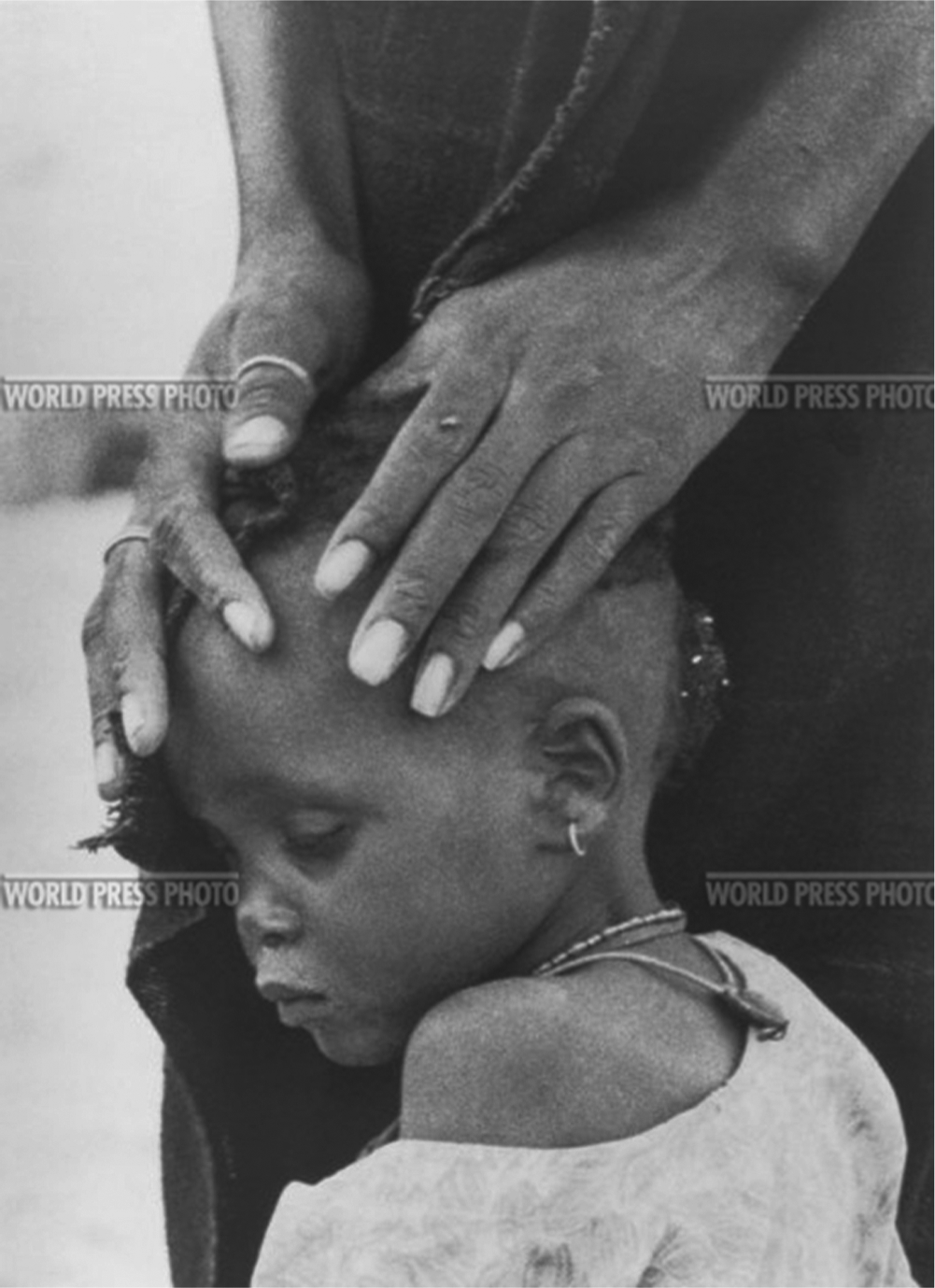
The faces of hunger. A mother comforts her child, both victims of drought (1974).
The critique of namelessness could be enhanced when analysing the next awarded photograph, the World Press Photo in 1980 (Figure 2). It is a photograph taken in Uganda’s Karamoja District by Mike Wells (UK). The location, however, is the only context the viewers are provided with. The caption of the photograph states only that it is a portrait of ‘a starving boy and a missionary’. 4 The impersonal and metaphoric nature of a starving boy is reinforced through the framing, which allows for nothing but two hands in the picture, hand in hand. Underneath, as the hand that seems to control the situation, there is a white hand of a missionary. Usually, the ‘face of hunger’ is quite literally a face, but in this photograph, both the actual face of hunger and the face of aid are left for the viewer to imagine. The photograph uses affectively binary oppositions and colonial traditions familiar to the Western visual tradition. Later on, for example, United Colors of Benetton and the photographer Oliviero Toscani have used similar imaginary. With it, they have been able to form a brand based on a thought-provoking advertisement which plays with dichotomies and overcoming them (Lury, 2000: 150; see also Kaplan, 1999: 143). This shows that the colonial history and Western binary thinking can be used as a resource which both questions and reproduces dichotomic thinking.
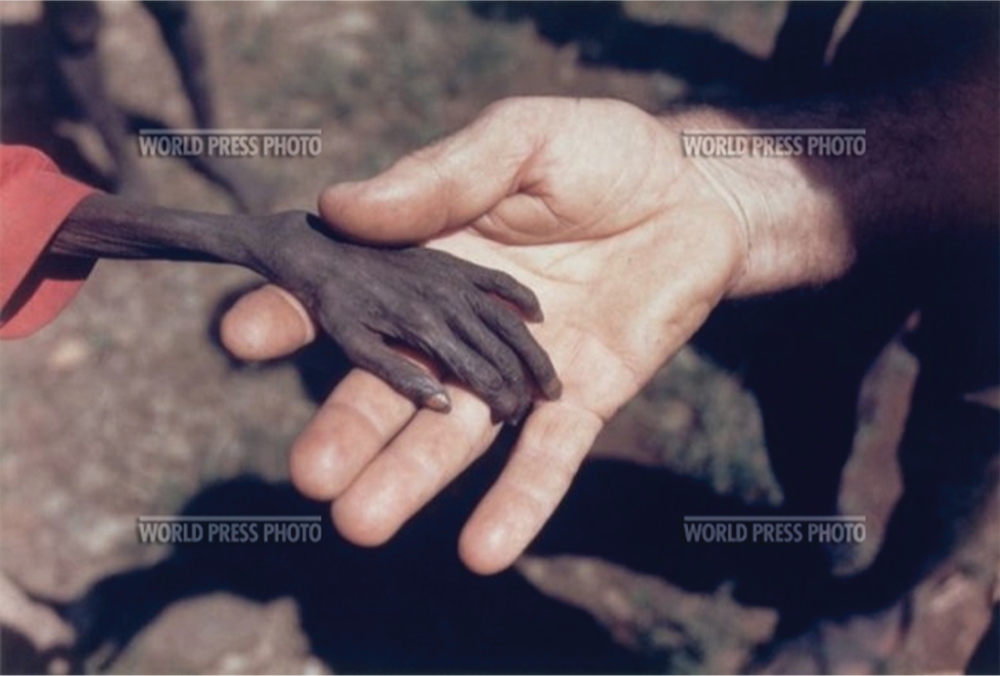
A starving boy and a missionary (1980).
Admittedly, the use of dichotomies is affective. Yet it also raises the question of outcontextualization. Although the World Press Photos of the years 1974 and 1980 are thought provoking, they take part in reproducing and establishing a tradition of photography in which certain contextual events in Africa are extrapolated from the specific social and political contexts and re-embedded into an abstract story of globality (Lury, 1998: 68). In this process, the child becomes a child, a nameless example, the one who makes the viewer cry, though any other child could have done the same (Boltanski, 1999: 11–12). Consequently, the child becomes a metaphoric and generic figure that works as a medium for overcoming differences. Within this framework, the hand or the face of the starving child becomes the hand or a face of any child, even a child that ‘could be mine’ (Ahmed, 2004: 192–193). The bond between the viewer and the sufferer is thus based on the illusion that care is only a matter of warm feelings.
When the bond between the child and the viewer is formed, the child becomes a virtuous victim who ought to be saved. Through established practices of humanitarian representations she or he becomes an object of fascination and disavowal around whom history ought to be organized, and for whom, the world is not good-enough (Berlant, 1999: 56; Malkki, 1996: 389). To the viewer, the photographs, such as the World Press Photos from 1974 and 1980, tell an affective story which invites the viewer to become a conscious political actor, sympathetic attendant in a story where the ‘I’ of the individual story becomes the ‘we’ of the grand narrative of globality, and where ‘the heroic subject now liberates him/herself from ignorance’ (Stacey, 2000: 136). I am not suggesting that this ‘liberation from ignorance’ would be problematic in itself, but rather I want to remind that the liberation is often done through practices of philanthropy and charity that may hide the more complex economic and political connections between the viewer and the suffering children of the world.
The World Press Photos are, then, ambiguous. They are quotidian objects of mass consumption, but they also have their productive side as they produce fantasies of boundarylessness and reinforce the myth of a ‘world without boundaries’ (Kaplan, 1999: 151). The notion of shared world invites us to protect it, which might explain why the trope of a suffering child is usually aesthetic, subtle and calm. The sentimental alliance, as I will elaborate in the following section, forms powerfully through the notions of beauty and vulnerability and awareness of risks that threatens them. Sarah Franklin et al. (2000: 30–31) refer to this mixture of threats and glorification of shared humanity as ‘panhumanity’, an ideology which can be interpreted as a construction of one coherent narrative established in the West. Therefore, the possibly problematic side of the World Press Photos is not only the lack of naming or the certain way of framing, but rather the ways they are attached to colonial histories and representational strategies.
On not having a voice
The debates on the namelessness of news photographs seem to have had an impact on the representational strategies in the World Press Photo competition. After the World Press Photos 1974 and 1980, the awarded photographs of child malnutrition have been contextualized more extensively. The most recent example of this change is the World Press Photo 2005 (Figure 3). The picture was taken at an emergency feeding centre in Tahoua, Niger, by Canadian photographer Finbarr O’Reilly. 5 The photograph contains some similar representational strategies as the World Press Photo of the year 1980, as it is framed to show only the hand of the starving 1-year-old Alassa Galisou. Hence, it has the same theme the World Press Photo 1974 had, as it is a description of motherly touch with ethnic references. The mother, who in this case has a name, Fatou Ousseini, is framed as the visible subject in the photograph.
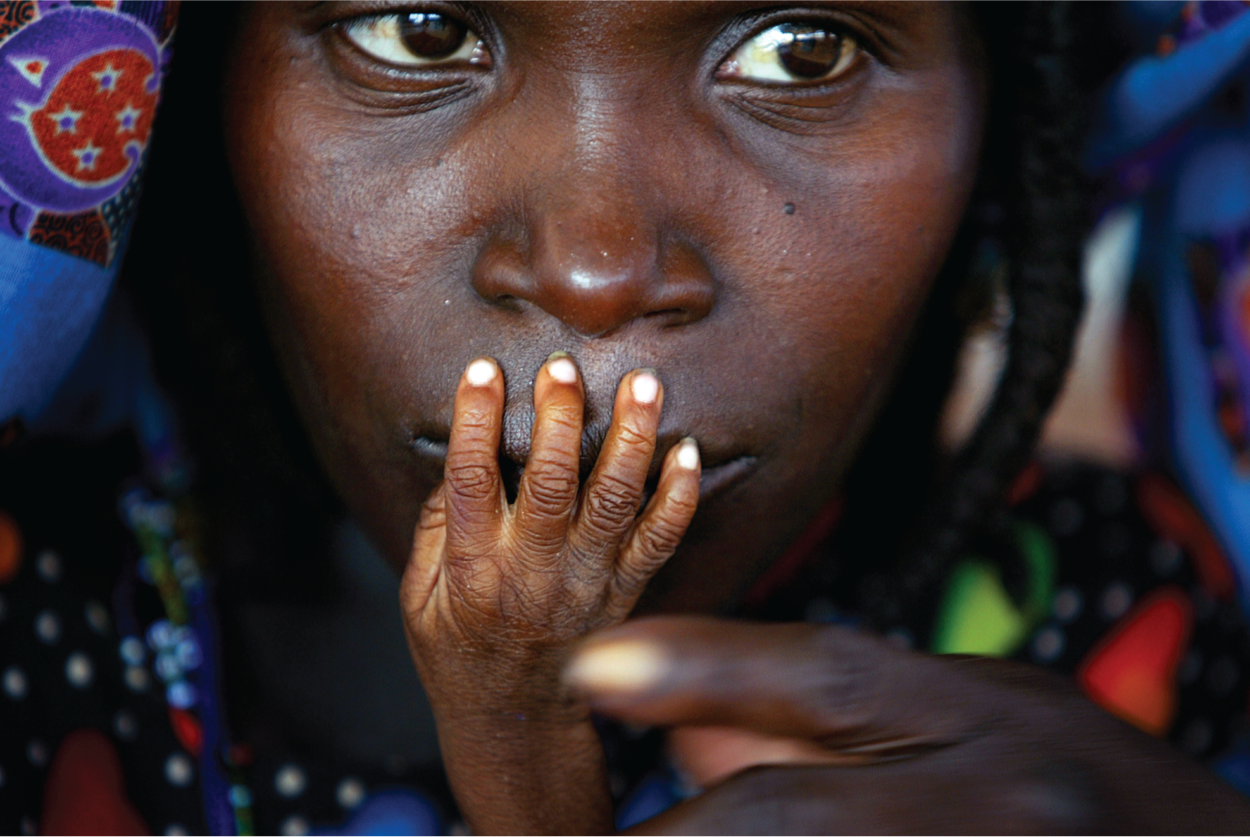
The fingers of malnourished 1-year-old Alassa Galisou are pressed against the lips of his mother Fatou Ousseini at an emergency feeding centre (2005).
The World Press Photo of the year in 2005 is provided with quite an extensive story around it. According to it, the photograph was taken in an area where people experienced one of the worst droughts in recent times that left millions of people severely short of food. The relief was slow to come, partly because of heavy rains, and it led to accusations that the United Nations, Western governments, and local aid workers and officials in Niger, failed to respond early enough to an imminent crisis. Yet, in the World Press Photo 2005 awarding ceremony held in 2006, the aesthetics of the photograph were highlighted rather than the context. Jury Chairman James Colton described the winning photograph with Alassa Galisou and Fatou Ousseini as follows:
This picture has haunted me ever since I first saw it. It has stayed in my head, even after seeing all the thousands of others during the competition. This image has everything – beauty, horror and despair. It is simple, elegant and moving.
6
In the exhibition catalogue World Press Photo 06, Colton (2006: 9) elaborates the statement further, as he describes the photograph as complex and simple at the same time. He also reminds the viewers of the political potentiality the photograph has, as it describes the easily forgotten ongoing tragedy of child malnutrition. Indeed, the grounds for awarding the photograph are just: often the ongoing fact of child malnutrition gets forgotten because there is more explicit violence that gains worldwide media attention. Therefore, a photography contest such as the World Press Photo can be a powerful political tool. It materializes otherwise distant events – such as child malnutrition –through the material-semiotic process of viewing (Haraway, 1997: 174).
Colton’s statement, however, is filled with disturbing dualisms: it highlights the cruelty of life (the horror and the despair) while, on the other hand, it emphasizes the sacredness of it (the beauty and the elegance). It is striking that Colton did not use the notion hope as opposite to despair, but rather he stressed the beauty the photograph has. On the one hand, the combination of global need and natural beauty is an effective composition when talking about images that should empower people to act and take part (Stacey, 2000: 126). On the other hand, it can be argued that the photograph is a description of the lack of hope. In this case, the hand of Alassa Galisou makes an act of silencing, as it is pressed against the lips of Fatou Ousseini. If the gesture is compared with the two hands of the World Press Photo in 1980, it can be argued that the World Press Photo 2005 creates more suspicion towards the possibilities of connection. Although the question of not having a name seems to be answered, it has incorporated new nuances of not having a voice.
If the World Press Photo 2005 is interpreted as a representation of muteness, its acclaimed ‘answers’ remain vague. This is not to say that the photograph itself remains distant, but on the contrary, as the photograph is extremely intimate. The intimacy in the photograph is formed through the relationship between the mother and the child, and the intimate framing that allows a close look at Fatou Ousseini’s face. Therefore, her position on the photograph is strong – even though it could be seen as muted and therefore voiceless. The story in the photograph is told through the starved hand of Alassa Galisou. The hand is the wound through which Fatou Ousseini becomes the subject with authority: a mother who holds her dying child (see also Malkki, 1996: 381). Adapting an idea from Gayatri Spivak (2006: 252), she is an object other to us until she enters the arena of loss that can only happen to a mother, when she emerges as ‘a terrifying superobject’, the most powerful ‘subject’. In a way she ascends to a holy, yet cathartic, position of those for whom the accident has already happened, confirming the ‘objectivity of the subjective under late capitalism’ (Massumi, 1993: 12). It is her loss the viewer witnesses, but through ‘panhumanist’ discourses, her loss becomes a shared loss. Therefore, it is a loss that ‘keeps on haunting us’, as Colton remarks.
I am trying to highlight here that although the subject of a photograph is literally and metaphorically silenced, there are strategies of representation that make the photographs ‘speak’ on behalf of the subject. The trope of losing a child is one of these strategies. This has also been noted by Lauren Berlant (1998: 644) who, in her reading of Uncle Tom’s Cabin (1852), writes how the mother may transform ‘into a species of superperson’ when she occurs in a story filled with suffering, witnessing and the sublimity of nature. Thus, the position of the mother opens up the possibility to discuss how explicitly women’s bodies are attached to political, racial and economic power relations (McClintock, 1995: 47). The combination of beauty, elegance and raw brutal nature is familiar especially to Western Christian discourses. Within these discourses, the protection of the children of the world goes hand in hand with the moralistic lament of the wealthy about the lack of family planning especially in sub-Saharan Africa (Haraway, 1997: 204–205). In this context, the malnutrition becomes ‘their’ problem down there – as witnessing and ‘fixing’ it becomes the problem of those privileged.
Feeling politics and virtuous victims
Although a photograph in itself would not have a strong subject who looks appealingly straight towards the camera, there are representational strategies, which still make the victims tell their story disarmingly. One of these strategies is to let the bodies and wounds ‘speak’ by raising them to be the subjects of the photographs. It has even been argued that there lies a special truth in diseased and damaged bodies, as they appear as the most powerful and necessary testimonials against power (Braidotti, 2002: 206–207; Foster, 1996: 123; Malkki, 1996: 384). In what follows, I will analyse from this point of view two World Press Photo winners from the years 1992 and 2001. Both photographs are perfect illustrations of telling an affective story through the body of a child without explicit violence and atrocities.
The World Press Photo from 1992 is a photograph taken by James Nachtwey (USA) in the aftermath of a bad drought in Bardera, Somalia. 7 In the picture, a mother carries her dead child to the grave, after wrapping it in a shroud according to local custom. According to the caption of the image, the civil war caused a terrible famine in Somalia, which claimed the lives of between 1 and 2 million people over the period of 2 years, more than 2000 a day in the worst affected areas. In the black-and-white photograph, the starved body of a child is wrapped in a shroud, and the mother is laying it on the ground. The framing of the photograph reveals only a beautiful, yet dry and hence desolate desert, which intensifies the impression of encompassing silence. The photograph has an atmosphere that could be named as sublime. This, as I will argue, is the strength and the problematic side of this photograph. As a representation of the fragility of life, the photograph is likely to lead the thoughts of the viewer rather to sacral ideas than to secular notions of contemporary world politics.
The World Press Photo winner in 2001 is as ambiguous as the World Press Photo 1992. It is a photograph taken by Danish photographer Erik Refner. 8 The photograph is extremely intimate with a dead child framed in the middle of it. The child is a 1-year-old boy who died of dehydration, and whose body is prepared for burial at Jalozai refugee camp, Pakistan. The photograph is taken from above, revealing only the child and the hands of three adults who have washed and wrapped the child’s body in a white funeral shroud, according to Muslim tradition. The adults are family members who have allowed, as the caption explains, the photographer to attend the funeral. The caption for the image is exceptionally extensive. It states, for instance, that in the overcrowded Jalozai camp 80,000 refugees from Afghanistan endured squalid conditions. Decades of political instability and drought drove millions of people over the border into Pakistan. By June, Jalozai could not cope with the numbers, and food and shelter were scarce. Although relief workers tried to provide basic health services, children died from diseases or dehydration. Eight months later, the United Nations closed the camp and moved refugees to other areas.
The obtrusiveness of the two photographs is created by a devout atmosphere. In both photographs, the atmosphere is calm and subtle, and the viewer is positioned as a bystander – not so much as an intruder but as a witnessing bystander. The World Press Photo 2001 forms a powerful feeling of belonging as it seems to invite the viewer to mourn and wash the body together with the victims. This opens up a possibility for affective attachment and affinity, but it also highlights the problems of intersubjectivity. Thus, both of the photographs invite deconstruction of the Christian metaphors evident in them. This happens, in particular, in the case of the World Press Photo 1992, which resembles the Pietà sculpture of Michelangelo, in which Mary holds crucified Jesus. In a way, both of the photographs represent the end and the possibility for new – and perhaps more ethical – beginning, similar to conventional Christian stories. Yet the form of this beginning is troubling: do the witnessing and the feeling of affinity lead to ‘political as acts’ or an intensification of ‘a world of private thoughts, leanings, and gestures’ (Berlant, 1998: 641)?
As both of the photographs are built around a dead child in a manner that makes the child look almost like an offering, the child becomes a powerful figure of pure innocence trapped in the middle of the turbulences in contemporary world politics. These politics, as the international community is well aware of, have turned out to be inefficient in handling the issue of child malnutrition. The World Press Photos materialize this brutality of contemporary reproductive politics where on the one side of the coin, there are ‘the intensely cultivated fetuses, located at the center of national culture and portrayed as individuals from fertilization on’, and on the other side of the coin, there are the throwaway fetuses and dead babies located ‘down there’ and known only as ‘angels’ (Haraway, 1997: 204). Therefore, the figure of a child becomes ‘superpolitical’, a trigger of true feeling, which can be worked out without being worked through (Berlant, 1999: 57–58). This is an essential problem in liberal sentimental politics, which has been widely criticized for ‘wounded attachment’: an outcontextualized over-identification with the pain of the other, which may turn the structural and contextual violence into a series of individual events about personal suffering and loss (Brown, 1995: 70; Malkki, 1996: 387; Skeggs, 2004: 58–59).
The ambiguity, then, is to be found not only in the representational strategies of the World Press Photo winners but also in liberal sentimental politics. There is no question that a promise given for a better future can be an optimistic attachment at heart. Yet in the historical and political contexts of contemporary capitalism, also the cruelty included in the promise should be carefully examined. In her theory of ‘cruel optimism’, Lauren Berlant speaks about projected possibilities, which ‘create a fake present moment of intersubjectivity’ that ‘is made possible by the fantasy of you, laden with the x qualities I can project onto you’. These possibilities can lead to the situation where it is the speaking subject who elaborates its boundaries, ‘so s/he can grow bigger in rhetorical proximity to the object of desire’ (Berlant, 2011: 25–26). If the World Press Photos are read through the Christian and liberal discourse, it should not be left unnoticed that the sacrifices they place in the front of the viewer might work as redemption.
To elaborate my claim of the possible redemption, I follow Lynne Pearce (2010: 156) who has reworked the notion of ‘cruel optimism’ as a troubling problem in the collective expectations, which have been created in the situation of ‘hopeless hope’. If we think that the awarding and circulating of these photographs contains a promise for a better world, we may also pose the question of whether this optimism is meaningful only to the witnesses – the viewers ‘with conscience and/or agenda’ – and whether it is cynical type of hope already ‘inscribed by loss’ (Pearce, 2010: 156–157). Posing this question does not have to mean either cynicism or making the hierarchical division between ‘bad’ emotional and ‘good’ rational reactions. Rather, it aims at re-thinking the content of the word ‘act’. The true feeling in front of explicit injustices as an ‘act’ raises a question of what kind of cultural criticism is needed in the contemporary Western tradition, which has elevated – especially after the Holocaust – subjective psychic pain as one of the prominent features of political and aesthetic discourse (Nelson, 2004: 220). How could the subjective psychic pain be encountered before virtuous victims establish something other than a self-referential cathartic space, in which witnessing suffering forms a firm position that does not need further elaboration or contextualization?
Modest witness revisited
After the book On Photography (1977) by Susan Sontag, witnessing suffering has been one of the key themes in the discussion considering photojournalism. The commonly used phrase is that the flow of images has lowered the tolerance of viewers and therefore even seeing explicit suffering does not have affectiveness. In my reading of the World Press Photo winners, this argument seems not to apply. The photographs are, due to their aesthetic strategies, tropes and cultural connotations, extremely affective. Moreover, suggesting that ‘we’ are or someone is numb is also suggesting that there is something ‘wrong’ and ‘correctable’ that ‘a dose of proper feeling might rectify’ (Dean, 2003: 108). As if there would be one ‘right’ answer to respond to the sufferings of 1-year-old children. Furthermore, the presumed passivity in witnessing poses ethical questions of the ways it tends to be located in the bodies of those whom we have given up (Ahmed, 2010: 209). It leads us to believe that the aesthetic of trauma and the wrong reaction of it would mean moral failure in the community the witnesses are supposed to form. For me, the problem in witnessing trauma is not so much the immediate reaction it is supposed to cause, but whether the reaction is followed by intellectual and psychological cathartic comfort.
There are several arguments that elaborate this line of thought. For example, Rosi Braidotti (2002: 207) states that the aesthetic of trauma is actually not the epitome of the cultural impoverishment of today, but it can also be a possibility for formulation of resistance. This, however, demands for hard intersection of questions and a strong epistemological position from which they can be asked. As I see it, this is the position Donna Haraway (1997, 2000: 158–161) tries to conceptualize when she advocates a feminist modesty, a notion different from traditionally female modesty (i.e. being out of the way), and traditionally masculine modesty (i.e. being a credible witness). In this dualistic tradition, the viewer and the witness are often expected to seek connections through either a true feeling or expert knowledge. Yet connections can be made also through history and listening (Malkki, 1996: 398). Feminist modesty, then, would mean taking a strong epistemological yet modest position to World Press Photo photographs through affinities and political and historical contexts.
Particularly in the case of the World Press Photo, the contextualization of sufferings is crucial. One of the disturbing facts, which should not be forgotten here, is that the photographs I have analysed are put to compete with thousands of other news photographs. The competition with representations of sufferings is dubious at heart, but it is still worth pondering how it brings into discussion the essential problem between witnessing as being there, and the outcontextualization written in the nature of photographs taken in one particular moment and then judged on a very different context. This is also a question that Mike Wells, the winner of the World Press Photo 1980, raised after winning the competition. According to Mr Wells, the same publication that sat on his picture of the starving boy and a missionary for 5 months without publishing it entered it into a competition. He was embarrassed to win as he never entered the competition himself and was against winning prizes with pictures of people starving to death. 9
The acclaimed shame of Mike Wells can be analysed as a political statement. As I interpret it, shame here refers to something more than just an individual act of shaming: it refers to colonial histories and the powers to represent and be represented. The politics of shame follows the writings of Elspeth Probyn (2005: xii–xiv), in which she states that although shame can be looked as a capacity that all people share, it is not automatically a ‘good’ feeling or something that works as a bond between entities. Hence, Probyn (2005: 105) distinguishes empathy and shame, asserting that ‘unlike empathy, shame does not permit any automatic sharing of commonality; rather, it poses deep limits to communication’. Shame here, then, is an action that poses limits through history rather than overcomes differences.
The contribution of Probyn’s politics of shame in this setting lies in the way she makes a difference between guilt and shame. According to Probyn (2005: 45–47), guilt is the driving force of repetition and compensation, and with compensation, it can be turned on and off. Within guilt, there is an in-built idea of right and wrong, of the inevitable. Therefore, it could be argued that guilt is the essence of optimistic yet cruel circles of witnessing, mourning and compensation. This makes it too easy to overcome the connection, for example, between history and guilt: we were not here then, so why should any of this matter to us now (Ahmed, 2004: 113–120)? Within the context of shame sceptical questions – such as, what am I supposed to do from here and now – may appear in a different light. This is because shame ‘attaches to and sharpens the sense of what one is, whereas guilt attaches to what one does’ (Sedgwick, 2003: 37). The sense of privilege is usually very uncomfortable in the context of explicit injustice, even if we might not feel directly responsible for it. The volatile reactions, such as cynical underestimation, compassion or even disbelief, are revealing because they are at the heart of our shame of who we are – well-fed, when others did not get any.
What I am proposing here is that to witness the dying of 1-year-olds should be a position where ambiguous feelings are given room, whether we were there then or not. Hence, it is a question of authority and a question of voice: who establishes the narrative authority over whom (Malkki, 1996: 393)? The attachment to the claim ‘I feel your pain’ can be made through fake intersubjectivity, or one can give room for volatile affects, such as shame that can rather denote privilege than overcome it (Berlant, 2004: 4). This would mean seeing also ‘bad emotions’ as something that are not simply reactive but also as having possibly creative responses to unfinished histories (Ahmed, 2010: 217). Witnessing suffering in a World Press Photo would not be defined as an action that ‘solves’ or ‘fixes’, but as a disturbing and complicated position from which the viewer can witness the insuperable complexities faced in particular and obviously recurring historical situations.
Conclusion
In this article, I have offered different reading strategies of the images of child malnutrition. I have analysed five photographs, all awarded in the World Press Photo competition as the World Press Photo of the year. Furthermore, I have discussed the problem of witnessing suffering in the context of Western liberal sentimental politics. In my reading, I have tried to contest the possible intellectual and psychological cathartic comfort that beautiful and sublime photographs of suffering might provide. Hence, I have tried to re-think the formation of ‘concerned international community’ and the notion of shared humanity, which promotes the world of consensus and offers promises of something better to come.
Although my reading of the World Press Photo winners is critical, I have also tried to emphasize the affective bond that forms between the viewer and the sufferer. The formation of this bond is in the photographs something that could be even defined as self-evident. The photographs are skilful, beautiful and thought provoking – after all, they have been chosen to be the winners of a highly appreciated photography contest. Hence, they represent a subject, child malnutrition, that begs for attention and as a topic forms a deeply emotional relationship filled with fascination and disbelief (Braidotti, 2002: 201). Yet, because of this, the fantasy built around the figure of the child should also be considered critically for its coercive universalization (Berlant, 1999: 56; Edelman, 2004: 11). This universalization, I argue, makes the viewer mourn for starving African children in particular and also for the constant failure in world politics in general. This might lead to the outcontextualization of the photographs, which have been taken to describe a certain tragic event.
When ‘true feelings’ are questioned, it usually causes defensiveness. Still, it is important to touch upon the ambivalence of feeling politics, especially because it is so easily posited as being ‘beyond ideology’ or being the ‘bad’ opposite to something ‘good’ called thinking (Berlant, 1999: 58–59). I do not see how it would even be possible to find ‘right’ or rational answers of how to relate to the starvation of 1-year-olds. The photographs awarded in the World Press Photo reveal well how the privileged witness has to constantly balance on a razor’s edge between paranoia and denial, progress and loss, beginnings and ends (Haraway, 1997: 7–10). Thus, the troubling combination of compassion and privilege is the inescapable position of the well-fed viewer who is the subject of modernity struck with structural inequality (Berlant, 2004: 10). The radical difference in the brutal limit of cultivated fetuses ‘here’ and dead babies ‘there’ should therefore stay in the focus of discussion of the images of child malnutrition.
As a theoretical solution for radicalizing and contextualizing differences I have offered the notion of ‘modest witness’. The notion perhaps seems vague, yet there is no absolute definition of it, because all the forms of engagement and witnessing are contextual, ambiguous and shaped through conventions and scenes that are volatile, surprising and contradictory (Berlant, 2004: 7). In my reading, the modesty in witnessing means accepting the complexity of positions and the willingness to work with that complexity. Therefore, it is a theoretical tool which can question the ‘religious traditions of self-loathing and cultural traditions confusing happiness with analgesia’ (Berlant, 1998: 657–658). The images of child malnutrition, such as the World Press Photo winners, probably make the witnesses feel uncomfortable. This disturbance is at the heart of their productivity: through material-semiotic process of viewing they reveal that our bodies are deeply attached to the history of colonialism and injustices of late capitalism.
Footnotes
Acknowledgements
I would like to express my sincere gratitude to Mr Carter, Mr Wells and Mr O’Reilly for giving me permissions to use their photographs in this article. I also thank my friends and colleagues in the School of History, Culture and Arts Studies for their encouragement and support.
Funding
This research received no specific grant from any funding agency in the public, commercial or not-for-profit sectors.