







Abstract
Over 20 years, the European Journal of Cultural Studies has been an important resource for those writing and thinking about television, and this article reflects on the rich material contained in the long run of issues published since 1998. As part of ‘On the Move’, the Special Issue to mark the 20th anniversary of the journal, it also introduces the special online dossier of articles on television. It offers an impressionistic reflection on the author’s experiences of engaging with work on television as it has appeared in this journal. In homage to Raymond Williams, that great writer about television (and much else), this article focuses on three key words which seem crucial to this enterprise – journal, television and European.
Over 20 years, the European Journal of Cultural Studies (EjCS) has been an important resource for those writing and thinking about television, and the contents of the special online dossier (available on the journal website) on television can only hint at the rich material contained in the long run of issues published since 1998. The editors kindly asked me to introduce this dossier, and since it is impossible for me to give a detailed account of the Journal’s entire work on television, I have chosen instead to write an impressionistic introduction, which reflects on my experiences of engaging with work on television as it appears in this Journal. In homage to Raymond Williams, that great writer about television (and much else), I have chosen to flick through the pages again while focusing on three key words which seem crucial to this enterprise – journal, television and European.
Journal
The term ‘journal’ invites us to think about how we engage with the EjCS as readers, as (potential) contributors, as (perhaps) peer reviewers and as subscribers, either as individuals or (more likely) via academic institutions. What makes a journal a Journal?
Much of the time our experience of a journal is quite abstract. The journal does not come to us from a fixed place (the reference in the article header to London; Thousand Oaks, CA; and New Delhi was expanded to Los Angeles, London, New Delhi, Singapore and Washington, DC, and then abandoned); reading is done online; authors and reviewers use the impersonal web-based online submission and peer review system ‘hosted on Scholar One’; those with problems using this are referred to Sage’s Journal Gateways for further information provided anonymously; proofreading involves battling with publisher templates. These mechanical systems, of course, hide hardworking editors and many others who take myriad decisions, ranging from acceptance/rejection of a proposal to the placement of a comma. And all these decisions contribute to that intangible sense of reputation which clings to a journal, a reputation which PhD supervisors advise their students about and research assessment panels debate.
It’s worth reminding ourselves that 20 years ago, the experience of a journal had a strongly physical element since its readers were much more likely to be reading it like a book. Spread out on the floor, the physical presence of this journal is still striking (see Figure 1). 1 The colours are vivid, even a bit frivolous for an academic journal: the first issue was pink; gold and silver featured later; and a grey cover is enlivened by yellow in the title. As the spines fade, the impact of the cover when taken off the shelf can still be a bit of a shock.
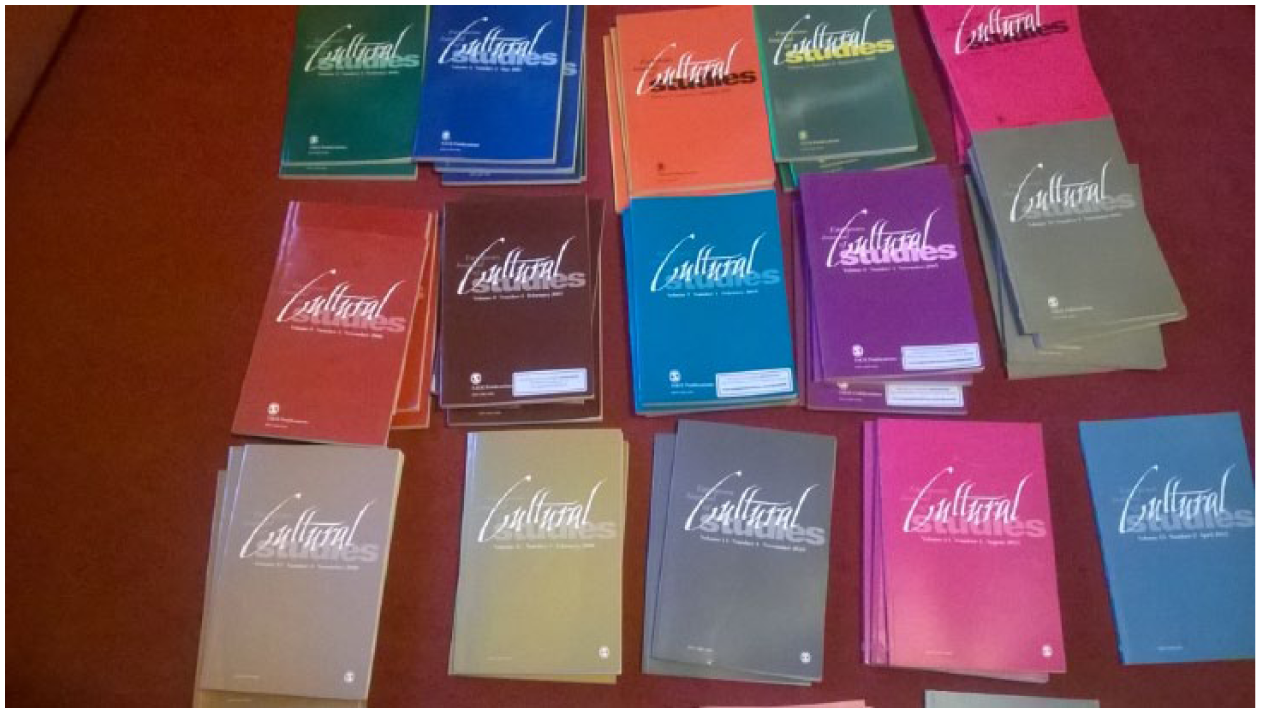
Physical copies of the European Journal of Cultural Studies spread out on the floor.
And note that there is no image on the cover. For those of us working in film and television studies, this absence was a reminder that this is a journal with a different brief from a screen journal, a journal which covered an elusive terrain for which iconic or indexical representation was not appropriate. Perhaps that is also why the title fonts have to work so hard. To my eye, there appear to be three fonts in four sizes; the word ‘Cultural’ is blazoned powerfully across the cover but its dominance is undermined, or perhaps reflexively resisted, by the ghostly white handwriting which hints that the concept of culture is evanescent and elusive. This is a new journal for a new field.
It is banal to say that opening the book reveals the contents page but that listing also reveals the fact of editing and a hierarchy of items. The order of articles does not necessarily indicate their importance, but together they are more important than the review article which may follow and the book reviews which are a standard feature. The Journal has no tradition of an editorial introduction except in themed issues but, in our hands, we have evidence of research material which has been placed into a context, brought together into an issue. However, loosely, the articles have some kind of connection because they all fit the idea of the journal itself. The authors’ idea of the journal has met up with that of the editors so that they share something – a politics, a tone, a method, an approach. Over the years to come, these articles in this combination will contribute to the readers’ understanding of what this Journal means.
Since I am a television scholar, I am drawn to an analogy between the Journal and a television channel. A yearly schedule breaks down into seasons and into individual numbers, and since this is a general channel (and not one of the many niche channels/journals which have since sprung up), the Journal needs to provide variety, something for everyone, though no reader will expect to find everything equally interesting. But, as with a Public Service Broadcasting (PSB) general channel, the hope is that readers will find something of interest even in articles that are well outside their specialism. And it works. Browsing in this context is almost inevitable, looking at one article leads to the next, odd connections may be established, serendipitous connections found.
But of course, the production of journals like the production of television has been transformed by the digital revolution. Now like most readers, I access the journal online and the physical presence of the journal is now only indicated by the indexical representation of the cover which is on the right-hand side of the home page and is smaller than the two bars guiding our access to the current and past issues (see Figure 2).
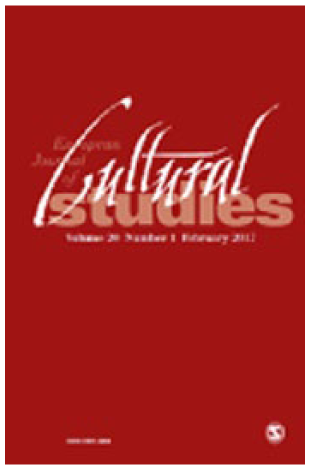
The indexical representation of the journal’s cover on its online pages.
Sometimes when I am reading it online, I am transported back to the 11th floor of the University of Glasgow library; there, when I looked up I could catch a glimpse of the hills and the weather arriving up the Clyde. But nostalgia recedes when I look at my current view of the backs of North London houses and realise that now, via Glasgow, I have the privilege of being able to access this and other journals in a way that no longer requires the physical conjunction of me and the book.
Browsing, of course, remains a quintessential aspect of journal reading, but online the pushes and tugs are different even if one enters via the journal portal and follows through to the contents page of an individual issue. Now, rather than make the extra click to go through to an unknown article on a strange topic, I am more likely to organise my browsing through a search. This can be much more focussed if, for instance, I use an author’s name, or it can produce an overwhelming but inaccurate list if I use something vague like ‘television’ or ‘TV’ which recently produced 411 and 259 EjCS articles respectively, all of which apparently contained the key word. Browsing in this way produces fascinating material, but I begin to lose a sense of the connections between television and other cultural and media contexts which the physical Journal foregrounds and of the editorial decisions which get the material onto this website.
Television channels and academic journals both work to produce brands. The physical cover of the EjCS aims for distinction and promises something which the reader will learn to recognise as characteristic of this Journal. Whether that branding, that distinctiveness, retains the same value online is a question both for television broadcasters and academic publishers. But for the moment, I will turn to the second word I want to examine.
Television
So, ‘What is the “Television” of European Journal of Cultural Studies?’ to paraphrase the title of an article – published in the same year as the Journal was launched – by Charlotte Brunsdon, in which she reflected on the development of this relatively young field of study. The opening editorial (Alasuutari et al., 1998) of the new journal was concerned with how to address ‘cultural studies … [as] a highly contested terrain’ (p. 5) and did not dwell on specific instances and media. It highlights ‘the need to understand culture as a process of meaning making, and to give attention to the power relations that set boundaries to those processes’. Oddly, perhaps, television does not feature in the list of possible sites which follows: ‘lived cultures, popular culture, consumer cultures, film, art or body cultures’ (p. 9).
Despite this omission, television has featured strongly in the Journal and the quality of articles included in this dossier indicates that television scholars have found a good home for their work. Even when the study of television was associated with the cinema studies of the 1970s and 1980s, television always seemed to carry a social dimension; as Annette Kuhn (1984), among others, pointed out, while film studies was developing an understanding of the abstract spectator positioned by the machine of cinema, television scholars tended to work with the notion of television audiences as grouped in a particular space and already socially positioned. As it developed in the 1980s and 1990s, television studies drew on the ideas and models being developed (often with television as an object) by cultural studies scholars, drawing on anthropological and sociological methods; teaching television, as well as researching it, became an interdisciplinary pursuit. The emphasis, in the EjCS’ first editorial, on interdisciplinary work developed through ‘well-theorized empirical case-study research’ with a starting point in ‘locally and historically specific practices’ was thus an implicit invitation to television studies scholars, while the call for ‘articles that critically and reflexively tackle all kinds of power relations’ (p. 9) spoke to the desire of many television studies researchers to question assumptions about the critical faculties of the ‘couch potatoes’ on the sofa. The ubiquity of television within popular culture and its overlapping local, national and global dimensions made it an appropriate object of study for the Journal in a way which has not been true of cinema.
One element of television emphasised by Brunsdon (1998) in her article was its ‘private and domestic aspects’ (p. 109). There is much work in EjCS which takes this emphasis on intimacy and familiarity in 1980s television studies and examines it further. In a much-referenced article included in the dossier, the Midlands Television Research Group reported on ‘a textually based investigation’ which was ‘attentive to the particular institutional and nationally timetabled aspects of programmes in a specific weekday time-slot’. By rooting the analysis in the schedule, the Group provided accounts of television which recognised specific production situations and identified the intimate ‘appeals to, pleasures for and assumptions about the audience visible through textual analysis of some of these programmes’ (Brunsdon et al., 2001: 30–31).
My early work on television was written outside the academy and for me television was indeed an intimate medium associated with family and the home but also a familiar topic of conversation at work. The Women and Film group which started me off on the study of soap opera in the late 1970s chose to study the British soap Coronation Street because it wanted to deal with a ‘cultural product which was
It is this emphasis on difference, on the capacity to make television strange, which is distinctive about television as an object of study in EjCS. And it demonstrates many different ways in which television can be rendered unfamiliar, for the viewer and/or the researcher. I list some of them here, associating each with a particular article for illustrative purposes. The Journal has offered
Different accounts of PSB such as that offered by Daniel Biltereyst (2004), which uses Belgium Radio and Television (BRT) in a case study and which ranges over a number of European broadcasters: For a British reader, such an article offers a context which treats the British Broadcasting Corporation (BBC) as one of a number of broadcasters rather than the stand-out exception.
Analysis of familiar programmes by writers from outside the national viewing audience: For me, Judith Franco’s (2001, 2013) articles on soap operas using EastEnders as an example offered an illuminating shift of focus.
Unknown television through accounts of programmes which the reader does not know and is unlikely ever to see: So Randi Marselis’ (2008) analysis of the Danish television documentary Slavernes Sloegt ((Descendants of Slaves), 2005) provided a detailed account which gave a vivid sense of the programme in its own right as well as generating connections with programmes which explore colonialism, ancestry and identity in different ways.
Television as viewed through a different disciplinary lens: Emily Keightley (2011) analyses a disparate group of programmes as a cultural resource for remembering. Seeking to make an intervention in memory studies, she uses methods and theoretical terms which are different from those of television studies.
Television as an example in a context outside television: Giselinde Kuipers (2012) offers an analysis of the role of television buyers, but the article is set in the context of a themed issue on ‘cultural intermediaries’ and so her television buyers rub shoulders with likely (publishing acquisition editors) and unlikely (retro retailers and bartenders) comparators.
Seeing this list helps to account for the two strong threads that run through television work in the Journal. The first is Reality TV, itself practically contemporaneous with the journal, which has become an ubiquitous component of popular culture with an impact well beyond television as a medium. Most reality television is based on formats that provide a recognisable framework for the study of the variations and distinctions that brought about national, regional and distribution differences. Such formats allow for familiarity and difference to be explored by the production team and enjoyed by the audience. The second thread is Audience Studies. Articles frequently report on audience research which studies the intimate watching situations of individuals or a group of viewers and compares differences between viewers by drawing on cultural studies’ interest in identity formation through class, gender, sexuality, nationality, age and ethnicity. In both cases, such work responds to the editors’ call in the first editorial for case study research which would reflect on ‘questions of identity, belonging and cultural citizenship’ (p. 9).
The ‘television’ of EjCS has thus been constructed through studies of difference as well as familiarity. Like much of television studies, it is a television rooted in notions of the private sphere of the home. But as David Morley (2003) alerted readers, home is not a stable concept: [A]fter its long process of domestication, TV and other media have now escaped the home – to (re)colonize the public sphere. While the domestic home itself might now be said to have become a fully technological artefact, it also seems that domesticity itself has now been dislocated. (p. 453)
Television is to be studied as part of the everyday experience, remembering that the everyday is itself shifting and unstable, and that watching ‘television’ on whatever platform takes on many forms.
European
Morley acknowledges at the end of his article that a previous version had been presented at the fourth International Crossroads in Cultural Studies conference held at Tampere, Finland, in 2002. This acknowledgement reminds us that the first issue was largely made up of plenary papers presented at the first of these conferences (which still continue) also held at Tampere in 1996. To me, as a British reader in the United Kingdom, the source of the EjCS in a university town in Finland gave its Europeaness a particular, almost exotic spin. This was not the Europe of holidays in Spain or Italy, nor of the European Union which seemed to centre on a German/French axis. In the days before Nordic Noir complicated the image, the association of the Journal with Northern Europe, a Europe of endless summer light and generous social democratic principles, seemed nothing but a good thing.
And yet for me and perhaps for the editors, being ‘European’ did not clarify the Journal’s remit but made it more fuzzy as well as more complex. The first editorial which starts robustly with the debates about what ‘cultural studies’ is or might be is rather more defensive about what being ‘European’ might mean. The editorial is clear that the Journal is not seeking to ‘reclaim cultural studies’ “true” European roots’. It values ‘openness’ as cultural studies’ ‘greatest quality’ and certainly does not want to restrict contributions either to European topics or to European contributors. Speaking from a particular place is associated with being open rather than isolated: ‘We feel our European vantage point and the “locatedness” of the editorial process will enhance the quality of the journal and will be our springboard to being truly open and international in orientation’ (p. 7). This is distinctive, 2 but it is unclear what it might mean in practice, particularly when speaking from a vantage point of Europe is linked with reflexiveness: ‘We do, however, want to encourage cultural studies’ reflexive quality in all contributions, part of which is the given that location matters. Hence “European” Journal of Cultural Studies’ (p. 8). The scare quotation marks indicate that what is meant to be a clarification (‘Hence’) does not really square the circle.
I dwell on this because it helps me think through the difficulties I have, even in the impressionist manner I’ve adopted in this essay, for thinking through what ‘European’ means to a reader of EjCS. The articles in the first issue indicate some of the problems. In particular, Ien Ang points out that the metaphor of the crossroads (often used with a utopian inflection) is a way of avoiding the key question: ‘how does one communicate in a heterogenous world?’ (p. 17). She helps us to see that the more located one is, the more one runs the risk of losing even one’s academic audience in a mass of contextual and conjunctural detail. Metaphor and theoretical concepts/methods are ways of finding common ground without having to actually land (another metaphor) in ‘Europe’. Jostein Gripsrud, however, calling for a more practical engagement with television policy in the first issue, rooted himself in Europe. He argued that postmodernist cultural studies of ‘television’ had been marked by ‘their fundamental lack of critique of American television’ and asserted that television was different in a European context where the central questions had to be ‘what public service television is more precisely supposed to mean, what the future role is to be for traditional public service institutions and by which means certain basic democratic functions of broadcast television are to be maintained and renewed’ (p. 88). Of course such a specifically local stance, in which Americanization is seen as one of the threats to PSB, may not be of interest to readers outside Europe nor accord with open and international orientation which the ‘European’ Journal seeks.
Certainly the Journal has regularly featured articles which use concepts and frameworks from cultural studies to analyse non-European television and focus, for instance, on the history of television as a national medium in Japan. But despite what for me sometimes seems a confused stance on Europeanness, one can pick out, in looking at articles on television, some of the ways it gets expressed over the last 20 years. These include the following:
Articles which look at how European television travels outside Europe: Thus, Jiang Chang and Hailong Ren provide an account of the reading patterns of female Chinese fans of the German TV show Knallerfrauen (2011) and analyse the pleasures they take from the show and their work to politicise such pleasure. A European show thus emerges as ‘one of the most important gender-related cultural phenomena in China over the past 5 years’ (Chang and Ren, 2016: 579).
Articles which conversely look at the success or otherwise of non-European shows in Europe such as Katixa Agirre’s (2014) study of how far a postfeminist sensibility is experienced by UK and Spanish viewers of Mad Men (2007–2015): Agirre further extended the comparison to US viewers, finding among other things that national distinctions were very slight.
Articles which look at how diasporic audiences in Europe understand and use television: An early example of this was Asu Aksoy and Robins’ (2000) ‘Thinking across spaces: Transnational television from Turkey’, part of a Special Issue (Vol. 3: 3) concerned with issues of Turkish media use and identity. Alexander Dhoest (2016) provides a more recent example with his study of how diasporic sexual minorities in Belgium understood and used representations of diverse sexuality from the ‘West’ and compared them with those in their home cultures.
Articles which look at how national or regional television in Europe works to generate certain kinds of identification and memory: Interestingly, articles about Spanish television are notable here, including Abigail Loxham’s (2015) work on the negotiation and representation of cultural memory in the light of the silences associated with the Franco era and an article by Ferré-Pavia et al. (2016) on a ‘European case’, which examines ‘the perceived effects of televised political satire among viewers and the communication directors of political parties’ by focusing on the Spanish programme Polònia (2006-).
Articles which recognise changes in the political shape of Europe: In a Special Issue in Hermes et al. (2005), the editors welcomed articles arriving from new Member States in the European Union as a reminder that ‘Europe is far from being a unitary system of nation-states but is in transition to a multicultural space contested by, among other things, global flows of people’ (pp. 132–133).
In such approaches, one can discern how the emphasis on locatedness might shape the reader’s sense of a particular way of speaking from Europe. But, of course, 20 years brings changes for the reader as well as the Journal, and I am aware that part of my feeling of uncertainty about the ‘Europeanness’ of the Journal may well relate to my own position of writing this from an overtly global city in a fractured Brexitland while awaiting the outcomes of important elections elsewhere in Europe in the coming months. In the first issue of the EjCS, Larry Grossberg argued that ‘cultural studies is an attempt to answer the most basic question – “What’s going on?”’ (p. 67). I wonder if a more detailed reading of the Journal than I can do here would help me answer that question in relation to the current state of Europe and the European Union (I suspect not) or whether the project was pointed in a different direction. It could be argued that the open, reflexive approach of the Journal which results in local explorations, nuanced readings and complex understandings is now more necessary than ever, though its purchase in the current climate is unclear. But certainly, while the theatrics of the Trump takeover threaten to dominate politically and culturally, it seems more important than ever to have a Journal (and readers) willing to identify, and indeed identify with, Europe.
Footnotes
Funding
The author(s) received no financial support for the research, authorship, and/or publication of this article.