







Abstract
This article examines how pre-existing Irish migratory cultural logics have been re-tooled in the post-Celtic Tiger period as a form of adaptation to the new imperatives of global capitalism. In this analysis, we show that just as Julien Mercille has discovered in regard to the Irish press and its role in normalizing and promoting neoliberal responses to the economic crisis, representations of the new emigration in the Irish broadcasting environment traverse a narrow spectrum that runs from optimism to resignation. Reality genres heavily tout the values of enterprise and resilience as well as the material affordances that are seen to accrue from emigration, while dramas are more customarily committed to the emotional management of experiences of loss and separation. Structural inquiry into national economic programmes and priorities is customarily excluded in such an environment, although it may be seen that more vernacular forms such as YouTube videos and a low-level but consistent preoccupation with the experiences and concerns of the returned migrant in the Irish press suggest public interest in unsettled questions about the permeability of Irish society and what it means to be located within or dislocated from it.
Ireland is a country whose economic/social position, one might plausibly argue, has been tied to issues of mobility to a greater extent than many other nations. With its long-standing history of economically driven migration, spurred in part by historical exigencies, most notably during the Great Famine of the 1840s, Irishness has been culturally, socially and economically imbricated with the movement of the country’s indigenous populations. As a result of these historical circumstances, the diasporic Irish populations and hyphenated Irish national identities dispersed throughout the world belie the island nation’s relatively modest size (both in terms of land mass and population). 1 Furthermore, the extensive history of Irish migration comprises a tangible and symbolic infrastructure ensuring that, during times of economic and social duress, a recourse to emigration is almost instinctive in the Irish populace (O’Toole, 2016).
Tied to these historical factors, and providing key context for the analysis to follow, Ireland’s current position as a low corporate tax haven that presents itself as a gateway bridging wealthy North American corporations to the Euro zone (Lynch et al., 2017: 264), means that in addition to the migratory drift of human capital, Ireland is a key site of (and facilitator for) the transnational ebb and flow of financial capital. 2 It is our aim in this article to draw out the connections between these various flows (of human and financial capital, of media texts) and assess the impact on shifting Irish subjectivities and notions of citizenship, both at home and abroad, primarily through a focus on non-fiction popular representations of emigration in Irish broadcasting between 2009 and 2017.
After an approximately 15-year boom known as the Celtic Tiger beginning in the 1990s and running up nearly to the global financial collapse of 2008, Ireland’s downwards plunge in the years following was vertiginous. A decision to effectively nationalize the private losses of bank shareholders led to drastic cuts to public service provision in areas including healthcare, support for seniors and the university sector. Public protest at the cuts in Ireland was minimal particularly in comparison to other austerity-beset European nations; Julien Mercille’s research has detailed how they were enacted in a conservative national press environment that normalized and justified them, upholding a ‘general stance in favour of fiscal consolidation’ (Mercille, 2014: 291). High rates of emigration have marked this period, helping to keep official rates of unemployment lower than they would have been.
Signifiers of the normalization of emigration in post-Celtic Tiger Ireland are regular and rampant in the popular culture field; indeed they are far too numerous for us to fully document here. One example, however, can be found in a competition advertisement for ‘Fly a Friend Home for Electric Picnic’, an exhortation to attendees of the popular eponymous musical festival (Figure 1). The implication that the gathering will be enriched by the presence of expat friends from abroad is widely directed and clearly founded on the premise (entirely justified, in our view) that the sort of young Irish people who attend Electric Picnic will inevitably have friends of that kind. It should be noted that other commercial entities ranging from supermarket Londis to homewares retailer Home Store+More have modelled a mode of address that incorporates emigrants and emigration-impacted families. In the case of the former, Londis has produced a recipe contest as a part of the second season promotion for its sponsored series Tastes Like Home with Catherine Fulvio (discussed below) on RTE, which focuses on the preparation of axiomatic Irish dishes that help to hold in place the emigrant’s relation to home. Home Store+More has produced a 2-minute advert depicting Mick, a grandfather who plans to mark his retirement with a visit from his family in Australia and assiduously prepares his barbecue and garden in advance of the visit. Rehearsing the surprise homecoming plot that we briefly discuss below, the ad gives us to understand that a vague travel problem threatens to scupper the plan, but in the end Mick is delighted to find the family assembled at his home and they are then treated to a display of his barbecuing skills.

A ‘Fly a Friend Home’ competition speaks of the prevalence of youth emigration in post-Celtic Tiger Ireland.
Our analysis concentrates on the post-Celtic Tiger era of contemporary Irish life. However, even within this limited time frame of 8 years, it is evident that there have been clear shifts in public feeling during this period. Even in the two years since two of the authors of this article wrote about media representations of migration (O’Leary and Negra, 2016), several profound changes in the geopolitical landscape have caused major recalibrations in the cultural, financial and affective landscapes of Irish life and attendant attitudes regarding migration. In particular, the emergence of an acute housing crisis within Ireland, and uncertainties regarding the legal classification of Irish migrants’ working status in countries such as the United States, Australia and Britain, as well as a growing sense that Irish national fortune is tied in ambiguous ways to powerful corporate supra-national entities have served to undermine any optimism regarding the recent economic upturn in terms of gross domestic product (GDP) and employment growth. While passage of the Marriage Equality Act of 2015 seemed to symbolize a mood of national euphoria and social hopefulness, subsequent developments, including the Brexit vote and the election of Donald Trump to the US Presidency, have diminished that sense of confidence, leaving in its place a socioeconomic field marked by heightened realization of the ways in which: … the global plutocracy has captured the state and has been commodifying politics – making it part of the market economy, dominated by media experts, lobbyists and consultants – while making democracy ‘thinner’, in the sense that most people now regard politics as a cynical game no longer worth joining. (Standing, 2016: 242)
Taken together, these developments provide a context in which expectations of what might constitute the good life for the Irish at home and abroad have downshifted significantly, a development that, as we demonstrate, informs a national broadcasting repertoire that has responded to demographic shifts through an increased focus on diasporic topics and themes.
Just as the Irish press played a significant role in normalizing and promoting neoliberal responses to the economic crisis (Mercille, 2014), representations of the new emigration in the Irish broadcasting environment traverse a narrow spectrum that runs from optimism to resignation. While there have been a few television dramas that register a commitment to the emotional management of experiences of loss and separation that accompany emigration, these are heavily outweighed by reality and lifestyle genre programming that incorporates diasporic themes and topics. These shows, ranging from cookery programmes to scripted reality docu-soaps, demonstrate remarkable versatility in terms of how they incorporate emigration into their formats, yet maintain a surprising level of consistency in heavily touting the values of enterprise and resilience as well as the material affordances that are seen to accrue from emigration.
RTÉ, public broadcasting and emigration
In gathering a selection of media texts for analysis, we have primarily chosen material broadcast on RTE, Ireland’s public service broadcaster, due to the unrivalled agenda-setting role it plays in the national media. 3 RTE’s public service remit is an issue of perennial debate within Ireland, and the television and radio broadcaster is regularly the subject of attack from its commercial counterparts in the national broadcasting field over what is seen as a competitive advantage due to its public funding that comes in the main through a broadcast licence fee (Flynn, 2017). This public funding, of course, comes with the expectation that RTE’s broadcast content will reflect the specific concerns of the nation, and this, as we shall see, includes the return of mass migration and a prevalence of dislocated families. The 2016 press release for the broadcaster’s new season schedules, for instance, highlights three programmes (#Missing You, Making it Down Under and Tastes Like Home with Catherine Fulvio) which ‘(follow) the Irish diaspora abroad’. However, there has been a growing realization that RTE’s public service commitment to the Irish nation (and its sizable diasporic population) goes beyond content and must also entail developments in technological infrastucture.
As Roddy Flynn argues in an assessment of the April 2017 restructuring inaugurated by RTE director general Dee Forbes, the broadcaster needs to shift from its reliance on what the media scholar terms ‘legacy media’, and embrace new technologies in combination with leveraging cultural specificity: The logic of hybrid media … suggests that, to attract [declining] audiences, the quality, cultural specificity, and uniqueness of that content needs to come to the fore in a way that current funding structures but also RTÉ’s de facto (as opposed to rhetorical) performance of its priorities do not always appear to encourage or permit. (Flynn, 2017)
RTÉ’s strategic move to a ‘digital first strategy’ will potentially facilitate the leverage (in terms of justification of remit) and capture of an increasingly dispersed population, given the theoretical global reach of a digital platform. The RTE Player International (a non-domestic but, at the moment, rather limited version of the RTE online service) already constitutes an attempt to monetize this audience through a premium pay model and the diaspora-focused content we track in this article would have obvious appeal to such a demographic.
Irish mobilities/elite mobilities
The economic exigency that has led to a sizable proportion of the Irish population departing in search of work coexists with another, culturally valorised mode of work-related movement, that of the ‘elite mobilities’ of the wealthy. As Thomas Birtchnell and Javier Caletrío (2015) elaborate, ‘Elite mobilities inform cultures of luxury, success and ‘the good life’ and enforce a self-stylization of global elitism founded on hypermobility, meritocracy and entrepreneurial heroism’ (p.1). Given its rising numbers of international finance, communications and pharmaceutical firms, greater Dublin is increasingly marked by a concentration of what Allison J. Pugh (2015) has termed ‘high-performance, low-loyalty’ professionals whose careers and lives are defined by mobility and a concomitant withdrawal from collective and communal interests (p. 47). Likewise, a number of Irish expatriates fill a similar role in locations ranging from the United Kingdom and Europe to the United States, Australia and (increasingly) the Middle East.
Writing about ‘outward mobility as upward mobility’, Erika Polson (2016), among others, has taken note of a shift towards a professional, middle-class global migration. She contends that ‘while the creation of national middle classes was key to the nation-building projects of modernity, the production of the global middle-class identity, through privileged mobilities, is fundamental, economically and culturally, to global corporate expansion’ (p. 10). We contend here that professional middle-class migration is an ambivalent, but nonetheless intensely aspirational norm in post-Celtic Tiger Ireland, and a norm that is sustained in part through its overrepresentation in Irish media.
The upward distribution of wealth, characteristic of contemporary neoliberal capitalism, results in a paradox of increased glamour and the generation of ideological doxa that percolate though popular culture with the underlying message that those who have not attained such lifestyles (i.e., those marked by a high degree of consumer agency) lack a sufficient level of commitment or entrepreneurial zeal. This contrast was well captured in one Sunday evening’s programming on RTE in November 2015 at 9.30 pm when Better Off Abroad, a documentary series depicting the lives of well-off Irish expats screened on RTE1, while the state broadcaster’s sister channel RTE2 showed Dole Life, an exploration of youth unemployment in the state. As one TV reviewer drily commented: ‘(S)omeone in RTÉ’s scheduling department has a perverse sense of humour’ (Boland, 2015).
In the face of striking levels of increasingly well-publicized wealth disparity within the state, Irish political and economic elites have maintained a notable post-2008 adherence to meritocratic ideologies and the precepts of market capitalism. This mode of operation ‘finds legitimate vast inequalities of wealth and poverty as long as the potential to travel through them for those savvy enough is maintained’ (Littler, 2013: 62). In stark contrast to its glamorizing representation of elite mobilities, Irish popular culture typically represses or minimizes compulsory emigration by the young in the period after the global financial collapse. And that emigration has been dramatic in character: since 2009, ‘the number of those in their 20s in Ireland has fallen by almost a quarter’ (Sweeney, see also Holland). While governmental bodies have tended not to engage with this stark demographic shift, as Tanya Sweeney has observed, estate agents have done so in part to justify de-prioritizing starter housing in a turbulent property market that in recent years has seen dramatic price escalation after a near collapse in 2008.
The flurry of programmes about emigration on Irish television might be seen to have a belated quality in the context of European television at large, which includes such long-running offerings as Goodbye Deutschland (since 2006, Germany), A Place in the Sun (since 2000, UK) and Españoles en el Mundo (since 2009, Spain). The success and longevity of those series certainly illustrates how television shows about emigration invariably have a distinctly national mode of address. 4 This category of television in the United Kingdom, for instance, is capacious and includes programmes that focus on second home purchase as well as those that assess in quite detailed ways whether a family should relocate. In a study of Wanted Down Under (since 2007), Jilly Boyce Kay and Helen Wood parse how a UK programme about potential emigration to Australia mobilizes culturally specific expectations. They write that ‘[t]he rhetorical move in Wanted Down Under works to legitimize the capacity of (white) Britons to move unimpeded across the globe, which of course must be understood as part of a much longer history of empire, colonialism and domination’ (p. 247). In his study of reality genres, Jon Kraszewski (2017) offers a model for analysing some of the ways that television normalizes the spatial management of populations under neoliberalism. He contends that US reality programmes exhibit a broad commitment to the ideological management of urban expulsion, naturalizing the fact that cities like New York, Boston, San Francisco and Seattle are increasingly home to bifurcated populations of the wealthy and the poor and spaces from which the middle class has been excluded. In an analogous fashion, Irish television formats display an ongoing dedication to the affective management of emigration, depicting it, on one hand, in relation to a globalized aspirationalism and, on the other, as a symptom of a national economy that is still insufficiently neoliberalized. In this rewriting of exigency as enterprise, internationally mobile elites must be carefully differentiated from a younger population whose sojourns abroad carry uncomfortable resonances of the past. It would be important to note, however, that various forms of Irish-inflected popular culture (from The Lad from Old Ireland (1910), to The Quiet Man (1952)) have sought to provide a guarantee that Irish emigrants and their descendants will always have physical access to their homeland and emotional access to an enduring Irishness.
The grip elite mobilities have on the public imagination is evident in recent internationally successful high-end drama series such as The Night Manager (BBC, 2016) and Billions (HBO, 2016–), to name but two. This heightened popular interest also fuels the more-modestly budgeted Irish series we analyse here, in particular Exiles: Vancouver, Maya Dunphy: The Truth about Breaking London, Better off Abroad, Making it Down Under and Irish in Wonderland. Documenting the conspicuous consumption and aspirational lifestyles of a select minority of Irish emigrants, these series comply with Laurie Ouellette’s observation (drawing on Ulrich Beck) that lifestyle television typically promotes individualization as a part of a shift away from industrial collectivities. She writes that, ‘Lifestyle television plays an especially visible role in the process of individualization by offering TV viewers an assortment of customizable templates, models and resources for ‘choosing’ and assembling their identities and lifestyles’ (Ouellette, 2016: 52). The reality/lifestyle programmes we analyse here strongly focus on the creative and digital industries echoing existing tropes of Silicon Valley successes and excesses and emphasizing opportunities for creative exploration and career expansion, which are repeatedly reinforced by the migrants themselves as unattainable in Ireland.
With a genealogy encompassing popular ‘scripted reality’ shows such as The Hills (2006–2010) and The Only Way is Essex (2010–) as well as Irish productions such as Fade Street (2010–2011), Exiles: Vancouver follows a set of attractive 20-something emigrants in the Canadian metropolis. Given that Canada is one of the most popular destinations for young Irish emigrants, the appeal of the series presumably lies in its fantasy depiction of an internationally situated ‘good life’. Participants primarily pursue career opportunities in the creative arts, in areas such as fashion styling, music, film/television production, modelling and photography. Although the opening episode of the show suggests that the ‘exiles’ must support themselves while in Vancouver, only one participant, who finds work as a barmaid while writing songs in her spare time, appears to have an actual income stream. The show clearly masks both the precarity of working in the creative industries and the high cost of living in Vancouver as participants appear to live a lifestyle completely at odds with the level of employment or success they achieve during their stay. Exiles: Vancouver elevates minor successes while showcasing elite lifestyles with little or no reference to the social or emotional costs of emigration. In this way, the show operates to separate the recent wave of Irish migration from its roots in economic downturn and ongoing austerity while upholding the fantasy of elite and easy mobility.
Radha S. Hegde (2016) has argued that ‘(n)ations strategically and selectively include citizens and immigrants who serve as nodes in the flow of capital and as key players in the scripts of a highly mediated global modernity’ (p. 7). Such strategic selectivity is evident in the RTE series Better Off Abroad, where economic correspondent George Lee travels to California, Hong Kong, Dubai and London to meet Irish migrants who are model examples of neoliberal success (Figure 2). As he flies over London’s financial district in a helicopter, Lee states that ‘in the past Irish people flocked to London to escape poor conditions at home. The newest wave of educated Irish are no longer labourers, they are professionals in a city that is the largest financial exporter in the world’. Lee’s assessment distorts several features of the recent wave of emigration in eliding the ‘poor conditions at home’ which were the primary motivation for the movement of almost 150,000 Irish people between 2007 and 2015, and in suggesting that these educated Irish migrants entered the workforce exclusively at an elevated level. With the series focusing on elite forms of work and lavish lifestyles including interviews on speed boats and helicopters (the showcasing of material wealth is a primary visual thematic device on the show), it is unsurprising that reviews pointed to a feeling that those who remained in Ireland during the recession had ended up with the lesser deal. In his Irish Times review Kevin Courtney queries, ‘Is RTE trying to make us jealous of these prosperous Paddies? Or maybe they are hoping we will up sticks and follow these emigrants to the promised lands’ (Courtney, 2016).
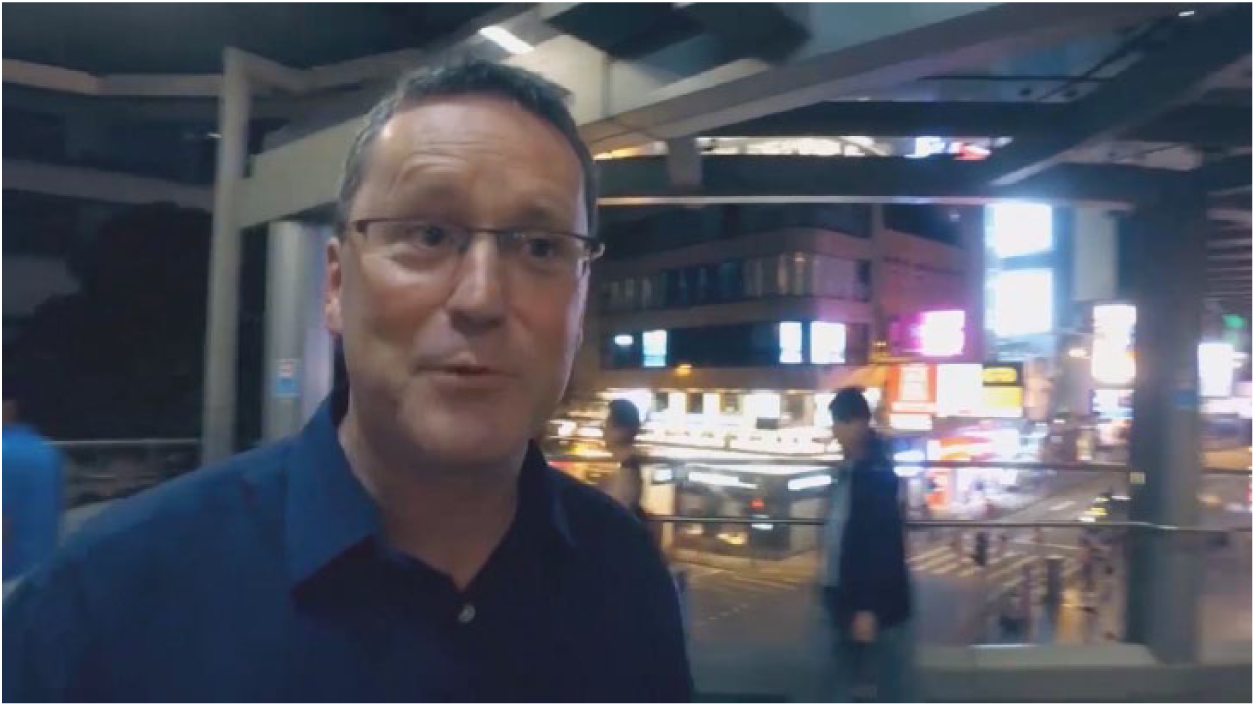
Demonstrating the series’ reliance on visual movement and rhetorical superlative to suggest the exhilarations of global capitalism, Better Off Abroad’s George Lee is here pictured in Hong Kong travelling on ‘the longest outdoor escalator in the world’.
Better Off Abroad wants to appear to evenly weigh up the pros and cons of Irish emigration. The seeming neutrality is belied, however, by its exclusive focus on wealth centres like Hong Kong, Dubai and Silicon Valley (there is no Better Off Abroad Alberta or Better Off Abroad Newcastle). High-flying careers based on canny assessments of market opportunity are heavily preferred in Better Off Abroad; the episode set in Dubai, for instance, notes that there are a number of Irish expat teachers and nurses there but they are only profiled in social settings, not at work, as the episode showcases instead a Porsche salesman and an Irish woman who opened Dubai’s first five-star pet hotel. The core idea of Better Off Abroad is that these urban global wealth centres are hospitable to enterprise and creativity in a way Ireland is not. This is put across through tart and reproachful commentary about Irish begrudery, pessimism and exorbitant tax regimes. As George Lee says approvingly of young Aidan Mannion, a sales executive for an American football team, because Mannion left Ireland early ‘[h]e was never beaten down by an expectation that things weren’t going to go well’.
Better Off Abroad does acknowledge the loneliness that may accompany emigration and upholds in many ways an ideal of Ireland as a socially healthy, caring nation. In one remarkable brief sequence in its Silicon Valley episode, an interview subject speaks of the perception that an expat would want to return to Ireland if he or she were old and vulnerable while the camera cuts to a homeless man rummaging through a garbage can in California. On the whole, however, these features tend to be subordinated to the notion of a world in which new flexibilities and resiliencies are required and the reassurance that globalization is ultimately not a threat to Irishness.
Making it Down Under similarly presents a range of high-end, specialist careers including flying doctors, equine vets and geologists. Narratives of adventure and opportunity inform discussions and representations of the lifestyles afforded by these migrants abroad. Levels of material wealth are certainly less than those depicted on Better off Abroad, but both shows consistently downplay the economic necessity to emigrate, highlighting individual resilience and success, and in this way emigrants are conceptualized as extensions of national success on the global stage. In many ways it could be argued that in this context they become ideal citizens – first by contributing to economic recovery by leaving and no longer being economic burdens in their homeland, second by becoming embodiments of the nation’s ability to thrive/survive by excelling in their new location. Hegde (2016) points to a tendency for nations to select members of their diasporas ‘to create and circulate a signature global brand’ (p. 117). Ireland has been particularly invested in this tactic, with former Taoiseach Enda Kenny highlighting during the recession the ‘downright dazzling potential of the diaspora’ to contribute to Ireland’s economic recovery. In the opening sequence of another RTE series, Crowded House (2015), parents near retirement age sit in their kitchen having breakfast while chatting to a son on Skype who has emigrated to live in New Zealand. From this cosy kitchen scene the parents openly discuss the disruption to their lives of having their daughter, her partner and two children move into their home, because the young couple have not been able to find work or affordable accommodation to support themselves. In detailing the emotional and financial cost of this living arrangement it becomes clear that the child who has attempted to stay at home has created the greater burden on the family. It is noteworthy that many of the young people who participated in the recent RTE documentary, The Undocumented (2017), articulated a sense that being an illegal immigrant in America was superior to being in receipt of social welfare in Ireland.
The most recent entry to the category of emigration-related programming on Irish television is Irish in Wonderland (2017), whose premise is that of an overawed Irish woman trolling magical ‘elsewheres’ of concentrated wealth overseas. In the series’ opening episode, these are specifically Manhattan and the Hamptons. Actress Yasmin Akram is the figurative ‘Alice’, delighted and agog at the luxury and self-indulgence she finds in elite realms. Interviewing such Irish figures as a luxury car salesman and an ‘estate agent in paradise’, about their proximity and value to the super-rich, Akram carefully delineates the town or county of origin of each expatriate. The series is notable for its blunt articulation of the idea that an exemplary 21st-century Irishness comprises the identification with global capital and most specifically that the Irish have a particular role to play as facilitators of luxury lifestyles. Thus Akram concludes the episode by reflecting: ‘We can’t all be millionaires, but the business of helping the super-rich spend their money, well there’s something kind of priceless about that’. From this we may extrapolate two further observations: one, that such a positioning of Irishness accords precisely with the nation’s own role as a low tax/no tax hub for transnational corporations and two, that in incarnating exemplary 21st-century Irishness, Akram is a notable choice to host Irish in Wonderland. A Pakistani-Irish actress and comedian, she joins a cohort of high-profile biracial Irish political and economic celebrities that includes Taoiseach Leo Varadkar, Oscar-nominated actress Ruth Negga and radio/TV personality Baz Ashmawy. Such biracial figures are placed to symbolize a particular Irish adaptability, released from the de rigeur Irish whiteness of previous generations and showcasing new identity hierarchies based upon the hybrid, fully commercialized self.
The consistency of these representations of the successful Irish emigrant – educated, elite, professional, resilient – helps to hold in place two distinct national narratives. The first maintains that recent high levels of Irish migration differ from other historical forms of economic migration, an ideological necessity given that immigration is a highly contested and divisive political topic. The second stipulates that any loss or cost endured as a part of the process of emigration is negated and justified through the migrant’s success. This second assumption is upheld through regular reference to the role of new media technologies in reducing the social and cultural distance created by emigration and the fantasy of easy return, both of which are evident in the production and circulation of media texts in the Post-Celtic Tiger era.
The long-running Irish Times section ‘Generation Emigration’ has been notable for its commitment to unvarnished coverage of the motivations for and experiences of emigration. In general, however, mainstream media are so idealizing in their presentation of emigration that an emotional gap has come to be filled chiefly by amateur media forms such as the surprise homecoming video (detailed in O’Leary and Negra (2016)) which in its (over)celebration of the emigrant’s return exposes the previous pain of their departure. At the same time, such videos, through their centralization of a ‘Mammy’s’ frequently dramatic reaction, characteristically couch that loss as feminine and irrational, effectively minimizing its importance.
Migration flows and resilient intimacy
Arguably one of the most timely texts screened in Ireland with regard to the post-crash displacement of Irish people was #Missing You (2013, 2017), a record of the Skype conversations (the Microsoft-owned company is thanked in the end credits) of various Irish families disrupted by emigration. The programme is structured as a linked series of these calls from several different sets of displaced families, with no bridging sequences other than occasional views of still family photographs with overlaid text informing us of the family connections. Foregrounding the centrality of such videoconferencing software to the new infrastructures of intimacy that comprise contemporary ‘global families’ (Beck and Beck-Gernsheim, 2014: 1–2), the programme provides a valuable insight into the affective dimensions of contemporary migration in a number of ways. In particular, #Missing You reveals a tension between the efforts of the documentary-makers to impose a bittersweet narrative on the curated calls that comprise the programme material (evident, for instance, in the form of non-diegetic uplifting music used throughout as well as, for instance, the imposed narrative trajectory of one 2013 episode which moves towards a number of the families meeting up for Christmas) and the ambivalent feelings that manifest in such communications and which are testament to the affective disturbance such flows of human capital generate.
Depictions of post-emigration connectivity are routinely marked by digital utopianism that manifests itself in fantasies of seamless connection on demand. Such formulations neglect the complex emotional framing around communication technology. As Hegde points out of emigrants: ‘the very object that may connect them also signals their precarity, their state of being outside the possibility of connection or communication’ (p. 9). Moreover, to anyone who has used such videoconferencing technology, an increasingly ubiquitous element of screen culture within both the workplace and the home is buffering, which freezes the image and eradicates sound. Buffering itself, as theorized by Neta Alexander (2017), is a ‘brief moment of helplessness’ (p. 1) that offers a number of insights into the affective and infrastructural workings of neoliberal capitalism. Buffering, she argues, stands as a contradiction to the frequently utopian discursive construction of technological progress that animates neoliberal capitalist life and which occludes the deleterious impact such technologies have on the environment. 5 A remarkable feature of the documentary given that it is almost entirely made up of such calls is the lack of buffering. Indeed, the only overt instances of such a disturbance in the programme happen during the conversations between two elderly siblings, one in Ireland and the other, a priest, in Brazil. In these instances, buffering is portrayed in the context of two older people negotiating the difficulties of unfamiliar electronic devices, and the implication is that any disturbance to the flow of image and sound is in part due to technological ineptitude.
However, at various points in the documentary we can detect in the physical comportment of the figures on screen the reaction to such a disturbance in communication. Alexander (2017) makes the point that buffering impacts us in multiple ways: ‘as a temporary emotional distress, as a disruption that triggers various bodily reactions, and as an enduring and unrecognized affective response of anxiety’ (p. 19). This is perhaps most evident when watching the conversations between Senan (a husband and father who had to move to Perth, Australia from his native Cork in order to find work, when he lost his job after the economic downturn), and his family (a wife, two daughters, and a son) at home. The emotional difficulties of the conversations between Senan and, for the most part, his younger daughter Maeve, can be discerned through the excessive use of gesture which both display when detailing the minutiae of their daily lives, suggesting a need to compensate through body language for the unspoken intimacy that physical proximity imparts.
Arguably, the buffering that is common to contemporary screen cultures and that is an ever-intrusive presence in the intimate communications of ‘global families’ that the Irish migrants depicted in #Missing You comprise, can be interpreted as a synecdoche of the affective landscape of contemporary neoliberal culture. Disruptions and fissures of this sort are indicative of a fractured connectivity, a reminder that ‘[t]he social and emotional costs of involuntary emigration for individuals, families, communities and the wider society are not fully captured by economic analysis of loss or gain’ (Lynch et al., 2017: 262). Throughout the series the barriers presented to fluent and natural communication, such as negotiation of different timezones, limits on the amount and quality of time spent together and so on, rise to the fore interrupting the idealization of emigration that predominates elsewhere. While video-conferencing and social media have greatly improved the quality and frequency of communication for emigrants and their families, users remain ‘electronically present but physically absent’ (Lijtmaer, 2011 quoted in Banerjee and German, 2010: 26).
Home-cooked meals are posited as a means of transcending the physical detachment from home in Tastes like Home with Catherine Fulvio, an RTE show that combines emigrant experience with the increasingly popular genre of food programming. Tastes like Home’s opening titles set up the premise of loved ones being reunited through the conduit of gastronomy, specifically a meal cooked by celebrity chef Fulvio, as we are told in voice-over: ‘When you’re living abroad there’s always something that reminds you of home … Tastes Like Home is all about learning … family recipes, and helping your loved ones recreate them, wherever they are’. Fulvio’s own transnational credentials have been established through her marriage to a Sicilian accountant, as well as her career on television (in programmes such as Catherine’s Italian Kitchen and Catherine’s Roman Holiday) and her guest house and cookery school business, through which she imparts the culinary skills of her husband’s homeland to the Irish. Fulvio’s broadcasting career can be contextualized within both an increased cosmopolitanism in the constitution of the Irish diet that occurred in the late 20th century in tandem with immigration trends that diversified the nation’s population (see Murphy, 2014), as well as popular trends in television programming. The popularity of female-fronted cookery programmes following a template established by Nigella Lawson that pairs an attractive quasi-maternal host with cuisine that is aesthetically and rhetorically presented as ‘indulgent’ has seen Fulvio referred to as ‘Ireland’s Nigella’, although in truth, her presenting style comes across as more bubbly and down-to-earth in comparison with the sultry qualities cultivated by her UK counterpart.
Tastes Like Home is part cookery programme, part foodie travelogue, as in its second half, after she has been cooked the meal she will recreate for the loved one abroad, Fulvio travels to the emigrant and is taken on a tour of their new home and usually treated to typical local delicacies. In a marked similarity with shows such as Better Off Abroad, the ability of the Irish to thrive in these diverse locales is foregrounded throughout, and we generally see migrants who are comfortably middle class. Various exterior segments are staged to demonstrate the migrant’s mastery of the culture of their new home, such as when in episode 3, Fiona Kennedy from Ranelagh in Dublin speaks a little Basque as she shows Fulvio around the food markets of San Sebastian in Northern Spain.
Structurally, in Tastes Like Home, the distance between the migrant and their family and friends is symbolically negated through the celebrity chef’s successful recreation of a beloved dish. Indeed, the mild challenge that Fulvio is set in each episode to recreate the dish from home using locally-sourced ingredients presents an exercise in adaptability and maintaining fidelity to one’s own national identity despite being uprooted from home soil. Fulvio’s advice to Fiona Kennedy that ‘It’s not always easy to exactly replicate a dish or get the same ingredients when living abroad, so sometimes you have to make a few little changes’, seems to function as metaphor for the qualities of adaptability and perseverance that come across as essential for the good migrant in this selection of texts.
While #Missing You and Tastes Like Home contrast in both their affective and generic qualities, they are united in their (inadvertent) exposure of fractures experienced by the familial and friendship groups impacted by emigration. The telling fact that in Tastes Like Home the migrant family member is never reunited with their family at home (only though the conduit of the celebrity chef and her re-creation of a favourite dish), and the technological disturbances that manifest in the video calls of Missing You both undermine the narrative of connection the texts purportedly provide. In contrast to the predominantly positive experiences recounted in emigration texts like Better Off Abroad, such depictions betray a dawning sense that connectedness in the era of globalization may be perpetually fraught.
Permanent liminality: the Irish emigration drama
While our focus in this article has been on reality and lifestyle programmes unified by a shared mode of address emphasizing emigration as a social good/necessity and manifestation of 21st-century Irish versatility, we want to conclude with a short analysis of a counter-text that interrogates the certainties on which those TV series rely.
While emigration and underemployment have been the subject of a set of male-focused films produced in the Post-Celtic Tiger period including Out of Here (2013), The Stag (2013), Standby (2014), The Omega Male (2014) and Get Up and Go (2015), there has been little representation of these themes in the category of Irish television drama which has been dominated by crime series such as Red Rock (2015–2016), Love/Hate (2010–2014), The Fall (2013–2016) and Clean Break (2015). A notable exception is the TV3 mini-series Smalltown (2016), which is set in a rural Irish village and focuses on the impact of emigration and bereavement. Smalltown typifies representational efforts to fuse long-standing narrative conventions with the particular features of the post-2008 emigration landscape. Conor, the eldest son of a rural farming family, is at loose ends as the drama begins – a truculent, hungover household member in early scenes, his parents sit him down in a rehearsed scenario to essentially kick him out of the house (though his father has been coached to use the upbeat phrase ‘move on’ he inadvertently says ‘move out’). Conor’s girlfriend Sarah agrees that some type of dramatic change is needed, telling him ‘This place is wrecking our heads … Conor, you’re no good here’. In an anguished departure Conor bids farewell to his parents and younger brother and emigrates to London where he does well in a debt-collection business and has a live-in girlfriend. (Figures 3 and 4). Smalltown then deploys the well-worn convention of the dying Irish mother to stage and assess Conor’s predicament, several years after moving away, as his mother Mary, in the late stages of cancer, motivates his return and a tentative reconciliation with the father and brother he left behind. The series places heavy emphasis on the contrastive temporalities of cosmopolitan London and a rural Irish town, which is initially represented as a site of economic and social inertia, but later complicated through depictions of the loving care Mary receives from the members of her community in the end stage of her life. Smalltown concludes with Conor anticipating a return to London, yet expressing his sense that he will always be significantly emotionally tied to the Irish small town from which he originates. The 3-hour drama then closes with an on-screen dedication: ‘For those who have left. Those who have returned. Those who still don’t know where they belong’. In this way, it becomes evident that the series’ most pronounced contribution to the popular culture of emigration is its emotionally searching account of the essential in-betweenness of the emigrant. In a sense, Smalltown harkens back to Cathal Black’s 1996 film Korea, which is permeated with the dread of a young rural man’s fear that he will be compelled by his father to emigrate to a Vietnam-era America that uses such immigrants as war fodder. The stakes in Smalltown are lower but still richly emotionally resonant. Most critically, the drama’s central concern with the loss of a centralizing maternal figure acts analogously to the withdrawal of national provision for young citizens.
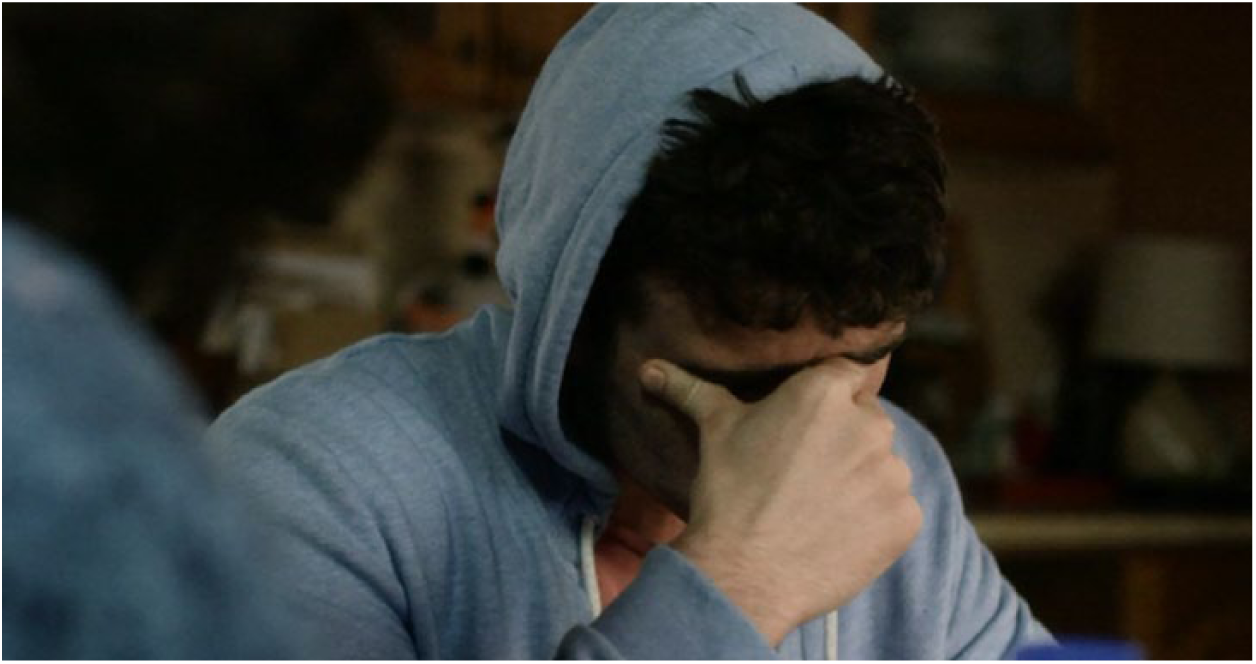
In Smalltown, protagonist Conor is depicted as being both financially and creatively constrained by his rural home in Ireland.
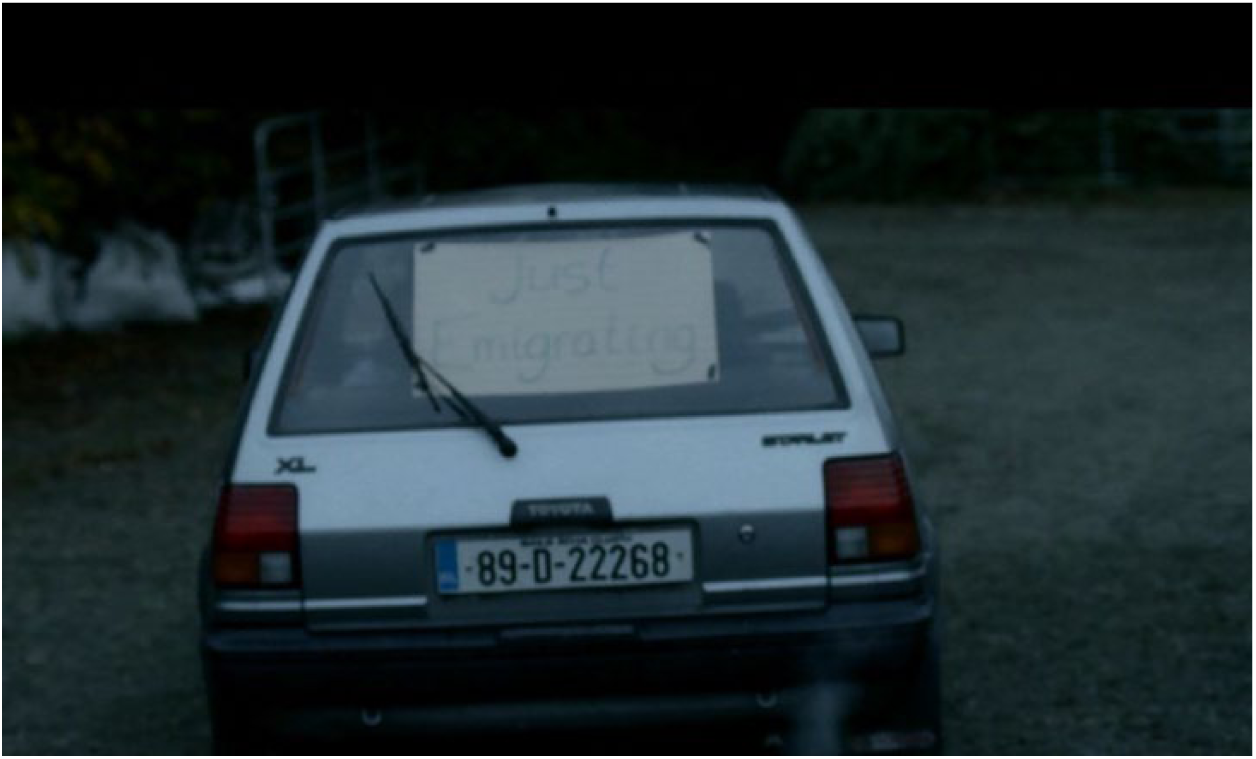
The ‘just emigrating’ sign on Conor’s car in Smalltown conveys in a darkly humorous style the contemporary rite-of-passage that such departures have become in Irish rural communities.
Conclusion
Post-recession Ireland is characterized by a set of economic and social features including: an Irish banking oligopoly which openly exhibits hostility to its customers, a surge in Irish income volatility and a heightened tolerance for economic inequality. It is a nation marked by the pervasive financial insecurity of a majority of citizens. Flat or stagnant wages, rising transport, utility and housing costs and a scarcity mindset have been key developments and just because many of these phenomena have been historically rehearsed doesn’t make them any less impactful. The continuous emigrant exodus is increasingly overshadowed by discourses of anticipatory arrival related to Brexit, with the Irish press providing a steady drumbeat of coverage announcing firms that will or may relocate to Ireland from Britain. In this way the national press for the most part continues to overvalue corporate citizenship over individual citizenship.
Under analysis, it becomes apparent that while the post-2008 displacement of people is a crucial component of many aspects of Irish broadcasting since that time, any sustained exploration of the underlying reasons for the devastation that has wreaked such havoc in the intimate and economic lives of Irish citizens is relatively sidelined. As noted, one exception to this representational pattern has been a cluster of low-budget films centering on the anguish, malaise and melancholy of young Irish males who are contemplating emigration or are attempting to return from long sojourns away (see O’Leary and Negra, 2016). The one hit that grew out of this category, Sing Street (2016), notably sets itself in an earlier period of recessionary exigency and takes a more buoyant tone than most such films.
In our study of the popular culture of emigration, we find that television reality and lifestyle series predominantly (and often relentlessly) uphold a commitment to neoliberal globalization as an imperative, while (a far smaller number of) dramas and more vernacular cultural forms are licenced to linger on the painful emotional calculus and sacrifice of leaving for abroad. Despite a tendency to de-prioritize outflow emigration in the context of national recovery, the most recent data supplied by the Central Statistics Office shows that Ireland is still a nation with higher numbers of emigrants than returnees (Kenny, 2017).
While there have been documentaries such as The Great Irish Sell Off (RTÉ, 2017), which examine the causes and symptoms of the current crisis in Irish life, a broad swathe of Irish programming promulgates a pervasive rhetoric of resilience (a keynote of global neoliberal popular cultures) combined with a leveraging of distinctive elements of Irish culture that serve to obfuscate abiding conditions of precarity and duress. While employment-focused programming tends to foreground exotic careers largely unavailable in Ireland in a manner that recasts economic displacement as ‘choice’, and ‘opportunity’, other programmes such as Tastes Like Home open up a space of nostalgic longing for displaced migrants only to demonstrate how the mobility of Irish culture, in this case, culinary, can provide an ameliorative solace. Irish culture, which, as scholars have detailed, was increasingly marketed as both mobile, lucrative and accessible to all in the 1990s and 2000s (Negra, 2006), often to hyphenated Irish populations at a (multi-)generational remove from the homeland, has thus been mobilized in the post-crash era to create a dual-address broadcasting paradigm that improbably seeks to consolidate a monolithic, cohesive and durable sense of national identity.
Footnotes
Acknowledgements
The authors thank Stacy Grouden for her help in preparing the images.
Funding
The author(s) disclosed receipt of the following financial support for the research, authorship, and/or publication of this article: Research and preparation of this article was supported by a grant from the Broadcasting Authority of Ireland.
