







Abstract
Coworking spaces have been affirmed in recent years as a mainstream, ‘neo-corporate’ model of flexible work in post-recession, urban knowledge economies. However, there is growing evidence of spaces that apply the discourses and practices of the coworking movement in ways that are alternative to the neo-corporate paradigm, both in urban and non-urban contexts. Exploring the ethos and practices of an urban co-operative space in London and a rural innovation hub in Southern Italy, the article illustrates the emergence of coworking endeavours that set in opposition to the neo-corporate model, and describes them as ‘resilient’. We show that resilient coworking spaces are organisational actors that interact with the surrounding context much more than their counterparts, blending entrepreneurial logics with forms of political and social activism. We argue their emergence might be the harbinger of a new phase in the evolution of the coworking phenomenon.
Introduction
Initially understood as ‘third places’ between home and work and a response to the constraints of freelance work, such as isolation and homeworking (O’Brien, 2011), today coworking spaces represent the main workplace for millions of knowledge workers in global cities such as London, San Francisco or Berlin (Deskmag, 2018; Moriset, 2014). Started in 2005 as a self-proclaimed grassroots movement promoting collaboration and communitarian interaction among freelancers (Reed, 2007), in about a decade coworking has evolved into a ‘neo-corporate’ model of flexible work, incarnated by global franchise giants such as WeWork, which appeals to workers in the wider digital and tech sector and embraces an entrepreneurial ethos (Johns and Gratton, 2013).
Recently, however, we have witnessed the appearance of coworking spaces and practices that explicitly represent themselves as alternatives to the neo-corporate model (Merkel, 2019). Interestingly, some of these spaces have appeared also outside the usual setting of the global city, in peripheral or disadvantaged areas (e.g. Fuzi, 2015) or emerging economies (e.g. Thailand and Malaysia, see Leung and Cossu, 2019). We define such spaces as ‘resilient’; with this term we draw from research in urban and cultural studies (Pratt, 2015) to describe shared workspaces that do not oppose the evolution of work towards flexibility and independence, but position themselves against the entrepreneurial ideology of ‘collaborative individualism’ (Bandinelli and Gandini, 2019) that characterises the neo-corporate coworking model. Resilient spaces, we contend, fully exist within the innovative scene of collaborative work; yet, they strive to bring the quality of the social relations created within and beyond their boundaries to the centre of the purpose and ethos of what a coworking endeavour should be. They integrate with the context in which they operate to a far greater extent than the typical neo-corporate coworking space does, blending entrepreneurial logics with forms of political and social activism. They make use of some of the same discourses and practices that characterise neo-corporate coworking, such as the ‘community’ signifier, yet for the ultimate pursuit of outcomes that marry innovation with social good.
To the aim of offering new insights on this emergent phenomenon, the article takes a closer look at two examples of resilient workspaces – an urban cooperative space in North London, and a rural innovation hub located on the Southern Italian hillside. Based on an ethnographic exploration of these spaces, comprising visits and interviews to key informants in these contexts, we argue that the diffusion of resilient coworking practices as here defined might be seen as the harbinger of a new phase in the evolution of coworking. Following an ‘avant-garde’ phase characterised by a grassroots, communitarian ethos (Reed, 2007), and the subsequent ‘mainstream’ affirmation of a neo-corporate model of flexible tech work (Johns and Gratton, 2013), we contend the appearance of ‘resilient’ spaces should be seen as a counter-movement to the trend of neo-corporatization of coworking practices, which aspires to reaffirm the original ethos of communitarian workspace sharing that characterised the avant-garde phase.
The article is organised as follows. In the next section, we look at the academic debate around coworking spaces and practices, with the aim of contextualising the neo-corporate model and its ‘resilient’ counterpart in a historical perspective. Subsequently, we observe the two spaces at the centre of our research and, in the concluding section, we reflect on the broader societal implications that the evolution of coworking practices brings to the fore.
Coworking spaces: a brief history
Research on work in the urban knowledge and creative economy has occupied the pages of this journal, and those of similar outlets, for more than two decades (Banks and O’Connor, 2017). Throughout this period, and particularly around the mid-2000s, this has focused on the critique of the diffusion of precarity and the contextual affirmation of a neoliberal entrepreneurial culture of work, which is reflected in the ethos and practices of ‘being creative’ (McRobbie, 2016). Coworking spaces have emerged in the same period precisely as a response to the increasing fragmentation and individualisation of work practices in the creative economy. In its initial phase, the coworking phenomenon represented a grassroots movement promoting a communitarian model of workspace sharing that would cater to the practical and emotional needs of freelancers, offering them an opportunity to socialise and work from a place that is different from the domestic environment (Spinuzzi, 2012).
Existing works have highlighted the heterogeneity of coworking practices (Waters-Lynch and Potts, 2016). Different kinds of spaces have ended up under the ‘coworking’ umbrella, including collaborative offices for freelancers working in advertising and marketing (Merkel, 2015; Spinuzzi, 2012), but also ‘hubs’ for social entrepreneurs (Bandinelli, 2019), makerspaces and Fab Labs (Niaros et al., 2017; Ramella and Manzo, 2018; Söderberg, 2016) as well as, controversially, real estate space managed by firms that establish a ‘coworking zone’ at their premises (JLL, 2016). This article adopts the extensive definition of coworking proposed by Parrino (2015), according to which a coworking space is characterised by: 1. The co-localisation of various coworkers within the same work environment; 2. The presence of workers heterogeneous by occupation and/or sector in which they operate and/or organisational status and affiliation; 3. The presence (or not) of activities and tools designed to stimulate the emergence of relationships and collaboration among coworkers. (Parrino, 2015: 11)
After an early enthusiasm, largely owed to seeing coworking as a grassroots and communitarian endeavour, the academic debate on coworking practices soon started to take notice of their somewhat incoherent nature (Gandini, 2015). Empirical research evidenced that workers access coworking spaces primarily with instrumental motivations, which combine a relief from the isolation of homeworking with the strategic necessity to network and proactively search for professional collaborations (Brown, 2017). Some have highlighted that collaboration among workers within coworking spaces actually occurs to a far lesser extent than is commonly believed (Parrino, 2015), and warned that coworking practices instead largely consist in ‘working alone together’ (Spinuzzi, 2012). In other words, following an early grassroots phase, coworking has largely turned into a ‘neo-corporate’ model of work aligned to the ethos of the tech sector, distinctively described by McWilliams (2016) as a ‘flat white economy’.
Neo-corporate coworking: defining features
The ‘neo-corporate’ coworking model emerged in recent years as a combination of real estate business and market intermediation, appealing to freelance workers but also to a larger pool of other subjects, including entrepreneurs, social entrepreneurs (Bandinelli, 2019b) and startuppers (Luise, 2019). This responded to the practical demand of flexible work that characterises this industry but is peculiarly affirmed as a consumption-driven trend, which offers workers the possibility to experience a ‘cool’ workspace that matches the lifestyle and ethos of the tech sector (Gruen and Bardhi, 2018). The neo-corporate coworking model is epitomised by global coworking giants such as WeWork, Google or Impact Hub, which put into practice what is essentially a scheme of renting out real estate space to individual workers, usually through a franchise operation principled on the payment of periodic fees by members.
WeWork has arguably been affirmed as the world leader in this sector, with 654 spaces open or coming soon in 2019, in 115 cities worldwide (WeWork.com, accessed April 2019). Spatially, WeWork spaces consist of a buzzing high-tech office environment, usually made of a noisy communal area on the ground floor, marked by the presence of a freely accessible cafe, and one or more quieter zones, usually on upper levels, accessible by members only. Quieter zones blend with play areas, which host food and beverage machines as well as leisure items with the purpose of fostering creativity and serendipitous encounters among workers.
Visually, spaces like WeWork are marked by the presence of conspicuous banners or signs upon which the word ‘community’ is inscribed, which serve to emphasise the kind of sociality that is (supposedly) engineered within them (Bandinelli, 2019a). ‘Community’, a key claim in the promotion of coworking practices in general, is particularly emphasised as a branding component in the ‘neo-corporate’ model. The WeWork official mission, for instance, states that When we started WeWork in 2010, we wanted to build more than beautiful, shared office spaces. We wanted to build a community. A place you join as an individual, ‘me’, but where you become part of a greater ‘we’. A place where we’re redefining success measured by personal fulfillment, not just the bottom line. Community is our catalyst. (www.wework.com, accessed April 2019)
In practice, however, neo-corporate coworking spaces like WeWork operate essentially as market intermediaries, enabling workers to come into contact with others and henceforth develop professional relationships in an office-like environment (de Peuter et al., 2017; Gregg and Lodato, 2017; Gruen and Bardhi, 2018). This in other words enacts a watered-down notion of community; workers experience what is akin to a perceived sense of community, which appeals to the symbolic and the imaginary rather than being a reflection of the nature of the sociality that occurs within the space (Bandinelli, 2019a). Arvidsson (2018: 295) argues that coworking spaces: are seldom ‘communities’ in the traditional sense of that term. They are not marked by dense webs of social interaction. Rather they are spaces of practice. People frequent such spaces to engage in a particular practice and it is by engaging in such practice that they connect together and form social bonds. Contrary to traditional communities, such social bonds are not based in traditions that precede the individual and determine his or her identity. In this sense, co-working space communities do not generate collective identities. Rather, individual members come and go, practice-based projects are temporary and dissolve once a period of often intense identification has come to its end.
For neo-corporate coworking spaces, in other words, the word ‘community’ most often works as a kind of market device, instrumental to the ‘collective construction of an imaginary that aims at conferring value on the activities of participants and to set them off from competitors’ (Arvidsson, 2018: 297, see also Bandinelli and Gandini, 2019). Furthermore, their actual embeddedness in the local context is quite thin; Arvidsson (2018: 295) again notes that most co-working space remain disconnected from the surrounding urban context. Most managers of co-working spaces that we have talked to recognize this low density of sociality as a problem and dedicate significant resources to address it by organizing internal as well as externally oriented events, lunches, seminars, workshops, or concerts, parties and open days. But the issue remains.
This reinforces de Peuter et al.’s (2017) interpretation of coworking as an inherently ambivalent set of meanings and practices which bear an unfulfilled potential for the enactment of collective-based work practices, but instead ultimately reinforce the neoliberal entrepreneurial ethos: Coworking is deeply ambivalent. It emerged from below and was subsequently harnessed by private market interests. Coworking softens effects of flexploitation, albeit in a manner that tends to deepen neoliberal subjectification. Pushing back against both recuperation and individualization requires that coworking spaces explore alternatives to capitalist ownership conventions. (de Peuter et al., 2017: 701)
Yet the very same ambivalence of coworking practices implies that the currently dominant, mainstream neo-corporate model ought not be seen as the only kind of coworking model available. On the contrary, we should see this model as part of a spectrum of practices that also entails ‘actually communitarian’ coworking endeavours (Arvidsson, 2018). In fact, as Merkel (2019) has argued, grassroots coworking initiatives have not ceased to exist despite the affirmation of coworking as a global franchise phenomenon.
Resilient coworking?
Despite the neo-corporate turn in coworking practices, the presence of smaller, independently run spaces which primary purpose is to ‘create new socio-material infrastructures for freelance work (. . .) to coordinate and facilitate an alternative organization of work’ (Merkel, 2019: 13–14) has remained a key component in the coworking scene. Their recent resurgence is seen in this article as part of a more comprehensive countermovement, made of spaces that acknowledge the affirmation of the ‘neo-corporate’ model of coworking promoted by WeWork and others, and thereby position themselves in opposition to the neoliberal culture that these uncritically reproduce. We define these spaces as ‘resilient’; with this term we seek to reconcile with a tradition in urban and cultural studies that conceives of resilience as an open perspective that does not resist but embraces change, and accepts it as part of existence and being. This is closer to a notion of sustainable living; a process of organisation and adaptation to work in harmony with others, the surroundings, and the wider world: one that enables adaptation and thriving. (Pratt, 2015: 62).
Thus, we define as ‘resilient’ those coworking spaces that embrace the evolution of work in a direction of flexibility and independence but, in so doing, oppose the entrepreneurial ideology of ‘collaborative individualism’ that characterises the neo-corporate model (Bandinelli and Gandini, 2019). Their resilience, we contend, does not represent a strategy to cope with the individualisation and uncertainty brought about by neoliberal job markets (Anderson, 2015; Joseph, 2013). Rather, resilient spaces embrace innovation and change, looking to set out practices of organisation that adapt to the context they inhabit and exist in harmony with it. At their core, resilient spaces strive to bring the quality of the social relations to the centre of the purpose and ethos of their practice, looking to shape coworking in a direction of developing ‘actually communitarian’ interaction. This entails:
Proactively working to maintain a closer relationship between the space and the geographical context in which it appears;
Producing outcomes, as a space, that do not reproduce the individualized ethos the neo-corporate model engenders;
Making use of some of the same discourses and practices that characterise coworking also in its neo-corporate version, such as the ‘community’ signifier, yet in the pursuit of combining economic sustainability with social impact.
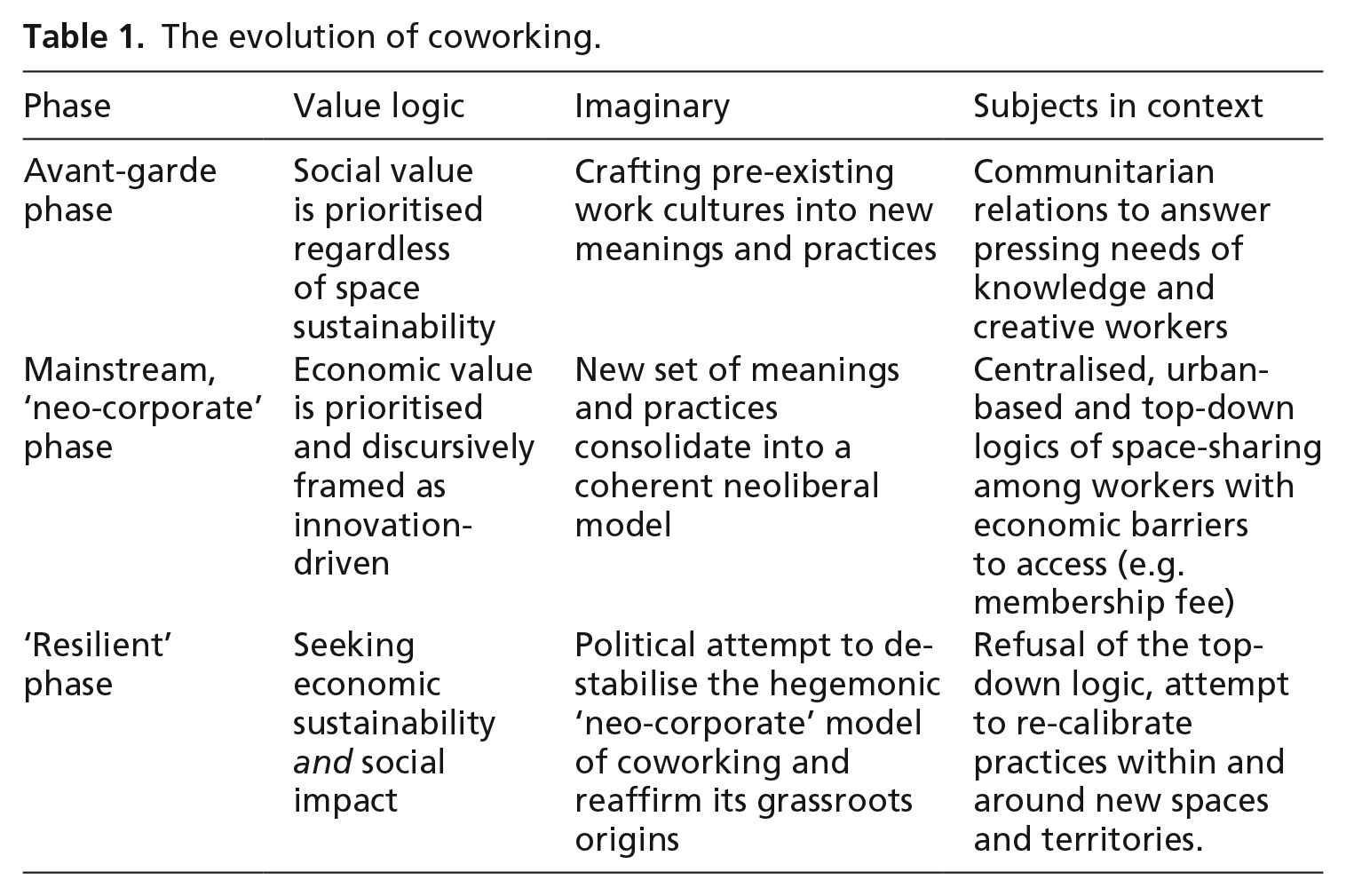
While we see the surfacing of resilient coworking endeavours as a new phase in the evolution of the coworking phenomenon, this should not be seen as a rigid chronological partitioning. Rather, we frame this as a fluid transition whereby a spectrum of practices and approaches reciprocally interact with each other as part of a hybrid context in which, as Arvidsson (2018) has noted, forms of sharing and market exchange coexist. Table 1 summarises the evolutionary trajectory of the coworking movement as here described.
The evolution of coworking.
Interestingly, ‘resilient’ coworking endeavours have started to appear also in contexts that are not necessarily that of a creative city (d’Ovidio and Cossu, 2016). Fuzi (2015), for instance, who studied emergent coworking practices in South Wales, suggests that when coworking spaces emerge within contexts where entrepreneurial cultures are weaker, these transform into hybrid social spaces whereby the features of corporate coworking practices blend with those of a grassroots accelerator or incubator (Fuzi, 2015). As noted by Brown (2017), the urban nature of coworking has somewhat been taken as an unchallenged assumption by existing research. Virtually all empirical work on coworking practices are in fact recounts of coworking experiences in global creative cities, mostly in the West – such as San Francisco (Moriset, 2014), Berlin (Lange, 2011), Barcelona (Capdevila, 2013), New York (Merkel, 2015), Milan (Colleoni and Arvidsson, 2014; Mariotti et al., 2017; Parrino, 2015), London (Bandinelli, 2019b), Athens (Papageorgiou, 2016) and in South-East Asia (Leung, 2019; Lindtner and Li, 2012). This reflects the somewhat natural connection between coworking and the urban environment, as coworking spaces represent a key interface and a middleground for knowledge production and dissemination around creative projects (Merkel, 2015). However, it also shows that non-urban coworking practices are still significantly under-researched. In the next sections, we take a closer look at two examples that adhere to the proposed ‘resilient’ framework, both within and outside the city.
Methodological note
The empirical evidence upon which this article builds originates from ethnographic research conducted as part of, and as a continuation of, the EU-FP7 project ‘P2Pvalue’, which aimed at studying practices of commons-based peer production in various contexts in the period 2013–2016. Through a multi-method approach, the project investigated the cultural notions of value and the processes of value formation in emergent collaborative contexts, taken in a broad sense and including, among others, free and open software communities in digital and non-digital spaces, makerspaces, and coworking spaces. This broad scope was aimed at gaining an in-depth understanding of how individuals involved in these communities interact, collaborate and culturally conceive social and economic exchanges within and beyond them. As part of this project, and thanks to its extensive nature, the authors visited a variety of shared and collaborative spaces in Europe and beyond. The ethnographic illustrations offered in this article pertain to two purposely selected spaces visited within the remit of this work.
The first space we observe in this article is Outlandish, a coworking cooperative based in north London, constituted of affiliates who work in a shared office and often on shared projects, receiving forms of remuneration for work they engage in as a collective, rather than as individuals. Part of Outlandish is also a traditional coworking space, named Space4. Outlandish offers an example of coworking practices that aim to suppress ‘alone togetherness’ by design, and instead seek to promote an approach to freelancing in a global creative city that refutes the hyper-entrepreneurialised Silicon Valley culture, using some of its features to promote fairer work practices. The second case here observed is RuralHub, a shared space located on the hillside of Salerno, in the Southern Italian province, designed to foster social innovation in a rural context. In chronological order, research at RuralHub was conducted first and entailed repeated visits to the space by authors (first in 2013, when the space opened, and the last in 2018), each lasting between a day and 2 weeks. This also entailed semi-structured interviews with the founders, some of the key members of the space and also representatives of the local network of collaborators established by RuralHub. Outlandish comes to be part of this research at a later date, as a follow-up to the previously mentioned ‘P2Pvalue’ project, when we decided to develop a specific focus on ‘resilient’ coworking practices. Research at Outlandish (and Space4) was conducted in 2017–2018 and entailed multiple visits to the space, during daytime as well as to specific events held at their premises. Alongside qualitative notes, an interview with one of the managers of the space as a key informant was conducted. Representatives for these spaces have agreed not to be anonymised in the presentation of findings.
As it presents illustrations, in the form of ‘vignettes’, about these two purposely selected spaces, the article maintains an exploratory scope, characterised by an unstructured qualitative approach. As a result, it does not represent a systematic account of ethnographic observations conducted at each space, nor does it seek to present a somewhat generalisable account. Rather, it is designed to provide insights about the existence of coworking practices that are represented as an alternative to the neo-corporate model, to the aim of stimulating further research on the topic.
‘Resilient’ coworking in the city: Outlandish
The urban context of London is an established and lively, global coworking scene (Merkel, 2015; Moriset, 2014). The website Coworking London, which hosts a directory of coworking spaces in the British capital, lists more than 170 coworking spaces active at the time of writing, and estimates that around 5000 workers inhabit them. Here is a screenshot (Figure 1) of the geographic distribution of these spaces, per urban area, taken from the same source, in July 2018.
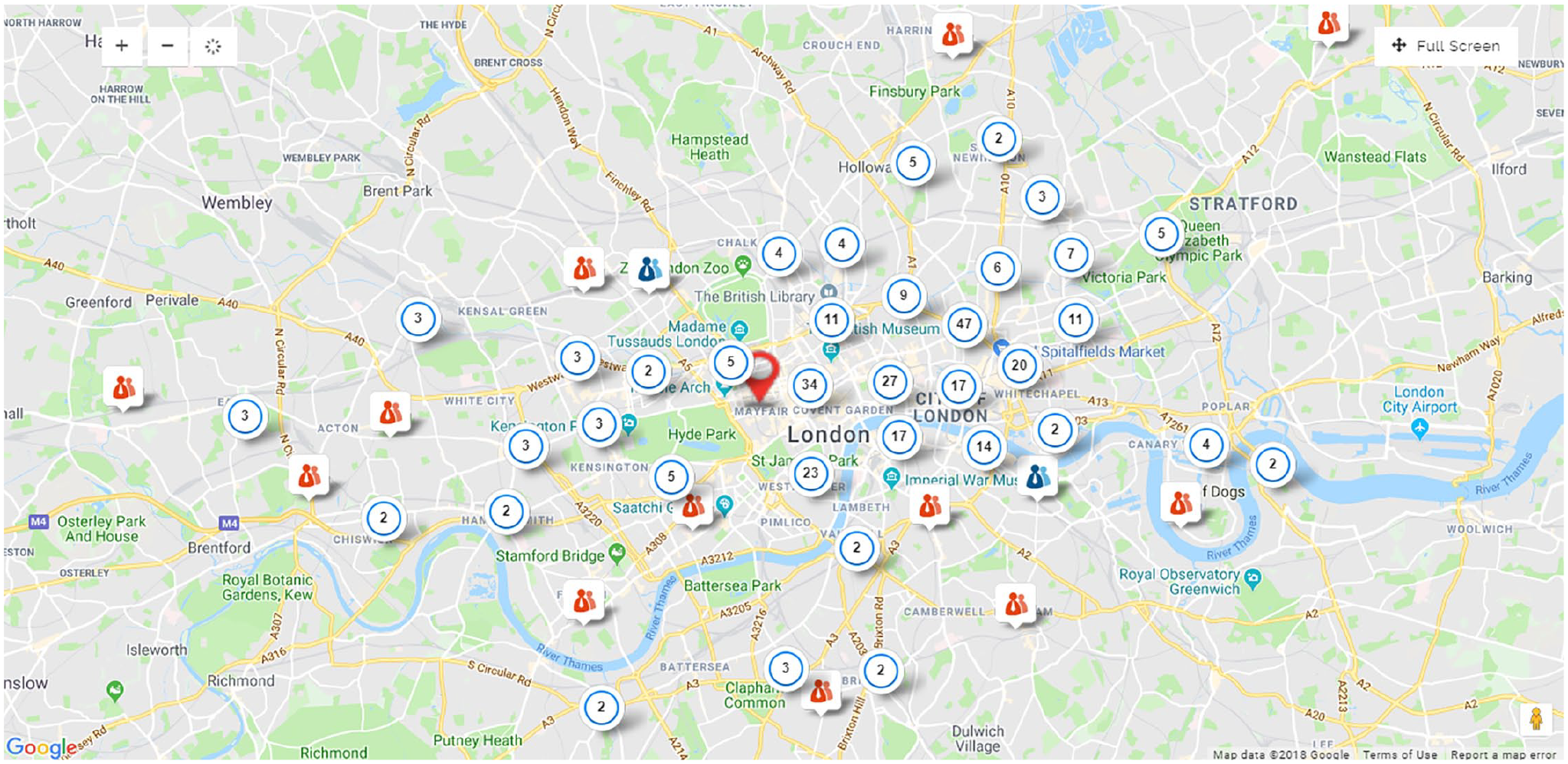
Coworking spaces distribution, London (July 2018).
The map shows that many coworking spaces are located in the Eastern part of the city, where most tech startups have their headquarters, and essentially the Old Street area – now commonly labelled the Silicon Roundabout, in an attempt to draw a parallel with the Silicon Valley (see McWilliams, 2016). Many of these belong to the neo-corporate model here discussed, such as the Google Campus, as well as a number of branches of WeWork. Yet, other kinds of spaces also exist within the very same context. A report from Institute for Public Policy Research (IPPR, 2016) estimates that a majority of shared workspaces in London are actually run by charities, social enterprises or local cooperatives (see Merkel, 2019: 13). Among these are, for example, grassroots spaces such as Camden Collective, Hackney Downs Studios, IndyCube and Outlandish/Space4.
Outlandish is a tech cooperative specialised in providing consultancy on a range of digital services. Established in 2010 as a grassroots organisation based on the practice of working together, initially its status was that of an asset-locked LLP. In 2016, it turned into a cooperative. 1 Members of Outlandish work for the cooperative for a minimum amount of time during the course of a year in order to be eligible for membership, but can also use the space to work on their own independent projects. In this sense, Outlandish is also a coworking space; Outlandish in fact also hosts a separate coworking area, named Space4, open to workers who do not want to join Outlandish as a cooperative. Space4 is housed in the same premises of Outlandish (one floor down) and is also used by cooperative members as a venue for events or public talks.
Practically speaking, Outlandish is headquartered on the third floor of an old building in the multiculturally diverse borough of Finsbury Park, North London. This is a typical area of residence for tech workers who partake in the Silicon Roundabout and Shoreditch scene, where renting is usually unaffordable (McWilliams, 2016). Incidentally, Outlandish is located just a few blocks away from the residence of current Labour leader Jeremy Corbyn, who is also the local Member of Parliament for this constituency. Our key informant and guide through the space, Kayleigh, is a project manager and designer in her 20s and a very active member of the collective, which she frequently represents at events and conferences. Kayleigh explains that the very own existence of Outlandish within this area is very much at risk, since the neighbourhood is undergoing a classic process of gentrification via real estate financing. This is visibly marked by the demolition of the buildings that used to stand right in front of Outlandish, which have been rebuilt into new ‘luxury accommodation’. Kayleigh tells us that, for the time being, the space has managed to renew its location agreement but the future of their premises is very uncertain, as the area is undergoing rapid and significant change.
The space itself is quite tiny and old, and looks more similar to an arts space than a corporate office. Members are variously dislocated into what Kayleigh describes as ‘thematic rooms’–one hosts developers, another hosts designers, and so on. This denotes a slightly more structured organisation of space-sharing compared with a traditional coworking space, and is a reflection of the cooperative way of working that Outlandish promotes. Observing the space, we are struck by the level of interaction among workers, that is far superior to that observed in a neo-corporate coworking space, where silence is a major presence and exchanges among users usually take place somewhat casually in communal areas or by the coffee machine. This, Kayleigh explains, is peculiar to the ethos of Outlandish, which wants to be seen as a safe haven for freelancers: I would definitely class Outlandish as a community, as the organization itself, because one thing that we really value, probably over skills to be honest, is alignment to our ethos, and it’s kind of like a way of thinking, being committed to Outlandish, and working on socially good projects, and also because we’re a worker coop this idea of community kind of goes hand in hand.
While making broad use of the ‘community’ signifier in ways that are typical of a neo-corporate coworking space, Outlandish actually engages workers into sharing the ethos of a cooperative. Yet Outlandish does not disdain to call itself a brand, as it sees this as a device for members to take projects on board, both individually and on behalf of the space. Just like any other actor in the tech scene, Outlandish has developed a lively online presence, particularly marked by a Twitter feed with more than 2600 followers on the date this article is being finalised. Yet contrary to a neo-corporate coworking space, this translates into ‘actually communitarian’ work practices, as one of the Outlandish members recounts in a post on the space’s blog, where she outlines how being an Outlander allows her to work with her friends, maintain a degree of the ‘good’ flexibility that the independent status offers but with the added responsibility of an employee-owned endeavour, and to avoid the necessity of profit-maximisation at the expense of quality work. Accordingly, the forms of sociality that can be observed among workers in the space signal the presence of a non-corporate mentality, funnily epitomised by a selection of ‘anti-neoliberal’ mugs on display in the communal kitchen. Kayleigh explains this further: It’s quite a world away from the kind of Old Street startup mentality, completely different . . . I find that startup mentality a bit of a shame, because it’s kind of like “make your business as valuable as you can in a short amount of time”, which usually means having quite a big gap in pay and perhaps exploiting workers in the sense that you’re not getting paid very well or working long hours, free internship and stuff like that . . . making it as much valuable as possible and sell it for as much cash as you can. (Kayleigh)
Through its cooperative status, Outlandish signals its aim to foster collectively-shared work practices; its members can work flexibly, collectively and individually, on both commercial and charity projects. The ethos of Outlandish rejects ‘alone togetherness’ by design; at the same time, some of the Outlandish coworking practices entail forms of skill development that are akin to that of a community of practice (Wenger, 1998), encapsulated in the expression ‘See one, do one, teach one’. 2 Just like any other coworking space (e.g. Forlano, 2011; Fuzi, 2015), also for Outlandish events are a key moment in the establishment and growth of a coworking endeavour. Outlandish regularly hosts events, mainly at Space4, and takes part in events hosted by others, including tech conferences. Its many projects maintain a strong social angle, and often entail campaigning around social issues, such as precarious employment, school funding, or the condition of women working in the tech sector, usually involving the local community. An example is the School Cuts project (see: http://www.schoolcuts.org.uk), an awareness campaign developed in collaboration with the National Union of Teachers to supply more resources to underfunded schools. Started as a local endeavour, the campaign developed into a national effort, whereby the participation of Outlandish consisted of the design of a platform through which members of the public were able to fact-check school funding by searching a database of schools per postcode or name. This also represents an example of the kind of embeddedness within the local community that Outlandish actively pursues.
While it performs consultancy work for some important actors in the tech world, at the same time Outlandish aims to establish itself as an exemplar that advances the cooperative model of work within the digital economy. In line with what is argued by Sandoval (2016), observation of Outlandish confirmed testifies to how the cooperative model can potentially establish as a viable alternative to the precarious and exploitative worklife of the knowledge worker. Co-ops, Sandoval argues, have “the potential to maintain the autonomy enjoyed by many freelance cultural workers while at the same time creating a workplace that offers security instead of precariousness, equal rights instead of inequality, and solidarity instead of individualisation” (Sandoval, 2016: 56). Its ethos, together with the forms of interaction that members are required to nurture to be part of Outlandish and its positioning as a social actor in the neighbourhood it inhabits, make Outlandish a paradigmatic example that makes use of the discourses and practices that actors such as Google or WeWork also display, but sets itself apart from, and in explicit opposition to, the competitive, profit-driven model of work these promote.
‘Resilient’ coworking outside the city: RuralHub
In parallel with the appearance of grassroots coworking spaces animated by communitarian logics within cities (Merkel, 2019), an interesting aspect in the current evolution of the coworking phenomenon is the appearance of coworking spaces and endeavours outside of the urban environment. The Italian context offers an interesting example, as a coworking scene characterised by a distributed geographical presence.
Italy has experienced a spike in the diffusion of coworking practices starting from 2008 in Milan, where the first coworking space appeared. In the same year La Repubblica, one of the leading newspapers in Italy, dedicated a special issue to the rise of coworking spaces in the city. Milan remains a significant coworking hub to date, as it hosts a remarkable number of spaces – 54, as ‘certified’ by the local municipality. 3
Some of them belong to the ‘neo-corporate’ model as here described, for instance Impact Hub, which has seven spaces dislocated throughout the whole country. Interestingly, WeWork has been late in joining the Italian market, and opened three spaces in Milan only in the last few years. In fact, the most important players in the Italian coworking scene are local franchises, such as Cowo and Talent Garden. Cowo is the initiator of the Italian coworking scene, being the space that introduced coworking in Milan in 2008 as part of an experimentation during the Milan Design Week. Since then, it has remained an active voice in the Italian coworking movement to date, having spread its presence across the entire country. While Cowo has developed as a local, albeit country-wide, endeavour, Talent Garden has instead established a more international presence, that includes a space in London. Cowo and Talent Garden maintain a neo-corporate nature, that is evidenced by a predominant attention to entrepreneurship and the active search for funding opportunities. Talent Garden, for instance, has been the beneficiary of a round of venture capital investment for entrepreneurial expansion in 2016. 4 The distributed presence of coworking spaces in the Italian context is evidenced by the Cowo network (Figure 2, below), which shows a variety of coworking spots appearing also in smaller towns and non-urban contexts.
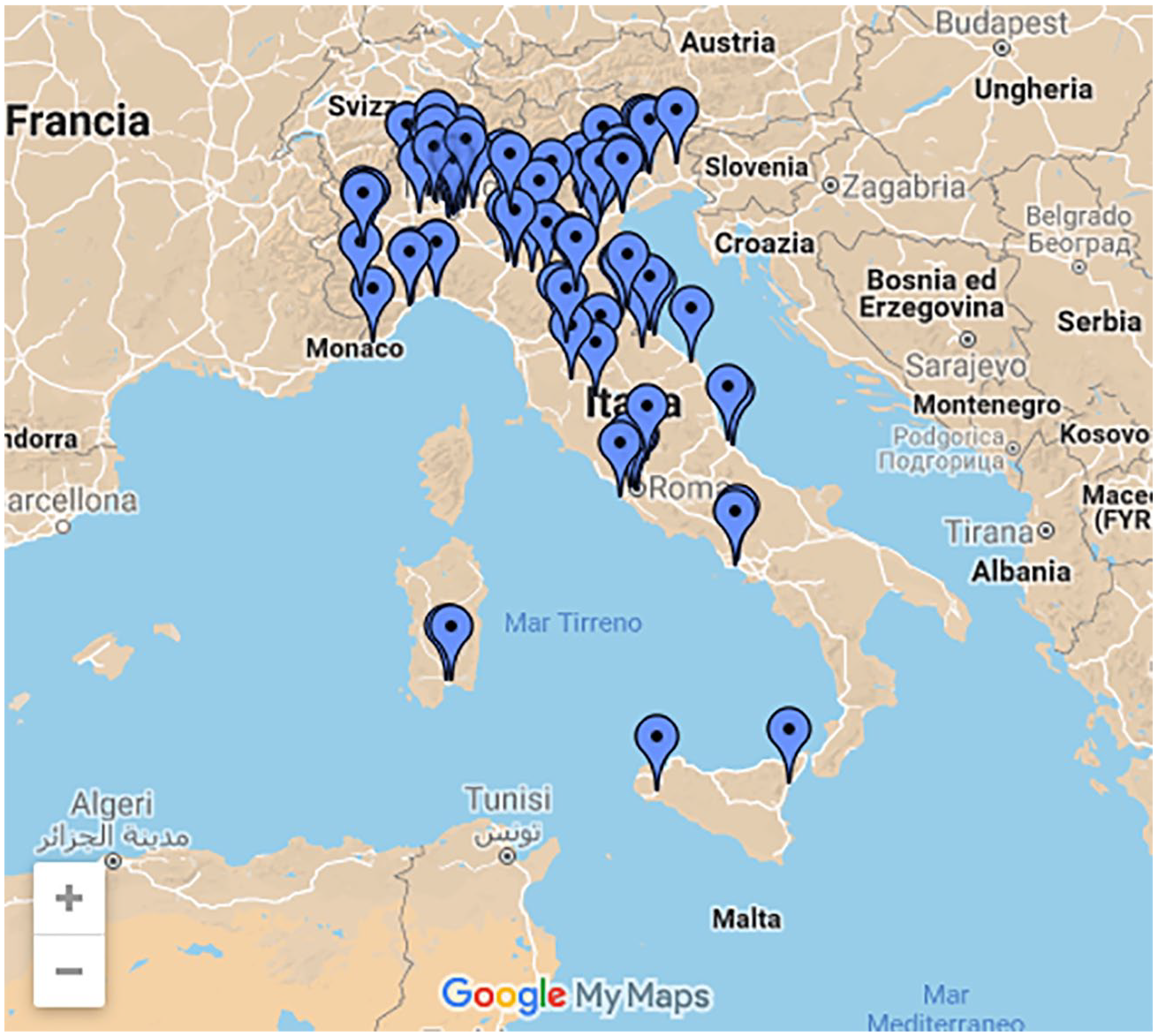
Cowo spaces in Italy (September 2018).
Alongside neo-corporate franchises, a plurality of coworking spaces are active across the peninsula as independent, grassroots initiatives. These are often the by product of the political context within which some of their founders and key actors are, or have been, involved. These spaces seek to actively countenance the precarious lives and underpaid jobs that young Italians often experience in a country characterised by high youth unemployment (Eurostat, 2018). Interestingly, some of these grassroots coworking endeavours are built principled on an idea of work that is intimately connected to a sense of belonging to a local territory, and attempt at putting in practice initiatives inspired by hacking or de-growth movements (see Orria and Luise, 2017). Such independent spaces are either self-funded or live on public funding on a competitive basis. They are mostly located in peripheral areas but nonetheless maintain some form of connection to the nearest urban context, and usually make part of a network of local partners who share the same ‘alternative’ approach to flexible work these spaces promote. The role of such spaces in the context in which they appear is often that of a platform for the translation and dissemination of organisational models of flexible work in relatively deindustrialised areas.
RuralHub represents an interesting example of this kind of coworking practice. Based on the hillside surroundings of Salerno, in the South of Italy, RuralHub is the first shared space based in Southern Italy, in the Campania region; it takes inspiration from the hacking movement and works as a connection hub and workspace for a number of different subjects, including researchers and activists but also local entrepreneurs who are interested in experimenting with new models of economic development in rural areas. Like Outlandish, RuralHub is in many ways also a coworking space; a key aim of RuralHub is in fact to facilitate the connection among subjects, innovative project and enterprises, as well as with local investors and grassroots associations active in the local area. Akin to a community of practice (Wenger, 1998), it fosters the learning and sharing of innovative practices. It is at once a co-living and coworking space, a research lab for social innovation and Do It Yourself (DIY) practices, a place to experiment with communitarian relations, both formally and informally, and an environment whereby participants can develop projects that involve local rural communities. As a space for education and learning, RuralHub supports and integrates with the formal education system thanks to the presence of a branch of the University of Salerno, located only few kilometres away. Thus, RuralHub also represents a training ground for young graduates of the area to experiment with new technologies and experience work in the local collaborative economy by posing a critique to its most controversial features.
Similar to Outlandish, RuralHub uses the lexicon, imaginary and discourses of the neo-corporate coworking model; in particular, it plays with the rhetoric of the tech economy–especially with the signifiers of ‘innovation’ and ‘entrepreneurship’ – to promote grassroots practices that are embedded within the local area in which it resides. As in a traditional coworking space, events represent an important aspect for RuralHub both as a means to economic sustainability as well as for aggregative purposes. An example is given by the event that took place in Caselle in Pittari (Salerno) in July 2016, in which RuralHub participated. The event was called ‘Antibodies to the Sharing Economy’, and sought to promote ‘good’ practices of sharing in the context of the rural economy of the region. On the one hand, the event aimed to challenge the ultra-positive narrative of the global sharing economy discourse by facilitating an open dialogue among experts, scholars, activists and representatives of the local community, hosted in both formal and informal settings. In parallel, it sought to engage in a highly participative and complex collaborative effort, the organisation of the ‘Palio del Grano’ (literally ‘award of grains’, a ‘grain fair’ created less than a decade ago that draws from the agricultural traditions of the Italian South in previous centuries). The event, designed to include both the local population and the wider community of artists, researchers and hackers in residence at RuralHub, also gained coverage from media outlets at national and international level. The ‘Palio del Grano’ event represents a discursive and material collaborative effort, the success of which is also due to the 5-year-long, behind-the-scenes work of nurturing relationships between RuralHub and the local community of Caselle in Pittari, which was actively ‘taken care of’ by representatives and members of the space. It is worth mentioning how such ‘taking care’ of relations, according to the RuralHub founders, was also essential to save the space from bankruptcy. The public funding call originally won by RuralHub in fact failed to deliver the money to most of the winners (31 projects never received funding for about 1 million euros per project).
This example showcases the communitarian approach that is at the heart of the RuralHub ethos; just like Outlandish, RuralHub distances itself from the neo-corporate model of work and space sharing by engaging in forms of self-organisation and ‘actual commoning’, which ultimately grant it economic survival. This also shows how grassroots models may be capable of achieving economic outcomes outside institutional funding schemes, without transforming coworking into a consumer-driven, neo-corporate experience.
Conclusion
The article has presented two examples of ‘resilient’ coworking initiatives and argued that their emergence might be seen as the harbinger of a new phase of evolution in the coworking movement, conceived as a countermovement to the mainstream neo-corporate coworking model that has been affirmed in recent years. Both Outlandish and RuralHub are exemplars of resilient coworking endeavours insofar as they work to facilitate the development of ‘actually communitarian’ ties within and beyond the space, in the broader context they inhabit, both with other relevant actors and among their members. These spaces do not enact just ‘imagined’ or ‘recursive’ coworking communities (Arvidsson, 2018); on the contrary, while they engage in initiatives that make use of some of the discourses and practices of neo-corporate coworking to distinguish themselves in the innovation scene, they put at the centre of their practice the quality of the social relations that are created within and beyond the space. In so doing, they embrace innovation and change but do not accept it as a given, or fail to question it. This confers to these coworking endeavours a (sometimes explicit) political subjectivation, which enacts socially embedded forms of activism seeking to restore coworking to its grassroots origins, and positions it against the colonisation of coworking practices by the neoliberal culture of work.
We have noted how there is increasing evidence of the presence of resilient spaces outside the boundaries of the global creative city. Resilient coworking spaces appear to bring coworking practices beyond its traditional boundaries at a time when knowledge and creative work also experience a tension towards escaping the urban environment, in favour of trendy forms of ‘digital nomadism’ (Reichenberger, 2018). A greater exploration of coworking beyond the urban environment, particularly to question whether the propensity towards resilient coworking practices increases as we move outside the city, and what their relationship with ‘digital nomadism’ is, seems therefore to be much needed. This would be of great interest not just for the study of the coworking movement but to the more general question of the evolution of work – not just knowledge or creative work, but all work – and the political subjectivity of workers in the years to come.
In accordance with existing research (de Peuter et al., 2017), we believe a critique to the neo-corporate evolution of coworking practices and to the role the coworking movement has had (and continues to have) in reproducing the neoliberal, individualised ethos of work despite (or, perhaps more appropriately, by means of) a pseudo-communitarian approach, should be of great interest to cultural studies research as much as the individualisation and precarisation of work was to cultural studies scholarship in the early 2000s. The affirmation of collaborative workspaces should be seen as one side of a broader transformation – the other being the ‘platformization’ of work (Gandini, 2019) – towards the institutionalisation of ‘post-employment’ work regimes, whereby the displacement and individualization of work in its entrenched relationship with digital technology becomes the status quo. While we share the scepticism advanced by de Peuter et al. (2017) about the possibility that coworking practices may be the harbinger of a fully formed, coherent social movement, capable (at least in part) of developing into a larger political proposition, we nonetheless contend that the emergence of resilient coworking spaces and practices, particularly outside the boundaries of the creative city, suggests the existence of spaces and practices that embrace innovative work models but do not want to be absorbed into the neoliberal tech economy without first putting its cultures and practices under question. This ultimately represents an interesting evolution, which we believe needs to be monitored and kept in account by future studies on these topics.
Footnotes
Funding
The author(s) disclosed receipt of the following financial support for the research, authorship and/or publication of this article: Research for this article was partially financed by the project P2PValue, funded by the European Commission’s Seventh Framework Program (FP7): grant agreement no. 610961.
