







Abstract
For countries receiving migration streams, integration policies have become increasingly central. In particular, the growing recognition of the role of communication tools in social integration has led researchers in the field of communication and media to study cultural adaptation processes. From a sociological framework, we examine the role of cultural products in the adaptation processes of immigrants to new cultural environments in societies with high levels of migration. We investigate how Somali migrants in Turkey engage with media content, interpret representation politics, and build intercultural capital through their viewing practices. We argue that media consumption shapes migrants’ adaptation processes while mediating their relationship with cultural identity. Focusing on migrant audience ethnography, the study reveals how Somali immigrants are represented in Turkish media and how these representations contribute to their integration experiences. As digital platforms transform traditional viewing, we demonstrate how migrants’ media practices simultaneously support integration and cultural preservation.
Keywords
Introduction
This immigrant audience paper aims to determine the relationship between the media consumption and social integration of Somali people in Keciören Ankara, to understand the social adaptation process of immigrants and cultural harmonization by expanding priority areas – such as education and employment. The issue of how to create a multicultural environment between the host (local) and immigrant (non-local) became especially important during the escalating mass migrations following the 2015 immigration crisis.
Integration policies are one of the most important issues for the receiving country. In order to eliminate the uncertainties of the new cultural environment shaped by migration in the globalized world, it is vital to analyze the fragility created by historical inequalities. The growing importance of communication tools in social life has led scholars working in cultural studies, communication studies and media to seek answers to the question of how this process affects culture (Campbell et al., 2014; Hepp, 2013; Sawyer and Chen, 2012). TV series/dramas featuring social life and new lifestyles have one of the highest shares of the media market (Parrot Analytics, 2017). The increasing number of spectators of the TV series, galvanized by digital platforms, is one of the key points of cultural interaction. A trans-cultural environment that can be formed with new citizenship definitions in today’s global migration is only attainable with a successful integration of migrants into social life. The main purpose of trans-cultural communication studies is to eliminate various prejudices between different national cultures or subcultures and to provide individuals with trans-cultural competence (Özdemir, 2011). Herein, it becomes significant how immigrants engage and evaluate their leisure activities. Although researchers define cultural interaction as a two-way process of change, the focus of research is usually on the assimilation to the dominant culture. Although some scholars, such as Malinowski (1995), argue that cultural interaction constitutes assimilation, the cultural dynamics in migration processes are far more complex. Television series and digital platforms intensify the complexity by mediating social practices through audiovisual narratives. As Berger (2008) argues, society maintains its belief in itself by multiplying its predominant practices through images – a process that becomes visible in television content where cultural codes of both dominant and immigrant cultures intersect. Migrants engage with the mediated cultural practices of the host society while maintaining their own cultural identity.
The research focuses on migration, which is a social phenomenon, views practices in immigrant integration processes, and attempts to integration within the framework of living standards and socio-economic status. It aims to analyze the positive or negative effects of international mobility on immigrant lifestyle change and immigrants’ viewing practices affecting the integration process. This approach asks the following questions from a sociological perspective through in-depth interviews: In the global environment where immigration is a normal phenomenon, do cultural products prevent immigrants from integrating into the new cultural environment? Or, in contrast, do some cultural products facilitate the integration of immigrants? Do the cultural codes of the host country enter daily life practices through information and communication technologies? Are there problems of adequate or under representation in media texts in which cultural codes are produced and reaffirmed?
To address these research questions, the study situates Turkey’s transformation into a receiving country in a new framework that expands the boundaries of Western-centered models of media integration. Somali migrants’ simultaneous consumption of Turkish, Somali and international media, the transformation of cafes and restaurants in Ankara into collective viewing spaces, and the contribution of digital platforms to sustaining transnational ties reveal the dynamics of hybrid identity construction that redefine migrant communities’ cultural adaptation processes in the digital age. For many years, migration and media studies have addressed the Turkish migrant experience in Western Europe from a particular hegemonic framework; however, Turkey’s transformation from a sending country to a receiving country offers an opportunity for media and integration studies to examine it in different contexts and perspectives. While transnational media influence social integration processes in different ways, Turkish media – especially television series and competition-game shows – have come to the fore as a means of cultural translation for migrants. Intergenerational variations in media engagement among Somali migrants engender hybrid-cultural identities that reconfigure conventional unidirectional integration models.
This study contributes to existing understandings of media and multiculturalism by focusing on Somali immigrants, a group overlooked in media and migration research in Turkey. Based on Meinhof and Triandafyllidou’s conceptualizations of intercultural capital and Geißler’s conceptualization of media integration, it focuses on migrant audience practices to reveal the relationship between Somali migrants’ intercultural capital structures and media integration, while exploring how media and television content contribute to their integration into the host country. Given Turkey’s position between Europe and the Middle East, we critically examine these theories’ relevance in a non-Western context.
Immigration policies and Somali communities in Turkey
Somali’s post-1991 experience witnesses the emergence of a collective identity space out of political fragmentation. The dissolution of central authority and the proliferation of regional power centers (Menkhaus, 2018) helped diasporic communities develop a new form of coexistence through media practices. In this process, digital platforms and satellite broadcasting have built a media environment that surpasses the political borders of the Horn of Africa and which is shaped by the digital mediation of everyday life (Chonka, 2018). Woven through social media platforms and satellite television channels, these networks have hybridized, transnationalizing and establishing global connections. Intriguingly, the media consumption practices of the Somali diaspora are not confined within territorial boundaries; they constantly reproduce a shared cultural identity with strong roots in traditional cultural ties (Abdi, 2015). The use of digital media, especially by younger generations, enables the construction of an alternative diasporic public sphere beyond mainstream representations (Stremlau, 2016). The media consumption of Somali migrants in Turkey is both a dynamic component of global Somali media and a distinctive moment of local integration processes.
Official relations between Turkey and Somalia began in the 1980s but were disrupted by the 1991 Somali Civil War. Relations were rekindled in 1998 with Turkey’s Plan of Opening to Africa 1 , leading to expanded diplomatic, social, and commercial ties by 2011 (Şahin, 2021: 114–117; Özkan, 2016: 219). Turkey’s expanding relations with Africa, particularly in trade, investment, and development aid, have influenced migration patterns from Somalia to Turkey. This coincided with Turkey’s adoption of an ‘active foreign policy’ approach (Öniş, 2011: 49).
Turkey’s active foreign policy prioritized humanitarian and development aid in Somalia, including healthcare initiatives and educational programs. Visa restrictions were lifted and travel facilities were provided. Turkey has not confined its public diplomacy in Somalia to the realms of security, politics, and economics; rather, it has established a novel Islamic identity through the deployment of soft power in the domains of culture, education, and media. A plethora of programs have been implemented, particularly the Turkey Scholarships, which encompass a range of academic levels from primary school to doctoral studies, including educational opportunities in Turkey. Specialization training has been provided to Somali professionals across various disciplines, along with the activities of Turkey-affiliated schools in Somalia and language teaching services to Somalis. The number of Somali students studying in Turkey increased from 638 in the 2013–2014 academic year, when Somalia already ranked as the second country among African nations sending students to Turkey (Abdi et al., 2021: 73), to 8872 in the 2023–2024 academic year (Yükseköğretim Bilgi Yönetim Sistemi, 2021). Turkish universities and think tanks have also established many new African research centers.
While the educational and cultural initiatives have laid a strong foundation, Turkey’s media industry has surfaced as yet another formidable apparatus for cultural interaction. Turkey’s global position in the media industry, especially in the television series sector, has shown a remarkable expansion in recent years, becoming the world’s third largest exporter of TV series after the United States and the United Kingdom (The Economist, 2024). This has significantly increased Turkey’s cultural influence, especially in developing countries such as Somalia. In the case of Somalia, the cultural phenomenon created by Turkish TV series has reversed the traditional Western-centered media flow, leading to a change in the country’s media consumption habits. Somali people’s growing interest in Turkish culture, language and lifestyle has led to unexpected cultural interactions. For example, the spread of Turkish names such as ‘Istanbul’ in Somalia can be considered a concrete manifestation of intercultural interaction (Daily Sabah, 2021). Somali audiences’ discovery of Turkey’s contemporary face, touristic appeal and gastronomic richness through Turkish TV series brings the role of media in cultural representation and perception formation back to the agenda (Akca, 2019). In this context, the widespread popularity of Turkish TV series in Somalia helps to reshape the dynamics of intercultural communication.
Immigrant (audience) integration and ethnomedia
Most modern nation-states are shaped around a public portrait considered homogeneous and to share a common language. Benedict Anderson (2015) points out that nations are ‘imaginary communities’ in which identities are discursively negotiated over time and become considered commonly held by the public. Today, however, we experience an era in which the nation-state model is becoming increasingly uncertain. Cultural interactions/encounters in Turkey, especially in the post-2011 period, have brought about a new social order that differs from the traditional multicultural structure. Changing cultural dynamics require a redefinition of the historical multicultural character (Kaya, 2012) inherited from the Ottoman Empire and based on ethnic and religious diversity. The migration movements across recent years are a manifestation of global demographic transformation within contemporary societies in that these flows necessitate reconsidering integration approaches across employment, education and cultural life regardless of the traditional nation-state model’s increasingly uncertain boundaries. In this new social environment, it is difficult to maintain traditional integration policies. Although sometimes associated with assimilation, there are also trans-cultural integration practices that contribute to creating a multicultural environment that adapts to the lifestyle of the host country without migrants forsaking their own culture, values, and characteristics in the social integration processes. In this framework, the concept of trans-cultural integration opposes the idea of assimilative integration (Geißler, 2007).
While Turkey’s transformation from a sending to a receiving country offers the opportunity to understand how trans-cultural capital accumulation is shaped in a different context, it also opens Western-centered integration models to question. Migrant policies in Turkey since the 2015 migrant crisis are one of the issues that occupy the nation’s political agenda the most. The relationship between media and immigrants generally is based on studies (especially of Syrian immigrants) conducted within the framework of representation, ideology, the other, and hate speech (Filibeli and Ertuna, 2021; Gölcü and Dağlı, 2017; Sunata and Yıldız, 2018). The majority of studies focusing on the role of the media in the integration process are research on immigrants (especially Turkish) in Germany (Geißler, 2008; Geißler, 2010; Geißler, 2012; Kara, 2013; Özsoy, 2014; Öztürk and Sevim, 2009). 2
The media plays a key role, even though it is not at the core of immigration integration policies. Per Geißler (2010) suggested that media integration includes three elements: (1) the contribution of mass media to the integration of immigrants into society; (2) the integration of immigrants into media content; and (3) the integration of immigrants into the larger media public. However, trans-cultural integration is based on three principles:
Living together with differences (unity in diversity). Different ethnic groups live in an environment where their own cultural and social rules, values, and attitudes are respected within a common language,
The differences of all ethnic groups are respected, and every individual is given an equal opportunity (equality of education, equality of employment),
A positive view of migration. In this context, migrants, from an intercultural perspective, should be integrated into society, and ethnic diversity should be expanded (Geißler, 2010: 8, 9).
Hence, Geißler, as a result of his observations of the Turkish immigrant minority, says that the intercultural content of the German media is integrative within particular criteria and contributes to the social environment in which diversity is affirmed. For example, immigrants can easily integrate into society when they see media professionals who represent them – with whom they can identify – in the national media. Research by Sevgi Ayşe Öztürk and Nurdan Sevim (2009) on the viewing practices of Turkish-origin citizens in Germany helps explain the cultural reflexes of migrants. The researchers found the variability of viewing practices depended on audience use. Turkish media was preferred for entertainment-oriented consumption, and German media was chosen for information about politics and economy. They also found that cartoons on German channels help children to overcome language problems (pp.237–242). This and similar studies show that the media practices produced by migrants in their everyday lives are not shaped around a fixed identity phenomenon, but intersect with both local and global flows and have a hybrid cultural form that cannot be predicted by classical integration processes (Ahmed, 2020; Hall, 1994). In particular, new communication technologies, crossing national borders and providing transnational connections, ensure the cosmopolitanization of immigrants. Indeed, the cosmopolitan subject is the fundamental element of today’s transnational culture (Kaplan, 1996). In other words, the media plays a crucial role in reconstructing the transnational cultural identity of immigrants (Hall, 1994). Information and communication technologies enable immigrants to preserve their cultural identity by maintaining their preferred social relations. This eliminates the sense of distance by establishing an invisible connection between the homeland and the country of immigration. In this context, the mediated relationship with the country-of-origin remains a central position for diasporic cosmopolitan subjects. The point here is the emergence of a cosmopolitan cultural subject at the intersection of new communication practices (Christensen, 2014) developed through transnational media and communication practices experienced in real social life. Thus, the cosmopolitan cultural subject builds their own trans-cultural capital (Meinhof and Triandafyllidou, 2006) through ICTs 3 . Trans-cultural capital production of the diasporic cosmopolitan subject takes place through the viewing practices developed within the scope and content provided by transnational media. Thus, diasporic subjects shape their identity by contacting their previous and current cultural environment. This suggests that although immigrants are integrated into the host country’s language, law, culture, and way of life, they also manage to preserve their own cultural practices. In this context, it can be said that transnational media has an effect on the integration of immigrants, in particular (Sinclair and Cunningham, 2000).
Finally, perhaps the most resistance to the integration of immigrants in the global cultural flow is the appearance of ethnomedia and the emergence of an ethnic subcultural structure that contributes to an isolated migrant community separate from the host society. Subcultures often express resistance to the values of the dominant culture (Hebdige, 1979). The mass media can affect the approaches of immigrants to the new culture in this new social and cultural environment. The constant negative representation of immigrants in mass media not only fuels the host community’s hatred of immigrants and rejects integration, but also causes immigrants to approach the host culture with prejudice (Christoph, 2012: 100). One of the most important points to be considered here is the capacity of language, as the dominant means for communication in the integration process. It can be thought that the first generation of immigrants who migrated to a country was forced to encounter a language they did not know. Immigrants who are faced with a language problem attempt to solve it in different ways. After learning current events and news in their native language, they tend to establish their own subculture. This results in the creation of ethnomedia at the media scale, but since the ‘media ghetto’ does not support integration it interrupts the learning the language of the host country (Halm, 2006: 79–81). While this prevents migrants from integrating into the country even in a subcultural context, it leads to the formation of an isolated community at a distance from the host country. However, it would not be accurate to claim that ethnomedia was created solely by the reaction to immigrant integration and dominant culture (Christoph, 2012: 101), since in the digital world, media with transnational content allow migrants to stay connected with their own countries. This allows multi-identity migrants to both preserve their cultural values and still allows them to integrate into a new cultural environment in more multicultural world. Digital connectivity (Leurs and Smets, 2018), which contributes to the reproduction of cultural identities on a more fluid and negotiable ground in the processes of migrants’ (new) media integration (Leurs and Smets, 2018), enables the simultaneous presence of both integration and resistance strategies in migrants’ media practices, thus paving the way for the emergence of subcultural formations and the use of ethnomedia, as Andersson (2019) points out in his work on digital diaspora. While the penetration of digital mediation into everyday life problematizes the classical theoretical assumptions of media integration (Leurs and Ponzanesi, 2018), the multi-layered nature of migrants’ interaction with digital platforms makes it necessary to rethink how subjects negotiate both local and transnational cultural codes. As Diminescu (2008) argues in the ‘connected migrant’, the constant state of connectivity enabled by digital technologies manifests itself in migrants’ media practices, which, on the one hand, shape integration processes and, on the other, produce unique forms of subcultural formations and ethnomedia use.
Method
This study applied audience ethnography (Nightingale, 1989), a method examining the effects of media on the audience and how viewers make sense of media content and integrate it into their daily lives in a cultural and sociological context. Semi-structured in-depth interviews with 10 basic questions were conducted with 13 Somali individuals in Ankara-Keçiören between March 2022 and August 2024. Despite the limited sample size, the findings provide valuable insights into a migrant community’s media consumption habits. Initially, the research sample consisted of ten people, and interviews were conducted with all 10 participants. One of the participants wanted to continue the interview the next day but left it undone, and thus the interview could not be completed. Later, three additional female participants were interviewed. These female participants were reached through the male participants. All participants were selected from different families, with each participant representing a family cluster. One individual from each cluster was interviewed. The reason why the sample is limited to Ankara-Keçiören is that Somalis have settled in this neighborhood after coming to Turkey and have created an alternative subculture. The researcher, having been born and raised in the region where the fieldwork was conducted, possessed familiarity with local tradespeople and residents. This local knowledge was anticipated to facilitate the research process. Fieldwork was conducted in parks, cafes, and Somali-operated restaurants in the Etlik vicinity. To establish trust during interviews, the researcher was accompanied by Turkish individuals known to the Somali participants. In addition, the Turkish-Somali Friendship Association was contacted, and face-to-face interviews were arranged. Ongoing communication has been maintained via WhatsApp. The endeavor of the migrating Somalis to create a neighborhood for themselves, and their attempts to maintain their local cultural characteristics in this neighborhood within the practices of daily life, are considered a subcultural formation that expresses resistance to the dominant culture. Some of the participants kept themselves at a distance from the researchers and interviews due to the difficulties they experienced in the integration process. The Turkish origin of the researchers may have presented challenges in establishing communication with Somali migrants. This observation is corroborated by other research on the Somali community in Ankara (Aslan, et al., n.d.). Furthermore, escalating police raids on Somali businesses in Ankara and threats of deportation may have rendered the community more reticent toward external inquiries (Büyüktanır, 2022; Taşkıran, 2022). This pressurized environment was also substantiated by interviewees during unrecorded conversations. In 2022, a newspaper report on Somali immigrants states that Somalis in Ankara were forced to dismantle and replace shop signboards under police pressure (Taşkın, 2022). This case coincides with the cautious/apprehensive attitude of some interviewees. This cautious attitude seems to stem from a complex mix of factors, including language barriers, cultural differences, and a general sense of insecurity due to recent police actions and deportation threats, rather than any inherent hostility toward the researchers. The participants were determined by random sampling method, aiming to ensure gender equality, but because of the local cultural characteristics, women were not allowed to interview with the researchers without the permission of the men, so only five interviewees were female and eight were with male participants. While Somali women are observed to behave freely in daily life and public spaces, a notable alteration in participants’ behavioral patterns was discerned within the context of this scientific study. This phenomenon may be attributed to linguistic limitations rather than unfamiliarity with the community, or it could potentially indicate a collective resistance to the research process. Besides, as previously noted, this behavioral shift might be a consequence of perceived pressure from official institutions, resulting in a sense of insecurity among Somali migrants. This pervasive atmosphere of uncertainty may have engendered a generalized reaction to initiatives perceived as official, including research endeavors.
This research places an emphasis on understanding the cultural dynamics of Somali immigrant audiences within the context of new media viewership. It builds on past studies by recognizing that traditional viewing practices alone are insufficient to capture the complexity of contemporary media consumption. The advent of digital platforms has fundamentally transformed the way individuals engage with media content, making it necessary to approach media consumption from an individualized perspective. This study takes a semi-ethnographic approach to delve into the media consumption experiences of Somali immigrants in Ankara. The research process afforded opportunities for intermittent observations of cafes and restaurants frequented by Somali migrants over an extended period of approximately three years. These places almost functioned as Somalis’ own sub-public spaces. The clientele predominantly comprised Somalis, with minimal presence of Turkish nationals or individuals of other nationalities. The interior design and menu offerings reflected Somali cultural elements, with Arabic and Somali script visible on the walls. Television programming typically featured Arabic or Somali channels. While women and families were present in these venues, they exhibited a tendency to avoid interaction with non-Somali individuals, potentially due to linguistic barriers or cultural norms. These establishments operated daily, providing services akin to standard restaurants or cafes. The research recognizes the need to adapt research methods to the evolving landscape of new media viewership and emphasizes the individuality and uniqueness of viewing practices in the digital age.
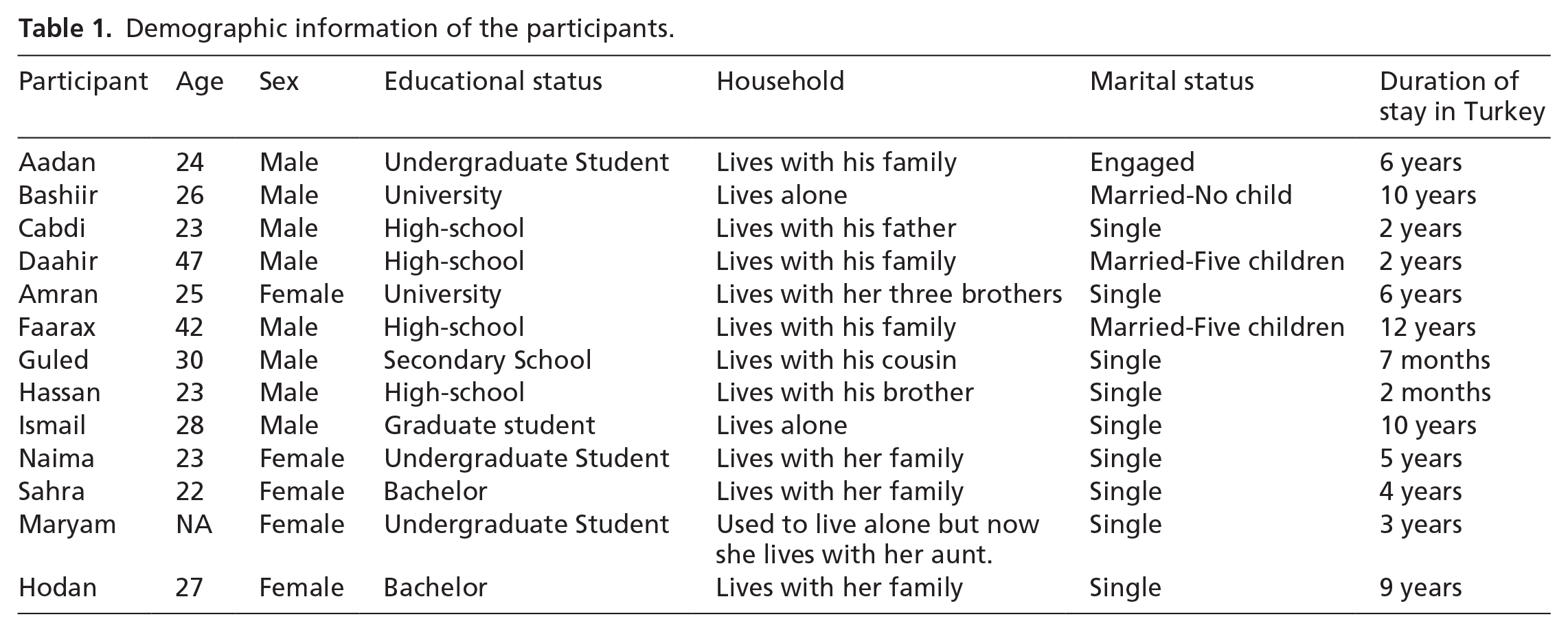
In qualitative research, focus on content rather than quantity allows for evaluation of individual meaning productions (Jensen, 2005: 136). The 13 interviews, each lasting up to 45 minutes, aim to provide a starting point for understanding cultural flow from Somali immigrant perspectives (see Table 1). To protect participants’ privacy while respecting their cultural identity, pseudonyms derived from common Somali names have been used throughout this study.
Demographic information of the participants.
Findings
In this section, the expressions and thoughts of Somali migrants about watching television and how they decide what to watch are examined within the framework of three themes using the descriptive analysis technique: (1) trans-cultural capital and integration processes; (2) the construction of subcultural identity and ethnomedia consumption; and (3) mechanisms of representation and critical distance in media texts. The themes were determined based on Wood and King’s (2001: 1–3) categorization of media texts and immigration relationship, which examines how host country media messages influence migrant behavior, how media representations shape public discourse, and how various media content affects the assimilation process.
When the media consumption habits of 13 Somali immigrants (8 men, 5 women, age range 22–47; see Table 1) participating in the study were analyzed, various patterns emerged. Participants’ daily TV viewing time ranged from 0 to 5 hours, but the majority preferred to consume media content via the Internet rather than traditional TV. Approximately 60 percent follow Somali broadcasts for news and cultural connection, while 40–50 percent watch Turkish TV series for language learning and cultural integration. Historical and cultural Turkish TV series (40%–60%) are particularly interesting to the participants. While there is a general downward trend in TV viewing habits after migration, there has been an increase in Internet and social media usage. Demographic characteristics and migration experience significantly affect media consumption habits. The age factor plays a significant role; younger participants (22–30 years old) engage with more social media and Internet-based content, while older participants prefer traditional TV channels. It is observed that the higher the level of education, the more critical participants are toward media content. Although interest in Turkish media tends to increase as the length of stay in Turkey increases, this trend does not apply to all participants. Regarding gender differences, female participants tended to watch more cultural programs than male participants. In addition, the current political and social situation in Somalia increases the participants’ interest in following the news, and this affects their media consumption preferences. Participants’ statements indicate that media consumption contributes to both trans-cultural capital accumulation and subcultural identity construction. For example, Amran stated that ‘Watching Turkish TV series helped me improve my Turkish. It improved my language a lot’ emphasizing the role of media in language learning. Faarax’s statement ‘I watch Somali films on Youtube. I watch them so that children do not forget Somali and protect their own culture’ shows its importance in preserving cultural heritage.
The study encompassed visits to local establishments, including Somali restaurants and cafes, as well as interactions with members of the Somali community residing in the research area. Evident throughout these places was a commitment to preserving Somali cultural identity, epitomized by the prevalent use of Somali language in conversations and signage, interior décor steeped in Somali traditions, and the presence of television channels broadcasting content relevant to the Horn of Africa region. It was observed that within these spaces, individuals predominantly used the Somali language and enjoyed traditional Somali cuisine. The multi-linguistic, including the use of both Somali and Arabic, subindicates the nature of Somali diaspora identities and media consumption. 4 It is form of self-segregation, with the Somali community showing a preference for establishments where other Somalis congregate (Abdi, 2015; Horst, 2017). These findings collectively show the formation of a distinct sub-community within the broader immigrant population, characterized by its preservation of cultural identity and experiences.
Trans-cultural capital and the integration process
The participants in the research exhibit different models of trans-cultural capital accumulation. While some participants have more interaction with the new culture as part of their acculturation strategy, others have very little interaction. This difference, which correlates with age and generation, also affects their integration processes. The media offer a platform for participants to establish a system of shared cultural values, and especially the interaction between the homeland and the country of immigration is established with the help of cultural intersections. Trans-culturality, not confined to national culture, aligns well with the cosmopolitan nature of large cities. The fact that multi-identity migrants with a high accumulation of trans-cultural capital continue to maintain their cultural identity and are willing to adapt to the new culture also reduces their perception as ‘the other’: I watch Turkish TV series and broadcasts, one day I even answered someone who criticized that the food is too spicy: What’s wrong bro? I’m an Ankara street-kiddo . . . I talk to my friends about football more than Turkish TV series. My friends and I usually discuss news and Somali TV series. I’m talking about what I’ve watched on BBC Somalia. (Aadan)
The integration process contains the positive contribution of narratives close to his own culture and are also related to his ability to express himself through the cultural idioms of the host country Turkey. Young participants between the ages of 23–30 (Aadan, Bashiir, Cabdi, Amran, Guled, Hassan, Ismail, Naima, Sahra, Maryam, Hodan) constitute their trans-cultural capital accumulation by watching the series and competition programs of the host country and combining the cultural differences of the country they live in with their own cultures. In this context, they incorporate dialects, local expressions, idioms, traditions, and local dishes learned through the media into their daily life practices. Aadan, a third-year university student engaged to a Turkish woman, has been living in Turkey since 2016. The analogy that Aadan establishes with the practice of watching series in real social life draws attention. For example, Aadan uses the expression ‘What’s wrong bro? I’m an Ankara street-kiddo’. 5 This shows that Aadan learnt local idioms and speech patterns through the practice of watching TV series and used them in his daily life. In addition the affirmation of family values depicted in series close to his own culture facilitates the integration of his trans-cultural capital. Among the TV series that Aadan watched and found close to his own culture was the military series named ‘Söz’. Aadan associates this series with his own military service experience and states that family values and representations of violence in the series are similar to his own cultural values.
This creates a sense of ‘us’ at the intersection of cultural connections. These intersections can revolve around topics like football or militaristic perspectives: We always talk about football. We speak Somali. I have 2 Turkish friends and I speak a mix of Turkish and English with them. I usually talk about football and bodybuilding with them. (Cabdi)
Similarly, Ismail, who is pursuing a master’s degree in Turkey, mentions that he watches Turkish series to contribute to his own cultural integration and to understand social-cultural codes. Ismail often builds his cultural capital on religious similarities, explaining that this makes the narratives in the series feel closer. An important point here is the role of television series in developing linguistic skills and facilitating the transfer of cultural capital. Middle-aged participants (Daahir and Faarax) between the ages of thirty-one and 47 do not use the media to learn about the cultural dynamics of the host country. Using the media as a tool to preserve the cultural values they brought from their homeland, the participants consciously avoid interaction with the new culture in order to prevent potential changes in their cultural identity. However, it’s noteworthy that other family members of middle-aged participants watch Turkish TV series. The difference within the family mobilizes the integration process along two distinct axes: economic and cultural. While men focus on the economic aspects of integration, women prioritize the emotional bonds they develop through television series. Cultural and religious affinity between Turkey and Somalia informs the media practices exhibited by middle-aged participants.
Construction of subculture structure and ethnomedia consumption
The collective viewing experiences of Somali migrants on digital platforms constitute a new cultural space between traditional television broadcasting and social media. However, not all migrants use the media in the same way for cultural interaction and social cohesion. The television viewing habits of Somali migrants have shown some changes, with varying viewing times and preferences before migration (ranging from not watching at all to watching 5–6 hours a day), but a general decrease in television viewing was observed after migration: I used to watch TV every day in Somalia. I’d turn on the TV right after I got back from school . . . Now, I watch less TV. I work 16 hours, sleep 8. I get to work at 8 in the morning and leave at midnight. I barely have any time to watch TV. (Hassan) I used to watch TV for about 1 hour a day at home in Somalia. I want to be a teacher here, so I watch more TV to improve my Turkish. (Cabdi)
Research on global Somali media practices (Chonka, 2018) shows that television content now exists in a wider digital medium – such that a news item received via satellite broadcasts is instantly shared in WhatsApp groups, discussed on Facebook and reproduced on Twitter. This multi-platform media consumption creates a new communicative space that enables migrants to maintain both local and transnational ties. Migrants are thus transformed from mere passive spectators into active digital subjects through which content is reproduced and circulated. While individual experiences vary, Somali migrants collectively exhibit a pattern of subcultural affirmation through their viewing practices. An interesting indicator of this is the constant presence of channels broadcasting in their language in common living spaces (such as cafes and restaurants). As participants construct a subculture in their host country through their viewing habits, they use new communication technologies to maintain ongoing contact with their homeland and sustain their cultural connections. Thus, it can be said that multiethnic migrants create a subcultural structure that preserves their culture alongside their trans-cultural experiences. This can be seen as a strategy to protect their culture rather than disrupting the relationship between the two cultures.
In addition, the media consumption habits of the participants can be associated with segregation, one of the acculturation strategies. Berry (1997: 10) defines segregation as an acculturation strategy where immigrants try to maintain their core values within their own culture and avoid interaction with the new culture. The participants also exhibit characteristics of assimilation, integration, marginalization, or separation strategies through their different ethnomedia consumption habits: I usually follow the news more than Somali TV series . . . I watch a new Somali series on YouTube. Apart from the series, I mostly follow the news on Twitter. I follow the news because I am curious about what is happening in my country, . . . how Somalia is governed and whether there has been a political change. (Amran)
Drawing on Andersson’s (2019) conceptualization of digital diaspora, we observe that migrants’ use of social media platforms to follow news is both a practice of acquiring information and a strategy to participate in political and social transformation in the homeland, albeit remotely. Among the participants, three stated that they do not watch Somali channels, two watch Somali channels using digital media due to their socio-economic status, and five watch Somali channels through satellite broadcasting.
In analyzing the participants’ statements, it can be noted that the data obtained for Somali immigrant viewers differ from the findings of Öztürk and Sevim regarding the viewing practices of Turkish immigrants in Germany. Somali migrants adopt two different approaches to establish a transnational identity structure. One group forms their views and gains different perspectives on the situation in the host country by following media texts related to politics and the economy from transnational media sources (e.g. BBC, CNN, TRT World, and Al Jazeera) or Somali channels. Satellite broadcasts are crucial tools for disseminating subcultural construction among Somali migrants. However, it is observed that not all participants have access to satellite broadcasts due to their socio-economic status, so they try to compensate for this deficiency by using new media channels (like YouTube and Facebook). While the alternative access provided by digital platforms allows migrants to overcome physical constraints in media consumption, new viewing practices developed through new media channels enable democratic media access within the diasporic community (Leurs and Ponzanesi, 2018).
The group with diasporic characteristics tends to establish a connection with their homeland. As Hall (1993: 362) points out, these groups hybridize their cultural identities with various concepts of home and homeland, continually redefining and constructing them through representational systems. In this context, satellite broadcasts play a unique role in creating diasporic communities of belonging. Digital content, including audio recordings, films, videos, and TV series, is embraced by illiterate or multilingual diasporic communities and serves as a means of interaction (Karim, 2003; Slade, 2014). Diasporic consciousness expressed in media texts allows migrants to stay informed about their home country, strengthening ethnic ties and reducing isolation. These migrants use media consumption as a form of resistance to the dominant culture of the host country.
The other group with cosmopolitan 6 characteristics watches entertainment content such as game shows and series through Turkish broadcasts (Söz, Yargı, Diriliş-Ertuğrul, Kız Kardeşler, Med Cezir, Çukur, Survivor, Master Chef, etc.) or streaming platforms like Netflix series (La Casa De Papel). With the images presented in these broadcasts, Somali migrant viewers not only identify and embrace the similarities between their cultural values and the local cultural and social context of the host country but also engage in discussions and transformations of the differences. For instance, Naima states: ‘Sometimes it’s also in the TV series. People eating together during Ramadan, having iftar invitations with neighbors, etc. These cultural features show similarities. I like seeing cultural similarities’. At the same time, they also observe and reflect on the differences. As Sahra notes: ‘Back home, women usually wear the diraa, you know, a long dress. But in Turkish shows, you mostly see them in modern Western clothes’. Thus, the relationship between migrants and their integration process aligns with Geißler’s perspective, while also demonstrating the development of a cosmopolitan outlook through media engagement (Horst and Olsen, 2021).
Critical distance on mechanisms of representation and media texts
The way migrants perceive the society they live in is heavily influenced by how they are represented in the media: There are some things that disturb me. For example, poverty and corruption are frequently associated with the word Somalia. When one wants to describe a chaotic or disordered situation, they ask, ‘Is this Somalia or what?’ . . . it was a Turkish series I watched 2 years ago. I was not angry as a Somali person, but every series conveys a message. Why should people think of Somalia in this way? Why is such a message chosen to be conveyed to the viewer? (Ismail)
While the media is one of the ways in which migrants integrate into society, the representation of Somali migrants remains inadequate. Migrants are either rarely portrayed or depicted positively – especially in news coverage – and are seldom featured in fictional stories, yet Somali migrants navigate incomplete or insufficient media representation through cultural and religious practices that connect them with the host country. In essence, when examining the media consumption habits and cultural interaction processes of migrants, the focus is on interculturality. Some migrant viewers prefer to highlight the similarities between their own culture and that of Turkey, emphasizing common ground rather than distortion, misinformation, stereotypes, racism, political biases, or incomplete and inadequate media representation. Furthermore, incomplete or negative representation practices in the media restrict more varied perspectives on cultural interaction among migrant individuals or groups, contributing to a critical distance from media content in Turkey: . . . There are similarities . . . in terms of religion. Screening times of TV series start after prayers or work. The series have a purpose and culture, which starts to resemble what religion brings. For example, not showing LGBTI+ TV series in Turkey is related to religion. However, there are also things I feel uncomfortable with when I watch them in TV series or on TV. (Ismail) I heard this song in a show and it really pissed me off . . . There’s this new song that goes ‘Dreams are Paris, life is Somalia’. It’s not cool! . . . Your country’s nice but ours ain’t that bad either. What if I said ‘Dreams are America, life is Turkey’? Same thing, right? Somalia’s a cool place too, no need for this discrimination crap . . . you got these news shows where people ask stuff like ‘Don’t you guys have any water? Is it all just hunger over there?’ Yeah, okay, there’s hunger, but we’ve got water, it’s not like we’re all standing in lines. They think we can’t get to water, that we’re always waiting in queues. (Amran)
Upon evaluating participant statements, it becomes evident that Somali migrant media representations are frequently characterized by misrepresentation or incomplete portrayal, often leading to marginalization or exclusion. The language used in media coverage of migrants tends to contain negative and stigmatizing elements, with correct terminology often not being used. Participants highlight commonalities between their local cultural values and those of the host country primarily through religion, followed by family ties, food and drink, and clothing culture: We have cultural similarities in religion, family relations, and respect for elders. There are similarities, such as people eating together during Ramadan and having iftar parties with neighbors. I like to see cultural similarities. I have not seen positive or negative situations about Somalis on TV, but we are approached positively or negatively in daily life. For example, some people say, ‘We are brothers’. Others say, ‘you are foreigners. Why did you come here? What are you doing here?’ (Naima)
Due to disparities in industrial development, formal similarities between media productions in the two countries are limited, leading participants to view home-country content as still evolving and to perceive Turkish productions as of higher quality. Two participants mentioned a small number of negative representations of Somali migrants in Turkish broadcasts, emphasizing the use of their local culture in an exclusionary and discriminatory manner. Participants express their reactions to these negative representations by discontinuing their consumption of such media content.
Regarding the preferences of Somali immigrants in terms of series content and representation policies such as Diriliş Ertuğrul Söz, Kurtlar Vadisi, and Çukur, they exhibit interest in militarism and violence while being disturbed by abusive language in youth and high school-themed series. In addition, they hold negative views of stories involving high socio-economic life, love, and sexuality. Participants express their reluctance to watch Netflix and similar digital platforms, noting that TV series often normalize violence, abuse, harassment, and conflict.
Discussion
The research reveals that Somali migrants’ perceptions of life in Turkey are complex and multidimensional. Participants’ statements indicate that there are important points of intersection between Turkish and Somali cultures, but also some prejudices and misunderstandings. While common cultural aspects are underlined in terms of religion, family relations and respect for elders (Naima), both similarities and differences are observed in food culture and daily life practices (Daahir, Amran, Hassan). For example, Amran said, ‘There are some things that are common to our culture in Turkish TV series. Things like love, respect for father and mother, women’s lives at home and not leaving the house are close’, emphasizing the cultural similarity. On the other hand, there are also differences between the perceptions before coming to Turkey and the actual experiences. Naima stated, ‘Before coming to Turkey, I had only heard of Istanbul. My opinion changed when I came. I thought that they all spoke English. When I arrived, I could not find anyone to talk to. We were very surprised’, clearly illustrating this point. However, these similarities and differences also manifest themselves in the media content. Guled’s statement, ‘Somali and Turkish TV series are different in terms of eating and drinking, clothing and dressing. Because Somalia is always sunny. But they are similar in many aspects’, and Hassan’s statement, ‘There are many cultural differences between Somalia and Turkey. . . We spend time at home. Here they are always outside. There is a difference in food culture: We drink tea with milk and sugar. There is a difference in clothing: You wear tight trousers, we wear loose trousers’, emphasize the nuances between the two cultures. These perceptions and experiences play an important role in the process of migrants’ adaptation to the new cultural environment. Geißler categorizes media integration as the contribution of mass media to the integration of migrants, the integration of migrants into media content and the integration of migrants into the wider media public. In this study it can be said that the mass media, which are included in Geißler’s categorization of media integration, contribute to the integration of migrants through popular culture products (TV series and TV programs), and the integration of migrants into the wider media public is achieved through digital platforms and the Internet, but the contribution to the integration of migrants in media content is not achieved due to incomplete and misrepresentations. In particular, media consumption and communication practices are at the center of this adaptation process. Immigrants’ cultural backgrounds, ethnomedia consumption habits and digital traces of TV series are important factors in building connections and bridges between immigrants and the host country. In this context, in addition to political, economic and sociological forces, information and communication systems also play a significant role in explaining migration and social change.
The representation policies of Turkish TV series, which take into account global market and local ideological balances, can be expressed as a double articulated cultural representation that reproduces local and conservative codes in the underlying value structures while adopting modernity in the global market standards on the surface. In the observations of the participants, while modern clothing and consumption codes are adopted, traditional values regarding gender, religion and family relations are preserved. Sahra’s observation that ‘in Turkish TV series, you mostly see women in modern Western clothes’ points to outward modernity, while Amran’s observation that in the same series ‘love for father and mother, women’s home life and not leaving the house’ indicates the maintenance of conservative values – a practice of representation that is ostensibly modern but in essence preserves traditional values. Such selective modernity is not a simple contradiction or inconsistency, but a strategic and productive mechanism of representation. The cultural contradiction here can actually be read as an attempt to construct a new conservative cultural hegemony at the intersection of global capitalism and conservative ideology. Thus, while liberal democratic values are hollowed out, their formal appearance is preserved and conservative values are re-commodified within the logic of the market. Turkish dramas calibrate their Western-style modernity to suit global audiences while systematically embedding local conservative codes to retain domestic viewership (Yeşil, 2015). The selective adoption and critical distance seen in the statements of the participants – mediating cultural subjects – are part of cultural interaction. Ismail’s statement ‘The fact that LGBTI+ TV series are not shown in Turkey is related to religion. However, there are things in the TV series that I am uncomfortable with’ points to these limits. Turkish TV series instrumentalize conservatism by trying to strike a balance between traditional life and family values and relationships, consumption and modern lifestyles; in other words, conservatism is reconstructed through modern consumption patterns. Westernization against the West proclaims the rational articulation of conservative values with the economic logic of neoliberal globalization, taking some Western cultural values and resisting others (Koçak, 2010). While Somali immigrants associate conservative values in Turkish TV series with their own cultural practices, they evaluate modern lifestyle representations through their own cultural filters.
Building on Pierre Bourdieu’s concept of cultural capital, Meinhof and Triandafyllidou introduce the concept of trans-cultural capital. Trans-cultural capital accumulation is vital for comprehending how immigrants are represented in the host country’s media, how they interpret representation policies and coding structures, how they incorporate these into their communication practices, and what contributions they decode for the integration process. When examining the statements of the participants in the context of trans-cultural capital accumulation, it becomes evident that Somali migrants have diverse experiences in accumulating trans-cultural capital, and they consume media content to fulfill their distinct needs. Media content may serve as a potential tool for socialization for some migrants, offering varying degrees of accessibility. Such texts provide a primary space for culture to become fluid and for communities to gain knowledge about different worlds (Georgiou, 2006: 90, 146). With the proliferation of digital technology, media content’s continuity increases allowing migrants to construct multiple identities through this flow. It is more accurate to categorize them as digital viewers, as most Somali migrant viewers prefer Internet broadcasts to the traditional practice of watching television in their country of origin for two reasons – long working hours and high broadcasting fees.
Viewing experiences can be categorized into two different age groups and generations. Immigrants in their twenties shape their viewing and media consumption around social and cultural phenomena rather than ethnicity. They aim to grasp the nuances of the language and learn about the local cultural values of the host country, employing the symbols and images they acquire from media content in their daily lives. Somali young migrants engage in discussions with their friends about the programs they watch, research and learn idioms or concepts they encounter, and contribute to the development of a shared culture in public spaces or their social circles. This facilitates the exchange of images, sounds, and codes present in Turkish media. In contrast, the middle-aged group/generation, aged 31 and above, continues to reconstruct their local identities by following broadcasts from the country they migrated to whether through satellite or Internet streaming. Ethnic identity is more prominent in the viewing habits of this age group.
When the integration processes of migrants are evaluated within the framework of the concepts of digital diaspora (Andersson, 2019) and connected migrant (Diminescu,2008), it can be said that migrants who stay connected through digital technologies preserve their cultural identities while experiencing new cultural processes. In this experiencing process, digital diasporas formed by digital platforms are effective in the transnationalization of national identities.
In the audience practices of middle-aged Somali migrants, while constructing their own collective identities, languages, communities, and daily life practices without interfering with the communities in which they live in the host country, they limit their trans-cultural capital accumulation through ethnomedia consumption. Middle-aged Somali migrants, who have the characteristics of diasporic audiences 7 , maintain their emotional ties with the country they migrated from through broadcasts and content from their country of origin. At this point, television is not only a tool for one-way cultural imperialism, but also facilitates national and local feelings of identity and enables global interactions (Ponzanesi, 2020: 982).
In Somalia, the Internet and social media are no longer just entertainment or communication tools, but have become an integral part of daily life and social interaction; this transformation has significantly changed the Somali media landscape, especially since the early 2000s, and reshaped the media consumption habits of migrants (Ahmed, 2020: 376). The participants’ experiences reflect this change and illustrate how migrants accumulate trans-cultural capital through media consumption: ‘While I follow Somali news websites, I also watch Turkish TV series. This gives me the opportunity to follow developments in my country and understand Turkish culture’ (Aadan). The experiences of the participants also indicate that social media platforms propel political participation and social mobilization in Somalia: ‘I use the Internet. . . I receive news about Somalia through social media and follow it from there. I look at news from both Turkey and Somalia on social media’ (Bashiir). Similarly, Amran remarked, ‘I follow political developments in both Somalia and Turkey through Facebook and Twitter. Thanks to these platforms, I can participate in discussions in both countries’. The statements demonstrate how migrants construct multiple identities and exist in different cultural contexts through digital platforms (Leurs and Ponzanesi, 2018). The fact that most of our participants reported following both Somali and Turkish media content shows the practical implications of this transnational media consumption. These platforms amplify the role of diaspora communities in both the production and consumption of media content, thereby extending their influence both within and beyond Somalia.
Conclusion
This study, based on an audience ethnography approach, aimed to emphasize the relationship between the practices of migrant audiences and their trans-cultural capital structures and integration processes. Cultural interaction is key in immigrant integration, involving adaptation to the host culture and creation of a new, hybrid culture. This research used a wide approach which narrowed down to focus on specific population segments. This narrowing down allowed for the uncovering of specific interactions and subcultural codes, as Fetterman (1998: 32) argues.
When evaluating the data obtained from interviews with the participants, it becomes clear that media texts from the host country can often facilitate cultural integration. The most significant factor here is that media usage habits accelerate the language learning process and create opportunities for communication. Immigrants predominantly realize their media usage through new media tools, which expedite language learning and enhance communication. In particular, changes have emerged in the viewing habits of Somali migrants after arriving in the host country. Somali migrants, who consume traditional media in their host country, prefer new digital and social media tools after arriving in the host country. They follow programs, TV series, and news on YouTube, digital platforms such as Netflix, and social media channels. This shift from traditional television is partly due to access issues, high broadcasting fees and post-migration lifestyle changes, long working hours, including employment and educational commitments.
The results of the migrant audience ethnography research indicate that audience practices are not uniform, with differences existing in the use of media content, message coding, processes, and interpretations of representations. Migrant audiences can be broadly categorized into two different forms: cosmopolitan and diasporic. Commonalities among Somali audiences include learning the cultural values of the host country, synthesizing these values with their cultural backgrounds, and contributing to the integration process by consuming media texts from the host country to acquire or develop language skills. Mediated global cultural experiences enable individuals with multilingual, hybrid, and multicultural identities to understand images, interpret codes, develop emotional and cultural affinities, integrate and reflect on the knowledge gained from media into their daily lives, reshape behaviors with the codes they have learned, and evaluate their trans-cultural capital as cosmopolitan viewers.
On the other hand, the hybrid identities of participants who are uprooted or separated from their national culture and their knowledge of multiple languages allow them to carry out their daily practices without necessarily needing to learn the host country’s language. Diverse audience practices are based on access to media broadcasts in more than one language and the fusion of these contents with diasporic audience characteristics. For instance, some participants, despite living in Ankara for more than a year, do not feel the need to learn Turkish and continue their communication habits by watching English, Arabic, and Somali broadcast channels. This illustrates how cultural interaction through the media spans distances and allows Somali immigrants to maintain a sense of cultural identity despite being in a different country. Furthermore, participants receive multiple cultures in their viewing, including the countries where they have previously resided, thereby adding to the complexity of their transnational media experiences. In the best of cases, the fluidity of culture through media content enables individuals to explore unfamiliar places, establish connections with fictional characters, revisit geographies they long for after displacement, and become part of a global cultural experience.
Footnotes
Data Availability Statement
Data sharing not applicable to this article as no data sets were generated or analyzed during the current study.
Declaration of conflicting interests
The author(s) declared no potential conflicts of interest with respect to the research, authorship and/or publication of this article.
Funding
The author(s) received no financial support for the research, authorship and/or publication of this article.
