







Abstract
Anime fan subtitling and online distribution offer rare insights into the relationship between fan creativity and industry conceptualizations of piracy. This article attempts to de-polarize this debate (wherein fans are presented as invaluable amateur producers or, alternatively, as overt pirates) in order to examine the roles played by these liminally situated fan producers in relation to the wider anime fan and industrial communities. These active fans are now represented as good or bad dependent on other groups’ investments in their practices, and unpacking these conceptualizations provides a better view of how anime fandom may be indicative of larger changes in online fan community construction.
When do fans become pirates? The distinction between fan practices and copyright infringement is not always clear; or rather, industry producers have tended to react strongly to what they perceive as fans’ copyright infringement, while fan producers view their practices as valid adaptations and interpretations that reinforce their legitimate consumption of media texts. Control over textual circulation forms the crux of the debates: debates over who should be allowed to distribute, and profit from, media texts, and how. Perhaps unsurprisingly, most of the academic work in this area still focuses on American media products, American fandom and overt piracy (for high-profile examples, see Hills, 2002; Jenkins, 1992; McDonald, 2007). However, Matt Hills (2005) and Henry Jenkins (2006a, 2006b) are among those who have begun to take interest in how fans respond to texts from beyond their own shores, particularly in how fans respond to Japanese texts. This article is intended to expand on such work by examining discourses around a perceived lack in transnational media distribution; namely, of anime.
Anime fans are, generally speaking, well-informed about piracy and so when some of them choose to infringe copyright it raises a series of questions pertaining to power, ethics and what it means to be an ‘active’ fan. This is because there is an ambiguous group of anime fan-pirates whose practices fall into liminal legal gray spaces: fan subtitlers. Sean Leonard writes that by the early 1990s: ‘Fans helped pave the way for the popularity of anime today. Without the fan network, and specifically without fan distribution, anime’s success could never have happened’ (2005: 298, original emphasis). Fan subtitlers’ distribution of anime is in many ways not unlike the work of other active fan-producers, who create ancillary texts ranging from fan fiction to fan art. However, in the case of anime, these fan texts are at the liminal edge between fan creativity and piracy. Essentially, this is because fan subtitled anime are texts augmented by, rather than created by, fans. These are the industry’s own texts, re-translated and distributed for free by fans, and they are shaping the discourse between anime’s most active set of fan-producers and the companies that originate their objects of fandom. The point of this study is to open up these debates in order to argue that fan subtitlers take up a greater range of positions in relation to the industry than previously polarized discourses suggest. The argument here is that the notion of the ‘fan subtitler’ contains within it a range of positions in relation to the fan community that indicate everything from new kinds of fandom within anime to a slide into the most overt forms of piracy.
The current picture of the fan subtitler is an increasingly negative one, whereas even ten years ago the impression of anime fansubbing was actually positive. Antonia Levi (2006: 47), for instance, has claimed that even in the mid 1990s anime fan subtitling was viewed as useful by industry officials, who looked to fan production to see where potentially profitable markets might lie. However, as the production of ‘digisubs’ (anime fansubs made available as computer files) grows the positive perception of the fan pirate is diminishing. This coincides with the increasing profitability of the anime market, as the anime industries of Japan and the United States of America now have more to lose through the illegal distribution of their wares. In many respects, therefore, fansubbed anime provides an extreme case study for the kinds of discussions that regularly pepper the media and academia regarding the legitimacy of fan practices. This links anime fan cultures to other media piracy debates around music and film downloading (Condry, 2004; Hesmondhalgh, 2007; Kwok, 2004), but also relates it to discourses around the legitimacy of fan art and fiction (Hatcher, 2005; Tushnet, 2007).
The resulting debate over the rights and privileges of fan subtitlers within the anime community is one that takes in not just issues of fandom, but also of new technologies and the (lack of) availability of preferred texts (Jenkins, 1992). Anime texts have become nexus points for discourse around ownership and rights, around fan knowledge and ‘subcultural capital’ (Napier, 2007; Thornton, 1995), and also around the nature of anime fandom online. Napier defines subcultural capital as knowledge about an area of fandom ‘that allows one to feel comfortable with other like-minded fans, but also to gain status among fellow enthusiasts’ (2007: 150). It will be argued that, although part of the fan subtitler’s subcultural capital comes from positivist notions of shared knowledge and respect, it is equally possible to accrue such capital through more competitive means and through a combative relationship to other mediators and subcultural arbiters.
By the same token, it has been the fan subtitlers’ adoption of new technologies of production (Aegisub, DivX) and distribution (BitTorrent) that has spurred the debate, as ease of online fansub production and distribution has shown the industry the potential reach of their texts. This article will therefore look at current shifting perceptions of the anime fan subtitler from several different angles: examining the oppositional pulls of individuation and standardization within contemporary fansubbing communities, while considering the discourses that are currently circulating around these fan ‘pirates’.
This article has been written based on a year-and-a-half long reception study of anime fansubbing and industry responses to it. It began with the annual Tokyo International Anime Fair (March 2008), where the Japanese industry promotes and announces the majority of shows that it intends to launch for the new television season. The study focused on the most heavily promoted new show for 2008, Soul Eater (created by Atsushi Okhubo, 2008–), for three reasons: first, because Soul Eater did not have pre-existing anime texts associated with it and was not a spin-off from a larger multi-media anime empire (though it was, as many anime are, an adaptation of a pre-existing manga). Therefore, any fansubbing of Soul Eater would occur after its initial Japanese broadcast beginning April 2008. Second, Soul Eater offers a text that aligns with previous successful transnational anime crossovers in several regards: in its presentation of a group of young teen characters, in its gothic aesthetic style and in its generic positioning in the action and horror genres (see Figure 1), making it a likely candidate for fan subtitling and downloading by particular niches of the transnational anime audience. Finally, Soul Eater offers not a special, but a relatively usual pattern of dissemination, making it a useful example. This is not intended to suggest that Soul Eater could stand in for any anime show, but rather that it offers a terrain of distribution and translation that should enable insight into the relationship between fans and licensed producers at a moment of heightened discord, which followed in the wake of a global recession, beginning in the summer of 2008.

Promotional image for Soul Eater’s UK release, reproduced by kind permission of Manga Entertainment, UK, © Atsushi Ohkubo, Square Enix, TV Tokyo, Media Factory, Bones, Dentsu 2008
It will be argued that, within an expanding milieu of online media piracy, anime fan subtitlers are part of a select community that can still make some claims to legitimacy. As is the case for fans who subtitle other kinds of non-English television shows, including live action ones, anime fan subtitlers’ claim to legitimacy is based on the fact that a significant proportion of the works that anime fans enjoy never make it as far as legitimate distribution beyond the domestic market. This was another reason for choosing Soul Eater, because its heavy advertising, known author, well-known animation studio and high-profile Japanese release all made it likely that the show would achieve international distribution, turning its continued piracy into further fodder for debates around fan morality. By focusing on the distribution – legal and illegal – of Soul Eater in the transnational, English-speaking marketplace, the aim here is to analyse the variety of reception sources that cohere around high-profile anime releases, from industry to media discourses, through to those of fan producers and viewers.
Online anime fan communities
The sheer scale of fandom online presents problems for a study such as this one. Borrowing from broader fan studies, Matt Hills (2002: 177–80) offers a useful way of pinpointing such online fandom as ‘communities of imagination’ that perform themselves for the benefit of other imagined audiences surfing the Internet. Similarly, among the very few scholars who have attempted to map anime fandom (in any form), Henry Jenkins has usefully described these communities of imagination as forming a ‘pop cosmopolitanism’, where fans embrace ‘difference’ and are ‘seeking to escape the gravitational pull of their local communities in order to enter a broader sphere of cultural experience’ (2006b: 155). Sean Leonard (2005) has also taken up pop cosmopolitanism in his exploration of the roots of anime fandom and its alternative distribution practices through fansubbing. However, despite these attempts to present anime fan culture as a more or less homogeneous group with a shared goals and passions, here it will be shown that this is not the case.
Susan J. Napier (2007) and Laurie Cubbison (2005) are among those who have attempted to engage with the more heterogeneous nature of online anime fandom. Cubbison’s use of Ru Igarashi’s annual anime fan survey 1 and Napier’s diachronic study of anime fandom through online questionnaires and interviews are both helpful interventions, but neither is particularly interested in tracing newly emergent fan practices online. In fact, work on online anime fandom tends to be found in fields nominally separate from the study of both anime and fandom: in translatology and legal studies. Perhaps unsurprisingly, the former of these groups has been particularly concerned with mapping the practices of anime fan subtitlers (Diaz Cintas and Muñoz Sánchez, 2006; Pérez González, 2006), while the latter has been concerned with the issue of copyright infringement (Daniels, 2008; Hatcher, 2005). Again though, and perhaps because of their clear reasons for focusing elsewhere, what is lacking in these studies is a sense of how fan subtitling groups relate to other kinds of anime fans, and how they present and perceive their work. Perceptions of fan subtitlers will be shown to play a role in broader community understandings of anime online, but there is potentially much more at stake in examining these fan subtitlers.
It is the examination of fan subtitlers’ positioning of themselves that separates this study from others that examine anime fansubbing. The central questions are not about the ability of fansubbers as translators, nor about the legality of their practices. Rather, this article is intended to amend the impression that the industry’s early positive response to fansubbing (Newitz; Jenkins) continues now, and that fansub groups always follow strict ethical codes of conduct. The aim here is to investigate how the industry and fans interact at specific moments in time, and particularly in times of rapid change.
A final way in which this article differs from previous studies is that it focuses on the relationship of anime fan subtitlers and the anime industries in their own words. This article is a reception study, following the historical work of theorists like Barbara Klinger (2006). The point here is to examine the discourses that arise out of the statements made by and practices of industry, fans and those mediating between them, focusing on those with a connection to Soul Eater in the main, but augmented where relevant by inclusion of sources relating to wider online anime cultures. While some particularism is inevitable in historical studies of this kind, it is hoped that the evidence supplied will offer insights into the wider cultures of fandom online in ways that may problematize American media accounts of fan–industry relations.
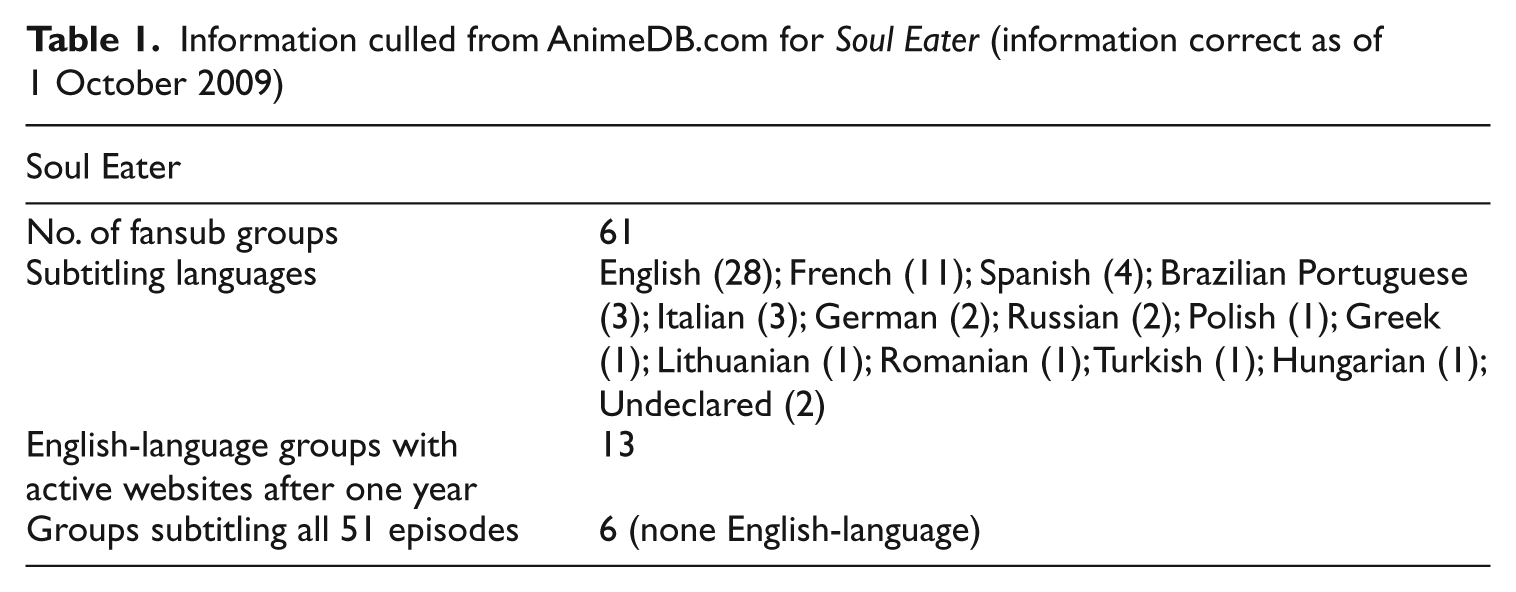
The sources used here will be dominated by online discussions of anime of various kinds, from industry to fan forums, to open letters to and from the industry. The materials were selected with reference to three major source types: industry websites (for companies like Right Stuf and FUNimation), mediation websites like the Anime News Network and fansub groups’ websites. The latter were selected based on the fansub database carried by AnimeDB.com (or AniDB), a well-known Wikipedia-style open access database which acts as a repository for information about the availability of fansubbed anime online. 2 Table 1 shows the raw data amassed through the study of this website.
Information culled from AnimeDB.com for Soul Eater (information correct as of 1 October 2009)
The rise of the pirates: the post-millennial anime fan subtitler, technology and community
Before discussing the fansubbing community, this section attempts to outline the roles played by fan subtitlers and technology in the transnational cultural flow of anime texts. The processes involved in fan subtitling require both technological and linguistic knowledge-bases to succeed. It is worth taking a brief moment to underscore the important relationship between fans’ creative work as translators, and the technologies that enable them to become so problematic to the industries serving their interests.
In most accounts of fansubbing, the rise of the Internet, improvements in digital re-production technologies and peer-to-peer file sharing are provided as reasons for the large growth in fansubbing in recent years (Leonard, 2005; Pérez González, 2006). This is suggestive of standardization in the processes and timetables of fan subtitling. As Jorge Diaz Cintas and Pablo Muñoz Sánchez (2006), and the Live-eviL fansub group (Live-evil, n.d.) relate, fansubbing is a highly specialized and diversified process. Diaz Cintas and Muñoz Sánchez list seven major translation tasks: source acquisition, translation, timing, typesetting, editing, encoding, distribution and ‘karaoke’ for credits sequences (2006: 40, 42), with Live-eviL adding quality checking and additional editing. A transnational set of translation and distribution processes often takes place, from those in Japan uploading ‘raw’ anime broadcasts to the Internet, through to international teams (who may not all be resident in the same country) who work collectively to produce a dispersed and transnationalized subtitled version of anime online. Anime fansubbing, therefore, is best understood as a transnational process involving loose collectives of individuals who may never actually meet in person.
Multiple linguistic translations also play a significant role in the globalizing of anime texts, taking them beyond the Japanese and English-speaking markets. In the case of Soul Eater 28 fansubbing groups are listed on MyAnimeList.net for English translations, whereas there were 30 groups working on non-English versions. 3 The implications are that, while the technologies of fansubbing are transnational, the linguistic and cultural specificities of the local make it almost inevitable that high-profile anime releases will be worked upon, and reworked, by a wide variety of specialist fansubbing groups. Moreover, the technologies, especially ‘softsubbing’ (which allows re-translations and re-encodings of new subtitles) are allowing raw footage to be re-produced repeatedly, with new iterations appearing over time in increasing numbers of languages. The spread of anime therefore becomes seemingly viral, and, while the supply of raw shows may be relatively limited in some cases, the potential for their spread seems limited only by a lack of fan translators.
The transnational organization of fan subtitling provides an augmentation to Matt Hills’ conceptualization of online fandom as ‘just-in-time fandom’. Hills argues that fans’ interactions with one another are organized around the broadcast schedules for their chosen texts, stating:
practices of fandom have become increasingly enmeshed within the rhythms and temporalities of broadcasting, so that fans now go online to discuss new episodes immediately after the episode’s transmission time – or even during ad-breaks – perhaps in order to demonstrate the ‘timeliness’ and responsiveness of their devotion. (2002: 178)
In the case of fansubbing and its followers, however, it is the Japanese, not the American, broadcast times that temporally organize fan viewers’ demands for content as well as their responses. Hence, the Dattebayo group have proclaimed that they will ban anyone who pressures them by asking for fansub release times. Their reasons are as follows: ‘it’s annoying’; ‘it distracts us from actually working on the episode’; ‘it’s rude’; ‘we’re providing a free service and we’ll release whenever we damn well please’; ‘because we said so’ and, rather more imaginatively, ‘because every time [you ask], a ninja cuts off a kitten’s head and doesn’t even care’. 4 The excessive language in this response implies that fandom from viewers is no longer ‘just-in-time’, but that anime fans are becoming more aggressive and proactive about their relationship to their favoured texts. Moreover, the speed requirements being placed on fansubbing groups also have potential ramifications for the Japanese and American industries who, as will be shown, are attempting to come up with business models that enable them to compete with fan subtitlers.
For fan subtitlers too, speed of translation has ramifications. The Live-eviL history webpage (Tofusensei, n.d.; see also Hatcher, 2005), for example, discusses the importance of using decentralized, specialist subgroups, each working on different anime series. In an interview with the Anime News Network, one Live-eviL fan subtitler provides information about the ways in which speed has become a central part of the fansubbing process. He claims that raws can be found within 15 minutes of an episode’s broadcast in Japan, and that groups then race to see who can translate and redistribute the fastest:
BitTorrent levelled the playing field, so you had a whole influx of new people coming in doing speed subs, because if you were the first person to release a file, you were going to get that notoriety, that attention. People would recognize you and be interested in you. It really is a competition; there are people who are friends and people who are enemies. At the end of the day, it’s one giant social environment, and instead of playing Warcraft, having guilds and fighting each other, fansub groups compete with one another for downloads. (Bertschy, 2008)
‘Speed sub’ groups are therefore now forming a new kind of anime subtitling community. In this incarnation the fansub is at its most market-ized and competitive, formulated by those inside it as similar to Massive Multi-Player Online Role Playing Game (MMORPG) groups in terms of community behavior. However, despite being constructed socially along the same lines as MMORPG, anime fansubbing creates end products that can be utilized long after the end of the ‘game’, and re-used and re-produced across transnational linguistic borders.
Anime fans of fansubbing online
As Nancy K. Baym (2000) and others indicate, the Internet is changing the manner in which fans gather, communicate and become active community members (Hills, 2002; Jenkins, 2006b). Johan A. Pouwelse et al. (2008: 701; with reference to Toffler, 1980) cite a particular kind of fan activism as central to the accumulation of subcultural capital in this regard: the ‘prosumer’ (producer-consumer) fan. The authority and power that the fan subtitling prosumer wields in relation to their audience is evidenced in the way anime fan viewers interact with their fansub providers. Therefore, it is worth beginning this section with an examination of the relationship between fan-as-prosumer and fan-as-consumer before considering the fan subtitlers and their relationship to the industry. Anime fan responses to fansub groups often result in unquestioning praise and thanks, without reference to ethics or morality. For example, Aero Subs’ website featured user comments for the group’s Soul Eater fansubs, with repeated responses offering thanks even in cases where the episode was deemed sub-par, or to be a ‘filler’ episode. 5 In this context, the statements of thanks revolved around perceptions of the quality of the fansubbed translations, in spite of the lacklustre reception for the episodes themselves.
More notable than the thanks offered by users, however, was users’ requisitioning of the language of fandom in their responses to fansub groups. For example, jaganshi responded to a negative post by tox (see below) in the Rumbel Fansubs Soul Eater forum in the following terms:
If they [the Rumbel group] were only concerned with pleasing others then they would be the ones burdened by people like you. That’s not to say they shouldn’t care at all about their fans but it shouldn’t be their priority. If they can satisfy their fans without a major interference to their own self-interest then I don’t see why they wouldn’t. (Rumbel Fansubs, n.d.)
6
Here, anime fandom becomes subsumed into discussions about fansubbing fandom. Fans display a hierarchical understanding of fandom that assumes a general fandom for anime, but which focuses upon the fansubbing group as a significant fan object. This indicates that, although not yet a normative viewing practice for all anime fans, fansub viewing has become such a well-established practice that fansub groups are now credited with creator-as-star status.
As the example from Aero Subs reveals, the fansubbing group’s relative star status works in a different manner to that of traditional media stardom. Fansubbing group members tend not to be singled out for praise or fan ire; rather, it is the whole group that wins praise or censure. Fans, therefore, accept collective re-authoring as a creative practice. This is partly a product of Internet anonymity. For instance, many groups do not sign their work individually, inserting just the name of their fansub group in the opening titles of their chosen anime. Fansub listings online also use the fansub group name as a means of indexing and differentiating episodes (see Figure 2), thereby protecting the anonymity of the individual fan authors concerned. The public face of fansubs, therefore, is organized around the notion of collective authorship as a means of garnering subcultural brand-like capital.
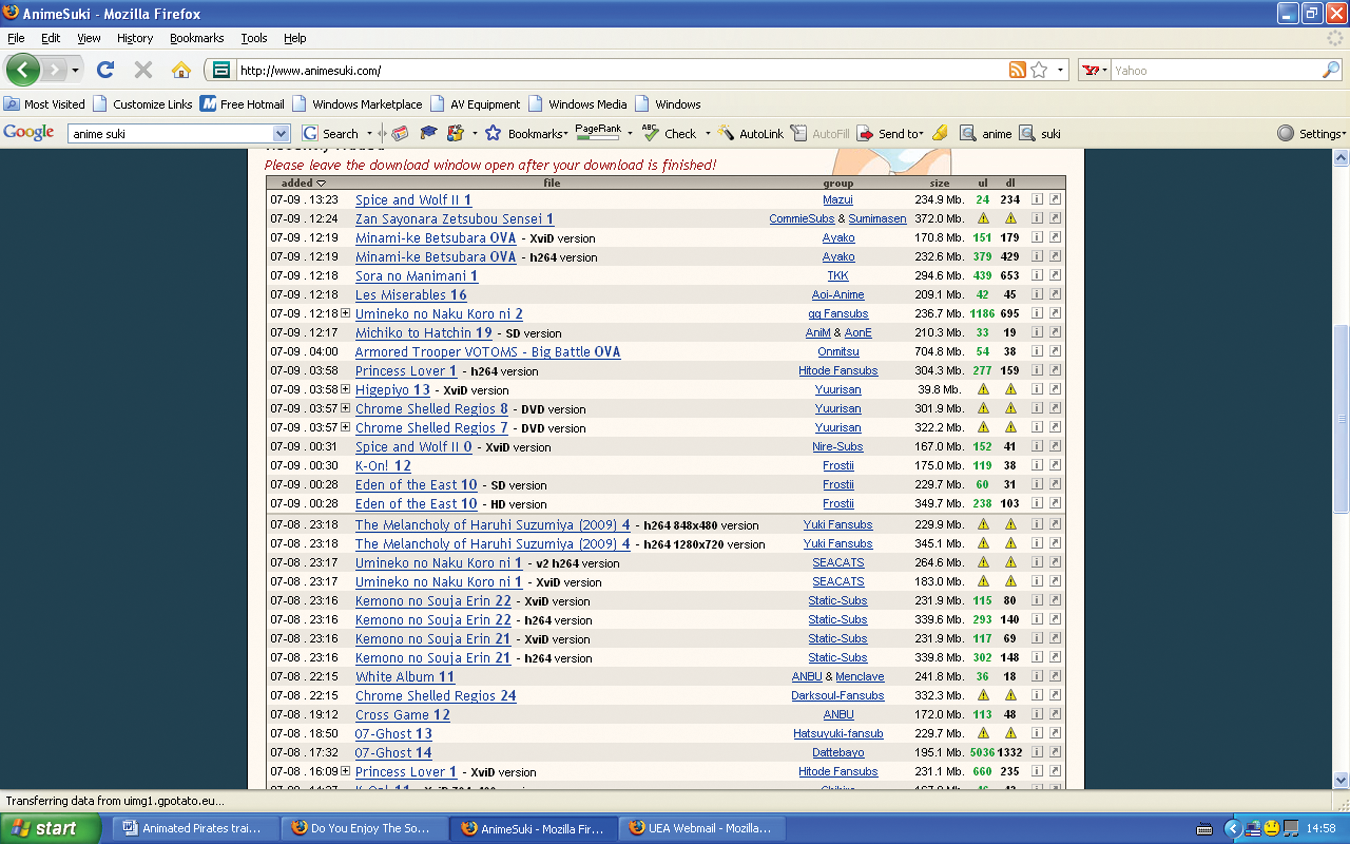
Screen shot from Anime Suki, showing anime fansub groups listed like authors (http://www.animesuki.com/)
Thus the fansubbing groups fulfil a branding function not unlike corporate brands. The closest corollary in legitimate anime distribution is American redistributors like FUNimation. Their redubbing, website, packaging, logos and re-sequencing of credits on shows acts to embed their brand within the textual content of the anime shows FUNimation distributes. However, the difference is that fan subtitling groups act as brands of fandom in which personal tastes and engagements with the text are foregrounded through the choices fan viewers make, and the discussions they have about which group produces the ‘best’ fansubs.
Therefore, in addition to effectively branding their work, fansubbing groups are now increasingly operating in a competitive, rather than mutually supportive or educative environment. Indeed, fan viewers’ choices of fansubs are often mediated. Comparative websites now exist that help fan viewers to select the ‘best’ fansubs available. 7 On the Rumbel site, fan member Suiton offers evidence of their use:
A few days ago, they [Anime Yoshi] announced that they’re officially dropping it [Soul Eater] (along with a bunch of their other projects).That’s when I rushed over to AniDB and found that Rumbel was the best group. (Rumbel Fansubs, n.d.)
AniDB and other comparative sites are one of the means by which anime fansubbing is becoming increasingly market-ized, with groups behaving competitively and being encouraged to standardize (and professionalize) production to attract greater numbers of fan viewers. In Suiton’s comments, as previous fansub groups go inactive, it is large community mediators, not individuals, who become arbiters of taste.
Criticisms of fansubbing, conversely, do seem to be more individualized. The competitive nature of speed subbing is highlighted in forum comments that compare fansubbing groups. On Rumbel Fansubs’ forum, for instance, Tadashi was most often compared with Rumbel, to Tadashi’s detriment. The problems cited by fans appear to have been related to trade-offs between quality, technology and speed. Some fan users on the Rumbel site referred to the types of technology used to compress video ready for streaming. For instance, Izzy wrote that ‘I have been watching tadashi, but then i replace it with rumbel once it is released. I like the softsubbed mkv’s better’ (Rumbel Fansubs, n.d.). Not only does this comment provide evidence of fansub collecting, separate from legitimate collecting practices, but it also implies a hierarchy of collecting habits. In this conceptualization, the slower group’s fansubs, because they offer high-quality releases, are those deemed worth keeping (Rumbel), while the faster, but lower-quality fansub (Tadashi) comes to be viewed as a disposable commodity. Technology choices are therefore an important part of the popularity of fansubbing groups, and fan consumers appear to be developing new archival viewing habits for fansubs that fly in the face of fan community calls to destroy fansubs once licenced DVDs become available.
However, for other users, like Elderkain and Pervy_Sage78, speed is more of a priority, and Tadashi’s quicker turnaround means Elderkain chose to watch their product over Rumbel’s. For example, Elderkain writes: ‘They could be faster becasue [Tadashi] is currently a couple releases ahead of [Rumbel] at the moment’ as a justification for his choice of Tadashi’s fansubs (Rumbel Fansubs, n.d.). Tox, posting slightly later, sarcastically comments on the length of time Rumbel Fansubs takes to produce an episode, citing a four-week turnaround. Tox writes:
My personal opinion about this is, if your own lifes take so much time that there is not enough time to sub a series in a reasonable time, then you shouldn’t do it at all or, at least, don’t release your subs from the start as they are anyway to late. I understand you are doing it for yourself but you shouldn’t burden the people around you with late releases. (Rumbel Fansubs, n.d.)
This unusually critical post caused a backlash of defense (see jaganshi’s comments above), and largely on the grounds of amateur-ism. Gram, for instance, replies that ‘Tox, they don’t do it for themselves. (Rumbel isn’t Dattebayo.) They do it for us poor souls that don’t understand japanese’ (Rumbel Fansubs, n.d.). This exchange highlights the shifting status of the fan subtitler, at one and the same time perceived as the producer of professional-standard quality goods, while also providing an amateur, free service on which fans are placing overly consumerist demands. Moreover, this fan of Rumbel defends them on the grounds of enabling audiences to access otherwise unavailable and untranslated texts. Communities are not therefore predicated simply on a performance of their own fandom. As these examples show, the communities of imagination around anime fansubs are complex entities filled with (often divergent) hierarchical understandings of how fansubs should look, as well as what fansubs are for and how the groups and their users should behave.
The ethics of fansubbing
The liminal status of fansub groups can be read at the level of their visibility online. There is considerable disparity between those groups that choose to remain liminal, engaging with their fans only through IRC, or which have little to no web-presence, and those moving closer to mainstream types of visibility. For example, a perhaps surprising proportion of Soul Eater’s fansub groups have websites. These websites regularly offer information about groups’ fansubbing projects, they give access to IRC or BitTorrent information for downloaders and even provide group histories and FAQ pages. However, despite surveying the groups with and without websites it is still not clear if there is a direct link between heightened online presence and professed responsibility. 8
This is all the more surprising given the general consensus that anime fansubbing is illegal (Kamen, 2009). Mirroring Rebecca Tushnet’s argument in relation to slash fiction writers, anime fan subtitlers and fans frequently ‘acknowledge copyright owners’ legitimate economic interests, but maintain that their activities do not hurt and even help revenues from authorized works, by increasing loyalty to and interest in the official versions’ (2007: 64). This is replicated in fan discussions on fansub websites. For example, in the Chatbox on Souleaterfan.com jurtango posted two messages complaining about those who continued to download the show after its official release had been announced:
im not talking about downloading on this site im talking about the comments below saying where can we download soul eater from when the dvds are coming out in the next few month and not to be rude but im a massive soul eater fan and if i can wait for the dvds to come out so can you (jurtango, n.d.)
As these comments indicate, there is a growing split in online fandom between those who place limits on the legitimacy of anime downloads, seeing DVDs as preferable texts, and those who place downloadable versions at the core of their anime consumption. Given that anime fansubs now directly compete with industry products, the question of ethics and a perceived slide into piracy are becoming common criticisms of fansubbing groups. In turn, the fansubbers are seeing an erosion of their status, with a concomitant decrease in the perceived legitimacy of their undertakings, and fansub groups are beginning to align in factions against one another, each claiming legitimacy and morality for their own side.
The rules for fansubbing are well established, to the extent that they have been laid out in a set of ethical guidelines by the Anime News Network (ANN). The ANN purports to hold a neutral position between the industry and audiences for anime, and its ‘New Ethical Code for Digital Subtitling’ offers a set of guidelines for standardizing fansubbing practices, offering what they term as the ‘holy grail’ of fansubbing ethics. The code focuses on three specific areas: first, on explaining the more legitimate purposes of fansubbing (introducing fans to new texts and offering English translations where otherwise unavailable); second, on limiting the extent to which fansubbing should be provided (when released by the industry, fansub production should cease and fansubbing groups should not compete openly with the industry); and it ends with an admonition to fansubbing groups that reads:
You make fansubs voluntarily, out of your own free time, because you are a fan. Never for personal profit or recognition. If at any time you feel you should be compensated for the work you’ve done, then you’re probably doing this for all the wrong reasons. (Anime News Network, 2003)
The tenuous status of fan prosumers of anime is made clear in this statement. The legitimacy of requiring rewards for their cultural work is denied – even just being ‘recognized’ for the work – and the emphatic nature of the statement suggests that the ‘holy grail’ of fansubbing is being regularly lost to piracy, indeed, the code is based on a fallacious conceptualization of invisible fan authorship that effectively renders all fansubbed works illegitimate because of the way fan consumers interact with groups as brand names. Conversely, the production of a set of guidelines by a mediating party also suggests that anime fansubbing is an established practice that is unlikely to disappear. The guidelines attempt to legitimate the practice of fansubbing, while at the same time creating clearer demarcations between acceptable fan practice and piracy. However, the extent to which fansubbing groups follow, or care about, rules and guidelines for fansubbing is debatable.
Fansubbing, as the above Code suggests, is becoming a broad and divided community. The community is increasingly split along not just ethical, but also generational lines, as two passages from ANN’s interview with Tofusensei from Live-eviL show:
I’ve been doing this a long time – hardly anyone has stayed in the scene as long as I have. And the reason is because people get frustrated with the new groups, who get increasingly younger and more annoying and are focused entirely on things like speed. We subtitled Wolf’s Rain. 11 or 12 groups were subtitling it. At the time, the group we really wanted to mess with was AnimeJunkies, because they were doing terrible things in the scene and genuinely giving fansubbers a bad name for a variety of reasons. That was an extreme, and it wasn’t indicative of the fansub movement, so we thought it’d be fun to one-up them on this title. So we started doing really high quality subs faster than they could do it, and more and more groups started doing that, and eventually they just collapsed under their own weight. (Bertschy, 2008: 2)
Fansubbers are positioned here as normally responsible and self-policed, with this fan subtitler making it his business to put errant groups out of business. In terms of ethics, however, it was not copyright infringement that apparently troubled this fan subtitler. Instead, it was widespread reports about AnimeJunkies’ insulting interactions with other groups and with the anime industry that provoked responsible community members’ approbation.
In 2003, for example, ANN carried an editorial that demonstrated AnimeJunkies’ apparent disdain for legitimate anime licence-holders. Christopher MacDonald reported that a representative from Urban Vision received responses that told her to ‘Rot in Hell’ and were peppered with expletives. AnimeJunkies’ response apparently also carried a denial of Urban Vision’s rights ‘to buy a series we were doing’ when asked to stop fansubbing the Ninja Scroll (dir. Yoshiaki Kawajiri, 2003) television series (Macdonald, 2003). In such comments the fansubbing group demonstrated a level of contempt for those producing DVDs, seeing their own product as a more legitimate version. Indeed, AnimeJunkies still exists and their website lists many high-profile licensed anime 9 as well as allowing ‘donations’, another practice discouraged by the code. Where AnimeJunkies’ antagonistic stance to the industry is perceived by some as a sign of relative immaturity, as with Tofusensei’s comments, its continuing popularity may also be indicative of a shift in the fan culture from responsible to more profligate piracy.
Tofusensei also describes a generational gap in fansubbing that may explain the variance between approaches to fansubbing. He uses terms of comparison that are based on his length of ‘service’ in the fansubbing community (in Bertschy, 2008), indicating that there is a high turnover in volunteers for fansub groups. His negative response to these new fan subtitlers chimes with Nancy K. Baym’s discussion of new and established users of Usenet, where shifts in the community online resulted in a quick adoption of overt rules and protectionist behaviours by those who had been long-term members (2000: 84–190). The generational divide in anime fansubbing does not, therefore, refer to a sense of actual age, but rather to ‘length of service’ style arguments outlined by Tofusensei (in Bertschy, 2008), and the sense of a new wave of unruly ‘young turks’ entering an established scene (Baym, 2000: 184). However, Tofusensei shows that it is not just younger fan subtitlers who are using speed as a competitive tool, so too are more established fansub groups. ‘Attention and name recognition … let’s call it the currency of the game’ (in Bertschy, 2008: 2), he says, further demonstrating that online fansubbing has become a new kind of fan practice.
Tofusensei’s reading of the fansubbing culture chimes with Tushnet’s (2007: 64) point about generational shifts in fan fiction writing, wherein ‘new fans are not always initiated by more experienced ones. They may not learn the norms of the pre-existing community when they start sharing their own stories and art.’ In much the same way, new fansubbing groups seem to be borrowing from other forms of fandom outside ‘traditional’ fansubbing practices, performing their own fandom as one differently constellated from that of the ‘older’ fan subtitling generation. However, it is interesting to note that most of the fan subtitling groups surveyed here did respond to direct industry requests to stop producing fansubs for Soul Eater. Tadashi closed down completely following the Cease and Desist letters from FUNimation, while Rumbel Subs offered an in-joke relating to Soul Eater character Excalibur. They wrote ‘Excalibur was let loose and took over the Soul Eater team who weren’t able to resist’ on announcing their cessation of Soul Eater fansubs. 10 In fact, of all the English-language fansub groups, only one group, sayonara, completed all 51 episodes of Soul Eater. All other groups that did the complete the series did so in non-English languages. This would seem to indicate that industry efforts to enforce copyright are taken seriously by the fansubbing community, but that the further the groups are from the English-language (American) hub of copyright enforcement, the less ethically constrained they become.
Mediating online distribution: the industry versus/uses fansubbing practices
The ambivalence with which fan subtitlers seem to view the industry also spills over into the tone of industry discourses. One American company, FUNimation, has been particularly active in recent years in attempting to ‘educate’ anime fans about the potential pitfalls of fansubbing, while also in litigating against fansubbing (Koulikov, 2008). For example, FUNimation recently took the unusual step of sending out Cease and Desist letters relating to programmes it did not (at the time) own the rights to, acting with power-of-attorney for the original Japanese producers (Anime News Network, 2008). Moreover, the manner in which FUNimation pursued these rights was relatively aggressive (three Cease and Desist letters were sent to Rumbel Fansubs alone), instigating backlash from fansub users (Raving Otaku, 2006). A panel discussion at a recent convention gives reasons for the ambivalence felt by FUNimation’s representatives towards the fansub community. Lance Heiskell comments:
At this stage, fansubbing has gone from something that requires a significant time investment and a level of technical expertise on the part of the potential viewer to mass penetration, with video quality that is sometimes beyond what the anime companies themselves are able to provide on their legit releases. (Koulikov, 2008)
In statements like these, the potential crisis that faces the American arm of the anime industry is pinpointed, as older forms of anime distribution, including television broadcasting and now even DVD sales, are losing ground to online anime fan practices.
It is perhaps for these reasons that Japanese and American anime distributors have begun to tackle fansubbing as piracy. Cease and Desist letters are the central means by which copyright is currently enforced, by Kadokawa and FUNimation in particular. Heiskell, in another article, reported monitoring eBay daily and having 20,000 clips of FUNimation’s programming taken down from streaming and BitTorrent websites in a single six-week period, indicating that scale of reproduction and distribution has been the trigger for the industrial shift towards enforcement (Koulikov, 2008). American anime distributor Arthur Smith from GDH describes the situation in the following terms:
the fact that files are now stored and transferred digitally … means that a fan sub is not seen by ‘a friend’. It is seen by 10,000+ ‘friends’ … in the examples that we looked at, we would see fan subs in 10+ languages within the month of broadcast in Japan’ and ‘because it is digital’ those 10,000 ‘friends’ can give it to their friends too with no loss of quality and then they can then fansub it into new languages.(Smith, 2007)
Smith and Heiskell provide examples of an industry forced into a competitive position with parts of its consumer base. FUNimation’s deployment of Cease and Desist letters in response to piracy of products it wishes to own in future, indicates how widespread the problem of anime fansubbing is becoming for the industry, making the entertainment corporations increasingly combative and protectionist.
It is perhaps for these reasons that the industry has been adopting the same technologies of distribution used by fansubbing groups. FUNimation recently began offering episodes of its English-language dubs on its website and ‘simulcasts’ of high profile shows like Fullmetal Alchemist: Brotherhood (created by Hiromu Arakawa, 2009) that aired at the same time online as it did in Japan. The Japanese industry is also adopting similar technologies, making previously illegal fansub sites like Crunchyroll into rehabilitated partners. Japanese producer and distributor Gonzo and others (Rebuck, 2008) are simulcasting through Crunchyroll, while Kadokawa have joined forces with YouTube (Fowlkes, 2008) in attempts to achieve near simultaneous releases of anime product in and outside of Japan. These simulcasts are a direct challenge to the proclaimed ethics of fansubbing groups, as there should be less need for fansubs when fans can legitimately access high-profile titles at the same time as they air in Japan.
Conclusions
As these shifts in industry practice should imply, fans’ practices are forcing the industry to utilize new online distribution methods. BitTorrent would seem to be the key, offering a little more control for fan distributors, in that they can withdraw their fansubs from websites, but BitTorrent and other peer-to-peer websites have also created a less visible viewer base who do not have to interact with the fan producers (Bertschy, 2008). It has been this, as much as recent use of Cease and Desist letters from the industry, which has led some fan producers to go back to using older technologies like IRC instead of BitTorrent for distribution. 11 However, in spite of the industry’s (both Japanese and US) attempts to curtail the time-lag between domestic and international distribution, only a limited amount of the 1000-plus hours of television anime produced annually in Japan achieves significant international distribution. Moreover, the provision of historically significant anime on DVD remains low, and the lack of both new and older anime outside Japan is routinely cited in claims to legitimacy made by more conscientious fansub groups.
This is a fact recognized by the partnerships being made between previously unauthorized anime streaming websites like Crunchyroll and the Japanese industry. However, while this shift has been led by active fan re-producers of anime texts, where they have led, large and increasingly massified fan viewers have followed. Therefore it is not just the active fan pirates that the industry is prioritizing, but equally their much more numerous, invisible consumers. This article has sought to argue that these fan consumers are not a homogeneous whole, but are comprised of groups that are making consumption choices based around complex subaltern fandoms for particular anime fansub groups, as well as around much else, from timely releases of popular anime titles to superior translations and hard-to-obtain genres of anime.
Anime pirates have played, and continue to play a vital role in the transnational anime market, but their greater prevalence and visibility in the marketplace due to technologies like BitTorrent, and their increasing emphasis on speed and, indeed, on quality, have placed them in closer competition with the most significant industries that create their objects of fandom. In a rare move in contemporary media history, anime fan prosumers are not simply being seen as litigation targets, but are also accepted as a part of the global marketplace, and some of their work is being adopted and promoted by the industry they have sought to mine. Moreover, these animated fan pirates are able to write their own histories, to promote their fan causes and to declare their status without obvious repercussions in ways that fans of American music and film fans have not enjoyed. In these ways, anime fan subtitlers offer a new model of fan community, one bound up in a set of hierarchies (including choice of titles, speed and quality of translation, technology, longevity and web ‘presence’) and judged by consumption rather than profit. Anime fansub groups therefore rest in a liminal, but culturally significant, space within fandom, leading industry, creating new fan bases and presenting a hybridized version of anime fan practice that is different from its ‘real life’ counterparts.
However, as the status of these fan prosumers becomes less marginal, as they increase in number and spread globally, their heterogeneity is becoming clearer. It is heterogeneity of practice, rather than morality, that seems to rest at the heart of discourses around the ethics of fansubbing, with some newer groups viewing the practice like online gaming, while others hark back to previous eras where fansubbing acted as a means of introducing anime to America. In these ways, the fansub margins of anime distribution are not homogeneous but filled with a variety of liminal spaces: between legitimate and illegitimate practices, between old and new fan groups, between older and newer technologies, between the highly visible and the more difficult to find. As this intriguingly suggests, the closer anime moves to the mainstream of global media cultures, the more its liminal spaces are becoming fraught with tensions over legitimacy.
Footnotes
Acknowledgements
I would like to thank the Great Britain Sasakawa Foundation for their support of this research.
1
This is based in Usenet at rec.arts.anime
6
All series titles are provided in their transnationalized English variants, with creators’ names; quotations have been reproduced without correcting or noting spelling and grammatical errors, in order to accurately reproduce the language of fandom.
7
For example, see: http://www.blinklist.com/tag/fansub and 