







Abstract
This article is concerned with the relationship between social media and Palestinian politics, focusing specifically on #Palestine. The theoretical background is that of mediation, which understands the relationship as a dialectical one, in which producers/users and contents are part of an ongoing cycle, feeding into, and consequently changing each other. In empirical terms, this article collected and analysed 7557 tweets with the hashtag Palestine. The findings and analysis suggest that the mediation of #Palestine involves the co-construction of a subjective, positioned and emotionally charged #Palestine by a multitude of users, but who are quite similar in their ideological positioning vis-a-vis Palestine. Further, this mediation involves a redistribution of power over the representation of #Palestine from mainstream media that focus on ‘hard’ news to activist, positioned, experience-based and affective news and other content on Palestine.
The issue of Palestine, or the right of Palestinians to self-determination and the return to the lands they occupied before 1948 and 1967, is a matter of ongoing contention. Palestinian politics is dominated by the acrimonious relationship and continued animosity and violence between Palestine and Israel, as evidenced in wars, forced exile, occupation and two ‘intifadas’. At the same time, there are divisions among Palestinians as to how to pursue statehood, and how to rule the Palestinian territories – this is also an irreducible part of Palestinian politics. This kind of politics is conducted not only through formal means, such as elections, but also in more informal ways, which range from street protests to online discussions. Palestinian politics remained more or less unchanged when early 2011 saw a series of political protests in the region. After years of political repression, people participated in spontaneous street protests and occupations of public spaces. These protests brought to the forefront the social media, and especially Facebook and Twitter, leading some commentators to argue that these media precipitated the protests (Shirky, 2011). However, several aspects of the relationship between social media applications and political processes remain unclear. The present article focuses on Twitter, the microblogging application, and one particular hashtag, #Palestine. It examines a set of tweets using the hashtag #Palestine in order to understand what becomes of ‘Palestine’ when it traverses Twitter.
In theoretical terms, this article suggests that the relationship between social media and Palestine can be understood as one of mediation (Couldry, 2008; Silverstone, 2002, 2005), which views Twitter as going in between people, groups, nations, ideas and so on, and in doing so, affects them in specific ways. The research question here focuses on the ways in which #Palestine is prodused (Bruns, 2008), and on the contents and uses of the tweets on #Palestine.
Mediation: a theoretical framework
One of the main questions surrounding social media concerns their influence and impact on socio-cultural and political processes. In some of the most celebrated cases in the Middle Eastern and North African (MENA) region, the public and media discourse posited the use of social media in the recent uprisings as one of their defining features. However, the discussion quickly became polarized. For some, social media have enabled or at least been a catalyst for these revolutions (Shirky, 2011). For others, such as Morozov (2011), at best social media generate publicity and at worst they are used by counter-insurgency forces to find and ‘neutralize’ activists.
A more nuanced approach may offer better insights into the diverse ways in which social media are implicated in socio-political processes. This may be found in the perspective of mediation, which holds that media enter into socio-cultural and political processes, playing a pivotal role in the construction and circulation of meanings. In doing so, they introduce shifts in the ways in which social institutions and political processes function and operate. The empirical question posed by mediation therefore concerns these changes and shifts associated with processes of mediation.
More specifically, Silverstone (2002: 762) defined mediation as the uneven dialectical process whereby media of communication are involved in the production and circulation of symbols in social and political life. For Silverstone, media’s influence on their environment is shaped by the context in which they appear and function. At the same time, the media help shape this very context in which they operate. Thus, social media are seen as shaped by technological, political, socio-cultural and economic factors, while at the same time they are influencing and shaping these. For Couldry (2008: 383), mediation is seen as the outcome ‘of flows of production, circulation, interpretation and recirculation’. Couldry argues that studying mediation requires a focus on contexts of production, media outputs and their (re)circulation, while it also involves an examination of the long term consequences of mediation on specific issues or practices.
Silverstone and Couldry understand mediation as an answer to the question of media power, holding that their power is located precisely in their ability to mediate, that is, to go in between institutions, concepts, people, nations, groups and so on. In doing so, they usurp or redistribute some of the power held by other institutions or groups of people. Livingstone (2009) points to work in this area which has traced the ways in which key cultural distinctions and practices are transformed precisely because they are mediated – for instance, childhood is becoming more individualistic, more commercialized and more globalized. In other contexts, Meyrowitz (1985) noted the start of an important elision between the public and the private, while Madianou (2012) found that the mediation of emotions such as shame has an amplifying effect. The theoretical question involved in a mediation perspective therefore concerns the ways in which media (in all and in each of their forms) go in between, thereby upsetting and unsettling previously established power relations. This is not to say that mediation is necessarily liberating: it may be that mediation leads to a concentration of power in the hands of a few (new) media corporations. The extent to which power redistribution is liberating is an empirical question.
In the context of politics and social media, a mediation perspective means that social media cannot be seen as having a uni-directional effect on political processes, but rather as part of a wider dialectic which includes their uneven and unequal patterns of distribution and use, the different ways in which they are appropriated by political antagonists, and the different political cultures in which they circulate. The main argument emerging from a mediation perspective is that different media intervene or mediate relationships, contentious issues, places, conflicts and so on in specific ways which need to be examined and understood in order to understand any changes and shifts introduced, especially those involving a redistribution of power.
In short, the theoretical lens of mediation suggests that while everything is mediated (Livingstone, 2009), the ways in which specific media forms interpolate in between socio-political and cultural processes must be identified and studied in detail. Operationalizing a mediation perspective requires a focus on the producers, contents, and the receivers of these contents. In these terms, the focus of this study is Twitter, the microblogging application, and the research question concerns the ways in which the hashtag Palestine, ‘intervenes’ or ‘interpolates’ the question of Palestine.
Twitter and Palestine: setting the context
This section reviews the research on the relationship between Palestine and social media in order to provide the context for the present study. Specifically, it begins with a brief discussion of Twitter as a social media application. Then, it examines recent research on social media and Palestine in terms of production, contents and uses. First, in terms of production, it examines the dissemination of social media in Palestine; this allows an initial insight into who may be producing social media contents. Second, it reviews research on the substantive contents of social media concerning Palestine. Third, it reviews work on the use of social media on and in Palestine.
Kaplan and Haenlein (2010: 61) define social media as ‘a group of Internet-based applications that build on the ideological and technological foundations of Web 2.0, and that allow the creation and exchange of user-generated content’. Because of this emphasis on user contents, social media production can be understood as a kind of produsage – Bruns (2008) coined this neologism to show the blurring of the distinction between production and use, as well as the collaborative character of social media: users are at the same time producers and producers are at the same time users.
Twitter first appeared in 2006. By 2012, the application counted some 140m active users worldwide who produce a volume of about 340m tweets a day (Wasserman, 2012). Studies on Twitter point to its resemblance to a news medium rather than a social network (Kwak et al., 2010). Further it is open, and non-registered users can visit and view the tweets – it is reported that Twitter has about 400m visitors per month (Wasserman, 2012). The hashtag convention, which refers to the symbol # preceding a term, allows for the classification of (and search for) topics and contents on the basis of themes rather than users – this is a kind of bottom-up classification scheme, a folksonomy, characteristic of Web 2.0. Finally, the convention of ‘mention’ (@username) points to a kind of conversation or exchange taking place between users.
Twitter has been selected for two main reasons: first, because of the role of microblogging in news and information dissemination, especially under conditions of restricted news access (Kwak et al., 2010; Papacharissi and Oliveira, 2012) – this is frequently the case for news on Palestine, as often special conditions apply (Philo and Berry, 2011). Second, because Twitter is becoming an integral part of a broader networked public sphere, and its role deserves more scrutiny and analysis (Bruns et al., 2010).
Before embarking on the actual empirical analysis it is useful to provide a map of the relationship between Palestine and social media, in order to understand the wider media context of the present study. There is little evidence on the actual numbers of social media users in Palestine. Internet World Stats (2011) estimates the diffusion of the internet in Palestine (which includes the West Bank and Gaza) at 53.7% in 2011, and Facebook penetration at 23.3% with about 600,000 users. This is above average for the region of the Middle East, for which Internet World Stats reports a mean internet diffusion rate of 33.5%, of which only about 7.5% are using Facebook. Social Bakers (2012) reports that there are 930,840 Facebook users in Palestine, which makes it number 81 in the world, with a penetration rate of 37.01%. To put this into perspective, the USA, which Social Bakers ranks as first in Facebook usage, has a 50.19% rate of diffusion.
While Facebook is undoubtedly very popular, the picture on Twitter is different. A recent study estimates Twitter users at 0.36% of the population of Palestine, which translates to about 15,500 users – however this number does not include diasporic Palestinians or those who live in Israel. Nevertheless, the numbers are rising fast, with an annual increase rate of 234% (Arab Social Media Report, 2011). In general, these data indicate that, notwithstanding broader issues of digital divide, the number of social media users in Palestine is steadily growing, thereby broadening their reach and influence. As the user base expands, the actual contents and uses or appropriations and functions of both Facebook and Twitter are also likely to change.
In terms of social media contents concerning Palestine, there are mixed findings. First, Etling et al.’s (2010) map of the Arabic blogosphere shows the persistence of this issue and its centrality across the various nations of the region. In their content analyses of blogs in the MENA region, Etling et al. report a continuing interest in the Palestinian question with most blogs across the spectrum tagging Palestine. Typically, these blogs support the Palestinian cause. In other research, Naveh (2007) has shown the ways in which antagonists in the Palestinian case use the new media in order to propagate their own version of events and influence political outcomes. Conway (2007), on the other hand, focused on the media strategies of Hezbollah (and Al Qaeda) arguing that these organizations seek to recruit supporters through propagandistic contents on new media platforms. In addition, Siapera (2007) discussed the role played by emotionally charged videos on Palestine posted on YouTube, pointing to their polarizing and sensational contents but also to their use in articulating the pain and loss experienced by Palestinians. At the same time, there is a continued articulation of ‘Palestine’ in online environments, especially by diasporic Palestinians and those living in refugee camps (Aouragh, 2011). Aouragh has linked online discussions of Palestinian history, geography and culture to the ways in which Palestine is re-articulated in the new media.
Regarding the use of social media, there are indications that they are used for multiple purposes. Specifically, social media have been used as ‘bridges’: as both Lynch (2007) and Etling et al.(2010) have noted, blogs in English have sought to alert people to the plight of Palestine, while also advocating its cause. In addition, research has shown that new media have been used as a means by which to create virtual Palestinian communities and connect parts of the Palestinian diaspora (Hanafi, 2005). In doing so, these communities actively reconstruct their ethno-cultural Palestinian identities through these kinds of media: in an ethnographic study, Aouragh (2011) shows that the limited mobility and continued struggle for their homeland leads Palestinians to (re)create a virtual Palestinian homeland, while also struggling to change conditions in the actual world. Aouragh’s work usefully points to the continuities between online and offline activities as the quest for a homeland continues. At the same time, reference must be made to the conditions of use in the Occupied Territories, a situation that has been described as digital occupation, because online access is essentially controlled by Israel, and it operates in a state of precariousness with constant shutdowns (Tawil-Souri, 2012).
While this scholarship has provided important insights into the relationship between new/social media and Palestine, there are still important gaps. Specifically, missing from this body of work are, first, a focus on specific social media applications and their involvement in Palestinian politics and, second, a clearer picture of the users and contents of specific social media applications. In this context, the present article focuses on Twitter and specifically on #Palestine, in order to understand the kind of dynamics that it contributes to the question of Palestine. In theoretical terms, this article seeks to contribute to theories of mediation by social media. Given that mediation is understood as the process by which (social) media ‘intervene’ in Palestine though produsing and representing it, this article formulated the following research questions: Who are the produsers of #Palestine on Twitter? What are the contents of the tweets on #Palestine? How is #Palestine understood and represented? And what uses are tweets called to serve? Responses to these questions may help in understanding the specificity of the political use of a given social medium, that of microblogging, the kinds of new actors that may emerge, as well as any change in the substance or contents of Palestinian politics.
Methodology
Social media present formidable methodological challenges: the volume of information, as well as its dynamic character, makes it extremely difficult to pin them down. Current scholarship on social media methodology may be divided in two main strands, which are often combined: first, research that seeks to map the universe of social media (Bruns and Burgess, 2010; Etling et al., 2010); this kind of research usually involves a mapping tool, which collects and visualizes a corpus of data. Such big-data kind of analysis has also traced the rhythms of posting information on Twitter (Lotan et al., 2011; Papacharissi and Oliveira, 2012). Second, research that focuses on a slice of the social media sphere (Bruns, 2011) – this can use visualization tools, but also typically involves a closer, more qualitative kind of analysis. It is this second kind of research approach that has been followed here.
The application used in order to collect tweets is Twapperkeeper, 1 which, however, is no longer active. Twapperkeeper allowed users to build archives on the basis of hashtags or keywords. The main methodological idea was to collect tweets using the hashtag #Palestine and then analyse them using two methods. First, through descriptive statistics that offer an insight on this slice of the Twittersphere: these mainly include the number of tweets, the Twitter users, and the languages used. Second, the tweets were approached through a qualitative content analysis that offers an insight into the kinds of topics or themes of the tweets on #Palestine.
Sample
The dynamism of Twitter meant that one of the main challenges concerned the reduction of a vast number of tweets to a more manageable corpus for a qualitative analysis. This was done through focusing on a single hashtag, #Palestine, within a particular time frame: 15–20 March 2011. Starting with the assumption that Palestine is a global issue, the choice of #Palestine was deliberate in order to capture the contributions of a broader public which may not know or use more specific hashtags, such as #Gaza, #Hamas, #Mar15 or transliterated Arabic-language hashtags. A search through topsy.com for the period 15–20 March 2011 yields 2002 tweets using #Gaza, 2510 using #Mar15 and 314 using #Hamas. #Palestine was by far the most popular relevant hashtag in the period under study. Finally, the choice of #Palestine echoes the use of similar country-based hashtags used widely in the 2011, such as #Egypt (Papacharissi and Oliveira, 2012).
March 15 was a significant day, as it marked the beginning of a protest against the division in Palestinian politics and the polarization between Hamas and Fatah. In essence, this was meant to be the beginning of the Palestinian version of Arab Spring style protests. The initial plan was to collect tweets for a week. However, Twapperkeeper disallowed the downloading of tweets in its archives on 20 March 2011 because of Twitter’s rules on the syndication of content. Within this five-day period the archive contained 7557 tweets. To give an indication of the continuous growth of tweets on #Palestine, by the end of July 2011 the archive contained 466,223 tweets. The initial 7557 tweets were subsequently downloaded into an Excel file and analysed through descriptive statistics and a manually conducted qualitative content analysis.
Content analysis of tweets
While there is some research using content analysis of tweets (Chew and Eysenbach, 2010), this is primarily quantitative, using automated software to search for terms. The current research questions required a more qualitative approach that allowed for the themes of the tweets to emerge from the bottom up. Thus, the coding into categories was based on an inductive approach drawing upon the principles of grounded theory, which requires that the researcher becomes immersed into the data, in order to identify the dimensions or themes of the contents (Strauss, 1987). In practice, this meant the tweets were re-read several times and initial thematic categories were refined, leading to the development of a series of themes that were exhaustive: all tweets fell under one of the categories developed.
The point of this analysis was to find out the kinds of meanings and associations circulating and which are attached to #Palestine as a means of understanding its mediation. In total, nine categories were identified, defined as follows: (1) news tweets, or tweets that convey new information on events concerning Palestine; (2) activist tweets, which call to action and mobilization, or which are involved in the organization of protests or other political activities, online and offline. (3) Solidarity tweets are tweets that do not offer any new information or call to action, but which convey support for the Palestinian cause. (4) Arab Spring tweets are tweets referring to events pertaining to, or which support the uprisings in, Egypt, Libya, Syria and elsewhere. (5) Personal tweets, which are tweets involving personal exchanges or conversations between users. (6) Israel-related tweets are tweets concerning Israel. (7) Topical tweets are tweets on events that occurred during the sample period but are unrelated to the Palestinian question, such as the Japanese tsunami, even if they use #Palestine. This category further included commemorative tweets, such as the anniversary of Rachel Corrie’s death. 2 The next category includes (8) advertisements, which are tweets that advertised products or services. And, finally, (9) anti-Palestinian tweets that include tweets hostile to the Palestinian cause.
Retweets were coded separately. Retweets with comments were coded on the basis of comments. Thus, ‘RT @RiverDryFilm Israel uproots a few more ancient olive trees: http://bit.ly/fesoUP #palestine’ was coded as news, but ‘Oh whyyyyy??? RT @RiverDryFilm: Israel uproots a few more ancient olive trees: http://bit.ly/fesoUP #palestine’ was coded as a solidarity tweet. To test the reliability of the coding frame, a second coder coded a random sample of 1000 tweets. Inter-coder agreement occurred in 89% of the cases. 3
Tweeting #Palestine
For each of the two questions, concerning the authors and the contents of the tweets, the empirical analysis is reported in two ways: first, through descriptive statistics and, second, in a more qualitative manner.
Who tweets?
What do we know about the authors of these tweets? Table 1 shows the top 10 #Palestine users in the time period under study. In total, there were 2736 users, but most of them (2404 or 87%) tweeted only once using the hashtag #Palestine in this time period.
Top 10 users.
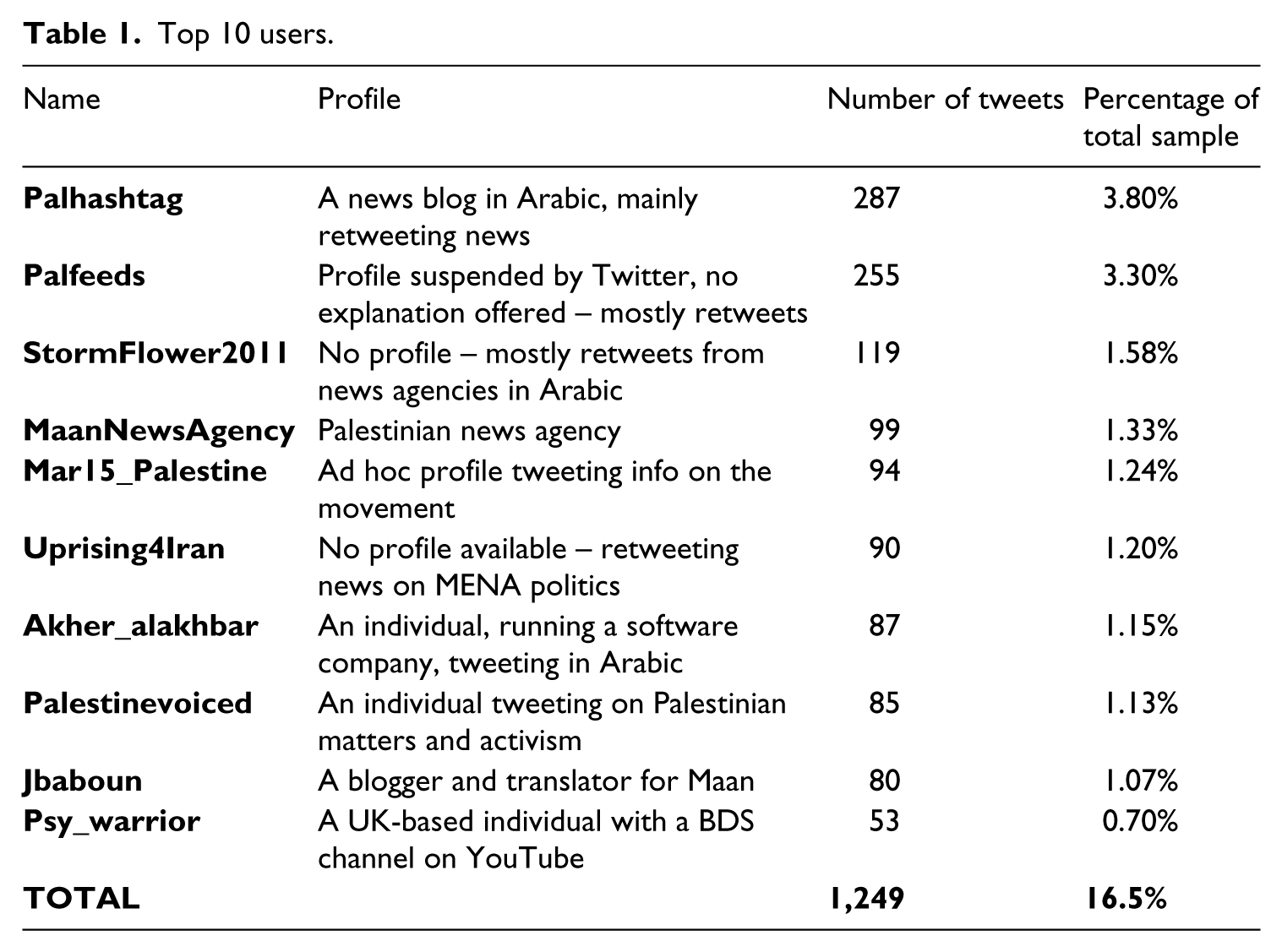
With a total of 1249 tweets, the top users account for the 16.5% of the total number of tweets within this time period. It is clear therefore that the bulk of tweets were from a broader base of users. Several interesting aspects have emerged here. First, users represent a mix of news blogs and organizations, individuals and ad hoc activist organizations. Second, some of these run other sites or blogs, and use #Palestine as an amplifier. Third, the top Twitter users represent the top of a wide pyramid, since they account for only about 16% of the total number of tweets in the sample. It is quite significant that the remaining 84% are tweeted by others, revealing a broad base of users. Equally noteworthy is that the majority of users (87%) tweeted only once – this shows that the public space created around #Palestine may be a broad one, but it lacks depth. In addition, this broad base of produsers appear to tweet as a real-time and immediate reaction to things they either saw first-hand or which they came across online. Finally, the use of ad hoc usernames in order to retweet information points to the use of #Palestine as a means for dissemination of information rather than communication or dialogue. It is here that we can locate a shift in the production of news and information on Palestine, as news organizations and journalists form the minority of those who tweet on #Palestine. Unlike the mainstream media, in which professional journalists and news values dominate, the tweets on #Palestine feature mostly individuals and activist organizations and only secondarily news outlets. Even then, the main news outlet is Maan News Agency, a local news organization, rather than a global media corporation such as Al Jazeera or the BBC.
What do they tweet?
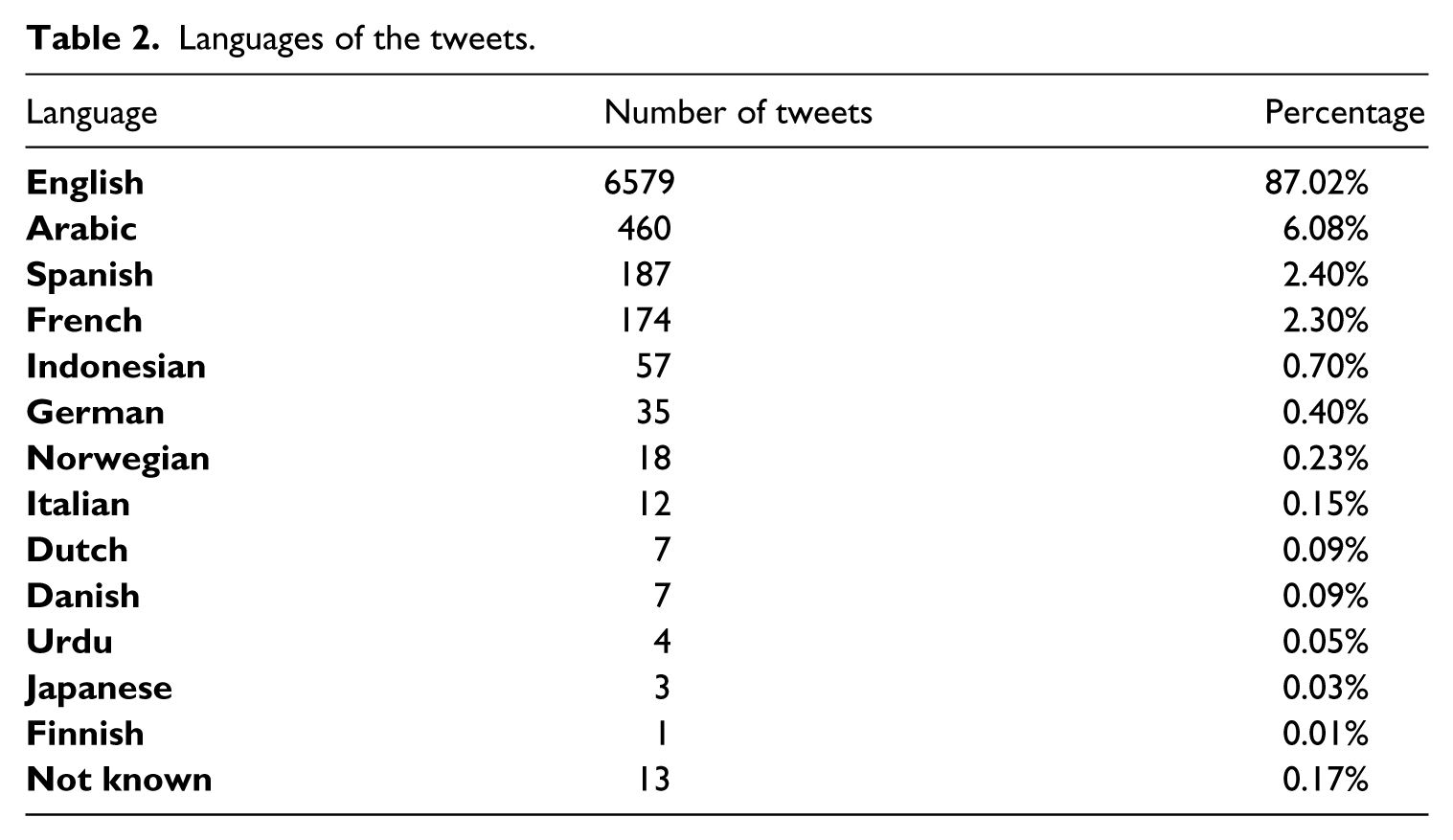
The first finding here concerns the language of the tweets. While English dominated, there were in total 13 languages, pointing to the global significance of, and interest in, Palestine. Table 2 offers some quantitative details on the frequencies of the languages in the sample.
Languages of the tweets.
In addition to #Palestine, Table 3 shows the top hashtags used in this sample. This offers a better picture of the kinds of issues associated with Palestine on Twitter.
Top 10 hashtags.
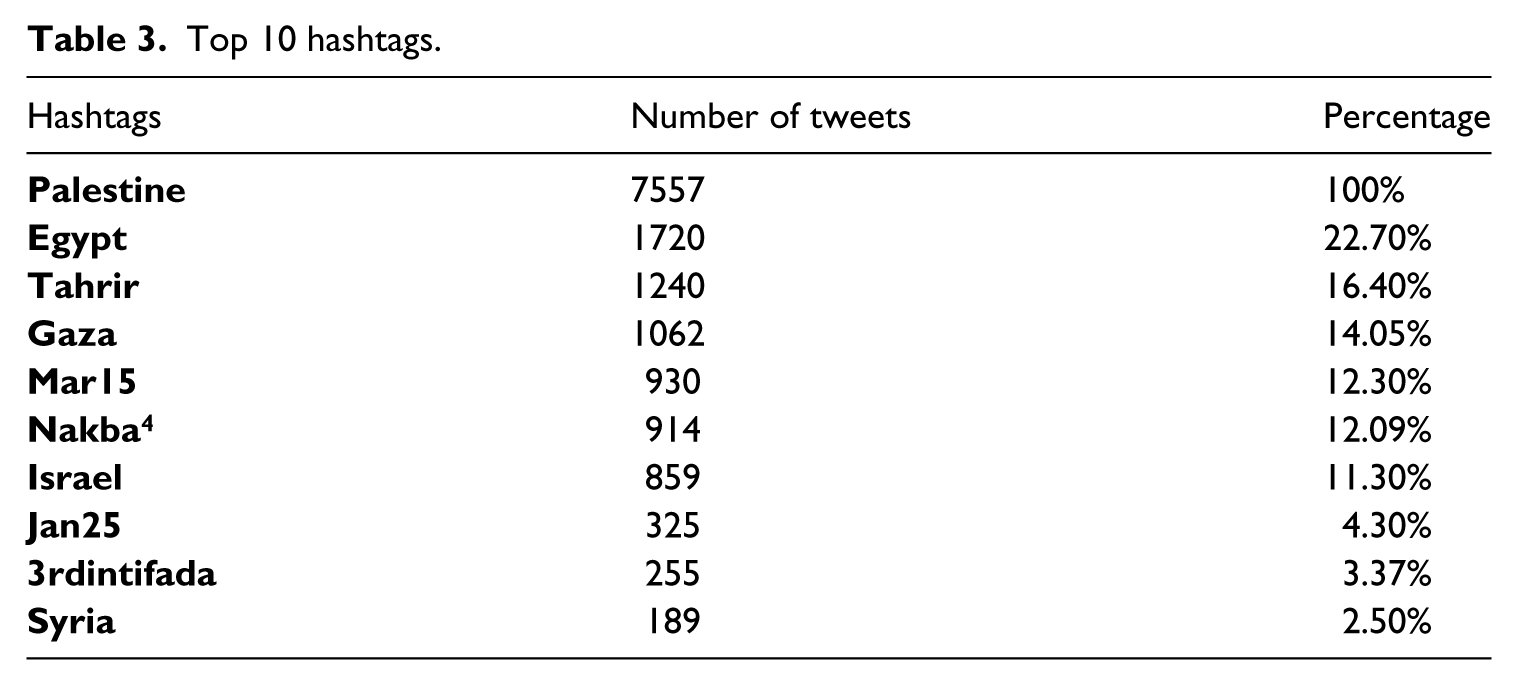
The dominance of the hashtags Egypt, Tahrir, and Jan25 may be due to recent events in Egypt, but their frequency shows their continuing importance and significance. Similarly, #Syria, where March 2011 saw the first of the demonstrations against the regime, shows the importance and centrality of the Arab Spring for Palestine. In addition, these hashtags may be connected to #Palestine because of the geographical proximity of these countries. The remaining hashtags – Gaza, Nakba, Mar15, Israel and 3rdintifada – are directly associated with Palestine. #Palestine is therefore clearly contextualized in terms of developments in the region, especially the uprisings in Egypt and Syria, which share the space with ongoing aspects of Palestinian politics and activism, such as developments in Gaza, the start of another uprising (3rd intifada) and the question of historical memory and return (Nakba).
Another significant finding concerns the number of retweets. A standard practice in Twitter is the repetition of a tweet already sent by someone else. These retweets were found to dominate the sample. Specifically, 3801 out of 7557 (50.3%) of all tweets were retweets. Most of the retweets were tweeted once, twice or three times and there was no domination of a single retweet. Table 4 shows the top 10 retweets.
Top 10 retweets.
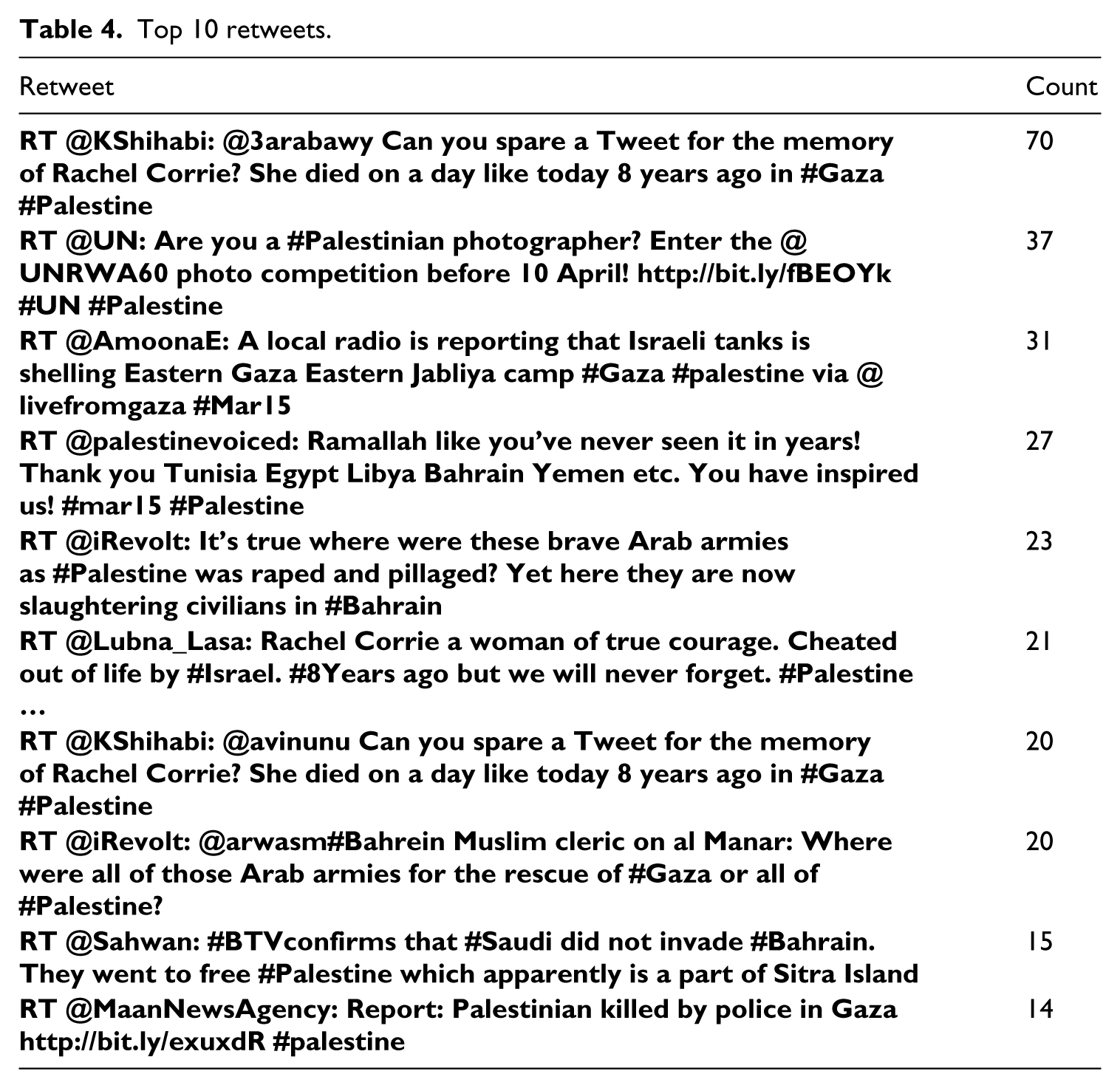
The issue of retweeting is significant, and it forms an important aspect of the current research, given that half the sample consisted of retweets. Relevant research shows that retweets are an organic part of Twitter but the percentages vary greatly. boyd et al. (2010) analysed a random sample of 720,000 tweets collected in 2009 and found that 3% were retweets. Heverin and Zach (2012), who looked at hashtags relating to US university campus shootings, found that an average of 46% of relevant tweets were retweets. In individual hashtags this ranges from 31% to 64%. Anstead and O’Loughlin (2011) in their study of tweets during the BBC programme Question Time report an average of about 19% retweets. Retweeting can be a form of conversation, while retweets without comments are taken to denote agreement. The proportion of retweets in the current sample shows that #Palestine involves in almost equal parts the tweeting of original information and the dissemination of tweets posted by others. In the current sample, the proportion of themes in retweets mirrored those of the original tweets, with the exception of the retweets on Rachel Corrie (see Table 5).
Themes of tweets and retweets.
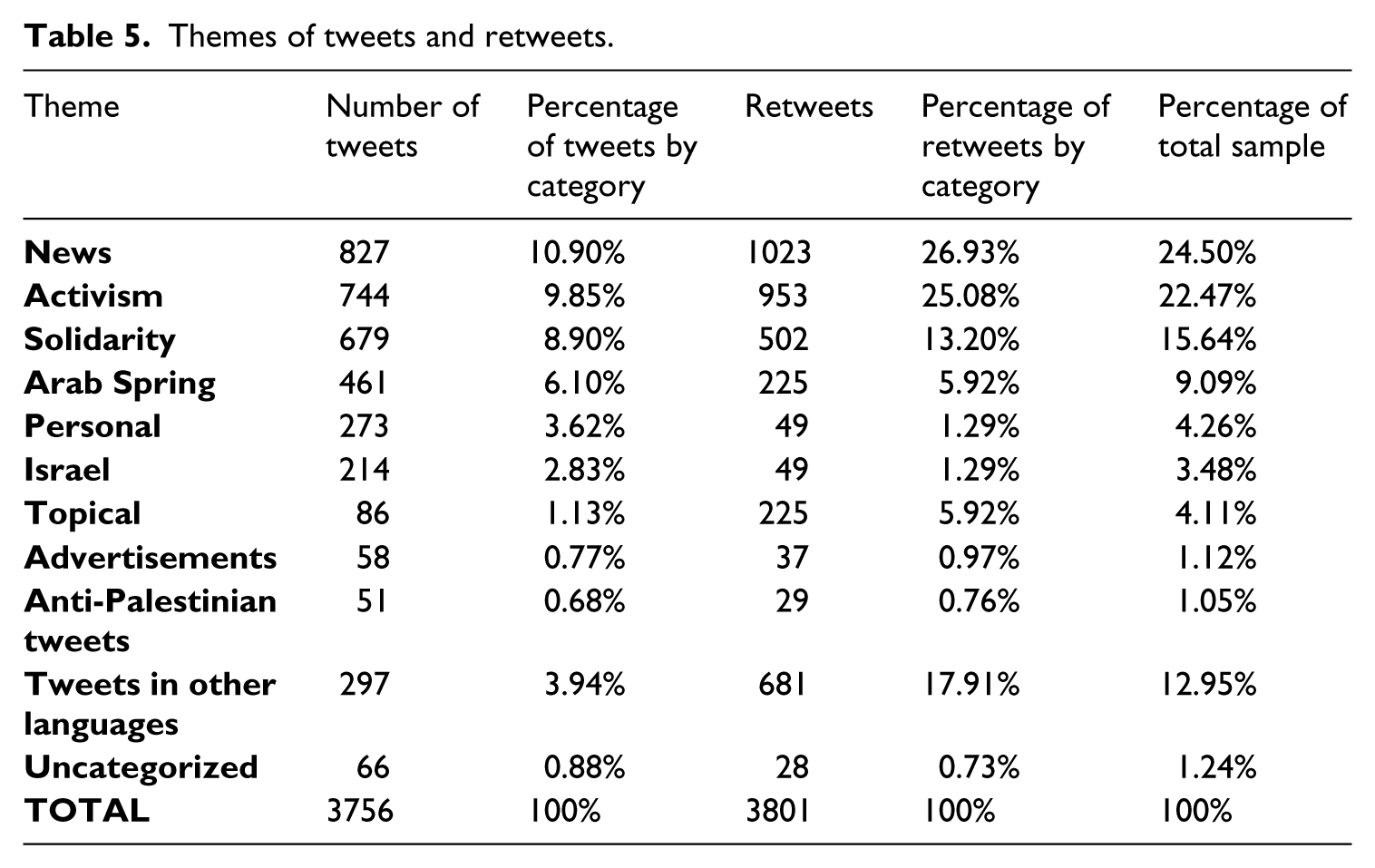
More specifically, three thematic categories appear to dominate: news on Palestine, activism and tweets in support of Palestine’s quest for independence. These three categories were also dominant in the retweets – the main differences between tweets and retweets in terms of these thematic categories were that the tweets in other languages and the commemorative tweets formed a greater part of the retweet sample. To some extent this can be explained by the explicit retweet request as in ‘Can you spare a tweet for the memory of Rachel Corrie?’
More specifically, the news on Palestine comes from various sources, including both news organizations (Al Jazeera, Maan, BBC, Haaretz) as well as from informal sources on the ground. Most tweets here took the form of a headline, with some tweets attaching a URL.
Activist tweets were primarily concerned with the organization of a protest against the division in Palestinian politics between Hamas and Fatah – the protest, which was organized by a youth organization (Gaza Youth Break Out), was understood as similar to the protests in other Arab nations, because it sought unity, transparency, liberty and real democracy. Tweets called for protesters to arrive, informed people about what was going on, and posted pictures, videos and relevant URLs. Other activist tweets included calls for the Boycott, Divestment and Sanctions (BDS) campaign, the anti-apartheid wall campaign, and the freedom flotilla second campaign, but the majority of tweets were about the 15 March protest.
The third most frequent theme concerned tweets supporting the Palestinian cause. These tweets did not provide any new information, but repeated the call for a ‘Free Palestine’. The tone here was quite emotional, for example: ‘ #Palestine in my heart in my head and in my blood’ or ‘#Palestine is my life & and my death..!!’.Some tweets linked to YouTube videos or Flickr photos connected to Palestine. Rather than informative, these tweets were supportive, affirmative and encouraging.
Tweets on the Arab Spring were the fourth most frequent theme. These included information but also solidarity tweets with the protests and uprisings in Egypt, Libya, Syria, Yemen and elsewhere. Pride but also concern and vigilance were noted in these tweets, which were in total support of the movements for real democracy in the Arab world.
Personal tweets and conversations were the next most frequent theme – these included replies to others. Additionally, some tweets took the form of private conversations and responses– e.g. ‘@Dima_Khatib I know my Palestinian boyfriend feels lost… Like the world has forgotten #Gaza forgotten #Palestine. Doesn’t care’. The style was informal, personal and often written in text messaging abbreviations.
The next thematic category includes tweets that refer to Israel and, as might be expected, the tone was mixed. Some tweets provided information about Israel, others admonished Israel, while yet others outright accused and denounced it, often using very strong language. Examples here include: ‘#israel must stop all forms of piracy & must be punished for its illegal terrorist attacks in the high seas. #Palestine #Gaza #Flotilla #BDS’
The next category included tweets about things that were happening at the time when the sample was collected (15–20 March 2011). March 16 was the eighth anniversary of the death of Rachel Corrie. This thematic category also included tweets sympathizing with the victims of the massive earthquake and tsunami of 11 March in Japan.
The tweets classified as advertisements included tweets that advertised services in the region, but also URLs, blogs and websites. Examples here include: ‘#TEDxRamallah promotes for the Palestinian innovation all over the world –> http://bit.ly/gpYtcU |#Palestine |@QualityPartners |#TEDnews’.
Finally, there were some tweets against Palestine. These oppositional tweets were disputing the right of Palestinians to the land, accusing them of terrorism and so on. Examples here include: ‘@deenoverdunyah Jordan is built on #Palestine. Why don’t u go there? U don’t need 2 Palestines along with 20 other nations greedy! #Israel #Palestine’.
If we consider all tweets on #Palestine as forming a mosaic and that this mosaic tells a story, then this story revolves around the organization of a protest across all Palestinian territories on 15 March 2011, which was meant to kick-start a Palestinian Arab Spring. The protests were organized by Gaza Youth Break Out, through a relevant Facebook page (https://www.facebook.com/GazaYBO?fref=ts) and its Twitter account (@GazaYBO), with a view to democratizing Palestinian politics and ending the political division. The protest event occurred in the context of other news, most notably protests in Syria and Bahrain, while locally the news was dominated by reports of the killing of a settler family and sporadic attacks from Israel. While the protests managed to attract a lot of people, as evidenced by photos posted on FB or Flickr and then tweeted (‘Photos from today’s protests http://on.fb.me/fhBtls #Jundi #Mar15 #Gaza #Palestine’) eventually both Hamas and Fatah moved in (‘#Palestine: Hamas &Fatah attempting to infiltrate youth rallies. Those movements are a blight to Palestinian liberation. #mar15’ and ‘After a period of grace where songs of Marcel Khalifa were playing Fatteh speakers playing party songs now. #Palestine #mar15’). The protesters used #Palestine to circulate their demands (‘Youth Press Release Demands: 2) An immediate halt on protest repression and respect for freedom. #Palestine #mar15’). However, in the end, and despite calls for more participation (e.g. WE NEED MORE YALLAH #BETHLEHEM! @ummhajarforpal: 500 come out in Bethlehem for unity: http://bit.ly/gCOwEL #Palestine #MAR15) the protests died out. Nevertheless, both the protests but also the broader events in the region as well as the eighth anniversary of Rachel Corrie’s death led to several hundred solidarity tweets which denoted clear support from across the world (e.g. ‘From #Libya to #Palestine to #Arizona to #Wisconsin- Your liberation is bound with mine. #Solidarity /@AhlamS’) . #Palestine as emerging from this sample of tweets is an affective, positioned and subjective story co-authored by both local people and those elsewhere, and anchored by grassroots blogs, local and global media.
Overall, the content analysis shows that tweets are not only factual/informational, but also emotive, rhetorical and offering encouragement. Second, that activist tweets, which pertain to the organization of protest activities, form a considerable part of the sample, calling people to action and informing them about places and events. Third, while a lot has been written about the Israeli-Palestinian online war, the current sample and analysis revealed relatively civil attitudes – this points to the homophily or similarity between those using this hashtag. Further, this limited engagement with the main antagonist points to the direction of this hashtag towards the inside of the community, that is, to Palestinians and their supporters. Fourth, there is little evidence of any exchange, dialogue or deliberation – the conversations that were encountered in the sample were mostly personal exchanges and they were limited to a few tweets. Thus, if conversations were taking place they did not use #Palestine. Finally, there is a lot of style diversity in the tweets, which range from the informative, to the personal and poetic.
#Palestine’s mediation
This section is concerned with drawing the theoretical significance of the findings of the present study. It signals a return to the theoretical perspective of mediation and outlines the meaning of the findings for the way in which Twitter, and specifically the hashtag #Palestine mediates Palestine the political issue.
Mediation is understood as the specific process (or set of processes) by which specific media applications intervene (mediate) in an issue. This has been operationalized as the analysis of the produsers of #Palestine tweets, the contents and the uses of these tweets. The mediation through #Palestine therefore includes: a widening of those producing and disseminating information on Palestine; second, #Palestine is personalized and subjective, seen from multiple perspectives; third, most of the produsers of #Palestine spread news and information, offered their opinions, but also provided and sought solidarity, support and participation in activist events.
More specifically, those who used and produced #Palestine included a variety of actors, among them political groups and media organizations, as well as non-organized people not only from Palestine but from across the world. This widening of produsers implies that news and information on Palestine is not easy to control and direct, as in the broadcasting/print media model (Philo and Berry, 2011) and from this point of view, it may be considered more participatory. In his study on media and politics in the Israeli-Palestinian conflict, Wolfsfeld (1997) found that in political conflicts, a lot depends on acquiring control over the media; antagonists seek to control the media, which can therefore be described as another domain for politics. In the case of #Palestine, we can see the difficulties that such attempts to control may have as users are many and diverse – this study found over 2500 users from across the world. This is not to say that Twitter is not, and cannot become, another domain for political antagonism: rather it points to the necessity for the development of a new set of tools and rules of engagement, as control through limiting access to the means of producing and disseminating contents is no longer as successful as it once was. 5 Moreover, this widening of produsers points to a collective or distributed way of producing #Palestine: the contents and emerging narrative of #Palestine are the result of a kind of collective authorship, in which produsers contribute from their own vantage point or to which they contribute through retweeting or disseminating information.
In substantive terms, the findings that the narrative on Palestine is co-constructed, often in real time, by a host of produsers who tweet from their own position and perspective, constructs Palestine in personal, experiential terms – it is a kind of ‘my Palestine’, but in which this ‘my’ subsumes many perspectives. While there were mainstream news tweets on #Palestine, the abundance of activist, solidarity and commemorative tweets show that #Palestine assumes a more emotive, affective dimension, drawing not only on events, but also on the emotional significance of these events for those who experience, write and disseminate them. This finding echoes Papacharissi and Oliveira (2012), who, in their study on Twitter and #Egypt, speak of affective news, which blends news with emotions and opinions, and drama with fact, revealing the subjective character of tweets on #Egypt. Similarly, tweets on #Palestine blend news and calls to action, rhetoric, opinion and emotion from a specific position, co-creating a subjective, personalized and affective Palestine. Two more aspects of this mediation involve the overall similarity of the stance of these tweets, which were critical of the Hamas-Fatah hold over Palestinian politics, and the lack of antagonistic contents and engagement with Israeli and other opponents: these show that the mediation of #Palestine may involve primarily networks of like-minded people, pointing to the homophily of these networks. Such homophily, or the tendency to form networks of people with similar characteristics, implies that tweeting on #Palestine may be a task or activity aiming at the inside of the community of friends and supporters of Palestine rather than engaging with opponents.
Conclusions
The response to the research question, how is #Palestine mediated, is that this mediation leads to a subjective, positioned co-construction of an affective Palestine. This kind of mediation further involves a redistribution of power from fact-based hard news and information produced by mainstream, branded media to diffused networks of news produsers, who tweet during real-time events as they witness or participate in them, or who tweet their opinions and reactions to these events.
On the other hand, we have focused here on a very thin slice of the Twittersphere, using a specific measure, that of a single hashtag. More research needs to be undertaken to show the extent to which these findings can be generalized across other hashtags concerning Palestine or other contentious issues. Since mediation is a dynamic process, we can expect both similarities and differences in re-examinations of #Palestine and other topics or themes in different circumstances. Moreover, in terms of power redistribution, since Twitter and other social media have emerged as significant political actors, it is likely that there will be attempts to control them, while players such as mainstream, branded media are unlikely to concede power so easily.
In these terms, future research may examine Twitter and #Palestine at different time periods to locate any differences across time, and also to establish if there are any shifts in terms of the produsers of such tweets. Establishing the geographical distribution of the produsers is equally important. In the current sample, most of those tweeting activist tweets were in Palestine, but the dominance of English-language tweets implies that a large proportion of users were from abroad; as Twitter use becomes more diffused we can expect an increase in local users. To what extent do these shifts in the geographical location of users introduce shifts in the contents and uses of tweets on #Palestine? Finally, it is important to further clarify and refine the theoretical construct of mediation, and look at the conditions under which users, contexts or media applications take precedence.
Footnotes
Funding
This research received no specific grant from any funding agency in the public, commercial, or not-for-profit sectors.