






Abstract
The article investigates the relevance of geographical imagination in refugee politics in the Mediterranean coast. It is based on empirical research conducted in Calabria, southern Italy, in a small village that in 1997 decided to host over 300 refugees that shipwrecked on its coast. By welcoming refugees the village, Badolato, appropriated politics of hospitality to gain new cultural and economic value for the village that was suffering from high unemployment rates and an ageing population. The story, exceptional as it was, soon attracted international media to cover the story of Badolato. The article depicts developments in the village over the course of 14 years and shows the force and changes over time of media publicity in the process. It points out the relevance of media for the process of geographical imagination and the contradictory and complex implications of the process.
Keywords
The ongoing arrival of asylum seekers to Europe caused by political unrest and economic struggles has shaped the border areas of Europe, resulting in the emergence of new political movements, social structures and policies targeted to manage the arriving populations. Over the past decade, the Mediterranean coast has witnessed an influx of asylum seekers arriving from Africa, Asia and the Middle East, often in extreme and life-threatening conditions. The camps set up in Melilla and Ceuta in the early 2000s, as well as in the Spanish Canary Islands in 2006 or in Lampedusa in Italy following the Arab Spring in 2011 evidence the hard conditions for the refugees. As gateways, these areas mark the construction of the fortress of Europe, the increase in border controls and tightened refugee policies in the European Union (EU).
In 1997, the realization of the Schengen Agreement, which abolished controls on the interior borders of the EU, had already created political pressure to toughen surveillance at the outer borders of Europe. The Schengen Agreement was expected to attract new, uncontrollable migration to Europe and Italy was seen as risky transit country due to its weak border control and policy of granting asylum to Kurdish asylum seekers (Menz, 2008).
The local villages and cities on the coast of the Mediterranean Sea have dealt with the situation in different ways. Refugee politics has become a hot topic fought over at the local level and deployed for the purposes of different political parties. While the idea of global refugee flows has mostly been used as a vehicle to advance the anti-immigrant movement and nationalist ideology in different parts of Europe, there are a few cases where it has been used as a tool for the revitalization of local business and as an instrument of utopian visions of a better future. This article looks at such a case, where by inviting arriving asylum seekers to stay there in 1997, a small Calabrian village in southern Italy strove to resist the harsh economic currents through a new set of values based on hospitality and global responsibility. At the time, Badolato was suffering from the typical problems of Calabria and southern Italy: high unemployment rates, an ageing population, organized crime and a bleak vision of the future. The arrival of over 800 asylum seekers in December 1997 was seen by the local government as an opportunity to reinvigorate Badolato.
Drawing on the theories of space and place, this article operationalizes the concepts of geographical imagination by David Harvey (2009 ]1973]) and time-space expansion by Cindi Katz (2004) to examine the ways in which the politics of hospitality is used to shape a region economically, politically and culturally in significant ways. The article shows how geographical imagination works to expand the time-space experience and enable understanding of a place as hospitable.
It designates the possibilities of geographical imagination and the ways it may expand understanding of responsibilities and capabilities to act in the world, but also that there are limits to what imaginations can do.
The research, using an ethnographic approach, depicts the developments in the village in the course of 14 years by focusing on the relations between media imaginations and political action. Against this backdrop, I ask what, if any, are the implications of the case for the political landscape and the bordering region of Europe?
Before the analysis, I introduce the context of the research and the key developments which occurred in 1997–1998. 1
The context of the study
On 26 December 1997 a ship named Ararat carrying 836 mostly Kurdish people 2 was wrecked on the coast of Badolato. Ararat was the second ship to arrive on the coast of Calabria over a short period, making the issue of refugees an urgent matter for the local municipality. From these developments, 339 people in total were offered accommodation in Badolato Borgo, a rustic medieval village of 600 inhabitants at the top of a mountain looking down over the Mediterranean Sea. 3 The rest were accommodated further away, at a local school in the region.
Thus over 300 asylum seekers resided in a town of 600 people while their legal status was being determined. The town of Badolato was at the time half empty as the people from Badolato had been emigrating to the industrialized north of Italy and Switzerland for decades. The municipality had 7000 residents in 1950, while in 1972 the figure was half that, at 3500, and in 1998, it was only 600. Migration, then, has been experienced in the family histories of many Badolatesi, whose relatives have left the struggling region. The fact that global forces shaped the village of Badolato, resulting in mass emigration to Switzerland, thus becomes a relevant frame for understanding the reactions to contemporary changes in this region.
Another important frame for understanding the context of re-imagining Badolato is the reputation of Calabria as a potentially dangerous region dominated by organized crime known as ‘ndrangheta. ‘Ndrangheta (different from the Mafia in Sicily and the Camorra in Campania) is particularly strong in political corruption and drug trafficking, with transnational connections to Germany and North America (Donadio, 2010, 2012; Hooper, 2006). The stronghold of organized crime in Calabria is considered to be in San Luca, on the other side of the peninsula, over 100 km from Badolato. Thus the presence of organized crime is not strong in Badolato, yet the village is not completely untouched by it. 4 However, organized crime appears as one of the most common topics associated with Calabria. Both of these frames – the history of emigration and the image of the region as crime-stricken – are essential for understanding the significance and motive for the re-imagination: to be able to see another kind of future for the migrants as well as for the Calabrian people.
In 1998 then, the new arriving asylum seekers were accommodated in the empty houses of Badolato left behind by people who had emigrated to North. The mayor Mannello (from the leftist party Partido Democratico) initiated his plan to create new businesses and livelihoods for Badolato with the help of the asylum seekers. The aim was to balance the severe budget deficit and use the extra funding from the government to revitalize business in the town (interview 28 July 2011). The Badolato method was introduced to benefit both the locals and the asylum seekers.
First, Badolato received extra funding of 516,400 euros from the government to restore 20 of its 450 empty houses for the families. 5 Another 170,000 euros was received to convert part of the school into 20 apartments and to hire social workers and interpreters. The main objective of the renovation project was to steer funding towards the support of the local construction business that executed the work. Moreover, the funding was used to establish a Kurdish restaurant called ‘Ararat’, named after the shipwrecked boat and run by the asylum seekers. In addition, a tourist shop selling local craft and food products was opened and run with the help of the asylum seekers. To further these initiatives, a Pro Badolato association was established with an additional role of attracting more tourism to the region. Moreover, the mayor and representatives of the Italian Refugee Council (CIR) created several cultural events to bridge the gap between the 600 local people and the 300 asylum seekers. These festivities included a Kurdish New Year’s celebration, Newroz, musical events and celebrations of friendship and peace (for example the Concerto della pace held on 30 August 1998).
Despite these initiatives conditions for employment remained poor for majority of the asylum seekers. Thus most of the newcomers moved to northern Italy or to another European country after they were granted asylum and received the necessary documents. Eight months after the arrival of the Ararat, of the 339 people who had been living in Badolato, only around 50 remained.
While most of the 50 people are still living in the area today, the overall situation of migration and refugees has changed in Calabria. The number of arrivals in Italy from the sea has been increasing, particularly in the past decade. In 2008 37,000 people arrived in Italy by sea and in 2013 the figure was estimated to be 25,000 according to UN High Commissioner for Refugees (UNHCR). 6 The conditions for asylum seekers are particularly poor in Lampedusa Island but also in the mainland. In Sant’Anna village in Calabria, for example, over 800 asylum seekers are accommodated in empty warehouses. 7 The situation between locals and the migrants has been tense and has resulted in various demonstrations and conflicts. In Rosarno, where immigrant labor from Africa is used in the citrus and olive groves, racist attacks have resulted in at least two deaths of migrant workers (Donadio, 2010). There are some villages, however, such as Riace, 8 that today follow the example of Badolato, and have publicly welcomed asylum seekers and migrants to the town.
Geographical imagination in global times
Geographical imagination, as defined by David Harvey, refers to a process through which the individual is able ‘to recognize the role of space and place in his own biography’ and to understand the relations between social structures and space (2009 [1973]: 24). Geographical imagination highlights the connection between social processes, spatial forms and social justice. The ways in which geographies are imagined have become increasingly multiple and complex due to the effects of globalization, global media and digitalization. Local–global ties are thus actively manufactured and shape our understanding of ourselves and others, as well as the way we act in the world (Castree, 2004: 139; see Malkki, 1997). To conceptualize this process, Cindi Katz (2004: 226) uses ‘time-space expansion’ 9 that refers to the perspective of those whose local worlds are shaped by global cultures. Her discussion offers a perspective on the ways in which global events enter particular places not simply by sweeping over the place, but rather by opening up and forcing the place into a new dynamics. In the process of change it becomes relevant whose imaginations are at play. To be able to imagine connections between places and people across borders and opportunities that may carry them forward, despite enormous challenges, is crucial for asylum seekers and migrants who are seeking new futures in distant places. However, the capacity to imagine opportunity and responsibility in change is also relevant for the construction of transnational and hospitable places, as argued by Wilding (2007). Here the connections between geographical imagination, time-space expansion and politics of hospitality become relevant. To imagine place as transnational and open for change is prerequisite for hospitality in the sense discussed by Levinas and Derrida. The Levinasian (1981) notion of hospitality, as an obligation, is present in the work of Jacques Derrida (2001), who explores the cosmopolitan rights of asylum seekers in western societies with an idea of a hospitable city. The politics of hospitality could be then understood as an attempt to create a place that includes such cosmopolitan understanding. In the case study of this article the term ‘hospitality’ refers to this kind of vision of an inclusive, cosmopolitan place, and comes close to how Massey (1994: 146–56) describes place as progressive. ‘Hospitality’ was also the term (accoglienza) that was adopted by the municipality of Badolato to describe their policies of refuge.
I propose that the capacity to imagine places anew (re-imagine) in this way is dependent on the public imaginations created in the media. To follow Harvey (1990: 287–8), media images have assumed growing importance in cultural and economic practices, as well as in political and social life; in this way, ‘investment in image-building has become as important as investment in a new plant or machinery’ (1990: 289). The struggle over representation – the image and the brand – is fundamental not only for commercial corporations, but also for regions and cities, that is, for places. In terms of geographical imagination, media publicity holds substantial power to define and shape the ways in which places are imagined. The media are significant agents that construct notions of places by focusing on particular issues and angles on particular events or phenomena (Hanna, 1996). With the machinery of news production and particular forms of framing, media have the power to reorient or refashion a place as violent, dynamic, dangerous, hopeless, attractive, etc. (Entman, 1993; Gold, 1994). These framings produce social meanings of a place that may have significant political, economic and cultural consequences. For the purposes of this article, it becomes relevant to explore how and by whom the place – Badolato – is imagined in public.
Methods and material
The research applies an ethnographic approach to analyse the process of geographic imagination by looking at the connections between media coverage and local politics. In this sense the research explores the relationships among culture, power and materialities (Hannerz, 2010), and to do this it relies on combining a wide range of sources of knowledge from analysis of media texts and documents to interviews and participatory observation. The approach, referred to as multilocal fieldwork (Hannerz, 2002), combines different perspectives to gain understanding of the processes that shape the phenomenon. In this case the temporal dimension forms the frame to observe the process and the significance of the imaginations in the long run.
The starting point of analysis is the media coverage archived by the municipality of Badolato. The archive includes 106 news stories (see Table 1), 23 images, 67 personal letters, and 37 invitations and honours sent to mayor Mannello over the period 1997–2003. There are restrictions to the media material that need to be acknowledged. It is not exhaustive of all the coverage concerning Badolato during the time period. However, the archived material is illustrative of what was held to be significant by the Badolato municipality. As such, it can be regarded as politically relevant and representative of the stories acknowledged by the municipality. To evaluate the representativeness of the material, I have researched news stories concerning Badolato from other sources, such as new media archives. From these sources, I found 16 additional stories that reflected the composition and the perspectives of the archived news stories. 10
The number of domestic and international news stories from 1997 to 2003 in the archive.
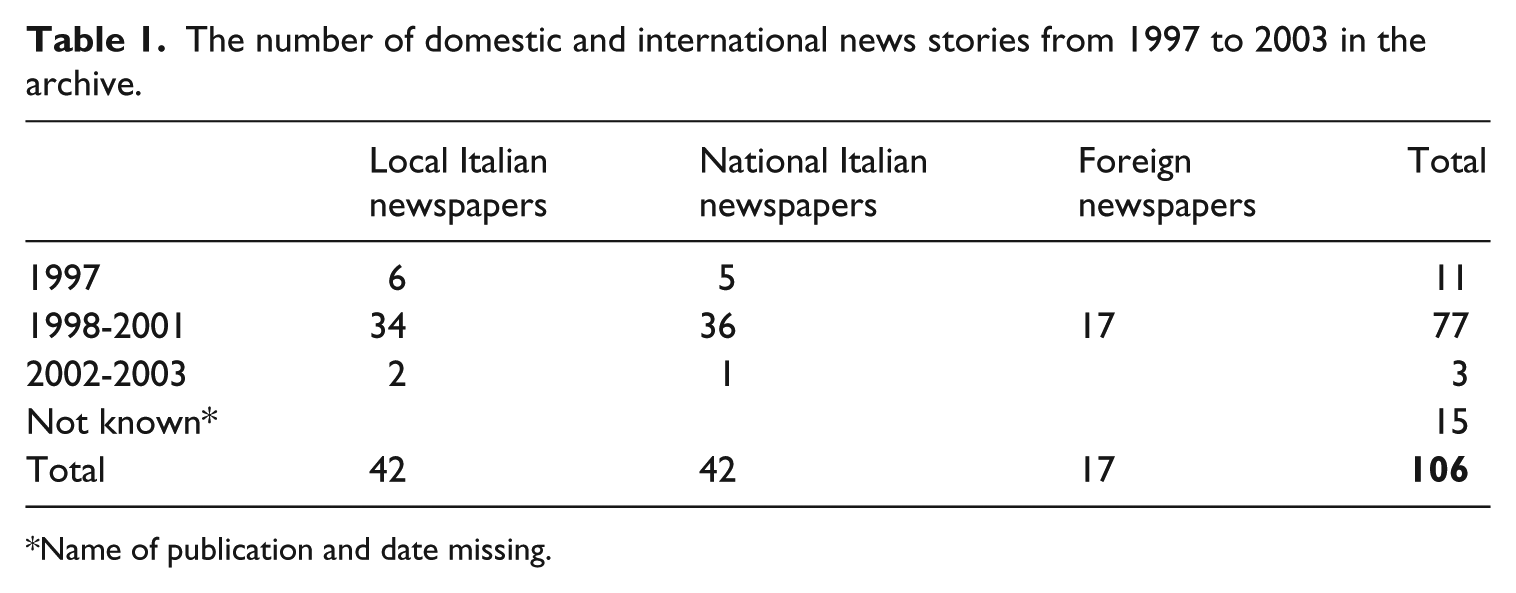
Name of publication and date missing.
The media texts were analysed according to the main argument proposed in the combination of headlines, images and texts. First the material was organized and analysed in terms of the main argument (the lead) and then in terms of the main agents in the story (whose voice, perspective, images). According to this analysis the media coverage was divided in three phases: first, a phase of refugee crisis from 1997 to the beginning of 1998; second, a phase of exceptional hospitality from 1998 to 2000; and third, a phase of institutionalization from 2001 to 2003. In this article I focus particularly on the second phase of media coverage and on the articulation of the values and meanings of the Badolato method.
The media texts are examined adjacent to series of semi-structured interviews to map out the dynamics and the significance of the media publicity for political action and for the process of imagining Badolato.
The interview material is to large extent retrospective in nature. Particularly, the interview with mayor Mannello looks back at the events and, as such, includes re-evaluation of and reflection on past actions. 11 The retrospective view, provided by locals and by myself, forms the core of the research. Indeed, the whole idea of going back to Badolato and collecting research data was inspired by the desire to investigate the impact of the media attention and the outcome of the initiatives in the course of time.
The interview analysis focused on the values attached to hospitality and to the media coverage, as well as to the process of the politics of hospitality. Thus the interview data offers interpretations of the relevance and value of media coverage but also sources to map out the relations between different agents. Particularly in the case of former mayor the interview data offers self-reflexive interpretations of the process.
For the purposes of this article then, archived news stories and letters from 1998 to 2003 are examined in juxtaposition with the interviews and field notes from 2011. In addition my visits to Badolato in 1998 and 1999 provide background in terms of the conditions and changes that have taken place throughout the years. The focus is to locate the significance of the media in the geographic imagination of Badolato and the consequences of this imagination in the long run.
Media coverage: from refugee crisis to exceptional hospitality
The first phase of refugee crisis (11 stories) involved breaking news stories that emphasized the plight and the situation of the Kurds who formed a majority of the asylum seekers. The first news stories focused on reporting the number of people arriving and their backgrounds, along with the political situation in the Kurdistan area. In these stories, the voice of the asylum seekers is prominent: the reader learns about the political situation of the Kurds, the dangers of the crossing and the hard conditions in the refugee shelter. In these stories the imagination of a better future for the Kurds is in the centre.
The second phase of media coverage (72 stories) focused on the hospitality of Badolato. This is the most notable both in terms of volume and political significance, and I discuss it in more detail below. Finally, the third phase of the media publicity (8 stories) – institutionalization – witnessed a clear decrease in the number of news stories. However, the stories followed the logic of the second phase and built on the concept of the Badolato method. The news included mainly short follow-up reports on the new administrative initiatives concerning the migrant issues in the local press. The national and international interest in Badolato was clearly decreasing from 2000 on.
I will now take a closer look at the second phase of media publicity. The news stories from 1998 and 1999 gave a detailed description of Mannello’s plans to offer housing for the asylum seekers and to invite them to stay in Badolato. Most of these stories were published in 1998; this was also the year of all the foreign news coverage of Badolato. The Badolato method received attention from a wide range of media, including local, national and international press. The story was covered in high-prestige national newspapers, as well as in women’s magazines, the popular press and local political left-wing newspapers. Given the variety of publications, the general tone in the coverage is surprisingly harmonious, echoing a shared sense of enthusiasm over the project. The news stories framed Badolato as a place that could ‘set an example’ (Neues Deutschland, 24 January 1998), offer ‘a different model of integration’ (Le Courrier), ‘a lecture on civility’ (Jonio Star, February 1998) and allowed observers ‘to see refugees as an opportunity’ (Le Courrier, 24 February 1998).
These stories singled Badolato out as an exceptional town with an innovative vision for the future and true hospitality. The news and feature stories emphasized Kurdish people as the new inhabitants of Badolato. Stories introduced families living in the empty houses and interviewed mayor Mannello along with the families. This composition, with labels such as ‘Kurdolato’, painted a picture of a village that had been reinhabited by the Kurdish population, even if the originally Italian population still formed the majority. The geographical imagination operates to picture, quite concretely, a transformation in the physical place.
The Badolato method became a success as a political concept and was referred to in several stories as ‘the method’, ‘the laboratory’ or ‘the miracle’ of Badolato. Mayor Mannello was viewed as the key figure in the press coverage, and the ‘miracle of Badolato’ was identified as his personal idea. The media attention gave Mannello a public name, and he received several contributions from associations, unions and political groups (mostly from the left) from Italy, Switzerland and Germany. The mayor also received invitations to lecture on his experiences and on the Badolato method in the parliament of Strasbourg, a European civic forum (Europäisches Burgerforum) in Bern and in the Interior Ministry in Rome. In 1999, the excitement over the exceptional hospitality of Badolato was at its height as a group of Italian senators proposed the Nobel Peace Prize for Badolato (Le Calabrie, 8 April 1999).
Through the concept of the Badolato method, the municipality gained unforeseen media attention, and this itself became part of the news. Local paper Il Quotidiano (13 August 1998) stated how the image of Calabria had shifted from mafia and ‘ndrangheta to the story of Badolato and the hospitality of the Calabrian people. Gazzetta del Sud (29 March 1998) devoted a whole story to two upcoming television shows that covered the case of Badolato on national television. The relevance of the outside attention is palpable in these stories that signify the emerging new identity of the village.
The newly awakened interest in the village became tangible through actual visits by politicians and journalists, who walked the streets, visited the cafes and interviewed the asylum seekers and the local people. Visitors included Giorgio Napolitano, the minister of the interior at the time (current president of Italy); he gave his support for the project and his visit was well documented by the local press and valued by mayor Mannello (interview 28 July 2011). While the presence of newly arrived asylum seekers had already changed the space to a more multicultural one, the presence of national and international high-ranking visitors further expanded the boundaries of the locality by making the interest of the outside world visible in the village. The positive interest in the village and its politics then together created sense of a place that was open to the world. The geographical imagination was created on both a symbolic level of media texts and the material level of the physical space.
The international coverage of Badolato more or less repeated the view of Badolato as an innovative and exceptionally hospitable place. Not surprisingly most (9) of the international media attention came from Switzerland, resonating with the transnational relations between Calabria and Switzerland. The story of Badolato and the asylum seekers struck a chord among the Swiss-Italian readers who sent letters to Mannello praising the humanity and hospitality of Badolato: ‘Your humanist and generous attitude towards the Kurdish refugees has impressed me profoundly (Il Suo atteggiament umano e generoso verso i rifugiati curdi mi fa una profonda impressione. Wädenswil, Switzerland)’. Of the 67 letters received by Mannello, 26 were from Switzerland. The geographical imagination in the international media coverage created a transnational space where the history of emigration was connected with the contemporary struggle of asylum seekers resulting in reactions of compassion and recognition.
There is a strong sense of hope in the narrative of Badolato. The aspirations and fears concerning the South, the poverty and crime, were embedded in the ways in which the story of Badolato is told. The Badolato method was seen as a counterforce to the futurelessness often repeated in visions of the South, and therefore it became a powerful symbol of utopia and hope. This utopia was expressed across the media, from the national to international level, from popular magazines to quality news media. It was a story that the media, the audience, the locals and the asylum seekers alike want to believe in. The eagerness to imagine the change overrode the journalistic endeavour to test the arguments and implications of the Badolato method. Therefore, the structural problems related to the Badolato method, the fact that the area lacked industry and employers for the asylum seekers and locals alike, and that this could not easily be fixed by federal subsidies, were not discussed in the media. Instead, the media coverage of the Badolato method evoked a utopian sensibility, depicting an exceptional event with particular energy and intensity that created sense of something better.
Political benefits and limits of the media imagery
Clearly, the media attention and the political interest in Badolato had significance in terms of the ways in which the town was conceived and imagined. Badolato, previously a poverty-stricken village, was described as a vigorous and even innovative actor in the world that had set an agenda on the issues of refuge and hospitality.
In practice the new image was created in interplay between the political actors and news media. News media repeated and distributed Mannello’s visions and highlighted the role of the village rather than the struggle of the asylum seekers as the centre of the imagination. Although the story of Badolato conveyed notions of hospitality and global responsibility, this was more about Badolato than about the asylum seekers and the deteriorating conditions for migrants in the Mediterranean area. The default mode of the press to look for the extraordinary resulted here in the emphasis on the town over the refugee experience. From the journalistic perspective the news was not the arrival of the asylum seekers but rather the hospitality of the local people. In addition, in the making of the news the contacts through whom the stories were introduced largely set the frames through which the issues were discussed. In the case of Badolato, the contacts were made through the refugee organization CIR and its representatives in Badolato. The journalists made the connections with mayor Mannello and the asylum seekers via the organization. As the journalists entered the story through the aid organization they more or less adopted their perspective on the situation. The common sources used by different media explain the uniform tone of the news stories. As a novel story the Badolato case was in itself intriguing, but it was also the perspective that was strongly supported by the political leaders and NGOs that were in contact with the media. The more pessimistic views had less vocal representatives, and as a story already told, less appeal for the news media. In this way the stories followed the conventions of news media, with an emphasis on criteria of unexpectedness (Harcup and O’Neill, 2001).
The media focus on hospitality was politically relevant for the local political actors thus illustrating the power of media publicity. In his reflection Mannello, even after 14 years, expresses excitement over the extensive media coverage and openly admits its benefits, as an asset for political negotiations.
We had never had this much media before, people coming from all over the world. And I was invited to talk in Strasbourg, but it was not the Italians that invited me (laughter) […] Of course, this was important support that we could use here to get things through. (interview 28 July 2011)
The media publicity was then considered to directly support the political mission and vision proposed by Mannello. After all, the media publicity demonstrated that Mannello had pursued politics that had evoked unforeseen positive and international responses. This shows the significance of media in the process of geographic imagination: they operate not only to create visions of places on a symbolic level but also through these symbolic representations put forward particular political actions and programmes that shape the social realities of the people (Entman, 1993). However, the imagination is not created solely in the media but in interaction between the media and the local actors who pursue particular political ends. This is how the re-imagining, the creation of a new image, of a place happens. The politicians in Badolato strived ‘to make their own places, rather than have them made for them’ (Castree, 2004: 136) by holding on to hospitality as their asset. Castree (2004) notes, that geographical imaginations deployed by local actors are often chauvinistic, essentialist and exclusive. This case clearly departs from such an essentialist imagination by emphasizing Badolato as a place of a transition shaped by global events that aspires to grow through these global changes towards a more open understanding of a place.
While the news coverage embraces change through hospitality, however, it also posits the original people of Badolato as the ones who are hospitable and welcoming, the true humanitarians. They become the heroes of the news stories; their struggle and innovative action is given priority in the public response.
The media coverage on the whole provided little discussion of the problems that the mostly Kurdish asylum seekers continued to encounter with delayed asylum procedures in Calabria. The news stories hardly mention that most of them did not settle in the village and could not find a job, and that, at the end of 1998, most of the newcomers were already moving to other European countries. Since the coverage focused on the hospitality of the Badolatesi, the asylum seekers and refugees were not asked why they decided to depart and move away from such a hospitable village. Overall, the voice of the asylum seekers was weak in the media coverage and tended to operate as a proof of the exceptional hospitality of the locals. In this respect we can fairly ask whose geographical imagination is here at play and whose ends the image of hospitality serves?
From imaginations to action
As Harvey (2009 [1973]) argues, imaginations have a significant impact on social processes. In the case of Badolato, the widely circulated image of the village as exceptionally hospitable and innovative became important political imagery through which the municipality executed several initiatives. Illustrative of this is the proposition of the Nobel Peace Prize for the village, first voiced in 1998 in the local press. While the idea of the Nobel Prize was not ultimately realized, the imagination of the place as exceptional was operationalized in other applications that pursued international recognition. In the 2000s, Badolato decided to apply together with the CIR for a World Habitat Award of £10,000. The award granted by the UK-based Building and Social Housing Foundation (BHSF) is for projects that provide innovative solutions for social housing and quality of life. Badolato reached the finals and received an honorary diploma in 2006. In addition, the village strove to be included in UNESCO’s World Heritage List, but without success. Through these institutional structures of global recognition, Badolato strived to move away from the category of a remote, futureless village to that of a globally valuable, exceptional place. Through these processes the politicians reformulated the local in relation to the global world in a way that illustrates the time-space expansion at work. Through geographical imagination the Badolatesi, by proposing the village as hospitable, assume the role of agents rather than victims in the global processes.
The new image of Badolato was advanced through various public materials distributed for tourists, journalists and other people interested in the village. The World Habitat award and UNESCO are both mentioned in the Badolato tourist brochures and on the website. As such, they have become part of the new brand image of Badolato. The brochures and website of Badolato state that ‘the hospitality that characterizes the people of Calabria was experienced by the Kurdish refugees who were shipwrecked in 1997, the event that transformed Badolato from the village of emigration to a village of hospitality’. The story of the Ararat, the Kurds and the politics of hospitality have thus become an essential element of the history and image of Badolato. In the next section I discuss the relevance of the geographical imagination and politics of hospitality as they appear 14 years later.
Relevance of the imaginations
Fourteen years after the arrival of the Ararat, in 2011, the piazza in Badolato seems as quiet as ever, with few customers whiling away the sleepy hours of early afternoon in the cafes. It is the summer after the uprisings in North Africa but, on the surface, Badolato seems intact in the wake of these events. Indeed, Badolato appears to be as before, and yet several things have changed. First, only 35 of the original group of Ararat refugees have remained in the area and are living permanently in Badolato. The Kurdish restaurant has changed ownership and now offers traditional Calabrian food. The craft store is closed. The administration has also changed. Mannello lost his position as the mayor of Badolato in 2002, and the current mayor, Nicola Parretta, lives permanently in Rome and visits Badolato mostly on weekends.
Badolato still hosts refugees, but the structure of refugee aid is different. From 2001 onwards, the management has been organized from Rome, and focused on integration. Thus, 15 refugees who have been granted residence permits are selected and sent from Rome to Badolato for three months at a time to learn Italian, find a job and integrate into Italian society. The refugees are offered housing in the same buildings originally renovated for the people arriving on the Ararat.
With the new structure, the scale of refugee work has shifted from the local to the national level. As a result, the refugees who now visit Badolato remain distant from the locals and interaction is scarce. This lack of interaction is apparent in the evenings in the piazza, where refugees meet in one corner and locals in another. The change is drastic according to a local resident and café owner (interview, 6 August 2011), who recalls the vivid interaction, exchange of experiences and various organized and spontaneous joint music events of the 1990s.
The refugees who were residing in Badolato for three months in 2011 also complained about the distance between the locals and themselves. This became apparent in their daily walks down to the seafront, when the locals refused to offer them a ride. Two refugees originating from Afganistan did not identify Badolato as particularly hospitable, rather they described the locals as rude, unhelpful and even racist (interview, 2 and 3 August 2011).
However, the story of the Ararat in tourist brochures and official documents serves as an attraction for tourism and a specific feature of Badolato that makes it distinct from other villages. Indeed, a real estate agent explained in July 2011 that he had made a deal with a Swedish family on a house with the help of a news story about the hospitality of Badolato. The story, published in the Swedish newspaper Dagens Industri (29 May 2011), now decorates the wall of his office. Besides Swedish tourists, Swiss, German and Danish tourists have also bought houses, and more houses are renovated for tourists to rent. In addition to single tourists, a whole Danish holiday village has appeared just a few kilometres away from Badolato on the coast. While the tourists in this resort remain more or less distant from the daily life of Badolato, they have brought livelihoods for some: An Ethiopian man who arrived in Badolato as an asylum seeker in 1998 has found a permanent job as the gardener in the holiday village. He has been able to build good life in Badolato, where he lives together with his family.
The presence of a Danish tourist village on the side of declining Badolato and the refugees demonstrates the unequal power-geometry of global times. As Massey (1994: 149) points out, ‘different social groups, and different individuals, are placed in a very distinct ways in relation to these flows and interconnections’.
There is a shift in the geographic imagination of Badolato: the image of the open and global place, making use of the narrative of hospitality, is now produced more (but not solely) in connection to western tourism than with the new arriving asylum seekers.
However, even if tourism has become the focus of business, concepts of humanity and hospitality continue to have relevance in local politics. The idea of hospitality is evident in the speech of the current mayor Parretta, who emphasizes the responsibility of helping people in need and the necessity of being prepared to act (interview 5 August 2011). Indeed, Parretta cooperates with the former mayor and attends seminars with Mannello to promote the Badolato method as well as with the neighboring village Riace whose mayor is actively promoting similar politics of hospitality. Parretta, like his predecessor, has characterized himself as a humanitarian whose actions reach beyond the borders of tiny Badolato. The refugee situation in 2011 in the Mediterranean region was becoming increasingly difficult due to the European financial crisis and uprisings in North Africa. As a response to this situation, Parretta prepared a joint declaration and petition of solidarity together with the mayors of Riace and Lampedusa (interview 5 August 2011). While the situation in Badolato is calm, the mayor is eager to take part in the making of the Mediterranean refugee politics and to pursue the topic at the European level. The effort to adopt an active role in refugee issues in the region illustrates the ways in which the politics of hospitality has become an essential part of the political life in Badolato, as a particular legacy with different applications. This is the result and relevance of the re-imagination: the realization of the ways in which the place is connected to global changes and the attempt to act and take responsibility in the situation.
Indeed the former mayor Mannello appeared genuinely proud of the project still in 2011. He described it as ‘a life-changing experience’ for him personally and for the whole municipality. Clearly, the events gave him an unexpected fame and a career boost, and in this sense he has been one of the beneficiaries of the politics of hospitality. For the municipality, as claimed by Mannello, the events created conditions where politics could be done differently. In a way, the asylum seekers and the national and global interest that followed, expanded the constraints and the binding traditions of local political life. In this sense, the politics of hospitality also operated as a frame against traditions of political trade-offs. The crisis offered a pretext for new developments and a stage to participate in global politics. It is fair to say however, that these imaginations relied too much on the symbolic level and less on the materiality and lived experience, and therefore could not go much further.
Conclusions
Imaginations are vital in creating a horizon of possibilities for alternative economic, social and political processes. In the case of Badolato, the image of the place as hospitable and humanitarian became crucial for political action. Here the geographical imagination connects with expansion of the space that produces sense of openness or ‘rural cosmopolitanism’ (Katz, 2004). Most importantly, the geographical imagination created an understanding of the connection between global processes and local action. Yet there are significant limitations to what imaginations can do. Due to the utopian nature of the media coverage, the actual problems and obstacles of the political actions were not tackled. The media celebrated the exceptional ideas proposed by the local government without paying much attention to the actual conditions of the asylum seekers and their experiences of the hospitality they praised. The visions of hospitality as a potential economic force eclipsed the prevailing problems in the economic structure of the region and the refugee struggle in general. In this way the case demonstrates the limitations to imaginations. The positive media coverage does not necessarily result in improvement of the actual social conditions of the asylum seekers. Thus, even if imaginations strive for social justice, without connection to the lived reality they may end up enhancing inequality.
So what are the implications of the Badolato method for the asylum seekers and refugees, for immigrant policies and for the region on a whole? Badolato today is not a lively village re-inhabited by hundreds of refugees, as originally envisioned. Yet, over 30 people have settled in the area permanently and the municipality has a permanent institutionalized structure for integration. In addition, the continuous efforts to engage with European immigration and refugee politics, even if tainted with branding and personal career moves, are traces left by the ship Ararat – and the media attention and politics it created. These traces illustrate the process of time-space expansion, where the regional struggle of a place becomes consciously and inevitably connected with a wider set of global relations.
The implications of the case for most of the asylum seekers and refugees were not revolutionary in the end: the people arriving in Badolato were caught in the political process and momentarily experienced enthusiasm for change. The people arriving in the Ararat have now moved to different parts of Europe, yet many remain in Italy. However, their entrance to Europe was more humane and welcoming than for most of the asylum seekers of today and, as such, may have improved possibilities for livelihood and wellbeing in Europe. The Badolato experience has also produced lasting relationships, as the former representative of the CIR, Daniela Trapasso, and mayor Mannello continue to keep in contact with a group of Ararat refugees who are now working as entrepreneurs in northern Italy. Yet, the experiences of the refugees of today speak of lack of hospitality and a growing distance between locals and immigrants.
The relevance of the politics of hospitality in Badolato becomes most evident when compared to other recent cases in the area, such as Sant’Anna and Rosarno (Donadio, 2010), where asylum seekers are held in gated warehouses and relations between locals and asylum seekers are tense. The attempt to create a more humane process of integration in Badolato was a political choice that, with the aid of positive media publicity, affected the self-image of the local population, who saw themselves not as victims of the arriving refugees, but as helpers and heroes. Such positioning bears relevance for the ways in which the refugee situation is understood and dealt with at the local level, and it also shows the power of geographical imagination.
The situation along the Mediterranean coast is increasingly difficult today and it is unlikely that the Badolato method would provide for clear improvement of the situation in the region. On a small scale, however, it has offered a model for acting differently and a way to see value in humanitarian action. Indeed a similar model is currently in use, perhaps more successfully, in other villages such as Riace, demonstrating that imaginations matter. Even if the local action in Badolato failed to realize the value system of hospitality, the notion of hospitality and the utopian imagery it carried became a significant concept to define the local condition and action in a globalized world. As such it established an alternative to the harsh economic values and demands of efficiency currently dominating the management of refugees and immigration in Europe.
Footnotes
Funding
This research received funding from the Academy of Finland and Patricia Seppälä foundation.