







Abstract
We discuss the concept of love presented in a set of songs composed by Brazilian samba singer Dona Ivone Lara about romantic and sexual relationships. Popular music is a pervasive kind of media, reflecting ideas, values, power relations, practices, prejudices and privileges. Black music in the diaspora has been a counter-hegemonic space of knowledge production which provides insight into cultural, social, economic and political matters. To analyze the songs, we created a methodology which intersects themes and categories, reflecting upon the complexity of Black women's experiences depicted in Lara's intellectual production. Adopting an intersectional approach, we concluded that the combined oppressions of gender, race, age and class in Brazil have an important influence in the melancholic aspect of banzo in her songs. The results also show that love, for Lara, is not a fixed or permanent feeling, but a cycle, renewed and reinvented in practice and in constant motion.
Introduction
We 1 understand music as one of the most powerful and pervasive types of media in contemporary societies. Since an early age, song lyrics are part of our life, reflecting ideas, values, power relations, practices, prejudices and privileges in places and times. In Brazil, a continental country where most of the population is Black, 2 samba has been an extremely popular musical genre for many decades. In its early expressions, samba was criticized (and even prohibited 3 ) as a lower quality type of music, due to its origins in African rhythms and Black people's experiences. Since around 1950, samba has gradually been considered as the official music of Brazil, being more accepted especially after its adoption, appropriation and resignification by middle-class and mostly white artists. Nevertheless, samba's origins in marginalized places, composed by oppressed artists, was key to its creativity and importance as cultural practice of resistance. Historically, music has been a very masculine field where women are invisibilized; and samba was and is not as exception. 4 In this article, we analyze the work of Dona Ivone Lara, a Brazilian Black female samba composer, and her sung reflections about love.
Dona Ivone Lara (Ms. Ivone Lara), born in Rio de Janeiro in 1922, had a long life and an outstanding career as a nurse, a social worker, and a samba composer and singer. One of the first Black women to receive a college degree in Brazil, she worked for 37 years at an important and progressive psychiatry institute. Although she only started working exclusively with music at the age of 56, it had been part of her life since her early years, as she was raised in a vibrant environment, surrounded by samba musicians and singers. Her parents, aunts, uncles, and in-laws used to sing, play, and parade in samba schools, along with their other jobs.
Lara started composing sambas at the age of 12 but, as this was not something expected of women, she did not present the songs as being hers at the beginning. Years later, in 1947, her samba Nasci para sofrer (Born to Suffer) became the theme song of a samba school. In 1965, she achieved success and recognition as the composer of Os cinco bailes da história do Rio (The Five Balls of the History of Rio), when she became the first woman to take part in a samba school in the prestigious, traditional and male-dominated group of composers (ala dos compositores).
In the 1970s and 1980s, Dona Ivone Lara’s work was recognized and praised by Brazilian and international audiences due to the success of Sonho meu (Dream of Mine) and her live performances in tours in Europe and the United States. Her long and prolific career as a composer and singer lasted for decades, including live concerts with numerous important Brazilian popular artists throughout the years, until her death in 2018. 5
In this article, after briefly presenting context and Lara's biography in the introduction, we discuss the misogynoir faced by Black women in Brazil in an intersectional approach. Then, we address the methodology we have created and adapted to analyze the songs composed by Dona Ivone Lara about romantic and sexual relationships, seeking to understand the concept of love presented in her work and its broader implications for a Black female audience in terms of their shared experiences of racialized and gendered violence.
We take Black music as a counter-hegemonic space of knowledge production which provides valuable insight into cultural, social, and political matters. Considering the historical and contemporary effects of structural and institutional racism on Black people's access to universities, our studies on Black intellectuality encompasses not only Black writers and researchers in higher education, but also a significant stream of antiracist and decolonial knowledge being constructed by Black artists — including filmmakers, visual artists, and musicians. By taking poetical-musical work as intellectual work, we recognize its value as an important section of Black women's epistemic legacy. This approach can offer sound contributions to cultural studies, both theoretically and methodologically, by enabling its objects to transcend their traditional status of empirical material to throw light on the intellectual nature of Black music and Afrodiasporic culture.
Dona Ivone Lara: Intersectionality and the loneliness of Black women in Brazil
As noted by Ana Claudia Pacheco (2013), Black women are violently devalued in their interactions in the dating ‘market’ in Brazil, being positioned in a state of loneliness, solitude and instability. Highlighting this scenario as an outcome of intersectional oppressions of race, gender, and class, the author identified that many of the Black women interviewed focused on other social ties as a way to cope with this loneliness: ‘The activists sought to overcome and give new meaning to solitude, or the absence of stable partners, through politics and other social relations developed at work, in the community, workers’ associations, family, friendship networks, leisure activities, their neighborhoods […]’ (Pacheco, 2013: 355), also citing professional success, political activism and African-Brazilian religion.
Beatriz Nascimento (1990), a Black Brazilian historian, addressed the loneliness of Black women in Brazil, especially the ones who ascend socially. She pointed that racial discrimination makes it difficult for Black women to have romantic relationships not only with white men, but also with Black men. When these women have a higher social and economic position, they are even more unlikely to accept the ‘formal patterns of dual relationship’ (Nascimento, 1990). ‘She, in turn, ends up rejecting these ‘machos’ and any proposal for unilateral domination’ (Nascimento, 1990).
In her understanding of this unbalance, Nascimento detected that independent Black women can develop alternative types of relationships, ‘where the bonds of domination can be loosened’ (Nascimento, 1990). Devalued and left with restricted options in the sexual and love universe, this woman has little chance ‘in a society in which sexual attraction is impregnated with racial models, as she represents the most submitted ethnic group’ (Nascimento, 1990). In a double bind mixture of misogynoir (Bailey and Trudy, 2018) and fetishism, Black women in Brazil are far from the white Eurocentric model of beauty, so we are not usually seen as possible partners for long-lasting and romantic relationships. Usually hypersexualized and desired, as in other contexts and countries, ‘when it comes to an institutional relationship, ethnic discrimination works as an impediment, more reinforced as this woman rises to a prominent social position’ (Nascimento, 1990). In relationships, Black women in Brazil tend to suffer more frequently from the practices of stashing or pocketing, which means that their partner (man or woman) would hide them from the public space, limiting their relationship to the casual, the unofficial, the private and the secret.
Considering Nascimento's ideas and our own experience as Black women, we can infer that Dona Ivone Lara's love life might have been difficult during most of her career as a composer due to intersectional elements of oppression: gender, race, class and age. Having lived most of her long adult life as a widow, i.e., without a formal relationship, from 53 years old until her death at 96 years old, it is possible that she had experienced painful events and loneliness in terms of love, sex and affection. These hardships and the joys can be heard in her songs, as well as theorizations about these feelings and practices. 6 More broadly, we draw attention to the way her songs interact with an audience of Black women, who can see themselves in her and who recognize the experiences she sings about in terms of how race, gender, and class impact their romantic and sexual experiences. It is precisely such interaction between Black women in the positions of singer/songwriter and listener/audience that we aim to emphasize in our work.
Looking through intersectional lenses, we see that gender, race, class and age function together, affecting the way Black women might express their/our experiences and the way their audience identify with such experiences in the songs. Nascimento (1990) suggests that ‘it is up to this woman to demystify the concept of love, transforming it into a cultural and social stimulator (involvement in political activity, for example)’. She adds that, ‘a participant Black woman may emerge, who does not reproduce authoritarian male behavior, since she is at the opposite of this, thus being able to take a critical stance mediating her own history and ethos’ (Nascimento, 1990). In this context, analyzing Lara's songs as an intellectual production allows us to examine her community-built critical perspectives, throwing light on how her poetical-musical body of work can help demystify the concept of love within Black culture.
An intersectional methodology to analyze the songs
Previous research about Dona Ivone Lara focused on biographical material and analyzed the songs as individual, separate pieces (Furtado, 2023a: 57–58, 77–82, 97); offering no insight into the concept of love in her poetical-musical work. These works do not consider the ways race, gender and sexuality emerge in Lara's songs and the connections between her work and Black feminist thought. To cast light onto those aspects, we decided to analyze her songs as a wider set instead of taking them as individual pieces, so that we could show the interrelations between them and emphasize its intellectual character as a body of work.
By searching Dona Ivone Lara's albums for songs written or co-written and recorded by her, and selecting the ones concerning love, romantic and sexual relationships, we discovered a group of 55 songs. This rich empirical material demanded a creative approach to the construction of a methodology to analyze it. To achieve this, we used some of the procedures carried out successfully in previous research (Guimarães Corrêa, 2013, 2018, 2020). For those investigations, we used procedures inspired by Aby Warburg's ‘iconology of the interval’ (Rampley, 2001), a methodology of image analysis which consisted of organizing large panels according to common elements, similarities and connections between many images. These sets of images were mobile and changeable. The iconology of intervals is a method that helps identifying content as well as setting a historical problem by connecting images and collective memory, considering, thus, the image analysis should consider both the text and the context (Guimarães Corrêa, 2018).
These references are adopted and adjusted according to the specificities of the empirical material: Lara's songs. After collecting and selecting the material, we built physical and digital murals with the printed lyrics, along with other information such as interviews and newspaper articles deemed relevant to the analysis of the lyrics. This procedure allowed us to ‘obtain an integral view of the empirical experience’ (Guimarães Corrêa, 2013: 143), helping to build groups and categories for analysis, exploring relationships, patterns and recurrences, opening gaps so that the researcher can also identify the silences and absences.
Through a preliminary listening process, plunging into the universe of her songs, we sought to identify the main themes approached by Lara in her poetical-musical intellectual work, in order to sort them in categories — aiming to organize the material for analysis, to allow for a panoramic vision of the whole set, and to understand the core notions that ground the concept of love presented in those songs.
We then listened again to Lara's work, combining it with the panoramic view provided by the spatial distribution of the material, in search of regularities, peculiarities and differences to support the elaboration of categories for grouping the songs. The next procedure was to create charts to organize the verses that demonstrated how each song belonged to their respective categories, as a way of highlighting the empirical elements that guided our associations. The aim was to ‘detect regularities, convergences, singularities and differences’, drawing attention to its main topics (Guimarães Corrêa, 2019: 120). Thus, we created distinct categories for the songs, according to the characteristics that emerged from Lara's intellectual work.
After these procedures, as in previous research, we wrote ‘the most general ideas, observations and impressions’ after decoupage of the empirical elements in descriptive boxes (Guimarães Corrêa, 2013: 144), complementing the verses with our initial reflections and using the boxes to support our organization. This process led to the creation of four main theme categories: connections, disconnections, dreams and samba.
The immersive process of listening to the composer's ideas confirmed that the investigation of complex subjects such as Black women — with ‘subject’ meaning the person and the topic — requires intersectional procedures in methodology. While sorting the songs according to these categories, it became evident that many songs did not fit just one single category, but rather belonged simultaneously to two or more categories, creating intersections — in a context that revealed clues for a deeper understanding of how these four main themes interact and mutually affect each other's meanings. The songs which bore intersections between themes were not exceptions, but the very rule. The only category that existed independently was disconnections, while all the songs located in the other categories—connections, dreams and samba—fit in an intersection with another category.
This method of organization and analysis not only satisfactorily contained all of Lara's songs about love, romantic relationships and sexual relationships, but also emphasized the relations, intersections and crossings between the themes approached by the author. The following step was to examine what emerged from the intersections, to deepen our understanding about the concept of love presented in her poetical-musical intellectual work. The graphs below show the intersections among the theme categories (Figure 1) and the 55 songs sorted into these categories (Figure 2). The use of colors and labels to classify the songs was a productive methodological procedure, allowing us to visualize the categories and intersections.
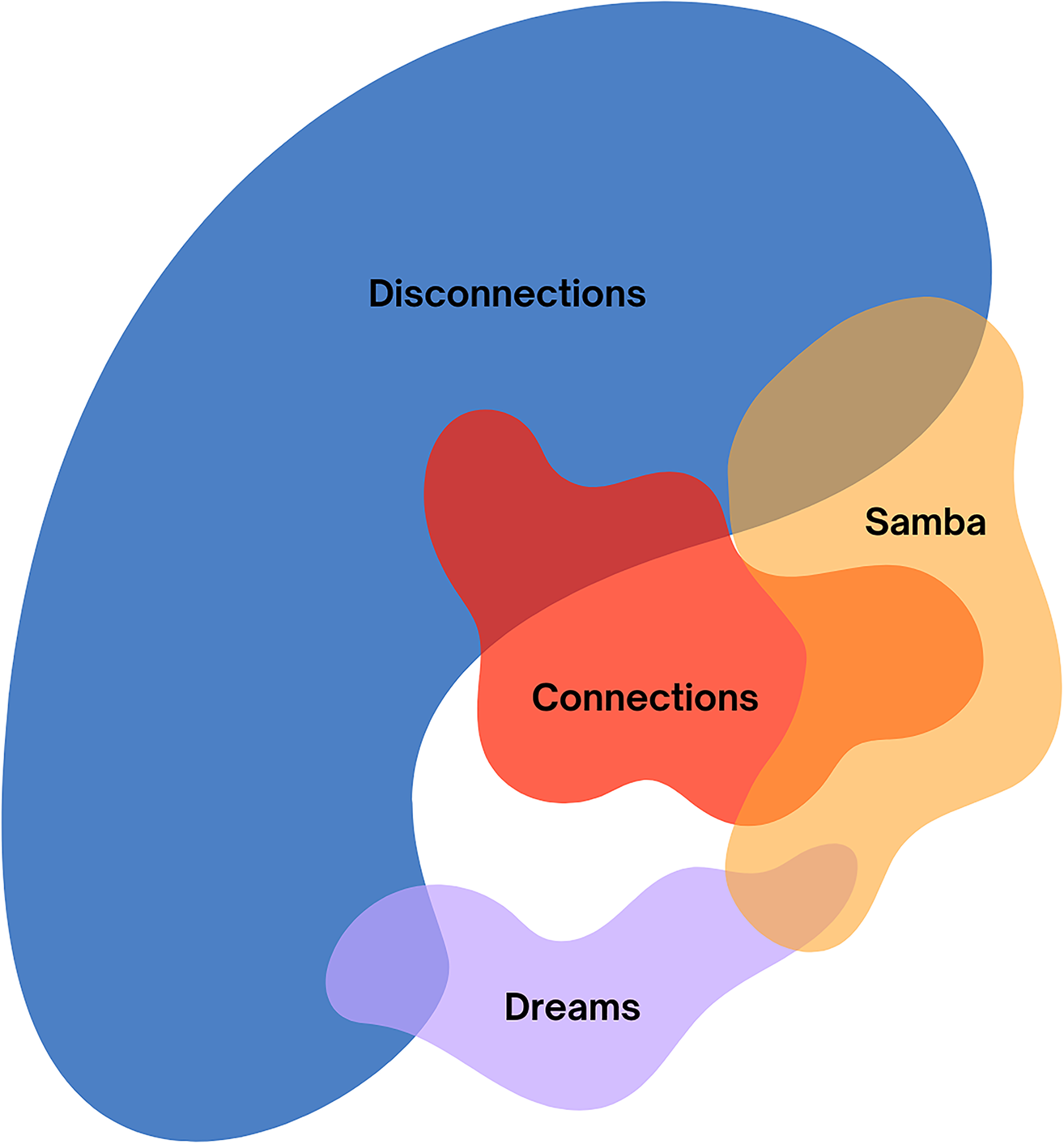
The intersections among the theme categories.

The songs sorted into the categories.
The next methodological stage was to listen again to the songs in groups. This procedure led to a chronological finding: each of the theme categories referred to a specific time. The category disconnections, encompassing ‘longing for a lost love, separation, conflict, getting over a former partner, loneliness, disillusionment, disappointment, infidelity, apology for mistakes made’, is dedicated to love in the past; the category connections, gathering ‘realization of love, reconciliation, revive an old love, being together, materializing happiness in love’, approaches love in the present; the category dreams, addressing ‘idealization, projection of love, search for love, wishing for new love, hope for a future love’, refers to love in the future; while the category samba, dedicated to the elements of ‘composition, singing and listening to samba as cure, remedy and consolation for love, samba as ambience for love, samba as the subject of love, samba as a romantic partner’, constitutes the idea of a timeless love, unbound by restraints of time.
The centrality of time in Dona Ivone Lara's songs, which emerged spontaneously in our theme categories, has also been previously identified by Marcelo Rangel (2015). According to the author, Lara's poetry promotes a re-enchantment of the world through time, an agent of transformation which allows for someone to move on from relationships while also being responsible for them ending. Rangel draws attention to the tragic and melancholic character of Lara's work, arguing, however, it does not bring a pessimistic perspective on life, since it also brings joyful and peaceful times (Rangel, 2015: 115).
Our results are similar to Rangel's (2015) in terms of Lara's main themes: dreams, melancholy, transiency, the impossibility of eternal love, samba as a source of joy in a hard life. However, our analysis differs from the author's in two points: 1) the songs analyzed, since he explores a set of six songs while we study a larger corpus of 55 songs, which provides us a broader panorama; 2) the articulation of time, since the author emphasizes the transient nature of life and the differentiation between past and present (Rangel, 2015: 120), while we seek to listen for the crossings and intersections between the time categories, which include not only past and present, but also future and timelessness/eternity.
The songs located in the category samba made intersections with all the other categories. The connection with the music genre goes beyond the romantic and sexual relationship themselves, emerging as an abstraction of love, manifested in the actions of creation, performance and listening to it, as well as the surrounding sociabilities that constitute this cultural form. The songs in this category interweave the love relationships with samba in distinct levels: the actions of composition, singing and listening to samba as pathways for cure and consolation for the pains caused by love; samba as the foundation of ambience and structuring of meanings for the relationship itself; and the constitution of samba as the very subject of love and its materialization as a romantic partner. Considering the permanent and long-lasting statute of Dona Ivone Lara's relation with samba, this category cuts across all the others — surviving the broken relationships with other people in the past, strengthening and attributing new meaning to the realization of love in the present, and grounding the search for new love in the future.
In parallel, the category disconnections also present intersections with all the others, showing how the pain and disappointment of broken loves can make an impact in the present, shaping the expectations for future loves and reconfiguring the idea of love as an abstract entity. Meanwhile, the songs located in the categories connections (love in the present) and dreams (love in the future) do not make intersections between each other, showing, thus, the absence of a link between love in present and future times. What is the reason for this void between present and future? By observing the classification of the songs throughout the categories, it stands out that the group of broken and lost loves constitute the predominant theme: disconnections comprise 47 songs, connections frame 16 units, dreams gather 8 units, and samba encloses 15 tracks.
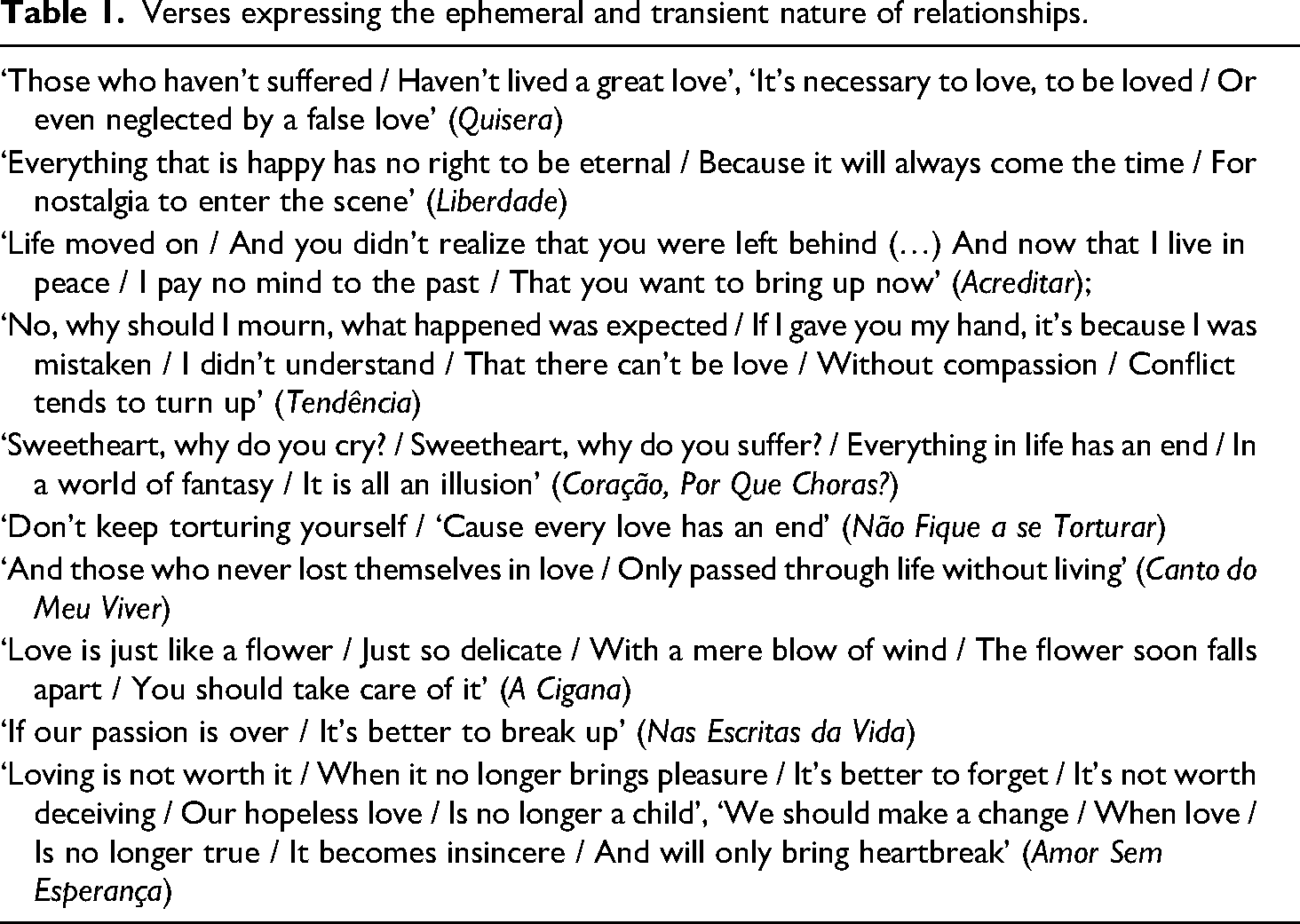
The absence of nexus between the categories that express love in the present and love in the future, aligned with the predominance of songs about broken hearts and ruptures, suggest that there is no expectation, for this Black female composer, for the love in the present to persist in the future: instead, the expectation is for this love to fatally come to an end. That the character of the romantic and sexual relationship as inherently ephemeral and transient is materialized in many excerpts of the songs, such as the verses 7 listed in Table 1.
Verses expressing the ephemeral and transient nature of relationships.
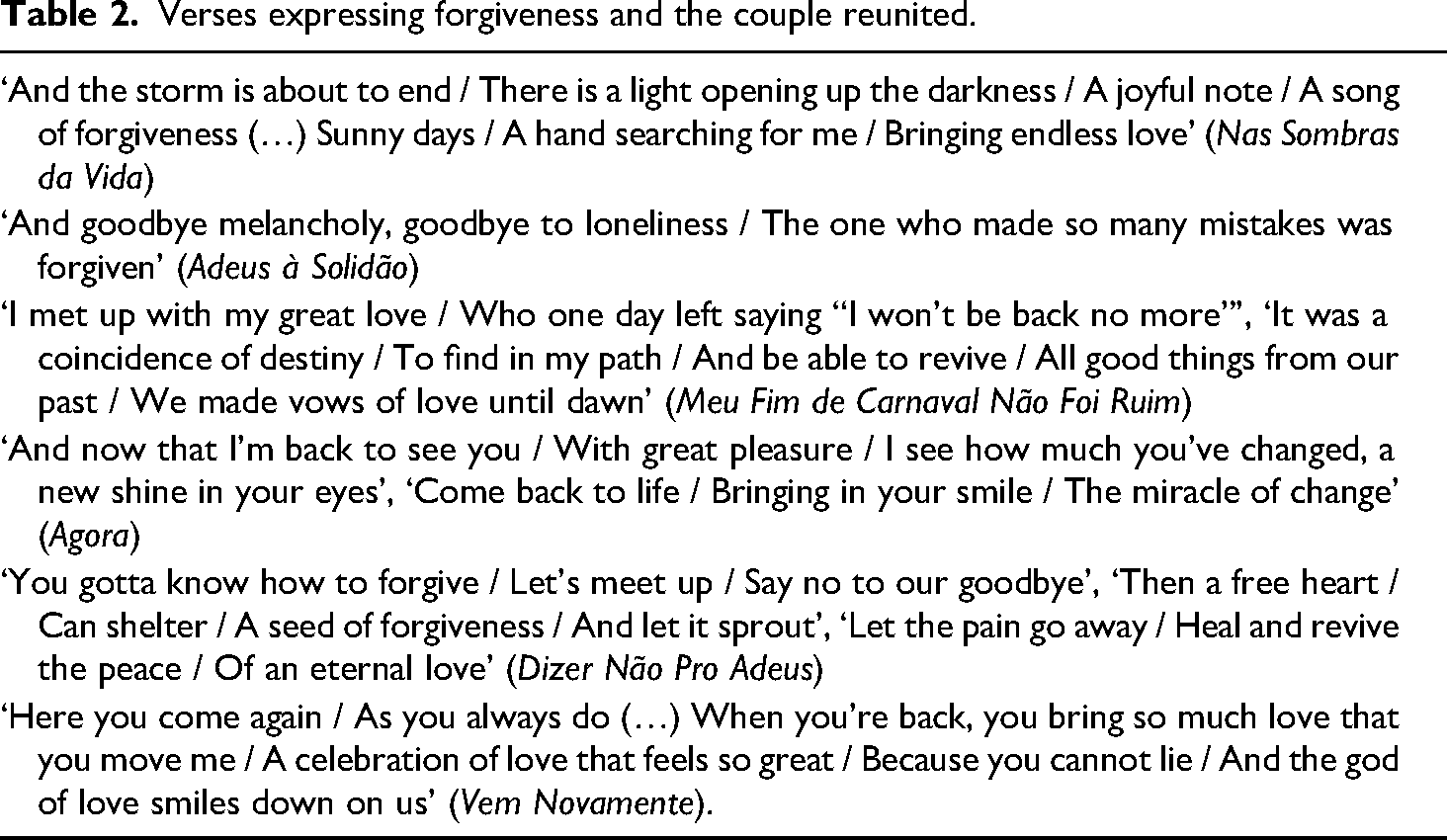
Some of those lost loves were later forgiven and rekindled, leading to happy reunions, as shown by the excerpts in Table 2.
Verses expressing forgiveness and the couple reunited.
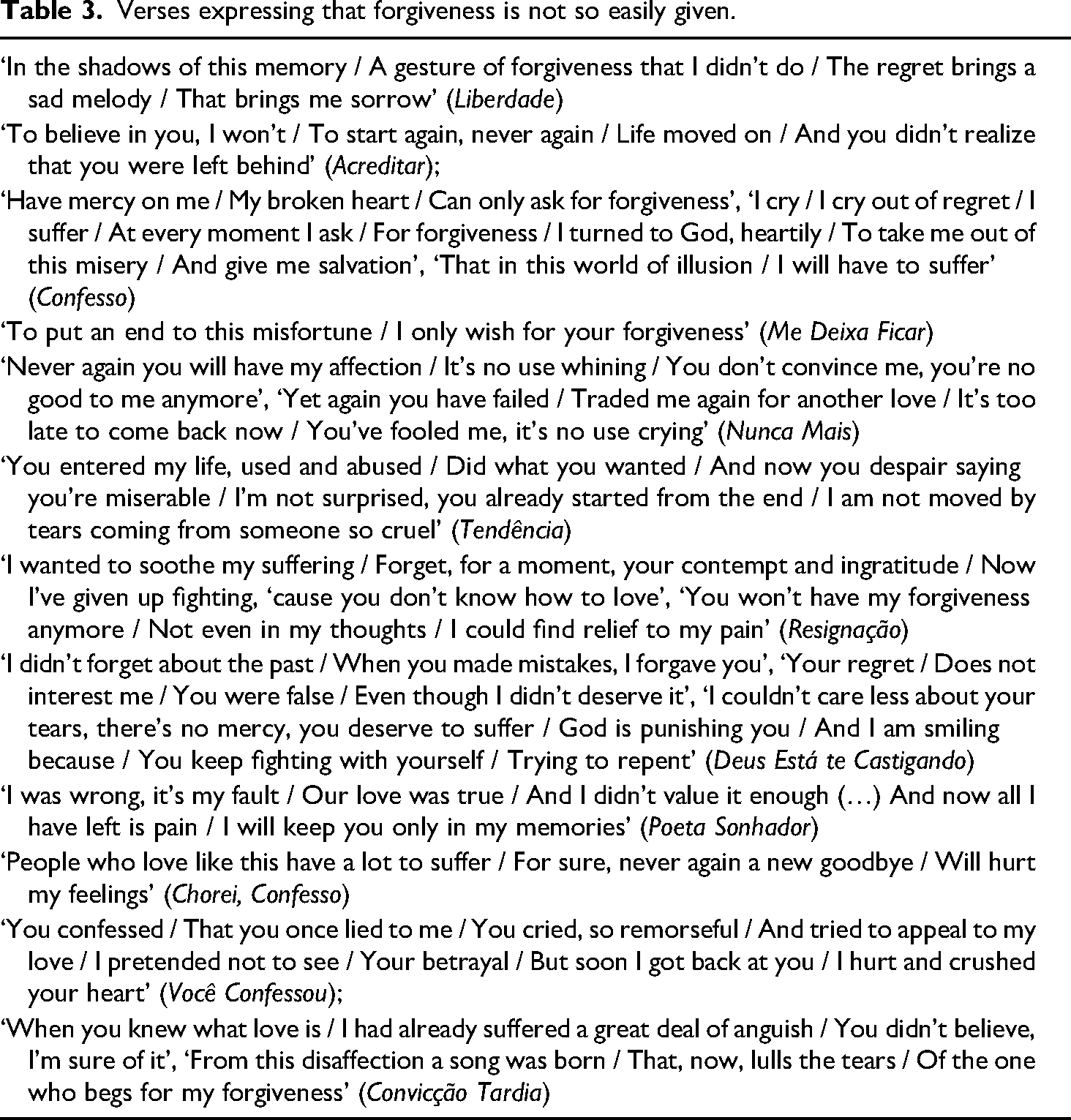
However, reconciliation to revive a lost love through forgiveness is not the predominant practice, considering forgiveness is not so easily given — both when the lyrical subject is in the position of granting it or begging for it. This aspect becomes evident, for example, in the verses listed in Table 3.
Verses expressing that forgiveness is not so easily given.
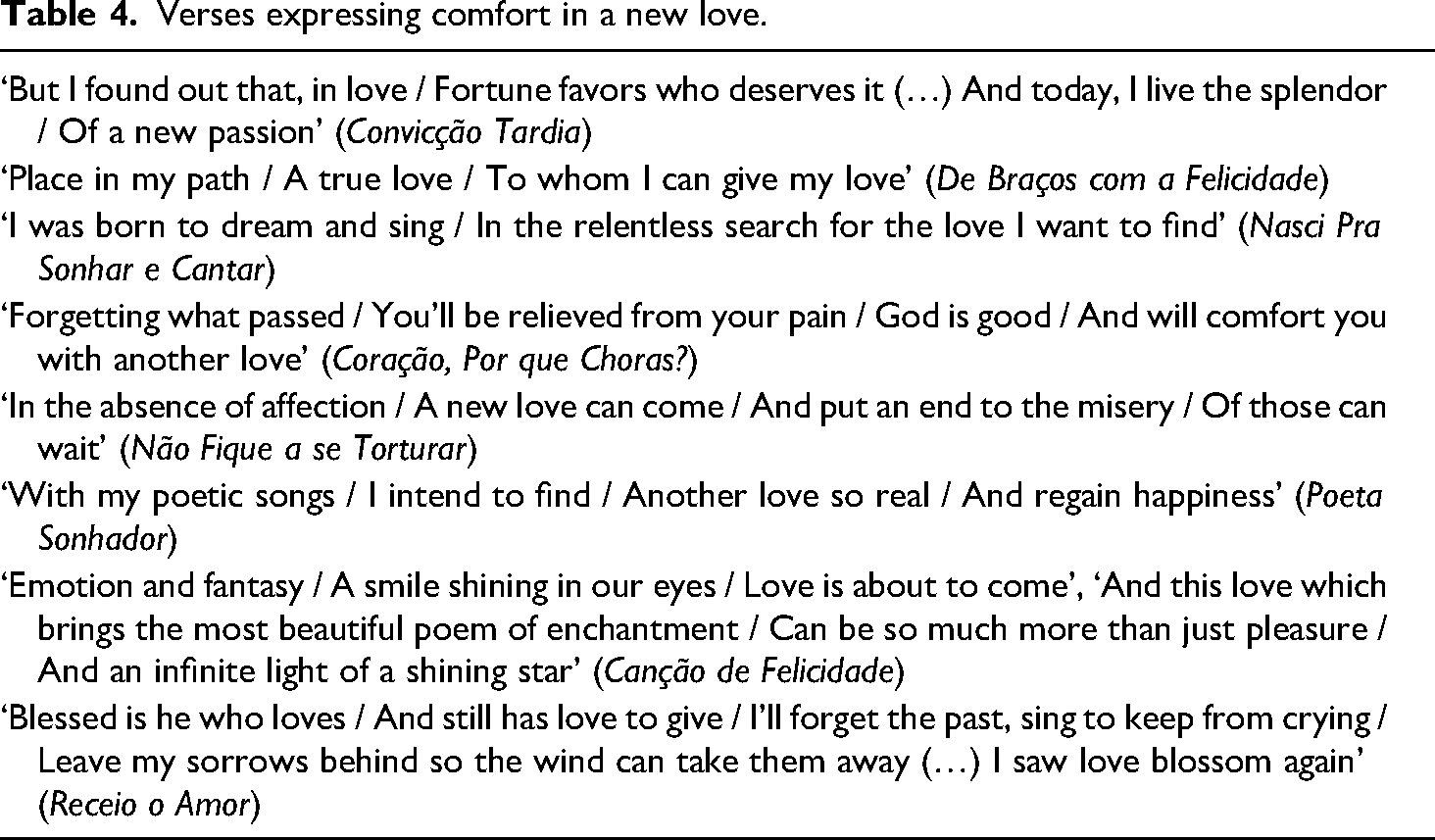
Another possibility, that appears more often than reviving a lost love, is finding comfort in a new one and, especially, in the creative action of making samba, as shown by the two sets of verses gathered and differentiated in Tables 4 and 5.
Verses expressing comfort in a new love.
Verses expressing comfort in making samba.
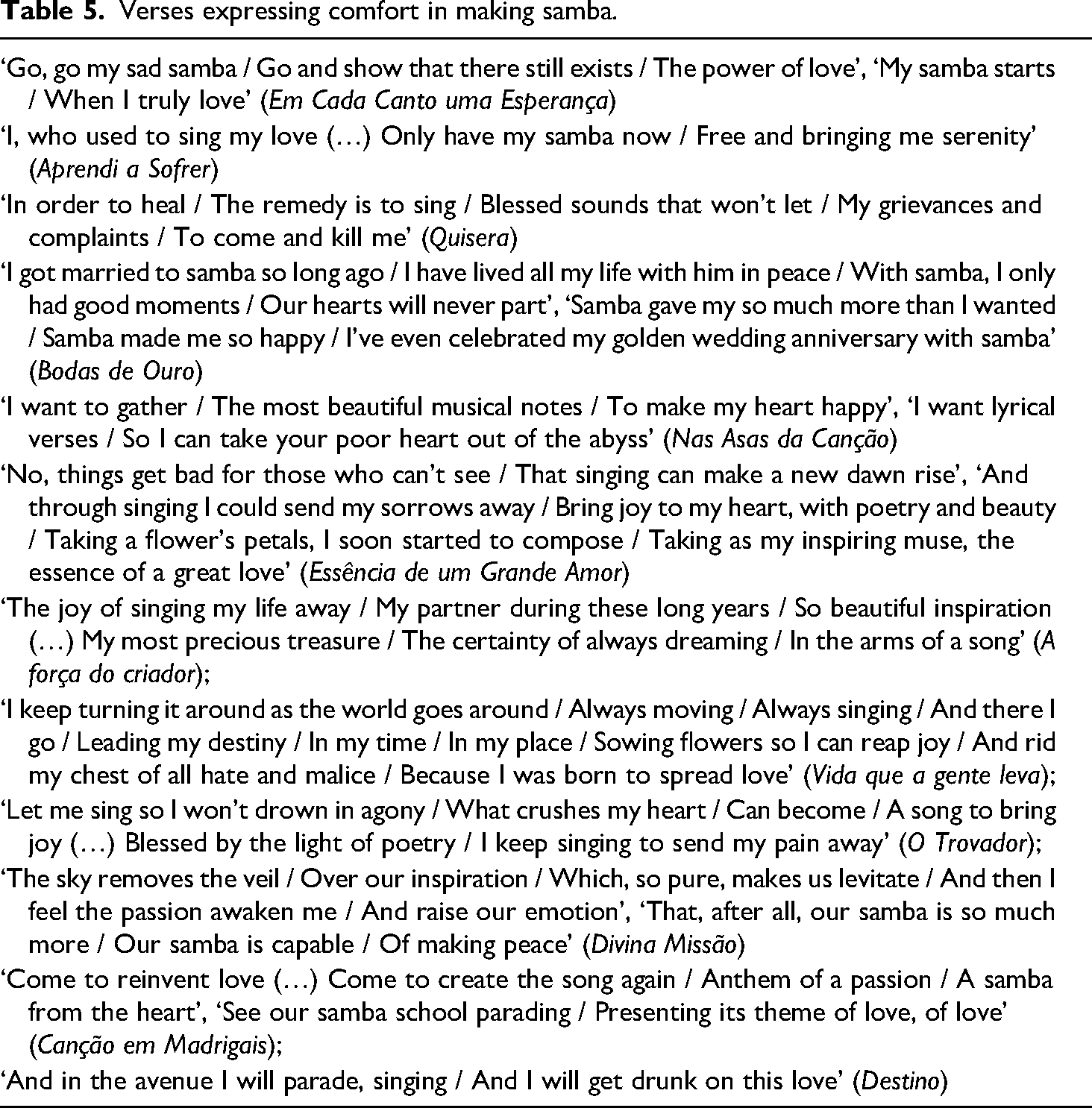
The selection of verses presented in the tables outline some of the core ideas in the concept of love constructed by Dona Ivone Lara: love in the present is disconnected from the one in the future because the current love is not to last forever, but, instead, will lead to disenchantment and give way to a new love and start all over again; considering that, according to the author, the only love that is eternal and capable of surviving the storms is the love of/in/for/with samba itself. This scenario constitutes, then, a concept of love that links itself to romantic and sexual partners in a cyclical, ever-moving way — a circular relation set in motion through the desire for and realization of love, passing through deception, disillusionment, and loneliness, moving forward to dreaming, projecting, and searching for new love.
In bell hooks’ work on love (2001), she emphasizes generosity, discipline, and devotion as necessary qualities for the practice of love, describing the disposition for self-improvement as fundamental in a healthy relationship. She highlights that the challenge of dealing with pain, conflict, and disappointment can lead people to easily give up on their relationships, instead of communicating with their partners and reaffirming mutuality. According to hooks, since people fear getting trapped in a romantic relationship which is not working, they tend to flee when conflicts arise and, because of this, they are unable to experience the fullness of love.
In Dona Ivone Lara's songs, she affirms the pleasure of being in love, but the importance of commitment does not stand as an absolute value: in many cases, she argues for ending the relationship when some fundamental conditions are not met by both parties. Such conditions are described in the verses as showing respect, care, and appreciation, and, most importantly, through the notion of knowing how to love. In this sense, the concept of love presented in her songs is in harmony with hooks’ belief concerning their defense of commitment and dedication to the relationship, but not at all costs, emphasizing there is a limit to such commitment. When there is no mutuality, hooks (2001) describes the labor of love as futile, affirming the decision of ending the relationship and moving on as a gesture of self-love.
In Dona Ivone Lara's songs, love is constituted as an entity which is not stuck, static, fixed, bound to one single person, but rather materializes in a constant cycle of many different loves, as a wheel in constant movement, defying the notion of ‘living happily ever after’. This successive cycle of relationships that start and end does not approach the separation as a mistake, but rather as its natural course. Moreover, the end is conceived as inevitable, and eternity, regarded as an impossibility in itself: ‘Everything that is happy has no right to be eternal’ (Liberdade), ‘Sweetheart, why do you suffer? / Everything in life has an end’ (Coração, Por Que Choras?), ‘Don’t keep torturing yourself / ‘Cause every love has an end’ (Não Fique a se Torturar).
As shown above, a state that echoes in many of Dona Ivone Lara's songs is loneliness, suffering for love, through the recurring narration of relationships painfully coming to an end—accompanied, sometimes, by a feeling of hope for a new love to come. Moreover, there is even a resignation to the fact that those relationships cannot last long and are destined to end in tears and disillusionment.
Discussion: Banzo, cycles of love and the reinvention of samba
The notion of Black women's loneliness, commonly discussed in Black social movements, academic and activist circles in Brazil, is closely intertwined with the knowledge of the colonial system and slave trade as historical processes that attempted to rupture and succeeded in damaging our connection to our ancestors’ African cultures. As the sociologist Caroline Borges (2019) points out, Black women's loneliness is merely the tip of the iceberg to critically reflect upon the banzo experienced by the Black diaspora. As stated by Chirly dos Santos-Stubbe (1989), the word banzo originates from the Kimbundu term ‘mbanza’, meaning ‘aldeia’ (village) in Portuguese. In this sense, Santos-Stubbe takes banzo as an African-Brazilian sense of nostalgia, felt by enslaved African people in Brazil who missed their own village and culture to the extent of falling ill and even dying. In her study, the author emphasizes the cruel conditions during the Atlantic journey, the violent physical punishment techniques, as well as the separation of family members and people from the same ethnicity as they were sent to colonial settlements to prevent organized revolts and escapes. In this context, Santos-Stubbe (1989) positions banzo as a feeling of nostalgia resulting from both the uprooting from African culture and the violence of slavery, in which Black people could lose their sense of identity, leading to psychic collapse.
Caroline Borges (2019) discusses banzo in terms of a deep, strong melancholy imposed on Black people that often leads to death, self-negligence, self-harm, and suicide, highlighting that, although originated in the context of slavery, banzo has been updated through everyday racism and oppression against Black communities. In the interviews conducted during her research on Black women's relationships, Bruna Pereira (2020) identifies the strong presence of banzo, which she describes as an ill feeling resulting from the shared experience of racism and a sort of melancholy originating from the humiliation and impotence felt while being the target of racist violence. Referring specifically to the context of love and sexual relationships, she defines banzo as a ‘sadness derived from the perception of how racism profoundly impacts their affections’ (Pereira, 2020: 201).
Banzo, both historically and currently, is the outcome of racist violence and oppression on Black people's well-being, and sense of belonging to society. That includes mental health, but is not limited to it, because it also concerns people's perspectives for the future, the ability to hope for better living conditions and a better place in the world both individually and collectively. Therefore, Black women's loneliness must be understood in terms of another facet of violence and fragmentation of Black people in diaspora, one that weakens, devalues and denies our right to establish healthy romantic connections and stable family ties. Lara defines herself as being married to samba, samba emerges as even more than a romantic partner: it shows its character as a cultural form of sociability for reconnection, reconstruction of social and familial ties in Black communities.
Banzo is a feeling—and a concept—rooted in Brazil, i.e., in the South Black Atlantic (Guimarães Corrêa, 2024; Henson, 2021), but it can also be seen in places and societies with a colonial past. Looking at two different diasporic contexts, there is a connection and a similarity between banzo and the expression feeling blue, meaning a type of deep sadness that can even affect someone's physical health. Going further in this link, we can make a parallel between the blues, probably the most poignant music made by African American people in the United States, and samba, which also approaches sadness, knowledge and resistance, by African Brazilian people (Furtado, 2023b). Patricia Hill Collins (2000), in dialogue with Angela Davis (1998), states that ‘the music of working-class Black women blues singers of the 1920s and 1930s is often seen as one important site outside academia for this intellectual tradition’ (Collins, 2000: 15–16). Although samba might sound lively and cheerful for those not familiar with the lyrics’ meaning, they are often melancholic or written as an effort to lift people up from their sorrows: as stated by Brazilian singer Teresa Cristina (2020), ‘Samba has such strength because it does not originate from joy, but rather from adversity. We make samba over our tears. There are many samba lyrics which, without their drumming, are pieces of poetry as beautiful as they are sad.’ So, samba, as well as blues, reflected the sorrow, loneliness, and desolation in the diaspora in both countries, but they have also been sung as an expression of freedom, joy and collective sociability; in short, of resistance.
In Lara's songs, romantic instability and solitude is not an obstacle for believing in love as an abstract entity: in the concept of love built in Dona Ivone Lara's work, although love is treated as a perennial and singular entity, it binds itself to plural subjects, in a cycle. Love emerges as venom and antidote: sometimes in an individually self-referential way, but not necessarily anchored to one single person, subject of that love, being able to materialize in a new love that acts as the cure to the lost love. In this context, just as the past love can only be healed by a new love, this one also will wear out, deteriorate, and disappoint, demanding to be healed by another love yet to come. Love is conceived as a cyclical notion, which is renewed and reinvented in constant motion.
This idea of love, aligned with the approach to samba as a romantic partner with whom she lives happily and celebrates a golden wedding anniversary, creates a dialogue with the resilient nature of samba itself through its changeable, renewable character — as a cultural form not only of singing and making music, but also of constituting oneself and interacting in community, which only survived due to its constant updating throughout its history, reinventing itself and continuously moving. As stated by Nei Lopes and Luiz Antônio Simas (2019), samba was only able to maintain its force and perpetuity due to its capacity to renew itself through appropriation and reinvention as a matrix genre of Brazilian music.
Dona Ivone Lara's poetical-musical intellectual work approaches love as a practice that needs to be recreated and renewed to live on, linking itself to people who are targeted by such affection and desire, but not in a stagnant, fixed and eternal way. Instead, the abstract entity of love can only live on to the extent it materializes through new subjects, new experiences, and new relationships. As stated in the verses ‘And those who never lost themselves in love / Only passed through life without living / By keeping forgotten, deep in their chest / This emotion that makes the world shake’ (Canto do Meu Viver), Lara's poetical-musical thought allow us to understand love as life's driving force, as that which keeps the cycle alive, which makes the wheel spin, which reconstructs social and familial ties.
By realizing all that, love also feeds the creation of samba, in relation to mutual strengthening and attribution of new meanings, with its mission of ‘Gaining people's voices / Backyards and ballrooms / And show, with its force / That, after all, our samba is so much more / Our samba is capable / Of making peace’ (Divina Missão). In these lyrics, the reconstruction of emotional ties does not start or limit itself only to their own broken heart, but rather strengthens Black collective cultural creation, echoing these lyrics so they can bring solace and hope to mend other broken hearts.
This context leads to the conclusion that samba is an important form of popular media (and mediation) in Brazil, due to its ability for reconstructing the ties that were severed by the experience of slavery in diaspora—which Simas (2020) defines as an experience marked by fragmentation, separation, and death, both symbolic and literal. As he asserts, since every diaspora involves dispersion, diasporic cultures tend to be directed toward reunion, cohesion, reconstruction of broken ties, reinvention of identities, reanimation of sociabilities and life.
Conclusion
In this article, we briefly presented the context of samba in Brazil and the outstanding trajectory of Dona Ivone Lara in the field. To analyze the songs she composed, many of them in co-authorships, we drew on previous research methodology, adding new procedures and layers to grasp the specificities of the lyrics. The categories showed us that the analysis demanded not only a conceptual-theoretical intersectional approach, but also an intersectional methodology, where the categories mingled and added complexity to the vast intellectual production of Dona Ivone Lara about love, sex and romantic relationships.
Lara's poetical-musical intellectual work alongside her co-authors is anchored to samba not only because of its identification with the music genre — not only for making self-referential sambas — but because it incorporates the actions of reflecting and singing about romantic and sexual relationships, epistemic properties of samba as a practice of constant reinvention and reconstruction of Black communities’ ties fragmented by the experience of misogynoir that taints Black women's lives in diaspora.
Moreover, the method we developed for analyzing the concept of love in Lara's songs made it possible to deal with her wider body of work as an intellectual production, tracing the connections between her perspective and Black feminist thought developed by American and Brazilian authors. We hope this article can strengthen the study of Black music in cultural studies, of concepts from the Global South (Guimarães Corrêa, 2024) and other related fields, through our effort to bring forth Black epistemologies within Afrodiasporic music to throw light on the connections between different points of the diaspora, as well as to emphasize the intersections of race, gender and sexuality deeply rooted in our experiences and intellectual endeavors.
Footnotes
Funding
This study was financed in part by the Coordenação de Aperfeiçoamento de Pessoal de Nível Superior – Brasil (CAPES) and by the National Council for Scientific and Technological Development (CNPq).

Notes
Author biographies
Lucianna Furtado, PhD in Communications from Federal University of Minas Gerais, Brazil. Lucianna is a member of Coragem (Research Group on Communication, Race and Gender) and currently studies Black feminist thought, intersectionality, music, and popular culture. Email: lucianna.furtado@gmail.com
Laura Guimarães Corrêa, Associate Professor – Social Communications Department at Federal University of Minas Gerais, Brazil. Laura co-leads Coragem (Research Group on Communication, Race and Gender) and is a board member of Ciseco (International Association of Semiotics and Communication). Email: guimaraes.laura@gmail.com